Home Blog Page 392

Dear Abby: Gay brother would have to be a saint to forgive sibling who deemed him ‘disgusting’ – OregonLive

DEAR ABBY: I am a senior male. I understand I may have some beliefs that others find old-fashioned. However, I consciously try to be tolerant of others’ feelings and beliefs. That said, my problem is with my younger brother, who is a homosexual. I have always tried to ignore that side of his life and, consequently, we have always had a good relationship. He lives in another state, so we only talk on the telephone.

A couple of months ago while we were talking, the subject of sexuality came up, and I told him I find the fact that he is gay “disgusting.” I know it was a poor choice of words. I merely meant to say that I, myself, am and always have been totally heterosexual. I have never had any sexual interest in members of my own sex. I never meant my comment to be judgmental of my brother or anyone else.

I left several messages apologizing for anything I said that he found objectionable. Now, when I try to contact him, he doesn’t answer my phone calls.

Abby, I miss my brother. I truly love him, and I don’t want to lose all contact with him. If you have any advice for me, please give it to me. I’m desperate and can think of nothing I might be able to do to restore our relationship. Please help me. — FEELS LIKE A FOOL IN WASHINGTON

DEAR FEELS LIKE: I have never understood why so many straight people spend so much time obsessing about what gay people might be doing behind closed doors. THAT, to me, is disgusting.

I’ll be frank. After what you said to your brother, he would have to be a saint to forgive you. He is doing what emotionally healthy people do, erasing a negative influence from his life. You can continue trying to apologize by penning a heartfelt letter of apology and remorse, promising to never use those words again, and sending it to your brother. But if he continues to be unreceptive, you will have to live with it.

DEAR ABBY: I met a man online seven months ago. We hit it off right away. I checked to make sure he wasn’t a “catfisher” and everything checked out. We talk on the phone at least twice a day, Facebook Messenger and video chat. He sent me a card for my birthday along with some money.

I have developed strong feelings for him, and he has told me he loves me. He has told me many times he wants to meet, but we couldn’t do it because of the pandemic. He’s a jewelry designer trying to get his business back up before he loses it. He’s afraid to lose everything.

I don’t know what to do. Should I keep waiting or just stay friends with him? We really care about each other, but circumstances prevent us from meeting. — BROKENHEARTED IN NEW YORK

DEAR BROKENHEARTED: Because “circumstances” prevent you from meeting this man in person, try HARD to regain your balance and stay friends. Although you think you know him, until you finally meet in person, you really don’t. Even if you confirmed he works in jewelry design, he may still be hiding something from you. Often when a significant other keeps making excuses not to meet, there’s a good reason for it and not always what you want to hear.

Dear Abby is written by Abigail Van Buren, also known as Jeanne Phillips, and was founded by her mother, Pauline Phillips. Contact Dear Abby at www.DearAbby.com or P.O. Box 69440, Los Angeles, CA 90069.

San Francisco supervisors back leather district sidewalk markers – Bay Area Reporter, America’s highest circulation LGBT newspaper

0

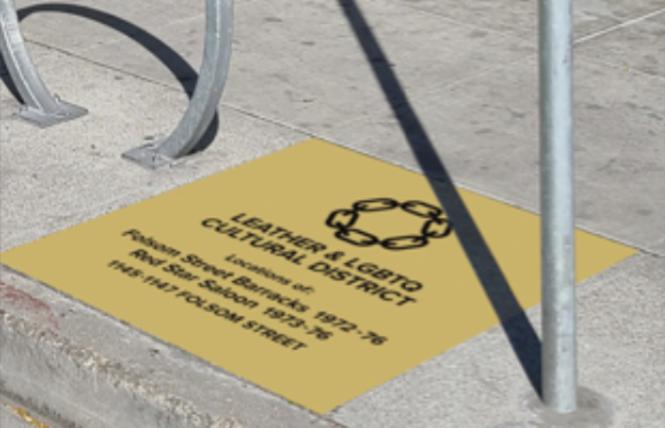
A plan to commemorate 50 locations tied to San Francisco’s leather and LGBTQ culture with sidewalk markers has been endorsed by the Board of Supervisors and will file for civic design review this week. The resolution in support was taken up on an expedited process this week due to pending deadlines and a streetscape improvement project underway that could incorporate the installation of the plaques.

As the Bay Area Reporter first reported in September, the Leather & LGBTQ Cultural District has proposed recognizing current and former businesses in the area by placing bronze plaques in the sidewalk near where they operated or currently are located. Such storied establishments as the Folsom Street Barracks, The Arena, Ramrod, The Brig, and the Club Baths of San Francisco would be memorialized with historical markers.

Plaques would also be installed in front of existing businesses such as the SF Eagle, which now fronts the new Eagle Plaza public parklet honoring the leather community built out of a portion of 12th Street at Harrison, and The End Up nightclub at the corner of Sixth and Harrison streets. One would also be located at the former home of the B.A.R at 395 Ninth Street. The weekly LGBTQ newspaper, celebrating its 50th anniversary this year, called the location home from December 1988 until October 2013.

Leather district leaders plan to file by Friday, April 9, to have the city’s arts commission review the designs for the plaques now that the supervisors voted 11-0 at their April 6 meeting to back the project. Gay District 8 Supervisor Rafael Mandelman asked to be added as a co-sponsor.

The district will also be seeking an estimated $120,000 to pay for the plaques from the community impact fees the developer L37 Partners will be required to pay for its 244-rental unit housing development in SOMA. The city’s planning commission recently approved the project to be built at Folsom and 11th streets adjacent to the gay nightclub Oasis.

“Each one of these steps will determine whether it goes ahead and whether we can get the money or not,” Robert Goldfarb, chair of the leather district’s board, told the B.A.R. prior to the supervisors’ meeting.

The approval processes will take anywhere from nine to 18 months, said Goldfarb. The leather district has been in close talks with the city’s Public Works Department and the office of District 6 Supervisor Matt Haney, who represents SOMA, about incorporating some of the plaques into Folsom Street’s sidewalks as part of the pedestrian safety improvements for one of the main corridors through the area. Its timeline for completion was delayed due to the COVID pandemic.

“I have been in discussion with DPW about the Folsom Street project for approximately two and half years. They are finalizing the drawings and the plans at the moment,” said Goldfarb. “My understanding is they are going to start groundbreaking in the fall, so maybe October or November. The plaques would be part of that, but it is not entirely clear where we would fall in the project timeline.”

Folsom Street at one point was known as the city’s “Miracle Mile” due to the many gay bars and bathhouses that operated on or near it in the 1960s and 1970s. But the onset of the AIDS epidemic in the 1980s soon would diminish SOMA’s leather scene. The health crisis resulted in most gay bathhouses and sex clubs in the area closing their doors.

By the 1990s, gentrification of the neighborhood began to push out the remaining gay bars, with only a handful left in business today. Further development in the area over the last two decades led community and city leaders to officially recognize a portion of western SOMA as an LGBTQ neighborhood in hopes of preserving it.

A number of historic SOMA leather businesses have already been memorialized on stone plinths in the San Francisco South of Market Leather History Alley. Dedicated four years ago, the side street project spans Ringold Alley between Eighth and Ninth streets and sports bronze bootprints embedded in the sidewalk honoring various leather community leaders, some of whom owned the remembered businesses.

The SOMA LGBTQ plaque project is similar to one undertaken several years ago by the Top of Broadway Community Benefit District in the city’s North Beach neighborhood. It has installed sidewalk markers at the site of historic businesses in the city’s Italian district, including a trio of LGBTQ nightlife spots shuttered decades ago.

With businesses in the leather district devastated by the COVID pandemic, which shuttered bars and nightclubs for much of the past year, boosters of the sidewalk plaques proposal hope it will bring in an influx of visitors to the area who will support the establishments as they begin to reopen their doors due to the health crisis ebbing. LGBTQ and leather tourism has been near nonexistent over the last 12 months with the outbreak severely limiting travel and canceling the in-person parties and street fairs that catered to the fetish scene.

“This is not only appropriate from a historical perspective but of tremendous interest to tourist visitors. It will drive visitors and helps not only our culture but our economy,” said Race Bannon, the B.A.R.’s former leather columnist who is active in the SOMA leather scene and community, told the supervisors’ land use and transportation committee Monday, April 5.

There has long been interest in learning about the various leather and LGBTQ establishments in SOMA. The late college professor Eric Rofes, a gay man who studied the city’s gay male culture, led popular walking tours of the neighborhood in 2005, believed to be the first such walks down SOMA’s leather memory lane.

Over the ensuing years others have created their own history walking tours and site-specific performance pieces honoring SOMA’s queer past. Once installed, the sidewalk markers will allow people to take their own journey through the neighborhood’s history.

In conjunction with the leather district plaques will be self-guided walking tours the cultural district plans to host on its website. There will be audio components in addition to write-ups about the various locations, according to Goldfarb.

As David Hyman, who is also involved with the SOMA leather district, noted during the land use committee hearing, “Many visitors who come for Leather Week and other special events ask about these places. They are not forgotten, but in most cases, they are invisible.”

A full list of the 50 SOMA locations where plaques are planned can be found in the supervisors’ resolution posted here.

Help keep the Bay Area Reporter going in these tough times. To support local, independent, LGBTQ journalism, consider becoming a BAR member.

New research documents the severity of LGBTQA+ conversion practices — and why faith matters in recovery – The Conversation AU

New research reveals the harms of religion-based LGBTQA+ conversion practices are more severe than previously thought. People who have been harmed by attempts to change or suppress their sexuality or gender identity are often left with chronic, complex trauma and face a long journey of recovery.

This is also believed to be the first study anywhere in the world to include mental health practitioners and consider the effects of a wider range of conversion practices beyond formal “therapies”.

It’s been a long time since Australian and international health authorities regarded LGBTQA+ identities as mental illness needing a “cure”.

Yet, at least one in ten LGBTQA+ Australians is still vulnerable to religion-based pressures to attempt to change or suppress their sexuality or gender identity. Such conversion practices have been reported in communities of almost all religious and cultural backgrounds.

This is why Australian states are gradually moving towards banning the practice. In February, Victoria passed a comprehensive law that would prohibit LGBTQA+ conversion practices in both healthcare and religious settings.

Other state laws are not going far enough. Last year, Queensland passed a narrowly focused law that prohibited health service providers from performing so-called conversion therapy.

However, research has shown formal “therapies” with registered health practitioners are only a small part of the harmful conversion practices experienced by LGBTQA+ people in Australia, and elsewhere.

What conversion practices include

Such conversion practices can include formal programs or therapies in both religious and healthcare environments. However, they more often involve informal processes, including pastoral care, interactions with religious or community leaders, and spiritual or cultural rituals.

In all of these practices, LGBTQA+ people are told they are “broken”, “unacceptable” to God(s) and need to change or suppress their identities in order to be accepted.


Read more: ‘Treatments’ as torture: gay conversion therapy’s deep roots in Australia


Many LGBTQA+ people live in fear of the spiritual, emotional and social consequences of not being able to “heal” or “fix” themselves, which may include loss of faith, family and community.

Research to date has proven that conversion practices are ineffective and unethical. These practices do not reorient a person’s sexuality or gender identity.

Further, they are in breach of professional medical ethics.

How conversion therapies affect people

Until now, however, we have had only a limited understanding of the harms of conversion practices on LGBTQA+ people and what survivors need to recover and heal from these programs.

In research conducted in 2016 and 2020, we interviewed 35 survivors of conversion practices and 18 mental health practitioners. Our study had a significantly more diverse cohort of survivor participants than previous studies, including people from cultural and gender minority groups.

We found the harms experienced by survivors of both formal and informal conversion practices can be severe. Health practitioners described it as “chronic trauma” or a “complex trauma experience”, with survivors having “the symptoms of PTSD [post-traumatic stress disorder]”.

Many survivors described struggling with suicidal thoughts, major mental health issues, grief and loss, self-hatred and shame. As one cisgender gay man, aged 40, recalled:

I nearly had a breakdown trying to keep repressing my sexuality […] I was very, very mentally unwell for a significant time […] I had been spiritually abused.

One counsellor described the experience of conversion therapies as:

a life of being constantly bombarded with the message that you’re not right or that you’re broken or that you’re flawed. And it has all the hallmarks of someone who’s been to a war zone.

What type of support survivors need

After LGBTQA+ people undergo these types of conversion therapies, we found they have complex needs in recovery, dealing with such things as

  • grief, loss and religious trauma

  • improving self care

  • correcting misinformation about LGBTQA+ people and communities

  • repairing and rebuilding their social support and community networks

  • navigating their relationships with faith.

Professional mental health support is essential, participants explained. As one cisgender lesbian, age 50, told us,

if it hadn’t been for my ability to access really good quality, professional counselling, I would have killed myself several times over by now.

Why recovery must include discussions of faith

Unfortunately, the LGBTQA+ people in our study experienced numerous barriers to seeking and accessing mental health support, including:

  • not being able to afford it

  • mistrust of health professionals due to their experiences with conversion practices

  • reluctance to disclose their involvement in conversion practices because of shame

  • a lack of confidence in health practitioners’ ability to deal with trauma at the intersection of religion, culture, sexuality and/or gender identity.

Strikingly, both survivors and health practitioners reported a reluctance to raise faith and spirituality in their recovery therapy. For example, one psychologist reflected,

A lot of the time, we don’t ask about spirituality. They come in because they’ve got anxiety, depression. And we might ask […] about suicidality, we ask about substance use, but we need to take it further and ask about their spirituality

We ask about sex, which is really quite personal, and yet, a lot of time, I don’t know, we’re reluctant to ask about spirituality.

For some survivors of conversion practices, faith remains an important component of their lives. Shutterstock

Many survivors reported negative experiences in recovery of counsellors assuming that being LGBTQA+ and having religious faith were incompatible. One cisgender, 35-year-old gay man told us,

It’s like, ‘Oh, great, you’re out of that […] You don’t want any of that religious stuff. Let’s help you to be a balanced secular person’, rather than embracing the whole spectrum of faith and where you are.

And another transgender bisexual woman, aged 26, said,

My first psychiatrist […] tried to convince me that being religious was delusional. I never went back to see her.

Such comments unhelpfully reinforce the false messages that LGBTQA+ people are told in conversion practices — that being LGBTQA+ and having faith are incompatible.

All survivors needed help balancing the relationship between their LGBTQA+ identity and their faith, family and culture.

For some, healing did mean leaving faith. For others, it was finding a faith community that accepted their LGBTQA+ identity. And for others, it was about learning how to develop healthy boundaries that enabled them to navigate the different communities they belonged to.


Read more: Some Christian groups still promote ‘gay conversion therapy’ – but their influence is waning


How this research can help people

Our study has two main implications for supporting the recovery of people who have been harmed by LGBTQA+ conversion practices.

First, because our report details the severity and complexity of the trauma experienced by survivors, this can inform the very specific type of long-term care they will need in recovery.

Second, cultural and religious awareness are vital factors in supporting survivors’ healing and recovery. Most survivors struggle to find mental health practitioners who appreciate their continuing connections to culture, faith and spirituality.

We recommend more training for health practitioners to be able to support survivors’ recovery, including the integration of their spirituality and LGBTQA+ identity.


This research was conducted in partnership with the Brave Network, the Australian GLBTIQ Multicultural Council and the Victorian government.


If this article has raised issues for you or you’re concerned about someone you know, call Lifeline on 13 11 14.

As anti-gay MKs sworn in, activists fear ‘step backwards’ on LGBT rights – The Times of Israel

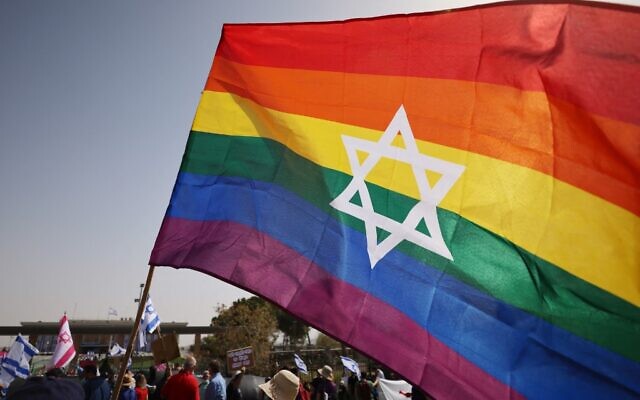
AFP — Hundreds of people demonstrated in Jerusalem on Tuesday against a group of newly elected Knesset members who oppose gay rights.

A coalition of groups marched and held signs outside the parliament, where 120 lawmakers were being sworn in following elections last month.

The protesters included groups supporting women’s and LGBT rights and others calling for Prime Minister Benjamin Netanyahu’s resignation.

Activists have raised particular concern about the far-right Religious Zionism party, which controls six seats.

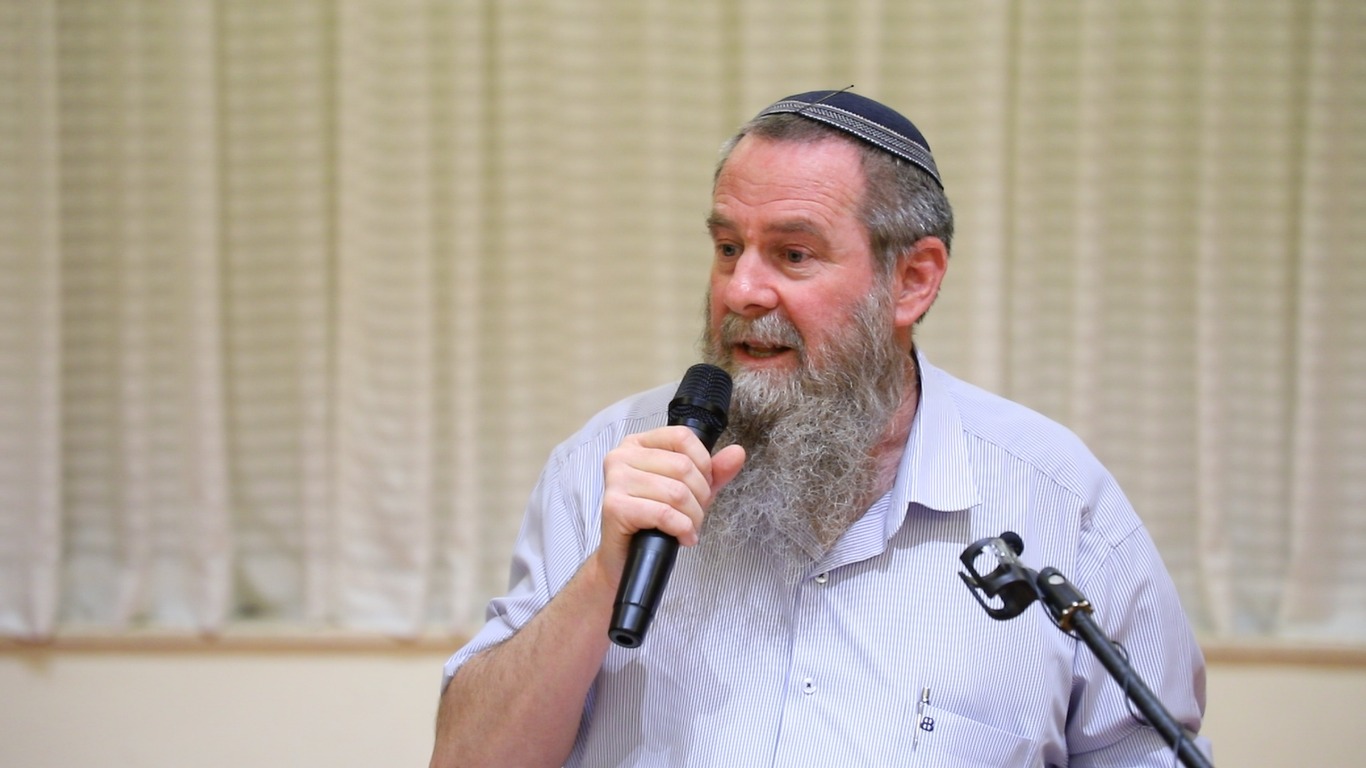
Noam party chairman Avi Maoz (Noam Party)

Within that group are three members openly hostile to LGBT rights, including Avi Maoz, leader of the Noam party.

Activist Or Keshet said Maoz had made demeaning homosexuality the centerpiece of his political career.

“Already during the 2019 elections, when it first appeared, Noam was targeting the LGBT community with humiliating slogans bordering on incitement to hatred,” Keshet told AFP ahead of Tuesday’s demonstration.

In a campaign clip from that election, Noam compared Reform Jews, left-wing activists and LGBT rights activists to Nazis and accused them of wanting to “destroy” the Jewish people.

Running with a slogan calling for “a normal people in our land,” Noam opposes the recognition of gay and lesbian couples with children as families.

Hundreds of people demonstrate during the swearing-in ceremony of the 24th Knesset against a group of newly elected MKs who oppose gay rights, April 6, 2021. (Emmanuel DUNAND/AFP)

Other MKs from the Religious Zionism alliance have also espoused anti-LGBT rhetoric, including Itamar Ben Gvir and leader Bezalel Smotrich, organizers of the 2006 “beast march” in Jerusalem, in which religious opponents of the Pride March strode with donkeys.

Religious Zionism has endorsed Netanyahu to form Israel’s next governing coalition.

President Reuven Rivlin on Tuesday assigned the premier a four-week mandate to do so.

Netanyahu also has the support of 16 lawmakers from the ultra-Orthodox Jewish Shas and United Torah Judaism parties, which openly oppose LGBT rights.

Prime Minister Benjamin Netanyahu (center), Interior Minister Aryeh Deri (right) and then-health minister Yaakov Litzman (left) attend a conference in Lod on November 20, 2016. (Kobi Gideon/GPO)

The Jewish state recognizes gay marriages performed abroad, but homosexuality remains a taboo in religious Jewish circles.

Activist Keshet said he feared “a step backward” on LGBT and women’s rights.

“We do not want these people to be part of the government and occupy key positions,” he said of the anti-gay lawmakers.

Activists have also expressed concern about a possible rising influence of the conservative Islamic Ra’am party led by Mansour Abbas.

The party controls four seats and Abbas could be a kingmaker in ongoing coalition talks.

In July last year, his party condemned a bill to ban some forms of the controversial practice of “conversion therapy,” which aims to change LGBT people’s sexual orientation and is widely considered a human rights violation.

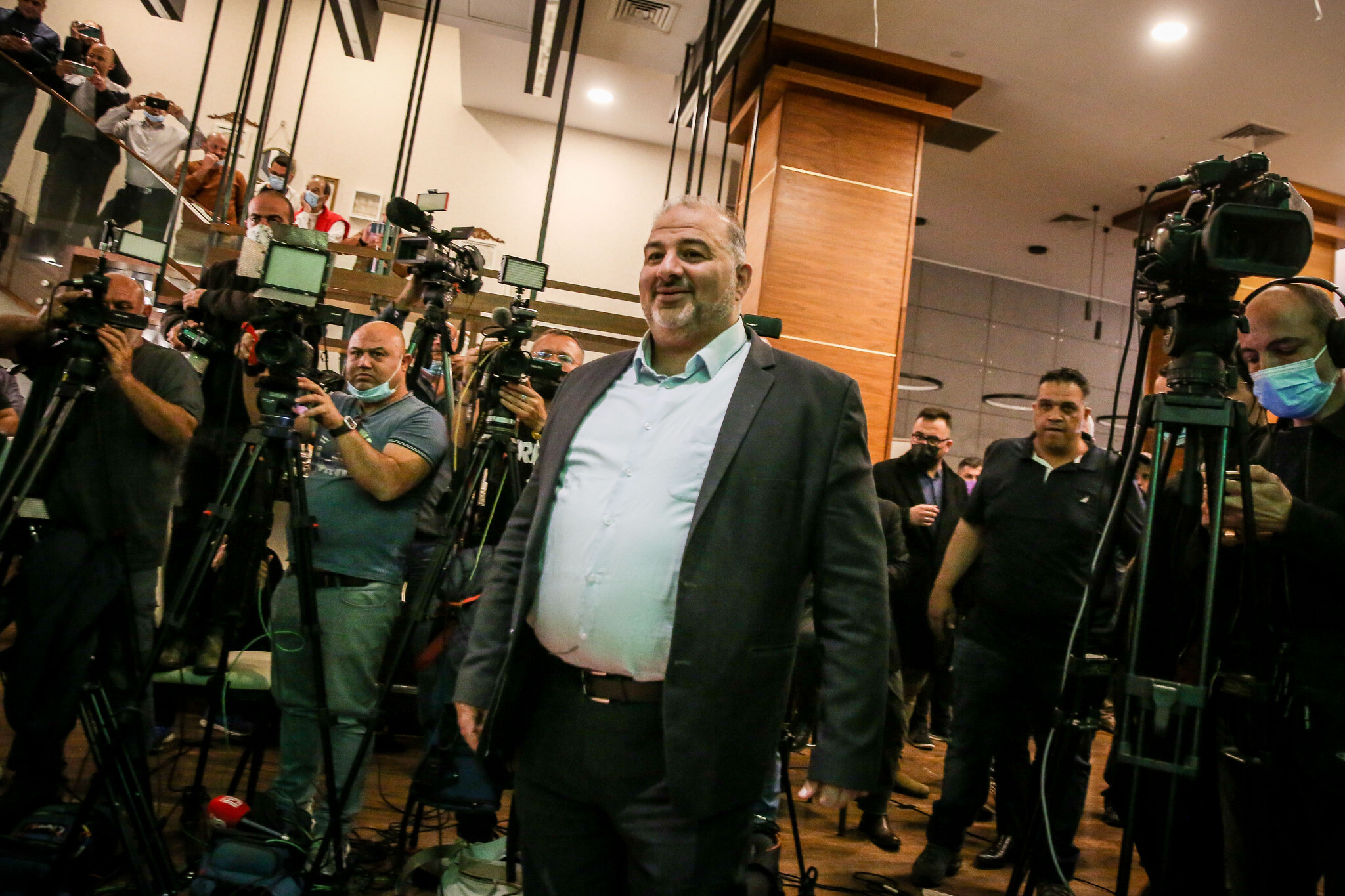
Ra’am party leader Mansour Abbas speaks during a press conference in Nazareth, April 1, 2021. (David Cohen/Flash90)

Such a law “spread obscenity and homosexuality” and was a “crime against religion and society,” the party said in a statement at the time.

According to Keshet, “the problem is that the Israeli political system gives a lot of power to small groups, regardless of their real weight in society.”

“We are worried about a scenario that would see the formation of a very conservative government, trapped between these groups” and dependent on them for its survival, he said.

Tennessee Senate OKs bill allowing opt-out of LGBT curriculum – wreg.com

TUNICA CO., Miss. — Tunica County officials are searching for a 17-year-old they say is responsible for a shooting at a motel.

Deputies responded to a report of a shooting at the America’s Best Value Inn in Robinsonville at around 1:40 p.m. Thursday afternoon. Officials have not released information regarding a victim’s condition.

Ad of the day: Orbitz encourages LGBTQ+ consumers to ‘travel as you are’ – The Drum

0

In anticipation of the post-pandemic travel boom, travel search giant Orbitz launched a new national campaign today encouraging LGBTQ+ consumers to travel as their authentic selves.

The campaign, “Travel As You Are” — concepted and executed by full-service creative agency Laundry Service — invites all people to travel on their own terms, not the ones society created for them. The campaign’s film features an all-LGBTQ+ cast and spotlights real couples, with well-known faces including model Ahmad Kanu, the Vietnamese-American photographer, actor and model Cameron Lee Phan and fashion blogger Rahquise Bowen. Behind the lens of the energized, bright film is LGBTQ+ director and photographer Cass Bird, who has worked with major fashion brands including Dior and Calvin Klein.

“Authentic representation in advertising is extremely important,” says Carey Malloy, director of brand marketing at Orbitz. “And the LGBTQ+ community is extremely diverse, so we really wanted to show members of the community traveling freely and being exactly who they are.”

The campaign’s theme song is a cover of Lesley Gore’s 1964 hit You Don’t Own Me by experimental Brooklyn-based gay musician Serpentwithfeet. The lyrics nod to the freedom and empowerment that Orbitz hopes LGBTQ+ travelers will feel when planning their next trip.

’Travel As You Are’, though decisively contemporary, also serves as a homage to Orbitz’s roots. Orbitz was the first major US travel brand to launch advertising campaigns featuring openly gay couples as well as drag personalities with its 2001 print ads supporting LGBTQ+ travelers to “see the world on your terms”.

The brand has a rich history of LGBTQ+ allyship; its advertising and marketing efforts have not only highlighted LGBTQ+ celebrities but have often commented on major social and political moments, including the 2015 decision to legalize gay marriage in all 50 states and the 50th anniversary of the Stonewall riots in 2019.

With ’Travel As You Are’, Orbitz reaffirms this allyship. “We wanted to revisit the values that the company was founded on and we also wanted to drive a deeper relationship with a smaller group of customers,” says Malloy. “We were the first travel company to launch a dedicated LGBTQ+ microsite – and that was way back in 2002. Today, almost 20 years later, we strongly believe in advocating for inclusion and diversity in travel.”

As the US population becomes inoculated against Covid-19, rates of travel are already on the rise. “We are really energized by the progress in distributing the Covid-19 vaccine,” Malloy says. “I think we’re definitely going to see a return to travel.” Orbitz hopes that as the world begins to open up to travel again, consumers of all identities and backgrounds will feel empowered to take on the world authentically and unapologetically.

For more, sign up for The Drum’s daily US email here.

Gov. Lee sidesteps whether anti-LGBT bills are discriminatory or hurts Tennessee businesses – WHNT News 19

0

Gov. Lee sidesteps whether anti-LGBT bills are discriminatory or hurts Tennessee businesses | WHNT.com


Senate OKs bill allowing opt-out of LGBT curriculum – WATE 6 On Your Side

0

Senate OKs bill allowing opt-out of LGBT curriculum | WATE 6 On Your Side


Commentary: Sports remain hostile territory for LGBTQ Americans – pressherald.com

For all of the gains LGBTQ people have made over the past few decades, sports remain a highly visible reminder that homophobia and transphobia persist.
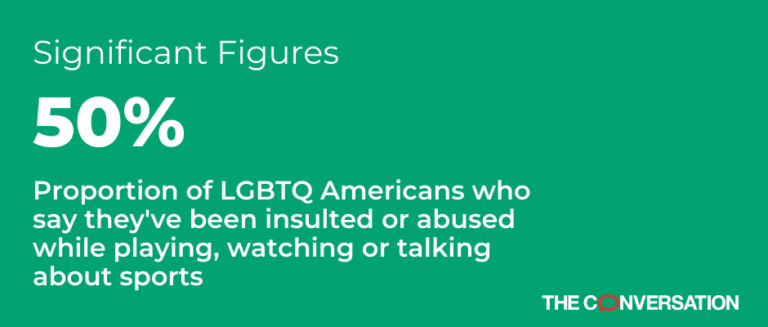
In recent years, more professional athletes, from U.S. women’s soccer team player Tierna Davidson to Olympic gymnast Danell Leyva, have come out of the closet. However, locker rooms remain less inclusive of LGBTQ people than places like schools or workplaces. And though many sports teams and figures have publicly campaigned against homophobia and transphobia, half of LGBTQ respondents in our recent study said that they’d experienced discrimination, insults, bullying or abuse while playing, watching or talking about sports.
Mistreatment doesn’t discriminate by age
For the study, we surveyed 4,000 U.S. adults and asked them whether they’d been mistreated in various sports-related contexts. We also asked them whether they believed LGBT athletes were unwelcome in sports.
We found that this sort of personal mistreatment – whether it’s bullying or insults – is a relatively common experience in sports: 36% of U.S. adults said they’d experienced some form of it. But LGBTQ adults were particularly likely to have fallen into this camp, with half of adults who identify as gay, lesbian, bisexual or another nonheterosexual identity responding that they were personally mistreated. About 60% of nonbinary adults in the survey said that they’d experienced sports-related mistreatment.
We also found that perceptions of homophobia and transphobia are common, and LGBTQ adults seem more attuned to them. While 30% of heterosexuals somewhat or strongly agreed that lesbian, gay, bisexual and transgender athletes are not welcomed in sports, 45% of adults who identified as a sexual minority did so. About 42% of nonbinary adults felt that these athletes aren’t welcomed in sports.
Given all of the recent cultural and political advancements for LGBTQ people, you might think younger LGBTQ adults would be less likely to disclose that they’d been insulted or abused while playing or watching sports.
But that wasn’t the case. In fact, we didn’t find any generational differences in sports-related mistreatment among LGBTQ adults, which suggests that LGBTQ barriers and backlash in the world of sports have endured.
Turning a blind eye to homophobia takes a toll
An ongoing task for researchers is to understand why mistreatment remains so prevalent.
We have a few theories.
For one, sports continue to play an important role in the development and communication of a masculine identity, and ideas of “what it means to be a man” are still intertwined with heterosexuality. So the sort of mistreatment and abuse that can be experienced by LGBTQ people on the playing fields and in the stands could be part of a conscious or subconscious effort by others to police gender and sexual boundaries.
Furthermore, while homophobic beliefs may have declined, many athletes, coaches and fans tend to presume one another’s heterosexuality. At best, this can create awkward and uncomfortable situations for LGBTQ people. At worst, these assumptions may make athletes, coaches and fans more comfortable openly maligning LGBTQ people.
Practices like homophobic chanting in the stands and homophobic trash talk on the field, ice or court went on for years with little pushback. The language then became unremarkable and more difficult to peg as problematic or harmful.
Yet being exposed to persistent mistreatment – subtle or overt – has real consequences. Aside from evoking shame or anger, it can cultivate a strong dislike of sports, causing many LGBTQ people to avoid or withdraw from sports altogether.
Still, over one-third of lesbian and gay adults are devoted sports fans. Some leagues, like the WNBA, see legions of untapped customers and have successfully worked to attract more LGBTQ fans.
Ultimately, playing and following sports are a huge part of American culture, and participating is an important aspect of human development.
With LGBTQ Americans who play sports reporting better mental and physical health than those who don’t, the more welcoming playing fields and stadiums can be, the better.
The Conversation is an independent and nonprofit source of news, analysis and commentary from academic experts.

Comments are not available on this story.

filed under:

Likely Legal, ‘Vaccine Passports’ Emerge as the Next Coronavirus Divide – The New York Times

0

Conservatives and libertarians, though, are resisting such mandates. Gov. Ron DeSantis of Florida on Friday signed an executive order barring businesses from requiring patrons or customers to show vaccine documentation, under penalty of losing state contracts. Mississippi’s Republican governor, Tate Reeves, said on Sunday that he too opposed the idea.

That has left technology executives like Stanley Campbell in the lurch. His firm, EagleForce, which specializes in health records, has created “myVax,” a digital platform that, he said, might even be used by farmers to screen their workers. Mr. Campbell, a Florida native, pitched the idea to Florida’s agriculture commissioner last week — a day before Mr. DeSantis issued his ban.

“It’s not really a political football, which is what they keep using this thing as,” said Mr. Campbell, whose wife, Cheryl Campbell, is also a health care technology expert and recently joined the Biden administration. “It’s sad because Florida could lead the nation in this if we just took a minute to talk and think it through.”

Mr. DeSantis’s order has already altered the back-to-school plans for Nova Southeastern University, based in Fort Lauderdale, which had announced a policy for returning students to be vaccinated. The university’s president and chief executive officer, George Hanbury, said the university was reviewing the order and planned to follow it.

“We’re not trying to do anything but protect our students,” he said.

Republican critics say vaccine passports raise the specter of centralized databases of vaccinated people, which they view as a government intrusion on privacy.

“A vaccine passport—a unified, centralized system for providing or denying access to everyday activities like shopping and dining—would be a nightmare for civil liberties and privacy,” Justin Amash, a former Republican congressman who is now a libertarian, wrote on Twitter last week.

Ellen DeGeneres: Scooby-Doo’s Velma is gay | Entertainment | insidenova.com – Inside NoVA

Ellen DeGeneres is certain that ‘Scooby-Doo’ character Velma is a lesbian.

The 63-year-old talk show host has responded to comments online that Velma Dinkley could be gay after it was revealed the cartoon character was receiving her own spin-off show.

Speaking on her series ‘The Ellen DeGeneres Show’, she said: “People online are once again debating whether Velma is a lesbian. So here are my thoughts. First of all, she’s a cartoon character so no one should really care about her sexuality. Secondly, just ’cause she wears those clothes and has short hair doesn’t mean she’s a lesbian.”

However, Ellen dubbed herself the “nation’s leading expert on gay” and assured fans that she believes that Velma is a lesbian because she is usually seen wearing a baggy orange turtleneck and a pair of black square glasses.

She quipped: “And third, obviously, she’s a lesbian. Come on. Velma, she’s on our team. She has short hair. She has thick glasses. She solves mysteries. She’s basically the Rachel Maddow of cartoons. I heard that she’s trying to get the rest of the gang to trade in the Mystery Machine for the Subaru Outback.”

Ellen continued to list a number of other cartoon characters that she is adamant is gay including Spongebob Squarepants and Peanuts character Peppermint Patty.

She added: “[Spongebob Squarepants] spends a lot of time with his friend Patrick. He has a pet snail. I don’t know if that’s gay. It just sounds like it is though.”

The comedian continued: “Snagglepuss? Gay. Ursula? Gay. He-Man? Gay. Yogi and Boo-Boo? Gay. Flounder? Gay. Four of the seven dwarfs? Gay. Jiminy Cricket? Gay. The candlestick from ‘Beauty and the Beast?’ French or gay, same thing.”

However, Ellen also noted that not all female characters who don’t pursue a man mean that they are a lesbian as there are comments that ‘Frozen’ character Elsa was gay.

She explained: “Not sure why this rumor started in the first place. I guess as soon as a Disney princess doesn’t spend the entire movie pursuing a man, that makes her gay.”

Sports remain hostile territory for LGBTQ Americans – The Conversation US

CC BY-ND

For all of the gains LGBTQ people have made over the past few decades, sports remain a highly visible reminder that homophobia and transphobia persist.

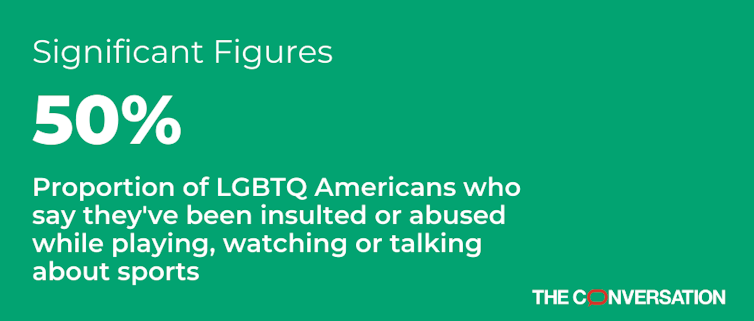
In recent years, more professional athletes, from U.S. women’s soccer team player Tierna Davidson to Olympic gymnast Danell Leyva, have come out of the closet. However, locker rooms remain less inclusive of LGBTQ people than places like schools or workplaces. And though many sports teams and figures have publicly campaigned against homophobia and transphobia, half of LGBTQ respondents in our recent study said that they’d experienced discrimination, insults, bullying or abuse while playing, watching or talking about sports.

Mistreatment doesn’t discriminate by age

For the study, we surveyed 4,000 U.S. adults and asked them whether they’d been mistreated in various sports-related contexts. We also asked them whether they believed LGBT athletes were unwelcome in sports.

We found that this sort of personal mistreatment – whether it’s bullying or insults – is a relatively common experience in sports: 36% of U.S. adults said they’d experienced some form of it. But LGBTQ adults were particularly likely to have fallen into this camp, with half of adults who identify as gay, lesbian, bisexual or another nonheterosexual identity responding that they were personally mistreated. About 60% of nonbinary adults in the survey said that they’d experienced sports-related mistreatment.

We also found that perceptions of homophobia and transphobia are common, and LGBTQ adults seem more attuned to them. While 30% of heterosexuals somewhat or strongly agreed that lesbian, gay, bisexual and transgender athletes are not welcomed in sports, 45% of adults who identified as a sexual minority did so. About 42% of nonbinary adults felt that these athletes aren’t welcomed in sports.

Given all of the recent cultural and political advancements for LGBTQ people, you might think younger LGBTQ adults would be less likely to disclose that they’d been insulted or abused while playing or watching sports.

But that wasn’t the case. In fact, we didn’t find any generational differences in sports-related mistreatment among LGBTQ adults, which suggests that LGBTQ barriers and backlash in the world of sports have endured.

Turning a blind eye to homophobia takes a toll

An ongoing task for researchers is to understand why mistreatment remains so prevalent.

We have a few theories.

For one, sports continue to play an important role in the development and communication of a masculine identity, and ideas of “what it means to be a man” are still intertwined with heterosexuality. So the sort of mistreatment and abuse that can be experienced by LGBTQ people on the playing fields and in the stands could be part of a conscious or subconscious effort by others to police gender and sexual boundaries.

Furthermore, while homophobic beliefs may have declined, many athletes, coaches and fans tend to presume one another’s heterosexuality. At best, this can create awkward and uncomfortable situations for LGBTQ people. At worst, these assumptions may make athletes, coaches and fans more comfortable openly maligning LGBTQ people.

Practices like homophobic chanting in the stands and homophobic trash talk on the field, ice or court went on for years with little pushback. The language then became unremarkable and more difficult to peg as problematic or harmful.

Yet being exposed to persistent mistreatment – subtle or overt – has real consequences. Aside from evoking shame or anger, it can cultivate a strong dislike of sports, causing many LGBTQ people to avoid or withdraw from sports altogether.

Still, over one-third of lesbian and gay adults are devoted sports fans. Some leagues, like the WNBA, see legions of untapped customers and have successfully worked to attract more LGBTQ fans.

Ultimately, playing and following sports are a huge part of American culture, and participating is an important aspect of human development.

With LGBTQ Americans who play sports reporting better mental and physical health than those who don’t, the more welcoming playing fields and stadiums can be, the better.

LGBT students sue Education Department over Title IX religious exemption – Inside Higher Ed


LGBT students sue Education Department over Title IX religious exemption

Current and former students at evangelical Christian colleges sued the Education Department to get the religious exemption to antidiscrimination protections granted to the institutions declared unconstitutional.

April 6, 2021

Kevin Truong for the Religious Exemption Accountability Project

McKenzie McCann, a former student at Liberty University and one of the students suing the Department of Education over Title IX’s religious exemption.

About 30 current and former students at evangelical colleges filed suit last week against the U.S. Department of Education, asking that the religious exemption to a federal law prohibiting sex-based discrimination at educational institutions be declared unconstitutional in how it is applied to LGBTQ students.

The students say the Education Department has failed to protect them from policies that discriminate against sexual and gender minority students at their colleges. The Title IX law, which dates to 1972, prohibits educational institutions that receive federal funding from discriminating on the basis of sex, but it includes an exemption for educational institutions “controlled by a religious organization” if the application of the law “would not be consistent with the religious tenets of such organization.”

“What we’re asking is the department be allowed to do its job and investigate discrimination complaints that are filed by LGBT kids instead of just closing them when there’s a religious exemption asserted,” said Paul Carlos Southwick, the lawyer representing the students and director of the Religious Exemption Accountability Project, a group that advocates for equality for LGBTQ students attending taxpayer-funded religious institutions.

“The government is actually giving its stamp of approval to the discrimination through its federal funding,” Southwick said. “That is a violation of the due process rights and equal protection rights of LGBTQ students. The Supreme Court has made clear that the government can no longer treat gay people in a manner that fails to recognize their dignity as human beings.”

A spokesman for the Education Department said, “The Biden-Harris administration — and the Office for Civil Rights — is fully committed to equal educational access for all students.”

The spokesman referenced a recent executive order from President Biden that stipulates “the policy of my Administration that all students should be guaranteed an educational environment free from discrimination on the basis of sex, including discrimination in the form of sexual harassment, which encompasses sexual violence, and including discrimination on the basis of sexual orientation or gender identity.”

However, the spokesman noted that Title IX, which was referenced in the executive order, includes an exemption for institutions controlled by religious organizations.

Southwick said in many ways the department’s hands are tied by that law.

“That’s why it’s so important for a judge in our case to make a constitutional ruling,” he said. “If a judge says, ‘that statute is unconstitutional,’ then the department has a lot more freedom.”

Christian colleges also see the exemption as a constitutional issue and a matter of religious liberty.

The Council of Christian Colleges and Universities, a group whose membership encompasses many (but not all) of the colleges named in the suit, said in a statement, “CCCU institutions subscribe to a number of biblical convictions, including a historic, biblical understanding of marriage as part of broader religious convictions around human sexuality and gender, and the right of our institutions to teach and instill those convictions in the next generation of believers is protected by the First Amendment.

“Faith-based higher education has always been an essential element of the diversity of the higher education system in the United States — many of the first colleges and universities in the United States were religious — and it is crucial that students continue to be given the opportunity to choose and access the college of their choice in a diverse educational landscape,” the group said.

The council added that “there is zero tolerance for bullying, harassment, and assault at CCCU institutions, and campus leaders understand their responsibility to ensure that all students believe and feel that they are created in the image of God and therefore possess full dignity, value, and worth.”

The 33 students in the suit attended or sought enrollment at a variety of evangelical Christian colleges, all of which have policies restricting LGBTQ+ student life.

The institutions — which are named but are not defendants in the suit — represent the full political spectrum of evangelical colleges, ranging from those viewed as relatively progressive to those viewed as highly conservative. They include Azusa Pacific, Baylor, Bob Jones, Brigham Young, Cedarville, Clarks Summit, Colorado Christian, Dordt, Eastern, George Fox, Grace, Indiana Wesleyan, La Sierra, Liberty, Lipscomb, Messiah, Oklahoma Baptist, Seattle Pacific and Union Universities; Nyack, Toccoa Falls, Westmont and York Colleges; Fuller Theological Seminary; and Moody Bible Institute. (One of those institutions, Grace University, in Nebraska, has closed down.)

Some of the students suing the Education Department said their admissions offers were revoked or that they were expelled when officials at institutions they attended or hoped to attend learned they were gay.

Some students kept their sexual orientation or gender identity secret on campus and reported being deeply fearful they would be expelled or lose their student housing if found out. Some of the students reported suffering from anxiety or depression as a result.

Several of the plaintiffs indicated they were not comfortable reporting incidents of sexual assault to college officials — while one student, from George Fox University, said she had reported it and the institution failed to act. (George Fox contacted the student and opened a Title IX inquiry last week in response to the lawsuit.)

Various plaintiffs describe facing harassment on campus.

“Students at Liberty behave in homophobic and anti-queer ways because they know they can do so with relative impunity,” one of the plaintiffs, McKenzie McCann, a former student at the Virginia university, says in the complaint. “Liberty’s culture enables such conduct and makes students feel like Liberty is backing them.”

Liberty officials did not respond to a request for comment.

Journey Mueller, a lesbian and a former student at Colorado Christian University, alleges in the suit that her roommates “locked her in a dorm room and forced her to confess to being attracted to women. Journey’s roommates then reported her to the school for breaking the school’s policy on sexuality.”

“The school did not discipline Journey’s roommates for locking her in her room,” the complaint alleges. “Rather, the school instead severely punished Journey for her sexual orientation, eventually forcing her to leave for mental health reasons. Acting pursuant to its student policies, CCU disciplined Journey by forcing her to participate in conversion therapy with the goal of making her straight.”

Officials at Colorado Christian did not respond to a request for comment. The American Medical Association and the American Psychiatric Association both oppose conversion therapy, which aims to change an individual’s sexual or gender identity.

Another plaintiff, Scott McSwain, a 2010 graduate of Union University in Tennessee, also alleges he was coerced into conversion therapy after university administrators learned he was gay.

“Union officials told Scott that he would be thrown out and all of his credits taken away if he did not attend sexual conversion therapy,” the suit alleges. “During his time in conversion therapy, Scott was sexually assaulted by his therapist.”

Union president Samuel W. Oliver issued a written statement in response to the suit.

“At Union University, we believe that all persons have inherent dignity and thus should be treated with kindness and respect,” Oliver said. “We exercise our legally-guaranteed religious freedom in a manner that upholds and reflects this bedrock principle. Faith-based colleges and universities are an indispensable part of America’s diverse higher education landscape. This dubious lawsuit is an ill-considered effort to erase religious schools by denying financially disadvantaged students the ability to attend the college of their choice. It’s a misguided attempt to discard a congressional enactment consistently respected and enforced by every presidential administration — both Democrat and Republican — for over four decades. We intend to vigorously protect our interests and encourage the Biden administration to fulfill its duty to defend a law that reflects the best traditions of American liberty.”

Union’s statement was nearly verbatim to one provided by Bob Jones University.

Two of the plaintiffs are current students at Baylor University in Texas, which has long declined to recognize a LGBTQ+ student club. One of the students, Veronica Bonifacio Penales, who identifies as queer, said she has been harassed on campus and online due to her sexuality.

“The school’s common response to my reporting hate on campus is that I should go to counseling,” she says in the lawsuit. “As a result, I stopped reporting incidents.”

Baylor said in a statement that it “maintains certain rights to exercise its freedom of religion under the U.S. Constitution and other federal laws without interference by the government. This includes exemptions for religiously affiliated institutions that uphold traditional religious beliefs about marriage and sexuality. As part of our Christian mission, Baylor continues to strive to provide a loving and caring community for all students, including our LGBTQ students.”

Adam Laats, a professor of education at the State University of New York at Binghamton, who wrote a book, Fundamentalist U (Oxford University Press, 2018), about evangelical higher education, said Christian colleges face strong pressures from administrators, alumni and students who don’t want the institution to recognize LGBTQ rights.

“I sympathize with the students, but it’s sort of this perfect storm of influences that makes it a very difficult issue,” Laats said. “On the one hand, there are sincere, strongly held religious beliefs among the administration, the faculty, the alumni that for religious reasons they think this is a core part of their identity as an institution. So that’s a really tall hill to climb, and then even if you get more cynical or market-based in your thinking, even if that weren’t the case, the schools have a financial life-or-death issue with this.

“You take a school that has this distinctive thing that it offers students, a religious niche in the minds of potential tuition-paying families,” Laats said. “A big part of that niche is that it trains students in what they call biblical sexuality. Why would a family shell out to go to Westmont or Azusa Pacific instead of going to a public university or a cheaper university if the school is no longer guaranteeing this important part of their niche appeal?”

Today’s News from Inside Higher Ed

Inside Higher Ed’s Quick Takes

Gymnasts Tend to Stick Their Landings With Flourish, but This Vaccine Card Surprise Takes the Cake – POPSUGAR

Running full speed toward a stationary object (as Haley Graham describes in Stick It) is terrifying, as are the flips onto and off of the vault. To stick the landing after flipping and twisting in the air repeatedly is incredible in itself, but University of Illinois gymnast Evan Manivong, a sophomore, added a little extra flare to what he confirmed was a Kasamatsu with one-and-a-half twists in a laid out position. (This is similar to, but not the same as, a Tsukahara, typically just called a “Tsuk” for short.) Once he landed this vault, seen above, he pulled out a flash card from his leotard, showing it off proudly. Spoiler alert: it was his COVID-19 vaccination card!

“It’s my vaccination card… go get vaccinated everyone!” Manivong, who was recently named a College Gymnastics Association regular-season All-American on the vault, wrote on Twitter afterward. He received a 14.750 for this vault on March 22, which tied his career-high (note: men’s collegiate gymnastics is not scored out of a 10.00 like women’s collegiate gymnastics; it uses the same scoring system seen in elite gymnastics).

Way to go, Manivong: you got a stuck landing and a vaccine jab stuck in your arm to help the US achieve herd immunity. That’s quite the accolade indeed!

NCAA LGBTQ+ group and other sports groups condemn anti-trans laws – Los Angeles Blade

INDIANAPOLIS – The NCAA LGBTQ OneTeam, a group of facilitators for a national training program that fosters LGBTQ+ inclusion in NCAA Division III athletics on Monday published a letter condemning the actions taken by Republican lawmakers in 28 states across the nation to introduce, pass, and have Republican Governor’s sign anti-transgender legislation.

2021 has been a record year for anti-transgender legislation, with 93 anti-transgender bills introduced across the country, the vast majority of which attempt to ban transgender women and girls’ participation in girls sports or ban transgender youth from accessing medically necessary, gender-affirming health care. 

Laws have been signed banning transgender women and girls’ participation in girls sports in Mississippi, Tennessee, and Arkansas, with Executive Orders being signed to the same effect in South Dakota.  LGBTQ Advocates and allies point out that those legislators have failed to provide examples of issues in their states to attempt to justify these attacks, laying bare the reality that these are attacks on transgender youth that are fueled by discrimination and not supported by fact. 

“Collegiate and professional sports organizations have had trans-inclusive policies for years without incident, and there is no reason any state would need a ban on transgender participation in sports,” the Human Rights Campaign pointed out in a media statement.

Aligned with the action taken by the NCAA LGBTQ OneTeam, the Miami Heat and the eSport giant Misfits Gaming have joined the growing list of sports leaders and business organizations condemning bans that would prevent transgender children from playing sports in school. 

The National Women’s Soccer League, the NCAA and women’s sports legends in basketball, soccer and wrestling are publicly opposing blanket bans targeting trans youth.

In a statement, a spokesperson for the team said: “The Miami HEAT champions diversity and inclusion both on and off the court. We believe sports are at their best when they bring people together to work, to play and to create a sense of belonging for all. Every young person deserves the opportunity to participate in athletics and experience the critical life lessons that sports offer such as wellness, dedication, problem-solving, and leadership. Sports should be welcoming for all.”

Cheryl Reeve, head coach of the WNBA Minnesota Lynx, denounced similar legislation being considered in St. Paul, calling out bill sponsors for using women’s sports as an excuse for harmful anti-transgender legislation. “Transgender exclusion pits woman athletes against one another, reinforces the harmful notion that there is only one right way to be a woman and distracts us from the real threats to women’s sports,” she explains.

Earlier this year, Utah Jazz owner Ryan Smith and team president Jim Olson met with bill sponsors in Salt Lake City to express concern that a ban on transgender kids participating in sports would not only negatively impact a community of young people that already face exponentially higher hurdles than their peers, but that such legislation could jeopardize the state’s relationship with the NBA and cost it the opportunity to host the NBA All-Star game in 2023. Smith’s opposition ultimately helped defeat the bill.

Professional and collegiate sports are huge revenue sources for states. The Miami Heat generated $266M in the 2019-2020 season and the growth of the eSports industry has been explosive, with revenue topping $1B globally in 2020. The legislation, if passed, could force the hand of sporting associations that have fairness and inclusion governance guidelines, leaving them no choice but to host events elsewhere.

Pressure is also coming from players. Last month, 545 collegiate athletes sent a letter to NCAA leadership calling on the organization to “ensure that the NCAA lives up to the guidelines and standards that they claim to uphold by making a firm statement that you will uphold the NCAA Anti-Discrimination Policy and only operate championships and events in states that promote an inclusive atmosphere”.

NCAA President Mark Emmert delivered a warning to lawmakers last week, penning a letter decrying the bills as “conflicting with the NCAA’s core values” and affirming NCAA board policy mandating that championship events take place in locations “free of discrimination”. Should a trans sports ban become law in Florida, the state’s 50 NCAA championship events scheduled through 2026 would be in jeopardy.

Dozens of major corporations have spoken out as well, with Airbnb, Amazon, Facebook, Google, Hilton, IHG Hotels, Instacart, Lyft, Microsoft, SunLife, Uber and others arguing that the business community has “consistently communicated to lawmakers at every level that such laws have a negative effect on our employees, our customers, our competitiveness, and state and national economies” and calling for “public leaders to abandon or oppose efforts to enact this type of discriminatory legislation and ensure fairness for all Americans”.

“We applaud the Heat and Misfits and the legion of sports and business leaders for standing on the right side of history — on the side of transgender young people,” said Nadine Smith, Equality Florida Executive Director. “Just like their peers, transgender kids participate in sports to find a place to belong. Major sports teams in Florida and the country have long understood this and sought to provide pathways into sports for young people of all identities. It is beyond time for the Florida legislature to stop these bills that are driven by election posturing not the needs of young people in our state. Lawmakers should heed the overwhelming calls for inclusion and put a stop to these bills.”