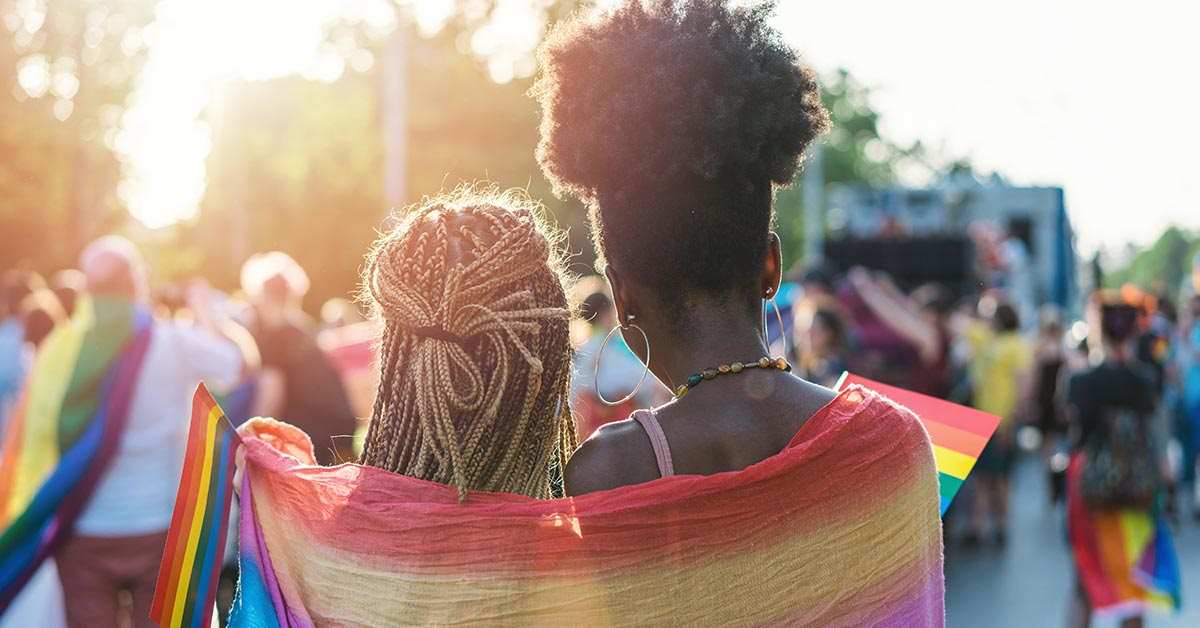
Young people within LGBTQIA+ communities are more likely to experience challenges with their mental health. This is largely due to the oppression and discrimination they may encounter at school, at home, and in their wider community.
This article uses the term “queer,” which some members of LGBTQIA+ communities consider offensive, to refer to self-identified participants in studies.
Lesbian, gay, bisexual, transgender, and other self-identified queer (LGBTQ) youth have higher rates of mental health issues than people in the general population.
Research suggests that these mental health challenges correlate with factors such as family acceptance and bullying. This indicates that stigma and discrimination, and not being LGBTQ itself, may predict LGBTQ youth mental health difficulties.
In this article, we will discuss statistics on mental health conditions prevalent in LGBTQIA+ communities, and where people can find support.
Suicide rates are rising across most groups, including teenagers. However, LGBTQ teenagers have even higher rates of suicidal actions and thoughts. A 2016 study suggests that lesbian, gay, and bisexual youth consider suicide at nearly three times the rate of heterosexual youth.
A 2018 study found that transgender youth experience mental health diagnoses at higher rates than their peers. They are also more likely to report abuse.
The Trevor Project highlight how rejection and discrimination affect the mental health of LGBTQ youth:
Two out of three participants reported that someone had tried to convince them to change their sexual orientation.
In the report, 76% said that the political climate affected their mental health.
Less than half were out to an adult at school.
In the report, 58% of transgender and nonbinary respondents said that other people discouraged them from using the bathroom that was consistent with their gender.
In the survey, 34% of LGBT youth experienced bullying at school.
Nearly a fifth of respondents (18%) experienced physical or dating violence.
In the survey, 18% of LGBT youth report sexual assault.
Roughly 1 in 10 LGBT youth were threatened or injured with a weapon at school.
A 2013 National School Climate Survey by the Gay, Lesbian, and Straight Education Network also highlights that schools can be unsafe learning environments and can expose LGBT youth to anti-LGBT behavior and discriminatory practices.
Most studies suggest that LGBTQ youth experience higher rates of anxiety and depression. A 2020 Trevor Project survey indicates that the COVID-19 pandemic may have been particularly challenging for the mental health of self-identified queer youth.
LGBTQ youth were 1.75 times more likely than their peers to experience symptoms of anxiety and depression. The figure was even higher among trans and nonbinary youth, as they were 2.4 times more likely to face anxiety or depression.
Respondents report that due to lockdown procedures, many felt more exposure to stigma. In many cases, quarantining with unsupportive family members exacerbated their anxiety.
Around a third said they were unable to be themselves at home, while 16% said they felt unsafe at home. About 1 in 4 also said they were unable to access mental health care.
LGBTQ youth face all the same stressors as other teenagers, such as:
They must also grapple with a society that may reject or stigmatize them.
A 2018 Human Rights Campaign report drawing on national survey data found much higher stress rates among LGBTQ youth. Some highlights include the following findings:
Nearly all respondents (95%) report trouble sleeping at night.
In the previous week, 77% reported feeling depressed.
Just 26% reported always feeling safe at school.
According to the Human Rights Campaign, LGBTQ youth are less likely to have family to whom they can turn for help, which can make it difficult to get treatment for substance abuse. Some may turn to alcohol or drugs to self-medicate or to manage the pain of rejection and bullying.
A 2015 study found that rejection at school correlated with a higher risk of substance abuse for LGBTQ teens.
Anti-LGBTQ messages, family rejection, and fear can all affect self-esteem. A 2018 Human Rights Campaign survey reports that although most (91%) LGBTQ youth report pride in their identity, 70% reported feelings of worthlessness or hopelessness during the previous week.
Additionally, 67% of respondents said that they heard members of their family make anti-LGBTQ statements.
Feelings of rejection were highest among LGBTQ youth of color. A mere 11% of whom said people view their racial or ethnic group positively.
Eating disorders are a way of coping with emotional pain, and some people use them to gain a sense of control when life feels out of control.
A 2020 analysis suggests that 54% of LGBT people received a diagnosis with at least one eating disorder at some point during their lives. An additional 21% suspect they may have an eating disorder.
While mental health issues are common among LGBTQ populations, a person does not have to suffer in silence. Some options for getting support include:
contacting a local organization or business that serve the LGBTQIA+ community, such as a bookstore or advocacy organization
joining a campus LGBTQIA+ advocacy and support organization
getting to know an LGBTQIA+ adult who can offer reassurance
sharing feelings with a trusted adult, such as a family member, teacher, or mentor
seeking help from an LGBTQIA+ affirming therapist or counselor, such as a school counselor or university counseling center, who may be able to connect with resources
People may also be able to seek help online via several organizations that provide support and advice. LGBTQIA+ youth resources include:
LGBTQIA+ youth can try accessing free, confidential assistance from trained professionals via national hotlines. These hotlines are available 24 hours per day and may benefit anyone experiencing difficulties with their mental health or those who want or need to talk about their feelings.
If anyone believes that a person is at immediate risk of suicide, they should call 911 or a local emergency number immediately. People should try to provide as much accurate information as emergency services need.
Suicide prevention
If you know someone at immediate risk of self-harm, suicide, or hurting another person:
Ask the tough question: “Are you considering suicide?”
Listen to the person without judgment.
Call 911 or the local emergency number, or text TALK to 741741 to communicate with a trained crisis counselor.
Stay with the person until professional help arrives.
Try to remove any weapons, medications, or other potentially harmful objects.
If you or someone you know is having thoughts of suicide, a prevention hotline can help. The National Suicide Prevention Lifeline is available 24 hours per day at 800-273-8255. During a crisis, people who are hard of hearing can call 800-799-4889.
Rejection, isolation, bullying, and safety issues can all conspire to make it more difficult for LGBTQIA+ youth to feel safe and supported. This can result in mental health issues and may account for the higher rates among those in LGBTQIA+ communities.
LGBTQIA+ youth can try to access online support services or find support networks in their local community that may be able to provide identity-affirming care and support.
It goes without saying that international travel is challenging these days. But gay travelers face the added complexity of navigating a myriad of LGBTQ+ laws around the world. Depending on where they’re headed, travel can still be considerably dangerous—even in 2021. And although there have been some improvements over recent years, more than 70 countries still have homophobic laws, according to Equaldex.
Journalists Lyric and Asher Fergusson run a travel safety blog and recently authored an up-to-date report on the most dangerous—and safest—places for LGBTQ+ travelers based on nine factors, like legalized same-sex marriage and protections against discrimination. After 250+ hours of research, the duo reviewed all countries’ individual laws and gathered data from trusted international sources to create an LGBTQ+ Travel Safety Index that reflects the most current information in an ever-evolving world.
Since the Fergussons’ study on the most dangerous places for gay travelers in 2019, several laws have changed—some for the better (Sudan), and some for the worse (Hungary, Poland). “LGBTQ+ rights are still at the forefront of our awareness and we plan to continue keeping this study up to date to help the LGBTQ+ community stay safe and navigate international travel,” says Lyric Fergusson.
A new report details the most dangerous—and safest—places for gay travelers.
getty
The journalists have noticed the Covid-19 pandemic negatively affect gay rights around the world. In 2020, Hungary ended the legal recognition of transgender and intersex people, and, according to Human Rights Watch, “It comes at a time when the government has used the Covid-19 pandemic as a pretext to grab unlimited power and is using parliament to rubber-stamp problematic non-public health-related bills, like this one.”
For the Fergussons, LGBTQ+ rights are top of mind, even amidst a pandemic. “LGBTQ+ rights are still at the forefront of our awareness, and we plan to continue keeping this study up to date to help the LGBTQ+ community stay safe and navigate international travel,” says Lyric Fergusson.
MORE FOR YOU
The most surprising revelation from this year’s study? The continued level of violent persecution of the LGBTQ+ community around the world. “Of the ‘least safe’ countries on our list, the top 49 still have prison sentences as punishment for being gay,” says Fergusson. The two countries topping the “most dangerous” list—Nigeria and Saudi Arabi—still utilize the death penalty as a possible punishment for being LGBTQ+, while lesser punishments can include lashings, flogging or life in prison. “It’s just so hard to believe we live in a world where we can treat our fellow human beings so poorly just for who they love or for what gender they identify with.”
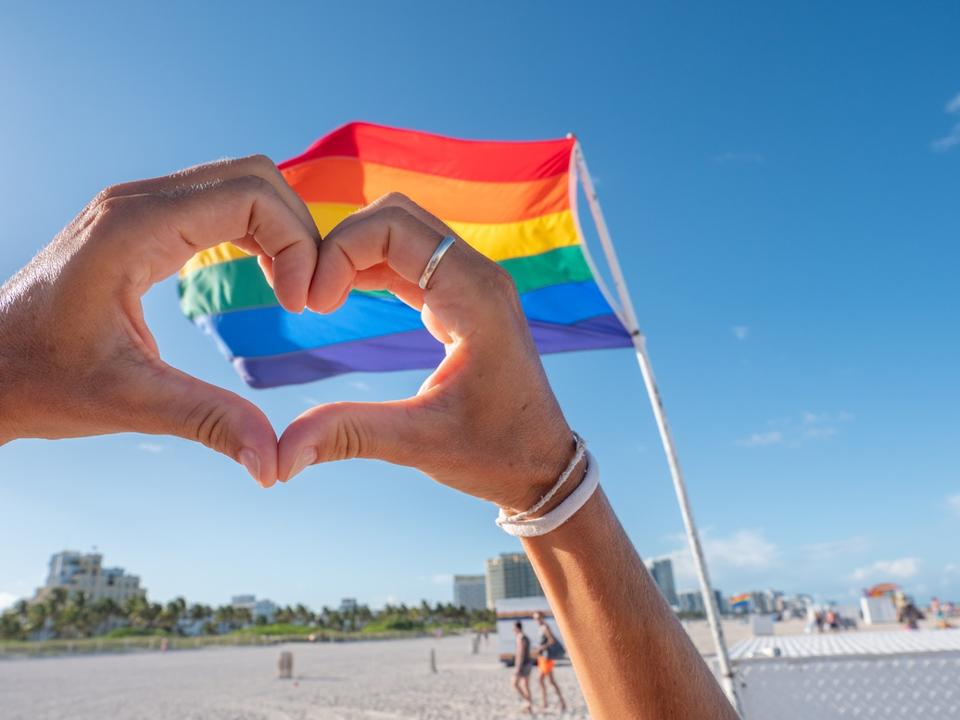
On the beach in Miami. While the U.S. is gay friendly in many ways, there are issues.
getty
Even here in the United States, there are some major legal shortcomings for LGBTQ+ rights. Some states (such as Texas) have made it illegal to play on a sports team or use a bathroom of your choice. Other states have made it illegal to exhibit advocacy for homosexuality in schools. It might surprise many travelers that the United States places 20th on the study’s list of the safest countries to visit. The wide variation in gay rights depending on the state you’re in certainly contributed to the United States’ low ranking of safest countries. There are also no constitutional or broad protections for LGBTQ+ rights under federal law in the U.S.
So is there any good news? “After our last study was published, there was a public outcry in many countries demanding that these inhumane laws be changed. Destinations that rely heavily on tourism continue to feel the heat as the LGBTQ+ community avoids countries like Jamaica for their conservative views. We hope that our 2021 study can add to the momentum for equality that is tangibly forming worldwide,” says Fergusson.
Read on for the 20 most dangerous places in the LGBTQ+ Travel Safety Index, plus commentary from the coauthors of the study. Following this list are the five safest destinations for LGBTQ+ travelers. See the entire world rankings and important safety tips here.
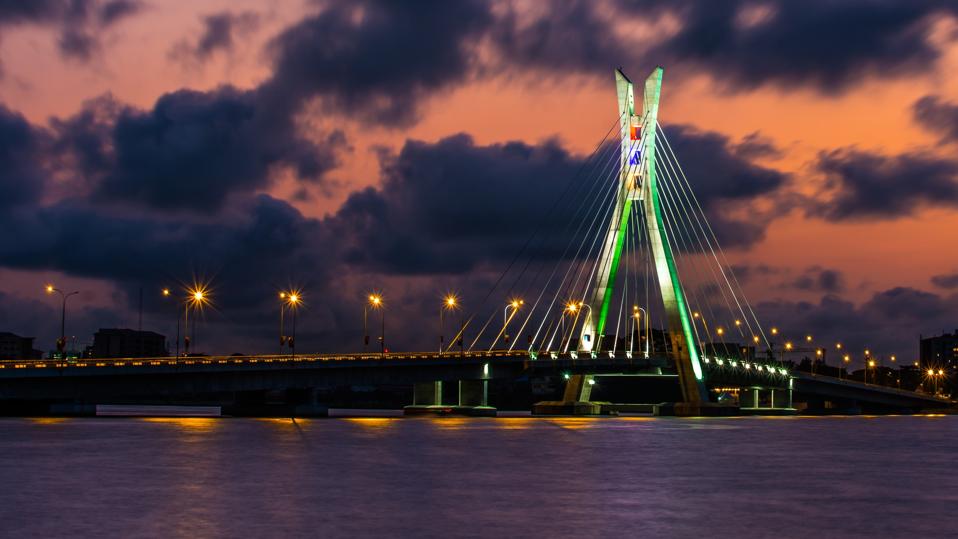
The Lekki-Ikoyi bridge in Nigeria—the most dangerous place for gay travelers.
getty
The 20 Most Dangerous Places for LGBTQ+ Travelers in 2021
1. Nigeria
“Both in our 2019 study and now in the 2021 update, Nigeria has ranked as the number one most dangerous country for members of the LGBTQ+ community,” says Fergusson. “It was ranked so poorly largely due to the extreme penalties for simply being gay, which include up to 14 years in prison and the death penalty in states under Sharia law. The mere discussion of LGBT rights is criminalized via the current system. Under Nigeria’s Same-Sex Marriage (Prohibition) Act of 2013, the country has seen an increase in violence and extortion against the LGBTQ+ community. Furthermore, Nigeria criminalizes transgender and gender-nonconforming people in its northern states under Sharia.”
2. Saudi Arabia
“Coming in as the second-worst country for LGBTQ+ travel is Saudi Arabia. This Middle Eastern kingdom is another on our list which can implement the death penalty for consensual homosexuality under their interpretation of Sharia law,” says Fergusson. “Other punishments include 100 whips or banishment for one year. “Men behaving as women” or wearing women’s clothes, and vice versa, is also illegal in Saudi Arabia, making this a particularly unfriendly country for members of the trans community.”
3. Malaysia
“This phenomenal Southeast Asian country is full of gorgeous beaches, islands, and UNESCO World Heritage Sites, making Malaysia a popular destination for international tourism. Unfortunately, imposed punishment for homosexuality is severe and the existence of gay people in Malaysia was denied by their tourism minister as recently as March 2019,” says Fergusson. “Under state interpretation of Sharia law, homosexuality in Malaysia results in up to 20 years in prison, whipping, and fines. And there are even recent proposals by the government to increase the penalties against the LGBTQ+ community. This makes Malaysia the least safe Asian country for queer and trans tourists.”
4. Malawi
“The punishments for homosexuality in Malawi have earned this African country as the number four worst country for LGBTQ+ travelers,” says Fergusson. “Same-sex acts result in 14 years in prison for men and five years imprisonment for women. Additionally, any male whose hair is longer than down to his mouth can receive up to six months in prison. Pro-LGBTQ+ organizations are banned by the government in Malawi and general public sentiment regards homosexuality as off-limits. Only 3% of Malawians said their city is a good place for gay and lesbian people when asked by the Gallup World Poll.”
5. Oman
“Oman is known for its incredible mosques and unique terraced landscapes, but its treatment of the LGBTQ+ community has placed it in the fifth worst spot on our list,” says Fergusson. “Homosexual acts in this country will lead to up to three years in prison. For simply imitating the opposite sex, you can be thrown into jail for up to one year. And all pro-LGBTQ+ organizations are banned from the country.”
6. Jamaica
“One of the Caribbean’s most popular vacation destinations for tourists worldwide, Jamaica was another shocking country to top our LGBTQ+ Travel Safety Index,” says Fergusson. “Jamaica ranks as the worst Caribbean nation for members of the LGBTQ+ community. This is largely due to Jamaica’s ‘buggery law,’ which is leftover from the colonial era, allows for a sentence of up to ten years in prison, including hard labor. In fact, Jamaica was called the most homophobic place on Earth by Time magazine in 2006 and LGBTQ+ people are sadly still the victims of homophobic violence today. Transgender individuals in Jamaica (especially male-to-female trans women) also face an exceptionally low tolerance from society at large.”
7. Myanmar
“Myanmar is a beautiful country filled with amazing Buddhist temples and pristine beaches but it’s also unfortunately not a safe destination for the LGBTQ+ community,” says Fergusson. “Transgender people (especially trans women) are commonly mistreated, raped, exhorted, and arbitrarily arrested by police. Homosexual acts, which their laws refer to as ‘carnal intercourse against the order of nature,’ are subject to 20 years in prison.”
8. Qatar
“Coming in eighth on our LGBTQ+ Travel Safety Index is Qatar,” says Fergusson. “This oil-rich Middle Eastern country enforces up to three years in prison, flogging, and the death penalty under Sharia law for any acts of homosexuality. Tourism to Qatar is expected to skyrocket for the 2022 World Cup, which is to take place there. After much pushback, the Qatari government has recently changed its stance to say it would comply with FIFA rules promoting tolerance and inclusion at matches despite the country’s strict anti-LGBTQ+ laws.”
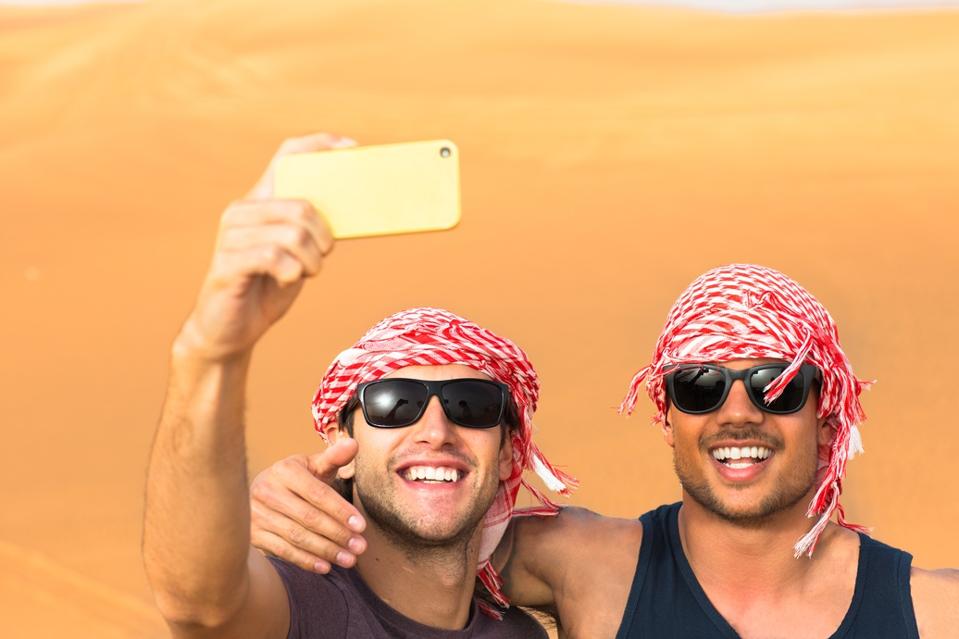
The United Arab Emirates is one of the most dangerous places for gay travelers.
getty
9. United Arab Emirates
“The UAE is most famous for its two largest cities, Dubai and Abu Dhabi, which attract millions of visitors each year. This popular tourist destination comes in as the ninth worst place to visit as an LGBTQ+ visitor,” says Fergusson. “If a male even wears ‘female apparel’ they can face up to one year in prison and a fine of up to 10,000 dirhams (approximately $2,723). According to the Gallup World Poll, only 1% of respondents felt their city was a good place to live for gay and lesbian people.”
10. Yemen
“In Yemen, the punishment for being gay for both men and women is prison time and 100 lashes, with death by stoning for married men,” says Fergusson. “This conservative Muslim republic means business when it comes to rejecting homosexuality, both in its laws and general public sentiment. Refugee Legal Aid Information highlights Yemen’s hostile attitudes toward their largely underground LGBT community.”
11. Zambia
“Home of the magnificent Victoria Falls, renowned as the largest waterfall in the world, and incredible wildlife, Zambia is filled with plenty to explore. That said, the LGBTQ+ community is marginalized in this country and there are heavy consequences for being gay, which include seven years to life in prison for any same-sex act,” says Fergusson. “One possible sign of positive changes in the country is that the president recently pardoned a gay couple who were sentenced to a 15-year prison term.”
12. Tanzania
“This East African country is known for its remarkable natural attractions, including Mt. Kilimanjaro and the Serengeti National Park, making Tanzania a massive hub for international tourism,” says Fergusson. “Unfortunately, this country was ranked at number 12 on our LGBTQ+ Travel Safety Index, which may inspire LGBTQ+ visitors to rethink their travel plans. In Tanzania, any homosexual acts result in 30 years to life in prison, and there has been a recent government crackdown on LGBT activity within the country.”
13. Sudan
“This African nation made some good progress in 2020 by abolishing the death penalty for same-sex relationships. They do, however, still have up to five years in prison as a penalty for being gay,” says Fergusson. “Publicly, homosexuality is a taboo topic, so LGBTQ+ travelers choosing to visit Sudan should proceed with caution and remain discreet with regards to their sexuality. It is also recommended to be extremely careful when inviting guests into your hotel room, as this can potentially spark unwanted complications.”
14. West Bank & Gaza
“In the Palestinian territories of Gaza and the West Bank, the anti-LGBTQ+ sentiment is taken very seriously, with homosexual acts resulting in up to ten years in prison,” says Fergusson. “Groups advocating for LGBTQ+ rights are threatened by the governing authorities in Palestine, who consider homosexuality to be ‘a blow to, and violation of, the ideals and values of Palestinian society.’”
15. Iran
“Iran made number 15 on the index, due in part to its extreme punishments for homosexuality, which include 100 lashes for intercourse or the death penalty, and 31 lashes for same-sex acts other than intercourse,” says Fergusson. “One positive situation in Iran is that they do allow for transgender legal identity changes via sex reassignment surgery. Interestingly, Iran carries out more sex reassignment surgeries than any other country in the world after Thailand.”
Sunset captured from Naguru in Kampala Uganda—one of the most dangerous countries for LGBTQ+ … [+] travelers.
getty
16. Uganda
“One of Africa’s most populous countries, Uganda ranks equal 16th on our LGBTQ+ Travel Safety Index,” says Fergusson. “Homosexual intercourse results in life in prison and pro-LGBTQ+ organizations are banned throughout the country. Unfortunately, things may soon be getting even worse for the LGBTQ+ community, as the Ugandan president has recently been ramping up the anti-gay rhetoric to help win votes in an upcoming election.”
17. Maldives
“Famed as a popular romantic vacation destination for LGBTQ+ travelers, it comes as a significant wake-up call that the Maldives bears such anti-LGBTQ+ laws,” says Fergusson. “Earning the equal 16th spot, the Maldives punishes homosexual acts and intercourse with up to eight years in prison or 100 lashes. Though these laws are enforced in the cities, they are largely ignored at the resorts. For more adventurous travelers, regardless of orientation, be wary of the local customs and avoid any public displays of affection in the Maldivian cities.”
18. Morocco
“An enchanting destination, packed with beaches and incredible architecture, Morocco ranks as the equal 18th worst on our travel safety index,” says Fergusson. “Homosexual or “unnatural” acts can lead to six months to three years in prison, plus additional fines. Although affection is often freely shown among Moroccan men it is recommended that LGBTQ travelers use discretion particularly if using social media dating apps since meetups have led to assault and robbery in recent years.”
19. Egypt
“Famous throughout the world for its ancient pyramids and historical and religious significance, Egypt is a massive tourist destination for global travelers. Unfortunately, Egypt ranked equal 18th on our list due to its negative laws regarding homosexuality,” says Fergusson. “Same-sex acts result in up to three years in prison with a fine, and possession of homosexual materials results in up to two years in prison with a fine. For LGBTQ+ travelers, it is recommended not to disclose your sexuality and avoid using dating apps since the local police have been known to create fake accounts to “catch” LGBTQ+ travelers looking to engage in illegal activity.”
20. Algeria
“This North African nation ranks as the equal 18th worst on our LGBTQ Travel Safety Index. Homosexual acts result in two months to two years in prison, plus a fine,” says Fergusson. “Simply being in possession of “homosexual materials” can subject you to up to 2 years in prison. As a tourist, you likely won’t be subjected to these laws, but you’re advised to be cautious. Dressing in clothing of the opposite sex is prohibited by law, and the general social attitude towards the LGBTQ+ community is openly negative and sometimes violent.”
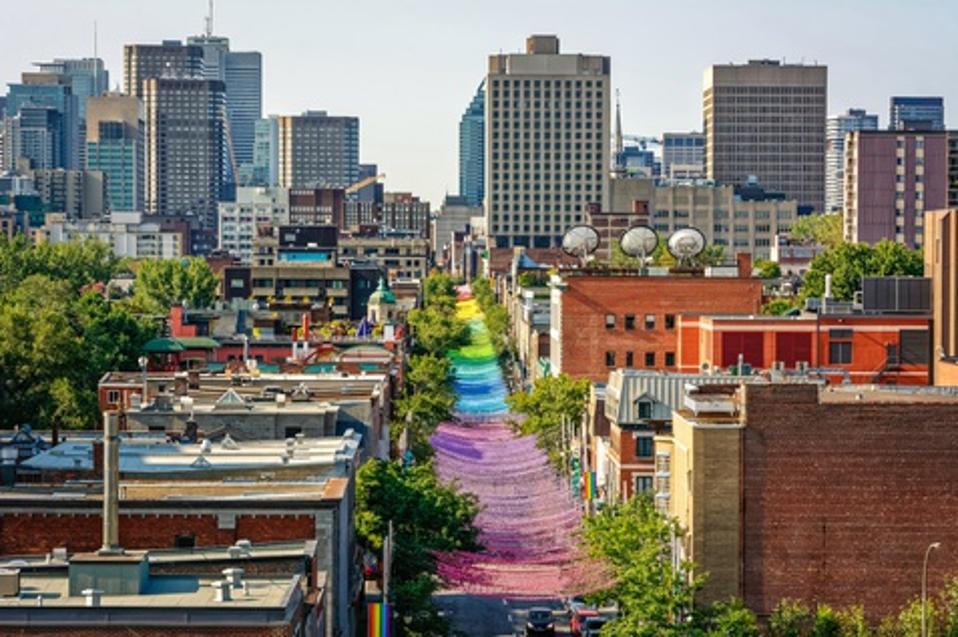
A rainbow pathway in Montreal, Canada—the safest place for gay travelers.
getty
The 5 Safest Places for LGBTQ+ Travelers in 2021
1 . Canada
“Coming in first place as the safest country for LGBTQ+ travel in this year’s update is Canada,” says Fergusson. “Known for its kind locals and chilly winters, Canada has constitutional protections in place to guard the LGBTQ+ community against violence and discrimination, and same-sex marriage has been legal since 2005. Most recently in 2020, Canada has made the positive move to criminalize LGBTQ+ ‘conversion therapy.’”
2. The Netherlands
“The Netherlands was the first place in the world to legalize same-sex marriage almost 20 years ago in 2001,” says Fergusson. “This alluring country renowned for its tulip fields, windmills, cheese markets, and canals has achieved an equal second spot in the 2021 LGBTQ+ Travel Safety Index. The Netherlands also ranked number one in the latest Gallup Poll with 92% of respondents saying that the city or area where they live is a good place for gay and lesbian people.”
3. Sweden
“Sweden’s friendly attitudes and positive legislation towards the LGBTQ+ community have earned it the title of equal second. Scandinavia is generally known for its friendly people and liberal attitudes towards equality for all,” says Fergusson. “Sweden legalized same-sex marriage in 2009 and performed well on all our nine ranking factors. This land of the Northern Lights has also been a regular host of Europride and has more Pride festivals per-capita than anywhere else in the worldwith over 30 different Pride celebrations throughout the country each year.”
4. Malta
“This tiny archipelago sandwiched in the Mediterranean between Sicily and the North African coast comes in fourth in regards to LGBTQ+ travel safety,” says Fergusson. “Malta has been rising in acceptance of LGBTQ+ individuals for decades and its legislations make it one of the most LGBTQ+ travel-friendly countries in both Europe and the world. Who wouldn’t want to honeymoon or vacation on this paradisal island?”
5. Portugal
“With legalized same-sex marriage since 2010 and numerous legal protections for the LGBTQ+ community, Portugal placed fifth on our list,” says Fergusson. “Cities like Lisbon and Porto have the best gay scenes in the country and Portugal came in second place in its bid to host the 2022 Europride which is the biggest event celebrating gay pride in Europe.”
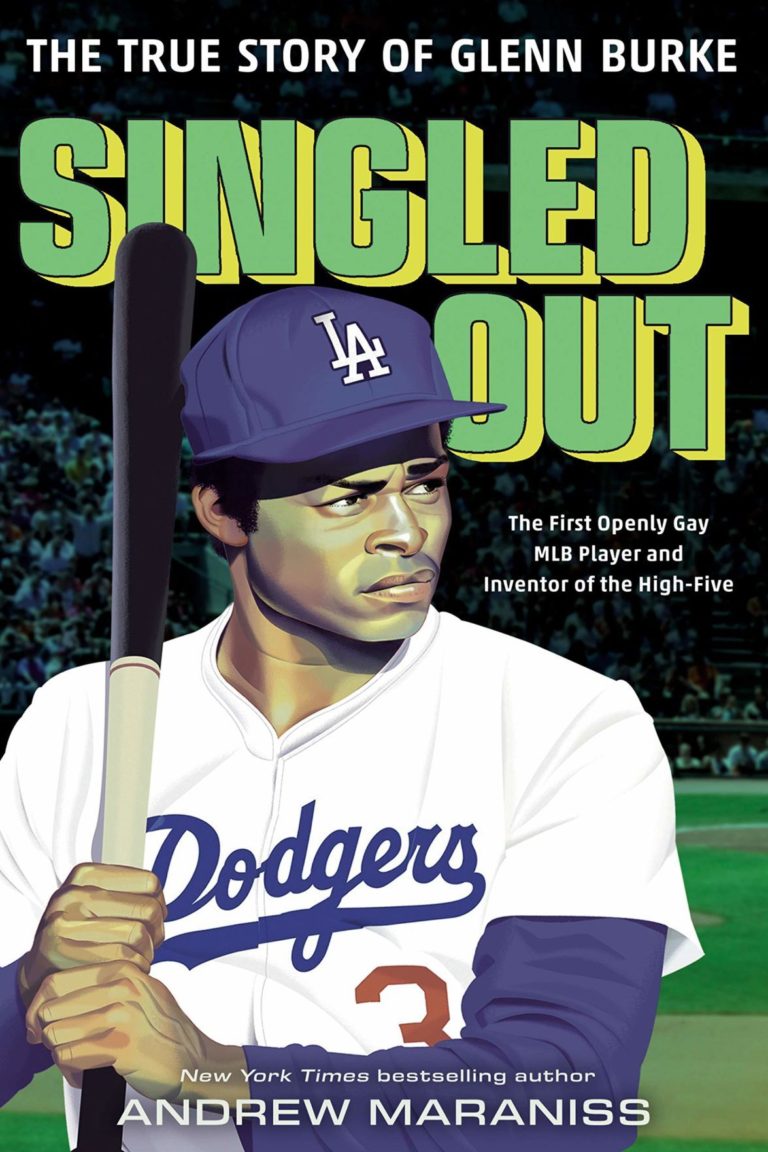
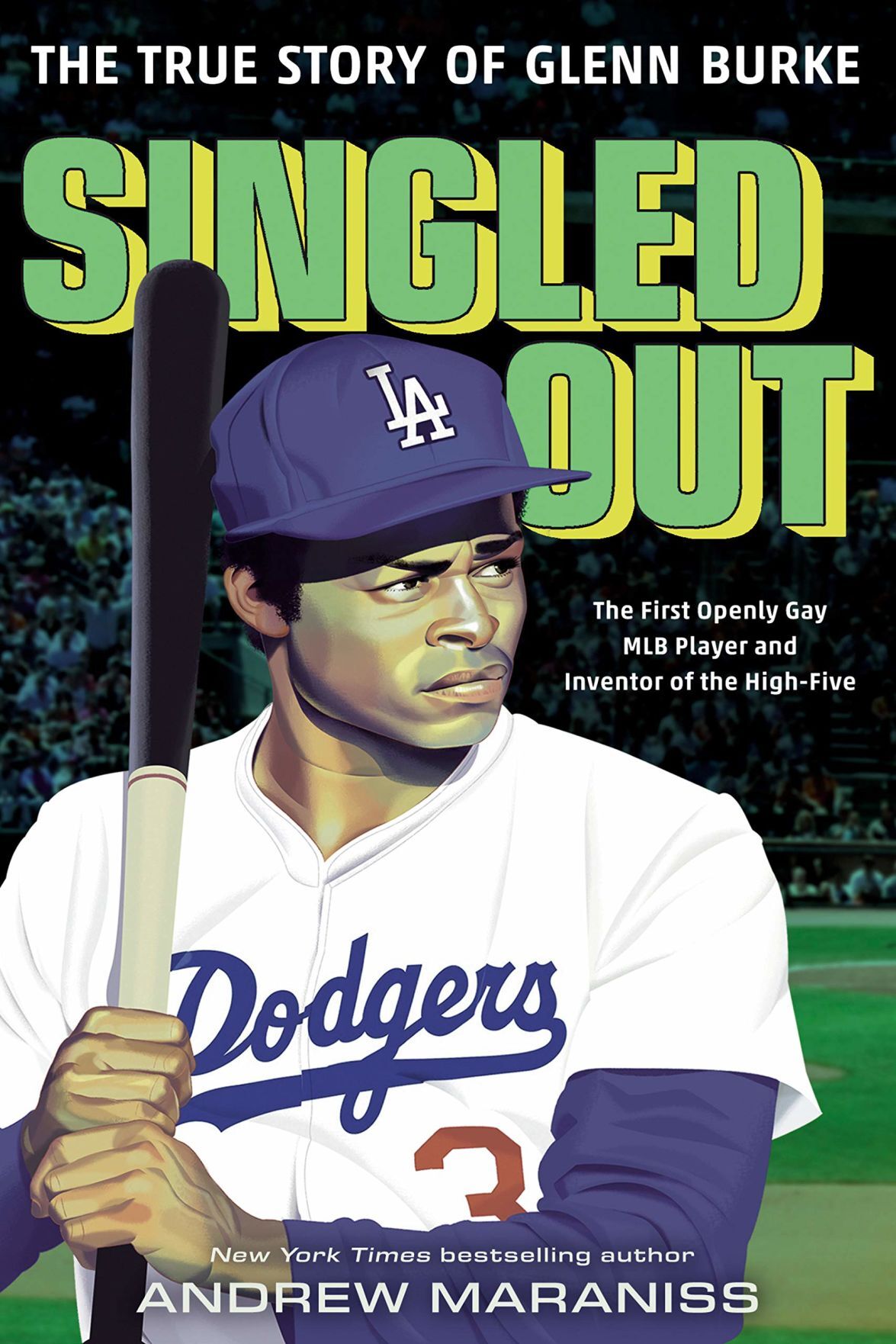
Andrew Maraniss’ “Singled Out” chronicles the life of major league baseball player Glenn Burke.
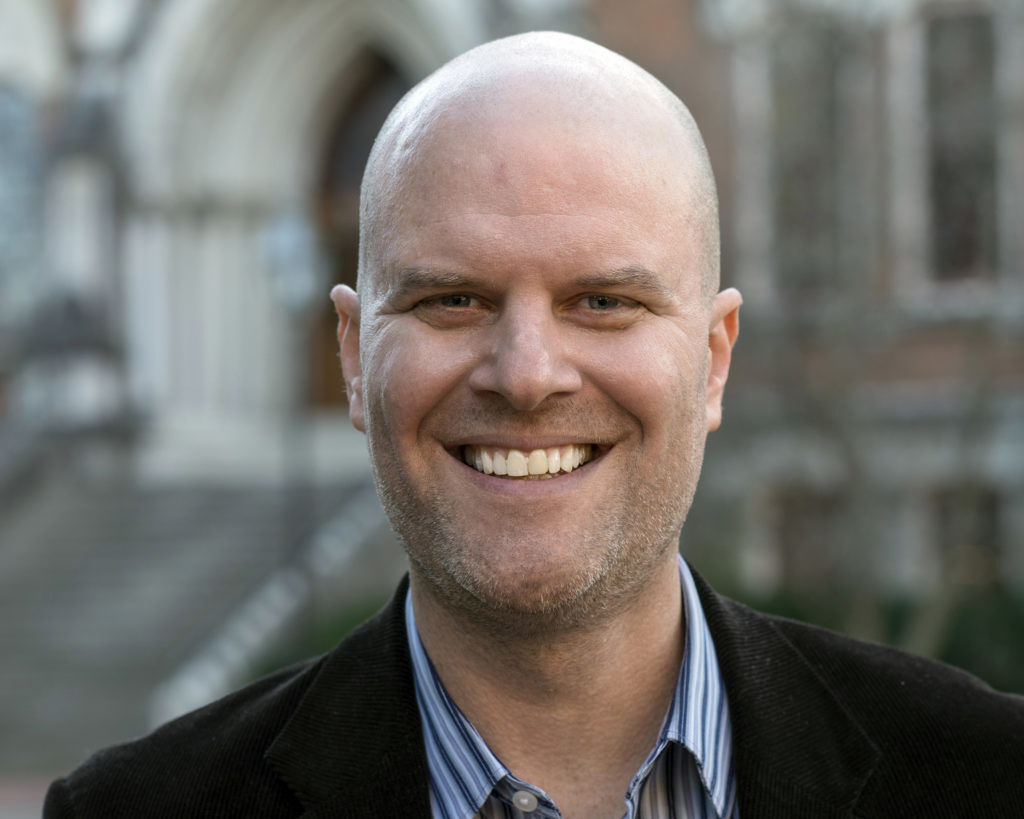
Madison-born author Andrew Maraniss, the grandson of former Cap Times editor Elliott Maraniss, has a new book, “Singled Out,” about openly gay baseball player Glenn Burke.
By Jane Burns
Sometimes being the first comes with fame and glory, sometimes it comes with pain. In the case of one former major league baseball player, being the first came with so much pain that no one remembers the things that should have brought him fame and glory.
That was the case for Glenn Burke, the first openly gay major-leaguer, who played for the Los Angeles Dodgers and Oakland A’s in the late 1970s. That was a first, but so were other things he accomplished that have been all but forgotten after homophobia chased Burke out of baseball after just four years.
Andrew Maraniss is trying to change that with his new biography of Burke, “Singled Out.” Not only does Maraniss tell the story of how Burke’s homosexuality curtailed his professional sports career, but also the story of a colorful, popular athlete who is credited with inventing the high five and also was the first baseball player to wear a shoe from an up-and-coming shoe company called Nike. Burke died of AIDS in 1995 at age 42.
“There’s a new generation now that is ready to hear Glenn’s story,” said Maraniss, a Nashville-based writer who was born in Madison. “There have been strides made, so the story can be heard in a more empathetic way than it once was.”
Maraniss, son of Pulitzer Prize-winning journalist David Maraniss and grandson of former Capital Times editor Elliott Maraniss, has written two other books that explore the intersection of sports and social justice. “Strong Inside” told the story of Perry Wallace, who was the first Black basketball player in the Southeastern Conference and went on to become a professor of law. “Games of Deception,” which came out last year, told the story of the 1936 U.S. men’s Olympic basketball team amid the backdrop of the Berlin Games held in the shadow of Nazi Germany. “Singled Out” continues in that vein, with a subject that goes way beyond sports.
“It was a chance to write about the times, the gay rights movement, the backlash; that’s what was appealing to me,” he said.
Burke was a talented athlete, one who probably could have pursued a basketball career (and he did play college basketball despite being a pro baseball player, also a first). He came to terms with his sexuality as a minor-leaguer and while Burke didn’t come out publicly until his playing career was over, he didn’t make much of an effort to hide it from the Dodgers when he made it to the big leagues.
That’s not what brought him attention in the Dodgers’ dugout, however. Burke was funny, and the rookie brought a welcome light-hearted spirit to the veteran roster that was under pressure to deliver a World Series championship. One of those light-hearted moments endures today: As veteran Dusty Baker rounded third base after hitting his 30th home run of the season, Burke stood in the on-deck circle with his hand raised in the air instead of in position for a handshake. Baker followed Burke’s lead and slapped his hand, creating the first of what is now the ubiquitous high five.
Off the field, things weren’t so smooth. Burke was friends with the gay son of Dodgers Manager Tommy Lasorda, which didn’t sit well with the manager. Team President Al Campanis offered Burke a $75,000 bonus if he got married.
“You mean to a woman?” Burke replied.
Despite Burke’s promise and key role on a World Series champion, the Dodgers traded him to the A’s the next spring. It was even worse for him in Oakland, as manager Billy Martin would introduce Burke to other players using a gay slur and vowed he’d never allow a gay player on his team. After being sent to the minor leagues again, Burke quit baseball.
“Once they found out who he really was, the attitude was, ‘We don’t want you around because of who you are’ and that robbed Glenn of everything he wanted to do in his life,” said Maraniss, who had Burke’s baseball card when he was a kid. “Not only did it cost Glenn, it cost the rest of us the benefit of someone like him. He created new things and you wonder what would have been next for him.”
Burke never found his way after baseball. He developed a drug problem, served a prison sentence, lived on the streets of San Francisco and died in 1995. Maraniss spoke to dozens of Burke’s friends, family members, teammates and social workers to piece together his story. Beyond the baseball, “Singled Out” is also a gut-wrenching look at the toll the AIDS epidemic took on the gay community, particularly Burke’s post-baseball home of San Francisco.
No baseball player has come out as gay since Burke played in the 1970s, and while baseball is one of the most conservative sports, Maraniss thinks it could turn out differently for another player today.
“If the situation were right, the right city or the right management, this could be a really popular player now,” Maraniss says. “If a player came out now, he could have the best-selling jersey in the major leagues. You don’t need everyone to accept you, but a lot of people would. There’s a great chance that it would go much better now than it did for Glenn.”
Maraniss’ next book is about the 1976 U.S. Olympic women’s basketball team, the first year women’s basketball was an Olympic sport. The book coincides with the 50th anniversary of Title IX.
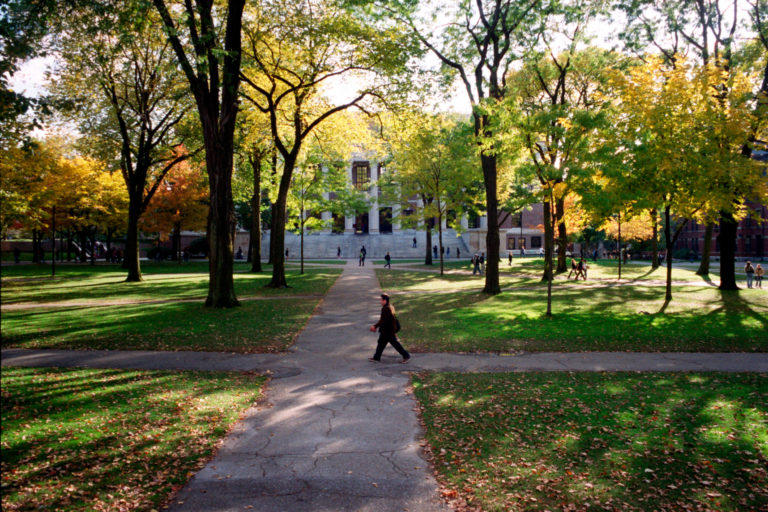
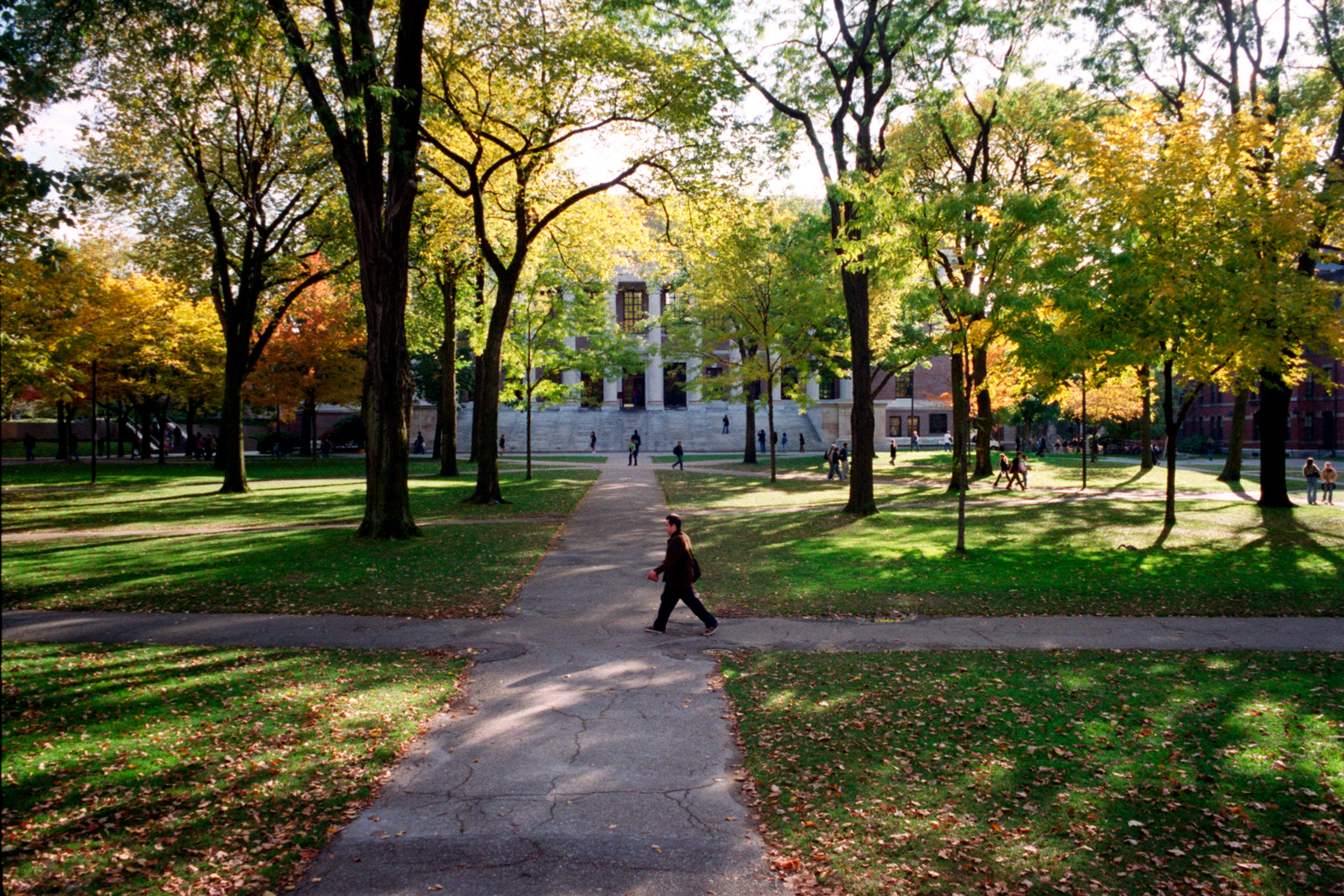
Harvard’s Faculty of Arts and Sciences is planning for a full return to campus in the fall, including opening residential accommodations at full density and holding classes in person.
Edgerley Family Dean Claudine Gay announced this expectation in a message to faculty, students, researchers, and staff today, and laid out details of the proposed return.
“I am proud of how we have met this moment and grateful for the hard work of the many faculty, staff, students, and researchers who have contributed to the success of our efforts over the past year. But our overriding goal has always been a full return to campus, and reaching that goal now feels not only possible but imminent,” Gay wrote. “Promising downward trends in infection rates, encouraging new CDC [Centers for Disease Control and Prevention] guidance on the impact of vaccination on public health practices, and the aggressive rollout of vaccinations across the nation have brought a new sense of hope that the end of this challenging period is in sight.”
[Harvard’s Schools will issue their own individual guidelines as they also move toward reopening. In a letter to the Harvard community on Monday, President Larry Bacow, Provost Alan Garber, and Executive Vice President Katie Lapp said the University is targeting Aug. 2 as the date when faculty, staff, and researchers will be authorized to return to campus, presuming the pandemic continues to wane. The University will continue to update its coronavirus workplace policies as future conditions warrant.]
[“ Our highest priority will remain the health and safety of every member of our community,” the three officials wrote, “and we will continue to engage in contingency planning so that we are prepared and can adapt if the public health situation changes.”]
Gay said the College is preparing to accommodate a larger number of students, including those who deferred their first year or took a leave during the pandemic. She stressed that the return to campus was designed for a full return to in-person teaching and research operations. In pursuit of this goal, she expects that the full range of academic resources will be available in person this fall, including libraries, archives, museums, and research facilities.
The fall planning update comes amidst expanded vaccine rollout plans at the state and federal levels, as well as gradual campus reopening procedures that rely on robust testing, tracing, and de-densification. Currently, the College is operating at Reopening Level 4: Lime, which allows for some residential gathering, athletics, and performance-practice activities, as well as for College, house, and Yard-sponsored outdoor programming. Some labs have reopened for in-person research, and graduate students have received financial and research support from the Graduate School of Arts and Sciences (GSAS) to continue their work on campus and virtually.
Gay’s letter addressed the challenges students have faced being away from campus. Many have not been there in more than a year, and some first-years have never visited Cambridge. International students also have faced “particular hurdles” with visa processing and government policies preventing them from entering or leaving the U.S. Acknowledging the potential for restrictions and delays in visa processing, Gay emphasized that students should confidently apply for visas knowing that there will be in-person instruction, and the FAS will work with those students to navigate their program options.
Nearly 15 percent of the population of Massachusetts has been fully vaccinated against the novel coronavirus, and Gov. Charlie Baker expects the state to vaccinate 4 million people by July 4. President Joe Biden has proposed a plan to make all adults in the U.S. eligible for the vaccine by May 1. Gay noted that fall planning will continue to evolve and be flexible, based on state and local information on case numbers, disease variants, and other relevant conditions.
FAS staff members working remotely will begin to transition to in-person work, in accordance with the University’s targeted return-to-campus date of Aug. 2. Some staff, in particular those involved in student life and learning, will come back earlier as part of preparations for the summer and fall. For all FAS community members, Gay said, the return to campus will be a major adjustment after a year of financial, emotional, and physical hardships brought on the pandemic.
“As a School, we know that our fall plans will require further investment at a time when financial resources continue to be constrained and spending is limited to the essential. As individuals, there is a lot about this that is hard,” she wrote. “Planning to work, teach, and carry out research in person can provoke anxiety after a year of diligent masking, distancing, and handwashing. That we assume these practices will still be needed this fall is also a sad reminder that the pandemic will still be with us in some form. Returning to campus also reminds us of the things that did not happen this past year, from lost athletic competitions to lost Commencement traditions in the Yard. And many of us carry a sense of loss and of mental strain from the worry and uncertainty we have faced.”
Still, she expressed optimism about the community’s ability to advance a shared mission to define “our new normal.”
“We are eager and excited to have you here, but more than that, we need you. The coming year will be an important time of transition. This year has changed us, individually and institutionally. We know we can’t recapture the campus experience of 2019. We can only move forward, bringing all we have learned from the past year to the project of rebuilding our campus-based identity,” Gay wrote. “We need your spirit of experimentation and your willingness to pilot and to change. They are not only welcome; they will be necessary as we endeavor to live up to the full promise of our mission in this moment in history.”
Final plans will be announced in late May, including specific information on re-entry protocols, housing details, public health protocols, financial aid updates, and more. Updates from the University on COVID-19 are available on its website.
The Daily Gazette
Sign up for daily emails to get the latest Harvard news.
We love how memes and trends evolve online. This weekend, a new meme and trend took over Twitter. At first, the meme started as a comparison of the old Ms. Frizzle from the cartoon The Magic School Bus with the new Ms. Frizzle. This new Frizzle is not, in fact, the Ms. Frizzle most millennials and Gen Zers grew up knowing. Instead, she’s the younger sister of the original cartoon teacher. She appeared in Netflix’s 2020s series The Magic School Bus Rides Again. And for most people, her arrival was not welcome.
Hard to explain but I would come out to the Ms Frizzle on the left, but not the one on the right pic.twitter.com/SKJ71aJFoy
From there, the joke evolved. After Twitter user @MajorPhilebrity posted, “Hard to explain but I would come out to the Ms Frizzle on the left, but not the one on the right,” Gay twitter users decided to celebrate fictional women they WOULD come out to. This includes Fran Fine from The Nanny, Betty and Hilda Suarez from Ugly Betty, Miss Piggy from The Muppets, Linda Belcher from Bob’s Burgers, and more.
So, Instinct readers, we have to ask. Which fictional female characters make you feel most safe? Who would you come to? Share your favorites and thoughts down below.
From time to time Seoncheol would come to dinner, and on one particular evening Jang, concerned that it had got late, persuaded Seoncheol to stay over. A few hours later, Jang found himself creeping out of his own bed and in beside Seoncheol. He was devastated when his sleeping friend didn’t so much as stir.
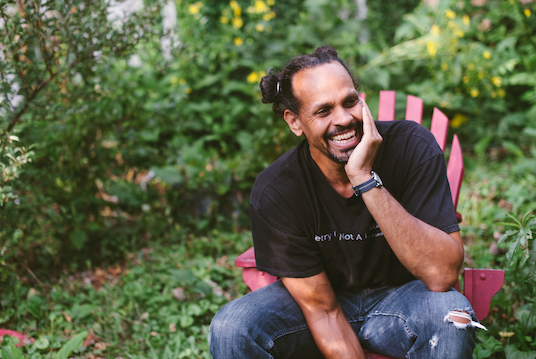
Landlocked Music will be selling autographed copies of a new album by a renowned poet, Indiana University’s Ross Gay. Gay reads his poetry from several books with musicians’ accompaniment on each track.
On March 26, digital copies will be available, with physical copies available April 9. Publicized readings or other events may also occur with the release, although they have yet to be scheduled.
Landlocked will launch the 25th anniversary celebration of Jagjaguwar at its store by featuring “Dilate Your Heart,” which is also Jagjaguwar’s first spoken-word album since American poet Robert Creeley’s self-titled release 20 years ago.
Jagjaguwar is an American independent record label based in Bloomington, with additional offices in New York, Los Angeles, Chicago, Austin, London, Paris, Amsterdam and Berlin. Since 1996, Jagjaguwar has championed artists who have bent the tides of popular music. The label’s goal is not to highlight specific songs but to encourage artists working together with their neighbors.
Gay teaches at IU and has received honors for “The Book of Delights,” released in 2019. Ever reminding his readers of the pleasure of thanking and reveling in the ordinary, he has written four books of poetry: “Against Which”; “Bringing the Shovel Down”; “Be Holding”; and “Catalog of Unabashed Gratitude,” winner of the 2015 National Book Critics Circle Award and the 2016 Kingsley Tufts Poetry Award. His recent book-length poem, “Be Holding,” was released last year.
“Over the last 12 years, Ross Gay’s poems have given us indelible images and phrases of radical empathy and unabated gratitude about community, collaboration, connectedness and hard work,” said in an email press release from Jagjaguwar.
“Dilate Your Heart” does not stem from any one of Gay’s poems, and the phrase means make room, let more in, welcome the expansion of one’s community, let in what life offers, even its end.
Each track is a conversation among artists. In “Catalog of Unabashed Gratitude,” Gay’s voice gives thanks for many things as Bon Iver, an American indie folk band founded in 2006, accompanies. In “Burial” harpist and composer Mary Lattimore’s music follows Gay’s voice explaining how we exchange energy with nature. Chicago’s Angel Bat Dawid dances with the frenetic, joyous scene through which Gay leads listeners in “To the Fig Tree on 9th and Christian.” Songwriter Gia Margaret provides the environment for Gay’s “Poem to My Child If Ever You Shall Be,” a love letter to an imagined future child. Saxophonist and jazz musician Sam Gendel affects Gay’s voice in “Sorrow Is Not My Name.” Gay focuses on the treasure of life’s every day instead of its finality and throughout recites his poems in his warm, easy voice.
A founding board member of the Bloomington Community Orchard, a nonprofit that provides free fruit for all, Gay also works on The Tenderness Project with Shayla Lawson and Essence London. Cave Canem, the Bread Loaf Writer’s Conference and the Guggenheim Foundation have all given him fellowships.
“Doing a project with Ross has been a goal and wish for us for many years,” Byers said. “We are delighted that Jagjaguwar is helping deliver to the world a glimpse into Ross Gay’s fantastic work.”
Needless to say, I wasn’t trying to make a statement with my clothes, particularly not a coming out statement. At 14, I’d never experienced same-sex attraction or any real attraction, for that matter – I just wanted to be comfortable. But the suggestion of queerness, even if it was from someone who cared about me, made me self-conscious about how I was presenting. I had no idea what I wanted, who I liked or if I liked anyone at all. The idea that my clothes were ‘gay’ created this expectation that really stressed me out.
The U.S. House of Representatives passed the Equality Act on Feb. 25, and the bill is now undergoing hearings in the Senate Judiciary Committee. The purpose of the Equality Act is to prohibit “discrimination based on sex, sexual orientation, and gender identity in areas including public accommodations and facilities, education, federal funding, employment, housing, credit, and the jury system.”
Public opinion data suggest that the majority of Americans support the bill, or at least the idea behind it. As far back as 2017, Gallup asked a general question about the need for this type of new law and found slim majority support — 51% — for “new civil rights laws to reduce discrimination against lesbian, gay, bisexual or transgender people.”
There is not a lot of current polling that asks Americans directly about the “Equality Act” per se. One recent poll conducted by Hart Research for the LGBTQ advocacy group Human Rights Campaign included a detailed summary of the new bill and found that 70% of those interviewed favored it. (Here’s how it was described to respondents in that poll: “The Equality Act would add to existing laws that currently protect people based on race, sex, religion, and other characteristics to include sexual orientation and gender identity. This law would ensure that LGBTQ people are protected from discrimination in key areas of life, including employment, housing, credit, education, and jury service. And it would also add protections based on sex, sexual orientation, and gender identity to use of public spaces and services and federally funded programs. The Equality Act would update current laws to prevent services that are open to the public, such as retail stores, banks, legal services, and transportation services, from refusing service for LGBTQ people. It prevents businesses from using religious objections as a basis for refusing service to LGBTQ people.”)
Another recent survey conducted by the Public Religion Research Institute showed that 82% of Americans favored “laws that would protect gay, lesbian, bisexual and transgender people against discrimination in jobs, public accommodations and housing.”
A Kaiser Family Foundation poll conducted in June found that 69% of Americans supported “laws that ban discrimination based on whether a person is lesbian, gay or bisexual.”
On the other hand, a survey conducted last summer by the National Opinion Research Center found that when given a choice, Americans were about equally split between the belief that “our country has made changes needed to give gay and lesbian people equal rights with other Americans” (48%) and “our country needs to continue making changes to give gay and lesbian people equal rights with other Americans” (50%). These responses may have reflected respondent confusion about the question wording. The first alternative seemingly overlaps with the second (i.e., a respondent could believe that the country has made changes and also believe that the country needs to continue to make changes).
We also know that Americans’ general attitudes toward LGBT rights have become much more positive over time, as my colleague Justin McCarthy reviewed last summer. Two-thirds of Americans now support same-sex marriage, and two-thirds say that gay and lesbian relations are morally acceptable. Gallup also recently reported that the percentage of the U.S. adult population identifying as LGBT has increased to 5.6%, from 3.5% in 2012.
All of this leads to the reasonable conclusion that a majority of Americans, in general, support the concept behind new legislation designed to outlaw discrimination against lesbian, gay, bisexual and transgender persons in the U.S.
Reasons Behind Opposition
With that said, not all is smooth sailing for the Equality Act, which has engendered significant opposition — both in Congress, where its passage is far from assured, and among many conservative and religious leaders. This is in part based on perceptions that the law would limit religious freedom. As Utah Sen. Mitt Romney’s office recently stated, “Sen. Romney believes that strong religious liberty protections are essential to any legislation on this issue, and since those provisions are absent from this particular bill, he is not able to support it.” The Ethics & Religious Liberty Commission of the Southern Baptist Convention has “worked tirelessly” to defeat the Equality Act, saying, “This bill would substantially undermine religious liberty protections in the United States.” The conservative Heritage Foundation announced, “A federal sexual orientation and gender identity law would empower the government to interfere in how regular Americans think, speak, and act at home, at school, at work and at play. Any bill promoting such authoritarianism is a danger to our freedoms.”
As can be seen from these objections, opponents of the Equality Act are largely focused on the collision between Americans’ rights to the “free exercise” of their personal religious beliefs and the power of the government to enforce anti-discrimination laws. This, in turn, reflects competing interpretations of the First Amendment (“Congress shall make no law respecting an establishment of religion, or prohibiting the free exercise thereof”), whose brief statement of the guarantee of freedom of religion has been the subject of discussion and legal challenges essentially since the day it was written.
Supporters of the Equality Act say it both guarantees equal protection of LGBT persons and maintains freedom of religion. Opponents say it would impose government mandates on their personal religious beliefs. In particular, opponents focus on language which they claim would reduce the ability of individuals to claim religious beliefs as the basis for their actions in any situation in the future, based on the law’s references to overriding the 1993 Religious Freedom Restoration Act.
There is some survey research that has asked Americans about situations in which individuals and organizations claim that their religious beliefs preclude them from adhering to anti-discrimination laws. The most well-known such case involved the Masterpiece Cakeshop in Colorado, which refused to create a wedding cake for a same-sex couple and was subsequently found by the Colorado Civil Rights Commission to be violating the state’s civil rights laws. The case wound its way up to the U.S. Supreme Court, which overruled the Civil Rights Commission decision based on narrow grounds relating to how the commission handled the case. Most polling that I have seen shows Americans tilt toward supporting the Civil Rights Commission position (i.e., that the baker is obligated to design wedding cakes for same-sex couples regardless of his personal religious beliefs).
More broadly, recent polling I have reviewed shows that Americans tend to support the right of the state to enforce laws that override religious beliefs in a variety of situations involving churches, hospitals and individuals’ claims that such enforcement would violate their religious beliefs. Research conducted by the Public Religion Research Institute and AP/NORC over the past year includes scenarios involving hospitals that refuse to provide abortion services because of their religious beliefs, religiously affiliated hospitals refusing to provide healthcare plans including contraception to their employees, parents wanting to send their children to public school without vaccines because of their religious convictions, and a business owner having to provide family healthcare benefits to employees who were part of a same-sex couple. In all instances, the results show that the public sides with the enforcement of existing laws, overriding claims of personal religious beliefs. And Pew Research last summer, in reference to pandemic lockdowns, found that Americans overwhelmingly say “houses of worship should be required to follow the same rules about social distancing and large gatherings as other organizations and businesses in their local area.”
Bottom Line
Overall, the Equality Act seems to be in general conformance with American public opinion. Polling suggests that the majority of Americans favor the idea of additional laws to ensure civil rights protections for LGBT persons. The bill as written is long and complex (as is the case for much congressional legislation), and critics argue that it will increase the government’s ability to override religious beliefs in violation of the First Amendment. But surveys suggest that the majority of Americans seem to be OK with the right of the state to enforce anti-discrimination laws even in the face of claims that they violate personal religious beliefs, at least in terms of specific scenarios presented in the research.
Religious freedom has taken on new significance in recent years as a rallying cry among conservatives and highly religious Christians and was one of the themes emphasized by former President Donald Trump in both of his presidential campaigns and while in office. Trump, appealing to religious conservatives, issued an executive order in 2017 proclaiming his support for the concept of freedom of religion (Promoting Free Speech and Religious Liberty). President Joe Biden also has indicated strong support for the concept of religious liberty, but with different emphases and interpretations than Trump.
The fate of the Equality Act (i.e., how it will fare in the Senate) is uncertain, but the controversy surrounding the proposed law serves to highlight the importance of religious liberty as an ongoing flashpoint in the current American political and cultural landscape.
The closure of Ireland’s only dedicated sexual health clinic for gay men has fuelled concerns of a “massive surge” in sexually transmitted infection outbreaks including HIV.
Dublin’s Gay Men’s Health Service (GMHS) shut its doors on March 19th last year as a consequence of the pandemic and has only recently resumed on a limited basis.
Members of the gay community and healthcare professionals have urged its immediate reopening, particularly to screen for STIs and to expand its PrEP scheme – Pre Exposure Prophylaxis medication taken to reduce the chance of contracting HIV.
According to HSE Community Healthcare East, which runs the GMHS, its clinic was attended by 2,228 patients last year. However, Act Up (Aids Coalition to Unleash Power), a grassroots activist organisation, says the service normally sees about 1,000 people every month.
In a recent letter pleading for service resumption, the organisation warned of the “disastrous consequences for the sexual health of gay and bisexual men in Dublin and Ireland” of its ongoing closure.
Undiagnosed STIs
“A significant percentage of STIs (including HIV) may be asymptomatic, or symptoms may not be recognised. Given the high rates of STI diagnosis among gay and bisexual men when screening is widely available, it is almost certain that the number of undiagnosed and untreated STIs has grown substantially in the last year,” it said.
“Allowing the proliferation of undiagnosed STIs creates the conditions for a massive surge in infections. The longer this remains unaddressed, the longer it will take, and the more resources will be required, to contain it.”
Dr Derek Freedman, specialist consultant in sexually transmitted infections, said while most people continue to socially distance there remains a group who continue to seek out sex during the pandemic.
“To close the doors completely for a year because of one epidemic may result in the resurgence of easily treatable infections . . . that we may have to live with for a further period of time,” he said.
“With that shut down, it means we are going to see people catching HIV who may have otherwise avoided it. PrEP is [otherwise] working out to be an extremely effective mechanism at stopping infection.”
Gonorrhoea and syphilis
However, he said while there was anecdotal evidence that gonorrhoea and syphilis infections appear to be problematic over the last year, he has not heard of similar issues with HIV.
John Gilmore, an assistant professor of nursing at University College Dublin and a member of Act Up, noted there has always been health inequality in the gay community.
“Men come from all over Ireland to access these services,” he said, adding that while existing PrEP recipients are being seen, the service is not being expanded to new users.
Mr Gilmore also noted that post exposure prophylaxis (PEP) was not being administered for those who may have been exposed to HIV.
In a statement, Martina Queally, chief officer at HSE Community Healthcare East, explained that at the onset of the pandemic, GMHS staff were reassigned out of necessity to other HSE services.
“Some staff continue to be redeployed to Covid-19 services, including to the Covid-19 vaccination programme which commenced in recent months,” she said. “Covid-19 has placed increased demands on HSE services which require to be delivered in accordance with current restrictions.”
The service reopened in January on a “phased basis”.
The U.S. House of Representatives passed the Equality Act on Feb. 25, and the bill is now undergoing hearings in the Senate Judiciary Committee. The purpose of the Equality Act is to prohibit “discrimination based on sex, sexual orientation, and gender identity in areas including public accommodations and facilities, education, federal funding, employment, housing, credit, and the jury system.”
Public opinion data suggest that the majority of Americans support the bill, or at least the idea behind it. As far back as 2017, Gallup asked a general question about the need for this type of new law and found slim majority support — 51% — for “new civil rights laws to reduce discrimination against lesbian, gay, bisexual or transgender people.”
There is not a lot of current polling that asks Americans directly about the “Equality Act” per se. One recent poll conducted by Hart Research for the LGBTQ advocacy group Human Rights Campaign included a detailed summary of the new bill and found that 70% of those interviewed favored it. (Here’s how it was described to respondents in that poll: “The Equality Act would add to existing laws that currently protect people based on race, sex, religion, and other characteristics to include sexual orientation and gender identity. This law would ensure that LGBTQ people are protected from discrimination in key areas of life, including employment, housing, credit, education, and jury service. And it would also add protections based on sex, sexual orientation, and gender identity to use of public spaces and services and federally funded programs. The Equality Act would update current laws to prevent services that are open to the public, such as retail stores, banks, legal services, and transportation services, from refusing service for LGBTQ people. It prevents businesses from using religious objections as a basis for refusing service to LGBTQ people.”)
Another recent survey conducted by the Public Religion Research Institute showed that 82% of Americans favored “laws that would protect gay, lesbian, bisexual and transgender people against discrimination in jobs, public accommodations and housing.”
A Kaiser Family Foundation poll conducted in June found that 69% of Americans supported “laws that ban discrimination based on whether a person is lesbian, gay or bisexual.”
On the other hand, a survey conducted last summer by the National Opinion Research Center found that when given a choice, Americans were about equally split between the belief that “our country has made changes needed to give gay and lesbian people equal rights with other Americans” (48%) and “our country needs to continue making changes to give gay and lesbian people equal rights with other Americans” (50%). These responses may have reflected respondent confusion about the question wording. The first alternative seemingly overlaps with the second (i.e., a respondent could believe that the country has made changes and also believe that the country needs to continue to make changes).
We also know that Americans’ general attitudes toward LGBT rights have become much more positive over time, as my colleague Justin McCarthy reviewed last summer. Two-thirds of Americans now support same-sex marriage, and two-thirds say that gay and lesbian relations are morally acceptable. Gallup also recently reported that the percentage of the U.S. adult population identifying as LGBT has increased to 5.6%, from 3.5% in 2012.
All of this leads to the reasonable conclusion that a majority of Americans, in general, support the concept behind new legislation designed to outlaw discrimination against lesbian, gay, bisexual and transgender persons in the U.S.
Reasons Behind Opposition
With that said, not all is smooth sailing for the Equality Act, which has engendered significant opposition — both in Congress, where its passage is far from assured, and among many conservative and religious leaders. This is in part based on perceptions that the law would limit religious freedom. As Utah Sen. Mitt Romney’s office recently stated, “Sen. Romney believes that strong religious liberty protections are essential to any legislation on this issue, and since those provisions are absent from this particular bill, he is not able to support it.” The Ethics & Religious Liberty Commission of the Southern Baptist Convention has “worked tirelessly” to defeat the Equality Act, saying, “This bill would substantially undermine religious liberty protections in the United States.” The conservative Heritage Foundation announced, “A federal sexual orientation and gender identity law would empower the government to interfere in how regular Americans think, speak, and act at home, at school, at work and at play. Any bill promoting such authoritarianism is a danger to our freedoms.”
As can be seen from these objections, opponents of the Equality Act are largely focused on the collision between Americans’ rights to the “free exercise” of their personal religious beliefs and the power of the government to enforce anti-discrimination laws. This, in turn, reflects competing interpretations of the First Amendment (“Congress shall make no law respecting an establishment of religion, or prohibiting the free exercise thereof”), whose brief statement of the guarantee of freedom of religion has been the subject of discussion and legal challenges essentially since the day it was written.
Supporters of the Equality Act say it both guarantees equal protection of LGBT persons and maintains freedom of religion. Opponents say it would impose government mandates on their personal religious beliefs. In particular, opponents focus on language which they claim would reduce the ability of individuals to claim religious beliefs as the basis for their actions in any situation in the future, based on the law’s references to overriding the 1993 Religious Freedom Restoration Act.
There is some survey research that has asked Americans about situations in which individuals and organizations claim that their religious beliefs preclude them from adhering to anti-discrimination laws. The most well-known such case involved the Masterpiece Cakeshop in Colorado, which refused to create a wedding cake for a same-sex couple and was subsequently found by the Colorado Civil Rights Commission to be violating the state’s civil rights laws. The case wound its way up to the U.S. Supreme Court, which overruled the Civil Rights Commission decision based on narrow grounds relating to how the commission handled the case. Most polling that I have seen shows Americans tilt toward supporting the Civil Rights Commission position (i.e., that the baker is obligated to design wedding cakes for same-sex couples regardless of his personal religious beliefs).
More broadly, recent polling I have reviewed shows that Americans tend to support the right of the state to enforce laws that override religious beliefs in a variety of situations involving churches, hospitals and individuals’ claims that such enforcement would violate their religious beliefs. Research conducted by the Public Religion Research Institute and AP/NORC over the past year includes scenarios involving hospitals that refuse to provide abortion services because of their religious beliefs, religiously affiliated hospitals refusing to provide healthcare plans including contraception to their employees, parents wanting to send their children to public school without vaccines because of their religious convictions, and a business owner having to provide family healthcare benefits to employees who were part of a same-sex couple. In all instances, the results show that the public sides with the enforcement of existing laws, overriding claims of personal religious beliefs. And Pew Research last summer, in reference to pandemic lockdowns, found that Americans overwhelmingly say “houses of worship should be required to follow the same rules about social distancing and large gatherings as other organizations and businesses in their local area.”
Bottom Line
Overall, the Equality Act seems to be in general conformance with American public opinion. Polling suggests that the majority of Americans favor the idea of additional laws to ensure civil rights protections for LGBT persons. The bill as written is long and complex (as is the case for much congressional legislation), and critics argue that it will increase the government’s ability to override religious beliefs in violation of the First Amendment. But surveys suggest that the majority of Americans seem to be OK with the right of the state to enforce anti-discrimination laws even in the face of claims that they violate personal religious beliefs, at least in terms of specific scenarios presented in the research.
Religious freedom has taken on new significance in recent years as a rallying cry among conservatives and highly religious Christians and was one of the themes emphasized by former President Donald Trump in both of his presidential campaigns and while in office. Trump, appealing to religious conservatives, issued an executive order in 2017 proclaiming his support for the concept of freedom of religion (Promoting Free Speech and Religious Liberty). President Joe Biden also has indicated strong support for the concept of religious liberty, but with different emphases and interpretations than Trump.
The fate of the Equality Act (i.e., how it will fare in the Senate) is uncertain, but the controversy surrounding the proposed law serves to highlight the importance of religious liberty as an ongoing flashpoint in the current American political and cultural landscape.
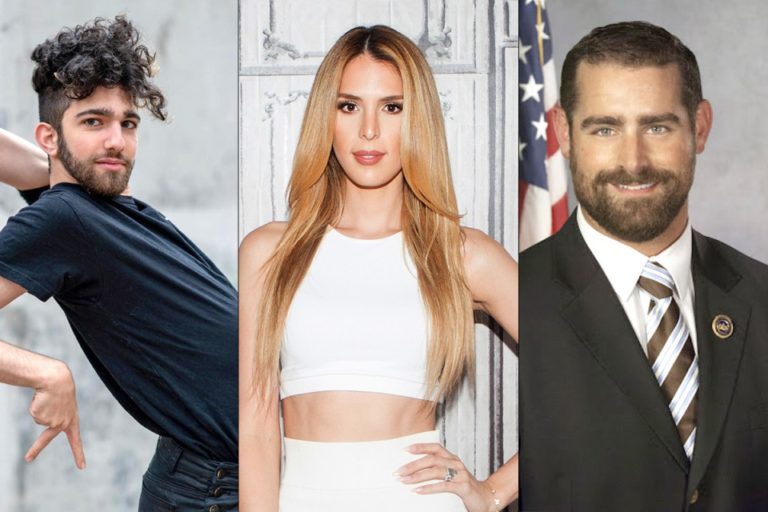
Unleashed LGBTQ speakers: Gravity Balmain, Carmen Carrera, Brian Sims
A week after the mammoth South By Southwest festival and conference — taking place virtually this weekend — comes a new meeting and marketing showcase that organizers are touting as a “gay SXSW” with a spotlight on “the best in entertainment and consumer tech for those game-changers who identify as LGBTQ.”
“Our goal is to create an LGBTQ event on par with ‘South By’ with more of a focus on new and emerging brands,” Wesley Smoot, producer of Unleashed LGBTQ, says in a statement. “We’ve curated a diverse and engaging slate of brands and presenters aimed exclusively at the LGBTQ market.”
Smoot adds that the inaugural virtual event is open “to anybody and everybody who wants to attend, thereby creating a community and offering an immersive, entertaining escape to the cooped-up confines of what has been a difficult year for all of us.”
The three-day event will offer educational and informative keynote addresses and discussion panels on topics of interest to business, marketing, and nonprofit executives during the day, then switching to entertaining content in the evening, ranging from virtual fashion shows to interviews and performances to the daily Unleashed LGBTQ Happy Hour serving up craft cocktails and hot topics.
Participants include Pennsylvania State Rep Brian Sims, vogue dancer Gravity Balmain from HBO’s Legendary, actress and entrepreneur Carmen Carrera, comedian Matteo Lane, TV and film casting director Mike Page, and retired football player Michael Sam, Martin Stark of World Gay Boxing Championships.
Marketing and management professionals include Stacey Chosed of AT&T, Andy Kraut of Grindr, and Celia Sandhya Daniels of TransCanWork and Indivisible: Conejo’s LGBTQ+ Issue Action Team. Other partner brands represented at the event include AussieBum, Gilead, iHeartRadio’s PRIDE Radio, Legacy Counseling Center, RIDE BodyWorx lube, Romperjack, the Trevor Project, and Dallas’s gay He Said Magazine.
Thursday, March 25, through Saturday, March 27. All events will take place through the WebinarJam platform. Free and open to all 18 and over, with registration required. Visit www.UnleashedLGBTQ.com.
These are challenging times for news organizations. And yet it’s crucial we stay active and provide vital resources and information to both our local readers and the world. So won’t you please take a moment and consider supporting Metro Weekly with a membership? For as little as $5 a month, you can help ensure Metro Weekly magazine and MetroWeekly.com remain free, viable resources as we provide the best, most diverse, culturally-resonant LGBTQ coverage in both the D.C. region and around the world. Memberships come with exclusive perks and discounts, your own personal digital delivery of each week’s magazine (and an archive), access to our Member’s Lounge when it launches this fall, and exclusive members-only items like Metro Weekly Membership Mugs and Tote Bags! Check out all our membership levels here and please join us today!
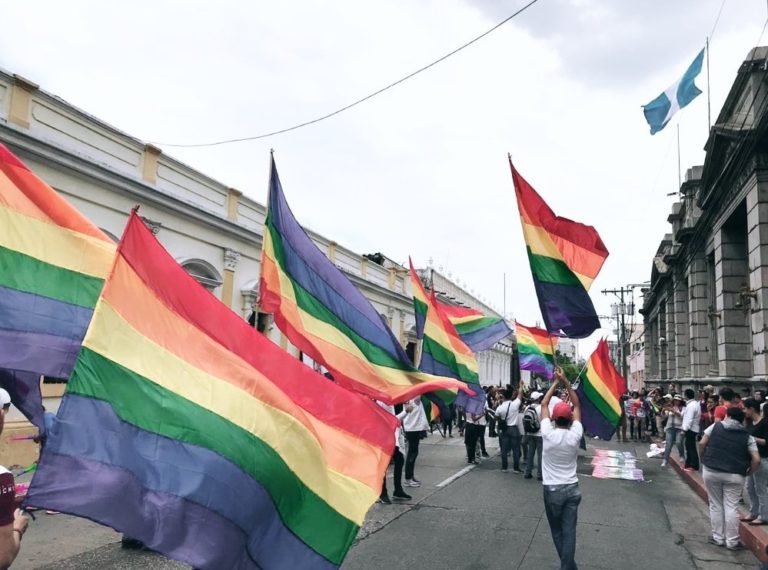
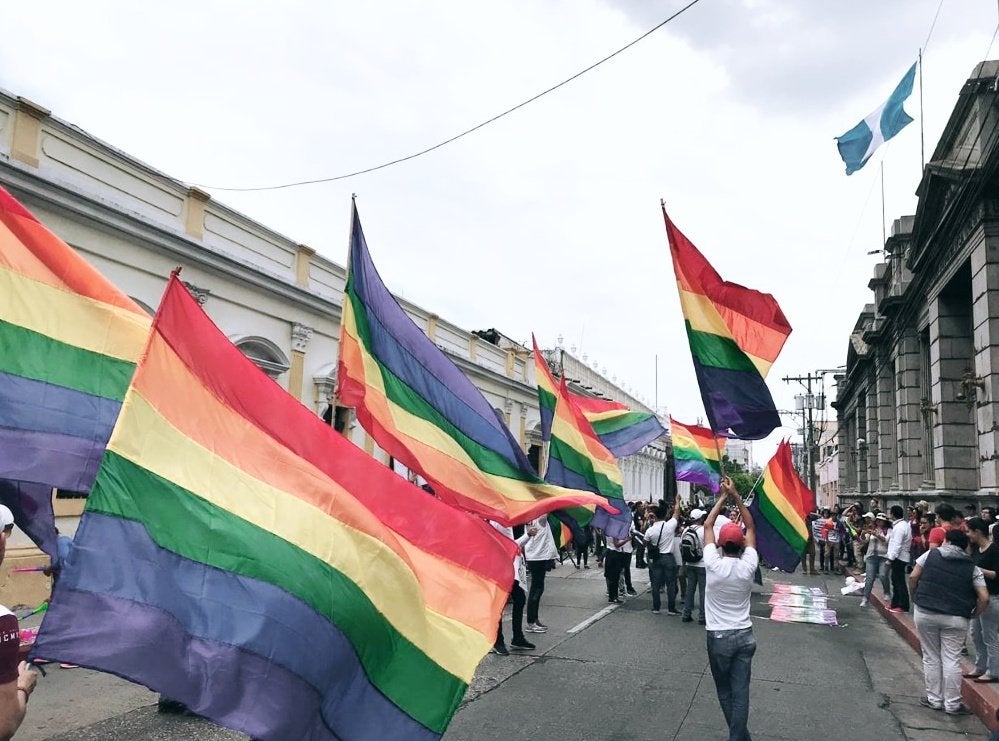
“We know where you live, we’re going to kill you.” Those words echoed in Ale’s mind long after she left Guatemala to seek asylum. The men who threatened her had phoned to extort her nearly every day for two months in 2018, calling her homophobic slurs and misgendering her.
Ale’s case was one of dozens that Human Rights Watch documented in a report published in March 2021 on violence and discrimination against lesbian, gay, bisexual, and transgender (LGBT) people in Guatemala. Perpetrators included public security agents, gangs, and the general public. Human Rights Watch conducted the research in 2019 and 2020, but 2021 is shaping up to be just as dangerous for LGBT Guatemalans. The Human Right Ombudsperson’s Office reports that during the first month of 2021, at least five gay and trans people were killed in the country.
Guatemalan authorities should prioritize LGBT people’s protection, but they are often part of the problem. In Ale’s case, when she reported the calls to the police, they responded with homophobic slurs rather than assistance.
Last month, Galilea Monroy de León, director of the transgender rights organization REDMMUTRANS, said police stopped her in the street while searching for someone accused of stealing a firearm. When Monroy asked for a female police officer to search her, an officer said, “You are a man, look at your genitals.” Shoved against a wall, Monroy explained that she is a human rights defender. A police officer said, “To hell with human rights.” REDMMUTRANS is calling for an investigation into this incident by National Civil Police and the Public Prosecutor’s Office.
Cases like Monroy’s are common in Guatemala, and many authorities’ anti-LGBT bias leaves LGBT people exposed to insidious levels of violence and discrimination. Congress should take meaningful steps to increase protections for LGBT people, including by passing Initiative 5674, which would address hate crimes and require the government to establish a comprehensive national plan to protect LGBT and intersex rights. It should also scrap the discriminatory “Life and Family Protection” bill and stop harassing authorities for supporting LGBT rights.
Monroy says she is committed to getting justice for the discrimination she experienced so that other trans people do not face a similar fate. It is time that Guatemalan authorities join her in that fight.
Monday April 5, 2021 Originally published on March 18, 2021
(Source:Getty Images)
In July 2020, San Francisco lifted restrictions that had effectively barred gay bathhouses from operating there for over three decades. For owners of public sex venues, would-be patrons, and anyone who considers that San Francisco is literally the gayest city in the country, the legislation was historic. Its timing, of course, could not have been more curious.
The bygone regulations, which prohibited locked doors and unmonitored play spaces, had been in place since 1984, as HIV/AIDS decimated the queer community, paranoia was near a fever pitch, and reliable information remained scarce. As public health measures, the rules were incredibly misguided. Bathhouses, and other businesses that facilitate sexual contact, have since proven to be pivotal vectors for disseminating health information and facilitating screening and prevention measures for HIV and other STIs.
That San Francisco’s reversal came as another epoch-defining virus circled the globe seemed like a cosmic course correction. There was some confusion at first. A few critics were outraged at the idea that public sex might be happening in person while public school was not. The July legislation has simply allowed for new bathhouses to potentially break ground and operate in the future, however, once coronavirus conditions allow for other types of businesses to open as well.
The pandemic has been disastrous for LGBTQ businesses, which are weathering dire straits like much of the economy, from bars and hotels to retail. Many nightlife venues have thrown in the towel or are relying on the life support of crowd-funding campaigns. COVID-19 has only accelerated an alarming trend; research suggests that the number of bars serving LGBTQ patrons has declined by nearly 40% since 2007, due in part to gentrification, the rise of digital means for social and sexual connection, and broader overall acceptance lessening the need for queer safe spaces, particularly in urban areas.
Currently, the majority of bathhouses and sex clubs in the U.S. are either closed or operating at limited capacity. Some have shuttered permanently, including, most recently, New York City’s historic Westside Club. Watergarden in San Jose, Calif, and Crew Club in D.C. are gone, too, with more likely to follow. In so many ways, the road ahead for these businesses looks challenging and uncertain. But COVID-19 has upended life as we know it, and bathhouses facilitate two social needs that have been thrown into especially sharp relief: Sex and public health consciousness.
A History of Public Health Intervention
(Source: Getty Images)
Though many sectors of the service industry, from restaurants to salons, operate under government health regulations, few have a similar history to bathhouses of direct intervention during an acute public health crisis. Venues that facilitated on-premises sex became crucial centers for information and prevention during the height of the HIV/AIDS epidemic and long afterward. Free condoms, STI testing, clear guidance about safe sex, and, more recently, information about PrEP, are all standard practice at bathhouses and similar facilities.
“The bathhouses participated in making sure people knew how to prevent HIV transmission, and provided an environment in which you could choose to prevent infection by having condoms and testing available,” says William Woods, Ph.D., professor emeritus of medicine at UCSF, who specialized in HIV prevention research. Attention toward halting the transmission of deadly disease became a built-in part of running public sex venues. That’s new territory for nearly every other type of business when it comes to slowing the spread of the coronavirus.
HIV and COVID-19 obviously pose very different threats to public health: transmission through respiratory droplets makes the coronavirus everyone’s concern. But while everyday businesses from big box stores to banks recently experienced a crash course in safeguarding patron health — with mask requirements, social distancing, enhanced cleaning measures, and the like — bathhouses have been operating with an eye toward disease prevention for decades.
“Replace the condoms with masks, and instead of just bathhouses asking people to change their behavior and use protections, other public environments like airplanes, grocery stores, and churches are all doing that same thing,” Woods says.
Bathhouses, in other words, already had a head start on what has become a whole new way of doing business under the threat of COVID-19. Notably, most of them have existing relationships with local health officials.
“Bathhouses have been working hand in hand with public health for over 30 years,” says Chris S., board president of the North American Bathhouse Association (NABA), who asked not to be identified by his last name. “Most of us have public health officials on speed dial.” In fact, the crackdown and closures that bathhouses and sex clubs faced in the 1980s meant those that survived have been hyperaware of operating in accordance with local health regulations. Not only would violations risk sanction, but patrons wouldn’t likely flock to establishments that had been cited for flouting cleanliness or safety.
Bathhouses may be more likely than churches to be stigmatized as potential sites of coronavirus spread, despite proof religious services have facilitated multiple superspreader events. But due to their close relationships with local health departments, there’s little reason to believe bathhouses will face greater hurdles to reopening than other types of businesses.
“Regulators can decline to allow bathhouses to operate any time they wish,” Woods says. “But I don’t believe they would use the current pandemic as a reason to keep them closed.”
Masked for Masked: How Bathhouses Are Handling Pandemic Operations
(Source: Getty Images)
Despite the intimacy of physical contact inherent to public sex venues, Chris suggests bathhouses offer heightened levels of COVID safety in several ways.
“If you think about it, bathhouses are probably one of the cleanest places to engage someone,” Chris says. Bathhouses tend to be equipped with sophisticated air filtration systems, like HVAC with UV filters, to reduce humidity and the risk of unpleasant smells. That’s better air quality than might reasonably be expected of many indoor spaces, from retail shops to hotel lobbies.
Around half of the 35 to 50 bathhouses with membership to NABA, which offers logistical and community support to owners and managers, are currently operational, Chris says. Regulations vary by state, but most are licensed as gyms or health clubs and subject to the same restrictions. As the country continues its piecemeal approach to reopening, some are back in operation after long closures and others still in a waiting game. While venues in Georgia, Texas, and Florida are all open, for example, many locations in states with stricter COVID regulations, like California and Illinois, remain closed.
Of the bathhouses that are open around the country, Chris says none are operating at full capacity, with reduced numbers allowed in locker rooms and other areas. Saunas and steam rooms are mostly closed, and Chris estimates that more than 70% of all play spaces are as well. Masks are required to walk around, and he says enforcement has been strong even between patrons, who don’t want to see the establishments close. The venues’ chief attraction, private rooms, operate much like a hotel — what happens behind a closed door is up to you.
Gay resorts that offer bathhouse amenities alongside more traditional hotel stays are also operating under local COVID-safety regulations. At Island House in Key West, resort guests are required to wear face coverings unless they’re using facilities like the sauna or gym, which are capped at two and three guests each, respectively. “Social distancing and respect for other guests and staff is mandated,” according to the resort’s website. Outside visitors to hotel guests are permitted, but they must register with the front desk and sign a waiver. Temperature checks may be required of anyone who enters the premises.
In addition to masks and a tendency toward personal hygiene, Chris points to temperature checks and collection of identification as routine practice (the latter could potentially facilitate contact tracing). NABA has advised members on strategies to enhance procedures even further. PPE and safety protocol to protect venue employees remains paramount as well. The prevalence of asymptomatic spread means that temperature checks and self-reporting symptoms may add up to half-measures, though they remain the standard baseline for many businesses.
Bathhouse partnerships with local health officials that include on-site STI screenings could eventually extend to include COVID testing or other interventions, Chris suggests. In many cases, that infrastructure already exists, with designated areas where patrons know they can access health services. In fact, at least a few bathhouses may be on the verge of serving an even more vital role in combating the pandemic.
Beyond Glory Holes: Could Bathhouses Bounce Back?
(Source: Getty Images)
Health officials in at least two cities have recognized that certain local facilities, sitting empty with dozens of private rooms, might be useful for a particularly urgent effort: COVID vaccination. According to Chris, locations in Chicago and Toronto have been surveyed by health departments as potential sites for the administration of COVID vaccines, though no decisions have yet been made.
Regardless of outcome, bathhouses landing on a short list of potential vaccination sites demonstrates the level of cooperation and trust they’ve developed with public health officials since the 1980s. The misconceptions behind San Francisco’s former bathhouse ban had become more and more apparent by the time City Supervisor Rafael Mandelman spearheaded the recent legislation to overturn it.
“It became clear, not just to advocates but also to the department [of health], that public health rationale for keeping bathhouses closed, whether or not it was valid in the first place, was not valid in 2018, when this conversation started,” Mandelman says. The timing of the bill’s ultimate passage two years later, during the coronavirus pandemic, may have been coincidental. But it has raised the question of what role such businesses could play in that city’s eventual recovery, and the future outlook for public sex venues around the U.S.
“I do think that really well-run bathhouses could actually be a great part of reviving some of San Francisco’s historically queer neighborhoods,” Mandelman says. The flip side of an economic downturn is a shakeup of the status quo, and potential for new business ventures down the road. “I do think that this is a moment, maybe in other places too, where there is such a blank slate in terms of vacant space,” Mandelman says, “and a willingness on the part of government to think about new ways of doing things.”
But opening a new bathhouse is expensive and complex, perhaps prohibitively so, even for experienced owners. Banks won’t lend to them based on the nature of their business, Chris says, so capital would be needed upfront at a time when business owners are still suffering.
“I wouldn’t say any of us are excited yet,” Chris says, though he considers that perhaps once COVID recedes and cash flows stabilize, a consortium of existing bathhouse owners might be able to pull it off. (An abandoned gym, which already has the necessary plumbing he says, would be their best bet.)
In addition to potential economic drivers, bathhouses will likely continue to serve as meaningful centers of community, fostering social and sexual connections that affirm identity and benefit mental health. Maybe even more so, considering how eager people will be for sexual contact and potentially tired of looking for it online. “People have pointed out that the roaring ’20s followed the [1918 flu] pandemic,” Mandelman says, and that prolonged social isolation may have made people hungrier for connection.
Despite tough times, Chris says nearly all of NABA’s surviving members have invested in renovations with an eye toward eventual reopening, from modest touch-ups to new saunas and re-tiled showers. Glory holes will abound, of course, along with other play spaces that may be creatively constructed with both sex and safety in mind. But playgrounds without patrons could amount to all potential and no payoff. As the dust settles on turbulent times, the question remains: If they build it, will we come?
“As an industry, we’re hoping that business comes back maybe even better than before, because people realize we need these spaces,” Chris says. “You don’t value it until it’s gone.”
Naveen Kumar is a culture writer and editor whose recent work appears on them.us, The Daily Beast, The Hollywood Reporter, and The New York Times.
Mr. Biden was impressed by Mr. Becerra’s personal story, according to a person familiar with his thinking. In particular, the president-elect liked the fact that Mr. Becerra served clients with mental health needs shortly after graduating from law school, the person said.
While in Congress, Mr. Becerra was a fierce advocate of the Latino community and became deeply involved in efforts to overhaul the nation’s immigration system. He also promoted plans to build a national museum devoted to exploring the culture and history of American Latinos. The House voted this year to create such a museum.
Representative Filemon Vela, Democrat of Texas, praised Mr. Biden’s choice of Mr. Becerra, calling it “historic” and saying the California attorney general was the right person to lead the sprawling agency during the worst public health crisis in 100 years.
“Becerra will lead an agency that will play a crucial role in overseeing a massive immunization effort and help manage a bolstered federal response to tackle the worsening Covid-19 crisis,” Mr. Vela said. “He will also help shape the Biden administration’s efforts to build on the Affordable Care Act.”
In the late 1990s, Mr. Becerra traveled to Cuba and visited with its leader, Fidel Castro, which infuriated Republican members of the Congressional Hispanic Caucus. They resigned, saying they were “personally insulted” by the visit.
Mr. Biden’s selection of Mr. Becerra to replace the current secretary, Alex M. Azar II, comes as the president-elect is under increasing pressure from the Latino community and the Congressional Hispanic Caucus to diversify his cabinet. Mr. Becerra is the second Latino Mr. Biden has chosen for his cabinet after the selection last month of Alejandro N. Mayorkas, a Cuban immigrant, as secretary of homeland security.
Gov. Michelle Lujan Grisham of New Mexico had been thought to be in line for the health secretary’s job, but she apparently fell out of the running. Instead, news leaked last week that Ms. Lujan Grisham had been offered, and turned down, the position of interior secretary.