A Louisiana man was indicted and charged today in federal court in the Western District of Louisiana on six counts, including hate crime, kidnapping, firearm and obstruction charges.
Chance Seneca, 19, of Lafayette, was charged by a federal grand jury on March 18 based on his attempted murder of a gay man and his overarching scheme to kidnap and murder gay men whom he met online.
The indictment alleges that on June 19 and 20, 2020, Seneca attempted to kidnap one man and successfully kidnapped two other men through his use of Grindr, a dating application for gay and bisexual men. The indictment further alleges that the defendant attempted to murder one of these men because of his gender and sexual orientation, and that the defendant intended to dismember and keep parts of the victim’s body as trophies, mementos and food. The indictment further alleges that the defendant possessed a firearm in furtherance of the hate crime, and that he tried to cover up his actions by deleting communications between himself and the victim of the attempted murder.
The statutory maximum for the hate crime, kidnapping and firearm offenses is life imprisonment. The statutory maximum for the attempted kidnapping and obstruction offenses is 20 years. The statutory minimum for the gun charge is five years.
The indictment was announced today by Acting U.S. Attorney Alexander C. Van Hook for the Western District of Louisiana, Principal Deputy Assistant Attorney General Pam Karlan of the Justice Department’s Civil Rights Division and FBI New Orleans Special Agent in Charge Bryan Vorndran.
The FBI conducted the investigation. This case is being prosecuted by Assistant U.S. Attorney Robert Abendroth of the Western District of Louisiana and Trial Attorney Thomas Johnson of the Civil Rights Division.
An indictment is merely an accusation, and the defendant is presumed innocent unless proven guilty.
For more information and resources on the department’s efforts to combat hate crimes, visit www.justice.gov/hatecrimes.
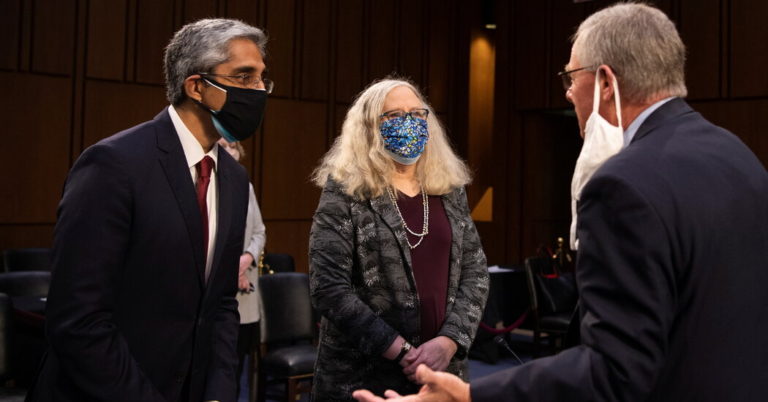
“There are a lot of people who might have trusted their instincts before, but that trust has been eroded,” Dr. Lurie said. “They need to be sure that they are doing the right thing and that if they step out and do something now that is perceived as risky that nobody is going to cut their neck off for it.”
Dr. Levine, a pediatrician and former secretary of health in Pennsylvania, has found herself targeted by Mr. Severino, who said he met with Dr. Levine early in his tenure at the department. At the time, he was considering whether to amend an anti-discrimination rule in the Affordable Care Act that the Obama administration had interpreted as protecting transgender people; the Trump administration ultimately cut back those protections.
While he said they engaged in a “very respectful dialogue and a good exchange,” he challenged Dr. Levine about whether she would favor hormone blockers or sex reassignment surgery for minors — topics that Senator Paul raised during Dr. Levine’s confirmation hearing.
“You’re willing to let a minor take things that prevent their puberty, and you think they get that back?” Senator Paul, who is an ophthalmologist, said angrily at one point. “You give a woman testosterone enough that she grows a beard — you think she’s going to go back looking like a woman when you stop the testosterone?”
Dr. Levine replied, “Transgender medicine is a very complex and nuanced field with robust research and standards of care.”
Detractors have seized on a 2017 speech that Dr. Levine gave describing hormone therapy as a standard of care for transgender youth, and also on a Twitter post she made in January 2020 about a study showing that transgender youth with access to puberty blocking drugs are at decreased risk of suicide.
After the hearing, Senator Chuck Schumer, Democrat of New York and the majority leader, denounced Republicans for “their attacks on trans people,” which he called, “just mean, mean and show a complete lack of understanding, a complete lack of empathy.” In a statement on Wednesday, Senator Bob Casey, Democrat of Pennsylvania, said Senator Paul’s “questioning was transphobic and a source of pain for many Americans, particularly transgender youth.”
With the COVID-19 pandemic, fashion this year has been quite unlike any other. From Instagram releases to livestreamed shows to videos, fashion titans have been creatively (and virtually) transforming the traditional runways. But for us nonindustry folks, here’s an interesting question — is fashion still a thing? For me, perpetually living in the same two mismatched lounge pants and shirt has been my reality. But Vogue magazine said, “If there’s been one fashion lesson learned during lockdown, it’s that personal style doesn’t disappear in difficult times.” If Vogue said it, then it must be true, right? So whether you’re still dressing up every morning, polished with a full face of makeup, or you’re like me, a bit frazzled and feeling as if you deserve a gold star every time you match up both socks, we can dream together of frolicking in designer get-ups while we empty our last drops of coffee before stuffing our noses into study guides. Your midterm can wait because we’re going to talk fashion.
We consulted some trusted sources to determine what’s hot right now. First, we’ll start with what we believe can stay.
Vogue: Miniskirts and shorts
“It’s a tale as old as time: The weather heats up and hemlines rise.”
While it’s still chilly enough right now in the Bay Area to throw on some fleece-lined tights, it’s nice to think that soon, heavy coats will give rise to silky shorts once more. “Mini” is a great word, as it brings to mind “layering.” Lots of creative choices are up ahead.
The Trend Spotter: Black face masks
“When it comes to protecting yourself, you may as well do it beautifully.”
We can’t say it any better than this. Masking is extremely important, and just because case counts are falling, it doesn’t mean we should be slacking off on protecting ourselves and others. But picking a classic and sleek color and style can make it more fun, so here’s a little challenge: Match your outfits while covering your mouth and nose.
Harper’s Bazaar: Button-down, but make it oversized
“How passé to believe your oversized shirting is your ‘husband’s shirt,’ your ‘dad’s shirt,’ or ‘borrowed from the boys.’”
How passé to believe the only time button-downs can be worn is when you’re networking, and under a blazer at that! We’re thinking billowing silhouettes, as a dress, over large trousers, tucked in. There are so many ways to wear this, and none of them are wrong.
InStyle: Matching sets
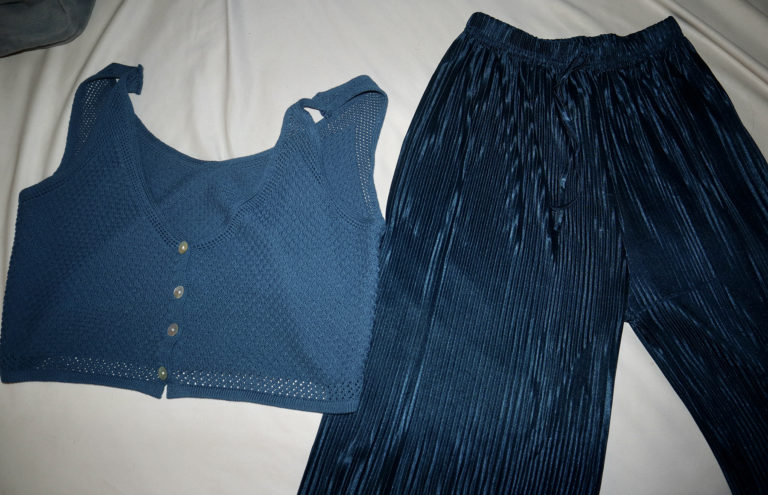
“Yes, matching sets and sweatsuits can still be worn around the house, but they work for social settings, too.”
Few of us college students think about putting together a professional wardrobe prior to graduation, but now might actually be the best time to start. As clothing can get expensive, particularly quality professional pieces (think Lafayette 148), starting early can mean creating a lasting classic wardrobe instead of throwing together a chaotic mess at the very last minute, just to purge it all when you get another paycheck. And what easier way than to buy already-made sets?
We’re excited about all these trends that quarantine has brought us, but there some that just don’t make the cut.
Who What Wear: Built-in G-strings
“As if 2020 wasn’t freaky enough, we’re here to report on one more freaky thing that is guaranteed to show up in 2021. The trend we speak of is G-strings — built-in ones to be exact.”
So, what is this really? It’s the “exposed underwear look.” Cue Paris Hilton à la the early 2000s. Not convinced it’s back in style? Ask Givenchy, LaQuan Smith and Versace. And, of course, when the fashion houses produce, everyone else copies. So maybe just check out Instagram and your favorite online retailers. Of course, my distaste of it is not rooted in its sexy appeals. Supporters, I’m sure you all pull it off very well, and cheers to you beauties. I’m just not a fan.
Fortunately, 2021 has so far confirmed that fashion is still alive and well, and even though we may have adjusted our lives to fit a new normal, things around us are still moving, changing and transforming (here’s to hoping built-in G-strings transform out of here). We can slow down or ride the waves. We can also start anew. It’s fashion we’re talking about after all, so when it comes to personal style, it’s all you.
The Kansas Senate voted 24-10 to pass a bill that bans transgender athletes in girl’s and women’s school sports. The proposal now goes to the Republican-controlled House.Democratic Gov. Laura Kelly on Wednesday derided the proposed ban on transgender athletes in girls’ and womens’ school sports as “regressive.”Kelly predicted ahead of a state Senate debate on the bill that the policy would make it more difficult to recruit businesses to the state. But supporters dismissed her criticism, and the measure was a priority for top Republicans in the Senate, where the GOP has a supermajority.Republicans in Congress and more than 20 state legislatures are pushing for similar bans, though supporters largely haven’t been able to cite examples of transgender students’ participation causing problems. Idaho enacted a similar law last year that’s being challenged in federal court, and Mississippi Republican Gov. Tate Reeves signed a measure into law last week.Kelly stopped short Wednesday of promising to veto the Kansas measure if it passes the Senate and then the House, as supporters expect. However, she pointed to a past executive order on LGBTQ rights as signaling her position. A day after taking office in 2019, Kelly prohibited discrimination based on sexual orientation or gender identity in state hiring or employment decisions.“We know from lots of experience in other states that when you implement these kinds of regressive social policies that you significantly decrease the ability to attract businesses here,” Kelly said. “Businesses want us to be inclusive.” The state association that oversees middle and high school activities in Kansas has said it knows of only five transgender students currently active in K-12 activities, and there’s no record of any transgender school sports champions. Supporters argue that a ban would promote fairness in girls’ and women’s sports and repeatedly point to the 15 championships won between 2017 and 2019 by two transgender high school runners in Connecticut, which prompted a federal lawsuit.Supporters of the Kansas bill also said they’re protecting the hard-won opportunities in sports and other activities since federal civil rights laws in the 1970s.“It’s a very positive step for girls in Kansas,” said Brittany Jones, advocacy director for the conservative Family Policy Alliance of Kansas. “Courts have consistently held that there are differences between men and women that matter in select instances. Athletics is one of those instances. Girls desire a fair playing field. That is all this bill provides. To every female athlete – this is a declaration that there is a place for you to shoot for the stars in Kansas.”State Sen. Renee Erickson, a Wichita Republican, said it’s fairer for Kansas to impose the ban before transgender athletes participate widely in girls’ and womens’ sports. She said Kelly “put money over what’s best for our women” by worrying about business recruiting. “It simply requires an equal and level playing field for women and girls, what we’ve had in place,” said Erickson, a former college basketball player. Senate Minority Leader Dinah Sykes, a Kansas City-area Democrat, called the measure “hateful” and “rooted in bigotry.” And she grew irritated during the debate with a key message from supporters of the bill, that natural differences mean that men are naturally the superior athletes in almost every sport.“I appreciate several of my male colleagues telling me how they want to protect the underdog, how men are superior. I actually find that rather misogynistic and rude,” she said. “Excluding women who are trans hurts all women.”LGBTQ-rights advocates see the bill as an attack on transgender kids that is likely to increase bullying of them, and they argue that the debate itself is damaging their mental health. “They’ve gotten some affirmation, and now they’re seeing that being stripped and being stripped by a governmental organization,” said first-term state Rep. Stephanie Byers, a Wichita Democrat and Kansas’ first transgender lawmaker. Sen. Mark Steffen, a Republican from south-central Kansas and an anesthesiologist, said the bill was based on “indisputable physiological facts” that demonstrate “the male as a genetically and time-engineered superior machine.” Sen. Virgil Peck, a southeast Kansas Republican, said he backed the bill because he believes in ”old-fashioned chivalry” and wants to take a stand for “young ladies, natural-born females.”“Have we – men – given away our manpower to the snowflakes? Are we going to allow someone to carry around our manhood in their fanny pack or in their purse?” Peck said. “Are there no longer any alpha males who will stand and defend our young ladies, our wives, our daughters, our granddaughters, our neighbors’ wives, daughters, and granddaughters?”
TOPEKA, Kan. —
The Kansas Senate voted 24-10 to pass a bill that bans transgender athletes in girl’s and women’s school sports. The proposal now goes to the Republican-controlled House.
Democratic Gov. Laura Kelly on Wednesday derided the proposed ban on transgender athletes in girls’ and womens’ school sports as “regressive.”
Advertisement
Kelly predicted ahead of a state Senate debate on the bill that the policy would make it more difficult to recruit businesses to the state. But supporters dismissed her criticism, and the measure was a priority for top Republicans in the Senate, where the GOP has a supermajority.
Republicans in Congress and more than 20 state legislatures are pushing for similar bans, though supporters largely haven’t been able to cite examples of transgender students’ participation causing problems. Idaho enacted a similar law last year that’s being challenged in federal court, and Mississippi Republican Gov. Tate Reeves signed a measure into law last week.
Kelly stopped short Wednesday of promising to veto the Kansas measure if it passes the Senate and then the House, as supporters expect. However, she pointed to a past executive order on LGBTQ rights as signaling her position. A day after taking office in 2019, Kelly prohibited discrimination based on sexual orientation or gender identity in state hiring or employment decisions.
“We know from lots of experience in other states that when you implement these kinds of regressive social policies that you significantly decrease the ability to attract businesses here,” Kelly said. “Businesses want us to be inclusive.”
The state association that oversees middle and high school activities in Kansas has said it knows of only five transgender students currently active in K-12 activities, and there’s no record of any transgender school sports champions.
Supporters argue that a ban would promote fairness in girls’ and women’s sports and repeatedly point to the 15 championships won between 2017 and 2019 by two transgender high school runners in Connecticut, which prompted a federal lawsuit.
Supporters of the Kansas bill also said they’re protecting the hard-won opportunities in sports and other activities since federal civil rights laws in the 1970s.
“It’s a very positive step for girls in Kansas,” said Brittany Jones, advocacy director for the conservative Family Policy Alliance of Kansas.
“Courts have consistently held that there are differences between men and women that matter in select instances. Athletics is one of those instances. Girls desire a fair playing field. That is all this bill provides. To every female athlete – this is a declaration that there is a place for you to shoot for the stars in Kansas.”
State Sen. Renee Erickson, a Wichita Republican, said it’s fairer for Kansas to impose the ban before transgender athletes participate widely in girls’ and womens’ sports. She said Kelly “put money over what’s best for our women” by worrying about business recruiting.
“It simply requires an equal and level playing field for women and girls, what we’ve had in place,” said Erickson, a former college basketball player.
Senate Minority Leader Dinah Sykes, a Kansas City-area Democrat, called the measure “hateful” and “rooted in bigotry.” And she grew irritated during the debate with a key message from supporters of the bill, that natural differences mean that men are naturally the superior athletes in almost every sport.
“I appreciate several of my male colleagues telling me how they want to protect the underdog, how men are superior. I actually find that rather misogynistic and rude,” she said. “Excluding women who are trans hurts all women.”
LGBTQ-rights advocates see the bill as an attack on transgender kids that is likely to increase bullying of them, and they argue that the debate itself is damaging their mental health.
“They’ve gotten some affirmation, and now they’re seeing that being stripped and being stripped by a governmental organization,” said first-term state Rep. Stephanie Byers, a Wichita Democrat and Kansas’ first transgender lawmaker.
Sen. Mark Steffen, a Republican from south-central Kansas and an anesthesiologist, said the bill was based on “indisputable physiological facts” that demonstrate “the male as a genetically and time-engineered superior machine.”
Sen. Virgil Peck, a southeast Kansas Republican, said he backed the bill because he believes in ”old-fashioned chivalry” and wants to take a stand for “young ladies, natural-born females.”
“Have we – men – given away our manpower to the snowflakes? Are we going to allow someone to carry around our manhood in their fanny pack or in their purse?” Peck said. “Are there no longer any alpha males who will stand and defend our young ladies, our wives, our daughters, our granddaughters, our neighbors’ wives, daughters, and granddaughters?”
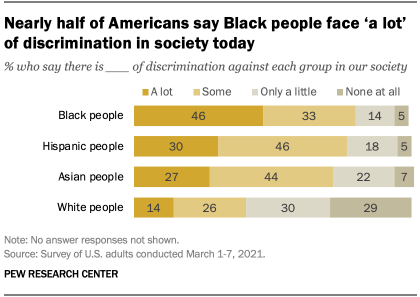
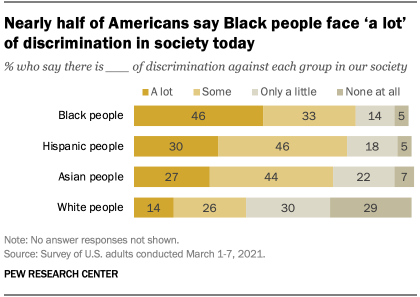
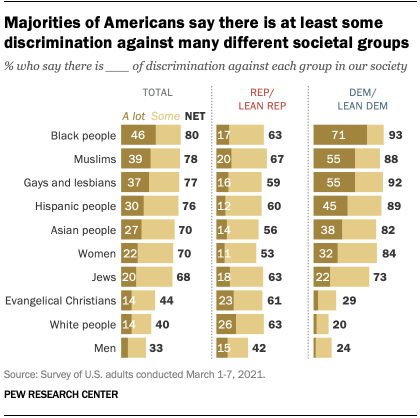
Large shares of Americans say there is at least some discrimination against several groups in the United States, including 80% who say there is a lot of or some discrimination against Black people, 76% who say this about Hispanic people and 70% who see discrimination against Asian people.
Nearly half of Americans (46%) say there is “a lot” of discrimination against Black people. About three-in-ten see a lot of discrimination against Hispanic people (30%) and Asian people (27%).
Americans are much less likely to say there is discrimination against White people: 40% say White people face at least some discrimination, and just 14% say White people face a lot of discrimination, according to a Pew Research Center survey conducted March 1-7, 2021.
The survey was fielded before the March 16 Atlanta-area shootings in which six of the eight victims were Asian women. Also, these questions ask Americans about their perceptions of discrimination against groups of people rather than about violence or individuals’ personal experiences with discrimination or violence; see “How we did this” for additional resources on those subjects.
To assess public perceptions of discrimination against various groups of people in the U.S., Pew Research Center surveyed 12,055 U.S. adults March 1-7, 2021.
The survey was fielded both before President Joe Biden’s March 10 address, in which he called attention to and condemned a rise in violence against Asian Americans and before the March 16 mass shootings in the Atlanta area in which seven women – six of whom were Asian women – and one man were killed by a White man.
This question is designed to ask about perceptions of discrimination, which can – and often do – contrast with measures of individuals’ experiences of discrimination. While views of discrimination may be related to views about violence against groups, these are also different questions.
Everyone who took part in this survey is a member of Pew Research Center’s American Trends Panel (ATP), an online survey panel that is recruited through national, random sampling of residential addresses. This way nearly all U.S. adults have a chance of selection. The survey is weighted to be representative of the U.S. adult population by gender, race, ethnicity, partisan affiliation, education and other categories. Read more about the ATP’s methodology.
Views of discrimination against racial and ethnic groups vary widely by race and ethnicity, as well as along partisan lines.
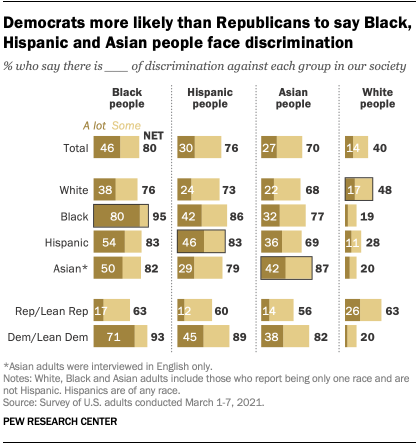
While large majorities of White, Hispanic and Asian American adults all say that Black people face at least some discrimination, Black Americans are far more likely to say that Black people face a lot of discrimination. Eight-in-ten Black adults say this, as do 54% of Hispanic adults, half of Asian adults and 38% of White adults. And almost all Black adults (95%) say that Black people face at least some discrimination.
Black adults and Hispanic adults are about equally likely to say there is a lot of discrimination against Hispanic people, while White and Asian adults are substantially less likely to say this.
Sizable majorities across racial and ethnic groups say Asian people face at least some discrimination; 42% of Asian Americans say that Asian people face a lot of discrimination. By comparison, 36% of Hispanic people, 32% of Black people and 22% of White people say the same.
White adults are by far the most likely to say that White people face at least some discrimination in our society: About half (48%) say this. Those in other racial and ethnic groups are much less likely to say White people face discrimination (28% of Hispanic adults say this, as do about two-in-ten Black and Asian adults).
Democrats and Democratic-leaning independents are far more likely than Republicans and Republican leaners to say that Black people, Hispanic people and Asian people face a lot of discrimination, and far less likely than Republicans to say that White people face discrimination.
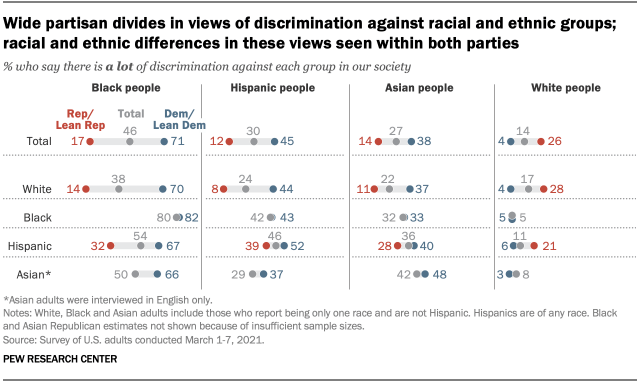
About seven-in-ten Democrats (71%), compared with 17% of Republicans, say that Black people face a lot of discrimination. White Democrats are 56 percentage points more likely than White Republicans to say this, and the gap between Hispanic Democrats and Hispanic Republicans is 35 points. While majorities of Democrats across racial and ethnic groups say Black people face a lot of discrimination, 82% of Black Democrats say this – a larger majority than among White (70%), Hispanic (67%) or Asian (66%) Democrats.
Overall, 45% of Democrats say Hispanic people face a lot of discrimination, while 12% of Republicans say the same. Hispanic Democrats (52%) are both more likely than Hispanic Republicans (39%) and more likely than Democrats in other racial and ethnic groups – Asian (37%), Black (43%) and White (44%) Democrats – to say this. Just 8% of White Republicans say there is a lot of discrimination against Hispanic people.
Similarly, while there is a wide partisan gap in views of whether Asian people face a lot of discrimination (38% of Democrats and 14% of Republicans say this), Asian Democrats (48%) are more likely than Hispanic (40%), White (37%) and Black (33%) Democrats to say this.
While Democrats are more likely than Republicans to say Black, Hispanic and Asian people face discrimination, Republicans are much more likely than Democrats to say that there is a lot of discrimination against White people in society today. About a quarter of Republicans (26%) say that White people face a lot of discrimination; just 4% of Democrats say this. White Republicans are 24 percentage points more likely than White Democrats to say that White people face a lot of discrimination.
Aside from racial and ethnic groups, the survey asks about discrimination against other groups in society, including gays and lesbians, women and men, Muslims, Jews and evangelical Christians.
Majorities of Americans say that Muslims, Jews, gays and lesbians, and women all face at least some discrimination in today’s society, while fewer than half (44%) say that evangelical Christians face some or a lot of discrimination.
Men are viewed as facing the least discrimination among groups included in the survey, with just one-third of adults saying that men face at least some discrimination.
Similar shares – including majorities of both Republicans and Democrats – say that Muslims (78%) and gays and lesbians (77%) face at least some discrimination, with 39% saying Muslims face a lot of discrimination and 37% saying gays and lesbians do.
Two-thirds of Americans say that Jews in the U.S. face at least some discrimination, including majorities of both Republicans and Democrats. Partisans are more divided on whether evangelical Christians face substantial amounts of discrimination. Republicans are about twice as likely as Democrats to say that evangelical Christians face at least some discrimination (61% vs. 29%), and nearly one-quarter of Republicans say that evangelicals face a lot of discrimination, compared with just 6% of Democrats.
Seven-in-ten also say that women face at least some discrimination, including 22% who say women face a lot of discrimination. Democrats are much more likely than Republicans to say that women face at least some discrimination, while Republicans are more likely to see discrimination against men.
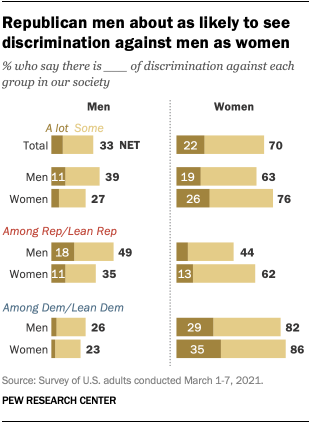
Views of discrimination against men and women differ sharply by gender, particularly among Republicans.
While majorities of both women (76%) and men (63%) say women face at least some discrimination, women are 13 percentage points more likely than men to say this. By contrast, while about four-in-ten men say men face at least some discrimination, only about a quarter (27%) of women say this.
These gender gaps are more pronounced among Republicans. About half of Republican men (49%) say that men face as least some discrimination, compared with 35% of Republican women. And while about six-in-ten Republican women (62%) say that women face at least some discrimination, fewer than half of Republican men (44%) say this.
Among Democrats, about a quarter of both men (26%) and women (23%) say that men face at least some discrimination. Similar majorities of both Democratic men (82%) and Democratic women (86%) say that women face at least some discrimination.
It’s now one year since the pandemic first began taking a toll on workplaces, schools, restaurants, and businesses around the world. If you’re anything like us at Instinct, you miss travel and being able to explore new places. For me, road trips and local food adventures have become the new normal. There’s nothing we enjoy more lately than getting in my car and driving to a beach I’ve never been to before or trying out a new food spot that the dreaded TikTok has recommended.
Being in Southern California certainly has its perks. While California had some of the worst COVID-19 numbers in the world until fairly recently, it does offer the opportunity to escape at a moment’s notice where you can be in the desert one moment and with your feet in the ocean less than an hour later.
Now, as over 13 million vaccines have been administered in California, cases and hospitalizations are reaching less alarming levels. So much so that it recently gave me boost of energy and optimism to #quarantineoutdoors in Big Bear Lake.
For those of us in So Cal, Big Bear is a road trip destination year around, but during the winter months it is especially popular because it is a fun-filled adventure waiting to happen.
Surrounded by the San Bernardino National Forest and its mountain trails, Big Bear Lake is a small city in Southern California about 100 miles from Los Angeles. It sits on the banks of the fish-filled Big Bear Lake and is known for the Bear Mountain ski resort and family-friendly Snow Summit. The Big Bear Lake Village is their iconic commercial district with boutiques, gift shops, restaurants, and local art that is perfect for relaxing after a long day of hiking or exploring.
Making the trek to Big Bear was an easy choice. We’ve been fortunate to have some heavy rain in the Southland over the last couple of months. Most of the year we are in a drought, so we like any day that it rains. Staying distanced and indoors has gotten the best of many and after being cooped up for months, we needed a late Winter refresh to play in the snow.
PRO TIPS:
Even if you have nothing planned in Big Bear, there are so many opportunities to go for scenic hikes or to stop and take in the surroundings. All of the activities mentioned here can also be booked same day, so if you just need to get out. Head to Big Bear! You’ll find something to do easily!
Big Bear is not a culinary hotspot. You won’t find amazing places to eat and it can be very expensive just to have a burger or salad. Whether you’re staying in a hotel, cabin, or Airbnb, consider picking up some groceries and packing snacks that will get you through your trip.
Ziplining
There is no better way of getting a glimpse of the snowy landscape of Big Bear than to do an outdoor excursion like ziplining. When you’re flying through the forest at 35 mph it really puts this whole pandemic thing into perspective. It reminds you how much it means to be in nature and to be able to stand on solid ground without potentially plummeting to the ground.
In all seriousness–When visiting Big Bear, I recommend Action Tours, the premier destination for adventure in Southern California. Action Tours offers activities year-round, and caters each experience specifically to you. Their certified tour guides are knowledgeable and know how to give you an unforgettable experience. During the snow season, Action Tours offers snowshoe tours that take you deep into unpaved trails that are caked in snow. But for us, booking the zipline tour was the only way to experience the last of the winter snow in Southern California.
Once we rode on the open air Jeep and reached our first of nine launch stations, the butterflies set in. It’s easy to forget your nerves as you look out over Mt. San Gorgonio. It took some core strength to try not to lose control while zipping down the line. By the sixth station, I mustered up enough courage to let go of the straps and go hands free–but just for a second. Needless to say, I was sore for about three days after this excursion. Time to lose some of the quarantine pounds!
The entire tour from check-in to return to the tour office is approximately 3 hours.
PRO TIPS:
Don’t be scared! As much as you feel like you will fall, you won’t! The calmer you are the easier it is to land.
If you want to capture your zipline excursion, Action Tours provides GoPro camera rentals.
One thing we have always wanted to try in Big Bear are the Alpine Slide and Mineshaft Coaster, located at theMagic Mountain Recreation Areajust before reaching the Big Bear camping areas. A release must be signed for all attractions in which you wish to participate.
The Alpine Slide at Magic Mountain is open all year and is Southern California’s only authentic bobsled experience, according to their site. We began with a scenic chairlift ride to the top where we got a look at the snow capped mountains and lake. Once at the top, we got on our bobsleds and navigated down the quarter-mile long cement tracks filled with high-banked turns and long straightways. The bobsleds are rider-controlled so you can choose from a fast track or a slow track.
If you want to take photos or record on your way down, I recommend taking the slow track so you have a chance to capture the moment. Otherwise, the fastrack is NO STOPPING.
This attraction is CASH ONLY. ATM is on site, but you will be subject to fees.
The Mineshaft Coaster is a thrilling coaster that is controlled and propelled by you. While you are on the coaster, you can enjoy mountain scenery on your way up and then drop at high speeds on the way down. The coaster is a mile long and features steep descents, dips, twists, hairpin turns, tunnels, and 360-degree corkscrews. It’s the first and only mountain coaster in California. Larger bears may have to ride alone, but two twinks can ride tandem.
PRO TIPS:
There are signs indicating no cameras or cell phones. This must be because they need you to control the speed while on the track. The speed is fast so I would be careful if you try to sneak a pic!
They do sell videos of your experience at the end of the ride, so if you have to have it documented, really ham it up during the ride so you can purchase the video at the end.
This attraction is CASH ONLY. ATM is on site, but you will be subject to fees.
Big Bear has numerous places for you to enjoy the snow. Whether you like skiing, snowboarding, snow tubing, building snow people, making snow angels, frolicking–you’ll find places around Big Bear Lake that will keep you busy.
On this trip to Big Bear, we got our snow fix by snow tubing at the Magic Mountain Recreation Area. Snow Play is open during the snow season and is a fun way to get the snow experience you’re looking for. After we picked up our inner tube, we took the standing lift uphill. A good 45 minutes-1 hour is good for snow tubing. Tickets are good for all day activities so you can leave to grab a bite to eat or have a drink and come back as many times as you’d like.
Pictures and videos are totally possible and worth it here so live your best Instagram model life.
If possible, try to visit after a recent snowfall. The snow, while mixed with man-made snow, will be more abundant and soft.
This is a family-friendly place. There will be children so if that impedes on your fun, try to visit during the week–chances are there won’t be as many families.
This attraction is CASH ONLY. ATM is on site, but you will be subject to fees.
For more info on day trips or extended adventures, visit bigbear.com
Support the independent voice of Houston and help keep the future of Houston Press free.
Like a lot of people, I put on some weight over the last year because I couldn’t go outside and white cheddar popcorn is cheaper than therapy. Even as gyms open up, they were never places I really ever felt at home. Soccer moms, wannabe MMA bros, and outright conspiracy nuts dominate every gym I’ve ever been to. What’s an aging goth who just wants to fit into his leather pants and a vintage Alien Sex Fiend T-shirt again to do?
One answer is to look up Goth Yoga here in Houston.
The company, started in 2017, is run by Christi Workman, a 57-year-old alternative scene mainstay who used to be in Stinkerbell (“Who Blew Smoke?” is an essential H-town punk track). These days, she spends most of her time on physical fitness, either running her own studio or selling a fantastic line of branded workout gear that finally speaks to people who just want to do step aerobics to Siouxsie’s “Spellbound” as the dark gods intended. Her line includes leggings, baseball shirts, and a nice line of bras. Almost all black, naturally, and featuring her bat wing yoga pose logo.
Christi Workman, fit and goth as heck.
Photo by Janette Lease
“I’m a goth girl, and I just didn’t like he music they played at gyms,” she says. “None of my friends wanted to go to a gym either. When I started training, I was working with people here in the alternative scene.”
It’s been hard for Workman since COVID started since her biggest business has been hitting up horror markets with eye-catching wares. Now that vaccination rates are headed up (she got her first shot this week), she’s eager to be back selling. She’ll be one of the vendors at the first Thorn and Moon Magickal Market of 2021 on April 3 at Raven Tower, and she just returned from a horror even in Bastrop.
“It was great being out there with people. It’s such a sense of community,” she says. “I had two actors from Jason movies and a bunch of heavy metal dudes come over to the booth with their eyes bugged out. They hadn’t seen anything like goth workout gear before.”
Work
man was selling at the Nosferatu Festival in Austin last year when news of SXSW being cancelled hit. People were devastated, and she lost bookings that had been set up through the end of the year. Mostly she’s been doing online sales of her products as well as individual and Zoom training sessions for clients. She films classes from her studio, which is tricked out in candles and other spooky paraphernalia.
True to her roots, she takes a lot of care in giving people workouts that use the darker side of music. She’s done yoga classes with classic horror movie soundtracks. One of her favorite training sessions involves a choreographed fitness routine set to “My Pet Werewolf” by The Immortalz, a song I am very embarrassed I missed last year when compiling my end of the year music video list.
“It was fun!” she says. “We did a whole bit about a werewolf standing on its hind legs, some planks, a little kick boxing. That’s the kind of stuff I want to hear working out.”
With the end of the world finally looking like it might end, maybe the time has come to get back out jogging in gear that properly reflects the dark times that we have survived. Goth Yoga is the spooky athletic apparel most goths I know have been waiting for since we realized dancing at Numbers wasn’t going to cut it as our only exercise anymore.
Keep the Houston Press Free… Since we started the Houston Press, it has been defined as the free, independent voice of Houston, and we would like to keep it that way. Offering our readers free access to incisive coverage of local news, food and culture. Producing stories on everything from political scandals to the hottest new bands, with gutsy reporting, stylish writing, and staffers who’ve won everything from the Society of Professional Journalists’ Sigma Delta Chi feature-writing award to the Casey Medal for Meritorious Journalism. But with local journalism’s existence under siege and advertising revenue setbacks having a larger impact, it is important now more than ever for us to rally support behind funding our local journalism. You can help by participating in our “I Support” membership program, allowing us to keep covering Houston with no paywalls.
For the first time in Marvel’s 80-year history, an openly gay superhero will pick up Captain America’s shield and join the comic franchise.
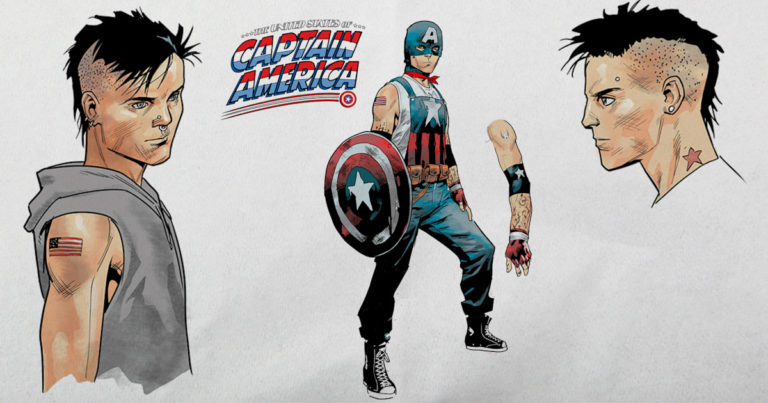
Marvel gave fans their first look at the newest Captain America on Wednesday. The gay teen, who is named Aaron Fischer, is described as “the Captain America of the Railways — a fearless teen who stepped up to protect fellow runaways and the unhoused.”
Fischer has black hair, with the sides of his head shaved, and sports an American flag tattoo on his left arm and a red star tattoo on his neck. A second image released by Marvels shows Fischer decked out in his Captain America gear, complete with the iconic shield.
Aaron Fischer is the first ever LGBTQ Captain America.Marvel
The new superhero will make his formal debut on June 2 when “The United States of Captain America” hits stores, just in time for Pride month.
“The incredible saga kicks off when Captain America’s shield is stolen. No one understands the value of the shield like those who’ve wielded it, so Steve Rogers and Sam Wilson set out on a road trip across America to chase down the thief. But instead, they find the Captains, everyday people from all walks of life who’ve taken up the mantle of Captain America to defend their communities. And for some reason, the shield thief wants them all dead. Can Sam and Steve get to them first?” Marvel teased in a press release.
The first issue of “The United States of Captain America” featuring Fischer will be released just in time for Pride month in June.Marvel
Joshua Trujillo, who wrote the debut issue in the series, said Fischer is “inspired by heroes of the queer community: activists, leaders and everyday folks pushing for a better life.”
“He stands for the oppressed and the forgotten,” Trujillo added. “I hope his debut story resonates with readers and helps inspire the next generation of heroes.”
Jan Bazaldua, who drew the issue, described what it was like to be a part of Marvel history.
“I really enjoyed designing him, and as a transgender person, I am happy to be able to present an openly gay person who admires Captain America and fights against evil to help those who are almost invisible to society,” Bazaldua said in a statement. “While I was drawing him, I thought, well, Cap fights against super-powerful beings and saves the world almost always, but Aaron helps those who walk alone in the street with problems that they face every day. I hope people like the end result!”
Alyssa Newcomb is a freelance contributor to TODAY.com where she covers breaking news and pop culture. She also contributes business and technology coverage to NBCNews.com and Fortune.com. She is based in New York City.
The Chronicle is getting in on the zeitgeist of true crime podcasts and stories, and revisiting a horrific case that, in the Chronicle’s trashier days in the 1970s, was mostly just tabloid headline fodder — and the SFPD never bothered to solve it.
It’s the case of The Doodler, also at the time called The Black Doodler — a serial killer who was African American (a rarity among American serial killers, generally), and who killed at least five gay men in the mid-1970s after picking them up in SF bars and doing quick sketches or doodles of them as a form of flirtation. He was said to be between the ages of 19 and 25, and between January 1974 and September 1975 he murdered as many as 16 people and assaulted several others, and then vanished.
The dead were found stabbed multiple times, near gay cruising spots, like out near the Ocean and near Spreckels Lake.
The SFPD has said they had a prime suspect based on accounts from surviving victims, however they couldn’t bring him to justice because those survivors wouldn’t testify publicly for fear of outing themselves. Reportedly, one was a politician and one was an entertainer.
The case remains open and cold, and there was some action on it in 2018, with the SFPD announcing it was reexamining evidence and considering genealogical DNA searches — and in 2019 they announced a new $100,000 reward for information to help solve the case.
It’s unclear if the Chronicle’s new Doodler podcast, launched this week will reveal anything in the investigation since the reward offer when out. Episodes are being released weekly, and a text version of Episode 1 mostly just provides profiles of two of the Doodler’s victims, Gerald Earl Cavanaugh, and drag performer Jae Stevens. But SFPD homicide cold case investigator Dan Cunningham is participating, and this could get interesting.
Also, the Chronicle spoke to retired SF DA’s office investigator Ron Huberman, who was the first openly gay investigator working fr the SF DA, and he admits that the case likely went unsolved “because, first of all, the police didn’t — to be honest with you — care.” This harkens back to the SFPD’s ugly history with the city’s LGBTQ community, and The Doodler case is just one piece of that — although the department did have its hands full in the 70s, and they never solved the Zodiac killings either.
The first two episodes of The Doodler podcast are now live, with five more to come.
If you have a tip in the Doodler case, the Chronicle is asking for it. You can email [email protected], or call (415) 570-9299.
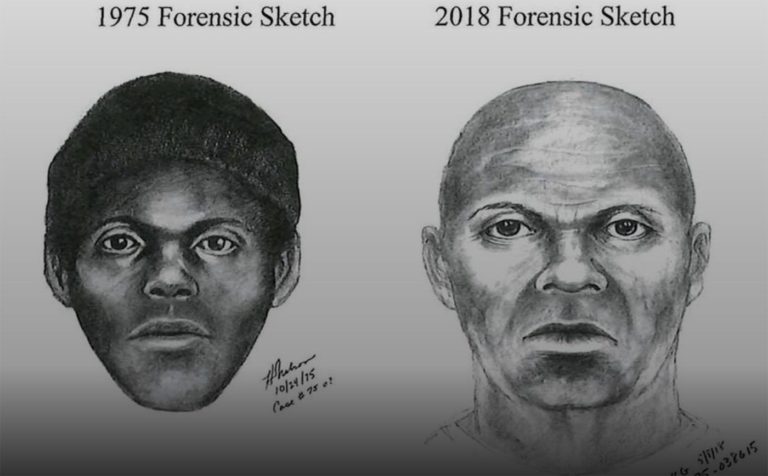
Top image: The SFPD’s original forensic sketch of the Doodler in 1975, and an age-enhanced sketch of what he might look like today done in 2018.
More LGBTQ people reported experiencing job loss and worsening mental health due to the pandemic compared with people who do not identify as LGBTQ, an analysis published last week by the Kaiser Family Foundation found.
The pandemic’s negative impact on mental health has been widely discussed by public health experts, but there has been a lack of data specific to how it has affected the LGBTQ community, said Lindsey Dawson, coauthor of the analysis and the associate director of HIV policy at KFF. The foundation has been polling Americans on how the pandemic has changed their lives for months, and after researchers began asking respondents whether they identify as LGBTQ, they were able to separate the data for further study.
“LGBTQ people have a history of stigma and discrimination,” Dawson said. “They have higher rates of mental illness and lack of access to health care, which is why it’s important to understand the impact of COVID on that community. We know they live on lower incomes and work in industries harder hit by COVID, so this is about understanding how a vulnerable population is impacted.”
In the analysis, 56% of LGBTQ people reported that someone in their household has experienced job loss, furloughs, or a reduction in income or hours due to COVID-19, compared with 44% of non-LGBTQ people. Nearly three in four LGBTQ people also reported that pandemic-related stress has had an impact on their mental health, compared with 49% of non-LGBTQ people.
While the pandemic has been challenging for everyone, LGBTQ people experienced additional burdens due to inequities that have been exposed, said Adrian Shanker, the executive director of the Bradbury-Sullivan LGBT Community Center in Allentown.
“LGBTQ people are more likely to work in the hospitality sector and the survival gig economy, industries that are among the hardest hit,” Shanker said.
Michael Galarraga, a therapist based in Center City, said many of his LGBTQ clients have had to put their lives on hold because they’ve lost their main source of income. These changes have been especially hard for those in performing arts or community-oriented work, like organizing, he said.
“There’s a sense of exhaustion,” he said. “There is a lot of anxiety that comes up from that and from change in general.”
When Shanker’s community center surveyed Pennsylvanians who identify as LGBTQ last spring, more than 70% of the 6,582 respondents reported experiencing a mental health challenge in the last year. Additionally, four in 10 respondents said they have dealt with at least one barrier to receiving health care.
“At the beginning of the pandemic, we were not counted among any of the data,” Shanker said. “We don’t have government data to confirm that LGBTQ people experienced unemployment, but we know anecdotally, the people we serve were affected.”
Data collection inmarginalized communities can help secure resources to serve those communities,he said.
The analysis also looked at the response of the LGBTQ community to the pandemic, and found that just 15% of LGBTQ people think that the media exaggerate the severity of COVID-19, compared with one third of non-LGBTQ people.
When it came to vaccination, LGBTQ people reported wanting to get vaccinated at the same rate as non-LGBTQ people. But 75% of LGBTQ people said that getting vaccinated is part of a collectiveresponsibility to protect others, compared with 48% of non-LGBTQ people.
Galarraga said the pandemic made him reflect on his experience as a gay man.
“I’m a pretty extroverted person, and I wouldn’t say that I turned introverted through the pandemic, but I definitely stopped what I was doing before,” he said. “I had to consider how I was showing up for my community of chosen family.”
Dawson said that the LGBTQ community’s experience with HIV/AIDS as well as their political stances may play a role in that difference in opinion as well.
“LGBTQ people are more likely to identify as Democrats, and it’s possible they’re in higher-risk occupations, so there’s a greater acceptance and willingness to participate in social distancing,” she said. “They know that there needs to be public health-driven behavior, not only to curb one’s own risk, but also to curb transmission as well. In doing that, they’re taking steps to take care of their community.”
[Episcopal News Service] Episcopal clergy are highlighting The Episcopal Church’s support for LGBTQ couples this week while condemning an announcement by the Vatican that it would not allow blessing of same-sex unions because the relationships are seen by the Roman Catholic Church as sinful.
A Vatican office that handles matters of church doctrine was responding to questions about whether Catholic clergy can bless gay and lesbian couples. The office’s March 15 response, approved by Pope Francis, asserted that God “cannot bless sin.”
“These words injure LGBTQ+ people and all who advocate for justice and equity for all children,” Los Angeles Bishop John Harvey Taylor said March 17 in an email message to his Episcopal diocese in Southern California. The Vatican’s statement, he said, “risks putting a stumbling block between Jesus Christ and all who are spiritually hungry and who need and deserve the hope of resurrection.”
Newark Bishop Carlye Hughes called the news “a heartbreaker” in a video message to her northern New Jersey diocese. “I can’t speak for any other denomination. I can speak for mine. I want you to know that in this church … we recognize your goodness and we are delighted that we are all part of the same denomination, looking for God, celebrating God, sharing God’s love.”
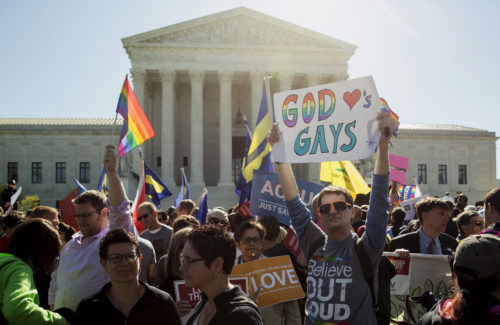
Supporters of same sex marriage rally in front of the U.S. Supreme Court before the court hears arguments about gay marriage in 2015. Photo: Reuters
The Roman Catholic Church does not offer the sacrament of marriage to same-sex couples. In announcing its position against same-sex blessings, it sought to differentiate that prohibition from its efforts to welcome gay and lesbian Christians more fully into the church. God may bless them as his children, the Vatican said, but not their unions.
Some Episcopalians turned to social media to condemn the Vatican’s statement while affirming The Episcopal Church’s efforts to promote full LGBTQ inclusion in the life of the church, including the sacrament of marriage.
“As an Episcopalian, I am often glad that the Vatican does not speak for me,” the Rev. Mike Angell said on Facebook. Angell is rector of Episcopal Church of the Holy Communion in University City, Missouri.
“My church has learned to stand proudly with our LGBTQ+ members, to declare God’s blessing. I am also mindful that there are so many Roman Catholics for whom this document comes as a slap in the face. … The church’s role in blessing is simply to witness what God has already done. You are blessed. Your loved is blessed. No church can take that away.”
Olympia Bishop Greg Rickel countered the Vatican’s statement by saying his Seattle, Washington-based diocese doesn’t see sin in LGBTQ couples’ relationships.
“We see you and experience you as true blessings, reflections of our living God,” Rickel said on Facebook. “Thank you for the inspiration and the many ways you show us how to love. Thank you for the gifts you bring to our collective body of Christ. Thank you for how you have blessed me and you bless this church.”
The Episcopal Church not only blesses same-sex unions but has gay clergy. An Episcopal High Mass is not that different from Catholic Mass. There’s always an alternative to the Vatican. https://t.co/3ZWzZCe9Hi
— Jack’sHouseOfPancakes (@RegimeChangeInc) March 15, 2021
Sometimes I miss the Catholic mass, but then I read things like this.
Luke and I left 3 years ago and became members of The Episcopal Church, which is LGBTQ-affirming and supports equal rights for people of all genders. https://t.co/hlXn2w2JpM
The Rev. Weston Mathews, rector at Grace Episcopal Church in The Plains, Virginia, also took issue with the Vatican’s justification, based in a claim that God “cannot bless sin.”
“The church has real sin to repent from. Can we stop scapegoating beloved people of God who seek love and care in this transitory life?” Mathews said on Facebook. “Sending love and light to LGBTQ+ Roman Catholic friends and family in Virginia and around the world who are in pain and mourning today. God loves you whether you’re single or married or in a relationship or [it’s] complicated.”
In the Diocese of New Jersey, Bishop Chip Stokes issued a statement of “sorrow and concern” and called the Vatican’s conclusion discriminatory and hurtful. Stokes also compared it to a recent anti-gay statement by the Anglican archbishop of Nigeria that labeled homosexuality a “deadly virus.”
“Both the recent Vatican statement and the statement of the Archbishop of Nigeria are unacceptable and dehumanizing of the people to whom they refer,” Stokes said.
“The witness, experience, faithfulness, and love of countless LGBTQ persons, many in exemplary, faithful partnered or married relationships, continues to evidence and reflect the divine love of God in Christ. This has been a great gift to us as church; one that we would urge other parts of the wider church to recognize, embrace and bless.”
– David Paulsen is an editor and reporter for Episcopal News Service. He can be reached at dpaulsen@episcopalchurch.org.
Congratulations to Craig Hickman. Not only has Hickman recently been elected as a Senator to represent the state of Maine, but he’s also the first Black man to serve in both chambers.
As Maine Beacon reports, Democrat Hickman won a special election last week for Main’s Senate District 14. Hickman won the position with 5,248 votes or 62.5% of the total votes. He bested Republican William Guerrette who got 3,136 votes and 7.45% of the vote. The seat became empty after Democrat Shenna Bellows was appointed secretary of state.
For Hickman, this isn’t the first time that he’s made history. The Senator was previously the first openly gay Black man to sever in Maine’s House of Representatives.
“Growing up Black and gay and blue-collar in America, nobody ever said it was going to be easy. But my experiences have taught me the importance of protecting our communities and standing up for those in need,” said Hickman.
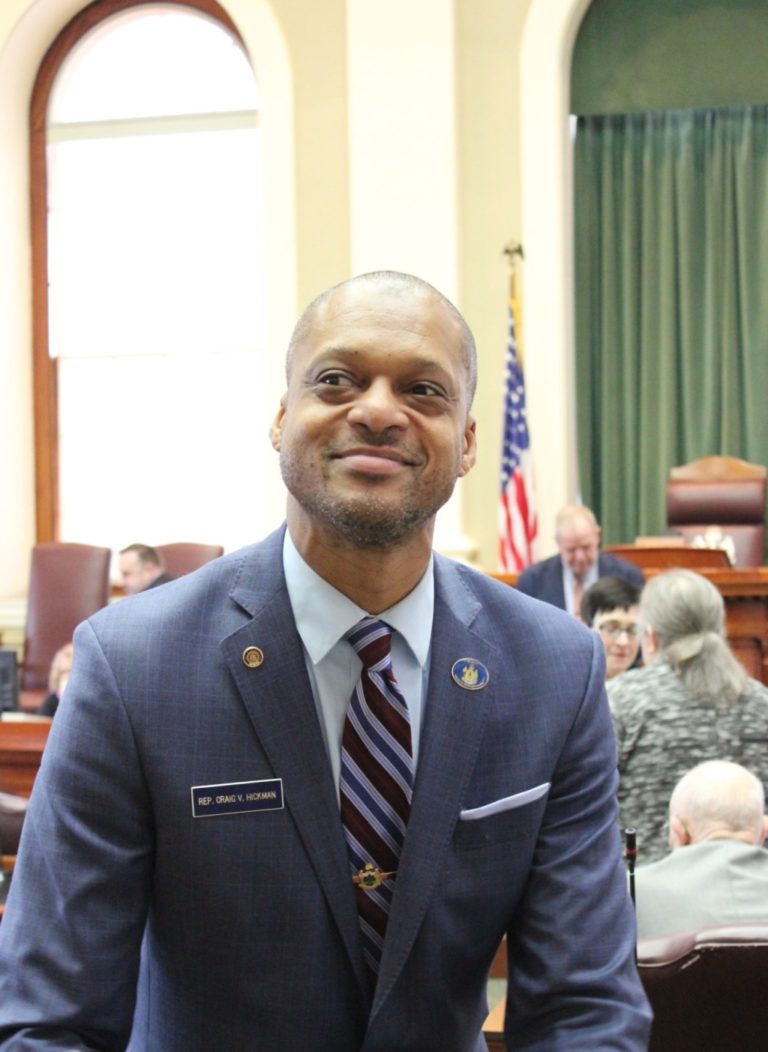
Image via Craig Hickman For Senate Campaign
Hickman also noted that he is excited to get to work and is happy that voters want to get necessary work done to course-correct the state and country.
“When I first was elected I remember saying that the voters pretty much have proven that it doesn’t matter what you look (like) or who you love, or how you walk or talk,” he told CentralMaine. “It only matters what you do. I just live that all day, every day.”
But on what policies did Craig Hickman promise to support? Hickman stated his support of health care for all and the affordable care act, the fight against climate change, struggle for food sovereignty and the fight for struggling farms, and more. On that last note, as Face2FaceAfrica reports, Hickman is a farmer from Winthrop, Maine. As such, he has pushed for legalization supporting farmers and small businesses.
For the devoted representative, there has been no time to rest. Governor Janet Mills swore Hickman in just one day after his victory. In addition, the Maine Legislature recently met for the first time since December through a socially distanced meeting. Several bills were discussed, including a state tax exemption for pandemic loans and unemployment benefits. For state Senator Craig Hickman, serving the public so quickly is a perfect idea.
Democrats’ momentum to enact landmark LGBT civil rights legislation is facing headwinds from opponents who say the measure would limit federal religious protections.
Those objections will likely be raised at a Wednesday Senate Judiciary Committee hearing on the bill. But some legal experts disagree with critics and say the measure wouldn’t completely wipe out religious rights of employers and other groups.
The Equality Act (H.R. 5), which the House passedalong party lines last month, would amend the 1964 Civil Rights Act to enshrine protections for sexual orientation and gender identity. It would expand rights to public and commercial spaces, jury selection, and transportation services.
The legislation would also bar certain religious defenses to LGBT claims of discrimination. That issue remains a contentious area that courts haven’t resolved, and appears to be a sticking point for Republicans, who would be crucial to passing the legislation in the Senate.
Photo: Al Drago/Getty Images
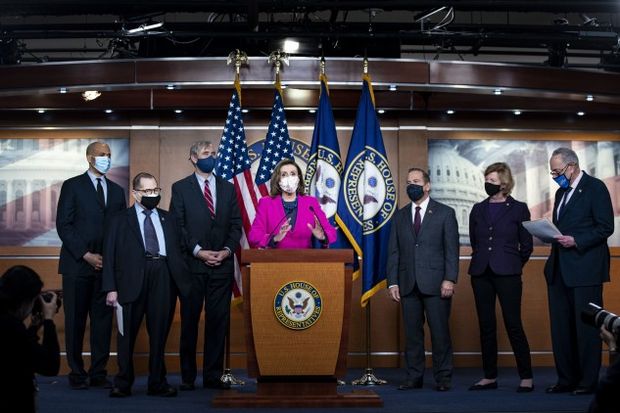
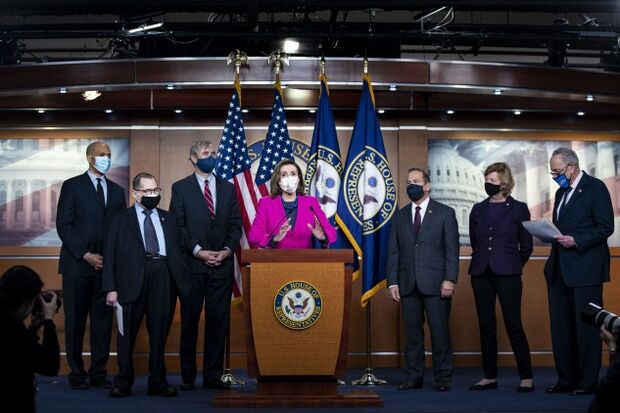
House Speaker Nancy Pelosi (D-Calif.) speaks as Sen. Cory Booker (D-N.J.), Rep. Jerrold Nadler (D-N.Y.), Sen. Jeff Merkley (D-Ore.), Rep. David Cicilline (D-R.I.), Sen. Tammy Baldwin (D-Wis.), and Senate Majority Leader Charles Schumer (D-N.Y.) listen during a news conference ahead of the House vote on the Equality Act on Feb. 25, 2021.
After decades of fighting for such protections, LGBT advocates are more optimistic about the bill’s chances, in large part because of the White House’s backing, said Sharon McGowan, chief strategy officer and legal director for Lambda Legal, an LGBT advocacy group.
“This time feels different,” McGowan said.
Filibuster Barrier
Supporters face a steep challenge to overcome the Senate filibuster—a procedural hurdle that requires 60 votes to bring a measure up for a vote—without resolving concerns around religious exemptions. No Senate Republicans have signed onto the bill, and some have said they won’t back it without new exemptions for religious organizations.
A spokeswoman for Sen. Mitt Romney (R-Utah) told the Washington Blade that he believed protections for religious liberty were essential for any bill, “and since those provisions are absent from this particular bill, he is not able to support it.” Romney’s office didn’t respond to a request for additional comment.
Sen. Susan Collins (R-Maine) signed on as cosponsor of the legislation when it was previously introduced in the Senate. She declined to do so this time, citing unspecified changes that hadn’t been made to the bill. A Collins spokeswoman said the Equality Act was a starting point for negotiations, and that Collins supported fairness and equal treatment of all Americans, regardless of their sexual orientation or gender identity.
Supporters say the Equality Act is essential because of the patchwork of protections guaranteed to LGBT people across the country. In 27 states, there are no laws explicitly banning discrimination against people on the basis of gender identity or sexual orientation, according to Freedom for All Americans, an LGBT rights group.
Congress is considering the legislation as a new wave of bills targeting transgender students advance in states. Lawmakers in South Dakota and Mississippithis year passed bills to block transgender athletes from participating in women’s sports, and similar legislation has been proposed in Tennessee.
Congressional Republicans and former President Donald Trump have sought to make political hay out of the issue.
The Equality Act proposes weakening a 1993 law that creates a religious defense in discrimination lawsuits.
Religious organizations and certain small, non-religious companies can invoke that law, the Religious Freedom Restoration Act, to defend against discrimination lawsuits brought by the government. As written, the Equality Act would trump this law, which is driving opposition from religious groups, said Stanley Carlson-Thies, senior director of the Institutional Religious Freedom Alliance, which advocates for religious employers.
“It’s never actually been limited before,” he said.
Carlson-Thies has consulted with Republicans on an alternative bill, the Fairness for All Act (H.R. 1440), which would ban LGBT discrimination but include carve-outs for religious institutions. The Equality Act doesn’t do enough to consider thorny questions that churches or religious employers could face in operations like food pantries or job training programs, he said.
The Equality Act provides no protections for “claims of conscience,” said Douglas Laycock, a law professor at the University of Virginia, who opposes the Equality Act.
“This is not an attempt to reconcile conflicting interests or reach any kind of compromise,” Laycock said. “It attempts to give one side 100% of what it wants, protecting even its most attenuated symbolic interests, while completely wiping out the rights of those who conscientiously object to participation.”
Religious objections create a false dichotomy between LGBT rights and religious protections, counters David Lopez, co-dean at Rutgers University and former general counsel at the Equal Employment Opportunity Commission.
He noted many religious groups back the Equality Act and other equal rights measures for LGBT people, particularly as reports of discrimination and hate against these groups continue. The bill’s supporters include more than 120 faith organizations, including the Presbyterian and Episcopal churches.
“They are trying to say exercise of religion means right to discriminate,” Lopez said. “You have an obligation not to discriminate, but you still can have a private belief.”
High Court Weighs In
The U.S. Supreme Court decision last year in Bostock v. Clayton County, GA protects LGBT workers from discrimination, but leavesopen questions on whether employers can fire or refuse to hire a gay or transgender individual because of religious objections.
Since then, the high court has expanded the view of who is a minister and therefore can’t make a bias claim against a religious employer, and has also upheld a Trump administration rule allowing religious groups to opt out of birth control requirements. It’s also considering a case involving same-sex couples serving as foster parents.
Other religious protections under the Civil Rights Act, as well as the ministerial exception, the First Amendment, and due process rights under the 14th Amendment would still be intact if the Equality Act was enacted, said Michelle Phillips, an attorney with Jackson Lewis PC.
“The idea that religious liberty is at risk, that is not the case,” she said. “It’s always the duty to reasonably accommodate someone on sincerely held beliefs. That highly evolved principle won’t go away.”
Religious Freedom Restoration Act questions mostly aren’t going to be relevant to LGBT discrimination claims in the workplace under the Civil Rights Act. That’s because that actapplies only to people who think their religious exercise is substantially burdened by government entities. For example, most religious employers would still be able to claim an exemption under various protections, unless the government sued.
“The issue of the balance and tension of sexual orientation is something we’ve been grappling with for a while,” Phillips said. “The Equality Act won’t resolve the continued issue of this balancing act between disparate rights.”
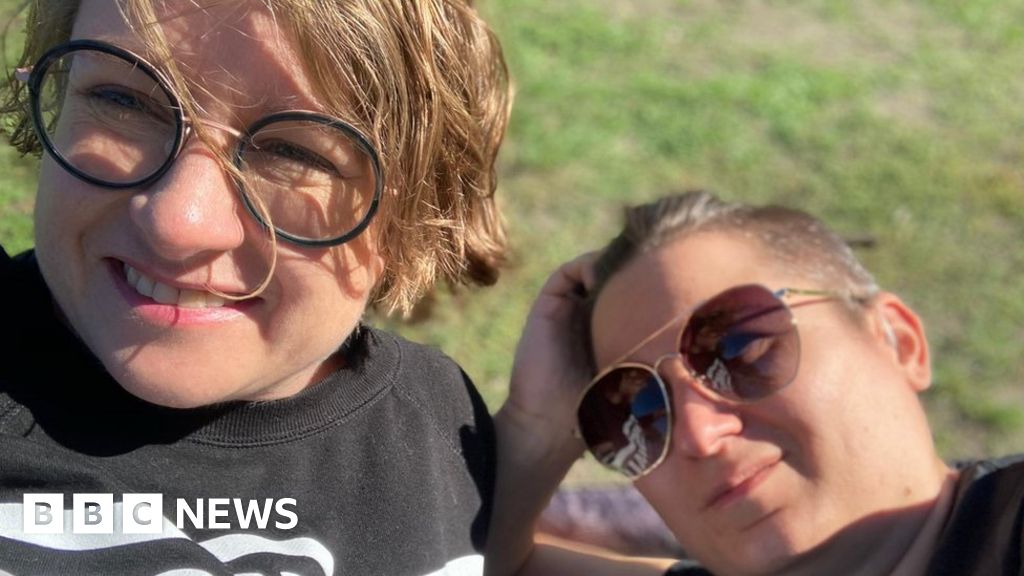
Thirteen-year-old Pola is one of an estimated 50,000 children in Poland being raised by same-sex couples. Like most of those children, Pola is growing up with her biological mother, Anna Adamowicz, together with her wife, Agnieszka. Pola was born during Anna’s previous relationship with a man and her father continues to play an active role in her upbringing.
Does the Catholic Church have the power to give blessings to same-sex unions? The answer is: Negative.
The Congregation for the Doctrine of Faith says it loves the sinner, but this does not mean the Church justifies a sin.
Catholicism sees the bond of marriage as a union between a man and a woman who are open to life and procreation.
In response to a “dubium” (doubt) question put to it, the Congregation for the Doctrine of Faith (CDF) of the Catholic Church said, “We cannot consider such blessings licit.” So, priests should not bless homosexual couples who ask for some type of religious recognition of their union, the CDF stated. Pope Francis “gave his assent” to the publication of its response to the dubium, confirmed the CDF.
The Church is not saying no to same-sex marriages. It is saying no to the pure eventuality that gay unions – be they de facto or de iure, sanctioned by a very secular public document as by a private agreement – can get any form of blessing from the Catholic Church which governs her people, but not at the cost of following the trends of the century, reported AGI.
“We love the sinner, writes the Congregation for the Doctrine of the Faith, but this does not mean that the Church justifies a sin.”
Cardinal Luis Ladaria, prefect of the former Holy Office and material writer of the denial of blessings and of the explanatory note participated in the announcement as well as Bergoglio himself who “in the course of an audience granted to the undersigned Secretary of the Congregation, was informed and gave his consent.” The secretary, for the record, is the archbishop of Cerveteri (Lazio region) Giacomo Morandi.
Sin cannot be blessed
In the traditional form of the question – the “dubium” – and of the answer, here is the question in summary. Dubium: “Does the Church have the power to give blessings to same-sex unions?” The answer was: “Negative.”
Detailed explanations follow summarized information as follows: “The blessing, in whatever form it may be, cannot be imparted in any way to a situation marked by sin, since one is not faced with a couple united by the bond of marriage understood as between man and woman and open to life and procreation. Indeed, not even one of these preconditions materializes. Blessing could be taken for a substitute form of recognition and equalization, so it cannot be.”
This is all despite the fact that “in some ecclesial spheres, projects and proposals of blessings for same-sex unions are spreading.” Of course, “these projects are not infrequently motivated by a sincere will to welcome and accompany homosexual people, to whom paths of growth in faith are proposed, so that those who manifest the homosexual tendency can have the necessary help to fully understand and realize God’s will in their life.”
But it is one thing to accompany, understand, and interact, and quite another to give the impression of equating, justifying, recognizing, and admitting.
“When a blessing is invoked on some human relationships, it is necessary that what is blessed is objectively and positively ordered to receive and express grace, according to the plans of God inscribed in Creation and fully revealed by Christ the Lord,” explains in a document signed by Cardinal Ladaria.
“Only those realities which are in themselves ordered to serve those designs are compatible with the essence of the blessing imparted by the Church.”
Therefore, “it is not permissible to impart a blessing to relationships, or even stable partnerships, which involve a sexual practice outside marriage (that is, outside the indissoluble union of a man and a woman open in themselves to the transmission of life), as is the case with unions between persons of the same sex.”
Of course, in some cases in these unions, real “positive elements, which in themselves are also to be appreciated and valued” can be recognized, but no – the ecclesial blessing is not: “these elements are found at the service of an unordered union to the design of the Creator.”
A substitute recognition
Another point follows, particularly delicate for the Church: “The blessing of homosexual unions would in a certain way constitute an imitation or a reference to analogy with the nuptial blessing.” That is: be careful not to make the blessing, given in good faith, the antechamber of the recognition of a marriage union.
This is why we cannot speak of “unjust discrimination” against homosexuals. The Church does not discriminate against them as such but limits herself to “recalling the truth of the liturgical rite and of what deeply corresponds to the essence “of the sacraments.”
“Everyone in the Church welcomes people with homosexual inclination with respect and delicacy, and will know how to find the most appropriate ways, consistent with ecclesial teaching, to proclaim the Gospel in its fullness.”
Homosexuals “recognize the sincere closeness of the Church and accept its teachings with sincere availability.” It is not “excluded that blessings are given to individuals with homosexual inclination” but on condition that “they manifest the will to live in fidelity to God’s revealed plans as proposed by ecclesial teaching.”
Because the crux (cross) of the matter is always the same: “We declare every form of blessing that recognizes their unions illicit,” because the Church “does not bless nor can it bless sin: it blesses the sinful man, so that he may recognize that he is part of her plan of love and allow himself be changed by Him.”