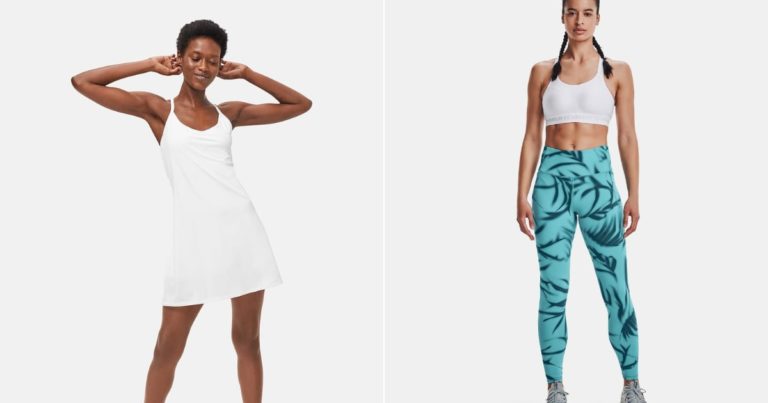
Is that . . . the sun we see? And green on the trees? It’s finally shorts and skirt weather, and our bare legs are so excited to see the sun! As we gear up for the unofficial start of summer during Memorial Day weekend, take a look at our favorite health and fitness gear and products that are getting us excited this month.
After tension over her speaking, here’s what the wife of the LDS president told graduates at Utah Valley University – Salt Lake Tribune
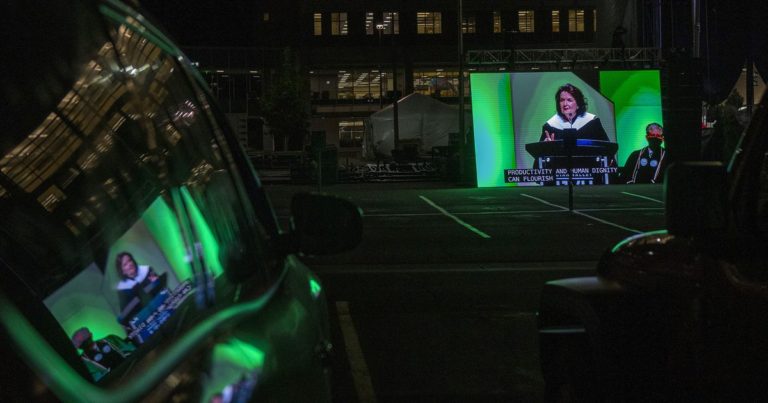
(Rick Egan | The Salt Lake Tribune) Graduates listen in their cars, as commencement speaker, Wendy Watson Nelson speaks, at Utah Valley University’s graduation program in Orem, on Friday, May 7, 2021.
In the face of concern and controversy over her speaking, Wendy Watson Nelson — a former family therapist and the wife of the president of The Church of Jesus Christ of Latter-day Saints — directed graduates in her address Friday night to drop their contentions, open space “for the existence of another” and, through those actions, come to find love in their lives.
“We don’t need to agree with another person’s ideas,” she said. “But when we open our ears and hearts to their ideas, love enters in.”
Nelson, who was the keynote at Utah Valley University’s commencement, said all people would be healthier if they let go of their disagreements and really listened.
Her message came, though, after several students at the campus expressed frustration that she was chosen as the speaker because of her past remarks about the LGBTQ community — and they argued that Nelson herself has failed to listen to gay, queer and transgender folks in her work in medicine and advocated against their love.
“Having her talk is an explicit endorsement by the university of that rhetoric,” one student said earlier. “And I thought this was a safe space.”
The university defended the choice and even reiterated its support from the lectern during the ceremony Friday.
As she introduced Nelson, UVU President Astrid Tuminez said several times that the school appreciated the address. “We are grateful that she has graciously accepted the invitation to be part of tonight’s celebration,” the president pointedly noted.
Her ‘surprise’ later in life
Nelson spoke for about 20 minutes about her life’s work, including as a former nurse and professor, and as the wife of LDS Church President Russell M. Nelson. Her message about dropping tensions and expectations to accept love is one, she said, she has personally experienced. And it felt like a rebuttal to the issues raised with her being on campus.
She began by talking about how when she was a student at Calgary General Hospital School of Nursing in Canada and later at Brigham Young University in Provo she had hoped to meet someone. She wanted to fall in love in her 20s, get married and have 10 kids.
That’s not what happened.
Nelson said she continued to progress through her degrees and opened her own private counseling practice. She became a professor, too. And she worked for 25 years.
“And then surprise!” she said. “I married when I was in my 50s to a man with 10 children.”
The small audience in the auditorium at Utah Valley in Orem laughed. The ceremony was supposed to be outside, due to COVID-19 precautions, where graduates could drive in, park by the stage and listen. But high winds forced some late pivoting. Many still tuned in from their cars as massive screens displayed the speeches into the parking lots and the radio carried the sound on a special station.
Russell M. Nelson was one of those who watched from inside, with Wendy Nelson pointing him out in the crowd. They married in 2006, when he was an apostle; he was named church president in 2018.
She described letting go of what she had planned — her stress over a prescribed timeline — listening to what she really needed and getting love in return. She had been angry, she said, that things didn’t go like she wanted. She tried to fight it.
“And now, after 15 years of marriage,” she said, “my husband and I still fall in love with each other more every day.”
Those moments only come, she said, when we make room for them, when we are open to other ideas, when we drop contention and expectation. That applies throughout life, Nelson noted.
She said people should let go of disagreements in politics, move forward despite tension in work and strive to eliminate it from their homes. She noted issues with cyberbullying, presidential campaigns, social media and “everything from masks to guns.”
“We hear and see so much contention today. And contention is lethal,” Nelson noted, citing her research as a family therapist. “It can ruin your physical health. Ravage your relationships. And play havoc with your productivity, creativity and stamina.”
Most of the problem, she said, is rooted in people holding close to their beliefs and expecting others to change. She said she did that when she held onto her expected life plan. But the answer, Nelson suggested, is being open, especially to other ideas and perspectives we may not agree with, to other routes we might take.
“When one person believes that he or she is more correct than another and that they must change, that leads to emotional violence,” she said. “We can have ideas that are different from each other. That’s just part of life.”
How you find peace, she said, is by engaging in conversations, listening, letting go, accepting and loving anyway. You don’t have to agree. But “love is a powerful healer,” Nelson added, noting it’s the opposite of contention.
Divisions still exist
The talk didn’t ease the contention for those who were upset that she was invited to campus, and a few were frustrated that Nelson spoke about openness to change being the solution and that she focused on love and her marriage. They called it ironic.
Some LGBTQ students and faculty did not attend the ceremony Friday in a silent protest. At least one student did go to campus but decked the graduation cap out in rainbow colors to make a point and be visible in opposition.
Since Nelson was named the commencement speaker, they had asked the university to reconsider, largely pointing to what they see as bias and discrimination in her work.
Nelson has published pieces where she labels gay relationships as “distortion and perversion.” In one of the most popular books of her career, “Purity and Passion,” she posits that “homosexual activities break the eternal law upon which the blessings of marital intimacy are predicated.”
That’s a position shared with LDS Church leadership, which has repeatedly confirmed its opposition to gay marriage and considers same-sex relations a sin, forcing gay and lesbian members to avoid intimate partnerships to remain full-fledged members. (The faith has, in recent years, attempted to carve out a more empathetic stance toward LGBTQ people, but those mandates remain.)
And she has repeated those stances in speeches, too. In an address at BYU’s Hawaii campus broadcast worldwide in January 2016, Nelson suggested that LGBTQ folks need to repent to have their “sexual feelings be in harmony with eternal laws.” That is commonly referred to as the “pray away the gay” approach, which most therapists say is harmful.
Arty Diaz, a graduating senior at UVU who identifies as queer, has been outspoken in pushing back against Nelson speaking, saying she doesn’t believe in acceptance and love for all.
“It’s just particularly hurtful to choose her,” he has said.
More than 70 faculty and staff also signed a letter asking the university to disinvite Nelson, fearing it would harm LGBTQ students and saying the public school should stand by its central mission of inclusivity.
“It’s not a problem with her (Nelson’s) religion,” said Kelli Potter, an associate professor of philosophy at UVU and a trans woman. “It’s that it is exclusionary to have someone who is anti-LGBTQ speaking at a school that identifies inclusion as a central value.”
Tuminez has said that inclusion should be about all voices, and she noted that 70% of the student body at Utah Valley — the largest college in the state — is LDS and would want to hear from Nelson.
She also told graduates Friday night, also seemingly in response to concerns: “You were seen here. You were educated here. You were loved here.”
During the address, some in the comments on YouTube did say they enjoyed the speech. In between notes congratulating graduates, one woman said “such a great example.” Another noted, “great lesson.” And some honked their horns from the parking lot in support while Nelson spoke.
The loudest round, though, came when she said, “Minds can expand. … Hearts can change.”
‘Travelers are ready to explore’: LGBTQ travelers leading the way to tourism recovery – AZCentral.com
Since the tragic events of 9/11 and the abrupt halt to travel that followed, about every 10 years, the tourism industry is knocked back on its heels.
The economic meltdown of 2008 and 2009 was even worse for the travel industry. And the pandemic is a once-a-century calamity.
The travel industry has rebooted before, and it will bounce back again soon. And if history is any guide, LGBTQ travelers will be leading the way.
“Gays lead, and the rest follow,” Roger Dow tells the National LGBT Media Association. Dow is president and CEO of U.S. Travel Association, the Washington, D.C.-based organization representing all segments of travel in America. “They’re adventurous and like new experiences. They have a penchant for travel far greater than their heterosexual counterparts. They travel more and spend more when they travel. They’re the darlings of the travel industry when it comes to spending and dollars.
COVID travel:How LGBTQ travelers can get back to exploring the world and traveling safely
Travel safety has long been a pillar in LGBTQ community
According to Randle Roper, co-founder and CEO of VACAYA Full-Ship and Full-Resort LGBT+ Vacations: “(Our) guests showed incredible resilience by traveling safely during the pandemic, and they proved they could adapt to live with health protocols that would keep each other and their loved ones back home safe.”
Travel safety is entwined with the LGBTQ community. In 70+ countries, many popular with LGBTQ travelers, homosexuality is criminalized. That includes 11 countries in which death is the punishment meted out for those convicted of homosexuality and other “crimes” of sexual and gender nonconformity.
While travelers would be spared the harsh treatments locals may suffer, they nonetheless have a great deal to consider when traveling. Same-sex couples still receive awkward and uncomfortable service when checking into hotels with a single bed on the reservation or even simply existing in places where everyone’s assumed to be heterosexual.
When a lesbian boards a plane with her legally married wife and their legally adopted children, they could land in a destination where their marriage license is void and legal guardianship of their children in question.
Trans and nonbinary travelers, especially those of color, may encounter challenges including lack of safe bathroom access, awkward encounters at Transportation Security Administration checkpoints and even outright hostility and worse in any public setting.
In the face of all this, queer people still explore and have a lot to teach the rest of the world about how to travel with intent and joy while maintaining their own safety and that of the community around them.
“LGBTQ consumers have the power to make change and support LGBTQ-friendly companies and destinations by choosing to spend their travel dollars with those that support our community,” says Jeff Guaracino, co-author of the “Handbook of LGBT Tourism and Hospitality.” “As a community, we can support LGBTQ-owned and friendly businesses and their employees by spending our travel dollars with them first.”
LGBTQ travel companies, agents report increased bookings
LGBTQ tour companies and travel agents have a direct connection to queer travelers and report strong interest in and bookings of travel.
“After (releasing) our entire tour schedule through the end of 2022, we saw our largest month of sales in our 12-year history,” says Robert Sharp, co-founder and CEO of Out Adventures.
Kelli Carpenter, co-founder of R Family Vacations, adds: “Our highest sales have come from our river cruise products and international tour business, showing that travelers are ready to explore the world again.”
VACAYA’s Roper has seen extremely robust sales over the past several months – including selling out their Antarctica Cruise. “With a starting price of around $25,000 per room, that was our best sign yet that our community members are ready to break free from their cages and return to travel,” he says.
Robert Geller, founder of FabStayz, agrees: “Pent-up demand is visible, palpable and quantifiable.”
Tips for marketers interested in the LGBTQ segment
You don’t have to be in the community to market to us, but you should do your homework. Here are a few tips. You can find much more insight in the “Handbook of LGBT Tourism and Hospitality” (co-authored by this reporter).
- Understand your opportunities and challenges and your brand’s strengths and weaknesses with this segment.
- Prepare for a sustained effort and financial investment.
- Hire an expert; don’t burden an LGBTQ colleague.
- Understand the needs, behaviors and concerns of this segment and avoid saying “everyone is welcome” until you know that that’s true.
- Apply marketing basics: Market the right product for the right segment at the right time.
- Develop tailored content/social, communications strategies.
- Don’t go it alone: Work with LGBTQ business leaders and employee resource groups.
- Get buy-in from the C-suite on down.
- Advertise support of employees and the community during Pride in local LGBTQ publications (and support the media you want to cover your business), but focus most of your marketing the other 364 days of the year.
What to expect when you’re expecting a queer crowd
LGBTQ visitors and guests want the same thing as everyone else: a safe and fun visit. You have to know the challenges confronting LGBTQ travelers in order to treat them with the same excellent welcome you accord all. Follow this guidance from Billy Kolber, founder of HospitableMe, which helps organizations with strategy and actionable training that drive equity and inclusion. The most successful organizations embrace these practices:
Focus on community first, profit second. Activities that start with a profit motive often backfire. Ask yourself, “How can we make our product or experience better for diverse customers and support their needs and their community?”
Educate your people. You can’t provide authentic, personalized service if your team doesn’t understand who LGBTQ people are and feel comfortable engaging with them.
Drive diversity in your own organization. Having diverse voices in the rooms where decisions are made is the only way to effect durable change. Ask why they’re not in those rooms, and what you can do to help get them there.
New York City-based Ed Salvato is a freelance travel writer, instructor at New York University and the University of Texas at Austin’s NYC Center, and an LGBTQ tourism marketing consultant.
The National LGBT Media Association is composed of the oldest and most established LGBTQ publications in the top U.S. markets.
NCAA reaches a key moment as transgender laws multiply – Moscow-Pullman Daily News

The NCAA has reached a delicate moment: It must decide whether to punish states that have passed laws limiting the participation of transgender athletes by barring them from hosting its softball and baseball tournaments.
Legislation requiring athletes to compete in interscholastic sports according to their sex at birth has been introduced in dozens of states this year, and governors have signed bills in Alabama, Arkansas, Mississippi, Tennessee and West Virginia. The Arkansas, Mississippi and West Virginia laws also cover college sports teams.
The NCAA Board of Governors issued a statement April 12 saying it “firmly and unequivocally supports the opportunity for transgender student-athletes to compete in college sports.”
“When determining where championships are held, NCAA policy directs that only locations where hosts can commit to providing an environment that is safe, healthy and free of discrimination should be selected,” the board added. “We will continue to closely monitor these situations to determine whether NCAA championships can be conducted in ways that are welcoming and respectful of all participants.”
Last week, the NCAA announced a preliminary list of 20 schools being considered to host the early round of the NCAA softball tournament; the 16 regional sites will be announced when the field is unveiled May 16. The 20 potential regional sites for baseball will be announced next week and that list will be pared to 16 on May 31.
Three of the possible softball hosts — Alabama, Arkansas and Tennessee — are in states with signed transgender sports bans.
“This is kind of where the rubber meets the road for the NCAA,” said Mac McCorkle, a Duke University professor of public policy.
Karen Weaver, a former college field hockey coach and athletic administrator now on the faculty at Penn, called the NCAA statement as “wishy washy as you can get.”
Weaver said the NCAA is in a precarious position because of separate, highly charged issues that are likely to impact its bedrock amateurism model: it is depending on Congress to create legislation allowing athletes to make money on use of their name, image or likeness. The Supreme Court also is considering a case weighing whether the NCAA’s prohibition on compensation for college athletes violates federal antitrust law.
The NCAA’s statement on transgender sports bans was “carefully worded,” Weaver said, “and I think it’s a tenuous time to be taking any kind of stance that might be viewed as political because they’re trying to craft their future in the Congress and Senate with the NIL legislation.”
“They’re trying to not tick off any potential folks who might vote for something that benefits the NCAA the most,” Weaver said.
Jeff Altier, the NCAA Division I Baseball Committee chairman and the athletic director at Stetson, said last month that his committee had been given no directive to exclude any school from consideration for hosting a regional.
Altier referred other questions to the NCAA. Gail Dent, spokeswoman for the Board of Governors, did not respond to questions about the NCAA’s willingness to pull events out of states with bans.
“It’s surprising the NCAA would say one thing, that they are monitoring it, and then select site locations that are in areas of the country that are doing anti-trans, anti-LGBTQ legislation,” said Shane Windmeyer, founder and executive director of Campus Pride, a national organization advocating for safer college environments for LGBT students.
Windmeyer said the NCAA’s Office of Inclusion has been an ally. He said Campus Pride and similar organizations have received grants from the NCAA to fund diversity and inclusion summits and other programming.
The NCAA has had policies in place since 2011 that allow for transgender participation in sports. Testosterone suppression treatment is required for transgender women to compete in women’s sports.
Last year, following the Southeastern Conference’s lead, the NCAA announced it would not hold championship events in Mississippi unless a depiction of the Confederate flag was removed from the state flag. The Mississippi Legislature acted swiftly to remove the symbol.
In 2016, the NCAA made good on its threat to pull championship events out of North Carolina in response to the “bathroom bill,” which required transgender people to use restrooms according to their sex at birth and not their gender identity. Greensboro lost first- and second-round games in the men’s basketball tournament in 2017; they were moved to Greenville, South Carolina. The law was repealed before the NCAA could take away more events.
“When they got involved with the bathroom bill in North Carolina, that was, in my opinion, a bold step for them,” Weaver said. “I’m not seeing that same enthusiasm right now.”
The NCAA traditionally selects baseball and softball regional sites based on a team’s performance as well as quality of facilities and financial considerations. This year, potential sites were pre-determined because each must be evaluated for its ability to meet the NCAA’s COVID-19 protocols.
Four of the top five teams in this week’s D1Baseball.com Top 25 — No. 1 Arkansas, No. 2 Vanderbilt, No. 4 Mississippi State and No. 5 Tennessee — ordinarily would be considered shoo-ins to be regional hosts. The four schools confirmed to The Associated Press they submitted bids to host but declined interview requests on the topic of the NCAA’s decision.
Since 2000, the home team has won 67.5% of baseball regionals and there is money to be made, too. A University of Arkansas study showed baseball fans visiting the Fayetteville area spent about $2 million during a three-day regional in 2018, excluding cost of tickets and in-stadium purchases.
The NCAA is limiting attendance to 50% of stadium capacity at its spring sports championships because of the pandemic, so the windfall won’t be as great this year.
For now, everyone waits to see the next step on site selections from the NCAA, which has referred all questions to the Board of Governors statement.
“Speaking as a consultant, you can say to the NCAA, ‘Oh well, you made this problem, you shouldn’t have said anything,’” McCorkle said. “I don’t know how they navigate it, but I don’t think there’s any way to have avoided this.”
This story has been updated to correct Weaver’s employer to Penn, not Penn State.
Pops preps Asia’s ‘first gay reality show’ – C21Media
Bromance launches on the Pops app this week
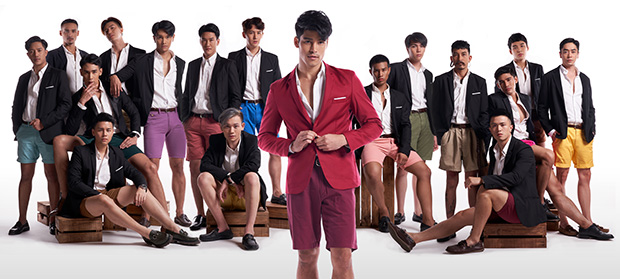
South-East Asian digital entertainment company Pops is gearing up to launch what it claims will be the first ever male-to-male romance reality show in Asian entertainment.
Pops Thailand will premiere Bromance on its app on May 9 as part of its original programming push.
The reality series will see an all-male cast vying for their shot at romance, with 16 single men facing off against each other to compete for the attention and love of 27-year-old Thai model Chudjane-Visut Chowbangprom.
A new episode of the 10-part series will be released every Sunday evening from May 9, with Thai celebrities and other special guests also set to appear on the show.
Anti-transgender bills are latest version of conservatives’ longtime strategy to rally their base | Opinion – Pennsylvania Capital-Star

(Julie Bennett/Getty Images/The Conversation).
By Alison Gash
On April 6, 2021, despite Republican Gov. Asa Hutchinson’s veto, Arkansas became the first state to prohibit physicians from providing gender-affirming medical care like hormone treatments designed to delay puberty in transgender youth. So-called “puberty blockers” are used to delay the physical changes associated with puberty and provide time for transgender young people to consider their options.
Arkansas physicians now face criminal penalties if they prescribe puberty blockers or other forms of cross-gender health care to transgender youth. Twenty other states are considering similar bills. Some would classify puberty blockers and other gender-affirming medical treatments as child abuse or would revoke the medical licenses of physicians prescribing these therapies.
These anti-transgender health care bills are part of a record number of anti-transgender policy reforms that conservative legislators have introduced this year in state legislatures across the country.
These include bills that will bar transgender athletes from participating in student sports and mandate parental notification for a school curriculum that is inclusive of LGBTQIA – lesbian, gay, bisexual, transgender, questioning and/or queer, intersex and asexual – issues. One additional variety – just signed into law by Republican Montana Gov. Greg Gianforte – requires gender reassignment surgery before any individual can change the sex marker on their birth certificate.
So far, anti-transgender athlete bills have gained the most traction. Despite consistent public opposition, 30 states have now considered barring transgender athletes from playing on teams that match their gender identity. Alabama, Arkansas, Mississippi, South Dakota and Tennessee have already passed legislation, and other states are likely to follow.
As a civil rights scholar, I have found that campaigns that mischaracterize LGBTQIA-supportive policies as harmful to young people are a staple strategy conservatives use to galvanize their base.

‘Save our Children’
Anti-gay activist and Florida orange juice queen Anita Bryant first perfected the strategy in the 1970s to oppose ordinances prohibiting sexuality-based discrimination. Bryant’s “Save our Children” campaign demonized gays and lesbians as “recruiting children.” Bryant successfully encouraged voters to oppose legislative attempts to protect gays and lesbians from discrimination and prompted Florida legislators to bar same-sex couples from adopting children, a law that was later overturned in 2010.
In the late 1990s and early 2000s, conservatives prompted over 40 states to bar same-sex marriage on the basis that all children could be at risk – those raised by same-sex couples and those introduced to marriage equality at school.
In 2015, when the Supreme Court overturned these bans in the landmark case Obergefell v. Hodges, conservatives began targeting transgender rights.
Conservatives again trained their focus on nondiscrimination measures – this time those prohibiting gender identity discrimination. They misleadingly argued that any measure protecting transgender individuals would place cisgender girls and women (individuals whose gender identity and birth-assigned sex are both female) at risk by allowing men dressed as women to use women’s locker rooms and restrooms.
There is no evidence supporting this claim. Yet there is significant evidence of health and safety risks to transgender students if they are prohibited from using bathrooms that reflect their gender identity.
Significant costs
Anti-transgender athlete and health care bills follow a similar approach. Advocates for bills targeting transfemale athletes claim that transmale teammates will “ruin women’s sports forever.”
Supporters of anti-trans health care bills claim that children are being pressured to employ these therapies, by physicians and parents, and describe the effects as permanent and scarring.
There is little empirical evidence to back up these assertions. Puberty blockers are an increasingly common treatment precisely because they provide a reversible and less invasive option for transgender adolescents and are provided only with the patient’s fully informed consent. Cross-gender hormone treatments (which are typically provided in later adolescence) are also relatively low-risk.
And there is little evidence to suggest that transgender female athletes are unfairly outcompeting their cisgender competitors – particularly if they have been on puberty blockers. In fact, conservative legislators have pointed to only one instance in their campaigns, when two Black transfemale athletes in Connecticut took first and second place in a 2017 statewide track tournament. Several cisgender female athletes who lost are suing state officials for permitting the transgender athletes to compete.
A far more common story is the relative obscurity of transgender athletes in women’s sports and their similarities with their cisgender teammates. Many of the states considering the legislation have no known transfemale athletes or have transfemale athletes who are performing on par with cisfemale teammates.
And even the cisgender Connecticut athletes currently suing state officials prevailed in several championship races against their transgender competitors shortly after filing their lawsuit.
But none of this has prevented bill supporters from stoking fears.
We do know, however, that the bills will harm transgender young people.
Prohibiting gender-affirming care like puberty blockers or barring transgender-inclusive athletic teams imposes real and devastating risks on transgender youths. Transgender people who do not have access to the kinds of hormone therapies that are being outlawed are four times more likely than cisgender people to struggle with depression.
They are also nine times more likely than cisgender individuals to attempt suicide.
Put simply, gender-affirming policies and supportive health care therapies are lifesaving.
Furthermore, if upheld in court, the athlete bills could require any female athlete to “prove” their gender to participate, potentially through invasive physical examinations.

Political landscape
Conservatives may be using these bills – which some describe as “erasing transgender youth” – to catalyze Republican voters to participate in upcoming midterm elections. And the strategy could work.
Attempts to bar transgender athletes appeal to at least some self-described feminists. And some high-profile women’s athletes have joined the fray. The Women’s Sports Policy Working Group convened in order to “protect” cisgender female athletes.
Conservatives are also using anti-trans-athlete talking points to oppose the Equality Act, a bill now circulating in the Senate that would add prohibitions against sexual orientation and gender identity discrimination to existing federal civil rights bills. The House passed a similar measure last year, but it failed to pass the Senate.
Transgender advocates have some recourse to fight the bills. Corporate backlash is one option. Litigation is another. Advocates for transgender rights have secured legal victories in state and federal court challenges involving bathrooms and locker rooms. More recently a federal judge in Idaho blocked that state’s anti-transgender athletes bill passed in 2020.
And the Supreme Court’s recent ruling in Bostock v. Clayton County, which protects LGBTQ individuals from certain forms of discrimination, seems at first blush to support transgender student equality. But the Bostock case is new, its application to sports and health care untested and political fervor is mounting. With a solid conservative majority on the Supreme Court – and in federal courts across the country – legal battles are unreliable.
In the meantime, transgender young people across the country are contemplating a more uncertain and dangerous future. Some are working with their parents to find out-of-state sources for puberty blockers. Others are contemplating moves to less hostile states. All of this because conservatives have channeled trumped-up claims into harmful legislation that outlaws transgender youths to further divide American voters.![]()
Alison Gash is an associate professor of political science at the University of Oregon. She wrote this piece for The Conversation, where it first appeared.
![]()
‘Don’t be scared to be who you are’ – Marshall Independent
Photo by Deb Gau
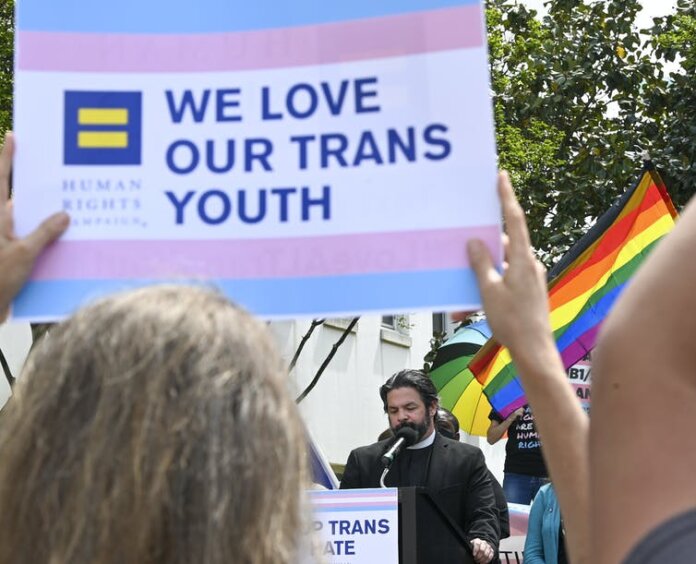
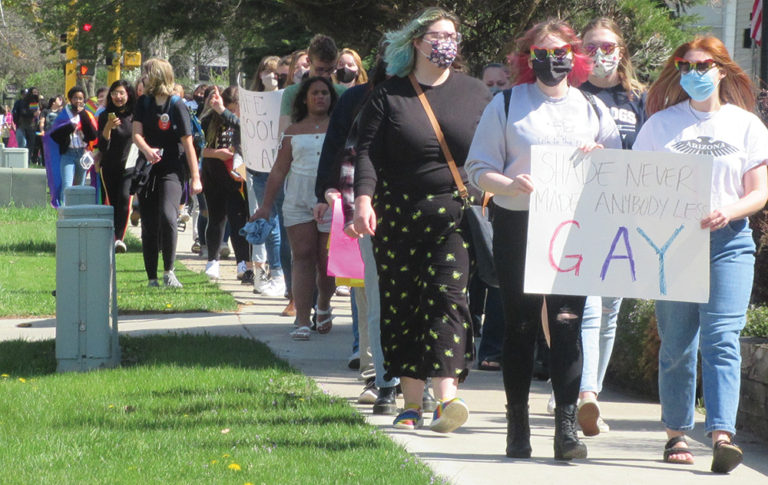
Marshall area residents, including students from Marshall Middle School and Marshall High School, marched down Main Street on Thursday afternoon in support of LGBTQ classmates and allies. Marchers carried signs with messages of support — and even some humor, like one slogan quoting the lyrics of a Taylor Swift song .
MARSHALL — They were marching with handmade signs, brightly colored flags and more. The gathering and the signs were all geared toward a shared goal: showing local youth who are part of the LGBTQ+ community that they aren’t alone.
“Don’t be scared to be who you are,” one marcher said after the group had gathered around at the corner of Main Street and East College Drive.
A group of Marshall students organized an after-school walk and gathering in support of LGBTQ+ classmates and community members on Thursday. Members of the Marshall Middle School Pride Club were joined by family, members of the Marshall High School SPECTRUM Club, members of Buffalo Ridge PFLAG, Southwest Minnesota State University students and other community members.
“They were talking about how they wanted to be more seen and heard,” said MMS Pride Club adviser Ellen Helgerson. The idea for a walk after school worked out for students to get together, she said.
The group gathered outside the Marshall-Lyon County Library and marched down C Street and Main Street to Memorial Park. Students waved rainbow pride flags, cheered when passing cars honked their horns, and gathered to share words of encouragement. Some Marshall students who had gone on to attend MHS or SMSU said they wanted to let the middle schoolers know they were there for them.
“I was proud of everyone who came here,” said James Lor, the president of the MHS SPECTRUM Club. Lor and other marchers said it was good to see people turn out to support LGBTQ+ youth. “I’m so glad this could happen, even in the tiny town of Marshall.”
Parents and community members at the march also said they wanted to show kids they cared. Emma Russ said she was there for her children Willow, 13, and Brennan, 8.
“I wanted to make sure they and their friends are supported,” she said.
Pastor Anne Veldhuisen told students gathered at the park to remember they were loved and supported for who they were.
Thursday’s walk came after controversy over a rainbow LGBT pride flag displayed at Marshall Middle School resurfaced in the form of a lawsuit against the school district. A display of flags, including U.S. and international flags and a rainbow flag representing lesbian, gay, bisexual and transgender students, was put up in the middle school cafeteria in January 2020.
A civil complaint filed in Minnesota District Court in April alleged the school district violated the First Amendment rights of a middle school student who petitioned to take down the rainbow flag. The lawsuit also alleged the school district’s policies on flag displays weren’t “viewpoint neutral.”
As of Thursday, court records showed the school district hasn’t yet filed a response to the lawsuit. The group suing Marshall Public Schools, Marshall Concerned Citizens, is seeking a jury trial.
Africa: Interview-Scrapping Gay Sex Bans Key to Fighting HIV, Says UNAIDS Ambassador – AllAfrica – Top Africa News
London — Gay sex is illegal in dozens of countries around the world, deterring many people from coming forward for HIV testing, according to former British health minister Norman Fowler
Scrapping gay sex bans around the world is vital to fighting the spread of HIV because it would encourage more people to get tested, Britain’s former health minister during the 1980s AIDS crisis said on Thursday.
Norman Fowler, who this month takes up an ambassadorial role at the U.N. agency UNAIDS, said many people are unwilling to come forward for HIV tests in countries that effectively criminalise homosexuality.
“That’s going to have a vast effect upon any population,” Fowler told the Thomson Reuters Foundation in a telephone interview.
“It means they don’t come forward for testing and it means that they come forward far too late for testing.”
Gay sex is illegal in 68 countries worldwide, according to the ILGA advocacy group.
As Britain’s secretary of state for health between 1981 and 1987 during the government of Prime Minister Margaret Thatcher, Fowler oversaw the country’s first HIV/AIDS awareness programme – facing widespread resistance, even from the late PM.
“I’m afraid that she was what these days might be called a sceptic on this whole area,” said Fowler, 83.
“Her position was quite near to a number of the religious leaders who simply said, as much as they said anything, that we should be pursuing a ‘moral’ campaign,” he added.
Thatcher’s concerns stemmed partly from what she saw as the explicit nature of some of Britain’s early HIV/AIDS awareness campaigns, which began in 1986.
An initial proposal for an advert mentioned “risky sex”, which Fowler said Thatcher thought “would offend people and … tell young people things about which they knew nothing, with the implication that it would encourage them”.
Thatcher’s scepticism was indicative of attitudes towards gay men and the wider LGBT+ community at the time, recently highlighted in the hit British television series “It’s A Sin”, which Fowler praised for its accurate depiction of the era.
While gay sex was partially decriminalised in England and Wales in 1967, there was still an unequal male age of consent up until 2001.
Famously, Queen Victoria’s refusal to believe lesbians existed meant that the age of consent for straight and gay women remained equal.
‘HEROIC EFFORTS’
In 1988, when Thatcher was still prime minister, her Conservative administration passed a law banning local authorities from “promoting” homosexuality.
Fowler supported the legislation, which was overturned in England and Wales in 2003, and later also voted against a possible equalisation of the age of consent at 16.
He said he regretted both decisions.
“That was a mistake,” he said. “And I’ve never made any bones about that.”
In his new role at UNAIDS, which he takes up after stepping down as the speaker of Britain’s upper parliamentary chamber on April 30, he will be focused on highlighting the battle to combat AIDS as COVID-19 dominates global health concerns.
“There’s a real danger that the world is going to forget about the crisis and problem of AIDS because obviously the COVID issue is foremost in people’s minds,” Fowler said.
“But the fact is that AIDS – in spite of all the heroic efforts that have been made over the past 20 years – remains an enormous problem.”
While anti-HIV/AIDS measures have seen transmission rates plummet in more developed countries, 1.7 million people were newly infected with HIV in 2019, according to UNAIDS.
Globally, more than 38 million are living with the virus.
“The issue of AIDS remains a very central one, and although it may not be as evident in Europe, it certainly remains very evident in whole swathes of the world,” Fowler said.
Class Acts: The champions for health equity | The Source | Washington University in St. Louis – Washington University in St. Louis Newsroom
This week, Class Acts celebrates graduates who are working for health equity across the globe, in their neighborhoods and in examination rooms. Meet Gautam Adusumilli and Cory French, doctor of medicine candidates from the School of Medicine, and Keishi Foecke, who is set to earn an undergraduate degree from Arts & Sciences at Washington University in St. Louis.

In the name of medicine, Gautam Adusumilli learned to ride a motorcycle during the pandemic. He considers the skill essential to becoming a radiologist and researcher in remote areas of the developing world.
“My passion is global health,” Adusumilli said. “Most everything I do — even taking up a new hobby like motorcycling — relates to my interest in improving access to health care and reducing the disparities afflicting marginalized, poverty-stricken communities.”
His decision to apply for residency specializing in diagnostic radiology also reflects this interest.
“I used the solitude of the pandemic to examine ways to integrate radiology into my global health ambitions,” Adusumilli said. “Radiology is a relatively untapped specialty in the global arena. This is partly due to the logistical incompatibility of imaging technology with resource-poor environments — but that is beginning to change. I believe diagnostic imaging should be a medical priority in developing countries. Without an ultrasound, how will a midwife in Uganda know that a pregnant woman about to deliver has placenta previa? How will a teenager who struggles to ride his bicycle to school know that his struggle is due to chronic rheumatic heart disease?”
In June, Adusumilli will begin residency training with a preliminary year focus on surgery in the Stanford University hospital system, followed by radiology training at Harvard University-affiliated Massachusetts General Hospital.
After Commencement, however, Adusumilli will travel to Uganda, where he co-founded a nongovernmental organization with classmate Yang Jae Lee. Empower Through Health runs a health center, advances public health measures and provides leadership and research opportunities to college students.
“One of my major focuses of the trip will be to help train our staff on the use of ultrasound for both maternal care and cardiac disease screening,” he said. “We recently became a global health partner of Butterfly Network, a health-tech company, and I’m thrilled to study and apply their hand-held ultrasound technology. The pandemic gave me an increased sense of purpose.”
— Kristina Sauerwien

Senior Keishi Foecke’s studies in global health took her to Uganda, where she researched school absenteeism among menstruating girls and documented the nation’s burgeoning #MeToo movement.
And to her hometown of San Francisco, where she helped unhoused families during the pandemic.
And down the street to The SPOT, the School of Medicine’s youth clinic, where Foecke marketed free services to low-income and LGBT teens.
“Global health is not just about injustices that occur in faraway places,” said Foecke, who is set to graduate with a degree in anthropology from Arts & Sciences. “There are incredible inequities in our backyards, too.”
Foecke credits her mentors in the student group GlobeMed for her expansive view of global health justice. The group has a long-running partnership with Uganda Development and Health Associates, which provides reproductive and child health services and runs the menstrual dignity program program that Foecke studied. GlobeMed members also are active locally, building new relationships with St. Louis nonprofits and advocating for social and health justice reforms.
“In classes, we talk a lot about ethics, cultural sensitivity and sustainable partnerships, but GlobeMed gave me a chance to see those values in action,” said Foecke, a Gephardt Institute Fox-Clark Civic Scholar. “It’s about listening to and centering the voices of the community.”
Foecke is a 3-2 student at the Brown School and will earn her master’s in public health next year. She currently is a research assistant on a Centers for Disease Control tobacco control project and will work this summer at the CDC’s Public Health Law Program. Ultimately, she may develop public health policy in Washington, D.C., conduct research at a university or work at a nonprofit here or abroad.
“No matter what you do or where you go, understanding public health and health disparities is central to solving the big problems,” Foecke said.
— Diane Toroian Keaggy

In 2019, a transgender man unknowingly led Cory French to his calling in medicine.
French was a third-year medical student working on a clinical rotation in gynecologic oncology when he recognized terror in the patient’s eyes. “It was the same paralyzing fear that had characterized the start of my life as a closeted gay man,” French recalled. “Even now, after coming out a decade ago while I was in high school, that fear never leaves me, and I must continue to fight every day to escape its influence.”
The patient was about to undergo an examination of the cervix, vagina and vulva for precancerous or cancerous lesions.
“It was here, in this moment at the intersection of identity and clinical care, that I knew that I had found my home in obstetrics and gynecology. Nowhere else in medicine is there such an entanglement of social identity, and nowhere else can I better use my own history to enable my patients to navigate their own care.”
This summer, French will begin training in the Beth Israel Deaconess Medical Center obstetrics and gynecology residency program at Harvard Medical School. “I’m particularly focused on advocating for vaccinations and screenings to prevent cervical cancer in queer patients, as well as understanding pelvic cancer risks for transgender patients on hormone therapies,” he said.
During and after his training, French said, he will continue leading advocacy efforts in LGBTQ+ medical groups, while also developing lessons that address gaps in gender and sexual minority representation in medical education.
A question posed by that patient exposed such gaps. “He asked me if his testosterone therapy served as birth control, and I had no answer,” said French, clarifying that it does not act as birth control. “I intend to spend my career breaking down barriers and building the empathy needed to eliminate the stigma around gender.”
— Kristina Sauerwein
Class Acts: The champions for health equity | The Source – Washington University in St. Louis Newsroom
This week, Class Acts celebrates graduates who are working for health equity across the globe, in their neighborhoods and in examination rooms. Meet Gautam Adusumilli and Cory French, doctor of medicine candidates from the School of Medicine, and Keishi Foecke, who is set to earn an undergraduate degree from Arts & Sciences at Washington University in St. Louis.

In the name of medicine, Gautam Adusumilli learned to ride a motorcycle during the pandemic. He considers the skill essential to becoming a radiologist and researcher in remote areas of the developing world.
“My passion is global health,” Adusumilli said. “Most everything I do — even taking up a new hobby like motorcycling — relates to my interest in improving access to health care and reducing the disparities afflicting marginalized, poverty-stricken communities.”
His decision to apply for residency specializing in diagnostic radiology also reflects this interest.
“I used the solitude of the pandemic to examine ways to integrate radiology into my global health ambitions,” Adusumilli said. “Radiology is a relatively untapped specialty in the global arena. This is partly due to the logistical incompatibility of imaging technology with resource-poor environments — but that is beginning to change. I believe diagnostic imaging should be a medical priority in developing countries. Without an ultrasound, how will a midwife in Uganda know that a pregnant woman about to deliver has placenta previa? How will a teenager who struggles to ride his bicycle to school know that his struggle is due to chronic rheumatic heart disease?”
In June, Adusumilli will begin residency training with a preliminary year focus on surgery in the Stanford University hospital system, followed by radiology training at Harvard University-affiliated Massachusetts General Hospital.
After Commencement, however, Adusumilli will travel to Uganda, where he co-founded a nongovernmental organization with classmate Yang Jae Lee. Empower Through Health runs a health center, advances public health measures and provides leadership and research opportunities to college students.
“One of my major focuses of the trip will be to help train our staff on the use of ultrasound for both maternal care and cardiac disease screening,” he said. “We recently became a global health partner of Butterfly Network, a health-tech company, and I’m thrilled to study and apply their hand-held ultrasound technology. The pandemic gave me an increased sense of purpose.”
— Kristina Sauerwien

Senior Keishi Foecke’s studies in global health took her to Uganda, where she researched school absenteeism among menstruating girls and documented the nation’s burgeoning #MeToo movement.
And to her hometown of San Francisco, where she helped unhoused families during the pandemic.
And down the street to The SPOT, the School of Medicine’s youth clinic, where Foecke marketed free services to low-income and LGBT teens.
“Global health is not just about injustices that occur in faraway places,” said Foecke, who is set to graduate with a degree in anthropology from Arts & Sciences. “There are incredible inequities in our backyards, too.”
Foecke credits her mentors in the student group GlobeMed for her expansive view of global health justice. The group has a long-running partnership with Uganda Development and Health Associates, which provides reproductive and child health services and runs the menstrual dignity program program that Foecke studied. GlobeMed members also are active locally, building new relationships with St. Louis nonprofits and advocating for social and health justice reforms.
“In classes, we talk a lot about ethics, cultural sensitivity and sustainable partnerships, but GlobeMed gave me a chance to see those values in action,” said Foecke, a Gephardt Institute Fox-Clark Civic Scholar. “It’s about listening to and centering the voices of the community.”
Foecke is a 3-2 student at the Brown School and will earn her master’s in public health next year. She currently is a research assistant on a Centers for Disease Control tobacco control project and will work this summer at the CDC’s Public Health Law Program. Ultimately, she may develop public health policy in Washington, D.C., conduct research at a university or work at a nonprofit here or abroad.
“No matter what you do or where you go, understanding public health and health disparities is central to solving the big problems,” Foecke said.
— Diane Toroian Keaggy

In 2019, a transgender man unknowingly led Cory French to his calling in medicine.
French was a third-year medical student working on a clinical rotation in gynecologic oncology when he recognized terror in the patient’s eyes. “It was the same paralyzing fear that had characterized the start of my life as a closeted gay man,” French recalled. “Even now, after coming out a decade ago while I was in high school, that fear never leaves me, and I must continue to fight every day to escape its influence.”
The patient was about to undergo an examination of the cervix, vagina and vulva for precancerous or cancerous lesions.
“It was here, in this moment at the intersection of identity and clinical care, that I knew that I had found my home in obstetrics and gynecology. Nowhere else in medicine is there such an entanglement of social identity, and nowhere else can I better use my own history to enable my patients to navigate their own care.”
This summer, French will begin training in the Beth Israel Deaconess Medical Center obstetrics and gynecology residency program at Harvard Medical School. “I’m particularly focused on advocating for vaccinations and screenings to prevent cervical cancer in queer patients, as well as understanding pelvic cancer risks for transgender patients on hormone therapies,” he said.
During and after his training, French said, he will continue leading advocacy efforts in LGBTQ+ medical groups, while also developing lessons that address gaps in gender and sexual minority representation in medical education.
A question posed by that patient exposed such gaps. “He asked me if his testosterone therapy served as birth control, and I had no answer,” said French, clarifying that it does not act as birth control. “I intend to spend my career breaking down barriers and building the empathy needed to eliminate the stigma around gender.”
— Kristina Sauerwein
New preorientation program PennGenEq will promote gender equity and social justice – The Daily Pennsylvanian
The Penn Association for Gender Equality will host PennGenEq beginning in the fall 2021 semester.
Credit: File Photo
The Penn Association for Gender Equity, a student organization on campus that aims to promote gender equity and social justice, will host a new first-year pre-orientation program called PennGenEq beginning in the fall 2021 semester.
After four years of developing the program under the leadership of previous chairs, PAGE chair Samantha Pancoe said that PAGE is set to host PennGenEq in efforts to give new students a space to explore the role of gender and identity in their lives and form connections with students, organizations, and on-campus centers — such as the LGBT Center, Penn’s Women’s Center, and PennNonCis — prior to move-in. Pancoe said the program is currently planning to be in person, but that it will be conducted on a virtual platform if the University makes all pre-orientation events virtual due to COVID-19.
“We hope to provide a community for incoming students to learn and socialize alongside students with similar backgrounds to make their first year a little easier,” Pancoe said. “We also hope that our program will provide students with avenues to get involved in advocacy and action both on campus and in Philadelphia more broadly.”
The curriculum of the program includes discussions on the history of feminism, identity and intersectionality, binaries and labels, a critical history of feminism, and discussions about privilege.
Pancoe said that one way the program will help first years become involved in advocacy is through allowing centers and groups on campus such as Penn Anti-Violence Educators, the Women’s Center, which houses PAGE, the LGBT Center, and the Gender, Sexuality and Women’s Studies Program to give presentations to participating students.
After listening to these presentations, Serena Martinez, one of two First Year Coordinators at PAGE, said that students will be given the time to critically self-reflect, be vulnerable with others in the program, and decompress with each other.
Martinez, who has played a substantial role in developing the program, said that although PennGenEq will be like other orientation programs in that it will allow first years to get acclimated to campus, find friends prior to move-in, and encourage discussion on important topics, the program will still be unique.
“What PennGenEq does that other programs do not is create a space exclusively for students of minority genders to discuss identity in their lives and in their futures at Penn,” Martinez said.
Director of the LGBT center Erin Cross and Director of Penn’s Women’s Center Sherisse Laud-Hammond agreed that the inclusive nature of the program will enable a safe space for students to discuss identities and gender equity.
Prior to launching the program, Cross and Hammond said that PAGE members attended many meetings with Vice Provost for University Life Mamta Motwani Accapadi to develop documents that ensure the program has the right learning objectives and outcomes for students.
“It has been deeply inspiring to work with PAGE leaders to support their vision of a student experience centered around building intentional community for students from marginalized gender identities,” Accapadi wrote in an email to The Daily Pennsylvanian on May 4.
Martinez said that in addition to wishing that there was a program like this when they were a first year, they found that the lack of open conversations about gender and identity at the University inspired them to create PennGenEq.
“Gender and identity affect all of us, whether we study it academically, cross-culturally amongst other fields, or rarely if at all in school,” they said. “I don’t believe it is ever too early to discuss and think critically about gender, especially entering a predominantly white institution with frats lining campus and rates of sexual violence statistically heightened for minority groups.”
For Pancoe, it was the success of PAGE’s pilot first-year retreat in 2019 and its first-year fellowship that led to launch PennGenEq.
PAGE has been running a first-year fellows program every fall, Martinez said, which invites around 20 students to talk about gender equity and the intersection of gender with other identities. In order to further connect with first years, PAGE held a one-day retreat for first years in 2019 with grants provided by GSWS in the hopes of it leading to a pre-orientation program the following year, which ultimately did not happen due to COVID-19.
“It has been really great both from a learning perspective and a community building perspective [to have these first-year programs], so we are hoping to sort of get that energy going a little bit earlier through a pre-orientation program,” Pancoe said.
Martinez said they are confident that PennGenEq will continue on for many years, adding that they are open to suggestions about improving the program for the future.
“The program is not fixed and will continue to evolve based on participant feedback, so if you are applying and have topics you want covered, we welcome those suggestions,” Martinez said.
More Like This
With ambassador picks, Biden faces donor vs. diversity test – KOKI FOX 23

President Joe Biden is facing a fresh challenge to his oft-repeated commitment to diversity in his administration: assembling a diplomatic corps that gives a nod to key political allies and donors while staying true to a campaign pledge to appoint ambassadors who look like America.
More than three months into his administration, Biden has put forward just 11 ambassador nominations and has more than 80 such slots to fill around the globe. Administration officials this week signaled that Biden is ready to ramp up ambassador nominations as the president prepares for foreign travel and turns greater attention to global efforts to fight the coronavirus.
Lobbying has intensified for more sought-after ambassadorial postings — including dozens of assignments that past presidents often dispensed as rewards to political allies and top donors. Those appointments often come with an expectation that the appointees can foot the bill for entertaining on behalf of the United States in pricey, high-profile capitals.
But as he did with the assembling of his Cabinet and hiring top advisers, Biden is putting a premium on broadening representation in what historically has been one of the least diverse areas of government, White House officials say.
“The president looks to ensuring that the people representing him — not just in the United States, but around the world — represent the diversity of the country,” White House press secretary Jen Psaki told reporters this week.
Presidents on both sides of the aisle have rewarded donors and key supporters with a significant slice of sought-after ambassadorships. About 44% of Donald Trump’s ambassadorial appointments were political appointees, compared with 31% for Barack Obama and 32% for George W. Bush, according to the American Foreign Service Association. Biden hopes to keep political appointments to about 30% of ambassador picks, according to an administration official who spoke on the condition of anonymity to talk about internal discussions.
Most political appointees from the donor class, a small population that’s made up of predominantly white men, have little impact on foreign policy. Occasionally, they have been the source of presidential headaches.
Trump’s appointees included hotelier and $1 million inaugural contributor Gordon Sondland, who served as chief envoy to the European Union. Sondland provided unflattering testimony about Trump during his first impeachment, which centered on allegations Trump sought help from Ukrainian authorities to undermine Biden ahead of the 2020 presidential election. Sondland was later fired by Trump.
Trump donor-turned-envoy Jeffrey Ross Gunter left locals in relatively crime-free Reykjavik, Iceland, aghast over his request to hire armed bodyguards. In Britain, Ambassador Robert “Woody” Johnson faced accusations he tried to steer golf’s British Open toward a Trump resort in Scotland and made racist and sexist comments.
In 2014, the American Foreign Service Association called for new guidelines to ensure that ambassadors meet certain qualifications for top diplomatic posts after a series of embarrassing confirmation hearings involving top Obama fundraisers. At least three of Obama’s nominees — for Norway, Argentina and Iceland — acknowledged during confirmation hearings that they had never been to the nations where they would serve.
Another big Obama donor, Cynthia Stroum, had a one-year tour in Luxembourg that was fraught with personality conflicts, verbal abuse and questionable expenditures on travel, wine and liquor, according to an internal State Department report.
So far, Biden has made two political appointments — retired career foreign service officer Linda Thomas-Greenfield for U.N. ambassador and Obama-era Deputy Labor Secretary Christopher Lu for another ambassadorial-ranked position at the U.N. Thomas-Greenfield is Black, and Lu, who is awaiting Senate confirmation, is Asian American.
His other nine nominees are all longtime career foreign service officers, picked to head up diplomatic missions in Algeria, Angola, Bahrain, Cameroon, Lesotho, Republic of Congo, Senegal, Somalia and Vietnam.
Jockeying for ambassadorial positions started soon after Biden was elected and has only heated up as administration officials have signaled that the president is looking to begin filling vacancies ahead of his first overseas travel next month.
Cindy McCain, the widow of Republican Sen. John McCain and a longtime friend of the president and first lady Jill Biden, is under consideration for an ambassadorial position, including leading the U.N. World Food Program. Rahm Emanuel, the former Chicago mayor, Illinois congressman and Obama chief of staff, is in contention to serve as ambassador to Japan after being passed up for the role of transportation secretary, according to people familiar with the ongoing deliberations who spoke on the condition of anonymity to discuss personnel matters.
Biden is also giving close consideration to former career foreign service officer Nicholas Burns, who served as undersecretary of state under George W. Bush and as U.S. envoy to Greece and NATO, to become ambassador to China. Thomas Nides, a former deputy secretary of state in the Obama administration, and Robert Wexler, a former Democratic congressman from Florida, are under consideration for ambassador to Israel.
The White House declined to comment about any of the potential picks.
Of the 104 diplomats currently serving or nominated for ambassador-level positions, 39 are women and 10 are people of color, according to the Leadership Council for Women in National Security, a bipartisan group of national security experts.
A group of more than 30 former female U.S. ambassadors, in an open letter organized by the Leadership Council and Women Ambassadors Serving America, urged Biden to prioritize gender parity in his selections for ambassadorships and other high-level national security positions.
“As you build out your diplomatic leadership, we hope you will pay attention to growing allies within the U.S. government who will also focus upon the diversity America’s representatives to the world should demonstrate,” the former ambassadors told Biden.
During the transition, Reps. Veronica Escobar and Joaquin Castro, both Texas Democrats, wrote a joint letter to Secretary of State Antony Blinken urging the administration to address the “persistence of grave disparities in racial and ethnic minority representation in the Foreign Service.”
To that end, the State Department last month appointed veteran diplomat Gina Abercrombie-Winstanley as its first chief diversity and inclusion officer. Abercrombie-Winstanley will be the point person in a department-wide effort to bolster recruitment, retention and promotion of minority foreign service officers.
Blinken, in announcing her appointment, noted “the alarming lack of diversity at the highest levels of the State Department” during the Trump administration, but said the issue runs much deeper.
“The truth is this problem is as old as the department itself,” he said.
As a candidate, Biden declined to rule out appointing political donors to ambassadorships or other posts if he was elected. But he pledged his nominees would be the “best people” for their posts.
“Nobody, in fact, will be appointed by me based on anything they contributed,” Biden promised.
Ronald Neumann, a former ambassador to Afghanistan, Algeria and Bahrain, said Biden’s team has made progress in the early going in diversifying the upper ranks of the State Department.
He pointed to the nomination of Donald Lu, a career foreign service officer, as the next assistant secretary of state for South and Central Asia and Brian A. Nichols to be the top envoy for Latin America. Nichols would be the first Black assistant secretary of state for Western Hemisphere affairs since the late 1970s; Lu is Asian American.
In addition, the State Department’s chief spokesperson, Ned Price, is the first openly gay man to serve in that role. His principal deputy, Jalina Porter, is the first Black woman in that job.
“I think the administration is finding a good balance of experienced, accomplished career foreign service officers coming from diverse backgrounds,” said Neumann, who heads the American Academy of Diplomacy.
Finding good picks from Biden’s donor class, however, might be trickier, Neumann said, adding, “I don’t know how you go about finding competent, big donors from a pool that might be limited in diversity.”
___
AP Diplomatic Writer Matthew Lee contributed to this report.
Trixie Mattel Keeps Wisconsin Gay and Proud – The Scarlet

RuPaul Drag Race Season 7 Star Becomes Part Owner for Wisconsin’s Oldest Gay Bar
Over Quarantine, Drag Queen and internet personality Trixie Mattel bought Milwaukee’s oldest gay bar to prevent the business from going under with the lack of in person business. “This Is It!” has been a staple of the gay community in Wisconsin since 1968, hosting Drag Queens for the last 53 years. Being a Wisconsin-born Drag icon, Mattel saw the opportunity to give back to the gay community that helped her launch her world renowned career and seized it. She became a part-time owner and financially supported the business throughout the pandemic. Now, as vaccinations continue to roll out and summer 2021 fast approaches, “This Is It!” (lovingly referred to as “Tits!”) has once again opened its doors.
Trixie Mattel, alternately known as Brian Firkus, has made a name for herself after appearing on season seven of “RuPauls’ Drag Race” and season three of the “All Stars” series. Mattel has a series on YouTube called “UNHhhh” as well as an MTV series that features herself alongside her illustrious co-star Katya Zamolodchikova, with the Youtube series now entering its seventh season. Mattel also has a new channel on Youtube where she posts free, fully-edited and well-shot videos on a regular basis, including collaborations with internet personalities such as Sarah Schauer and Brittany Broski.
Unsurprisingly, Mattel has had the revenue to support “This Is It!” through this pandemic, even helping with cosmetic touch ups like painting the outdoor seating area’s wooden fence rainbow and posting the newly redesigned outside onto her Instagram with millions of followers world-wide. Mattel has been a patron of “Tits!” long before she became a world renowned Drag Queen – since before she had even become comfortable enough with her queer identity to dabble in Drag itself. It was the confidence and community that “Tits!” fostered that helped Trixie Mattel become Trixie Mattel. Without the support of the oldest running gay bar in Wisconsin, the world may have never felt her impact, and the star recognizes the significance of gay bars in broaching the gay community for newbie homosexuals.
“Tits!” has adapted to the modern world – with some help from Mattel – and now produces weekly Twitch livestreams featuring the Queens who make their way to Milwaukee. This not only helps the bar, but gives a massive platform to these midwestern Queens. In the age of the internet, it is tactics like this that help foster a larger community and bring in more money for small local businesses that are loved by those far and wide.
Mattel described the bar as “tacky” and as “the Cher of gay bars” in an article for “them.” perfectly describing what sounds like a fun place to spend your Saturday nights. It is loyal patrons and benefactors like Mattel that will help small businesses through the pandemic and help them better adjust to being businesses in the 21st century. Without Mattel, Wisconsin could have lost its longest running gay bar. With increasing conservative movements across the Midwest, it is important to keep these businesses that are the cornerstone of queer culture alive. What would the world be without gay bars or Drag Queens or rogue twinks or Trixie Mattel? It is unfair to queer youth if these businesses failed because their patrons follow CDC guidelines and prioritize protecting the greater community, not to mention the lack of support these businesses received from the U.S. government over the past year. It is these businesses that help young 21-year-old gays find a greater community and support system that helps them be authentically who they are.
Thank you, Trixie Mattel. And UNHhhh.
Ian McKellen says coming out as gay improved his work – The Bolton News
Sir Ian McKellen has said his work improved after he came out as gay.
The actor, 81, told ITV’s The Jonathan Ross Show he was no longer “hiding” after coming out.
Sir Ian revealed his sexuality on BBC radio in 1988.
Discussing the period after he came out, Sir Ian said: “I have never stopped talking about it since. Made up for lost time.
“It changes your life utterly. I discovered myself.
“And everything was better. My relationships with my family, with friends, with strangers, and my work got better as I wasn’t hiding any more.
“Up to that point, my acting had really been about disguise and then, when I could feel I was myself, it came about telling the truth, which was much more interesting.”
Sir Ian said his “dilemma” about coming out when he was younger was that if he was openly gay he “could have risked being prosecuted”.
“That’s not true any more,” he added.
“We have very good laws in this country.”
Sir Ian also told the programme why he has not written an autobiography.
“I put aside six or nine months to write it – it was for an awful lot of money which was basically the attraction,” he said.
However, Sir Ian said there was “a list of the chat shows, including this one, that I would be expected to appear on, all over the world, right across the States, South America, Australia”.
“That would take a year of my life, longer than to write the book,” he said.
“I said I don’t have enough time. So I gave them the money back.”
He added: “I wanted to start with my parents, why did they decide to have me, just before the Second World War, they must have discussed this and thought about this.
“It’s too late to ask them and I can’t quite imagine.
“I got rather teary thinking about them as young people and wishing I’d known more about them. That was another reason why I rather went off the idea.”
The Jonathan Ross Show airs on Saturday on ITV.
JEWEL GAY PETTY | Ohio – Huntington Herald Dispatch

JEWEL GAY PETTY, 78, of Chesapeake, Ohio, died May 6 at home. Hall Funeral Home and Crematory, Proctorville, Ohio, is in charge of arrangements, which are incomplete.