Home Blog Page 90

Park and playgrounds lead the NYC Public Design Commission’s 39th Excellence in Design awards – The Architect’s Newspaper

An imaginative, James Corner Field Operations-led revamp of a Brooklyn playground, an SOM-designed lab facility in Harlem, and the expansive restoration of a historic outer-borough Carnegie Library building are among the winning projects of the New York City Public Design Commission (PDC)’s 39th Annual Awards for Excellence in Design.

As evidenced by the three winning projects mentioned above, the just-announced awardees are, as in years past, a diverse bunch although parks and playgrounds, both newly constructed and reimagined, dominated the list this year. That was intentional on the part of the PDC given the essential function of city parks over the past year-plus. While the Department of Parks & Recreation-operated green spaces have long played a vital role in the complex and layered urban fabric of New York City, that role only became more consequential during the pandemic.

“Over the past year, it has become abundantly clear that well-designed and sustainable public parks and open spaces are essential foundations of public health. This year’s awards will focus on projects and programs that will provide and maintain these critical places for social gathering, recreation, and wellbeing,” said Signe Nielsen, a Manhattan-based landscape architect and president of the 11-member Public Design Commission.

Alongside Nielsen, the winning projects were announced by Deputy Mayor for Housing & Economic Development Vicki Been and Keri Butler, a 15-year veteran of the PDC who was appointed by Mayor Bill de Blasio as executive director this past April following the departure of Justin Garrett Moore.

“These award-winning designs reflect our City’s commitment to recovery and long-term resiliency, providing critical public spaces that enhance our physical and mental health and enrich our cultural and civic lives,” added Butler.

While all five boroughs (and Westchester County) are represented amongst the dozen Excellence in Design Award-winning projects, Brooklyn leads the pack with five projects in neighborhoods including Red Hook, Brownsville, and Greenpoint. Manhattan is home to two winning projects while the Bronx, Queens, and Staten Island can each claim one. One project is a city-wide initiative and the other, as mentioned, is a Department of Environmental Protection-operated facility located just north of the city in Westchester County.

In addition to the winning individual projects, the PDC announced two Special Recognition Awards: one goes to a generous handful of different initiatives collectively working to protect New York City’s vulnerable waterfront communities through coastal resiliency projects. The other is bestowed to the maintenance, operations, and art conservation teams of the various park conservancies, nonprofits, and operators who tended to the city’s open spaces during an extended period of historic duress.

Below are the 12 recipients—with project descriptions and imagery courtesy the PDC along with the names of the spearheading city agencies and outside firms, artists, and collaborators—of this year’s Awards For Excellence in Design along with the (multitude of) Special Recognition Award honorees. More detailed descriptions of the winning projects can be found in the 39th Annual Awards for Excellence in Design book.

Reconstruction of Grant Park | The Bronx

rendering of children play in a large open lawn, a 39th Excellence in Design awards winner
Grant Park in the Claremont section of the Bronx. (Courtesy NYC PDC)
  • A project of the Department of Parks & Recreation and the Department of Transportation
  • Stantec
  • “As part of the Jerome Avenue rezoning initiative, this project will convert a portion of the Grant Avenue roadbed into green space, integrating two smaller areas into one larger and more cohesive park. Designed to serve a growing community, the enlarged park will feature natural lawn for passive recreation and field games, shaded areas for seating and gathering, and an active recreational zone with a full-size basketball court and adult fitness area.”

Reconstruction of soccer fields at the Red Hook Recreation Area (Phase IV) | Brooklyn

rendering of people visiting food trucks at a city park, a 39th Excellence in Design awards winner
The Red Hook Soccer Fields (and famous food trucks) in Red Hook, Brooklyn. (Courtesy NYC PDC)
  • A project of the Department of Parks & Recreation
  • Abel Bainnson Butz
  • “As the final phase of the 36-acre reconstruction of the Red Hook Recreational Area, this project will complete the transformation of a formerly contaminated industrial site and popular neighborhood park into a city-wide destination for multi-generational recreation. The design includes storm resiliency and sustainability interventions, park-wide circulation and accessibility enhancements, and a gathering space with a variety of seating to accommodate the Food Truck Marketplace held along Bay Street.”

Construction of Bushwick Inlet Park, Motiva Parcel | Brooklyn

rendering of people relaxing along a waterfront park
Bushwick Inlet Park (Courtesy NYC PDC)
  • A project of the Department of Parks & Recreation
  • Abel Bainnson Butz
  • “A critical component of a larger waterfront park initiative and in line with the Williamsburg-Greenpoint Master Plan, this project will remediate a post-industrial landscape while restoring the local ecosystem. A continuous accessible esplanade includes areas for passive recreation such as nature observation points, and a kayak launch provides access to the water for more active pursuits.”

Reconstruction of the Pool and Rink at the Harlem Meer | Manhattan

aerial view of a large forested park with an ice rink
Aerial view of the Pool and Rink at the Harlem Meer in Central Park. (Courtesy NYC PDC)
  • A project of the Department of Parks and Recreation and the Central Park Conservancy
  • Susan T. Rodriguez Architecture & Design; Mitchell-Giurgola
  • “The capstone effort of a decades-long commitment to restore the northern end of the Park as a vital resource for the surrounding community, this new pool and rink will replace a failing facility with one inspired by the visionary design of the landmarked park and the tradition of fusing architecture and landscape. Integrated into the topography of the site, the structure’s mass will be minimized while providing open and light-filled spaces. The oval-shaped pool, which will be transformed into a flexible recreation space in spring and fall and an ice-skating rink in winter, is framed by a low retaining wall enveloped by a landscape berm. A stream course and park path that were displaced by the construction of the existing facility will be re-established, restoring the continuity of the landscape. The Meer shoreline adjacent to the facility will be naturalized, and a waterside pergola and boardwalk through freshwater marsh plantings will support nature-based recreation.”

Reconstruction of Gorman Playground | Queens

children frolic at a play structure
Gorman Playground in East Elmhurst, Queens (Courtesy NYC PDC)
  • A project of the Department of Parks and Recreation
  • Department of Parks and Recreation in-house
  • “Exemplifying a commitment to inclusive play and universal design, this park reconstruction will offer play opportunities for a wide range of ages and abilities. The play structures feature multiple accessible ramps as well as a variety of slides and climbers. Cozy spaces off the main play area provide a more intimate play experience with lower sensory stimulation. The spray shower, which doubles as a seating area and free play space during cooler months, has both decorative sea animals and ground sprays. Companion seating can be found throughout the play area, bordered by new plantings chosen for their seasonal and sensory interest. Great care was taken to locate new playground features around existing trees and to increase surface permeability for better stormwater retention.”

Reconstruction of Dongan Playground | Staten Island

children and their adults converge at a new playground
Dongan Playground in the Dongan Hills neighborhood of Staten Island. (Courtesy NYC PDC)
  • A project of the Department of Parks and Recreation
  • Department of Parks and Recreation in-house
  • “Utilizing adaptive strategies for building in the floodplain while maintaining typical park functions, this design accommodates sea level rise for the lifespan of the playground. High-value structures are elevated above the projected floodplain and water from moderate storm events is detained below the raised park, decreasing surface flooding and lessening the burden on the neighborhood stormwater system. A large play area with ample seating welcomes students and parents into the park after school. A central ramp connects to elevated play equipment, raising accessible play experiences, while containing the active play zone. The tot-lot and game tables are separated into the quieter spaces within the park, while the synthetic turf lawn creates opportunities for unprogrammed and intergenerational play.”

Reconstruction of Ericsson Playground | Brooklyn

children play in a colorful basketcourt
The basketball courts at Ericsson Playground in Greenpoint, Brooklyn. (James Corner Field Operations/Courtesy NYC PDC)
  • A project of the Department of Parks & Recreation
  • James Corner Field Operations
  • “Designed in part to serve the Magnet School for Environmental Engineering, this park will nearly triple the amount of planting on site and expand on the school’s eco-focused mission and programs. A nature trail defines three activity areas: a flexible field and running track, basketball courts with an outdoor fitness area, and a unique climbing feature called the “Tree House” that is universally accessible and promotes rigor, challenge, and socialization.”

Modular comfort station prototype for parks citywide

design rendering of a squat modular public restroom building
An NYC Parks Department modular comfort station (Courtesy NYC PDC)
  • A project of the Department of Parks & Recreation
  • 1100 Architect
  • “Piloted in Staten Island’s Luis Lopez Playground, this comfort station prototype utilizes the efficiencies of off-site construction and the lower costs associated with modular production techniques to economically provide amenities in the City’s public spaces. The steel-frame structure is clad with a pattern of glazed blocks in a variety of color options, depending on the site, while a green roof enhances the project’s environmental performance. The station includes two restrooms and a space for park maintenance, and is designed to be universally accessible, vandal resistant, and available year-round.”

Brownsville Library renovation and expansion | Brooklyn

exterior rendering of a renovated library and busy streetscape
The Brownsville Library in Brownsville, Brooklyn. (Courtesy NYC PDC)
  • A project of the Department of Design and Construction and Brooklyn Public Library
  • LTL Architects, Architectural Preservation Studio, Local Office Landscape + Urban Design
  • “The restoration of this historic Carnegie library will provide inspirational light-filled spaces while the addition will enhance the facility’s ability to provide 21st-Century services to the Brownsville neighborhood. Given the multi-faceted social and cultural roles performed by branch libraries today, this project is designed as a center of hope, learning, and gathering for a community that has been disproportionally impacted by the Covid-19 pandemic.”

Paradise Parados by Teresita Fernández | Brooklyn

an undulating public art installation
Paradise Parados by Teresita Fernández at the Robert W. Wilson Sculpture Terrace at BAM Strong in Fort Greene, Brooklyn (Courtesy NYC PDC)
  • A project of the Department of Cultural Affairs and the Brooklyn Academy of Music
  • Teresita Fernández, Camber Studios
  • “Fabricated from mirror-polished stainless steel, this site-specific installation will reflect the changing light of the day and seasons, passersby, street activity, and the surrounding tree canopies of the sculpture’s dynamic urban surroundings. Derived from the meandering ivy-covered brick walls common throughout Brooklyn’s urban landscape, the artwork’s form becomes a canopy that suggests a draped, proscenium-like entrance, mimicking the undulating curtains that would frame a stage.”

Public Health Laboratory at the Harlem Hospital Center | Manhattan

exterior view of a health building
The New York City Public Health Laboratory at the Harlem Hospital Center in Manhattan. (SOM/Courtesy NYC PDC)
  • A project of the Economic Development Corporation and the Department of Health and Mental Hygiene
  • Skidmore, Owings & Merrill
  • “The New York City Public Health Laboratory’s new 230,000 square foot building will further strengthen the City’s capability to protect and promote the health of all New Yorkers. Located adjacent to Harlem Hospital, the state-of-the-art lab will allow for testing and services for a wide range of clinical and environmental health-related concerns. From microbiology and virology, to immunology and biosafety, the new laboratory will enhance the City’s response to emerging public health challenges like COVID-19. The building’s design is characterized by its structural diagrid and corresponding diagonal glass and metal cladding. On the south side, the volume steps to accommodate various laboratory sizes – resulting in a massing that provides passive solar shading. The building will comply with the City’s ambitious resiliency and sustainability regulations.”

Waterfowl Management Program Building | Kensico Reservoir, Valhalla

exterior of a building with a solar panel array on roof
Waterfowl Management Program Building at Kensico Reservoir in Valhalla, Westchester County, New York. (Courtesy NYC PDC)
  • A project of the Department of Environmental Protection
  • Hazen and Sawyer, Goshow Architects
  • “Sited on the shoreline of the Kensico Reservoir, the Waterfowl Management Program building will provide the resources necessary to maintain the safety and high quality of NYC’s drinking water. The new facility will enhance the program with offices, storage, and training spaces, as well as boat repair and maintenance workshop. Expansive glazing provides unrestricted views to observe the water and surrounding site, while the rear façades face the reservoir’s historic campus and are primarily clad in stone, providing an aesthetic continuity with the nearby early 20th-century buildings.”

Special Recognition Awards

Citywide Coastal Resiliency Initiatives

coastal resiliency work at the rockaways, new york
The Rockaways Atlantic Shorefront Project being built on Monday, October 26, 2020. (Michael Appleton/Mayoral Photography Office/Courtesy NYC PDC)

They include: including the Raise Shoreline program, the US Army Corps Staten Island Coastal Storm Risk Management and Rockaways Atlantic Shorefront Projects, East Side Coastal Resiliency, Lower Manhattan Coastal Resiliency, and Interim Flood Protection Measures by the Mayor’s Office of Climate Resiliency, New York City Economic Development Corporation, Department of Design and Construction, Department of Environmental Protection, Department of Parks and Recreation, Department of Transportation, New York City Emergency Management, and the US Army Corps of Engineers.

  • “New York City is advancing the largest and most ambitious portfolio of coastal resiliency projects anywhere in the United States. These projects, which are being implemented across all five boroughs, use a wide variety of design features to protect against coastal storms, prevent regular tidal flooding caused by rising sea levels, reduce beach erosion, and guard critical infrastructure like the Hunts Point Food Markets. As the impacts of the climate crisis continue to worsen, cities around the world are reimagining how their waterfront areas can evolve to meet the needs and challenges of the 21st century.”

Parks Maintenance, Operations, and Art Conservation Staff

park workers working on sculptures in a pocket park, 39th Excellence in Design awards winners
Park conservation workers restore Gay Liberation, a 1980 sculpture by George Segal at Christopher Park In Manhattan’s West Village. (Parks NYC/Courtesy NYC PDC)

They include: Department of Parks & Recreation, Asphalt Green, Bronx River Alliance, Bryant Park Corporation / 34th Street Partnership, Central Park Conservancy, City Parks Foundation, Alliance for Flushing Meadows Corona Park, Forest Park Trust, Friends of the High Line, Greenbelt Conservancy, Historic House Trust, Hudson Yards Hell’s Kitchen Alliance, Lincoln Center for the Performing Arts, Lower East Side Ecology Center, Madison Square Park Conservancy, New York Restoration Project, Prospect Park Alliance, Randalls Island Park Alliance, Riverside Park Conservancy, The Battery Conservancy, and Times Square Alliance.

  • “Throughout the pandemic, New Yorkers have recognized the importance of neighborhood parks for providing access to recreation, safe gathering spaces, and enhancing health and well-being. This award celebrates the citywide staff whose dedication and efforts have ensured that these spaces are clean and safe for the public to enjoy every day.”
Senate passes bill designating Pulse as a national memorial – Los Angeles Blade

WASHINGTON – In a rare bipartisan move, a bill that designates the former Pulse nightclub in Orlando, Florida a national memorial was passed by unanimous consent in the U.S. Senate Wednesday.

Florida’s two U.S. Senators Marco Rubio (R-FL) and Rick Scott (R-FL) introduced Senate Resolution 265 recognizing the fifth anniversary and honoring the 49 victims of the mass shooting attack inside the Pulse Nightclub that occurred on June 12, 2016.

Companion Senate legislation also passed was authored by California U.S. Senator Alex Padilla (D-CA).

“It is my hope that this memorial will serve as an enduring reminder of the pain and loss felt in Orlando five years ago and as a testament to the resilience and strength of the LGBTQ+ community. It is also an important reminder of the need recommit ourselves to end the senseless cycle of gun violence that has touched too many families across the country and taken too many of our loved ones,” Senator Padilla told the Blade in an emailed statement.

“It’s an epidemic that has claimed far too many LGBTQ+ lives, particularly in Black and Latino communities. We will never let the memory of the victims of the Pulse Nightclub mass shooting fade away– and this memorial is an important part of their enduring legacy,” Padilla added.

Congressman Darren Soto’s (D-FL) House Resolution 49 that passed by voice vote on May 13 in the House was also passed by the Senate.

“The tragedy at Pulse rocked our community and served as a reminder of the work we have to do to uproot hate and bigotry. We’re proud of the bipartisan coalition of Florida Congressional leaders for leading the effort to recognize this hallowed ground as a national memorial site.,” Brandon J. Wolf, the Development Officer and Media Relations Manager for LGBTQ advocacy group Equality Florida and a Pulse survivor told the Blade. “Our visibility matters. May the 49 lives stolen never be forgotten. And may we always honor them with action.”

Wolf was inside the club at the time of the shooting and lost his two best friends, Juan Ramon Guerrero and Christopher Andrew (Drew) Leinonen, who were among the 49 murdered during the rampage. Wolf had managed to escape but the event has forever left him scarred.

Since that terrible night Wolf has been a force for advocacy in gun control and LGBTQ equality rights and is a nationally recognized leader in those endeavors to include by President Joe Biden.

“Pulse is hallowed ground and what happened on June 12, 2016 must never be forgotten. ” Wolf added.

Florida’s Senator’s both released statements:

“The terrorist attack at Orlando’s Pulse nightclub was a heinous act of violence and hatred against members of the LGBTQ community,” Marco Rubio said. “Forty-nine innocent lives were lost on that horrific day. As the fifth anniversary approaches, we must continue to honor the memory of those who were taken far too soon. And while work still remains to root out evil, I am inspired by Orlando’s continued resiliency, pride, and strength.”

Rick Scott, who was Florida’s governor at the time of the mass shooting said, “Nearly five years ago today, our state, nation, the City of Orlando, and Hispanic and LGBTQ communities were attacked, and 49 innocent and beautiful lives were lost. It was an unspeakable tragedy,” he said. 

“An evil act of terrorism designed to divide us as a nation and strike fear in our hearts and minds. But instead, we came together, and supported each other through heartbreak and darkness, to preserve and rebuild. Today, we still stand strong, together, to remember the 49 young lives lost that tragic day and honor their memory with passage of our resolution and our bill to establish the ‘National Pulse Memorial.’ It is my hope that this memorial will forever serve as a tribute to the victims and a reminder for us all to always stand for love and kindness over hate and evil in this world.”

Although the United States Senate marked the upcoming fifth anniversary by honoring the victims and shooting survivors with passage of the legislation which now goes to President Joe Biden for his signature, in Florida, Repuiblican Governor Ron De Santis has taken a different tack.

Last week, DeSantis vetoed funding for LGBTQ programs from the state budget including money earmarked for mental health programming to support survivors of the Pulse Massacre, to house homeless LGBTQ children, and for Orlando’s LGBTQ Community Center. 

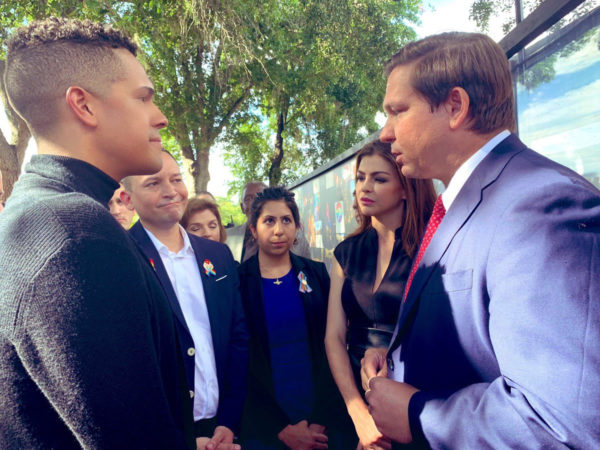
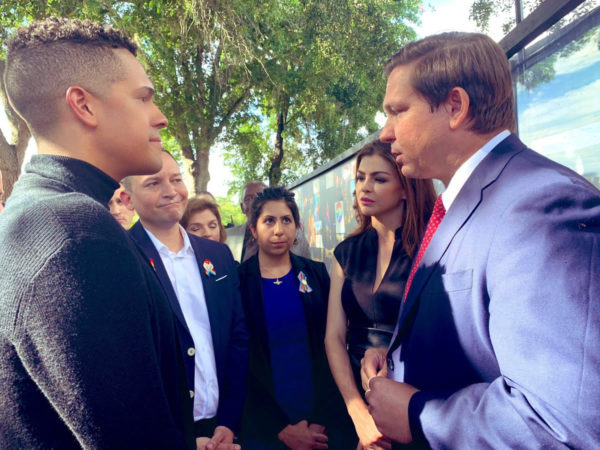
Brandon Wolf (L) speaking with Florida Governor DeSantis (R) at PULSE Memorial 2019 (Photo courtesy of Brandon Wolf)

These actions following his signing a bill on June 1, the start of LGBTQ Pride month- an education bill amended to include a previous stand alone bill, specifically targeting transgender girls and young women, banning them from playing on female sports teams.

“Let’s be clear about what this is: Governor DeSantis has declared war on Florida’s LGBTQ community.” said Wolf. “Before the 2019 Remembrance Ceremony, Governor DeSantis stood on hallowed ground, steps from where I escaped the building in 2016, and promised me that he would always support those of us impacted by the Pulse nightclub shooting. Today, almost two years later to date, he vetoed mental health services for us. I will never forget.”
Gay Olympics: HK leaders label event ‘disgraceful’ – Human Resources Director

Read more: Asia ‘at a crossroads’ in fight for LGBTQ+ rights

The heated debate began when lawmaker Regina Ip urged the government to support the game’s organiser as they have been experiencing difficulties in finding event venues. Ip made the case that it’ll help maintain the city’s metropolitan image and boost the economy, reported South China Morning Post.

Fellow politician Junius Ho shot down the idea and said that it’ll be akin to taking “dirty money”. “We respect people with different sexual orientation,” Ho said. “Whatever you do in your room, it’s your own business. But if you do it in public, it’s disgraceful.”

Ricky Chu, chairman at the Equal Opportunities Commission fought back against the clear LGBT bias. “Don’t make a mountain out of a molehill,” he said in a local radio interview. “All people can participate in the sports event and it is completely different from advocating same-sex marriages in the city.”

He added that leaders’ inflexible attitude “will only bring more harm than good” to HK. “The Gay Games is a public event in which everyone can participate, regardless of your race, sex or sexual orientation,” he said. “We hope society can stop the stigmatisation and uphold the values of equality and respect.”

Rural local takes decisive action against anti-gay cyberbullying directed at teachers – NYSUT

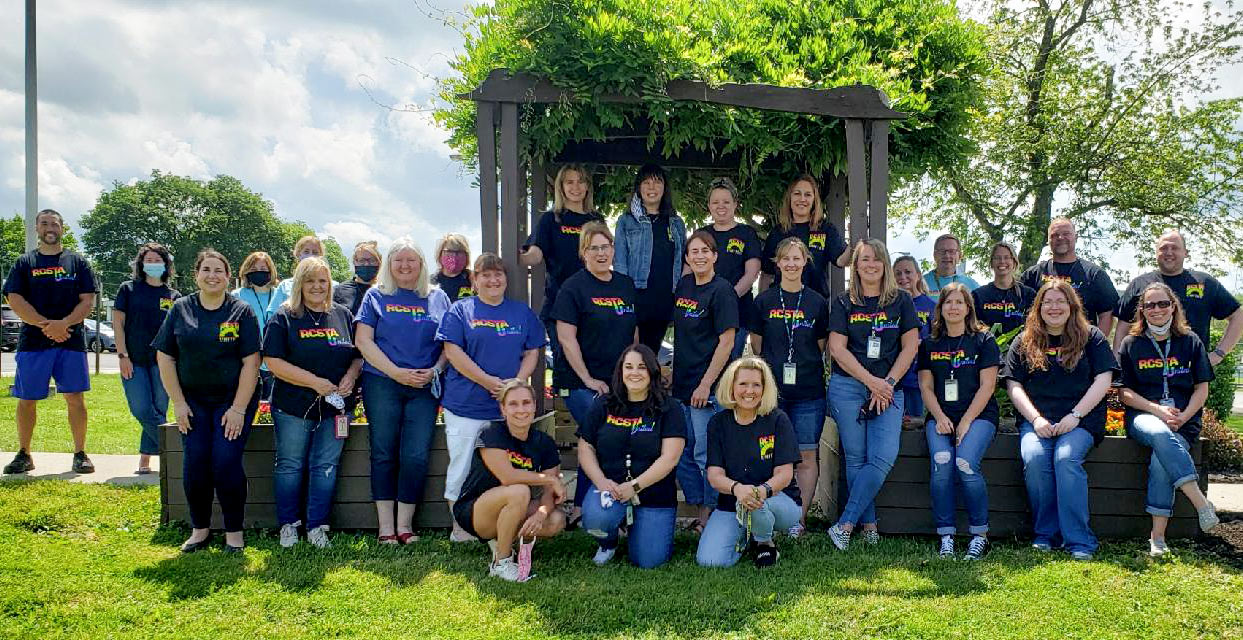
Caption: The Ravena-Coeymans-Selkirk Teachers Association purchased T-shirts for its Friday dress down days with the union logo and Pride colors to show support and solidarity for their maligned colleagues and for LGBTQ+ students. The union-driven response plan also included school assemblies and Restorative Justice sessions. Photo provided.

Invasive and vile anti-gay social media posts by students targeting specific teachers in the Ravena-Coeymans-Selkirk school district has galvanized the teachers union to press administrators to take action.

A video maligning and ridiculing one gay teacher was posted in the fall, and malicious TikTok videos later created in the spring were directed at two other teachers for their alleged sexuality. The videos called the teachers derogatory names, said gays should not be teaching, made crude comments, and equated being gay with being a pedophile. The perpetrators assumed one of the identities of the teachers in spreading the misinformation.

The union-driven response plan included assemblies, held in the spring and again this past week, to discuss cyberbullying and harassment against individuals and groups, including LGBTQ+, minorities, immigrants and people with disabilities.

The RCS Teachers Association, led by Matt Miller, also advocated for the use of Restorative Justice. That involved the students who posted the anti-gay comments sitting with the teachers they maligned, and with school social worker Jessica Doerr, their parents, and administrators to discuss the situation.

“There were 1,500 people who viewed the (spring) TikToks,” said teacher Abby Retzlaff, RCSTA member.

As the target of the October TikTok, she knows how distressing it can be to be shamed and ridiculed. A student had taken a photo of her while she was teaching remotely, and then put her in drag queen outfits as a man, along with other made up situations.

“I was shocked. I was hurt. I was embarrassed,” she said, noting that she wondered: “Why is (the student) lashing out at me? This is a serious situation.”

Retzlaff has all three students responsible for the two separate incidents in her eighth grade classes.

How to Support Our LGBTQ and Allied Students
Thursday, June 17, 4-5 p.m. (EDT)

Please join members of the NYSUT LGBTQ Committee, and allies, to learn how to start a Gay Straight Alliance in your school. Educators, students and parents will discuss why GSAs are important and offer tips for establishing them. Join us online Thursday, June 17, 4-5 p.m. (EDT)! Zoom registration is required to participate. Learn more and register.

Retzlaff said that when administrators put off taking action to address high schoolers, she helped form an anti-bullying committee after the second incident with a dozen other colleagues. The educators joined with social workers Doerr and Kimberly Mathias, and school resource officers who explained possible criminal repercussions of this type of social media activity, including aggravated harassment. Students were also told how these types of posts not only cause harm to the victims, but also can affect their own chances at getting into a good college or getting a good job.

The students who created the posts found the social media accounts of teachers’ family members and tagged them to bring their attention to the cruel videos.

This week’s assemblies for the eighth graders was led by the National Coalition Building Institute, which focuses on anti-bullying, diversity and inclusion. High schoolers from other regions shared with RCS students their experiences facing harm and discrimination.

ravena coeymans educators

Miller said administrators would receive sensitivity training this summer in how to handle and respond to similar violations.

The RCS TA also purchased T-shirts for its Friday dress down days with the union logo and Pride colors to show support and solidarity for their maligned colleagues, and for LGBTQ+ students.

“If they’re doing it to teachers, what about students?” Miller asked. “The shirts are to support staff and show kids that they have allies here. It’s a safe place. The message we send matters.”

Since the video incidents, students from the Gay Straight Alliance have come forward with concerns, said Retzlaff.

Since the video incidents, students from the Gay Straight Alliance have come forward with concerns, said Retzlaff. As the school has been making daily announcements related to June as Pride Month, one student used a personal Instagram account to decry the use of this time for those whom he felt did not deserve a month of recognition, and included offensive term for members of the LGBTQ+ community.

The problem does not only fester in school.

“It’s a community issue,” said Miller, who teachers AP and Regents biology and also serves as an Albany County Legislator.

Miller noted how a former county legislator from Coeyman’s resigned earlier this year after making comments that were recorded in which the lawmaker said that all gays should be put on an island so they can disappear after 40 years.

“You don’t have to agree, but you need to be respectful and tolerant,” Miller said. “In the past, we had some severe racial divisions and had a few tough years dealing with that.”

ravena coeymans educators

Gay Fred Angel | Obituaries | themountaineer.com – The Mountaineer

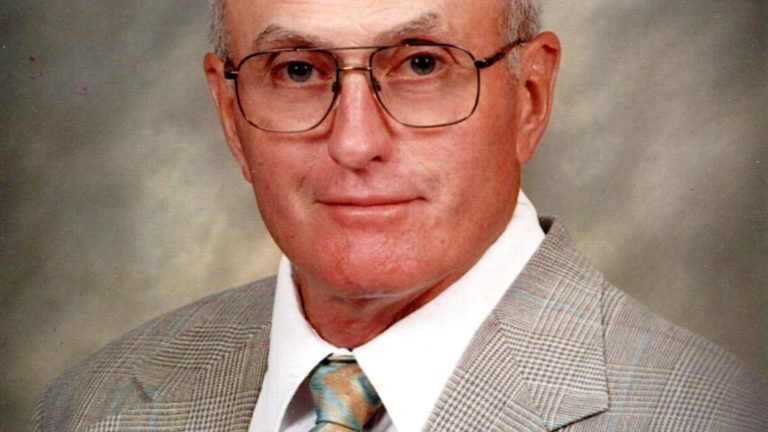
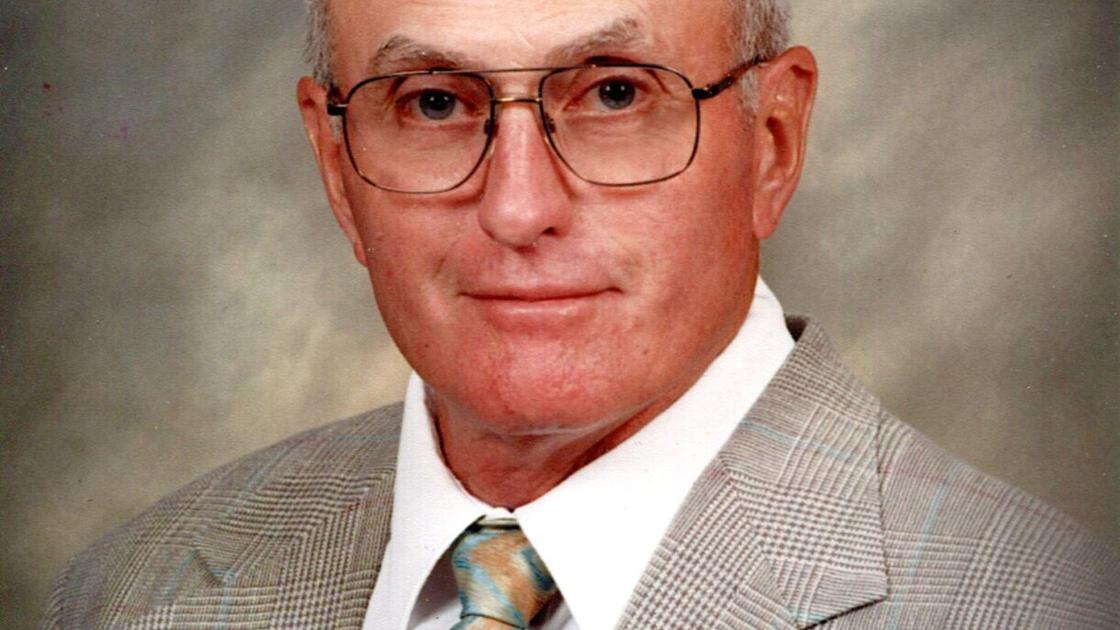
Gay Fred Angel, 84, passed away on Tuesday, June 8, 2021, surrounded by his family at Mission Hospital.

A native of Madison County, he was the son of the late Ben and Zona Angel. He was preceded in death by a brother, Guy Angel.

Gay was a lifelong farmer. He was passionate about his farm and family. Many local farmers would seek him out for advice. Gay graduated from Mars Hill High School in 1954. In 1957, he graduated from Warren Wilson College with an Associates in Arts degree. He went on to obtain his Bachelor of Science from Tennessee Tech in 1958 with a major in Agricultural Science. In addition to farming, Gay retired from Champion International after 38 years of service.

Gay was a loyal deacon at Antioch Baptist Church. He faithfully served the congregation and loved singing in the choir. Gay was a quiet man but expressed his love for others through music and acts of service.

Gay is survived by his loving wife of 61 years, Polly McElroy Angel; one daughter, Tara Angel Pratt, and her husband, Dr. Kris Pratt, of Fletcher; and two wonderful granddaughters, Lenore and Emeline Pratt. He is also survived by his sister, Fay Galloway, and several nieces and nephews.

A funeral service will be held at 2:30 p.m. on Saturday, June 12, 2021, at Antioch Baptist Church with the Rev. Chris Wilmoth officiating. Burial will follow at Antioch Baptist Church Cemetery. The family will receive friends from 1 p.m. until 2:30 p.m. at the church.

Memorials may be made to: Antioch Baptist Church Children’s Ministry, 542 Iron Duff Road, Waynesville, NC 28785.

The care of Mr. Angel has been entrusted to Wells Funeral Homes of Waynesville and an online memorial register is available at “Obituaries” at www.wellsfuneralhome.com.

To send flowers to the family of Gay Angel, please visit Tribute Store.

LGBTQIA+ owned brand Five North Chocolate is making a positive impact on the world – Yahoo Lifestyle

PopSugar

14 LGBTQ+-Owned Brands to Stock Your Beauty Cabinet With

As much as we love seeing our favorite beauty brands turn out for the LGBTQ+ community for Pride Month by donating a portion of proceeds to various organizations, we love supporting the queer community directly even more by shopping from LGBTQ+-owned beauty brands. There are plenty of ways to get involved during Pride Month, from donating to volunteering, but making a conscious effort to shop from LGBTQ+ brands during June and beyond is one of our personal favorites. When you go to restock on moisturizer, look for a new lip color, or pick up a shampoo and conditioner combo, buying from queer-founded brands cuts out the middle man and helps independent business owners directly.

Socially Responsible Products You Can Buy at Target – Causeartist – Causeartist

When you’re looking for a frictionless way to buy from businesses that support social justice, racial equity, and climate action — global issues that the COVID-19 pandemic exacerbated — several big retailers are adding more socially responsible products, making it easier for you to switch to a sustainable option. One prime example is Target, a general merchandise retailer with more than 1,900 locations and extensive reach: 75% of the U.S. population lives within 10 miles of a store.  

Target’s financial clout, topping more than $78 billion in annual sales, gives it purchasing power and influence — and it increasingly looks to create positive impact through the brands it partners with and the socially responsible products they bring to its shelves. For years this has included an emphasis on sustainability, through products made to minimize impact on people and the planet and in-store recycling kiosks for plastic bags and small electronics. More recently, Target has increased its commitment to diversity and inclusion by expanding its offerings of products from Black-owned businesses and spending with Black-owned partner companies, with a goal of topping $2 billion by 2025, as well as adding more items from Latina- and Asian American-owned brands. The company also has reinforced its commitment to inclusion through support of the federal Equality Act that provides protections to LGBT individuals, and by encouraging customers and workers to use restrooms or fitting rooms that correspond with their gender identity. 

By bringing more on-trend products from diverse suppliers and sustainable manufacturers to its shelves, Target creates positive ripples: More people make planet-friendly shopping swaps, and Black-owned businesses connect with new customers, overcoming market and economic barriers. But Target also realizes the negative environmental impacts of fast fashion and joined others in the industry in signing a climate action charter to address sustainability concerns and carbon emissions, and explore the potential of circular business models.

The eight brands highlighted below offer socially responsible products at Target that build positive impact while boosting your style points or making it easier to keep your home clean and fresh.

Method 

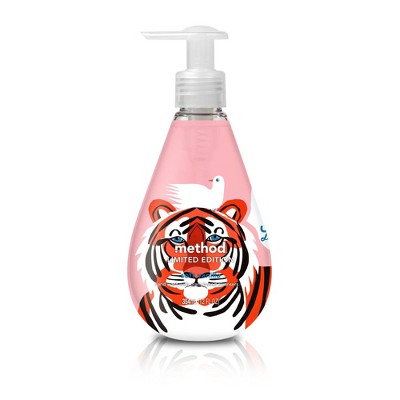
With its planet-friendly and design-driven home, fabric and personal care products, Method keeps you and your household looking fresh. The company’s San Francisco LEED-certified headquarters also is designed with the environment in mind, and it encourages employees to give back to their communities by giving them three paid days off each year to volunteer. 

Seventh Generation 

Socially Responsible Products You Can Buy at Target

By developing plant-based cleaning products to protect the health of people and planet, Seventh Generation lives its mission to create a more sustainable and equitable world for the generations to come. The Certified B Corporation’s Thrive Agenda addresses the inequalities exposed by COVID-19 with a focus on creating jobs, averting climate catastrophe, and supporting hard-hit communities. 

Yes To 

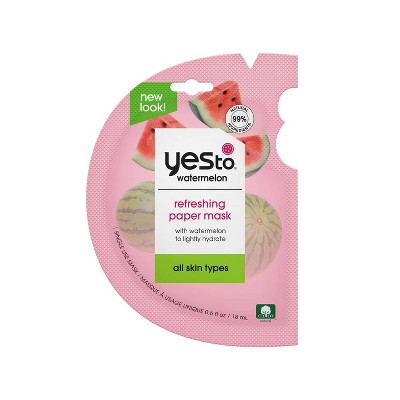
This skincare brand (with packaging that looks pretty enough to eat!) is committed to working toward a more sustainable future with less pollution and less waste. As a Leaping Bunny certified brand, Yes To does not test products on animals. Its products contain at least 95% natural ingredients (excluding water), and more than 90% of its formulas are vegan. Its SPF products are environmentally friendly and reef-safe.

Matter

Ditch the plastic by switching to these disposable products made with natural, renewable and sustainable resins and fibers that compost in a matter of months. Designed to minimize waste, the plates, bowls, bags, and other houseware items require less energy during their production process and contain natural additives that increase their strength and shatter resistance.  

BLK & Bold Coffee

This Black-owned, Des Moines, Iowa-based specialty coffee and tea roastery and wholesaler donates 5% of profits to support local and national programs for at-risk youths. Add its light or medium roasts or beans to your morning brew options. As a Certified B Corporation, BLK & Bold also meets verified standards for its benefit to community, customers, workers, and the environment.

Sweet Chef

Made in Korea and inspired by the popular K-Beauty trend of layering serums, Sweet Chef offers a variety of veggie- and vitamin-packed skin care products. The vegan and Leaping Bunny certified line also incorporates sustainable practices, including recyclable packaging and plans to be Carbon Neutral certified by 2022.

Siete Foods

After discovering how a grain-free diet reduced her autoimmune symptoms, Veronica Garza began making tortillas for her family — and they urged her to share them with others. Now, the family-owned business creates tortilla chips and dips and pursues its mission to impact the lives of underserved communities through education, entrepreneurship, and wellness. Their grain-free chips, taco shells, and dips work for those who are vegan or paleo.

Be Rooted

Jasmin Foster founded Be Rooted so women of color could see themselves in a place they hadn’t been. Her journals and stickers encourage customers to celebrate their sense of self and explore their inner muse.

All images courtesy of Target.

How Greg Louganis’ Olympic Diving Accident Forced a Conversation About AIDS – History

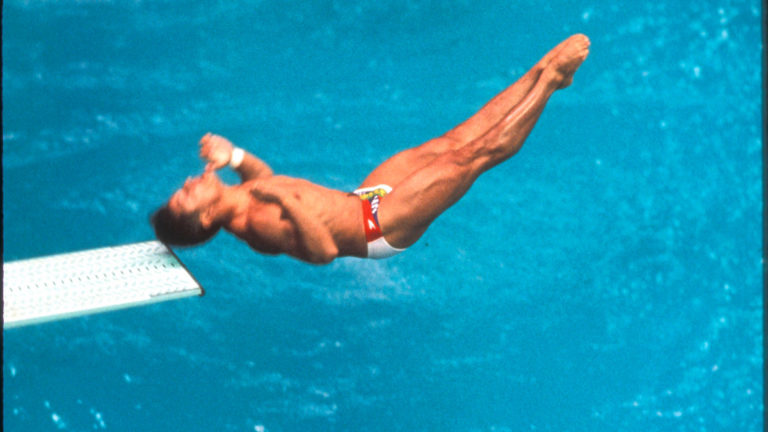
Greg Louganis knew something was off as soon as his feet left the springboard. It was September 19, 1988, and the U.S. diver who had won two golds at the previous Olympics, was competing in the preliminaries at the Seoul Olympic Games. He later recounted to ABC’s Barbara Walters that he knew it “was going to be close because I could feel it in my own body. What I was concerned about was hitting my hands, so I came out wide so that the board would go by, and I wouldn’t hit it. I started coming out of the dive and I heard this big hollow thud…”

That “big hollow thud” was the back of Louganis’ head, which collided with the springboard after his body had spun in two and a half somersaults and then unfolded to meet the water. After a doctor applied four stitches to his wound, Louganis was able to return to the diving board and finish the round in third place. He then went on to win the gold medal and become the first man to win back-to-back Olympic golds in both the springboard and platform diving events.

But what had initially appeared to be a straightforward comeback story became more complicated when Louganis revealed seven years later that he was gay and that he had been diagnosed with HIV six months before the 1988 Games.

Some criticized the fact that Louganis hadn’t revealed his diagnosis at the time. “I think Greg had the right to not tell anyone that he was HIV-positive, but (he should) be honest and fair with the doctor who treated him. The doctor was in jeopardy. He should have told him,” U.S. Olympian Wendy Lucero, who competed in the springboard competition following the men’s event in Seoul, told the Los Angeles Times after Louganis’ 1995 interview.

Louganis himself said he was immediately concerned, telling Walters in 1995 that as soon as he realized he’d struck his head, “I didn’t know if I was cut or not, but I just wanted to hold the blood in and just not [let] anybody touch it.”

But this was 1988, during a time when attitudes toward HIV/AIDS—and LGBTQ identity—often veered into hostility.

1980s: AIDS and LGTBQ Stigma 

“First of all, the concept of ‘LGBTQ’ didn’t even exist yet in 1988,” explains Jennifer Brier, author of Infectious Ideas: U.S. Political Response to the AIDS Crisis and director of Gender and Women’s Studies and History at the University of Illinois, Chicago. “1988 is before the reclamation of the word ‘queer,’ so there wouldn’t have even been an acronym LGBTQ in 1988.”

She adds that “in 1988, there’s an assumption that Olympians are just not gay . . . and in the cultural imagination at that point, people with HIV aren’t gold medal winners—they’re dying.”

By the late 1980s, the country was in a deep state of fear around a disease that had recently reached epidemic proportions. The disease that became known as AIDS had only been first described by the Centers for Disease Control in a U.S. medical journal in 1981. In 1982, The New York Times published its first front-page story about AIDS. And it wasn’t until September 1985 that President Ronald Reagan even publicly mentioned the word AIDS. By then the disease had become a public health crisis.

In 1986, C. Everett Koop, the U.S. surgeon general under President Reagan, oversaw the mailing of an AIDS information pamphlet to every American, detailing everything scientists understood up to that point about the disease. But there was still no effective treatment, people were dying by the thousands and many Americans wrongly believed it was only a “gay man’s disease.” By 1988, HIV/AIDS had already infected 82,362 individuals and killed 61,816, according to The Foundation for AIDS Research.

“It’s not like Greg Louganis was acting in a vacuum,” says Brier. “There’s no way to understand his decision to keep that a secret as something about just him. The political culture, the social and health landscape was really scary.”

Fear and stigma around AIDS was so intense, in fact, that a year before Louganis’s fateful dive, residents in the town of Arcadia, Florida tried to bar three young brothers, Randy, Robert and Ricky Ray, from enrolling in the local school because they were HIV positive. The brothers had contracted HIV from blood transfusions at a young age and residents feared they could infect other students. A federal judge overruled the ban in 1987, but then the family lost their home in a suspicious fire and decided to move away. 

When Diagnosis Was a ‘Death Sentence’

The same year, American pianist Liberace died of AIDS, but his doctor initially covered up the fact that the musician had AIDS and instead told the public that he had died from cardiac arrest. “Stigma around AIDS was so strong that it was even there after death,” says Ronald O. Valdiserri, an AIDS expert and epidemiologist at Emory University who led HIV/STD prevention at the Centers for Disease Control during the 1980s.

“There was also a sense of futility,” Valdiserri adds. “Most people who were infected with HIV at the time assumed that the infection would kill them.”

Louganis also thought his diagnosis was “a death sentence,” telling ESPN in 2016, “I was like, ‘Well, I’m going to pack my bags and go home and lock myself in my house and wait to die.’” 

Greg Louganis hits his head on the diving board in the 3-meter competition during the 1988 Olympic games in Seoul, South Korea. Louganis still won the gold medal.

Greg Louganis hits his head on the diving board in the 3-meter competition during the 1988 Olympic games in Seoul, South Korea. Louganis still won the gold medal.

Louganis’ coach, Ron O’Brien, knew of Louganis’ diagnosis, but believed if the Olympic Committee knew an athlete had HIV, he would not be allowed to compete. O’Brien also believed the nature of diving posed no risk to other athletes. After the accident, Louganis was “stunned” and unsure about what to do.

“This had been an incredibly guarded secret,” Louganis explained to Walters. “You could throw the entire competition into a state of alarm.” Louganis and his coach decided that his accident posed no risk to others. The greatest concern, Louganis said, was when an Olympic doctor stitched up Louganis’ wounds without wearing gloves. But that doctor, James Puffer, later told the New York Times that he wasn’t concerned, since studies had shown that transmission was extremely rare, even in the contact sport of football.

Ultimately, no one at the Games was affected, and Louganis remains one of the most well-known divers in the world. He was inducted into the International Swimming Hall of Fame in 1993. He also (belatedly) appeared on a Wheaties cereal box in 2016.

Thanks to the help of effective drugs and treatment, and to advances in LGTBQ rights, a few decades later, Louganis was healthy with undetectable HIV levels and his outlook was transformed. “It’s unbelievable,” he told Time in 2015, “I never dreamed this day would be possible.”

As for the 1988 accident, Louganis said he believes the attention he drew during the accident and then following his 1995 revelation may have—at some level—helped advance Americans’ acceptance of those with HIV.

As he told Walters in 1995, “Some people don’t think that AIDS has touched their lives. A lot of people saw me at the Olympics and were cheering for me. So all of those people can’t say that they have not been affected by AIDS.”

WATCH: A powerful meeting between gay people and Catholics in Dundalk – IrishCentral

The short Irish film Novena is now available to stream for free on the Irish Film Institute’s IFIPlayer.

Directed by award-winning filmmaker Anna Rodgers, who has made numerous LGBT films that have been distributed internationally, Novena captures an unusual event in Catholic Ireland.

The Solemn Novena is an annual 9-day festival of faith at St. Joseph’s Redemptorists Church in Dundalk, Co Louth. Each year, the festival is attended by thousands, coming from the local area and the surrounding towns and counties.

In the 2012 St. Gerard Majella Novena, the festival director, Father Michael Cusack, invited Stephen Vaughan and Kay Ferreter to address the congregation about their experiences of being gay and lesbian in Ireland and feeling excluded by Catholic doctrine. 

This short film documents this event, capturing their powerful speech and one priest’s aspiration of a more inclusive church.

Novena was completed through crowd-funding on the website Fund:It. It won Best Documentary at the Kerry Film Festival 2013, Best Film & Television at GALAS 2014, and was joint winner of Spirit Of The Festival at GAZE LGBT Film Festival 2013.

With kind permission of Anna Rodgers, “Novena” is published here with thanks to the Irish Film Institute (IFI), who IrishCentral have partnered up with throughout 2021 to bring you a taste of what their remarkable collection entails. You can find all IrishCentral articles and videos from the IFI here.

To watch more historic Irish footage, visit the IFI Player, the Irish Film Institute’s virtual viewing room that provides audiences around the globe free, instant access to Irish heritage preserved in the IFI Irish Film Archive. Irish Culture from the last century is reflected through documentaries, animation, adverts, amateur footage, feature films, and much more. You can also download the IFI Player Apps for free on iPhone, Android, Apple TV, Amazon Fire TV, and Roku.

IrishCentral has partnered up with the IFI throughout 2021 to bring you a taste of what their remarkable collections entail. You can find all IrishCentral articles and videos from the IFI here.

Iht 600x300px with button2

CFL player Chris Larsen suspended over alleged role in anti-gay attack | Offside – Daily Hive

The Ottawa Redblacks have suspended defensive lineman Chris Larsen due to his alleged involvement in an anti-gay attack on the Toronto Island.

The 24-year-old victim, David Gomez, was walking back to the ferry docks from Hanlan’s Point with a friend on June 5 when he encountered a group of three people, one of whom is alleged to be Larsen.

The group allegedly targeted Gomez with homophobic slurs, and the incident escalated to Gomez being violently beaten. The attack left Gomez unconscious, and a GoFundMe organized by friends is covering his out-of-pocket expenses. At the time of publication, the fundraiser had raised $39,520.

“It’s maddening to think that during PRIDE MONTH, we still have to watch our backs in areas like Hanlan’s that have served as an enclave and safe haven for the queer community for as long as some of us can remember,” fundraiser organizer Cianan Liburd wrote.

The Redblacks announced the suspension in a statement on Wednesday from Mark Goudie, CEO of the Redblacks’ parent company, Ottawa Sports and Entertainment Group.

“Late last night, we were made aware of social media allegations of an assault by a group of individuals that included Chris Larsen and immediately commenced an investigation which is ongoing. Today we were advised that an investigation by the Toronto police is underway,” Goudie said.

“We recognize there are larger systemic issues that plague our society, and as an organization, we know that we can play a role in making our community a more tolerant, respectful, educated and inclusive place. We are particularly sorry for the trauma caused to the 2SLGBSTQ+ community,” he added.

But the statement, which was also posted to the team’s Instagram page, drew criticism for various reasons, including not explaining why Larsen was suspended rather than released, as well as not being transparent about the ways the team helps promote diversity and inclusion in the community.

“Take the pride flag off your logo until you fire him. It’s an empty gesture,” one comment said.

“Like is this the first draft of the statement? Cuz I’m sorry diva this ain’t it,” read another.

Physical activity may curb health care worker burnout – EurekAlert

There is no question that the pandemic has been immensely stressful for health care workers, especially for those on the frontline of patient care. Yet, even before the pandemic, the regular demands of many health care industry jobs put these workers at risk for burnout.

Now, a new study from the University of Georgia suggests that investing in more physical activity programming could mitigate the effects of stress and improve worker mental and emotional health.

Tackling burnout in health care is critical to ensuring patient safety, said lead author Marilyn Wolff, an alumna of UGA’s College of Public Health.

“Studies show increased worker stress and burnout are associated with poor patient safety. In order to keep our patients safe and provide quality health care delivery, we must first care for our health care workers, physically, mentally and socially,” she said.

Physical activity, said Wolff, is a known coping strategy against burnout, but the type of activity matters.

“Less is known about the role of physical activity people may get at work versus in their free time. I set out to better understand the separate associations of occupational and leisure-time activity with worker stress, burnout and well-being,” said Wolff.

The study surveyed 550 full-time health care employees, including physicians and nurses as well as those who didn’t work directly with patients like coders, billers and analysts.

Respondents were asked about their physical activity on the job and physical activities they did in their free time. Workers also answered questions about their job stress, whether they felt exhausted or disengaged, and questions about their emotional well-being – all markers of burnout.

An analysis of the responses showed that employees who experienced higher levels of job-related physical activity reported feeling more stressed and exhausted. Conversely, when employees were able to spend more time doing leisure-time physical activity, their reports of job stress and exhaustion were lower.

This suggests that leisure-time physical activity was helping health care workers exit the stress cycle, said co-author Jennifer Gay, a professor of health promotion and behavior in the College of Public Health.

“The stress cycle begins with a stressor, then an individual’s physiological response to that stressor, and optimally, a release from the body’s physiological response,” said Gay. Leisure-time activity is known to help a person exit the stress cycle.

However, when reported levels of job-related physical activity were really high, leisure-time activity didn’t have the same mitigating effect on stress.

“An interesting next step in this line of research would be to examine timing of leisure-time activity related to work stress,” said Wolff. “For example, we may see less stress when workers exercise in the middle of their workday as opposed to before or after work.

This study was done before the COVID-19 pandemic inundated hospitals and health care systems across the U.S., but Wolff and Gay say the take home message still holds true.

“It is important for health care workers to be able to find that release to minimize stress and burnout. Physical activity is one strategy for exiting out of the stress cycle, even when the stressor is still present, like the pandemic,” said Gay.

Though more research is needed to untangle the connection between work-related physical activity and mental health, the benefits of fun physical activity are clear. More and better physical activity programming or providing structural supports that accommodate different work schedules and preferences would benefit workers, said Wolff.

###

The study, “Associations Between Occupational and Leisure-Time Physical Activity with Employee Stress, Burnout and Well-Being Among Healthcare Industry Workers,” was published in the American Journal of Health Promotion.

Co-authors include Jennifer Gay and Mark Wilson with UGA’s College of Public Health and Pat O’Connor with UGA’s Mary Frances Early College of Education.

Disclaimer: AAAS and EurekAlert! are not responsible for the accuracy of news releases posted to EurekAlert! by contributing institutions or for the use of any information through the EurekAlert system.

Conservative MPs Produced Video Highlighting Benefits of Professional Counselling to ‘Challenge’ Gay ‘Sexual Behaviour’ – PressProgress

New

Conservative MP won’t say if public money was used to produce campaign video featuring social conservative activist

Two of Erin O’Toole’s Conservative MPs are behind a video criticizing anti-conversion therapy legislation that features a youth evangelist who claims counselling helped him overcome his interest in gay “pornography” and “going to gay bars.”

Conservative MPs Garnett Genuis and Tamara Jansen produced a video that appears on a website called “Fix The Definition” promoting a petition calling for changes to Bill C-6, federal legislation that would make it a criminal offence to coerce minors into or profit from programs aimed at changing people’s sexual orientation or gender identity.

The campaign, launched by Genuis last year, claims a ban on conversion therapy would actually “discriminate” against LGBTQ people by restricting access to “professional or spiritual support” to “limit” their “sexual behaviour” — or “de-transition.”

Fixthedefinition.ca

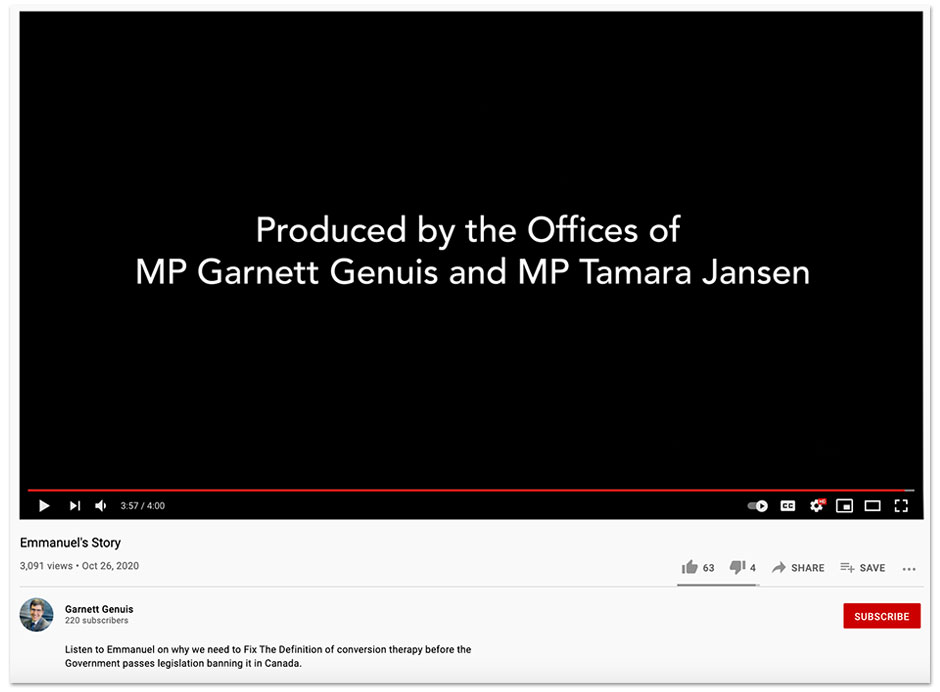
The end credits of the video that appears on the campaign website  indicates that it was “produced by the Offices of MP Garnett Genuis and MP Tamara Jansen.”

Neither MPs addressed questions from PressProgress seeking clarification as to whether the video was produced using any public money from their MP’s office budget.

House of Commons records show a few months earlier, Genuis’ office listed a $131 expense at Vistek for “video communication and broadcasting equipment” — a rate that roughly corresponds with Vistek’s listed prices for day or weekend rentals of some high-end video cameras and other equipment.

Garnett Genuis (YouTube)

The video itself features United Youth Outreach “evangelist catalyst” Emmanuel Sanchez, who introduces himself as an ordinary Calgarian who enjoys taking walks in the woods, loves eating pizza and plays card games with friends.

“I grew up in a loving family and I dreamed of raising a family of my own one day,” Sanchez says. “But ever since I was a kid, I remember feeling attracted to the same gender.”

“I started to ask myself: Am I gay?”

“I started watching pornography” and “going on chat rooms,” Sanchez continues, adding that by the age of sixteen, he had even started “going to gay bars.”

That, Sanchez says, continued until a religious leader gave him “advice about sexual behaviour” and “counselled me in ways I personally wanted him to challenge my behaviour.”

Genuis and Jansen’s video ends with Sanchez issuing a bleak warning about what could happen if Bill C-6 becomes law:

“If professionals don’t feel free to have conversations with people that might challenge their behaviour, their identity or their assumptions, then I wouldn’t have been able to get the counselling I needed from my mentor who I freely sought out.”

MacEwan University Professor Kristopher Wells, who specializes in youth and LGBTQ issues, said Genuis and Jansen’s video distorts what the legislation actually says.

“There is no legitimate basis for these concerns,” Wells told PressProgress. “All conversion therapy prohibition laws in Canada support access to non-judgemental counselling. Bill C-6 would not restrict any appropriate and professional conversations between a counsellor and client of any age.”

The star of Genuis’ video is also a social conservative activist.

Sanchez previously spoke at a seminar hosted by an anti-LGBTQ group called Free To Care alongside a representative from the social conservative political action group Association for Reformed Political Action (ARPA) and a failed Conservative nomination candidate Ann Gillies, who later ran with the People’s Party and is now involved with groups called “Take Back The Rainbow” and “Restoring the Mosaic.”

In his speaker bio, Sanchez describes himself as having “received counselling for his unwanted same-sex attractions when he was a minor.”

Sanchez and Free To Care communications director Jose Ruba are elsewhere jointly described as having “called several counselling agencies in Calgary to find help to ‘reduce non-heterosexual behaviour or attraction’ such as gay pornography use.’”

Sanchez declined to answer questions from PressProgress about the production of the video and whether he was paid for his appearance.

ARPA Canada (YouTube)

“This anti-LGBTQ2 movement is rapidly growing, connected, and well-funded,” Wells noted. “The same choreographed speakers often appear at any public hearing on conversion therapy prohibition laws in Canada. Their tactic is to try and create confusion and doubt about the intended purposes of the proposed legislation.”

“It is disappointing that Members of Parliament would promote such blatant propaganda and disinformation.”

The Conservative Party of Canada did not respond to requests for comment from PressProgress about whether it endorses the views expressed by Genuis and Jansen’s video.

In a statement to PressProgress, Jansen attempted to draw a distinction between regular conversion therapy and “coercive” conversion therapy, indicating that she opposes the latter:

“I am completely opposed to coercive conversion therapy, and support banning it. Unfortunately, the government has chosen to ignore legitimate concerns that have been raised about the flawed definition of conversion therapy in Bill C-6. I have called on the government both in the House and on social media to fix the definition in the bill so that we can unanimously vote to ban conversion therapy.”

Likewise, Genuis told PressProgress the video — which extols the benefits of seeking professional counselling to “question” and “challenge” gay “behaviour” — is “consistent” with his past statements about opposing conversion therapy:

“I have been consistent and public in calling on the government to fix the definition in Bill C-6 and ban conversion therapy. The answers to all of your questions are clearly available in the speeches that I’ve given on this topic, including my firm conviction that conversion therapy should be banned.”

Last October, Genuis abstained on a second-reading vote on Bill C-6. In his local newspaper, Genuis claimed that Bill C-6 could criminalize “private conversations” between a “parent or mentor” and gay teenagers.

The debate on Bill C-6 has seen a number of Conservative MPs make headlines wading into topics of sex and gender:

Conservative MP Philip Lawerence sponsored a petition from a far-right pastor who called for civil disobedience to stop the bill while Conservative MP Jeremy Patzer claimed conversion therapy can help husbands manage “same-sex attractions.”

Jansen previously made headlines telling the House of Commons that conversion therapy could help curb “lesbian activity.”

Several other Conservative MPs, including Ted Falk, Arnold Viersen, Cathay Wagantall and Damien Kurek have also sponsored nearly identical petitions calling for Bill C-6 to be revised.

Help us protect Canadians by holding the powerful accountable.

Journalism is an important public service. That’s why PressProgress is prioritizing stories aimed at keeping Canadians safe and holding the powerful accountable during the coronavirus pandemic.

Please consider supporting our award-winning non-profit news organization so we can keep making a positive impact for Canadians.

Support Our Journalism

Physical activity may curb health care worker burnout – University of Georgia

There is no question that the pandemic has been immensely stressful for health care workers, especially for those on the frontline of patient care. Yet, even before the pandemic, the regular demands of many health care industry jobs put these workers at risk for burnout.

Now, a new study from the University of Georgia suggests that investing in more physical activity programming could mitigate the effects of stress and improve worker mental and emotional health.

Tackling burnout in health care is critical to ensuring patient safety, said lead author Marilyn Wolff, an alumna of UGA’s College of Public Health.

“Studies show increased worker stress and burnout are associated with poor patient safety. In order to keep our patients safe and provide quality health care delivery, we must first care for our health care workers, physically, mentally and socially,” she said.

Physical activity, said Wolff, is a known coping strategy against burnout, but the type of activity matters.

“Less is known about the role of physical activity people may get at work versus in their free time. I set out to better understand the separate associations of occupational and leisure-time activity with worker stress, burnout and well-being,” said Wolff.

The study

The study surveyed 550 full-time health care employees, including physicians and nurses as well as those who didn’t work directly with patients like coders, billers and analysts.

Respondents were asked about their physical activity on the job and physical activities they did in their free time. Workers also answered questions about their job stress, whether they felt exhausted or disengaged, and questions about their emotional well-being – all markers of burnout.

An analysis of the responses showed that employees who experienced higher levels of job-related physical activity reported feeling more stressed and exhausted. Conversely, when employees were able to spend more time doing leisure-time physical activity, their reports of job stress and exhaustion were lower.

This suggests that leisure-time physical activity was helping health care workers exit the stress cycle, said co-author Jennifer Gay, a professor of health promotion and behavior in the College of Public Health.

“The stress cycle begins with a stressor, then an individual’s physiological response to that stressor, and optimally, a release from the body’s physiological response,” said Gay. Leisure-time activity is known to help a person exit the stress cycle.

Physical activity different than leisure activity

However, when reported levels of job-related physical activity were really high, leisure-time activity didn’t have the same mitigating effect on stress.

“An interesting next step in this line of research would be to examine timing of leisure-time activity related to work stress,” said Wolff. “For example, we may see less stress when workers exercise in the middle of their workday as opposed to before or after work.

This study was done before the COVID-19 pandemic inundated hospitals and health care systems across the U.S., but Wolff and Gay say the take home message still holds true.

“It is important for health care workers to be able to find that release to minimize stress and burnout. Physical activity is one strategy for exiting out of the stress cycle, even when the stressor is still present, like the pandemic,” said Gay.

Though more research is needed to untangle the connection between work-related physical activity and mental health, the benefits of fun physical activity are clear. More and better physical activity programming or providing structural supports that accommodate different work schedules and preferences would benefit workers, said Wolff.

The study, “Associations Between Occupational and Leisure-Time Physical Activity with Employee Stress, Burnout and Well-Being Among Healthcare Industry Workers,” was published in the American Journal of Health Promotion. Link

Co-authors include Jennifer Gay and Mark Wilson with UGA’s College of Public Health and Pat O’Connor with UGA’s Mary Frances Early College of Education.

How Sabel Scities Embraces Island Life – Thrillist

0

JdB: Do you ever bartend in drag?

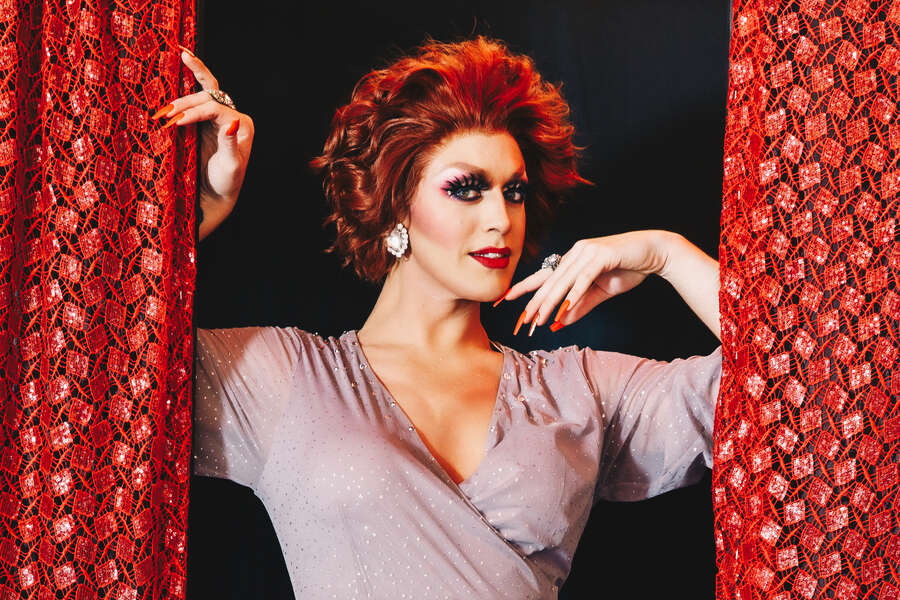
SS: Yeah? It’s not the most comfortable thing in the world [laughs]. I get to do a Christmas party, which is really fun because people like to have a drag queen bartend on Christmas. And it’s fun because I get to use every joke I have in my rolodex on people who haven’t heard it before and, all of the sudden, I’m hilarious. I’m the life of the party.  

JdB: So, who is Sabel Scities?

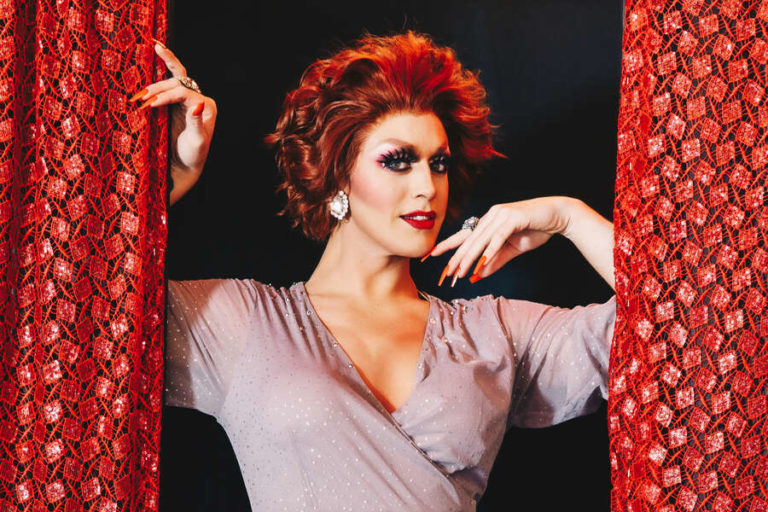
SS: She’s a little bit of a sponge, she’s a little bit of everyone I’ve ever met. When I meet comedians, I feed off them. When I meet glamorous goddesses, I study them. I love studying people. You could drop me into a brunch, you could drop me into story time with children, you could drop me into a bar at 1 am and I could survive any environment. She’s very gregarious. 

She enjoys the interactions with people and being there when they’re celebrating something and when a drag queen shows up and it’s the best day of their life. Or people who are having the worst day and all of the sudden they’re having the best. Or they came in crying and walked out laughing. That’s what I’m trying to bring to everything. 

JdB: That’s really sweet. Tell me about what kind of drinks you like. 

SS: Well I really love vodka. Vodka is my personal vice. Summer time I switch it up to spiced rum because I like to be a drunken sailor on the beach. Maybe it’s just me being a bit of a tourist but I drank a lot of Mai-Tais in Hawaii—a little spiced rum and dark rum, coconut, triple sec, pineapple and orange juice. That’s what I was serving.  

JdB: And now you’re back at Cherry’s in Fire Island, right? What’s Fire Island like for those who’ve never been?

SS: It’s kind of like never never land. It’s a place unlike anywhere else. I like that it’s such a separation from the outside world. You learn so much about yourself—your boundaries, your tolerance. You try things you’ve never done before (and should probably never do again). You find instant family. You put on amazing parties and then you want to come back and do it again. 

One of London’s oldest gay bars could soon reopen after sitting shuttered for six long years – Yahoo Eurosport UK

A beloved London gay bar that welcomed the queer community for more than five decades could soon reopen thanks to a determined group of campaigners.

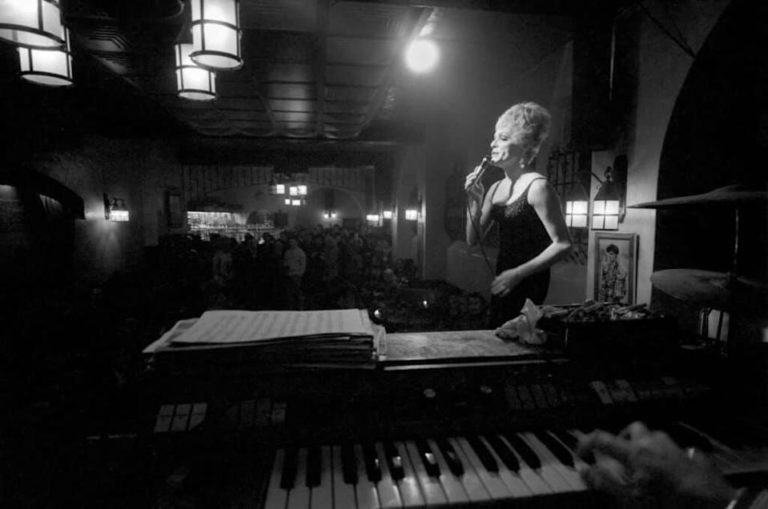
The Black Cap on Camden High Street was a haven for LGBT+ Londoners from the 1960s onwards, eventually becoming one the city’s premier stages for cabaret and drag acts.

Tragically the historic pub was forced to close in 2015 due to planning issues, and it looked like one of London’s oldest gay bars was lost forever.

Six years later, that could be about to change.

According to the Camden New Journal, a company called Kicking Horse Three has taken ownership of the building along with two other pubs, the Sir Richard Steele in Belsize Park and the Dartmouth Arms in Dartmouth Park.

The directors, Andy Merricks and Steve Billot, are clear that the pub should be revived as an LGBT+ venue.

“We understand and value the historical and cultural importance of The Black Cap to Camden Town, and in particular, to the local LGBTQ+ community,” they told the outlet.

“We are engaging directly with Camden Council, and look forward to further positive discussions as we work closely with officials and the local community.”

Long-term campaigners Alex Clark and Ben Walters have drawn up a business plan and formed The Black Cap Community Company to potentially buy the site from them.

They’d previously been trying to strike a deal with the building’s former owner, but are now keen to open negotiations with Kicking Horse Three so they can restore the pub to its former glory.

“We have been consistent since the closure: this should be an LGBTQ-friendly pub, club and cabaret space called The Black Cap,” Clark said.

“It is a unique, iconic and irreplaceable Camden institution that was viable before it closed and we believe is needed today more than ever.”

Among those whose careers have started at the Black Cap include Lily Savage actor Paul O’Grady, drag act Hinge and Bracket, and several RuPaul’s Drag Race stars: Bianca Del Rio, Adore Delano, BenDeLaCreme, Raja Gemini and Trixie Mattel.

If all goes to plan, a new generation of queer performers will soon be following in their footsteps on the iconic Black Cap stage.