Home Blog Page 71

More gay and bisexual men allowed to donate blood thanks to ‘historic’ rule change – Yahoo Eurosport UK

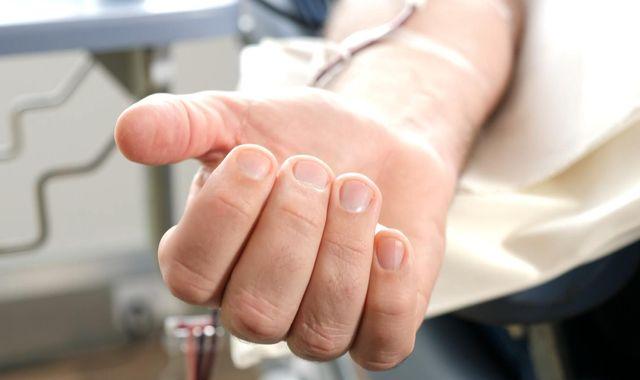
More gay and bisexual men will be allowed to donate blood, platelets and plasma after “historic” new rules came into effect.

The new eligibility rules came into force today on World Blood Donor Day and mean that donors in England, Scotland and Wales will no longer be asked if they are a man who has had sex with another man, NHS Blood and Transplant said.

Instead, any individual who attends to give blood regardless of gender will be asked if they have had sex and, if so, about recent sexual behaviours.

Anyone who has had the same sexual partner for the last three months will be eligible to donate, meaning more gay and bisexual men will be able to donate blood, platelets and plasma while keeping blood just as safe, NHS Blood and Transplant said.

The organisation’s chief nurse for blood donation, Ella Poppitt, said: “Patient safety is at the heart of everything we do.

“This change is about switching around how we assess the risk of exposure to a sexual infection, so it is more tailored to the individual.

“We screen all donations for evidence of significant infections, which goes hand-in-hand with donor selection to maintain the safety of blood sent to hospitals.

“All donors will now be asked about sexual behaviours which might have increased their risk of infection, particularly recently acquired infections. This means some donors might not be eligible on the day but may be in the future.”

The changes to the donor safety check form will affect blood, plasma and platelet donors but the process of giving blood will not change.

NHS Blood and Transplant said eligibility will be based on individual circumstances surrounding health, travel and sexual behaviours shown to be at a higher risk of sexual infection.

Under the changes people can donate if they have had the same sexual partner for the last three months, or if they have a new sexual partner with whom they have not had anal sex and there is no known recent exposure to a sexually transmitted infection (STI) or recent use of pre-exposure prophylaxis (PrEP) or post-exposure prophylaxis (PEP).

Anyone who has had anal sex with a new partner or with multiple partners in the last three months will be not be able to give blood but may be eligible in the future.

The changes were welcomed by charities including the National Aids Trust, Stonewall and Terrence Higgins Trust.

However, the Terrence Higgins Trust said the government had kept a “discriminatory restriction” in England which will affect black communities’ ability to give blood.

The restriction relates to a three-month deferral period for anyone who has a “partner who has, or you think may have been, sexually active in parts of the world where HIV/Aids is very common” and references “most countries in Africa”, the charity added.

To become a blood donor, register and book an appointment by calling 0300 123 2323, downloading the GiveBloodNHS app, or visiting www.blood.co.uk.
Which countries prohibit gay or bisexual men from donating blood? – The Economist

IN 1983 BRITAIN’S National Blood Transfusion Service released a pamphlet entitled “AIDS and how it concerns blood donors”. It described how the disease attacks the immune system and listed the groups most at risk, including gay men who had several sexual partners and intravenous drug users. Much was still unclear, though: the authors suspected that AIDS was caused by a virus but it was “not known for certain”; they reckoned it could “almost certainly” be passed on through blood and blood products. There was no screening that the service could provide to detect infections, so “until there is and more is known…donors are asked not to give blood if they think they may either have the disease or be at risk from it”. Restrictions have lingered for decades on blood donations from men who have sex with men. But on June 14th Britain switched to an individual risk-assessment system for all donors.

The Economist Today

Hand-picked stories, in your inbox

A daily email with the best of our journalism

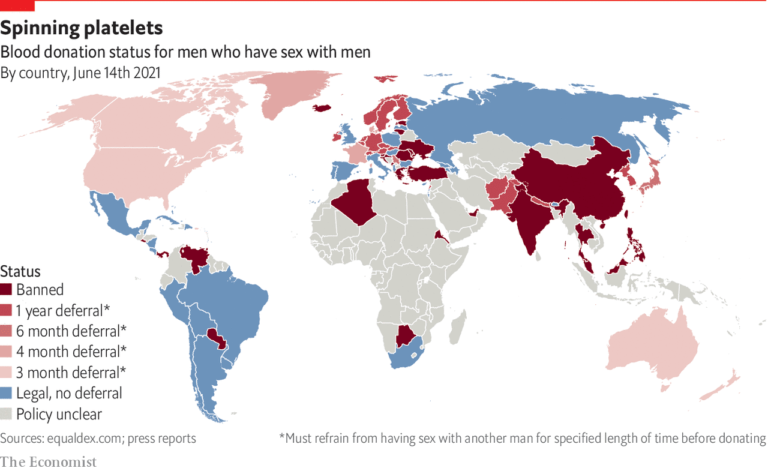
Even as scientists have learned more about HIV/AIDS—it is transmitted via bodily fluids and can afflict people of any sexuality—many countries have remained cautious about blood donation by gay and bisexual men. In the 1980s and 1990s, after thousands of people were infected with HIV via products made from donated blood, health services introduced formal policies that excluded donors who engaged in “high-risk behaviour”. These ranged from outright bans to “deferral periods” (ie, a man must refrain from having sex with another man for months, if not years, before donating.) In effect, these deferral periods amount to bans by proxy. LGBT activists argue that such measures are homophobic.

Today the risk of transmitting HIV through the blood supply is negligible, because knowledge of HIV prevention, testing and management has deepened. People who have HIV but are on antiretroviral drugs cannot pass on the disease. Every blood donation is swiftly and accurately tested for the virus: the leading tests have a median “window period”—the time following the initial infection during which the virus may be undetectable—of only 18 days.

Many countries are relaxing their rules as a result. Brazil, Italy, Poland, Russia and South Africa, among others, have already done away with sexuality-based deferrals (see map). Covid-19 has also increased the demand for blood products and encouraged countries to reassess their policies, or at least to shorten deferral periods. In America, where community blood-donation drives were cancelled during the first wave of the pandemic, the deferral period was dropped from 12 to three months in April 2020. New Zealand did the same in December and Australia followed suit in January.

Reducing or ending deferral periods may help combat the stigma still associated with HIV and AIDS. Crucially, it will also increase the amount of blood available for patients in need. A study conducted in 2014 by the Williams Institute, a think-tank which studies sexual orientation and public policy, found that lifting bans and restrictions on men who have sex with men would increase the annual blood supply in America by between 2% and 4%. A report in Britain by FAIR (For the Assessment of Individualised Risk), a steering group set up by the Department of Health and Social Care, found that LGBT people were more likely to encourage others to donate under the new policy.

‘Sweat with pride’ event held at Boca Raton gym – WPTV.com

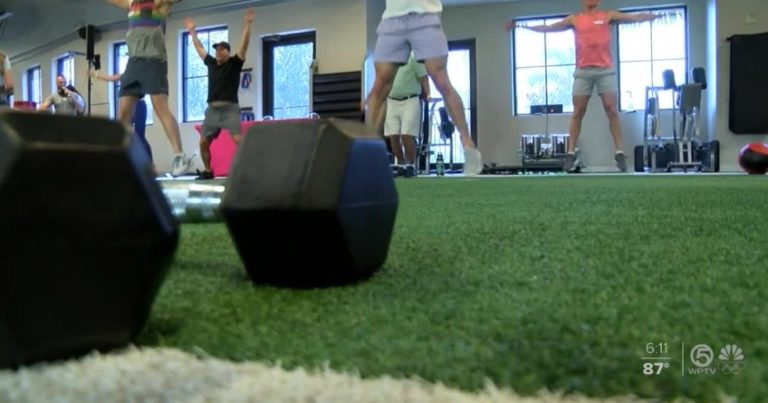
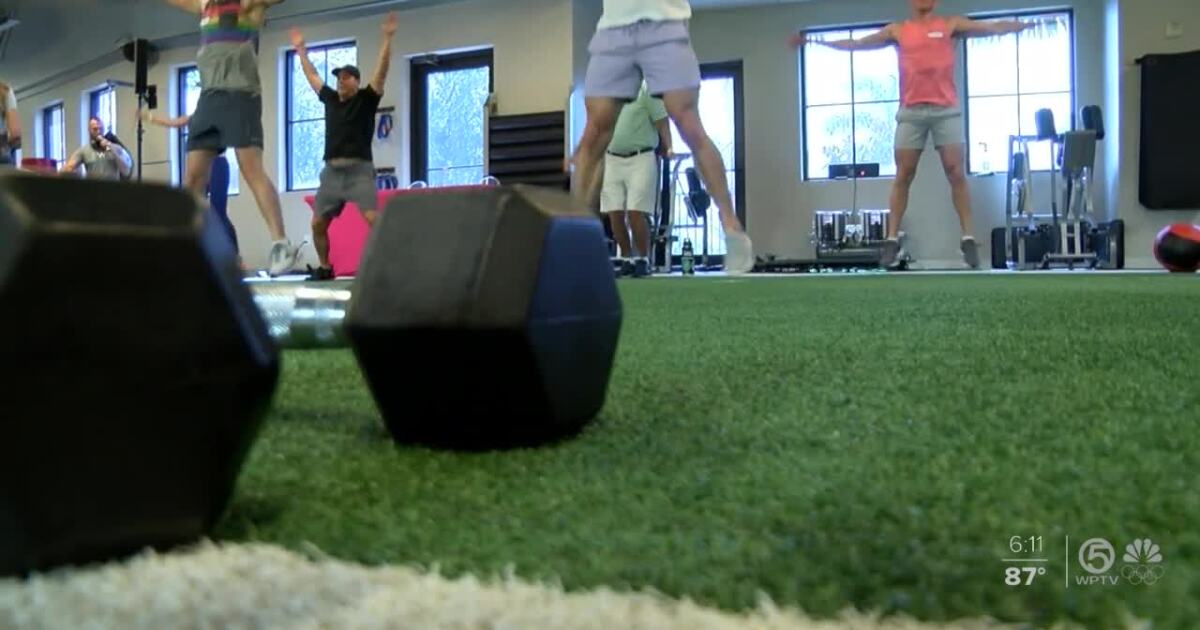
BOCA RATON, Fla. — A South Florida gym is working to bring health wellness and mindfulness to the LGBTQ community.

‘Sweat with pride’ was hosted by FTX Wellness and Performance in Boca Raton on Sunday.

The event was geared towards raising awareness and helping the LGBTQ community with addiction recovery.

Mark Turnipseed and Tim Quinn of the gym created the event to help raise money for the nonprofits Gay & Sober and OUT South Florida.

“We are much more likely to experience depression, addiction, suicide ideation and that’s why I started being an activist in this arena is to spread awareness that it is possible to be LGBTQ and healthy,” said Turnipseed.

For more information on the organizations visit gayandsober.org and theoutfoundation.org.

Video goes viral showing use of force during arrest in Ocean City – Yahoo News

0

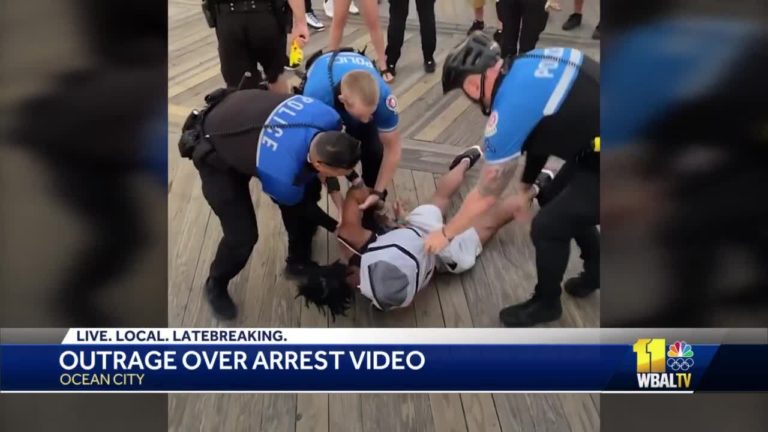
A video involving an interaction with Ocean City police is going viral. The video, recorded by a woman who asked to remain anonymous, shows several police officers taking a man into custody. They are heard telling the man to stop resisting, and he says back that he is not resisting and is asking why he is being arrested.

Cathedral City Gay Bars Mark National Pride Month With Open House Tour – Palm Springs Life

trunks bar cathedral city california

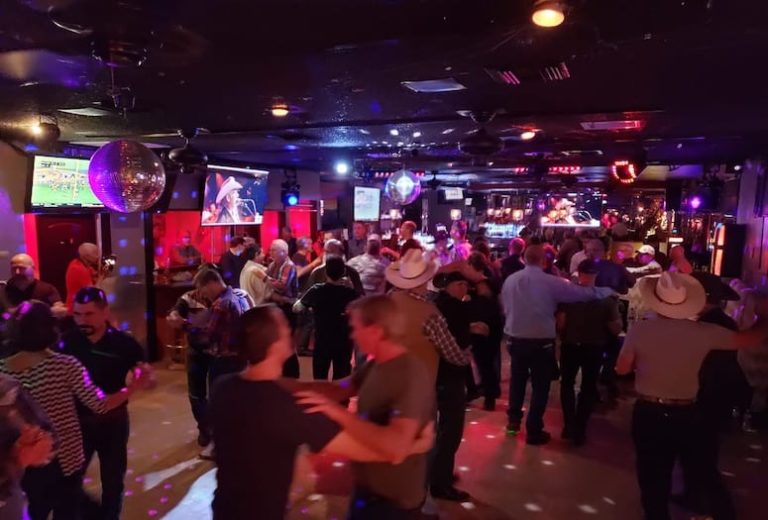
Trunks Bar in Cathedral City will reopen this week and participate in the Open House Bar Tour, June 21-26, by the Cathedral City Gay Business Association.
PHOTOGRAPHS COURTESY OF THE BARS

When California reopens completely on June 15 free of COVID restrictions, it will mark the first time Trunks Bar in Cathedral City will open its doors in more than a year.

A few days later, Trunks will be part of an Open House Bar Tour set to run June 21-26 featuring five Cathedral City gay bars. Organized by the Cathedral City Gay Business Association (CCGBA), the tour also coincides with National Gay Pride month celebrated in June.

Unlike their counterparts in Cathedral City, Trunks remained completely closed while the other bars were able to maintain first patio business and then limited capacity indoors by applying for a special permit that allowed the bar to operate as a restaurant due to a relationship with a nearby eatery.

oneelevenbar

“Some of the bars always had menus from other restaurants,” explains Antonio Lopez-Cochran, who owns Amp Sports Lounge and is also vice president of the CCGBA. “Fortunately, for example my bar, we have several restaurants around the location, so we always had menus in our bar and people were able to order food. Transition wasn’t too hard for some of those bars.”

The tour will initially spotlight one bar a night with a designated happy hour from 6-8 p.m. starting with One Eleven Bar on June 21, followed in order by The Barracks, Trunks, The Runway, and Amp Sports Lounge. On June 26, all five bars will host a special happy hour from 6-8 p.m.

Lopez-Cochran spoke further with Palm Springs Life about the event and how gay bars have weathered the pandemic.

When did you first begin organizing this event?

We first started to talk about it in March and we’ve been meeting every other week since then. So myself, Richard Altman (owner of The Runway and president of CCGBA) along with Chris Parman, who is the LGTBQ liaison at the city of Cathedral City and event manager, discussed options for events after the restrictions were lifted. The team is always trying to come up with ideas to promote Cathedral City.

How does it feel to be able to schedule an event in the city after more than a year?

It’s a great feeling being able to create an event, and actually go through with it. We had several events scheduled for 2020, and everything had to be canceled. I’m nervous about it, but excited at the same time.

Will there still be COVID precautions for the Open House Tour?

Yes, certainly, we all believe that we have to be safe. Temperatures are still being taken and masks are mandatory upon entry. At the AMP Sport Lounge patrons can be without a mask if they’ve been vaccinated while seated at the table. We do highly recommend that once guests are inside and stand up to walk around or go to the restroom that they wear their mask. Our staff will certainly be wearing masks all the time.

ampsportslounge

Do you have other events planned in the near future?

Yes, we do. As an organization, with this Open House Tour we really would like to welcome the community back to our businesses in Cathedral City. But it’s also an opportunity for us as an association to invite other restaurants and bars in the city, along the 111 Catwalk, to join our organization.

We are planning an event we did a couple years ago called the Cat City Drag Race. It was a fundraiser for the Transgender Health and Wellness Center, as well as opportunities for people to come to each of our bars and participate in a drag contest.

How important is the gay community for Cathedral City?

I think it’s very important. About 35 percent to 42 percent of the residents in Cathedral City are gay, or consider themselves part of the LGBTQ community. They are very important, their support means a lot to our businesses, as well as doing community service.

• READ NEXT: The Former Studio One Eleven Has New Owners, a New Name, and a New Lease on Life.

Real Housewives Of Salt Lake City’s Heather Gay Breaks Silence On Jen Shah’s Legal Troubles – CinemaBlend

Yet it sounds like Heather Gay is already anticipating the possibility of Jen Shah’s conviction. No one will know for sure, though, until Shah’s trial on October 18. But Gay confirmed that the Real Housewives of Salt Lake City captured all the currently unfolding legal issues in Season 2, and Bravo fans won’t want to miss it. She said:

Pro football player is accused of leading a gay-bashing that left a man near death – LGBTQ Nation

A professional football player has been suspended as he faces allegations of assaulting a gay man outside of Toronto Island and leaving him with severe injuries.

The victim, David Gomez, was beaten “nearly beat to death” while walking home from Hanlan’s Point late on June 5. He and a woman he was walking with reportedly got into a dispute with a larger group. They proceeded to attack Gomez while saying homophobic remarks.

Related: Gender reveal party results in wildfire. The family that started it got off with a $500 fine.

Gomez said in a private Facebook post alerting friends that he was “knocked unconscious, and nearly beat to death … I was dragged around, kicked and punched in the face.”

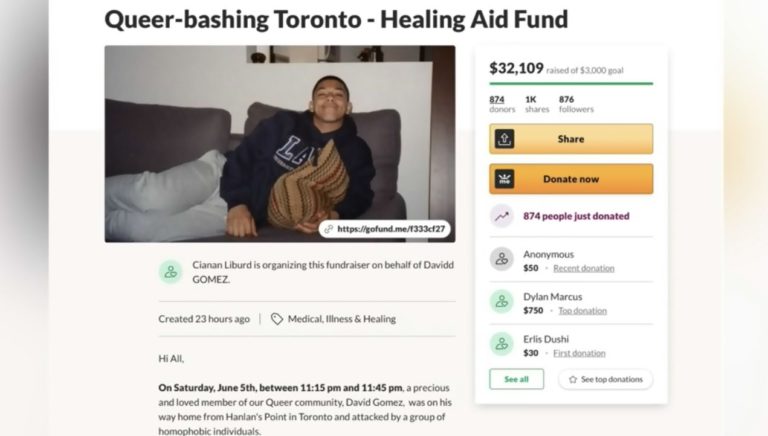
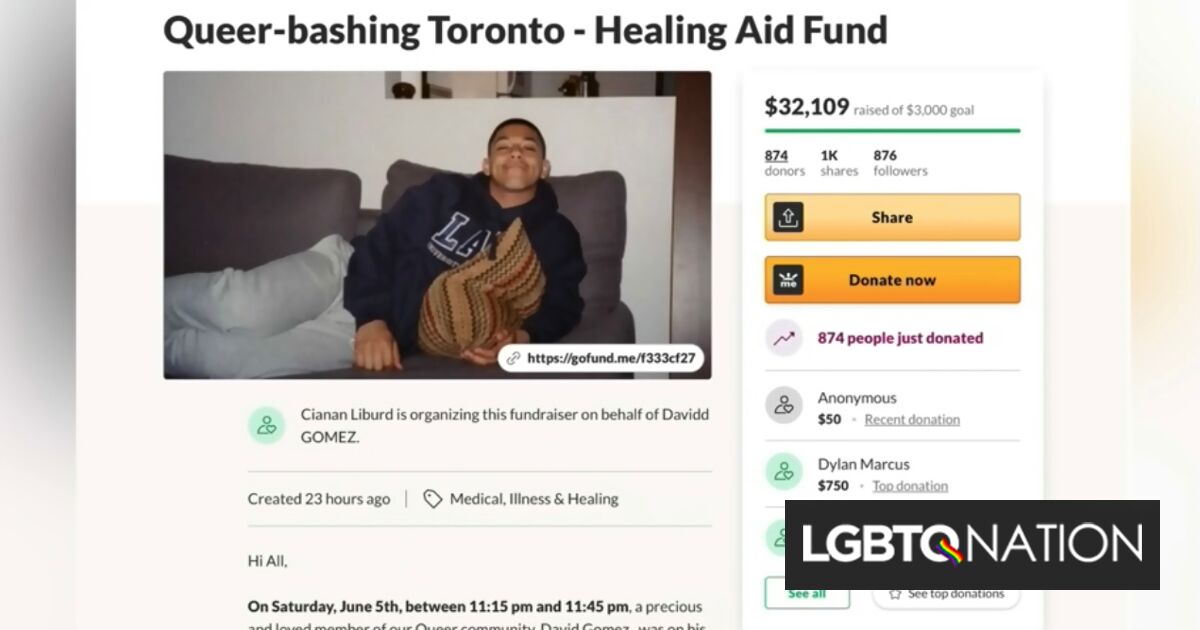
A GoFundMe fundraiser for Gomez launched by friends on June 9, read, “David and a friend found themselves in danger when they were outnumbered by a group of folks (approx 5+) shouting and hurling homophobic slurs at them until things reached a boiling point, which compelled the attackers to become violent, leaving David incapacitated and in need of serious medical attention.”

A woman in the group grabbed and held Gomez while two men began beating him. Gomez was left with “significant injuries” that left him hospitalized, including a broken nose, cheekbone, orbital bone, hip bone, and also a concussion.

Friends began bringing attention to the assault by way of social media. The GoFundMe notes their belief that “there were apparently bystanders, INCLUDING the police (a minute or so before the conflict took place), who made a shallow attempt at calming tempers.”

They note that Hanlan’s Point is an “enclave” for the LGBTQ community in Toronto and that this attack happening during Pride Month is “maddening.”

Following tips from social media, police focused on Chris Larsen, a defensive lineman for the Ottawa RedBlacks, an American football team in the Canadian Football League (CFL). When police identified Larsen as one of their suspects, the RedBlacks suspended him.

“Diversity and inclusion are central to our organizational values and we will try our best to use our platform to help make acts of hate and violence, including homophobia, stop,” RedBlacks owner Mark Goudie stated. “We are particularly sorry for the trauma caused to the 2SLGBTQ+ community.”

The CFL also released a statement. “We want to reaffirm our values: We condemn homophobia, violence and hate. We support inclusivity and diversity. More needs to be done and we will continue to stand with the LGBTQ2S+ community,” they wrote in a post on social media.

The Toronto Sun reported Larsen as wanted by the Toronto police. Is it not clear if he has been arrested. There are also two other suspects described in police statements, including one man who looks “white, thin build, 5’ 6”, and possibly had dreadlocks,” and a woman who looks “white, 22-28 years old, 5’5”, 180 lbs, with long blonde hair.”

Larsen was a draft pick by the RedBlacks in 2019 but had not yet appeared on the field for the team. The 2021 CFL season is expected to start in August.

Social media users also found previous anti-gay comments made by Larsen online.

One of Gomez’s friends, Cianan Liburd, has reported to CTV News that Gomez needed surgery, but he is okay and recovering now.

Still, the assault and Gomez’s “really rough shape” deeply affected Liburd. “It was scary. It was shocking. It made me upset,” he said.

“This remains an active investigation and extensive inquiries are being carried out including scouring for video, recovering evidence and speaking to witnesses to establish the motive,” Toronto Police said in a statement on June 9.

“The Toronto Police Service understands that incidents of this nature cause concern in LGBTQ2S+ communities. We want to assure everyone that our investigators are working hard to determine if this was a hate crime and identify the suspects involved. Any type of hate crime will not be tolerated.”

It is the second notable violent attack that appears to be hate-motivated in Canada in the last week. Earlier this week in the small town of London, Ontario, a man killed four virtual strangers and members of a Muslim family with his vehicle. The only survivor was a nine year-old who is now orphaned.

Toronto Mayor John Tory said he was “disturbed” and finds “the assault of any resident is unacceptable.”

“There is absolutely no place for homophobia in our city. It’s time to once again say an emphatic ‘no’ to this hateful violence,” Tory added.

At the time of this writing, Gomez’s GoFundMe has raised over 48,000 Canadian dollars, equivalent to more than $40,000 U.S. Dollars.

AMA Delegates Debate Making Sex on Birth Certificate Private – MedPage Today

Several physicians expressed support for a new draft policy report from the American Medical Association (AMA) Board of Trustees recommending that the sex designation be removed from the publicly available portion of birth certificates at a Special Meeting of the AMA House of Delegates.

Currently 48 states and DC allow people to change the sex designation on their birth certificate to align with their gender identity, but only 10 states allow a gender neutral option. Two states, Ohio and Tennessee, prohibit changing the sex marker on a birth certificate entirely, according to the report.

“We unfortunately still live in a world where it is unsafe in many cases for one’s gender to vary from the sex assigned at birth,” said Jeremy Toler, MD, a delegate representing GLMA: Health Professionals Advancing LGBTQ Equality (previously known as the Gay & Lesbian Medical Association), who spoke in support of the report’s recommendations.

Given that laws around birth certificate criteria vary by state, eliminating sex on the public part of the birth certificate would “serve as an equalizer among individuals who were injured due to their state of birth,” he stated.

Sophia Spadafore, MD, a delegate for the Resident and Fellow Section, authored the original resolution that led to the report. She spoke on her own behalf, and shared the story of Preston Allen, her friend and a transgender man. Allen transitioned 4 year ago, and most government documents have been revised to reflect the transition. But in order to amend the birth certificate, Allen had to rely on “‘people who may work against me because of their personal issues with my identity,'” Spadafore quoted Allen as saying.

Continuing to quote Allen, Spadafore stated, “‘This is an example of a myriad of situations, in which mine and other trans people’s lives, jobs, and safeties could be threatened by having to reveal documents that locked us into a box at birth, and force us to exist through that lens forever.'”

Allowing the sex designation on a birth certificate to remain private would be “life-changing” for a lot of people, Spadafore said, and it would “set a new much needed standard that a body part, and a word on a piece of paper, does not and should not define who any of us are.”

One delegate at the virtual committee meeting questioned the recommendation. Robert Jackson, MD, an alternate delegate for the American Academy of Cosmetic Surgery, spoke on his own behalf, saying that he knows he’s “old-fashioned” but that he was taught throughout medical school, residency, and his specialty training to track “all of the physical findings” of the patients in his care.

“So I think when a child is born, they do have physical characteristics of either male or female, and I think that probably should be on the public record. And that’s just my personal opinion,” Jackson said.

The committee also discussed a second report from the Council on Science and Public Health (CSAPH) focused on preventing youth suicides.

Given the significant increase in youth suicide in recent years, CSAPH member Mary LaPlante, MD, stressed the importance of physicians accessing tools to help them identify youth at “imminent risk” of suicide, and to be able to respond appropriately.

The CSAPH report called for the AMA to encourage the development and dissemination of resources, such as screening tools, safety plans, and appropriate follow-up care including treatment. The council also encouraged more research into suicide risk and prevention efforts among high-risk subpopulations, such as Blacks, LGBTQ, and Indigenous/Native Alaskan youth.

Joanna Bisgrove, MD, a delegate for the Women’s Section Governing Council, requested that the report specifically include young people with intellectual disabilities among those high-risk subpopulations. Teens with disabilities are between three and nine times more likely to attempt or complete suicide, she said. She also noted that people with autism spectrum disorder and attention deficient-hyperactivity disorder (ADHD) are more likely to attempt suicide.

Samantha Rosman, MD, MPH, a delegate for the American Academy of Pediatrics, requested that the report include an acknowledgement of the current pandemic-related “pediatric mental health crisis.” She cited CDC data from January to October 2020 showing age-dependent mental health-related emergency department (ED) visits jumping from 24% to 31%.

Rosman said her own ED has about 60 beds, and roughly half are being used by “boarders” waiting for “mental health beds.”

“So while screening is very important — and we certainly don’t say to wait until [something bad] happens — we need to acknowledge the crisis,” she said.

This and other policy recommendations will be decided in the coming days and potentially voted on by the House of Delegates.

  • author['full_name']

    Shannon Firth has been reporting on health policy as MedPage Today’s Washington correspondent since 2014. She is also a member of the site’s Enterprise & Investigative Reporting team. Follow

Dolly Parton Says County Music Community Embracing Gay Listeners More Than They Used To – Showbiz Cheat Sheet

Dolly Parton has been a long-time advocate for gay rights. In an interview she did in 2014, she spoke about the progress the country music community has made as a whole toward embracing LGBTQ listeners. Simply put, the “9 to 5” singer thinks people are more educated now.

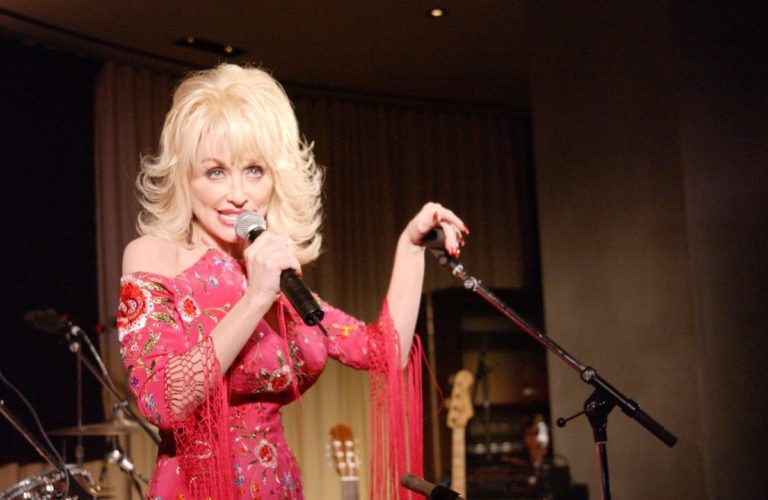
Dolly Parton performing on stage. She's in a red dress and singing into a microphone, smiling.

Dolly Parton | Robert Mora/Getty Images

Parton’s interviewer, Chris Azzopardi of Pride Source, asked the “Jolene” singer her thoughts on “the progress the country music community has been making as a whole when it comes to embracing its gay listeners.”

“In defense of a lot of people, they didn’t have as true of an understanding as they do now,” she said. “Now people really see that this is real, these are real people with real feelings, that this is who they really are. I think a lot of people, anytime you talked about gay people, thought ‘perverse.’ Now, they’re being more educated that this is who people really are. There’s just been so much made of (gay rights) in the last two or three years and it’s been brought to the front so people can really see it and be like, ‘Yeah, I guess there are a lot more gay people than we ever knew! I have a better understanding of it now. I know that these people are for real.’ I think they’re getting that now.”

RELATED: Dolly Parton on the Rumor That She Had an Affair With Her Friend Judy Ogle

Parton blames the community’s previous closed-mindedness on “a lack of knowledge.”

“When you’re with someone, of course you should have your rights,” she said. “You’re gonna be with who you’re gonna be with even if you starve to death and have no privileges and no rights. I think people understand that more now.”

This interview, of course, took place in 2014. The community has more knowledge today than ever before.

Dolly Parton was one of the first country artists to advocate for gay rights

Azzopardi went on to ask Parton why she first decided to advocate for her LGBTQ fans when it wasn’t a common thing to do for country artists.

“Why wouldn’t I stand up for everybody, for all people?” she asked. “In the country field, we’re brought up in spiritual homes, we’re taught to ‘judge not lest you be judged,’ and it’s always been a mystery to me how people jump all over things just to criticize, condemn and judge other people when that is so un-Christian – and they claim to be good Christians! We’re supposed to love one another. We’re supposed to accept and love one another. Whether we do or not, that’s a different story. But that’s what we’re supposed to do.”

What the world would look like ‘free of judgment,’ according to Dolly Parton

RELATED: Dolly Parton Reveals the Length and Color of Her Real Hair

“It’d be a lot better, I can tell you that,” said Parton. “But people love to hate, and it’s just unfortunate but that’s the way it is. People like to judge, they like to condemn, they won’t accept anything they don’t understand – that’s just too bad.”

Even so, Parton isn’t giving up on people.

“We have to work at those things anyway, but most people are not willing to,” she said. “A lot of people are just blind and they’re not seeing through the spiritual eye, and we need to look that way and then we would be more forgiving, more loving and more accepting.”

UK hosts world’s first LGBTQ+ cricket match – Big News Network

History was made on Sunday in a quiet corner of Birmingham, central England, as the world’s first match was played between two LGBTQ+ cricket teams.

Hosts Birmingham Unicorns were founded in March and contested just their second fixture against London-based Graces Cricket Club — England’s only other inclusive side.

The players received commemorative caps and posed for a group photo, while spectators enjoyed picnics and chilled drinks on a balmy afternoon.

“It’s more than just a game — it’s a statement,” Graces captain Stuart Anthony, 43, told AFP.

“If you’re into cricket, there’s a place for you. It doesn’t matter if you’re different — we have a home.”

Unicorns skipper Lachlan Smith, 45, added: “It’s a celebration of inclusion, demonstrating that LGBTQ people can have a place in cricket.

“There are lots of LGBTQ players who aren’t out in their clubs and wanted to play with us because that appeals to them.”

Smith initially sought advice from Graces about founding an inclusive team and both realised that playing each other would be a historic opportunity.

Governing body the England and Wales Cricket Board (ECB) and county team Warwickshire have supported them, as coronavirus restrictions are relaxed, allowing the match to go ahead.

Australia-born Smith grew up with cricket but later questioned its compatibility with his sexual orientation.

After 15 years away from the game, he needed two years to feel able to come out at his current club, while finding an LGBTQ-inclusive team in 2009 rekindled Anthony’s love for cricket after he became disenchanted.

“You aren’t going to be forever pilloried and feel bad. People will help on that journey through this sport we share and love,” Anthony said.

“There’s space for everybody to be themselves. That safe space is marvellous — we learn from it and share along the way.”

The ECB has supported the LGBTQ community in recent years through the Rainbow Laces and Rainbow Stumps campaigns.

Yet few professional cricketers have come out and other sports like football and rugby have arguably done more to promote LGBTQ visibility.

Graces became England’s first LGBTQ+ team in 1996 but it has taken 25 years for a second to come to the wicket — and arrange Sunday’s fixture at Weoley Hill Cricket Club.

Smith thinks a lack of role models and the expenses involved in cricket explain the lag and suggests inclusivity charters at recreational level could solve the problem.

“There’s got to be space for more inclusive clubs. It shouldn’t have taken 25 years,” he said.

“I don’t think cricket has taken seriously the whole idea of inclusivity around sexuality until the last three to five years — we shouldn’t be complacent.”

Anthony believes cricket has “a long way to go” to become more inclusive but thinks a younger generation will be more accepting of LGBTQ+ players.

National LGBT charity Stonewall welcomed the ECB’s support for inclusion but stressed that wider attitudes needed to change to achieve equality.

Director of programmes Liz Ward said: “Initiatives like this game bring us closer to the day where everyone, from players to fans, are able to be themselves on and off the pitch.

“Tackling anti-LGBT+ attitudes and behaviours cannot and must not rest on the shoulders of LGBT+ athletes alone.”

England Test captain Joe Root received praise after telling West Indies bowler Shannon Gabriel “there’s nothing wrong with being gay”, following Gabriel’s alleged homophobic remarks during a match in 2019.

“The more players, fans, clubs and organisations stand up for equality, the sooner we bat discrimination out and make sport everyone’s game,” Ward added.

ECB chief executive Tom Harrison praised both teams’ efforts as English cricket tries to become more accessible.

“I’m really excited about the game of cricket coming together to break down barriers and become more inclusive,” he said.

Source: News24

Kamala Harris makes time for gay pride parade not border – Washington Times

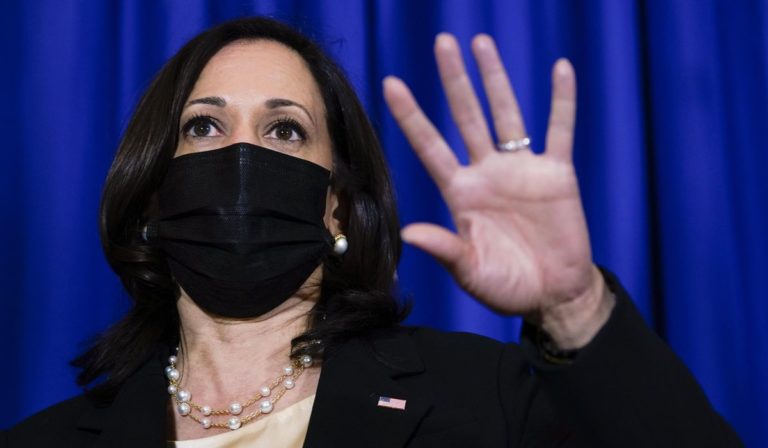
Vice President Kamala D. Harris has yet to visit the southern border, but she did turn up Saturday for the Capitol Pride Walk and Rally in Washington, D.C., as critics were quick to note.

Ms. Harris, who became the first sitting vice president to march in a pride event, took plenty of flak on social media for her appearing at the festivities with her husband Doug Emhoff after dodging questions about when she plans to witness the chaotic border situation.

“Hey, look you guys,” said the conservative site Twitchy. “Kamala Harris made time for a photo op with her hubby at DC Pride … and still hasn’t made time to visit the border.”

Other comments included: “Kamala went to pride but not to border,” “That’s funny, you can attend a pride event, but not visit or acknowledge a border crisis,” and “Maybe they should have a pride event at the border. Then you’d do your job!”

“Doesn’t go to the border but goes to DC pride parade. Ignoring the children at the border won’t make them go away Kamala. Thanks for supporting Pride but ignoring the growing problem at the Border is sad,” said the @BonaFideSlimLo account.

Ms. Harris made her surprise appearance shortly after her bumpy trip to Guatemala and Mexico to study the root causes of international migration to the U.S. border, during which she was tripped up by questions about when she plans to see it for herself.

She told NBC News anchor Lester Holt last week that “at some point, you know, we are going to the border,” but when he reminded her that she had not yet done so, she replied, “I haven’t been to Europe. I don’t understand the point you’re making.”

Ms. Harris was on firmer footing at the LGBTQ parade, where video footage showed she was met with cheers as she waved to the crowd.

“Happy pride, everyone!” she said Sunday in White House video celebrating Pride Month, which is June. “I want you to know, we see you, we hear you, and the president and I will not rest until everyone has equal protection under the law.”

Brandon Judd, president of the National Border Patrol Council, said Sunday that Ms. Harris has boxed herself in on the border crisis, which he called a “manmade disaster” created by “this current administration.”

She can’t go to the border. If she goes to the border, she‘s going to be expected to solve this problem,” said Mr. Judd on Fox’s “Sunday Morning Futures.”

Sign up for Daily Newsletters

UK hosts world’s first LGBTQ+ cricket match – Deccan Herald

History was made on Sunday in a quiet corner of Birmingham, central England, as the world’s first match was played between two LGBTQ+ cricket teams.

Hosts Birmingham Unicorns were founded in March and contested just their second fixture against London-based Graces Cricket Club — England’s only other inclusive side.

The players received commemorative caps and posed for a group photo, while spectators enjoyed picnics and chilled drinks on a balmy afternoon.

“It’s more than just a game — it’s a statement,” Graces captain Stuart Anthony, 43, told AFP.

“If you’re into cricket, there’s a place for you. It doesn’t matter if you’re different — we have a home.”

Unicorns skipper Lachlan Smith, 45, added: “It’s a celebration of inclusion, demonstrating that LGBTQ people can have a place in cricket.

“There are lots of LGBTQ players who aren’t out in their clubs and wanted to play with us because that appeals to them.”

Smith initially sought advice from Graces about founding an inclusive team and both realised that playing each other would be a historic opportunity.

Governing body the England and Wales Cricket Board (ECB) and county team Warwickshire have supported them, as coronavirus restrictions are relaxed, allowing the match to go ahead.

Australia-born Smith grew up with cricket but later questioned its compatibility with his sexual orientation.

After 15 years away from the game, he needed two years to feel able to come out at his current club, while finding an LGBTQ-inclusive team in 2009 rekindled Anthony’s love for cricket after he became disenchanted.

“You aren’t going to be forever pilloried and feel bad. People will help on that journey through this sport we share and love,” Anthony said.

“There’s space for everybody to be themselves. That safe space is marvellous — we learn from it and share along the way.”

The ECB has supported the LGBTQ community in recent years through the Rainbow Laces and Rainbow Stumps campaigns.

Yet few professional cricketers have come out and other sports like football and rugby have arguably done more to promote LGBTQ visibility.

Graces became England’s first LGBTQ+ team in 1996 but it has taken 25 years for a second to come to the wicket — and arrange Sunday’s fixture at Weoley Hill Cricket Club.

Smith thinks a lack of role models and the expenses involved in cricket explain the lag and suggests inclusivity charters at recreational level could solve the problem.

“There’s got to be space for more inclusive clubs. It shouldn’t have taken 25 years,” he said.

“I don’t think cricket has taken seriously the whole idea of inclusivity around sexuality until the last three to five years — we shouldn’t be complacent.”

Anthony believes cricket has “a long way to go” to become more inclusive but thinks a younger generation will be more accepting of LGBTQ+ players.

National LGBT charity Stonewall welcomed the ECB’s support for inclusion but stressed that wider attitudes needed to change to achieve equality.

Director of programmes Liz Ward said: “Initiatives like this game bring us closer to the day where everyone, from players to fans, are able to be themselves on and off the pitch.

“Tackling anti-LGBT+ attitudes and behaviours cannot and must not rest on the shoulders of LGBT+ athletes alone.”

England Test captain Joe Root received praise after telling West Indies bowler Shannon Gabriel “there’s nothing wrong with being gay”, following Gabriel’s alleged homophobic remarks during a match in 2019.

“The more players, fans, clubs and organisations stand up for equality, the sooner we bat discrimination out and make sport everyone’s game,” Ward added.

ECB chief executive Tom Harrison praised both teams’ efforts as English cricket tries to become more accessible.

“I’m really excited about the game of cricket coming together to break down barriers and become more inclusive,” he said.

‘The Circle’s Courtney Revolution Celebrates Pride Month; ‘Being Gay Is Such a Small Part of What I Offer’ – Showbiz Cheat Sheet

Courtney Linsen, better known as Courtney Revolution, is a 28-year-old entertainment host and digital creator from Los Angeles. Playing as his authentic self, Revolution came in third place in season 2 of Netflix‘s The Circle. Now, he is celebrating Pride Month and sharing his story with the world. 

Courtney Revolution, also known as Courtney Linsen, from Netflix's 'The Circle'

Courtney Linsen | Ben Blackall / Netflix ©2021

‘The Circle’ Season 2 cast member Courtney Revolution isn’t defined by his sexuality

Revolution will be a guest on the Shifting Her Experience podcast with Sophie and Tiana on June 15. During his time on the show, The Circle star shares advice on coming out and his LGBTQ identity on the Netflix series.

“Never forget that you’re valuable and you being alive offers something to the world,” Revolution says regarding anyone who is considering coming out to their friends and family. “Being gay is such a small part of what I offer to the world,” Revolution continued.

Don’t let that be the thing that keeps you up at night or ruins your day. Out of all the people on earth, believe me, you got a handful that love what you bring to the table, so keep serving it up so people can eat.

‘The Circle’ Netflix star always wanted to be himself 

The Circle is a game that isolates contestants in apartments where they compete through a voice-activated platform to become the most popular player. With $100,000 at stake, each player enters the game with a strategy.

From catfishing opponents to flirting and everything in between, there’s really no rules when it comes to how contestants play The Circle. Some players enter the game with a persona, like Lee Swift, who played as the younger River in season 2.

But Revolution entered the game with authenticity in mind. “I didn’t think of my [LGBTQ] identity before going on the show,” he explains on the podcast. “I am a black gay man and if I’m going on as that, that’s who I am.”

Revolution didn’t want to come across as “too masculine or too feminine.” Instead, he wanted to play as his authentic self. Stream Revolution’s entire interview with Sophie and Tiana on June 15. 

Courtney Revolution told 1 lie in ‘The Circle’ game

The only thing Revolution did lie about on The Circle was his occupation. Today, many fans know Revolution is a podcast host and digital creator. But in The Circle, he pretended to have a humble job as a barista. 

Revolution believed other players would have perceived him as “nosy” if he shared his actual occupation. Instead, Revolution claimed he was a “coffee-slinging hero” who “loves to laugh” in his bio on the show. 

RELATED: ‘Stranger Things 4’ Teaser: Fans Are Underwhelmed, Assume 1 Major Villain’s Return

The rest of Revolution’s bio was extremely authentic. “I live my life loud out and proud,” Revolution said. “Family is everything to me. I can’t wait to make some new friends and more than anything, I hope to be your cup of joe. #WhenInDoubtTwerkItOut.” 

When Revolution made it as one of The Circle Season 2‘s finalists, fans learned he would use the $100,000 prize to help take care of his stepdad, who is battling stage 3 kidney disease. Revolution may not have won The Circle, but he has won many fans’ hearts and continues to symbolize pride and love in the LGBTQ community. 

Sarasota LGBTQ community protests FDOT Ringling bridge lighting decision – Sarasota Herald-Tribune

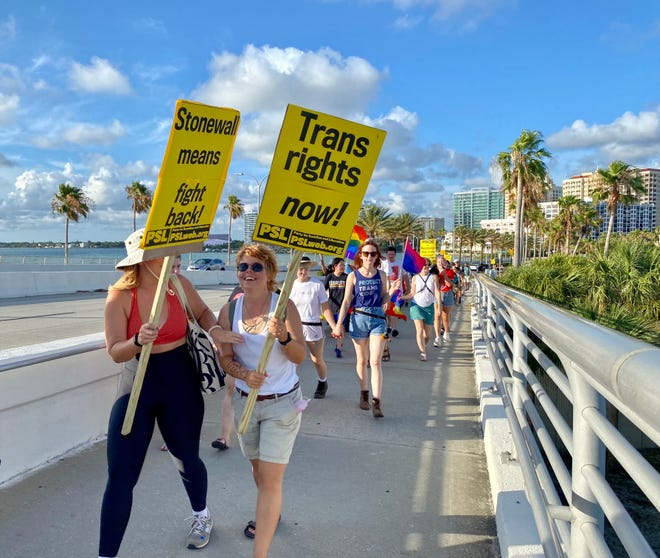
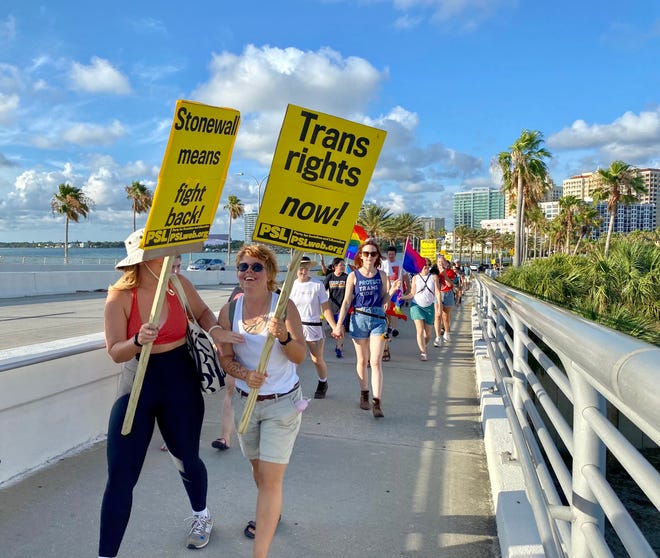
LGBTQ+ protest heading across Ringling Bridge on the 5th anniversary of the Pulse massacre.

After the Florida Department of Transportation rejected a request from Sarasota to light the John Ringling Causeway Bridge with rainbow colors in solidarity with Pride Month, Sarasota’s LGBTQ+ community decided to light it themselves.

A group of more than 50 LGBTQ supporters marched the bridge Saturday evening with rainbow colors to show support for the community. The rally coincided with the 5th anniversary of the Pulse nightclub massacre that left 49 people dead. 

Members of the march said the rally was so much more than just lighting the bridge. It’s about human rights.

Pulse anniversary:Five years later, grief remains for friends of Pulse shooting victim from Sarasota

Bridge lighting:Florida’s own bridgegate highlights gay rights struggle, angers Sarasota LGBTQ community

“I feel like it’s kind of a slap in the face to the LGBTQ community,” said Steven Philips, who heard about the rally from an email blast on SarasotaOut.com, a website that promotes LGBTQ events and businesses. “It’s saying, ‘You’re not important enough for us to recognize.’ The rainbow colors is just a symbol, but it’s a powerful symbol for the gay community around the world.” 

Steven Philips addressing Pride protest on Ringling bridge.

The state’s decision to reject a plan by Sarasota to light the bridge in rainbow came the same week Gov. Ron DeSantis signed a bill banning transgender girls from playing girls sports. On June 2, DeSantis’ veto list included getting rid of funding that would go towards counseling for survivors of the Pulse massacre.

“This is the most hateful, anti-LGBTQ bill,” said Shannon Fortner executive director and founder of the Harvey Milk Festival. “We’ve had funds taken away from Pulse survivors, access for LGBTQ organizations that were providing mental health and housing took away; a lot of really important funding that was being used for the community that was really important, and he (DeSantis) took that away.” 

“It’s obvious it was done strategically as an insult to our community.”

Shannon Fortner (right) with her partner at the Pride protest.

The march went from Marina Plaza to the opposite end of the bridge just before St. Armands Circle. The group waved their flags, held signs and shouted towards drivers passing by. Some drivers honked their horns in solidarity with the group, and an occasional passenger stuck their head out of the window to chant with the protestors. 

Background:State denies Sarasota plan to light Ringling Causeway in rainbow for Pride Month

Pride:City of Sarasota issues proclamation recognizing June as Pride Month for the first time in history

The protest turned emotional as they reached the end of the bridge, when lead organizer, Traci Lipton, stopped to read the 49 names of those who lost their lives that day five years ago at Pulse. After she read each name, the group shouted the words “never again.”

Traci Lipton leading Pride protest on the John Ringling Causeway Bridge.

Lipton said she created the event to show the community love and support because the State of Florida hasn’t. 

“I wanted people to be in a community with people where they could feel the love and feel the support,” said Lipton. “To be able to be around people that they know care about them, that was my entire goal.”

Other organizers of the event included the Party for Socialism and Liberation – Florida, the Leaders Rights Organization and Vegang

Mayo Clinic Minute: Coming out as LGBTQ to your health care provider – Frederick News Post

LGBTQ Pride Month is celebrated each June to commemorate the impact that lesbian, gay, bisexual, transgender, queer or gender nonconforming people have had, and continue to have, on society. While millions may celebrate, many members of the LGBTQ community continue to experience stigma and keep their identity hidden. That may mean not sharing their sexual identity or orientation with their health care provider.

Dr. Natalie Erbs, a Mayo Clinic family medicine physician, says it’s important information to share to ensure everyone gets the best care possible.

When filling out forms before seeing your health care provider, you might see a line asking about your sexual orientation or gender identity.

“Sometimes it’s hard to say the words out loud, but it’s much easier to click a button. But again, we want to know that about you to get you the right care and get you to the right place,” says Dr. Erbs. “We want to know that about you so that we can get you the right care and get you to the right place.”

Talking about sexual behaviors is essential when it comes to your health.

“It affects what type of screenings you might need for certain sexually transmitted infections, depending on the type of sex you’re having, and what exposures you might have to other things like HIV,” says Dr. Erbs. “Some of my patients might qualify to be put on HIV prophylaxis to prevent HIV, depending on the type of sex and who they’re having sex with.”

Dr. Erbs says she hopes you choose to come out to your health care provider. “We in primary care want to see you, and we want to know about you and get to know you as a person.”