Home Blog Page 68

Rickey Thompson On The Difference Between Vine and TikTok – NYLON

Above Rickey Thompson’s bed there is a painstakingly arranged collage of posters. The cover of Missy Elliott’s trailblazing 2001 album Miss E… So Addictive sits between the movie poster from John Singleton’s Oscar-nominated 1991 classic Boyz n the Hood and the ever-iconic picture of Destiny’s Child mimicking the Charlie’s Angels pose circa “Independent Women, Pt. 1.” Directly beneath those is a movie poster for the 1992 Tupac Shakur vehicle Juice, which slightly overlaps with one for the 1995 Emma tribute Clueless and a portrait of the Spice Girls in their prime.

It’s clear that the wall, which is completely covered from end to end, was a passion project for Thompson, a loving ode to all things ‘90s and early aughts. The social media influencer, actor, and model admits that he “hunted” each and every poster down himself, letting go of “a lot of money” in the process. But after turning 25 in February and feeling inspired to undertake a total apartment makeover — his attempt to open “a new chapter of my life,” as he describes it — the wall is also the only remnant of Y2K nostalgia left in his Los Angeles living space.

“When I turned 24, I was like, ‘OK, I still feel like a cute 21 or whatever,’” he says. “But now, since I’m 25, just five years until I’m 30, I’m like, oh wow.” So after years of living in an apartment that “looked like some set from a ‘90s teen movie,” Thompson decided that it was time for less adolescent indulgence and more Matisse art in the living room. The upgrade reflected in his personal styling choices, too. “I was dressing like a ‘90s pop star,” he says. “Then, I was like, ‘I’m 25 years old. I need to start giving grown and sexy, not preteen.’”

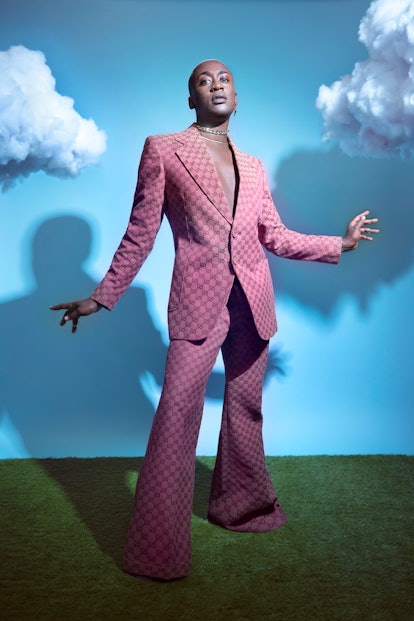
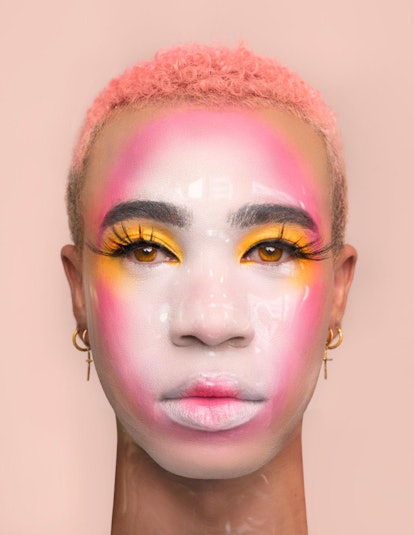
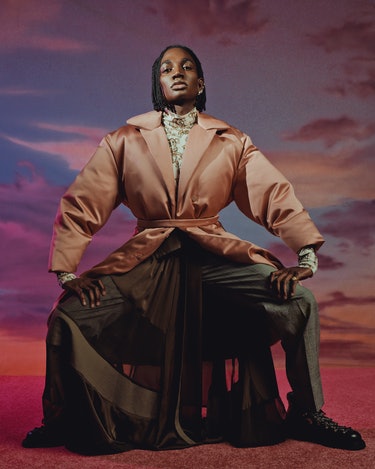
Giambattista Valli coat, Dior Men top and shoes, Michael Kors Collection pants, Sacai skirt, David Yurman earrings and ring, Talent’s own earrings

It’s late morning and Thompson, still in bed, is initially reluctant to turn his camera on, claiming that he looks “real rough” after recently waking up. But after spending two minutes sprucing up, he appears, his skin glowing in that much-coveted dewy aesthetic that has turned Glossier into a billion-dollar empire. “Well, I had the bonnet on,” he says when I make note of this. “You know I had to take the bonnet off.”

Thompson has spent the better part of the last decade amassing the kind of following most content creators could only dream about (5.5 million followers on Instagram, 2.6 million on TikTok, and close to 1 million on Twitter). But the origins of his fame lie in Vine, the now-defunct video platform where short-form content was king. An early adopter, Thompson made a name for himself with videos that were uproariously funny and strangely inspiring, using his trademark wit (and impressively athletic dance skills) to impart messages of unshakeable confidence, often while sending up a stiff middle finger to any potential haters. (“Mirror mirror, on the wall, who’s the baddest of them all?” he asks in a memorable clip. “Me, bitch!”) On the strength of his internet persona, he’s managed to branch out into several different arenas — he nabbed a lead role in the YouTube Premium series Foursome, narrated several interludes on a mixtape for rapper Aminé, and is currently fronting fashion campaigns as one of the faces for American luxury brand Coach.

Still, as he looks back on a quarter-century of life, he can’t help but feel like he’s destined for even more. “I feel like I’ve been this same person for the past seven years,” he says. “But I’m getting older and I feel like I’m getting more mature. I just want to be taken more seriously. I want to start doing things differently.”
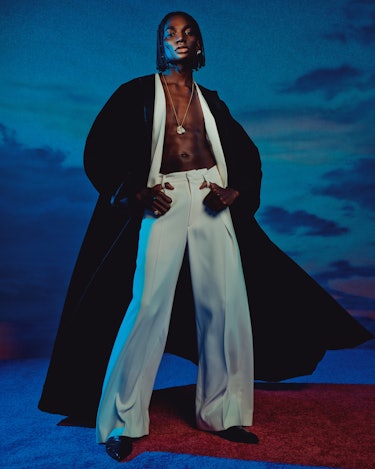
Chanel coat and necklace, MM6 Maison Margiela vest and pants, David Yurman earrings and ring, Talent’s own earrings, Jimmy Choo shoes
Chanel coat and necklace, MM6 Maison Margiela vest and pants, David Yurman earrings, Talent’s own earrings
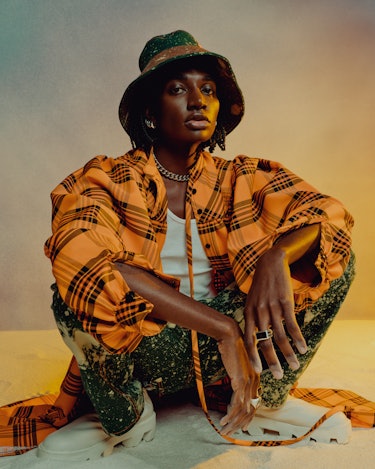
Sterling Ruby robe, pants, hat, and shoes, Calvin Klein top, David Yurman earrings and rings, Talent’s own earrings, Dalmata necklace

Raised in Raleigh, North Carolina, Thompson describes his teenage self as shy. “I was not the most popular kid. I literally had not a lot of friends.” Luckily, he had the world of theater to keep him company; throughout high school, he appeared in a number of productions, from Mulan to Les Misérables, My Fair Lady to Little Shop of Horrors. “I just always found my voice in performing,” he says. “I felt like anytime I got on that stage, anytime I was acting out a scene, I could do anything. My nerves went away. I wasn’t scared to be myself.”

The version of Thompson we know — the relentlessly unapologetic, magnetic superstar — first revealed himself around the performer’s junior year, right around the time the Vine app was coming into vogue. Crawling to the internet as a means of escape from the bullying he was experiencing in the real world, Thompson began to make videos about his experiences. “I just randomly thought of ideas, like, What if I said this in the video? Maybe somebody will understand,” he recalls. “And every single time I made a video, people were like, ‘Oh my God. That is so me! I relate to that!’”

Soon, Thompson had millions of followers — and it didn’t take long for people at his high school to notice. “Everything switched for me,” he says. “People started realizing, ‘Oh! The shy kid is actually funny and amazing.’ I became the most popular kid in school. I won prom king. I literally went from being the underdog to being at the top.”

“I went through a lot of friend groups and knew a lot of people who weren’t on my side. They weren’t really rooting for me. They were talking mad mess behind my back and whatever.”

Thompson moved to Los Angeles shortly after graduating and, buoyed by his newfound confidence, did the exact opposite of what he did in his hometown: he sought out new friendships wherever he could find them. “I wanted to be in the center of everything. I just wanted to be friends with everyone,” he says. But just as quickly, he realized how dangerous this mindset could be. “I went through a lot of friend groups and knew a lot of people who weren’t on my side,” he continues. “They weren’t really rooting for me. They were talking mad mess behind my back and whatever.” Eventually, he came to the conclusion that, sometimes, smaller friend groups are better, and today he’s “finally found [his] core group of people.”

This includes Denzel Dion, a close collaborator who Thompson calls his best friend (the pair host Spotify’s We Said What We Said podcast together), and a boyfriend he has somehow managed to keep out of the public eye. “I feel that it’s just so good to have something private,” he says about the latter relationship. “You just want to mess around and have that to yourself.”

Thompson’s insistence on maintaining privacy around this facet of his life immediately distinguishes him from the younger microgeneration of content creators popping up in the post-Vine era. While the most-followed members of a place like Hype House are inclined to use their relationships to maintain audience attention, Thompson’s refusal to even offer a name for his partner — let alone post a picture of him to any of his social media platforms — is just one sign that he’s not exactly pursuing the same kind of fame.
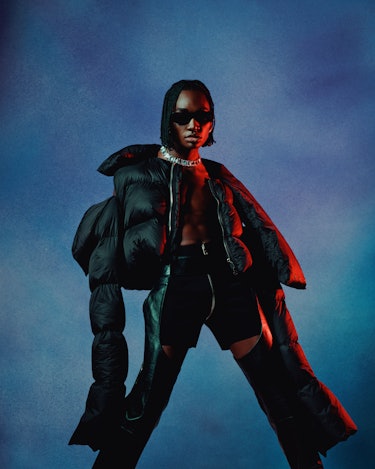
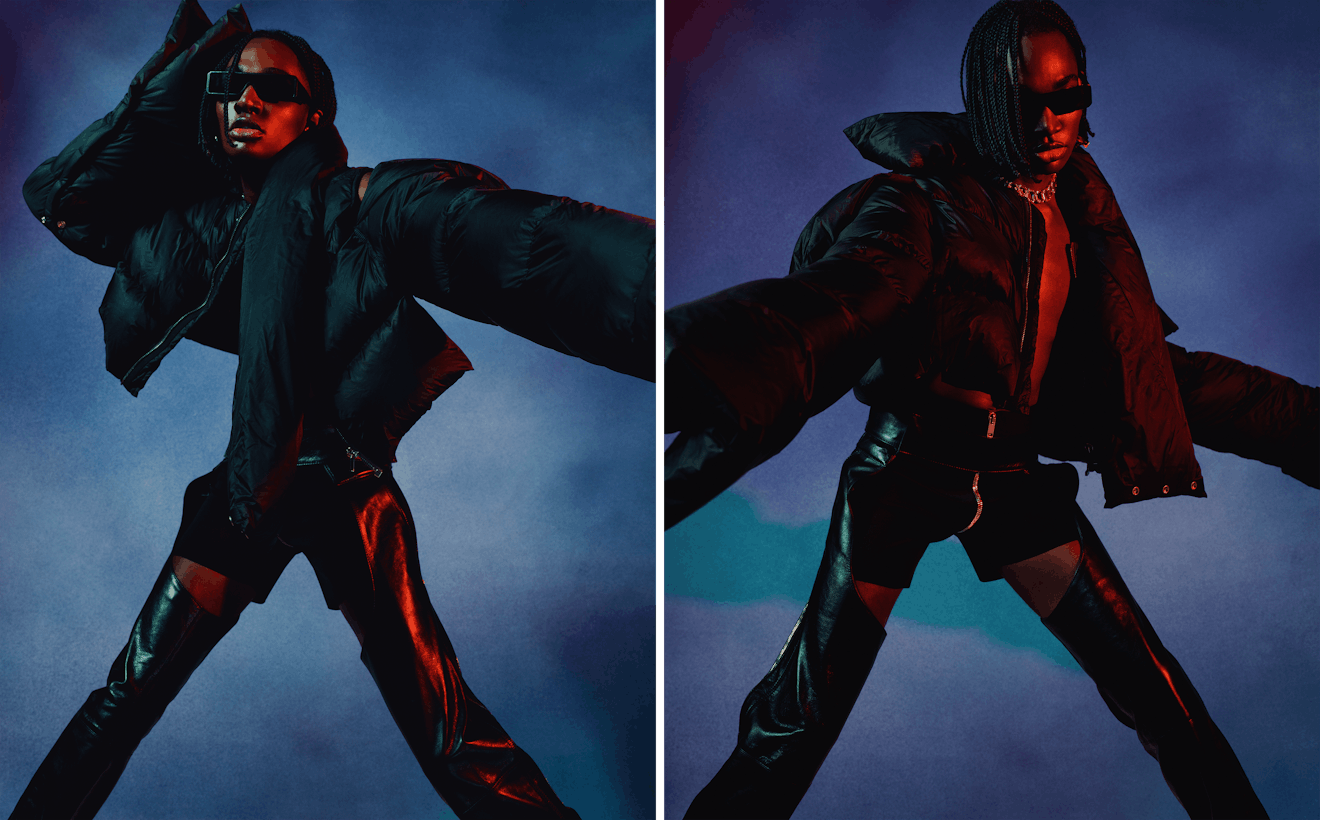
Rick Owens jacket and sunglasses, Givenchy pants, Swarovski necklace

Thompson’s Vine-honed, short-form comedy translated well enough to Instagram (less so to YouTube, where Thompson briefly tried his hand at fashion videos). But when it comes to TikTok, which is, for better or for worse, Vine’s true successor, he found himself a bit slower on the uptake. “At first, I was very nervous because I felt like I was too old to be on TikTok. I was like, ‘All these [users] are young children,’” Thompson tells me. “I remember when TikTok was Musical.ly. I hopped on that and I just saw all these comments, like, ‘Oh my God! You said bitch! You said ass! This is too inappropriate!’” He ultimately found his footing, primarily through the same kinds of content — rants, dances, motivational speeches — that made him such a hit on Vine.

But it wasn’t quite the same. With his massive cross-platform following, there’s no denying that Thompson is one of the most visible creators on the internet right now. However, as a gay Black man in the modern-day “influencer” media landscape, he exists in a league of his own, poking through a translucent bubble already crowded with mostly heterosexual white people.

It’s something we both can’t help but compare to Vine: during its prime, the most prominent Vine creators were often Black and, as a quick Google search will remind you, were recognized and celebrated as such. In the era of TikTok, however, creators of color are frequently finding their contributions erased and usurped by their white counterparts; look no further than Jimmy Fallon’s recent invitation of a white TikTok influencer onto his show to teach him several viral dances originally choreographed by people of color. (After complaints, the talk show host invited the original creators on as well.)

“I feel like, back in the day, Black people were just being funny and that was highlighted way more,” Thompson theorizes. “But now, it’s so hard. Now, I feel like, for you to be popping, you have to be white, cute, and straight.” It doesn’t help that he now sees lifestyle and beauty content largely overshadowing comedy on the algorithm — a shift he doesn’t hesitate to say he “hates.” “I think that’s what the new generation wants to see. Our generation, we just wanted to laugh, have a good time. Now it’s like, oh, who’s going to be the prettiest, who’s going to be the richest, oh my God.”
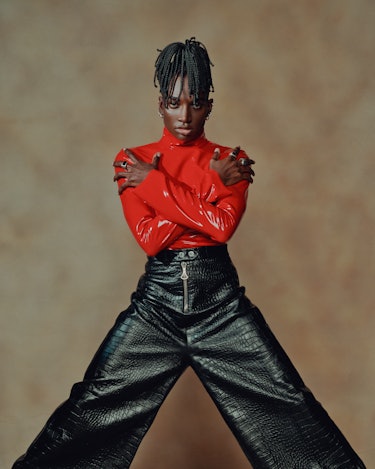
Ellery clothing, David Yurman earrings and rings, Talent’s own earrings

Of course, Thompson’s ability to pierce through that bubble is only further proof of his singular charisma, which he has honed into an instantly recognizable brand, one many would find hard to replicate without plainly coming off as a plagiarist. Still, Thompson is imagining a world for himself beyond the confines of social apps, anyway. He points to the “comedy genius” Regina Hall as a lifelong inspiration, citing his own desire to one day be part of a long-running franchise like Scary Movie. “I want to master that — how you go to the movies and you just die laughing when you see me. That’s what I really want to be.”

It’s partially why the role of Dakota on Foursome, the YouTube scripted series that ran for four seasons, meant so much to him. Even though he bombed his first audition — “It was rough,” he says, “It was sooooo bad” — he got the part by being himself. As he recalls, he was the “only Black boy” in the audition room, but ultimately beat out “all the blonde, white boys” for the part of, as the pilot put it, “the gayest straight-shooter.” He cherished the opportunity to play a character that gave voice to gay Black boys like himself, and wants to secure similar roles in the future. Not that he would turn down a juicy straight part if offered one, but as he says, “When I’m playing somebody gay, I’m just so comfortable.”

Balenciaga top and hat, David Yurman earrings, Talent’s own earrings

And why shouldn’t there be a Rickey Thompson-esque character in the next ‘90s reboot or moody teen drama? After all, the fashion world came around. He finds it funny to look back on his early days in LA, when a modeling casting agent once told him that he was “too funny, too comedy” to ever get true work in the cutthroat world of high fashion. “Well, look at me now!” the Coach model says. “I’m over here, gracing the covers of magazines!”

Towards the end of our call, I ask Thompson what he, in all his present-day glory, would say to the shy little teenager that was simply honored to get a part in his school’s production of My Fair Lady. “I would tell him to just literally never, ever, ever give up,” he responds. “I would say, ‘Hey. I know life right now is not the best. I know it’s a struggle. But you’re going to be it. You’re going to be successful. People are going to love you. You’re going to have your haters and whatever, but you got this. You’re going to be a star.”

Top Image Credit: Sterling Ruby robe, pants, hat, and shoes, Calvin Klein top, David Yurman earrings and rings, Talent’s own earrings, Dalmata necklace

Photographer: Ryan Pfluger

Stylist: Corey Stokes

Grooming: Eliven Q

Set Designer: Robert Ziemer

Bookings: Special Projects

Videographer: Sade Ndya
NYLON’s Pride 2021 Playlist Includes These 19 Artists – NYLON

All good things happen in June. The delicious beginning of summer, and Pride, a time for parades, parties, and all pleasures of the highest order.

Here at NYLON, we’re celebrating the month by sharing 19 of our favorite rising queer artists, who are telling moving stories about their own identities and journeys and, really, just making good ass music to get down to. From Cookie Kawaii’s bed- and booty-shaking Jersey club anthems, to Adult Mom’s searing indie rock for the more introspective moments — these are the musicians you should be listening to for Pride, and always.

Save the playlist on Spotify.

Adult Mom

Daniel Dorsa

From the first two lines of Adult Mom’s single “Sober,” it was clear that Driver was going to be a strong contender for best album of the year — and the March release didn’t disappoint, touching upon the varying after-effects of a breakup, sparing no detail.

What is your favorite LGBTQ+ moment in pop culture history? “There are so many, but the 1993 Vanity Fair photoshoot with K.D. Lang and Cindy Crawford is endlessly incredible to me. The photo itself is timeless and gorgeous, and the impact that it had is wild. I know that it angered a sh*t-ton of people, which is important, because I think it ended up changing a lot of people’s feelings about lesbians and lesbian imagery. I mean, the photo is of Cindy Crawford shaving the face and armpits of K.D. Lang while K.D. holds Cindy’s thighs. It’s hot and a beautiful display of gender play and I love it!

What is your prediction for song of summer? “Brutal” by Olivia Rodrigo.

Allison Ponthier

Weslee Kate

Allison Ponthier may only have two solo songs out at the moment, but they are vivid, startling pieces of storytelling about her experience growing up in a small Texan town coming to terms with her queer identity. Their sparkling country sound and windswept spirit is just the cherry on the top.

What are your plans for Pride this year? My plans are:

  • Keep writing gay songs
  • Do karaoke with my friends
  • Watch Jennifer’s Body 20 times

What is your prediction for song of summer? Ashnikko “Slumber Party” is going to be even more huge than it already is. It is perpetually stuck in my head and I would die for her.

Boyish

Nicole Teckchandani

New York City’s Boyish is made up of musicians and friends India Shore and Claire Altendahl. Together, they craft hazy and romantic bedroom pop, a sound that blossomed from Shore’s childhood of obsessing over Lorde, and Altendahl’s playing in a band with her dad. “I was a dancer and a gymnast for most of my life and then I got injured and had to stop,” Shore says. “I was searching for something else to do and I heard Lorde and just wanted to be her.” “My dad played in a band while I was growing up and it was always my biggest goal to be the drummer for him,” Altendahl adds. “Except I play guitar now.”

What is your favorite LGBTQ+ moment in pop culture history?

Shore: This was a really hard question to answer, but honestly, the Sasha Velour versus Shea Couleé lip sync in the finale of Drag Race. I think about it every day and for some reason it makes me cry.

Altendahl: I grew up playing a lot of tennis for some reason and I love the story about Billie Jean King kicking Bobby Riggs’ ass in the Battle of the Sexes tennis match. Bobby Riggs was a self-proclaimed male chauvinist and said he could beat any woman tennis player, so watching the footage of her winning is so badass. She was also one of the first female athletes to come out and I have always looked up to her.

Chippy Nonstop

Toronto-based rapper and DJ Chippy Nonstop knows how to get a party going. Whether it’s blaring club tracks to get you hyped or something mellow and wavy to soundtrack the comedown, Chippy Nonstop brings it full force.

What is your favorite LGBTQ+ moment in pop culture history? Colton Underwood from The Bachelor coming out as gay. Just kidding! I would probably say Madonna: Truth or Dare. It’s cliche, but iconic.

What is your prediction for song of summer? Well, my songs for my DJ sets this summer are the Lobsta B “Toxic” Remix and LSDXOXO “Sick Bitch.”

Vincint

Ash Danielson

Dynamic pop storyteller Vincint released his infectious debut album, There Will Be Tears, appropriately for this Pride month, but his influence and buzz have been building for years as he’s lit up stages around the world. Vincint’s song “Higher” featuring Alex Newell and Princess Precious is “euphoric and a true banger,” as he says, and already a contender for song of the summer.

What are your plans for Pride this year? My plans are a bit hectic. I’ll be playing a bunch of Prides so travel is at the top! But I mostly plan on meeting and hugging everyone I can. I’ve missed the world so much and getting to be back with my people is the ultimate joy!

Chloe Moriondo

Jimmy Fontaine

Artist Chloe Moriondo, 18, may be an “internet kid” like many of her peers, but her music has already reached new heights beyond the DIY world she started in. With her major-label debut album, Blood Bunny, arriving May 7, it’s time to pay attention.

What are your plans for Pride this year? I will be being very lesbian and hot hopefully.

Cookie Kawaii

Pierre York

The force behind the bed-squeaking bop “Vibe” and one of TikTok’s earliest viral stars, Jersey club DJ Cookie Kawaii has been honing her craft since she was little; knowing how to lay down a vibe is in her blood: “Music has always been a part of my life since I was younger with my parents being DJs, but I started making music around 2011,” she says. “I’ve been writing poetry since I was younger so I decided to put my poems to beats after high school.”

What is your favorite LGBTQ+ moment in pop culture history? There’s a lot of favorite LGBTQ + moments especially when talking about Lil Nas X lol but if I had to pick one … probably when Miley Cyrus performed at the VMAs and brought out some of the iconic Queens from Ru Paul’s Drag Race to perform with her. I love everything about Drag Race so I remember seeing that and just being so happy.

dodie

Parri Thomas

Don’t underestimate the sweetness of Dorothy Miranda Clark’s voice. In songs like “cool girl” and album standout “Hate Myself,” Clark, aka dodie, explores quiet moments of self-doubt in searing detail that will stay with you long after the track ends.

What is your favorite LGBTQ+ moment in pop culture history? Katy Perry’s “I Kissed a Girl” really opened a door for me in terms of starting to explore my sexuality. Even if just that the topic of it was brought to light in school as not something horrendous.

What are your plans for Pride this year? You know, I’ve always wanted to bake a rainbow cake. But it’s impossible to find sprinkles bright enough in the U.K.! I want more color! Also probably watching Portrait Of A Lady On Fire for the sixth time.

Evann McIntosh

Shore Fire Media

At just 17 years old, Evann McIntosh has already developed a loyal fan base for their soulful take on modern pop and R&B. Following success on TikTok, the songwriter self-released their own debut album, to soon be followed by new record Character Development, out Aug. 27.

When did you first realize you wanted to be a musician? I can’t remember the first time I knew, because I always knew I really wanted to be a musician and I couldn’t see myself doing anything else. I think one time I never knew I could want to more, was when I saw Bruno Mars in concert during the Moonshine Jungle Tour. Seeing him perform and do his thing, I knew that was what I wanted to do, be just like that.

Fanclubwallet

If you’re looking for punchy bedroom pop, it’s all about Fanclubwallet. Full of melodrama, nostalgia, and just straight charm, Fanclubwallet’s Hannah Judge does it all with a wink.

What is your favorite LGBTQ+ moment in pop culture history? I’m not sure there’s a specific moment, but I remember being very excited when I’d find out some of my favorite TV characters were queer as a kid. Like when Willow started dating Tara in Buffy The Vampire Slayer I was pretty stoked.

Frances Forever

TikTok smiled on Frances Garrett, aka Francis Forever, when their track “space girl” exploded on the app. They’re far from a one-hit wonder, with rich vocals and a knack for emotional songwriting that will easily worm its way into your heart.

What are your plans for Pride this year? My plan for Pride is learning more about our history (that I didn’t get taught in high school) and spreading as much love as possible.

Jayli Wolf

Hayden Wolf

An alt-pop artist, activist, actor and filmmaker, Jayli Wolf is a multitalented, multifaceted artist with a story to tell, and a message of hope and resilience for Indigenous youth. Her groundbreaking debut, “Child Of the Government,” will be followed up with EP Wild Whisper, due out June 18.

When did you first realize you wanted to be a musician? When I left the cult that I was raised in, that’s when I really decided to go for it. I feel like I’ve always known and always wanted to be a musician but I suppressed it. Within the Jehovah’s Witness religion and my mother’s family, I believed that it just wasn’t in the cards or possible for me. Looking back though, I was always humming, making music with whatever I had. Escaping into sound.

Joy Oladokun

Nolan Knight

There aren’t many frills to Joy Oladokun’s folk music but that doesn’t mean her songs, which capture the quieter moments of life with a frank honesty, don’t still sear to the core. Especially “Jordan,” a love song that’s also about redemption.

When did you first realize you wanted to be a musician? I realized I wanted to be a musician when I was 10 years old. I was sitting in this TV room that we had in the back of our house, my dad had recorded all these concert videos and music videos and one was of Tracy Chapman singing at Wembley for Nelson Mandela’s 70th birthday. It was the first time I’d seen a Black woman playing the guitar. I grew up in a farming town, there was a lot of country and folk music, and I’d had my own experiences with music in different genres at home, but it was really powerful to see a tool that I had only seen in the hands of people who don’t look like me to be used by someone who looks like me.

Kezia

Sanny Bisquerra

Kezia’s party-ready anthems — whether a desperately horny bop called “megan fox” or a song about sucking… you know what — stem from a surprising origin: the guitar. “Once I learned how to play guitar it was a wrap,” the Bay Area musician says. “The summer from fifth grade into middle school I wrote songs every day while my family and I lived in Germany. I haven’t stopped writing since.”

What is your favorite LGBTQ+ moment in pop culture history? When Frank [Ocean] came back from his hiatus and dropped Blonde…. it was truly a moment in time. The world stops when he steps out, and every time I revisit Blonde I find something new to love, something I didn’t quite get at first. Every listen is a rediscovery.

River Moon

You might be familiar with her as the chef emoji on the laugh-out-loud Instagram meme account @patiasfantasyworld, but get ready to know River Moon as your new favorite DJ and performer. Take her track “THE RAVE PRINCESS,” for instance — a cheeky ode to raves with a beat so filthy that it’ll turn any room into an all-out freak-fest.

When did you first realize you wanted to be a musician? I knew I wanted to be a musician when I heard M.I.A.’s Kala album when I was 8 or 9. I don’t have many memories before 15, but I do remember the first time I heard that album. In the days of dial-up internet and Limewire, that album took two days to download. I just wanted to hear “Paper Planes,” but as soon as I hit play on Track 1, “Bamboo Banga”… I just knew. I never heard anything like it. I don’t think a day goes by from that day, til now where I don’t play at least one song from that album. It sparked something in me. I wanted to make music just like that!

Sam Buck

Courtesy of Sam Buck

Sam Buck’s last album came out in 2018, but the Los Angeles musician’s electrifying country — theatrical, unconventional, and playful — still sounds fresh.

What are your plans for PRIDE this year? I was just visiting New York for the first time post pandemic and now I’m actually gonna go back to my cabin in Topanga, close the curtains and be hungover for a month and finish my album. I think it’s actually very LGBTQ+ to be too hungover or late to attend Pride.

What is your prediction for song of summer? My song of the summer is definitely “Free” by Deniece Williams, and while I highly recommend and find it extremely relatable to a post pandemic summer…. I don’t know if this track from 1976 is gonna top the charts right now, though crazier things have happened. I do have to say I think its impressive how much an insanely sad and meandering song like [Lana Del Rey’s] “Blue Banisters” seems to be resonating with the gay guys of New York City. I was at Julius with some friends last week and multiple times we were just blasting it through a little bluetooth speaker, head banging.

Semler

Courtesy of Semler

One of this year’s most honest — and heartbreaking, and hilarious — musical moments came earlier this year with the release of Semler’s Preacher’s Kid, a tight, but no less impactful sophomore album chronicling singer Grace Semler Baldridge’s personal experiences as a queer musician. “My Dad is an Episcopal priest and he used to take me to Christian music conferences in Nashville when I was little,” Baldridge says. “We would bop around to showcases and panels. The whole thing felt very glamorous and interesting to me. I really looked up to those artists and would imagine myself on stage with them. Soon after, I started writing songs of my own. They were all very bad.”

What are your plans for Pride this year? For Pride this year my wife and I are going to have some friends over to drink, eat breakfast, and dance around my yard. Now that I’m vaccinated I just want to eat a biscuit and listen to Cher with loved ones.

Siena Liggins

Victorian Prime

Siena Liggins’ debut album, Ms. Out Tonight — which includes stunning visuals for each track — brings a highly creative take on the already innovative genre of queer pop. “Girlfriend,” which Liggins co-wrote with Jesse Saint John “with an epic lesbian slumber party in mind,” is a perfect example of the artist’s charismatic point of view and potent sound.

When did you realize you wanted to be a musician? I’ve always known I wanted to be a writer and storyteller, but I was 11 when I recorded my first song about self-love and confidence and from there, there was no turning back. My dad would always push me to connect with my music and to master and embody my lyrics, and that began my journey of becoming a student of music and ultimately was how I found my sound in all of this.

Tiberius b

Singer and producer Tiberius b is all about catharsis. It’s pop music at its most raw — playful, tender, and totally electrifying.

What is your prediction for song of summer? “Sink In” by Tirzah will be soundtracking all my bike rides to and from anything that happens this summer. That song makes me feel like I got gifted a special superpower to be able to see the love in everything there is as sparkly green bioluminescent light. The music video for it is the best ever and gives me wet, wet eyes.

Arby’s worker blames ‘computer glitch’ after calling gay man ‘f*g’ on his receipt – PinkNews

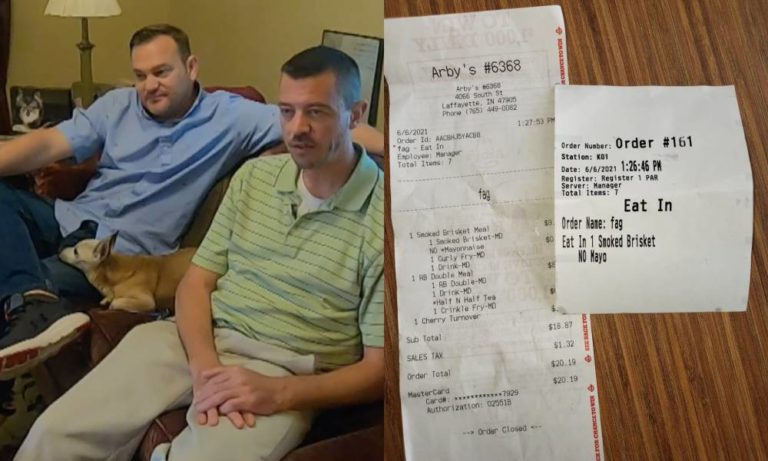
Craig Gray and John Burns say they were the victims of a homophobic incident after a worker at an Arby’s in Layfayette, Indiana wrote a slur on their order receipt on 6 June 2021. (NBC News/Facebook/Craig Gray)

A worker at Arby’s restaurant in Indiana was fired after writing a homophobic slur on a gay man’s order receipt.

Craig Gray and John Burns told NBC News that they were dining at Arby’s in Lafayette, Indiana on 6 June when they received a customer’s receipt with “f*g” typed on it. Burns said the slur came as a “shock” because the worker seemed a “little awkward but very nice”.

“The cashier that helped us, the young man that’s been mentioned, seemed really new and a little awkward but very nice,” Burns explained. “So a very run of the mill type of fast food occurrence. Nothing that you would expect out of the ordinary.”

As they waited for their order in the restaurant, Gray noticed there was the homophobic slur on the receipt instead of his name. He later shared a photo of the receipt on Facebook with the caption: “So this happened at Arby’s! Happy Pride, huh?”

Burns said such a homophobic incident has never happened to him, and he’s “lived here my whole life”. He told NBC News that they brought the receipt to the worker’s attention, but the employee said the incident was because of a “computer glitch”.

“I said, ‘Look at this. What is this? Why would you do this?’” Burns recalled. “And that’s when he tried to give me some lame excuse about a computer glitch, where he said: ‘Sometimes I’ll put in a name, and it will come out different on the receipt.’”

But Burns demanded to see the manager, who refunded the couple’s order and fired the cashier on the spot. Burns remembered seeing the fired worker “walking down the street in the parking lot” by the time he and Gray got their food.

Burns told NBC News that they have not had a “phone call or phone conversation” with anyone from Arby’s corporate office to acknowledge “what’s happened and apologise”. He said he also wanted to “hear something from the franchise owner” about what they’re doing to prevent such homophobic incidents from happening again in the future.

An Arby’s spokesperson confirmed to NBC News that the “franchised employee was terminated within minutes of management becoming aware of the incident”. The spokesperson explained that Arby’s has “zero tolerance for discriminatory speech of any kind”.

“I can confirm that both the franchisee and us at Arby’s corporate have both reached out to the guests to no avail,” the spokesperson added.

Rachel Levine in ‘rewarding’ visit talks with trans youth at DC health clinic – Washington Blade

It’s not unusual for Rachel Levine as assistant secretary of health to visit medical facilities on behalf of the Department of Health & Human Services. But her visit last week to the LGBTQ youth clinic at the Children’s National Medical Center was special because she was able to meet with transgender youth as an openly transgender presidential appointee.

The visit on Thursday by Levine at the D.C.-based hospital comes not long after the U.S. Senate approved her appointment, making her the first openly transgender presidential appointee to win a Senate-confirmed position. As such, her visit to the LGBTQ youth clinic, where transgender kids come for transition-related care and health services, held particular significance for the patients.

Levine, speaking with the Washington Blade at the end of her visit, said having the opportunity to speak with both transgender youth and medical professionals testing them was “tremendously, tremendously rewarding”

“It’s tremendously gratifying to be able to speak to the medical professionals and the clinic personnel at beds, particularly to the youth and their families from my experience,” Levine added. “So I have two aspects of that. One is that I’m a pediatrician and adolescent medicine specialist. So I’ve been teaching to children and their families my entire career, but the other is coming from my lived experience as an openly transgender woman, and so I find it tremendously rewarding.”

The warm environment of the hospital for children is readily apparent upon entering the main atrium of the building. Lights dressed up as hot air balloons fill the tall ceiling while a nearby TV shows music videos consisting of squares of kids’ faces singing, followed by easy-listening country music and Asian K-pop. Children and their parents await their appointments seated in comfy plush red chairs before white blocks meant for use as tables.

Key to Levine’s visit was taking part in a discussion at the hospital auditorium with three transgender youth and their families who obtain services at the clinic. During the question-and-answer period, Levine shared her experience as a transgender person who underwent transition later in life and went on to tremendous success as a high-ranking presidential appointee.

For the transgender youth, Levine’s presence at the hospital — at a time when state legislatures are busy enacting bills to restrict their access to medical care and school activities — serves as a reminder that barriers based on gender identity are breaking down and the sky’s the limit for their future.

After the question-and-answer session, Levine told the Blade she “learned a lot” about the Children’s National Medical Center, which she called “a world-renowned children’s hospital and academic medical center.”

“I’ve known about it before,” Levine added. “I’m a pediatrician, adolescent medicine specialist, but I learned more about what they’re doing. And I learned specifically about their gender clinic, where they take care of transgender and gender non-conforming youth and got to meet some of the staff as well as the kids and their families.”

The Youth Pride Clinic, which opened in 2015, is one of the few clinics in the nation to provide primary care and mental health services to LGBTQ youth from ages 12 to 22. Among the services offered are hormone replacement therapy, STP/STI treatment and PrEP services as well as individual and family therapy for transgender youth.

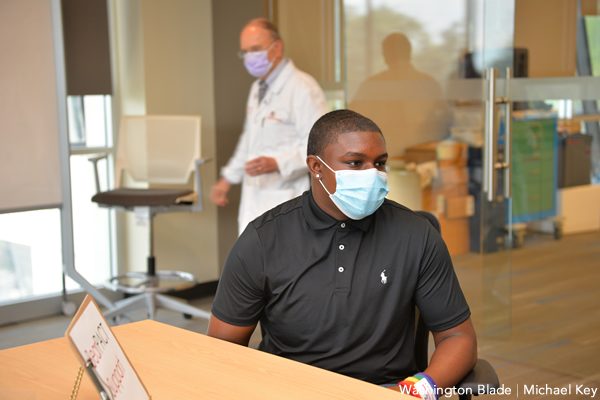
Among the transgender youth patients at the clinic who spoke to the Washington Blade was Amir, a 15-year-old Georgia native whose last name as a minor is being withheld for confidentiality purposes.

“I started out in fifth grade coming out as lesbian,” Amir said. “I didn’t even really know, but when I came out to my grandma in Georgia, where I’m from, I still didn’t feel like myself. So then, later on, me and my friend researched, and next thing you know we came across the term transgender, and I was like, ‘This is who I am. This is me.’”

Amir said he began taking shots as part of care regimen in January. Being able to receive care from the Youth Pride Clinic, Amir said, means a lot because he has an opportunity not available to other transgender youths, who face challenges and even hostility as they make the journey to transition. The staffers at the Youth Pride Clinic, Amir said, are “like a second family” who work hard to provide the services they offer.

Sonia Murphy, Amir’s aunt who became his legal guardian, said when she began reaching out for medical help for Amir she found a two- or three-year wait list to get access to treatment, which she said makes her “saddened” such care isn’t widely available.

“There’s a population of kids and parents out there who need the services and just can’t access it because there’s not enough bandwidth, not enough manpower,” Murphy said.

Amir said he’s getting other avenues of support from his two cousins, one who is older at age 18 and one who is younger at age 12. “They’re like sisters to me, so I call them my sisters,” Amir said. Amir also identified two other male cousins as well as his uncles and his aunt.

“They’re all very supportive of me,” Amir said. “My auntie Tonya, for example, Pride month came up, first day, she sent me a paragraph, saying, ‘I’m glad you’re yourself and you’re open to who you are and things like that,” and that I’m not afraid to be who I am around anybody. It’s just things like that. And for my birthday, I had tons of Pride shirts, and I got a rainbow shirt with the fist in the middle for Black Lives Matter, and it was a ton of different things.”

Lawrence D’Angelo, director of the Youth Pride Clinic and an occupational health adolescent medicine specialist, told the Blade being able to start the facility in 2015 in and of itself was one of the key victories for the initiative, although he said the Children’s National Medical Center has been providing transition-related care since 1998.

“When we started it…we thought that we were going to be running a PrEP clinic, that we were going to be providing preventive services to LGBTQ kids,” D’Angelo said. “The first day, the first patient actually came in and asked for PrEP, and the other six patients that were scheduled that day all wanted transgender services. So, suddenly, it became obvious what we were going to be spending 90 percent of our time doing, which is exactly what we think we should be doing, because that’s where the need is the greatest.”

Despite the advantages of having access to the Youth Pride Clinic, transgender youth have clear challenges and face hostility based simply on their gender identity, especially in a year when state legislatures have in an unprecedented manner enacted legislation against them. The Youth Pride Clinic, in many ways, is an oasis of support.

Arkansas, for example, enacted a measure that would make criminal the kind of services provided at the clinic. Other states have enacted measures prohibiting “biological boys” from participating in sports, which essentially bars transgender girls from participating in sporting events.

While anti-trans measures aren’t being enacted in D.C. or any nearby states, the advancement of anti-trans legislation in states has had a negative effect on transgender patients at the Youth Pride Clinic.

D’Angelo, based on conversations he’s had with the patients, said they’re aware of the wave of legislation, which he said has led to fear, anger and being “unable to understand what is happening and why it’s happening.”

Amir said watching states enact legislation against transgender youth “makes me feel some type of weight,” pointing specifically to the anti-trans sports measures because he said he’d welcome the opportunity to participate in athletics.

“I’m athletic,” Amir said. “I do all types of sports. I play basketball, soccer, I’m going to do boxing…With sports and stuff, I just feel like I want to be able to do everything, just as a regular cisgender person will be able to do,”

Amir, despite the enactment of anti-trans laws, has an optimistic outlook and said the enactment of state measures against transgender youth demonstrates they’re now “on the radar” of the social conservative movement.

“I feel like if everybody who’s a part of LGBTQ and trans together, we can stand up and we can overcome this because the thing is, there are so many people out there who don’t understand what we do, and the thing is that they’re noticing us, so that’s a start to something big.”

Amir (Blade photo by Michael Key)

With many states hostile to transgender youth, others are looking to the federal government for support under the Biden administration. On his first day in office, Biden signed an executive order directing federal agencies to implement the U.S. Supreme Court’s decision against anti-LGBTQ discrimination to the fullest extent possible.

Levine cited an announcement from HHS that resulted from this order on implementing regulations prohibiting anti-LGBTQ discrimination in medical care, reversing a policy under the Trump administration that green lighted discrimination, as one of the ways it has answered that call and helped families like the Youth Pride Clinic.

“So the Affordable Care Act says that you cannot discriminate based upon sex,” Levine said. “The Department Health & Human Services and the Office of Civil Rights has interpreted sex to include sexual and gender minorities, to include sexual orientation and gender identity, which means LGBTQ individuals under that. So we need to look at all aspects of the Affordable Care Act, and to work to implement that interpretation of the statute. That was only done a month or so ago, so we’re going to be working on that now.”

Is there anything more the federal government can do to support the clinic? D’Angelo cited a number of key things already secured, including the hospital being able to offer insurance to patients and the affirmation from HHS against anti-LGBTQ discrimination. More research dollars and greater focus from the National Institutes of Health on gender diverse and sexual minority individuals, D’Angelo said, would also be welcome.

“There are things out there that the federal government can do, but I think…there are limitations of what they can do,” D’Angelo said. “They can’t, unfortunately, effect what’s going on in individual states, which is, in some cases draconian. That’s an awful thought if we were practicing medicine in Arkansas, we could be in jail.”

Meanwhile, Levine said the Biden administration, including Secretary of Health & Human Services Xavier Becerra, is working on both internal and external policies to facilities like the Youth Pride Clinic to help them secure their place in the health system and reach transgender youth.

“The secretary and I will be doing everything we can to advocate for the LGBTQ community,” Levine said. “So I think we’re going to be working externally, in terms of advocacy, and then we’re going to be working internally in terms of policy.”

Five Nights At Freddy’s creator denies he’s a homophobe after donating to Donald Trump – Yahoo Eurosport UK

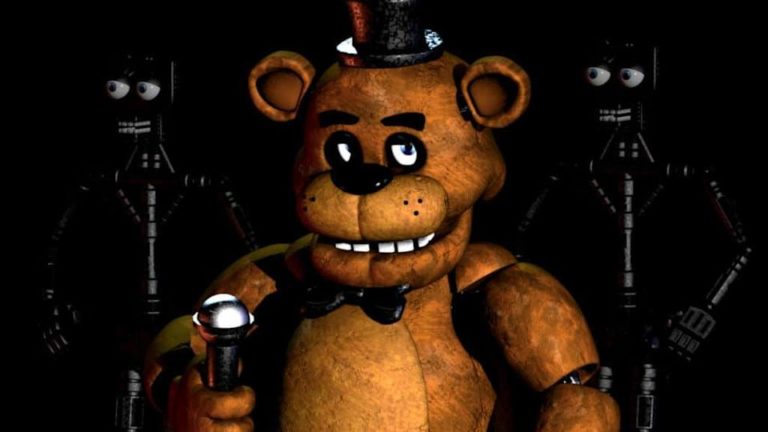
Scott Cawthon, the creator of the popular horror video game series Five Nights at Freddy’s, has said he “won’t apologise” for funding Republican politicians, including Donald Trump.

The animator and designer came under fire last week for donations to various US politicians.

As revealed by a Twitter user known as ‘Chief Imagineering Officer of Antifa’ with a screenshot of Cawthon’s public filings, Cawthon has maxed out his political donations to a number of Republican politicians from 2015 to 2020.

The donations range from $5 to $5,000, including a $2,000 donation to Donald Trump and a $5,000 donation to anti-LGBT+ senator Mitch McConnell.

“turns out scott cawthon, well-known as the creator of five nights at freddy’s and less known as being a christian fundie, maxed out his political donations to republican candidates and PACs in 2020,” reads the tweet.

The list of politicians does include Democrat Tulsi Gabbard, receiving $2,500, but as noted “if you look at her politics the picture becomes clear”.

“she’s a crypto-fash who’s allied with hindutva militias, pushes anti-trans bills and appeared on PragerU…”

Since then, Cawthon followed up on Reddit to defend his stance: “I’ve debated greatly how best to address this, including not addressing it at all, but with so many people from the LGBT community in the fanbase that I love, that’s not an option.

“I’d like to think that the last seven years would have given me the benefit of the doubt in regards to how I try to treat people, but there I was, trending on twitter for being a homophobe, getting doxed, with people threatening to come to my house.”

He continued: “Even if there were candidates who had better things to say to the LGBT community directly, and bigger promises to make, I believed that their stances on other issues would have ended up doing much greater harm to those communities than good.

“I’m a republican. I’m a Christian. I’m pro-life. I believe in God. I also believe in equality, and in science, and in common sense. Despite what some may say, all of those things can go together. That’s not an apology or promise to change, it’s the way it’s always been.”

Cawthon is known as an animator and game designer, not only for Five Nights at Freddy’s but a number of biblical films.

He began Five Nights at Freddy’s in 2014 and has since released several more games in the series, as well as a novel trilogy and a forthcoming film adaptation.

Owing to the success of the series, in 2020 he was estimated to have a net worth of $60 million.

A new game in the series, Five Nights at Freddy’s: Security Breach, is due out later this year on PlayStation and PC. A gameplay video was recently shown at a PlayStation State of Play presentation.

However, many gamers have responded negatively to this donation news, especially LGBT+ gamers unhappy that Cawthon has been funding politicians against LGBT+ rights. FNAF has since been trending on Twitter.

For more gaming news, follow Gaymeo on Facebook. You can also email us with any news or tips on Gaymeo@pinknews.co.uk

Survey reveals 97% of Northern Irish LGBTQ+ youth struggle with anxiety and depression – Gay Times Magazine

A national survey, conducted by BeLong To Youth Services, has shown Northern Irish LGBTQ+ youth are struggling with mental health due to the pandemic.

Trigger warning: this article includes mention of suicide and mental health conditions.

The pandemic has posed a significant risk to marginalised and vulnerable groups, including LGBTQ+ and POC communities.

In 2016, Higgins A. et al conducted a  national study of the mental health and wellbeing of lesbian, gay, bisexual, transgender and intersex people in Northern Ireland.

The study highlighted the mental health struggles experienced by young LGBTQ+ people in Ireland.

Findings of the study revealed Northern Irish (NI) LGBTQ+ youth were twice more likely to self-harm and three times more like to experience suicide ideation.

The LGBTQ+ youth were also four times more likely to experience anxiety and depression than their non-LGBTQ+ friends.

BeLong To Youth Services’ new data has revealed this mental health struggle has been exacerbated by the pandemic.

The key finding of BeLong To Youth Services uncovered that more than 60 per cent of LGBTQ+ youth are struggling with suicide ideation and loneliness throughout the pandemic.

More than 50 per cent of queer youth have been dealing with self-harm and described their mental health as “bad” or “very bad”.

Moninne Griffith, CEO of BeLong To Youth Services, offered a statement on the results of the survey.

“The past 12 months have been extremely difficult for LGBTI+ young people, as clear from our research. Levels of self-harm and suicide ideation are rising as LGBTI+ young people experience unique mental health challenges. Many formal and informal safety nets, supports, and services have been unavailable because of lockdowns and increased social isolation.

More than half of LGBTI+ young people surveyed told us they are not fully accepted in their home environment because of who they are or who they love. Family rejection, feeling unaccepted, and a denial of identity can result in loneliness, stress, anxiety, and more complex mental health challenges.”

She added: “We need to let LGBTI+ young people know that they are not alone. We need to show LGBTI+ young people across Ireland know that there are spaces for them to come together, be who they are, and receive the support they need.

“To achieve this, we are calling for the support of those passionate about ensuring LGBTI+ young people have their needs met, and their voices heard. We are sure that whatever lies ahead, the impact of Covid-19 will be with us for years to come. Our commitment is to continue to understand how this affects LGBTI+ young people, share that evidence to ensure that their needs are not forgotten, and be here for every LGBTI+ young person who needs us.”

Hopkins County Native Wilma Thompson Crowned 2021 Ms. Hopkins County Sr. Classic! – KSST

Smiley face

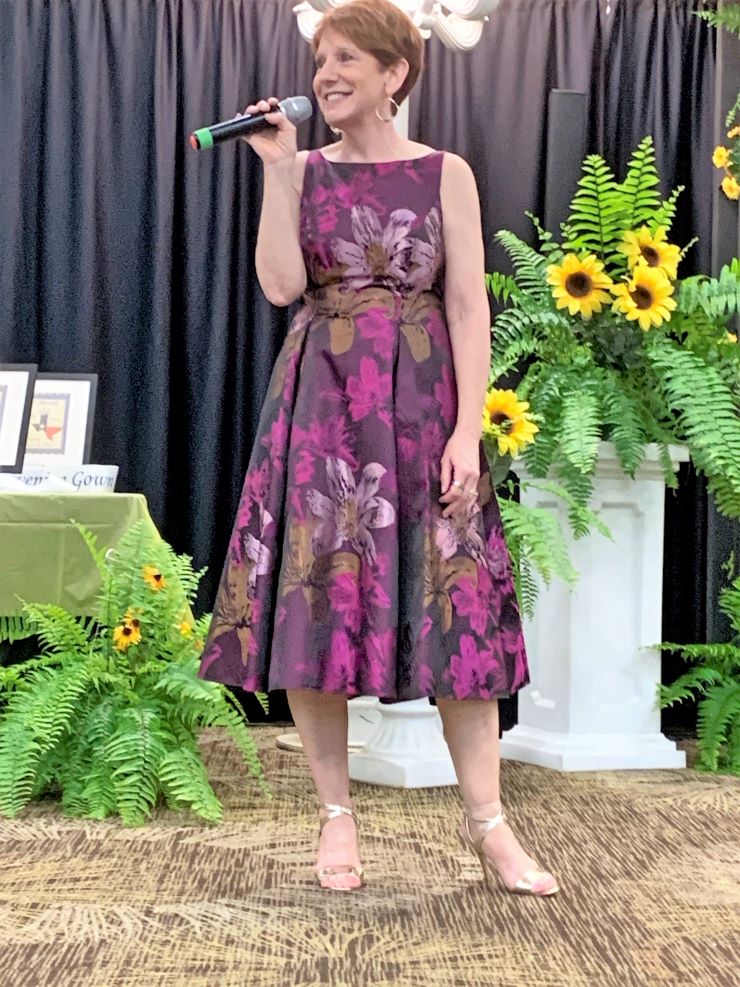
“Changing the Face of Aging” is the theme of the Ms. Senior Classic Pageant, open to ladies age 60 and older.

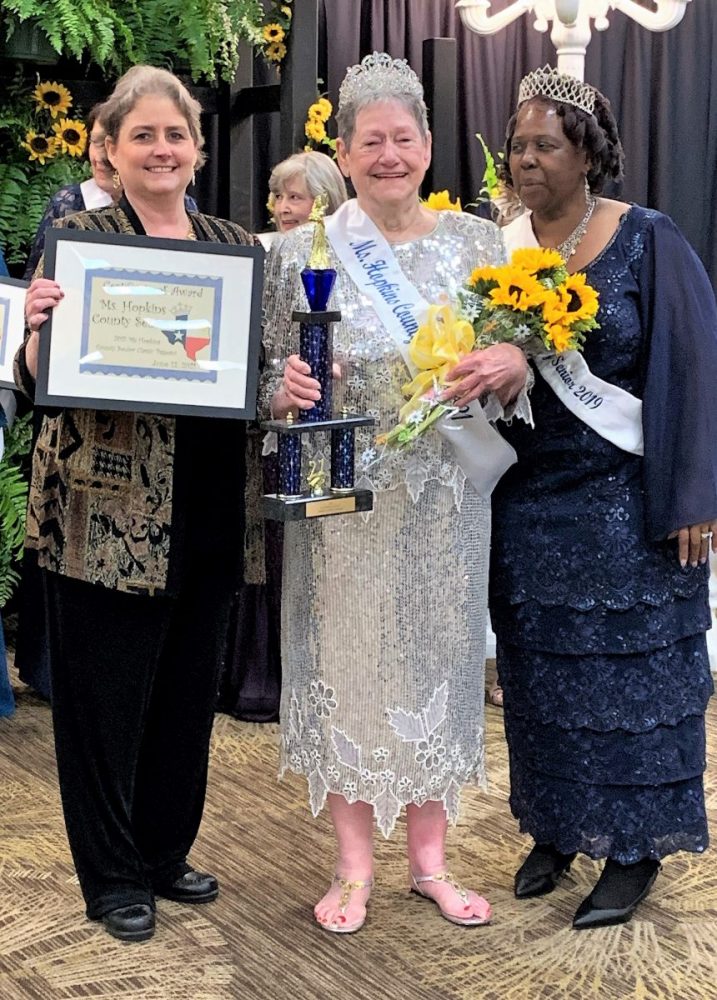
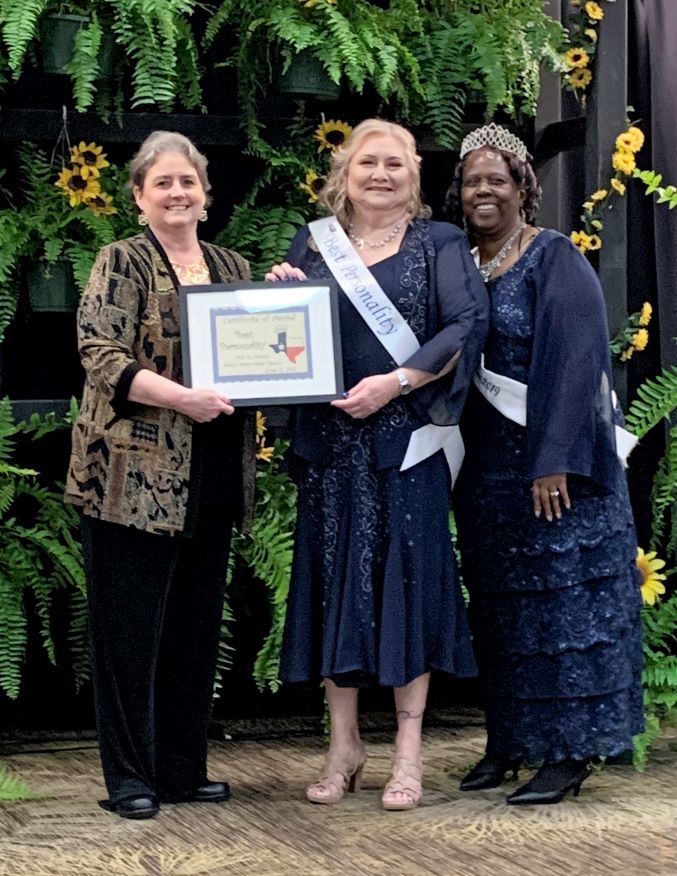
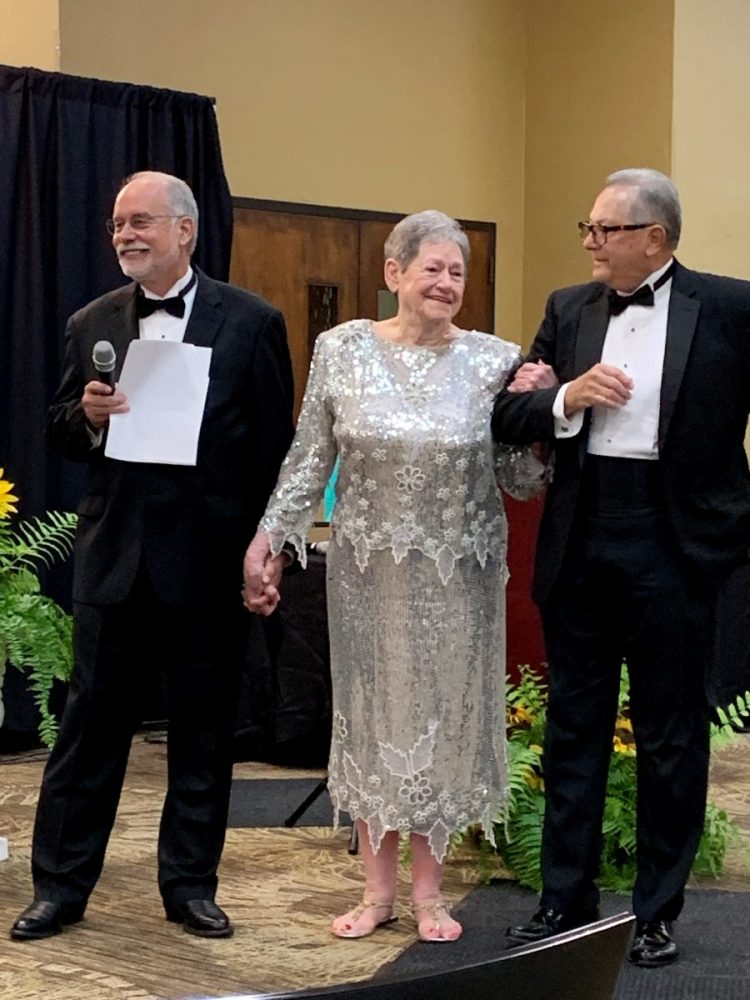
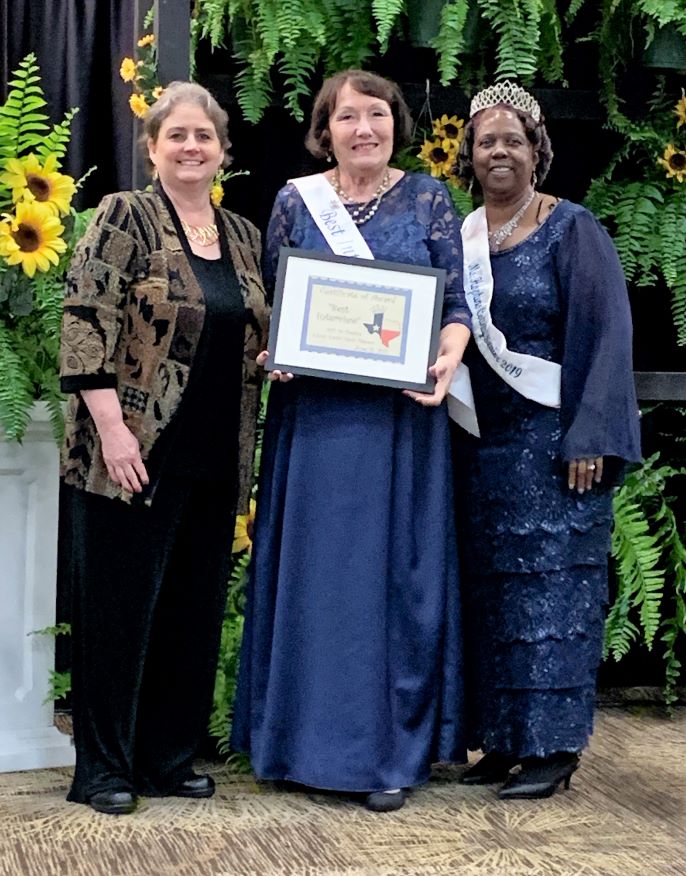
Director Karon Weatherman, 2021 ‘Queen’ Wilma Thompson and 2019/2020 ‘Queen’ Vender Wright
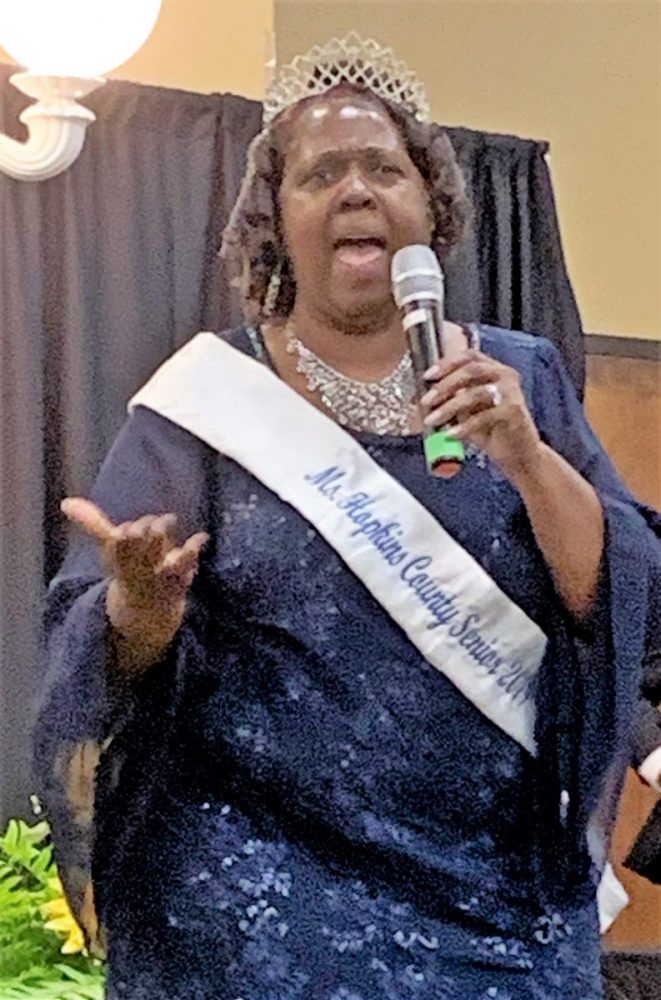
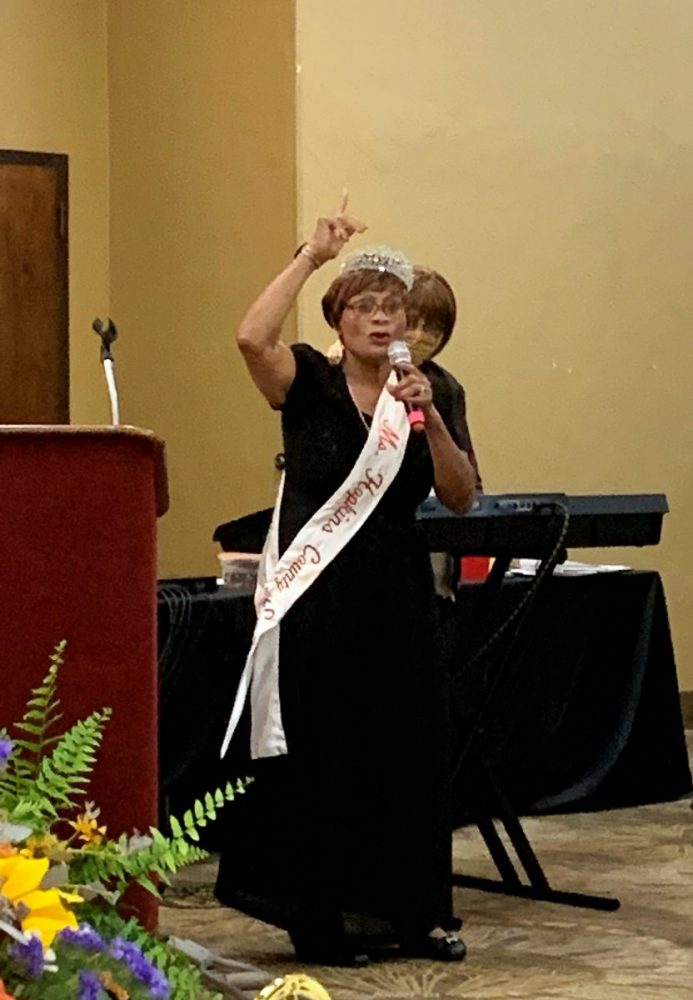
Outgoing Vender Wright blessed everyone with her rendition of “Just Stand”

Ten contestants initially entered, but due to various circumstances, only seven were able to be present on June 12 for the 2021 Ms. Hopkins County Senior Classic Pageant in the banquet hall of the Civic Center in Sulphur Springs. Like many other public events, last year’s contest could not be held due to the pandemic. Thus, in the 12th year since the competition began, Wilma Thompson became the 11th to wear the crown and sash of Ms. Hopkins County Senior Classic. She was crowned before a large audience by outgoing ‘Queen’ Vender Wright and Pageant Director Karon Weatherman.

Winners are:

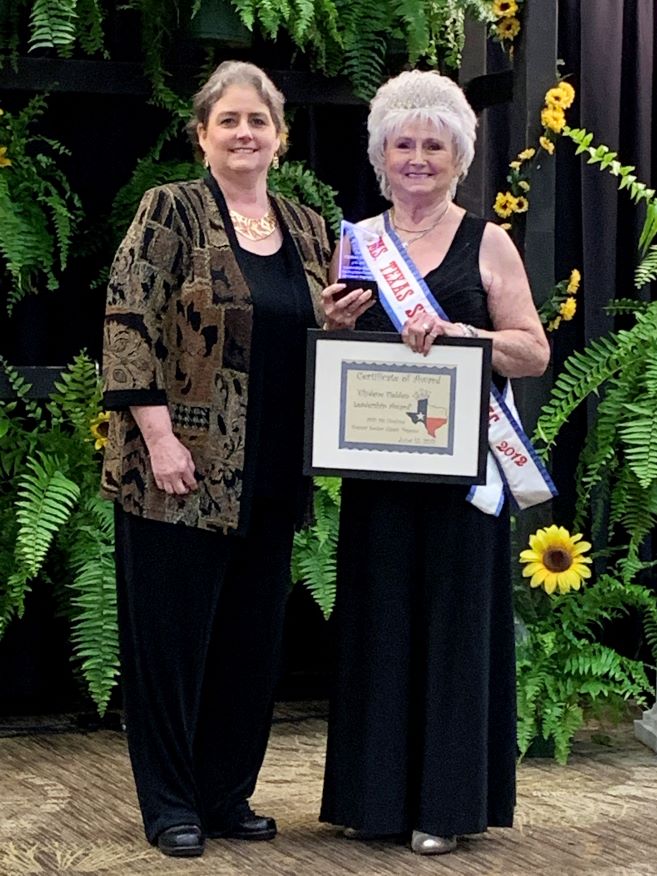
Nancy Bolton for the 2021 Clydene Fielden Memorial Leadership Award (Nancy is a Ms. Texas Classic winner and runner-up in previous local and state pageants)

Linda Pickle Hill for the 2021 Spirit Award

Ticket Sales Winner, Patsy Cowan

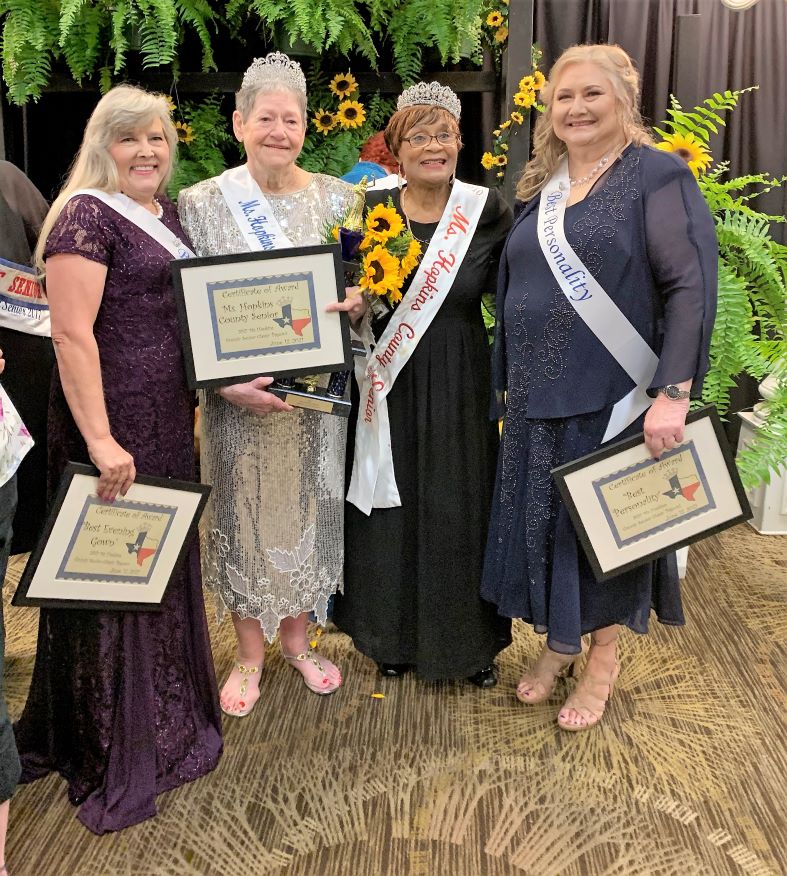
Best Personality, Sharon Baker

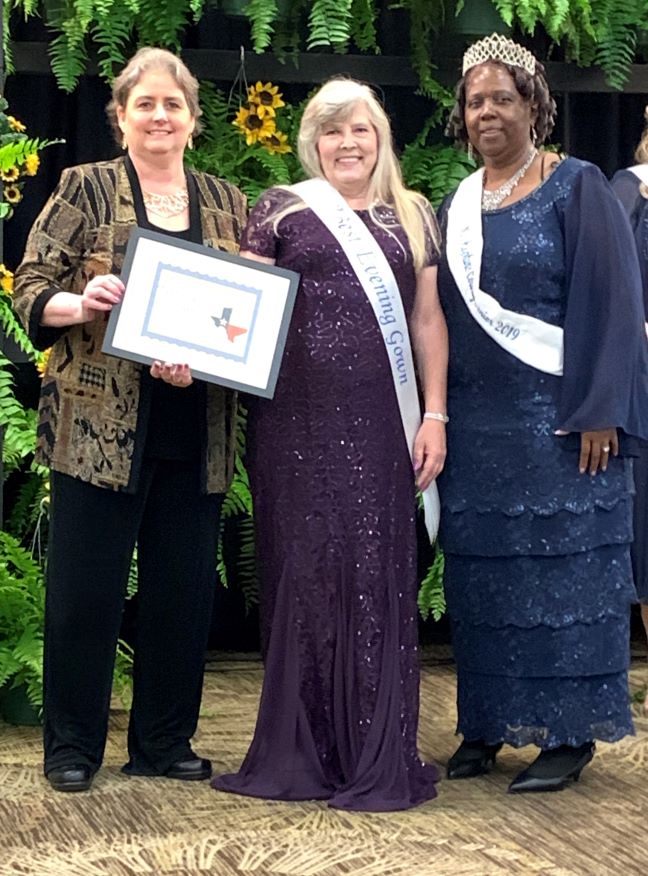
Best Evening Gown, Valerie Ross

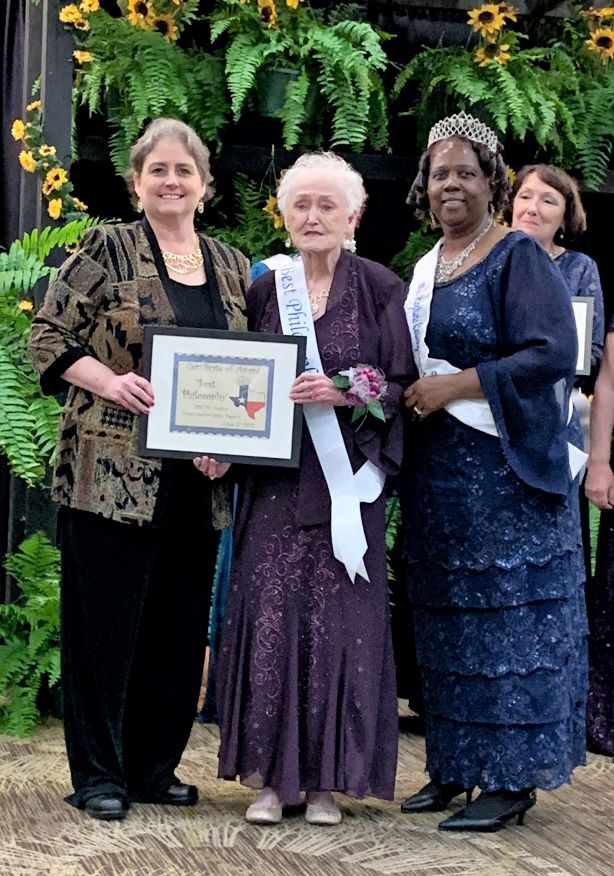
Best Philosophy of Life, Elizabeth Wilburn

Best Interview, Nancy Roy

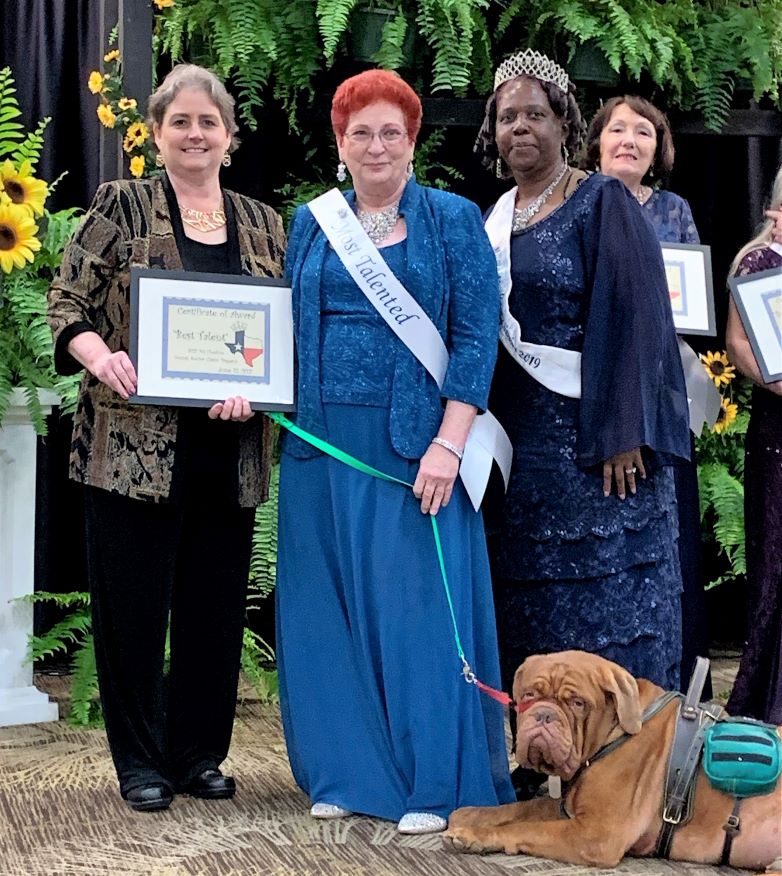
Most Talented, Linda Pickle Hill

Miss Congeniality, Patsy Cowan

Second Runner Up, Patsy Cowan

First Runner Up, Elizabeth Wilburn

Ms. Hopkins County Senior Classic 2021, Wilma Thompson

Ms. Texas Senior Classic 2019/2020 Regina Money
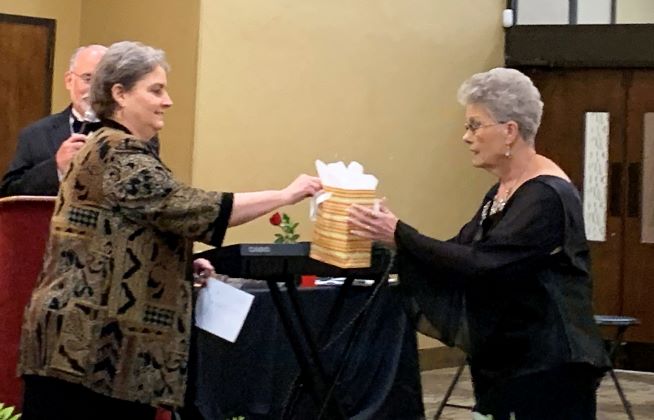
Weatherman awards the Clydene Fielden Memorial Leadership Award to Nancy Bolton (Fielden’s sister) who has provided strong support for the pageant for numerous years

Talent presentations ranging from comedy skits, readings and recitations to singing and clowning provided great entertainment. The interviews with judges consisted of each contestant’s answer to a random question she selected. And each contestant was resplendent as she modeled a formal evening gown as her philosophy of life was read aloud.

Linda Pickle Hill wins Most Talented and Spirit Award (with her service dog)

When the four judges turned in their scores and tabulation took place, more entertainment was provided by Ms. Texas Senior Classic 2019/2020 Regina Money, Ms. Hopkins County Sr. 2009 Stella Bagley and Ms Hopkins County 2019/2020 Vender Wright. More entertainment was provided by the duo ‘Sentimental Journey’ Mike Shing and Enola Gay who also served as Emcees along with Chuck Roy, editor of the Community Chronicle newspaper. Story and video of the pageant can be seen on ksstradio.com and on the KSST YouTube Channel.

First Runner Up Elizabeth Wilburn also received the Best Philosophy of Life award

The Texas Senior Classic pageant series is a ‘celebration of the senior woman and the changing face of aging’. Contestants are judged in three categories; talent, evening gown/philosophy of life and interview with judges. Winners and runners-up may advance to the Ms. Texas Senior Classic Pageant, to be held in Tyler in September 2021. For more information, contact Karon Weatherman at the Sulphur Springs Senior Citizens Center, 150 MLK Drive or phone 903-885-1661.

Best Personality Award Sharon Baker
Best Interview Nancy Roy
Best Evening Gown Valerie Ross
Ticket Sales winner Patsy Cowan is also Miss Congeniality and Second Runner-Up
The very first Ms. Hopkins County Sr. Stella Bagley is known for rousing gospel music provided by Cassie Edwards on keyboard
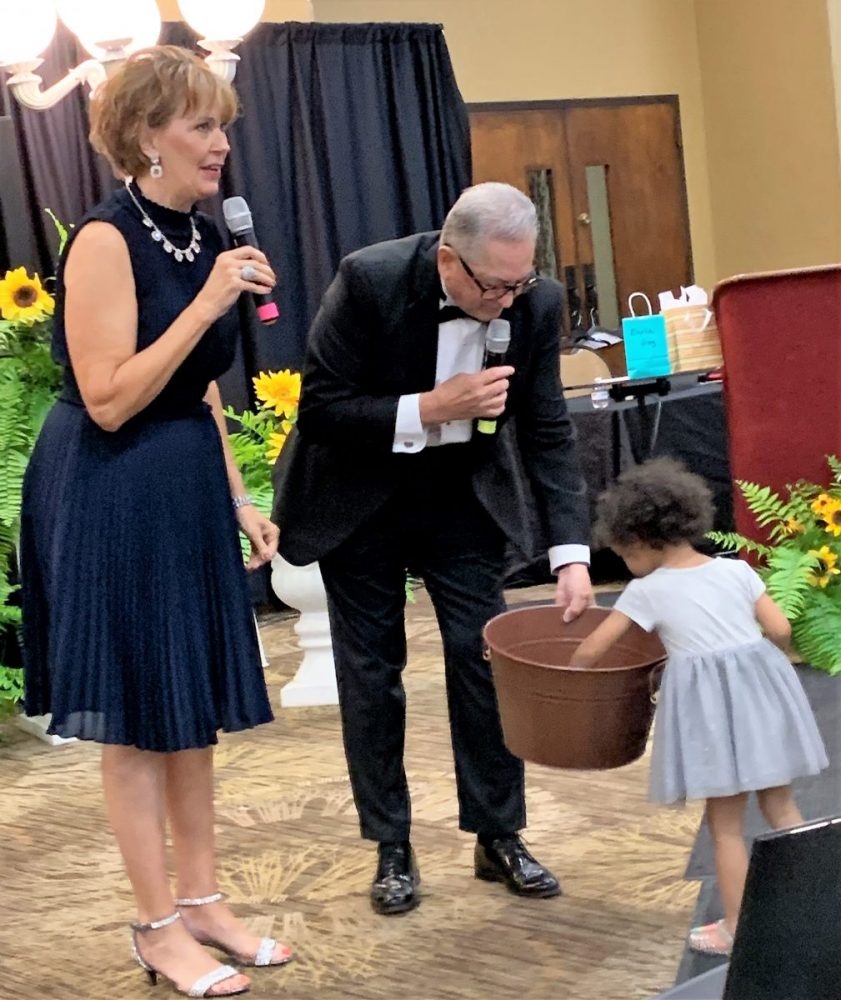
Co-emcees MIke Shing and Enola Gay get help in ticket drawing
The new Ms. Hopkins County Sr. Classic is escorted to the stage by Chuck Roy and Mike Shing
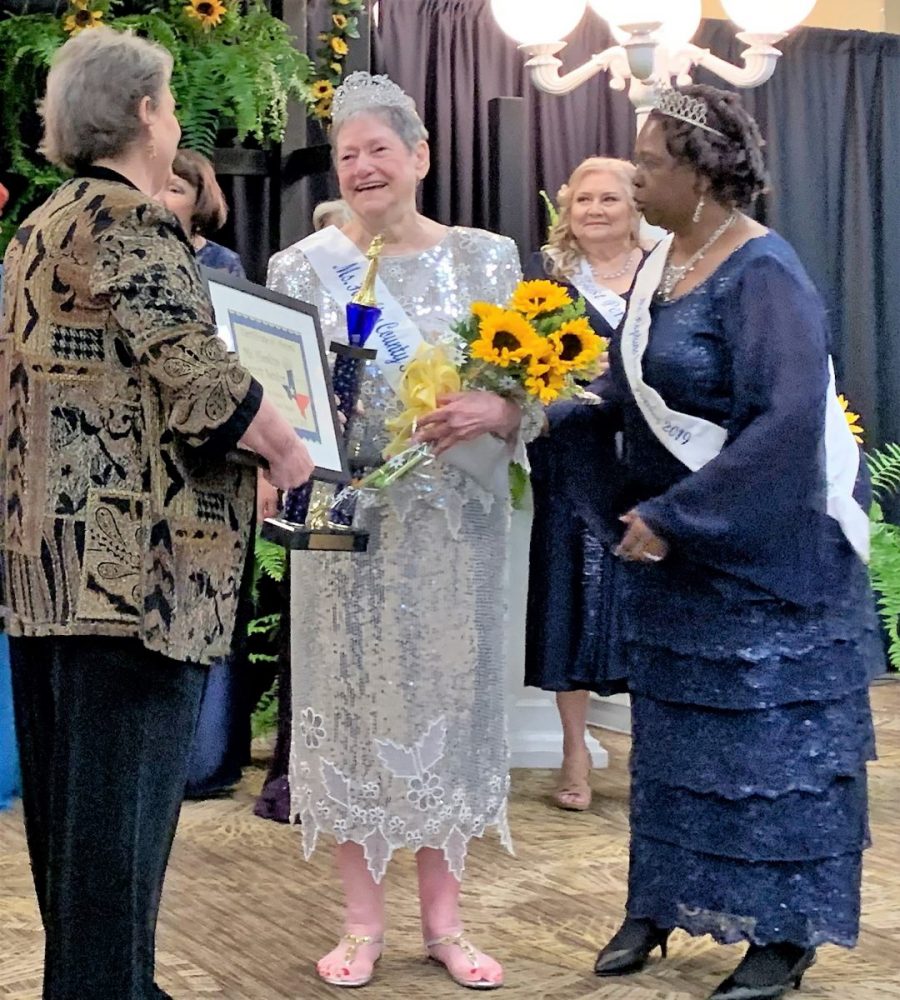
2021 ‘Queen’ Wilma Thompson assumes her title with a smile, crown, sash, bouquet, trophy and framed certificate
L. to R. Valerie Ross, Wilma Thompson, Stella Bagley and Sharon Baker

A woman has never been elected mayor of New York City. Will one of these women change that? – USA TODAY

NEW YORK – New York City has had 109 mayors. Not one has been a woman. But that may change in the coming election for City Hall.

In a mayoral race centering on policing, public safety and New York’s recovery from the COVID-19 pandemic, the possibility of the first female mayor has only grown as the race narrows.

Three women running are major Democratic candidates in the June 22 primary, and most observers expect the winner not to face much of a Republican challenge in the general election in November.

Polling in the final weeks of the race has shown two female candidates – Kathryn Garcia and Maya Wiley – surging on the heels of big endorsements and after two men, Eric Adams and Andrew Yang, have been viewed as the front-runners throughout the campaigns.
To be sure, Adams, the Brooklyn Borough President and former NYPD officer who has made public safety his central message, remains the top candidate in most polls. But jostling for the second position recently has included close battles between Garcia, Wiley and Yang.

Whoever wins most voters’ picks as their top choice is not guaranteed a victory as the election will feature ranked choice voting for the first time this year, allowing voters to select their top five candidates.
“If New Yorkers elect their first woman mayor, it would signal that they believe she is the best person in the race to lead the city out of the crises we’re in,” said Ester Fuchs, director of the Urban and Social Policy Program at Columbia University.

New York City mayoral race:What to know about the candidates, issues and why a ‘progressive’ isn’t leading the way

Who are the women running to be New York City mayor?

Women in New York City have had to bear the brunt of the COVID-19 pandemic, raising children while juggling work, serving in front-line health care roles and facing the realities of job losses and economic inequities, said Pascale Bernard, vice president of public affairs and community organizing for the Planned Parenthood of Greater New York Votes PAC.

“So to have a woman leading the city that understands the needs of working moms, that understands the needs of caregivers, whether you’re caring for the generation prior to yours or the generation after you, those are really, really important things,” Bernard said.

Bernard’s organization has endorsed Garcia, who served in Mayor Bill de Blasio’s administration as head of the Sanitation Department. Garcia also won the endorsements of The New York Times and New York Daily News.

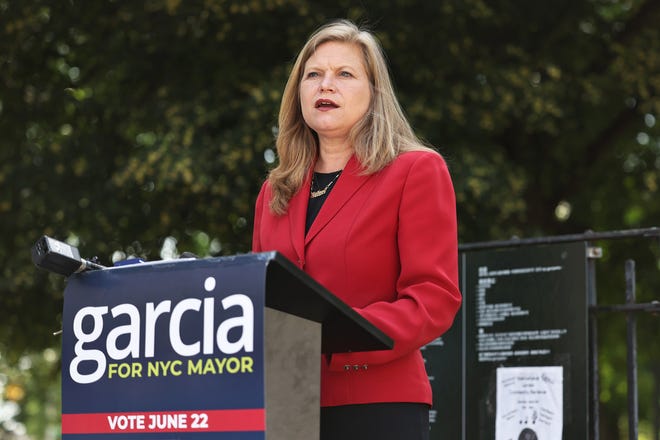
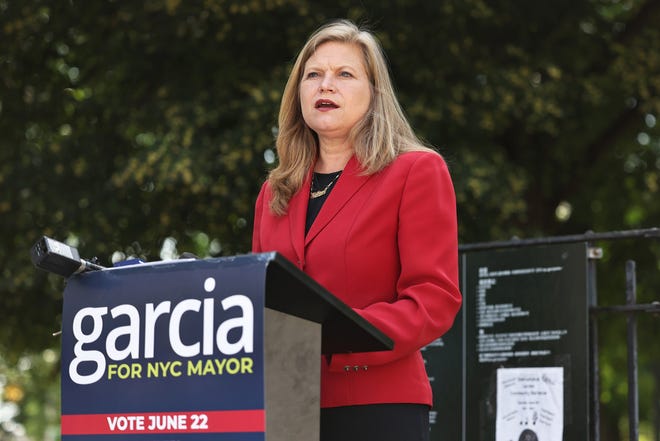
New York City mayoral candidate Kathryn Garcia speaks during a press conference on June 10, 2021 in the Bushwick neighborhood of the Brooklyn borough in New York City.

Her campaign has focused on more moderate polices than the two other women running as Democrats and relied on her crises management experience serving in city government. She’s called for an increase in police in certain areas to combat rising crime and also made climate change a pillar of her campaign.

Bernard touted Garcia’s support for an array of sexual reproductive health issues, including access to abortion, contraceptives and gender affirming care.

Wiley, meanwhile, recently picked up momentum after she won the backing of Rep. Alexandria Ocasio-Cortez, D-N.Y., which came as many other progressives have coalesced around her. EMILY’s List and the National Organization for Women-NYC have also endorsed Wiley.

Maya Wiley’s surge:New York City’s mayoral race is all about police, crime. Will Ocasio-Cortez endorsement give progressives a boost?

“Maya is a trailblazer who has dedicated her career to fighting for racial justice and equity. As a fearless advocate for families and communities of color, Maya is committed to confronting systemic inequalities and helping New York City’s most vulnerable recover from the health and economic ramifications of the COVID-19 pandemic,” Emily Cain, executive director of EMILY’s List, said in an April statement endorsing Wiley.

The lawyer, professor and former MSNBC commentator and member of de Blasio’s administration has called for a number of progressive policy proposals, including investing in public housing, financing a stipend for child and elder care and diverting police funding to schools and mental health and homelessness services.

Democratic New York mayoral candidate Maya Wiley kicks off "Women for Maya" with activist and author Gloria Steinem, left, at the Women's Rights Pioneers Monument in Central Park in new York on May 7, 2021.

Dianne Morales also has run as a progressive, embracing the “defund the police” movement and calling for more taxes on the city’s wealthy. Morales’ campaign, though, has faced a recent setback after her campaign staffers formed a union. Morales said some of their demands would violate campaign finance laws if she fulfilled them.

In the most recent major polls, Wiley and Garcia have placed in the top tier of candidates.

A poll conducted and released last week from PIX11, NewsNation and Emerson College found Wiley jumped to the No. 2 spot with 17% of voters, trailing Adams’ 23%. Garcia with 12% was just behind Yang, who had 15% in third.

A NY1/Ipsos poll conducted May 17-31 and released last Monday had Garcia in third with 15% support. Wiley was in only fifth, though the poll took place before the Ocasio-Cortez endorsement.

Data released from the city’s Campaign Finance Board shows the female candidates have also been among the leaders in the share of their donations coming from small donors.

Of the eight major Democrats, all three women had over 60% of their contributions coming from donors giving less than $175: Morales at nearly 90% and Wiley over 80%. Yang was the only other major Democrat to break 70%. 

More:What will it take to get a Black woman elected governor?

The possible historic firsts in the NYC mayoral race

While women have come close before to winning the mayor’s office, the position has almost exclusively been held by white men. David Dinkins, a Democrat, was the city’s first and only Black mayor, elected in 1989.

Dinkins lost his 1993 re-election bid to Republican Rudy Giuliani, who faced Ruth Messinger, a Democrat, in the general election in 1997.

New York Democratic mayoral candidate Ruth Messinger, left, and her Republican opponent, incumbent Rudy Giuliani, right, prepare for a televised debate at WABC studios in New York Wednesday, Oct. 29, 1997.

Messinger was the first and only woman to have won the Democratic Party’s nomination for New York City mayor. Before her unsuccessful bid, two women, Carol Bellamy running as the Liberal Party’s nominee and Diane McGrath running as the Republican nominee, lost in a landslide to Democrat Ed Koch in 1985.

In 2013, Christine Quinn, the first woman and openly gay city council speaker, was seen as the front-runner for the Democratic nomination, but her election hopes dwindled late in the primary amid de Blasio’s rise and criticism of her ties to Bloomberg, said Fuchs, who worked in Bloomberg’s administration.

In 2017, Republican Nicole Malliotakis, who is now a congresswoman for Staten Island and parts of southern Brooklyn, lost her challenge in the general election to de Blasio.

“The women are better positioned in this race,” Fuchs said.

Yang would be the city’s first Asian-American mayor. Adams, Wiley or McGuire would be the city’s second Black mayor. And Morales, who is Afro Latina, would, like Wiley, be the first woman of color as mayor.

“Knowing that these women candidates are viable, and if they won, it would be a symbolic victory,” said Michael Hendrix, director of state and local policy at the Manhattan Institute.

Washington, D.C., Mayor Muriel Bowser is sworn in to testify at a House Oversight and Reform Committee on March 22, 2021.

If a woman were to win, they’d join the ranks of the roughly 25% of women who are mayors of cities over 30,000 people, according to the Rutgers Center for American Women and Politics.

Tishaura Jones wants to reimagine policing in St. Louis:With rising crime and a push to ‘defund,’ can she do it?

Other prominent female mayors have risen in national profile in recent years, and if a woman were elected mayor of New York City, she could do the same, Hendrix said.

Washington Mayor Muriel Bowser, for example, was seen as a stark opponent of the Trump administration while holding strong support among residents in D.C., he said.

But the mayor of New York City holds a unique place in local American politics, overseeing a budget bigger than some states’ and acting as a spokesperson for the country’s most populous city, Hendrix said.

“By simply winning, (she would) become, of course, one of the most prominent mayors in the country and, by far, one of the most prominent female mayors in the country.”

Follow USA TODAY’s Ryan Miller on Twitter @RyanW_Miller

‘Football needs more Proud Allies’ – Sheffield United’s LGBTQ+ fans group Rainbow Blades launches new campaign – Sports Media LGBT+

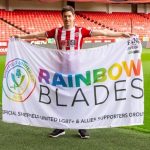
Rainbow Blades have had a big impact at Sheffield United since launching in 2020, with visibility provided by the club, the Premier League, and Sky Sports, as well as support from the FSA and an awards nomination from Football v Homophobia. Now they’re asking for greater allyship in the game, as founder and chair James Laley explains…

By James Laley


James Laley is the founder and chair of Rainbow Blades, Sheffield United’s official LGBTQ+ supporters group.

Rainbow Blades’ vision is total and comprehensive LGBTQ+ equality, diversity and inclusion at Sheffield United FC.

Our mission is to bring the LGBTQ+ communities and allies of Sheffield United together to celebrate the diversity of the club, highlight inclusion, and increase LGBTQ+ visibility – ensuring a safe and inclusive environment for all Blades at a progressive football club.

As Rainbow Blades is now well established having been founded in 2020, and with June being Pride Month, we’re announcing our next venture – the launch of Proud Allies.

It’s an allies campaign that seeks to make a difference not just at Bramall Lane but throughout football as one collective family.

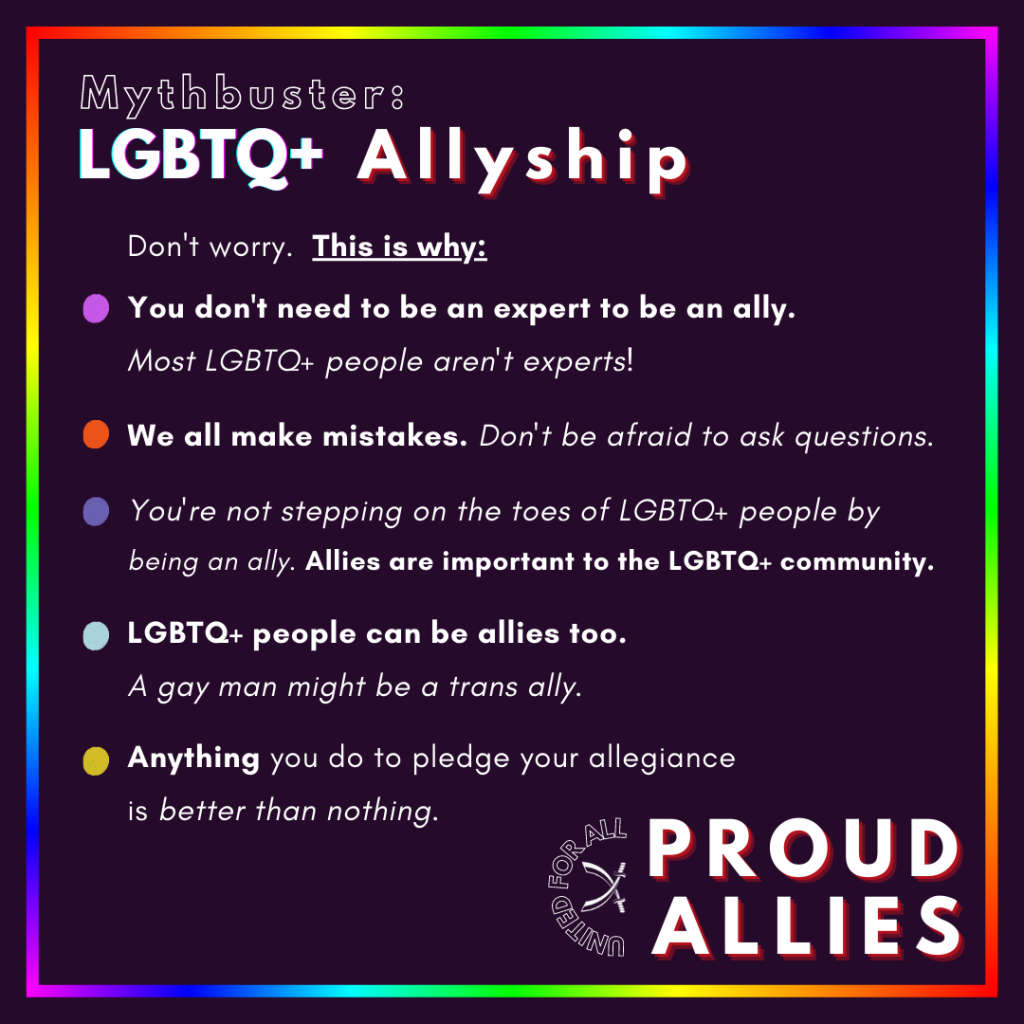
The aim of Proud Allies is to increase awareness of allyship, why it’s needed, and to expand the base of visible allies around our club and beyond.

All new members will receive a digital Rainbow Blades Allyship booklet, and, in addition, campaign pin badges will be on sale through the group’s website, with a £1 donation from every sale going to our charity partner, SAYiT.

We’ve also released a video featuring members and other allies speaking on the topic of allyship, recorded outside Bramall Lane.

Allies of LGBTQ+ people should never underestimate the significant difference they can make to LGBTQ+ people’s lives through positive support. This involves recognising that individuals deserve respect and equality and can be themselves openly and honestly with their friends, colleagues, and family without fear of their reactions.

Our campaign lead, Anna Kent, says: “It’s so important that we work with groups linked with the club, around the city, and beyond to highlight the importance of LGBTQ+ allyship.

“Our voice is so much stronger when we stand together. It’s wonderful that almost half of our Rainbow Blades membership of over 200 people are straight allies. We’d love this to be more than half! Our work will continue until every Sheffield United fan feels confident to be themselves at Bramall Lane.”

One of the things many LGBTQ+ people find most difficult, especially early on in their lives, is the need to keep ‘coming out’, i.e. telling another person, family, friend, colleague, acquaintance etc that they are an LGBTQ+ person. It takes courage and resilience to be so open, especially as others can be less accepting and even actively discouraging.

The growing number of vocal, active allies have helped to transform the experiences of LGBTQ+ people – you should never underestimate what you give to LGBTQ+ people by advocating for us.

Amy Hood is the EMPOWER LGBTQ+ Coordinator at Sheffield United…

The Rainbow Blades Allies Campaign is incredibly powerful and it’s an initiative that has the potential to make a real impact and kickstart change both down at The Lane and in the football community as a whole. The work Rainbow Blades has done over the last year has been unbelievable and the Allies Campaign is just another amazing piece of work they have put together.

Football is all about being for everyone, and having as many Allies on board as possible will ensure football can be reached by everyone – including the LGBT+ community. The Allies campaign will be so influential in raising awareness of how to be inclusive to everyone and give opportunities for every Sheffield United fan to be a part of the family down at Bramall Lane without feeling uncomfortable or excluded.

Amy Hood

The campaign launches on Monday, June 14, and we’ll be actively encouraging as many people and groups as possible to post pledges on social media with our graphic and the hashtag #ProudAlly. We’ll also be launching our Proud Allies film.

This new campaign is another vitally important part of what Rainbow Blades does and what our group is all about. It isn’t just a flash in the pan. We want this to have longevity and to work in tandem with Rainbow Blades. We want to be able to empower and give confidence to all Sheffield United fans to be Proud Allies.

Sheffield United fans are a family and we should all stand together – United for all.

How can people get involved?

Our thanks to James and good luck to all at Rainbow Blades for the campaign!


Sports Media LGBT+ is a network, advocacy, and consultancy group that is helping to build a community of LGBT+ people and allies in sport. We’re also a digital publisher. Learn more about us here.

LGBT+ in sports? Your visibility will inspire other people – sharing your story can be hugely rewarding and you don’t have to be famous to make a positive and lasting impact. We encourage you to start a conversation with us, in confidence, and we’ll provide the best advice on navigating the media as part of your journey so that you retain control of your own narrative.

Email jon@sportsmedialgbt.com or send a message anonymously on our Curious Cat.

Ayushmann Khurrana brings attention to new, more gender-inclusive Pride flag – Devdiscourse

Bollywood star Ayushmann Khurrana, who often uses his films and social media handles to promote inclusivity, on Monday, marked Pride Month by bringing attention to the all-new Pride flag that has been unveiled aiming to make the movement more gender-inclusive. The actor, who portrayed an openly gay man on screen in the movie ‘Shubh Mangal Zyada Saavdhaan’, and is the Celebrity Advocate of UNICEF in India, when asked to elaborate on his choice of the new Pride flag, revealed, “I read about the intent with which the new design of the Pride flag has been unveiled and I wanted to bring attention to this important conversation. The new design by Intersex Equality Rights, UK incorporates intersex people into the movement.”

Speaking about the intersex movement, he further said, “I try and bring focus towards inclusivity as much as possible with my films and social media and I do feel that people need to be aware of the intersex movement. As actors, we are fortunate that we can raise awareness to important issues and I’m trying to do my bit by speaking about Pride month.” The rainbow flag has seen many modifications over the years. It originally was designed by American artist and gay rights activist Gilbert Baker, with the colour variety representing the diversity of the LGBTQ+ community. The flag flew at the San Francisco Gay Freedom Day Parade on June 25, 1978.

According to britannica.com, Baker saw the rainbow as a natural flag from the sky. He chose eight colours, each symbolising something. Hot pink for sex, red for life, orange for healing, yellow for sunlight, green for nature, turquoise for art, indigo for harmony, and violet for spirit. Later, due to production issues, the pink and turquoise stripes were removed while indigo was replaced with blue resulting in the contemporary six-striped flag. It was not until the year 1994 that the flag really became a prominent symbol of the community.

In 2017, the flag incorporated black and brown stripes to include people of colour, under the leadership of American civil rights activist Amber Hikes, Philadelphia’s Office of LGBT Affairs. In 2018, the flag was once again redesigned by Daniel Quasar to include the transgender community. Meanwhile, on the work front, Ayushmann, who made his Bollywood debut with the 2012 film ‘Vicky Donor’, in the past couple of years has delivered a string of hits.

Ayushmann currently has ‘Anek’, ‘Chandigarh Kare Aashiqui’ and ‘Doctor G’ in the pipeline. The actor was last seen in Shoojit Sircar’s ‘Gulabo Sitabo’, alongside megastar Amitabh Bachchan. (ANI)

(This story has not been edited by Devdiscourse staff and is auto-generated from a syndicated feed.)

UK eases curbs on blood donations for gay and bisexual men – Times of India

0

LONDON: Eligibility rules were relaxed across Britain on Monday to allow more gay and bisexual men to donate life-saving blood, platelets, and plasma.
Under the changes, introduced on World Blood Donor Day, individuals will no longer be prevented from donating if they are a man who has sex with other men.
Instead, they will now be asked more tailored questions about their recent sexual behaviour, health, and travel, before an individual infection risk assessment is made.
Those who have had the same sexual partner for the last three months will now be eligible to donate, NHS Blood and Transplant said.
NHSBT chief nurse Ella Poppitt said all donations are screened for evidence of significant infections, to ensure safety.
“All donors will now be asked about sexual behaviours which might have increased their risk of infection, particularly recently acquired infections,” she said.
“This means some donors might not be eligible on the day but maybe in the future.”
Health Secretary Matt Hancock said: “This is a fantastic step forward in making blood donation easier, fairer, and more inclusive.”
The founder of campaign group FreedomToDonate, Ethan Spibey, said the changes had created “one of the world’s most progressive blood donation policies”.
“This is more than just about a fairer and more inclusive system, it’s about those who rely on blood, and giving blood literally saves lives,” he added.
The chief executive of the National AIDS Trust, Deborah Gold, said it meant “more gay and bisexual men can donate blood safely” but it was only a first step.
“We now want to see other exclusionary criteria urgently reviewed so donors are asked questions that successfully identify higher risk, without unnecessarily excluding people or groups,” she added.
The Terrence Higgins Trust, the UK‘s leading HIV and sexual health charity, said the changes were “much-needed” but did not go far enough.
It said the government had retained a “discriminatory question” which would act as a “significant barrier” to getting more black people to give blood.
A three-month deferral period will remain in place for anyone who has “a partner who has, or you think may have been, sexually active in parts of the world where HIV/AIDS is very common”, referencing “most countries in Africa”.
The question has been removed in Scotland and Wales, whose devolved governments set health policy, but not in England, the trust said.
“This barrier to the donation of blood and other blood products will perpetuate the health inequalities faced by black communities, including individuals from these communities who desperately need blood and other blood products,” it added.

Rotherham: We Need a National Commission on Inclusion for Transgender Student Athletes – The 74

TALKING POINTS

Get essential education news and commentary delivered straight to your inbox. Sign up here for The 74’s daily newsletter.

When I was in high school I worked part time at a dry cleaners. One day, a regular customer came in and asked to speak with me privately. He was, he told me, about to undergo a process to change his gender that involved some physical changes and was concerned that because the legalities would not catch up in time, cashiers might not take her checks (checks, this was the 1980s) because she would no longer match their drivers license.

They understandably wanted to smooth things over in advance.

I remember having two reactions. First, at 16, one was certainly, ‘OK, this isn’t a question we get every day around here.’ But I also remember thinking to myself how hard it must have been for this middle-aged person to be trapped in a life they didn’t want. I had a sort of intuitive, now more developed, sense that life is not easy so people should just do whatever makes them happiest.

A few years later, when an old friend married another woman in the early 1990s, it was controversial for all the usual reasons, but I remember being proud of her and not seeing what the big deal was and why it mattered what the state said anyway. Again, just do whatever the hell you want. It wasn’t until the first legal gay wedding I went to, in New York about two decades later, that I realized the power of state sanction. What the state does is a big deal when it comes to inclusion.

That sometimes unavoidable collision between the personal and the state is the crux of the quickly escalating debate about transgender students and sports. In particular, who should be allowed to play women’s sports is becoming a politically charged flashpoint.

Much of the culture war theatrics about transgender issues are a poor fit for education. If you’re not going to call kids what they want to be called, make accommodations to keep them safe, and otherwise respect their basic humanity, education is not the career for you. Most people don’t get that worked up about things like pronouns and in general anti-LGBT sentiment is in no small part generational. To borrow from Dr. King, on LGBT issues over time the arc bends toward inclusion.

But the arc can nonetheless be long and tortured. Especially where politics are concerned. One of former President Trump’s biggest applause lines at the conservative CPAC political gathering earlier this year was about transgender students and women’s sports. That wasn’t a coincidence or off-the-cuff moment. He’s returned to the theme since. It is Trump’s usual blend of hyperbole, tactlessness, and politically potent reading of the public mood. Obviously, this won’t become the one issue where the former president injects nuance and calms the water.

It’s not just Trump raising the issue. California gubernatorial candidate Caitlyn Jenner said recently she’s against letting transgender women play women’s sports. Transgender students and sports are already a common attack line about the Biden administration and House Democratic priorities. An amendment that would withhold federal funds from K-12 schools or colleges that allow a “student whose biological sex is male to participate in an athletic program or activity designated for women or girls” was narrowly defeated during debate on President Biden’s $1.9 trillion COVID relief bill. We’ll be hearing a lot about it between now and November 2022. More than half the states are considering legislation to ban transgender students from women’s sports altogether. Seven states, including sports-focused Florida, have actually enacted bans and in one state, the governor did it by executive action. The courts will have a say about all this as well.

Related

‘It’s So Hard’: As Trans Bans Spread, Experts Weigh How to Balance Fairness and Inclusion in High School Sports

It’s a confused conversation and the public is split. Sure, there is bigotry — any debate about including transgender students in sports that turns on how God created humans is not really about sports at all. And yes, it would be nice if everyone suddenly concerned about women’s sports showed up for the routine athletic slights and second-class status girls and women endure all the time.

Proponents of banning transgender students from sports overstate the prevalence of transgender athletes today. Opponents, meanwhile, at once cheered the Biden administration’s decision to withdraw from an actual pending federal court case brought by four female track athletes in Connecticut while chirping on social media that there is no issue here at all. For both sides it’s a proxy fight about inclusion for transgender people in American life, which is by extension part of a larger culture war. As a result there is more heat than light and what both sides have in common is some indifference to any specifics.

Yet the specifics matter. In practice, there are real complexities here that will land on the doorstep of high schools: the level of youth sports where this is really a substantial public policy issue.

The NCAA has policies for transgender athletes governing collegiate sports and the International Olympic Committee does for Olympic competition. The rules cover issues like testosterone levels and pre-requisites for participating in women’s sports. These policies are not without reasonable criticism and unsettled science, but they are legitimate efforts to balance fairness with inclusion. Some of the legislation, including the federal amendment, would supersede these policies.

Youth and school sports remain more of a patchwork of rules — or no rules at all. There are some unique aspects of high school sports in terms of mission, inclusion, and adolescent human development. So the Olympic or NCAA models don’t fit high school sports because measures like sitting out for a year are impractical at that level and become de facto exclusion. Likewise, requiring students to take certain medications or undergo medical procedures to participate in high school sports raises a host of ethical concerns. And the issue also affects different sports differently. Archery is probably different than track and field and those sports raise separate issues than, say, ice hockey.

On the extremes, we hear that if someone is transgender then a cost is simply foregoing sports. Or, conversely, that a student who identifies as a transgender student should be able to play any sport they wish and anything less is straight up transphobia. The solution to clearly exclusionary attitudes can’t be a totalizing one that ignores complicated issues that arise where adolescents and competitive and contact sports are concerned. This is the issue for competitive high school sports in general because post-puberty there are physical differences between biologically male and female athletes. It’s also not bigoted to be alert to potential risks to women’s sports, where hard-won gains are still fragile and simply going “co-ed” poses real risks to opportunities for girls.

Complicated, though, doesn’t mean insurmountable for those concerned about balancing inclusivity and opportunity with fairness and safety in sports. In addition to lessons from the NCAA, the Olympics, and other countries there are probably also lessons to be learned from other sports leagues, for instance the Paralympics, about how to balance inclusion with fair and safe play.

All this is why K-12 education and youth sports more generally would be well served by a national commission to bring together stakeholders from across the spectrum of these issues with an eye toward developing model policies to balance inclusion with the realities of high school-level sports. The answer here cannot be a blanket ‘no’ any more than it can be anything goes. Yes, commissions are often a strategy for punting on hard problems. And no, they don’t have a mandate to force adoption of their preferred policies. But sometimes well-designed commissions with genuine mandates to listen, learn, report, and recommend can pave the way for effective policy. And voluntary standards that states or sports leagues could choose to adopt might be exactly the way to lower the altitude from hypotheticals to specifics and build consensus.

Right now there are a lot of conversations, various groups lobbying Congress and the states, and too many people quietly expressing concern about the absolutism characterizing the debate, but not speaking up for fear of retaliation. The writer Andrew Sullivan noted recently, “If you are an opinion writer, you really do have to be a masochist to even want to dabble in [this] debate.” The increasingly strident rhetoric is not leading to reasonableness or detente but rather just spinning each side up even more. It is, of course and not coincidentally, a fundraising juggernaut.

Related

Idaho’s Ban on Transgender Girls in Sports a Big Win for the Powerhouse Law Firm Suing Schools to Enact Bathroom Bills

That’s the way in our polarized times where every contested issue turns into a social media-fueled toxic centrifuge of weaponized animosity for each “side.” It works for political consultants or activists looking to “mobilize the base” or raise money, but rarely for well-intentioned people trying to sort through complicated issues. For instance, when Florida’s legislature recently passed a ban on transgender students playing sports the bill was wildly mischaracterized by advocates and subsequently in the media. Sensational headlines claimed the bill would “allow schools to subject minors to genital inspections.” The bill, now law, has real problems in my estimation, but you probably won’t be surprised to learn that’s not exactly how it would work.

I’m not a masochist, I’m an optimist. I don’t have a model policy up my sleeve but believe that collaboratively we can do better.

We should proceed from the base assumption that getting as many kids involved in sports as possible is a good thing in terms of overall wellness, healthy lifestyles and skills like an ability to work with others. Most people agree we need a far broader culture of inclusion in sports than we have today — for all young people, too many of whom are excluded from sports for various reasons ranging from how youth and school sports are structured to personal finances and, yes, sometimes anti-LGBT sentiment. If the north star is how to get and keep more kids playing, the other issues can be sorted out.

Sure, a commission sounds like weak soup as a response to what’s quickly becoming another political wildfire. Yet done well it might be just what we need to lower the temperature and put the focus back on what matters for kids rather than Kulturkampf.

Related

Sign up for The 74’s newsletter

Submit a Letter to the Editor

National Commission Needed on Transgender Student Athletes – Report Door

Get essential education news and commentary delivered straight to your inbox. Sign up here for The 74’s daily newsletter.

When I was in high school I worked part time at a dry cleaners. One day, a regular customer came in and asked to speak with me privately. He was, he told me, about to undergo a process to change his gender that involved some physical changes and was concerned that because the legalities would not catch up in time, cashiers might not take her checks (checks, this was the 1980s) because she would no longer match their drivers license.

They understandably wanted to smooth things over in advance.

I remember having two reactions. First, at 16, one was certainly, ‘OK, this isn’t a question we get every day around here.’ But I also remember thinking to myself how hard it must have been for this middle-aged person to be trapped in a life they didn’t want. I had a sort of intuitive, now more developed, sense that life is not easy so people should just do whatever makes them happiest.

A few years later, when an old friend married another woman in the early 1990s, it was controversial for all the usual reasons, but I remember being proud of her and not seeing what the big deal was and why it mattered what the state said anyway. Again, just do whatever the hell you want. It wasn’t until the first legal gay wedding I went to, in New York about two decades later, that I realized the power of state sanction. What the state does is a big deal when it comes to inclusion.

That sometimes unavoidable collision between the personal and the state is the crux of the quickly escalating debate about transgender students and sports. In particular, who should be allowed to play women’s sports is becoming a politically charged flashpoint.

Much of the culture war theatrics about transgender issues are a poor fit for education. If you’re not going to call kids what they want to be called, make accommodations to keep them safe, and otherwise respect their basic humanity, education is not the career for you. Most people don’t get that worked up about things like pronouns and in general anti-LGBT sentiment is in no small part generational. To borrow from Dr. King, on LGBT issues over time the arc bends toward inclusion.

But the arc can nonetheless be long and tortured. Especially where politics are concerned. One of former President Trump’s biggest applause lines at the conservative CPAC political gathering earlier this year was about transgender students and women’s sports. That wasn’t a coincidence or off-the-cuff moment. He’s returned to the theme since. It is Trump’s usual blend of hyperbole, tactlessness, and politically potent reading of the public mood. Obviously, this won’t become the one issue where the former president injects nuance and calms the water.

It’s not just Trump raising the issue. California gubernatorial candidate Caitlyn Jenner said recently she’s against letting transgender women play women’s sports. Transgender students and sports are already a common attack line about the Biden administration and House Democratic priorities. An amendment that would withhold federal funds from K-12 schools or colleges that allow a “student whose biological sex is male to participate in an athletic program or activity designated for women or girls” was narrowly defeated during debate on President Biden’s $1.9 trillion COVID relief bill. We’ll be hearing a lot about it between now and November 2022. More than half the states are considering legislation to ban transgender students from women’s sports altogether. Seven states, including sports-focused Florida, have actually enacted bans and in one state, the governor did it by executive action. The courts will have a say about all this as well.

Related: ‘It’s So Hard’: As Trans Bans Spread, Experts Weigh How to Balance Fairness and Inclusion in High School Sports

It’s a confused conversation and the public is split. Sure, there is bigotry — any debate about including transgender students in sports that turns on how God created humans is not really about sports at all. And yes, it would be nice if everyone suddenly concerned about women’s sports showed up for the routine athletic slights and second-class status girls and women endure all the time.

Proponents of banning transgender students from sports overstate the prevalence of transgender athletes today. Opponents, meanwhile, at once cheered the Biden administration’s decision to withdraw from an actual pending federal court case brought by four female track athletes in Connecticut while chirping on social media that there is no issue here at all. For both sides it’s a proxy fight about inclusion for transgender people in American life, which is by extension part of a larger culture war. As a result there is more heat than light and what both sides have in common is some indifference to any specifics.

Yet the specifics matter. In practice, there are real complexities here that will land on the doorstep of high schools: the level of youth sports where this is really a substantial public policy issue.

The NCAA has policies for transgender athletes governing collegiate sports and the International Olympic Committee does for Olympic competition. The rules cover issues like testosterone levels and pre-requisites for participating in women’s sports. These policies are not without reasonable criticism and unsettled science, but they are legitimate efforts to balance fairness with inclusion. Some of the legislation, including the federal amendment, would supersede these policies.

Youth and school sports remain more of a patchwork of rules — or no rules at all. There are some unique aspects of high school sports in terms of mission, inclusion, and adolescent human development. So the Olympic or NCAA models don’t fit high school sports because measures like sitting out for a year are impractical at that level and become de facto exclusion. Likewise, requiring students to take certain medications or undergo medical procedures to participate in high school sports raises a host of ethical concerns. And the issue also affects different sports differently. Archery is probably different than track and field and those sports raise separate issues than, say, ice hockey.

On the extremes, we hear that if someone is transgender then a cost is simply foregoing sports. Or, conversely, that a student who identifies as a transgender student should be able to play any sport they wish and anything less is straight up transphobia. The solution to clearly exclusionary attitudes can’t be a totalizing one that ignores complicated issues that arise where adolescents and competitive and contact sports are concerned. This is the issue for competitive high school sports in general because post-puberty there are physical differences between biologically male and female athletes. It’s also not bigoted to be alert to potential risks to women’s sports, where hard-won gains are still fragile and simply going “co-ed” poses real risks to opportunities for girls.

Complicated, though, doesn’t mean insurmountable for those concerned about balancing inclusivity and opportunity with fairness and safety in sports. In addition to lessons from the NCAA, the Olympics, and other countries there are probably also lessons to be learned from other sports leagues, for instance the Paralympics, about how to balance inclusion with fair and safe play.

All this is why K-12 education and youth sports more generally would be well served by a national commission to bring together stakeholders from across the spectrum of these issues with an eye toward developing model policies to balance inclusion with the realities of high school-level sports. The answer here cannot be a blanket ‘no’ any more than it can be anything goes. Yes, commissions are often a strategy for punting on hard problems. And no, they don’t have a mandate to force adoption of their preferred policies. But sometimes well-designed commissions with genuine mandates to listen, learn, report, and recommend can pave the way for effective policy. And voluntary standards that states or sports leagues could choose to adopt might be exactly the way to lower the altitude from hypotheticals to specifics and build consensus.

Right now there are a lot of conversations, various groups lobbying Congress and the states, and too many people quietly expressing concern about the absolutism characterizing the debate, but not speaking up for fear of retaliation. The writer Andrew Sullivan noted recently, “If you are an opinion writer, you really do have to be a masochist to even want to dabble in [this] debate.” The increasingly strident rhetoric is not leading to reasonableness or detente but rather just spinning each side up even more. It is, of course and not coincidentally, a fundraising juggernaut.

Related: Idaho’s Ban on Transgender Girls in Sports a Big Win for the Powerhouse Law Firm Suing Schools to Enact Bathroom Bills

That’s the way in our polarized times where every contested issue turns into a social media-fueled toxic centrifuge of weaponized animosity for each “side.” It works for political consultants or activists looking to “mobilize the base” or raise money, but rarely for well-intentioned people trying to sort through complicated issues. For instance, when Florida’s legislature recently passed a ban on transgender students playing sports the bill was wildly mischaracterized by advocates and subsequently in the media. Sensational headlines claimed the bill would “allow schools to subject minors to genital inspections.” The bill, now law, has real problems in my estimation, but you probably won’t be surprised to learn that’s not exactly how it would work.

I’m not a masochist, I’m an optimist. I don’t have a model policy up my sleeve but believe that collaboratively we can do better.

We should proceed from the base assumption that getting as many kids involved in sports as possible is a good thing in terms of overall wellness, healthy lifestyles and skills like an ability to work with others. Most people agree we need a far broader culture of inclusion in sports than we have today — for all young people, too many of whom are excluded from sports for various reasons ranging from how youth and school sports are structured to personal finances and, yes, sometimes anti-LGBT sentiment. If the north star is how to get and keep more kids playing, the other issues can be sorted out.

Sure, a commission sounds like weak soup as a response to what’s quickly becoming another political wildfire. Yet done well it might be just what we need to lower the temperature and put the focus back on what matters for kids rather than Kulturkampf.

Related: Sign up for The 74’s newsletter

Iowa’s HIV infections are decreasing, data shows – Yahoo News

0

Data: Centers for Disease Control and Prevention; Chart: Axios Visuals

Iowa ranks near the top in the nation for its low HIV incidences and for having the “best health outcomes” for people living with HIV, said John Shaw, prevention services manager of The Project with Primary Health Care.

Stay on top of the latest market trends and economic insights with Axios Markets. Subscribe for free

Driving the news: New CDC data shows Iowa is among the top five states in the U.S. for connecting people newly diagnosed with HIV to medical care.

By the numbers: Our total HIV diagnoses and estimated incidences reduced by nearly 30% between 2015-19, according to the CDC.

What’s helping: Over the last five years, there’s been a strategic change in how the U.S. should stop the spread of HIV — mainly through medicine, Shaw said.

  • In 2018, a federal task force urged doctors to prescribe PrEP — a medicine that prevents HIV from sex or drug use — to high-risk communities. The recommendation also opened access to the drug by categorizing it as “preventative” under insurance plans.

  • In 2019, former President Trump announced plans to “end America’s epidemic of HIV” by getting everyone with it on TasP — medicine that prevents the sexual transmission of HIV.

And in Iowa, health officials have pushed to better connect higher-risk people, like gay/bi men and Black and Latino communities, to tests and drug treatment.

  • Plus: People in rural areas who want PrEP or an HIV test can call in and have either sent to them, Shaw said.

Yes, but: 13 people in Polk County were diagnosed with HIV the last two weeks of May — an unusually high number, said county Health Department spokesperson Nola Aigner Davis.

The big picture: It was only 40 years ago the AIDS epidemic gripped our country, disproportionately harming marginalized communities.

Learn more how you can get free STD/STI testing here.

Like this article? Get more from Axios and subscribe to Axios Markets for free.

The pandemic hit LGBTQ youth hard. Many turned to TikTok – San Francisco Chronicle

0

Even before COVID-19 canceled San Francisco’s iconic Pride Parade for the second straight year, gay teen Steven Sutton was finding celebration and solidarity online.

On his TikTok account, between videos celebrating gay love and trolling Millennials, the 15-year-old San Mateo high schooler posts raw, vulnerable updates about his daily life and challenges. While Sutton is out to his family, he said he feels most comfortable among fellow queer Gen Zers, whom he perceives to be “the most mature and kindest.”

“To be out and gay at a young age requires a lot of introspection and maturity,” Sutton, a rising junior at Design Tech High School in Redwood City, told The Chronicle. “Never once on TikTok have I been told that my emotions are not valid. I get told that all the time in real life.”

Especially during the pandemic, TikTok — and the queer internet at large — have been lifelines for LGBTQ youth experiencing the most isolating effects of lockdown, according to research published last fall in the Journal of Adolescent Health and a more recent survey by the Trevor Project, which offers crisis services to LGBTQ youth.

According to the analyses, societal lockdowns and social distancing had more pronounced mental health effects on LGBTQ youth, who are more likely to reside in unsupportive home environments and seek out identity-based resources. According to the Trevor Project survey, 42% of LGBTQ respondents in the U.S. considered suicide in the past year, including more than half of transgender and nonbinary youth.

Even with the end of the pandemic in sight, experts say the psychological fallout — and the need for virtual safe spaces — will linger.

Samson Stebbins, 16, films his San Mateo neighbor and friend Steven Sutton, 15, for a TikTok video. Steven, who is gay and has a TikTok series, says he finds affirmation from his TikTok followers that he doesn't always receive in real life.

Samson Stebbins, 16, films his San Mateo neighbor and friend Steven Sutton, 15, for a TikTok video. Steven, who is gay and has a TikTok series, says he finds affirmation from his TikTok followers that he doesn’t always receive in real life.

Yalonda M. James/The Chronicle

“A lot of LGBTQ youth were living in situations where they weren’t able to be themselves, or their pronouns weren’t affirmed by the people they lived with,” said Amy Green, vice president of research at the Trevor Project. “It gives new meaning to the need for safe online spaces for LGBTQ youth who otherwise may have been isolated in places that were unaccepting.”

Indeed, as the world went virtual, many LGBTQ Gen Zers went looking for alternative support systems online, particularly on TikTok.

The social video app has exploded to 689 million active global users in less than five years of existence (and more than 1.2 billion if counting TikTok’s differently named iteration in China, which is owned by the same parent company). While the service became a popular quarantine hobby over the past 15 months, it has, according to online publication GayTimes, “transformed into a place of education and self-discovery helping to reclaim the queer experience online.”

That’s certainly what it felt like to Cas Davis. The 19-year-old genderqueer lesbian from Fairfield is better known to their 56,800 TikTok followers as @uppercasman, where they post everything from comedy sketches to “frog lesbian” content to guitar songs performed in drag.

Davis experienced loneliness in the early months of lockdown, they said, because while they’d found acceptance in their college theater program, their family didn’t know they were trans. Their experience wasn’t unique: Trevor Project’s data showed that over the pandemic, only 1 in 3 LGBTQ youth found their homes to be LGBTQ-affirming.

“I was pretty depressed at the start of the pandemic,” Davis told The Chronicle. “It was just me, myself and I.”

Cas Davis records original music at home in Fairfield. Like many LGBTQ youth, Davis found their community online when pandemic lockdown cut them off from their peers.

Cas Davis records original music at home in Fairfield. Like many LGBTQ youth, Davis found their community online when pandemic lockdown cut them off from their peers.

Brittany Hosea-Small/Special to The Chronicle

Eventually Davis turned to TikTok, where they cultivated a highly alternative feed, experimented with pronouns and received constant affirmation from their followers, all of which created the perfect conditions for a pandemic metamorphosis.

“TikTok knows who you are,” Davis joked, adding that their online friends were the first to adopt their nonbinary pronouns. “Queer TikTok is massively unique, very colorful, one of the most expressive online communities I’ve ever seen. I met a lot of wonderful mutuals. We give each other nice comments, it’s just great.”

Not all queer youth find immediate community online, however.

Anu, a 20-year-old nonbinary person from the Bay Area, said that they initially felt “invalidated” because many of the service’s inside jokes and trends — even those as seemingly benign as cuffing one’s jeans, drinking iced oat milk coffees and wearing androgynous fashion — centered on queer white people.

“At first the algorithms didn’t realize I was brown,” said Anu, who is of South Asian descent. “It was all white gays. I thought, ‘I can’t be androgynous like that, my face and body looks different, none of this represents me.’”

Anu knew they were queer since age 13, but isn’t out to their parents. In 2019, Anu experienced a transformative freshman fall at UC Berkeley, coming out to supportive roommates within the first two weeks. They also experienced an affirming role reversal when they became the first person another student came out to.

Less than seven months later, the coronavirus forced Anu back to their childhood home. The experience effectively re-closeted them. (The Chronicle has agreed to withhold Anu’s last name.)

“I’ve never had a dating experience, and was looking forward to that in college. It’s been a setback,” Anu said. “There’s no blueprint; I’m figuring this all out on my own. I feel like I’m not growing. It’s the feeling of not being able to move forward.”

Anu’s pandemic experience isn’t uncommon — and it occurred at an important developmental period for LGBTQ youth, said Green of the Trevor Project.

“Part of that process is being able to talk about it with others,” Green explained. In the absence of real-life interactions, she added, “Online becomes the forum through which youth are able to understand and express themselves, or for those who have formed their identities to find support from others to be themselves.”

Anu said their digital feeds are slowly diversifying, with more creators of color and discourse about South Asian queerness. They also discovered empowerment in online political advocacy.

On Instagram, Anu said they’ve educated themselves and others on issues that aren’t solely related to queerness, like climate change and tech policy. In doing so, they’ve tapped into a network of justice-oriented young people who validate their passions and identity.

“I’m learning about how climate policy is directly connected to the liberation of people in the global South and their queer identities,” Anu explained. “I love talking about it online and people are always responding and DMing me, like, ‘This really resonated with me!’ I feel quite bold and willing to share myself, because I meet other people who feel similarly.”

But they’re also looking forward to getting back to their peers “irl.” That’s set to happen in August, when in-person classes are scheduled to resume at UC Berkeley. Anu already knows who their roommate will be — the same friend who came out to them in freshman year.

Malavika Kannan is a San Francisco Chronicle staff writer. Email: malavika.kannan@sfchronicle.com Twitter: @malavikawrites