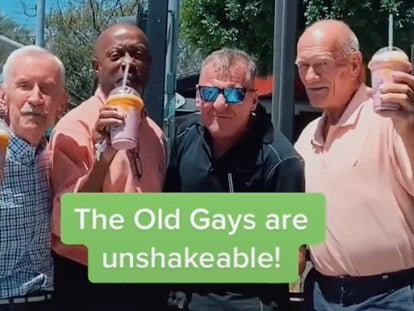
A group called “Old Gays” put together the sweetest video as an ad for Shake Shack’s new Pride shake, and their fans are loving it.
“When I was growing up, my father was always trying to out me. Well, here I am,” the video opens. “Free, proud, and gay as be.”
“Omg I am crying,” wrote one user after watching the ad. “This is so beautful thank y’all for sharing!”
(tiktok)
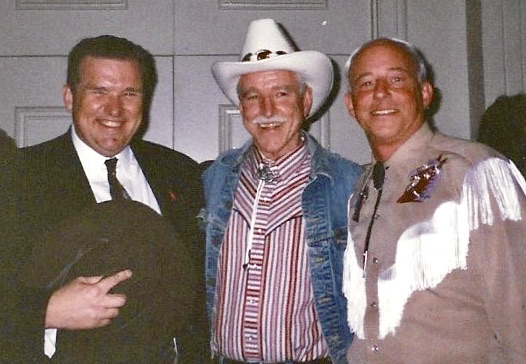
The ad is for the June special shakes, and features the four men, all betwen 50 and 80, talking about coming out.
The TikTok shows old photos of the Old Gays’ parents, as well as themselves in their youth. They tell stories about being nervous to come out – but ultimately encouraged and celebrated by their parents.
(tiktok)
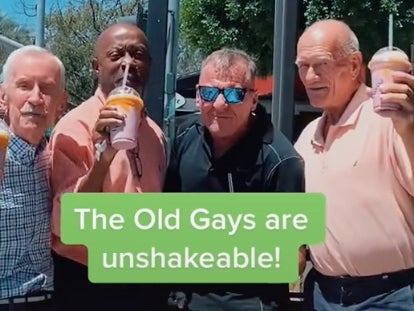
It ends with the four men enjoying their shakes while declaring themselves “unshakeable.” They also note that proceeds of the summer treat will be donated to the Trevor Project.
“Y’all give me so much hope,” one user wrote on the ad.
(tiktok)
The TikTok group has gained a huge following for their tales of being old and gay, leading to the Shake Shack partnership. Fans are leaving comments expressing gratitude for their shared stories.
“Me crying with y’all,” wrote user Monica.
“Y’all all looked so good as teens omg,” wrote Jasmine Wallace.
In a press release, Idris Stover, Shake Shack’s director of Diversiy, Equity, and Inclusion, said “Shake Shack seeks to support and create safe spaces for LGBTQ+ employees and communities at a time when hatred against marginalized groups continues to escalate in this country.”
“This past year was challenging, but we want everyone to know that we’re here and ready to bring the energy, love and iconic shakes back for Pride this year,” the press release says.
The ad is for the June special shakes, and features the four men, all betwen 50 and 80, talking about coming out.
The TikTok shows old photos of the Old Gays’ parents, as well as themselves in their youth. They tell stories about being nervous to come out – but ultimately encouraged and celebrated by their parents.
It ends with the four men enjoying their shakes while declaring themselves “unshakeable.” They also note that proceeds of the summer treat will be donated to the Trevor Project.
“Y’all give me so much hope,” one user wrote on the ad.
The TikTok group has gained a huge following for their tales of being old and gay, leading to the Shake Shack partnership. Fans are leaving comments expressing gratitude for their shared stories.
“Me crying with y’all,” wrote user Monica.
“Y’all all looked so good as teens omg,” wrote Jasmine Wallace.
In a press release, Idris Stover, Shake Shack’s director of Diversiy, Equity, and Inclusion, said “Shake Shack seeks to support and create safe spaces for LGBTQ+ employees and communities at a time when hatred against marginalized groups continues to escalate in this country.”
“This past year was challenging, but we want everyone to know that we’re here and ready to bring the energy, love and iconic shakes back for Pride this year,” the press release says.
Bruins have helped shape national policy, led research into HIV and also helped make campus a more welcoming environment
UCLA
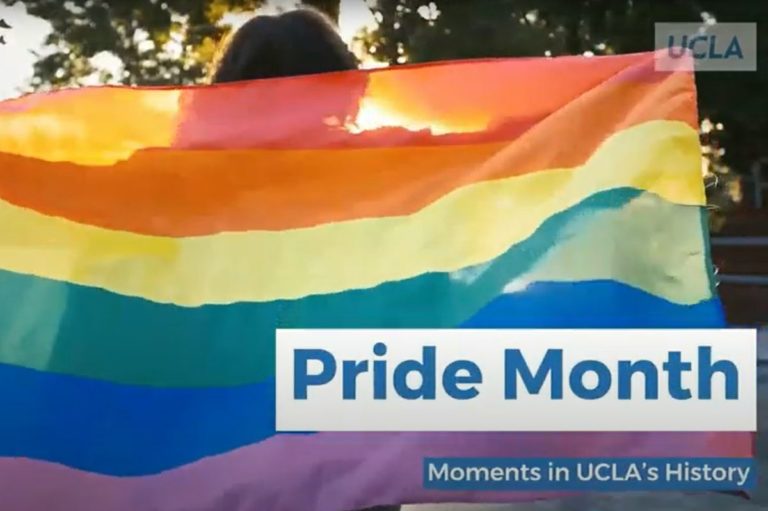
As part of its 25th anniversary, the UCLA LGBTQ Campus Resource Center created a timeline of important events in the campus’s queer and trans history. Center interns Mika Baumgardner and Arlene Reynolds worked on this project with Al Aubin and Kaya Foster, who are both part of the Lambda Alumni Association. The timeline celebrates moments that show how much things have changed for the LGBTQ community at UCLA and how people at UCLA have shaped history.
UCLA Broadcast Studio
Among the highlights:
In 1950, Dr. Elmer Belt, urologist and first dean of UCLA Medical School, performed some of the first gender-reassignment surgeries in the United States.
In 1954, UCLA psychologist Evelyn Hooker began publicly presenting her research showing that there is no detectable difference in the psychological health of homosexual and heterosexual men. Hooker’s research is considered to be the foundation for homosexuality eventually being removed from the Diagnostic and Statistical Manual of Mental Disorders.
In 1979, a gay film festival was held at UCLA, organized by John Ramirez and Stuart Timmons. This grew to become the OutFest Film Festival. TenPercent — the first college-funded, LGBT-focused magazine — is published by UCLA students.
In 1991, Alice Hom and Luis Balmaseda are the first winners of the Lambda Alumni scholarship. Curt Shepard proposes the formation of an LGB Center. Adam Stuart (née Ross) became the first gay student to be nominated for homecoming court. Steven Gonzales became the first openly gay person to be successfully elected to UCLA Undergradaute Student Association Council.
In 2014, UCLA hosted the first Pride Admit Weekend, the first and only yield event for LGBTQ+ admitted first-year students. Univeristy of California President Janet Napolitano announced a systemwide push to increase the number of all-gender restrooms. At the time, UCLA had nearly 50 such facilities, all single-stall. Since then, UCLA has been converting all existing single-stall restrooms into all-gender restrooms and now has more than 250 on campus.
By Karen Ocamb | LOS ANGELES – Before the CDC’s first report on AIDS, there was news from the New York Native, a biweekly gay newspaper published in New York City from December 1980 until January 13, 1997. It was the only gay paper in the City during the early part of the AIDS epidemic and it pioneered reporting on AIDS.
On May 18, 1981, the newspaper’s medical writer Lawrence D. Mass wrote an article entitled “Disease Rumors Largely Unfounded,” based on information from the Centers for Disease Control and Prevention scotching rumors of a “gay cancer.”
“Last week there were rumors that an exotic new disease had hit the gay community in New York. Here are the facts. From the New York City Department of Health, Dr. Steve Phillips explained that the rumors are for the most part unfounded. Each year, approximately 12 to 24 cases of infection with a protozoa-like organism, Pneumocystis carinii, are reported in New York City area. The organism is not exotic; in fact, it’s ubiquitous. But most of us have a natural or easily acquired immunity,” Mass wrote. He added: “Regarding the inference that a slew of recent victims have been gay men. . . . Of the 11 cases . . . only five or six have been gay.”
Gottlieb’s CDC report was picked up that same day by the Los Angeles Times, which published a story entitled ”Outbreaks of Pneumonia Among Gay Males Studied.” A slew of similar reports followed and on June 8 the CDC set up the Task Force on Kaposi’s Sarcoma and Opportunistic Infections to figure out how to identify and define cases for national surveillance. On July 3, the CDC published another MMWR on pneumocystis carinii pneumonia (PCP) and Kaposi’s Sarcoma (KS) among 26 identified gay men in California and New York. The New York Times’ story that day — “Rare Cancer Seen in 41 Homosexuals” – stamped the disease as the “gay cancer.” GRID (Gay-Related Immune Deficiency) came next. In the new Reagan/Bush Administration, dominated by homophobic evangelical advisors such as Gary Bauer, funding to investigate the new disease was scarce.
Two years later, the New York Times finally put AIDS on the front page, below the fold, with a May 25,1983 headline that read: “HEALTH CHIEF CALLS AIDS BATTLE ‘NO. 1 PRIORITY.’” By then 1,450 cases of AIDS had been reported, with 558 AIDS deaths in the United States; 71 percent of the cases were among gay and bisexual men; 17 percent were injection drug users; 5 percent were Haitian immigrants; 1 percent accounted for people with hemophilia; and 6 percent were unidentified.
But Health and Human Services Assistant Secretary Dr. Edward N. Brandt Jr. told reporters that no supplemental budget request had been made to Congress. ”We have seen no evidence that [AIDS] is breaking out from the originally defined high-risk groups. I personally do not think there is any reason for panic among the general population,” he said.
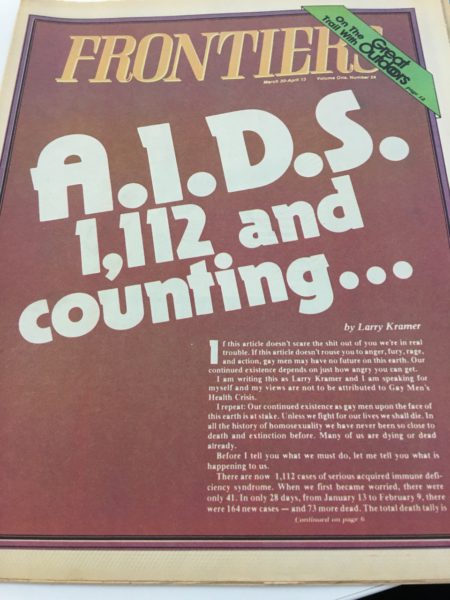
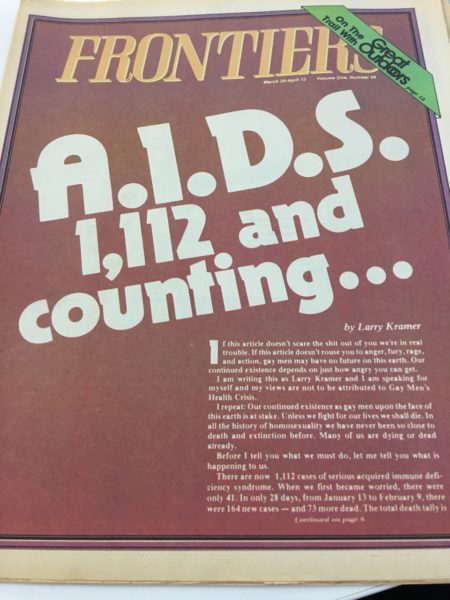
Frontiers Magazine Cover Story by Larry Kramer (Photo Credit: Karen Ocamb)
Gays in denial seemed to accept feigned governmental concern. Others were deathly afraid. The HHS news conference was just 10 weeks – and 338 more cases – after the March 14 publication of playwright Larry Kramer’s infamous screed on the cover of the New York Native: “1,112 and Counting…”
“If this article doesn’t scare the shit out of you, we’re in real trouble. If this article doesn’t rouse you to anger, fury, rage, and action, gay men may have no future on this earth. Our continued existence depends on just how angry you can get,” Kramer wrote. “I repeat: Our continued existence as gay men upon the face of this earth is at stake. Unless we fight for our lives, we shall die. In all the history of homosexuality we have never before been so close to death and extinction. Many of us are dying or already dead.”
Too many gay men were not scared shitless. When LA gay Frontiers News Magazine re-published Kramer’s article as their March 30 cover story, bar owners threw the publication out, lest it unnerve patrons. Meanwhile, gay men wasted away and died, often alone, sometimes stranded on a gurney in a hospital hallway; sometimes – if lucky – with family or friends crying at their bedside as in the intimate photo taken by Therese Frare as her friend AIDS activist David Kirby died.
None of this was new or startling to Gottlieb or fellow AIDS researcher and co-author, Dr. Joel Weisman.
Gay San Francisco Chronicle reporter Randy Shilts dubbed Weisman “the dean of Southern California gay doctors” in his AIDS opus, “And the Band Played On.” In 1978, as a general practitioner in a North Hollywood medical group, Weisman treated a number of patients with strange diseases, including a gay man in his 30s who presented with an old Mediterranean man’s cancer, Kaposi’s sarcoma.
In 1980, Weisman opened his own Sherman Oaks practice with Dr. Eugene Rogolsky and identified three seriously ill gay patients with strange fevers, dramatic weight loss from persistent diarrhea, odd rashes, and swollen lymph nodes, all seemingly related to their immune systems. He sent two of those patients to Gottlieb, a young UCLA Medical Center immunologist studying a gay male patient with pneumocystis pneumonia and other similar mysterious symptoms, including fungal infections and low white blood cell counts.
“On top of these two cases,” Shilts wrote, “’another 20 men had appeared at Weisman’s office that year with strange abnormalities of their lymph nodes,’ the very condition that had triggered the spiral of ailments besetting Weisman and Rogolsky’s other two, very sick patients.”
LGBTQ activist David Mixner, former U.S. Ambassador Jim Hormel, Dr. Joel Weisman at an amfAR event (Photo by Karen Ocamb)
Weisman later recalled to the Washington Post that “what this represented was the tip of the iceberg. My sense was that these people were sick and we had a lot of people that were potentially right behind them.”
There were other missed signs, such as the CDC getting increasing requests for pentamidine, used to treat pneumocystis pneumonia. Gottlieb says that after his first report, the CDC’s Sandra Ford confirmed that she was sending increasing shipments of Pentamidine around the country. “But I’m not sure any infectious disease doctor there knew or investigated why they were seeing a run on pentamidine or asked what that meant,” Gottlieb told the Los Angeles Blade. Later pentamidine became “the second line therapy for pneumocystis,” after Bactrim.
Pentamidine “caused kidney problems, so we didn’t like it. Eventually, aerosolized Pentamidine became one of the preventatives. We didn’t realize at first that pneumocystis would happen in multiple episodes. Like a patient would have pneumocystis, we treated, it would clear and they’d go home for a month and then they’d get it again. We didn’t learn until later that we had to do something to prevent recurrences. And that’s where aerosolized Pentamidine came in doing a monthly breathing treatment.”
But Randy’s race was not included in that first report, nor was the omission caught by the MMWR editors, probably, Gottlieb speculates, because they were focused on collecting disease data while they struggled to save their dying patients. Gottlieb views the absence of race “as an omission and as an error” because demographic data is “good form as a doctor because it is important.” If race was not included in the MMWR, it was an unconscious omission.”
Karen Ocamb is the Director of Media Relations for Public Justice, a national nonprofit legal organization that advocates and litigates in the public interest.
The former News Editor of the Los Angeles Blade, Ocamb is a longtime chronicler of the lives of the LGBTQ community in Southern California.
Editor’s note; The photo of a dying David Kirby in Ohio in 1990 by photographer Therese Fare was labeled by LIFE Magazine as the photo that changed the face of AIDS. To read the story and to see a gallery of addition photos visit here; (LINK)
This is Part 2 of a series on AIDS @40. Part 3 looks at Rep. Henry Waxman’s congressional hearing in LA and the creation of AIDS Project Los Angeles.
When the Wake County chapter of the National Alliance on Mental Illness (NAMI) and the LGBT Center of Raleigh created mental health support groups for LGBTQ people struggling with mental illness, they didn’t expect to garner membership from across the country.
Those virtual spaces not only hosted youth from rural areas normally out of their reach in North Carolina but also young people from Florida, California, and even Canada.
“It was interesting to see how many people were finding this group as something that they wanted,” said Annie Schmidt, executive director of NAMI of Wake County.
Since the dawn of the internet, members of the LGBTQ community have created and used virtual spaces to find community and support. Because the COVID-19 pandemic forced many aspects of life online, digital mental health “safe spaces” have made their mark as a crucial resource.
Like other marginalized groups, the LGBTQ community has been disproportionately affected by the mental toll of the pandemic.
More than 80 percent of LGBTQ youth ages 13-24 surveyed by the Trevor Project, an organization that provides crisis and suicide prevention for LGBTQ youth, said the pandemic made their living situation more stressful. Some 70 percent of those surveyed said they had “poor” mental health during the COVID pandemic.
Schmidt said she reached out to the LGBT Center of Raleigh to see what resources they could provide to help. The LGBT Center identified a gap when it came to LGBTQ youth.
“Our goal is to be supporting the mental health needs of everyone in all communities,” Schmidt said. “And we know that there are a lot of disparities within the LGBT community. A lot of it’s due to trauma and discrimination.”
The result was a virtual mental health peer support group that has met twice a month on Zoom since September 2020. The group is open to people of all ages, but it skews young, said facilitator Peg Morrison, who is also the director of programs at the state chapter of NAMI.
Because the group is peer support, that means that everyone attending, including both of the two facilitators, can raise their hands and say they both struggle with a mental health problem and are a member of the LGBTQ community.
Continuing legacy of virtual LGBTQ spaces
LGBTQ youth have persevered through the pandemic to make spaces where they have community, said Lora Pilcher, youth and family initiative coordinator at the LGBT Center of Raleigh.
Some of the youngest members of the center have created virtual spaces on Discord, a platform that had previously been used predominantly by gamers. There they can chat, watch movies, and even play video games together on a private server that is safe and moderated by the center, Pilcher said.
“Throughout the pandemic they kind of supported each other in everything from socially transitioning, trouble with parents, trouble of coming out or being back in the closet because they’re stuck at home and not an affirming space, to just helping each other with homework,” Pilcher said. “It’s just been a really supportive and affirming space.”
Ash Hiser, a transgender man who founded TransGens—a discussion group for parents and their transgender or gender non-conforming children co-sponsored by the center—when he was in high school, said platforms like Discord helped fill the gap of in-person meet-ups.
“It’s a nice way to make connections outside of the official group setting where you may only see someone once a week or once a month, depending on what events you go to or whatever,” Hiser said.
“In a lot of ways, despite mainstream society, we have found ways to connect with each other to mitigate loneliness,” Przewoznik said.
“My site to mitigate loneliness was not a virtual space,” Przewoznik said. “It was a physical space. It was a brick-and-mortar location known as the gay bar, a place that kind of is going out of existence. But these sort of chat rooms serve similar purposes.”
A hybrid model
“Virtual spaces have been and continue to be incredibly important for LGBTQ+ people in general,” Przewoznik said. “They are spaces where we are able to find comrades who are sharing our lived experiences to some degree. So I see that continuing and growing.”
But the LGBTQ community is not a monolith, they said, and so the pandemic affected different parts of the community in nuanced ways.
Many of the conversations the TransGens group has had are the same as before the pandemic, Hiser said. Virtual living gave some transgender youth who were newly out the opportunity to adjust to living as their authentic selves.
“If someone is newly out,” Hiser said, “they’re able to get more comfortable with their families and with themselves at home without having to also deal with the kids at school and stuff like that. There’s challenges as well, like with some of the learning systems that they use online, it’s hard for people to maybe change their names on there.”
Some support group regulars before the pandemic dropped off when programs transitioned online, Pilcher and Schmidt said, while new members who would not have been able to join the in-person groups due to geographic or transportation reasons have flocked to the programming.
To make the groups more inclusive, NAMI Wake County also provides digital safe spaces for those who may not be able to access their programming at home, so people can access reliable Wifi from inside their cars at various points throughout the county.
Originally, the goal was to transition the NAMI LGBT support groups to in-person at the LGBT Center of Raleigh once the pandemic eased. But because virtual programs have become such a vital resource to people outside of the geographic area, a hybrid model has become the goal.
“We decided to have it virtual with the pandemic,” Schmidt said. “And once we’re both operating programs more in person, our goal is to be able to offer it in person as well but still have a virtual component.”
For some people, K-12 schools are a safe space, Przewoznik said, depending on whether there are supportive adults and also whether students have unsupportive or violent home environments. For others, schools are not a safe space. A 2018 survey by the Human Rights Campaign found only a quarter of LGBTQ youth say they feel safe at school.
In that same vein, while virtual spaces have been revolutionary for some members of the community, others without access to broadband and other resources that would allow them to go on the internet could be excluded.
“We really have to have to invest in centering the most marginalized among us as LGBTQ+ people,” Przewoznik said, “to ensure that folks who do not have access to the sort of level of resources that, let’s say, people like myself have are getting what they need to thrive, and are able to feel in community and are able to feel like they are getting their psychological needs met.”
North Carolina Health News is an independent, non-partisan, not-for-profit, statewide news organization dedicated to covering all things health care in North Carolina. Comment on this story at backtalk@indyweek.com.
MILTON, Massachusetts (WCVB) — A gay married couple in Milton who had been harassed for years has discovered who was behind it all.
LeeMichael McLean says he and his husband, Byron Furze, received countless magazine subscriptions in the mail over a five-year period that were addressed to fictitious, homophobic names. The couple was also footed with the bills for those subscriptions.
“It was upsetting and we didn’t know when it was going to stop, or if it would advance to something more,” McLean said. “And it was an annoyance because I had to follow up on all of them.”
The couple did not have any leads on who was doing this until recently when a Boston Globe subscription card was returned to them. The subscription was for “Michelle Fruitzey,” an offensive play on the couple’s first and last names.
“That was the first time in five years that I had seen the person’s handwriting,” McLean said.
McLean shared a photo of the subscription card on social media and gave it to police. A good Samaritan was able to find a potential match by comparing the handwriting to the signatures of members of the Milton Town Meeting, a local board that the couple belongs to.
This ultimately led police to a neighbor and fellow Town Meeting member, who apparently confessed to the mailings.
“He says hi to me. We’ve had casual conversations,” McLean said. “I spoke with him about a week before that last card came about work that was being done on his house. I was running by his house and stopped to have a chat. Never would have suspected it.”
The suspect, who has not been identified by police, has not been charged at this point but could face criminal harassment charges.
The couple is hoping to turn the bigotry into positivity by selling T-shirts that read “#iammichellefruitzey.” All proceeds are going to the Gay Straight Alliance at Milton High School and Pierce Middle School. The T-shirts have raised more than $15,000 for the GSA so far.
Please note: This content carries a strict local market embargo. If you share the same market as the contributor of this article, you may not use it on any platform.
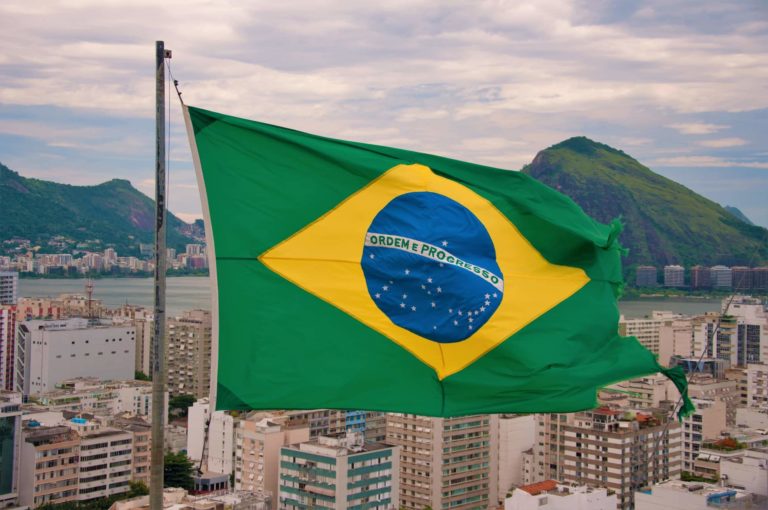
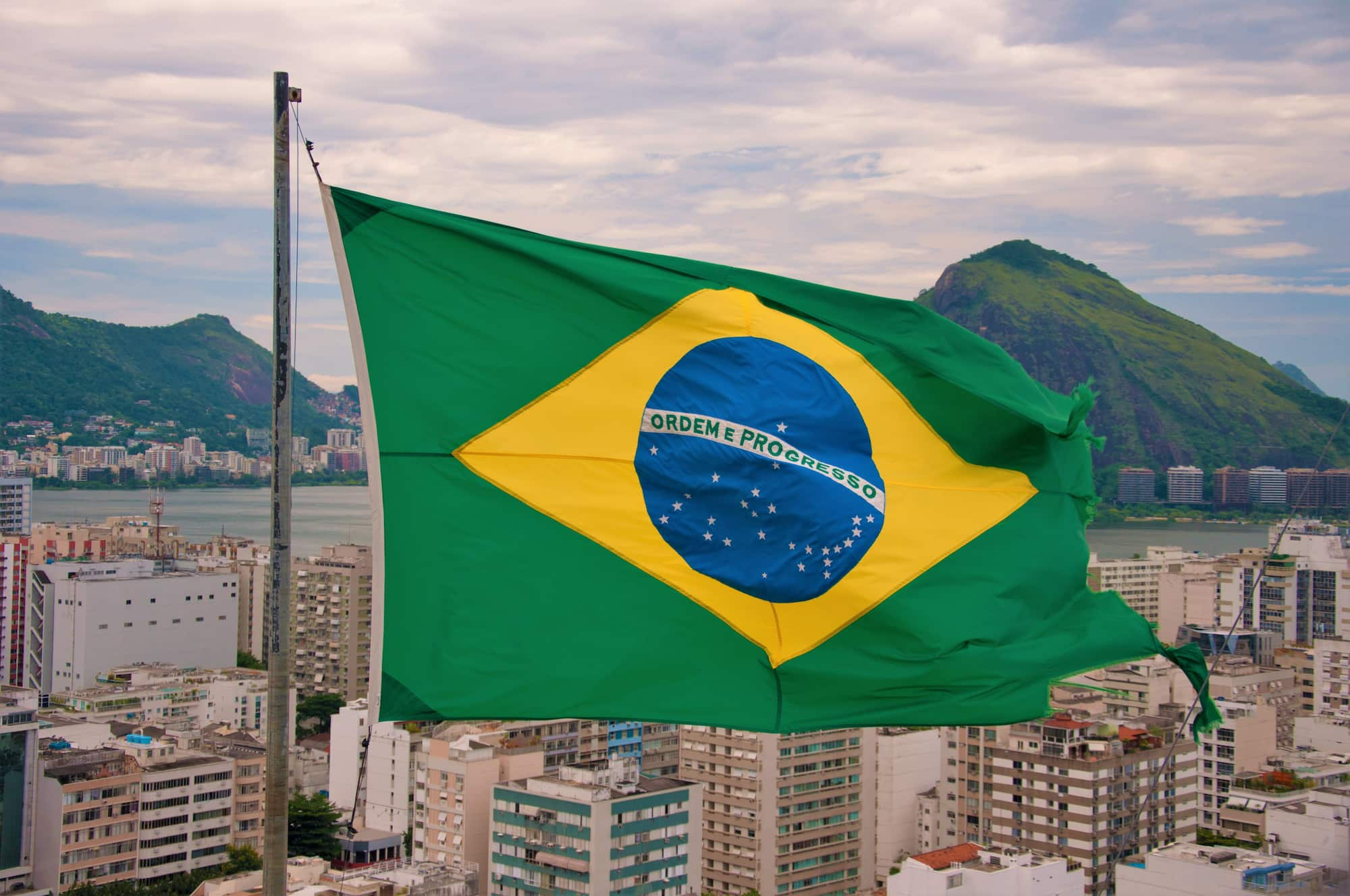
The flag of Brazil — Photo: L.C. Nøttaasen via Flickr
Brazil’s LGBTQ community is speaking out about “worsening” conditions in the country after a gay man was gang-raped and tortured last week.
The 22-year-old man was attacked by three armed men in Florianópolis, a city in southern Brazil, the Guardian reports.
During the attack, the man, whose identity has been withheld, was raped with sharp objects and forced to carve anti-gay slurs into his legs.
After assaulting him, the attackers left the man in the street, where he was found and taken to a local hospital.
Police told The Guardian that an investigation is underway, but no arrests have yet been made. The victim has since been discharged from hospital and is recovering at home.
Lirous Ávila, president of the Association in Defense of Human Rights, told the Guardian that the “frightening crime” was “very common in Brazil, and violence — not only against lesbian, gay, bisexual and transgender people but also women, black people and immigrants — is worsening.”
While LGBTQ people and allies have been horrified at the attack, Ávila said that some have attempted to justify it by pointing to the victim’s sexuality.
“It’s absurd to justify violence that is brutal and barbaric,” she said.
Brazil has taken steps towards improving equality for LGBTQ people — including banning discrimination based on sexuality or gender identity in 2019 — but activists have noted that homophobia and transphobia are rife and on the rise.
Margareth Hernandes, a lawyer and president of the gender law commission, said that anti-LGBTQ violence in Brazil has “grown a lot recently.”
“Brazil is the world champion of LGBT murders,” Hernandes said. “We are a very conservative country where there is still a lot of prejudice. Hate speech ends up propagating violence.”
LGBTQ rights organization Grupo Gay da Bahia recorded 224 LGBTQ murders in 2020, with an additional 13 suicides related to situations of violence.
Anti-LGBTQ crimes often go unpunished, and activists have pointed to Brazil’s far-right leader, President Jair Bolsonaro, for enabling homophobia and transphobia.
“We have a president who compounded this violence,” Ávila said. “It seems that the population feels it has a right to commit these violent acts against the LGBT population, influenced by Bolsonaro.”
Last year, Bolsonaro — who has been compared to Donald Trump both for his mishandling of the COVID-19 pandemic and his far-right brand of populism — allegedly downplayed the need for masks to prevent the spread of the novel coronavirus by using an anti-gay slur, saying, “Masks are for faggots.”
The comments are part of a long-running pattern of anti-LGBTQ statements from the Brazilian president, who was elected in 2018 on a right-wing platform that included opposition to LGBTQ rights.
Last year he accused the World Health organization of encouraging children to masturbate and be gay, in a since-deleted Facebook post in which he said he wouldn’t be following advice from the organization.
Bolsonaro has also made comments to the effect that he’d prefer his son to die in an accident or be a drug addict than be gay, claiming that he does not have a gay child because his children are “well educated.”
He has also expressed support for violence against LGBTQ people, threatening to hit gay men if he saw them kissing, claiming that the presence of gays drives down property values, and suggesting that parents beat sons who act effeminately.
Bolsonaro also opposes allowing same-sex couples to adopt children, but has gone further than most right-wing politicos by accusing LGBTQ people of wanting to recruit children for sex and insisting that gay parents sexually abuse their children.
In a 2013 interview with Stephen Fry, Bolsonaro claimed that “homosexual fundamentalists” were brainwashing children to “satisfy them sexually in the future.”
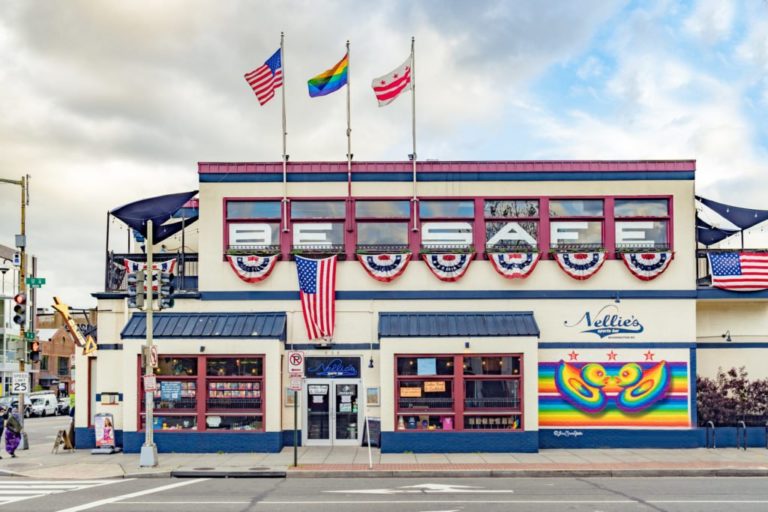
“2020.05.07 DC People and Places, Washington, DC USA 127 13208-Edit,” licensed under CC BY-SA 4.0. Photo courtesy of Ted Eytan on Flickr.
Nellie’s, the venerable U Street gay sports bar, announced on Instagram it will be closed this week following an ugly incident during Pride weekend. Early on Sunday, a video of 22-year-old Keisha Young being dragged down the stairs by security at Nellie’s sparked outrage and a broader conversation about how the bar treats non-white customers.
Nellie’s posted the announcement Monday evening, saying it “has terminated, with immediate effect, the independent security vendor hired” for Pride. The bar will be closed this week, with pay to its non-security employees, to “listen and understand what more we can do to create the safe and friendly atmosphere our guests have come to expect.”
There were protests on Sunday evening outside both the U Street bar and owner Douglas Schantz’s house. Brandon Burrell, who is representing Young, said the family is pursuing a civil claim against Nellie’s and considering filing a police report.
Young started a GoFundMe to raise money for legal fees, medical bills and therapy.
Nellie’s has long had a problem with catering to the Black queer community on U St, it was an issue when I lived there a decade ago. This is so awful and I hope that woman has a strong network around her. https://t.co/srhaWBICtU
There are more cops here protecting the home of Nellies owner than there were at the actual SHOOTING earlier tonight up the street. COPS DO NOT KEEP US SAFE! COPS PROTECT PROPERTY AND THE RULING CLASS! pic.twitter.com/VNBzuBpPIB
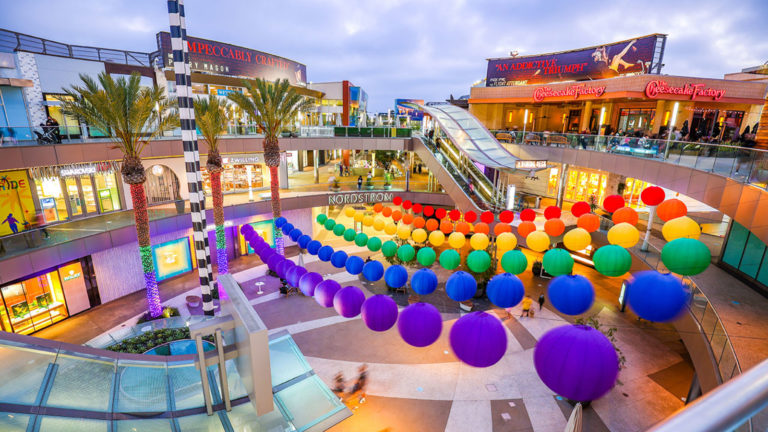
The Santa Monica Pier, Downtown Santa Monica, and Santa Monica Place, in collaboration with the City of Santa Monica and Santa Monica Travel and Tourism are celebrating Pride Month with the “Rainbow Road Art Walk,” on display through June 30, 2021.
Curated in partnership with Allies in Arts, the rainbow-lit art walk exclusively features the creations of LGBTQIA+ visual artists and spans the Third Street Promenade, Santa Monica Place and the Santa Monica Pier.
The art walk is a dynamic collection of murals, photo installations, interactive and multimedia works from over a dozen innovative artists and artist groups local to Southern California.
Featured artists include Annie Hong aka Hootnannie whose piece “Where Will U Take You” will be on display at Santa Monica Place. Recognized by vibrant eye-catching whimsical wordplay, Hootnannie’s work challenges contemporary art narratives and seeks to voice underrepresented perspectives, informed by their experience navigating the world as a queer, gender-nonconforming, first generation Asian American artist.
Very Gay Paint, the beloved painting duo comprised of LA-based comedians Nicholas Scheppard and Jenson Titus will apply their evocative colorplay to the Santa Monica Pier for a “Very Gay Mural.” The pair have made a name for themselves with their signature custom murals of mainly geometric, retro and landscape designs with flowing lines and muted color palettes.
“The Mothers of Pride Pearly Gateway” interactive installation on the Third Street Promenade by gender fluid AfroIndigenous artist Grey… references indigenous ideology that considers queer beings to be sacred gatekeepers between this world and the rest. Visitors will be invited to stand beneath the playful arch, contemplating how spiritual iconography resonates within LGBTQIA+ community and expressing gratitude for the leaders who made Pride possible.
The queer, women of color-owned and operated floral studio in Los Angeles, UnderNewMGMT, in collaboration with ShakesTheArtist, will present “Protest and Pageantry” a 3D multimedia floral installation on the Third Street Promenade. Inspired by trans performers turned activists, this piece is both a celebration of iconic trans POC performers (such as Marsha P. Johnson, Sir Lady Java, Sylvia Rivera) and a tribute to the numerous trans lives lost to violence. Mixing art and florals, UnderNewMGMT utilizes vintage and recycled materials to create sustainable event and floral options.
Spanish-born artist and designer Yaicecream and LA-based illustrator Jeromy Velasco join forces for a collaborative 3D mixed-media installation titled “Chosen Family” on the Third Street Promenade. Depicting a floating dance floor over the Los Angeles skyline, the piece serves to evoke the ways in which chosen families can be an important method of survival and source of support for members of the LGBTQ+ community. The interactive piece encourages viewers to engage with the imagery and take a photo with their chosen family and loved ones.
Additional artists and works include “Queer Bodies / Queer Identities” a black and white photography installation by Katt Foxx; “I Stand With Trans Youth” and “I Love My Queer Family,” and interactive pieces by James Kinsley Daniel in support of trans youth.
“Rainbows of Resilience,” a technicolor, large-scale digital illustration of a Pride parade scene by Parisa Parnian; “Celebrate” by Grey… & Grayson Prnce whose sculpture letters will spell out LGBTQIA+; “The ArtsNotParts Archive” by Grey… which was part of a collective street art movement made in response and defense of the trans community in 2017 following anti-trans legislation enacted by President Trump are included as well.
“Together Forever.” by Erick Luis; “E(we) are all Crazy Beautiful!” featuring artist Ricky Sencion’s “sheep moonsters;” and Chris Classen’s multimedia piece “Love Letters” also make up the Pride installations.
HAUS OF DéVLIN’s colorful multi-textured floral-based installation “Pride-a-Blooma” will be on display inside the Fairmont Hotel on Wilshire Blvd as a visual representation of the joyful energy of Pride.
More gay, bisexual and queer men will be able to donate blood in England and Wales, in a major equality win for the LGBTQ+ community.
Between 2017 and now, men who have sex with men (MSM) could not donate blood without abstaining from oral and anal sex for three months, regardless of whether or not it was in a long-term monogamous relationship.
The rule change, which came into force on World Blood Donor (June 14), means NHS Blood and Transplant will now judge the sexual behaviour of all prospective donors equally and based on risk, rather than gender or sexuality.
Campaign Group Freedom to Donate founder Ethan Spibey said: “It’s genuinely incredible, this is something we’ve been working on for years. This is a fundamental rethinking of how people are assessed on the basis of their individual eligibility.”
Now anyone who has had new or multiple partners in the last three months – excluding oral sex – or who is otherwise high-risk for blood-related disease will be deferred.
Freedom to Donate has fought hard for these changes for over six years, and contributed towards a FAIR (For the Assessment of Individualised Risk) government steering group report, which recommended them.
“That is something that has directly come from a call from the campaign, so to have that as the government policy is massive,” said Spibey.
“There aren’t many wins when it comes to being LGBTQ quite often, but this genuinely feels like a positive step forward for a more inclusive and fairer donation system.”
All I could think of was my Grandad. I made him a promise I’d never, ever stop until I repaid the donor who saved his life
New, fairer and more inclusive rules on blood donation introduced today thanks to tireless campaigning from @FreedomToDonate & others mean I finally did it pic.twitter.com/ZsUoPR5CXP
Spibey, 29, donated blood for the first time in his life on the same day as the rule change, which arrives during Pride Month.
He started campaigning for the change as a university student, following his grandfather Ken’s life-saving operation.
Spibey said: “My grandfather needed about eight pints of blood and my parents’ family hadn’t really donated blood up until that point. Grandad only survived this operation because of those donors, so it was almost a family pact that we’re going to repay that donor.
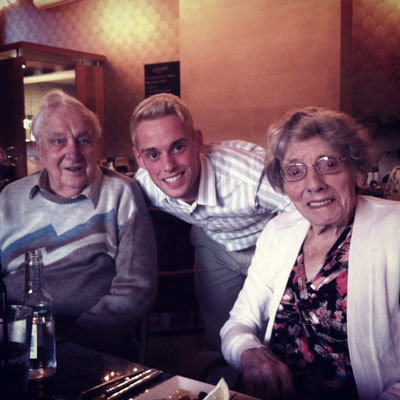
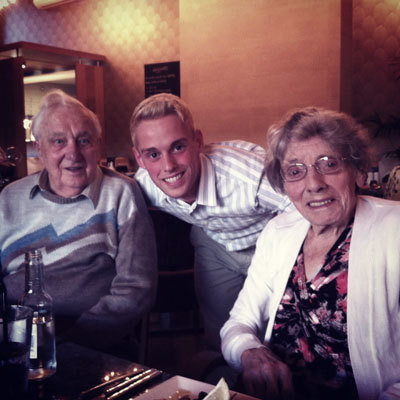
MAKING A PROMISE: Freedom to Donate founder Ethan Spibey standing next to his grandfather Ken (left) who inspired the campaign
“I remember my dad came home with the papers and I looked down the page at this question: ‘have you had sex with a man in the last twelve months?’ and obviously I was essentially excluded from donating blood.
“The double hit at the time was I wasn’t out to my parents so not only did I have to lie about not wanting to donate blood but I couldn’t be honest as to the reasons of why I couldn’t.
“I felt awful because we’d wanted to do something positive and it was one of those moments where you realise as a gay man, there are still things in place that make you feel like you’re not ‘normal’.
“There’s always this question of stigma around HIV, which obviously affects people’s access to health and sexual health services. It’s fair to say, historically, that there was clear prejudice there against people living with or impacted by HIV.”
According to Public Health England data, the proportion of people accessing HIV care, who acquired HIV from sex between men in 2019 was 46.4%, virtually the same as the proportion of people accessing care who acquired HIV through heterosexual sex, at 46.1%.
But although HIV no longer disproportionately affects MSM, MSM and women who had sex with MSM, still faced discriminatory questions about their sex lives in blood donation risk assessment questionnaires.
“It was certainly stigmatising as if we were the only sect of the population that was risky in their sexual promiscuity. We couldn’t be treated as trustworthy to stop others from getting it,” said 27-year-old David Huish.
Huish has not yet attempted to donate blood after his first and final attempt, around seven years ago, put him off.
He said: “I tried to give blood once and I wasn’t aware of the rules and it was really embarrassing because I was there with my mum. She got up to donate and I then sat down and that was kind of when she knew that I might be sexually active because she was like ‘oh I didn’t see you do it’ and I was like ‘yeah the criteria weren’t matching me’. It was meant to be such an altruistic nice thing to do and it was really demonising at the same time.
“Being a blood drive at the time it was like well ‘I’ve got blood, I know I’m safe’, we get free HIV NHS checks, which gay people, I think probably take more because there is more association of that. A lot of my straight friends, for example, don’t get a sexual health check more than once every year or so, whereas I like to do it once every three months just to make sure.
“I’ve never actually given blood and I would like to, so I feel that it’ll be a really nice thing to do.”
Campaigns director at HIV and sexual health charity Terence Higgins Trust, which was also part of the government’s FAIR steering group, Richard Angell, said: “The changes are really important, because for MSM and women who have sex with MSM, it will put behind them an institutionalised stigma that had a real impact on the LGBTQ community and crucially has been based for too long on fear rather than science.
“We have taken down a big boulder in the fight against discrimination and that lazy application of science in the process.”
But despite this victory, Terence Higgins Trust has pledged to continue the fight against rules which defer people with a sexual partner in what the NHS calls “parts of the world where HIV/Aids is very common” and “most countries in Africa,” which Angell claimed is vague and discriminates against Black potential donors.
The rule-change is a far-cry from public health policy at the height of the 1980 AIDS crisis, when a lifelong blood donation ban for MSM was enforced until 2011. It was then replaced by a one-year ban in England, Scotland and Wales.
37-year-old Angell still remembers being rejected from donating blood in 2001 as a teenager, unaware of the ban.
“I remember being, I think, 17 and going to give blood with my old scout hut. I went with a group of friends from school to give blood. In my head I thought it was sort of the equivalent of doing jury service, a good honourable citizenship thing to do. I was young and healthy and wanting to do my bit,” said Angell.
“I sat down in front of the nurse and she says ‘just checked through and if any of these apply you can’t give blood’. It might as well have been highlighted and had flashing lights on it because I saw it said: ‘if you’d had sex with a man ever’. She thankfully, for some reason, got up and left the cubicle and I literally had to sneak out the back.
“I just disappeared and my friends were like: ‘where had you gone?’ I said I had to go home straight away after giving blood. It was pretty bloody awful. It wasn’t my first interaction with homophobia but there was a sense of ‘oh my god, everywhere I turn there is going to be something making this harder’.
“I wasn’t out to my friends at school, that was not an easy conversation and also I didn’t want the health service deciding that I had to have that conversation.
“To have come full circle and it to be a purely scientific and precise set of rules, means that everyone can be confident in the blood supply there won’t be any discrimination in the process.”
Today we’re making a landmark change to the criteria to be a blood donor.
👬 Men who have sex with men in a long-term relationship will be able to donate blood.
— Department of Health and Social Care (@DHSCgovuk) December 14, 2020
A Department of Health and Social Care spokesperson said:“We are committed to making blood donation policy fairer and more inclusive, and the changes to the blood donor selection criteria that will be implemented on 14 June are a step towards this.
“We encourage everyone who is eligible to give blood to register to donate.”
A Beauty and the Beast prequel series following iconic villain Gaston and his bumbling sidekick LeFou has been officially ordered by Disney.
Disney Plus has greenlit an eight-episode limited musical series known by the working title Beauty and the Beast. The series will be a prequel to the 2017 live-action film starring Emma Watson, Dan Stevens, Luke Evans and Josh Gad.
Evans and Gad will reprise their roles as Gaston and LeFou in the new series. No other stars from the film – like Watson and Stevens – are currently attached to the new Disney Plus project.
According to Variety, the show will follow Gaston and LeFou as they set off on an adventure with the sidekick’s step-sister Tilly (Brianna Middleton). As the trio set off on their journey, they encounter “old friends and new enemies”.
LeFou was heralded as a gay character, and director Bill Condon told Attitude that Gaston’s manservant would have an “exclusively gay moment” in the 2017 film. Condon described LeFou as a man who “on one day wants to be Gaston and on another day wants to kiss Gaston”.
But the “gay moment” that Condon was referring to is a blink-and-you’ll-miss-it shot where LeFou dances with a man in the ball sequence just before the credits roll. The film itself doesn’t explicitly confirm that LeFou was gay, though it’s heavily implied that he might have an unrequited crush on Gaston.
Michael Paull, president of Disney Plus and ESPN Plus, told Variety that Beauty and the Beast has “inspired generations of fans around the world”, and the new series will welcome fans new and old to a new chapter in the “tale as old as time”.
“We can’t wait to welcome our guests back to the magical and musical world of Beauty and the Beast for an all-new chapter with LeFou, Gaston and a fantastic new cast of characters,” Paull said.
Gary Marsh, president and chief creative officer of Disney Branded Television, hinted that the show will “finally provide” answers for “anyone who’s ever wondered how a brute like Gaston and a goof like LeFou could have ever become friends and partners”.
It’s not clear if the new series will explore LeFou’s sexuality or his supposed attraction towards Gaston.
Gad revealed in 2019 that the “gay moment” was actually his idea. He said the scene was his “pitch”, and he felt like the dance was how he “wanted the movie to end” for his character.
“We decided LeFou’s happy ending would be to dance with another man, and that became such a controversial thing, apparently, even though it was only three seconds of screen time,” Gad said.
“We never meant to put a spotlight on it.”
Production on the new Beauty and the Beast prequel series will begin in 2022, according to Deadline. It’s not currently known when the series will premiere on Disney Plus.
Community Responds to Anti-Gay Graffiti at Iconic Irish Drag Bar
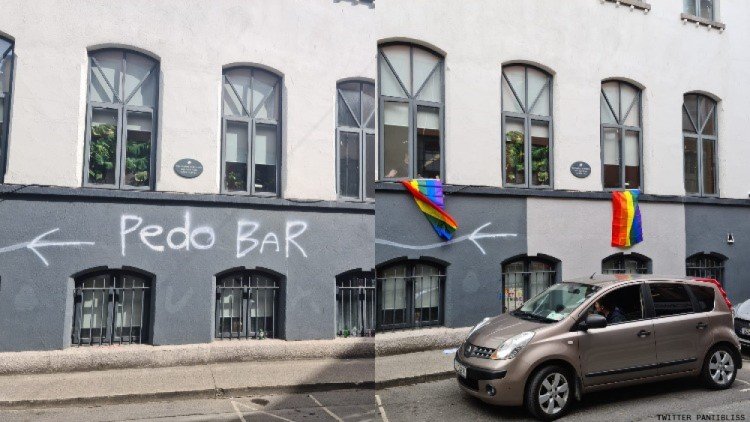
An iconic gay bar in Ireland was the target of homophobic graffiti this week, but the city and community quickly responded to clean away the hate. Vandals spray-painted an anti-gay slur on the building next to the PantiBar in Dublin, with an arrow pointing at the famed drag venue. The club’s owner, Dr. Panti Bliss-Cabrera (a.k.a Rory O’Neill), told the Irish Examiner the act was clearly premeditated and that an investigation is underway. Dublin is currently celebrating Dublin Pride 2021 throughout the month of June.
“It was very clearly planned and premeditated, rather than a spur of the moment thing,” O’Neill explained.
Bliss-Cabrera posted a picture of the vandalism to Twitter which struck the building next to the PantiBar, saying the act had happened “during the night.” The picture showed the spray-painted homophobic slur “pedo bar” along with a large arrow pointing toward PantiBar.
Luckily, Dublin officials were quick to dispatch a cleaning team “straight away” and the graffiti was quickly removed.
In a later post to Twitter, Bliss-Cabrera thanked the team for their rapid response in removing the offensive, homophobic graffiti.
The case has been referred to Gardaí, the Irish national police, for an investigation of criminal damage.
This is the third anti-gay act in Ireland in less than two weeks. Pride flags flown in front of the city and council halls in Waterford were torn down in two separate incidents. The replacement flags were torn down on Saturday, June 12, after the original flags had been torn down and burned on Monday, June 7. The Gardaí arrested an unnamed man in his 40s and charged him with criminal damage for the first incident. It was unclear if he was connected to the second attack on the flag as well.
“A truly despicable act,” Waterford Mayor Damien Geoghegan tweeted.
The multiple incidents against the LGBTQ+ community have taken place as Ireland celebrates Pride this month. Waterford concluded its celebrations last weekend, while Dublin is celebrating Pride online throughout the month. The Dublin Pride Parade and March will take place virtually Saturday, June 26. The city’s celebrations conclude Monday, June 28, to commemorate the anniversary of the Stonewall Riots.
Support the independent voice of Miami and help keep the future of New Times free.
It’s already been a rough enough year for LGBTQ+ people. On the first day of Pride Month, Florida Gov. Ron DeSantis signed Florida’s Fairness in Women’s Sports Act into law. The measure prevents transgender girls from middle school through college in Florida from participating in their school’s sports teams. And anti-trans legislation is nowhere near Florida-specific. Similar laws have passed in Mississippi, South Dakota, and Idaho, potentially paving the way for more states to follow suit.
Sure, same-sex marriage was federally legalized six years ago, but anti-queer and anti-trans sentiments continue to pervade present-day policy. Their presence is overt, stressful, and leaves a lasting impact on communities. The Trevor Project reported this year that 94 percent of the nation’s LGBTQ+ youth say recent politics have a negative impact on their mental health. And, mind you, we’re only halfway through 2021.
Let this serve as a reminder to us all that we observe Pride Month both to reflect and to rejoice. In that spirit, here are eight ways to celebrate your beautiful existence in the face of adversity.
LGBTQ+ Speed Dating at Time Out Market
With many of us still emerging from pandemic-induced cocoons after a year of disconnect, meeting people can feel like a frustratingly new and persistent challenge. Maybe you want something low-stakes. Consider meeting a few people in person at Time Out Market’s LGBTQ+ speed-dating event. If you’re nervous that your social skills have dramatically dulled, have no fear: Conversations with dates are limited to five minutes or less. Plus, your ticket includes a free drink and access to happy-hour deals. 7 to 9 p.m. Wednesday, June 16, at Time Out Market Miami, 1601 Drexel Ave., Miami; 786-753-5388; timeoutmarket.com. Tickets cost $15 via eventbrite.com.
Miami Beach Pride Bar Crawl
Love gay bars? Never been to one? Looking to cram as many as you can into one night? Miami Beach Pride’s bar crawl on June 16 offers a momentary reprieve in a city of exorbitantly priced cocktails: one ticket, five drinks! You can gallivant from Gaythering to Axel South Beach, Nathan’s Bar, Palace Bar, then finish off at Twist — enjoying a cocktail at each location. Participants who visit all five bars will be eligible to enter a raffle for prizes. 7 p.m. to midnight, Wednesday, June 16, at Hôtel Gaythering, 1409 Lincoln Rd., Miami Beach; miamibeachpride.com. Tickets cost $25 via eventbrite.com.
Wynwood Pride
Miami’s Art District is known year-round for its color-blotted stucco walls and equally noisy nightlife. It’s never a shock to find Wynwood drenched in disorienting rainbows or hear the untz-untz-untz of bass waft out of the neighborhood’s shops and restaurants way too early in the daytime. The visual and auditory stimuli supply a fitting backdrop for the third-annual Wynwood Pride, which begins Friday, June 18. Friday’s ticket-exclusive festivities include a Charli XCX concert and drag performances by Miss Toto, FKA Twink, Kandy Muse, and others. On Saturday, catch Honey Dijon, Derrick Carter, Ultrathem, La Goony Chonga, and other DJs for free at the Oasis until the late afternoon — when everyone will trickle out and into the participating bars and businesses to enjoy all-day discos and discounted drinks. Sunday’s final hurrah at Freehold will feature sets by Eli Escobar, Vakdevi, and Miguel Clark. Friday, June 18, through Sunday, June 20, at various locations; wynwoodpride.com. Tickets for Friday cost $80 to $150 via tixr.com.
Stonewall Pride
Welcome to Wilton Manors: the second gayest city in America! Nestled in the crook of Fort Lauderdale’s geographical elbow and less than an hour north of Miami, the small city is one of the safest urban areas for LGBTQ+ people in the state and of Florida’s most frequented Pride destinations. Stonewall Pride, named in honor of the 1969 riots against police brutality and LGBTQ+ oppression in New York City, is an annual full-day festival with plenty of music and drag performances. This year it falls on Saturday, June 19. The main stage will be devoted to Black excellence for Juneteenth with a lineup of Black DJs and recording artists like Nik Nak London and Tpromix. The theme for this year’s evening parade (Yes! Fans of theatrics are in luck — there’s a theme!) is “Out of the Darkness, Into the Light,” encouraging attendees to stride with Pride ‘neath the night sky after a day of sweating it out on the sidewalks. 3 to 11 p.m. Saturday, June 19, at 2200 Wilton Dr., Wilton Manors; stonewallpride.lgbt. Tickets cost $5 to $100 via tickettailor.com.
Daybreaker Pride & Joy at Space Park
For the Miamians who wake up with ample energy — or those who feel like cultivating some through early morning exercise — Daybreaker hosts a fitness Pride party on June 26. Choose between a yoga or dance-fitness class from 10 to 11 a.m., then go to the immediately ensuing party for some live music. If you only want to work out, there’s a ticket option to attend the fitness class without sticking around for the DJs or breakfast. If you just feel like skipping the whole sweaty ordeal to go to the party, we promise not to judge. 10 a.m. to 1 p.m. Saturday, June 26, at Space Park, 298 NE 61st St., Miami; daybreaker.com. Tickets cost $30 to $40 via eventbrite.com.
Pridelines Pride Pop-Up Festival
Formed in response to Anita Bryant’s anti-gay rights “Save Our Children” campaign, Pridelines supports Miami’s LGBTQ+ community with access to healthcare and mental-health referrals, leadership programs, and support groups. The Pride Pop-Up Festival on June 26 is a free, family-friendly event with live music and vendors for those looking to do a little shopping and dancing at a more age-inclusive venue. Noon to 4 p.m. Saturday, June 26, at Pridelines on 6360 NE Fourth Ct., Miami; 305-571-9601; pridelines.org. Admission is free with RSVP via eventbrite.com.
Reflect Collective’s Queer Market
If you’re shopping for Pride on June 26, your dollar might as well go straight to queer and trans community members. You can support local LGBTQ+ vendors at Reflect Collective’s Queer Market in Hallandale Beach from noon to 5 p.m. Every purchase grants you a raffle entry to win prizes. Every dollar raised from the entrance fee goes toward the Reflect Collective supplying queer survivors with unrestricted grants for financial support. Noon to 5 p.m. Saturday, June 26, at 307 NW Tenth Ter., Hallandale Beach. Tickets are here and cost $10.
Aqua Foundation for Women’s LGBTQ Family BBQ
The Aqua Foundation for Women has offered grants, scholarships, initiatives, and support to South Florida’s lesbian, bisexual, and transgender community since 2007. On Sunday, June 27, the organization is holding space for a family-friendly Pride event with a universal crowd-pleaser: food. Aqua’s open-to-all LGBTQ Family BBQ is a safe environment for families to connect and foster community on the soft shores of the Historic Virginia Key Beach Park, Miami-Dade County’s first safe and accessible beach for African-Americans. The mile-long park will shade families under palms from noon to 4 p.m., with plenty of time for parents to mingle and grill before the kids get overtired and cranky. Noon to 4 p.m. Sunday, June 27, at Historic Virginia Key Beach Park’s Main Pavillion on 4020 Virginia Beach Dr., Miami; 305-960-4600; virginiakeybeachpark.net. Admission is free with RSVP via eventbrite.com.
Keep Miami New Times Free… Since we started Miami New Times, it has been defined as the free, independent voice of Miami, and we would like to keep it that way. Offering our readers free access to incisive coverage of local news, food and culture. Producing stories on everything from political scandals to the hottest new bands, with gutsy reporting, stylish writing, and staffers who’ve won everything from the Society of Professional Journalists’ Sigma Delta Chi feature-writing award to the Casey Medal for Meritorious Journalism. But with local journalism’s existence under siege and advertising revenue setbacks having a larger impact, it is important now more than ever for us to rally support behind funding our local journalism. You can help by participating in our “I Support” membership program, allowing us to keep covering Miami with no paywalls.
MOSCOW — Eight years ago in Moscow, 40-year-old Denis adopted Aleksei, who was two years old at the time. The abused baby of a teenage alcoholic, Aleksei had behavioral problems from the beginning of their life together — orphanage staffers told Denis that Aleksei would hide under tables, wouldn’t speak, and would generally act “wildly.” It took months of rehabilitation and massage for him to learn to walk properly.
“It was strange to me that he never asked for anything like other children do,” Denis, who asked that his real name and the name of his child not be used for this article for fear of repercussions, told RFE/RL. “He never paid attention to the television. When we went to the store at the beginning, he didn’t seem to understand that you could buy things there.”
Their time together has been full of challenges, but none has been as terrifying as what they have endured this year. In February, the authorities took Aleksei away and handed him over to Moscow child-protective services. Denis found himself being questioned — albeit as a “witness” — in a criminal investigation into alleged physical abuse. After prosecutors hinted that he might soon be charged as a suspect, Denis fled Russia on the advice of his lawyers. From abroad, he continues to fight to get Aleksei back.
An investigator told Denis’s lawyer that the two men in plainclothes who attended Denis’s interrogation before he left Russia were Federal Security Service (FSB) agents who had long been monitoring what the investigator described as this “strange” family: Denis is gay and his partner, who is also Aleksei’s godfather, is a German who splits his time between Germany and Moscow.
The family’s nanny, Lyudmila Abramova, said the accusation that Aleksei was subject to physical abuse is absurd.
“In eight years, he has been told to stand in a corner two or three times,” Abramova told RFE/RL. “He was normally punished by being deprived of treats. He loves ice cream and candy.”
“Every day Denis would come home from work and, tired or not, he took Alyosha for a bike ride,” Abramova added. “They had two nice bicycles that are still hanging on the wall.”
Aleksei and Denis’s bikes at their Moscow apartment.
“I will never believe that his father beat him,” agreed one of Aleksei’s teachers, who asked not to be identified. Aleksei’s swimming instructor, Aleksandr Kaluzhsky, told RFE/RL the same.
Aleksei’s behavioral issues became really problematic when he made the transition from kindergarten to elementary school, his adoptive father said.
“He didn’t want to study,” Denis said. “He would throw school things around, wander around the classroom, take things from other kids…. The complaints started from the very first day.”
After two months in first grade, Aleksei was sent home for the rest of the year. Denis tried to hire tutors, but Aleksei’s behavior drove most of them away. He enrolled Aleksei in three private schools but he never lasted more than three months.
“Intellectually, Aleksei is fine,” Denis said. “He keeps up with the program. But he has social problems.”
A school commission recommended Aleksei be enrolled in a special program for children with speech issues, although Aleksei did not have any such problems. But the program had more resources and smaller classes.
However, Aleksei continued to act up, throwing things out the window and once biting a teacher. He was put on a part-time schedule, completing half of his classes at home and half in a one-on-one situation with a school instructor.
The Moscow Education Department and the administration of Aleksei’s school declined to be interviewed for this story.
Aleksei did somewhat better when the school was forced to go to distance learning in 2020 because of the COVID-19 pandemic. But his problems continued as soon as in-person classes resumed. He went through four instructors, Denis said, and was often sent home from school early by the fifth.
‘Looking For An Excuse’
“I had the impression that she had run out of patience with him,” Denis said. “She began criticizing Alyosha very harshly because of his behavior and the disruptions he caused. At the end of 2020, the school began asking parents if they intended to continue sending their kids to the school the next year. Of course, we told them we did.”
“They began strenuously recommending that Alyosha be sent to a special school for dangerous children,” Denis continued. “We went there and met with the administrators, but…we didn’t want to send my son there. I think our school was looking for an excuse to get rid of us.”
It didn’t take long to find one, Denis added.
In addition to his academic program, Aleksei had a full schedule of physical activities aimed at helping him develop his attention span and patience. His behavioral issues were a problem in this area as well. Denis said they went through numerous swimming pools and gyms.
“Sometimes it took a month, sometimes three months,” he said, “but they always asked us to leave.”
In February, Aleksei got into a conflict during a swimming lesson and cut himself on a lane divider. The instructor complained to Denis, but he took it as just another in a long line of similar incidents.
But soon after a school administrator noticed the bruise on Aleksei’s neck and contacted Denis. He told her about the incident at the pool, but three hours later, a school counsellor called and asked Denis to come in for a meeting. At the same time, the school summoned a doctor and child-protective services. Alyosha was taken to a police station.
When Denis went to find his son, he was taken into the criminal-investigations unit and questioned.
The police were particularly interested in who lived at home with Aleksei and asked about his “second papa.”
When Denis was sent back to the juvenile-affairs department, Aleksei was gone. Police told him that he had been taken to a hospital. When Denis asked why, they said: “Because we can’t hand him over to you.”
Police told him that Aleksei had told them not only that he was being raised by “two papas” but also that he was frequently beaten and often went hungry.
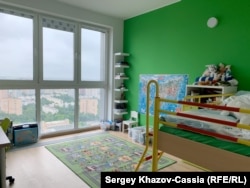
Aleksei’s bedroom in Moscow
“The child has a tendency toward pathological fantasy,” said psychologist Natalya Volgina, who has worked with Aleksei. “The family makes an excellent impression. The father is actively involved and participates in everything, in all the consultations. We can see that he has been doing everything correctly.”
Initially, social workers told Denis, the Investigative Committee was considering charges of physical and sexual abuse. But the latter charge was dropped because of a complete lack of evidence. Officially, Denis has been classified as a witness.
Investigators questioned all of Aleksei’s teachers and relatives, as well as Denis’s friends. Only the swimming instructor who saw how Aleksei was injured has not been questioned, Denis said.
Investigators and a representative of child-protective services searched the family’s apartment. After the search, Denis was summoned again to investigators. His phone was confiscated. He was asked if he had particularly adopted a child “with issues” because he “wouldn’t understand what they were doing to him.” The two FSB officers in plainclothes observed the questioning.
Later, investigator Vitaly Martynov told Denis’s lawyer that the men were with the FSB and had been monitoring the “strange” family for a while. He said that they “know” that the two “fathers” have valuable assets abroad and take yachting vacations. Denis said these assertions are not true and that neither man owns significant property or a yacht.
‘I Told Him We Love Him’
According to the lawyer, Martynov hinted that investigators don’t believe Denis did anything wrong but want him to testify against his partner.
Shortly thereafter, Martynov asked Denis to take a lie-detector test. From this, Denis’s lawyer concluded that Denis was likely to be named a suspect in the case and could even be charged. He advised Denis to leave the country. Around the same time, investigators indicated to Denis that the whole matter could be dropped for 9 million rubles ($125,000). With no guarantee of success, Denis was unwilling to get caught up in an illegal bribery scam.
Aleksei was handed over to the central Moscow Center for Support of Families and Children. Denis said that his son’s condition has deteriorated significantly, and his behavior has become more erratic. At one point, he was hospitalized.
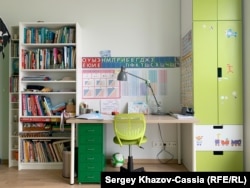
The desk where Aleksei did his homework. There are fears that the boy’s educational development could now suffer in institutional care.
Nonetheless, authorities have either rejected or failed to respond to requests from Denis’s mother, Aleksei’s godmother, Denis’s brother, and the family nanny that they be allowed to care for Aleksei while the case proceeds. Denis’s mother and others applied repeatedly to be allowed to visit Aleksei, but none of their requests was granted.
Denis and the nanny were able to speak with the boy a couple of times by telephone, to assure him that they were fighting to get him back.
“They had told him that his father went away on a business trip,” Abramova said. “He was crying and told me, ‘I want to come home. It hurts.’ When I asked where it was hurting, he said: ‘There, where my heart is, granny. As if a bee stung me.”
Authorities have also refused to allow the family to send Aleksei any packages. He is forced to wear institutional clothing. During one phone call he requested wet wipes to use in the toilet. An RFE/RL correspondent was present when officials agreed to take a package from Aleksei’s godmother on the occasion of his birthday.
Abramova sometimes goes to the orphanage to watch Aleksei as he plays.
Recently “I went to the orphanage and was watching the children play through the fence,” she told RFE/RL. “He came out with a social worker and saw me. He ran to the fence, calling ‘Granny! Granny!’ He latched onto the fence and the social worker had to pull him away. I told him that we would definitely get him back and that he needs to be patient and that we love him.”
Nowhere To Turn?
After numerous requests, Denis was allowed to speak with the facility’s doctor. “The doctor’s answers were monosyllabic,” Denis recalled. “Everything is fine. He’s studying.”
In the weeks since Denis left Russia, the case has stagnated.
“I think that I spoiled their fun by leaving,” Denis said. “Apparently they haven’t collected any evidence of guilt except for the child’s words about the two fathers and stuff…. The child was always in view. He went to school every day. He went swimming three or four times a week and was even monitored there in the showers. If he was being beaten, someone would have seen something. They can’t proceed with the criminal case. They can’t name me as a suspect. But they also can’t return my child and close the case.”
Denis’s lawyer, Artyom Lapov of the LGBT-rights group Stimula, has filed several court requests asking investigators to turn over the document under which they ordered Aleksei removed from his home.
Because the office of the Investigative Committee that is handling the case is in a different district than where Denis lives, the courts have refused to hear his cases on jurisdictional grounds.
“We don’t know where to appeal,” Denis said. “We tried to appeal the refusals, but the Moscow City Court refused to hear both of the appeals.”
Psychologist Alyona Sinkevich, of the NGO Volunteers for Child Orphans, told RFE/RL that Aleksei’s fate in a state institution would likely be unhappy.
“When such a child ends up inside the system, he will likely be hospitalized,” she said. “Most likely, he’ll end up in an orphanage where they will try – to use a euphemism – to ‘calm’ him. In reality, that means keeping him on psychotropic medications so that he will be less dangerous to those around him.”
“That is absolutely the wrong thing to do in such cases, but I can’t throw stones at anyone,” she added. “When you have a lot of children living in a group situation and there is one child like that and the adults who are responsible for everyone’s health can’t keep him under constant control, that is the only alternative. But will that alternative be good for Alyosha? No, it won’t.”
In the end, she predicted, such a person would end up spending his life in a psychiatric facility for adults.
Written by RFE/RL senior correspondent Robert Coalson based on reporting from Moscow by RFE/RL Russian Service correspondent Sergei Khazov-Cassia
SACRAMENTO, Calif. (KTXL) – While the weather is pleasant for California’s reopening Tuesday evening, things are going to heat up over the next few days.
“It’s easier for fires to start. We’re already at super dry vegetation. We’re two months ahead of schedule,” said Sacramento Metro Fire Captain Chris Vestal.