WASHINGTON — The U.S. Education Department on Wednesday expanded its interpretation of federal sex protections to include transgender and gay students, a move that reverses Trump-era policy and stands against proposals in many states to bar transgender girls from school sports.
In a new policy directive, the department said discrimination based on a student’s sexual orientation or gender identity will be treated as a violation of Title IX, the 1972 federal law that protects against sex discrimination in education.
The decision is based on last year’s landmark Supreme Court ruling protecting gay and transgender people from discrimination in employment, according to agency officials. A legal analysis by the department concluded there is “no persuasive or well-founded basis” to treat education differently.
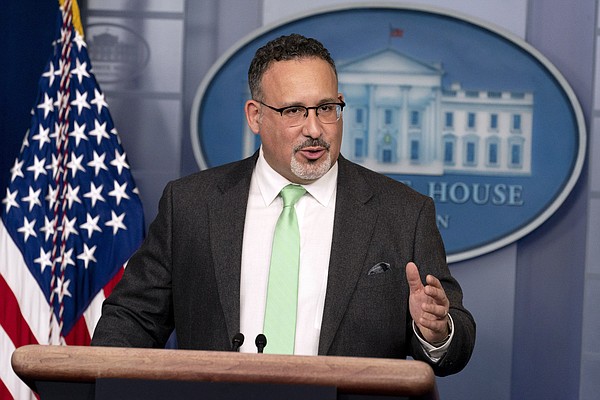
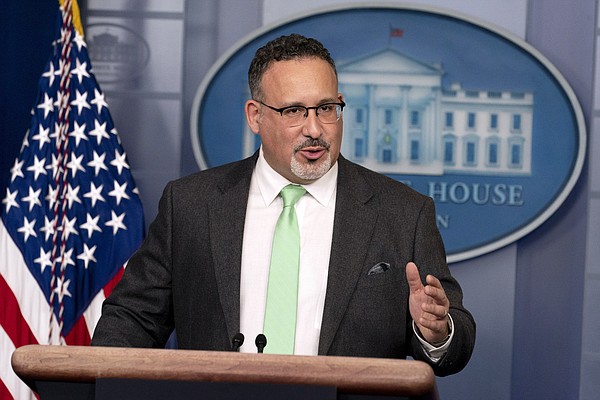
In announcing the shift, Education Secretary Miguel Cardona said gay, lesbian and transgender students “have the same rights and deserve the same protections” as workers.
“Today, the Department makes clear that all students — including LGBTQ+ students — deserve the opportunity to learn and thrive in schools that are free from discrimination,” Cardona said in a statement.
The policy is not likely to bring immediate, sweeping change but carries the possibility of federal sanctions against schools and colleges that fail to protect gay and transgender students.
Under the federal law, students who face sex discrimination can take complaints to the Education Department or federal courts. Schools found to have violated Title IX can face a range of penalties as severe as a loss of all federal education funding, although the Education Department has never dealt that punishment.
With its new stance, the department is taking a stand against legislative proposals in a growing number of states that aim to forbid transgender girls from participating on female sports teams. Legislators in more than 20 states are considering such bans, and some others already have enacted them.
Although those bans appear to be a direct violation of the Education Department’s new policy, it’s not clear how the agency will respond. The new guidance does not explicitly address the question but says it will take action if students are denied equal access to “academic or extracurricular opportunities” because of their sex.
The update drew the ire of conservatives who have pushed to keep transgender girls out of girls athletics. Christiana Holcomb, legal counsel for the Christian group Alliance Defending Freedom, called it a “politically motivated change” that effectively rewrites Title IX.
“Title IX exists precisely to ensure that women and girls have equal opportunities in education, including in sports,” Holcomb said. “Girls and women deserve better than having their opportunities stripped away in service of harmful ideology.”
Democrats and civil-rights groups applauded the change, however, saying all students deserve equal protections. Rep. Bobby Scott, D-Va., chairman of the House Education and Labor Committee, said the department is right to extend the Supreme Court’s ruling to education.
“As a result of today’s action, LGBTQ students will have strong and clear legal protections from discrimination in schools, and a safe learning environment,” he said in a statement.
The decision reverses Trump-era policies that removed civil-rights protections for transgender students. In 2017, President Donald Trump’s administration lifted Obama-era guidance allowing transgender students to use bathrooms and locker rooms that match their gender identities.
At the time, Education Secretary Betsy DeVos said the issue was “best solved at the state and local level” and that the earlier guidance led to a spike in lawsuits seeking clarification.
The new action does not reinstate the Obama-era policy but instead clarifies that the Education Department’s Office for Civil Rights will investigate complaints of discrimination involving gay or transgender students.”
The new guidance was issued as a “notice of interpretation” and does not carry the force of law. But the shift could be cemented in a policy overhaul that President Joe Biden ordered in March.
Biden’s order directed the Education Department to review all aspects of Title IX — including sweeping changes issued last year by DeVos — and “consider suspending, revising or rescinding” policies that fail to protect students.
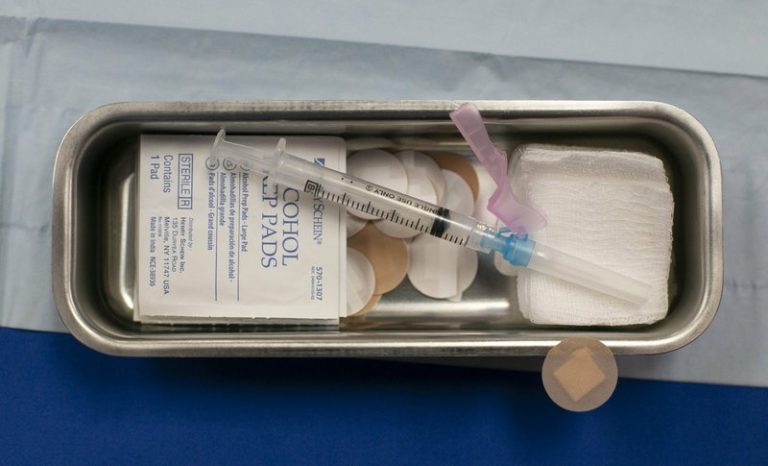
Unanswered questions about COVID vaccines have prolonged people’s hesitancy to get their shots and caused vaccination rates in North Carolina to plateau.
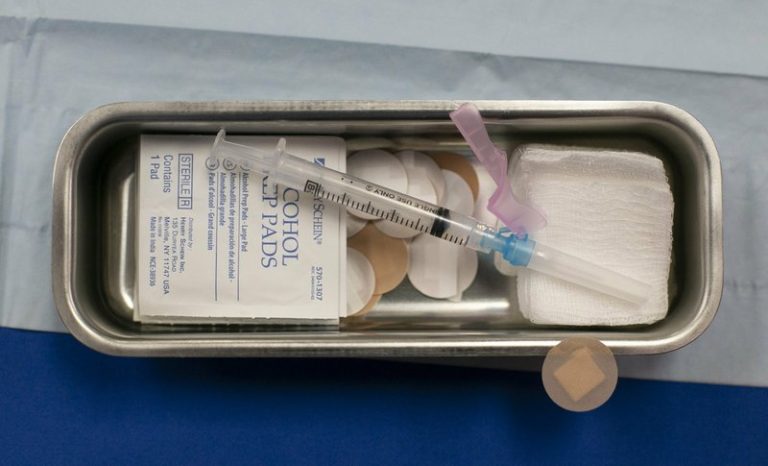
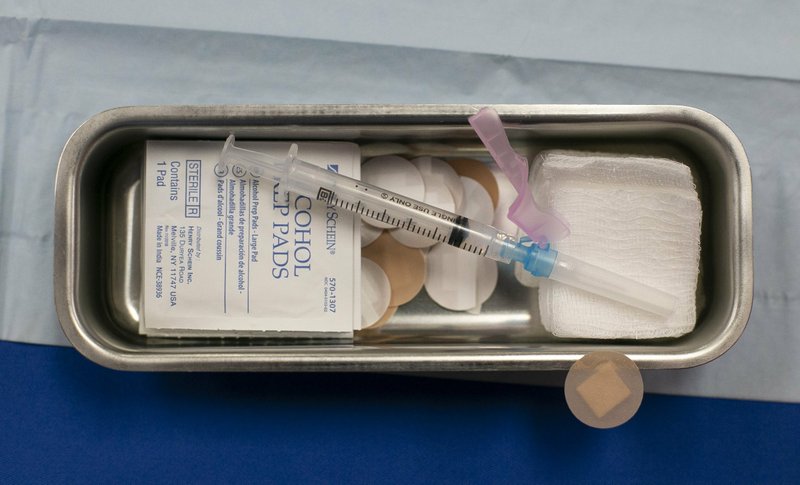
Early CDC data and COVID case count numbers show all three approved vaccines are highly effective in preventing deaths and hospitalizations from the virus. Despite this research, many people are concerned about potential side effects and the speed at which vaccines were developed.
Dr. Cynthia Gay is a UNC researcher and associate professor of medicine at the division of infectious diseases. She said these vaccines have been proven to be highly effective and that any side effects from the COVID vaccines are no different than the side effects from any other vaccine.
“I would say most of us would consider the efficacy of these vaccines to be a homerun and within a very short amount of time we’re really grateful,” Gay said. “There are very few safety concerns.”
Gay said there are several reason researchers developed vaccines so quickly. Not only were the projects heavily funded, but other areas of research were largely shut down when the pandemic began.
“Really the reason we were able to get these vaccines so much quicker than in the past was really two main things. One was resources and by that, I mean funding and people. The other was technology,” Gay said.
Gay said she believes the speed of vaccine development is something to be grateful for, rather than question. She said that is especially true because of the transparency of the development process.
“In a lot of ways these vaccine trials were under a microscope in a way that other clinical trials have never been,” she said. “So I’m hoping that will provide some reassurance to a lot of folks.”
As of now, COVID vaccines are only FDA approved for emergency use. Moderna and Pfizer have both applied for full approval, which would improve availability and public confidence.
Gay said emergency use for vaccines does not indicate a lack of safety.
“It’s not really a new concept.” Gay said. “I think it’s new for a public health perspective like this where we were using it for vaccines and trying to roll it out on such a widespread basis.”
The reason for the emergency authorization is FDA officials thought the vaccines would save lives and prevent hospitalizations. The resulting COVID-19 trends show that to be true.
Beyond hesitancy, another reason people have not yet received their shots is access. Gay said access can be improved by distributing vaccines to rural areas and ensuring people don’t have to take off work.
“I think we will make some progress there as people take vaccine administration more locally and really remove some of the barriers for folks,” she said.
Gay said while there is less transmission of the coronavirus, it is still important for people to get vaccinated to protect yourself and others, especially with new virus variants on the rise.
For more information, on vaccines Gay recommends visiting here.
Featured Photo via Robert Willett/The News & Observer
Unanswered questions about COVID vaccines have prolonged people’s hesitancy to get their shots and caused vaccination rates in North Carolina to plateau.
Early CDC data and COVID case count numbers show all three approved vaccines are highly effective in preventing deaths and hospitalizations from the virus. Despite this research, many people are concerned about potential side effects and the speed at which vaccines were developed.
Dr. Cynthia Gay is a UNC researcher and associate professor of medicine at the division of infectious diseases. She said these vaccines have been proven to be highly effective and that any side effects from the COVID vaccines are no different than the side effects from any other vaccine.
“I would say most of us would consider the efficacy of these vaccines to be a homerun and within a very short amount of time we’re really grateful,” Gay said. “There are very few safety concerns.”
Gay said there are several reason researchers developed vaccines so quickly. Not only were the projects heavily funded, but other areas of research were largely shut down when the pandemic began.
“Really the reason we were able to get these vaccines so much quicker than in the past was really two main things. One was resources and by that, I mean funding and people. The other was technology,” Gay said.
Gay said she believes the speed of vaccine development is something to be grateful for, rather than question. She said that is especially true because of the transparency of the development process.
“In a lot of ways these vaccine trials were under a microscope in a way that other clinical trials have never been,” she said. “So I’m hoping that will provide some reassurance to a lot of folks.”
As of now, COVID vaccines are only FDA approved for emergency use. Moderna and Pfizer have both applied for full approval, which would improve availability and public confidence.
Gay said emergency use for vaccines does not indicate a lack of safety.
“It’s not really a new concept.” Gay said. “I think it’s new for a public health perspective like this where we were using it for vaccines and trying to roll it out on such a widespread basis.”
The reason for the emergency authorization is FDA officials thought the vaccines would save lives and prevent hospitalizations. The resulting COVID-19 trends show that to be true.
Beyond hesitancy, another reason people have not yet received their shots is access. Gay said access can be improved by distributing vaccines to rural areas and ensuring people don’t have to take off work.
“I think we will make some progress there as people take vaccine administration more locally and really remove some of the barriers for folks,” she said.
Gay said while there is less transmission of the coronavirus, it is still important for people to get vaccinated to protect yourself and others, especially with new virus variants on the rise.
For more information, on vaccines Gay recommends visiting here.
Featured Photo via Robert Willett/The News & Observer
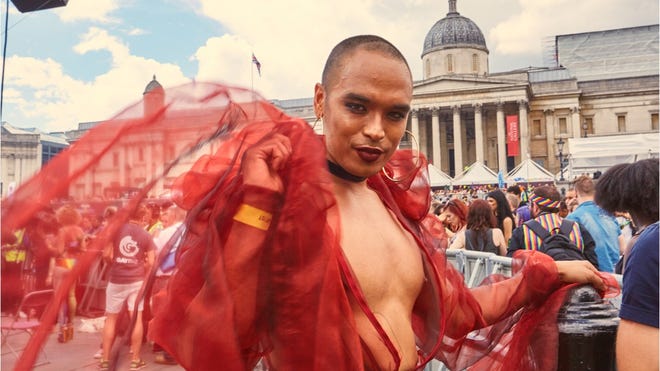
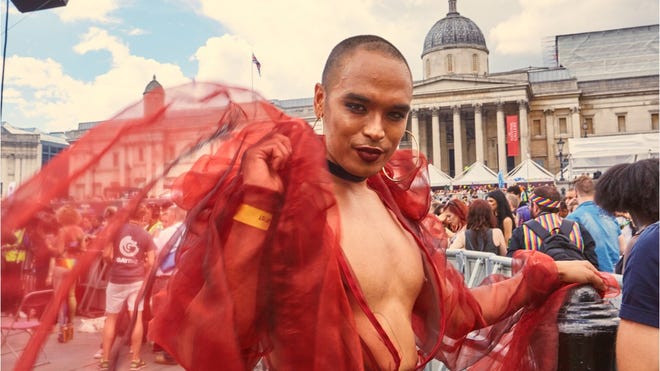
TRENTON – Just walking up to Arm & Hammer Park on June 12, it was clear there was a different vibe in the air.
The music outside of the Triple-A Trenton Thunder’s baseball home included Queen, Elton John and George Michael. Staffers wore special rainbow attire. Even the mascot, Boomer, donned a gay-friendly uniform.
Pride Night was on.
Trenton is one of two New Jersey minor league teams holding such events during June, which is Pride month. The Thunder and the Jersey Shore BlueClaws in Lakewood brought prideful game themes to New Jersey in 2019.
The Sussex County Miners and New Jersey Jackals of Montclair have so far skipped the idea, while the Somerset Patriots said they are hoping to plan something for later this season.
“It is great to promote the open mindedness we are supporters of,” said Gregg Caserta, Thunder media director. “Minor league baseball brings a lot of people under one umbrella.”
But even as pride nights and LGBTQ rights are seeing a surge across many fields, openly gay professional athletes are still a rarity among the four major team sports.
For baseball, each of the 30 Major League teams averages 28 players, while the 120 minor league clubs usually hold about 30, according to league data.
That comes to more than 800 MLB players and about 3,600 minor league players, none of whom are openly gay.
Locker room should be ‘somewhere where people can be themselves’
“It is hard to say why,” said Chris Adamson, BlueClaws manager. “It is a little bit stigmatized and that is not ideal. It could be the fact that they are a little bit more intimidated by that, whether it is just the locker room environment. That is difficult to hear because you want your locker room to be somewhere where people can be themselves.”
Belicia Montgomery, director of diversity & inclusion for Minor League Baseball, said so much pressure is placed on players coming up through the ranks that many probably feel it would add more scrutiny, especially since there are so few open players, if they came out.
“A lot of it is that they do not want that to be their identity, they want to be judged being a player,” she said. “That is sometimes the case. What is the locker room culture really like? Especially on the minor league side.”
Some players I approached on several Garden State minor league teams were reluctant to speak on the record about the issue, while Caserta declined to allow access to Thunder team members fearing such inquiries would make them uncomfortable.
“I’m afraid I can’t have the guys talk about tonight. I wouldn’t want to put someone in an uncomfortable or awkward situation because I don’t know anything about their personal beliefs” he said via email. “I know on our side of the fence we can talk about these things openly but clubhouse culture is still different than what we’re used to. I hope you understand because I know you’re a good reporter and wouldn’t sandbag anyone, but I don’t want to create a possible negative situation for any of the players.”
But gay rights proponents among the minor league clubs say events like Pride Nights and related signs of acceptance and support may make players less timid about coming out.
Lakewood event drew praise – and sparked protests
“That is the whole purpose of days like this,” Adamson of the BlueClaws said the week of their Pride Night. “Hopefully for the players it might create more of an avenue.”
The BlueClaws drew support and praise in 2019 with its first pride event, which actually sparked some protests. But, in the end, the team received a Minor League Baseball Presidential Citation for standing up to opposition.
“We are committed to the idea that baseball is for everyone and all people are welcome at a BlueClaws game,” read a team statement at the time. “It is unfortunate that some individuals are choosing to display intolerance rather than embrace the true spirit of the night.”
The BlueClaws 2019 event was part of a nationwide pride campaign that year to promote and support LGBTQ fans and issues for the first time on a broad scale.
In 2019, there were events held by 69 of the then-160 minor league teams, according to Montgomery.
With a sharp reduction in teams during 2020, due in part to the pandemic and a new agreement with Major League Baseball, there are now just 120 teams, so fewer events are likely.
Still, Montgomery says the awareness and campaign for broader support continues.
“There is definitely no slowing down on pride nights as minor league teams are coming back from going a whole year without having games,” she explained. “The teams are off and running on their own. A team’s main activation may be participating in the pride parade in their hometown or they collaborate with a local non-profit. It is not always a game night.”
The feeling in Trenton on Pride Night showed acceptance was growing and at least a few fans showed up because of the special meaning.
“I think it’s wonderful,” said Patty Jackens of Yardville, Mercer County, who sported a rainbow shirt and brought her gay niece along. “I think it is nice they recognize LGBT issues and support them.”
Caserta, who said the music by gay artists was not a coincidence — noting Thunder Video Director Ben Wolverton, who is gay, chose the selections for that purpose. He added that there has been no public opposition to their event.
“There is no blowback,” he stressed. “And it is no different than any other game.”
Invidual sports, women’s teams have breakthroughs
Still, the lack of openly gay players in baseball, as well as football, hockey and men’s basketball shows the stigma remains. Other more individual sports such as tennis, golf and many women’s teams have broken through, according to Outsports, a website that covers LGBT issues and personalities in amateur and professional sports.
Outsports has a special section dubbed “Coming Out Stories” that chronicles when athletes decide to end their closeted ways. Recent examples range from the April 22 story on Missouri Western State University softball captain Emma Hoffart to the June 3 piece on gay triathlete Michael Lalli.
Then there is the story of Candace and Tig Archer, who met on the West Virginia University cross country team and were married in 2019. The duo penned an account of their story in April 2021, a month before they graduated.
“We choose to be visible because there are people that believe our marriage is not real, or that our love is fake,” they wrote in the Outsports piece. “We think when people see how kind we are to each other and how much we make each other happy, they have a very hard time hating us and what we stand for.”
Baseball ‘very slow to change’
But such openness has yet to transfer to the big four sports and, pride nights or not, it appears to be a slow road, observers say.
“Baseball as a general thing is very slow to change and has to be among the more conservative of sports,” said Ken Schultz, an Outsports contributor based in Chicago. “You also have to remember that baseball is always run by old white men and old white men are usually one of the last groups to change when it comes to an approach to civil rights.
“In addition to being a slow-moving sport, baseball is also part of conforming to a clubhouse culture,” he said. “That culture has to change. Baseball still draws a lot from the south, from small towns, from religious players.”
But, he added, “when it comes to players being public I think we are approaching a better place.”
He pointed to one positive example from history, former Los Angeles Dodger and Oakland Athletic Glenn Burke, who played four seasons from 1976 to 1979, including as a starting outfielder in the 1977 World Series.
“He was one of the most popular people on those Dodger teams of the 70s,” Schultz said of Burke, whose story was the basis of a great 2020 biography titled, Singled Out.
While the minor leagues are where a lot of change has often come first, most recently with some rules getting their first tryout there, Schultz believes the first self-outed player may have to be a proven superstar better able to handle the heat.
“Because major league clubhouses are so insular and have such a unique atmosphere I think it would be more influential if a star level player were to come out,” he said. “It would really be the signal to teams everywhere.”
But he agreed it won’t be easy no matter who is brave enough: “Once a gay player comes out, he’s going to have to be comfortable being scrutinized and be the focus of attention and answer the same questions at every town he visits.”
Looking back at Jackie Robinson’s historic color barrier success, many credit his abilities as a top player along with his courage for making him succeed: “It certainly would help if a player of Jackie Robinson’s caliber would come out,” Schutz said.
Joe Strupp is an award-winning journalist with 30 years’ experience who covers education and Monmouth County for APP.com and the Asbury Park Press. He is also a die-hard Yankees fan when not checking out the marvelous minor leagues.
TRENTON – Just walking up to Arm & Hammer Park on June 12, it was clear there was a different vibe in the air.
The music outside of the Triple-A Trenton Thunder’s baseball home included Queen, Elton John and George Michael. Staffers wore special rainbow attire. Even the mascot, Boomer, donned a gay-friendly uniform.
Pride Night was on.
Trenton is one of two New Jersey minor league teams holding such events during June, which is Pride month. The Thunder and the Jersey Shore BlueClaws in Lakewood brought prideful game themes to New Jersey in 2019.
The Sussex County Miners and New Jersey Jackals of Montclair have so far skipped the idea, while the Somerset Patriots said they are hoping to plan something for later this season.
“It is great to promote the open mindedness we are supporters of,” said Gregg Caserta, Thunder media director. “Minor league baseball brings a lot of people under one umbrella.”
But even as pride nights and LGBTQ rights are seeing a surge across many fields, openly gay professional athletes are still a rarity among the four major team sports.
For baseball, each of the 30 Major League teams averages 28 players, while the 120 minor league clubs usually hold about 30, according to league data.
That comes to more than 800 MLB players and about 3,600 minor league players, none of whom are openly gay.
Locker room should be ‘somewhere where people can be themselves’
“It is hard to say why,” said Chris Adamson, BlueClaws manager. “It is a little bit stigmatized and that is not ideal. It could be the fact that they are a little bit more intimidated by that, whether it is just the locker room environment. That is difficult to hear because you want your locker room to be somewhere where people can be themselves.”
Belicia Montgomery, director of diversity & inclusion for Minor League Baseball, said so much pressure is placed on players coming up through the ranks that many probably feel it would add more scrutiny, especially since there are so few open players, if they came out.
“A lot of it is that they do not want that to be their identity, they want to be judged being a player,” she said. “That is sometimes the case. What is the locker room culture really like? Especially on the minor league side.”
Some players I approached on several Garden State minor league teams were reluctant to speak on the record about the issue, while Caserta declined to allow access to Thunder team members fearing such inquiries would make them uncomfortable.
“I’m afraid I can’t have the guys talk about tonight. I wouldn’t want to put someone in an uncomfortable or awkward situation because I don’t know anything about their personal beliefs” he said via email. “I know on our side of the fence we can talk about these things openly but clubhouse culture is still different than what we’re used to. I hope you understand because I know you’re a good reporter and wouldn’t sandbag anyone, but I don’t want to create a possible negative situation for any of the players.”
But gay rights proponents among the minor league clubs say events like Pride Nights and related signs of acceptance and support may make players less timid about coming out.
Lakewood event drew praise – and sparked protests
“That is the whole purpose of days like this,” Adamson of the BlueClaws said the week of their Pride Night. “Hopefully for the players it might create more of an avenue.”
The BlueClaws drew support and praise in 2019 with its first pride event, which actually sparked some protests. But, in the end, the team received a Minor League Baseball Presidential Citation for standing up to opposition.
“We are committed to the idea that baseball is for everyone and all people are welcome at a BlueClaws game,” read a team statement at the time. “It is unfortunate that some individuals are choosing to display intolerance rather than embrace the true spirit of the night.”
The BlueClaws 2019 event was part of a nationwide pride campaign that year to promote and support LGBTQ fans and issues for the first time on a broad scale.
In 2019, there were events held by 69 of the then-160 minor league teams, according to Montgomery.
With a sharp reduction in teams during 2020, due in part to the pandemic and a new agreement with Major League Baseball, there are now just 120 teams, so fewer events are likely.
Still, Montgomery says the awareness and campaign for broader support continues.
“There is definitely no slowing down on pride nights as minor league teams are coming back from going a whole year without having games,” she explained. “The teams are off and running on their own. A team’s main activation may be participating in the pride parade in their hometown or they collaborate with a local non-profit. It is not always a game night.”
The feeling in Trenton on Pride Night showed acceptance was growing and at least a few fans showed up because of the special meaning.
“I think it’s wonderful,” said Patty Jackens of Yardville, Mercer County, who sported a rainbow shirt and brought her gay niece along. “I think it is nice they recognize LGBT issues and support them.”
Caserta, who said the music by gay artists was not a coincidence — noting Thunder Video Director Ben Wolverton, who is gay, chose the selections for that purpose. He added that there has been no public opposition to their event.
“There is no blowback,” he stressed. “And it is no different than any other game.”
Invidual sports, women’s teams have breakthroughs
Still, the lack of openly gay players in baseball, as well as football, hockey and men’s basketball shows the stigma remains. Other more individual sports such as tennis, golf and many women’s teams have broken through, according to Outsports, a website that covers LGBT issues and personalities in amateur and professional sports.
Outsports has a special section dubbed “Coming Out Stories” that chronicles when athletes decide to end their closeted ways. Recent examples range from the April 22 story on Missouri Western State University softball captain Emma Hoffart to the June 3 piece on gay triathlete Michael Lalli.
Then there is the story of Candace and Tig Archer, who met on the West Virginia University cross country team and were married in 2019. The duo penned an account of their story in April 2021, a month before they graduated.
“We choose to be visible because there are people that believe our marriage is not real, or that our love is fake,” they wrote in the Outsports piece. “We think when people see how kind we are to each other and how much we make each other happy, they have a very hard time hating us and what we stand for.”
Baseball ‘very slow to change’
But such openness has yet to transfer to the big four sports and, pride nights or not, it appears to be a slow road, observers say.
“Baseball as a general thing is very slow to change and has to be among the more conservative of sports,” said Ken Schultz, an Outsports contributor based in Chicago. “You also have to remember that baseball is always run by old white men and old white men are usually one of the last groups to change when it comes to an approach to civil rights.
“In addition to being a slow-moving sport, baseball is also part of conforming to a clubhouse culture,” he said. “That culture has to change. Baseball still draws a lot from the south, from small towns, from religious players.”
But, he added, “when it comes to players being public I think we are approaching a better place.”
He pointed to one positive example from history, former Los Angeles Dodger and Oakland Athletic Glenn Burke, who played four seasons from 1976 to 1979, including as a starting outfielder in the 1977 World Series.
“He was one of the most popular people on those Dodger teams of the 70s,” Schultz said of Burke, whose story was the basis of a great 2020 biography titled, Singled Out.
While the minor leagues are where a lot of change has often come first, most recently with some rules getting their first tryout there, Schultz believes the first self-outed player may have to be a proven superstar better able to handle the heat.
“Because major league clubhouses are so insular and have such a unique atmosphere I think it would be more influential if a star level player were to come out,” he said. “It would really be the signal to teams everywhere.”
But he agreed it won’t be easy no matter who is brave enough: “Once a gay player comes out, he’s going to have to be comfortable being scrutinized and be the focus of attention and answer the same questions at every town he visits.”
Looking back at Jackie Robinson’s historic color barrier success, many credit his abilities as a top player along with his courage for making him succeed: “It certainly would help if a player of Jackie Robinson’s caliber would come out,” Schutz said.
Joe Strupp is an award-winning journalist with 30 years’ experience who covers education and Monmouth County for APP.com and the Asbury Park Press. He is also a die-hard Yankees fan when not checking out the marvelous minor leagues.
It doesn’t ever feel like much of a coincidence for me that Father’s Day occurs during Pride Month. Though I suppose it is.
The first Father’s Day commemorations were around the turn of the last century. One in 1908 honored more than 300 men who had died in a coal mine in West Virginia. Two years later, a woman whose widower father raised her and her five siblings tried to make Father’s Day a national celebration, but it took until 1972 for that to actually happen.
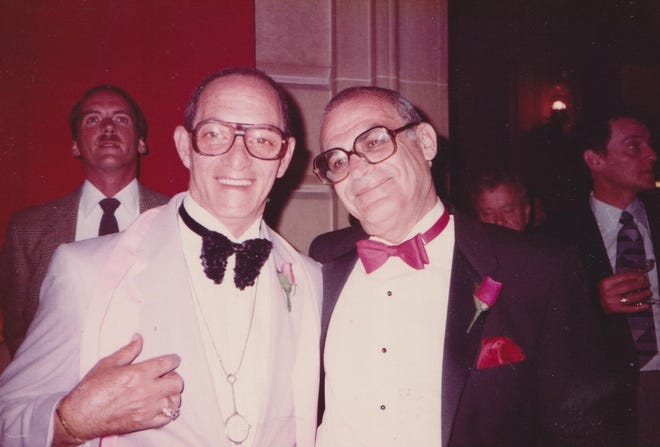
For me, though, the two celebrations have been inexorably linked for decades. In late 1980, at a support group for gay fathers, my dad met Lionel –– the man with whom he would spend the next 23 years.
The Father’s Day gift request I refused
A few months later, I helped them move into an apartment in West Hollywood. I was happy for my dad. He had seemed kind of lost in his new life – pushing 60, recently divorced from my mother, recently out of the closet as gay man. The indignities he had endured included requiring my assistance to get rid of an angry hustler, who was just a few years older than me, and defending him against the angry Orthodox Jewish parents of a young man with whom he had a brief, awkward romance.
The year after he met Lionel, 1981, was the only time my father ever asked me for a Father’s Day present. He asked that I march with him, alongside the other gay fathers and their kids, in the Los Angeles Pride Parade.
I don’t remember much about the parade. What I do remember was that someone had made T-shirts that said “I LOVE MY GAY DAD” and I refused to wear one.
I was 22 and in full possession of that youthful self-consciousness mixed with self-serving pseudo-idealism. I told my dad, “I love you, but not because you’re gay. I don’t love you in spite of it, either. I’m glad you got things straight with yourself and the world, but I’m not wearing a shirt that defines our relationship so simplistically.”
The truth, though, is that I lacked the courage to stand all the way up for my father and his comrades against a homophobic and indifferent world. My dad didn’t push me. He was glad I was there with him at all.
I probably left my “I LOVE MY GAY DAD” T-shirt next to the box it had come out of, though I might have taken it home with me and buried it in a drawer. What I do know is that I don’t have it anymore. And I wish I did.
Together but never allowed to marry
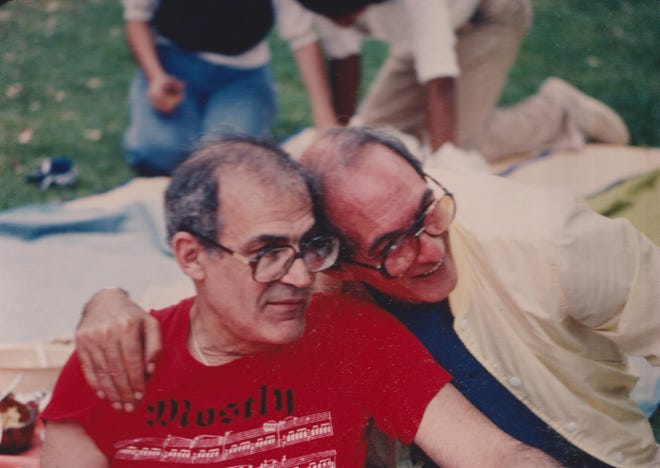
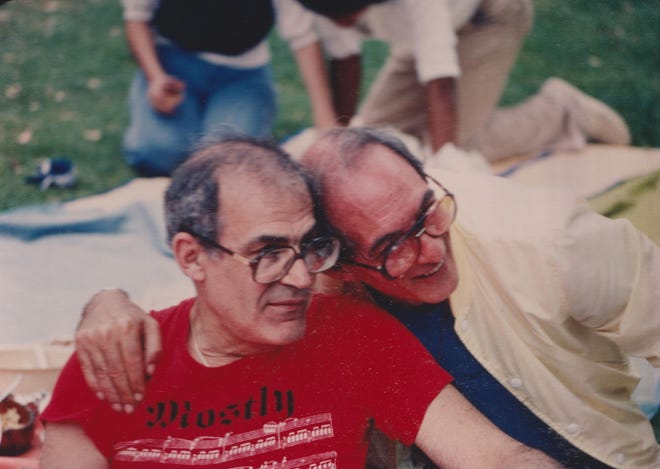
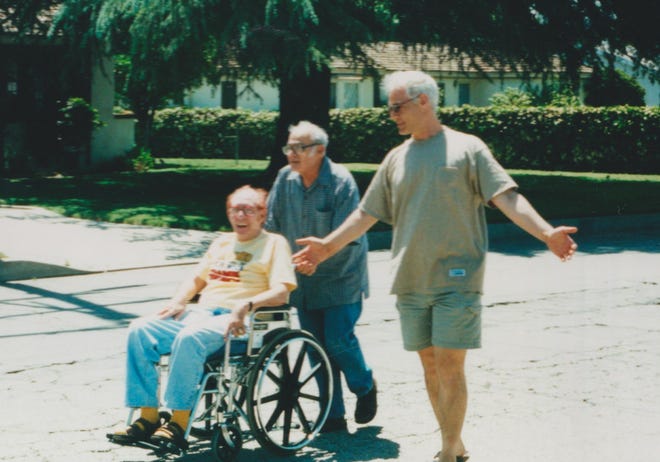
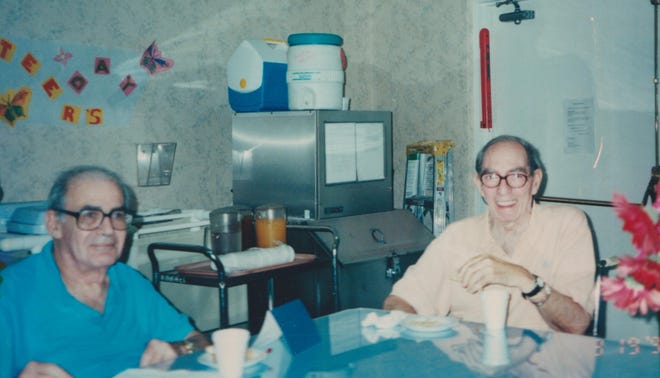
My father passed away a little over 10 years ago, after a decade of heartbreak and illness, a slow and quiet fade from the world. I dug out a lot of old photographs to show him in the last few years of his life to try to rouse him from his catatonic state.
Mostly, he just stared expressionless. Occasionally, he would reach out or his face would hint at a smile, like when I held up a photograph of a young soldier with whom he had served in World War II.
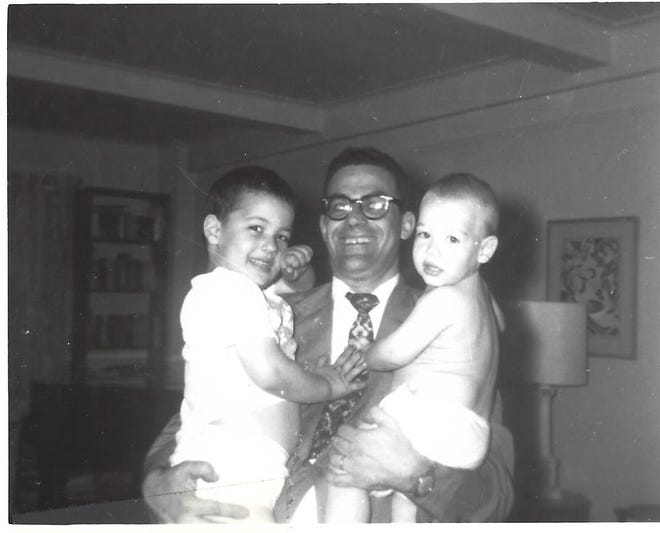
Mostly, the photographs roused me. Like the picture of him proudly holding my brother and me in his arms. The one that shows us carving pumpkins. And him standing in line outside New York’s Madison Square Garden for hours to get playoff Knicks tickets in the nose-bleed section for himself and me. Actually, that last picture is just one from my mind, along with thousands of other memories and images of him.
I had thought I might get a rise out of him with the photographs of him and Lionel getting arrested at a protest outside former California Gov. Pete Wilson’s office, or at the National March on Washington for Lesbian and Gay Rights.
My dad and his husband lost a lot of friends to AIDS. Many had been abandoned by their families and had only their friends to take care of them – and then bury them.
Did I say husband?
Of course, John Strauss and Lionel Friedman were never married. Lionel passed away in 2003, five years before same-sex marriage first became legal in California in 2008.
I told my father when that happened. I thought he’d want to know – though I couldn’t tell at that time if anything I said registered.
I didn’t tell him when, later that year, the voters in this state banned same-sex marriage through a proposition. But I did tell him, just a few months before he died, that the California Supreme Court declared that proposition unconstitutional. And when he passed away and I was filing for his death certificate, I declared him a widower.
Whenever I meet a married couple of the same sex, I think of my father, and how he and Lionel, alongside their friends and peers, helped to break the road. I’m proud of his commitment to justice – for all people.
And I’m grateful for his love for and commitment to my brother and me. The man had no interest in basketball and didn’t even understand the game, but he took me to one of the most legendary games in basketball history. Actually, when Willis Reed hobbled out onto the court and we all stood up with a collective roar, and when Willis hit the first two shots, I don’t believe my father had any trouble understanding the transcendence we were witnessing.
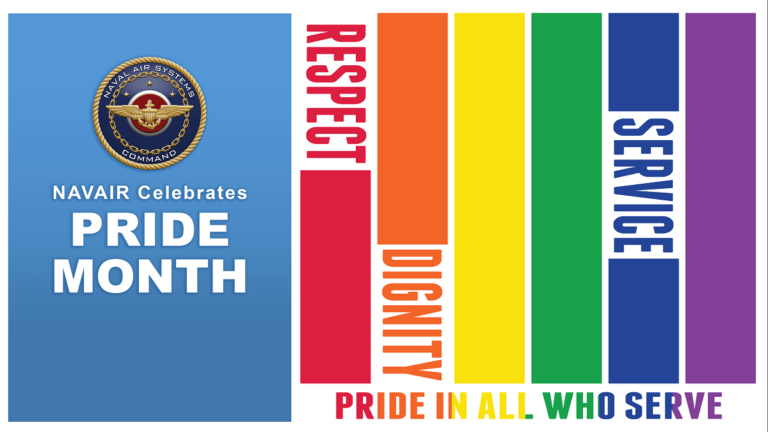
HEADQUARTERS, NAVAL AIR SYSTEMS COMMAND, PATUXENT RIVER, Md.– Part of LGBT Pride Month each June is having pride in your true self.
That’s the message Risha Grant, author, television host, international speaker and a former Division 1 women’s basketball player, imparted to NAVAIR employees at the national NAVAIR Lesbian, Gay, Bisexual, Transgender (LGBT) Pride Month event June 10.
“I haven’t always celebrated Pride [Month] or had pride,” Grant, a self-described bisexual woman, said. “It took me awhile to get to that point.”
Grant said she embarked on a four-step process to “own her authenticity,” which took her more than 30 years and down several different paths.
“I am diversity personified, but so are all you,” she told employees. “We are all diverse. I made my diversity my superpower by owning everything about me.”
First, she redefined “normal,” which meant being true to her sexuality and eschewing some of the lessons she learned growing up.
“I was told to be normal, but that word means common or standard, and who wants to be that? It isn’t inclusive of everyone. Honor your uniqueness.”
Second, she released the expectations people had of her.
“I had to radically accept myself,” she said. “I had to love myself, and not judge myself.” She told employees to ask themselves, “Are you living in love or living in fear? Be intentional, and ask yourself, ‘Am I being real? Am I living my real life?’” she advised. “Live your life on your terms.”
Third, she embraced inclusion.
“Allow another human being to be who they are for the space they’re taking up in this world,” she said. “Be open-minded, say hello with a smile and include everyone. We owe this world to leave it better than we found it for the people who are coming behind us.”
Grant has coined the term “bias-synapse” to describe how biases can unconsciously color how you view the world and urged employees to let go of the “BS.”
“What is it you can do to become an ally and help someone feel a part of the team?” she asked. “Am I experiencing the world through my ‘bias-sphere’ or how it actually is?”
Last, she realized her voice and used it to start speaking to shift hearts and minds as an award-winning diversity and inclusion expert.
“Sometimes, you can plant a seed that may not bear fruit for many, many years,” she said, but encouraged employees to keep learning, growing and working to understand their biases and live their truth.
LGBT Pride Month is celebrated each year in the month of June to honor the 1969 Stonewall riots in Greenwich Village. This year’s theme was “Pride in All Who Serve.”
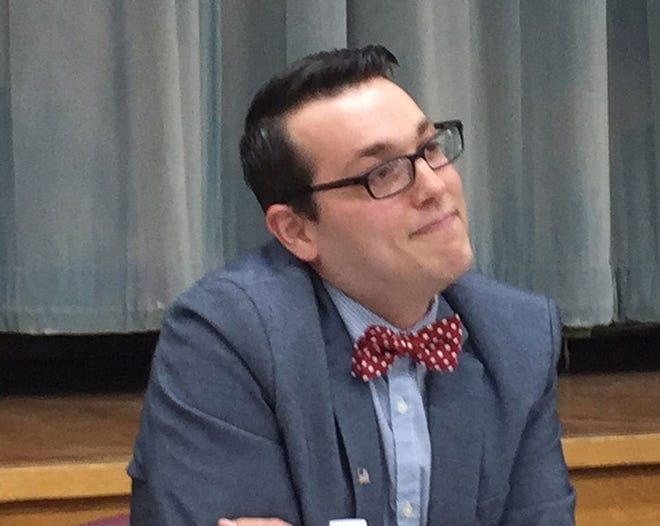
DIGHTON — Selectman Brett Zografos wants to explain the importance of June as Pride Month.
It’s his goal for reasons much deeper than the fact his name is attached to a controversial plan to raise the Pride flag at Town Hall that failed in January but that town officials are now reconsidering.
It’s about who he is and is proud to be: one of the few openly gay selectmen in the state.
The 36-year-old Dighton native said he became a selectman because he had always wanted to serve the town where he was raised. His father, too, was raised in Dighton, though he was born in Taunton at the Dighton line. His family moved to Fall River for a time then returned to Dighton in 1993. He graduated from the Dighton Elementary and Middle schools and Dighton-Rehoboth High School. He said his was one of the first classes to go all four years through the new middle school, rebuilt after a 1991 fire.
“I am a proud product of the Dighton Public Schools,” he said. “Dighton neighbors, family and friends all helped raise me.”
Unfriendly encounters early on helped raise him, too. But these influences only strengthened his resolve to return to Dighton and serve and educate. As his gay identity evolved, he said, “There was no role models to go to figure out what I was. No television or movies about it. Though my family was supportive, kids were cruel. That experience changed me. But it made me keep the idea that I wanted to come back and serve as a thank you to the community that raised me. And I wanted to make my community a safe, supportive space for people like me.”
The latter goal is the one that makes him want to speak out during Pride Month. A statement he wrote and read at the time of the selectmen’s proclamation on the event pointed out, “Despite a society that told us time and again to be ashamed of ourselves, we choose pride: in ourselves, in each other, in our community.”
When he first knew who he was, he explained, “It was not a supportive, welcoming environment. I internalized that it is bad, that I was bad. It’s a perception others too have had of themselves that has to change.”
For Zografos, that perception about himself evolved as he earned an undergraduate degree in cellular molecular biology at Bridgewater State University and a Ph.D. at the University of Texas. He then won a Marie Curie Fellowship award that sent him to Paris to study brain stem human cancer. But there he felt the calling to pursue a career in public service, not science.
“So when my contract was up I returned to Dighton,” he said. “The work (in Paris) was not rewarding — long hours; it’s not a 9-to-5 job. I realized this was not the life I wanted for myself. I’m a social person. I’m not satisfied without human interaction.”
Nowadays he works in the human resources department of an environmental resources firm, Velola North America, and he applies his knowledge of science to grant writing for Dighton projects that need funding of that kind.
“I use my education every day,” he said. “It’s very helpful in grant writing. I helped us get our recent $143,000 Green Communities infrastructure grant. I wanted to use the knowledge, the education that Dighton gave me to move the town forward. Pay it forward.”
When he ran for Dighton selectman, he said, no one asked him about his sexuality. They put him in office based on his experience.
Does this moment in time feel different as he promotes flying the Gay Pride Flags around town hall?
“People think this is my agenda,” he said. “But that is the furthest from the truth. I just want to foster a position of tolerance, of love. The flag supports all that, supports that Dighton welcomes everyone with open arms.”
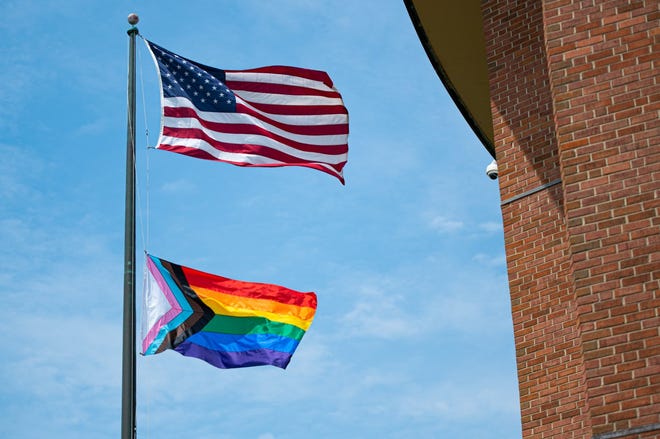
He added it is a false choice when some say it’s the Pride flag versus the American Flag.
“My father served in Desert Storm and in Yugoslavia,” he said. “My father was a proud veteran, and we’re a proud military family. I see the rainbow flag as symbolizing the struggle of gay rights and the American dream and the promise of justice for all.”
But he would not be discouraged if “the rainbow flag” never flew at town hall. The town selectmen have done a lot of other good work, he said.
“Whether or not the flag gets raised. I know this town is full of good people. Otherwise, I wouldn’t have chosen to serve them.”
For the record, he said, here’s what the colors of the rainbow flag symbolize: Red: Life; Orange: Healing; Yellow: Sunlight; Green: Nature; Blue: Peace/Harmony; Purple/Violet: Spirit.
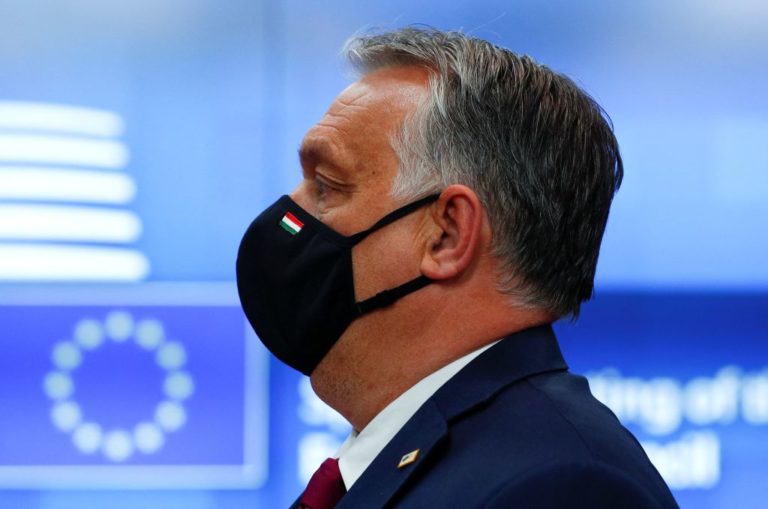
Has the EU Commission lost any sense of moral value? This week, Hungary, an EU member state, voted to impose bigoted and oppressive laws on its LGBT citizens. This amounted to a clear breach of many of our domestic laws – and it is a breach of the shared Human Rights laws. Yet the EU’s response has been dismal. Is it time for Britain to show solidarity with LGBT Hungarians – and walk away from its treaty with the EU?
The EU Commission said it is aware of what is unfolding in Hungary and that:
‘When protecting children from harmful content it is important for member states to find the right balance of relevant fundamental rights, such as the freedom of expression and non-discrimination’
But this falls far short of what it needed to say.
Does this response mean the EU thinks children should be protected from knowing gay people exist? Surely, whatever your politics, there is no balance to be struck when it comes to ensuring LGBT people have basic protection in law?
This isn’t the first time that Viktor Orban’s government has sought to make life difficult for gay people. Back in December, Hungary banned same sex parents from adopting children. The EU’s response was, again, predictably weak. And it seems that the EU’s refusal to make Hungary’s government pay the price for its shameful policies has ensured a continuation of this worrying crackdown.
The new law effectively prevents children being told that gay people exist. So Radio 4 show, The Archers – which has the double of both openly gay characters, and now an openly bisexual one – could be banned in Hungary before a watershed. And what about Harry Potter: is that now for adults only in Hungary?
As well as breaching the international laws we share, these new laws breach EU law. That is because Hungary’s actions breach the Charter of Fundamental Rights and the European Convention on Human Rights, as well as the pithily titled, Audiovisual Media Services Directive and the Unfair Commercial Practices Directive.
Lots of law breaking.
Yet the EU commission has chosen to ignore clear and apparent breaches of the law provided that the right balance is struck. Does it also endorse the idea that it is necessary to protect children from knowing lesbians exist? Is it really saying that you can ban LGBT people from TV?
The idea that children need to be protected from the existence of people who are not wholly (or in part) heterosexual was a toxic and stupid idea. The damage done to the lives of LGBT people was recognised as wrong.
But far more importantly, we all enshrined the idea that we would never do it again in our laws. If you want to oppress LGBT people, a political view, you can’t do so because we brought the idea that you mustn’t in to law. And we are told that the EU is a creature of law.
The UK government has extensive powers under the treaty it signed with the EU. The UK has committed in law to apply that treaty. In fulfilling its legal obligation to uphold the treaty the UK must now consider using them.
Under Article SERVIN.1.3, the UK can suspend trade and capital (money) movements to EU investors or service providers in order to protect human rights. If the UK government believes it can protect an LGBT person in Hungary then it must do so by using these powers.
The entire treaty is based upon the promise that both parties will protect and uphold human rights. This is a legal obligation, on both, to call the other out if they do something so wrong as to oppress marginalised people. Article LAW.GEN.3 makes that very clear. It expressly recognises the EU ‘and its Member States’ are bound both by human rights law and by the Charter of Fundamental Rights – the things Hungary just broke.
It puts an obligation on the EU and the UK to hold the other to account. Belatedly, the EU Commission president, no doubt in response to public outcry, sent a tweet promising to ‘investigate’. But there is nothing to investigate here. Hungary is in the wrong.
To its credit, the EU parliament has confirmed Hungary is in breach of the rules. Ursula Von der Leyen can investigate the stable door all she wants, it’s open; the horse bolted. But whatever the Commission’s investigation decides, one thing is all too certain: the EU’s response is likely to be weak and insufficient.
For sure, Democrats rejoiced as they watched Republicans painfully twist in the wind at the beginning of LGBTQ Pride Month, trying to figure out how to position their party on this issue.
Republican National Committee Chairwoman Ronna McDaniel got flak from the right and from the left, as she essentially waved a white flag, declaring Republican Party neutrality on a key issue of our cultural conflicts.
“We will continue to grow our big tent by supporting measures that promote fairness and balance protections for LGBTQ Americans and those with deeply held religious beliefs,” she tweeted.
But McDaniel’s invitation to relegate these life-defining issues to the sidelines and enter a Republican big tent wasn’t received with great enthusiasm.
In America’s raging culture war, there is little doubt who is winning.
In 1996, according to Gallup, just 16% of Republicans said same-sex marriage should be legal. In 2021, this was up to 55%.
Across the board, what are generally thought of as traditional values have collapsed.
Twenty years ago, 40% of Americans said gay/lesbian relations were morally acceptable. In Gallup’s most recent polling, it was 66%. Similarly, over this period, Americans saying out-of-marriage childbirth is morally acceptable went from 59% to 66%, sex between unmarried adults 53% to 72%, and divorce from 59% to 77%.
In 2006, 49% said that it is “very important” that couples with children legally marry. In 2020, this was down to 29%.
The point is that Republican pretense about neutrality on so-called social issues — marriage, family, sexual identity — is self-delusion.
Those pushing the LGBTQ agenda, the anti-Christian, the anti-traditional values agenda, are totally clear with themselves that this is not about peaceful coexistence, mutual acceptance or religious liberty.
They are in an all-out cultural war to eradicate all influence of biblical values in our culture.
And why should they back off? As the data above shows, they are winning. So, why not continue this successful war until no further burning embers of orthodoxy are left in America’s public places.
At this writing, the Department of Education is being sued by LGBTQ activists, challenging the Title IX exemption for Christian schools to maintain biblical standards in the behavior they require at their schools. Although Attorney General Merrick Garland has indicated the Department of Justice will defend these protections for religious schools, as the LGBTQ assault aggressively persists, the language coming from the DOJ regarding how intensely they will defend these protections is becoming attenuated.
A Republican state committeewoman in Massachusetts, Deborah Martell, has been condemned by fellow Republicans, including McDaniel, for saying she was “sickened” by learning that a gay Congressional candidate adopted children with his husband. Martell is under pressure to resign, which she says she refuses to do.
Alaska Airlines is being called out by the ACLU, and threatened with a lawsuit, as result of a complaint from one its flight attendants that its uniforms do not accommodate nonbinary attendants — those who do not identify as male or female.
So, where does this go without an opposition party?
Values matter because they translate into behavior.
If the Republican Party becomes a big tent of moral relativism, who will fight for transmission of the values that sustain life and freedom?
In the early 18th century, French nobleman Alexis de Tocqueville traveled around the United States, trying to grasp the secret of the great success of the new, young country. In his classic book “Democracy in America,” he observed as follows:
“America is, however, still the place in the world where the Christian religion has most preserved genuine power over souls. … one cannot say that in the United States religion exerts an influence on laws or on the details of political opinions, but it directs mores, and it is in regulating the family that it works to regulate the state.”
We know quite well what the Democratic Party is about. The question is whether the Republican Party will provide the country a choice, championing the Christian values that de Tocqueville identified as the “secret sauce” of America’s success.
¯¯¯
Star Parker is president of the Center for Urban Renewal and Education and host of the weekly television show “Cure America with Star Parker.” To find out more about Star Parker and read features by other Creators Syndicate writers and cartoonists, visit the Creators Syndicate website at www.creators.com.
Police say a woman fell about 40 feet to her death at an indoor climbing gym in northern Colorado.
Fort Collins police spokesman Brandon Barnes told The Coloradoan the woman fell at Ascent Studio Climbing & Fitness on Saturday, and it appears she became unattached from the auto-belay system. Investigators did not find any faulty equipment.
The Larimer County coroner’s office has not released the climber’s name.
The climbing gym in Fort Collins released a statement Tuesday calling the fall a “tragic event” and expressing sympathy for the climber’s friends and family. It also said the auto-belay systems that keeps climbers from falling will not be used at least until a full investigation is completed.
The Coloradoan reported fatal accidents at indoor climbing gyms are extremely rare, with only a handful in the United States in the last decade. In 2014, a man died while climbing indoors at the Boulder Rock Club.
A Utah state attorney angry about being awakened from a nap has apologized for sending an expletive-laden email to an LGBT politician campaigning to be the first Asian American person elected to the Salt Lake City council.
Assistant Utah Attorney General Steven Wuthrich told Darin Mano he hated him and his family, then threatened to “do everything in my power to see you will never get elected to any office higher than [a] dog catcher.”
He sent the email after Mano knocked on his door Saturday looking for someone else living there who is a registered voter, either Wuthrich’s wife or roommate, Mano told the Salt Lake Tribune.
Mano was appointed to the City Council and is now campaigning to be the first Asian American officially elected. Mano is also a member of the LGBTQ+ community and a father of four. He told Fox13-KSTU he was shocked and disturbed by Wuthrich’s message.
“It was hard not to wonder why that email was so particularly aggressive,” said Mano.
Wuthrich apologized in a statement Tuesday, saying he regrets the “ferocity and language” of the email and does not wish any harm to Mano or his family.
The Utah attorney general’s office has said officials take the situation seriously and are determining next steps.
A fatal fall from a cliff in northern Wyoming appears to have been an accident, sheriff’s officials said Wednesday.
Sheridan County sheriff’s officials identified the victim as Calli Aust, 28, of Sheridan. She fell from Steamboat Point about 20 miles west of Sheridan.
Aust and her husband hiked to see the sunrise Tuesday from the clifftop, which is accessible by a steep trail less than a mile long, sheriff’s officials said.
Aust fell over 200 feet and landed at the base of the cliff where she was found by her husband, who had called for help, and rescue crews.
Sheriff’s officials were investigating with help from the Wyoming Highway Patrol and Bighorn National Forest law enforcement. The county coroner also was investigating.
MORGANTOWN — The Mon Health Medical Center Foundation recently awarded $45,000 in scholarships to 45 area students pursuing degrees in healthcare fields for the 2021-22 school term.
The scholarships are valued at $1,000 per year for up to four years. Selection was based on financial need and academic performance. Each applicant also submitted a letter describing why they selected a specific health career. A sub-committee of the Foundation’s Board of Directors selected the recipients.
The Foundation created the Health Career Scholarship program in 1991 to promote healthcare careers in fields with projected worker shortages in the Morgantown area. Since the establishment of the program, the Foundation has awarded over $700,000 in Health Career Scholarships and has expanded the program to include 11 counties in north central West Virginia and two counties in southwestern Pennsylvania.
Recipients of the Mon Health Medical Center Foundation Health Career Scholarships for the 2021-22 school term are as follows:
Arthur Gabriel Scholarship
• Jennifer Grace Amos of Bridgeport, seeking Biomedical Engineering degree from WVU
• Desiree Grimes of Kingwood, seeking Health Information Technology degree from Mountwest Community & Technical College
Bill Hennessey Health Career Scholarship
• Colleen Christopher of Morgantown, seeking Biology (Pre-Med) degree from WVU
• Kaleigh Eddy of Grant Town, seeking Nursing degree from FSU
Edward & Norma Jean Skriner Scholarship
• Marinna Heath of Roanoke, seeking Nursing degree from WVU
• Haleigh King of New Martinsville, seeking Nursing degree from WVU
Gail W. Cunningham Scholarship
• Emma Fox of Glenville, seeking Pre-Med degree from Marshall University
• Melody “Ryanne” Garrett of Weston, seeking Nursing degree from West Virginia Wesleyan
George D. Hott Scholarship
• Jessica Moore of Waynesburg, Pa., seeking Nursing degree from Waynesburg University
• Jasmine Pegg of Mount Braddock, Pa., seeking Nursing degree from Community College of Allegheny County
• Sarah Savage of Kingwood, seeking Master of Science in Nursing degree from WVU
• McKenzie Smith of Elkins, seeking Pre-Med degree from WVU
• Lauren Williams of Fairmont, seeking Nursing degree from FSU
Glenn & Susan Adrian Scholarship
• Jordan Blankenship of Fairmont, seeking Nursing degree from WVJC
Greg Smajda Memorial Scholarship
• Levi Canada, of Morgantown, seeking Nursing degree from FSU
• Courtney Victor of Masontown, seeking Physical Therapy degree from Shenandoah University
John Matthew Gay Brown Scholarship
• Autumn Ansell of Connellsville, Pa., seeking Physician Assistant degree from St. Francis University
• Jared Fagan of Morgantown, seeking Biomedical Engineering degree from Mercyhurst University
• Sadie Harvey of Morgantown, seeking Pharmacy degree from WVU
• Autumn Haught of Morgantown, seeking Psych/Nursing degree from WVU
John Michael Piribek Scholarship
• Kaleb Walls of Uniontown, Pa., seeking Pharmacy degree from University of Pittsburgh
• Matthew Wolfe of Morgantown, seeking Physician Assistant degree from WVU
John Michael Pritchard Scholarship
• Caitlin Forquer of Clarksburg, seeking Pharmacy degree from WVU
• Karissa Towns of Rivesville, seeking Biomedical Diagnostics degree from WVU
Martha Phillips Hupp Scholarship
• Ryan Leep of Shinnston, seeking Pre-Med degree from WVU
• Alisha Tate of Fairview, seeking Nursing degree from FSU
Nancy C. & Jerome G. Johnson Scholarship
• Amy DeFazio of Uniontown, Pa., seeking Nurse Practitioner degree from Penn State
Rachel C. Piribek Scholarship
• Abby Warnick of Kingwood, seeking Nursing degree from WVU
Robert & Sharon Lynch Scholarship
• Ta’Marra Cook of Shinnston, seeking Health Science degree from Marshall University
• Madison Myers of Uniontown, PA, seeking Nursing degree from Waynesburg University
Robert “Bob” W. Nehls Scholarship
• Abigail Tillema of Fairmont, seeking Pre-Med degree from WVU
Sonya Maset, RN, Nursing Scholarship Sponsored by the David Goldberg Family
• Hope Rieser of Salem, seeking Nursing degree from FSU
Virginia Ann Harris Memorial Scholarship
• Denise Bohn of Pentress, seeking Nursing degree from La Roche University
• Faye Carroll of Shinnston, seeking Nursing degree from FSU
• Olivia Groves of Morgantown, seeking Nursing degree from WVU
Walter G. Hoffman, Jr. & Mary R. Hoffman Scholarship
• Abbie Denham of Fairview, seeking Nursing degree from FSU
• Ty Flynn of Elkins, seeking Nursing degree from WVU
• Hayley Harman of Morgantown, seeking MS Health Science degree from WVU
• Yohann Nenebi of Morgantown, seeking Pre-Med degree from WVU
• Isabella “Belle” Nichols of Morgantown, seeking Biomedical Diagnostics degree from WVU
• Alexis Pride of Morgantown, seeking Nursing degree from Waynesburg University
• Hayle Shepherd of Clarksburg, seeking Ultrasound degree from UHC Diagnostic Medical Sonography Program
• Jenna Sypolt of Morgantown, seeking Nursing degree from FSU
Wilma B. Nailler Scholarship
• Gracie Dally of Dunbar, Pa., seeking Nursing degree from WVU
• Ben Fletcher of Morgantown, seeking Occupational Therapy degree from Misericordia University
There’s a moment in any heist narrative when the goal is stated, loud and clear: break into the vault, bankrupt the casino, plant a false memory three dream-layers deep into the target’s mind. Inevitably, someone will label the mission “impossible,” but there’s always a way; all it takes is a well-laid plan and a team of aces, each with a unique skillset to help pull off the job. The new Audible Original podcast Hot White Heist thrives in that familiar mold, spinning a high-stakes action-comedy yarn across six episodes as a ragtag group comes together to accomplish the impossible. But the fact that the series pulls it off with an entirely LGBTQ+ cast and crew? That’s a queer inception.
Hot White Heist comes from Adam Goldman—best known as the creator/writer/director/star of web series The Outs—and it was inspired by a tweet (an apparent trend in this summer’s entertainment offerings): “My kingdom for a queer heist movie,” Goldman pleaded to the Twitter-sphere. Three years later, the writer’s making his own dream come true with the original scripted comedy podcast, produced by Audible, and directed by beloved bi icon Alan Cumming. In telling the story of a heist to snag high-profile sperm samples from a maximum-security vault, Goldman and Cumming assembled a team of their own—a voice cast that doubles as a who’s who of queer celebrities, including Cynthia Nixon, Jane Lynch, Pose’s MJ Rodriguez, Broad City’s Abbi Jacobsen, and American Horror Story’s Cheyenne Jackson, not to mention Drag Raceroyalty Bianca Del Rio, Peppermint, Katya, and more. But Hot White Heist needed the right voice for its lead role—the Danny Ocean to this chosen family of con artists—and for Goldman, there was no one more perfect for the part than Saturday Night Live’s Bowen Yang, the show’s breakout featured player who pulls off his own version of the impossible, week after week, by bringing a distinctly queer sensibility to the mainstream comedy giant.
With all of Hot White Heist’s episodes dropping simultaneously on Audible on June 17, The A.V. Club sat down with Bowen Yang and Adam Goldman to preview the uniquely gay adventure. In the humorously insightful conversation, the pair ponders the allure of the genre that was previously—more often than not—comprised of straight men, and surmise why heists “ultimately tell a queer narrative.” Yang also reveals why he stopped worrying about “gay voice” in his SNL character work, and the two discuss the empowering feeling of collaborating with a team full of LGBTQ+ voices.
The A.V. Club: Bowen, back in your active Twitter days, you had a great runner about things in the culture that “ultimately tell a queer narrative.” Not to put you on the spot, but why do heists ultimately tell a queer narrative?
Bowen Yang: It’s about community assemblage. All heist movies are about gadgetry, ultimately, which feels very queer. And an ex always rolls in to fuck shit up. And all three of those things are elements of queer narratives!
Adam Goldman: Those feel very queer to me, yeah.
BY: Well, Adam, do you have anything to add? I’m just trying to generalize broadly about the heist genre
AG: No, I think you’re exactly right. And the thing that keeps popping into my head lately is that everything is a heist. You can take any genre and be like, “No, it’s a heist!” A rom-com is just a heist where they’re trying to steal some romantic feelings from each other when they don’t exist at the beginning of the movie. You twist your brain in any old way and you can get there.
AVC: Specifically Goldeneye, because that was the first one I saw. But I mean, Alan Cumming—coming back full circle to this podcast—[Famke Janssen as] Xenia Onatopp…
AG: [Izabella Scorupco as] Natalya! I don’t want to make any assumptions here, but [we’re] three bespectacled media gays—we all played the video game. It was a way into a lot of aspects of my personality.
BY: It was also a way to ingratiate yourself to straight boys. It was a way of, like, asserting some dominance over them, but also just getting them to respect you. Even though you were a fey little boy, they could at least be like, “Oh, well, if Bowen plays as Xenia, then he’ll kill us all.”
AG: You can play an N64 with a limp wrist! [Laughs.] That’s well-acknowledged.
AVC: But to zoom back out to the spy genre, the heist genre: Adam, how did you end up on the heist milieu as a means to tell this queer comedy story? Why did it feel like a natural fit for you?
AG: I mean, everybody loves [them]—heist stories are cool, spy stories are cool, and I think it’s a fun genre to play with because everybody knows something about it, which you can turn on its head. The project grew out of a tweet that was a joke that was, like, “I would just love to see a queer heist movie. And, no, they’re not stealing sperm.” Then I thought about it for 10 seconds, and I was like, “Oh, no, wait, that kind of works!” So, in this specific case, that was where it came from. But [heists are] just something that everybody—when you think you know where a story is going to go, when you think you know the building blocks, it’s really easy to run those through whatever filter you want. And in this case, it was, “Cool, so what if it’s a queer thing?,” and I just love writing about queer people because I think we’re the most interesting people on the planet.
AVC: So what’s the queer appeal of these genres? Why is James Bond—why is Goldeneye—a specific touch point for all of us?
AG: I mean, I think there are these very basic ideas—like, queer people, closets, keeping secrets—that make a natural fit for spies. You know, there was that Ben Whishaw [project] London Spy a few years ago, which was that taken to its darkest and weirdest and most British conclusion. But I don’t know if there is anything inherently queer about a heist, which is kind of the fun of it, the tension of it.
BY: I think the clandestine element to it is probably the one big queer thing—the fact that you have to sort of fly under the radar, but still think in terms of procurement, in terms of getting what you want; it feels very queer. I think there’s that [Bells Hooks] quote that’s like, “Not queer as in who I have sex with, but queer as in the way I engage myself relationally to the rest of the world that is hostile to me,” or whatever that is. I mean, I think that’s a heist.
AG: And I think there’s something about, like, everybody on the heist team is good at something. In a way, putting a heist team together is just about people being found, you know?
BY: Oh my god, Adam!
AG: Not to be the Dear Evan Hansen of the heist genre here, but it’s like, “You’re a great drag queen, so you’re a great master of disguise.” We need these people, and they’re going to do something greater than the sum of their parts. And that’s part of what I love about the heist thing: Doing research and watching all these movies, the secret to all these heists is saying something is impossible and then doing it anyway. Literally, every heist movie is just: You explain why something can’t be done and then you do it anyway! So maybe that’s what queer people are doing anyway—we’re just doing the impossible every day.
BY: This bitch! [Laughs.]
AVC: The “assembling the team” montage is my favorite part of any heist movie; it’s so satisfying. And, of course, I’m tickled by the fact that, to put this podcast together, you also had to assemble a team, with Bowen as your lead. Bowen, what immediately stood out to you about this project? What excited you?
BY: Well, Adam was catching me at various points; when he pitched it to me, I was just so addled by work, I was so overwhelmed. But I remember what cut through all of that, my own personal stress, was the fact that it was Adam, and that he is known for work that—I mean this is a show about representation on some level. But then, any time I think about Adam and what he’s done, it’s not that, “it’s a story about queer people” is tertiary, but it’s not the first thing that I think about when I watch [Goldman’s series] The Outs. When I watched The Outs, I was like, “Oh my god, this is just such a great, grounded, lived-in story about people my age living where I happen to live.” But I had this latent processing when I watched Adam’s things that, after the fact, I’m like, “Oh, that was about queer people!”
And I feel like that’s what [Hot White Heist] was, to where I was like, “I’m just so along for the ride.” Even though there are so many semiotically queer things about this where everything is gay, in the general sense. But it’s not until afterwards that I realized, “Oh wait, I was on this project with an all-queer cast,” like, down to the Foley artist, Joanna Fang; and the post team was all queer. Like, I forgot about that! And that is just Adam’s calling card, in a way. It’s just great work, first and foremost—which is not to say that the representation is unimportant—it’s just not the thing that is driving it all the time.
AG: Not to get too heist-y, but it’s just about: What can you get away with? Can you get away with casting 100% queer people in a 100% queer story? Like, “I don’t know, you better get away with it.” That’s how you do it! So the story just was what it was, and the stories that I tell are often about queer people. And it’s not like that’s where they start from, but that’s what interests me. Especially in this story, it just makes fucking sense. It’s baked into the DNA of Hot White Heist, if you will—which, ew—but you know what I mean. [Laughs.]
AVC: So, the real heist was the queer family we found along the way!
BY: Yes! [Laughs.]
AVC: The flip-side of my previous question, then, is for Adam: Why Bowen for the lead of this story?
AG: That’s a ludicrous question. I mean, there’s no—Bowen, just leave for a minute because I’m just going to talk about you in the most flattering way. Bowen’s a genius, I’ve been saying for years that we’re all going to be working for Bowen one day.
I know that, with Audible, part of the pitch of these shows is casting people who people love to hear, casting big stars and that kind of thing. I did not know how we were going to cast this. And even the fact that it was going to end up with a 100-percent queer cast was not a sure thing from the get-go. But writing it, it was always in Bowen’s voice. And I think when I started to write it, I texted Bowen like, “I’m writing this thing. I’m not going to be ready to talk about it for a long time. But, love you!” And then, as it developed, it just felt so comfortable in Bowen’s voice to me, and it just felt like this character made so much sense for Bowen.
Bowen can turn any written line, or any unwritten line, into a moment in an incredibly effective way. And I think that’s really important in this medium where we don’t have the visuals. Bowen has a great voice and a lot of control over that, so that just made a lot of sense to me. And then we were able to build the cast around that, but it was not always certain that we were going to have Bowen—I think there was a lot of scheduling mishegoss, and a lot of conversations going back and forth. I just feel incredibly fortunate that we ended up having you on our little heist team, because it brings the whole thing together. I mean, it’s really Bowen’s story, it’s [his character] Judy’s story. It really all comes down to that person who forms the spine of the whole story and is putting that team together, and I don’t know that anyone could have done it as well as Bowen did it.
There, you can come back now. You can un-mute, Bowen.
AVC: Bowen, on your podcast Las Culturistas you’ve spoken a bit about how there’s a certain math to a performance on SNL, where you’re pitching it to the rafters, in a sense, whereas podcasting is a whole other medium. Is there a different calculation, in your mind, for this type of acting?
BY: Absolutely, and I still went into this thinking that—like I’ve said, the credits don’t transfer from SNL; you are being trained to read off a cue card and scream and be big. And Adam wrote these truly poignant—there’s a better word, but these scenes are suffused in emotion and all these things. I was like, “Am I going to be able to do this?” And then, through Adam and Alan [Cumming] guiding it and shaping it—even just the line-by-line run-through of the scripts—I managed to [get there]. Adam sent me the episodes last week, so I listened to them, and there were some line reads where I was like, “How did I do that?,” and it was Adam and Alan. I feel I was not the person doing the math—that was just Alan and Adam—but I think I learned so much from this!
AG: It’s tricky. When you’re doing what Bowen is doing, what the character is doing, sometimes [they’re] the far-out one to someone else’s straight man, sometimes Judy is the most grounded person in the scene doing the action stuff, and sometimes the material is the straight man. And that’s really hard. There’s a balance to find where it’s like, “Actually everything that’s happening is insane.” You need to have established the world in a way that the audience understands how this is working. So it takes a lot of versatility, and that was part of us all feeling it out together.
AVC: And to have Alan Cumming steering the ship as the director—someone who has experience with voice work and all manner of performance—what did he bring to the project?
AG: I think it’s his sense of humor; we just have very similar sensibilities in that way. He has never directed—I think—a podcast like this, so it was interesting, but he has so much experience that he just really knows. I would say, “I think we got it,” and he’d say, “No, no, no, let’s just do one more like this,” you know?
BY: Do you remember—I think it was the first day, the first scene we did. There were just a million cobwebs that I hadn’t shaken off; Alan was giving me a note, and then I immediately was like, “I’m sorry to do this: You can just give me the line read if you want. That’s just how people do it at SNL.” Alan so politely laughed and was like, “Oh, that’s very nice, but no. I’m actually going to do my job well and not give you the line reading and just guide you to that place,” in a way that was completely organic and professional and great. He cut under my nerves so quickly and then just made me feel immediately taken care of; the trust was there. I had not experienced that before, and that’s just Alan being Alan.
AG: He’s a great producer, and that’s directing, too. I think a producer can mean so many things—like, literally anything—but he’s very good at that, and he’s good at reading a room and getting people on the same page. I really respect and appreciate that about him. Watching him, every day, get on Zoom and figure out the right way to get what we needed from different people—it’s a unique talent.
AVC: Perhaps this is a leap too far in logic, but does it feel revolutionary—at least on an individual level—to be queer and in the podcasting space? We grew up in a time where there was a lot of shame around our voices, thinking we couldn’t sound a certain way. But in podcasting, your voice is all you’ve got.
AG: I think that’s legit, and I think there’s—you know, we were lucky enough to have Tony Kushner do narration in this a little bit, and he wrote his own stuff. Part of the thing that he wrote for himself is like, “By the way, sorry about my voice.”
BY: “I don’t like my voice,” right!
AG: “I sound like Bea Arthur.” Which is such a weird insight into him, because he—
BY: I think he has a great voice, yeah.
AG: So, that even Tony Kushner is like, “I don’t like the way my voice sounds; sorry about my voice,” says something. But no, there is something there about queer voices—about “gay voice”—on podcasts, I think. And you’re talking to someone with an incredibly popular podcast led by two gay men, you know? It just proves that we want to hear that, we want to hear ourselves, we want to hear us.
BY: Well, you want to know something? I think this season on SNL is when I gave up on, like, trying to mask the gay at all. I’m just like, “You know what? There’s no point.” And I might as well set the model for gay voice in a way that’s like: The timbre of the gay voice is not the joke. It might be the vehicle, but that’s not what the content is. I’ve fully turned a corner in terms of thinking about my own voice. I think I have a pretty cool voice, just sonically. Then, listening to the episodes of this, I think it sounds really interesting, in a textured way, when I’m like opposite Bianca [Del Rio,] or I’m opposite Jonathan [Bailey,] or Abbi [Jacobson,] or MJ [Rodriguez,] or whoever. It all is a beautiful little tapestry.
AG: A big part of it for me was building this tapestry of all these people. You know, I just heard the other day that there’s going to be a Hot White Heist billboard in LA, which is very cool. And I’m so excited about it, like, Bowen at a thousand feet tall! Other than that being cool and exciting, the fact that you’re going to look up and see this billboard of all these queer actors, that really means something to me. I just think that’s really fucking cool. And so I think there is an element of putting us in places that maybe you don’t expect to see us, or at least in numbers like this. That is fucking awesome, and I’m really excited that I get to be a part of that.
BY: But the experience itself of an all-queer cast, working on something with an all-queer group—I took for granted the fact that that never happens. Except, Adam, this is something that you and I were used to when we were pounding the pavement with our own projects, like with The Outs. That set some expectation for me to be like, “This is how it normally is!,” to work with all queer people and it’s great and there’s a shorthand and it’s all understood. Now, fast-forward to being on SNL and being like, “Oh shit, I’m kind of in the minority here.” And that’s a tough thing to navigate. But then, to do Hot White Heist, I’m like, “Oh, I remember this feeling!” It kind of sucks that it’s hard-won, or that it’s rare, but this is cool. This thing is cool, and it should portend some [projects] like it in the future.
AG: Yeah, it’s like, whatever it is, if the thing is for you—I mean, I will say, if you don’t listen to and enjoy the podcast, you are a homophobe.
AVC: [Laughs.]
BY: Yes!
AG: But, whether it’s for you or not, it’s producing a specific kind of work. When we get together, we put our heads together, and we’re able to do this, we’re making a thing that is unique, that is cool, and that is not anywhere else. So that’s got worth on its own.
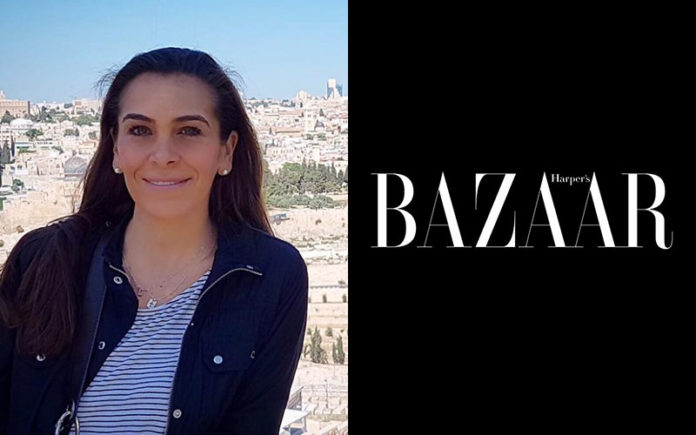
Harper’s Bazaar Mexican Editor in Chief Lucia Alarcón
< 1min read
Fashion magazine Harper’s Bazaar is investigating Lucia Alarcón, editor-in-chief of the Mexican version of the magazine and part-time cousin of former Mexican labour minister Javier Lozano.
Lucia Alarcón tweeted “Jesus is changing lives!” and published a video in which representatives of the LGBT community were allegedly undergoing conversion therapy.
The journalist quickly removed the post, but many social media spies already condemned her for homophobic statements.
Advertisement
The head office of Harper’s Bazaar magazine, which is located in the United States, reacted to Alarcon’s homophobic statement.
“We noticed that a post was published from a personal account associated with Harper’s Bazaar Mexico that promoted discrimination. This is unacceptable, and at the moment we are actively addressing the issue with the publisher. We condemn hatred, homophobia, discrimination and racism. We support representatives of the LGBT community, as well as advocate for a diverse, inclusive and fair culture for all, ” – said in the official Harper’s Bazaar US Instagram account.
The Mexican unit replied that it would begin an investigation into the chief editor.
Alarcon herself on Instagram soon wrote that she apologizes to those whom she has offended.
“I will cooperate with those who are investigating and will accept the sanctions that the publisher will impose, who teach to be tolerant. I am very sorry that this happened, but it is never too late to rectify the situation. I thank those who gave me instructions.”
The editor-in-chief of Harper’s Bazaar Mexico has not been fired or even temporarily removed from office.
Last Updated on Jun 17, 2021
The news team for Gay Nation love tips from our readers. Got tips or a news story that you would like published? Go here to tell us something. Visit the Gay Nation store Now
When it comes to cultural phenomena, there are two general truisms:
First, there is nothing new under the sun. (That is to say, nearly every idea we encounter on a daily basis, be it musical, cinematic or theatrical, is a rehashing or a retelling of something that came before.)
Second, cultural memory is notoriously short, which typically renders the average person less aware of (or at least less bored by) the existence of No. 1 above.
Given these two truths, one would be forgiven for thinking that drag is finally having its long-awaited cultural “moment.” Turn on the TV or scroll through your newsfeed today and drag seems to be everywhere. “RuPaul’s Drag Race” is about to enter its fourteenth season, “Pose” is changing lives and educating the masses on New York’s underground drag ball culture (and winnings tons of awards while doing it) and former boy bander Harry Styles even performed on “Saturday Night Live” wearing a dress.
But none of what we’re seeing today is even remotely new.
The Great Conch Republic Drag Race practically demands that participants don heels and skirts. COURTESY PHOTO
Consider the four decades from 1975 to the mid-aughts — Boy George (who was in fact a boy, but preferred not to look much like one) was a household name, RuPaul became a fixture on televisions across America, donning her sky-high wigs on “Hollywood Squares,” the ever-subversive Dennis Rodman was wearing dresses on a regular basis, “Hedwig and the Angry Inch” had exploded on the Off-Broadway scene and movies like “The Rocky Horror Picture Show,” “The Adventures of Priscilla, Queen of the Desert” and “To Wong Foo, Thanks for Everything! Julie Newmar” were, if not exactly blockbusters, at least popular enough that audiences across the world were becoming acquainted with the image of a man in a dress and a full face of makeup.
But even further back, the phrase “drag queen” first appeared in print in 1941 in Gershon Alexander Legman’s study, “The Language of Homosexuality: An American Glossary.” There, it was defined as, “A professional female impersonator; the term being transferentially used of a male homosexual who frequently or almost invariably wears women’s clothing, often for purposes of homosexual contact.” But if we learned anything in high school, we know at the very least that men dressing as women has occurred for centuries, even farther back than Shakespearean England.
The music continued to blast as firefighters fought the 1995 blaze that consumed the Copa, a famed gay disco on Duval Street in Key West. COURTESY OF FLORIDA ARCHIVES
Down in Key West, it feels like drag has existed as long as anyone can remember, even back in the days when the island was populated with no one but shrimpers and sailors.
And today, the Aquanettes and 801 Girls and the female impersonators who perform under their male names, like Christopher Peterson and Randy Roberts, are institutions. Local celebrity drag queens like Sushi and Inga are as recognizable by name — and more recognizable by face — to most locals (and many tourists, too) than Jimmy Buffett, Mr. Margaritaville himself. The girls hustle on Duval Street before shows and headline local fundraisers and variety shows. During the pandemic, Sushi, aka Gary Marion, and her merry band of fellow costumers churned out hundreds, if not thousands, of masks to raise money for the 801 Girls while the cabaret was closed.
Female impersonator Christopher Peterson actually does his own vocals for his Eyecons show at LaTeDa. He does a dizzying array of impressions — Marilyn Monroe, Tina Turner, Liza Minnelli, Barbra Streisand and, seen here, Judy Garland.
So how, exactly, did we get to this cultural moment, where seeing a man in a wig and a dress has become almost mundane in its normalcy? In Key West, we have decades of drag foundations and a number of pioneering performers to thank.
From the Copa to CNN
The allure of gay tourism in Key West started to climb in the 1970s, when a number of gay guesthouses, bars and restaurants opened their doors. Two bars in particular, the Monster and Delmonico’s, were among the first establishments to host drag performances, although the shows were not exactly the choreographed masterpieces we think of today.
Longtime Key West resident Rikki Fessler, who moved to the island in 1978, discovered the Monster when he performed in drag there as a member of the Royal Scagettes, a cross-dressing musical comedy troupe based in Coconut Grove. At the time, both the Monster and Delmonico’s frequently played host to traveling female impersonators.
“Back in the early ’70s, before I came down here, Delmonico’s, which was located approximately where Rick’s is right now, brought a show called ‘Broad Minded Men’ down,” said Fessler. “It starred Michael St. Laurent, Stacey Carlson and Emory Dubois, who was a former Ms. Gay Florida winner. Delmonico’s was the only fully recognized gay bar in the city at the time, although Captain Tony’s was tolerant enough to host a drag group called Lip Sync that featured Gordon Ross, Kim Lempesis, and Michael Reece.”
When the Monster opened in the late ’70s, Fessler scored a coveted job as a bartender — and drag performer. “When the Monster started up, the bartenders formed a group called the Monsterettes and we’d do a show every few months with the bartenders performing in drag,” Fessler said. “It was gay camp, intended to be funny.”
Small though Key West may be (and it was much smaller back in those days), the drag community was not content to let the Monsterettes have their drag moment without some competition. After the Monsterettes came about, the bartenders at LaTeDa formed their own group — the LaTeDettes — and Papillon, which was located in the Atlantic Shores (an infamous and long-closed gay hotel), hosted its own merry band of White Glove Girls.
“I directed a show called Underestimated Understudies that brought in parts of each of those troupes — the Monsterettes, LaTeDettes and White Glove Girls,” Fessler said. “And as the drag community grew, the Fairy Garden Room at the Monster and then the Copa, when it opened, started bringing down big names in the drag and not drag worlds, like Eartha Kitt and Dana Manchester.”
The 1978 formation of the Key West Business Guild, a chamber of commerce type organization, was created in large part to promote the island as a haven for gay tourists and in the mid-’80s, Duval Street’s Copa and Club Epoch was the place for the gay community to see and be seen. Key West’s own disco inferno featured many androgynous and drag entertainers from the disco days, like Grace Jones, Vicki Lawrence and Divine. The Copa hosted grand theme parties where the dance floor was always packed and there was always a line to get in. When the club burst into flames in 1995, the music reportedly still blared inside while the firefighters doused the blaze.
What we now call Aqua Nightclub was once called Diva’s, a dance bar that also featured drag shows back at the turn of the millennium. And when 801 opened in 1987, the now-famous Sushi was working across the street, cleaning Bourbon Street Pub after hours. Before long, Sushi was hosting “Drag Your Friends to Friday,” a Friday night drag bartending event at Bourbon Street that quickly became the busiest night of the week. On the suggestion of Jim Gilleran, co-owner of Bourbon Street at the time, bartending eventually turned into drag performance.
One drag night became two, and then owners Gilleran and Joe Schroeder bought 801, where the outrageously popular drag queen R.V. Beaumont was already doing drag shows. Sushi was appointed drag queen in charge, and the 801 Girls were officially born. Today, drag shows at 801 and Aqua run the gamut, from wholesome and lighthearted to raunchy and blush-inducing. The girls lip-sync tongue-in-cheekily to songs like Shania Twain’s “Man! I Feel Like a Woman” and Katy Perry’s “I Kissed a Girl.”
New Year’s Eve 1998 was the first time that beloved local drag queen Sushi dropped down to Duval Street in her now-famous red glitter high-heeled shoe. In 1999, the story goes, a local cameraman filmed the shoe drop and put it on the internet and The Associated Press and CNN picked it up. The following year, CNN included the shoe drop in its coverage of millennium celebrations around the world and Sushi has been a New Year’s Eve staple on CNN every year since — Key West’s very own drags to riches story.
Drag for charity
Because their personalities are so much larger than life and outrageous, it’s sometimes easy to forget that Key West’s resident drag queens and female impersonators are an integral part of the fabric of the island, citizens who are civically active and invested in giving back to and bolstering the community in which they live and work. Since 1982, during the height of the AIDS epidemic, drag queens and chromosomal queens have competed for the title of Queen Mother, a contest held the Monday after Mother’s Day each year and organized by legendary drag queen John “Ma” Evans. As in your typical pageant, contestants compete in categories including appearance, talent, pose, and originality. The pageant raises money for a constantly rotating list of charities in town, from Helpline to the Florida Keys SPCA.
In 1983, Bourbon Street Pub hosted the first Conch Republic Red Ribbon Bed Race, in which local bars and establishments organize teams to push decorated bed floats down Duval Street to raise money for A.H. Monroe. And in April 1998, three years after the Copa had succumbed to its fiery end, Joey Schroeder of Bourbon Street Pub devised the Great Conch Republic Drag Race to rally the local gay community around a new tradition.
The infamous drag race, held during Conch Republic Days, practically mandates stiletto heels, mini-skirts and hairspray. Men in drag, decked out in daringly short dresses, makeup, and teased tresses, race down a block of Duval Street in their highest platform heels as they tackle an obstacle course, made all the more treacherous by the nature of the footwear involved. These obstacles include running football drillstyle through tires, weaving overstuffed shopping carts between traffic cones in a driver’s test from hell and dodging an abandoned wig or two like they’re banana peels in Mario Kart.
This (Wo)man’s work
Without question, Key West’s Christopher Peterson is one of North America’s most talented (and hardest working) female impersonators. In his nearly nightly Eyecons show at LaTeDa, Peterson does a dizzying array of impressions — Marilyn Monroe, Tina Turner, Liza Minnelli and, of course, Barbra Streisand, can all make an appearance on stage on any given night. And unlike the drag shows at 801 and Aqua, where the girls typically lip-sync their numbers, every note in Peterson’s show is sung by the man himself.
Peterson started performing in drag in Halifax, Nova Scotia, when he was fresh out of high school. “My real career started when I moved to Vancouver in 1982,” he said. “In 1984, I won the first Mr. Alternative pageant at the Orpheum Theater, and then I was thrust into a whole different world of professional drag. In the ’80s, drag was all about female celebrity impersonation. At the time, you only really saw men like Milton Berle doing impressions of famous women on TV, but Divine had just come on the scene and she was the first breakthrough star who had created her own outrageous drag character.”
Peterson, a Canada native, was working in Toronto in late 1997 when friend connected him with Sal Rapisardi, who ran Diva’s in Key West. “An eight-week run at Diva’s turned into 12 weeks, which turned into 23 years,” he laughed. “By then, the Copa had burned to the ground and so Sal decided to open up a small dance club called Diva’s, where he wanted to host full drag shows. Vogue, Vanna Black and Diamonique were the house girls and I came in and did the early show.”
It didn’t take long for the Diva’s drag shows to join the list of not-tomiss nighttime entertainment in Key West. “The first few weeks almost nobody showed up and then the buzz got around,” Peterson said. “I remember one Thursday night I was in the dressing room and Blake, the DJ, came to the back and opened up the door and said, ‘There are 300 people sitting down on the dance floor waiting for you to go on.’ And from that point on, every night 300 people would sit on the dance floor and wait. And it was a mix of gay and straight — exactly the type of audiences we’re getting now. It was a great, great time to be in Key West doing drag.”
It was during his stint at Diva’s that Mark Barauck, who owned LaTeDa at the time, showed him the plans for The Crystal Room, LaTeDa’s upstairs cabaret theater, and Peterson signed on to be one of its star performers. And even today, 23 years after he first started, Peterson — and Marilyn, Tina, Liza, and Barbra — are still performing to soldout crowds.
Though Peterson may dress in drag, he doesn’t necessarily consider himself a drag queen — a holdover mentality from his early days performing as a woman.
“When I first started in the business, being a ‘drag queen’ was a dirty thing,” he said. “A drag queen was somebody who wore big hair and too much jewelry and loud outfits. The goal for those of us in the business was to try to become a female impersonator. One of the things I learned right away was that you could have a drag name, like Sara Lee or Iris or Emerald, but if you wanted to be a professional female impersonator you had to have a stage name. In other words, you want the emcee to say, ‘Ladies and gentlemen, Mr. Christopher Peterson.’ And then the curtain opens up and a beautiful, glam woman is standing there and the audience goes, ‘Wait, that’s a man?’ And that’s why I’m Christopher Peterson and not Samantha.”
But the world of female impersonation has certainly evolved since the ’70s and ’80s.
“Drag has had a slow creep into the cultural consciousness, but it’s almost like what I do now is kind of considered not just passé but pooh-poohed,” Peterson said. “People go see drag shows and they want the three blue wigs and the clown makeup — what we call ‘clowning drag.’ That’s the direction that drag has gone in and it’s made it so that anybody can do it. There’s a fun good thing about that, but there’s also a sad thing about that. Whether you’re 7 or 70, man or woman, anyone can do drag now. Not everyone is good at it, but everybody can do it.
Drag for a modern era
Because of Key West’s status as a mecca for gay tourism, the island’s drag queens have the unique opportunity to perform every night year-round for a varied audience — men, women, gay, straight, locals, tourists, and every variation in between. Drag shows serve as an accessible way through which any individual, regardless of gender or sexual identity, can participate in gay life. And by making the gay world more available to anyone who cares to partake of it, the meaning of drag shows transcends the merely performative nature and becomes a greater statement on acceptance and equality. You don’t need to be a gender studies scholar to appreciate the nuances of a show in which a man named Roger Hultman can so convincingly transform himself from a club kid to a Swedish bombshell named Inga and wow a gay couple from New York City as much as someone who lives a more conservative lifestyle.
Interviewed in a Key West newspaper for a story about drag queens in Key West in the early 2000s, Sushi said, “We’re not just lip-syncing up here, we’re changing lives by showing people what we’re all about.”
Because the shows are so entertaining, and because they’ve become synonymous with Key West, they attract viewers who otherwise wouldn’t be exposed to gay culture. And in so doing, as Christopher Peterson articulated, they’re perhaps accelerating that “slow creep into the cultural consciousness” to the point where we’re not just experiencing one drag “moment,” but a phenomenon that will endure in its current intensity until the distinction between drag entertainment and non-drag entertainment is as blurred as Maya Montana’s flawless contouring. ¦