Kansas Gov. Laura Kelly announced Thursday she has vetoed a proposed ban on transgender athletes from playing on school sports teams for girls and women.The bill was originally approved by the Republican-controlled House and Senate in early April.“This legislation sends a devastating message that Kansas is not welcoming to all children and their families, including those who are transgender — who are already at a higher risk of bullying, discrimination, and suicide,” Kelly said in a news release announcing the veto.“As Kansans, we should be focused on how to include all students in extracurricular activities rather than how to exclude those who may be different than us. Kansas is an inclusive state and our laws should reflect our values. This law does not do that.”Kelly said the bill would have caused more harm than good.“This bill would also undoubtedly harm our ability to attract and retain businesses,” she said. “It would send a signal to prospective companies that Kansas is more focused on unnecessary and divisive legislation, than strategic, pro-growth lawmaking.”Kansas Republicans said Kelly’s veto was disappointing. “It’s not surprising but nonetheless disappointing that Governor Kelly opted to veto the Fairness in Women’s Sports Act and capitulate to the mistruths and extreme rhetoric offered by the left,” Kansas Senate President Ty Masterson and State Sen. Renee Erickson said in a statement.“The Fairness in Women’s Sports Act is as simple as it sounds – it ensures fairness. It’s not about anything else other than that, and no state should allow itself to be intimidated by big corporations or the NCAA into pretending otherwise. We will continue to fight for fairness in women’s sports until this bill becomes law.”Kansas is among more than 20 states that have considered such a ban this year, pushing back against an executive order from Democratic President Joe Biden aimed at preventing discrimination against transgender students. Idaho enacted such a ban last year, and Republican governors in Arkansas, Mississippi and Tennessee have signed measures this year.On Wednesday, the Missouri House advanced a bill that banned transgender girls from playing on girls’ sports teams.“It’s about scoring points in the culture wars,” said Democratic state Rep. Boog Highberger, of Lawrence, home to the University of Kansas. “Instead of finding new ways to persecute people for being the way that God made them, why don’t we work on understanding — increasing our understanding and compassion instead?”Supporters argued that they’re trying to preserving decades of hard-won opportunities for “biological” girls and women to compete in K-12 sports and win college athletic scholarships. They suggested that failing to enact such a ban represented discrimination against girls and women.Backers of the bill were eight votes short in the House and one short in the Senate of the supermajorities they would need to override a veto.Erickson, a Wichita Republican and former college basketball point guard who led the push for the bill, said she hopes to get at least one colleague to switch to yes after Kelly vetoed the measure.“I want girls and women to have a chance at a fair and equitable playing field in sports,” she said. “This bill protects that.”With Idaho’s ban on hold because of a federal lawsuit, the American Civil Liberties Union has promised to file a lawsuit if Kansas enacts a law.The threat of a lawsuit — and arguments that Kansas could lose collegiate sports tournaments or business development — irritated some conservative lawmakers. They also bristled at LGBTQ-rights advocates’ predictions that enacting the ban would increase bullying of transgender students.“Saying, ‘If you don’t do what we like and do what we want or think different than us, we’re going to hurt you by not coming to your state,’ that is corporate bullying, and it’s wrong,” Erickson said. Supporters of such bans have pointed to the 15 championships won between 2017 and 2019 by two transgender high school runners in Connecticut, which prompted a federal lawsuit. They argue that “biological boys” have innate physical advantages in girls’ and women’s sports that would ruin competition.“It’s discrimination to not pass this — it’s discrimination for women,” said Sen. Kristen O’Shea, a Topeka Republican. Sen. Mark Steffen, a Republican from south-central Kansas, told colleagues last month that the bill was based on “indisputable physiological facts” that demonstrate “the male as a genetically and time-engineered superior machine.” He said Friday that the issue also is about “the chaos that’s permeating our country.”Supporters generally have been unable to cite local examples of problems. The association overseeing extracurricular activities in Kansas K-12 schools says it has been notified of only five active transgender athletes, and there is no known case of a transgender athlete having won a Kansas championship.The debate in the Senate became emotional and heated. Minority Leader Dinah Sykes, a Kansas City-area Democrat, began to cry as she said the proposed ban “hurts vulnerable children.” Sen. Ethan Corson, another Kansas City-area Democrat, found himself accused of ageism after he suggested the bill’s support resulted from many senators being 60 or older and fearing what’s “different than the way we grew up.”In the House, freshman Democratic Rep. Stephanie Byers, of Wichita, the state’s first transgender lawmaker, saw the bill as an effort to prevent trans students from being fully part of society. “Trans girls are girls,” she told colleagues. “Trans women are women.”The Associated Press contributed to this article.
The bill was originally approved by the Republican-controlled House and Senate in early April.
Advertisement
“This legislation sends a devastating message that Kansas is not welcoming to all children and their families, including those who are transgender — who are already at a higher risk of bullying, discrimination, and suicide,” Kelly said in a news release announcing the veto.
“As Kansans, we should be focused on how to include all students in extracurricular activities rather than how to exclude those who may be different than us. Kansas is an inclusive state and our laws should reflect our values. This law does not do that.”
Kelly said the bill would have caused more harm than good.
“This bill would also undoubtedly harm our ability to attract and retain businesses,” she said. “It would send a signal to prospective companies that Kansas is more focused on unnecessary and divisive legislation, than strategic, pro-growth lawmaking.”
Kansas Republicans said Kelly’s veto was disappointing.
“It’s not surprising but nonetheless disappointing that Governor Kelly opted to veto the Fairness in Women’s Sports Act and capitulate to the mistruths and extreme rhetoric offered by the left,” Kansas Senate President Ty Masterson and State Sen. Renee Erickson said in a statement.
“The Fairness in Women’s Sports Act is as simple as it sounds – it ensures fairness. It’s not about anything else other than that, and no state should allow itself to be intimidated by big corporations or the NCAA into pretending otherwise. We will continue to fight for fairness in women’s sports until this bill becomes law.”
Kansas is among more than 20 states that have considered such a ban this year, pushing back against an executive order from Democratic President Joe Biden aimed at preventing discrimination against transgender students. Idaho enacted such a ban last year, and Republican governors in Arkansas, Mississippi and Tennessee have signed measures this year.
“It’s about scoring points in the culture wars,” said Democratic state Rep. Boog Highberger, of Lawrence, home to the University of Kansas. “Instead of finding new ways to persecute people for being the way that God made them, why don’t we work on understanding — increasing our understanding and compassion instead?”
Supporters argued that they’re trying to preserving decades of hard-won opportunities for “biological” girls and women to compete in K-12 sports and win college athletic scholarships. They suggested that failing to enact such a ban represented discrimination against girls and women.
Backers of the bill were eight votes short in the House and one short in the Senate of the supermajorities they would need to override a veto.
Erickson, a Wichita Republican and former college basketball point guard who led the push for the bill, said she hopes to get at least one colleague to switch to yes after Kelly vetoed the measure.
“I want girls and women to have a chance at a fair and equitable playing field in sports,” she said. “This bill protects that.”
With Idaho’s ban on hold because of a federal lawsuit, the American Civil Liberties Union has promised to file a lawsuit if Kansas enacts a law.
The threat of a lawsuit — and arguments that Kansas could lose collegiate sports tournaments or business development — irritated some conservative lawmakers. They also bristled at LGBTQ-rights advocates’ predictions that enacting the ban would increase bullying of transgender students.
“Saying, ‘If you don’t do what we like and do what we want or think different than us, we’re going to hurt you by not coming to your state,’ that is corporate bullying, and it’s wrong,” Erickson said.
Supporters of such bans have pointed to the 15 championships won between 2017 and 2019 by two transgender high school runners in Connecticut, which prompted a federal lawsuit. They argue that “biological boys” have innate physical advantages in girls’ and women’s sports that would ruin competition.
“It’s discrimination to not pass this — it’s discrimination for women,” said Sen. Kristen O’Shea, a Topeka Republican.
Sen. Mark Steffen, a Republican from south-central Kansas, told colleagues last month that the bill was based on “indisputable physiological facts” that demonstrate “the male as a genetically and time-engineered superior machine.” He said Friday that the issue also is about “the chaos that’s permeating our country.”
Supporters generally have been unable to cite local examples of problems. The association overseeing extracurricular activities in Kansas K-12 schools says it has been notified of only five active transgender athletes, and there is no known case of a transgender athlete having won a Kansas championship.
The debate in the Senate became emotional and heated. Minority Leader Dinah Sykes, a Kansas City-area Democrat, began to cry as she said the proposed ban “hurts vulnerable children.” Sen. Ethan Corson, another Kansas City-area Democrat, found himself accused of ageism after he suggested the bill’s support resulted from many senators being 60 or older and fearing what’s “different than the way we grew up.”
In the House, freshman Democratic Rep. Stephanie Byers, of Wichita, the state’s first transgender lawmaker, saw the bill as an effort to prevent trans students from being fully part of society.
“Trans girls are girls,” she told colleagues. “Trans women are women.”
Wide range of business and advocacy groups, athletes oppose anti-trans legislation
More than 80 major U.S. corporations have stood up and spoke out to oppose anti-transgender legislation being proposed in states across the country. New companies like Facebook, Pfizer, Altria, Peloton, and Dell join companies like Amazon, American Airlines, Apple, AT&T, AirBnB, Google, Hilton, IBM, IKEA, Microsoft, Nike, Paypal, Uber, and Verizon in objecting to these bills. Four of the largest U.S. food companies also condemned “dangerous, discriminatory legislation that serves as an attack on LGBTQ+ individuals, particularly transgender and nonbinary people,” and the Walton Family Foundation issued a statement expressing “alarm” at the trend of anti-transgender legislation that has recently become law in Arkansas.
The nation’s leading child health and welfare groups representing more than 7 million youth-serving professionals and more than 1000 child welfare organizations released an open letter calling for lawmakers in states across the country to oppose dozens of bills that target LGBTQ people, and transgender children in particular.
The NCAA opposes efforts to limit participation of transgender students
The NCAA Board of Governors released a public letter making clear that it “firmly and unequivocally supports the opportunity for transgender student-athletes to compete in college sports.” Moreover, “When determining where championships are held, NCAA policy directs that only locations where hosts can commit to providing an environment that is safe, healthy and free of discrimination should be selected.” This puts the 30 states with discriminatory anti-transgender
A fight driven by national anti-LGBTQ groups, not local legislators or public concern
These bills come from the same forces that drove previous anti-equality fights by pushing copycat bills across state houses — dangerous, anti-LGBTQ organizations like the Heritage Foundation, Alliance Defending Freedom (designated by Southern Poverty Law Center as a hate group), and Eagle Forum among others.
For example, Montana’s HB 112, the first anti-transgender sports bill to be passed through a legislative chamber in any state, was worked on by the Alliance Defending Freedom.
Trans equality is popular: Anti-transgender legislation is a low priority, even among Trump voters
A new PBS/NPR/Marist poll states that 67% of Americans, including 66% of Republicans, oppose the anti-transgender sports ban legislation proliferating across 30 states.
In a 10-swing-state poll conducted by the Human Rights Campaign & Hart Research Group last fall:
At least 60% of Trump voters across each of the 10 swing states say transgender people should be able to live freely and openly.
At least 87% of respondents across each of the 10 swing states say transgender people should have equal access to medical care, with many states breaking 90% support
When respondents were asked about how they prioritized the importance of banning transgender people from participating in sports as compared to other policy issues, the issue came in dead last, with between 1% and 3% prioritizing the issue.
Another more recent poll conducted by the Human Rights Campaign & Hart Research Group revealed that, with respect to transgender youth participation in sports, the public’s strong inclination is on the side of fairness and equality for transgender student athletes. 73% of voters agree that “sports are important in young people’s lives. Young transgender people should be allowed opportunities to participate in a way that is safe and comfortable for them.”
States that pass anti-transgender legislation suffer economic, legal, reputational harm
Analyses conducted in the aftermath of previous divisive anti-transgender bills across the country, like the bathroom bills introduced in Texas and North Carolina and an anti-transgender sports ban in Idaho, show that there would be or has been devastating fallout.
The Idaho anti-transgender sports bill that passedwas swiftly suspended by a federal district court. The National Collegiate Athletic Association (NCAA) came out against the Idaho bill and others like it and subsequently moved planned tournament games out of Idaho.
The Associated Press projected that the North Carolina bathroom bill could have cost the state $3.76 billion over 10 years.
During a fight over an anti-transgender bathroom bill in 2017, theTexas Association of Business estimated $8.5 billion in economic losses, risking 185,000 jobs in the process due to National Collegiate Athletic Association (NCAA) and professional sporting event cancellations, a ban on taxpayer funded travel to those states, cancellation of movie productions, and businesses moving projects out of state.
I mean, think of the global ramifications of that kind of event, when connected to other doctrinal developments on the Catholic left in German and Europe in general. Remember that recent Memo to journalists that GetReligion patriarch Richard Ostling, the one with this headline: “With open talk of schism, will German bishops mar the rest of Pope Francis’s reign?”
But there seems to be some question about whether the plans for this event are worthy of mainstream media coverage. Why is that? That was the topic of this week’s “Crossroads” podcast (click here to tune that in or sign up for the podcasts with iTunes).
One crucial detail jumped out at me in the overture of this Crux report (see if you can spot it):
ROME — Continuing to openly challenge the Vatican, several Catholic leaders in Germany are openly supporting the blessing of same-sex couples, with a massive blessing service scheduled for May 10, in direct opposition to Rome’s chief doctrinal office.
Bishop Franz-Josef Overbeck of Essen said that the priests in his diocese will face no canonical consequence if they decide to bless gay and lesbian couples next month as part of the event called “Love wins, blessing service for lovers.” …
His comments came in an interview with WDR earlier this week, and follow his comments on Easter, when he argued that there are “many blessings for gay couples” in Germany. He also said that the Catholic Church is not supposed to reject gay people but “find ways for homosexuals to be able to live together.”
Note: We are not talking about one or two rebellious priests. There is a bishop who plans — in a rather passive-aggressive manner — to support the event by refusing to discipline his priests if they take part.
Obviously, Bishop Overbeck is not the only man in a mitre in Europe who has gone on the record in opposition to that recent headline-fueling Vatican ruling against same-sex marriages. Check out my “On Religion” column on that ruling and the aftermath on the Catholic left: “Did Pope Francis undercut that Vatican ruling on blessings for same-sex couples?”
There are many, many Catholic priests (and other activists) in the German Parish Priests Initiative who have signed a petition in support of same-sex blessings.
That made it sound like there was the potential for a wave of public same-sex union rites — as opposed to those held in secret — in Germany and elsewhere. Unless I have misunderstood, it now sounds like there will be one May 10 event, perhaps led by priests who have clearly been given a green light from their bishop or bishops.
Think like a journalist: What’s the story?
What are the questions reporters will want to answer ahead of May 10, if they have decided that this story is worth covering (which it is)?
OK, who is taking part? Who are the priests who are risking their futures or, at the very least, face the potential wrath of German cardinals who still support the teachings of the Catholic Catechism? Where will this event be held? One location or many? Have there been communications from the Vatican about this planned celebration of what some German leaders clearly see as a valid development of doctrine?
So where is the mainstream and even elite coverage? What is happening here?
Well, ask yourself this question: If journalists wanted to support the LGBTQ cause at this point in the Catholic game, how would they handle the timing of the coverage? Would they want to out their sources on the Catholic left or protect them? Would they want to help conservatives put pressure on Pope Francis or keep things quiet?
Why not wait to cover the event or events when they happen? Why not, maybe, actively cooperate behind the scenes with the activists who are planning the event, thus guaranteeing access for coverage and photography, while protecting the planners in the short term?
Do mainstream journalists do things like that?
With that in mind, please allow me to do some time travelling. Set the WABAC Machine for Baltimore in 2011, when I wrote two posts about some strange (or not so strange) editorial decisions by editors at The Baltimore Sun. See these two posts, in particular: “Who made her a Catholic bishop?” and a podcast and post entitled “If Womenpriests were rabbis?”
The key is a passage from Sun coverage of a rite to ordain women as priests in a movement that continues to claim that it is a valid expression of Catholic sacramental life, even though it is rejected by the Vatican and mainstream bishops. Read this Sun language carefully:
Andrea Johnson, presiding as bishop, ordained two women from Maryland, Ann Penick and Marellen Mayers, one from Pennsylvania and one from New York in the sanctuary of St. John’s United Church of Christ. The church was filled with family members – including husbands of three of the ordinands – and friends, including some who are employed by the Archdiocese of Baltimore but who support the ordination of women. Photography was limited to protect the privacy of those attending the ceremony.
In 1994, Pope John Paul II said the church has no authority to ordain women, “and this judgment is to be definitively held by all the Church’s faithful.” In 2008, the Vatican further decreed that women who seek ordination or any bishop who attempts it immediately excommunicate themselves from the Roman Catholic Church.
Stop and think about this, again, in the context of the “Love wins, blessing service for lovers” plans in Germany on May 10.
Did Sun journalists know the timing for this ordination rite? Yes. Did they know the location? Yes. Did they know — this is a huge news story in and of itself — that employees of Catholic institutions, including the Archdiocese of Baltimore, were going to take part, to some degree? It would appear so.
Now, these Womenpriest events have been happening for years and years. They are, at this point, not all that newsworthy. The big story here, as I mentioned, was the behind-the-scenes participation of local Catholic leaders and educators in this illegal rite (in terms of Catholic law).
Why would journalists agree not to cover the big story? Why go so far as to agree not to photograph the congregation and, thus, expose Catholic employees who were working to undercut the laws and teachings of their own church?
To be blunt: The journalists didn’t want to hurt the cause.
Would they extend this grace to movements on the conservative side of the religion beat? In one of those earlier posts, I created this alternative vision. This is long, but I think you will see the links to the current context:
“ … Let’s say that the home mission board of the Southern Baptist Convention decided to hold a celebration in a Baltimore-area church sanctuary in which four people who are of Jewish birth and background would be ordained in order to serve in new congregations that would compete directly with local congregations that are affiliated with traditional Jewish movements. …
Now, as it turns out, the participants in this public celebration actually included recognizable leaders from the Baltimore Jewish Federation, major Jewish schools, the Jewish studies programs of local universities and even major Jewish congregations. They were there to celebrate the ordination of these new “rabbis,” cheering and applauding the rites.
And how about the news media? The event’s organizers asked the media professionals who were present to honor the privacy of these Jewish leaders who came to celebrate the ordination of these Jesusrabbis. For example, the Baltimore Sun team members agreed not to cover this important factual element of the story or even to take photos of the crowd. In a way, the Sun actually helped these Jesusrabbi movement supporters to maintain their positions in prominent local Jewish institutions, even though the overwhelming majority of local Jews would see their actions as scandalous acts of betrayal to any traditional form of the Jewish faith.
Did I mention that all of this took place in a church sanctuary in an event that was clearly open, in some sense, to the public?
But wait! If the event was secret, then that would be even more significant. The Jesusrabbi Movement even knew to invite these Jewish leaders who were acting in rebellion against their own congregations and institutions. They would had to have been, to some degree, on the inside.
So, who can imagine Sun editors cooperating in this manner in this hypothetical case, going to far as to ignore crucial news information that the public would want to know? How about other major media institutions? Would they agree to help the Jesusrabbis movement in this manner?
Once again, here is the current question: Why are journalists not following up on the Crux piece (and other online discussions) of the plans for the May 10 “Love wins, blessing service for lovers” same-sex union blessings in Germany? Will there be pre-event coverage?
Three transgender people allege they suffered abuse at a Miami jail last year after police arrested them during Black Lives Matter protests.
The Transgender Legal Defense and Education Fund in a letter it sent to Miami-Dade County Mayor Daniella Levine Cava on Wednesday notes Christian Pallidine, a college student who identifies as a trans man, was attending a Black Lives Matter protest in downtown Miami on May 31, 2020, when Miami-Dade police officers arrested him and charged him with violating a county-wide curfew.
Pallidine arrived at the Turner Guilford Knight Correctional Center a short time later, and the letter notes personnel abused him because of his gender identity.
“The staff at TGK subjected Mr. Pallidine to degrading and outrageous treatment because he is transgender,” it reads. “TGK staff forced him to strip and display his genitals in front of a group of officers — part of a series of invasive, pseudo-medical, sexualized procedures conducted on him for no legitimate purpose. TGK staff also belittled Mr. Pallidine, publicized his transgender status to others, asked gratuitous questions about his anatomy, and called him derogatory names.”
The letter, among other things, notes Pallidine underwent an examination that “focused solely on his transgender status” and it “took place in a public area where others could easily see and hear him and the person questioning him.” The letter says the officer who conducted the exam asked him “multiple questions about his genitals and plans for future medical care, such as, ‘Do you want a penis in the future?’”
Pallidine alleges he was forced to take a pregnancy test “because of his genitals” and officers mocked him because of his gender identity. Pallidine also says officers forced him to undergo a strip search and placed him in solidary confinement before his release.
Jae Bucci and Gabriela Amaya Cruz on July 19, 2020, attended a rally and march for Black trans women in downtown Miami. Miami-Dade police officers brought them to the Turner Guilford Knight Correctional Center after they arrested them.
Bucci, who is a teacher and makeup artist, on Wednesday during a virtual press conference that TLDEF, the Southern Poverty Law Center and the Harvard LGBTQ+ Advocacy Clinic organized, said the gender marker on her ID is female and the Miami-Dade Police Department processed her as such. Bucci noted Turner Guilford Knight Correctional Center personnel also processed her as female, but she said an officer told her, “Aha, I knew it. That’s what I was looking for” after she disclosed her gender identity.
Bucci said her friends were not able to find her because officers had reclassified her as male. Bucci told reporters that officers placed her with male prisoners and, like Pallidine, forced her to undergo an “illegal strip search in front of several officers.”
“They tugged at my piercings, drawing blood, and forcibly tried to remove my hair, assuming it to be a wig,” said Bucci.
“They forced me to sit with men … I was put in danger,” she added. “I needed protection. I asked to be seated with other women, but the guards were only hyper-focused on my genitals, repeatedly calling me a man.”
Bucci said she was later placed in solitary confinement “for hours with no contact, food, water, leading to a panic attack where I began to self-harm and contemplate suicide.” Bucci said officers also forced her to wear men’s clothing “with my breasts clearly visible.”
Jae Bucci (Photo by Emely Virta)
Amaya Cruz — a barista, artist and activist — said she suffered many of the same abuses that Bucci and Pallidine described once she arrived at the Turner Guilford Knight Correctional Center.
Amaya Cruz told reporters the officers did not know whether to place her with female or male inmates once she disclosed her gender identity to them.
She said officers forced her to remove her wig before they took her mugshot.
Amaya Cruz said she objected to male officers patting her down, and they told a female colleague that “he’s saying he’s a woman, but he’s a man. He has a dick still.”
Amaya Cruz said the female officer did her pat down and allowed her to fill out paperwork in which she disclosed her gender identity. Amaya Cruz said the officer allowed her to sit with other female inmates.
Amaya Cruz was born with ectrodactyly, a rare genetic disorder that limits finger movement, but she was subject to “excessive force” during the pat down and when guards took her fingerprints.
Amaya Cruz said the female officer who did her pat-down told her to change into a pair of basketball shorts and a white t-shirt before her release.
“I was so uncomfortable and I just complied because my only reaction was I don’t want to be here any longer,” said Amaya Cruz. “At that point I felt uncomfortable, humiliated, my gender was being yelled out the entire night. My gender identity was not being taken seriously in any way.”
Gabriela Amaya Cruz (Photo by Sonya Revell/Southern Poverty Law Center)
TLDEF Staff Attorney Alejandra Caraballo told reporters the “health and safety of our clients were jeopardized by the willful and wanton treatment by the officers at TGK.”
“The current policies followed at TGK are woefully inadequate and are discriminatory on their face, which will inevitably lead towards the targeted harassment of trans people in custody,” added Caraballo.
Harvard LGBTQ+ Advocacy Clinic Founding Director Alexander Chen also took part in the press conference alongside Arianna Lint, chief executive officer of Arianna’s Center, an organization that serves trans women in South Florida. Tatiana Williams, co-founder and executive director of Transinclusive Group, which also works with trans people in South Florida, also participated.
“The change has to happen, as we all mentioned, structurally,” said Williams. “It has to happen at the top.”
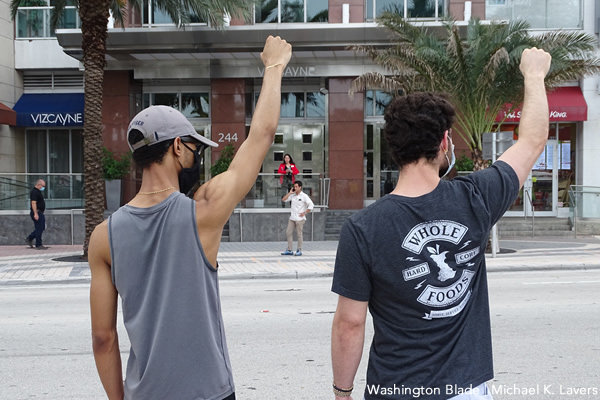
Two men hold their fists in their air during an anti-police brutality protest in downtown Miami on June 1, 2020. (Washington Blade photo by Michael K. Lavers)
The letter to Levine Cava calls for her office to “reach a resolution” with Pallidine, Bucci and Amaya Cruz without litigation that specifically addresses several points:
1) “Policy and procedure updates to address the issues faced by our clients and other transgender community members.”
2) “Meaningful accountability measures for MDCR (Miami-Dade Corrections and Rehabilitation Department) staff that go well beyond what Internal Affairs currently provides.”
3) “Appropriate discipline for the MDCR staff involved in the inappropriate treatment of our clients.”
4) “Updates to county records concerning our clients and their gender.”
5) “Compensation to our clients as allowed by law; and reasonable attorneys’ fees and costs as allowed by law.”
“We have achieved similar results working with officials elsewhere in the country, and are confident we can do the same here,” reads the letter.
Chen echoed this point during the press conference.
“We have every expectation that we will be able to come to an accord with the county that will both do justice to our plaintiffs and protect transgender people in the county going forward,” he said.
Lint, like Chen, noted Levine Cava championed LGBTQ rights when she was a member of the Miami-Dade County Commission until she succeeded now-Congressman Carlos Giménez last November.
“I am calling on Mayor Levine Cava to continue this support for the transgender community by taking steps to address the mistreatment of transgender individuals in Miami-Dade County jails,” said Lint. “Arianna’s Center is committed to working with Mayor Levine Cava to eradicate prejudice against the transgender community in our prisons, jails, detention centers and through the whole criminal justice system.”
Levine Cava’s office has not returned the Washington Blade’s request for comment.
Montgomery: State lawmakers have inched closer to approving a ban on so-called vaccine passports that would require proof of COVID-19 vaccination to access services from a business or state agency. The House Health Committee voted Wednesday to send the bill to House of Representatives for a vote. It has already cleared the Senate. The bill contains a number of exceptions. Surgeons, dentists, medical institutions, hospitals and other health care providers are exempted. Universities could still require students to receive a vaccine; however, there would be exceptions for vaccines approved for “emergency use” by the FDA, as is the case with all three COVID-19 vaccines given in the United States thus far. The idea of vaccine passports is to have a document that shows a person has been inoculated against COVID-19. Federal officials say there are no plans to make them broadly mandatory, but some Republican governors have issued orders barring businesses or state agencies from asking people to show proof of vaccination. The Senate approved the bill earlier this month by a 30-0 vote.
Alaska
Juneau: Legislators want a say in how the state spends more than $1 billion from a new federal aid package, a year after largely ceding decision-making on a prior pandemic-related relief package to Gov. Mike Dunleavy. Several lawmakers expect debate over how to spend the money to take center stage in the final weeks of the Legislature’s regular session, the Anchorage Daily News reports. Issues many lawmakers saw heading into session as critical to address or settle, such as Alaska’s long-running deficit and the future of the yearly oil check paid to residents from the state’s oil-wealth fund, have been overshadowed. Some lawmakers previously said the influx of new federal money should not be seen as an excuse to delay tough fiscal decisions. Senate President Peter Micciche said the federal aid provides an opportunity “to make a generational change in the economy of Alaska.” The Soldotna Republican said money could be used to retrain unemployed workers, develop infrastructure and prepare the state for the next decade. The Legislature hits its 121-day regular session meeting limit May 19. The state constitution permits a 10-day extension if enough lawmakers agree to one. Federal guidance on how the money can be spent isn’t expected until about May 10.
Arizona
Tucson: A plan to establish a large, federally supported mass vaccination site in metro Tucson is being shelved, and Pima County is now asking for it in mobile form instead. Following weeks of discussions, state and federal officials did not come to terms on an agreement for authorizing and running the proposed mass vaccination site, officials said Tuesday. The county is now pivoting to ask the Federal Emergency Management Agency for mobile sites capable of providing about 300 shots daily to reach populations that could use help getting vaccinated, said County Administrator Chuck Huckleberry. “It’s an inconvenience for a variety of reasons because they don’t have the technology, they don’t have the time, because they don’t have the wherewithal, mobility issues, language barriers,” said Dr. Francisco Garcia, the county’s medical officer. “We need to decrease those barriers.” The mass site would have been operated by FEMA and could have vaccinated up to 6,000 people daily. The plan’s apparent demise comes as existing state-run mass vaccination sites across the state have thousands of appointments available, including one on the University of Arizona’s campus in Tucson. State and county officials said sticking points in the talks on the proposed FEMA site included the state’s insistence it have a liability shield.
Arkansas
Little Rock: The state on Wednesday reported its biggest daily increase in coronavirus cases in more than a month and two more deaths from the illness caused by the virus. The Department of Health said virus cases rose by 352 to 334,061 total since the pandemic began. Arkansas has recorded 5,708 COVID-19 deaths. The increase was the biggest since the state reported 396 new cases March 16. Active virus cases, ones that don’t include people who have died or recovered, increased by 139 to 1,943. The state’s COVID-19 hospitalizations dropped by two to 175. Gov. Asa Hutchinson called the increase in cases “a serious reminder of the importance to get vaccinated” and urged Arkansans to schedule appointments if they hadn’t been immunized yet. “It is also a reminder that the virus is still here along with the more contagious variants,” Hutchinson said in a statement released by his office. “Our best defense is the vaccine.” The department said an additional 20,706 doses of COVID-19 vaccine were administered. More than 650,000 people in the state have been fully immunized, while about 331,000 have been partially immunized.
California
Los Angeles: Austin Beutner will step down as superintendent of the Los Angeles Unified School District, he announced Wednesday, leaving the post as the nation’s second-largest school district begins reopening classrooms shuttered for a year by the coronavirus pandemic. “I believe that it is fitting that a new superintendent should have the privilege of welcoming students back to school in the fall. I respectfully request that my contract end as planned on June 30,” Beutner said in a letter to the Board of Education. “In the meantime, I will remain focused on the task of ensuring that schools reopen in the safest way possible while helping in a seamless leadership transition.” Beutner said his three-year tenure at the head of the 600,000-student district was “the most rewarding job I’ve held during my nearly 40-year career.” The school board issued a statement praising Beutner’s “unwavering leadership during the extraordinary challenges” faced during the pandemic, when most students were restricted to remote learning. The board said Beutner was instrumental in providing school district services, including COVID-19 tests and vaccinations to employees, distributing computers to provide internet connectivity to virtually all students, and giving away more than 120 million meals to students and families in need in the community.
Colorado
Denver: The state’s clean energy industry lost more than 4,000 jobs in 2020 but rebounded, along with the rest of the country, after a low point earlier in the year. The sector employed 58,182 people in Colorado at the end of 2020, the Denver Post reports. The state, ranked 18th in the U.S. in industry employment, lost 6.8% of its jobs last year, but employment bounced back 6% from June to December. The solar industry in Colorado has regained sufficient traction, said Mike Kruger, CEO of the Colorado Solar and Storage Association. “We are full strength,” Kruger said. “I expect, when the numbers come out, we’ll be about a thousand folks down, from 7,000 to 6,000 in 2020. I think we’ll be up from that this year, given that all my members are hiring for everything.” The report from Environmental Entrepreneurs is based on an analysis of preliminary energy employment data by BW Research Partnership. The U.S. clean energy industry was growing by about 6% annually before the pandemic began, according to the report. Phil Jordan, vice president of the research firm, said about 66% of clean energy businesses employ fewer than 20 people, and many businesses have closed due to the pandemic. “The sector has rebounded better than many in the U.S. from its summertime lows, but there’s still a long way to go,” he said.
Connecticut
Hartford: The state will be offering free summer camp for about 24,000 children with the help of $11 million in federal COVID-19 relief funds, and officials hope cities and towns chip in some of their federal aid money to double or triple the number of summer camp spots for kids, Gov. Ned Lamont said Wednesday. The Democratic governor joined with members of the state’s congressional delegation, education officials and summer camp leaders in a video conference to announce the funding, which will be distributed through a competitive grant program. Officials said the grant program is aimed at helping children, particularly those in poor and minority communities, who have struggled with remote learning during the pandemic to catch up on learning and to provide opportunities to socialize with their peers whom many have missed over the past year. “Kids this summer need an emotional reset,” said U.S. Sen. Chris Murphy, D-Conn. “They need an ability to reconnect with their peers, to get into a space emotionally and socially and psychologically that they’re ready to succeed once schools reopen in sort of a quasi-normal setting in the fall.” Lamont said if municipalities and their school districts provide enough matching funds, they could provide free summer camp for more than 70,000 children.
Delaware
Wilmington: The Saint Clare Medical Outreach Van aims to provide primary care services to residents of underserved communities who are uninsured or reluctant to visit health care providers amid the pandemic. Many have avoided routine checkups for fear of contracting COVID-19. “One thing that we were seeing early on when our van resumed its services during COVID was reluctance on the part of the community to come into the hospital, especially those who were uninsured and have chronic conditions,” said Lisa Schieffert, manager of community health and well-being for St. Francis Healthcare, which runs the van. “That hesitancy really was around that fear of ‘am I going to go to the hospital and get COVID?’ ” As a result of community’s concerns, Schieffert, alongside Trinity Health Mid-Atlantic, developed several safety protocols for the van to alleviate coronavirus-related fears. Nurses and medical assistants don personal protective equipment at all times and screen patients for COVID-19 symptoms before they enter the bus. The safety protocols have caused the amount of patient traffic to increase to levels seen before the pandemic, Schieffert said. “That has gone a long way for us in terms of better managing, for example, diabetes so that these individuals are not being treated in the emergency department,” she said.
District of Columbia
Washington: Live music has struggled for more than a year under the pandemic, with music venues and clubs forced to shut their doors because of social distancing restrictions. But a COVID-19-friendly festival will bring live music and good vibes to the Petworth neighborhood over the weekend, WUSA-TV reports. The Petworth Porchfest includes 83 bands performing on 64 porches, all within about a mile of one another. The event Saturday afternoon is slated to run from 2 to 6 p.m. Organizers say there will be a wide range of bands and genres represented, with something for everyone. “Acts include everything from an old-time Appalachian square dance band to a Middle Eastern jazz fusion group,” organizers said in a release. Roosevelt High School will host two quartets featuring members of the National Symphony Orchestra. Organizers say if it rains, the free fest will take place the next day.
Florida
Naples: Vaccination rates among Southwest Florida’s Black residents are far below state averages, so authorities are bringing the lifesaving shots closer to where they live and to places of worship. The outreach is critical to overcoming residents’ reluctance to getting vaccinated out of mistrust of the health care system and misinformation about COVID-19 vaccines, Black civic leaders say. The challenge was made even harder when the federal government paused use of the one-dose Johnson & Johnson vaccine, which was seen as the best way to reach people who are reluctant to get immunized. Offering the vaccine near where Black residents live goes a long way toward making them feel more comfortable, said Theresa Shaw, executive director of Emmanuel Lutheran Church in Naples. Shaw helped form a coalition of 10 churches in Collier to assist people of all races get vaccinated. Since late February, the churches have helped 1,500 people get COVID-19 shots at the health department’s clinic site at North Collier Regional Park. Church volunteers can go door to door to educate people about the vaccine’s value for their health. “We don’t try to change their minds. We educate them as to the positives. You can’t change people’s mindsets,” Shaw said, adding that pastors also helped residents make appointments and fill out paperwork.
Georgia
Augusta: Less than two weeks out from Masters Week and the return from spring break, the city’s hospitals are again seeing their beds fill with COVID-19 patients, and cases overall are climbing compared to other cities. But this surge may be different from previous spikes. After many weeks, the Augusta area has again returned to a list of hot spots highlighted in the Community Profile Report from the White House COVID-19 Team. It’s one of 10 cities with a population less than 1 million listed as “Statistical Areas with Increasing Burden” from the disease, including a 23% increase in cases over the past week, according to that report. Since April 2, the Friday before Masters Week, through Tuesday, Richmond County recorded 403 new cases compared to 278 for the same period prior, an analysis found. Augusta reported 154 cases per 100,000 population over the past two weeks compared to 103 per 100,000 for Savannah, 115 per 100,000 for Athens and 70 per 100,000 for Macon, according to data from the Georgia Department of Public Health. The three Augusta hospitals had a combined 48 COVID-19 inpatients Tuesday, a level they last saw March 12. Among those hospitalized at AU Health, 58% were under age 50, unlike in previous surges, said Dr. Phillip Coule, chief medical officer for AU Health System.
Hawaii
Wailuku: Maui will soon require a second coronavirus test for trans-Pacific travelers arriving on the island. Maui County Mayor Michael Victorino said the program is expected to begin the first week of May, The Maui News reports. The new measure will require trans-Pacific travelers to take a rapid virus test when they arrive at Kahului Airport. All travelers are also required to get a pre-travel test before arriving in Hawaii. Residents who have been fully vaccinated in the state can skip testing and quarantine requirements for travel between islands beginning May 11, Gov. David Ige announced Tuesday. Those people will be exempt from testing at the Maui airport. Victorino said the county is interested in finding out how many COVID-19 cases are related to travel. “Maui has to introduce a secondary test to make sure that we are statistically correct that our visitors and travelers are not the ones bringing in a larger number of cases than we had in the past,” he said. Maui has a seven-day average positivity rate of 2.4%, and state health officials have said many cases are linked to a highly transmissible coronavirus variant first found in California. “It is about a layered approach to the health and well-being of our community, and every layer is important to reduce incoming travelers who may be infected by COVID-19,” Ige said.
Idaho
Boise: Legislation outlawing nearly all abortions in the conservative state by banning them once a fetal heartbeat can be detected headed to Republican Gov. Brad Little on Wednesday. The Republican-dominated Senate voted 25-7 to approve the measure that makes providing an abortion to a woman whose embryo has detectible cardiac activity punishable by up to five years in prison. It would also allow the woman who receives the abortion to sue the provider. Fetal cardiac activity can be detected as early as six weeks using an invasive vaginal ultrasound – before many women discover they are pregnant. “This is good legislation that gives a preborn child the same rights as a mother,” said the bill’s sponsor, Republican Sen. Patti Anne Lodge. The bill has exceptions for rape, incest or medical emergency. The exception for rape and incest would likely be impossible to meet, opponents said, because Idaho law prevents the release of police reports in active investigations. Opponents also said many rape victims don’t want to report the crimes to law enforcement right away, and even if they do, the reports are often sealed for three months or more. They say forcing women to immediately report their rape and fight to get a copy of the report quickly enough for an abortion would deeply compound the trauma they’ve already experienced.
Illinois
East St. Louis: Public school students in the city will be attending class a month longer this year to make up for a loss in educational progress due to the pandemic. East St. Louis School District 189 board voted late Tuesday to extend the school year by nearly a month. Instead of May 26, the last day of school will arrive June 29. The district’s approximately 5,200 students spent most of the school year logging into classes remotely. The disproportionately higher number of COVID-19 infections in areas served by the district kept students out of school until March of this year. Superintendent Arthur Culver said students, including those considered to be passing, have lost ground with remote learning. The extended school year is required for all students in preschool through 11th grade and for high school seniors who have not met graduation requirements by May 19. Currently, there are no plans for a traditional summer school. Culver said enrichment materials will be shared with parents, and if there is enough student and teacher interest, he wouldn’t be opposed to summer school in July.
Indiana
Indianapolis: State and local governments would be prohibited from issuing or requiring so-called vaccine passports under a bill approved by lawmakers. The Republican-dominated House and Senate voted Thursday by wide margins to approve a wide-ranging health care and insurance bill that included the ban. Vaccine passports in use or development in other countries are typically a cellphone app with a code that verifies whether someone has been vaccinated against COVID-19 or recently tested negative for the coronavirus. The Biden administration has ruled out a national vaccine passport, saying it is leaving it to the private sector to develop such a system. Republicans across the country portray the idea as a heavy-handed intrusion into personal freedom and private health choices. Rep. Martin Carbaugh, R-Fort Wayne, said the Indiana ban would protect individual health care information. Rep. Ed DeLaney, D-Indianapolis, criticized the ban as chasing the fantasy of something that doesn’t exist. The bill doesn’t place any limits on private businesses. It allows government agencies to continue keeping immunization records for public health administration and provide people with their own immunization records. The legislation now goes to Gov. Eric Holcomb for consideration.
Iowa
Fort Madison: Administration of COVID-19 vaccines has been halted at the Iowa State Penitentiary after nursing staff incorrectly gave 77 inmates overdoses of the Pfizer COVID-19 vaccine Tuesday, the state Department of Corrections said. Agency spokesman Cord Overton said in an email that once the error was realized, staff immediately sought guidance from the federal Centers for Disease Control and Prevention and from Pfizer. The inmates were notified of the overdose and are being closely monitored by medical staff, Overton said. The inmates affected have so far shown only the side effects commonly associated, including soreness at the injection site, body aches, fatigue and fever, he said. The mother of one of the inmates affected, Kimberly Koehlhoeffer, of Fairfield, said doctors told her son he and the others had received six times the recommended dose. The Pfizer vaccine is packaged as a concentrate that must be diluted with saline solution. Two nursing staff members who administered the vaccine to the 77 inmates have been placed on leave pending the outcome of an investigation, Overton said.
Kansas
Lawrence: Counties are increasingly allowing people to get a COVID-19 shot without an appointment as interest wanes. In the Lawrence area, mass vaccination clinics at the Douglas County Fairgrounds, which had been immunizing almost 700 people per hour at their peak, are coming to an end next week. They will be replaced next month with five-day-a-week drive-thru clinics that will deliver 200 to 300 shots per day to people at Lawrence Memorial Hospital without advance scheduling, the Lawrence Journal-World reports. The health department in Johnson County, the state’s largest, also opened a mass vaccination clinic in Lenexa to walk-ins Wednesday and Thursday, WDAF-TV reports. In the Wichita area, appointments will not be needed starting Monday to get a vaccination at the former downtown library, The Wichita Eagle reports. And Wyandotte County also has opened its three clinics to people who don’t have appointments. The shift comes as newly released state data shows counties turning away new doses, even though just 37% of Kansans are at least partially vaccinated. “It is kind of stalling. Some people just don’t want it,” said Stacey Hileman, a nurse with the health department in rural northwest Kansas’ Decatur County, where only about 29% of residents have gotten a dose.
Kentucky
Louisville: An outbreak of COVID-19 at a nursing home in the state where most residents were vaccinated is cited in a new federal study as an example of why it is “imperative” that more staff get vaccinated as new variants of the coronavirus emerge. The study, released Wednesday by the U.S. Centers for Disease Control and Prevention, found 18 residents and four workers at the nursing home who had been vaccinated tested positive for the virus after an unvaccinated worker brought a mutated strain of the virus into the facility. In all, 46 cases were identified at the nursing home in 26 residents and 20 workers. Three residents who contracted COVID-19 died, two of whom had not been vaccinated, the study said. But overall, those who had been vaccinated fared much better with fewer or no symptoms, it said. About half the staff and 90% of residents had been vaccinated for COVID-19. The facility is not identified in the CDC study. But the March outbreak occurred around the same time Gov. Andy Beshear and public health commissioner Dr. Steven Stack described an outbreak involving a variant of the coronavirus that had been identified at an Eastern Kentucky nursing home. A spokeswoman for Beshear confirmed Thursday that the Eastern Kentucky nursing home is the same facility cited in the CDC study.
Louisiana
Baton Rouge: After announcing this week that they will not require students to get COVID-19 vaccines, the presidents of LSU and the University of Louisiana system said Wednesday that they are reviewing how to accommodate faculty members who feel they might be at risk in returning to in-person classes this fall. Dr. Jim Henderson, president of the UL system, said the nine universities in his purview will assess requests by faculty members to teach online on a case-by-case basis assuming that the vaccines are as effective as expected and depending on public health conditions at the time. Henderson said administrators will consider age, medical conditions and family health concerns, along with the latest public health guidance, in making the decisions. “Widespread vaccination is just recently underway,” he said, adding that the Centers for Disease Control and other researchers “are collecting copious amounts of data that will lead to much more informed decision-making over the coming weeks.” But if the pandemic worsens, he said, “we will adapt.” LSU interim President Tom Galligan said his university has not decided whether it would require unvaccinated students to wear masks to class or tell professors how many unvaccinated students are in their classes.
Maine
Portland: Tiny baby eels are worth big bucks again. The state is home to the nation’s only significant fishery for the baby eels, called elvers. Prices tanked last year due to disruption to the worldwide economy caused by the onset of the coronavirus pandemic. This year, the fishery is experiencing a return to normalcy. The tiny, wriggling fish are worth $1,634 per pound to fishermen, the Maine Department of Marine Resources reported Monday. The elvers, which play a crucial role in Asian aquaculture, have been worth between $1,300 and $2,400 per pound every year since 2015, except last year, when they brought in just $525. The elver business has benefited from improved health in international trading at large, said Mitchell Feigenbaum, an elver dealer. “There’s confidence in the market in all commodities right now,” he said. “There’s a crazy boom in real estate, a crazy boom in the stock market, a crazy boom in the eel market.” The elver fishing season takes place in rivers and streams every spring in Maine. The eels are sold to Asian aquaculture companies that use them as seed stock so they can be raised to maturity and used as food. The improved prices are a boon to the industry after a frustrating 2020, said Darrell Young, co-director of the Maine Elver Fishermen Association. “It definitely makes life easier, the money does,” he said.
Maryland
Annapolis: Demand for COVID-19 vaccine remains high, but Gov. Larry Hogan said Wednesday that the state needs to get more creative to use all its supply. Maryland has administered more than 4 million vaccines, the governor said. More than 82% of people over 65 have been inoculated, and more than 55% of people over 18 have gotten a dose. “We truly are close to that light at the end of the tunnel, but those of you who have not yet been vaccinated, please go get a vaccine as quickly as you can,” Hogan said. To better reach others, the Republican announced initiatives to better get shots into the arms of the unvaccinated. He’s calling it “No Arm Left Behind,” and it will involve all state agencies and private companies. “This will include redoubling our efforts to reach that remaining 18% of Maryland seniors by going county by county and ZIP code by ZIP code in an effort to get every senior vaccinated,” Hogan said at a news conference. The initiative will include reaching out directly to more than 70,000 of the state’s Medicaid recipients who have not received a vaccine. State health officials also are partnering with some of the largest employers in Maryland – including Southwest Airlines, Exelon, Comcast and Amazon – to get their workforces vaccinated as expeditiously as possible.
Massachusetts
Somerville: A Boston suburb is holding fast to strict limits on businesses to limit the spread of the coronavirus, even as the state and other communities start to open up more widely. The city of Somerville continues to limit capacity to 25% at stores, offices, salons and gyms, whereas the state has been allowing for 50% capacity in the fourth and final phase of its economic reopening plan. But Somerville officials said in mid-March that third-phase restrictions will remain in place in the city across the river from Boston, at least for the foreseeable future, The Boston Globe reports. Restaurants and other businesses have complained about the rules, but Mayor Joe Curtatone said city officials are waiting for a more substantive drop in COVID-19 cases locally. He also said the city has done more to help the local restaurant industry weather the pandemic than many other communities.
Michigan
Detroit: Teachers and other city school employees who get a COVID-19 shot are eligible for a $500 bonus and two additional sick days. The extra days are intended to help employees who might have side effects after a vaccination, but they can also be carried over if not used, said Nikolai Vitti, superintendent of Detroit Public Schools Community District. The vaccine bonus will be paid with pandemic relief money from the federal government. More than 30% of school staff have been vaccinated, The Detroit News reports. “The incentive is a way to promote the greatest protections to all employees as we work to stop the spread of COVID, while respecting the individual’s choice to not vaccinate,” spokeswoman Chrystal Wilson said. The district has stopped regular in-person learning through at least May 11 because of rising COVID-19 cases in Detroit and southeastern Michigan.
Minnesota
St. Cloud: Coronavirus cases and hospitalizations, already “at a pretty high rate of daily case growth” across the state, have been especially rising in younger populations, including children, Minnesota Department of Health Commissioner Jan Malcolm said Tuesday. As of this week, the average age of residents admitted to hospitals for COVID-19 was 59, down from 69 in 2020. Dr. Brooke Moore, a pediatric pulmonologist at Children’s Minnesota, said there have been more children admitted to hospitals of late – 11 in the past week. Five children have been admitted to intensive care for COVID-19 in the past week, Moore said, and “three of them are very sick.” She urged Minnesotans over 16 to get vaccinated to help prevent spread to children, as none of the vaccines available has been cleared for use in children under 16. The number of new COVID-19 cases that are school-related, including in staff as well as students, has exceeded the rate of school-related cases in the state back in November, Malcolm said. In response, the state is increasing coronavirus testing resources to schools beginning Monday and encouraging schools to work to get students tested every two weeks, Minnesota Department of Education Commissioner Heather Mueller said.
Mississippi
Jackson: The state health department reported 319 new coronavirus cases and 10 related deaths Thursday. Since the virus hit the state in March 2020, a total of 310,137 cases and 7,173 coronavirus-related deaths have been reported. The department on Thursday reported 25 outbreaks at Mississippi nursing homes. There have been 10,442 cases in long-term care facilities and 1,974 deaths reported as of last Friday, the latest figures available. Residents between the ages of 25 and 39 represent the largest portion of the infected population in the state, with 68,399 cases reported Tuesday, the latest figure available. Among patients under 18, children between the ages of 11 and 17 have the highest infection rate, with 23,914 cases identified. The 65-and-older age group has the highest total number of deaths with 5,488 reported. According to health department data, 921,649 people have begun the vaccination process in Mississippi, as of Wednesday morning. Since December, about 714,399 people are fully immunized against COVID-19. Approximately 299,066 people are presumed recovered from the virus as of Tuesday, the latest figure available, according to the health department’s website.
Missouri
Kansas City: Vaccine doses that were sent to rural areas at the beginning of the state’s immunization campaign often didn’t reach locals, state data shows. That means that vaccinations in parts of largely rural southern Missouri have stalled at some of the lowest rates in the country, even though rural areas initially received more doses per person than cities, KCUR-FM reports. For instance, 46,000 doses were allocated as of April 13 to a cluster of nine counties that includes West Plains. But state data shows that only 37,000 doses were administered to the south-central region’s 137,110 residents. State data provides limited information about where they wound up, although many likely went to residents of urban areas. When vaccines supplies close to home were in short supply, many urban residents embarked on long road trips to get immunized. Rural residents, meanwhile, expressed more hesitancy in polls conducted by the Missouri Hospital Association. West Plains Mayor Jack Pahlmann said the pandemic had exposed deeply rooted skepticism toward the health care establishment among his Ozark neighbors. “They’re honest. They’re hard-working,” Pahlmann said. “But they’re just not – the term these days is ‘sheeple’ – they just don’t line up and do whatever the government tells ’em to do.”
Montana
Great Falls: City commissioners passed a resolution Tuesday night that ended city manager Greg Doyon’s emergency powers that were granted to him in response to the rapid spread of COVID-19. A resolution passed in March 2020 had affirmed a local emergency and defined Doyon’s power to declare an emergency and his ability to exercise that authority. “We joke about ‘Putin powers’ (Russian President Vladimir Putin), but the reality is that this is kind of a scary amount of authority that was given to me by that declaration,” Doyon said. “And even though the commission would have had to sanction some of the efforts there, really it’s an unprecedented thing, and I want to just tell you that I was not comfortable with it.” He said it was necessary in order to enact certain requirements, but he hopes the community understands what he did with that authority was to try to help the community get through the pandemic. “We’re at that point now where we’re able to retract some of that authority because we’re able to kind of carry on the way that we are now,” Doyon said. “Thank you for entrusting me with that.”
Nebraska
Lincoln: A political party focused on legalizing marijuana can now run candidates and claim registered voters after it gained official state recognition Wednesday. Secretary of State Bob Evnen said the Legal Marijuana NOW Party has met the requirements to qualify as a political party. The designation allows voters to register with the party, and party officials can nominate candidates for partisan offices. Activists Mark Elworth Jr. and Krystal Gabel, who frequently run for public office, said they collected more than 10,000 signatures over four years to gain party status. Approximately 6,800 signatures were needed. State law requires petition circulators to gather signatures equal to at least 1% of the total votes cast in the most recent governor’s race in each of Nebraska’s three congressional districts.
Nevada
Reno: Washoe County Commission Chairman Bob Lucey issued a statement defending the commission’s decision to eliminate social distancing requirements for businesses starting May1, despite an increasing coronavirus positivity rate. “We stand behind the plan because we know there is COVID fatigue in our community,” Lucey said. “People are going to return to life and the things they’ve missed in the last year whether we dictate mandates or not.” Lucey said the commission’s position is that individuals and families can make their own decisions about how to stay safe. “The community also has a choice on when and where they do their business,” he said. The commission’s plan to eliminate social distancing requirements was rejected by the city of Reno and the Washoe County District Health Officer late Wednesday. Lucey said the city of Sparks and the Nevada Hospital Association did not withdraw their endorsement. The Nevada COVID-19 Task Force planned to review the plan at a meeting Thursday.
New Hampshire
Concord: A timed hill-climb auto race up the Mount Washington Auto Road is making a return this year. The event, known as the “Climb to the Clouds,” has been rescheduled to Aug. 13-15, from July. It was canceled last year because of the coronavirus pandemic. The 7.6-mile climb heads along a serpentine tarmac and gravel road lined with trees, rocks and dramatic drop-offs, to the 6,288-foot summit. The climb was first held in 1904, making it one of the oldest motorsport competitions in the United States. More than 92,000 people have tested positive for the virus in New Hampshire, including 362 cases announced Wednesday. Two new deaths were reported, for a total of 1,273. The seven-day rolling average of daily new cases in New Hampshire decreased over the past two weeks, going from 394 new cases per day April 6 to 345 new cases per day Tuesday.
New Jersey
Trenton: Tired of what they said was “discrimination in its truest form,” people with disabilities, their families and advocacy groups had prepared to take action and force the state to reopen shuttered day programs. But days before a planned protest, state officials announced the day programs that provide much-needed therapy and socialization for members of the disabled community may reopen. The Division of Developmental Disability “understands that some participants and families are eager for more programs to re-open as soon as possible,” said a statement released Thursday by Jonathan Seifried, assistant commissioner of New Jersey Department of Human Services. “In response to such feedback from individuals, families and guardians, and in continuous consultation with the New Jersey Department of Health, today the Division is releasing updated Congregate Day Program Re-Opening Requirements.” The newly updated requirements allow providers of the day programs to elect to open and operate “at limited capacity, regardless of the current CALI designation,” the statement said. In light of the announcement, the protest that was planned for Saturday in front of the Monmouth County Hall of Records in Freehold has been canceled, organizers said.
New Mexico
Albuquerque: First lady Jill Biden kicked off a three-day, two-state visit to the U.S. Southwest on Wednesday with a tour of a vaccination clinic in New Mexico, where early efforts to get people registered for shots helped to propel the state’s standing as a national leader in vaccine distribution. Nearly 39% of residents 16 and older have been fully vaccinated. While eligibility was expanded earlier this month, the focus is now shifting to younger people ahead of the summer break. State health officials also are recruiting trusted voices in local communities to respond to skepticism about vaccine efficacy and safety. The first lady had encouraging words for three people waiting for shots at a clinic in Albuquerque. “I’ve had the shot, and it doesn’t hurt,” she said at the clinic, where staff have been working overtime and on weekends to immunize more people. One women told Biden she was hesitant at first because she didn’t know what she was going to be putting into her body, but she ultimately changed her mind. After the quick jab, she encouraged other people to get vaccinated to help New Mexico keep infections down. Biden was accompanied by Gov. Michelle Lujan Grisham, whose administration has been working to ensure shots are distributed to rural and underserved areas through mobile clinics and partnerships with community health organizations.
New York
Yonkers: Walk-in COVID-19 shots will be available to anyone over 60 at mass vaccination sites run by the state starting Friday, Gov. Andrew Cuomo announced Wednesday. “You can just walk in to any of the mass vaccinations sites across the state and walk in, and they will give you the vaccine,” Cuomo said during a virtual briefing in Yonkers. “You don’t have to go onto the internet. You don’t have to make a phone call. You don’t have to do anything. Just show up at the vaccination site if you’re 60-plus, and they will give you vaccine.” The new policy is a change from previous appointment-only rules for everyone that often involved hours scouring different websites for available slots. People over 50 have been eligible for walk-in vaccinations at dozens of New York City-run sites since last Friday. Mayor Bill de Blasio said Wednesday that walk-in vaccine availability would be expanded in the coming days. “What could be easier than just walking in and getting the shot?” de Blasio asked. About 44% of New York state residents have received as least one vaccine dose since the immunization effort began. Infection rates in New York have begun falling substantially lately as vaccine access has improved.
North Carolina
Raleigh: The state has set aside money to reimburse farmers who bore the financial toll of quarantining their workers during the COVID-19 outbreak last year, a state agency said. The N.C. Department of Agriculture and Consumer Services said the state has made $2 million available for farmers who employ immigrant farmworkers with H-2A work visas that allow them to work temporarily in the U.S., The News & Observer of Raleigh reports. Funding for the department’s COVID-19 Farmworker Quarantine Reimbursement program comes from federal pandemic relief money approved by the Legislature. The application period opened April 14 and will continue through Dec. 15, or until program funds are exhausted, the department said. The exact economic toll of COVID-19 is unknown across the roughly 1,000 farmers in the state who employ H-2A workers. Lee Wicker, deputy director of the N.C. Growers Association, estimated that “the loss of productivity and yield would be in the millions of dollars across the state.” Approximately 20,000 H-2A farmworkers will come to North Carolina to work the 2021 agricultural season, a majority of them from Mexico, according to the N.C. Department of Health and Human Services.
North Dakota
Bismarck: The state House voted Thursday to override Gov. Doug Burgum’s veto of a bill that would prohibit state officials from mandating face coverings. Representatives voted 66-27 to override the second-term Republican governor. Sixty-three House votes were needed to provide a two-thirds majority. The legislation now goes to the Senate, which will hold its own override vote later in the afternoon. The bill received broad support in both chambers in the Republican-led Legislature, with a 67-24 vote in the House and a 30-17 vote in the Senate. Thirty-two votes are needed in the chamber for an override. In his veto message Wednesday, Burgum said North Dakota law assigns the governor the responsibility to “minimize or avert the adverse effects of a disaster or emergency.” “To strip future governors and their state health officers of any low-cost tool that might be used to save lives and livelihoods in a future pandemic or other emergency would be both irresponsible and unnecessary risk to the future public health and well-being of North Dakota citizens,” Burgum wrote. Bill sponsors have argued there was no proof that masks work to slow the spread of the coronavirus and questioned the government’s role in mandating them.
Ohio
Columbus: Preparing to return to performing amid the pandemic, the Columbus Gay Men’s Chorus has rehearsed in a succession of large, airy environments – a parking garage, a park, a warehouse. All singers are masked and distanced while practicing. “This is just a very ‘Twilight Zone’ moment, but then all of a sudden, you’re like, ‘All right, this feels natural that we’re actually able to sing again,’ ” longtime chorus member David Hayes recalled of early rehearsals. The end results, however, have been worth it: The chorus is not only among a handful of central Ohio performing arts organizations to offer a complete season but, according to leaders, is unique throughout the nation. “We are the only Gay and Lesbian Association of Choruses member that is having in-person rehearsals, and we’re the only ones that have had basically a full, normal season – as normal as you can have,” Artistic Director Brayton Bollenbacher said. During the pandemic, the chorus has performed in a small configuration at Huntington Park in October and gathered to produce a virtual holiday show in December. On Saturday, in its most robust offering since the start of the pandemic, the group will return again to Huntington Park for a concert titled “Light & Love.”
Oklahoma
Oklahoma City: Unemployment claims in the state showed mixed numbers as initial claims for benefits declined while continuing claims increased, the Oklahoma Employment Security Commission said Thursday. For the week ended Saturday, unadjusted initial claims of 16,034 were below the previous week’s number of 17,997, but continuing claims for benefits rose from 25,593 to 31,976, OESC reported. “Last week, we saw a decrease in initial claims, with an increase in continued employment claims, which is likely due to an increase in initial claims from the previous week rolling into the continued claims category,” OESC director Shelley Zumwalt said. The commission is hosting career fairs in five cities across the state during May and a virtual career fair to help people find jobs. The increased claims during the prior week were due to people who lost jobs at the beginning of the coronavirus pandemic a year ago reapplying for benefits as required after 52 weeks, Zumwalt said. The state has reported totals of 446,246 virus cases and 8,197 deaths, based on data provided to the federal Centers for Disease Control, since the pandemic began, according to the state health department.
Oregon
Portland: State health officials reported 989 new COVID-19 cases Wednesday – the highest daily case count since mid-January. The spike follows Oregon’s fourth consecutive week of surging daily cases and increasing hospitalizations. According to the most recent data from the state health authority, last week there was a 27% increase in cases. The state’s positivity rate is 5.3%. Since the start of the pandemic, Oregon officials have recorded 177,134 COVID-19 cases. The state’s death toll is 2,466. More than 1 million people in Oregon, or about one-fourth of the population, have been fully vaccinated. Although eligibility has opened to everyone 16 and up, health officials warn that the coronavirus, including variants, continues to spread through communities, senior living centers, workplaces, homes and even the state Capitol building. On Tuesday, officials canceled floor sessions for the rest of the week in the House of Representatives after someone in the building tested positive for the virus. Gov. Kate Brown has warned that businesses will be shut down again if hospitals become inundated with patients. On Tuesday, she announced that about 10 counties are moving into the “high risk” category, which implements more COVID-19 restrictions, including decreased capacity in restaurants and gyms.
Pennsylvania
Harrisburg: The state House on Wednesday gave divided approval to a Republican-sponsored bill to let many retail stores remain open during a declared state of disaster emergency, which backers said would safely prevent smaller businesses from going broke. The chamber voted 117-84 to allow retailers to be open if they restrict operations to a single employee and a single customer or can fulfill drive-up sales that limit contact. Six Democrats joined the unanimous Republican caucus in voting for the legislation. Retail stores have long since reopened, but the bill would affect future disaster emergencies. Rep. Brad Roae, R-Crawford, said the widespread retail closures a year ago caused many to close, and people lost their jobs. Roae said large retail stores were allowed to remain open, while smaller operations that could not get a waiver from the Wolf administration remained shuttered. “With the governor’s orders, we were all forced to go to be amongst hundreds of other shoppers at big-box stores, rather than be by ourselves in a small retail store,” Roae said. Rep. Matt Bradford, D-Montgomery, said that instead of revoking the retail closures authority that Wolf exercised, lawmakers ought to pass a plan to provide additional financial help to small businesses.
Rhode Island
Providence: The state is loosening its pandemic-related economic restrictions in time for Memorial Day weekend in May. Democratic Gov. Dan McKee said Thursday that he plans to phase out regulations on mask-wearing, social distancing and capacity in certain locations that have been in place in some form for more than a year. Starting May 7, he said, people will not be required to wear masks while outdoors, and businesses will be able to increase their capacity to 80%, so long as people are spaced at least 3 feet apart. Restaurants won’t have any capacity limits for outdoor dining and will be able to reopen outdoor bars, he said. Capacity limits, which have also been imposed on retail stores, gyms, church and other locations, will then be fully lifted May 28, as will limits on the sizes of parties and other social gatherings, McKee said. Masks will still be required indoors after May 28, however. “It’s a little early to put a ‘mission accomplished’ sign up, but we’re getting ready to order that sign,” McKee said. “The work is still ahead of us, and we need to make sure that we’re disciplined and that we are following the protocols.”
South Carolina
Greenville: Prisma Health has announced that the North Greenville Hospital will no longer operate as a dedicated COVID-19 unit and will reopen its long-term acute care unit. “I’m very grateful for the extraordinary care provided by the team members to patients at North Greenville Hospital during this long pandemic year,” Dr. Wendell James, chief clinical officer for Prisma Health-Upstate, said in a statement. “They have provided exceptional care under exceptionally difficult circumstances.” The health system said the decision was made because of declining COVID-19 inpatient numbers. Prisma has seen about 100 COVID-19 inpatients per day in the past few weeks, a stark decline from January’s peak of 550 inpatients per day. “While this is a significant decrease in the number of inpatients, we must continue to stress to our community about the importance of remaining vigilant, even as vaccinations continue to expand and vaccine availability continues to improve,” James said. The hospital was cleaned and disinfected with CDC-approved protocols and has discontinued special COVID-19 accommodations. One COVID-19-ready area will be retained at the facility as a temporary precaution against any potential surge in cases in the next few weeks.
South Dakota
Pierre: Gov. Kristi Noem is asking the South Dakota Athletic Commission to immediately rescind its requirement that sports participants provide proof they are vaccinated for COVID-19. In a letter to commission Chairman Michael Kilmer, Noem wrote that requiring proof of a vaccination would eliminate South Dakotans’ ability to “make reasonable decisions on their own health while they participate in activities in our communities.” The South Dakota Athletic Commission oversees mixed martial arts, boxing and kickboxing within the state. “While I understand the commission’s intent to protect participants at events under its purview, the commission’s decision to pass this motion does not reflect South Dakota’s relationship to the public regarding COVID-19,” Noem wrote. The Republican governor said her request is under the authority of her latest executive order banning government-instituted vaccine passports. The so-called passports are documents that could be used to verify immunization status and allow vaccinated people to more freely travel, shop and dine. Noem’s order does not apply to private businesses, with the exception of nursing homes and long-term care facilities. It also prohibits local governments from requiring businesses to show proof of vaccines to do business with local government.
Tennessee
Memphis: Unless demand for COVID-19 shots in Shelby County sees a dramatic increase, federal personnel staffing the mass vaccination site at the Pipkin building will close up shop in a few weeks. Doug McGowen, chief operating officer for the city, said Thursday that the federal government will likely not be extending its stay in Memphis to aid vaccine distribution. The Federal Emergency Management Agency could choose to extend its stay in Memphis beyond the initial May 17 drawdown date, but low uptake makes it possible the agency will choose not to remain. McGowen said city officials wanted the federal government to remain in Memphis, and federal officials had indicated they wanted to stay, but low turnout almost all but guarantees their departure. “The next four weeks are critical. We have a unique opportunity in this community to have Department of Defense resources available,” he said. The Pipkin site has the ability to give 3,000 shots a day or 21,000 shots a week. Since it opened two weeks ago, it has operated at about 50% of its capacity and has never given more than 2,000 shots in a day.
Texas
Austin: New coronavirus cases and deaths in the state continued to register at an above-average pace Wednesday. The Texas Department of State Health Services reported 4,518 new cases and 82 COVID-19-related deaths, compared to the rolling seven-day daily average of more than 3,247 new cases and 55 deaths as calculated by Johns Hopkins University researchers. The state has reported almost 3.07 million cases during the 14-month pandemic, according to the U.S. Department of Health and Human Services, while Johns Hopkins data shows 49,672 COVID-19-related deaths in Texas. Meantime, 36% of the state’s population has received at least one dose of COVID-19 vaccine, while 23% of the population is fully vaccinated, according to the U.S. Centers for Disease Control and Prevention.
Utah
St. George: New weekly unemployment claims in the state increased last week compared with the week prior, the U.S. Department of Labor said Thursday. New claims, a proxy for layoffs, rose to 8,413 in the week ended Saturday, up from 4,352 the week before, the labor department said. Last year at this time, there were 19,649 new claims in Utah as businesses laid off and furloughed their employees in the early days of the pandemic. U.S. unemployment claims dropped to 547,000 last week, down 39,000 claims from 586,000 the week prior on a seasonally adjusted basis. New claims have dropped to their lowest level since before the pandemic, a positive sign for the country’s economic recovery. Last Thursday’s report also showed U.S. jobless claims dropping to their lowest level since before the pandemic, and economists expected jobless claims to creep back up last week. That didn’t happen.
Vermont
Montpelier: More than a year into the pandemic, the state’s tourism industry is estimated to be down about $700 million to date, according to the state Department of Tourism. Losses to the ski industry make up about a seventh of that loss in revenue, WPTZ-TV reports. And the towns surrounding ski areas and local businesses have also taken a big hit. “We are losing money in a way I never would have imagined being able to sustain,” said Benjy Adler, the owner of The Skinny Pancake, which has restaurants in Stowe, Burlington, Montpelier and Quechee. It will take more than a strong spring and summer for local businesses to start to recover, according to the department. Trapp Family Lodge in Stowe temporarily cut pay for upper management and froze wages for a period, said Sam von Trapp, director and executive vice president. Now it’s expecting its biggest wedding season this summer, he said. “I think it’s going to be a long time before we see a full recovery, and I don’t even know what a full recovery will look like,” von Trapp said. “There will be certain things that we changed which will be changed forever.”
Virginia
Richmond: Gov. Ralph Northam has rolled back restrictions on bar seating that have been in place since the start of the pandemic. The changes were contained in an amended executive order signed Wednesday, The Virginian-Pilot reports. Restaurants, dining establishments and other venues can use bar seating only if there is 6 feet between patrons, according to the order. The previous version of the order said bar seats and other “congregating areas” of restaurants had to be closed. Dining and drinking establishments must keep up other precautions, like regular cleaning and distancing tables. The order also makes two small changes announced earlier this week. It relaxes limits on outdoor races and allows school performances like plays and musicals to take place.
Washington
Seattle: The state is upping its COVID-19 vaccine ambitions as cases increase, worrying variants spread and vaccine demand softens in some areas, State Health Secretary Dr. Umair Shah said Wednesday. Shah said the new goal for the state is 90,000 vaccines per day if the federal government can provide it, The Seattle Times reports. Earlier this year, the goal was 45,000 shots daily. Everyone over age 16 has been eligible for vaccination since last week, and more than a third of Washington residents have received at least one dose. The state expects to receive more than 377,000 doses of Moderna and Pfizer vaccines next week. Shah also said state officials are aware of some concerns about the willingness of Washington residents to seek vaccines, saying he’s heard many scheduled appointments are going unfilled. “We know vaccines are making a difference. Our data are showing that,” Shah said. Additionally, the state is still struggling with equitable vaccine administration, he said. Latinos represent about 13% of Washington’s population but have received only 8% of the vaccine doses administered. Gender gaps are also happening nationwide and in Washington state. More than 57% of those fully vaccinated in Washington are women. Men represent just over 42%.
West Virginia
Charleston: The state will receive $1.88 million from federal coronavirus relief funding to track the spread of new coronavirus variants. The state has so far confirmed cases of virus strains from the United Kingdom, California and Brazil, mostly concentrated in the northern part of the state and eastern panhandle. Some variants are seen as more infectious and deadly, and officials urge residents to get vaccinated in order to stamp out their spread. “Several new COVID-19 variants have been found in West Virginia which is concerning because of the higher rate of transmission and mortality,” Democratic U.S. Sen. Joe Manchin said in a statement announcing the new funding. The money is allocated through the Centers for Disease Control and Prevention and aims to expand genomic sequencing to identify variants.
Wisconsin
Madison: The supply of COVID-19 vaccine in the state is nearing the point of exceeding demand for the first time, with more than 50% of the eligible population having received at least one dose and nearly 30% of the total population fully vaccinated. State health leaders said Thursday that while the gap between supply and demand is closing, there is an increasing emphasis on reaching those who may have difficulty getting vaccinated or who have been hesitant to receive a shot to date. As an example of the closing gap, this week 250,000 doses were requested from vaccinators, down from 400,000 the week before, said Julie Willems Van Dijk, deputy secretary of the Wisconsin Department of Health Services. Of the 250,000 doses requested, the state had 150,000 available to distribute to vaccinators, she said. Also, after seven straight weeks of increasing numbers of vaccinations, in the week beginning April 11 the number of doses given declined from about 419,000 to 343,000. There were several reasons for the decline, in part an influx of 85,000 doses of Johnson & Johnson vaccine the week before, followed by a halt in administering that vaccine the week of the drop, Willem Van Dijk said. The large number of people who have been vaccinated to date also has an impact on lessening demand, she said.
Wyoming
Casper: Gov. Mark Gordon has authorized the use of $200 million in coronavirus relief aid to launch a federal rental assistance program in the state. The Republican governor signed legislation Wednesday authorizing the program and its funding, the Casper Star-Tribune reports. The program is not new, but it has been reorganized under the Department of Family Services. The Wyoming Community Development Authority was overseeing the previous rental assistance program paid for by federal pandemic aid. It distributed less than $2 million from the $15 million set aside for the program. It has not been active since December. Officials said it was largely unused in the state because of strict eligibility requirements and high rates of denial. The Department of Family Services is hoping the new iteration of the program will be more successful. Residents can apply for the program online starting April 27. Applicants will need to meet income-based eligibility criteria and prove their housing instability related to the pandemic. Funds can be used to pay late fees, utilities and other housing-related costs. “The program also will help landlords, many of whom are small businesses, avoid financial difficulties when their renters cannot pay,” said Korin Schmidt, department director.
Kehlani has officially come out and confirmed that she is gay.
The singer, 25, posted a video to TikTok on Thursday where she made her sexuality crystal clear, professing directly to the camera that she is ‘gay, g-gay, gay, gay.’
The confession comes a few weeks after she hinted at her sexuality during an Instagram Live with Jamie-Lee B.
During the livestream, Kehlani dropped the line, ‘You wanna know what’s new about me? I finally know I’m a lesbian,’ which many of her fans took to be a joke.
Making it crystal clear: Kehlani (born Kehlani Ashley Parrish) confirmed she is gay in a TikTok video posted on Thursday, April 22
Dressed in a white top, baseball cap and glasses, Kehlani (born Kehlani Ashley Parrish) appears to be sitting in the passenger’s seat of a car when she looked straight into the camera to tell the world of her truth.
‘I’m just going to f***ing say it, because everyone keeps bringing it up today! You know the video,’ she began before going on to describe the Instagram Live clip that has since gone viral.
‘Well, it’s f***ing true. I am gay, g-gay, gay, gay.’
The singer and dancer, 25, confessed: ‘I am gay, g-gay, gay, gay,’ before revealing that her family and friends were not surprised by her personal revelation
Surprise! The Oakland, California native said of being lesbian: ‘everyone knew but me’
The Oakland-born artist then joked about coming out to her family as a lesbian, which didn’t surprise any them in the end.
‘But now my thing is, it’s like, when I want to have a heart to heart with my family, and be like “I finally know that I’m gay,” they’re like “we know, duh…stupid, like, duh.”‘
She continued: ‘I just feel like, no….like, I want you fall on the floor and [gasps] “Congratulations, we had no idea! S**t! Damn.” Everyone’s just like, “Duh. You’re the only one who didn’t f***ing know. The f***ing closet was glass. So I guess I just wanted y’all to know that everyone knew but me.’
Coming out: Kehlani more than hinted that she is a lesbian during an Instagram Live with Jamie-Lee B just over two weeks ago; she previously stated she was pansexual
Kehlani, who shares her two-year-old daughter Adeya with guitarist Javaughn Young-White, had previously stated she is ‘pansexual’ and that she wishes to be referred to by she/they pronouns.
‘I think a lot of artists who we talk about and say, “Oh, they had to come out or they had to do this,” a lot of them can’t hide it. I didn’t even really have to come out in my private life,’ she recently told The Advocate.
‘I don’t walk down the street and people look at me and go, “Oh, I bet she’s queer” or “I bet that she’s into women” or anything like that because of the way I present.’
She added at the time, ‘That’s all privilege and I think that there are quite a few artists who were truly at the forefront but weren’t able to make the strides that I was able to make being 100 percent myself because of the way they present and the biases and the phobias of the American public and the world. I’ve been lucky, super lucky.’
Her truth: Kehlani thought she had come out in the Instagram Live earlier this month, saying she ‘finally knows’ her sexuality; but it appears some fans thought it was a joke
Fans react: The clip where Kehlani came out on Jamie-Lee B’ IG Live has since gone viral
Kehlani highlighted her fluid sexuality with a prom-themed photoset for Playboy in February. The R&B starlet was both prom queen and king in the cover image, which evoked an idealized high school dance and the glamorous night leading up to it.
The songstress delved into embracing both her feminine and masculine sides during her interview with Playboy,
For the cover image, she showed off her tattoos in a feminine red-and-black patterned off-the-shoulder dress with a high slit to showcase her legs.
She also tried on a more traditionally masculine outfit with a red velvet tuxedo and a white shirt that was only partially buttoned and tucked in.
‘I always wanted to date me,’ she joked when she posted the photo on her Instagram page.
Masculine and feminine: Kehlani opened up about gracing the cover of Playboy in a shoot that highlighted her gender fluidity
The singer highlighted her curves in another photo taken on the dance floor that showed her in a sparkling sequined gown with a bow design on it that was bathed in amber light.
Kehlani was also seen partying in a dressing room, where she popped open a bottle of Dom Pérignon and let the expensive champagne spew everywhere.
A steamy closeup featured her pouring some of the bubbles onto her tongue.
Another set of images showed the Can I singer dressed up in a glamorous 1950s-era outfit. Her white off-the-shoulder dress was tightly ruched and looked more like a fan than an outfit.
Classic: Kehlani wore an avant-garde white dress that seemed inspired by the shape of Marilyn Monroe’s iconic white dress in The Seven Year Itch after it’s blown up by a sewer grate breeze
The avant-garde dress appeared to be inspired by Marilyn Monroe’s iconic white dress in Billy Wilder’s 1955 film The Seven Year Itch, that was famously blown up when she stepped over a sewer grate cover.
Kehlani’s update outfit looked like the wind-swept skirt had been preserved while the rest of the dress was jettisoned.
She posed inside the gray suede interior of a classic white Cadillac.
In the interview with Playboy, Kehlani confessed she feels ‘very fluid’ whether she’s affecting a masculine or feminine appearance.
‘I feel more masculine when I am in my stillness and I’m grounded in a quiet, contemplative mode. I feel most feminine when I’m being the mother of my house,’ she explained.
In flux: In her interview with Playboy, Kehlani said she feels ‘very fluid’ whether she’s affecting a masculine or feminine appearance
Opening up: ‘I feel more masculine when I am in my stillness and I’m grounded in a quiet, contemplative mode. I feel most feminine when I’m being the mother of my house,’ she explained in the interview
‘I also feel my femininity when I take time for self-care — when I take really beautiful baths where I throw some flowers in and I do a hair mask and take time oiling my body in the mirror and saying how beautiful I feel,’ she continued.
‘My femininity makes me feel soft and gentle and tender and careful in a different way than my masculinity makes me feel. I’m trying not to let it fall into the gender norms of feminine and masculine, but for me it does a tiny bit. But I also am very fluid in both of those settings.’
Kehlani, who welcomed her daughter in March 2019, went on to admit that becoming a mother has made her feeling like an ‘insane sex symbol.’
‘I feel the sexiest when I’m really bare — when I’m taking extra time to oil up after my bath and put essential oils into my shea butter. For me, sexy is very internal,’ she said. ‘It’s in the comfort and the feeling — not when do I look most sexy, but when do I feel scrumptious?’
Queen: Kehlani, who gave birth to her daughter Adeya Nomi Parrish Young-White in March 2019, also said that becoming a mother has made her feeling like an ‘insane sex symbol’
She continued: ‘Being a mom is the sexiest thing ever. I think something happened to me when I became a mom; I just became sexier. I was this quirky little person before — not super in touch with myself, a super tomboy.
‘Then I became a mom, and all of a sudden I got these mom hips. I got this mom sensuality and grown-woman attitude and in-touch-ness with my body that I never had before,’ she explained.
‘You really f**ing get to know your body when you birth. When you get pregnant, you become a f***ing universe and a portal. So I think motherhood has made me this insane sex symbol even to myself.’
BOSTON (AP) — Kemba Walker matched his season high with 32 points and the Boston Celtics rolled to a 99-86 victory over the Phoenix Suns on Thursday night.
Walker was 11 of 17 from the field, hitting five 3-pointers. The Celtics were without Jaylen Brown because of a sore left shoulder, and Jayson Tatum struggled shooting for the second straight game, going 3 of 17. He had 15 points and 11 rebounds.
The Celtics led by 21 points in the second half. They have won nine of their last 11.
BUCKS 124
76ERS 117
MILWAUKEE (AP) — Giannis Antetokounmpo scored 27 points, Khris Middleton had 24 and Milwaukee beat Philadelphia to end a five-game home losing streak.
SPURS 106
PISTONS 91
SAN ANTONIO (AP) — Derrick White had 26 points, Jakob Poeltl added 17 points and 11 rebounds and San Antonio beat Detroit to snap a five-game home losing streak.
Lonnie Walker added 18 points and Rudy Gay had 14 for San Antonio.
PELICANS 135
MAGIC 100
ORLANDO, Fla. (AP) — Zion Williamson scored 23 points in 23 minutes in his first game against Orlando, and New Orleans beat the Magic to snap a four-game losing streak.
BULLS 108
HORNETS 91
CHICAGO (AP) — Nikola Vucevic scored 18 points and matched a season high with 16 rebounds in Chicago’s victory over Charlotte.
Coby White and Thaddeus Young each had 18 points apiece for Chicago.
Devonte’ Graham led Charlotte with 16 points. The Hornets lost for the sixth time in seven games.
SAN ANTONIO (AP) — Derrick White had 26 points, Jakob Poeltl added 17 points and 11 rebounds and the San Antonio Spurs beat the Detroit Pistons 106-91 on Thursday night to snap a five-game home losing streak.
Detroit’s bench closed to 84-81 with 7:20 remaining but San Antonio went on a 13-1 run to seal the victory.
“When you do that, it adds to your experience,” Spurs coach Gregg Popovich said. “Makes you feel a little more confident and you learn an NBA game is a long time, and you just have keep on trucking.”
Lonnie Walker added 18 points and Rudy Gay had 14 for San Antonio.
Josh Jackson had 29 points to lead Detroit. At 18-42, the Pistons have the worst record in the Eastern Conference.
The Spurs have won three of four to move into ninth in the Western Conference ahead of the Golden State Warriors. They would face each other in the play-in tournament if the standings remain the same.
San Antonio swept the two-game series with Detroit, winning both by double digits.
The Pistons and Spurs were both short-handed Friday with less than a month remaining in the regular season.
Detroit was without Wayne Ellington, Jerami Grant, Cory Joseph, Rodney McGruder, Mason Plumlee, Dennis Smith Jr. and Hamidou Diallo. Ellington and Plumlee sat out for rest and injuries sidelined the rest.
San Antonio was without DeMar DeRozan, Dejounte Murray and Patty Mills, who were all late scratches to its lineup. Murray and Mills sat out for rest on the second night of a back-to-back and DeRozan missed the game with a bruised right quadricep.
The Spurs dug deep into their bench and received a crisp and balanced effort with seven players scoring at least five points.
After shooting 40% from the field and 29% on 3-pointers in a 20-point loss to Miami on Wednesday, San Antonio shot 46% from both against Detroit.
“My focus is on defense and then on offense I try to be productive within my role and try to be aggressive when there is an opportunity,” Poeltl said. “Tonight, we had a couple of guys out, so I think we needed a little bit more on offense. We had some good motion going on the pick and roll.”
The Spurs’ backups scored 33 points and committed just three turnovers.
The Pistons had 17 turnovers, which resulted in 22 points.
“The mistakes we made were fundamental mistakes,” Pistons coach Dwane Casey said. “One-hand passes trying to squeeze it into places where it’s not. Just making some uncharacteristic non-fundamental passes and plays that a lot of young players make in this league.”
Frank Jackson finished with 14 points and Killian Hayes had 10 points and five assists.
Pistons: Detroit is 7-26 on the road this season. … Joseph missed the game as part of an injury management for a sore left ankle, Smith has a sore left knee and McGruder has a sprained right elbow. Grant and Diallo both sat out with a bruised left quadriceps. … Hayes played after sitting out Wednesday’s game against Dallas as the team manages the rookie’s minutes after he missed all but three games in January through March with a hip injury. Hayes started after initially being listed as out. … Josh Jackson averaged 22 points in two games against the Spurs this season.
Spurs: Johnson jogged back to the locker room followed closely by trainer Will Sevening with 6 minutes remaining in the first quarter after being substituted for. Johnson took a shot earlier in the quarter while on offense and fell to the floor, where he remained for about 30 seconds before rising and continuing to play. Johnson returned to the team’s bench with 2:50 remaining in the first and re-entered the game in the second quarter without any noticeable injury. He finished with 10 points and seven rebounds in 30 minutes. … Trey Lyles missed his 14th straight game with a sprained right ankle.
A look at what’s happening around the majors today: ___ DEGROMINATOR Jacob deGrom of the Mets is 1-1 with a 0.45 ERA, 35 strikeouts and three walks in 20 innings going into a homestand opener against Washington and Erick Fedde (1-1). While deGrom has a 2.03 ERA in 79 starts since the start of the 2018 season, New York is 37-42 in those games. NL WEST SHOWCASE Clayton Kershaw (3-1, 2.19) starts for the Los Angeles Dodgers in the second game of the big series at Dodger Stadium against the San Diego Padres. Yu Darvish (1-1, 2.55) takes the mound for the Padres, who lost two of three last weekend in San Diego during the first series of the season between the NL West rivals. SPRING FORWARD Blue Jays outfielder George Springer will play in an intrasquad game, the next step on his return from two strained muscles that have delayed his Toronto debut. Springer signed a team-record $150 million, six-year deal with the Blue Jays this off-season but missed time in spring training, first because of a strained oblique and later because of a right quadriceps strain. The World Series MVP when Houston won its first title in 2017, Springer could return in this weekend’s road series against the Tampa Bay Rays, according to general manager Ross Atkins. ZACK ATTACK Zack Greinke (2-1, 2,81) starts for the Houston Astros after allowing four hits over eight shutout innings to win at Seattle, a game in which he reached 2,700 strikeouts. Andrew Heaney (1-1, 5.65) starts for the visiting Los Angeles Angels. LONG BALLS Jorge López (1-2, 8.56) starts for the Baltimore Orioles against Oakland coming off three starts in which he allowed five home runs in 13 2/3 innings. Cole Irvin (1-2, 4.60) starts for the visiting Athletics. MEET ME IN ST. LOUIS Cincinnati’s Sonny Gray (0-0, 4.15) seeks his first win at Busch Stadium, where he is 0-1 despite a 2.04 ERA in three starts. Kwang Hyun Kim (0-0, 9.00) starts for the Cardinals. FAST START Left-hander Steven Matz (3-0, 1.47), coming off wins over Texas, the Los Angeles Angels and Kansas City in the start of his first season with Toronto, starts at the rival Tampa Bay Rays, who go with Tyler Glasnow (2-0, 0.73). ___ More AP MLB: https://apnews.com/hub/MLB and https://twitter.com/AP_Sports The Associated Press
Many of West Hollywood’s gay institutions were forced out of business during the COVID-19 pandemic, affecting not only the businesses but also their staffs, families and the local gay community. Lost Hollywood will be a multimedia public art sculpture combining sound and neon, immortalizing the iconic bars and institutions that closed. It draws inspiration from two of Carl Hopgood’s other neon artworks, Looking for Love in All the Wrong Places and My Heart Is Open, currently on display at the Maddox Gallery in West Hollywood.
“I walk past the shuttered bars and restaurants and all I see are chairs and tables stacked up in the window. It has become a place I no longer recognize; it is like a ghost town. It makes me feel so helpless, but I know there is something I can do to memorialize these iconic places. I have started a kickstarter campaign to raise funds to realize this ambitious neon-and-sound public art for our community. The names of the iconic gay places we lost will be created in glowing neon lights seemingly falling from the sky from white neon clouds. Their spirit and memory will live on,” Hopgood says.
Lost Hollywood will literally give voice to the LGBTQ+ visitors and residents of West Hollywood who had experiences at the shuttered places. Recorded sound bites of their stories will be amplified from speakers below the installation. These were the places where we came out, made friends, went on dates, celebrated life, and laughed in the face of adversity. Lost Hollywood will be a memorial to the LGBTQ+ community, a clear message about preserving the legacy of these gay institutions and keep their spirit alive for future generations.
The location of the work will be at the legendary Circus of Books in West Hollywood above Chi Chi LaRue’s Circus. The location is opposite the Gold Coast, sadly one of the first gay institutions to close. The work will be on display for six months, after which time it will be donated to the Los Angeles LGBT Center, where it will be on permanent display.
To support this Kickstarter campaign please click on the link to find out more information and to donate.
Many of West Hollywood’s gay institutions were forced out of business during the COVID-19 pandemic, affecting not only the businesses but also their staffs, families and the local gay community. Lost Hollywood will be a multimedia public art sculpture combining sound and neon, immortalizing the iconic bars and institutions that closed. It draws inspiration from two of Carl Hopgood’s other neon artworks, Looking for Love in All the Wrong Places and My Heart Is Open, currently on display at the Maddox Gallery in West Hollywood.
“I walk past the shuttered bars and restaurants and all I see are chairs and tables stacked up in the window. It has become a place I no longer recognize; it is like a ghost town. It makes me feel so helpless, but I know there is something I can do to memorialize these iconic places. I have started a kickstarter campaign to raise funds to realize this ambitious neon-and-sound public art for our community. The names of the iconic gay places we lost will be created in glowing neon lights seemingly falling from the sky from white neon clouds. Their spirit and memory will live on,” Hopgood says.
Lost Hollywood will literally give voice to the LGBTQ+ visitors and residents of West Hollywood who had experiences at the shuttered places. Recorded sound bites of their stories will be amplified from speakers below the installation. These were the places where we came out, made friends, went on dates, celebrated life, and laughed in the face of adversity. Lost Hollywood will be a memorial to the LGBTQ+ community, a clear message about preserving the legacy of these gay institutions and keep their spirit alive for future generations.
The location of the work will be at the legendary Circus of Books in West Hollywood above Chi Chi LaRue’s Circus. The location is opposite the Gold Coast, sadly one of the first gay institutions to close. The work will be on display for six months, after which time it will be donated to the Los Angeles LGBT Center, where it will be on permanent display.
To support this Kickstarter campaign please click on the link to find out more information and to donate.
Assembly Speaker Robin Vos, R-Rochester, indicated earlier this week that a hearing, and thus possibly a vote, on a bill that would ban transgender athletes from competing in women’s or girls’ sports in Wisconsin may be coming.
“We’re going to have a hearing on it, we’re going to move that legislation forward,” Vos said in a WISN-TV interview.
Republicans who have forwarded nearly identical bills in more than a dozen states argue that student-athletes who are born male but who are undergoing treatment to transition to female would have an advantage over female-born student-athletes, even if these situations are a rarity.
The Wisconsin Interscholastic Athletic Association, the nonprofit that governs most of the state’s high school sports, already has a policy in place regarding transgender athletes.
WIAA’s policy states that a student transitioning from male to female “must have one calendar year of medically documented testosterone suppression therapy to be eligible to participate on a female team, consistent with WIAA policy. Note that a MTF (male to female) student who has NOT started testosterone suppression therapy may participate on male teams if desired by the student, as there would be no concern about safety or competitive equity without biological interventions having been implemented.”
Taiwan is at the vanguard of the burgeoning gay rights movement in Asia and became the first place in the region to allow same-sex marriage in May 2019 after a bruising political fight. It has also achieved remarkable success against the coronavirus, recording more than 200 days in a row without a single local infection. As a result, there are few of the social distancing measures currently in place across much of the globe, allowing crowds to gather on the island. Rainbow coloured flags and balloons were carried through Taipei under blue skies on Saturday afternoon. Saturday’s parade came a day after two same-sex couples joined a mass wedding hosted by the military for the first time in another gay rights landmark in Asia. Over 4,000 gay couples have registered their marriages since the law change took effect last year when Taiwan became the first place in the region to allow same-sex nuptials. Organisers estimated a turnout of 130,000 on Saturday, the 18th Pride march in Taipei, down from last year’s record 200,000 participants, when many international visitors were still able to travel to the island. Taiwan is home to a thriving LGBT community and its capital is due to host Asia’s Gay Games next year. But the issue has caused deep divisions on the island, especially among conservative religious groups and older generations. President Tsai Ing-wen took a considerable risk in pushing for gay marriage. But she won a second term in January with a landslide. Taiwan’s gay marriage law still contains restrictions not faced by heterosexual couples, including on adoption and foreign marriages. Currently Taiwanese people can only marry foreigners from countries that also have gay marriage laws.
Regardless of if the Republican-controlled Legislature passes such a bill, Gov. Tony Evers would likely veto it. When the proposal first came forward last month, Evers tweeted: “My message to Wisconsin’s transgender kids and students today is simple: I see you. You are welcome, you are wanted, and you belong.”
State Rep. Greta Neubauer, D-Racine, who identifies as queer and is a member of the Wisconsin Legislative LGBT Caucus, said in a text to The Journal Times: “It’s deeply disappointing to see the Assembly Speaker double down on a cruel and discriminatory bill that actively harms children in our communities, instead of focusing on proactive policy to build Wisconsin back up as we work to recover from COVID-19.
“This is a blatant attempt to codify discrimination and perpetuate damaging, inaccurate, and deeply offensive narratives against a group of young people who just want to play. Our kids and our state deserve better.”
The Senate also has appeared less enthused about the issue. Wisconsin’s bill was brought forward by state Rep. Barb Dittrich, R-Oconomowoc, and new Senate Majority Leader Devin LeMahieu acknowledged last week that relations between Republicans in the Assembly and Senate got off to a “rocky” start this session.
Public opinion
Vos argued during his TV appearance that he thinks the proposal is “something that is broadly supported by the public.”
There hasn’t been much polling on this topic; the polling that has been done has yielded inconsistent results.
A March 2021 Morning Consult/Politico poll found that, out of 1,990 registered voters, 36% strongly support such a ban while 19% oppose such a ban. That poll had asked: “As you may know, Mississippi is moving towards banning transgender athletes from participating on women’s sports teams at the state’s high schools and universities. Based on what you know, do you support or oppose banning transgender athletes from competing on women’s sports teams?”
Another March 2021 poll, from Hart Research Associates, asked 1,005 U.S. voters how they felt about the following statement: “Sports are important in young people’s lives. Young transgender people should be allowed opportunities to participate in a way that is safe and comfortable for them.” 55% of respondents said they strongly agreed and another 21% said they somewhat agreed.
A March 2019 poll from Rasmussen Reports found that 51% of American voters oppose “allowing transgender students to participate on the sports teams of the gender they identify with” while 29% supported it.
Demonstrators speak with Racine County Clerk Wendy Christensen asking her to grant marriage license applications to same-sex couples “right now” while inside the clerk’s office in the Racine County Courthouse on Friday, June 13, 2014. Demonstrators staged a rally in support of same-sex marriage held outside the courthouse Friday after the county has still refused to grant marriage licenses to same-sex couples despite a judge’s ruling that the state ban on gay marriage is unconstitutional. Racine County is one of a minority of counties in Wisconsin currently continuing to refuse to issue marriage licenses to same-sex couples. / Scott Anderson scott.anderson@journaltimes.com Buy this Photo at jtreprints.com
Gary Jones, 37, Racine, holds aloft the Rainbow Striped Gay and Lesbian Pride flag in front of the Racine County Courthouse on Friday, June 13, 2014 during a rally in support of same-sex marriage.
Demonstrators stand in front of the Racine County Courthouse on Friday, June 13, 2014 during a rally in support of same-sex marriage held outside the courthouse Friday after the county has still refused to grant marriage licenses to same-sex couples despite a judge’s ruling that the state ban on gay marriage is unconstitutional. Racine County is one of a minority of counties in Wisconsin currently continuing to refuse to issue marriage licenses to same-sex couples. / Scott Anderson scott.anderson@journaltimes.com Buy this Photo at jtreprints.com
Racine County Clerk Wendy Christensen answers questions inside the clerk’s office inside the Racine County Courthouse on Friday, June 13, 2014 during a rally in support of same-sex marriage. An earlier rally was staged outside the courthouse Friday after the county has still refused to grant marriage licenses to same-sex couples despite a judge’s ruling that the state ban on gay marriage is unconstitutional. Racine County is one of a minority of counties in Wisconsin currently continuing to refuse to issue marriage licenses to same-sex couples. / Scott Anderson scott.anderson@journaltimes.com Buy this Photo at jtreprints.com
Rev. Tony Larsen and his partner Craig Matheus are refused a marriage license by Racine County Clerk Wendy Christensen in the clerk’s office inside the Racine County Courthouse on Friday, June 13, 2014. Demonstrators held a rally in support of same-sex marriage held outside the courthouse Friday after the county has still refused to grant marriage licenses to same-sex couples despite a judge’s ruling that the state ban on gay marriage is unconstitutional. Racine County is one of a minority of counties in Wisconsin currently continuing to refuse to issue marriage licenses to same-sex couples. / Scott Anderson scott.anderson@journaltimes.com Buy this Photo at jtreprints.com
A group calling on Racine County to begin issuing marriage licenses to same sex couples protested in front of the Racine County Courthouse late Friday morning.
Photo Gallery: Protest for gay marriage at Racine County Courthouse in 2014
Demonstrators speak with Racine County Clerk Wendy Christensen asking her to grant marriage license applications to same-sex couples “right now” while inside the clerk’s office in the Racine County Courthouse on Friday, June 13, 2014. Demonstrators staged a rally in support of same-sex marriage held outside the courthouse Friday after the county has still refused to grant marriage licenses to same-sex couples despite a judge’s ruling that the state ban on gay marriage is unconstitutional. Racine County is one of a minority of counties in Wisconsin currently continuing to refuse to issue marriage licenses to same-sex couples. / Scott Anderson scott.anderson@journaltimes.com Buy this Photo at jtreprints.com
Gary Jones, 37, Racine, holds aloft the Rainbow Striped Gay and Lesbian Pride flag in front of the Racine County Courthouse on Friday, June 13, 2014 during a rally in support of same-sex marriage.
Demonstrators stand in front of the Racine County Courthouse on Friday, June 13, 2014 during a rally in support of same-sex marriage held outside the courthouse Friday after the county has still refused to grant marriage licenses to same-sex couples despite a judge’s ruling that the state ban on gay marriage is unconstitutional. Racine County is one of a minority of counties in Wisconsin currently continuing to refuse to issue marriage licenses to same-sex couples. / Scott Anderson scott.anderson@journaltimes.com Buy this Photo at jtreprints.com
Racine County Clerk Wendy Christensen answers questions inside the clerk’s office inside the Racine County Courthouse on Friday, June 13, 2014 during a rally in support of same-sex marriage. An earlier rally was staged outside the courthouse Friday after the county has still refused to grant marriage licenses to same-sex couples despite a judge’s ruling that the state ban on gay marriage is unconstitutional. Racine County is one of a minority of counties in Wisconsin currently continuing to refuse to issue marriage licenses to same-sex couples. / Scott Anderson scott.anderson@journaltimes.com Buy this Photo at jtreprints.com
Rev. Tony Larsen and his partner Craig Matheus are refused a marriage license by Racine County Clerk Wendy Christensen in the clerk’s office inside the Racine County Courthouse on Friday, June 13, 2014. Demonstrators held a rally in support of same-sex marriage held outside the courthouse Friday after the county has still refused to grant marriage licenses to same-sex couples despite a judge’s ruling that the state ban on gay marriage is unconstitutional. Racine County is one of a minority of counties in Wisconsin currently continuing to refuse to issue marriage licenses to same-sex couples. / Scott Anderson scott.anderson@journaltimes.com Buy this Photo at jtreprints.com
A group calling on Racine County to begin issuing marriage licenses to same sex couples protested in front of the Racine County Courthouse late Friday morning.
A Cambridge University college has threatened students with eviction if they do not remove flags and political posters from their windows.
Jesus College emailed students earlier this week asking them to remove all posters, flags or banners displayed inside or outside college accommodation. This includes rainbow “Pride” flags left hanging outside college properties in the wake of LGBT+ History Month in March.
College dons warned students their accommodation licence could be terminated if they did not obey the rules.
“As you are aware, it is a breach of the terms of your licence agreement to display any poster, flag, or banner internally or externally from the property,” the email said.
“I must ask you to please remove this item by Thursday, 22 April. The college will take further action if you fail to put right the breach, which could ultimately result in the licence agreement being terminated.”
Aurelio Petrucci, a former president of the Jesus College Students’ Union, criticised the move and questioned its legality.
Jesus College emailed students earlier this week asking them to remove all posters, flags or banners displayed inside or outside college accommodation
Credit: REUTERS
He urged the college to apologise, saying: “Forcing students to remove posters which criticise the college on pain of eviction is truly awful.
“By threatening to evict students for exercising their basic right to self-expression, all this will do is add to the stress and anxiety students are already feeling about the pandemic and their exams,” he added.
“Being able to criticise institutions, express one’s identity and political beliefs are the core features of British academia.
“[This is] now being trampled by coercion and threats of homelessness/eviction by a Cambridge college.
“The college needs to reconsider this immediately, and apologise.
“I can only hope that they start to listen to the student union and stop trying to curtail our right to free speech and free expression of our identities.”
Founded in 1496, Jesus College is one of Cambridge’s wealthiest colleges. Its alumni include Thomas Cranmer, the first Protestant Archbishop of Canterbury and Samuel Taylor Coleridge, the poet.
Jesus College said they have already contacted students about this issue twice during last month and are contacting “the few students who have not yet followed our request….to remind them of their license agreement terms”. A spokesman for the college said the rules on displaying any flags, banners or posters are “a long-standing clause in our license agreement”.
He added: “We encourage all community members to express themselves and their views, as long as it doesn’t break their license agreement or the law. We have asked that everyone living in college accommodation abides by the agreement they signed.
“We have informed students that we will run an in-depth consultation this term with students, fellows and staff about the most inventive and creative ways to enable this in college for the benefit of the whole community.”