Maryland Requires Vaccines for All, Michigan for Students Who Live on Campus
April 26, 6:11 a.m. The University System of Maryland will require all students, faculty members and other employees to get vaccinated against COVID-19 by the fall.
“I’m convinced that the risk of doing too little to contain COVID on campus this fall is far greater than the risk of doing too much,” said Jay A. Perman, chancellor of the 12-campus system.
The University of Michigan will require vaccines of students who plan to live on campus in the fall.
— Scott Jaschik
U of California and Cal State Systems to Require Vaccines for All
April 23, 6:20 a.m. The University of California and California State University systems are planning to require all students, faculty members and other employees to be vaccinated against COVID-19 by the fall.
“Receiving a vaccine for the virus that causes COVID-19 is a key step people can take to protect themselves, their friends and family, and our campus communities while helping bring the pandemic to an end,” said Michael V. Drake, president of the University of California.
“Together, the CSU and UC enroll and employ more than one million students and employees across 33 major university campuses, so this is the most comprehensive and consequential university plan for COVID-19 vaccines in the country,” said Cal State chancellor Joseph I. Castro.
— Scott Jaschik
Wayne State to Pay Students $10 to Be Vaccinated
April 22, 6:25 a.m. Wayne State University will pay students $10 if they provide proof of vaccination by May 10, The Detroit Free Press reported.
President M. Roy Wilson said he hoped the money would provide an “extra incentive” to get vaccinated.
Colleges are debating the ethics of payments to students for getting vaccinated.
— Scott Jaschik
Bowdoin to Require Vaccines of Students and Employees
April 21, 6:20 a.m. Bowdoin College will require all students and employees to be vaccinated in the fall.
Clayton Rose, the president, wrote to the campus that vaccines are “the best approach for the college to take from a larger, public health perspective” and they create “a safer, more secure environment for Bowdoin community members to avoid having COVID-19 outbreaks on campus in the close learning environment and residential setting, which facilitates the resumption of a more normal semester.”
Exemptions will be given for medical or religious reasons.
While dozens of colleges are imposing the requirement for students, only a few (so far) are requiring vaccines of employees. Hampton University is among them.
— Scott Jaschik
Chicago Extends Stay-at-Home Order
April 20, 6:18 a.m. The University of Chicago has extended a stay-at-home order through tomorrow because of COVID-19 cases.
“We know this decision will cause disappointment, in part because our community’s efforts already have greatly reduced the number of COVID-19 cases this week. The extension of restrictions is based on our … ongoing examination of the recent cluster of COVID-19 cases, which provides compelling reasons for continued caution,” said a university memo on Friday.
“Although our initial investigation suggested that the cases began with one or more parties, further study … indicates that there are multiple clusters, starting with individuals who were unknowingly infected over break. There was subsequent spread among students in smaller gatherings as well as larger parties. The ability of the variants to spread to so many college students in one week shows how important it is to prevent a larger outbreak,” the university added.
The Chicago Tribune reported that the university has had 209 cases of COVID-19 since March 26.
— Scott Jaschik
More Colleges Require Vaccines for Students
April 19, 6:20 a.m. Three more colleges have decided to require students to be vaccinated in the fall.
Assumption University, in Massachusetts, will require faculty and staff members to be vaccinated as well. “To reduce the transmission of COVID-19 and the possibility of acute illness if you are infected, the university will require that all faculty and staff are fully vaccinated by Monday, August 9. Students must be fully vaccinated two weeks prior to their return to campus. To be fully vaccinated, individuals must have received all required vaccine doses and two weeks have passed after the final vaccination,” said a statement from the college.
Grinnell College and Seattle University also announced policies for students.
— Scott Jaschik
COVID-19 Vaccinations Won’t Be Required at Iowa Public Universities
April 16, 6:20 a.m. Iowa’s public universities will encourage but not require COVID-19 vaccinations in the fall for students, The Ames Tribune reported.
“We continue to strongly encourage members of our campus community to get vaccinated” but will not require vaccinations, said Michael Richards, president of the Iowa Board of Regents.
Iowa governor Kim Reynolds, a Republican, opposes vaccine requirements.
Dartmouth College and Vassar College are the latest colleges to announce that students will be required to get vaccinated to enroll in the fall.
— Scott Jaschik
More Colleges Requires COVID-19 Vaccinations for Students
April 15, 6:22 a.m. More colleges are requiring students to get vaccinated for COVID-19 by the fall.
Among them: American, Georgetown, Roger Williams and Syracuse Universities, and Ithaca and Manhattanville Colleges.
Rutgers University was the first university to announce a requirement and was quickly joined by several others.
— Scott Jaschik
Michigan Locks Out 718 Students From Nonresidential Buildings
April 14, 6:15 a.m. The University of Michigan has locked out 718 students from nonresidential buildings for not getting tested for COVID-19, The Detroit Free Press reported.
Students are required to be tested weekly. The 718 students notified Monday hadn’t had a test recorded for four weeks.
In March, the university took similar action against 375 students. Of those students, 136 students requested and were granted approval to have their Mcard — which unlocks buildings — reactivated, with most students completing a coronavirus test.
— Scott Jaschik
Saint Joseph’s of Maine Issues $50 Tickets for Failing to Wear a Face Mask
April 13, 2:50 p.m. Saint Joseph’s College in Maine is issuing $50 tickets to students for failing to wear a face mask, the Associated Press reported.
The college has issued more than 20 tickets during the past two weeks.
— Scott Jaschik
Hopkins, Wesleyan to Require Vaccines for Students
April 13, 6:12 a.m. Johns Hopkins and Wesleyan Universities are the latest universities to require students to be vaccinated in the fall.
A Hopkins press release said, “Given recent increases in COVID-19 vaccine availability and distribution, the university intends for vaccination to be a critical component to its campus safety plan — all students who plan to be on campus in the fall will be required to be vaccinated or have a religious or health exemption; faculty and staff are also strongly urged to be vaccinated before returning to campus.”
Wesleyan officials confirmed to Fox 61 News that a similar policy would be announced today.
— Scott Jaschik
Northwestern Holds Midnight Vaccine Clinic for Students
April 12, 6:12 a.m. Northwestern University held a COVID-19 vaccine clinic Saturday at midnight — for students, ABC7 News reported.
Nearly 200 students received vaccines. The university organized the event to use vaccines that would have expired at 7 a.m. Sunday. The students will be able to get second vaccine doses as well.
“This is actually the first time I’ve left my dorm while it’s been late at night. There is normally nowhere to go at night,” said Gabrielle Khoriaty, one of the students. “The first time in college I’m leaving my dorm out late at night, it’s to get the COVID vaccine.”
— Scott Jaschik
University of Chicago Converts All Undergraduate Courses to Online
April 9, 6:16 a.m. The University of Chicago is converting all in-person undergraduate classes to online courses for a week and ordered students living in residence halls to stay there for a week.
“Tests in recent days have detected more than 50 cases of COVID-19 involving students in the college, including many living in residence halls, and we expect this number to increase,” said a memo on the changes from Michele Rasmussen, dean of students, and Eric Heath, associate vice president for safety and security. “Those who have tested positive are in isolation, following university protocols. Many of these cases may have been connected to one or more parties held by off-campus fraternities over the last week. We are particularly concerned because of the high likelihood that these cases involve the B.1.1.7 coronavirus variant, which is currently widespread in the Chicago area, appears to spread more easily than other variants, and is able to cause more severe disease in people of all ages.”
— Scott Jaschik
Emerson Cancels All In-Person Activities Except Classes
April 8, 6:24 a.m. Emerson College has canceled all in-person activities, except classes, because of a spike in COVID-19 cases, News 10 reported.
The order, which included athletics, will be in place until April 14.
Twenty-six people tested positive for coronavirus at Emerson last week. Twenty-four people are in isolation, and 38 are in quarantine. These are some of the highest numbers the college has seen in the last two semesters.
— Scott Jaschik
Women’s Lacrosse Team Suspended at University of Delaware
April 8, 6:16 a.m. The University of Delaware has suspended its women’s lacrosse team for violating COVID-19 rules, WPVI News reported.
The suspension is for six weeks, effectively ending the team’s season.
The violations took place on March 21, when team members hosted a large off-campus party, in violation of the university’s rules.
— Scott Jaschik
St. Edward’s Modifies Policy Because of Texas Governor’s Executive Order
April 7, 6:12 a.m. St. Edward’s University last week said that all students would be required to be vaccinated against COVID-19 by the fall.
But the university, located in Austin, Tex., will create an exemption to the policy because of an executive order by Texas governor Greg Abbott, a Republican. Abbott barred any organization that receives state funds from requiring proof of vaccination. Although St. Edward’s is private, it receives state funds for financial aid.
St. Edward’s announced that “the university’s policy will not deny services to those submitting documentation or a qualifying exemption. Qualifying exemptions for students include declining to provide the university an individual’s COVID-19 vaccination status.”
— Scott Jaschik
Northeastern Will Require Vaccinations
April 6, 10:48 a.m. Northeastern University announced Tuesday that it will require all students to be vaccinated against COVID-19 by the first day of classes in the fall.
Ken Henderson, chancellor and senior vice president for learning at Northeastern, said, “If all, or nearly all of our students are vaccinated, we expect that we’ll be able to achieve herd immunity.”
Rutgers University was the first college with such a requirement. It was followed by Cornell and Nova Southeastern Universities.
— Scott Jaschik
University of Oregon Won’t Reduce Pay
April 6, 6:14 a.m. The University of Oregon announced Monday that “while the University of Oregon continues to face financial challenges due to the COVID-19 pandemic, the university will not implement progressive pay reductions for faculty or officers of administration as a cost-savings measure.”
The university had said earlier that such pay cuts were a possibility. (Other employees are covered by union contracts.)
Oregon cited federal funds for colleges recently approved by Congress as one factor in improving the financial picture. Other factors included hiring freezes, voluntary leadership salary reductions and a ban on nonessential travel.
— Scott Jaschik
Wayne State Will Suspend Face-to-Face Instruction
April 5, 6:21 a.m. Wayne State University will suspend face-to-face instruction, effective Wednesday, to reduce the number of people on campus in light of rising COVID-19 cases in Michigan, The Detroit News reported.
The only exception will be clinical rotations in health professions programs.
All athletics team practices and competitions will be suspended. Teams may resume practice after 10 days — if 80 percent or more of team personnel have received full COVID-19 vaccination.
— Scott Jaschik
UConn Places Residents of 5 Dorms in Quarantine
April 5, 6:12 a.m. The University of Connecticut has placed the residents of five residence halls in quarantine after 35 students tested positive for COVID-19, NBC News reported.
“This spike in positives may be related to large off-campus gatherings that were reported this past weekend,” said Dean of Students Eleanor Daugherty, in a letter.
State police broke up a party near campus on March 27 that was attended by an estimated 100 guests, without social distancing.
— Scott Jaschik
Bates Imposes Lockdown of Students
April 2, 6:18 a.m. Bates College, facing a sharp uptick in COVID-19 cases, on Thursday ordered all students to stay in their dormitory rooms until Tuesday, The Sun Journal reported.
Bates currently has 34 active cases of COVID-19, and another 50 students who were in close contact with them are also in quarantine.
A week ago, Bates had one student with COVID-19.
“Please know that this decision was not made lightly, but it is necessary to protect our campus and the broader community,” said a note from Joshua McIntosh, vice president of campus life.
— Scott Jaschik
Vermont Bars Out-of-State Students From Getting COVID-19 Vaccines
April 1, 6:17 a.m. Vermont has barred out-of-state students from getting COVID-19 vaccines in the state, The Burlington Free Press reported.
Governor Phil Scott, a Republican, said at a press conference, “At this point in time, we want to make sure we’re taking care of Vermonters first.”
The decision drew immediate criticism. At the University of Vermont and at some private colleges, a majority of students are from out of state, and they have been discouraged from traveling.
An editorial in The Middlebury Campus said, “We stand in staunch opposition to this short-sighted, illogical and dangerous restriction.”
The editorial added, “Scott’s rhetoric of ‘Vermonters first’ is both disconcerting and disappointing. It feels especially hypocritical given Scott’s desire for young people who come to Vermont — for college or otherwise — to build a life here. This nativist, protectionist approach estranges students who spend nine months or more out of the year living and working in Vermont. But more importantly, it denies them important access to the most effective protection against COVID.”
— Scott Jaschik
Washington State Colleges Experience Upticks
March 31, 6:17 a.m. Colleges in Washington State are experiencing an uptick in COVID-19 cases, The Seattle Times reported.
Washington State University said last week that student gatherings and parties have directly resulted in an increase in COVID-19 cases, according to the Associated Press. Whitman County Public Health reported 73 infections — all in people younger than 40 — in the county over the weekend.
“Our numbers are alarmingly high,” Washington State officials said in a letter Friday. “This is unacceptable. We are potentially putting our community and vulnerable populations at an increased risk.”
At the University of Washington, 48 cases have been reported in the last 10 days. The recent tallies have pushed the infection rate to 1.3 percent in the last seven days, more than double the program’s cumulative infection rate of 0.6 percent.
Western Washington University has reported 30 positive COVID-19 cases involving students living in residence halls in the past week, the AP said.
— Scott Jaschik
Savannah State to Give Away Hand Sanitizer to Black Colleges
March 30, 6:16 a.m. Savannah State University has announced that it will be giving away hand sanitizer for every historically Black college student in the country, WSAV News reported.
The action is financed by a gift from the owner of a hand sanitizer company. The university will be sending packages to every historically Black college in the country.
Savannah State has sent 75,000 bottles of sanitizer to 30 Black colleges so far. New shipments are being prepared every day.
— Scott Jaschik
College Students to Be in Large Study of Vaccine Effectiveness
March 29, 6:14 a.m. Scientists are planning a large study on college students to determine if the COVID-19 vaccines prevent those who have been vaccinated from spreading the disease to others, The New York Times reported.
The clinical trials on the vaccines did not study that question.
The new study will include more than 12,000 students.
— Scott Jaschik
New Hampshire Bans Out-of-State Students From Getting Vaccines
March 26, 6:10 a.m. New Hampshire governor Chris Sununu, a Republican, has banned out-of-state students from getting a COVID-19 vaccine in the state, WMUR News reported.
The town manager of Durham, Todd Selig, is among the critics of the policy. He said 60 percent of the 15,000 students at the University of New Hampshire are from out of state.
“It’s important to get vaccinations to them as soon as possible,” Selig said. “Their lack of vaccination creates a clear and present risk for the rest of the population.”
— Scott Jaschik
Students Plan to Save or Invest COVID-19 Checks
March 25, 6:16 a.m. Most students plan to save or invest their $1,400 COVID-19 stimulus checks, according to a new poll of 804 college students from Generation Lab and Axios.
Asked how they would spend the money, the following answers were given (students could list more than one answer):
- Saving or investing: 62 percent
- Essentials (food, rent): 44 percent
- Paying off debt: 27 percent
- Vehicle payments: 10 percent
- Travel or entertainment: 8 percent
- Clothes: 7 percent
- Recreational goods: 7 percent
- Household items: 6 percent
- Charitable donations: 3 percent
— Scott Jaschik
Dayton Investigates Gathering of Hundreds Without Masks
March 24, 6:18 a.m. The University of Dayton is investigating a large celebration Saturday of St. Patrick’s Day, in which hundreds of students were close together, without masks, WKEF/WRGT News reported.
A statement released Tuesday said, “Disciplinary action could include suspension or, in egregious situations, expulsion. The university will continue to explore ways to encourage students to gather safely and peacefully. The university also is increasing mandatory surveillance testing during the next several weeks to quickly identify and isolate those who have contracted the virus and their close contacts. During the last few weeks, we have conducted a high volume of surveillance testing with minimal incidence of the virus and will continue to monitor campus conditions.”
— Scott Jaschik
Cincinnati Doesn’t Renew Contract of Adjunct Over Comment on ‘Chinese Virus’
March 23, 6:20 a.m. The University of Cincinnati has not renewed the contract of an adjunct who has been on leave over his calling COVID-19 the “Chinese virus,” The Cincinnati Enquirer reported.
John Ucker, who taught in the College of Engineering and Applied Science, answered a student’s email about missing class due to exposure to someone with the virus by saying, “For students testing positive for the chinese [sic] virus, I will give no grade.”
— Scott Jaschik
COVID-19 Cancels Athletic Events
March 22, 5:40 a.m. The first round of the National Collegiate Athletic Association men’s basketball tournament game between the University of Oregon and Virginia Commonwealth University was canceled, and Oregon was declared the winner, because of multiple COVID-19 infections on the VCU team, ESPN reported.
The game was called off three hours before it was to have started.
The University of Maine called off a series of baseball games at Stony Brook University, of the State University of New York.
Six members of the Maine baseball program have been placed into quarantine or isolation.
— Scott Jaschik
Saint Anselm Sees Spike in Cases
March 19, 6:20 a.m. Saint Anselm College, in New Hampshire, is seeing its largest-ever spike in COVID-19 cases, The New Hampshire Union Leader reported.
On Monday, 14 new cases were reported. While those numbers are small compared to those at larger institutions, Saint Anselm only enrolls 2,000 students.
All on-campus isolation rooms are full, so the college is doubling up on their use.
“We have to dial this back,” wrote Dean of Students Alicia Finn in a message to students. Twenty people tested positive in the first half of this week. She called the pace “unsustainable.”
— Scott Jaschik
Colby-Sawyer Responds to Criticism Over COVID-19
March 18, 6:15 a.m. Colby-Sawyer College has made changes in its overflow quarantine housing after the college’s initial arrangements were criticized by students, WMUR News reported.
Eighteen students are currently in isolation. Because the dormitory for them was full, the college set up space in the gym, but that was criticized as inadequate.
President Sue Stuebner said, “We’ve added Wi-Fi and electrical outlets, increased the partitions, added some study spaces.”
— Scott Jaschik
Student Workers Strike at Kenyon Over COVID-19 Restrictions
March 17, 6:03 a.m. Student workers at Kenyon College held a strike on Monday over the restrictions placed on their work during the pandemic, The Columbus Dispatch reported.
Kenyon does not recognize the Kenyon Student Worker Organizing Committee, also known as K-SWOC, which called the strike.
During the pandemic, some student work has been disrupted and some pay has ceased for some workers, K-SWOC members say.
Kenyon student workers are paid on a tier system and earn between $8.70 and $11.17 an hour.
The college says it developed a financial aid program for those who were not paid when their work ceased. But K-SWOC members say the system doesn’t work effectively.
— Scott Jaschik
University of Arizona to Resume 100-Person In-Person Classes
March 16, 6:13 a.m. The University of Arizona will resume classes of up to 100 students later this month. Since Feb. 22, there has been a limit of 50 students.
President Robert C. Robbins said, “We are able to project this shift due to continuing lower numbers of COVID-19 cases in the campus population. From the period of March 8 to March 12, we administered 8,945 COVID-19 tests, with 17 positives — a positivity rate of 0.19 percent.”
— Scott Jaschik
Stanford to Welcome Juniors and Seniors Back on Campus
March 15, 6:14 a.m. Stanford University said that it would welcome juniors and seniors back on campus for the spring term, which starts March 29.
“We have concluded that the conditions support moving forward with offering juniors and seniors the opportunity to return to campus for the spring quarter, with systems and safeguards in place to protect our community’s health,” said a statement from Marc Tessier-Lavigne, the president, and Persis Drell, the provost.
Currently, there are 5,100 graduate students and 1,500 undergraduates with approved “special circumstances” living on campus. About 1,300 juniors and seniors, beyond those already on campus, have applied for campus housing in the spring quarter.
Most undergraduate courses will be online.
— Scott Jaschik
University of Washington Asks Public to View Cherry Blossoms Online Only
March 12, 6:17 a.m. The University of Washington is asking members of the public to stay away — and to view the university’s famous cherry blossoms online.
The university invites people to view “cherry blossoms virtually this year to promote physical distancing and safety during the ongoing COVID-19 pandemic.”
Options for the public include “UW Video’s live webcam overlooking the Quad, a virtual tour with photos from campus that will be updated throughout the blooming season and tweets from @uwcherryblossom.”
— Scott Jaschik
UC Davis Offers Students $75 to Stay Put During Spring Break
March 10, 6:14 a.m. The University of California, Davis, is offering 750 students $75 each to stay put during spring break, March 20-24.
Chancellor Gary S. May wrote that “students have until 5 p.m. Wednesday, March 10, to apply. The first 750 applications to meet all qualifications will be awarded grants to be redeemed at selected Davis businesses, where students can purchase supplies in four categories: Get Active, Get Artsy, Home Improvement and Let’s Stay In.”
University officials report that students are enthusiastic about the offer. But with 40,000 students, most will not receive a grant.
— Scott Jaschik
Florida Faculty and Staff Protest Exclusion From Vaccines
March 9, 6:18 a.m. Faculty and staff members in Florida are protesting a policy of Governor Ron DeSantis, a Republican, to offer vaccines to all employees at K-12 schools, but not to higher education employees, The Miami Herald reported.
“This is not acceptable,” said a statement from Karen Morian, the president of the United Faculty of Florida, which represents about 22,000 educators in the state. “Now that the governor has admitted the scientific value of vaccinations and publicly voiced support for vaccines, we call on him to recognize that education in Florida continues beyond K-12 and to include ALL educators in Florida’s vaccination programs.”
The governor’s spokeswoman did not respond to a request for comment.
— Scott Jaschik
COVID-19 Halts Hockey Game After 2 Periods
March 8, 6:12 a.m. A hockey game between Utica College and Elmira College was suspended Saturday due to COVID-19.
Utica tweeted, “In accordance with COVID-19 health and safety protocols, tonight’s men’s hockey game between Utica College and Elmira College has been suspended due to a positive test within the Utica team.”
The Observer-Dispatch reported that two periods were played normally, but a 45-minute delay in starting the third period was followed by the announcement that the game had been suspended. No information was available on who had COVID-19 or when the diagnosis was received. Numerous athletic events have been called off this year because of COVID-19, but not during the games.
Utica led Elmira 5 to 2 when the game was suspended.
— Scott Jaschik
Michigan Deactivates ID Cards for 375 Undergraduates
March 4, 6:16 a.m. The University of Michigan has deactivated the ID cards that undergraduates use for access to nonresidential buildings for 375 undergraduates who failed to comply with requirements that they be tested for COVID-19.
“The notification sent on Tuesday should not come as a surprise to the recipients,” said Sarah Daniels, associate dean of students and a member of the Compliance and Accountability Team. “Prior to this notification, students were sent reminders via email … that they needed to complete their weekly test because they are in the mandatory testing cohort.”
To get their access to nonresidential buildings back, the students need to get tested.
— Scott Jaschik
Study Finds Sharp Rise in Depression and Anxiety Among First-Year Students
March 3, 5 p.m. A group of first-year students reported significantly higher levels of depression and anxiety in the wake of COVID-19 than they did before the pandemic hit, according to a study published Wednesday by researchers at the University of North Carolina at Chapel Hill.
The researchers tracked the same group of 419 students over the course of their first year at North Carolina and found that their reports of moderate to severe anxiety rose by about 40 percent and their reports of moderate to severe depression grew by 48 percent.
Black students and gay and lesbian students were more likely to report mental health concerns related to social isolation. Latino students reported less social isolation after they left campus and returned to their homes.
The researchers found that much of the depression and anxiety related to remote learning.
“First-year college students seem to be particularly struggling with social isolation and adapting to distanced learning,” said lead study author Jane Cooley Fruehwirth, an associate professor in the UNC Chapel Hill Department of Economics in the College of Arts & Sciences and a faculty fellow at the Carolina Population Center.
— Doug Lederman
Controversy Over COVID-19 Rules Violations at Colby-Sawyer
March 3, 6:22 a.m. Some students at Colby-Sawyer College, in New Hampshire, are complaining about a form with which students can report others for violating COVID-19 rules, WMUR reported.
“There are some allegations of misbehavior that warrant a quick conversation and reminders, and then there are patterns of violations that put the community and campus at risk,” Gregg Mazzola, vice president for marketing and communications, said.
But a student, Sam Mohammed, said that when she arrived for the spring semester, another student reported her for going to the grocery store before starting a two-week quarantine. She and her roommate lost housing as a result.
“In the campus’ emails it says to stock up before you start your quarantine,” Mohammed said.
She said the school will not return her $8,000 for housing.
The administration will not comment on her case.
— Scott Jaschik
Dartmouth Reports 119 Cases
March 2, 6:21 a.m. Dartmouth College logged 119 cases of COVID-19 over the weekend, The Valley News reported.
Dean Kathryn Lively said in an email that the cases reflect a “rapid and significantly increased risk of transmission within our community.”
The college will revert to having students eat alone in their rooms and told them to remain on campus so as not to endanger residents of Hanover, N.H.
— Scott Jaschik
St. Bonaventure President Dies of COVID-19
March 1, 1:53 p.m. The president of St. Bonaventure University, Dennis R. DePerro, died Monday of complications from COVID-19.
“Words simply can’t convey the level of devastation our campus community feels right now,” said Joseph Zimmer, provost and vice president for academic affairs, who was named acting president late last month. “I know when people die it’s become cliché to say things like, ‘He was a great leader, but an even better human being,’ and yet, that’s the absolute truth with Dennis. We are heartbroken.”
DePerro was diagnosed with COVID-19 on Christmas Eve and hospitalized on Dec. 29. He had been placed on a ventilator in mid-January.
— Scott Jaschik
Edinboro University Pauses In-Person Classes
March 1, 6:13 a.m. Edinboro University has announced a 10-day pause on in-person classes due to a rise in COVID-19 cases, The Pittsburgh Post-Gazette reported.
The pause is based on “an abundance of caution for our students, faculty and staff,” said Dale-Elizabeth Pehrsson, the interim president of the university.
Currently, there are 56 students and three employees with COVID-19.
— Scott Jaschik
University of Delaware Changes Policies After Uptick in Cases
Feb. 26, 6:15 a.m. The University of Delaware reported that 145 students and two employees tested positive for COVID-19 this week, a record total for the university, WDEL News reported.
As a result, the university announced a series of policy changes:
- Dining halls and food court items will be grab-and-go only.
- The student centers will be reduced to 25 percent capacity.
- Students will not be allowed to congregate to eat meals indoors, including in dormitory common spaces.
- No guests will be permitted in dormitory rooms.
In-person classes will continue, but the university said that changes “may be necessary in the future if the number of positive cases on campus continues to rise.”
— Scott Jaschik
Faculty Cuts at Point Park
Feb. 25, 6:15 a.m. Point Park University is not renewing the contracts of 17 nontenured faculty members, The Pittsburgh Post-Gazette reported.
Paul Hennigan, the president, said that “the pandemic has taken a toll on our operations, just as it has affected the operations of many higher education providers. After one full year of the COVID-19 pandemic, significant disruptions continue in higher education.”
— Scott Jaschik
SUNY Athletic Conference to Resume March 20
Feb. 24, 6:12 a.m. The State University of New York Athletic Conference will resume spring sports on March 20. Lacrosse, baseball, softball, tennis and track and field will all have seasons.
The SUNYAC is a National Collegiate Athletic Association Division III intercollegiate athletic conference with 10 full-member SUNY institutions (Brockport, Buffalo State, Cortland, Fredonia, Geneseo, New Paltz, Oneonta, Oswego, Plattsburgh and Potsdam) and one affiliate (Morrisville).
Teams will be operating under special rules. They include:
- Masks will be worn at all times by athletes, coaches and officials, except for athletes during competition or active practice.
- No spectators, pursuant to New York State Department of Health guidance.
- Regular weekly testing/COVID symptom checks prior to competition.
- Prior to road games, athletes will be tested within three days of departure.
- Masks will be worn on buses for travel, bus capacity reduced to 50 percent and no eating allowed.
- No handshakes, group celebrations or pre- or post-interaction with opposing team
— Scott Jaschik
Binghamton Limits Student Activities on Campus
Feb. 23, 9:31 a.m. Binghamton University, of the State University of New York, is limiting student activities and movement on campus after reaching a 2.4 percent positivity test result, on a 14-day average.
In-person classes will continue, but the university announced that “to reverse this upward trend” it was canceling:
- All nonclassroom student activities, including Greek life
- All student group dance rehearsals and other nonacademic student activities
- All intercollegiate athletics, club sports and intramurals
- All performances of any kind.
Dining facilities will be open, but only for takeout.
— Scott Jaschik
Duke Investigates Off-Campus Party
Feb. 23, 6:12 a.m. Duke University is investigating an off-campus party where 50 students were without masks, WNCN News reported.
A gathering of that size violates Duke’s guidelines for students.
“As a reminder, hosting large scale social events — on or off-campus — is considered a flagrant violation of university COVID-19 expectations. Hosts, and in most instances, attendees, of events are referred to the Office of Student Conduct and Community Standards for further resolution. Other students found responsible this academic year for flagrant violations such as hosting large scale social events and parties have lost campus privileges and/or been issued a two-semester suspension from the university,” said an email sent to students.
— Scott Jaschik
Newton Mayor Calls for Stronger State Oversight of Boston College
Feb. 22, 6:16 a.m. Ruthanne Fuller, the mayor of Newton, Mass., is calling for tougher state oversight of Boston College’s COVID-19 efforts, The Boston Globe reported.
Since August, there have been 858 cases of COVID-19 at the college, according to the university’s website.
“We are continuing to urge Boston College officials that their students strictly adhere to public health guidelines and to urge the state to strengthen the oversight,” Fuller said.
— Scott Jaschik
Maryland-College Park Announces Weeklong Sequester
Feb. 20, 12 p.m. The University of Maryland’s main campus in College Park on Saturday announced that all on-campus students would sequester in place for at least a week and that all instruction would move online beginning Monday.
University officials cited a sharp rise in COVID-19 cases: Maryland’s pandemic dashboard shows a total of 74 cases reported since Thursday, significantly more than had been reported in the previous 10 days.
“We have seen a significant and concerning increase in positive COVID cases on and around our campus in recent days,” Maryland’s president, Darryll J. Pines, and the director of its health center, Spyridon S. Marinopoulos, wrote to the campus Thursday. “From the beginning of this pandemic, we have pledged to take action whenever we see the threat of further spread.”
— Doug Lederman
Shortage Forces Auburn to Suspend Vaccinations
Feb. 19, 6:22 a.m. Auburn University is suspending COVID-19 vaccinations because it has run out of vaccines, EETV News reported.
An email urged students and employees to seek vaccinations elsewhere.
— Scott Jaschik
Ivy League Cancels Spring Sports Season
Feb. 18, 2:35 p.m. The Ivy League on Thursday became the latest sports conference to cancel its spring sports seasons, citing the continuing health threats of the COVID-19 pandemic.
The Division I conference of highly selective universities in the Northeast has been among the most conservative in the country when it comes to competing during the health crisis. It was the first major college conference to abandon sports competition last spring, and it canceled its winter seasons in early November and opted not to play fall sports this spring, as some other leagues did.
League officials said local, non-league competition may be possible later in the spring “if public health conditions improve sufficiently.”
The decision was necessitated by trying to keep the Ivy campuses safe, the presidents of the universities said in a joint statement. “The ability of the league’s members to continue on-campus operations during the ongoing pandemic requires rigorous limitations on travel, visitors, gatherings, and other elements that are essential for intercollegiate athletics competition,” the statement said.
It continued: “We know that this news will come as a disappointment to many in our community. We regret the many sacrifices that have been required in response to the pandemic, and we appreciate the resilience of our student-athletes, coaches and staff in the face of adversity during this difficult and unusual year.”
— Doug Lederman
U of Michigan Sees Surge in Cases
Feb. 18, 6:20 a.m. The University of Michigan is experiencing a surge in COVID-19 cases, MLive reported.
For the week of Feb. 7, the university saw 352 cases, its highest in a single week since the pandemic started.
Officials blame off-campus social activities. “Students are largely infecting other students,” said Robert Ernst, executive director of University Health Services.
— Scott Jaschik
Kansas Lawmakers Want Colleges to Refund Students for Remote Learning
Feb. 17, 4:20 p.m. A committee in the Kansas House of Representatives on Wednesday backed an amendment to the state’s higher education budget that would require colleges and universities to refund half the tuition students paid when their courses were online last spring and fall, The Kansas City Star reported.
“I’ve talked to many parents who tell me that their kids aren’t learning, that several of them watch their kids cheat on their final exams because they take it together,” said Representative Sean Tarwater, a Republican who introduced the amendment.
A Democratic lawmaker, Brandon Woodard, called the vote “reckless,” adding, “We literally just made a decision to wreck the budgets of our universities without allowing them to testify.”
The proposal has a long way to go to become law, but another legislator said it “holds [state and campus officials’] feet to the fires so they know we’re serious about the monies.”
— Doug Lederman
New Limits on Students at 2 Universities
Feb. 17, 6:18 a.m. Two more universities have imposed limits on student movement as a result of increasing COVID-19 cases.
Plymouth State University, in New Hampshire, moved classes online and canceled all athletic events until at least Feb. 21, WMUR reported.
The University of Virginia is keeping in-person classes, but banning students from leaving their rooms for most other purposes, except attending classes, obtaining food, individual exercise and being tested for COVID-19.
— Scott Jaschik
Student Parties Criticized as Unsafe at 3 Campuses
Feb. 16, 6:02 a.m. Officials at three campuses are criticizing recent student parties as unsafe during the pandemic.
At Syracuse University, athletes are being blamed for a large party at which students were not wearing masks, Syracuse.com reported.
At York College, in Pennsylvania, President Pamela Gunter-Smith wrote to students, “This is not the time to be complacent or to give in to pandemic fatigue. Each one of us must do what is necessary to mitigate the spread of COVID-19 in our communities.” She wrote after an unauthorized student gathering was linked to some of the 65 cases of COVID-19 that the college is experiencing, WHTM reported.
At the State University of New York at Cortland, several large gatherings of students led to the recent arrests of several students.
SUNY system chancellor Jim Malatras said, “These unauthorized large parties could result in a significant increase in COVID cases. SUNY Cortland’s Administration must take control of this situation and they have begun taking disciplinary actions. To monitor any potential issues arising from these parties, I’ve asked SUNY Cortland to implement twice weekly testing of all students — on or off campus — for at least the next two weeks.”
— Scott Jaschik
SUNY Offers Funds for Food Pantries
Feb. 15, 6:17 a.m. The State University of New York System is offering up to $1,000 to campus food pantries that lack refrigerators.
Many campus pantries are experiencing a surge in visits during the pandemic, but some lack refrigerators.
“As we deal with the challenges of COVID, we must do everything in our power to help our students succeed. Food insecurity is a major problem with more than a third of our students going hungry at some point before the pandemic and we’re seeing an even greater spike in student hunger because of COVID,” said Chancellor Jim Malatras. “The pangs of hunger should not cloud a student’s education.”
— Scott Jaschik
Franklin Pierce University Issues Shelter-in-Place Order
Feb. 12, 6:16 a.m. Franklin Pierce University in New Hampshire has issued a shelter-in-place order after 18 new positive cases of COVID-19 were confirmed in 24 hours, WMUR News reported.
The order will begin at 8 a.m. today and will last for 10 days.
All classes will be held online and all labs, studios and the library will be closed. All student activities, including athletics, have been suspended.
— Scott Jaschik
University of New Hampshire Pivots to Online for 2 Weeks
Feb. 11, 4:55 p.m. The University of New Hampshire said Thursday that a “dramatic and sustained rise” in COVID-19 cases would force it to transition most courses to fully online and limit gatherings and student visits.
“We are seeing the consequences of COVID fatigue and its impact on our ability to offer additional in-person opportunities,” President James W. Dean Jr. said. “If the numbers continue to climb, we will have to put additional measures in place.”
— Doug Lederman
Feb. 11, 3:42 p.m. Dozens of conferences and hundreds of colleges are preparing to play football this spring, having canceled their typical seasons last fall because of COVID-19. But the Mid-Eastern Athletic Conference won’t be among them, the league announced Thursday, citing continuing health risks from the pandemic.
“While it is tremendously disappointing to suspend the spring 2021 football season, it is the right decision with regards to the health and well-being of our student-athletes, coaches, staff and fans,” MEAC commissioner Dennis E. Thomas said. “As I have stated since the beginning of the pandemic, health and safety will continue to be at the forefront of every decision.”
Six of the league’s nine members — all historically Black colleges and universities — opted not to play this spring, so the conference canceled its own season and championship.
Three MEAC institutions — Delaware State, Howard and South Carolina State Universities — told league officials they intended to try to play the sport this spring.
— Doug Lederman
Another Student Death From COVID-19
Feb. 11, 6:16 a.m. Another student has died from COVID-19. The New York Times reported that Helen Etuk, a senior at the University of North Texas, died Jan. 12 from complications of the virus. She hoped to become a doctor.
Etuk had been going to in-person classes. She wore a mask and tried to maintain social distance from other people, but she developed a bad cough that turned out to a symptom of COVID-19.
She was hospitalized for three months before she died.
— Scott Jaschik
Senior at University of New Haven Dies of COVID-19
Feb. 10, 6:23 a.m. A senior at the University of New Haven died Feb. 6 due to complications from COVID-19.
Joshua Goodart became ill during winter break and was hospitalized at home. He didn’t return for the start of the spring semester.
Liberty Page, Goodart’s adviser, said he was passionate about his cybersecurity and networks major, describing him as a “hardworking, sincerely nice, and happy person. He never had a complaint and was nothing but positive. I am thinking of his smile, how cheerful he was, and how excited he was about his future.”
— Scott Jaschik
As Precaution, Clarkson Moves to Remote Learning
Feb. 10, 6:16 a.m. Clarkson University is shifting to remote learning “for the next few days” to “contact trace positive cases, follow thorough cleaning protocols and assess next steps.”
Athletics activities — including practices and games — “will pause” during this time.
The university said these steps are being taken “as a precautionary measure.”
— Scott Jaschik
Feb. 9, 2:50 p.m. An increase in COVID-19 cases that Calvin University officials described as “extraordinary” prompted the Michigan institution to tighten its physical distancing rules Monday.
The number of active cases involving on-campus students rose to 35 Tuesday, from 14 last Friday, according to Calvin’s dashboard. Calvin started classes last Tuesday, Feb. 2.
In a message to students, President Michael Le Roy described the “extraordinary uptick” as “alarmingly rapid.”
“We have also seen evidence of failure by some to adhere to our health and safety guidelines, including delays in reporting COVID-like symptoms and illness, elevated numbers of close contacts because of social gatherings, failure to remain six feet apart, and ignoring occupancy limits in common spaces,” Le Roy wrote.
The president said Calvin would embrace “enhanced physical distancing,” in which students may not gather with their peers and classes and athletic activity would be determined case by case. All food will be takeout only, and public seating in most campus buildings closed.
Le Roy’s message closed with what by now has become a standard warning from administrators around the country: “We must reduce the spread of COVID-19 in our community in order to persist in living and learning on campus together this semester.”
— Doug Lederman
Ohio State Updates Dashboard Features
Feb. 9, 6:16 a.m. Ohio State University, whose dashboard is one of five to receive an A-plus ranking from “We Rate COVID Dashboards,” has revised its dashboard. Ohio State previously had the most recent 20 days of data. Now, it has all of the data from the start of the pandemic up until today.
“Users, for example, can still get to the various testing results by single day, seven-day average and cumulative for both students and employees by using the available filters. New with this version, users can view information compared over a significantly longer period of time,” said Eric Mayberry, director of data and analytics in Ohio State’s Office of the Chief Information Officer and a creator of Ohio State’s dashboard.
The next potential update to the dashboard will be vaccination data for the state of Ohio as well as the university.
— Scott Jaschik
UMass Issues Stay-at-Home Order for 2 Weeks
Feb. 8, 6:24 a.m. The University of Massachusetts at Amherst ordered all students to “self-sequester” for two weeks.
“Self-sequestration means that students must stay in their residences, both on and off campus, except to get meals, undergo twice-weekly COVID testing, or to attend medical appointments. In addition, to minimize potential spread, students should refrain from travel from campus or outside the surrounding area,” said an email message from Chancellor Kumble R. Subbaswamy.
The order came as the university raised its threat level from “elevated” to “high” risk amid a “surge” in COVID-19 cases.
“To many of you these may seem like drastic measures, but faced with the surge in cases we are experiencing in our campus community, we have no choice but to take these steps,” Subbaswamy said.
— Scott Jaschik
UNC Gives Faculty the Right to Teach Online Until Feb. 17
Feb. 8, 6:13 a.m. The University of North Carolina at Chapel Hill is starting the semester today but giving faculty members the right to teach online until Feb. 17 in the wake of Saturday’s celebration of a men’s basketball win over Duke University.
The reason is that “hundreds of Carolina fans — many, presumably students — flooded Franklin Street to celebrate our men’s basketball victory over Duke. In any other year, this would be a typical, joyous occasion. Of course, this is not a typical year for our community. As we said in the chancellor’s statement last night, this type of behavior is unsafe during this pandemic and creates health risks for our entire community,” said a university statement.
The university “has already received hundreds of student conduct complaints. Those leads will be evaluated and students found to have violated our COVID-19 Community Standards will be subject to developmental or disciplinary action,” the statement said.
— Scott Jaschik
2 Berkeley Students Have COVID-19 Variant
Feb. 5, 6:15 a.m. Two students at the University of California, Berkeley, have tested positive for the variant of COVID-19 that is much more contagious than the virus normally is, the Bay Area News Group reported.
There are no indications that the students have been on campus, except for testing. The students had recently been outside the United States.
The University of Michigan has 14 people with the variant.
— Scott Jaschik
Salve Regina Orders Students to Shelter in Place
Feb. 4, 6:19 a.m. Salve Regina University ordered students to shelter in place from Wednesday night until the morning of Feb. 16.
The university cited a rise in COVID-19 cases, but also student behavior. The order is a “direct result of some students failing to comply with basic social gathering guidelines, and the seriousness of this situation cannot be overstated. Further spread of the virus within our campus community may compel Salve Regina to take additional measures, including the closing of campus.”
All classes will be held online.
— Scott Jaschik
Michigan Community College Cancels Sports Seasons
Feb. 3, 10 a.m. Kellogg Community College, in Michigan, on Wednesday became the fifth two-year college in the state to cease competition in several sports, given the impact of COVID-19 in its region.
The college announced that it would opt out of league competition in men’s and women’s basketball and volleyball, joining several peers that have made similar decisions.
College officials said they had considered a range of factors in making its decision, including state and national guidance that limits physical contact.
Those same factors led the college to decide that it would continue to compete in men’s and women’s bowling, baseball, and women’s soccer.
— Doug Lederman
Linfield Resumes In-Person Classes After ‘Pause’
Feb. 3, 6:17 a.m. Linfield University, in Oregon, is resuming in-person classes today after a four-day “pause” ordered by the administration following an outbreak of COVID-19.
“Due to the diligence of the McMinnville, [Ore.], community in following established safety and health protocols, however, the cluster of cases was mostly confined to a single residence hall and the numbers remained small,” said a college statement.
Some students and faculty members do not plan to return to the campus today, according to OPB News. They say the university should be online only for a longer time.
“Just thinking about the massive amounts of people who are dying from COVID — is there any amount of risk acceptable? You’re gambling with human lives,” said Esmae Shepard, a freshman. “Linfield is not taking it seriously enough. They’re gambling with our lives, and I don’t find that acceptable.”
— Scott Jaschik
Villanova Sees Spike in COVID-19 Cases
Feb. 2, 6:19 a.m. Villanova University has warned students of a sharp rise in COVID-19 cases on campus, The Philadelphia Inquirer reported. The university had 186 active cases as of Sunday.
“This weekend the COVID-19 dashboard numbers are higher than we have previously experienced,” the Reverend John P. Stack, vice president for student life, wrote to students Sunday. “Although we have the resources to manage the current situation, these numbers are not sustainable.”
Students returned to campus Jan. 25.
Father Stack warned that the semester will move online if the numbers don’t come down.
— Scott Jaschik
Berkeley Warns of ‘Surge’ in COVID-19 Cases
Feb. 1, 6:19 a.m. The University of California, Berkeley, has warned students of a “surge” in COVID-19 cases.
“We are now seeing a need to quarantine more students because they were exposed to the virus,” the university said. “Please help us to reverse this disturbing trend. It is critical and required by current public health orders, that you do not attend indoor gatherings — large or small — with people outside your household. Even if you think it is safe, it probably is not.”
According to the university’s dashboard, 44 people tested positive this weekend. That’s 3.2 percent of those tested. Since August, 546 people have tested positive, or 0.4 percent of those tested.
— Scott Jaschik
Student Caregivers More Likely to Consider Dropping Out
Jan. 29, 6:16 a.m. Students who are caregivers are more likely than other students to consider dropping out of college, according to new polling by Gallup and Lumina.
Forty-two percent of students pursuing associate degrees care either for a child or a parent. Twenty-four percent of those seeking a bachelor’s degree are parents.
“College students who provide care to children or adults are far more likely than those who are not parents or caregivers to say they have considered stopping taking courses in the past six months, 44 percent to 31 percent,” says a Gallup summary of the poll. “The significant relationship between caregiving or parental responsibilities and consideration of pulling out of courses persists even after controlling for race, program level, age, gender, marital status, household income, and the amount of money taken out in loans.”
About a quarter of caregiving students cite the pandemic for the reason they think about dropping out.
— Scott Jaschik
Cornell Adjusts Testing Procedures
Jan. 28, 6:15 a.m. Cornell University on Wednesday announced changes in its COVID-19 testing procedures. University officials said they were pleased with the low rates of infection in the fall semester but wanted to learn from them.
During the fall, most test results were available within 24 hours. In the spring, 80 percent of test results will be available 12 to 18 hours after collection. The university will do this by making more morning appointments than it has in the past, purchasing more equipment and hiring six additional staff members (on top of 10 who were doing the testing in the fall).
In addition, to discourage travel, all students will have one of their weekly tests on Friday, Saturday or Sunday.
“We saw a lot of our positive cases in the fall linked to students who had left the Ithaca area and brought the virus back with them,” said Ryan Lombardi, vice president for student and campus life. “Since we now know that travel is a high-risk activity, we are strengthening the approval process for any nonurgent travel outside of the region.”
— Scott Jaschik
Stay-at-Home Order for University of Michigan Students
Jan. 27, 4:30 p.m. Washtenaw County health officials recommended Wednesday that all students on or near the University of Michigan’s Ann Arbor campus remain at home for two weeks to help slow the spread of COVID-19 — including the more easily transmitted variant that led to a shutdown of the university’s sports programs last weekend.
University officials supported the county’s recommendation.
Since the start of the winter term, the university has identified 175 COVID-19 cases among students, including 14 of the B.1.1.7 variant that was first identified in Britain.
“We are very concerned about the potential for this variant to spread quickly,” said Jimena Loveluck, the county’s health officer. “We are working closely with the university to take coordinated steps to control the current outbreak and understand the situation more fully.”
Students are being directed to stay in their residence hall rooms or apartments except for essential activities, which include in-person classes, medical appointments, picking up food, jobs that can’t be done remotely and religious activities.
— Doug Lederman
Notre Dame de Namur Will Become Graduate, Online University
Jan. 27, 6:20 a.m. Notre Dame de Namur University will stay open but will become “a primarily graduate and online university, potentially with undergraduate degree completion programs,” said a letter from Dan Carey, the president of the university on Monday.
No new undergraduate students will be admitted this year, but new graduate students will be admitted.
“The board has acted to continue operations based on a high degree of confidence that financial arrangements in progress to sell lands on the campus to a compatible organization will provide the operating funds required to see the university through to sustainability. The board’s endorsement reflects their confidence and vision for the future of NDNU, while being realistic and financially responsible. This past year NDNU has diligently explored ways to rebuild the university in order to become sustainable in the future. Essential to the plan was meeting the needs of the region by narrowing curricular focus, modifying existing programs, and developing new programs,” the letter said.
In the fall of 2019, the university had 795 undergraduates and 568 graduate students.
The university’s financial problems predate the coronavirus but have been worsened by the pandemic.
— Scott Jaschik
St. Bonaventure President Still Hospitalized
Jan. 26, 6:18 a.m. Dennis DePerro, the president of St. Bonaventure University, has been hospitalized for COVID-19 since Dec. 29, the university announced Monday.
“I know I speak for everyone in the Bonaventure family when I offer prayers for healing and strength to Dr. DePerro and his family at this difficult time,” said John Sheehan, chair of the Board of Trustees.
Joseph Zimmer, the provost, is serving as acting president.
— Scott Jaschik
Richmond, Charleston Warn About Parties
Jan. 25, 6:15 a.m. The University of Richmond and the College of Charleston are warning students about the dangers of parties.
The University of Richmond sent students a letter Friday that said students were endangering in-person learning, The Richmond Times-Dispatch reported. University officials said they were aware of two parties in the last week.
The university has had 54 cases of COVID-19 in January.
The College of Charleston, in South Carolina, sent out a tweet to students: “Over the past 72 hours, rates of COVID-19 transmission have been very high among our campus community. There have been several reports of large, non-socially distanced, unmasked gatherings throughout the day. There is zero tolerance for violating CofC’s COVID-19 protocols.”
— Scott Jaschik
University of Michigan Pauses All Sports Activity
Jan. 24, 11:30 a.m. — The Michigan Department of Health and Human Services ordered the University of Michigan on Saturday to cease all athletics activity for up to 14 days, after several people linked to the athletics department tested positive for the more transmissible varient of the novel coronavirus.
“While U-M has worked diligently on testing and reporting within state and Big Ten Conference guidelines, the Michigan Department of Health and Human Services is mandating a more aggressive strategy for this B.1.1.7 variant, which exceeds current program efforts designed around the standard form of the virus,” the university said in a release.
All athletes and coaches must immediately isolate until further notice, up to 14 days, the university said. All athletic facilities will be closed. All games will be canceled.
“Canceling competitions is never something we want to do, but with so many unknowns about this variant of COVID-19, we must do everything we can to minimize the spread among student-athletes, coaches, staff, and to the student-athletes at other schools,” said Warde Manuel, the Donald R. Shepherd Director of Athletics at Michigan.
— Lilah Burke
Brown Commencement Will Be In Person — Without Guests
Jan. 22, 6:09 a.m. Brown University announced that its commencement, May 1-2, will be in person, but that guests will not be welcome.
Christina H. Paxson, Brown’s president, said she consulted with public health experts before making the decision. There will be live webcasts for guests.
“Should circumstances improve, we will consider relaxing restrictions, but we cannot plan for that uncertain outcome,” she said.
— Scott Jaschik
Santa Rosa Extends Remote Instruction Through Summer
Jan. 21, 1:30 p.m. Santa Rosa Junior College announced Thursday that it would extend remote learning and services through summer 2021, citing high COVID-19 infection rates in Northern California. The college had announced in August that it would conduct most classes remotely this spring.
“While I do not make this decision lightly, it is clear to me that the current infection and mortality rates in Sonoma County are far too high to consider a full return to face-to-face instruction,” wrote Fred Chong, the college’s president/superintendent. “Other colleges and universities across the U.S. reopened for in-person classes too early and saw a dramatic increase in COVID infections. The safety of our students, employees and community members remains the top priority at SRJC and while we look forward to the day when we can come together again, we will not risk the health and wellness of our community to do so.”
Chong said he hoped that the decision would give students and employees “a small bit of certainty in these uncertain times.”
— Doug Lederman
Rice Sued Over Online Education
Jan. 21, 6:14 a.m. A student at Rice University has filed a suit against the university saying the university should not have charged full tuition rates when most of the education was delivered online, The Houston Chronicle reported. The suit seeks to be a class action.
“Plaintiff and the members of the class have all paid for tuition for a first-rate education and on-campus, in-person educational experiences, with all the appurtenant benefits offered by a first-rate university. Instead, students like plaintiff were provided a materially different and insufficient alternative, which constitutes a breach of the contracts entered into by plaintiff with the university,” the suit said.
Students enrolled at Rice this fall for a mix of in-person, hybrid and online courses. But many facilities — libraries, labs and study rooms — were closed. The university boasts that it offers students “an unconventional culture,” the suit said.
A Rice spokesman said the university does not comment on litigation.
— Scott Jaschik
Alabama Sends 7,500 False Negative Results
Jan. 20, 6:15 a.m. The University of Alabama mistakenly sent 7,500 email messages telling people they had tested negative for COVID-19, Al.com reported.
A university statement said, “Yesterday afternoon a technical problem caused an automated UA COVID-19 (negative) test result email notification to be sent to more than 7,500 individuals. The technical problem was quickly identified and corrected. Everyone who received the message in error was notified directly via email with information and an apology.”
The statement added that those whose test results are positive are contacted by phone.
— Scott Jaschik
Williams Tightens Rules for Students
Jan. 19, 6:18 a.m. Williams College has tightened the rules for students who are coming to the campus for the spring semester, iBerkshires reported.
They must provide proof of a recent, negative COVID-19 test before they arrive and are tested by Williams.
Marlene Sandstrom, dean of the college, sent all students an email that said, “This message is intentionally sobering. Because fall term went well, we have the sense that many students are now thinking spring will be similar or even easier. The very high number of students planning to study on campus in spring seems to support this. We absolutely do want everyone to have a good term, and are doing everything in our power to make it happen. But that also includes an obligation to give you a realistic sense of the challenges, so that you have enough information to decide for yourself if an on-campus spring is the right option for you.”
She noted that there will not be outdoors social events, as there were in the fall. Students living on campus will not be able to visit off-campus houses.
Sandstrom said she and President Maud Mandel will announce soon whether the spring semester will start with online classes.
— Scott Jaschik
Union College of New York Imposes ‘Campus Quarantine’
Jan. 18, 6:18 a.m. Union College of New York imposed a “campus quarantine” to deal with an increased number of COVID-19 cases one week after students returned to campus, The Daily Gazette reported.
The college has had 51 positive cases since Jan. 1.
President David Harris announced a two-week quarantine. Students who live on campus may not leave the campus without permission. The college is also increasing its testing of students to twice weekly, extending mask-wearing requirements to dormitory rooms and limiting visitors in residence halls.
— Scott Jaschik
Luther College Students Want to Work at Home
Jan. 15, 6:19 a.m. Students at Luther College, in Iowa, want to finish their winter quarter at home, KCRG reported.
More than 700 students have signed a petition asking the college to change its expectations. The students started the winter quarter, before Christmas, taking classes online, but the college wants them back this month to finish.
“After Christmas, I made a post that said something to the extent of, ‘Hey I am really nervous about going back to school, how are you guys feeling?’” Shannon Schultz said. “And I got over 200 likes, which is sort of a huge number for Luther since there is close to a little under 1,800 students.”
But Jenifer Ward, the president at Luther, noted that local rates for COVID-19 infections are going down.
— Scott Jaschik
Central Oklahoma Shifts Start of Semester to Online
Jan. 14, 6:20 a.m. The University of Central Oklahoma, which had planned for face-to-face classes this semester, is switching its plans for at least the first two weeks. Most courses will now be online. Classes start Jan. 19 and will be online through Jan. 31.
“Campus facilities will remain open, including the library, campus housing, residential dining, Wellness Center and athletics locations. Most campus services will continue to offer in-person options, including enrollment, admissions and financial aid,” said a university statement.
“Campus operations will be reassessed prior to Feb. 1 to consider a return to in-person classes. The university is encouraging students, faculty and staff to continue reporting COVID-19 exposures and positive test results as well as practicing mitigation measures, including wearing a face mask, washing hands and social distancing when around others on and off campus,” said the statement.
— Scott Jaschik
Chaffey Cancels All In-Person Classes for the Spring
Jan. 13, 6:17 a.m. Chaffey College, a community college in California, has previously decided most of its courses would be online this spring. On Tuesday, the college announced that all classes would be online, The Press-Enterprise reported.
Most of the classes that had been scheduled for in-person instruction were in biology, aviation maintenance, automotive technology and health care. The courses will be canceled for the spring.
About 500 students will be affected.
“This was a difficult decision for us because we know our students are anxious to return to the classroom,” Henry Shannon, the president and superintendent, said in a press release. “We need to exercise extreme caution for the sake of our students, faculty and staff. We look forward to returning to in-person instruction as soon as conditions improve.”
— Scott Jaschik
Rutgers President Has COVID-19
Jan.12, 6:15 a.m. Jonathan Holloway, the new president of Rutgers University, has COVID-19, he announced Monday.
“I am fortunate; my symptoms are minimal and like a common cold,” he said. “I will continue to self-quarantine and closely monitor any health changes. I will be paring back my schedule for the next 10 days in order to get proper rest at home and return to full health.”
— Scott Jaschik
Pitt Tells Students to Stay Home for Now
Jan. 11, 6:16 a.m. The University of Pittsburgh has classes scheduled to start next week, but it is telling students to stay where they are and not travel to campus until at least the last week in January.
“We continue to recommend that you remain where you are currently residing,” said a letter from the university.
Classes will start online and may shift — at some point — to face-to-face.
“To aid in planning, Pitt will provide notice at least two weeks before we advise that you travel to our campuses. Accordingly, the very earliest we will advise that you travel is sometime in the final week of January, and all Pitt students — whether or not you live in university housing — should not travel to the area prior to this time,” the letter said.
— Scott Jaschik
CDC Study: In-Person Instruction Linked to Higher Rates of COVID-19
Jan. 8, 6:26 a.m. A study by the Centers for Disease Control and Prevention, released today, compared the rates of COVID-19 exposure in counties with large universities with remote instruction and with in-person instruction.
“U.S. counties with large colleges or universities with remote instruction (n = 22) experienced a 17.9 percent decrease in incidence and university counties with in-person instruction (n = 79) experienced a 56 percent increase in incidence, comparing the 21-day periods before and after classes started. Counties without large colleges or universities (n = 3,009) experienced a 6 percent decrease in incidence during similar time frames,” the study said.
The study said, “Additional implementation of effective mitigation activities at colleges and universities with in-person instruction could minimize on-campus COVID-19 transmission and reduce county-level incidence.”
— Scott Jaschik
Kutztown University President Has COVID-19
Jan. 8, 6:19 a.m. The president of Kutztown University, Kenneth Hawkinson, tested positive for COVID-19 on Thursday, WFMZ News reported.
His symptoms are mild, and he is working from home.
— Scott Jaschik
UNC-Chapel Hill to Start Spring Virtually; Goucher to Remain Online
Jan. 7, 4:30 p.m. The University of North Carolina at Chapel Hill announced Thursday that it will start the spring semester as planned on Jan. 19 but will deliver the first three weeks of undergraduate instruction online because of the elevated threat of COVID-19.
“We are making these changes with the health of our campus and the community in mind,” said a letter from Kevin M. Guskiewicz, the chancellor, and Robert A. Blouin, the executive vice chancellor and provost. “We have carefully analyzed the data and consulted with our campus public health and infectious disease experts, the chair of the faculty, the chair of the Employee Forum, the student body president, UNC Health, county health officials and the UNC System to inform these decisions.”
Chapel Hill joins a growing number of colleges that are either delaying the start of the semester, or making the first weeks of the semester online.
Goucher College, in Maryland, went a step further on Wednesday, announcing that it would remain fully virtual this spring. Citing a statewide COVID-19 positivity rate of 9.5 percent and a local rate of 7 percent, which are “well above the Return to Campus criteria we established last summer,” Goucher officials said they had made the “deeply disappointing” decision.
“We wanted nothing more than to welcome everyone back to campus this spring,” wrote Kent Devereaux, the president. “However, our community’s health and well-being remain our highest priority. We cannot ignore the science and public health data that indicates a return to campus would not be in our community’s best interests.”
— Doug Lederman
Colorado Chancellor Has COVID-19
Jan. 7, 5:35 a.m. Phil DiStefano, chancellor of the University of Colorado at Boulder, has tested positive for COVID-19. So has his daughter.
DiStefano is experiencing mild symptoms, and a university announcement said he is isolating at home.
“I went with my family to participate in the campus monitoring program and am grateful we did,” DiStefano said. “Without it, we may not have known we needed to complete diagnostic testing. We are participating in contact tracing, and I encourage our campus community to use the campus monitoring program.”
— Scott Jaschik
Howard President Produces Vaccination PSA
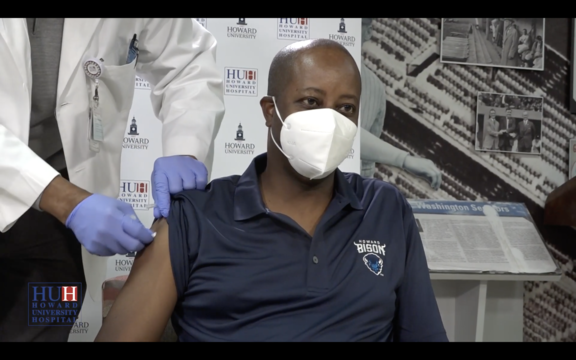
Jan. 6, 12:13 p.m. Howard University president Dr. Wayne A. I. Frederick has produced a public service announcement aimed at Black Americans on the importance of getting the coronavirus vaccine. Frederick, a practicing surgeon who lives with sickle cell disease, was one of the first to receive the vaccine at Howard University Hospital.
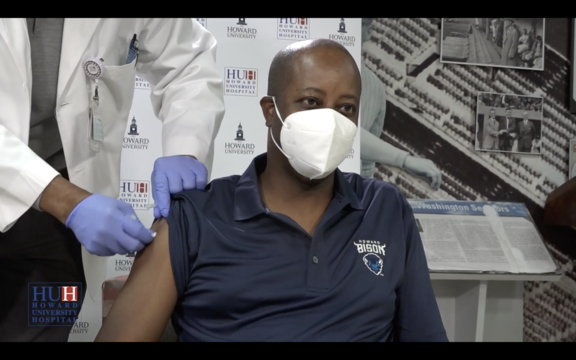 “The coronavirus pandemic is having a significant impact on communities of color, and that narrative won’t change until we take the necessary steps to protect ourselves from exposure,” Frederick said in a press release.
The one-minute PSA from Howard, a historically Black university in Washington, D.C., can be watched here.
— Elizabeth Redden
West Virginia Begins Vaccinating Faculty, Staff Over Age 50
Jan. 6, 11:38 am. West Virginia colleges and universities have begun vaccinations of faculty and staff who are over age 50.
Although many universities have begun vaccinating workers in health-care roles, the state of West Virginia is early in beginning vaccinations for faculty and staff more broadly. The state includes both higher education faculty and staff and K-12 teachers in Phase 1D of its vaccination plan.
Jessica Tice, a spokeswoman for the West Virginia Higher Education Policy Commission, said 28 of the state’s 43 universities started vaccinating faculty and staff beginning last week.
“The initial allocation for the higher education system was 1,000 total doses, to be given last week; 1,000 more doses were received by the higher education system today, to be given this week,” Tice said via email on Tuesday. “Second doses will be provided per manufacturer’s recommendations. Colleges are responsible for following the guidelines for prioritization set by the state. Specifically, those receiving the vaccine in this first wave must be over 50-years-old and working on campus, or be in a high-risk position such as health sciences faculty or campus security.”
— Elizabeth Redden
BU and Holy Cross Play Basketball, With Masks
Jan. 6, 10:24 a.m. The men’s and women’s basketball teams from Boston University and the College of Holy Cross played this week — with face masks on.
WCVB News reported that the men’s game is believed to be the first in which both teams wore masks. BU requires wearing of masks at its athletic facilities. When the teams played at Holy Cross, the Holy Cross players didn’t wear masks.
“We feel like we’re used to it a little bit now. We’ve been practicing with a mask on since September,” said Jonas Harper, a BU junior. “We’ve been trying to get used to it more and more when we practice and play, so it’s kind of getting easier to play with it, but we’re all just happy to be playing in the first place. In the middle of the game, we really don’t recognize we’re using a mask in the first place.”
— Scott Jaschik
More Colleges Alter Start of Spring Term, Citing COVID Cases
Jan. 5, 4:30 p.m. Several more colleges announced Tuesday that they would either delay the start of their spring semesters or begin the terms with virtual instruction, citing local or national conditions for COVID-19.
Among the institutions to act:
- Indiana University of Pennsylvania said it would begin instruction as planned on Jan. 19, but that the first three weeks of the term would be delivered virtually. The university “strongly encourages” students to delay their return to the public university campus in western Pennsylvania until just before the Feb. 8 start of in-person classes. “Statewide cases remain high. The rollout of vaccines has been slower than anticipated. And the number of cases resulting from New Year’s gatherings won’t be clear for another two weeks,” the university’s statement read.
- Nazareth College, in New York, said Tuesday that it would delay the beginning of its spring semester until Feb. 1. “On February 1, we will resume our engaged learning experience for a full semester (with the same number of instructional days as usual), to conclude on May 12,” President Beth Paul said in an email to students and employees. “We will continue with vigilant COVID-19 safety protocols so as to protect our in-person learning and on-campus experiences for our students. And we will continue to prepare proactively for engaging in the COVID-19 vaccination effort and emerging from the pandemic.”
- Syracuse University announced late Monday that it would delay the start of its spring term by two weeks, to Feb. 8. “Starting our semester two weeks later best positions us to resume residential instruction in a manner that safeguards the health and safety of our students, faculty, staff and the Central New York community,” Syracuse officials said.
— Doug Lederman
Wrestling Match Called Off Due to COVID-19 Exposure
Jan. 4, 6:14 a.m. A wrestling competition between Hofstra and Lehigh Universities was called off Saturday, moments before it was to start.
The cause, according to Lehigh’s athletics department, was “a positive COVID-19 test result among a member of Hofstra’s Tier 1 personnel.”
Tier 1 “is the highest exposure tier and consists of individuals for whom physical distancing and face coverings are not possible or effective during athletic training or competition. Examples of relevant individuals include student-athletes, coaches, athletic trainers, physical therapists, medical staff, equipment staff and officials.”
The match is unlikely to be rescheduled, the university said.
— Scott Jaschik
Michigan Will Open Stadium for Vaccinations
Dec. 31, 6:21 a.m. The Big House, the famous stadium for the University of Michigan football team, will open today … for vaccinations, MLive reported.
The university hopes to offer a COVID-19 vaccine to hundreds of Michigan employees and students who are in the designated first group to receive it.
— Scott Jaschik
President Trump Signs COVID-19 Bill
Dec. 28, 6:12 a.m. President Trump on Sunday night signed a $900 billion bill to give coronavirus relief to Americans, The Washington Post reported.
The bill would give higher education $23 billion and would also simplify the Free Application for Federal Student Aid from 108 to 36 questions, let more prisoners get Pell Grants and forgive $1.3 billion in loans to historically Black colleges.
The president had initially been expected to sign the bill, as administration officials had been involved in negotiations over it. But last week he repeatedly criticized it and created doubt over whether he would sign it.
He continued to make those criticisms after he signed the bill, saying that he would send Congress a redlined version of the bill “insisting that those funds be removed from the bill.”
— Scott Jaschik
Chapman U President Has COVID-19
Dec. 23, 6:15 a.m. The president of Chapman University, Daniele Struppa, has COVID-19, he announced in an email to the campus, the Los Angeles Times reported.
“I want to share the news that today I tested positive for COVID-19,” Struppa said. “I am feeling tired and am resting at home, but overall, my symptoms are not extreme and currently limited to a slight fever and cough.”
He said he is working with contact tracers to identify anyone whom he may have infected. He likely received the virus from his 16-year-old daughter, who has also tested positive for it.
— Scott Jaschik
Penn State Will Delay In-Person Start of Semester
Dec. 21, 6:23 a.m. Pennsylvania State University will start the spring semester online because of “extensive analysis and scenario planning given worsening virus conditions nationally and across the state indicating predictions of rising hospitalization rates in the coming weeks,” the university announced Friday.
The university will start classes online on Jan. 19 and will continue that way until Feb. 12. On Feb. 15, classes will transition to in person.
“While we know this creates a number of challenges for our community, we are very concerned with the current outlook across the country and the commonwealth and believe this is the most responsible way to begin our semester. Shifting to a remote start has been a scenario we have been preparing for by building flexibility into every level of our operations in order to prioritize our students’ academic achievement,” said Penn State president Eric J. Barron.
The decision is consistent with the recommendation of the state’s Department of Education, which last week urged colleges to delay the start of their spring semesters.
— Scott Jaschik
Pennsylvania Urges Colleges to Delay Bringing Students Back
Dec. 18, 6:24 a.m. Pennsylvania acting secretary of education Noe Ortega has urged colleges to delay the start of their spring semesters to February, as some colleges are already doing.
“We are seeing an alarming increase in COVID-19 cases and hospitalizations, and these trends are expected to worsen in January at the time when students normally return to campus,” he said. “Colleges and universities play a critical role in mitigating the spread of COVID-19 and creating safe learning environments for students. By delaying students’ return to campus, our institutions of higher learning can help slow the spread of the virus, help businesses to remain open, and protect regional health care systems.”
A press release from the state’s Department of Education said that “the number of cases among 19 to 24-year-olds in northcentral Pennsylvania spiked from 7 percent in April, when students were not on campus, to 69 percent in September, and in the northeast from 6 percent in April to 40 percent in September. Campuses are urged to evaluate their policies and circumstances and ensure the safety of their on-campus population while also promoting strong mitigation measures for off-campus students.”
— Scott Jaschik
U.S. College Student Sentenced to 4 Months in Prison in Cayman Islands
Dec. 18, 6:14 a.m. Skylar Mack, a premed student at Mercer University, has been sentenced to four months in jail in the Cayman Islands for breaking COVID-19 rules, the Associated Press reported. She has been in prison since Tuesday.
She arrived in the Cayman Islands in November and was supposed to be in quarantine for two weeks, but her boyfriend, who is from the Cayman Islands, picked her up to attend a water sports events. He was also sentenced to jail time.
Mack’s lawyer said that they pleaded guilty but deserved a lesser sentence.
The Cayman Compass quoted Judge Roger Chapple as saying Mack’s actions reflected “selfishness and arrogance,” adding that she had spent seven hours out in public without a face mask or social distancing.
— Scott Jaschik
Judson College May Close Unless It Receives Gifts
Dec. 17, 6:19 a.m. Judson College, a Baptist women’s institution in Alabama, may close if it doesn’t receive enough gifts by Dec. 31.
Judson president W. Mark Tew said the college has been hurt by declining enrollment, the recession of 2008 and this year’s COVID-19 pandemic.
Tew wrote to donors, “Should the college be unable to secure sufficient resources by December 31, we are making plans to assist our students with teach-out and transfer options. However, should the generosity of the college’s dedicated family of donors reach specified goals by December 31, your college will proceed with the spring semester and look forward to celebrating commencement on April 30, 2021.”
— Scott Jaschik
COVID-19 Cuts Student Drinking, Study Finds
Dec. 16, 6:18 a.m. COVID-19 has cut student drinking, a study has found.
The study, published in The Journal of Studies on Alcohol and Drugs, said that the key factor was — no surprise here — students were again living with their parents. The study was based on interviews with 312 college students, mostly juniors and seniors.
Student alcohol users who switched from living with peers to parents decreased the number of days they drank per week, from 3.1 before closure to 2.7 after. However, those who remained with peers increased drinking days from three to 3.7 weekly, and those remaining with parents increased from two to 3.3.
The total number of drinks per week for students who moved home went from 13.9 to 8.5. Those continuing to live with peers drank essentially the same amount (10.6 drinks before compared with 11 weekly after closure). Those who continued living at home drank almost three drinks per week more (6.7 before versus 9.4 drinks weekly after closure).
— Scott Jaschik
Survey Finds Students Pleased With Educational Experience — With Some Caveats
Dec. 15, 6:18 a.m. Students are generally pleased with the quality of education they are receiving during the COVID-19 pandemic, according to a survey by Gallup and the Lumina Foundation.
Among students seeking a bachelor’s degree, 35 percent ranked it as excellent and 41 percent said it was very good. Among those seeking an associate degree, 33 percent rated their program as excellent and 39 percent said it was very good.
But among the students who were mostly or completely online, criticism emerged.
Among those seeking a bachelor’s degree, 44 percent said it was slightly worse and 16 percent said it was much worse. Among those pursuing an associate degree, 40 percent said it was slightly worse and 13 percent said it was much worse.
— Scott Jaschik
Ball State President Has COVID-19
Dec. 14, 6:15 a.m. Geoffrey Mearns, the president of Ball State University, has tested positive for COVID-19, The Muncie Star Press reported.
He is currently without symptoms. He took the test before he had planned to attend a football game against Western Michigan University. When he was notified of the result, he immediately began to quarantine.
— Scott Jaschik
College Sports Has at Least 6,629 COVID-19 Cases
Dec. 11, 6:51 a.m. College sports has had at least 6,629 cases of COVID-19, according to an analysis by The New York Times.
The figure includes coaches and other employees. But the figure is certainly low, as the Times was able to gather complete data for just 78 of the 130 universities in the National Collegiate Athletic Association’s Football Bowl Subdivision, the top level of college football.
The University of Minnesota had 336 cases in its athletic department, more than any other university in the FBS.
— Scott Jaschik
Cal State Plans Fall Return to In-Person Classes
Dec. 11, 6:18 a.m. The California State University system, one of the first to announce that it would be primarily online for this academic year, has announced that it will be primarily in person in the fall.
“It’s critical that we provide as much advance notice as possible to students and their families, as we have done previously in announcing our moves toward primarily virtual instruction,” said Cal State chancellor Timothy P. White. “While we are currently going through a very difficult surge in the pandemic, there is light at the end of the tunnel with the promising progress on vaccines.”
— Scott Jaschik
Collin College Switches to Online Instruction After Death of Professor
Dec. 10, 6:17 a.m. Collin College, in Texas, is switching to online instruction for the winter, following the death of a professor.
Iris Meda came out of retirement to teach nursing after the pandemic started. Her colleagues have criticized the way Collin communicated her tragic death from COVID-19.
Teaching in the fall has largely been in person.
The college did not cite Meda’s death in announcing the change, but said, “Collin College served more than 35,000 credit students during the fall 2020 semester while following safety protocols. Due to the recent regional surge in COVID-19 cases, the college is implementing changes to its master calendar over the next two months for the protection of students, faculty, and staff, including an extended closure for the winter break and a period for employees to telework during the winter season. Wintermester classes, which will be held Dec. 14-Jan. 6, now will be offered 100 percent online.”
The college also announced that “while campuses are closed, the college will accelerate the installation of new air cleaning technologies that will virtually eliminate airborne contaminants, similar to those found in hospitals, at all 10 college facilities.”
— Scott Jaschik
Kentucky Suspends Fraternity for Breaking COVID-19 Rules
Dec. 9, 5:50 a.m. The University of Kentucky has suspended Sigma Alpha Epsilon fraternity for two years for violating rules on COVID-19 and on drinking, The Lexington Herald-Leader reported.
The fraternity will not be allowed to have meetings for two years, or to use its house.
It is unclear what COVID-19 rules were broken.
— Scott Jaschik
Arizona Ups Testing Requirements
Dec. 8, 6:16 a.m. The University of Arizona will require anyone visiting campus next semester to have had a negative COVID-19 test the previous week, the Associated Press reported.
And students won’t be able to access the campus Wi-Fi network if they don’t have a recent negative test.
President Robert Robbins also said he would like to require the COVID-19 vaccine for anyone visiting the campus, with religious and medical exemptions. “I would very much like to see this be required for everyone who works and comes to campus as a student,” Robbins said.
— Scott Jaschik
Protest of Florida’s Plans for the Spring
Dec. 7, 6:15 a.m. Students and faculty members spoke at the meeting Friday of the University of Florida Board of Trustees to protest plans for more in-person instruction in the spring, The Gainesville Sun reported.
“The carelessness and the profiteering with which UF’s board has approached student well-being is morally reprehensible,” said a third-year student.
“We believe that it’s not right to force faculty, staff and instructors who have pre-existing health conditions, to force them back in classrooms that are going to be inherently unsafe,” said Paul Ortiz, chair of the university’s faculty union. “We see a lot of our students are not following COVID safety protocols.”
University officials defended the plans. “I fully understand and empathize with the anxiety,” said David Nelson, Florida’s senior vice president of health affairs. “But it’s not really backed up by the facts. We have done so much. We have so many contract tracers, we have so much testing. We have gone out of our way to make sure that our faculty and our staff and our students who come to this university, to get whatever kind of in-person or virtual education, are going to be safe.”
— Scott Jaschik
Boston University Students Use 4-Letter Words to Get Focus on Real Issues
Dec. 4, 6:23 a.m. Boston University students have used social media to get their fellow students’ attention on wearing masks, hand washing and COVID-19 testing, The Boston Herald reported. Their message is helped by expletives.
The tag line for the campaign is “F*ck It Won’t Cut It.”
“This is a dream for us. We would have never thought that we were noticed by the CDC as students,” said Hannah Schweitzer, one of the students who worked on the campaign. “This is crazy.”
The Centers for Disease Control and Prevention did notice. And the BU students presented about it at a CDC event this week.
— Scott Jaschik
Chapel Hill Faculty Oppose Plans for Spring
Dec. 3, 6:18 a.m. Sixty-eight faculty members at the University of North Carolina at Chapel Hill have published a letter in The Daily Tar Heel opposing the university’s plans for the spring.
The university plans to offer more in-person classes than it does now, and to require COVID-19 testing for those on campus.
“We call on UNC administrators to put public health first, to show courageous leadership and to accept the realities that the unchecked coronavirus has created for us all. Deciding now to go remote for the spring will allow students and their families time to plan for the spring semester. It will also save lives in communities across the state and nation until the pandemic is brought under control,” the letter says.
While the letter notes that there are better plans in place than was the case for the fall, when the university abandoned plans to open, it says there are too many dangers to resume operations.
The Herald-Sun reported that the university plans to have 20 percent to 30 percent of classes in person.
— Scott Jaschik
Students File Class Action Suits Against Georgia Tech and U of Georgia
Dec. 2, 6:17 a.m. Students have filed class action suits over the tuition they paid last spring to attend the Georgia Institute of Technology and the University of Georgia, The Atlanta Journal-Constitution reported.
The two lawsuits, filed in state court, say the students did not receive the full educational experience they anticipated when they paid their tuition. “You should not get the students’ money if you don’t provide the service,” Lee Parks, a lawyer representing the students, said.
The University System of Georgia said that it doesn’t comment on litigation.
— Scott Jaschik
Scott Atlas Quits White House Post
Dec. 1, 6:22 a.m. Dr. Scott Atlas today resigned from his White House position advising President Trump on coronavirus issues.
He posted his letter of resignation — with praise for the president’s efforts — on Twitter.
Atlas has been on leave as a senior fellow at Stanford University’s Hoover Institution.
The Faculty Senate at Stanford condemned Atlas for distorting the science about the coronavirus and downplaying its dangers.
In September, he threatened to sue Stanford faculty members who had been speaking out against him.
— Scott Jaschik
College Runners Flock to Flagstaff During COVID-19 Pandemic
Nov. 30, 6:12 a.m. College runners seeking to pursue their sport during the pandemic are flocking to Flagstaff, an Arizona city of 65,000 people, AzBigMedia/Cronkite News reported.
Five members of Stanford University’s cross-country team relocated there to train and to take their classes online. Fourteen runners for the Johns Hopkins University team are living together, training and taking classes online.
“We chose Flagstaff because it’s a great running town at high elevation with lots of remote trails and has a relatively low cost of living,” said Liam Anderson, a sophomore on Stanford’s cross-country team.
— Scott Jaschik
Ontario Faculty and Students See Negative Impact of Online Education
Nov. 27, 6:23 a.m. Ontario faculty members and students say that widespread use of online education in response to COVID-19 has had a negative impact on the quality of education.
Among faculty members, 76 percent said that online learning has “negatively impacted the quality of university education in Ontario,” according to a survey by the Ontario Confederation of University Faculty Associations.
Among students, 62 percent agreed.
— Scott Jaschik
Maine Sees Spike in COVID-19 Cases
Nov. 25, 6:14 a.m. The University of Maine system is seeing a spike in COVID-19 cases as students prepare to leave campuses and finish the semester remotely, The Bangor Daily News reported.
As a result, students who have tested positive and those in close contact with them will quarantine on their campuses through Thanksgiving.
Of the 84 current cases of COVID-19, 66 are at the Orono campus.
— Scott Jaschik
Professor at Ferris State on Leave Over Comments on COVID-19, Race and Religion
Nov. 24, 6:23 a.m. Thomas Brennan, an assistant professor of physical science at Ferris State University, has been placed on leave over his comments on COVID-19 and other subjects.
David L. Eisler, president of the university, said in a letter to the campus, “Last week the university learned of racist, anti-Semitic and homophobic slurs made on Twitter that appear to be posted by Thomas Brennan … Individually and collectively we were shocked and outraged by these tweets. They are extremely offensive and run counter to the values of our university and our commitment to diversity, equity and inclusion. Our students, faculty, staff and members of the community are upset and offended by these comments, and they should be. As reported Dr. Brennan disrupted a College of Arts, Sciences and Education Zoom meeting last August. At this he expressed via video and chat that COVID-19 death rates in the United States were exaggerated, and the pandemic and rioting were leftist stunts. These comments both surprised and offended those attending the meeting. Dean Williams addressed this in a message to the College’s faculty and staff, and disciplined Dr. Brennan. On Thursday, Dr. Brennan was placed on administrative leave and an investigation is underway.”
In a statement to the campus, Brennan said, “This controversy started after I made a few statements in a College of Arts and Sciences meeting of faculty and staff about the COVID-19 pandemic. My statements were to the effect that I believe the COVID-19 pandemic is a stunt designed to enslave humanity and strip us of all of our rights and freedoms. I don’t believe that the pandemic is a hoax, people have died. But its severity is being exaggerated by revolutionary leftists in the media and government who ‘never let a good crisis go to waste.’ The end result of this hysteria, if unchecked, will be a mandatory vaccine. No one will be allowed into public places or permitted to buy food in a supermarket unless they present proof-of-vaccination. Initially, this electronic vaccination certificate will be tied to a person’s smartphone, but will soon after be in the form of injectable micro or nanotechnology in the vaccine itself. If this comes about it will truly be a fulfillment of the prophecy of the mark of the beast, as described by St. John the Apostle in the Book of Revelation, Chapter 13:16-17.”
He added, “Let me address a few of these tweets, starting with the one where I used the ‘n-word.’ I believe the ‘n-word’ is a mind-control spell designed to make us hate each other. I am not racist against black people, I love and respect them. But I reject the premise that there are certain magic words that should never be used in any context or by certain people. I uttered the word to try to neutralize its power, and its implied meaning in the context of the tweet was as a synonym for ‘human being,’ or ‘person,’ since I used it to describe people of different races.”
Brennan also said in the statement that the atom bomb and the moon landings were “fake.”
His Twitter account is now private.
— Scott Jaschik
College of Charleston Rejects Pass-Fail Grading
Nov. 23, 6:16 a.m. The College of Charleston has rejected pass-fail grades as a way of relieving student stress during the pandemic, The Post and Courier reported.
Nearly 4,500 people (about 45 percent of all students) signed a petition asking for a pass-fail option.
“We recognize this decision will not be universally popular, but we also believe it is the right decision,” said an email to students from Provost Suzanne Austin and Simon Lewis, speaker of the Faculty Senate. “Since classes began this past August, faculty have been encouraged to be flexible with their assignments, attendance policies and grading, and that flexibility has resulted in some very positive outcomes during a difficult time.”
— Scott Jaschik
St. Lawrence Moves Online
Nov. 20, 6:22 a.m. St. Lawrence University announced that it is moving all classes online for the rest of the semester.
“As of November 19, we have completed 18,149 tests of students and employees. We learned of seven additional members of campus who have tested positive bringing our total number of active cases up to nine. Contact tracing is in process now,” said a message to the campus.
The university also called off all in-person student activities, including athletic practices and competitions.
— Scott Jaschik
Tracking the Spikes in Changes to Colleges’ Fall Plans
Nov. 19, 3:30 p.m. More colleges have altered their fall instructional plans in the last week than at any time since August, Inside Higher Ed‘s database and map of changes in colleges’ fall reopening plans show.
The originator of the Inside Higher Ed project, Benjy Renton, a senior at Middlebury College in Vermont, created the graphic at left that shows how many colleges changed their plans on a given date, as well as a seven-day average.
In the last two weeks, closely tracking both Halloween and the surge in COVID-19 cases that many communities around the U.S. are enduring, more colleges altered their plans than at any time since mid-August, when many campus leaders pulled back on decisions they’d made weeks earlier to reopen.
The changes made in the last two weeks have mostly involved colleges ending in-person instruction and pivoting anew to remote learning ahead of the Thanksgiving holiday, earlier than they had planned.
— Doug Lederman
Judge Orders Miami U to Reinstate Students
Nov. 19, 6:26 a.m. A state judge ordered Miami University of Ohio to reinstate two students whom it had suspended for violating the university’s COVID-19 rules, WCPO reported.
Two women sued for reinstatement and won a temporary restraining order.
Miami opposed the order, telling the judge, “It will indicate to plaintiffs and their classmates that they can flout university rules and regulations. That would be a particularly dangerous statement to send now, with cases rising at dramatic rates.”
But the women said they were not in violation of the rules and only came outside when ordered to do so by police officers.
— Scott Jaschik
New Mexico State Men’s Basketball Team Relocates to Arizona
Nov. 18, 7:37 a.m. The men’s basketball team at New Mexico State University is relocating to Phoenix for five weeks, The New Mexican reported.
The move was because the state’s health guidelines do not allow games or workouts with more than five people.
The Aggies are believed to be the first men’s basketball team at the college level to relocate to another state, but other teams in New Mexico are currently considering similar moves.
New Mexico State officials said the cost of rooms, facilities, food and testing for the five weeks will be about $79,000.
— Scott Jaschik
West Virginia U Moves to Online
Nov. 18, 6:21 a.m. West Virginia University announced Tuesday that all undergraduate education — except some health sciences courses — will move online Monday and Tuesday.
The university cited the rise in COVID-19 cases in the state and on campus.
“Now more than ever, we ask our students, faculty and staff to stay home and away from those outside of your immediate bubble as much as possible,” Carmen Burrell, medical director of WVU Medicine Student Health and Urgent Care, said. “If you have to be out or travel, follow the safety guidance that has been put in place to protect you and others, especially our more vulnerable residents.”
— Scott Jaschik
Stanford Distances Itself From Views of Scott Atlas
Nov. 17, 6:23 a.m. Stanford University on Monday distanced itself from the views of Scott Atlas, a senior fellow at the Hoover Institution who is currently on leave to work at the White House. Atlas has expressed views that run counter to the scientific consensus on control of COVID-19, and he has threatened to sue Stanford faculty members who criticized him.
Stanford’s statement said, “Stanford’s position on managing the pandemic in our community is clear. We support using masks, social distancing, and conducting surveillance and diagnostic testing. We also believe in the importance of strictly following the guidance of local and state health authorities. Dr. Atlas has expressed views that are inconsistent with the university’s approach in response to the pandemic. Dr. Atlas’s statements reflect his personal views, not those of the Hoover Institution or the university.”
— Scott Jaschik
Rice Uses Students to Run COVID-19 Court
Nov. 16, 6:12 a.m. Rice University has found a useful tool for enforcing its COVID-19 rules: a student-run court.
The Texas Monthly reported that the COVID Community Court “has overseen dozens of cases in recent months, the vast majority, including that of the socializing scofflaws, set in motion by fellow classmates who have been encouraged by the university to report coronavirus-related misconduct that makes them feel unsafe. Friends have turned in friends, usually without advance warning, for failing to wear masks and maintain social distancing. Most tips are submitted anonymously online, and they often include photographic evidence or screenshots from Instagram stories. In many cases, the rule-breaking is accidental. When confronted with evidence of an infraction, the majority of students are cooperative and apologetic, court members say.”
Typical penalties given out by the students: “writing letters of apology, performing community service projects, meeting with advisers, or completing educational research papers about public health.”
— Scott Jaschik
Missouri Shifts Plans to All Online After Thanksgiving
Nov. 13, 6:30 a.m. The University of Missouri has shifted its plans and will no longer offer in-person classes after Thanksgiving, The Kansas City Star reported.
Students are being asked to go home for Thanksgiving and not return until January.
“We believe these actions will support our community, and will provide the best path forward for our university’s return to in-person learning in the spring semester,” Mun Choi, the Columbia campus’s chancellor and president of the University of Missouri’s four-campus system, said in a letter.
— Scott Jaschik
King’s College Will Go All Online
Nov. 13, 6:24 a.m. King’s College, in Pennsylvania, will go all online after today’s classes.
The college also suspended National Collegiate Athletic Association athletics and intramurals.
— Scott Jaschik
Ivy League Calls Off Winter Sports Season
Nov. 12, 6:50 p.m. The Ivy League said late Thursday that it would cancel its winter sports season because of the continuing impact of the COVID-19 pandemic, becoming the first conference that plays Division I men’s and women’s basketball to make that call.
An announcement from the league said the decision was made by the presidents of the league’s eight universities. The reported decision comes less than two weeks before the National Collegiate Athletic Association’s Division I basketball season was set to begin.
The league was the first major conference to call off its fall sports season as well. Ivy officials also said Thursday that the conference will not conduct competition for fall sports during the upcoming spring semester, as it had said it might. The league also said that its members would postpone any spring sports at least until the end of February.
“The unanimous decisions by the Ivy League Council of Presidents follow extended consideration of options and strategies to mitigate the transmission of the COVID-19 virus, an analysis of current increasing rates of COVID-19 — locally, regionally and nationally — and the resulting need to continue the campus policies related to travel, group size and visitors to campus that safeguard the campus and community,” the statement read.
The Ivies’ decision comes as the fall football season has been increasingly interrupted by cancellations related to mounting coronavirus cases, and just a day after the University of Miami and Stetson University called off their opening basketball game.
— Doug Lederman
Students Rate Online Learning This Fall as Somewhat Better Than in the Spring
Nov. 12, 1 p.m. Undergraduates who are studying online this fall rate their learning experience as modestly better than what they encountered last spring — with greater levels of satisfaction among students who see their instructors taking steps to understand and engage them, according to a new survey of 3,400 undergraduates in the U.S. and Canada.
The survey by Top Hat, whose courseware platform is used by about 750 colleges, also finds that nearly three-quarters of students who say their instructors are meaningfully interacting and engaging with them say they are likely to return for the spring semester, compared to less than two-thirds of students who disagree that their professors are doing so.
The survey’s findings are a mixed bag for colleges at a time when many of them are being forced, again, to shift to virtual rather than in-person learning.
Students still overwhelmingly say they prefer in-person to online learning, with 68 percent believing they are not learning as effectively as they would have had they been in person. Roughly three-quarters of respondents say their online courses lack an engaging experience during class sessions and direct interaction with peers and professors.
But students rated their fall courses as somewhat more engaging and interactive than was true in a similar survey Top Hat conducted in the spring.
In the spring, 53 percent of responding students said they didn’t have regular access to their instructors, and 69 percent said they lacked engagement with their peers. This fall, those figures had dropped to 48 percent and 65 percent, respectively.
— Doug Lederman
King’s College Will Go All Online
Nov. 13, 6:24 a.m. King’s College, in Pennsylvania, will go all online after today’s classes.
The college also suspended National Collegiate Athletic Association athletics and intramurals.
— Scott Jaschik
Miami U Students Sue Over COVID-19 Punishments
Nov. 12, 6:20 a.m. Two students at Miami University of Ohio have sued the university in federal court saying that Miami suspended them based on “erroneous” information, WCPO reported.
The students were suspended based on their having hosted an off-campus party on Aug. 26. The Oxford, Ohio, police cited them for violating city ordinances prohibiting noise and mass gatherings.
Miami officials based their actions on the Oxford police. But Miami only sent out information about new rules five days after Aug. 26, the suit says.
Miami officials did not respond to a request by WCPO for comment.
— Scott Jaschik
Allegheny Requires All Employees to Take 2-Week Furlough
Nov. 11, 6:20 a.m. Allegheny College is requiring all employees to take a two-week furlough between Dec. 14 and June 30, The Erie Times-News reported.
“Allegheny College has made the difficult decision to implement a mandatory two-week furlough program for college employees, a direct result of the continued financial impact the global pandemic has had on the college’s revenues and expenses,” President Hilary Link said in a statement. “Unfortunately, we have come to a determination that such temporary furloughs are an important step in our work to keep the college strong into the future.”
Employees will be eligible for unemployment compensation for their weeks on furlough.
— Scott Jaschik
Cal Poly San Luis Obispo Sees Surge in Cases
Nov. 10, 6:23 a.m. Cal Poly San Luis Obispo experienced its largest surge in COVID-19 cases on Wednesday, and then on Thursday, and then on Friday as well, The Tribune reported.
Last week, the university added 130 student cases, raising its total number of positive tests from 280 to 410. As of Friday, 596 students are in quarantine, and 66 are isolating.
President Jeffrey Armstrong emailed the campus, “We want to reiterate how critically important it is that each member of our campus community exercise personal responsibility in helping to slow the spread of COVID-19 in our community. What you do matters, and can make things better or worse for everyone.”
— Scott Jaschik
Clemson to Expand Testing to Nearby Colleges
Nov. 9, 6:18 a.m. Clemson University has built an on-campus COVID-19 testing facility and will soon expand services to colleges and other organizations nearby, The Greenville News reported.
Currently, it can test 2,500 samples a day but is expecting to double that number by mid-November. Eventually, the lab will be able to conduct 9,000 tests a day.
When it reaches that level, it will offer to test students at nearby community colleges, such as Tri-County Technical College.
— Scott Jaschik
Students at British University Tear Down Fences
Nov. 6, 6:23 a.m. Students at the University of Manchester, in Britain, awoke in a COVID-19 lockdown to find that fences had been put up around some of their residence halls. The BBC reported that the students responded by tearing down the fences.
One management student, who asked not to be identified, said, “Morale is really low; we’re really disappointed we didn’t hear about this beforehand and about the fact it went up without any explanation. They’re huge metal barriers; they’re connected to one another and there’s literally no gaps.”
The university apologized. Nancy Rothwell, president and vice chancellor, issued a statement that said, “The fencing was intended as a response to a number of concerns received over recent weeks from staff and students on this site about safety and security; particularly about access by people who are not residents. There was never any intent to prevent students from entering or exiting the site. The fences are being taken down from Friday morning and students are being contacted immediately. Alternative security measures, including additional security patrols, are being put in place. I apologize once again for the issues caused by this incident.”
— Scott Jaschik
50 Presidents Call for Research Support During COVID-19
Nov. 5, 6:28 a.m. Fifty presidents of colleges and universities, all members of the Council on Competitiveness, have issued an open letter in Science calling for the federal government to maintain research support during the COVID-19 pandemic.
“As colleges and universities across the nation make difficult decisions to advance their vital missions this fall, the $55 billion in federal support for university-performed R&D (i.e., on-campus research) is at risk. Maintaining the strength of the U.S. research enterprise — the same research enterprise that has enabled the rapid sequencing of the COVID-19 genome and launched numerous treatment and vaccine studies — must be a national priority,” the letter says.
“We cannot afford to shut down critical projects with long-term national benefits or to postpone projects that provide the hands-on graduate and undergraduate student research experiences necessary to train the next generation of scientists and engineers. In these difficult times, we call upon the federal government to provide the leadership, critical funding, and programmatic flexibility necessary to enable the nation’s colleges and universities to continue the U.S. commitment to research, exploration, and new knowledge creation that will power our economy and provide opportunity for all,” the letter says.
— Scott Jaschik
Protest Over Florida’s Plan to Open Campus
Nov. 3, 6:15 a.m. Faculty members and graduate students held a protest at the University of Florida over the institution’s plan to offer the same number of classes in the spring as were offered last spring, The Gainesville Sun reported.
The protest was held outside the president’s home and featured a graduate student dressed as the Grim Reaper.
“People shouldn’t have to choose between their livelihood and their lives,” said Ara Hagopian, a graduate student and organizing chair with Graduate Assistants United.
Currently, 35 percent of classes are either fully face-to-face or offered in a hybrid format.
Provost Joe Glover said in an email to deans that the university is moving toward “more robust” in-person classes for the spring 2021 semester and each college should schedule at least as many face-to-face classes as were given last spring.
— Scott Jaschik
Skidmore Suspends 46 Students
Nov. 2, 6:20 a.m. Skidmore College suspended 46 students for violating the college’s COVID-19 rules, News10 reported.
Skidmore said investigations into other reports of “unacceptable behavior” are ongoing and the college “urged all students to follow the guidelines they agreed to in order to bring the semester to a successful close.”
— Scott Jaschik
Assumption Locks Down Campus
Oct. 30, 6:25 a.m. Assumption University locked down its campus this morning and will remain locked down for at least one week, CBS Boston reported.
Assumption cited a rise in COVID-19 cases.
All classes will be online. Students will only be allowed to leave their residence hall, floor or apartment to pick up meals, for medical emergencies or twice-per-week COVID-19 testing.
— Scott Jaschik
Duquesne Suspends All Greek Activities
Oct. 29, 6:15 a.m. Duquesne University has suspended all Greek activity on the campus because of “repeated and egregious” violations of COVID-19 rules, KDKA reported.
A letter to Greek organizations said that members held gatherings over the 25-person indoor limit and threw parties that violated both coronavirus policies and “more typical conduct standards.” It also said that members of sororities and fraternities were deliberately misleading in an attempt to limit contact tracing. “At a time when the university and, indeed, our region needed you most to live the values you espouse, as a system you failed to do so. Furthermore, you deliberately persisted in behaviors known to endanger people,” the letter said.
— Scott Jaschik
CDC Report Examines a Campus Sports Outbreak
Oct. 28, 4:35 p.m. A report published by the Centers for Disease Control and Prevention Wednesday examines a COVID-19 outbreak that affected more than a third of the 45 members of an unidentified Chicago-area university’s men’s and women’s soccer teams this fall.
The report found that the university brought athletes back to its campus in June and required two negative tests before they could participate in team activities. In August one member of the men’s team reported COVID-like symptoms to a coach, and said he had attended a birthday party and an unsanctioned soccer match involving the men’s and women’s teams in the preceding two weeks.
The CDC interviewed all 45 athletes and concluded that there had been 18 social gatherings (in addition to the coed soccer game) during the two-week period. Several of the gatherings were seen as the likely spreading incidents, at which relatively little mask wearing was reported.
“This outbreak highlights challenges to implementation of prevention strategies associated with persuading students at colleges and universities to adopt and adhere to recommended mitigation measures outside campus,” the CDC report said. “University protocols mandated mask use during training sessions, and coaching staff members reported universal compliance. However, multiple students reported inconsistent mask use and social distancing at social gatherings, which quickly negated the benefits of pretraining testing, on-campus mask use, and social distancing prevention measures.”
— Doug Lederman
Bethune-Cookman, Keuka Go Virtual for Rest of Fall Term
Oct. 28, 3:45 p.m. Private colleges in Florida and New York announced this week that they would complete the rest of the fall term with all virtual instruction.
Bethune-Cookman University, in Daytona Beach, Fla., said in a letter to students and employees Monday that today would be the last day of in-person instruction and that it would complete the last three weeks of the fall term virtually. Officials cited a spike in COVID-19 and a desire to “begin reducing the on-campus density for the remainder of the fall semester.” Bethune-Cookman’s president, E. LaBrent Chrite, encouraged the historically Black institution’s students to “expedite their planned departure from campus beginning this week,” if they are able to, but said they could remain on campus through Nov. 20. Those who remain will operate under a shelter-in-place order and a curfew.
Bethune-Cookman also became the first institution in the National Collegiate Athletic Association’s Division I to cancel competition for the rest of the 2020-21 academic year.
“The recent spike in COVID-19 positivity rates in the state, across Volusia County and on our campus, provides clear and unambiguous evidence, in our view, that now is simply not the time to resume athletic competition,” Chrite wrote. “While the decision to opt out of spring competition is the only responsible one for us at this time, it was not made lightly. We know that this decision greatly impacts our student athletes, our coaching staff, our Marching Wildcats and others.”
Keuka College, in New York’s Finger Lakes region, began the fall semester with in-person instruction but shifted to virtual learning three weeks ago when COVID cases emerged after a “non-sanctioned off-campus gathering,” the college said in a notice Monday.
Although officials said that the number of cases had fallen from a high of 70 on Oct. 15 to about a dozen now, they “decided continuing the remote-learning model is the safest course of action,” the announcement said.
Keuka said that students who return home will be eligible for a room and board credit for the rest of the term, and that students who can’t leave can remain.
— Doug Lederman
Wyoming President Sheltering in Place
Oct. 28, 6:21 a.m. Ed Seidel, president of the University of Wyoming, will shelter in place for 14 days because he was at an event with someone who was subsequently diagnosed with COVID-19. Thus far, Seidel has tested negative for the virus.
“I have worked to follow the guidelines and requirements for face protection and physical distancing while becoming acquainted with the UW community and our state during my first months as president,” Seidel said. “I take seriously my own responsibility to model the conscientious behavior that I have asked our students, faculty and staff to follow. While my contact with the individual who unfortunately tested positive did not meet the standard for me to be officially quarantined by the Department of Health, I’m going to work from home during the 14 days following the known exposure because I feel strongly that it is my responsibility to lead through example. As COVID-19 cases are rising rapidly around the nation and in Wyoming, it is important that we take every precaution to limit the spread of the virus.”
— Scott Jaschik
Political Divide Over Colleges’ Fall Reopenings
Oct. 27, 5:20 p.m. The American public is divided over just about everything — so why wouldn’t it be divided over whether colleges and universities should have brought students back to their physical campuses this fall?
A survey released by the Pew Research Center this week finds Americans split down the middle on the question of whether colleges that are providing “in-person instruction did/did not make the right decision bringing students back to campus this fall.”
Fifty percent of those surveyed by Pew said colleges made the right call — while 48 percent said they did not. But as will probably surprise no one, the proportions look very different by political party. Almost three-quarters of Republicans (74 percent) said that colleges and universities that opened their campuses for in-person instruction made the right decision, while more than two-thirds of Democrats (68 percent) said the institutions were wrong to open.
The survey also sought respondents’ views about the validity of online education, which many students are encountering even if they are physically on campus this fall.
Asked whether a course taken only online provides equal educational value (or not) to a course taken in a classroom, fewer than one in three Americans (30 percent) says it does — while 68 percent say online courses are inferior. Respondents with a bachelor’s degree were most likely (75 percent) to say an online course doesn’t measure up, compared to 64 percent of those with a high school diploma or less.
And Americans continue to be deeply divided about the state of higher education generally (though nobody is all that happy with it).
A majority of respondents to the Pew poll (56 percent) said that the U.S. higher education system is going in the wrong direction, while 41 percent said it is going in the right direction.
While half of Democrats (49 percent) say higher education is going in the right direction and the same proportion say it’s heading in the wrong direction, a full two-thirds of Republicans (66 percent) say it’s going in the wrong direction.
— Doug Lederman
U of Vermont Freezes Tuition, Room and Board for All Students
Oct. 27, 6:21 a.m. The University of Vermont announced a complete freeze on tuition, room and board — for all students, undergraduates and graduates, in-state and out-of-state, on Monday.
The university froze tuition last year, but President Suresh Garimella cited COVID-19 as a reason to extend it.
Garimella will also recommend a reduction in the student comprehensive fee and the postponement of a previously approved increase of $140 for the multipurpose center, even while substantial facility improvements for recreation and wellness are underway.
And he announced a campaign to raise $150 million — for which $18 million has already been raised — for financial support for students.
— Scott Jaschik
Bucknell Warns Students to Remain in Place
Oct. 26, 6:23 a.m. Bucknell University told students to remain in their rooms this weekend, except for getting food, NorthcentralPA.com reported.
The university acted after confirming seven COVID-19 cases.
President John Bravman emailed all students, “Return to your room (or off-campus residence) and remain in place. You may leave your residence for meal service or emergencies (such as a fire alarm).” He specified that all events scheduled for Sunday would be virtual.
— Scott Jaschik
University of Dayton Freshman Dies of COVID-19 Complications
Oct. 23, 2 p.m. An 18-year-old freshman at the University of Dayton died yesterday, reportedly of COVID-19-related complications.
The Roman Catholic university in Ohio announced the death of Michael Lang, a first-year student in its College of Arts and Sciences, in a message today addressed to students, faculty members and staff members. Lang was from LaGrange, Ill.
 He died after a long hospitalization “apparently due to complications from COVID-19,” according to the message. Lang left campus Sept. 13 “to return home for remote study,” it said.
“We extend our deepest sympathy and prayers to his family, friends, professors and our campus community,” said the message, signed by Eric F. Spina, the university’s president, William M. Fischer, its vice president for student development, and Crystal Sullivan, its executive director of campus ministry. “Campus ministers, housing and residence life, and counseling staff are always available for you and for those you know who may be deeply affected by this loss.”
The university invited campus community members to light a candle of remembrance and pray for Lang in its chapel this afternoon.
Students moved into University of Dayton residences over two weeks starting Aug. 8. The university has since seen several spikes and declines in COVID-19 cases detected, moving between different campus statuses indicating varying levels of outbreak containment and transitioning between in-person and remote learning.
The university’s COVID-19 dashboard lists 42 active cases and 1,368 recovered cases as of Oct. 22. It covers a period beginning Aug. 10.
No additional information is available at this time, according to Cilla Shindell, the university’s executive director of news and communications.
Lang is at least the third college student reported to have died from COVID-19 or related complications this fall. Chad Dorrill, a 19-year-old sophomore studying to become a physical therapist at Appalachian State University in North Carolina, died Sept. 28. Jamain Stephens, a 20-year-old senior who played defensive tackle on the football team at California University of Pennsylvania, died Sept. 8.
— Rick Seltzer
Michigan State to Increase In-Person Classes in the Spring
Oct. 23, 6:23 a.m. Michigan State University on Thursday announced the first steps toward a spring semester that will feature more classes in person than this semester, but still far fewer than normal.
“In the fall, only about 40 in-person classes were offered at MSU. This spring, we expect to offer about 400 in-person educational experiences. We will prioritize offering classes that can only be taught in person in order to keep our students on track for an on-time graduation. To protect the health and wellness of the community, most classes still will be offered only as online courses,” said a letter from Samuel L. Stanley Jr., the president.
In addition, he announced that about 2,500 additional single-occupancy residence hall spaces will be available for those who want or need to be on campus.
— Scott Jaschik
Medical Colleges Call for National Strategy on Testing
Oct. 22, 6:43 a.m. The Association of American Medical Colleges on Thursday called for a national strategy on COVID-19 testing.
“Seven months after the onset of the pandemic, COVID-19 cases continue to increase in most states and in the nation’s capital,” said David J. Skorton, AAMC president and CEO. “At the same time, current testing levels for the SARS-CoV-2 virus are inadequate in identifying the actual number of individuals infected and in suppressing the potential spread of the virus in our country.”
The AAMC’s key point is to call for “a clear and transparent national testing strategy with specific methods to calculate diagnostic and screening testing targets, and a mandate that each state implements the standards the same way.”
Every person with symptoms and every person in close contact with those who have COVID-19 should be tested, the AAMC says.
In addition, the AAMC called for screening tests for “every person who enters a health care facility for an inpatient admission or outpatient surgery.” And it called for “routine testing of every K-12 teacher, all health care providers in hospital settings, and first responders (including law enforcement officers, paramedics, and EMTs).” It also called for the country to “conduct a strategic sampling of incarcerated individuals, residents and staff in homeless shelters, and residents in nursing homes and assisted living facilities.”
— Scott Jaschik
Chapman University Opens for In-Person Instruction
Oct. 22, 6:27 a.m. Chapman University opened for in-person instruction for the first time this semester, The Orange County Register reported.
Students have the option of returning or of continuing with online instruction.
About 35 percent of students came back to campus for in-person learning.
— Scott Jaschik
Binghamton Resumes In-Person Classes Today
Oct. 22, 6:20 a.m. Binghamton University, of the State University of New York, is resuming classes today after a two-week pause due to COVID-19 cases.
President Harvey Stenger said, “All of us at Binghamton can be proud of what we have accomplished. We have been successful because everyone did their part, something that typifies a campus that comes together to solve challenges.”
On Wednesday, 787 individuals had been tested for COVID-19, with only one positive result.
— Scott Jaschik
Oops: ‘Significant Outbreak’ in Study Abroad Program Isn’t Quite as Significant
Oct. 21, 1:45 p.m. The University of Dallas announced Monday that two-thirds of the students in its study abroad program in Rome had contracted COVID-19, with its officials expressing “deep sadness and disappointment” over the “significant outbreak.”
Late Tuesday, the university made another announcement: the Italian authorities messed up and the outbreak, while still bad, isn’t nearly as significant as originally described.
“There are no words to excuse the unforgivable error committed yesterday by our laboratory,” the Italian health agency told Dallas officials (in Italian) in a letter Tuesday. Instead of there having been 52 positive tests and 26 negative ones among the 78 students, as Peter Hatlie, dean and director of Dallas’s Rome program, was originally told, the numbers were flipped, and 26 students were positive and 52 negative, Hatlie wrote.
“We are of course relieved and reassured that the number of positive cases is some 40% lower within our community than reported yesterday,” Hatlie wrote.
“As of the writing of this letter, I am in contact with the local health authority to understand the implications of these corrected figures for student and staff mobility in the coming days. Despite their egregious if uncharacteristic miscarriage of duty in recent days, we still need to seek guidance from them in this regard and other respects, including the prospect of follow-up testing, for it is their legal responsibility to protect all citizens and visitors within their jurisdiction. More on this and related issues when that information becomes available.”
— Doug Lederman
St. John Fisher Goes Online for Rest of Semester
Oct. 21, 6:25 a.m. St. John Fisher College, in Rochester, N.Y., announced Tuesday that it would go all online for the rest of the semester.
“While the number of confirmed cases does not meet the New York State threshold that would require us to take further action, we remain focused on the safety and well-being of our students, employees, and the surrounding community. Therefore, we have decided to transition to remote instruction for the remainder of the fall semester,” the college said.
Classes are canceled tomorrow and Friday and will resume — online — Monday.
The college has had 52 confirmed cases since Oct. 10, The Democrat & Chronicle reported.
— Scott Jaschik
Michigan Receives Stay-at-Home Order
Oct. 20, 3:01 p.m. The University of Michigan is subject to a stay-at-home order (with exceptions) from its county health office for the next two weeks, The Detroit Free Press reported.
Sixty-one percent of the COVID-19 cases in the county in which the university is located are from its students.
The university announced it is shifting more classes to online only.
Students will be permitted to leave their residences only for certain activities, including to go to class, to get food, to get medicine or seek medical treatment, to get tested for COVID-19, or to vote.
— Scott Jaschik
Athletic Cuts at East Carolina
Oct. 20, 6:25 a.m. The athletics program at East Carolina University has announced pay cuts and furloughs for the entire athletic department.
- Football and men’s basketball head coaches will have their base salaries temporarily cut by 20 percent.
- Baseball and women’s basketball head coaches will have their base salaries temporarily cut by 15 percent.
- Coaches and staff members making greater than or equal to $100,000 will have their salaries cut by 12 percent.
- Coaches and staff members making $50,000 to $99,999 will have their salaries temporarily cut by 10 percent.
- Coaches and staff members making below $50,000 will be furloughed for 12 days.
- A group of employees will be on an extended furlough ranging from six weeks to 35 weeks.
— Scott Jaschik
Louisville Shortens Spring Break
Oct. 20, 6:15 a.m. The University of Louisville has shortened spring break from the normal week to two days, The Louisville Courier Journal reported.
Many universities with students on campus have eliminated spring break, fearing that students would travel and return to campus with COVID-19. But Louisville officials believe that students will need some break during the semester. They hope to discourage travel by shortening the break.
— Scott Jaschik
Lafayette Suspends Athletics, Closes Buildings
Oct. 19, 6:15 a.m. Lafayette College suspended athletic activities and in-person dining and closed several buildings as a result of a COVID-19 outbreak at the college, Lehigh Valley Live reported.
Seven students were detected with COVID-19.
Before that, Lafayette had not experienced any major COVID-19 outbreaks.
— Scott Jaschik
Saint Augustine’s University President Dies Due to COVID-19 Complications
Oct. 16 1:45 p.m. Irving McPhail, president of Saint Augustine’s University, died yesterday due to COVID-19 complications.
McPhail quarantined after learning he’d been in contact with someone outside the university who tested positive for COVID-19. He received a positive COVID-19 test result about 10 days ago, according to James Perry, chairman of the university’s board. McPhail later developed symptoms including headaches and a fever, and he was hospitalized and put on a ventilator, Perry said.
One of McPhail’s staff members also tested positive for the virus but has recovered and is back at work. Two Saint Augustine’s students have tested positive for COVID-19 since the beginning of the fall semester, and both have recovered, Perry said.
Maria Lumpkin, vice president and chief of staff at Saint Augustine’s, has stepped in as interim president.
Saint Augustine’s is a private historically Black university in Raleigh, N.C. It enrolled about 900 undergraduates as of last fall. McPhail only became the university’s president in July. He was previously the sixth president and CEO at the National Action Council for Minorities in Engineering Inc., the founding chancellor at the Community College of Baltimore County, president at St. Louis Community College at Florissant Valley and president at Lemoyne-Owen College.
— Emma Whitford
Goshen Puts Athletics on Hold Due to COVID-19
Oct. 16, 6:30 a.m. Goshen College, in Indiana, has paused all athletic activities for a week, due to “a recent uptick in COVID-19 cases.”
The fitness center will also be closed.
“While we understand this isn’t what any of us want, it is necessary to keep all of our student-athletes and our campus as safe as possible,” wrote Erica Albertin, interim athletic director, and Gilberto Perez Jr., vice president for student life and dean of students. “Your health is our guiding concern, and our thoughts and prayers are with those who are in isolation or quarantine.”
— Scott Jaschik
Chicago Business School Goes Online After Students Attend Party
Oct. 15, 6:25 a.m. The University of Chicago’s Booth School of Business is going online-only for two weeks because a large group of students attended a party off campus, and some of those students tested positive for COVID-19, CBS Chicago reported.
More than 100 students in the full-time M.B.A. program were at the party. All of those students are now in quarantine.
“Not a good look for them. Not a good look for the university,” said a Chicago student, Daniel Simon.
— Scott Jaschik
Oct. 14, 6:21 a.m. The University of Florida paused its football program due to 19 players having COVID-19, The Orlando Sentinel reported.
Five players were detected Sunday and the remainder on Tuesday.
“Out of an abundance of caution, team activities are paused as of Tuesday afternoon,” Athletics Director Scott Stricklin said in a statement. “Head coach Dan Mullen has been in communication with football players and their parents, and I have had conversations with the Southeastern Conference office, last week’s opponent Texas A&M, and this week’s opponent [Louisiana State University].”
Mullen had earlier called for fans to fill the stadium to capacity. But university officials said they would stick with their original limit of 20 percent capacity.
— Scott Jaschik
BYU Idaho Warns Students Against Intentionally Contracting COVID-19, Selling Plasma
Oct. 13, 12:00 p.m. Brigham Young University Idaho released a campus update Monday saying that the university is “troubled” by accounts that students have deliberately exposed themselves to COVID-19 in the hopes of selling plasma that contains antibodies for the disease.
“The university condemns this behavior and is actively seeking evidence of any such conduct among our student body. Students who are determined to have intentionally exposed themselves or others to the virus will be immediately suspended from the university and may be permanently dismissed,” the university said in the update.
Idaho plasma centers are offering greater compensation for donations containing COVID-19 antibodies, EastIdahoNews.com has reported.
The Food and Drug Administration has authorized the use of plasma with COVID-19 antibodies to treat the disease in hospital settings and has concluded that the product may be effective as a treatment.
— Lilah Burke
Ohio Wesleyan Eliminates 18 Majors
Oct. 13, 7:39 a.m. Ohio Wesleyan University has eliminated 18 majors and consolidated other programs to save $4 million a year, The Columbus Dispatch reported.
The majors include comparative literature, computational neuroscience, dance, earth science education, earth sciences, geology, German, health promotion, journalism, Middle Eastern studies, planetary science, religion and urban studies.
An example of the consolidations is that Black world studies and women’s and gender studies will join and become a Department of Critical Identity Studies.
All students currently majoring in one of the eliminated fields will be able to complete the major.
COVID-19 was not the sole cause of the cuts, university officials said.
President Rock Jones said, “Through the administrative and academic actions OWU has taken during the past six months, Ohio Wesleyan has become a more focused, more efficient university.”
— Scott Jaschik
Kutztown Loses 1,000 Students to Online Option
Oct. 13, 6:22 a.m. Kutztown University, in Pennsylvania, welcomed 3,300 students to campus in the fall. But more than 1,000 left within weeks, fearing COVID-19 and opting for online education, The Morning Call reported.
In addition to not having the students on campus, the university is losing $3.5 million in room and board fees it would have collected.
Paul Berlet, a Kutztown student who didn’t return this year, said, “It’s not a safe, healthy environment right now, especially when you factor in the lack of social gatherings, which is good, and the inability of the administration to actually keep these people safe.”
— Scott Jaschik
At U of New Hampshire, Faculty and Staff Outpace Students in COVID-19 Infections
Oct. 12, 6:21 a.m. Like most colleges, the University of New Hampshire has devoted considerable resources to telling students what they should do (and not do) to prevent the spread of COVID-19. But The Concord Monitor reports that for the past two weeks, staff and faculty have had 104 positive cases, while students have had 91 cases.
Erika Mantz, a spokeswoman for the university, couldn’t say why the university has seen a spike of positive COVID-19 cases in faculty and staff.
“While any positive COVID case is a concern, the university is identifying more positive cases as a result of its regular testing of all community members, not just those with symptoms,” she said.
— Scott Jaschik
Professor Quits to Protest Working Amid COVID-19
Oct. 9, 6:28 a.m. A professor at Dominican University in Illinois quit his job this week to protest working conditions with COVID-19, NBC Chicago reported.
Gary Wilson said he quit after a student in his advanced anatomy lab class tested positive for the coronavirus. “I told them I’m resigning because this is an unsafe workplace,” Wilson said. “All you need is one person to infect everyone. Look at the White House.”
Wilson said all 60 students in the class should quarantine for 14 days.
The university confirmed that a student had tested positive for the virus. But the university said that contact tracing had been used and that only three students needed to quarantine.
— Scott Jaschik
New England Sports League Cancels Winter Season
Oct. 8, 2:25 p.m. The New England Small College Athletic Conference on Thursday announced the cancellation of the Division III league’s winter sports season. The league appears to be one of the first to take this step, with the National Collegiate Athletic Association going ahead with winter sports championships, if sometimes with reduced season lengths or tournament sizes.
The presidents of the league’s members, which include 11 selective liberal arts colleges in Connecticut, Maine, Massachusetts and New York, said that changes in many of the institutions’ academic calendars for the spring semester meant that many students would not return to their campuses until late January or early February, cutting deeply into the traditional season of intra-conference competition.
Middlebury College, for instance, announced today that it would hold its January term virtually and that students would return for the spring two weeks later than normal, in late February. Bowdoin College said this week that it would bring sophomores, juniors and seniors to campus for the spring term, also two weeks later than usual.
“We understand this decision will disappoint many of our students, given the important role athletics plays in the student experience,” the statement read. “We remain committed to providing meaningful opportunities for our students to engage in athletic activities. Students may continue to participate in practice activities, strength and conditioning, skill development and leadership programming in accordance with NCAA, Conference and institutional policies, as well as state and local health guidelines.”
The league also said that members “may schedule outside competition at their discretion.” The NESCAC members are Amherst, Bates, Bowdoin, Colby, Connecticut, Hamilton, Middlebury, Trinity and Williams Colleges, and Tufts and Wesleyan Universities.
— Doug Lederman
Top Journal, Citing COVID-19, Endorses Biden, Without Naming Him
Oct. 8, 6:28 a.m. A top journal endorsed Joe Biden for president because the Trump administration is “dangerously incompetent.” The endorsement, by The New England Journal of Medicine, is the first time the journal has endorsed anyone.
“Although we tend to focus on technology, most of the interventions that have large effects are not complicated,” the editorial says. “The United States instituted quarantine and isolation measures late and inconsistently, often without any effort to enforce them, after the disease had spread substantially in many communities. Our rules on social distancing have in many places been lackadaisical at best, with loosening of restrictions long before adequate disease control had been achieved. And in much of the country, people simply don’t wear masks, largely because our leaders have stated outright that masks are political tools rather than effective infection control measures. The government has appropriately invested heavily in vaccine development, but its rhetoric has politicized the development process and led to growing public distrust.”
The editorial continues, “The response of our nation’s leaders has been consistently inadequate. The federal government has largely abandoned disease control to the states. Governors have varied in their responses, not so much by party as by competence. But whatever their competence, governors do not have the tools that Washington controls.”
The editorial does not mention Biden or President Trump by name.
It concludes, “Our leaders have largely claimed immunity for their actions. But this election gives us the power to render judgment. Reasonable people will certainly disagree about the many political positions taken by candidates. But truth is neither liberal nor conservative. When it comes to the response to the largest public health crisis of our time, our current political leaders have demonstrated that they are dangerously incompetent. We should not abet them and enable the deaths of thousands more Americans by allowing them to keep their jobs.”
— Scott Jaschik
Syracuse Limits Social Gatherings After Party Linked to 45 Cases
Oct. 7, 6:28 a.m. Syracuse University has limited social gatherings to five people after an off-campus party was linked to 45 cases of COVID-19, Syracuse.com reported. More COVID-19 cases are expected from the party.
The limits do not apply to courses.
Previously, the university banned social events with more than 25 people.
The university is also asking all fraternities and sororities to adopt a “no-visitors” policy.
— Scott Jaschik
Research: Only 25% of Colleges Doing Surveillance Testing
Oct. 6, 11:20 a.m. An analysis of testing strategies at more than 1,400 institutions found that more than two-thirds either have no clear testing plan or are only testing “at-risk” students, those who either feel sick or who have had contact with an individual who tested positive for coronavirus, National Public Radio reported. The analysis was done by researchers at the College Crisis Initiative at Davidson College, in North Carolina.
Just 25 percent of colleges are conducting mass screening or random “surveillance” testing of students. Only 6 percent are routinely testing all of their students.
Some experts have argued that frequent surveillance testing is necessary to contain outbreaks because the virus can be spread by asymptomatic and presymptomatic individuals. Recently revised guidance on testing at higher education institutions from the Centers for Disease Control and Prevention says that “a strategy of entry screening combined with regular serial testing might prevent or reduce” transmission of the virus, although the guidance stops short of explicitly recommending serial testing as a strategy.
Officials at many institutions that are not testing regularly say that doing so would be too expensive for them.
— Elizabeth Redden
Doane President Proposes Closing Numerous Programs
Oct. 6, 6:30 a.m. The president of Doane University, in Nebraska, has proposed ending a number of programs because of financial pressures created by the COVID-19 pandemic, 10/11 Now reported.
The president, Jacque Carter, proposed ending:
- Minor in Asian studies
- Minor in computational science
- Major in criminal justice
- Major in English as a second language
- Major in film and media production
- Minor in gender studies
- Major and minor in German
- Major in graphic arts and print design
- Major in health and society
- Major in international studies
- Major in law, politics and society
- Major and minor in philosophy
- Major and minor in political science
- Major and minor in religious studies
The Faculty Council has this month to provide its recommendations. The board of the university will vote on the cuts in November.
— Scott Jaschik
Oct. 5, 12:15 p.m. The Belmont campus of Scott Community College, part of Eastern Iowa Community Colleges, is closed until Monday, Oct. 12, after a small number of staff reported positive cases of COVID-19.
As of Monday morning, two staff members had reported testing positive for the virus, according to a college spokesman.
“In an abundance of caution,” the campus was closed to everyone to prevent spreading the virus, the website states. Students will take their courses online this week, and services will be provided virtually. No one is allowed onto campus. Faculty can make appointments to pick up items they need to work from home.
The college’s other campuses remain open.
— Madeline St. Amour
Instagram Connects Freshmen During Pandemic
Oct. 5, 6:27 a.m. Instagram has become a key tool for freshmen to make friends, either from their homes or from colleges that limit their movement on campus, The Boston Globe reported.
The story focuses on collegeboston2024, an account created by Lucy Garberg, a freshman at Tufts University. “My hope is that this account will bring us together,” she wrote in May.
The site has thousands of followers and requires seven students to manage.
“We can’t really rely on naturally organic, flowing relationships, which is what I thought was going to happen in college,” said Jaime Kim, a student Garberg recruited to help her manage the account. “We definitely have to … go out of our way to reach out to people.”
— Scott Jaschik
Notre Dame President Tests Positive for COVID-19
Oct. 2, 1:20 p.m. The University of Notre Dame announced Friday that its president, the Reverend John Jenkins, tested positive for COVID-19 just days after attending a White House event for Supreme Court nominee Amy Coney Barrett.
A colleague Father Jenkins was in regular contact with had tested positive for the virus, and Father Jenkins was subsequently tested, according to a message to students, faculty and staff members. He will quarantine at home.
“My symptoms are mild and I will continue to work from home,” Father Jenkins said in a statement. “The positive test is a good reminder for me and perhaps for all of how vigilant we need to be.”
The announcement follows the news overnight of U.S. president Donald Trump and first lady Melania Trump testing positive for the virus.
Earlier this week, Jenkins was criticized for not wearing a mask or social distancing at White House event for Barrett.
— Emma Whitford
Penn State Releases Student Punishments
Oct. 2, 6:24 a.m. Pennsylvania State University on Thursday released a list of the punishments students have received for violating COVID-19 rules since Aug. 17. The punishments include:
- Suspensions for the rest of the academic year: 10.
- Removal from on-campus housing: 17.
- Probation or probation with a transcript notation: 204.
- Warnings, “which may include a discussion about the situation, an explanation of the misconduct and expectations going forward, and a warning that a further violation may result in more serious consequences”: 1,046.
“The university’s top priority in response to the pandemic has been the health and safety of our community. We are grateful for the seriousness with which most of our students take the virus’ threat, but we will continue to hold accountable those students who threaten our community by violating our clearly stated expectations,” said Damon Sims, vice president for student affairs.
— Scott Jaschik
Judge Dismisses Lawsuit Seeking Tuition Refund for Remote Learning
Oct. 1, 3:35 p.m. A federal judge on Thursday largely dismissed a lawsuit in which a group of Northeastern University students sought refunds of their tuition and other payments after the university, like most colleges in the country, closed its campuses and shifted to remote learning because of the coronavirus last spring.
Many such cases were filed last spring and summer, and this appears to be the first one decided by a federal court.
In his ruling, Judge Richard G. Stearns granted Northeastern’s motion to dismiss the class action on all of the students’ demands except for possible refund of the campus recreation fee, which he agreed could proceed.
The two named plaintiffs, Thom Gallo and Manny Chong, undergraduate and graduate students, respectively, had paid Northeastern between $23,400 and $26,100 in tuition, plus several hundred dollars in fees for the spring term. Chong petitioned the university for a refund based on the “pedagogical inferiority of online instruction,” and when that was rejected, he and Gallo filed a class action on behalf of similarly situated students, saying that the university either breached its contract with them or engaged in unjust enrichment.
The judge, citing the annual financial responsibility agreement that students sign with Northeastern, concluded that the university did not commit to providing in-person instruction, invalidating the breach-of-contract claim. Stearns dismissed the claims for refunded student fees because, he said, students pay those fees “to ‘support’ certain facilities during terms for which those students are enrolled in classes, not to gain access to any on-campus facility or resource.”
Stearns permitted the recreation fee claim to proceed because that fee gives students the option to attend home sporting events and to use fitness facilities that were unavailable to them when the campus closed.
— Doug Lederman
University of Denver Suspends 38 Athletes for Attending Off-Campus Party
Oct. 1, 6:23 a.m. The University of Denver suspended 38 members of the swim and dive team for attending a large off-campus party in violation of COVID-19 rules set by the university, 9News reported.
“We will continue to swiftly pursue disciplinary action if members of our community disregard the protocols and public health orders designed to prevent the spread of COVID-19,” said a letter explaining the decision. “We can’t have anyone in our community believe they don’t need to abide by DU’s, the city’s or the state’s COVID-19 restrictions while the rest of the community is working so hard to have protocols in place intended to keep everyone safe and healthy.”
All of the athletes will be required to test for COVID-19 and are under “location restrictions” until they test negative, the letter says.
— Scott Jaschik
U of Florida Approves Regulation for Furlough Policy
Sept. 30, 6:30 a.m. The University of Florida Board of Trustees on Tuesday approved a regulation for a furlough policy that would apply to faculty members, sworn law enforcement and postdoctoral associate employees. “Furloughs are designed to be a proportionate response to such conditions and a job preservation tool, where possible, in lieu of layoffs or other separations from employment,” the policy says.
The university said it does not plan to use the policy right now but wants it in place should it lose more money during the pandemic.
Paul Ortiz, president of the United Faculty of Florida Union, said many are worried about the new policy, WCJB reported. “I beg you to first consider the many alternatives that exist to going down the furlough road. I am looking for a firm commitment from the BOT and President [Kent] Fuchs to use the university’s unrestricted net assets and other resources in order to buffer our campus from the types of budget cuts that will negatively impact the working lives and fragile earning power of members of our community already reeling from the global pandemic and the after-effects of the Great Recession,” Ortiz said.
— Scott Jaschik
CDC: COVID-19 Cases Among Young Adults Rose Sharply as Campuses Filled
Sept. 29, 5 p.m. The number of young adults with COVID-19 rose by 55 percent from early August to early September, as most colleges were bringing students back to their campuses, the Centers for Disease Control and Prevention said in a new report Tuesday.
The federal agency’s “Morbidity and Mortality Weekly Report” found that the incidence of COVID cases among people aged 18 to 22 years increased by nearly 63 percent from Aug. 2 to Aug. 29, then dropped off slightly through Sept. 5, accounting for the 55 percent rise. The increases were greatest in the Northeast (144 percent) and Midwest (123 percent). The increases were particularly sharp among white young adults, as seen below.
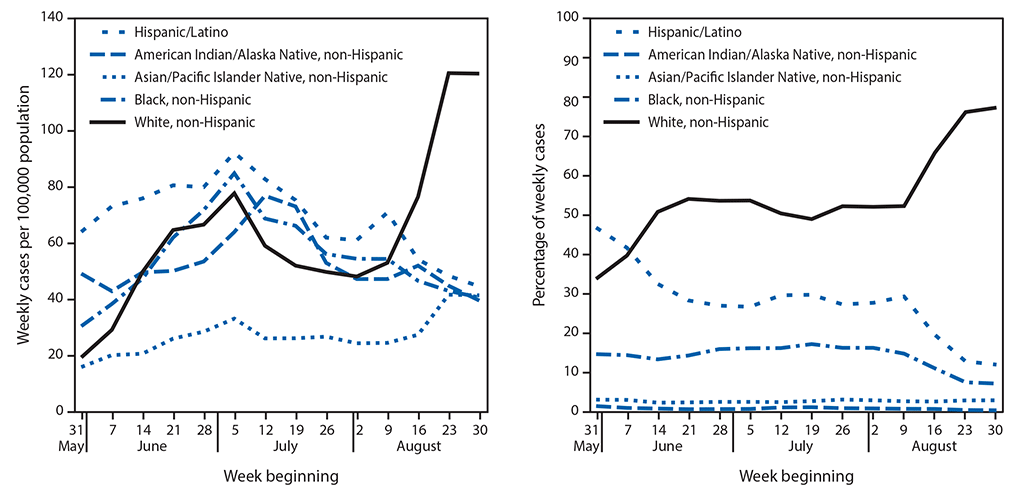
The CDC study includes its usual disclaimer that the increases in cases “were not solely attributable to increased testing.”
The report suggested that multiple factors are likely at play, but said, “Because approximately 45 percent of persons aged 18-22 years attend colleges and universities and 55 percent of those attending identified as white persons, it is likely that some of this increase is linked to resumption of in-person attendance at some colleges and universities.”
It concluded by stating, “Mitigation and preventive measures targeted to young adults (e.g., social media toolkits discussing the importance of mask wearing, social distancing, and hand hygiene), including those attending colleges and universities, can likely reduce SARS-CoV-2 transmission among their contacts and communities. Institutions of higher education should support students and communities by taking action to promote healthy environments.”
— Doug Lederman
Police Break Up Party of More Than 1,000 Near Florida State
Sept. 29, 7:30 a.m. Police broke up a party Sunday near Florida State University with more than 1,000 people — most of them students, the Associated Press reported. Large social gatherings, with people not practicing social distancing or wearing masks, are one way COVID-19 is spread.
Florida State reported that more than 1,400 students and 26 employees had tested positive for COVID-19 through Sept. 18.
The party came just days after Florida’s governor, Ron DeSantis, said the state should create a “bill of rights” for students. “I personally think it’s incredibly draconian that a student would get potentially expelled for going to a party,” DeSantis said Thursday. “That’s what college kids do.”
— Scott Jaschik
Florida May Protect Partying Students
Sept. 25, 6:25 a.m. Florida governor Ron DeSantis, a Republican, said the state could create a “bill of rights” to protect college students who face expulsion for attending parties under COVID-19 rules, Politico reported.
“I personally think it’s incredibly draconian that a student would get potentially expelled for going to a party,” DeSantis said Thursday. “That’s what college kids do.”
He did not provide details.
— Scott Jaschik
Health Agency in Boulder Further Restricts Student Behavior
Sept. 24, 12:45 p.m. The public health agency in Boulder County, Colo., on Thursday issued an order further restricting the behavior of college-aged people in the county, home to the University of Colorado at Boulder. The order from Boulder County Public Health, which takes effect today at 4 p.m. MST, forbids gatherings “of any size” among 18- to 22-year-olds within the county, and requires residents of 36 off-campus facilities (mostly fraternities and sororities) to remain in place for two weeks.
“A gathering is defined as more than one individual coming together or being physically near each other for any shared and common purpose, including socializing or participating in any activity together including but not limited to shopping, dining, or exercising,” the order stated.
The county’s order follows on the university’s decision Monday to begin two weeks of remote instruction Wednesday, which itself followed the announcement of a recommended stay-at-home period it began last week.
The university’s chancellor, Phil DiStefano, said Thursday that the county’s order gives students three options: stay in Boulder and follow the public health guidelines, return to their permanent residences and study fully online for the rest of the spring, or “choose to not follow the rules that protect our community from COVID-19 spread and run the risk of serious health consequences to yourself and others … Please do not choose this option,” he wrote.
DiStefano continued, “Like many of our peer universities across the country, we continue to face new challenges related to the COVID-19 pandemic. Some have enacted similar approaches to ours and are successfully reducing their positive cases. I believe we can as well, but only if we work together and make sacrifices for each other.”
— Doug Lederman
Sacred Heart Threatens to Send Students Home
Sept. 24, 6:25 a.m. The president of Sacred Heart University, in Connecticut, threatened to send students home if all students don’t follow guidelines for preventing the spread of COVID-19.
Speaking in a video message, John Petillo said that most students were following the rules. But he said “a significant number” are not. The university is receiving reports of gatherings, both on and off campus, in which rules are violated and face masks are not being worn.
These violations, he said, result in “too many positive COVID cases” among students, especially those in off-campus housing. And parents are urging the university to go fully remote in instruction. (Currently, it is teaching in a hybrid model.)
The university says that it has 119 cases of COVID-19, 94 of them from students in off-campus housing.
— Scott Jaschik
U of Michigan Resident Advisers End Strike
Sept. 23, 12:00 p.m. University of Michigan resident assistants have accepted a deal with the university and ended their strike, which began Sept. 8.
The staff had raised concerns about COVID-19 protections for residential staff and demanded, among other things, regular access to testing for RAs, hazard pay, personal protective equipment, greater enforcement of university policy and greater transparency from the administration. The staff is not unionized.
University officials have said the deal included priority testing for RAs through the university’s surveillance program, additional PPE and the creation of a council where concerns can be raised, mLive reported.
The residential life staffers began their strike the same day that Michigan’s graduate employees began theirs, and the two engaged in mutual actions. The graduate employees’ strike ended Sept. 16.
“This wouldn’t have happened without everyone that extended a helping hand in our direction,” the RA staff posted on Twitter. “Solidarity forever!”
— Lilah Burke
Middlebury Punishes 22 Students for Violating COVID-19 Rules
Sept. 23, 6:21 a.m. Middlebury College has punished 22 students for rules violations related to COVID-19.
“We have concluded that 22 students violated college policies related to COVID-19. We took swift action according to our sanctioning guidelines shared earlier with the community. These sanctions included revoking on-campus housing privileges and disallowing the students from visiting, studying, or taking courses on campus,” said a message on Middlebury’s website from Derek Doucet, dean of students.
He continued, “We cannot share any more details of particular conduct cases because of privacy concerns. I can tell you that these were very difficult decisions to make, but there is nothing more important than the health and safety of our community. Students removed from campus because of COVID-19 violations are ordinarily eligible to return in the following semester.”
— Scott Jaschik
Sept. 22, 3:40 p.m. The University of Notre Dame postponed a Sept. 26 football game against Wake Forest University after seven players on the Fighting Irish team tested positive for COVID-19, Notre Dame’s athletics department said in a statement. All football-related activities are on pause “until further testing is completed,” the statement said.
Notre Dame administered 94 COVID-19 tests to football players on Monday, and the seven athletes who tested positive are now in isolation, the statement said. A total of 13 players are in isolation and 10 are in quarantine, based on this and last week’s testing results from the football team, the statement said.
— Greta Anderson
Researchers Estimate Campus Openings Linked to ~3,000 New Daily Cases
Sept. 22, 10:48 a.m. A new working paper estimates that reopening college campuses for in-person instruction has been associated with more than 3,000 additional COVID-19 cases per day in the United States.
The researchers found an increase of 2.4 daily cases per 100,000 people in counties with a campus that opened for in-person instruction.
“No such increase is observed in counties with no colleges, closed colleges or those that opened primarily online,” they write.
“The uptick in local COVID-19 incidence was higher in colleges with greater exposure to students from states with high recent COVID-19 case rates. College reopenings that drew students from areas with a 10 percent greater weekly incidence were associated with an additional 1.19 new cases per 100,000 per day.”
The lead author of the study, conducted by a group of scholars with expertise in economics, epidemiology and higher education, is Martin Andersen, assistant professor of economics at the University of North Carolina at Greensboro. Researchers plan to publish the paper, titled “College Openings, Mobility, and the Incidence of COVID-19 Cases,” on a server for preprints (e.g., articles that have not yet been peer reviewed), medRxiv.
–Elizabeth Redden
Elon Moves to Level 3 Alert
Sept. 22, 6:20 a.m. Elon University has moved to level 3 — high alert following an increase in COVID-19 cases.
The university moved to level 2 four days prior after an outbreak among athletes led to the suspension of athletic practices. Since the move to level 2, 79 students have tested positive for COVID-19.
The move to high alert level has prompted the university to increase testing. The university’s mobile testing lab plans to conduct tests of 300 people who have had indirect contact with people who have tested positive. And random testing will be increased to 400 tests. (Elon enrolls about 7,000 students.)
In addition, certain classes with a “significant proportion” of positive cases will move online.
— Scott Jaschik
Northeastern Lets Suspended Students Apply Tuition to Spring Semester
Sept. 18, 6:23 a.m. Northeastern University has backed down, in part, on its decision to charge full tuition to 11 students it suspended for violating the rules mandating social distancing and wearing face masks, The Boston Globe reported.
The university originally said that it would take the entire tuition payment for the semester, $36,500. But now the university is taking only $8,740. The rest can be applied to the spring semester’s tuition.
“The university’s response is still not acceptable, although it is telling that they appear to be backtracking from their initial position about taking these families’ money without an obligation to deliver any services whatsoever,” said Brett Joshpe, a lawyer for two of the students’ families.
— Scott Jaschik
President Sorry for Posting Photo
Sept. 17, 6:27 a.m. The president of Allegheny College is apologizing for posting a photograph of herself outside, off campus, The Meadville Tribune reported.
The photo was posted to Instagram at a time when the college’s students were all supposed to be on campus in a quarantine.
Hilary Link, the president, apologized. “Posting the picture without the whole context was not my best choice,” Link told the Tribune on Tuesday. “I was watching my 14-year-old son in his first-ever varsity soccer game for the Meadville High School in a stadium very, very physically distanced from every other person except my husband — wearing masks,” Link said. “Everybody was wearing masks. Outdoors. Absolutely following guidelines that we set out for our facility and staff who do not live on campus.”
Students and parents complained about her photo.
— Scott Jaschik
Big Ten Will Play Football in October
Sept. 16, 10:10 a.m. The Big Ten Conference reversed course on its decision to postpone college football until spring 2021 and will instead resume competition Oct. 23, the league announced Wednesday. The decision applies only to football, and the future of other fall sports “will be announced shortly,” a Big Ten news release said.
The conference, which includes big-time football programs such as Pennsylvania State University, the University of Michigan and Ohio State University, originally decided in August that the medical risks of COVID-19 for athletes called for postponement. The league’s leaders were concerned about a heart condition, myocarditis, that some athletes who previously had COVID-19 are at risk of developing due to heart inflammation while battling symptoms of the virus.
League leaders faced political pressure to resume the season from governors of several states and from the federal government, including United States senator Ben Sasse, a Republican from Nebraska, and even President Donald Trump, who met with Big Ten commissioner Kevin Warren earlier this month. Parents of Big Ten athletes also protested the decision and several University of Nebraska football players sued the league, USA Today reported.
Along with the decision to resume fall play, the league developed new protocols for testing athletes for COVID-19, cardiac screening and “an enhanced data-driven approach when making decisions about practice/competition,” the press release said. All athletes, coaches and others on the field for practice and games will be tested daily for COVID-19 and athletes who test positive will not be able to return to games for 21 days, the release said. The resumption of practice or games will be determined by the team and staff members’ coronavirus positivity rate.
“Our goal has always been to return to competition so all student-athletes can realize their dream of competing in the sports they love,” Warren said in the release. “We are incredibly grateful for the collaborative work that our Return to Competition Task Force have accomplished to ensure the health, safety and wellness of student-athletes, coaches and administrators.”
— Greta Anderson
SUNY, Faculty Union Reach Agreement on Testing Professors
Sept. 15, 6:24 a.m. The State University of New York and its faculty union, United University Professions, announced an agreement under which faculty members will be tested for the coronavirus.
SUNY Chancellor Jim Malatras said, “We will now regularly test UUP faculty members serving on campus for the virus. I want to thank President Frederick Kowal for his continued leadership in protecting his members and all of SUNY as we make COVID-19 testing available for all of our UUP faculty and other professional members. This will help us pinpoint and isolate cases on our campuses, avoid outbreaks, and most importantly — keep our dedicated faculty members safe. I look forward to working closely with UUP leadership in the months ahead as we navigate these uncertain times.”
Kowal said, “We welcome this opportunity to make the SUNY state-operated campuses as safe as we possibly can for students, for the surrounding campus communities and for our UUP membership, with this new agreement for mandatory COVID-19 testing of employees represented by UUP.”
— Scott Jaschik
University of Arizona Recommends Shelter in Place for Students
Sept. 14, 3:40 p.m. The University of Arizona and the Pima County Health Department are recommending students on campus and near campus shelter in place for 14 days as the university battles a rising number of COVID-19 cases.
Students following that recommendation, which has also been described as a voluntary quarantine, would still be able to travel to certain activities like essential in-person classes or to purchase necessities like food or medication that can’t be delivered. Leaders are still determining the exact geographic area to be covered by the recommendation. They expect to release additional details later today.
Without intervention, officials worry the coronavirus could incubate among students and spread to more vulnerable populations in the region.
“The university is not an island,” said Dr. Theresa Cullen, director of public health for Pima County, during a virtual news conference today. “It may seem that way, sometimes, but it’s not.”
Local government officials were already considering steps like removing pool permits from apartment complexes that host a large number of students. The university has confirmed well over 600 positive cases this month.
Officials during today’s news conference blamed off-campus social gatherings for accelerating transmission of the virus. The university has been operating with limited in-person courses since beginning the fall semester at the end of August.
The university’s president, Robert C. Robbins, called Monday’s announcement a “last-ditch effort” to ask students to follow social distancing rules before more drastic changes must be made.
“I’m short of saying ‘I’m mad as hell and I’m not going to take it anymore,’ because there are only certain things that I can do,” Robbins said. “But this is part of being a good member of society, to take into account the health of others — not just your individual health, and not just your individual desire to go out and have a good time and party.”
— Rick Seltzer
Athletes With COVID-19 at Risk of Heart Inflammation, Small Study Finds
Sept. 12, 2:32 p.m. Roughly one in six college athletes who contracted COVID-19 later showed evidence of heart inflammation that could be dangerous if they return to play, a new study found.
The small study, conducted on 26 athletes at Ohio State University and published in JAMA Cardiology, revealed through cardiovascular magnetic resonance imaging that four of the athletes had myocarditis, heart inflammation that can cause serious damage. Several others showed evidence of previous myocarditis that could have resulted from the coronavirus.
The threat of COVID-driven myocarditis among competitive athletes has been a source of contention in recent weeks. The Big Ten and Pac-12 Conferences opted not to play this fall in significant part because of concern among its member universities about the potentially fatal heart ailment.
Last week, officials at Pennsylvania State University sent conflicting signals about the threat. After the university’s director of athletic medicine said at a public meeting that about a third of Big Ten Conference athletes who tested positive for the coronavirus showed signs of myocarditis, university officials sought to correct the record, citing the 15 percent figure.
— Doug Lederman
Sept. 11, 6:24 a.m. University of Missouri president Mun Choi has removed blocks on his Twitter account from students who were posting criticism of the university’s policies on reopening the campus, The Columbia Daily Tribune reported.
Choi removed the blocks after a lawyer threatened to sue over them. “Not only is it immoral and repugnant for President Choi to block students and other persons on social media who are trying to raise awareness of campus safety issues in the middle of a global pandemic, it is also unlawful,” the lawyer wrote.
A spokesman for Choi said some of the posts that led the president to block the accounts were obscene.
— Scott Jaschik
California State to Stay Virtual in Spring 2021
Sept. 10, 7:45 p.m. The California State University system has announced that all 23 of its campuses will continue to offer virtual instruction for the academic term beginning in January 2021.
“After extensive consultation with campus presidents and other stakeholders, and careful consideration of a multitude of factors — regarding the pandemic and its consequences, as well as other matters impacting the university and its operations — I am announcing that the CSU will continue with this primarily virtual instructional approach for the academic term that begins in January 2021, and also will continue with reduced populations in campus housing,” CSU chancellor Timothy P. White announced in a message to the university Wednesday. “This decision is the only responsible one available to us at this time. And it is the only one that supports our twin North Stars of safeguarding the health, safety and well-being of our faculty, staff, students and communities, as well as enabling degree progression for the largest number of students.”
White said the decision was announced now in order to give students and their families time to plan for the spring 2021 semester. He also cited the need to publish and promote course offerings and to meet accreditation requirements for virtual courses.
— Marjorie Valbrun
Wisconsin Pauses In-Person Instruction, Quarantines 2 Residence Halls
Sept. 10, 7:55 a.m. The University of Wisconsin at Madison announced Wednesday evening that it would pause in-person instruction for two weeks, citing a positive COVID-19 testing rate that had risen above 20 percent this week.
Much of the increase was driven by off-campus activity, but “the latest numbers also show a sharp increase in certain residence halls,” said Chancellor Rebecca Blank. “We will not contain this spread without significant additional action.”
In addition to the two weeks of fully virtual instruction for undergraduate and graduate students alike, Wisconsin said it would impose a quarantine on two residence halls where positive cases have spiked, close all in-person study spaces at libraries and the student union, and cancel all in-person gatherings of more than 10 people.
“I share the disappointment and frustration of students and employees who had hoped we might enjoy these first few weeks of the academic year together,” Blank said.
— Doug Lederman
Stanford Medical Faculty Attack ‘Falsehoods’ by Trump Adviser
Sept. 10, 6:28 a.m. More than 70 professors at Stanford University’s medical school have signed a letter criticizing the “falsehoods and misrepresentations of science” by Scott Atlas, a former colleague currently advising President Trump on the coronavirus.
Specifically, the letter defends face masks, social distancing and the development of a vaccine and says that young children can get the virus.
“Failure to follow the science — or deliberately misrepresenting the science — will lead to immense avoidable harm,” the letter says.
— Scott Jaschik
Tennessee Evacuates Residence Hall So More Students Can Isolate
Sept. 9, 1:30 p.m. The University of Tennessee at Knoxville, where the number of students with COVID-19 has almost tripled this month, to 612, told students in one of its residence halls Wednesday that they would have to move out to make room for self-isolating peers.
“I recognize that this is unexpected news and that shifting residence halls will disrupt your semester. I am sorry for the disruption, and we are here to support you academically, socially, mentally, and financially,” Frank Cuevas, vice chancellor for student life, said in an email to residents of Massey Hall Wednesday. “I know this is not how you envisioned your semester, and we will work to support you through this. As circumstances evolve on campus we are adjusting our operational plans to help manage through this pandemic, with our top priority being the health and well-being of our campus community.”
Like many major public universities, Tennessee is seeing large numbers of students test positive for COVID-19 and much larger numbers in isolation or quarantine. The University of Tennessee System coronavirus dashboard shows a doubling of the number of students in either isolation or quarantine at the Knoxville campus between Aug. 31 and Sept. 8, to 2025 from 990.
Tennessee officials said the hotel they had secured was inadequate to house all the isolating students. They chose Massey for the overflow, they said, because of its size and the fact that it has proportionally few students living there now. The students who live there can choose between either moving to another residence hall on the campus or canceling their housing contract and moving back home. The university said it would provide “supplies and staff” to help students move to another room on the campus, and would “make every effort” to keep roommates together.
— Doug Lederman
Wisconsin-Madison Restricts Student Activities
Sept. 9, 6:29 a.m. The University of Wisconsin at Madison has restricted students to “essential activities” for two weeks, to control the spread of COVID-19.
The following activities were defined as essential:
- Classes
- Medical care, including COVID-19 testing
- Purchasing food
- Going to a job
- “Engaging in an individual outdoor activity, such as running or walking”
- Attending a religious service
The university reported an increase in positive test results for the virus.
— Scott Jaschik
Florida State Shows Increase
Sept. 9, 6:19 a.m. Florida State University is seeing an increase in the number of students testing positive for the coronavirus, The Tallahassee Democrat reported. More than 700 students tested positive last week.
“Florida State does not plan a shift to remote instruction at this time. If a decision is made to transition to all remote instruction in the future, the university will notify the community,” the university said. “The current increase in cases was not unexpected as it correlates to the marked increase in voluntary testing of the campus community during the first two weeks of the fall semester.”
— Scott Jaschik
Advice for Keeping Students Safe Amid COVID-19 Outbreaks
Sept. 4, 10:20 a.m. As a growing number of colleges and universities struggle to control COVID-19 after resuming in-person instruction, the Pittsburgh Regional Health Initiative (PRHI) released results of a survey of public health experts and others on how colleges should respond now to outbreaks of the virus. The more than 100 respondents to the survey included physicians, health-care administrators, students and community leaders.
Colleges should conduct daily saliva testing as well as random sample blood/mucosal testing to track the spread, prevalence and incidence of the virus, the survey found. Respondents said colleges also should have contact tracing capacity in place. The survey found that institutions should run crowdsourced symptom monitoring with as many students and employees as possible, using wearable wrist and bed sensor devices. And it said colleges should require students to wear a device to track their movement and notify students when they are not practicing adequate social distancing.
“The safety of our campuses for students, faculty, staff, surrounding neighborhoods and local health personnel requires vigorous and innovative measures. To date, we have not seen a national strategy to address these outbreaks and ensure the safety of those involved with higher education. The suggestions provided through this survey can help universities answer these difficult questions and make decisions based in science and a public health approach,” Karen Wolk Feinstein, president and CEO of PRHI, said in a statement.
Masks should be mandatory for students, the survey said. And colleges should use and enforce codes of conduct to encourage social distancing. The survey also said colleges should not penalize faculty members for choosing to work remotely.
The group of respondents said college leaders should close hot spots for transmission, including bars that violate protocols and fraternity homes.
“Close fraternity houses. Period,” the report on the survey’s results said.
Respondents urged college leaders to communicate with their local communities about measures institutions have taken to keep them safe.
“Ask the community how they think the university can be a partner in protecting all,” the report said. “They did not have a voice in campus reopenings, so engage them now.”
The Pittsburgh Regional Health Initiative is the operating arm of the Jewish Healthcare Foundation and a member of the national Network for Regional Healthcare Improvement.
— Paul Fain
Sept. 4, 9:45 a.m. Pennsylvania State University has issued new information after its director of athletic medicine drew attention this week by saying in a public meeting that about a third of Big Ten Conference athletes who tested positive for the coronavirus showed signs of myocarditis.
The official, Wayne Sebastianelli, made the comments Monday at a local school board meeting about “initial preliminary data that had been verbally shared by a colleague on a forthcoming study,” a Penn State Health spokesman said, according to multiple news outlets. Sebastianelli didn’t know the study had been published with a significantly lower rate of myocarditis — about 15 percent for athletes who had the virus.
Penn State also said that its athletes who’d tested positive for the coronavirus had no cases of myocarditis.
Myocarditis is an inflammation of the heart muscle that can cut the heart’s ability to pump and cause abnormal heart rhythms, according to the Mayo Clinic. Untreated, it can cause permanent damage to the heart and lead to heart failure, heart attack, stroke or sudden death.
— Rick Seltzer
Maryland Suspends Athletic Activities After COVID-19 Spike
Sept. 4, 6:25 a.m. The University of Maryland at College Park suspended all athletic activities after a spike in athletes testing positive for the coronavirus, The Baltimore Sun reported.
Maryland said that 501 student athletes were tested for COVID-19 on Monday and Tuesday. Of those, 46 had positive tests. They were on 10 teams.
The Big Ten is not playing games this fall, but has been allowing athletes who have tested negative to practice.
— Scott Jaschik
Democrats Urge Campus Ban on Vaping During Pandemic
Sept. 3, 5:46 p.m. Top House and Senate Democrats are urging the Centers for Disease Control and Prevention to advise colleges to bar e-cigarettes for the fall semester.
In the letter, Representative Raja Krishnamoorthi, chairman of the House economic and consumer policy oversight subcommittee, and Senator Dick Durbin cited a Journal of Adolescent Health study, which found that 13- to 24-year-olds who vape are five times more likely than nonvapers to be diagnosed with COVID-19.
“With the added public health risk posed by coronavirus, the CDC must act quickly and forcefully,” wrote Krishnamoorthi and Durbin, both of Illinois.
— Kery Murakami
Union Calls on Louisiana Board to End Face-to-Face Activities
Sept. 3, 3:30 p.m. The United Campus Workers of Louisiana today called for regents to stop face-to-face activities because of the coronavirus.
A statement from the union, which was chartered a year ago and has about 120 members who are graduate workers, faculty members and staff members, focused heavily on the situation at Louisiana State University. LSU has counted a total of 366 positive cases of COVID-19 since Aug. 15, with most coming since Aug. 25.
More information has been learned about the transmission of the coronavirus since the university created its reopening plans, the union said in its statement. It raised concerns about the risk of transmission in enclosed spaces and from people who are not showing symptoms of the infection.
“In light of these facts, reopening a university system that operates in all 64 parishes in Louisiana endangers everyone in the state, particularly the state’s underserved and high-risk populations,” said the union’s statement. “For the safety of the LSU community and the state at large, United Campus Workers of Louisiana calls on the Louisiana Board of Regents to act in accordance with its ‘constitutional mandate to serve the educational, health care and economic development goals of Louisiana’ and immediately halt face to face activities on campus.”
The statement comes shortly after LSU’s interim president, Tom Galligan, said four student organizations have been charged with violating the university’s code of conduct regarding the coronavirus. Video has surfaced that appears to show off-campus parties with few precautions in place.
“We have seen the videos, and they are very concerning,” Galligan said, according to KSLA. “We’re going to investigate, communicate and, as necessary, we’ll enforce.”
Galligan also signaled a high level of concern about the virus’s spread.
“I’m concerned and I’m monitoring and we’re looking at it very carefully, because if it keeps going up, we’re going to go remote,” he said, according to KSLA.
The union does not have a collective bargaining agreement with LSU.
— Rick Seltzer
Positive Cases Top 1,000 at the University of Dayton
Sept. 3, 2:43 p.m. The University of Dayton announced this afternoon on its COVID-19 dashboard that the cumulative number of positive cases among students on campus has reached 1,042, including 639 active cases. The rest — 403 students — have recovered.
The private university enrolls roughly 11,500 students, including about 9,000 undergraduates, meaning its total positive cases comprise almost 10 percent of all students. The university’s first day of classes was Aug. 24. UD has created five campus status levels for COVID-19, with level five being to largely vacate the campus and have most students leave on-campus housing. The university reached level four last week, which includes pivoting to remote learning while students stay in on-campus housing. It shifted to remote learning last month when cases spiked.
UD in a statement cited a flattening of seven-day averages for new positive cases as an encouraging sign. It said the university has been aggressive with the testing, isolation and quarantining of students.
“University leaders continue to work closely with local public health officials and UD’s panel of local medical experts to monitor, assess and contain the situation on campus,” the university said. “We will determine next week what steps to take based on the situation and trends we see at that time. While we hope the trends will indicate that we can return to at least some in-person learning, we also may need to consider further restrictions, including the possibility of moving to fully remote learning, if Public Health believes our campus is contributing to broader community spread.”
— Paul Fain
About One-Third of Positive Big Ten Athletes Showed Signs of Myocarditis
Sept. 3, 1:00 p.m. A potentially dangerous inflammation of the heart muscle was detected in about a third of Big Ten Conference athletes who’d tested positive for COVID-19, according to the Centre Daily Times.
Pennsylvania State University’s director of athletic medicine, Wayne Sebastianelli, shared the estimate at a State College area school Board of Directors meeting Monday, the newspaper reported. MRI scans showed the athletes in question had myocarditis, an inflammation that can be deadly if not addressed.
“When we looked at our COVID-positive athletes, whether they were symptomatic or not, 30 to roughly 35 percent of their heart muscles [are] inflamed,” Sebastianelli said. “And we really just don’t know what to do with it right now. It’s still very early in the infection. Some of that has led to the Pac-12 and the Big Ten’s decision to sort of put a hiatus on what’s happening.”
The Big Ten and Pac-12 postponed fall sports in August. Both cited uncertainty about college athletes’ health amid coronavirus infections.
But other major football conferences continue to forge ahead with plans to hold modified seasons. That’s led to some pushback, with Nebraska football players filing a lawsuit against the Big Ten. The lawsuit prompted the revelation that the league’s members voted 11 to 3 in favor of postponing the football season. Recently, reports have surfaced that the Big Ten was discussing a season to begin the week of Thanksgiving.
Earlier today, ESPN reported that 21 universities in the Atlantic Coast Conference, Southeastern Conference and Big 12 Conference — the three conferences making up college football’s Power Five that plan to play sports this fall — would not disclose data on COVID-19 cases when asked. Almost half of the 65 institutions across all Power Five conferences declined to share data about positive tests recorded to date.
— Rick Seltzer
Many Colleges Playing Big-Time Football Withhold COVID-19 Numbers
Sept. 3, 12:15 p.m. Twenty-one institutions in the Atlantic Coast Conference, Southeastern Conference and Big 12 Conference declined to disclose positive COVID-19 cases among athletes to ESPN, citing federal student privacy laws, the media outlet reported. These three “Power Five” conferences are all preparing to play football games this month.
Of the 65 total Power Five institutions surveyed by ESPN, nearly one-third did not provide information about their coronavirus protocols for athletes in addition to withholding the number of positive tests among athletes, the outlet reported.
— Greta Anderson
Temple Extends Remote Instruction for Rest of Semester
Sept. 3, 9:50 a.m. Four days after announcing a two-week suspension of in-person classes, Temple University in Philadelphia today extended the move for the rest of the fall semester for almost all courses.
Only essential courses — those that require some in-person instruction to meet educational objectives — are not covered by the decision. Temple estimates 95 percent of its courses will be delivered online for the rest of the semester.
Students in university housing who choose to leave by Sept. 13 will receive full refunds of housing and meal plan charges. But students can remain on campus if they want or need to do so.
“We know this is disappointing for the many students and their families who had hoped for an on-campus experience,” said the university’s president, Richard M. Englert, and its provost, JoAnne A. Epps, in a public letter announcing the decision. “Please know that if the data supported a decision to safely continue the fall semester experience on campus, we would have made every effort to do so. Unfortunately, the risks associated with the COVID-19 pandemic are simply too great for our students, faculty, staff and neighboring community.”
Two days ago, Philadelphia’s health commissioner declared a COVID-19 outbreak at Temple. The university’s COVID-19 dashboard listed 212 actives cases as of 1 p.m. yesterday, all among students. All but one were recorded among on-campus students.
Temple began fall classes 10 days ago, Aug. 24.
— Rick Seltzer
Ohio State Reports 882 Positive Cases
Sept. 3, 8:32 a.m. Ohio State University reported 882 positive cases of COVID-19 among students, and 20 positives among employees. Classes began at Ohio State on Aug. 25.
The university has a 3.13 percent positivity rate among students and a 4.3 percent positivity rate average over the last week, according to its dashboard site. But it reported a 9.66 positivity rate for students who live off campus and were tested in the last 24 hours, with a 5.7 percent rate for students who live on campus. The university currently has 462 students in isolation and quarantine.
Ohio State recently suspended 228 students for violating coronavirus-related safety guidelines. And it has threatened to crack down on students who host gatherings of more than 10 people who are not wearing masks or social distancing.
— Paul Fain
30 of 40 Greek Houses at Indiana Are in Quarantine
Sept. 3, 6:27 a.m. Thirty of the 40 Greek houses at Indiana University are under quarantine for COVID-19, The Indianapolis Star reported.
There is an 8.1 percent positive rate among students living in fraternity and sorority housing. Residence halls have a 1.6 percent positive rate.
All communal houses at Indiana have been ordered to suspend activities, except housing and dining.
— Scott Jaschik
NCAA to Furlough All Employees Except Top Executives
Sept. 2, 5:50 p.m. The National Collegiate Athletic Association will furlough 600 employees amid severe budget strains due to the pandemic’s impact on college athletics, according to a memo obtained by the Associated Press. The furloughs of three to eight weeks will affect the entire staff of the Indianapolis-based NCAA except for senior executives, the Indianapolis Star reported.
Beginning Sept. 21, all staff members in the NCAA’s national office will be furloughed for three weeks, according to the memo. And some employees will be furloughed for up to eight weeks depending on their jobs and the seasonal timing of their duties. USA Today reported in March that Mark Emmert, the NCAA’s president, and other top managers were taking pay cuts of 20 percent. That move followed the cancellation of the Division I men’s basketball tournament, which generates nearly all of the NCAA’s roughly $1.1 billion in typical annual revenue, the newspaper reported.
— Paul Fain
Iowa State Reverses Plan to Play Football Opener in Front of 25,000 Fans
Sept. 2, 3:50 p.m. Iowa State University’s announcement Monday that it would let as many as 25,000 fans attend its football season opener Sept. 12 drew both scorn and, as recently as today, support from Iowa’s governor, Kim Reynolds, who said at a news briefing Wednesday that “we can do these things safely and responsibly. We can open our schools back up, we can open our colleges back up, we can continue to move forward, but we have to have personal responsibility.”
But the university’s athletics department announced today that the game will be played without fans after all.
The statement from the athletics director, Jamie Pollard, didn’t exactly embrace the decision, saying that Iowa State president Wendy Wintersteen had reversed the decision “after weighing feedback she has received from the community … Our department has always taken great pride in working hand-in-hand with the university and this situation is no different. We are in this together and will do everything we can to support Dr. Wintersteen and her leadership team in their efforts to lead our institution during very challenging times.”
— Doug Lederman
University of Georgia Reports 821 Cases in First Full Week of Classes
Sept. 2, 2:17 p.m. The University of Georgia reported 821 new cases of COVID-19 for the week of Aug. 24-30, bringing the total number of cases reported since Aug. 10 to more than 1,000.
Of the 821 individuals with reported positive tests, 798 were students, 19 were staff members and four were faculty.
The university’s surveillance testing program of asymptomatic students turned up 97 positive cases out of 1,810 tests conducted, for an overall positivity rate of 5.4 percent.
University of Georgia president Jere W. Morehead described the rise in positive tests as “concerning” and urged students to take steps to avoid exposure.
“I urge you: continue to wear your masks, maintain your distance from others, make wise decisions, and stay away from social venues where appropriate distancing is impossible to maintain,” Morehead said on Twitter. “Resist the temptation to organize or attend a large social gathering. And, for those of you heading out of town over the Labor Day weekend, be very careful and think about the health of everyone around you.”
— Elizabeth Redden
University of Kentucky at 760 Cases, Only Testing Greek Life Members
Sept. 2, 12:55 p.m. The health department for Lexington, Ky., has reported that there have been 760 coronavirus cases among students at the University of Kentucky.
The university tested every on-campus student upon arrival, resulting in 254 positive results, and is currently retesting 5,000 members of Greek life organizations.
But it has no current plans to test other students or student populations. University officials have said they are waiting on further data to decide how to proceed, The Louisville Courier-Journal reported.
— Lilah Burke
All-Student Quarantine at Gettysburg
Sept. 2, 7:50 a.m. Gettysburg College announced late Tuesday that all of its students must quarantine in their residence halls through at least the end of the week, in an effort to slow the spread of the virus that has infected 25 of 348 students tested through Tuesday afternoon.
“This interim all-student quarantine allows us to better understand the path of the virus on campus, informed by the results of the remainder of this week’s tests,” the dean of students, Julie Ramsey, wrote in a message to the campus. All classes will be remote and students can leave their rooms only to pick up food, use the bathroom or get their COVID-19 test.
Ramsey said college officials would reassess their plan for the rest of the semester at the end of the week.
— Doug Lederman
James Madison Goes Remote in September
Sept. 2, 6:28 a.m. James Madison University announced Tuesday that it is abandoning plans for an in-person semester, instead moving to an online September.
President Jonathan R. Alger wrote to students and faculty members that “We spent the last several months planning to start this year with a mix of in-person, hybrid, and online classes. In the days since students have been back on campus, we have observed their vibrancy, excitement to engage with their faculty, and large-scale adherence to COVID-19 rules and guidance. However, we have also observed troubling public health trends. As a result of a rapid increase in the number of positive cases of COVID-19 in our student population in a short period of time, the university is concerned about capacity in the number of isolation and quarantine spaces we can provide. Protecting the health of our Harrisonburg and Rockingham County community — including students, faculty, staff — is our top priority, and we need to act swiftly to stop the spread as best we can.”
Alger continued, “After consultation with the Virginia Department of Health, James Madison University will transition to primarily online learning, with some hybrid instruction for accreditation and licensure requirements, graduate research, and specialized upper-class courses requiring equipment and space, through the month of September.”
— Scott Jaschik
COVID-19 ‘Outbreak’ Declared at Temple University
Sept. 1, 4:15 p.m. The Philadelphia health commissioner on Tuesday said there is a COVID-19 “outbreak” at Temple University and told students to “assume everyone around you is infected,” 6ABC reported.
The university reverted to online instruction on Sunday after reporting 103 people on campus had tested positive for the coronavirus. According to contact tracing, the outbreak stemmed from off-campus apartments and small social gatherings, 6ABC reported.
“For any Temple student who is listening to this today, I want to be really clear, and we are asking you to follow this guidance: you should assume that everyone around you is infected,” Thomas Farley, the city’s health commissioner, said during a press conference Tuesday.
— Greta Anderson
White House Warns Against Sending Infected Students Home
Sept. 1, 3:58 p.m. White House officials are worried college students infected by coronavirus will go back to their home communities and spread the disease. Dr. Deborah Birx, the White House’s coronavirus coordinator, in a call Monday called on governors to urge college presidents in their states not to send students who test positive for the virus home and to keep them on or near campuses.
Not doing so could lead to another national outbreak, Birx said, according to an aide to one of the governors who was on the call, which included Vice President Mike Pence and Dr. Anthony Fauci, director of the National Institute of Allergy and Infectious Diseases.
Birx cited the University of Wisconsin at Madison as an example. The university has set up housing for students to isolate themselves if they test positive, and for others at high risk of having been exposed to quarantine themselves, so that the rest of campus can continue functioning.
The call was first reported by The Daily Beast. The site quoted Birx as having said, “Sending these individuals back home in their asymptomatic state to spread the virus in their hometown or among their vulnerable households could really recreate what we experienced over the June time frame in the South. So I think every university president should have a plan for not only testing but caring for their students that need to isolate.”
Terry Hartle, the American Council on Education’s senior vice president for government and public affairs, said colleges already are doing what Birx urged. “Any college that brings students back to campus will have a clear plan in place to isolate those who test positive and to provide medical assistance to individuals who need it,” he said. “There is simply no way that a campus would go through the extensive planning related to reopening in the COVID environment — cleaning, testing, tracing and distancing — and fail to ask themselves, ‘How do we isolate and treat students who test positive?’”
— Kery Murakami
With Many Students Quarantined, Colorado College Goes Virtual
Sept. 1, 1:30 p.m. First Colorado College quarantined students in one of its three residence halls for two weeks after a student tested positive for COVID-19. Then the liberal arts college in Colorado Springs had to do the same with its other two residence halls, just as the first residence hall completed its quarantine period.
On Tuesday, college officials conceded that “despite our rigorous testing and response protocols … our earlier plans to bring the rest of our student body to campus … are no longer feasible.” The college plans to deliver classes remotely for the rest of 2020 and require all students not in quarantine to leave campus by mid-September.
Colorado is probably best known for its block scheduling plan, which multiple colleges copied this year presuming that it would give them more flexibility to respond to potential COVID-19-required pivots.
The college’s COVID-19 dashboard shows only three positive cases (out of 1,111 tests), but it has not been updated since last Wednesday. The dashboard showed about a quarter of its 805 students living on campus as being in either quarantine or isolation, again as of last Wednesday.
— Doug Lederman
Illinois State Records Over 1,000 Cases
Sept. 1, 12:30 p.m. More than 1,000 students have tested positive for COVID-19 at Illinois State University roughly two weeks into the fall semester.
The 1,023 cases the university reported as of Tuesday represent nearly 5 percent of its student body, WGLT reported. The university has conducted about 4,400 tests at three locations on campus since Aug. 17, and its testing positivity rate for the last week is 24 percent.
Illinois State is located in Normal, Ill., which has enacted emergency orders aimed at curbing the spread of infections. One of those orders is a temporary ban on gatherings of more than 10 people near campus. The other in part requires customers at bars and restaurants that serve alcohol to be seated to be served.
University leaders say they have moved 80 percent of classes online, are encouraging faculty and staff members to work remotely if possible, and have de-densified dorms. But Illinois State’s on-campus coronavirus testing is reportedly slower and more expensive than tests being used in large numbers at the state flagship, the University of Illinois at Urbana-Champaign. Illinois State was forced to change its testing strategy after the federal government redirected testing supplies to nursing homes — a series of events that contributed to university leaders deciding to shift plans toward online classes about a month ago, as the start of the semester neared.
— Rick Seltzer
Sept. 1, 6:39 a.m. Scott Atlas, an adviser to President Trump on the coronavirus, said Monday that college football can be played safely during the pandemic, Click Orlando reported.
He said college football players “are among the most fit people in the universe. They’re very low-risk people.”
“They have testing, they have doctors. This is the best possible healthy environment for the healthiest people. And so to start saying that we can’t have these sports when so many people in the community also depend upon the athletes themselves or their families — this shouldn’t really be a point of controversy,” Atlas said.
The Big Ten and Pac-12 Conferences called off the 2020 season due to coronavirus concerns, but other big-time football conferences are playing this fall.
— Scott Jaschik
U of New England Warns Students They May Face Charges
Sept. 1, 6:27 a.m. The University of New England, in Maine, is warning students who attended an off-campus party that they will face disciplinary action, News Center Maine reported.
President James Herbert announced the university’s first positive case of COVID-19 and two additional cases among undergraduate students.
Herbert said the cases stemmed from “precisely the situation we have warned students against — a large off-campus gathering without masks and [social] distancing.”
— Scott Jaschik
Students, Employees Hold ‘Die-in’ at Georgia College
Aug. 28, 12:30 p.m. Students and staff members at Georgia College staged a protest this morning as the public liberal arts college’s COVID-19 numbers continue to mount.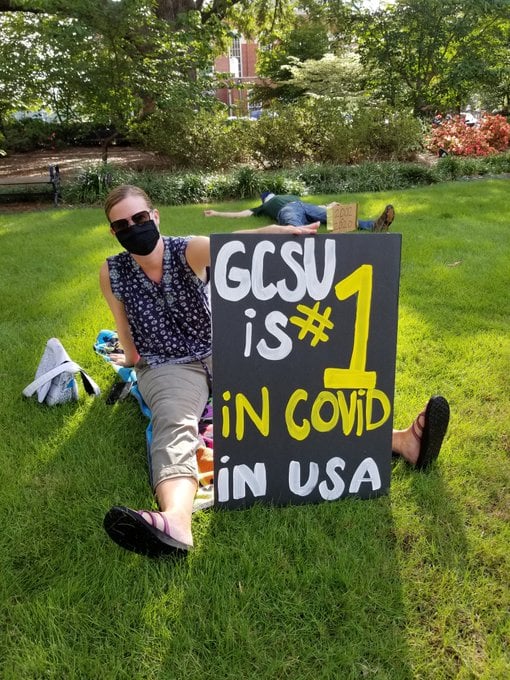
The “die-in,” which was sponsored by the United Campus Workers of Georgia at GCSU union, featured masked and (mostly) physically distanced students and employees carrying signs such as “I can’t teach if I’m dead” and “I won’t die for the USG,” a reference to the University System of Georgia, of which Georgia College is a part.
UCWGA-GCSU is demanding online learning options for students and instructors, hazard pay, contact tracing, greater diagnostic testing and security from layoffs. The union has said neither testing nor quarantine housing has been provided by the university. Up to a third of students may currently be in quarantine.
College officials, who have issued mild statements and declined to answer numerous questions from Inside Higher Ed reporters as the proportion of students with COVID-19 has hit 8 percent, have said any decisions about the campus’s status must be made in consultation with officials from the system and from the state health department. Georgia’s governor, Brian Kemp, has generally opposed aggressive efforts to contain the coronavirus.
Georgia College updated its COVID-19 webpage Friday morning to add another 40 student cases from Thursday, pushing its student total to 514 and its campus total to 535. The college has about 7,000 students total, but its on-campus population is lower.
— Doug Lederman
Notre Dame Plans to Restart Undergraduate Classes in Person
Aug. 28, 11:05 a.m. The University of Notre Dame is moving to hold in-person undergraduate classes again in stages starting Wednesday, it announced this morning.
Notre Dame will resume in-person classes after two weeks of remote undergraduate instruction and physical lockdown prompted by spiking COVID-19 infections. The university announced Aug. 18 that it was closing public spaces on campus, restricting access to residence halls and asking students not to come to campus while its leaders reassessed plans amid a rising coronavirus infection rate.
At the time, Notre Dame counted 147 confirmed cases since Aug. 3 out of a total of 927 tests performed. The university only began classes Aug. 10.
When announcing that it plans to resume in-person classes for undergraduates, Notre Dame said that the number of new cases has decreased “substantially.” It cited a positivity rate of 6.3 percent from Aug. 20 through Aug. 25, as well as a positivity rate of less than 1 percent among over 1,200 surveillance tests on “members of the campus community.”
The university’s COVID-19 dashboard shows 12 new positive cases out of 409 total tests on Wednesday, the last day for which data have been posted. In the first three days of this week, it shows 66 new positive cases out of a total of 1,504 tests.
“With these encouraging numbers, we believe we can plan to return to in-person classes and gradually open up the campus,” the university’s president, the Reverend John I. Jenkins, said in a news release.
Two security firms and state troopers have been monitoring off-campus quarantine sites at Notre Dame after students were said to be leaving them in violation of rules, The South Bend Tribune reported yesterday. A Notre Dame spokesman has declined to provide additional information, citing student privacy concerns.
Father Jenkins said he was proud of staff members who have gone “above and beyond their ordinary responsibilities to keep the campus open and safe.” He also stressed those on campus should wear masks, maintain physical distance, wash their hands, complete a daily health check, report for surveillance testing as requested and limit social gatherings to 10 or fewer people.
“The virus dealt us a blow and we stumbled, but we steadied ourselves and now we move on,” Father Jenkins said. “Let us redouble our diligence in observing health protocols and recommit to a semester of learning and growth. Together, we are writing one of the great comebacks in Notre Dame history.”
Colleges across the country have been grappling with the question of how they will decide whether to continue holding in-person classes amid COVID-19 spikes. Relatively few have posted firm guidelines.
The World Health Organization has recommended that governments should not begin reopening until positivity testing rates remain at or below 5 percent for at least 14 days.
— Rick Seltzer
U of Michigan President Sorry for Comparing COVID-19 Testing to HIV Testing
Aug. 28, 6:23 a.m. University of Michigan president Mark Schlissel apologized this week for comparing the COVID-19 pandemic to the HIV epidemic of the 1980s, MLive reported.
Schlissel said during a town hall that testing can give a false sense of security, and “that happened in the HIV epidemic when people got a negative test, and they presented it to their sex partners and spread the disease nonetheless.”
UM’s Queer Advocacy Coalition criticized the statement for reinforcing stereotypes about gay people.
“The analogy I used is not a good or fair one. In using this analogy to make my point, I unintentionally reinforced stereotypes that have been historically and unjustly assigned to the LGBTQIA+ community as well as other communities and persons affected by HIV and AIDS,” Schlissel wrote to the Queer Advocacy Coalition. “Again, for this I apologize, especially as it relates to groups that have been historically maligned and stereotyped. It was not my intention to disparage any community or person affected by HIV and AIDS.”
— Scott Jaschik
U of South Carolina President ‘Will Pull the Plug if I Have To’
Aug. 28, 5:30 a.m. Bob Caslen, president of the University of South Carolina, has ordered the development of a plan to shut down the campus after the number of cases of COVID-19 doubled in a day, to 380, The Post and Courier reported.
“We cannot sustain [191] new cases a day,” Caslen told faculty and staff. “And I certainly will pull the plug if I have to.”
Many of the cases are from the Greek system. Five houses are under quarantine.
“Was it predictable? Yes. Is it acceptable? Absolutely not,” Caslen said. “We had appealed to students to do the right thing, although we knew realistically what we could expect.”
— Scott Jaschik
Bloomsburg University, Kalamazoo Go All Online for Semester
Aug. 27, 2:52 p.m. Bloomsburg University of Pennsylvania and Kalamazoo College have both announced that all classes will be online for the fall semester.
Bashar W. Hanna, Bloomsburg’s president, said that he wanted to offer courses in person. “Unfortunately, the circumstances have changed, and we have seen a concerning trend in positive COVID-19 cases within the BU community. After consultation with my leadership team, the members of our Council of Trustees, and the Office of the Chancellor, I have decided that, effective Monday, August 31, BU will transition to remote learning for all courses in progress,” he said.
Jorge G. Gonzalez, president of Kalamazoo, said, “I know that this is a deeply disappointing decision for everyone, especially for those of you looking forward to your first on-campus experience. While faculty and staff across the college are prepared for a return to campus next month, external factors have led us to this difficult decision.”
— Scott Jaschik
Aug. 27, 2:45 p.m. New York governor Andrew Cuomo took to Twitter this morning to outline metrics that would trigger remote learning at colleges with coronavirus outbreaks.
“As college students return to campus, schools must be prepared for all possibilities,” he wrote. “If a college experiences 100 COVID cases or an outbreak equal to 5 percent of its population (whichever is less) — that college MUST go to remote learning for 2 weeks while the situation is evaluated.”
Many of the colleges that have already seen outbreaks this fall have reported case counts much higher than those thresholds.
— Lilah Burke
Georgia College Has 447 Cases, More Than 6% of Student Body
Aug. 26, 3:00 p.m. A total of 447 people — and roughly 440 students — at Georgia College have contracted COVID-19, according to the public liberal arts institution’s public dashboard. That is more than 6 percent of its nearly 7,000 students.
Inside Higher Ed‘s reporting has not revealed any other campus with anywhere near that proportion of COVID-19 positivity among the student body to date.
Officials at the college did not respond to several inquiries from Inside Higher Ed about how many students are in isolation or quarantining, or about the college’s plans to restrict in-person events or learning.
— Doug Lederman
Under Pressure, Arizona State Publishes Some COVID-19 Data
Aug. 26, 1:50 p.m. Arizona State University has come under criticism in recent weeks for declining to publish data about the spread of COVID-19 among its 100,000-plus students and employees, citing privacy concerns. On Wednesday, the university responded — partially.
In a message to the campus, President Michael Crow said that the university had test results from 32,729 students and employees and has “161 known positive cases within our community,” including students and staff members on and off the campus.
Crow said he knew that there “has been and will continue to be interest in this number,” and he committed to “regular updates about our COVID management strategy.”
But in response to an inquiry from Inside Higher Ed, an Arizona State spokesman acknowledged via email that the university did not plan to “have a dashboard/website, etc. with a running total. But we will have regular updates on trends — and we will be disclosing case counts in the future updates.”
University officials have cited privacy concerns as a reason not to publish COVID-19 case data regularly, but experts have dismissed that as a valid reason not to publish information that is not personally identifiable.
— Doug Lederman
USC Reports 43 Cases, Despite Holding Classes Online
Aug. 25, 8:58 a.m. The University of Southern California resumed classes one week ago, with most of its courses offered online. Residence halls have remained largely closed and the university told students they should not return to Los Angeles for the fall term. Despite these efforts, the university has reported 43 COVID-19 cases among students living in off-campus housing. Over 100 students are now in quarantine due to exposure, according to a memo from Sarah Van Orman, chief health officer for USC Student Health.
“This increase comes despite the continued State and County health guidance that significantly restricts in-person instruction and on-campus activities for universities located in counties that are on the state’s COVID-19 monitoring list, including Los Angeles County,” Van Orman wrote. “For students who remain on or near campus in shared living arrangements, we strongly advise you to act with caution and strictly follow all guidelines for physical distancing (6 ft.), avoiding gatherings with other outside your home, wearing face coverings around others to protect against respiratory droplets and proceed with high adherence to hand hygiene and frequent surface contact cleaning.”
— Lilah Burke
Alabama Reports 531 Cases, 159 at Mizzou, 107 at Iowa
Aug. 25, 7:45 a.m. The University of Alabama on Monday had 531 positive cases of COVID-19 among its students, faculty and staff members, the University of Alabama system reported.
The university’s classes began less than a week earlier, on Aug. 19. It reported 310 positive cases among nearly 30,000 students who were tested when they arrived on campus. Those cases were not included in the 531 new ones. The university’s isolation space for students with the virus currently is 20 percent occupied, the system said.
In an attempt to tamp down the outbreak, the city of Tuscaloosa, where the university is located, on Monday shut down its bars and bar service at restaurants for two weeks, AL.com reported.
The University of Missouri at Columbia reported 159 active cases of the virus among its students on Monday, the first day of classes at the university.
The University of Iowa also began its in-person classes on Monday. It had 107 self-reported cases among students during the previous week, and four among employees.
Alabama’s president, Stuart Bell, did not blame students when addressing the spike in cases.
“Our challenge is not the students,” Bell said, according to AL.com. “Our challenge is the virus and there’s a difference, folks. What we have to do is identify where does the virus thrive and where does the virus spread and how can we work together with our students, with our faculty and with our staff to make sure that we minimize those places, those incidents. It’s not student behavior, OK. It’s how do we have protocols so that we make it to where our students can be successful, and we can minimize the impact of the virus.”
— Paul Fain
Ohio State University Hands Out 228 Interim Suspensions
Aug. 24, 4:03 p.m. Ohio State University has issued 228 interim suspensions to students for violating new coronavirus-related safety guidelines, WSYX/WTTE ABC 6 has reported. The university has threatened consequences for students who host gatherings of more than 10 people, where people are not wearing masks or social distancing.
— Lilah Burke
Cases Spike at Auburn, Bars Shutter in Tuscaloosa
Aug. 24, 3:45 p.m. Auburn University reported 207 new positive cases of COVID-19 from last week, including 202 students and five employees. Those numbers are a fivefold increase from the 41 positives cases reported during the previous week. The university has had 545 total positive cases since March.
Students packed bars in downtown Auburn over the weekend, AL.com reported. And officials now are investigating reports of students not wearing masks or practicing social distancing in the bars. The state of Alabama has a mask mandate in place until the end of the month.
The University of Alabama today declined to release specific numbers of positive cases on campus, according to AL.com. But the University of Alabama system plans to announce those numbers later today.
Cases appear to be spreading in Tuscaloosa, however, where the university is located. And the city today closed bars and suspended bar service at restaurants for two weeks, the site reported, to try to slow the spread of the virus.
“They have made tough decisions, and I appreciate Mayor Walt Maddox and the University of Alabama leadership for tackling a serious problem as quickly as possible,” Kay Ivey, the state’s Republican governor, said in a statement.
— Paul Fain
On the First Day of Class for Many, Zoom Is Down
Aug. 24, 10:00 a.m. The academic year is off to a rough start at several institutions.
Zoom, the videoconferencing platform now used by nearly everyone during the age of social distancing, is facing technical difficulties. The company’s meetings and video webinar services were partially down since at least 8:51 a.m. Eastern time, according to its status updates site.
The outages are concentrated on the East Coast, according to website that tracks outages of online platforms. By about 11 a.m., service was restored for some users.
Students and faculty members at several universities posted about the disruption on social media, including those at Temple and Widener Universities, Florida State University, and Pennsylvania State University.
A company spokesperson provided the following statement: “We have resolved an issue that caused some users to be unable to start and join Zoom Meetings and Webinars or manage aspects of their account on the Zoom website. We sincerely apologize for any inconvenience.”
— Madeline St. Amour
University of Iowa Drops Four Sports, Citing Impact of COVID-19
Aug. 21, 4:35 p.m. The University of Iowa announced Friday that it would discontinue four sports teams, citing a nearly $100 million decline in athletics revenue due to the Big Ten Conference’s decision to forgo fall competition. As part of a plan to close a deficit of up to $75 million in the 2020-21 fiscal year, Iowa said it would end its varsity programs in men’s gymnastics, men’s and women’s swimming and diving, and men’s tennis after the current academic year.
President Bruce Harreld said the university considered several factors in addition to cost-cutting in its decision, including Iowa’s compliance with federal gender equity requirements and the state of the sports within the National Collegiate Athletic Association.
“We are heartbroken for our student-athletes, coaches and staff,” Harreld said. “We also understand how disappointing this is for our letterwinners, alumni, donors and community members who have helped build these programs.”
— Doug Lederman
North Carolina State, La Salle Move Undergraduate Classes Online
Aug. 20, 2:41 p.m. North Carolina State University announced Thursday that all undergraduate courses this semester will be online.
Randy Woodson, the chancellor, wrote that “battling the spread of COVID-19 is a challenging endeavor even when everyone is practicing safety measures. Unfortunately, the actions of a few are jeopardizing the health and safety of the larger community. This week we’ve seen a rapidly increasing trend in COVID-19 infections in the NC State community, including the clusters mentioned above. As of today, through our aggressive contact tracing program we have more than 500 students in quarantine and isolation, mostly off campus, who have either tested positive or have been in contact with someone who has tested positive. We are also investigating other potential off-campus clusters. To best protect the health and safety of the entire campus community, we are making difficult decisions and implementing the following changes to campus operations.”
He said that all undergraduate classes would be online, effective Monday. Currently, a majority of classes are online.
Woodson added that students will be able to stay in residence halls. “We understand how important it is for many of our students, and their families, to have the benefits of an on-campus experience, even at this time of reduced operations. For our residential students who want to continue living on campus and receiving the support it provides, you are welcome to stay — we are not closing on-campus housing,” he wrote. “With oversight from dedicated staff and resident advisors, and the continued outstanding cooperation from student residents, we are confident that the spread of the virus can be limited. We’ll continue proactively monitoring the virus with the hope of keeping on-campus housing open throughout the semester. Of course, we’ll change direction if needed in order to protect our students and staff.”
La Salle University, in Philadelphia, announced a similar move. However, the university will also close residence halls to most students.
— Scott Jaschik
UConn Evicts Students Who Held Party Without Social Distancing
Aug. 20, 6:30 a.m. The University of Connecticut has evicted students who held a packed party in a residence hall without social distancing or face masks, The Hartford Courant reported. The students became known because video of the party was widely circulated.
The university said the students were “endangering not only their own health and well-being, but that of others.”
UConn dean of students Eleanor Daugherty and residential life director Pamela Schipani said in letter to all students that those who were evicted did not represent the entire student body. “Our residential community has demonstrated an admirable commitment to follow universal precautions and keep our community safe. In doing so, they have made considerable sacrifice. We cannot afford the cost to the public health that is associated with inviting students into a room for a late night party,” they wrote. “The vast majority of our students are doing the right thing — but every student needs to do the same.”
— Scott Jaschik
Drexel Pivots to Online, Pitt Extends Remote-Only
Aug. 19, 3:35 p.m. The University of Pittsburgh will extend its period of remote instruction until Sept. 14, Ann E. Cudd, the university’s provost and senior vice chancellor, said in a written statement. Pitt began its fall term this week with remote classes and had planned to move to mostly in-person next week. But Cudd said the university made the adjustment today to “allow for completion of staged arrival and shelter-in-place procedures so that all students can start in-person classes at the same time.”
Drexel University, located in Philadelphia, will remain closed to undergraduates with its courses remaining remote throughout the fall term.
“We had all hoped to stage our gradual return to campus,” John Fry, Drexel’s president, said in a statement, “but the shifting nature of the COVID-19 pandemic and its impact on other colleges and universities has necessitated a change of course for Drexel.”
The University of Notre Dame on Tuesday announced it was suspending in-person classes for two weeks after a spike of COVID-19 cases among students. And Michigan State University told students who had planned to live in residence halls to stay home as the university moved courses that were scheduled for in-person formats to remote ones. Those moves followed the Monday decision by the University of North Carolina at Chapel Hill to go remote and to send undergraduates home after several COVID-19 clusters emerged among students.
— Paul Fain
Warren and Tlaib Question Student Housing Developer Over Reopening Pressure
Aug. 19, 10 a.m. Two progressive members of Congress are probing a student housing developer for pressing universities this spring on the financial ramifications of their fall reopening plans and the possibility they would cut housing occupancy amid the coronavirus pandemic.
Senator Elizabeth Warren and Representative Rashida Tlaib, both Democrats, yesterday sent a letter to John G. Picerne, the founder and CEO of housing developer and operator Corvias. They requested information about the Rhode Island-based company allegedly “putting profits above public health during the COVID-19 pandemic.”
As first reported in Inside Higher Ed earlier this month, Corvias wrote to public university officials in at least two states in May, telling university leaders the company had not accepted the risk of universities taking “unilateral actions” that would hurt student housing revenue. The company sent nearly identical letters to leaders at the University System of Georgia and Wayne State University in Detroit. Leaders at the Georgia system and many of its campuses where Corvias operates housing have denied any outside influence over their reopening decisions, as have Wayne State leaders.
Warren and Tlaib are asking Corvias to provide several pieces of information by Sept. 1. They include a list of all higher education partners for which the company manages, operates or builds student housing; copies of all written communications between the company and university partners regarding the status of student housing for the upcoming academic year; and information about whether the company has engaged in any legal action or communications telling colleges and universities they cannot reduce student housing occupancy.
Further, the Democrats’ letter asks if Corvias agrees with Centers for Disease Control and Prevention’s risk assessments for student housing occupancy, what steps it is taking to reduce risks of student housing residences it manages and if the company consulted public health experts or state officials before making arguments about the number of students housed in buildings. They also seek copies of the agreements between the company and universities and details about how those agreements allow for company profits.
“Reports that Corvias has been pushing for a less restricted reopening of on-campus housing that would be inconsistent with Centers for Disease Control and Prevention (CDC) guidelines raise serious questions about the nature of these partnerships and the private sector influences affecting campuses as they make important public health decisions for the Fall,” Warren and Tlaib wrote.
Their letter also noted that an investigation of privatized housing in the military raised concerns about Corvias.
“It would be troubling if Corvias was once again prioritizing its profits over the health and safety of its residents,” they wrote.
Corvias has not responded to multiple requests for comment since its May letters were first uncovered.
— Rick Seltzer
Positive Cases Spike at Notre Dame
Aug. 18, 2:33 p.m. The University of Notre Dame reported 80 new confirmed COVID-19 cases on its campus today. The university’s daily report included 418 new tests, for a positivity rate of roughly 19 percent.
Notre Dame welcomed students back to campus on Aug. 3 for its fall term, which it plans to conclude in late November. The university conducted pre-matriculation virus tests of all undergraduate and graduate students. It found 33 positive cases among those 11,836 tests, for a positivity rate of just 0.28 percent. Since Aug. 3, the university has reported a total of 147 confirmed cases from 927 tests.
Rev. John I. Jenkins, Notre Dame’s president, is scheduled to “discuss with students the current state of COVID-19 cases at the university” later today.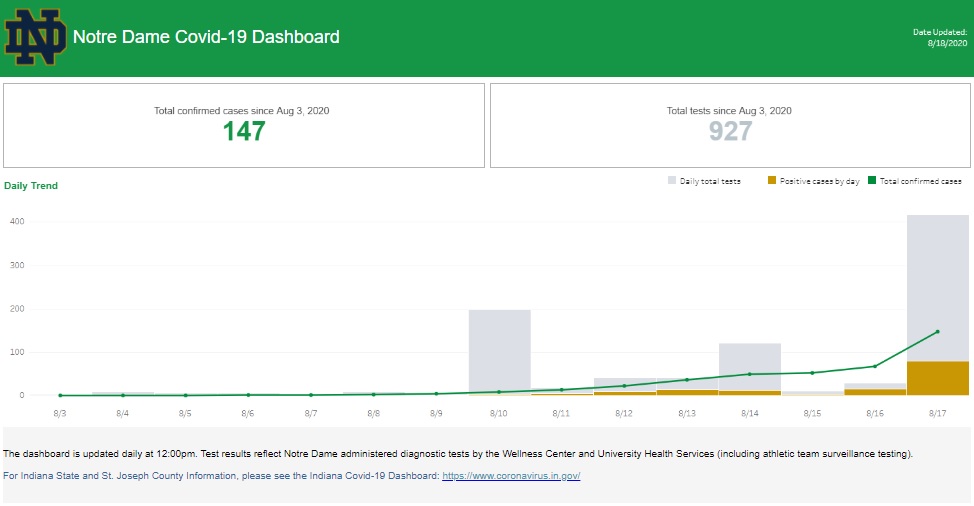
— Paul Fain
COVID-19 Cluster at Kansas’ Bethel College
Aug. 17, 4:25 p.m. Nearly 10 percent of the first roughly 500 students and employees tested for COVID-19 at Bethel College, in Kansas, have the virus, the local health agency and Bethel’s president announced Monday.
In a videotaped statement, Jonathan Gering, Bethel’s president, said that “approximately 50” of those tested as they came to campus this week had the virus, including 43 students and seven employees. Those who tested positive were in isolation on the campus, and contact tracing had begun to identify others who had contact with those infected. Some of those identified are already in quarantine, Gering said.
The 43 infected students came from “faraway states and nearby locations as well,” Gering said. They represented a sizable fraction of Bethel’s roughly 500-student enrollment, since only about two-thirds of students had arrived on campus already for Wednesday’s planned first day of classes.
Gering said Bethel would delay the arrival of those students who had not yet come to the campus. “We’ll get you here when it’s safe to do so,” he said. Courses will begin online.
He also said that the college had moved to “orange” in its color-coded virus response system, and that students would be discouraged from leaving campus and visitors barred from coming onto campus.
— Doug Lederman
UNC Chapel Hill Pivots to Remote Instruction
Aug. 17, 4:05 p.m. The University of North Carolina at Chapel Hill has announced that all of its undergraduate instruction will be remote, effective Aug. 19 — nine days after the university held its first in-person classes for the fall term.
The university cited a “spate of COVID-19 infection clusters” in making the decision. Three announced clusters last week were in student housing, with a fourth linked to a fraternity. UNC on its COVID-19 dashboard reported 130 new positive student cases in the last week, and five positive cases among employees.
Chapel Hill reported a high and rapidly increasing positivity rate among the nearly 1,000 students it had tested as of this morning.
“In just the past week (Aug. 10-16), we have seen the COVID-19 positivity rate rise from 2.8 percent to 13.6 percent at Campus Health,” said Kevin M. Guskiewicz, Chapel Hill’s chancellor, and Robert A. Blouin, its executive vice chancellor and provost, wrote to employees.
In addition to shifting its instruction to remote learning, the university said it would continue to “greatly reduce residence hall occupancy,” which it said were at 60 percent capacity.
Barbara K. Rimer, dean of UNC’s Gillings School of Global Public Health, on Monday wrote on her blog that the university should “take an off-ramp and return to remote operations for teaching and learning.”
She cited reports of noncompliance with social distancing by students off campus, saying the reopening was not working. “The rationale for taking an off-ramp now is that the number of clusters is growing and soon could become out of control, threatening the health of others on campus and in the community and putting scarce resources at risk,” wrote Rimer.
UNC’s campus health services reported that 177 students were in isolation Monday, with 349 in quarantine.
“There are no easy answers as the nation navigates through the pandemic. At this point we haven’t received any information that would lead to similar modifications at any of our other universities,” Peter Hans, the UNC system’s president, said in a written statement. “Whether at Chapel Hill or another institution, students must continue to wear facial coverings and maintain social distancing, as their personal responsibility, particularly in off-campus settings, is critical to the success of this semester and to protect public health.”
— Paul Fain
UNC Chapel Hill Faculty Call Emergency Meeting After Fourth COVID Cluster
Aug. 16, 4:41 p.m. The Faculty Executive Committee at University of North Carolina at Chapel Hill will hold a meeting Monday to discuss the growing number of coronavirus cases after the university reported a fourth cluster of cases on Sunday, the Raleigh News & Observer reported. A cluster is defined as five or more cases in close proximity.
Three of the announced clusters were in student housing complexes, and the fourth was linked to a fraternity.
The chair of the faculty, Mimi Chapman, wrote to the UNC System Board of Governors over the weekend urging it to give UNC Chapel Hill’s chancellor authority to make decisions in response to the pandemic.
“We knew there would be positive cases on our campus. But clusters, five or more people that are connected in one place, are a different story,” Chapman wrote. “The presence of clusters should be triggering reconsideration of residential, in-person learning. However, moving to remote instruction cannot be done without your approval.”
Classes began at the Chapel Hill campus last week. The university opened for in-person classes over the objections of the local county health director.
— Elizabeth Redden
UNC Chapel Hill Reports 2 COVID-19 Clusters
Aug. 14, 4:32 p.m. The University of North Carolina at Chapel Hill informed students, faculty and staff members this afternoon that it has identified two clusters of COVID-19 cases at student housing complexes.
A cluster is five or more cases in close proximity within a single residential hall or dwelling. Those in the clusters “are isolating and receiving medical monitoring,” according to an alert issued this afternoon. Local health officials have been notified, and efforts are under way to identify others who could have been exposed.
“All residents in these living spaces have been provided additional information about these clusters and next steps,” the alert said. “Contact tracing has been initiated with direct communication to anyone determined to have been a close contact with a positive individual. A close contact is defined as someone who has been within 6 feet of an infected person for more than 15 minutes when either person has not been wearing a face covering. Those identified as a close contact will be notified directly and provided with further guidance.”
The clusters are at the Ehringhaus Community and Granville Towers. Ehringhaus has four-bedroom suites and is heavily skewed toward first-year student residents. Granville Towers are privately managed.
Chapel Hill’s COVID-19 dashboard shows main campus housing occupancy at 60.7 percent as of Monday and Granville Towers occupancy at 76.6 percent.
The university cited the Jeanne Clery Disclosure of Campus Security Policy and Crime Statistics Act when issuing the alert. That act set requirements for disseminating health and safety information on campus. But Chapel Hill does not plan to provide details about individual positive cases, citing privacy considerations and laws.
Chapel Hill held its first day of classes Monday.
— Rick Seltzer
Twenty-Eight COVID-19 Cases at the U. of Tennessee, Knoxville
Aug. 13, 5:30 p.m. The University of Tennessee at Knoxville reported that 20 students and 8 staff members have COVID-19, WATE News reported today. Due to potential exposure, 155 people are self-isolating, officials said. Students started moving into residence halls at the university on Aug. 9.
— Lilah Burke
Medical Advisers to NCAA Discourage Fall Sports Competition
Aug. 13, 1:30 p.m. Several medical experts with key roles in advising the National Collegiate Athletic Association offered discouraging words about fall sports competition in a conference call with reporters Thursday, according to news reports.
“I feel like the Titanic. We have hit the iceberg, and we’re trying to make decisions of what time should we have the band play,” ESPN quoted Dr. Carlos Del Rio, executive associate dean at Emory University and a member of the NCAA’s COVID-19 advisory panel, as saying. “We need to focus on what’s important. What’s important right now is we need to control this virus. Not having fall sports this year, in controlling this virus, would be to me the No. 1 priority.”
Most college sports conferences have opted not to hold intercollegiate competition this fall, but several leagues that play high-profile (and high-dollar) football are planning to play on.
Dr. Colleen Kraft, an associate professor of infectious diseases at Emory and a member of the NCAA panel, said of the leagues planning to compete: “There will be transmissions [of COVID-19], and they will have to stop their games,” according to ESPN.
Officials at the Big Ten and the Pac-12, the two leagues in the Power Five football series that have opted not to play this fall, have especially cited concerns about apparently increased incidence of myocarditis, a potentially deadly heart condition, related to COVID-19. The NCAA’s chief medical officer, Dr. Brian Hainline, said on the conference call that between 1 and 2 percent of all athletes who’ve been tested by NCAA members have tested positive for the coronavirus, and that at least a dozen have myocarditis, ESPN reported.
Dr. Kraft said colleges were “playing with fire” regarding myocarditis.
— Doug Lederman
Athletic Departments May Need ‘Extraordinary Support’ as Cancellations Hit Revenue
Aug. 13, 12:23 p.m. The recent spate of athletic conference decisions to postpone fall sports means substantial revenue shocks for college athletic departments, and cutting expenses will not always be enough to absorb the blow, according to a new report from Moody’s Investors Service.
Because sports are strategically important for universities, Moody’s expects universities to provide “extraordinary support” like internal loans in order to stay current on debt payments for athletic facilities. Colleges and universities may tap their financial reserves to close budget gaps tied to the pandemic, the ratings agency said in a report released Thursday morning.
“Athletic expenses have grown significantly in recent years, including certain fixed costs such as debt service, which will impact universities’ ability to adjust to the disruption,” said Dennis Gephardt, vice president at Moody’s, in a statement.
Fall sports cancellations reached a crescendo this week when two of the most important conferences for college football, the Big Ten and the Pac-12, joined many non-Power Five conferences and programs in pulling the plug on fall sports amid COVID-19 concerns. Although the Atlantic Coast Conference, Southeastern Conference and Big 12 were still hoping to play football, the ramifications of existing cancellations will be felt across higher education.
Football has been the biggest driver of athletic revenue in the sector. Football contributed $5.8 billion in 2018, a whopping 40 percent of the $14.6 billion in total athletic revenue counted by Moody’s. Growth in revenue has been driven by media rights like the payments television networks make for the right to broadcast games.
Disappearing ticket sales will also hit revenue. Although some donor support might be expected to offset losses, a significant portion of donor support comes from seating priority programs — donors buying the right to pick seats under certain conditions.
This situation is particularly important because the median athletic department broke even in 2018, meaning a significant number of departments lost money.
Moody’s called that year a relatively strong revenue year. Still, more than a third of Division I public universities, 37 percent, reported expenses exceeded revenue that year. The median operating deficit among that group was 3 percent.
Conferences that generate more athletic revenue generally reported better operating performance than others. The financial health of operations varies greatly across athletic conferences.
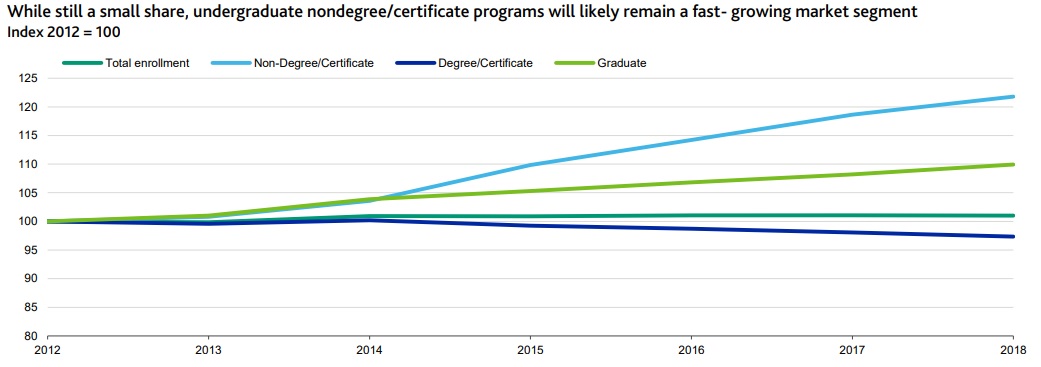
“Compensation for coaches as well as other athletic support and administrative expenses among NCAA Division I members make up the largest portion of the expense base for a combined 35 percent and will be a focus for expense management efforts in fiscal 2021,” Moody’s said in its note. “With games canceled, universities will save some money on game day operations and travel expenses.”
Athletics requires more capital than other arms of higher education. Median debt-to-operating-revenue was 58 percent for public higher education overall, compared to 66 percent for institutions competing in the NCAA Division I Football Bowl Subdivision. Facility expenses and debt service at Division I public universities drove increases in debt between 2013 and 2018, with debt growing 54 percent in that period to a total of $2.3 billion.
“Given the revenue shocks, many athletic departments will not be able to cover debt service with net revenue from recurring operations, prompting the need to fill the gap from appropriate auxiliary and/or other reserves. In many cases, this is likely to take the form of internal loans that the athletic departments will need to repay the university over time,” the Moody’s report said.
All of this follows the cancellation of the NCAA basketball tournaments in the spring. Men’s basketball accounted for about 15 percent of 2018 athletic revenue across higher education. Women’s basketball was 7 percent.
Still to be determined is how the spread of COVID-19 affects sports scheduled for later in the year and how universities balance pressures on athletics against pressures to other parts of their operations.
“Budget difficulties at athletic departments will add to the financial strains facing universities, including a tuition revenue pinch, reduced state funding and incremental expenses to combat the coronavirus,” the Moody’s report said.
— Rick Seltzer
A survey by Pearson finds that 77 percent of Americans think that reopening colleges and universities is vital to a healthy economy. But 62 percent say colleges and universities are risking the lives of students by reopening in the fall.
–Scott Jaschik
Aug. 11, 4:40 p.m. The Pac-12, another “Power Five” conference, quickly followed the Big Ten Conference with a decision to postpone fall sports for the remainder of 2020 at its institutions on the West Coast. The postponement also includes winter sports, which are on hold for the remainder of the year, and the conference will consider playing all sports impacted by the decision in 2021, the Pac-12 said in a release about the decision.
Three Power Five conferences, the Big 12, Atlantic Coast Conference and Southeastern Conference, which include the nation’s top football programs and gain most from the sport’s financial benefits, have not yet announced postponement of the fall sports season and are moving forward with modified schedules as of Aug. 11.
—Greta Anderson
Aug. 11, 3:32 p.m. The Big Ten Conference officially postponed its 2020-21 fall sports season, including football. The decision affects some of the top college football teams in the country and was discouraged by several federal lawmakers on Monday.
Kevin Warren, commissioner of the Big Ten, said in a news release that athletes’ mental and physical health was “at the center” of the decision and that the coronavirus posed too many potential medical risks for the season to proceed this fall. Spring competition for football and other fall sports, including cross country, field hockey, soccer and volleyball, will be considered, the Big Ten said in the statement.
— Greta Anderson
Notre Dame President Apologizes for Photos
Aug. 11, 7:20 a.m. Rev. John I. Jenkins, president of the University of Notre Dame, has apologized for letting several students take photographs of him that were not safe.
“In a few instances, over recent days, I stopped for photos with some of you on the quad,” Father Jenkins wrote to students. “While all of the scientific evidence indicates that the risk of transmission is far lower outdoors than indoors, I want to remind you (and myself!) that we should stay at least six feet apart. I recognize that it’s not easy, particularly when we are reuniting with such great friends. I am sorry for my poor example, and I am recommitting to do my best. I am confident you will too.”
— Scott Jaschik
Financial Aid Applications Lag for Low-Income Students
Aug. 10, 12:45 p.m. Applications for federal and state financial aid for college are a leading indicator of how many students will enroll in and complete a college degree. A University of Michigan study shows that those applications have not increased with the additional need created by the coronavirus pandemic
The study found no increases in Michigan in students filling out the Free Application for Federal Student Aid and the Tuition Incentive Program, Michigan’s largest state scholarship program for low-income students.
“It is worrying that we haven’t seen any aid application expansion, and particularly that the gaps based on race or school income level have widened. FAFSA and TIP completion rates would need to be even higher than normal to keep up with the challenges created by the pandemic,” said Kevin Stange, associate professor at the Ford School of Public Policy.
— Scott Jaschik
Report: Big Ten Votes to Cancel Football Season
Aug. 10, 12:06 p.m. University presidents in the Big Ten Conference, one of the NCAA Division I “Power Five” conferences, voted to cancel the 2020 football season, The Detroit Free Press reported. The conference had originally planned for conference-only competition, but has faced increased pressure over the last week from athletes organizing to improve health and safety measures for play amid the coronavirus pandemic.
Other Power Five conferences, which include the country’s top college athletics programs, are expected to make announcements about the fall season early this week, ESPN reported. Division II and III leaders decided last week that they would cancel fall athletic championships, and the first conference in the Football Bowl Subdivision, the Mid-American Conference, postponed fall sports on Aug. 8.
— Greta Anderson


:strip_exif(true):strip_icc(true):no_upscale(true):quality(65)/d1vhqlrjc8h82r.cloudfront.net/04-26-2021/t_fd2e7a014d2b4303b2d6ddddac7accc9_name_image.jpg)