Home Blog Page 352

Wake County to resume usage of Johnson & Johnson vaccine this week – WTVD-TV

RALEIGH, N.C. (WTVD) — Here are the latest updates about COVID-19, the disease caused by the novel coronavirus, in North Carolina.

TUESDAY MORNING HEADLINES
Updated guidance about when you should wear a mask outdoors is expected to be released today.

Sources say the guidance relates specifically to if fully vaccinated people need to wear masks outdoors. The guidance comes from the Centers for Disease Control and Prevention, but President Joe Biden is expected to be the one announcing the guidance.

Specific language of the guidance is not known. However, Dr. Anthony Fauci hinted over the weekend that the guidance would include a loosening of restrictions, saying the CDC will be “updating their guidelines of what people who are vaccinated can do and even some who are not vaccinated.”

Biden has previously said he hoped outdoor gatherings would be possible by July 4. North Carolina leaders have said they will consider lifting portions of the mask mandate in June.

Meanwhile, Wake County Public Health will resume use of the Johnson and Johnson vaccine this week. Last week the FDA and CDC lifted the pause on use of the vaccine after determining the risk of blood clots was so low that the benefit of the vaccine outweighed it.

Wake County has 7,900 doses of the Johnson and Johnson vaccine. The first clinics of the single shot vaccine will happen Thursday and Friday at Ting Park in Holly Springs.

MONDAY
3:20 p.m.
Wake County will resume usage of the Johnson and Johnson vaccine later this week.

Last Friday, state and federal agencies reaffirmed their confidence in the J&J vaccine following a brief pause.

Triangle clinics resume use of Johnson and Johnson vaccine after brief pause

Wake County has 7,902 doses of the vaccine in storage at this time. The first J&J clinics are planned for Thursday and Friday from 9 a.m. to 3:30 p.m. at Ting Park in Holly Springs.

“As with everything we have done in the past, we want to offer the choice of J&J for those who are seeking that unique one-shot vaccine,” said Ryan Jury, Wake County Public Health’s Vaccine Branch Director. “Safety during and after vaccination are very important to us. Health and safety have always been a guiding principle for Wake County Public Health.”

2:30 p.m.
Lee County health officials are reporting 75 more COVID-19 cases since last Monday. There have been a total of 76 deaths from the virus in Lee County since the pandemic began.

11:45 a.m.
North Carolina health officials are reporting 1,334 new COVID-19 cases.

The state is reporting a 6.5% positive test rate.

Throughout North Carolina, 78 fewer people are being hospitalized for the virus. There are currently 1,067 COVID-19 patients being hospitalized in the state.

On Monday, the state reported 37 more COVID-19 deaths, bringing the total to 12,560.

As of Monday, 48.2% of the adult population in North Carolina is vaccinated with at least one dose.

SATURDAY
2 p.m.
A free walk-in COVID-19 vaccine clinic is available in Durham Saturday afternoon.

The clinic is being held at CityWell United Methodist Church at 2317 Chapel Hill Road in Durham.

No registration is required and Spanish translation is available.

US lifts pause, allowing Johnson & Johnson COVID-19 vaccinations to resume

FRIDAY

12:15 p.m.
Friday’s report from the NCDHHS included 2,167 newly-reported COVID-19 cases and 1,145 hospitalizations.

The daily percent positive rate was 5.1%.

47.7% of adults have been vaccinated with at least one dose. 37.3% have been fully vaccination.

Sadly, 12,523 people have died since the start of the pandemic.

FRIDAY MORNING HEADLINES

A committee within the Center for Disease Control and Prevention will meet today to determine what to do with the Johnson and Johnson COVID-19 vaccine.

Use of that vaccine has been paused for over a week while researchers look into a possible link between the vaccine and dangerous blood clots.

A woman in her 50s from Oregon died this week from a rare blood clot less than two weeks after getting the Johnson and Johnson vaccine.

A handful of other women have reported blood clotting issues shortly after getting the vaccine. The vaccine has been given to more than 6 million Americans, so experts say the risk appears to be about one in a million.

The CDC committee meeting begins at 11 a.m. A vote is expected by the end of the day.

The committee has a few options: it could fully resume use of the vaccine, recommend its use for certain demographics, or delay making a decision.

The committee’s recommendation will then be considered by the entire CDC.

Meanwhile in North Carolina, the state reported more than 2,000 new COVID-19 cases for the first time in a week–although the rate of positive tests fell to under 5 percent, its lowest mark in nine days.

THURSDAY
3:19 p.m.

Gov. Roy Cooper and North Carolina Department of Health and Human Services Secretary Dr. Mandy Cohen visited a vaccine clinic at Mission Health / Asheville-Buncombe Technical Conference Center to see people receive their vaccines.

“The quicker more people get vaccinated, the sooner we can turn the corner on this pandemic,” Cooper said. “Getting vaccinated is easy and everywhere, and it’s safe and effective, so do it now for your family, your friends and yourself.”

Next week, Cooper will issue an Executive Order outlining safety restrictions for the month of May.

“Thanks to collaborative community partnerships, we are making steady progress in our vaccination efforts here in Buncombe County,” Buncombe County Public Health Director Stacie Saunders said. “Partnerships with the Community College, Mexican Consulate, YMCA, faith community, aging services and other providers have helped to ensure that the vaccine reaches every corner and community in Buncombe County with equity and efficiency.”

1:57 p.m.
The NC House voted 112-1 to pass House Bill 334 – Temporarily Align PPP Treatment to Federal Treatment, which will provide tax relief for small businesses and individuals affected by the COVID-19 pandemic.

After the bill’s second reading on the House floor, House Finance Chairman Rep. Keith Kidwell, R-Beaufort, offered an amendment that would extend tax relief to thousands of North Carolinians who were unemployed during the COVID pandemic.

The amendment brings North Carolina in line with the federal CARES Act of 2020 and the American Rescue Plan Act of 2021 by excluding unemployment compensation from taxpayers’ gross income up to the amount specified under federal guidelines. The provision will apply for taxable years of 2020 and 2021.

“We should not be taxing COVID Relief money,” said Rep. Kidwell. “The federal government got it right, forty-seven other states got it right, and it is time for North Carolina to correct its position on the issue.”

House Bill 334 was filed by Rep. Ray Pickett, R-Ashe, and Rep. Jason Saine, R-Lincoln, to reduce the tax burden on small businesses who utilized PPP loans to keep employees on the payroll and keep their businesses open.

“This is a commonsense bill to help North Carolinians who have been dealing with the significant economic impact of COVID-19,” Pickett said. “For this situation, we felt it was best to simplify the process, align with the Federal tax guidelines specified in the American Rescue Plan, and save folks a little more money towards the bottom line.”

Specifically, the bill would allow PPP loan recipients to deduct expenses paid for by the loans. Currently, North Carolina is one of only three states that do not allow business owners to deduct expenses paid for by PPP loan funds.

1:56 p.m.
The 4th Fighter Wing is hosting a COVID-19 mass vaccination line for authorized TRICARE beneficiaries at the Seymour Johnson Air Force Base Fitness Center on Friday from 7:30 a.m. to 4 p.m.

The first and second doses of the Pfizer vaccine are available for anyone 16 years of age and older. Persons must have a valid DoD ID card and be TRICARE authorized for healthcare in Military Medical Treatment Facilities.

1:27 p.m.
The Halifax County Health Department reports 14 new cases for a total of 5,436 positive COVID 19 cases. Deaths remain at 108, or 2% of cases.

12:44 p.m.
NCDHHS is reporting 2,236 new cases for a total of 954,765. It’s the first time above 2,000 cases since Saturday but still fewer cases than a week ago at the same time.

The percent positive is 4.9%, the lowest in nine days and certainly welcome news to NCDHHS, which has 5% set as the target high. A day earlier,it was 7%.

Hospitalizations fell by 19 from Wednesday, with a total of 1,149 people in the hospital. The number has decreased for the second day but it is still 13% above last Thursday’s level

Twenty-five more deaths were added, bringing the statewide total to 12,505 since the start of the pandemic.

In all, 37.5% of the overall population has been partially vaccinated and 28.9% of the overall population has been fully vaccinated.

10:52 a.m.
CityWell United Methodist Church in Durham is holding a free COVID-19 vaccination clinic from 2 p.m. to 4 p.m. Saturday.

No registration is required, Spanish translation is available.

The church is at 2317 Chapel Hill Road.

10:27 a.m.
The North Carolina Department of Health and Human Services announced the Bringing Summer Back get-out-the-vaccine campaign that hopes to engage community organizations across the state to fully vaccinate as many people as possible by summer.

To date, more than 3.6 million adults in North Carolina have been vaccinated with at least one dose. While the state has made great progress in helping people schedule and get to their vaccine appointments, more than half of the adult population is still completely unvaccinated, putting them at higher risk of contracting and spreading the virus, NCDHHS said.

The Bringing Summer Back campaign will run during two weeks in May (May 9-15 and May 16-21) and two weeks in June (June 6-12 and June 20-26), during which organizations across the state will rally together to promote vaccination.

8:12 a.m.
Free drive-thru COVID-19 testing is available at three new Wake County park locations through the weekend, with one permanent testing site transforming into a vaccination drive-thru for the next three days.

Wendell Community Center, at 601 W. 3rd St. in Wendell, has been open to free testing seven days a week, but from April 22 through 24 the park site will transform into a free drive-thru vaccination clinic. Appointments for free COVID-19 shots are available from 9 a.m. to 4 p.m. through Saturday. Just click here to schedule an appointment. This site will return to testing on Monday, April 26 from 8:30 a.m. to 5 p.m.

In Wake County, COVID-19 positive cases have been nearly stable – with only a 1% increase in cases comparing March over April. However, in the last two weeks, Wake County has seen a 9.4% increase in positivity and a 16.4% increase in hospitalizations. The highest positivity rates are in the 25-49 age group. Anyone with any signs or symptoms of COVID-19 is urged to get a free test, regardless of vaccination status or prior infection.

Three local parks will offer free testing weekly from Thursday through Sunday, 8:30 a.m. to 3 p.m. in rotating locations. These convenient sites make it easy for people who live in these communities to get tested. All sites are free, and residents do not need an appointment, insurance or ID. Sites will offer walk-up testing for anyone who does not have a car.

Park locations for Thursday through Saturday, April 22-25 are:

  • Sanderford Road Park, 2623 Sanderford Road, Raleigh, NC 27610
  • Carolina Pines, 2305 Lake Wheeler Rd, Raleigh, NC 27603
  • White Deer Park, 2400 Aversboro Rd, Garner, NC 27529

THURSDAY MORNING HEADLINES
North Carolina could be fully reopened as early as June 1.

Gov. Roy Cooper said Wednesday he planned to lift all social distancing, capacity and mass gathering restrictions by the start of June as long as key COVID-19 numbers remained steady.

However, you will still be required to wear a mask while out in public.

Cooper said he thought the mask mandate would remain in place until at least 66 percent of North Carolinians get fully vaccinated.

Currently, just 36 percent of adults in the state are fully vaccinated–although 47 percent are partially vaccinated.

A Raleigh church is hosting a vaccine clinic for the LGBTQ community.

Raleigh Pride and the LGBT Center of Raleigh partnered with St. John’s Metropolitan Community Church on Maywood Avenue to create the clinic.

The clinic has around 200 doses of Moderna. Anyone interested in getting vaccinated at this location should click here to register.

Lastly, an advisory panel with the Centers for Disease Control and Prevention will meet tomorrow to discuss the future of the Johnson and Johnson vaccine.

Experts have been investigating the vaccine after a small number of people who received the vaccine developed blood clots.

A regulatory group working for the European Union said it had identified a possible link between the vaccine and the blood clots, but that group still determined that the benefits of the vaccine outweighed the risks.

The CDC advisory panel is expected to come to a similar conclusion as the European Union regulatory group.

Copyright © 2021 WTVD-TV. All Rights Reserved.
Previous article Project lifts the voices of Eswatini’s LGBT people – Erasing 76 Crimes

Voices of Eswatini, a new project from Eswatini Sexual and Gender Minorities (ESGM) and All Out, amplifies the voices of the small but strong LGBT community in a tiny kingdom in southern Africa where same-sex relations are illegal.

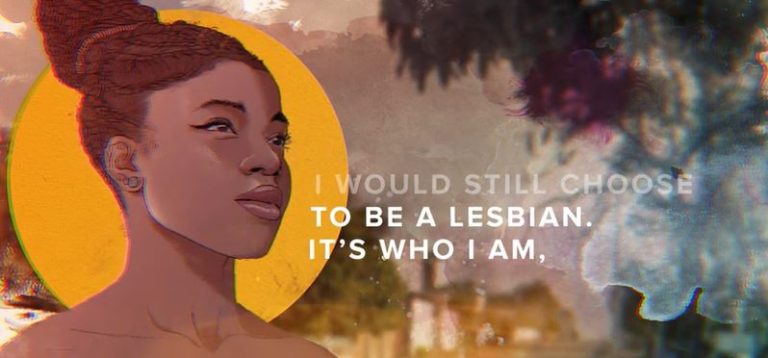
S’Thembile has survived being raped by men who told her that her body was “going to waste” because she’s a lesbian. (Photo courtesy of Voices of Eswatini/ESGM/AllOut).

Same-sex sexual activity is criminalized in Eswatini under the colonial-era Roman-Dutch common law that is still applied in the country, which officially changed its name from Swaziland in 2018. The Voices of Eswatini campaign by ESGM and the online advocacy group All Out seeks to convince the government to repeal the prohibitions against sodomy.

The project presents stories from LGBT people in video, audio, and print format to help other people in Eswatini understand their experiences, and how discrimination, persecution, and social stigma harm them.

S’Thembile, a 27-year-old lesbian, says she was gang raped by a group of the police who declared that, because she was a lesbian, her “body is going to waste.”

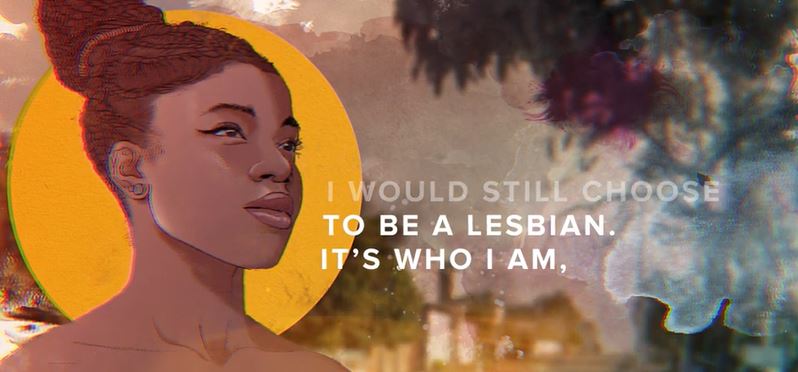
“I was angry but then I didn’t want to let my mind stay in all those things. I went through a lot of counselling,” S’Thembile says in Voices of Eswatini. “For me, being an LGBTI person, it hasn’t been the easiest and the smoothest journey of my life but if I have to live and had a chance of choosing, I would still choose to be a lesbian. It’s who I am. It’s a life that God has given me.”

Many of the queer Swazis featured in the project say that they routinely face harassment and violence in their communities, and that the police will give them no help.

“After I reported an assault to the cops with no success, all they asked me was, ‘Am I gay?’ Ignoring the fact that I had been violated and fought for my life,” says Thando, a gay 27-year-old man.

“I have had suicidal thoughts that flood my mind and I tried so much or so many times to take my life but somehow I could not go through with it,” Thando says. “I have so much to do with my life, and the friends I have now have made me strong. They’ve kept me strong and sometimes I wonder what and where would I be without them.”

Many queer Swazis flee to neighboring South Africa, where LGBT people have more legal rights and protections, as Thobile Shiba did when her parents forced her to drop out of school when she came out as a lesbian.

“I went to Nelspruit, South Africa, where I felt at home and found other lesbians. When I’d would come back home, I’d find that the news of me being a lesbian were still doing the rounds and it really didn’t sit well with me,” Shiba says.

Shiba says she wants to see the Eswatini government promote tolerance of LGBT people so that families can stay together.

“To change the situation in Swaziland [which remains a common name for Eswatini] for people like me would be to put educative measures into place so the parents could learn about such issues,” Shiba says. “We as children suffer when we being forced out of our homes because in the rural areas people like me are branded as demons.”

A young gay man named Mpolweni shares a story of an abusive relationship that illustrates how the lack of legal rights for queer people increases danger even from intimate partners.

“He took advantage of me knowing that our same-sex relationships are not legal in our country. Every time I had an argument, he’d beat me up,” Mpolweni says. “I ended up telling myself, ‘This is not how I should be living my life.’ But then it was like jumping from the frying pan to the fire because at home they neglected me, disowned me actually.”

Still, Mpolweni has hope that tolerance can improve in Eswatini.

“Maybe if they can treat us as normal people because we are normal,” he says. “There is nothing that is abnormal about us except our sexual preferences and to be recognized legally like everything we want to do, there shouldn’t be any hiccups along the way.”

Related articles:

Project lifts the voices of Eswatini’s LGBT people – Erasing 76 Crimes

Voices of Eswatini, a new project from Eswatini Sexual and Gender Minorities (ESGM) and All Out, amplifies the voices of the small but strong LGBT community in a tiny kingdom in southern Africa where same-sex relations are illegal.

S’Thembile has survived being raped by men who told her that her body was “going to waste” because she’s a lesbian. (Photo courtesy of Voices of Eswatini/ESGM/AllOut).

Same-sex sexual activity is criminalized in Eswatini under the colonial-era Roman-Dutch common law that is still applied in the country, which officially changed its name from Swaziland in 2018. The Voices of Eswatini campaign by ESGM and the online advocacy group All Out seeks to convince the government to repeal the prohibitions against sodomy.

The project presents stories from LGBT people in video, audio, and print format to help other people in Eswatini understand their experiences, and how discrimination, persecution, and social stigma harm them.

S’Thembile, a 27-year-old lesbian, says she was gang raped by a group of the police who declared that, because she was a lesbian, her “body is going to waste.”

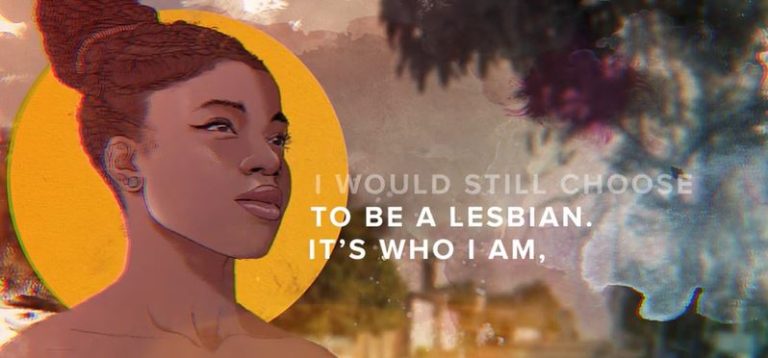
“I was angry but then I didn’t want to let my mind stay in all those things. I went through a lot of counselling,” S’Thembile says in Voices of Eswatini. “For me, being an LGBTI person, it hasn’t been the easiest and the smoothest journey of my life but if I have to live and had a chance of choosing, I would still choose to be a lesbian. It’s who I am. It’s a life that God has given me.”

Many of the queer Swazis featured in the project say that they routinely face harassment and violence in their communities, and that the police will give them no help.

“After I reported an assault to the cops with no success, all they asked me was, ‘Am I gay?’ Ignoring the fact that I had been violated and fought for my life,” says Thando, a gay 27-year-old man.

“I have had suicidal thoughts that flood my mind and I tried so much or so many times to take my life but somehow I could not go through with it,” Thando says. “I have so much to do with my life, and the friends I have now have made me strong. They’ve kept me strong and sometimes I wonder what and where would I be without them.”

Many queer Swazis flee to neighboring South Africa, where LGBT people have more legal rights and protections, as Thobile Shiba did when her parents forced her to drop out of school when she came out as a lesbian.

“I went to Nelspruit, South Africa, where I felt at home and found other lesbians. When I’d would come back home, I’d find that the news of me being a lesbian were still doing the rounds and it really didn’t sit well with me,” Shiba says.

Shiba says she wants to see the Eswatini government promote tolerance of LGBT people so that families can stay together.

“To change the situation in Swaziland [which remains a common name for Eswatini] for people like me would be to put educative measures into place so the parents could learn about such issues,” Shiba says. “We as children suffer when we being forced out of our homes because in the rural areas people like me are branded as demons.”

A young gay man named Mpolweni shares a story of an abusive relationship that illustrates how the lack of legal rights for queer people increases danger even from intimate partners.

“He took advantage of me knowing that our same-sex relationships are not legal in our country. Every time I had an argument, he’d beat me up,” Mpolweni says. “I ended up telling myself, ‘This is not how I should be living my life.’ But then it was like jumping from the frying pan to the fire because at home they neglected me, disowned me actually.”

Still, Mpolweni has hope that tolerance can improve in Eswatini.

“Maybe if they can treat us as normal people because we are normal,” he says. “There is nothing that is abnormal about us except our sexual preferences and to be recognized legally like everything we want to do, there shouldn’t be any hiccups along the way.”

Related articles:

2021 Quest for the Best Winners Named | NewsCenter | SDSU – SDSU Newscenter

Ten students were recognized for their achievements in academics, community service and leadership.

Ten high-achieving San Diego State University students are the recipients of the Quest for the Best award for their outstanding performance in academics and community service.
In addition, the student winners are asked to nominate a faculty or staff member who has had a significant and positive impact on their personal growth and development during their time at SDSU.
The Division of Student Affairs and Campus Diversity virtually honored this year’s recipients. The ceremony can be seen here
The following are the 2021 honorees:

Madi Balagtas

Faculty/staff honoree: Ricardo Zayas, associate professor in the Biology Department 

Balagtas is a senior majoring in cellular and molecular biology with a minor in honors interdisciplinary studies. Her involvements include Mortar Board Honor Society and Women in Science Society, and she serves as an undergraduate researcher. Balagtas has volunteered with UCSD Health, Flying Samaritans and Alzheimer’s San Diego. She is an Initiative for Maximizing Student Development scholar and an SDSU Merit Scholar. After graduation, she will work in the biotechnology field while applying to M.D.-Ph.D. programs.

Dylan Corliss
Faculty/staff honoree: Stacey Sinclair, director of the Weber Honors College

Corliss is a senior majoring in philosophy with double minors in computer science and honors interdisciplinary studies. Activities include the SDSU Chamber Choir, the Asian Pacific Student Alliance and the Weber Honors College Student Society. Corliss has volunteered as a tutor for the International Rescue Committee. He has been honored with the Fulbright Canada-MITACS Globalink Research Internship Award and serves as an undergraduate research assistant. After graduation, Corliss will teach English in the Peace Corps and later attend law school with a focus on international law and technology policy. 

Margot Ermer
Faculty/staff honoree: Brandi Tonne, government affairs coordinator for Associated Students

Ermer is a junior majoring in communication with a double minor in women’s studies and honors interdisciplinary studies. Her involvements include Associated Students, College Panhellenic Association and Rotaract of SDSU. Ermer has volunteered for the Crisis Text Line, the Miracle League and letter-writing to human trafficking survivors. She has been honored with the Delta Zeta Order of the Rose award and is a recipient of the Betty Nesvold Women’s Studies Scholarship. After graduation, Ermer plans on working in the health care field, focusing on survivors of sexual violence. 

Ashley Jackson
Faculty/staff honoree: Gerilyn Herold, lecturer in the School of Nursing 

Jackson is a senior majoring in nursing with a double minor in leadership and child development. She has been involved with the Student Nurses Association, Sigma Theta Tau and  Peer Leadership Consultants. She also has volunteered with UCSD Health and the San Diego County Office of Education. Jackson earned the D.B. Williams Memorial Scholarship and the 100 Service Hours Lapel Pin, and she is on the Dean’s List. After graduation, she plans on starting a nurse residency program. Jackson’s goal is to work as a registered nurse in either an emergency department or an intensive care unit and then earn her Doctor of Nursing Practice degree.

Maxwell Johnson
Faculty/staff honoree: Brandi Tonne, government affairs coordinator for Associated Students

Johnson is a senior double majoring in political science and communication with a minor in honors interdisciplinary studies. His involvements include Rotaract of SDSU, Associated Students and Camp Kesem. He has volunteered with Aztecs Rock Hunger, and the Community Service Commission. He is part of the Sigma Alpha Lambda Honors Society and served on the 2020 Homecoming Court. After graduation, Johnson will work in the lobbying and advocacy field to provide marginalized communities with the resources and equitable opportunities they need to pursue their passions and achieve their goals.

Sophie Levi
Faculty/staff honoree: Sonja Pruitt-Lord, professor of speech language and associate dean of academic affairs in the College of Health and Human Services

Levi is a senior majoring in speech, language and hearing sciences with a minor in Spanish. She has been part of New Student and Parent Programs, the Associated Students Food Pantry and supplemental instruction. She volunteered with Miracle League and also as a literacy volunteer. Levi has been honored with the Aztec Pride Award and an Aztec Achievement Award. After graduation, she will continue her studies in the SDSU/UCSD Joint Doctoral Program in Language and Communicative Disorders. 

Cassandra Libang

Faculty/staff honoree: Hsing-Chen Tung, lecturer in the Department of Child and Family Development

Libang is a senior majoring in child and family development. Her involvements include Dance Marathon, Tijuana Home Build and Rotaract of SDSU. She has volunteered with 805 Holiday Bracelets and UURISE and serves as a tutor and teaching assistant. Libang has been honored with the Presidential Volunteer Service Award and has earned the Diversity Awareness Certificate and the SDSU LEAD Summer Program certificate of completion. After graduation, Libang will work at a nonprofit that helps families meet their basic needs,  then go back to school to study nonprofit management.

Katrina Mogannam

Faculty/staff honoree: Manal Swairjo, associate professor in biochemistry

Mogannam is a senior majoring in biochemistry, with double minors in honors interdisciplinary studies and leadership. She has participated in undergraduate research, Associated Students and Pi Beta Phi sorority. She volunteered with Aztec Unity Project, the International Rescue Committee and Mary’s Kitchen. Mogannam has been honored with the Dora Newell Endowed Scholarship for Chemistry and the Shiley Scholarship in Life Sciences and Bioengineering (Chemistry) Scholarship, and she is a Vice President for Student Affairs scholar. After graduation, she will continue her education at University of California, Irvine as a Ph.D. student in pharmaceutical sciences with a medicinal chemistry track.

Rebecca Rodriguez Casillas
Faculty/staff honoree: Jamie Harguess, formerly of Well-being and Health Promotion

Casillas is a junior majoring in food and nutrition with a minor in social work. Her involvements include the Adaptive Fitness Clinic Nutrition Committee, the Breast Cancer Awareness Club and the Student Nutrition Organization. She has volunteered with the American Red Cross, Young Women’s Study Club and Feeding San Diego. She has been honored with the Joseph and Patricia Ferrero Endowed Scholarship, and she received the 100 Community Service Hours Lapel Pin. After graduation, Casillas plans to become a registered dietitian and work in underserved communities.

Chrystian Smith
Faculty/staff honoree: Wesley Palau, assistant director of Equity and Inclusion, The Pride Center

Smith is a senior double majoring in political science and history with a minor in sociology. Their involvements include the College of Arts and Letters Student Council, Mortar Board Honor Society and SDSU Model United Nations. Smith has volunteered with the San Diego Food Bank, the SDSU Center for Intercultural Relations and the SDSU Women’s Resource Center. They have been honored with the Cotton Metzger Scholarship in Honor of LGBT Students and the Undergraduate Lavender Graduation Award, and they have earned the SDSU Leadership Certificate. After graduation, Smith will continue their education at SDSU as a master’s student in the Postsecondary Educational Leadership with a specialization in Student Affairs. 

Gay couple gets married in front of erupting volcano – LGBTQ Nation

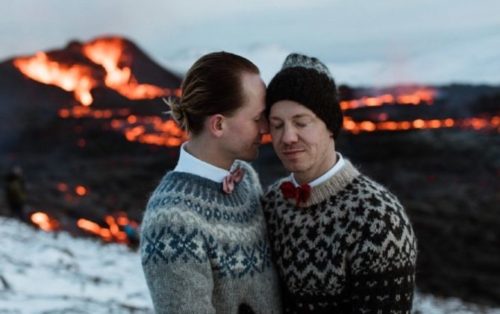
A volcano in a remote location in Iceland began “quietly” erupting earlier this month, giving the area around it a consistent flow of lava for the first time in about 800 years.

For Sumarliði and Jónsi, that sounded like the perfect wedding venue.

Related: Cruel videographer walks out in middle of wedding to protest same-sex marriage

The Fagradalsfjall volcano is on the Southern peninsula of Iceland, and volcanic activity has gone on for past several weeks fissures. It is possible to safely visit the eruption area, but only at certain times and in a certain manner. There are no amenities near the location, no clear paths, and the wind has to blow in a certain direction or else visitors will be hit with gases from the eruption.

Jónsi and Sumarliði's volcanic wedding

Sumarliði and Jónsi had scheduled their wedding for last year, but it got postponed due to the pandemic. This year, they saw the volcano as an opportunity to make their wedding more special.

“The whole idea was very last-minute as we then had four days to find suits, polish our rings, get Sumarliði’s hair cut, and meet with Árni, the wedding officiant,” they told Queerty.

They got in contact with wedding planners Pink Iceland, who helped them research the location.

“So we were well aware we were not in charge. Mother Nature is in charge,” said Birna Hrönn Björnsdóttir of Pink Iceland. “So one of the security measures was to have a gas measurement type of thing with us at all times.”

Then there was making the journey from where they live in downtown Reykjavik to the mountainous, most southwestern part of the island nation.

Jónsi and Sumarliði's volcanic wedding

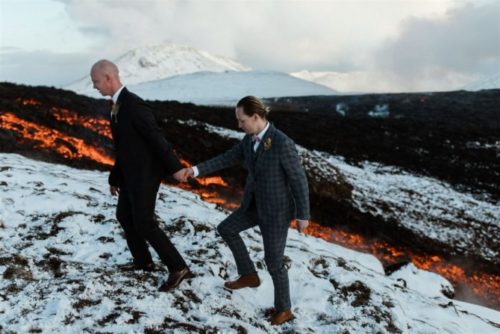
“The volcanic eruption site lies in a valley about 90 minutes from where we parked. So we hiked together in full hiking gear with trekking poles and the whole nine yards,” they explained. “The hike was fun but we had to walk through a snowstorm most of the way which stressed Sumarliði out as he was terrified of freezing to death once he’d changed into his wedding suit.”

When the small group made their way to an optimal site, they set up a small area, changed, and hoped for the conditions to improve.

And they did.

Birna shared, “We had the luxury of picking from three craters that were erupting when we got there. And almost immediately, as we chose the spot, after we had hiked for three or four hours, the sky kind of cleared and we got a blue sky.”

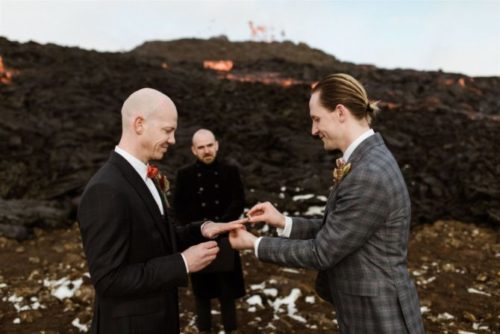
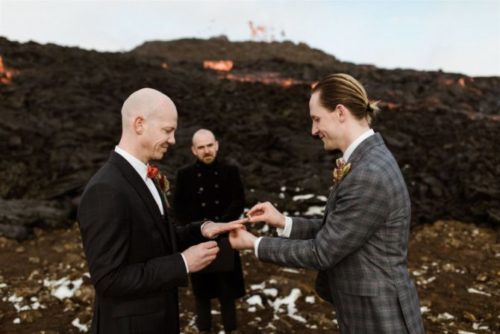
“Something magical happened: the wind died down, it stopped snowing, and the sun came out,” they recalled. The pair came together, and “as we were about to start the ceremony, a wall in the crater burst and a slow river of neon-orange lava flowed past us as we said our vows, exchanged our rings and got married.”

“It was a beautiful, awe-inspiring, and yet terrifying experience to get married in front of this majestic wonder of mother nature.”

It’s a lovely conclusion to the couple’s journey, after meeting on Tinder in 2015. They are no stranger to scenic moments — Jónsi proposed to Sumarliði at the Eiffel Tower in Paris on Bastille Day in 2017, right in front of an exuberant fireworks display.

This time, their joyous moment was not only beautifully documented, but was featured on the BBC in reporting of the ongoing volcanic activity.

See more of the photos as shared with LGBTQ Nation‘s sibling site Queerty.

Jónsi and Sumarliði's volcanic wedding

Symone: I Set Out to Show “You Can Be Black and Gay and Love Yourself” – NewNowNext

Is your blood sugar low? If so, then Symone has just the thing to satisfy your Sweet Toof.

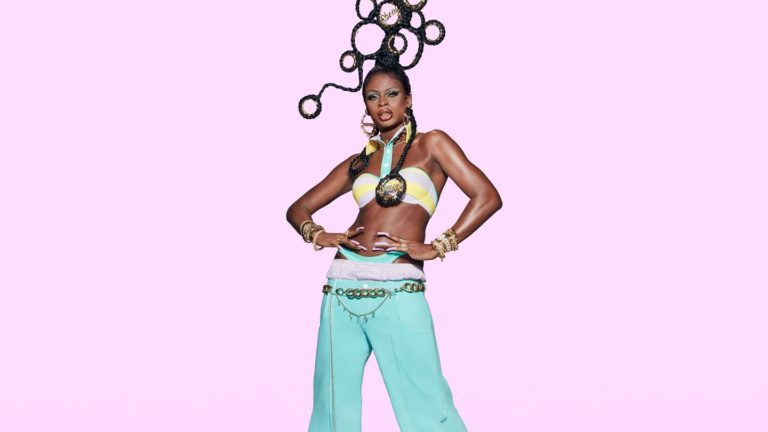
The Arkansas-born, Los Angeles-based queen was never afraid to make a statement when sashaying down the RuPaul’s Drag Race runway. A frontrunner from the beginning, Symone won the first two maxi-challenges back-to-back. She would go onto win four maxi-challenges but land in the bottom two twice, for the Rusical and Nice Girl Roast episodes.

Symone turned it up to 11 during the acting challenges, but she also brought it with her fashion. Her outfits highlighted Black culture and mixed couture with political commentary, including her du-rag train look and her Fascinating Fascinators look with bloody bullet holes on her back and “Say Their Names” etched on the back of her headdress.

Symone spoke with NewNowNext about making it to the final four of Drag Race Season 13, if her good friend Gigi Goode had any advice for her going into the finale, and how seeing RuPaul on Sabrina the Teenage Witch inspired her drag journey.
 

Hi, Symone! First off, your runway looks were so beautiful, and they were also political. Why was it important to you to celebrate Black culture on the runway?

Well, it was important because there have been other queens before me and they’ve paved the way for me, for sure. I wanted to celebrate it in a way that I’d never seen before, and I think it was a way for me to send the love out to all of the kids who felt like I did growing up, who felt bad about being Black and gay. There’s kind of a connotation with it, especially in our own community — I’m just going to be real. So it was really important for me to show people, specifically queer Black people, that you can be Black and gay and love yourself and have fun, and be gorgeous, and stunning, and also say something with how you present yourself. I had three points I wanted to hit on the runway. I wanted to have fun; I wanted people to be like, “That’s a Symone look,” I didn’t want to ever look like anyone else; and I also wanted to say something. People need a little hope, a little love, and a little encouragement everything’s going to be okay, especially in the times we’re in right now. So I kind of just wanted to blend all of that together.

Were your runway looks always going to be political, or did last summer’s protests influence that?

Oh no, it would have always been that way. I’ve always been that type of person. I don’t want to just be a pretty thing. I think if anything, it made it more important to me to do it because how you look and how you express yourself is very important. It’s drag; it’s a visual art form. As much as it is comedy and things, it is also a visual thing, and it’s important to be yourself. I’ve always been that way, and I just think that’s the purpose of art, to challenge the times and reflect on it.

When you said queens that paved the way, are there one or two queens that come to mind who really inspire you?

Shea [Couleé]. I think her being on the show. And imagine, I auditioned for her season and I wish I could show you the audition tape — you would have been like, “No. Send her home first, now.” [Laughs] I think for me, she was very pinnacle because she very much opened the door for me. And Naomi [Smalls], being able to infuse fashion and drag in the way that she did, she’s very big up there for me, too.

Seeing RuPaul getting choked up talking about how proud he is of you…we don’t see that very often as viewers. What was that moment like for you?

It was amazing because if anything, it’s just like, oh my God, thank you so much. I love you. You were a huge influence in my life. Seeing you on Sabrina the Teenage Witch — it’s insane, just snapping your fingers and becoming this gorgeous Glamazonian woman, I was just like, oh, my God! And now, for you to give that love back to me for showing myself on the show, you cannot buy that. It was beautiful for me and I think, in a way, beautiful for everyone to see. I could probably cry now thinking about it.

You’re standing up on stage, and the most famous drag queen in the world is saying that they’re proud of you.

It was what you strive for … I mean, of course, you strive for the [Drag Race] crown, but it’s kind of what you want when you go on the show. You want to impress RuPaul and to get that kind of love and adoration. You can say whatever you want, but that’s what you want when you go on the show. And I got that, so yay for me. Yay for Symone!

So what was it like preparing for the finale?

Preparing for the finale was fun and very stressful, as you can probably imagine, because I wanted to … as much as I’d shown of myself, I felt like, okay, I can give them more, I can give them another side of me. So that was really important to me and kind of nerve-racking in the sense that you never know what’s going to happen. But then when we actually started filming and we were getting ready and whatnot, there was a certain sense of calm that washed over me because it was like, you’ve made it to the top four, so now just show who you are and just further prove to them why you deserve to be crowned. I know I did what I needed to do, and I know that I have an impact. Those are all the things I wanted, regardless of what happened. But don’t get it twisted — I came there to win, I said it. But I know I did what I needed to do and I’m very proud of everything. It was all a lot of fun, a lot of nerves, but overall just a beautiful experience.

And you four, the final four, you all seem so close.

Yeah. I’m literally getting messages now from them. We talk every day. We have a group chat. Before we got busy, busy, we would call each other every day on FaceTime. We’re really, really close. We root for each other. We’re all so different but it’s love, and we were even filming the finale being like, “You all bitches, we made it here.” It was really lovely.
 

I know Gigi’s finale was a little different, but did Gigi have any advice for you going into the finale?

It was kind of the same advice that she had going into the competition, which was, “Have fun with it and really bask in it because it’s almost over, so just enjoy it.” I had a tendency to be a little crazy person when I was filming, so they were just like, “Bitch, you made it to the top four, so just literally enjoy yourself. These looks are stunning. You’re going to be great. It’s fine.”

What was your favorite look that you wore this season?

People ask me this and I’m like, it is so hard. They’re just all so beautiful.

I know.

They’re like my babies. Well, the one that is the closest to my heart is my du-rag look because that came from seeing my cousins, my uncles, and my brothers. When I look at that look, I think of them, and it’s such a sweet place in my heart. It just warms me every time I see it, and I think it’s so important. And it was a strong look at the beginning. We don’t know the runway until we know, so I did that one for me.

When you think back to filming Drag Race, do you have a favorite moment or a moment that just encapsulates your time there?

Not a specific moment. I think of it all as one big journey. I think the runways and seeing RuPaul light up and the judges light up and everyone just getting it immediately. All the runways and the times with Mother Ru and the judges with them giving advice, those are my favorite moments. There are so many things I enjoyed about filming. I learned so much about myself and what I’m capable of, and it was just all so great. I don’t really have a specific moment, although I will say getting to talk with Ru and Michelle [during the Tic-Tac lunch], that was pretty major.

Well, I mean, Ru was right. You walked out on that stage, and we knew instantly, “Oh, she’s a star.”

There she is! Oop!

I write about drag queens. Dolly Parton once ruffled my hair and said I was “just the cutest thing ever.”

@chrisreindeer

Biden admin. to allow US embassies to fly LGBT pride flags, reverses Trump-era policy – The Christian Post

Franklin Graham criticizes move: ‘Only US flag should be flown’

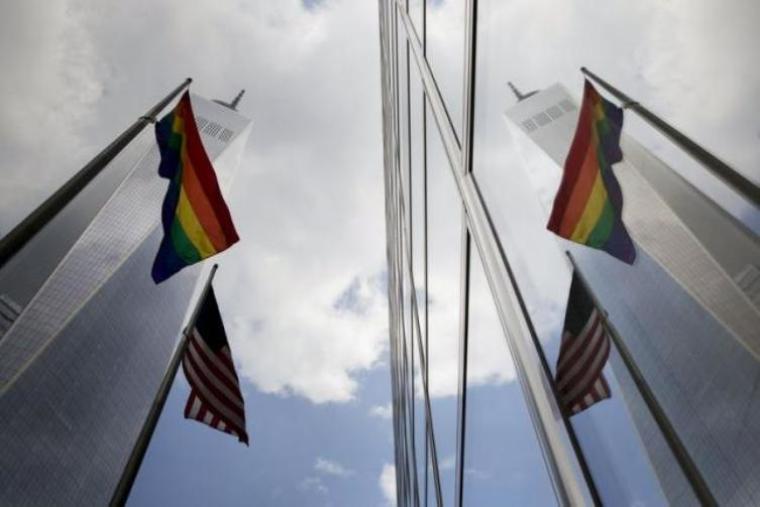
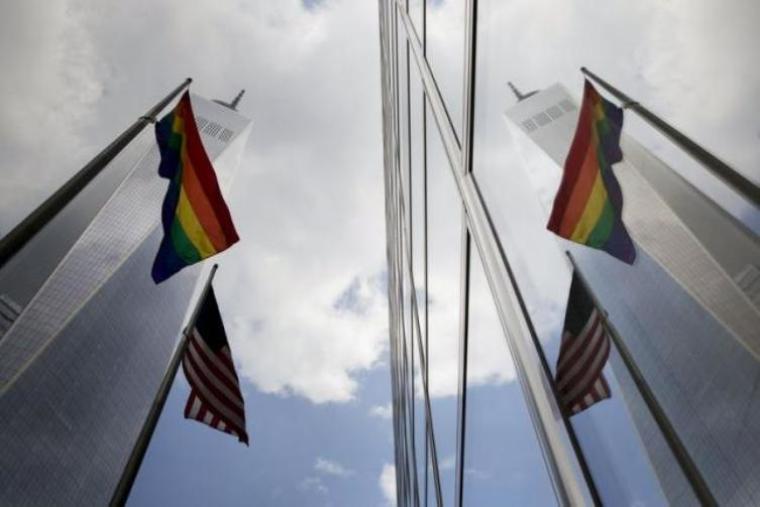
A gay pride flag flies alongside the U.S. flag (lower), as they are reflected off the front of 200 West Street, also known as the Goldman Sachs Tower, in lower Manhattan, New York June 26, 2015. | REUTERS / Brendan McDermid

The U.S. State Department has authorized embassies worldwide to display the rainbow pride flag on embassy flagpoles along with the American flag, which reverses the Trump-era policy. 

In a State Department cable reviewed by news outlets, Secretary of State Antony Blinken said that the diplomatic outposts are not required to fly the LGBT pride flag but can decide if it is appropriate to display on the flagpole “in light of local conditions.”

The rainbow pride flag can be displayed before May 17, the International Day Against Homophobia and Transphobia, through the end of June, according to the cable and a State Department official who spoke with the New York Times.

June is officially recognized as Lesbian, Gay, Bisexual, and Transgender Pride Month to commemorate the 1969 Stonewall riots in New York City, which are viewed by many as the beginning of the gay rights movement. 

In the cable reported originally by Foreign Policy, State Department officials were told to follow the “do no harm” policy to prevent backlash against the local LGBT population.

“Posts should support efforts to repeal [criminalization] legislation, while ensuring that ‘do no harm’ remains our overarching principle so U.S. efforts do not inadvertently result in backlash or further marginalization of the LGBTQI+ community,” the cable was quoted as stating. 

Though the flag would be relatively non-controversial in some countries, in many Middle Eastern or North African countries where same-sex relationships are banned, the pride flag could stir up contention. 

Franklin Graham, a prominent conservative evangelical leader and president of Samaritan’s Purse, criticized the decision on Facebook. He said just because something is “authorized” does not make it right. 

“Why should a flag representing one group of people and a specific agenda be literally raised up above all others and allowed to fly at our embassies and consulates?” Graham, the son of legendary evangelist Billy Graham, wrote.

“The embassies represent the United States of America on foreign soil—only the U.S. flag should be flown. Not the gay pride flag, not the Christian flag, not any other flag.”

“The previous administration had a one-flag rule that the Biden administration has rescinded,” he continued. “Our U.S. flag represents the sacrifice, the honor, the unity, the patriotism—and the blood—that made America great. Pray for our nation and our leaders.”

The Trump administration denied requests from U.S. embassies to display the rainbow flag on the embassy flagpole to celebrate LGBT Pride Month and only allowed the American flag to be flown on the flagpole. 

In defense of former Secretary of State Mike Pompeo’s one-flag rule, former Vice President Mike Pence told NBC News in June 2019 that he and the president believe only the U.S. flag should be displayed on the embassy flagpole. 

“We both feel that way very passionately, but when it comes to the American flagpole, and American embassies, and capitals around the world, one American flag flies,” Pence proclaimed. 

The Trump administration’s State Department reportedly denied requests from U.S. embassies in Brazil, Germany, Israel and Latvia to fly the rainbow pride flag for LGBT Pride Month. 

Embassies were still allowed to display the pride flag outside of the embassy under Trump, and some embassies displayed the flag elsewhere. 

South Korea, for example, displayed the pride flag on the building instead of the flagpole until embassy officials removed it and a Black Lives Matter banner, the New York Times reported. 

During the Obama administration, embassies were allowed to fly the rainbow flag under the American flag on the embassy flagpole. 

Blinken pledged to support the LGBT agenda by flying the pride flag at U.S. embassies and reinstating the special envoy for the human rights of LGBTI persons upon being sworn in this January.

The State Department is yet to make a formal announcement regarding this decision.

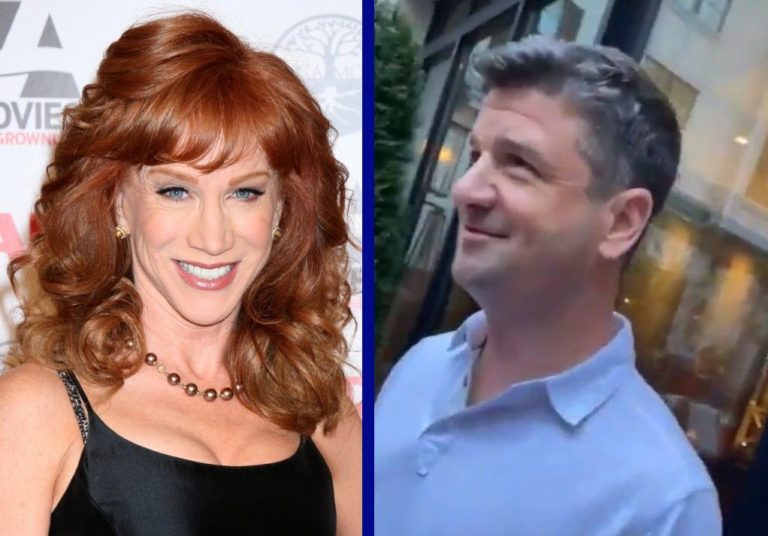
CEO caught harassing gay teen who wore dress to prom. Kathy Griffin helped him get “online famous.” – LGBTQ Nation

Video of a Nashville executive harassing a gay couple at a prom has gone viral, and even comedian Kathy Griffin has called out the arrogant CEO.

“You look like an idiot,” Sam Johnson, 46, CEO of the telemedicine platform VisuWell, can be heard telling student Dalton Stevens, who showed up at Franklin High School’s prom in a red dress.

Related: Kathy Griffin gets ultimate revenge on MAGA harasser by turning her in to FBI for rioting at Capitol

“We went to this hotel close to where we live and we got a lot of good photos and we were there for about an hour and right as we were about to leave we standing outside in this little middle area with a bunch of buildings surrounding us,” said Jacob Geittmann, Stevens’s boyfriend who recorded the video and posted it to TikTok.

“This man comes up and he’s about an inch away from my boyfriend and he says, ‘What are you wearing?’ And he’s like, ‘A dress, why?’ And he’s like, ‘Why are you wearing that? You shouldn’t be wearing that.’”

Geittmann said that Johnson started “going on and on” with “homophobic banter” like “You look disgusting, you look ridiculous, you look like an idiot. Men shouldn’t be wearing this.”

His video starts with the confrontation already in progress. Stevens is telling Johnson to get away from him. The teen walks to go into the hotel, and Johnson follows him.

An adult can be heard telling Johnson to stop because it’s “a special night” for the teens, and he shrugs in his short-sleeve collared shirt and grins.

“I’m sorry, I’m gorgeous,” the teen says.

“Are you?” Johnson responds.

At one point, Johnson swings at Geittmann’s phone and tells him to stop recording. He also appears to hit Stevens in the arm.

In another video, Geittman said that Johnson succeeded in knocking the phone out of his hand and it hit the ground, which is not shown. He said Johnson was “pretty obviously drunk.”

After being posted to TikTok this past Saturday, the video went viral and was shared on Reddit and Twitter.

“It seems like he’s dying to be online famous,” Kathy Griffin wrote when sharing it on Twitter.

Johnson told NewsWeek that the allegations against him are “entirely false.” He said that the gay teens were “obnoxious” and “loud” and that he wanted them to “tone down the vulgarities around the families and children who were present.”

He said he was at the restaurant at the hotel when he “was presented with their loud cursing.”

“Making it about the dress was their idea and they edited out most of the exchange. I have no ill will towards anyone or their personal choices, so long as it does not harm me or my family.”

After the encounter, Geittman said that his boyfriend “looked gorgeous, everybody loved it, and nobody had a problem with it.”

LGBT people more likely to experience intimate partner violence than heterosexual women and men – The Georgia Straight

Intimate partner violence is a serious problem in Canada and around the world.

This form of gender-based cruelty causes a lot of pain and suffering.

Intimate partner violence or IPV can be categorized into three types: psychological, sexual, and physical.

 Women are more likely than men to experience abuse from their romantic partners.

A new report by Statistics Canada indicated that 44 percent of women in the country reported in 2018 that they have experienced some form of intimate partner violence in their lifetime.

“By comparison, this was the case for just over one-third (36%) of men,” the federal agency stated Monday (April 26).

In the same report, Statistics Canada noted that people from other population groups indicated “higher-than-average rates of IPV”.

Foremost of these are members of the LGBT community.

“Sexual minority people—those whose sexual orientation is gay, lesbian, bisexual, or another sexual orientation that is not heterosexual—are much more likely to experience all forms of intimate partner violence than heterosexual people,” Statistics Canada stated.

For instance, in 2018, two-thirds or 67 percent of sexual minority women said that they had experienced at least one type of IPV since the age of 15.

This rate was “significantly higher” than the 44 percent of heterosexual women who reported similar experiences.

“When broken down by sexual orientation, relatively similar proportions of bisexual (68%) and lesbian (61%) women said that they had experienced some form of IPV in their lifetime, though both were significantly more likely to experience IPV than heterosexual women,” Statistics Canada reported.

Moreover, more than one-quarter or 27 percent of sexual minority women reported being sexually assaulted by an intimate partner at some point since age 15, compared with 11 percent of heterosexual women.

“As was the case among sexual minority women, sexual minority men were much more likely than heterosexual men to experience both physical and sexual assault by an intimate partner over their lifetime,” Statistics Canada reported.

To illustrate, about one-third or 31 percent of sexual minority men indicated that they had been either physically or sexually assaulted by an intimate partner since age 15, compared with 17 percent of heterosexual men.

People with disabilities also experience a high rate of intimate partner violence.

More than half or 55 percent of women with disabilities experienced some form of IPV in their lifetime, compared with 37 percent of women without disabilities, Statistics Canada reported.

The agency noted that the most commonly reported form of IPV among women with disabilities was psychological abuse (53 percent), physical abuse (32 percent), and sexual assault (18 percent).

More

What a Gay, Jewish Scientist of the Nazi Era Has to Teach Us About Cancer – Jewish Week

The German biochemist Otto Warburg made few friends — not among his fellow scientists, despite his Nobel Prize for unlocking one of the secrets of cancer, and not among the Nazi leadership, who nevertheless let this scion of a famed Jewish family run one of the Reich’s most important biology research centers.

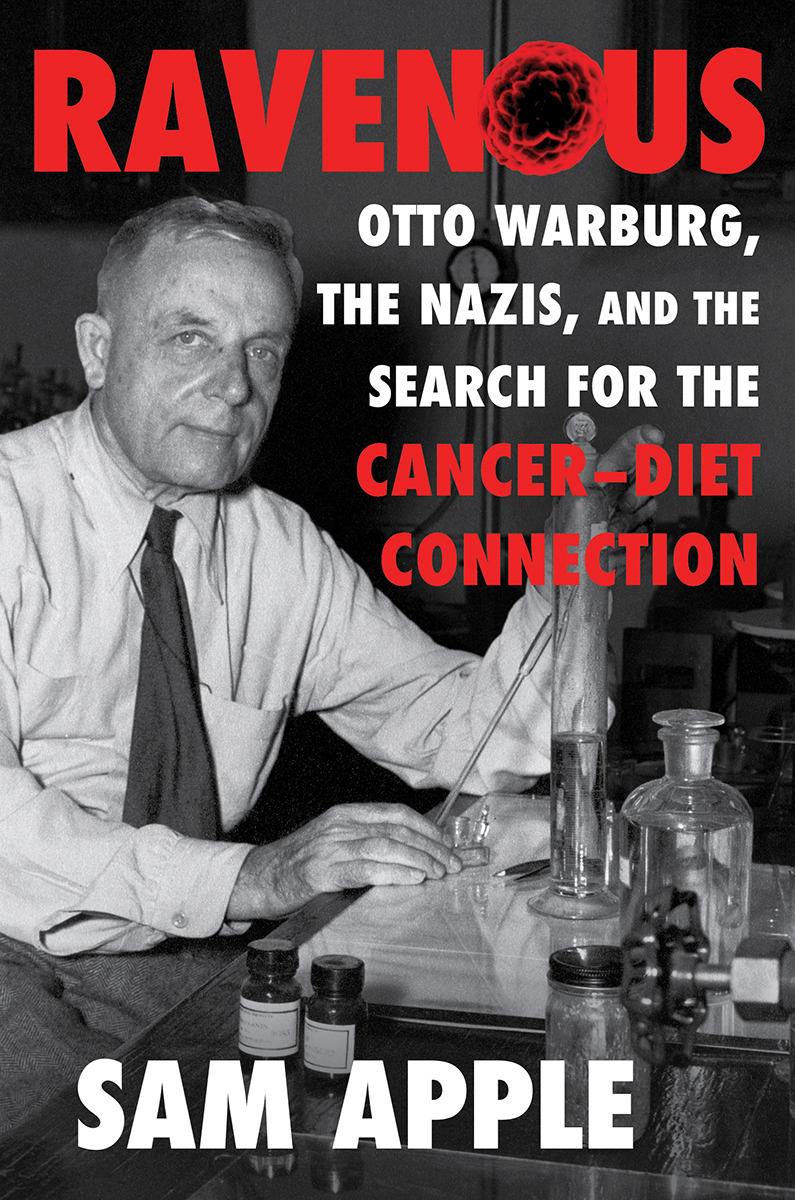
How the brilliant and imperious Warburg (1883-1970) stood up to the Nazis and continued his sometimes lonely pursuit of a cure for cancer is the subject of Sam Apple’s forthcoming biography, “Ravenous: Otto Warburg, the Nazis, and the Search for the Cancer-Diet Connection” (Liveright). It’s a deep dive into the history of cancer research, the anti-Jewish madness and medical quackery that consumed Hitler, and the recent rediscovery of the “Warburg effect” and how it might just explain the West’s cancer epidemic.

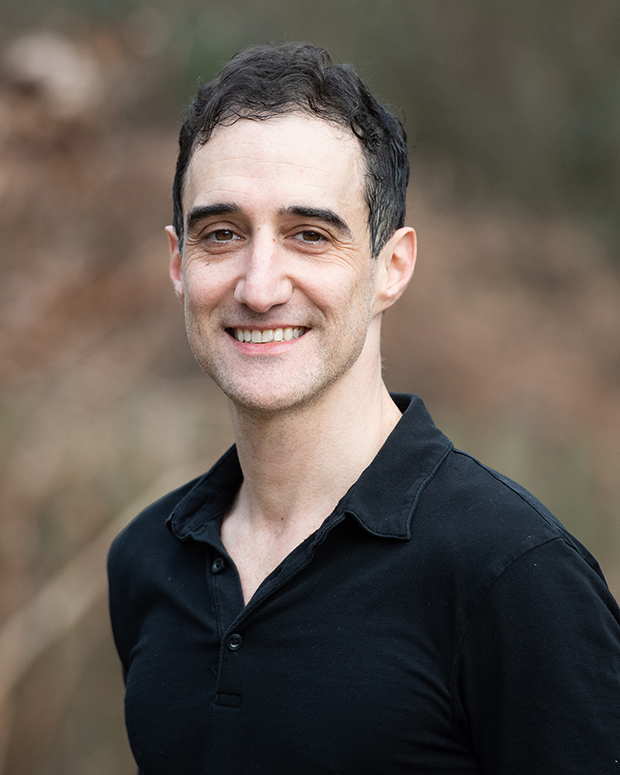
Apple is the author of two previous books, “Schlepping Through the Alps” and “American Parent,” and teaches journalism and creative writing at Johns Hopkins University. He spoke to The Jewish Week from his home in Wynnewood, Pa. This interview has been condensed for length and clarity.

I hate asking the “why this book” question to start any interview, but when I remember your first book — about an eccentric Austrian shepherd who happens to sing Yiddish folk songs — I wondered why you would want to spend so much time with a person as unpleasant as Otto Warburg.

I came to the topic of cancer metabolism before I came to Warburg. I was interested in the science, but it really wasn’t until I came across Warburg that I decided to write a magazine article, and then a book. He was an awful guy in many respects, but he was a genius, and he was an eccentric and I, you know, I’ve always been attracted to those kinds of characters. 

Place Warburg in his time, which is the first part of the 20th century. Germany is a scientific powerhouse and he’s studying plant cells and that eventually morphs into cancer research.

His father Emil was a really prominent physics professor at the University of Berlin, at a time when it was still very unusual for Jews to reach a central position. Einstein really loved Emil. Otto grows up in a household surrounded by some of the greatest minds in the history of science. Somebody described him as having even a religious devotion to science. 

The question for him is, what can he do to be a great scientist in his own right and reach the fame of his heroes — Louis Pasteur and Robert Koch, the great German scientist who won the Nobel Prize for his studies of infectious diseases? He decides, I think very consciously, that he’s going to defeat the great disease of his time and era, and that was increasingly becoming cancer.

We know the Warburgs from his American cousins, the famous Jewish banking family, but by the time you get to Otto it’s two generations removed from his Jewish grandparents.

He’s not particularly close with that branch of the family, but his father grew up Jewish, although, like many German Jews of that generation, assimilated. Although there’s no evidence that Emil rejected his Judaism, Otto grew up with no real Jewish upbringing, and didn’t think of himself as Jewish.

Otto won the Nobel Prize in Medicine in 1931 for his contributions to cellular metabolism and cellular respiration. What should we know about him in terms of science, especially now, as you write in the second half of your book, his ideas are making a comeback? 

Sam Apple (Liveright)

Because his father’s a physicist and Einstein is one of his heroes, he views everything through the lens of energy. In 1923 he makes this fairly remarkable discovery that cancer cells are overeating — eating in a way very different from other cells. That leads to a lot of scientific interest about the connection between metabolism and cancer, but after World War II, his ideas largely began to disappear.

Because of his record during the war? Otto chose to stay in Germany as the head of his fiefdom, the Kaiser Wilhelm Institute for Biology in Dahlem, when so many other scientists, Jews and non-Jews, were leaving either out of self-preservation or to protest the Nazi regime.

There are a number of reasons. One is that people detest Warburg. He wasn’t a likable guy, in many respects, and he did himself no favors by making sort of extreme statements saying his own work was all you needed to know about cancer and the rest is garbage. 

He was a tremendous narcissist. One example: He didn’t want to be photographed with other scientists out there, including Nobel Prize winners. He was brilliant and he thought of himself as above everybody else. He had an aristocratic personality.

A bigger factor was the genetics revolution that took hold in the late 20th century. As they began to understand DNA and cancer mutations, Warburg’s study of the energy reactions began to seem very unimportant.

He was a patriotic German and served in a famed Prussian cavalry during the First World War. Was he a Nazi sympathizer? 

He hated the Nazis but for not entirely the right reasons. He stood up to the Nazis when they came to his institute, and basically screamed at them, saying, “I’ll burn down this institute before I let you interrupt my work.” He wasn’t particularly worried, however, about what they were doing to everybody else. He was happy to just sort of be alone in his institute.

You write that 2,600 scientists had left the country, especially but not only Jews and half Jews and quarter Jews like Warburg (as the Nazis saw him). And yet despite his Jewish ancestry he manages to survive, and the Nazis let him stay on. How does he pull that off?

When I grew up I learned in Jewish day school that the Nazis defined a Jew as someone having one Jewish grandparent. Warburg had two Jewish grandparents. But it’s more complicated than that. In the initial racial regulations of 1933, there were exceptions — for example, if you had served in World War I. And restrictions only applied to people in the civil service and government positions. It really came to a head in 1935 when a lot of Nazi officials were frustrated that so many people were sort of skirting the regulations and that the definition hadn’t been fully worked out. In 1935, they passed the Nuremberg laws, which were meant to crack down on Jews and also provide some clarity as to who’s a Jew and who’s not. 

It’s eerie and macabre how, in a country known for its science, Hitler tried to bring fake scientific precision to deciding who was and wasn’t racially a Jew. 

There are different regulations according to your parentage, so someone like Otto, who is considered a “first degree Mischling,” or mix-ling, was sort of in the middle. Mischlings were assimilated into German society, went to German churches and their relatives weren’t Jewish, and Hitler was savvy enough in the early days, when Germany still cared about its international reputation, to see that cracking down on them might not be so easy. But as things progressed and particularly after the start of World War II, there was no more political need to protect the Mischlinge people. Hitler hated them especially because they were the living embodiment of what he detested: the intermingling of Jews and Aryans. 

In January, 1942, after the second “final solution” conference, Warburg’s status became much more precarious. I believe the preponderance of evidence that it really was the cancer research that saved him. 

You write how cancer was both a personal fixation of Hitler’s but also a national fear. 

(Liveright)

There’s a tremendous amount of evidence that he was fixated on cancer more so than other diseases. And it makes sense because he lost his mother to breast cancer. There is this phenomenally strange story about a Jewish doctor coming in to care for his mother and young Hitler, by the doctor’s side, telling him to try whatever he can to help his mother. He ends up giving her these terrible, painful treatments and he later described Hitler as the most distraught person he’d ever seen.

But cancer was a very large part of Hitler’s hypochondria. He was constantly talking about the research, spouting off nonsensical theories about cancer and trying a lot of dietary therapies. I don’t have clear proof that Hitler was directly involved in Warburg’s case, but there’s a lot of things pointing to it. On June 21, 1941, when the Nazis would launch Operation Barbarossa, the biggest military operation in history, there’s a conversation between Hitler and Goebbels and they’re talking about cancer research. Warburg had applied for what they call a German “blood certificate” to have his status, you know, upgraded, so I think it’s very likely that Hitler personally intervened to [protect] Warburg.

Hitler also uses cancer as a metaphor for Jews, and the real and fake science gets mixed into his theories of how cancer itself is a symptom of a society that’s allowed itself to be degenerated.

Hitler used the metaphor all the time. You can find it in “Mein Kampf” and his various speeches. In Hitler’s case, the connection between Jews and cancer was more than a metaphor. It was much more a literal connection in his mind. He was worried about cancer and he was worried about Jews. The historian Robert Proctor calls Nazism a national hygiene experiment inflicted on the Jews.

Warburg, of course, wanted to literally conquer disease and Hitler, in his own mind, was attacking disease by lumping Jews into that same category. 

Amazingly, Hitler at one point described himself as the Robert Koch of politics. I was struck by the fact that both Hitler and Warburg saw themselves in the image of Robert Koch. Warburg, of course, wanted to literally conquer disease and Hitler, in his own mind, was attacking disease by lumping Jews into that same category. 

They were two narcissists born of the same generation, both trying to emulate this heroic German scientist, but one doing it in a rational way and the other doing it in the most monstrous way imaginable.

Warburg was a gay man and had a life-long male partner, which under the Nazis would have been another mark against him. But it wasn’t a deeply held secret exactly.

It’s kind of amazing that he survived, not only as a Jew or first-degree Mischling, but also somebody who’s very clearly homosexual. He and his partner lived in the same house, traveled together, they were inseparable. At one point it was clear that he had been turned in or someone had written a letter to Nazi authorities accusing them of homosexuality, among other crimes. In the same way that he refused to let the Nazis interfere with his science, he wasn’t going to let anybody interfere with his homosexual lifestyle.

You suggest Otto stood up to the Nazis only to the degree that they were going to affect him personally. What was his record in terms of protecting other Jewish scientists? Did he have any empathy for perhaps Jews in his lab, or did he have opportunities and punted?

It’s a little bit of both. He did try to protect a few people, particularly inviting Hans Krebs and other famous biochemists to come work at his laboratory as a way to protect them. There was a guy named Erwin Haas in his laboratory who he protected because he valued his science, but there was another young Jewish researcher who he let go in 1933, seemingly under pressure. He tried to find a position for him in the United States, he wasn’t totally unsympathetic, but he was no champion of the Jewish people. I got the impression that he was worried about himself. And in fairness, like many people he really believed that the Nazi insanity was going to die out after a year or two.

A cousin of Warburg’s said he wrestled every day with, you know, should I stay or should I go. And when I read the stories of all these people who had fled, it really struck me that so many of them were not happy in places where they felt like outcasts. They lost all the prestige they had in Germany. Warburg knew himself and knew that he would have been miserable had he left. He knew himself well enough to know that he needed his castle to feel like an emperor.

There is an ethical debate about Nazi science and whether society can derive a benefit from their inhumane experimentation. Is there any indication that Warburg’s science is tainted?

I don’t think there is. After the war, because he hadn’t left, some thought he was a Nazi sympathizer, but I don’t think that they thought he was actually working on behalf of the Nazis. It is true that after 1942 his institute was reclassified as a war institute, but that only allowed him additional protections to continue his cancer research. 

What is Warburg’s legacy in Germany?

In the immediate post-war period I think the new government actually wanted to sort of highlight his career and say look, there’s a Jew who survived. As it became clear that his science was falling out of fashion, he was sort of disregarded in Germany as well. But there is still an Otto Warburg medal that goes to German scientists and the institute is now known as the Otto Warburg House.

Why is it important for people to understand who he was and what he was part of?

There are a few different models of how cancer progresses, and you can focus on the genetic impact on mutations in the DNA, or you can focus on the metabolic angle. Both are clearly relevant, but what Warburg said until the end of its life was: It’s metabolism, metabolism, metabolism, and everybody forgot about that in the late 20th century. And in the last 20 years or so there’s been a huge rediscovery of cancer metabolism and the way that a cancer cell produces energy. It’s absolutely fundamental to cancer. I think he has been redeemed really.

One example you give is that “the path from the refined sugar added to our diets to insulin resistance, and from insulin resistance to cancer, is now well understood and based on widely accepted science.”

My larger goal in this book was to try to investigate a mystery, which is why cancer has become so much more common since the middle of the 19th century, and my ultimate answer is that it’s connected with the sugars in our diet and how they leave us with higher levels of the hormone insulin, which helps cancers grow and overeat in the way that Warburg discovered. Warburg didn’t get the whole story right, but insofar as he focuses the picture of cancer on metabolism he is very much at the center of this 200-year mystery.

Gay TikTok: Is Vanessa Carlton’s “A Thousand Miles” About Sara Ramirez or Rutina Wesley? – Autostraddle

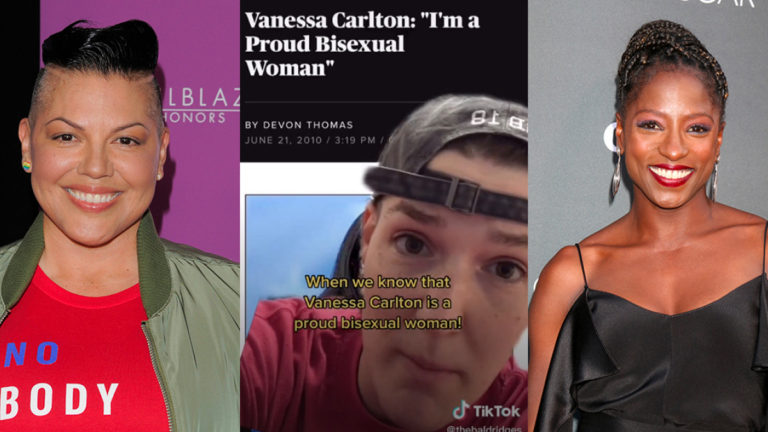
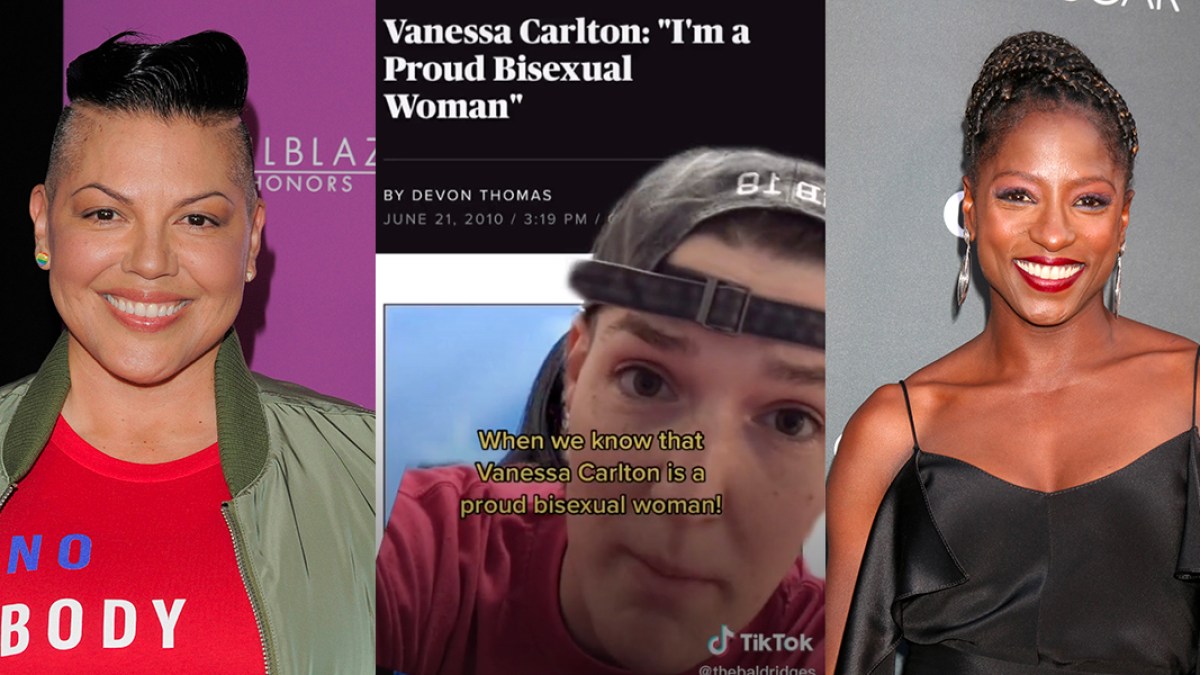
Google News alerts me any time any celebrity says anything that’s even leaning up against the idea of being gay — or when websites lie about it. Starting two weeks ago I kept hearing that Vanessa Carlton’s “A Thousand Miles” was about Jessica Chastain, but I also kept hearing that Kristen Stewart was going to make another Twilight movie if Bella Swan could be bisexual. Just a lot of bananapants rumors out here, you know? Okay, but then! Today! My Sara Ramirez Google News alert mentioned this Vanessa Carlton/Jessica Chastain thing, so I finally clicked on it — and lo! A gay from the TikTok The Baldridges has done a special investigation about Vanessa Carlton’s “A Thousand Miles” and decided it’s either about Jessica Chastain, Sara Ramirez, or Rutina Wesley, which means this thing now has my full attention.

@thebaldridges

The truth is out there! #athousandmiles #lgbt #vanessacarlton

♬ original sound – The Baldridges

Okay so the theory goes like this: Vanessa Carlton is a known bisexual who one time said “A Thousand Miles” is about a crush she had on someone who went to Juilliard with her. And guess who went to Juilliard with her? Yuh: Other known queers Sara Ramirez and Rutina Wesley! @thebaldridges also points out that walking really fast with a blank stare on your face is queer culture, and I cannot disagree.

I would also point out, as we often do when we talk about Taylor Swift, that straight people simply do not pine with the same kind of intensity as queer people. Walking one hundred miles on a treadmill in an air conditioned room seems straight; walking one thousand miles through a mystical timeless void? That’s gay. Also, there’s at least three employees of Autostraddle dot com who would absolutely walk one thousand miles through the flames of literal hell for Sara Ramirez and Rutina Wesley, so, I mean, there’s a precedent.

Thank you for your investigatory work, The Baldridges! We look forward to your next gay deep dive about which soft butch Kacey Musgraves’ song “Space Cowboy” is about.

@thebaldridges

who wouldn’t walk a thousand miles for @jes_chastain ????

♬ A Thousand Miles – Vanessa Carlton

No masc, no entry – Daily Californian

When Colton Underwood of “The Bachelor” came out, I honestly wasn’t surprised. Out of 25 seasons of the show, one of the bachelors was bound to be a little gay.

What shocked me even more, however, was that he soon got his own Netflix show. Not only that, but he was going to have famous gay Olympian, Gus Kentworthy, as his personal “gay guide” through queer culture and life after coming out. 

It’s always great when someone comes to terms with their sexuality and expresses it openly. I applaud Underwood’s bravery and courage to share something so personal with millions of people. And his announcement has probably meant a lot to closeted fans and helped push for more queer visibility in the media. 

But Underwood’s reward of a show highlights the underlying homophobia in mainstream society: a preference for “straight-passing,” masculine, or masc, queer men over feminine, flamboyant queer men.

This isn’t a new concept. The idea that masc queer men are superior pervades heterosexual thought. Men such as Matt Bomer, Neil Patrick Harris and Ricky Martin are seen as “more straight” because of their masculinity, breaking the stereotype of the effeminate gay man. Masc queer men also don’t “look” gay and often enjoy stereotypically masculine things such as sports and power tools. 

In contrast, the effeminate gay man is gay, in all capital letters. Think RuPaul, Adam Lambert and Jonathan Van Ness. They probably watch “RuPaul’s Drag Race” and listen to Ariana Grande. This type of queer man is often considered more feminine because of the emphasis on looks through fashion and cleanliness. These men also may have higher-pitched voices and are more flamboyant and expressive, fueling the idea that they are “diet women.” 

But the differences between these two types of queer men extend far beyond their characteristics. Heteronormativity — and the oppression that accompanies it — treats them differently.

I remember looking at the Instagram profile of Jonathan Van Ness from “Queer Eye” a few years back. After looking through his sea of photos, ranging from his luscious hair to incredible style sense, I went through the comments section. 

Some of the comments were supportive and kind, but most called Van Ness various combinations of demeaning adjectives, including slurs, with a lot of viewers attacking him for being feminine. (I honestly have to give the homophobes some props for their creativity in insults.) Nevertheless, this was a textbook case of homophobia mixed with misogyny, perpetuating the idea that masculinity is the standard. Since Van Ness is outwardly feminine, many consider him “too gay,” and therefore lowlier than his more masculine gay counterparts. 

Van Ness’ costar, Antoni Porowski, who is the masculine cooking expert of the show, got a wildly different reception. When the show first premiered, he instantly became a fan favorite. Everyone on my Twitter timeline talked about how hot he was and created memes about his love for avocados. Out of the entire “Queer Eye” cast, I’d argue Porowski has the least interesting personality. Van Ness carries the show, but Porowski gets all the attention. 

I don’t mean to suggest that Porowski has never experienced homophobia in his life. But queer men who pass as straight have some privilege. 

This frustrates me because feminine queer men have often been at the forefront of championing LGBTQ+ rights. The 1969 Stonewall riots, credited for being the beginning of the modern LGBTQ+ rights movement, had effeminate twinks and drag queens protesting with transgender women and butch lesbians. Feminine queer men have changed societal conceptions of what makes a man, regardless of sexual orientation, and consistently blur the rigid line separating gender roles. They have done so much for gay rights but are paid dust while masc queer men reap all the benefits.

Through my youth, the immense pressure to be a masculine gay — and conform to social expectations — controlled my every action. I’ve written about how ashamed I was of watching “RuPaul’s Drag Race” and listening to pop stars such as Britney Spears. I convinced myself these things were “too gay” and that if I wasn’t straight, I wasn’t going to be “like those other gays.” I’d scoff at other gay men for wearing makeup or listening to Taylor Swift’s latest album, thinking I was different and cool. In reality, this was self-projected, internalized homophobia.

I’m happy that Colton Underwood has come to terms with his queerness, but the reward of a Netflix show puts him and other masc queer men on a pedestal while feminine gay men are given scraps and pieces. Although some feminine queer men do enjoy the spotlight, they are not given the same platforms. “RuPaul’s Drag Race” was on a more niche television network before getting picked up by VH1 eight years later. It faced so much backlash before it went mainstream, but it definitely paved the way for shows such as Underwood’s to be on a platform as huge as Netflix.

If Underwood was an effeminate twink, I’m not sure he would’ve been given his own series right after he came out. If that was a reward for coming out, I want my own Netflix show for God’s sake.

Nicholas Clark writes the Monday column on LGBTQ+ issues in media and politics. Contact him at [email protected]

Cassie Randolph Overjoyed at Party After Colton Underwood Came Out – Showbiz Cheat Sheet

Cassie Randolph is moving on from Colton Underwood for good, and a video of her at her birthday party proves it. The reality TV star, who “won” Underwood’s season of The Bachelor, was seen with friends over the weekend celebrating her 25th birthday. Randolph was born on April 27. She was seemingly in good spirits after Underwood came out as gay on April 14 after their relationship ended.

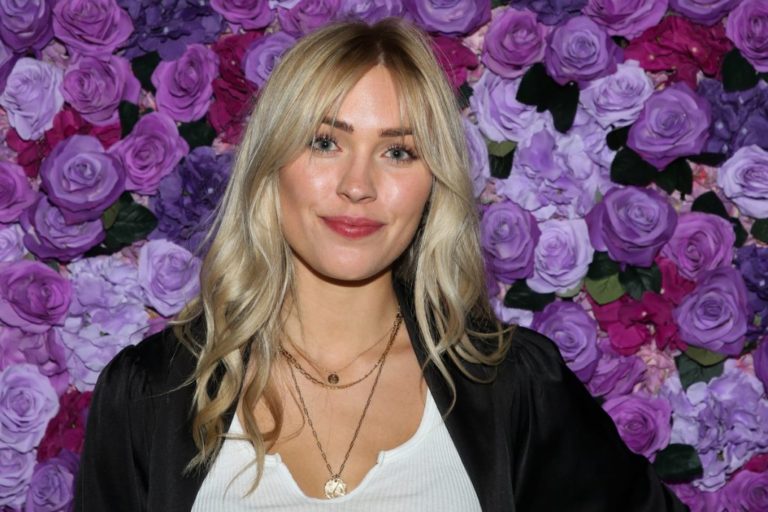
Cassie Randolph grinning in front of purple flowers

Cassie Randolph | Paul Archuleta/Getty Images

Cassie Randolph filed restraining order against Colton Underwood

Randolph and Underwood dated for around a year after being the final couple on his season of The Bachelor. Following their split, Randolph filed a restraining order in September 2020 against Underwood for him allegedly placing a tracking device in her car, per TMZ.

Furthermore, the outlet reported that “Colton would show up uninvited to her L.A. apartment and her parents’ house in Huntington Beach and bombarded her with harassing texts.”

Two months later, Underwood told People that the former couple came to a “private agreement” and that Randolph dropped the restraining order.

“Today Cassie asked the court to dismiss the temporary restraining order against me,” Underwood stated. “The two of us were able to reach a private agreement to address any of Cassie’s concerns.”

He continued: “I do not believe Cassie did anything wrong in filing for the restraining orders and also believe she acted in good faith. I appreciate everyone’s respect for privacy regarding this matter.”

Colton Underwood came out as gay after leading ‘The Bachelor’

RELATED: ‘The Bachelor’: Chris Harrison Breaks Social Media Silence After Colton Underwood Comes Out as Gay

While Underwood kept pretty low-key after the restraining order, he appeared on Good Morning America on April 14 to reveal a new revelation about his identity.

“I’ve ran from myself for a long time,” Underwood stated. “I’ve hated myself for a long time, and I’m gay.”

The former bachelor explained that this discovery happened in 2020.

“I came to terms with that earlier this year and have been processing it,” he continued. “The next step in all of this was letting people know. I’m still nervous. It’s been a journey, for sure.”

Cassie Randolph looked happy after Colton Underwood came out

Around a week after Underwood came out, Randolph addressed the situation in a YouTube video.

“Regarding the topic in the media that brought my name up this week, just wanted to let you know that I’m not gonna be further discussing it or commenting on it for now,” she stated. “There’s a lot of layers to it and I just feel like the best thing for me at this time is to move forward and just focus on going forward.”

And she seemingly did just that.

Fans from The Bachelor Reddit reposted a video of Randolph arriving at her surprise birthday party over the weekend. In the clip, Randolph was smiling and put her hands to her mouth. People cheered her on as well.

Fans had thought that Randolph might be having a difficult time with Underwood bringing up their relationship on GMA. But the latest video of Randolph celebrating with people she loves seems to show that she is doing what she said — moving forward.

Lil Nas X Calls Out Misogyny in the Gay Community – Pride.com

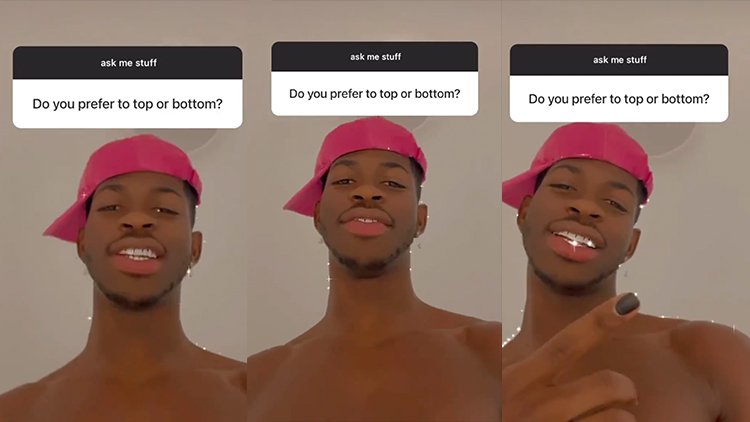
In his latest Q&A on Instagram, someone asked “MONTERO (Call Me By Your Name)” rapper Lil Nas X if he’s a top or a bottom. 

At first, he answers with a joke. “I’ve never been a bunk bed kind of guy. I like queen-size beds, I like king-size beds, I like full.”

But then he gets a bit serious.

“All jokes aside, with this top and bottom shit in the gay community. Its become a huge form of misogyny,” he says. “How you n****s misogynists, you’re all gay, you’re f****ts. We’re all f****ts.”

He has a point. Some folks like to feminize or even shame men who like to bottom when that desire has nothing to do with how you present your gender or sexuality. At the end of the day, we’re all gay and shaming each other over positions is quite silly.

Thank you for speaking out X, we love a woke king!

Lesbian Visibility Week survey reveals mental health impact of pandemic – PinkNews

Just over half (51 per cent) of the whole sample considered themselves to have a mental health condition. (Envato)

More than three quarters of queer women and non-binary people are suffering worse mental health due to the pandemic, a Lesbian Visibility Week survey has shown.

The 2021 DIVA survey, from DIVA magazine, Kantar and Stonewall, revealed the huge impact of the coronavirus pandemic on queer women and non-binary folk.

The survey included 1,884 respondents, of which 72 per cent identified as lesbian, 16 per cent as bisexual, five per cent as gay and one per cent as asexual. 

The majority of the respondents were cisgender women, but six per cent were non-binary and four per cent were trans women.

Every participant in the survey was asked whether they felt that their mental health had worsened during the pandemic, whether or not they considered themselves to have a mental health condition.

More than three quarters (77 per cent) said it had, but this figure reached 88 per cent for 16- to 24-year-olds.

Just over half (51 per cent) of the whole sample considered themselves to have a mental health condition, but this figure also skyrocketed for young queer women and non-binary folk between the ages of 16 and 24 (67 per cent).

The top three concerns for respondents during the pandemic were being unable to see friends and family (63 per cent), worrying about the health of their friends and family (51 per cent) and fear surrounding their own decreased wellbeing (48 per cent).

One respondent said: “Uncertainty about the future has left me very anxious and sometimes it’s hard to push through feelings of despair and carry on. Concentration is difficult and things often feel hopeless.”

“I’ve felt very low every day,” explained another. “Having no motivation, no want to get out of bed, especially on the weekends.

“Continuously tired and fed up with being inside. Also, with the fear of not wanting to be outside, I found myself having multiple breakdowns a week.” 

While 52 per cent of all respondents had accessed mental health services in the past year, and 12 per cent tried to but were unsuccessful, of the 16- to 24-year-olds, 18 per cent had been unsuccessful in accessing services.

Created by DIVA publisher Linda Riley, this year Lesbian Visibility Week has teamed up with Stonewall to provide virtual workshops and events throughout the week.

Riley said in a statement: “I am delighted to have founded Lesbian Visibility Week and be working with Stonewall to build an innovative programme of events around Lesbian Visibility.

“For too long the L in LGBT+ has been under-represented and not celebrated within the LGBT+ community, hopefully Lesbian Visibility Week will finally give our voices a chance to shine.”