A major new study endorsed by 60 top international scholars, including former president of Ireland, Professor Mary McAleese, has called for an “urgent” change in Catholic teaching on gay relationships.
he authors of the study, which was launched on Tuesday, claim their findings disprove the traditional objections of the Catholic Church to same-sex relationships.
A spokesperson for the Wijngaards Institute for Catholic Research, which produced the study, said it “should serve as the final nail in the coffin of biblical and other arguments justifying homophobia”.
Professor McAleese told the Irish Independent that ‘Christian Objections to Same-Sex Relationships: An Academic Assessment’ would challenge the “firm and baleful grip on Christian thinking of views which have marginalized same-sex relationships” and which have been used “to justify teachings which conduced to dangerous homophobia” and made “lives miserable”.
She added, “Not for the first time has the Church backed itself into a cul-de-sac. Not for the first time will it have to acknowledge that it got things wrong at huge cost to humanity.”
The new report follows a statement in March from the Vatican’s doctrinal office – the Congregation for the Doctrine of the Faith (CDF) – upholding the ban on blessing same-sex unions because, “you cannot bless sin” and restating the Church teaching that same-sex attraction is ‘disordered’.
The theologians and scripture scholars behind the Wijngaards Institute’s report have appealed directly to Pope Francis to establish an independent study to revisit the Church’s teaching on this issue.
Key discoveries include the finding that the Old Testament passages in the Book of Leviticus, which are traditionally believed to condemn same-sex relationships, are in fact a mistranslation and refer to specific kinds of male same-sex sexual activity such as adultery and incest.
It also argues that passages in the New Testament by St Paul which are long believed to prohibit same-sex relationships are misinterpreted.
Another finding is that there is no condemnation anywhere in the bible of female same-sex relationships, or of consensual and faithful same-sex relationships in general, and that from the point of view of natural sciences, homosexuality is a “natural variation within the range of human sexuality”.
The report is the work of twenty academics, including biblical scholars, theologians, ethicists, evolutionary biologists, and sociologists. The accompanying Academic Statement is endorsed by a further 60 academic scholars
According to Professor Mary McAleese, the international collaborative research project is “the first serious attempt to use the tools of interdisciplinary scholarship to challenge, probe and interrogate Church teaching in the area of homosexuality”.
She said the faithful needed this to help convince “a blinkered magisterium to open its eyes and ears, to see and hear the damage inflicted on good people, young and old, by teachings that run counter to science and counter to the love of the Creator”.
Professor McAleese, who is currently Professor of Children, Law & Religion at the University of Glasgow and Chancellor of Trinity College Dublin, said the study is the work of highly regarded scholars who want the best for the future of the Church and for humanity. “It is hoped the study will be accepted in that spirit and will open up much-needed debate. The Church will benefit hugely from opening the door to fresh thinking just as it is losing credibility by keeping the door closed.”
She said Pope Francis was the “ideal person” to acknowledge the importance of the study and to open debate on its findings. “The Church has not yet evolved an effective or credible model for such an internal discussion unfortunately but that is something
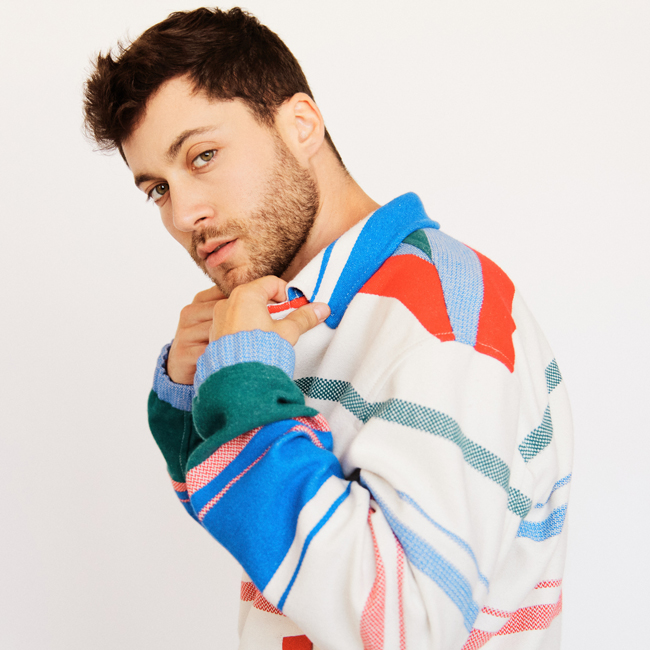
JORDY, the latest in the long tradition of mono-monikered performers in the music world—from Cher to Madonna and Beyoncé—gets up close and personal with listeners on his viral TikTok hit single “Long Distance.” The song, which tells a story about the challen ges of falling for a guy who lives far away, is the runaway song of the season. JORDY has made the most of various viral-video platforms throughout his career, and is poised for stardom. A proud Pisces and out singer-songwriter, JORDY’s infectious enthusiasm and expressive vocals are a winning combination.
The young performer was kind enough to take time out of an incredibly busy week in April to answer a few questions for OutSmart.
Gregg Shapiro: JORDY, I’d like to begin by congratulating you on your thrilling week, beginning with signing your first record deal with 300 Entertainment. What does such an accomplishment mean to you? JORDY: Oh, my gosh! Thank you so much, I really appreciate the kind words. To me, it means that we’re just going to keep working harder than ever. I’m gonna keep grinding harder than ever, and the hard work doesn’t stop. It also means that we have more people in my corner and we’re expanding the family. There’s going to be more hands on deck getting the music to more ears around the world. For that, I’m very, very excited.
In addition to your record deal, you also performed on The Today Show. What was that experience like for you? Completely surreal. I grew up with The Today Show. It was one of those moments where my mother is like crying herself crazy. Very exciting for me and my family. It’s really cool to be able to see this little song I wrote on national TV. It’s pretty cool.
Earlier this year, you competed in the Battle of the Instant Songwriters on The Tonight Show with Jimmy Fallon, where you won $1,000 and a Tonight Show notebook for the song you wrote, “Wedgie in My Ski Pants.” [Laughs] I loved when you picked up your guitar to sing the song and there were rainbow stickers visible on the back. Oh, my God! The best part is that the guitar is one of my really good friend Dom’s guitars. She’s also queer, like me. I needed a guitar, and she was like, “Oh, I got you!” She provided! It was perfect—everything I stand for, obviously.
And as if your record deal and Today Show performance and interview didn’t provide enough excitement for one week, your song “Long Distance” continues to grow in popularity. The song is especially notable for the out gay content of the lyrics. How important is it to you, as a gay artist, to share your identity in your work? It’s essential—there is no alternate option. That’s how I’ve been doing it from the start. I was lucky enough to come out at an early age and have a super-supportive and loving family. I grew up in the Chicagoland area, and felt really at home and welcome. I want to use that voice for those who feel that they don’t have the power to speak out yet.
I’m really glad you mentioned your family and their support. While you were still a student at Glenbrook North High School, you and your mother did an interview about your coming out that ran on the Your Teenmagazine website. Can you please describe what that experience was like for you? Oh my God! I haven’t thought about that in a really long time, actually. My mom is the best! She is a huge reason why I am where I am. I think we had this opportunity to write this article from each of our perspectives. It’s special to have such a close relationship with her. Her validation and support is definitely the reason why I’m so comfortable being who I am. I’m very lucky. She is the absolute best.
“Long Distance” already has an irresistible dance beat. Is there a remix in the works? Yes, there actually is. There’s a remix out right now by one of my favorite DJs, Luca Schreiner. It is on Spotify, Apple—wherever you listen to music. It’s very fun, and perfect for the dance floor.
Speaking of dance floors, what would it mean to you if “Long Distance” became popular with DJs spinning at tea dances this summer in gay hot spots like Key West, Provincetown, and Fire Island? Honey, go for it! All the way! That’s why it’s there. Please, by all means. That would make me the most happy.
When things return to normal and Pride festivities resume, would you perform at a Pride festival if you were invited to do so? One million percent! I was supposed to last summer, and then COVID happened. We’re very excited for Pride events.
Were you scheduled for L.A. Pride or somewhere else? I was doing L.A. and San Diego. We were excited, and then everything happened. So we’re excited for Prides to start up again. I think that’ll be like a really great time for all of us to get together and have a really good time.
I agree. When do you think your fans can expect your full-length album to be released? I think they can expect it sooner rather than later. Maybe this summer! No dates in the works, but we do have an album.
You recently announced 15 fall tour dates, including one in your Chicago hometown. What are you looking forward to most about performing in concert? I’m so excited. I did my first hometown show at Schubas last January, and we sold out. We will be back on November 27 at Lincoln Hall. We’re growing, and we’re very excited. Hometown shows are always the most special, so we’re looking forward to getting back out.
Maybe that’s because you’ve spent a lot of time there. It’s the right height, you can easily see who comes and goes, and the bartender knows your favorite drinks, so why not? In the new memoir Gay Bar: Why We Went Out by Jeremy Atherton Lin, that stool is one of the best places to be.
Long before it was legal for him, Lin, like most gay teenage boys, dreamed about going to gay bars. Ironically, he says, “I can’t remember my first.”
As someone with a foot on two continents, he has a long list of old favorites—places that have mostly closed, been re-named, or relocated. He’s danced in them and had sex in them. Some were carved out of a back room or basement—places that used to be something else. They might be packed with men dancing or doing drugs, or thick with bachelorette parties and tourists (to the annoyance of the gay men who are regulars). Some of them were routinely raided by the police once upon a time.
And they’re all an important part of being a gay man pre-Stonewall, pre-AIDS—and now, post-pandemic.
You can’t stop Lin from sharing fond memories of those nights in the Castro or Los Angeles or London—even though, he says, “There does remain something embarrassing about a gay bar.”
You could be forgiven for wondering what you’re getting yourself into while reading the first few pages of Gay Bar. Lin leaps right into a hazy description of a night on the town. Clarity comes later, and it’s fragile. He assumes that readers are familiar with the men he mentions, or others exactly like them.
Still, his sex-and-booze-filled tales of drag, dance, and la dolce vita are compelling as he weaves gay history in with interesting then-and-now comparisons and explicit tales of life as a young gay man.
While each chapter takes us through doors of a particular gay bar, once we’ve entered with Lin, there are times when we feel like we’ve been abandoned, the music’s too loud, and we just want to go.
In spite of those rough spots, the surreality of Gay Bar is not insurmountable. In fact, if you wait it out, you’ll be mostly glad you did.
Jeremy Atherton Lin’s Gay Bar: Why We Went Out is now available on Amazon.
This article appears in the May 2021 edition of OutSmart magazine.
Let’s begin with my terrible confession: For decades, I’ve been wrong about The Nanny. (And also about Steve Urkel, but we’ll get to him later.)
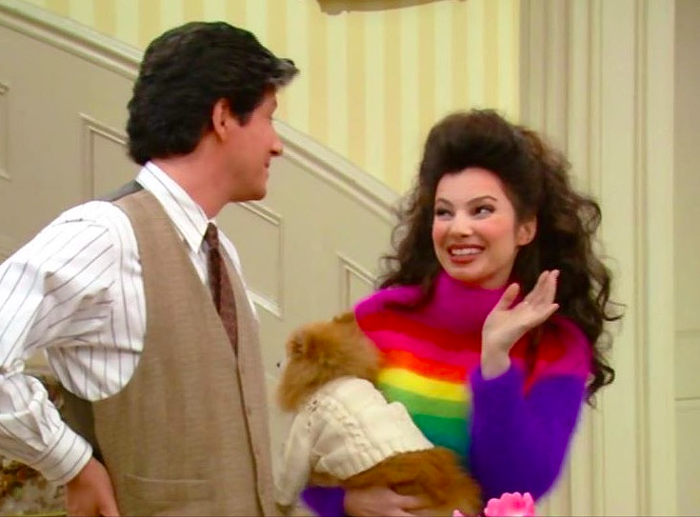
Long, long ago, when The Nanny was originally on the air, I considered myself more of a Frasier gay than a Nanny gay; I assumed that Fran Drescher’s show was all crass sex jokes, annoying child actors, and wall-to-wall heterosexuality.
But oh. Oh dear. I was so wrong. Terribly, horribly, homosexually wrong. At the urging of some friends, I’ve been giving the show a second chance, now that it’s available in crystal-clear fidelity via HBO. And not only is it honest-to-goodness very very funny, it is surprisingly queer. And not just because it’s basically The Sound of Music meets Mame on Broadway! It also has a startling approach to gay characters that really caught my eye.
The ‘90s — particularly the early-to-mid section — was a time for gay characters on sitcoms to be a crisis or awkward or a challenge. Whether it’s Friends, or The Simpsons, or Murphy Brown, or Designing Women, queer sitcom episodes in the ‘90s tend to focus on queer characters as a source of trouble. Don’t get me wrong, these are some great episodes of television (usually), but they always present the gay guest as the problem of the week, a difficulty that needs to be resolved.
Not so on The Nanny, though. Take a look at Season 2, Episode 19, “A Fine Friendship.” In that one, Fran meets another nanny, a handsome man named Kurt who is decked out in head-to-toe denim who knows more about musical theater than is seemly for any heterosexual. She determines that he’s gay, and that’s … just fine. No big deal. No crisis. No “whadda we do about this” scene, no Very Special Episode music that leads into the commercial with the characters staring meaningfully just off-camera at the script supervisor.
It’s easy to take that for granted today, but in the mid-90s, Fran’s easy-going acceptance of a gay colleague is a big deal. The show even manages a neat flip of the “homosexual as problem” trope at the end of Act I, when it’s revealed that Kurt is actually straight. Fran freaks out — and for once, the gay episode twist is not that there’s an unexpected homosexual in the main characters’ lives, but that there’s an unexpected heterosexual.
Ultimately, Fran decides that she likes Kurt better as a friend (though apparently not much better; he never comes back, at least not on this show).
But that’s far from the only gay storyline on The Nanny; there’s another episode where Fran is momentarily mistaken for a lesbian, and she takes it completely in stride. (A year earlier, Friends had an episode in which Chandler freaks out about being mistaken for gay; a year later, Frasier would have a similar freakout.)
My favorite of The Nanny’s queer twists comes in the episode “Val’s Apartment.” That one features a cameo by the actor who played Squiggy on Laverne & Shirley, 17 years earlier, but The Nanny retcons his character to make him and Lenny into gay lovers. It’s an amazing queer flex, taking iconic characters from a totally different show and making them gay.
In real life, Fran Drescher’s been a steadfast ally — she’s supported various causes, from Spirit Day to marriage equality — and last year she starred in Lifetime’s first holiday movie to center a same-sex couple. It’s incredible that it took until 2020 (2020!!!) for Lifetime to make their first gay Christmas movie. And even more incredible that Drescher was just casually including queer characters in her show long long before it was easy to do so.
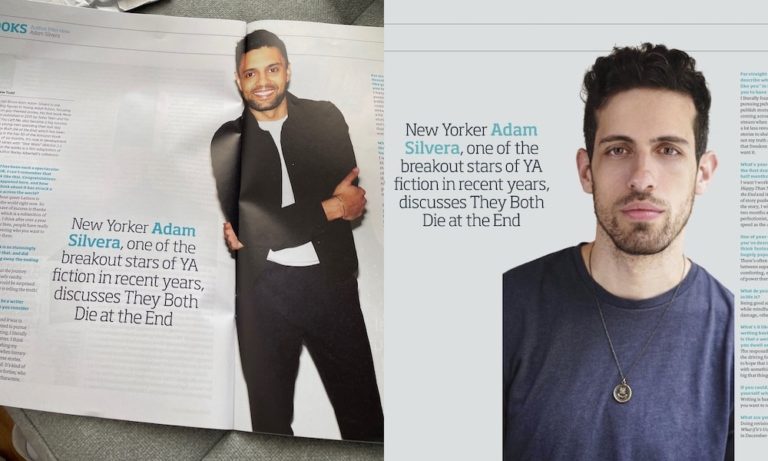
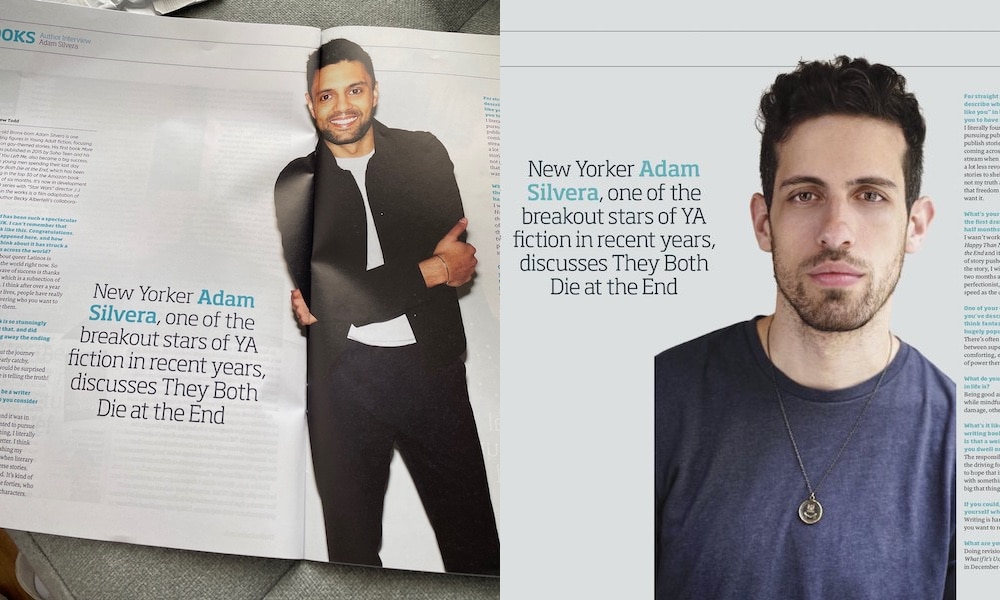
The Bookseller mixed up gay authors of colour Adam Silvera and Mohsin Zaidi in its latest issue. (Twitter/ junodawson and Twitter/ philipdsjones)
The Bookseller magazine made the “humiliating” mistake of confusing two queer authors of colour in a special “LGBT+ spotlight” issue.
The latest issue of the print magazine, which came out on 30 April, featured an interview with Puerto Rican author Adam Silvera, who wrote the best-selling books They Both Die at the End and Infinity Son.
However, the huge photo included in the two-page spread was not, in fact, of Silvera, as the magazine had confused him with Pakistani barrister and author Mohsin Zaidi, who wrote the coming-of-age memoir A Dutiful Boy.
In a statement on the mix-up, Zaidi said: “It is humiliating to have written a piece in the very same issue about the gatekeepers of the book world, the power in giving diverse voices a platform and thanking the industry.
“Inclusion is not a box-ticking exercise. No amount of diversely themed editions of a magazine is going to dull the need for real and meaningful reform.
“Minorities are not window-dressing, which is, unfortunately, the distinct impression one is left with when a working culture fails to instill the importance of being able to tell the difference between someone who is South Asian and (a very talented) person who is Latinx.”
Silvera added on Twitter: “What sucks about this The Bookseller business is that there’s no attention on the article itself which is highlighting the success of a story about queer Latinos by a queer Puerto Rican.
“Really hope The Bookseller can make this right.”
Hi Adam, we noted this on Friday, and I emailed your publisher to apologise. We corrected the online version then, with the version attached. Please accept my apology; it was entirely my fault, not Matthew Todd’s and I am happy to re-run the piece next week in print again. pic.twitter.com/lDcuFQqoBv
Philip Jones, editor of The Bookseller, swiftly responded to Silvera and said he had emailed the author’s publisher to apologise.
He added: “We corrected the online version then, with the version attached. Please accept my apology; it was entirely my fault, not [journalist] Matthew Todd’s and I am happy to re-run the piece next week in print again.”
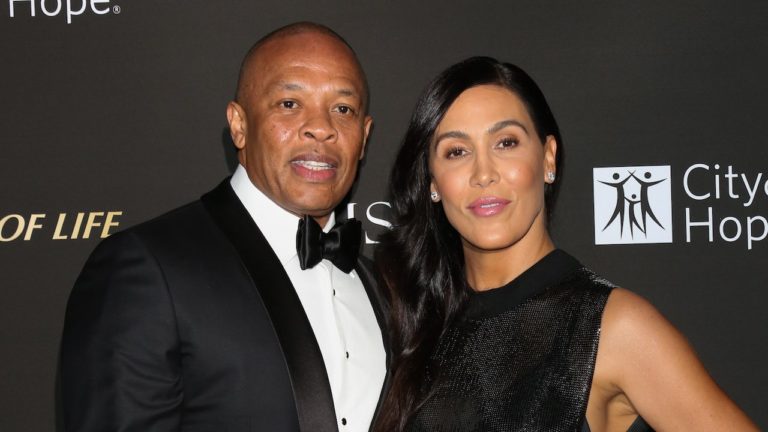
Former Death Row Records producer Kurt Kobane made some wild allegations during a recent interview with The Art of Dialogue. Not only did he claim Suge Knight used to receive love letters from actress Halle Berry, he also said Dr. Dre’s ex-fiancée and son’s mother Michel’le told once told Tupac Shakur she caught him in bed with another man.
But according to The Neighborhood Talk, Michel’le never said anything of the sort. In fact, she reportedly said it was a bold faced “lie” and confessed she couldn’t comprehend why Kobane would say that. She confirmed she discussed plenty of topics with the late 2Pac, but Dr. Dre’s sexuality wasn’t one of them.
As depicted in the 2016 Lifetime documentary Surviving Compton, Michel’le and Dr. Dre’s relationship was undeniably complicated. Michel’le started working with Dre on the World Class Wreckin Cru’s 1987 cut “Turn Off the Lights” and their son was born in 1991. But alleged physical abuse rocked their relationship and she reportedly had to have her nose surgically corrected as a result of Dre’s violence.
Dr. Dre has been accused of assaulting numerous women over the years. In 1991, he brutally attacked former Pump It Up! host Dee Barnes at a Hollywood industry party, which resulted in a lawsuit. In the 2017 HBO documentary The Defiant Ones, Dre admitted he was “out of his fucking mind” when he assaulted her and offered a public apology.
“Any man that puts his hands on a female is a fucking idiot,” Dre said in the clip. “He’s out of his fucking mind and I was out of my fucking mind at the time. I fucked up. I paid for it. I’m sorry for it. I apologize for it. I had this dark cloud that follows me and it’s going to be attached to me forever. It’s a major blemish on who I am as a man.”
related news
Dr. Dre Reportedly Calls Nicole Young’s Abuse Claims ‘A Money Grab’ As $1B Divorce Drags On
“Now, one would say, does Dre get a pass for being such a notorious woman beater ’cause he makes good music?” she said at the time. “One would say. One would say that some people ain’t gonna be praying for Dr. Dre. A lot of women, but you can get a pass, it seems, if you’re popular. He a notorious woman beater.
“I love Dr. Dre’s music, don’t get it fucked up and I don’t want to see any of our icons die. Some of the charges his wife was making was even that he had been violent with her. His track record sucks.”
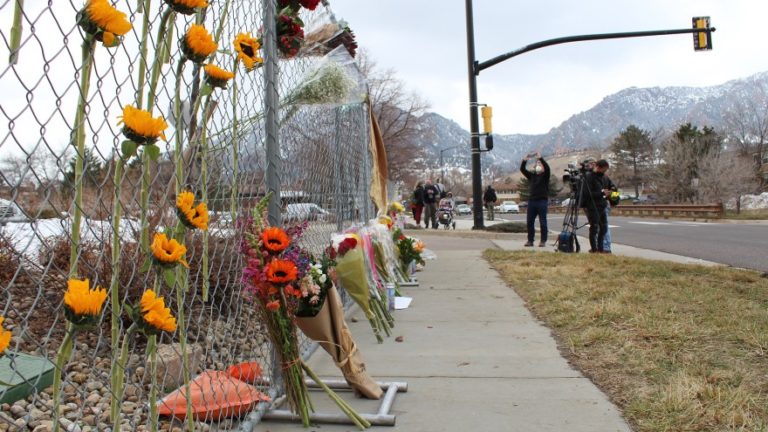
The grocery store at the center of a shooting that left 10 people dead in Boulder remains closed. More than a month later, a memorial around the perimeter of the site still attracts mourners who leave behind flowers and heartfelt notes. What lies ahead for that building is very much an open question. But there is a playbook, of sorts, for communities finding a way to move forward with physical infrastructure that has become synonymous with mass tragedy.
A handful of people have a very good idea about what the road ahead might look like for Boulder in the wake of the shooting. It didn’t take long for community leaders from Aurora, Colorado, Parkland, Florida, Newtown, Connecticut and other cities that have gone through similar ordeals to reach out to Boulder officials. They offered condolences and support.
Frank DeAngelis was among them. The retired Columbine High School principal said he has devoted himself to helping these communities cope with loss and the prospect of recovery, describing it as “a club in which no one wants to be a member.”
DeAngelis has a very specialized type of wisdom to share with communities emerging from the shadow of a mass shooting.
“It’s not that I’m an expert,” he said, “but when I called and responded saying, ‘I know what you’re going through,’ I really did. I just hope that I can share some of the things that we learned, from Columbine.”
One of the questions that needs to be addressed is what to do with the physical space where the event took place. So far, the Kroger Company, King Soopers’ parent company, has not released their plans for the building. But DeAngelis said that if they do decide to reopen, the company will have to answer the important question of how to do so thoughtfully, taking into account the health, safety and comfort of the employees who work there as well as that of the surrounding community.
How to do so is a deceptively complicated question, according to Ken Foote, a University of Connecticut geographer who studies sites of trauma and says that horrific events can fundamentally interfere with our attachment to a particular place.
“Maybe it erases (attachment) altogether or modifies it so that people develop … a sense of foreboding or fear or a sense of haunting,” he said.
Foote has a framework for thinking about what happens to sites like these. Some become sanctified – almost sacred – and they can’t return to normal use.
This idea is familiar to DeAngelis. In 1999, during his tenure as principal of Columbine High School, 12 students and a teacher were killed by two gunmen. Several were in the library, which was directly above the cafeteria. In the aftermath of the shooting, there was consensus in the community.
“We knew we could not go back in the library,” DeAngelis said. “We felt that was really hallowed ground.”
At the same time, community members took a lot of pride in the school. They did not want to start over with a new building. So, they devised a creative solution that honored the victims and satisfied that need to sanctify the space. The floor of the library was removed, opening the cafeteria into a double-height space with an atrium.
At the other end of Foote’s spectrum, however, some communities need to demolish these buildings. “I call it obliteration,” Foote said, “where people find the events so shocking and shameful that they try and scour the landscape.”
That’s what happened at Sandy Hook Elementary school, in Newtown Connecticut. A shooting there left 26 dead, including several young children. Michel Gay lost her daughter at Sandy Hook Elementary, and she later co-founded a crisis prevention and recovery nonprofit called Safe and Sound Schools. Gay said that her community ultimately landed on completely demolishing the school building.
“Those decisions are very heavy decisions to make,” she said, noting that practical considerations, like the age of the school building, contributed to that decision.
But Foote also says that some places simply need to be marked – he calls it a designation, which he describes as “a sign indicating that something important happened here.” That acknowledgment can be enough to bring life back to a particular site.
Based on his research, Foote says designation is the most likely outcome for the Boulder King Soopers. But, he warned that whatever shape that designation takes, it has to be thoughtful.
“You have this this stigma and there’s trauma attached to place and it can be very strong,” he said. “It can be so strong that that no amount of changing the physical setting or whatever is necessarily going to release that trauma.” But a process that is sensitive to processes of grief and trauma can help.
Adam Rayes
Flowers left at a memorial outside the King Soopers in Boulder where 10 people died in a mass shooting in March.
Safety and security
John McDonald is director of security for Jeffco Public Schools, which includes Columbine. He was not in that role in 1999, but has been responsible for school safety in the extended aftermath. More than 20 years later, Columbine High School still attracts hundreds – or even thousands – of unwanted visitors a year. These so-called “dark tourists” are fascinated by the school’s tragedy.
“We’ve seen an increase in the number of people that want come experience and feel it, touch it,” he said. “They’re inspired by the stories of the victims and unfortunately, sometimes inspired by the killers.”
With all of the notoriety a mass shooting can bring, McDonald said that a safety and security plan is one of the most important considerations for reopening. “Safety and security … has to look different than what it was on the day that you had a tragedy,” he said. “You have to pay attention to what’s being said on social media. You have to respond to threats much more aggressively.”
But McDonald warns that the tools to ensure physical safety are costly. He said ongoing enhanced security for Columbine High School was significantly higher than any other school in the district. And he said some of that security comes at the cost of emotional safety.
“You’re always managing a welcoming environment with this fortress building mentality,” he said. “People are going to want to feel safe again.”
Reacting to the space
Melissa Reeves is a psychologist, author and national expert on prevention and recovery from mass trauma, who warns that some people respond poorly to spaces that reopen after a mass atrocity.
“Trauma triggers are real,” she said. “If a space is kept the same and someone does have a very negative connotation of that space, when they see it, it reminds them of that day and they could actually have some flashbacks.”
Reeves says it would be a good idea to remodel the supermarket before allowing the public back in. That could help people prone to trauma responses.
“They don’t want that reminder of what that day exactly was like,” she said. “Usually communities reconfigure the space somewhat in order for it to not serve as a trauma trigger for certain individuals.”
According to Ken Foote’s framework, marking the site with some sort of memorial can be important for recovery. But at the same time, experts warn that victim memorials can also unearth trauma.
Frank DeAngelis recalled having very mixed feelings about the makeshift memorials – the flowers and teddy bears – that popped up outside of Columbine High School in the weeks following the shooting there. “The generosity was outstanding,” he said, “but it would trigger emotion because it would bring back the sadness of the event.”
At Columbine, that issue was addressed by locating a permanent memorial to the victims at a park across from the school. DeAngelis thinks King Soopers should take a similar approach.
“As employees, when you walk in every day, if you see flowers and you see posters and things of that nature, what does that do for the people that have to report to work every day?” he said. “It’s a constant reminder of that day.”
Leigh Paterson
Photos of the memorial at Columbine High School.
A custom fit
Every community has different strengths and weaknesses and different values, all of which can affect what shape recovery takes. According to Michele Gay, the Sandy Hook Elementary School mother and safety and recovery expert, there is no one right way to move forward.
“The best practices are going to come from the community itself because no two communities are the same,” she said, “and no two journeys forward are the same.”
The first step towards recovery is tending to a community’s mental health. “In the wake of a tragedy the focus really needs to be on supporting those who are hurting,” Gay said. “It’s just mission critical. You can’t do anything until you can find your feet and breath.” She said it’s key to take care of immediate and basic needs.
Then the community can think about the future – and the future is always a custom fit. The process of finding that fit involves conversations and community input. Gay hopes to see King Soopers engage with the community – speak to the survivors, the families of those who didn’t survive, the store employees and the people who used to shop there every day.
Psychologist Melissa Reeves says this process of dialogue and input-gathering can be more important than the eventual outcome for a site. “What’s important is that whatever decision is made about what to do with that space, that business took time to dialog with those community members that use it the most and seek input to make an informed decision,” she said.
Rushing the process of community dialogue can be counterproductive. Foote says that it can take years – or sometimes even centuries – for a community to fully contextualize a mass casualty event like this.
“Those processes are never fixed and they never stop that sites can change in meeting through time,” he said.
It was years before the permanent memorial for the Columbine victims was built. In Newtown Connecticut, voters approved a permanent memorial to the Sandy Hood Elementary School victims just last week. And this week, in Pittsburgh, the Tree of Life Synagogue – the site of a 2018 shooting where 11 people were killed – revealed preliminary plans for that building.
“It is important to not rush these decisions, to try to to put up a memorial immediately,” Gay said. “Sometimes the public wonders how come you don’t have your memorial constructed already? And the honest answer is that it just takes time to do it right.”
A spokeswoman for King Soopers told KUNC that the company is focused on healing and has no timeline for making a decision about what to do with the store. City leaders have no say in the matter, because it’s private property. But they say they will support King Soopers as they make plans for the future.
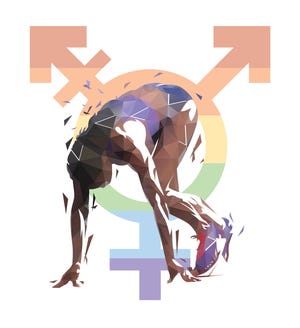
Editor’s note: This is the second in a series of guest columns by Dana Rasmussen meant to advance understanding of transgender people and the issues confronting them in Pennsylvania. Rasmussen (She/Her/Hers) is a member of the TransFamily of NWPA Board of Directors. This column addresses trans feminine sports participation.
Does enough of an issue exist with transgender girls/women participation in sports to warrant a law governing trans lives and hindering their social development? Let’s discuss three common questions on the topic:
1. Do trans girls/women have an unfair physical advantage in sports?
Before we begin: Can you name a trans girl or woman athlete through college age who has dominated her sport after coming out or beginning her transition?
The effects of Hormone Replacement Therapy (HRT) and puberty blockers replace or reduce testosterone production in trans females to levels similar to that of cisgender females. Without higher levels of testosterone, our strength diminishes rather quickly. It diminishes so much that the International Olympic Committee allowed trans athletes to compete starting in 2004.
Can you name a trans girl or woman who has dominated her sport in the Olympics since 2004?
The National Collegiate Athletic Association (NCAA) trans guidelines stated this in 2011: “Transgender women display a great deal of physical variation, just as there is a great deal of natural variation in physical size and ability among non-transgender women and men. Many people may have a stereotype that all transgender women are unusually tall and have large bones and muscles. But that is not true. A male-to-female transgender woman may be small and slight, even if she is not on hormone blockers or taking estrogen. It is important not to overgeneralize. The assumption that all male-bodied people are taller, stronger, and more highly skilled in a sport than all female-bodied people is not accurate.”
Can you name a trans girl or woman who has dominated her sport during her NCAA eligibility?
The Pennsylvania Interscholastic Athletic Association (PIAA) makes these statements in their policies and procedures guide: “(PIAA) is committed to the principles of equal opportunity and treatment for all individuals involved in interscholastic athletics. PIAA believes that all boys and girls, coaches, contest officials, and athletic administrators should have equal opportunity to participate in, coach, officiate, and administer at all levels of interscholastic athletics and receive equal treatment, without regard to race, color, religion, gender, age, national origin, or ethnic background.”
“Where a student’s gender is questioned or uncertain, the decision of the principal as to the student’s gender will be accepted by PIAA.”
The 2017 report titled “Age of Individuals who Identify as Transgender in the United States” from the Williams Institute at the UCLA School of Law, estimates there are 5,250 trans Pennsylvanians aged 13 to 17. Assuming roughly two-thirds of these are trans girls, that gives us 3,465 trans girls. The Pennsylvania Department of Education lists 394,438 girls enrolled in 2016-17. The website statista.com indicates 38% (150,250) participated in sports. Applying this percentage to the number of trans girls, we arrive at 1,316 or 0.01% of Pennsylvania’s 12.79 million 2017 population.
Can you name any of these 1,316 Pennsylvania trans girls who have dominated her sport since 2017?
2. Will trans females sexually assault other girls and women in the locker room or bathroom?
Trans girls and women are generally incapable of the male functions needed to perpetrate these acts. Hormone replacement therapy and puberty blockers bring testosterone to an extremely low level, affecting libido and capability of sexual function. Without the capability to have a typical male sexual function, the likelihood of a trans girl or woman being capable of such an attack becomes minimal.
Trans girls and women are often affected by gender dysphoria to the point that the concept of taking a typical man’s role for a sexual encounter is so extremely uncomfortable that we would remove ourselves from the situation as quickly as possible.
3. Are women’s sports threatened by trans girls/women’s participation?
On March 31, 2021 (coincidentally the 12th annual Transgender Day of Visibility), Outsports.com reported on a letter penned by the Gay & Lesbian Alliance Against Defamation (GLAAD). “More than 465 superstars and everyday feminists added their names to the letter objecting to the targeting of trans women and girls.” Among those who signed were United States Women’s National Soccer Team members: Megan Rapinoe, Ali Krieger and Ashlyn Harris.
One of the strongest statements in the letter read, “We all must fight against the unnecessary and unethical barriers placed on trans women and girls by lawmakers and those who co-opt the feminist label in the name of division and hatred. Our feminism must be unapologetically expansive so that we can leave the door open for future generations.”
Trans girls/women are girls/women. Medical and mental health professionals have stated this. University researchers have stated this. Sports organizations have stated this. Should we not listen to the experts?
Dana Rasmussen (She/Her/Hers) is a member of the TransFamily of NWPA Board of Directors.
Alan Davidson, a longtime Houston resident, author, teacher, and internationally known specialist in the area of mind/body wellness, died unexpectedly on Easter Day, at age 62. Davidson is survived by his husband of 19 years, Jim Giulian, several family members, and a worldwide cadre of individuals from his numerous endeavors in entertainment, massage, wellness and, most recently, strategic online marketing.
Davidson was born in the small ranching community of Refugio, Texas, on December 31, 1958. “Alan’s father was in the Navy, so the family moved several times,” Giulian remembers. “Alan lived there until age 16, left home, and eventually moved to Houston.”
Davidson lived on his own throughout the ’70s, working and eventually graduating from the University of Houston with a degree in psychology. Early in his life, he received support from many in the gay community, and in the early ’80s became “Bartender to the Fabulous” by working at the Montrose Mining Company and then, most famously, at Rich’s disco. While there, the notoriously charismatic Davidson began to develop a following.
One of Davidson’s close friends, Gary Archer, remembers those early days. “Alan and I met in 1983 while we were working to open Rich’s. I was a member of the technical staff and Alan had been recruited to manage the bar.”
From 1983 to 1986, Rich’s was a cornerstone of Houston’s gay nightlife. “The club and its ‘family’ of employees were important to our patrons,” Archer recalls. “By today’s standards this may seem odd, but at that time, a club-centered social life was the norm in the LGBT community.”
Like many of Davidson’s friends, Archer remembers their first meeting vividly. “In walks this big man with a big personality.” Davidson had been hired to recruit patrons to populate Rich’s then-iconic upstairs bar, and to make the space his own. It quickly became the off-the-dance-floor destination for everyone who visited the disco.
Alan Davidson and Jim Giulian
“Alan was so warm and welcoming, he just took people in,” Archer says. “If you didn’t know who Alan was when you walked in, within a matter of seconds you wanted to.”
Davidson’s outsized persona enabled people to experience that warehouse-sized space and still have a connection to someone on a personal level.
Teacher and mentor Helen Terry met Davidson around that same time. “Alan was part of a very small nucleus I call family,” she remembers. “We met at the old downtown YMCA where I had started to teach. Alan took the Saturday-morning class that was offered just before mine, which he described as being filled with ‘all those badass people.’ He would hang around, wondering what we were doing [in my Nia sensory-based movement and healing class] and what music we were listening to. He eventually grew interested enough to take classes with me, and that’s how we began to know each other.”
Terry and Davidson quickly realized their potential for creative synergy. “We would be in a conversation, something would ‘spark,’ and we’d just riff off of it,” Terry recalls. “Alan would come up with these off-the-wall ideas, stretching the boundaries of what had been done previously. Suddenly we were both creating something interesting out of nothing.
“One of the first things Alan and I did was rent out Rich’s and offer a chakra-centered meditation training utilizing the club’s lighting and disco balls,” Terry explains. It was the first of many unique joint endeavors.
“Alan was magnetic in his ability to attract people. His friends were simultaneously eclectic and connected. He also had very long ‘coattails,’ having stayed in contact with everyone from his various careers. He drew allof them to every new venture he created. If Alan Davidson was going to do something, people knew that it was worth showing up for.”
As Davidson transitioned professionally away from the club scene, Terry and her studio became an anchor in his life. He continued to meet others in the wellness community and develop a collective of friends and associates. Eventually, he taught and hosted events on his own at her studio.
Both the Montrose Counseling Center and Body Positive Wellness Center provided Davidson with his entrée into professional wellness leadership. While at the Counseling Center, he helped with their crisis hotline and, at Body Positive, began to work with HIV-positive individuals.
Archer remembers the parallels between Davidson’s contrasting careers: “Your hairstylist, bartender, and massage therapist are all ‘listeners,’ performing essentially the same function at different venues. Alan was a trusted counselor to me and many others, always providing advice, friendship, and unconditional love.”
A watershed moment in Davidson’s life occurred in the midst of the AIDS epidemic, when he received a negative HIV test. Taking this as a prompt from the universe to transform, he altered his life’s trajectory away from the entertainment industry and toward the field of wellness.
According to his husband, “Alan became a licensed massage therapist who was interested in mind/body work—an area where his impact and expertise is still internationally recognized. He eventually became an award-winning author who penned books, short pieces, and essays—some of which were published in OutSmart magazine.”
Giulian recounts their early days together: “When we met 19 years ago, I was widowed after 25 years of marriage. I had retired from the Navy and had a teenage daughter. I often traveled between Corpus Christi and Houston for work. A friend of mine in Houston invited me to dinner, and suggested we meet at his gym. He neglected to tell me it was a gay gym full of men. I had been the senior enlisted naval officer on five different submarines, so seeing naked men was no big deal.
“Alan was there, and we struck up a conversation and went to dinner. I enjoyed his company and experienced happiness [with Alan] for the first time since my wife’s sudden death.”
Their courtship lasted two years. “I had a young daughter still at home [to consider]. She got married, and at that point I knew that Alan and I could be together. I moved to Houston in 2004.”
In stark contrast to Davidson, Giulian is pragmatic and introverted. “At first, it was a bit overwhelming being with him,” he recalls. “However, our core values—those things we wanted to do as a couple—coincided. Alan introduced me to an entirely different way of life, and a new group of people.
“Even though we shared everything, our professional lives were completely different. Alan was heavily involved in mind/body work—his domain at that time. Our professional lives were completely different. During our partnership, he had the freedom to expand his knowledge and finish the book that he had been trying to complete. Body Brilliance: Mastering Your Five Body Intelligences was published in 2010.”
Though their lives were completely enmeshed, the naval officer and the mystic healer didn’t always mesh. Giulian, reportedly a homebody, nonetheless supported Davidson completely. Together, they hosted and entertained numerous personalities from around the country. “I wasn’t part of his ‘woo-woo’ world, [laughs] but all of his friends accepted and tolerated me,” Giulian says.
“Most people assumed that Alan was always outgoing and gregarious. In reality, our life together was much quieter. With me, he didn’t have a persona. He used our domestic calm to recharge.”
The community’s response to the news of Davidson’s death has been profound. Several Zoom tributes have taken place, each with hundreds of friends and colleagues from around the world. A group of his closest collaborators has agreed to finish the second book Alan was working on at the time of his death. “I have a real appreciation of his impact on others, as does Alan’s family,” Giulian notes. “Everyone has supported me wonderfully since his death.”
Mentor Helen Terry sums up Alan’s life: “He was humorous, speaking truth in a lighthearted way. He was a visionary, but entirely without ego. He was generous, but without intent or expectation.”
This article appears in the May 2021 edition of OutSmart magazine.
Few things are better than when a sexy Italian is on your side in a battle for gay rights. And when that sexy Italian is a mega-star, and straight, it captures headlines not just in his native Italy, but around the world.
Such is the case when on May 1st during a live televised concert on Italian state-owned television Rai, rap superstar Fedez began speaking in favor of more rights for Italy’s LGBTQ and denouncing the homophobia of the country’s powerful (Northern) League political party. His prepared remarks were soon cut from the broadcast, which Rai claimed was because they were political in nature.
After subsequently denying they deliberately cut-off Fedez’s remarks, the rapper produced a recording of a prior phone call with a Rai executive who had demanded to read Fedez’s statement in advance. Fedez shared his proof on his Twitter feed, which immediately created a maelstrom in the Italian media and political universe.
A proposed law to enhance protections for gays similar to other countries’ hate crimes laws is currently being considered in the Italian parliament, but is being blocked by the ultra-right wing League party. The spokesman of the country’s LGBTQ political party, Fabrizio Marrazzo, came out in support of Fedez’s remarks and denounced the censorship by the television broadcaster, saying that “the phone call from Rai3 executives to Fedez is disconcerting, the Rai Supervisory Authority intervenes against censorship: civil rights and respect for LGBT people are never ”inappropriate “.”
Each year there are hundreds of hate crime reports reported but rarely get any traction with criminal prosecution. Most recently, an attack in February against a gay couple who kissed at a metro station in Rome generated outrage and raised the urgency for the approval of the law. In April, Fedez and other celebrities contributed to a fundraising initiative for a 22-year-old woman who was thrown out of her home after telling her parents she was in a relationship with another woman.
The proposed bill, drafted by Alessandro Zan, a gay politician with the Democratic party, would make violence and hate speech against LGBTQ+ and disabled people, as well a misogyny, a crime, with jail terms of up to 18 months and fines of up to €6,000 ($7,200).
Fedez is married to an influencer and together they have two young children.
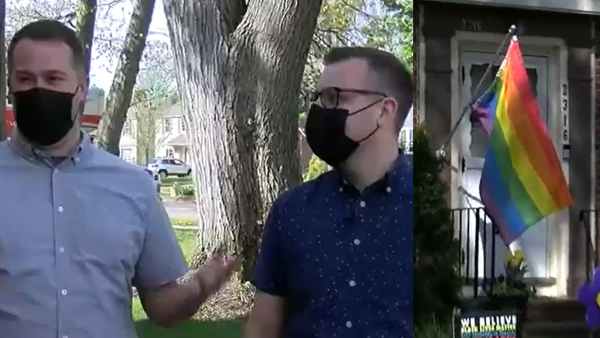
Charlie Olivo (right) and husband Tommy — Photo: 19 News
A gay couple was left distraught last week after discovering that their LGBTQ Pride flag, which hangs outside their home in University Heights, Ohio, had been stolen.
“I came home from work and noticed that the Pride flag was missing,” Charlie Olivo told 19 News.
Olivo and husband Tommy suspected they had been the victims of an anti-LGBTQ incident similar to others across country, where properties with Pride flags have been targeted and had their flags defaced or stolen.
The couple immediately mobilized their neighborhood to find the ne’er-do-well, posting on Facebook and asking if anyone had security footage of the theft.
While no suspect could be found, the couple received overwhelming support from their neighbors, including Joe Hochheiser, who offered to not only replace the couple’s flag, but also buy 10 more for neighbors to fly and show their support.
“We kind of live in this time where there’s a lot of negativity,” Hochheiser told 19 News. “I thought, how can we spread a little bit of joy, how can we spread a little bit of light?”
However, the mystery of the stolen flag was solved just days later by the couple’s dog, Daisy, who they noticed “barking out the window…directly at the tree.”
Olivo opened the blinds, looked out the window “and saw this little red and orange stripe. I said ‘Oh my gosh, I think that’s our Pride flag.’”
Then, the flag thief finally made an appearance: “I looked and saw a big, fat raccoon walking up the limb, back and forth.”
Olivo and his husband realized that the racoon had pinched their flag in order to make (an LGBTQ-affirming) nest in their tree.
The couple were “shocked,” Olivo said, with his husband Tommy calling it “so funny, because it had taken off on the Facebook page so much, with the community.”
Hochheiser noted that, in addition to the 11 flags he purchased, their neighborhood now has 12 LGBTQ Pride flags on display, given “the raccoon has one as well.”
“It was very heartwarming but a good ending,” Olivo said.
An unlikely bandit takes a couple’s Pride🌈 flag from their University Heights home in broad daylight.
These are challenging times for news organizations. And yet it’s crucial we stay active and provide vital resources and information to both our local readers and the world. So won’t you please take a moment and consider supporting Metro Weekly with a membership? For as little as $5 a month, you can help ensure Metro Weekly magazine and MetroWeekly.com remain free, viable resources as we provide the best, most diverse, culturally-resonant LGBTQ coverage in both the D.C. region and around the world. Memberships come with exclusive perks and discounts, your own personal digital delivery of each week’s magazine (and an archive), access to our Member’s Lounge when it launches this fall, and exclusive members-only items like Metro Weekly Membership Mugs and Tote Bags! Check out all our membership levels here and please join us today!
Published on May 4 2021 10:53 am Last Updated on May 4 2021 10:54 am
May is Foster Parent Appreciation Month in Illinois, a time to thank the thousands of foster families across the state who are providing temporary safe havens to youth and urge other residents to become licensed foster families.
Youth are placed in the temporary care of the Illinois Department of Children and Family Services (DCFS) by local courts when it is determined that their families cannot safely care for them. DCFS works with the family to make the positive changes necessary to reunite with their children while foster families step up and provide homes where the children are protected, nurtured and loved. Today, there are just over 21,000 youth living in foster care in the state: 8,200 are living with foster families, 11,300 with relatives and 1,200 in group homes and institutions.
“By opening their hearts and homes, foster parents give vulnerable children the stability and connections to community, friends and family members they need to thrive,” said Illinois DCFS Acting Director Marc D. Smith. “They are an invaluable part of the child welfare team; and we could not do the work of keeping children safe without them.”
Currently, foster homes are needed for sibling groups, adolescents, African American and Latino youth, children with special medical needs, teenage mothers and their babies and LGBTQI (lesbian, gay, bisexual, transgender, questioning, intersex) youth. To learn more about some of the youth in need of a foster family, visit the Heart Gallery of Illinois at https://greenlightfamilyservices.org/heartgalleryofil/.
Making the decision to become a foster parent is a serious commitment to a child who needs stability and love. DCFS and a network of private agency partners offer a range of supports to foster families, including a monthly stipend for the child’s basic needs, such as food, clothing and housing costs; a medical card; therapeutic, educational, recreational and crisis support services; and access to caseworkers, training programs and support groups to meet the child’s and family’s needs.
Foster families also become part of a team, working with DCFS and private agencies, birth families, counselors, physicians and the courts to reunite children with their families whenever possible.
The licensing process to become a foster parent can take up to six months. Prospective foster families are required to:
• Participate in a social assessment and home inspection; • Complete a training on foster care and the needs of children who are in foster care; • Complete a criminal background check of all household members; • Be financially stable; and • Complete a health screening.
Foster parents must be at least 21 years old and can be married, in a civil union, single, divorced or separated. They can work full- or part-time, go to school or be a stay at home parent; and rent or own their own home.
There are many types of foster care, including traditional care, emergency/shelter care, medical/therapeutic care, relative/kinship care, respite/short-term care and tribal care.
Organizations wishing to schedule a virtual or in-person presentation to learn about waiting children, how to become licensed and the adoption process may contact the DCFS Communications Office at 312-814-6847.
On Sunday, May 2, 2021, Gay Lefebvre, 82, loving wife and mother passed away in Southport, NC. She was born November 15, 1938, in Middletown, CT to Ruth and Carl Byloff. Gay graduated from East Hampton High School, East Hampton CT, where she met her beloved husband of 60 years, Richard H. Lefebvre and they raised two daughters in Johnstown, NY.
Gay was a gifted artist and teacher. With two young children at home, she returned to school and graduated with high honors from Skidmore College, Saratoga Springs, NY in 1976. With over 30 years as an educator, Gay spent most of her career as a secondary level art teacher and chair of the art department for the Fonda-Fultonville Central School District. She loved teaching and impacting the lives of young people. She was known for her listening ear, her fiery spirit and her straight talk with her students. She was a tenacious champion for those who needed her most. After retirement, Gay continued her career as a professional wildlife artist and her art was shown and sold in many esteemed galleries on the East coast. Her spirit will live on through the lives of the students that she touched, and her incredible artwork that is held in numerous private collections throughout the country.
Gay was a member of several art guilds, supported the community of artists in and around her home in Southport, NC and enjoyed her summers in York Beach, ME. She was an avid reader, an ardent traveler, a skilled gardener and always interested in political and current events at the local and national levels.
Preceded in death by her mother, Ruth Byloff, her father. Carl Byloff and her sister, Carol Dulaney, Gay is survived by her loving husband, Richard; daughters, Kim and Ann (Mika); and her grandchildren, Wesley, Dana and Nathan; as well as additional extended family and lifelong friends.
For those who wish to do so, memorial contributions may be made to SECU Hospice House of Brunswick, 955 Mercy Lane, Bolivia, NC 28422 or the Adirondack Center for Loon Conservation, P.O. Box 195, Ray Brook, NY 12977.
Online condolences may be made at www.peacocknewnamwhite.com.
Peacock — Newnam & White Funeral and Cremation Service, Southport, North Carolina.
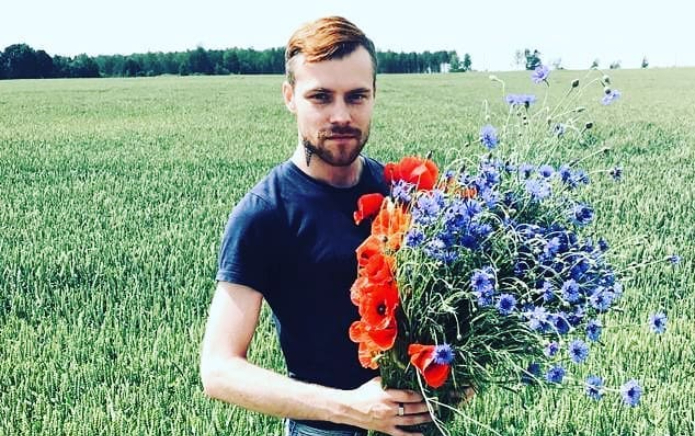
A gay paramedic has been killed after being doused in petrol and set on fire.
On 23 April, 29-year-old medical assistant Normunds Kindzulis was targeted at his home in Tukums, Latvia, in what authorities are widely referring to as a homophobic attack.
Normunds was treated for burns to 85% of his body in Latvia’s capital of Riga. However, his burns were too severe and he died from his injures five days later (28 April).
His co-worker and roommate Artis Jaunklavins, who is also gay, was hospitalised after rushing to Normunds’ aid. He told Delfi: “I woke up from screams in the corridor. Normunds was flaming like a torch.
“I tried to put out the flames, I carried him in and put him in the bath but the burns were too severe, his clothing had fried into his skin.”
The burned entrance to their home has now been covered with rainbow posters and Pride flags as an act of solidarity.
Although Normunds was set on fire, police claimed there was “no full evidence that a crime took place” and failed to launch a formal investigation. Now that he has passed away, police are required by law to open a criminal investigation.
Normunds previously relocated to Tukums from Riga to escape homophobic death threats. The anti-gay violence continued in Tukums as he was physically attacked at least four times because of his sexuality.
The attacks were not investigated by police, which reportedly contributed to Normunds’ mental health issues and suicidal thoughts.
Artis also told Tukums Independent News that he and Normunds reported threats from their neighbours on numerous occasions, “but there was no reaction”. He said: “We had to wait for someone to be mutilated or killed.”
Andrejs Grishins, Deputy Chief of Latvia’s criminal police, told reporters that “driving someone to the verge of suicide is also a crime.”
Normunds’ murder has prompted a national debate around homophobia in Latvia, which is widely known as one of the worst countries in the EU to be gay. LGBTQ+ activists from around the world mourned his death on social media.
President Egils Levits also condemned the attack, tweeting that “there is no place for hate in Latvia” because the “value of Latvian society is tolerance”.
Normunds Kindzulis, a victim of the homophobic arson attack in Latvia last week, has succumbed to his injuries. Our deepest condolences to his partner and family, and to all our community in Latvia. 🖤 pic.twitter.com/IM90oTk80E
This is Normunds Kindzulis, last week he was the victim of a cruel homophobic arson attack at his home in Latvia with his partner. They recently moved due to death threats but the abuse continued. He died a few days later, he was only 29. Hate like this has no place in this world pic.twitter.com/HeQRyn0WSt
No passado dia 23, Normunds Kindzulis foi queimado à porta de casa por ser gay. 85% do seu corpo ficou queimado e morreu na consequência dos ferimentos. Tinha 29 anos, era paramédico e isto aconteceu na Letónia, um país que faz parte da União Europeia. pic.twitter.com/0TEdUgF69p
— Comunidade Cultura e Arte (@comculturaearte) May 1, 2021
Hommage et pensées pour Normunds Kindzulis.
Il avait 29 ans et vivait en Lettonie.
Il était homosexuel.
Il est mort brûlé vif par ses vêtements arrosés d’essence.
Il avait reçu des menaces et avait été attaqué physiquement plusieurs fois.
Año 2021. Ha fallecido Normunds Kindzulis tras ser quemado vivo el pasado 23 de abril en su casa en Tukum, Letonia 🇱🇻. Los homosexuales son atacados por el mero hecho de serlos. Ni un paso atrás en los derechos humanos #StopHomofobia Descanse en paz. pic.twitter.com/SC1w8wS5qD
Normunds Kindzulis, activista LGTB en Letonia, ha sido asesinado, le han quemado en su propia casa. La homofobia sigue campando a sus anchas por el mundo. Nuestras condolencias a su familia y nuestro compromiso de que su memoria seguirá viva en nuestro activismo. Descansa en Paz. pic.twitter.com/znoJ37fxpO
Se llamaba Normunds Kindzulis. Tenía 29 años. Y ha sido asesinado, quemado en su propia casa, en un ataque homofóbico en Letonia. Ante hechos tan terribles, activismo y visibilidad. Siempre. Hasta que este horror deje de suceder 💔 pic.twitter.com/288REMucYW
Naidam Latvijā nav vietas. Ja apstiprināsies, ka Tukuma noziedznieka motivācija ir bijusi naids pret kādu sabiedrības daļu, tad tas pastiprina viņa vainu. Latvijas sabiedrības vērtība ir iecietība, un šāda naida izpausme vienlaikus ir noziegums pret sabiedrību.
There is a packed agenda for tonight’s monthly meeting of Belfast City Council (BCC), with a total of six motions to be debated by members and a further four motions to be tabled.
irst up we have a motion calling for equality for the LGBTQ community and the endorsement of the Government’s LGBTQ strategy.
Next up is motion highlighting the need to tackle waiting lists for diagnosing autism in children. If successful, the council will right to the Health Minister Robin Swann to take “all steps necessary” to address the problem.
Councillors will also be discussing charges for the use of ATMs, with a view to writing to the Financial Conduct Authority urging the body to cap the number of cash machines that charge for withdrawing cash.
People Before Profit councillors have tabled a motion regarding services at the Mater Hospital that were halted due to the pandemic. If successful, BCC will seek a cross-party meeting with Cathy Jack, the chief executive of the Belfast Trust, and a representative from the Department of Health, to discuss plans for the future of the hospital, post-Covid.
Following on from a similar motion which passed in the Assembly last month, councillors will debate supporting a ban on conversion therapy.
The final topic to be debated is the current pay rise dispute for public sector workers. If members vote in favour, BCC will write to Finance Minister Conor Murphy, urging him to “go back to the negotiating table” with unions to secure a better deal than the 1% non-consolidated salary increase previously offered.
Four other motions will be tabled and referred back to committee for further debate. These include installing a statue of anti-slavery campaigner Mary Ann McCraken, the extension of the Belfast Bikes scheme, and the recent violence and disorder in the city.
Follow all the latest updates in our live blog below: