Home Blog Page 305

Asian Mental Health: It’s Time We Talked About It – HuffPost

Asian Americans Out Loud is a project highlighting Asian Americans who are leading the way forward in art and activism. You can read more by visiting our APAHM 2021 homepage.

Hoiyan Isabel Pang has had a difficult, yearslong journey finding a mental health professional who understood all of her intersections: She is a bisexual woman, Asian American immigrant and survivor of childhood sexual abuse.

Pang saw a range of therapists and counselors, all of whom were white, before making the decision to work only with therapists of color. That move has helped her to feel more open and understood.

“I needed someone who could have balance and empathize with the act of walking through this world with multiple identities,” Pang, a 27-year-old social worker from Florida, said in an email.

HuffPost heard from more than half a dozen Asian Americans who connected via the Subtle Asian Mental Health (SAMH) Facebook group, a fast-growing online community with close to 60,000 members. The group is managed by the Asian Mental Health Collective (AMHC), a nonprofit with a mission to build community, raise awareness, provide resources and challenge stigmas around mental health for Asian Americans.

“I think there are a lot of people who are itching to have these conversations and they just haven’t found a community in which they can have them,” said Kaila Tang, an Atlanta-based psychotherapist and chief program officer at AMHC.

The organization has mushroomed from a small Facebook group to a far-reaching mental health resource inventory for Asian Americans in just three years. It created a directory of Asian, Pacific Islander and South Asian American therapists, and it organizes roundtables and panels to raise awareness and kick-start conversations on mental health in the AAPI community. The group offers a space for current and prospective mental health professionals of Asian background to connect and educate one another. It elevates the mental health journeys and experiences of Asian Americans and Pacific Islanders; amplifies AAPI leaders, artists and experts; facilitates peer listening and Q&As with therapists; and provides a safe space for its members to share and relate on experiences and challenges that have influenced their well-being.

Discussions in SAMH are wide-ranging but can often revolve around topics such as overcoming toxic parenting, stigmas about mental health, imposter syndrome, and racist microaggressions in life and at work. There are graphics reminding people to be kind to themselves, Asian mental health memes aplenty and a resounding chorus of people asking one another, “Does anybody else feel this way?”

Lillian Nguyen, a 27-year-old psychiatric nurse, said that while growing up Vietnamese in a predominantly white community in Pennsylvania, she struggled to find connection. Since joining SAMH and reading what others share there, she has developed a better understanding of how her parents and her upbringing affected her mental health. It confirmed for her that she wasn’t alone, she said. Since then, she’s joined the group as a volunteer and found her first Asian therapist through the group’s directory.

Conversations about Asian mental health have become more urgent following a troubling surge in anti-Asian discrimination and hate crimes brought on by the pandemic, in particular the horrific fatal shooting of six Asian women in Atlanta-area spas in March.

These events certainly exacerbated the anxiety and distress felt by the AAPI community.

But the issues are nothing new. Organizations have been fighting for years to cultivate awareness about Asian mental health and to dismantle the damaging myth of the “model minority” ― a broad stereotype casting all Asian Americans as hardworking, smart and likely to achieve socioeconomic success.


Lillian Nguyen has been in and out of therapy for 10 years and has been diagnosed with depression, anxiety, PTSD and anorexia. She’s recently started working with an Asian therapist. This has allowed her to speak about her family relationships without having to give context on why her parents do the things they do, she said.

Lillian Nguyen

What’s different about Asian mental health?

Difficulties adjusting to and balancing cultural differences, stigma, internalized racism, intergenerational trauma, identity struggles and societal pressures to succeed are just a few of the challenges AAPI individuals face that can influence mental health.

Bernie Wong, manager of research and design at Mind Share Partners, a nonprofit seeking to change the culture of workplace mental health, noted that along with the complex and intergenerational mental health challenges imposed by immigration, this community faces elements including income inequality and joblessness, anti-Asian discrimination and violence, and the erasure of all of these challenges under the guise of the model minority.

Due to a number of cultural and structural barriers, research has found Asian Americans to be the least likely of any racial group to seek mental health care. In addition to factors like stigma, lack of access to health care, limited data and research on AAPI people, and language barriers, that statistic is also linked to the limited number of AAPI therapists.

The psychology and therapy workforces in the U.S. are overwhelmingly white. Asians make up less than 5% of psychologists in the U.S. and just over 10% of therapists. It can be particularly difficult in some parts of the country to connect with an AAPI mental health professional.

Jeanie Chang, a licensed therapist and AMHC president and board chair, said that in a white-dominated field, creating directories of therapists of color is relatively new.

“It encourages the AAPI population to seek treatment when already they’re the least likely to go. So just knowing that a fellow Asian possibly could be in their state or in their city can help start that conversation to get help,” she said.

Based on a better understanding of the client’s culture, an Asian therapist might also be able to offer more nuanced guidance and treatment.

HuffPost spoke with a number of individuals who said that therapists without experiences as people of color were unable to grasp their struggles as Asian Americans. Some others said they’d had positive experiences but understood the need for better representation and training in this field as a whole.

“I realized that I’d experienced cultural insensitivity in two types of ways,” Pang said of her experiences in therapy. “One made culture and race my entire identity, and the other who completely erased it.”

Being a member of another marginalized group often complicates these challenges for Asian Americans.

Wong said his experience managing chronic depression as a gay, Asian American man led him to minimize aspects of his identity for much of his life.

“Homophobia is prevalent within the AAPI community; racism is pervasive within LGTBQ+ circles; and both communities face ongoing social, structural and systemic disenfranchisement,” he said.

Multiple Asian Americans who identify as LGBTQ+ reported significant challenges finding therapists who could appropriately treat them.

Sydney Rae Chin, a third-generation Chinese American who is a queer, polyamorous woman, said she saw three therapists before finding someone she connected with.

“I’ve been lucky to [currently] work with a queer East Asian woman as my therapist who understands all my intersections,” Chin said. “But I know this is rare.”

“Working with her has been one of the most life-changing things for myself; I think being seen in wholeness in all my intersections is affirming.”

AMHC is in the process of revamping and expanding its therapist directory to allow people to run intersectional searches, including for providers who are LGBTQ+ affirming.


Hoiyan Isabel Pang, who grew up in Malaysia and moved to Florida as a teen, said that when therapists generalized about her culture, it made her feel defensive, “and like I had to fight for my heritage, as if they were perceiving that sexual abuse and lack of support from family on trauma is just a defining feature of Asian cultures.”

Provided by Hoiyan Isabel Pang

Where do we begin to address it?

Organizations like AMHC are bringing support directly to the AAPI community. Other advocates are fighting for more systemic change. The Asian American Psychological Association (AAPA), for example, has been working since 1972 to advance AAPI mental health through research, practice, education and policy.

It has members actively researching specific topics in Asian American psychology, including identity issues and microaggressions, to guide training on cultural competence. It’s working to increase representation in mental health care via mentorships, scholarships and development programs for students. It advocates for policies that would close the gap in access to health care.

Chang, who does a range of work on Asian mental health advocacy and awareness, said she has been calling for educational reform across the board.

“First of all, getting racism and model minority and Asian American history into the public school system,” she said. “But I’m really focusing on wanting someday to change college campuses and graduate programs in psychology or social work that barely touch on cultural competence.”

“I just really don’t understand how the training is still so outdated.”

For mental health care professionals, better cultural competence comes from education and addressing internal biases.

“The first step to cultural competence is awareness, for therapists to be aware of their own biases,” said Gloria Wong-Padoongpatt, secretary-historian of AAPA and an assistant professor of psychology at the University of Nevada, Las Vegas.

“When I teach multicultural psychology … I spend the entire semester just working on that first step of building awareness. So building awareness of their own world views.”

Though representation in the field is important, and some individuals may feel more comfortable and understood by an AAPI clinician, all providers should be able to offer some level of culturally appropriate support to patients of all backgrounds.

“We’re talking about systemic change for the future of psychology to shift,” said Chang. “We need to have better education in the psychology program. So white, non-Asian or even Black clinicians know exactly, or actually feel pretty equipped to treat an AAPI individual.”

At a time when Asian Americans are the targets of increased levels of discrimination and violence, it’s important to be aware of the social and political moment, and to call out racism against the community.

“Without naming it and just pretending that it’s not happening is very detrimental for everyone involved,” Wong-Padoongpatt said. “This is a learning moment.”

In her research on the effects of microaggressions on marginalized people, Wong-Padoongpatt found that Asian Americans experience lower self-esteem, resulting in more stress from everyday slights perpetrated by non-Asians. She used examples like, “Where are you really from?” and comments about English-speaking abilities in her experiments ― offhand remarks in daily life that are all too familiar for many Asian Americans and other minorities.

Making communities and workplaces better, safer and more equitable environments for AAPI people takes time, education and investment.

“You are not expected to become experts about the challenges that every community and their intersections face,” Bernie Wong said.

“Take time — regularly — to consider what you are uniquely positioned to do to unravel our long history of disenfranchisement on the premise of gender, identity, culture, community membership and more.”

More APAHM Stories
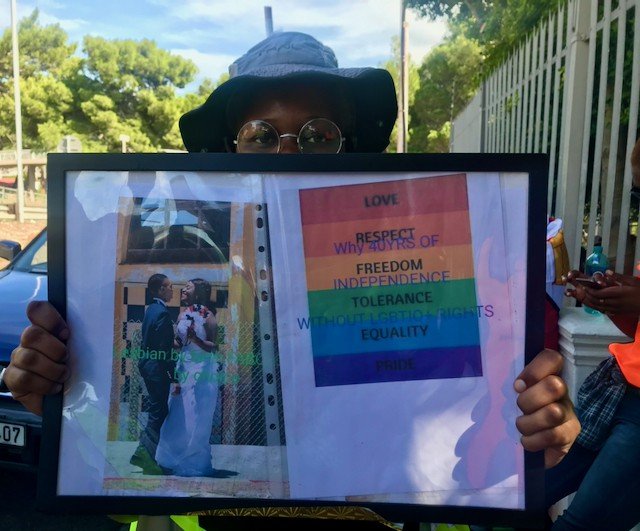
Zim Gay Refugees Denied Asylum In SA – New Zimbabwe.com

Spread This News

GroundUp


A REPORT released recently by several civil society organisations has found evidence that LGBT refugees are being denied asylum in South Africa despite being “eligible for protection under international and domestic law”.

The authors of the report surveyed denial letters for 67 asylum applicants who had applied for asylum on the basis of sexual orientation or gender identity (SOGI).

The letters were written by 32 Refugee Status Determination Officers (RSDOs) in Cape Town, Musina, Gqeberha and Pretoria between 2010 and 2020.

Amy-Leigh Payne, attorney at the Legal Resources Centre (LRC), summarising the report findings, said that the Refugees Act requires South Africa to extend protection to people who have a well-founded fear of SOGI-based persecution.

The report identifies among others the following discriminatory practices by Home Affairs officials: the use of stereotypes about sexual and/or gender minorities to justify denials; displays of bigotry or hostility, evidenced by the use of derogatory language in official documentation; and a high proportion of credibility concerns raised about applicants’ identities rather than their asylum claims.

In one egregious case the RSDO found that a Zambian asylum seeker could not be “a gay” because he claimed he experienced pain when he was raped.

The report found some RSDOs “seem unaware that SOGI-based persecution is accepted grounds for asylum, or that sexual and gender minorities constitute a protected social group under the Refugees Act”.

Asylum claims were therefore denied on the grounds that they were “manifestly unfounded”. One of these was Ethan Chigwada’s application. Originally from Zimbabwe, he applied for asylum in 2018. He came to South Africa in 2014 to visit his boyfriend.

A video of them went viral in Zimbabwe, after which his parents rejected him and the Zimbabwean authorities started to look for him.

The report found that during the interview on the first day of his application the RSDO asked Chigwada what had happened to him before he left the country. He explained that nothing had happened, but that was because he had not identified as openly gay back home. He feared his community would kill him.

The RSDO concluded that his application was made on other grounds than those which can be made in terms of the Refugee Act.

This was factually incorrect says the report. “High levels of social stigma and the presence of anti-LGBTI+ laws are both well documented in Zimbabwe.”

On Thursday, Chigwada told GroundUp that he was given 30 day-notice to appeal in 2018, which he submitted on time.

He lives in Cape Town but since then he had been going to renew his papers every two to six months in Gqeberha, until the Covid-19 lockdown started. (Since the closure of the Cape Town Refugee Reception offices in 2012, refugees can only renew their permits at the offices which issued them.)

He is still waiting to be called for an interview.

“My life is on hold. I applied to Stellenbosch university but they want a valid document. My bank account was once frozen and there is no guarantee that it won’t happen again. Employers don’t give you a job with a document valid for less than three months,” he said.

At the launch of the report, Willson Tarusarira, a PhD student in Public Health at Stellenbosch University, speaking on behalf of refugee organisation PASSOP, said he provides legal advice to gay and lesbian refugees who struggle with documentation.

Unlike many refugees who can turn to their communities of origin for support, gay and lesbian refugees often face discrimination from compatriots.

“Very few LGBTI have received a Section 24 permit, which formally recognises their refugee status,” said Tarusarira.

“Many LGBTI refugees cannot find work … Others cannot find housing or are evicted from their housing without cause, due to landlords who discriminate against them.

They are also denied medical care at state hospitals because of lack of documentation and turned away by police or government agencies when they seek recourse for discrimination or violence against them.”

He said they had received complaints of mistreatment of gay asylum seekers by Home Affairs officials.

The report was compiled by the Legal Resources Centre (LRC), the Women’s Legal Centre (WLC), the African LGBTQI+ Migration research Network (ALMN), and People Against Suffering, Oppression and Poverty (PASSOP).

Despite repeated attempts, we have been unable to get comment from Home Affairs.

Up Next President of Tonga LGBTQ rights group murdered – Washington Blade

The leaders of several local and national AIDS organizations have expressed concern over a decision by D.C. Department of Health Director Dr. LaQuandra Nesbitt to abruptly dismiss Michael Kharfen from his position since 2013 as Senior Deputy Director of the department’s HIV/AIDS, Hepatitis, Sexually Transmitted Disease and Tuberculosis Administration.

Under the leadership of Kharfen, who is gay, the Department of Health entity commonly referred to as HAHSTA has played a lead role in what AIDS advocacy organizations consider to be D.C.’s highly successful efforts in recent years to lower the rate of new HIV infections among city residents.

Alison Reeves, a spokesperson for Nesbitt, declined to give a reason for Kharfen’s termination, saying the DOH does not comment on “personnel matters.” Reeves said DOH official Dr. Anjali Talwalker has been named as interim Senior DOH Deputy Director for HAHSTA while a national search is being conducted for a permanent HAHSTA leader.

People who know Kharfen have said he has declined at this time to publicly comment on his departure from HAHSTA. He could not immediately be reached by the Blade for comment.

“Michael Kharfen’s departure is a real loss to HAHSTA, the D.C. community, and nationally,” said Paul Kawata, executive director of the D.C.-based National Minority AIDS Council. “It is important to remember that when Michael took over HAHSTA there were real challenges and concerns,” Kawata said.

“He transformed the agency and built strong relationships with local organizations and D.C.-based national organizations,” said Kawata. “His reasoned voice and ability to collaborate will be sorely missed.”

At least three sources familiar with HAHSTA, who spoke on condition of not being identified, have said reports have surfaced internally from DOH that director Nesbitt is planning to reorganize several DOH divisions, including HAHSTA.

The sources say people familiar with the reported reorganization expressed alarm that HAHSTA would be dismantled as a separate DOH entity, with AIDS-related programs operated by other DOH divisions.

“Some think she wants to use the funds earmarked for HAHSTA for other things,” said one of the sources. “She could be jeopardizing federal grant money for HIV and hepatitis,” the source said.

The Washington Blade raised questions surrounding Kharfen’s departure with John Falcicchio, the D.C. Deputy Mayor for Planning and Economic Development, who also serves as Mayor Muriel Bowser’s chief of staff, at a press conference on Monday on an unrelated topic. Falcicchio said he would try to arrange for mayoral spokesperson LaToya Foster to respond to the Blade’s questions about a possible DOH reorganization of HAHSTA and the issues surrounding Kharfen’s departure from DOH.

Neither Foster nor another mayoral spokesperson had responded as of late Tuesday.

“Michael Kharfen’s leaving D.C. government is a huge loss to the D.C. community and potentially puts at risk federal grants for HIV, sexually transmitted diseases, and hepatitis,” according to David Harvey, executive director for the D.C.-based National Coalition of STD Directors.

“If his departure is about a consolidation of agencies within DOH, then the community will be the loser,” Harvey said.

“We need HAHSTA to continue,” he said, adding, “The mayor should reverse this decision and reinstate Michael Kharfen.”

Sources familiar with the D.C. government’s personnel polices have said that Kharfen and other high-level officials holding positions such as that of a senior deputy director are considered “at will” employees who serve at the pleasure of the mayor and the agency head for whom they work. They can be removed for any reason or no reason, those familiar with the personnel policy say.

Before becoming the DOH Senior Deputy Director in charge of HAHSTA in 2013, Kharfen served from 2006 to 2013 as HAHSTA’s Bureau Chief for Partnerships, Capacity Building, and Community Outreach. Those who know Kharfen said in that role he is credited with working closely with a wide range of local and national organizations that provide services for people with HIV/AIDS as well as other public health organizations.

Among them is the D.C. Appleseed Center for Law & Justice, which has worked closely with HAHSTA and the DOH to develop, among other things, a plan to significantly curtail new HIV infections in the city by 2020.

Other groups working closely with Kharfen have been the Washington AIDS Partnership, the National Coalition of STD Directors, the Prevention Access Campaign, and the HIV-Hepatitis Policy Institute.

“Under Michael’s leadership, D.C. was instrumental in pioneering many new innovations in preventing and treating HIV that were later adopted by other jurisdictions,” said Carl Schmid, executive director of the D.C.-based HIV-Hepatitis Institute. “And if you look at the results, I think it demonstrates success,” Schmid said.

“I do not know any details of his departure, but I know he will be missed not only in D.C. but across the country,” Schmid told the Blade.

Tennessee Just Passed Two Sinister, Hateful Laws Putting Health And Safety Of Trans People At Risk – Lavender Magazine

Photo courtesy of BigStock/jiawangkun


Pink News reports that Tennessee lawmakers have voted to enact two anti-trans bills – one banning gender-affirming care for trans minors and another requiring businesses to post signs saying trans people use their bathrooms.

Read the full story at Pink News 

Harry Styles dons full uniform to play gay cop on set of new film My Policeman – Yahoo Eurosport UK

The first photos of Harry Styles in My Policeman prompted reports of rampant swooning, sweaty palms and skipped heartbeats.

Styles is playing in one of the lead roles for the queer flick by Amazon Studios, based on a 2012 novel of the same name by Bethan Roberts.

Set in Brighton in 1957, the movie follows cop Tom Burgess (Styles) falling for David Dawson’s Patrick Hazelwood, a museum curator.

But an embittered love triangle forms as Burgess marries Marion, a school teacher who will be played by Emma Corrin. When she discovers her husband is having an affair, she mounts a bid to have him arrested – homosexuality being still illegal at the time.

In one of the first sightings of Harry Styles in his My Policeman role, he was spotted in full 1950s-style police uniform while filming a scene with his on-screen love interest, Dawson, in Brighton.

Harry Styles and David Dawson on a film set, masked camera crew surrounding them

David Dawson (L) and Harry Styles are seen on the film set for My Policeman. (Neil Mockford/GC Images)

(Neil Mockford/GC Images)

(Neil Mockford/GC Images)

(Neil Mockford/GC Images)

(Neil Mockford/GC Images)

Styles was also spied earlier this week sharing a kiss with Corrin while filming in Worthing, the Metro.co.uk reported.

On both occasions, the “Watermelon Sugar” hitmaker’s aggressively thirsty fanbase went into overdrive.

Donning vintage police officer’s gear isn’t the only way Harry Styles is prepping for the role – he’s also said to be eager to “throw himself” into candid sex scenes with Dawson, 38.

Sources told The Sun that with the scenes, “not much is going to be left to the imagination”.

“Harry is throwing himself into this new role and is really excited about the challenge, even though it’s a daunting task,” they claimed.

The insider added that Styles “always wants to do things that people wouldn’t expect” and that his upcoming queer role will challenge people’s perceptions of him.

Shaun T’s dance workouts have a cult following. Why Lizzo’s a fan of the AZ fitness guru – The Arizona Republic

Fourteen years ago, fitness guru Shaun T was showing viewers of his TV infomercial how they could get rock-hard abs by following his hip-hop dance program. Today, the 43-year-old lives in Arizona with his husband and their two sons and is less focused on promising quick results.

These days, he hopes to“take people on a journey” rather than encourage them to focus on physical results.

“If your main focus is to get abs, I’m probably not your guy,” he told The Arizona Republic. “I have to (help) build the confidence muscle more than anything.”

Shaun T’s newest Beachbody workout, Let’s Get Up!, is a 30-day cardio and dance  program of 24 videos that promise to “lift your booty and lift your spirits.” Prices and streaming options can be found at www.letsgetup.com.

“I can help you find consistency,” said Shaun T, whose fullname is Shaun Blokker. “I can help you dig deep into your reserve so that you can make fitness a lifestyle — and more than a lifestyle — just a part of who you are.”

Arizona’s most-followed Instagrammers:Here are the top 25

‘100% real, 100% authentic’

Blokker has accumulated a fan base of more than 4 million followers across Instagram, TikTok, Facebook and YouTube. By The Republic’s count, he is one of the most-followed Instagrammers living in Arizona.

Shaun T, known for fitness programs such as INSANITY and Hip Hop Abs, is releasing a 30-day program called Let's Get Up! in May 2021.

Since Hip Hop Abs, he has created programs such as Cize, Focus T25 and Insanity. He started posting short workout videos on Facebook around eight years ago, he said, and decided to expand his online presence after seeing their success.

“I just kept doing what I do best, which is be 100% real (and) 100% authentic,” Blokker said. “The majority of the people in this world, they need to be inspired to move.”

Blokker has a degree in sports science from Rowan University in New Jersey and says he specializes in health promotion. He has taught aerobics, cycling and cardio kickboxing, among other exercise styles.

“I know how to promote health, and I know how to talk to people,” he said. “My first love is cardio fitness — dance fitness — because that was the first class I taught. That’s how I lost my weight. It’s near and dear to my heart.”

Finding joy after ‘the toughest time in my life’

When Blokker projects “fun, joy (and) realness” in his workouts, his inspiration is his 8-year-old self — an age that was “the toughest time in my life,” he said.

That is when a family member — as he told NJ.com in 2016 — started sexually abusing him, he said.

“I’m a sexual abuse survivor, so I have a lot that I had to climb out of,” he told The Republic. “I lived in quicksand for half my life. Now I know how to find joy and help people find the joy.”

Shaun T, known for fitness programs such as INSANITY and Hip Hop Abs, is releasing a 30-day program called Let's Get Up! in May 2021.

Blokker spent his childhood in New Jersey and Philadelphia, according to the NJ.com profile.

“I actually utilize (my) 8-year-old self to give me the power because he was the strongest person I knew. He was the person that had to go through the turmoil of being sexually abused, hiding it and also knowing that he was gay,” Blokker told The Republic.

“A lot of times (I) have to go back to my 8-year-old self to find the strength, to find the confidence, to tell (myself), ‘You’ve been through worse things, and I know you can do it.’”

(Anyone who suspects or is experiencing child abuse can call the Childhelp National Child Abuse Hotline, which is staffed with professional crisis counselors 24 hours a day, at 800-422-4453. They are also available over live chat at https://www.childhelp.org.)

Though he’s most known for his fitness videos, Blokker emphasizes mental health in his other content, which includes a podcast, “Trust and Believe With Shaun T;” a blog called Shaun T Life; a paid membership community called the SafeSpace and a Facebook group called Dig Deeper Nation, which has 67,000 members.

“I want to give them a different place to go to where they feel supported,” he said.

Best free online workouts:Try these Arizona fitness experts’ videos

How Lizzo started doing Shaun T’s new workout program

It appears that Blokker can count singer Lizzo among his millions of fans.

On April 23, he shared a video of himself surprising the musician in her garage for her birthday. Chawntá Marie, who dances with Lizzo on tour and owns a dance school, connected the two after filming Let’s Get Up! with Blokker.

According to Blokker, Chawntá Marie would go back to Lizzo’s house after filming and share the routines.

“Lizzo saw her having fun (and) staying fit,” Blokker said. “And Lizzo said to Chawntá, ‘What are you doing? I want to do that.’”

After the birthday surprise, they had a small group workout session in the garage.

“I’m freaking out because I’m surprising Lizzo, and she’s freaking out because Shaun T is about to work out with her in her garage,” Blokker said. “She is amazing and just 100% real, which is my kind of person … I think we both have such great respect for what each other stands for and what each other does.”

Why Shaun T and husband Scott live in Arizona

Moving to Mesa from New York City was “a big shift,” Blokker said. But it didn’t take long for him to fall in love with the weather, resort spas and restaurants.

Shaun T, known for fitness programs such as INSANITY and Hip Hop Abs, is releasing a 30-day program called Let's Get Up! in May 2021.

He and husband Scott Blokker moved to Arizona shortly after getting married in 2012 because Scott’s parents lived in the Valley. They moved into a home owned by Scott’s parents, which is now Shaun Blokker’s “transformation center.”

“One of our fears of moving here is we’re gay, and New York is so liberal,” he said. “So we had some reservations culturally, if you will, but (we) literally haven’t run into any issues in that way.”

Here, there are fun places to take their two sons, and Blokker can play tennis outside almost year-round.

“We live in a really great neighborhood,” Blokker said. “We’re really happy to raise our kids here.”

Reach the reporter at kimi.robinson@gannett.com or at 602-444-4968. Follow her on Twitter @kimirobin and Instagram @ReporterKiMi.

Support local journalism. Subscribe to azcentral.com today.

Arizona fitness guru Shaun T reveals new Beachbody workout program, and Lizzo is a fan – The Arizona Republic

Fourteen years ago, fitness guru Shaun T was showing viewers of his TV infomercial how they could get rock-hard abs by following his hip-hop dance program. Today, the 43-year-old lives in Arizona with his husband and their two sons and is less focused on promising quick results.

These days, he hopes to“take people on a journey” rather than encourage them to focus on physical results.

“If your main focus is to get abs, I’m probably not your guy,” he told The Arizona Republic. “I have to (help) build the confidence muscle more than anything.”

Shaun T’s newest Beachbody workout, Let’s Get Up!, is a 30-day cardio and dance  program of 24 videos that promise to “lift your booty and lift your spirits.” Prices and streaming options can be found at www.letsgetup.com.

“I can help you find consistency,” said Shaun T, whose fullname is Shaun Blokker. “I can help you dig deep into your reserve so that you can make fitness a lifestyle — and more than a lifestyle — just a part of who you are.”

Arizona’s most-followed Instagrammers:Here are the top 25

‘100% real, 100% authentic’

Blokker has accumulated a fan base of more than 4 million followers across Instagram, TikTok, Facebook and YouTube. By The Republic’s count, he is one of the most-followed Instagrammers living in Arizona.

Shaun T, known for fitness programs such as INSANITY and Hip Hop Abs, is releasing a 30-day program called Let's Get Up! in May 2021.

Since Hip Hop Abs, he has created programs such as Cize, Focus T25 and Insanity. He started posting short workout videos on Facebook around eight years ago, he said, and decided to expand his online presence after seeing their success.

“I just kept doing what I do best, which is be 100% real (and) 100% authentic,” Blokker said. “The majority of the people in this world, they need to be inspired to move.”

Blokker has a degree in sports science from Rowan University in New Jersey and says he specializes in health promotion. He has taught aerobics, cycling and cardio kickboxing, among other exercise styles.

“I know how to promote health, and I know how to talk to people,” he said. “My first love is cardio fitness — dance fitness — because that was the first class I taught. That’s how I lost my weight. It’s near and dear to my heart.”

Finding joy after ‘the toughest time in my life’

When Blokker projects “fun, joy (and) realness” in his workouts, his inspiration is his 8-year-old self — an age that was “the toughest time in my life,” he said.

That is when a family member — as he told NJ.com in 2016 — started sexually abusing him, he said.

“I’m a sexual abuse survivor, so I have a lot that I had to climb out of,” he told The Republic. “I lived in quicksand for half my life. Now I know how to find joy and help people find the joy.”

Shaun T, known for fitness programs such as INSANITY and Hip Hop Abs, is releasing a 30-day program called Let's Get Up! in May 2021.

Blokker spent his childhood in New Jersey and Philadelphia, according to the NJ.com profile.

“I actually utilize (my) 8-year-old self to give me the power because he was the strongest person I knew. He was the person that had to go through the turmoil of being sexually abused, hiding it and also knowing that he was gay,” Blokker told The Republic.

“A lot of times (I) have to go back to my 8-year-old self to find the strength, to find the confidence, to tell (myself), ‘You’ve been through worse things, and I know you can do it.’”

(Anyone who suspects or is experiencing child abuse can call the Childhelp National Child Abuse Hotline, which is staffed with professional crisis counselors 24 hours a day, at 800-422-4453. They are also available over live chat at https://www.childhelp.org.)

Though he’s most known for his fitness videos, Blokker emphasizes mental health in his other content, which includes a podcast, “Trust and Believe With Shaun T;” a blog called Shaun T Life; a paid membership community called the SafeSpace and a Facebook group called Dig Deeper Nation, which has 67,000 members.

“I want to give them a different place to go to where they feel supported,” he said.

Best free online workouts:Try these Arizona fitness experts’ videos

How Lizzo started doing Shaun T’s new workout program

It appears that Blokker can count singer Lizzo among his millions of fans.

On April 23, he shared a video of himself surprising the musician in her garage for her birthday. Chawntá Marie, who dances with Lizzo on tour and owns a dance school, connected the two after filming Let’s Get Up! with Blokker.

According to Blokker, Chawntá Marie would go back to Lizzo’s house after filming and share the routines.

“Lizzo saw her having fun (and) staying fit,” Blokker said. “And Lizzo said to Chawntá, ‘What are you doing? I want to do that.’”

After the birthday surprise, they had a small group workout session in the garage.

“I’m freaking out because I’m surprising Lizzo, and she’s freaking out because Shaun T is about to work out with her in her garage,” Blokker said. “She is amazing and just 100% real, which is my kind of person … I think we both have such great respect for what each other stands for and what each other does.”

Why Shaun T and husband Scott live in Arizona

Moving to Mesa from New York City was “a big shift,” Blokker said. But it didn’t take long for him to fall in love with the weather, resort spas and restaurants.

Shaun T, known for fitness programs such as INSANITY and Hip Hop Abs, is releasing a 30-day program called Let's Get Up! in May 2021.

He and husband Scott Blokker moved to Arizona shortly after getting married in 2012 because Scott’s parents lived in the Valley. They moved into a home owned by Scott’s parents, which is now Shaun Blokker’s “transformation center.”

“One of our fears of moving here is we’re gay, and New York is so liberal,” he said. “So we had some reservations culturally, if you will, but (we) literally haven’t run into any issues in that way.”

Here, there are fun places to take their two sons, and Blokker can play tennis outside almost year-round.

“We live in a really great neighborhood,” Blokker said. “We’re really happy to raise our kids here.”

Reach the reporter at kimi.robinson@gannett.com or at 602-444-4968. Follow her on Twitter @kimirobin and Instagram @ReporterKiMi.

Support local journalism. Subscribe to azcentral.com today.

Below Deck Sailing Yacht: Alli Dore and Dani Soares Received Brutal DMs and ‘Caveman Commentary’ About Their Hookup – Showbiz Cheat Sheet

Alli Dore and Dani Soares from Below Deck Sailing Yacht revealed that they’ve both received angry and “brutal” direct messages after viewers witnessed their hookup during the latest episode.

Curiously, the messages mainly pertained to the two stews hooking up. The remarks were not directed toward Dore’s make-out session with Gary King. Dore and Soares, along with Daisy Kelliher discussed the double standard, adding that some messages were aggressive.

Andy Cohen, Dani Soares, Alli Dore on WWHL

Andy Cohen, Dani Soares, Alli Dore on WWHL | Bravo/NBCU Photo Bank

‘Below Deck Sailing Yacht’ stews wonder why people care so much

Dore and Soares joked about their steamy hookup, with Soares adding, “What two adults do, having fun, not hurting anybody. Not doing anything bad to anybody else, just enjoying each other. It shouldn’t even be a discussion. It should be normal.”

“When Sydney [Zaruba] and Gary hooked up, and you and J.L [Jean-Luc Cerza Lanaux] hooked up, it wasn’t such a topic,” Dore pointed out. “But then when you and I hooked up, that clip has been shown many times. I have received some seriously brutal DMs. We both, because of two girls. Like really horrible things.”

RELATED: ‘Below Deck Sailing Yacht’: Daisy Kelliher Says She Doesn’t Know Who Is the Father of Dani Soares’ Baby

“I saw on Twitter somebody said, ‘Below Deck this season has been terrible,’” Soares added. “‘These hookups.’ And somebody commented, ‘But it’s always been like that. Look at Malia [White] and the two guys.’ And she was like, ‘Yeah, whatever this time it’s Alli and Dani.’ So, oh so it’s a problem because it’s two girls? Not because we’re hooking up.”

Dore added that not all fans think this way, but her hookup with Soares has definitely been discussed more than other hookups. “More of a shock-factor moment because it’s two females,” she noted. “I’ve been waiting for this episode because I’ve been waiting for this caveman commentary.”

Dore said every time the trailer would air, she would receive messages about her hookup with Soares. Dore added that some DMs were sexual in nature in addition to being hateful. “You’re not really saying that about anyone else kissing anyone else,” she observed. “It’s just such a medieval way of thinking. Maybe I’m naive but I thought we were a little more evolved than that.”

RELATED: ‘Below Deck Sailing Yacht’: Sydney Zaruba Busts Alli Dore and Gary King in a Passionate Kiss (and It Doesn’t End Well)

“Yeah, people are still in the dark ages about gay sex,” Kelliher agreed. “Or gay hookups.”

“Which is a shame,” Soares added. “It should be if two people are happy with each other. Happy doing whatever they want to do that’s like who cares.”

Why did Dani Soares and Alli Dore hookup?

So what led to the first stew hookup ever? Cerza Lanaux and Soares had already coupled up on the yacht. But when everyone got drunk, Soares made it clear she was ready for sex. Unfortunately, Cerza Lanaux was too fixated on the drinks being spilled on the deck. He grumbled to Soares about how much cleaning he will have to do in the morning and didn’t seem interested in hooking up.

That’s when Soares turned her attention to Dore. She playfully kissed her in front of the crew and even told Cerza Lanaux he had to compete with Dore for her affections. He continued to gripe so Soares told Dore, “OK Alli, let’s go!”

Below Deck Sailing Yacht is on Monday at 9/8c on Bravo.

UNITY Platform publishes annual report on violence against sexual and gender minorities in Cameroon – Mirage News

The UNITY Platform, a network of 34 organizations for lesbian, gay, bisexual and transgender (LGBT) people, has just published its 2020 annual report on violence against sexual and gender minorities in Cameroon. The report, produced annually by all the associations that the platform covers, shows more than 2000 cases of violence and violations of the rights of sexual and gender minorities affecting 930 people in 2020, compared to just less than 1400 in 2019. More than half of the reported cases involved psychological violence, with the rest consisting of cases of physical, sexual, economic or legal violence and hate speech. Gay men were the most affected victims of violence (552), followed by lesbians (214) and transgender people (64).

The report, Transphobie: le visage d’une nouvelle crise, places particular emphasis on violence against transgender people, which is being increasingly documented. According to a survey conducted by Réseau Indépendant des Trans d’Afrique, the results of which are published in the report, 53% of transgender people surveyed had experienced gender-based violence in health facilities. The perpetrators of violence could be strangers on the street (45%), family (41%), close or distant relatives (33%), intimate partners (26%) or ex-partners (10%).

The response to the violence by the UNITY Platform, which is hosted by the Cameroonian Foundation for AIDS (Camfaids), is presented in the annual report and includes services available within member organizations and external services offered in partnership with other organizations as needed.

The response mechanism starts with documentation and investigation and continues through medical care (consultations, examinations, care, treatment, provision of medication), psychological care (counselling, assessment of mental state, psychological consultations and follow-ups), social care (provision of means of subsistence, support in finding employment, admission to temporary housing as appropriate) and legal care (legal advice, assistance in drafting and filing a complaint) provided by one or more of the platform’s organizations.

“We have a system of focal points on gender-based violence issues within each UNITY member organization who are the first point of contact for victims. This is reassuring for the victims, who feel safe and understood simply because they are in a space that is well known to them,” said Nickel Liwandi, the Executive Director of Camfaids.

External mechanisms can include legal assistance through the intervention of a lawyer or police officer, medical assistance through specialized medical consultations, examinations, minor or major surgery and forensic certification or social assistance through referral to a partner organization’s shelter.

UNAIDS recently supported the efforts of the UNITY Platform and other civil society organizations in creating a space for exchange between LGBT organizations and other civil society organizations implementing HIV programmes with key populations, such as CAMNAFAW (Cameroon National Association for Family Welfare) and CARE Cameroon, to review the assistance provided to people prosecuted because of their real or perceived gender identity or sexual orientation.

Action continues to be taken to mobilize United Nations agencies and “champions” identified within governments, nongovernmental organizations and partner institutions to support civil society advocacy, as well as to institutionalize a platform for regular coordination and review of progress in implementing Cameroon’s recently adopted Five-Year Plan 2020-2024 to reduce human rights-related barriers to accessing HIV services.

“The mobilization of Cameroonian LGBT organizations within the Unity Platform is valuable because it provides us with the evidence needed for advocacy and action. The Unity Platform’s new report will serve to assess progress in reaching the targets of the Five-Year Plan 2020-2024. UNAIDS is committed to supporting the country’s efforts in line with our vision to achieve zero new HIV infections, zero discrimination and zero AIDS-related deaths,” said Steave Nemande, UNAIDS Strategic Intervention Officer for Cameroon.

/Public Release. This material comes from the originating organization and may be of a point-in-time nature, edited for clarity, style and length. View in full here.

Massachusetts not ready for rise in cocaine, meth use – MassLive.com

The focus for years in the state’s fight against substance abuse has been on illegal and prescription opioids, but a legislative committee on Tuesday heard from experts that the use of stimulants, particularly methamphetamines, has been quietly on the rise without a system in place to adequately respond.

The Joint Committee on Mental Health, Substance Use and Recovery held a hearing to solicit feedback from experts in the field on the use of stimulants and the state’s preparedness to respond.

After a year of living through a pandemic, the opioid crisis has not gone away, but not every overdose death can be blamed on opioids, with an increasing number of tragedies related to stimulants or the mixing of the two types of narcotics.

“These issues are now more pronounced than ever,” said Rep. Adrian Madaro, an East Boston Democrat and the co-chair of the committee alongside Sen. Julian Cyr.

Fentanyl continues to drive overdose deaths in Massachusetts, according to the experts, but increasingly the opioid is showing up in non-opiate narcotics, like cocaine and meth. The use of meth is also more prevalent among gay and bisexual men, according to researchers, and can lead to spikes in HIV and other health issues if not addressed.

Cocaine and crack seizures have actually declined in the region over the decade from 2000 through 2019, but methamphetamine seizures by law enforcement have climbed between 1,700 and 2,900 percent.

“It’s huge,” said John Eadie, project coordinator for the federal High Intensity Drug Trafficking Areas programs.

The Department of Public Health reported that over the first six months of 2020 cocaine was present in 31 percent of the 1,878 opioid related overdose deaths and amphetamines were present in 6 percent of cases.

Eadie said data on seizures is used by researchers to track supplies of a particular drug, and has been shown to have a very close correlation with overdose deaths in a particular region. While overdose data can lag a year to 18 months, Eadie said seizure data can be obtained through the local HIDTA office much more quickly and be used to warn hospitals and first responders about potential spikes in usage.

He encouraged Massachusetts to set up a system with the Northeast HIDTA to track seizures as Vermont is already doing.

While opioid prescription rates declined in Massachusetts in the second half of the last decade and the state ranked 20th of the 26 states reviewed by HIDTA for opioid prescriptions per capita, Massachusetts ranked first among those same states for stimulant prescriptions.

“They’re riding right along the wave with meth and the wave on cocaine,” Eadie said.

From 2010 to 2019, the number of stimulant prescriptions being written climbed from about 210 to 350 per 1,000 people.

“You’ll want to take a hard look at whether that is due to sudden radical changes in health and the medical diagnoses of the population of your state or whether more likely that is related instead to diversion into illicit use to match the methamphetamine use increase in your area,” Eadie said.

Other issues flagged for legislators included training for police, medical technicians and other public safety personnel and treatment programming designed for stimulant users.

James Cormier, drug intelligence officer for the New England High Intensity Drug Trafficking Area and a former police chief in Reading, said responding to a call for someone under the influence or overdosing on an opioid is very different than if someone had used a stimulant like meth.

“One of the things that we’re going to need to do is prepare public safety people for the increase in stimulants. It’s going to be completely different than what we’ve seen with opioids and it’s important that we get ahead of it,” Cormier said.

Deirdre Calvert, director of the Bureau of Substance Addiction Services at the Department of Public Health, also told the committee that many of state’s substance use treatment programs have been designed for people with alcohol or opioid addictions, but may not be appropriate for people detoxing from a stimulant who needs a different behavioral therapy approach.

“If you’re a polysubstance user or a stimulant user, what I’m hearing is we just don’t have interventions that are going to make a difference,” Cyr said.

Calvert said the federal government recently approved the use of substance use treatment funding for stimulants as well as opioids, which will make a difference. She said the state hoped to expand the use of fentanyl strips for users of stimulants to be able to tests for the presence of the lethal opioid.

“It’s trying to turn the Titanic on a dime,” she said.

Calvert said that 34 percent of admissions into Bureau of Substance Addiction Services programs report using stimulants, with only 7 percent indicating that as their primary drug of choice.

From February 2020 to September, 2020, people admitted to substance treatment programs reporting the use of cocaine increased from 40.3 percent to 50.5 percent, from 42.2 percent to 54.4 for crack cocaine use and from 33.4 percent to 39.1 percent for methamphetamine.

“Based on the data and recent reports, stimulant use and overdoses are occurring with the increasing infiltration of fentanyl in the non-opiate drug supply,” Calvert said.

California State Sen. Scott Weiner, who represents San Francisco and chair’s the California Senate’s mental health caucus, said the use of methamphetamine has been a problem on the West Coast, and in San Francisco, for a long time.

“Opioids understandably have gotten an enormous amount of attention and resources given the train wreck we have seen from Oxycontin and other drivers of this crisis and that is terrific, but I don’t think meth has gotten the focus that it needs,” Weiner said.

Weiner said in San Francisco political leaders like himself and activists are working to open meth sobering centers like the city uses for alcohol to keep people that don’t need to be in the emergency room out of hospitals.

He said he’s also working to pass legislation legalizing safe drug consumption sites, an idea that has been controversially debated in Massachusetts, and to improve private health insurance coverage for mental health and substance use treatments.

Cyr said he hopes the Legislature this session can revisit a comprehensive mental health parity law passed by the Senate last session that stalled as the pandemic arrived.

Activists concerned over removal of DC AIDS office executive – Washington Blade

The leaders of several local and national AIDS organizations have expressed concern over a decision by D.C. Department of Health Director Dr. LaQuandra Nesbitt to abruptly dismiss Michael Kharfen from his position since 2013 as Senior Deputy Director of the department’s HIV/AIDS, Hepatitis, Sexually Transmitted Disease and Tuberculosis Administration.

Under the leadership of Kharfen, who is gay, the Department of Health entity commonly referred to as HAHSTA has played a lead role in what AIDS advocacy organizations consider to be D.C.’s highly successful efforts in recent years to lower the rate of new HIV infections among city residents.

Alison Reeves, a spokesperson for Nesbitt, declined to give a reason for Kharfen’s termination, saying the DOH does not comment on “personnel matters.” Reeves said DOH official Dr. Anjali Talwalker has been named as interim Senior DOH Deputy Director for HAHSTA while a national search is being conducted for a permanent HAHSTA leader.

People who know Kharfen have said he has declined at this time to publicly comment on his departure from HAHSTA. He could not immediately be reached by the Blade for comment.

“Michael Kharfen’s departure is a real loss to HAHSTA, the D.C. community, and nationally,” said Paul Kawata, executive director of the D.C.-based National Minority AIDS Council. “It is important to remember that when Michael took over HAHSTA there were real challenges and concerns,” Kawata said.

“He transformed the agency and built strong relationships with local organizations and D.C.-based national organizations,” said Kawata. “His reasoned voice and ability to collaborate will be sorely missed.”

At least three sources familiar with HAHSTA, who spoke on condition of not being identified, have said reports have surfaced internally from DOH that director Nesbitt is planning to reorganize several DOH divisions, including HAHSTA.

The sources say people familiar with the reported reorganization expressed alarm that HAHSTA would be dismantled as a separate DOH entity, with AIDS-related programs operated by other DOH divisions.

“Some think she wants to use the funds earmarked for HAHSTA for other things,” said one of the sources. “She could be jeopardizing federal grant money for HIV and hepatitis,” the source said.

The Washington Blade raised questions surrounding Kharfen’s departure with John Falcicchio, the D.C. Deputy Mayor for Planning and Economic Development, who also serves as Mayor Muriel Bowser’s chief of staff, at a press conference on Monday on an unrelated topic. Falcicchio said he would try to arrange for mayoral spokesperson LaToya Foster to respond to the Blade’s questions about a possible DOH reorganization of HAHSTA and the issues surrounding Kharfen’s departure from DOH.

Neither Foster nor another mayoral spokesperson had responded as of late Tuesday.

“Michael Kharfen’s leaving D.C. government is a huge loss to the D.C. community and potentially puts at risk federal grants for HIV, sexually transmitted diseases, and hepatitis,” according to David Harvey, executive director for the D.C.-based National Coalition of STD Directors.

“If his departure is about a consolidation of agencies within DOH, then the community will be the loser,” Harvey said.

“We need HAHSTA to continue,” he said, adding, “The mayor should reverse this decision and reinstate Michael Kharfen.”

Sources familiar with the D.C. government’s personnel polices have said that Kharfen and other high-level officials holding positions such as that of a senior deputy director are considered “at will” employees who serve at the pleasure of the mayor and the agency head for whom they work. They can be removed for any reason or no reason, those familiar with the personnel policy say.

Before becoming the DOH Senior Deputy Director in charge of HAHSTA in 2013, Kharfen served from 2006 to 2013 as HAHSTA’s Bureau Chief for Partnerships, Capacity Building, and Community Outreach. Those who know Kharfen said in that role he is credited with working closely with a wide range of local and national organizations that provide services for people with HIV/AIDS as well as other public health organizations.

Among them is the D.C. Appleseed Center for Law & Justice, which has worked closely with HAHSTA and the DOH to develop, among other things, a plan to significantly curtail new HIV infections in the city by 2020.

Other groups working closely with Kharfen have been the Washington AIDS Partnership, the National Coalition of STD Directors, the Prevention Access Campaign, and the HIV-Hepatitis Policy Institute.

“Under Michael’s leadership, D.C. was instrumental in pioneering many new innovations in preventing and treating HIV that were later adopted by other jurisdictions,” said Carl Schmid, executive director of the D.C.-based HIV-Hepatitis Institute. “And if you look at the results, I think it demonstrates success,” Schmid said.

“I do not know any details of his departure, but I know he will be missed not only in D.C. but across the country,” Schmid told the Blade.

Hampton fire: Lady Gay owners ‘absolutely devastated’ to lose historic Dunkirk evacuation ship – Surrey Live

The Lady Gay – a Dunkirk evacuation ship – and its 87-year long history were “totally lost” after being destroyed in a Hampton fire this week.

The ship was lost in a fire at Platt’s Eyot island on the River Thames in Hampton, Richmond on Monday (May 3). Surrey Fire and Rescue Service was called to the scene at 5.12pm that evening and the fire was under control by 8.58pm.

The fire also “completely destroyed” two single-story industrial units according to the London Fire Brigade. A man was treated at the scene for smoke inhalation.

The current owners of Lady Gay, who gave their names as Jason and Christine, are “absolutely devastated” by the loss, according to the Association of Dunkirk Little Ships (ADLS).

Jason and Christine have owned the ship since 2008 and took her back to Dunkirk in 2010 and 2015 to commemorate the evacuation of the troops from its beaches.

SurreyLive email updates: We bring the stories to you



Signing up to the SurreyLive newsletter means you’ll receive our daily news email.

It couldn’t be simpler and it takes seconds – simply press here, enter your email address and follow the instructions.

You can also enter your address at the top of this page in the box below the picture on most desktop and mobile platforms.

Changed your mind? There’s an ‘unsubscribe’ button at the bottom of every newsletter we send out.

Ian Gilbert, veterans cruise organiser for ADLS, said: “Jason and Christine are absolutely devastated to lose Lady Gay. She was one of their family and meant much more to them than being simply a boat to have fun with.

“It was important that they had a boat which was a part of our heritage. Lady Gay, like all Dunkirk Little Ships is absolutely unique. The material value is almost irrelevant – once lost they cannot be replaced. Lady Gay was a passion for Jason and Christine.”

Mr Gilbert added: “All at the Association of Dunkirk Little Ships are saddened by what has happened and feel great sympathy for Jason and Christine.

“The only conciliation is that two other Dunkirk Little Ships, Mary Irene and Elvin also based on the Island are safe.”

Lady Gay had a length of 36ft 2ins and a beam of 10ft 10ins – every part of which was made by hand by Eric and George Davies, the craftsmen who designed and built it in 1934.

The ADLS hosted an annual Veteran’s Cruise, which took place during either the first or second Sunday in September.

Tom Allett, 58, a freelance history journalist based in Lincolnshire, was a friend of the late Dunkirk veteran Garth Wright for 20 years. He has fond memories of the Lady Gay when he attended the Veteran’s Cruise with Garth, who died in 2019 aged 99.

He explained that many Dunkirk veterans, ex-Army, Navy and Air Force, accompanied by either a family member or friend, were invited to join the free event courtesy of the boats’ owners.

Mr Allett said: “Each veteran was allocated a boat for the journey along the Thames to Weybridge Mariners Boat Club (WMBC), where everyone would disembark for lunch.

“The ADLS’s Honorary Admiral, HRH Prince Michael of Kent, often sailed with one of the boats and each ‘veteran’s boat’ had a Royal Navy rating on board to help with whatever needed doing.”

The event began at the Thames Motor Yacht Club, Hampton Court with a memorial service to remember the thousands of people lost in the Dunkirk evacuation in May to June 1940.

Mr Allett continued: “[Garth] joined the Veterans’ Cruise every year from 2010 to 2018 and had the privilege of sailing on the Lady Gay on at least two occasions.

“He was often the life and soul of the party wherever he went and would often sing songs from the wartime era as we sailed along the Thames.

“All the boat owners always treated the veterans like royalty and, as we sailed along, hundreds of people, either standing on their balconies alongside the river, walking along the riverbank, or in their own boats, would wave enthusiastically and cheer the veterans who were easily identifiable due to the medals on their jackets.

“Passing through the lock gates gave members of the public standing alongside the chance to grab a brief conversation with the veterans and applaud them for their service all those years ago. The veterans loved it.”

In 1934, Lord Alfred Dunhill, the chairman of the tobacco company, commissioned the ship which cost him £1,500.

Then craftsmen George and Eric, with helpers, dragged its 14 tons down a hill, through a local car park, over the sea wall, and eventually, into the water.

In 1939, the boat had a change in ownership before the war. She was initially requisitioned by the Royal Navy, but was later laid up and purchased by Vernon Bodley in 1946.

Then, she was sold to Mr. J W Gozzett of Wickham Bishops, Essex. Lady Gay was then found by Lt Cmdr. FW Clerke RNVR and, in the 1950s, was renamed Lord Nelson, according to the ADLS.

She later regained her original name of Lady Gay and had considerable work done by her current owner. This includes being re-engined with twin Nanni diesels and the addition of an outside helm position.

The Republican War Against Trans Kids – GQ Magazine

So much of the anti-trans rhetoric is phrased in terms of, “Oh, what if this person changes their mind later?” But that’s not actually how this medical treatment works?

No. It’s totally not true. That’s not how the treatment works. Again, it’s highly regulated. The doctors, the parents are checking in all the time. The idea behind these bills is that there’s somehow this huge social pressure to be trans and kids are just going to be pushed into this by the world. It’s just preposterous. First, the care is very difficult to receive. The biggest problem we have with trans healthcare is that not enough people are getting it. The only people who are able to get it are those who already have supportive parents, have access to health insurance, and live in a geographical location where there is access to a clinic or a professional to be able to provide the care. That’s part of why these bills in the South are so dangerous. 

For example, the University of Alabama at Birmingham has one of the preeminent gender clinics across the Southeast that treats kids from neighboring states like Mississippi and Florida and Georgia. So the consequence of a bill criminalizing the care is to shut down avenues of ongoing treatment not just in the states where these bills are passing, but potentially in the neighboring states too. Arkansas passed a ban already. It is not yet in effect. We know two things are already happening, one, families with needs are fleeing states like Arkansas and Texas because of these bills. And two, kids are so desperate that there is already an increase in ER visits for mental health crises. 

Of course, it’s not just politicians who are treating transgender people as debate topics. There is a certain demographic of white gay men who seem to be very fond of newsletters and using those newsletters, and magazine articles and tweets and TV appearances and open letters, basically to undermine transgender rights and transgender people under the auspices of “fighting” against— I guess, they’re calling it “censorship” at the moment. 

Don’t forget the straight white cis women.

Right. J.K. Rowling being a prominent example. But here’s the thing: there were two landmark Supreme Court decisions in favor of marriage equality in 2015. I was the LGBT editor at BuzzFeed News at the time. As I was watching those cases play out and seeing where the movement went, I remember being worried that once marriage equality became a reality for people across the country, a lot of white gay cis-gender people were going to abandon everybody else. Once they basically more or less got their concerns addressed, I worried that we would not see the same investment for the concerns of trans women, sex workers, immigrants, and so on. What I did not expect was that in 2021, I would be on Twitter or reading news publications I respect and seeing gay people actively discredit and endanger trans people. Is this a surprise to you? Let’s start there.

I would say yes and no. Because I similarly was 100% expecting there to be—and there was—a significant decline in investment in doing the material redistribution work that was demanded to actually see full justice for LGBTQ people. Looking at enforcement of existing law and expansion of laws to ensure that people had access to food and housing and decriminalization of all of the systems that were over-policing so many people in the LGBTQ community. I definitely thought, okay, we’re going to see that, like you said, the throwing up of the hands: “Oh, we did it, we won.”

Then I think that there’s been this slow progression towards people feeling finally emboldened to just fully show the extent of their disdain for trans people. And that’s been true in the movement for so long. You can think of Sylvia getting booed off the stage in Washington Square Park [in 1973], and the legacy of sentiments like “You trans women of color who represents the deviant, the sex worker, you are a threat to my legitimacy of the cis gay subject.” That has been part of the movement always.

I think what we’re seeing now is this moment where there are these loud voices who feel so empowered and emboldened to speak out with just utter hatred for trans people. And a lot of it emerging from the UK anti-trans discourse in JK Rowling and then that sort of being an impetus for this Substack brigade, asI like to call them—that idea of the self-victimized, well-paid writer who wants nothing more than to be able to hate others without consequence. That sort of famed victimhood of censorship, which is really just self-censorship and complaining, whether it was JK Rowling, or Abigail Shrier, and Bari Weiss. And then it became sort of the cause of Andrew Sullivan and Glenn Greenwald and Jesse Singal and all these other people who are just somehow finding their moment to be like, “Oh yes, trans people are so disgusting. And I feel that way. And now I get to frame this around my right to speak without criticism.” I did not necessarily anticipate the magnitude of the public discursive escalation and the sense of empowerment that people feel attacking trans people, and doing so while fueling a very dangerous set of legal and policy objectives that I think even these people would claim to not be aligned with.

There’s like the facile discourse of cis white gay advocacy: We will assimilate, and we will be professional models of success without claiming all of the ways in which we were always aligned with power. And then once we get all our power, look back on all of you and say, “Well, too bad for you. You’re actually your own problem.” I think that’s a lot of what we’re seeing.

And behind these anti-trans policy projects of entrenching in law a sex binary that the state is empowered to regulate and police, there is something that’s going to hurt these same gay people. Even for your own self-interest, you should be opposed to this, but you can’t see past your disdain and sense of your own proximity to power. And so this is self-sabotaging, but they don’t even care.

In the same way,cis white anti-trans women are pushing what they’re calling a feminist project, particularly in the context of sports, that at its core is fixated on the notion that men are better, stronger and faster than women. They’re so invested in hating trans people that they’re willing to push that, and in the process of doing so, give the state the power to decide who is enough of a woman.

I think of you as someone who is living history. You’re doing important work in real time that we will be talking about for the rest of our lives. Obviously this is really hard work, and so much of what we talked about is just scary. But what always stands out to me is that you are always smiling. You have this energy that makes me feel hopeful. It makes me feel like I can do this. How do you navigate all of this? Just on Twitter, for example, I see your mentions, I see what you’re dealing with on a regular basis, as I see for so many of my trans friends. And I think it would send a lot of us running in the other direction, but you don’t run. Are there habits or practices you focus on to help you manage the really difficult work you’re doing, while also just taking care of yourself?

I don’t know that people who are close to me would say, “Oh yeah, you’re a joy every day.” But first and foremost, and I think it’s true for a lot of trans people, I come from such a deep self-loathing. The very thing that saved me was learning who I was and loving who I was and celebrating transness, and also in the process of that, learning the rich and beautiful history of trans resistance. So I come to the work every day being obsessed with the fact that I’m trans. I live in a world of so many trans people, and have the just sheer privilege and joy of knowing generations of trans people who have navigated every impulse that sought to eradicate them, and still created systems of mutual aid and care to care for their community. From Sylvia and Marsha in STAR, from Flawless Sabrina and the pageant circuit in the ’40s and ’50s, to Lorena Borjas in my neighborhood of Jackson Heights, Queens creating these incredible networks of support. That is the legacy that I feel so lucky to be a part of and that brings me joy.

If what you are saying is that trans people should look inside ourselves and not be trans, we already tried that, so we know it doesn’t work. And we know that the lie that you are pedaling is one that we’ve already internalized and rejected. That just gives me a sense of righteousness and it helps me to embrace this work in my power. That doesn’t mean that there aren’t days where I’m like, “This is excruciating. I am terrified for people. I’m terrified for people in Arkansas. I’m terrified for people in Alabama.” I’m terrified for myself, because who has my address?

Visibility can be very scary.

Yeah. It’s like, does my kid need a different last name? And having to ask those questions is disconcerting. But I am someone who was able to be out as a trans person, go to law school, get an education. So once I made that decision to work within the system, but try to break it down from within, my duty and obligation is to do this work with the knowledge of its risks, with the knowledge of its harms, with the knowledge of its potential. That keeps me in conversation with so many trans people, and that is ultimately the most beautiful thing. And that’s what keeps me going.

Emma Corrin goes braless beneath a denim jacket as she joins Lila Moss in new fashion campaign – Daily Mail

She’s well known for playing Princess Diana in the fourth series of Netflix‘s The Crown.

But Emma Corrin‘s latest look was far from her regal role as she went braless beneath a denim jacket in a new fashion campaign for Levi’s collaboration with Miu Miu.

The 25-year-old actress looked stunning in the snap as she joined a fresh-faced Lila Moss, 18, to pose for a new photoshoot for the Italian fashion label and the US clothing brand. 

Stunning: Emma Corrin's latest look was far from her regal role as she went braless beneath a denim jacket in a new fashion campaign for Levi's collaboration with Miu Miu

Stunning: Emma Corrin’s latest look was far from her regal role as she went braless beneath a denim jacket in a new fashion campaign for Levi’s collaboration with Miu Miu

Emma and Kate Moss’ daughter Lila appear in the campaign alongside model Georgia Palmer. 

The collection includes ‘refreshed and renewed’ versions of Levi’s classic 80s and 90s denim, enhanced with Miu Miu embellishments.

Among the pieces from the sustainable line are a 40-year-old Levi’s denim jacket which has been transformed to include puff sleeves, while a pair of 501s are covered in dazzling rhinestones.

Announcing the campaign, a representative of  Miu Miu said in a statement: ‘Each adds a depth and richness to the Miu Miu universe. 

Beauty: The 25-year-old looked stunning in the snap as she joined a fresh-faced Lila Moss, 18, (pictured) to pose for a new photoshoot for the Italian fashion label and the US clothing brand

Beauty: The 25-year-old looked stunning in the snap as she joined a fresh-faced Lila Moss, 18, (pictured) to pose for a new photoshoot for the Italian fashion label and the US clothing brand

‘A cast comprising actors and performers is inherently keyed to the meaning of Miu Miu – of transformation, of reinvention, of a woman who can be women.’

While on Miu Miu’s Instagram, the collaboration is described as ‘Inspired and inspiring.

‘A  selection of classic denim pieces by Levi’s is re-fashioned by #MiuMiu seen through the brand’s maverick and determinedly playful eye.’ 

The new collection hits Selfridges and MiuMiu.com on May 24. 

Upcycled: Among the pieces from the sustainable line are a 40-year-old Levi's denim jacket which has been transformed to include puff sleeves, while a pair of 501s are covered in dazzling rhinestones

Upcycled: Among the pieces from the sustainable line are a 40-year-old Levi’s denim jacket which has been transformed to include puff sleeves, while a pair of 501s are covered in dazzling rhinestones

This isn’t the first time that Emma has worked with Miu Miu.

The beauty teamed up with the fashion label for their Christmas campaign last year, which featured the likes of Kim Basinger, Chloe Sevigny, Du Juan and Raffey Cassidy, Jordan Kristine Seamón and Storm Reid in which they represented the idea of the ‘icon’.

It’s a busy time for Emma as she currently filming alongside Harry Styles in their new movie My Policeman. 

The TV star was seen passionately kissing the singer while filming the LGBT drama in Worthing, with Harry portraying gay police officer Tom Burgess, while Emma will play his on-screen teacher wife Marion.

Crowning glory: Emma soared into the spotlight last year with her breakout role as Princess Diana in Netflix's The Crown (pictured in character)

Crowning glory: Emma soared into the spotlight last year with her breakout role as Princess Diana in Netflix’s The Crown (pictured in character)

Emma soared into the spotlight last year with her breakout role as Princess Diana in Netflix’s The Crown. 

The British star plays the late Royal in the fourth series of the drama, in a role which has won her widespread critical acclaim.

Elsewhere, earlier this year, Lila stormed the runway with her mum Kate for designer Kim Jones’s first couture catwalk show for Fendi in Paris for Fashion Week in January. 

While she coincidentally made her catwalk debut for Miu Miu in October last year.

Like mother, like daughter: Kate Moss' daughter Lila made her catwalk debut for Miu Miu at their virtual event in October last year (pictured)

Like mother, like daughter: Kate Moss’ daughter Lila made her catwalk debut for Miu Miu at their virtual event in October last year (pictured)

A Look Back: May 5 – GazetteNET

For the Gazette

Published: 5/5/2021 7:00:05 AM

50 Years Ago

■Lorie Schnarr of South Amherst has been elected queen of the Amherst Fair to be held Friday and Saturday at the town common. Queen Schnarr is a member of the junior class at Amherst Regional High School. She is a cheerleader, active in Tri-S and a member of the Pep Club and other school activities.

■Speaking on “Drugs and Youth” at the spring “Salute Breakfast” of the greater Northampton Chamber of Commerce, Dr. Saul Rotman of the Veterans Administration Hospital in Leeds said that Americans live in a drug culture and members of the older generation set an example for youngsters. “Drugs are symptoms of these troubled times,” he said.

25 Years Ago

■Sunshine coming through the windows of the Kendall Sports Complex at Mount Holyoke College lighted the academic processional in honor of Joanne V. Creighton, who was inaugurated yesterday as the college’s 17th president.

■Spirits may have been dampened by Saturday’s drizzle and rain, but there were plenty of smiles beneath the umbrellas that lined the route of the 15th annual Lesbian, Gay, Bisexual and Transgender Pride March. Estimates of crowd size varied, but it seemed certain that fewer people attended than last year, when organizers estimated the crowd at 4,000.

10 Years Ago

■The Aubuchon hardware store in the Stop & Shop plaza in Hadley closed Monday after 70 years in business, the victim of stiff retail competition. “The volume wasn’t here in this location,” district manager Shane Mason said Wednesday, as he supervised the removal of inventory at the 458 Russell St. store.

■The paddle boats at Look Park are a favorite of all ages, but the pond they float in has become murky over the years. The park’s trustees plan a dredging project that will deepen Willow Pond and enhance boating and fishing. The National Guard has agreed to do the dredging project as part of a training program.