The Taiwan Tongzhi (LGBTQ+) Hotline Association yesterday urged employers to create more gender-friendly workplace environments, saying that transgender people continue to face many problems at work.
Taiwan has legalized same-sex marriage and is a model for gender equality in Asia, the association said.
However, a survey it conducted with the Taiwan Equality Campaign last year showed that 53.1 percent of companies have yet to implement any gender-friendly measures or make an attempt to create a LGBT-friendly workplace, the association said.
One of the main issues faced by transgender people is that they often have trouble finding a job, association secretary-general Tsai Ying-chich (蔡瑩芝) told a news conference in Taipei, citing reports it has received from transgender people.
Many transgender people write down on their resumes or job applications forms the gender that is recorded on their national identification cards, the association said.
However, because the photographs on their resumes or applications might not match that gender description, transgender people might not be able to find an ideal job or even get an interview, it said.
Another issue is that in some work environments, transgender people might not be able to access the bathroom that matches their gender identity, it said.
It added that some workplace environments not only require workers to wear a uniform, but also have different styles of uniform for male and female employees.
This forces transgender workers to wear a uniform that does not correspond with their personal gender identity, it said.
Some managers ask other employees in the company whether they would be willing to work with a transgender colleague or announce in advance that a transgender person would be joining the company, resulting in everyone in the workplace knowing they are transgender even in cases where other people might not have had questions about their gender based on their appearance, it said.
Taiwan has been discussing the need for gender-friendly workplaces for many years, but in the past the focus has been on women and gay or lesbian groups, Democratic Progressive Party Legislator Fan Yun (范雲) said.
She said she would urge government agencies to promote more inclusive measures, such as having companies remove the gender question on their job application forms or giving applicants the option of choosing “other” as a response.
The association called for greater public awareness of the need for transgender-friendly workplaces ahead of the International Day Against Homophobia, Transphobia and Biphobia on Monday next week.
The association said it would invite people to upload photographs of themselves wearing clothing in light blue, pink and white — the colors of the transgender pride flag — onto Facebook or Instagram on Monday with the hashtag #517我挺跨, the characters of which mean “I support the transgender community,” to show their support, it said.
Comments will be moderated. Keep comments relevant to the article. Remarks containing abusive and obscene language, personal attacks of any kind or promotion will be removed and the user banned. Final decision will be at the discretion of the Taipei Times.
U.S. Jews are culturally engaged, increasingly diverse, politically polarized and worried about anti-Semitism
(Photo illustration/Pew Research Center)
How we did this
What does it mean to be Jewish in America? A new Pew Research Center survey finds that many Jewish Americans participate, at least occasionally, both in some traditional religious practices – like going to a synagogue or fasting on Yom Kippur – and in some Jewish cultural activities, like making potato latkes, watching Israeli movies or reading Jewish news online. Among young Jewish adults, however, two sharply divergent expressions of Jewishness appear to be gaining ground – one involving religion deeply enmeshed in every aspect of life, and the other involving little or no religion at all.
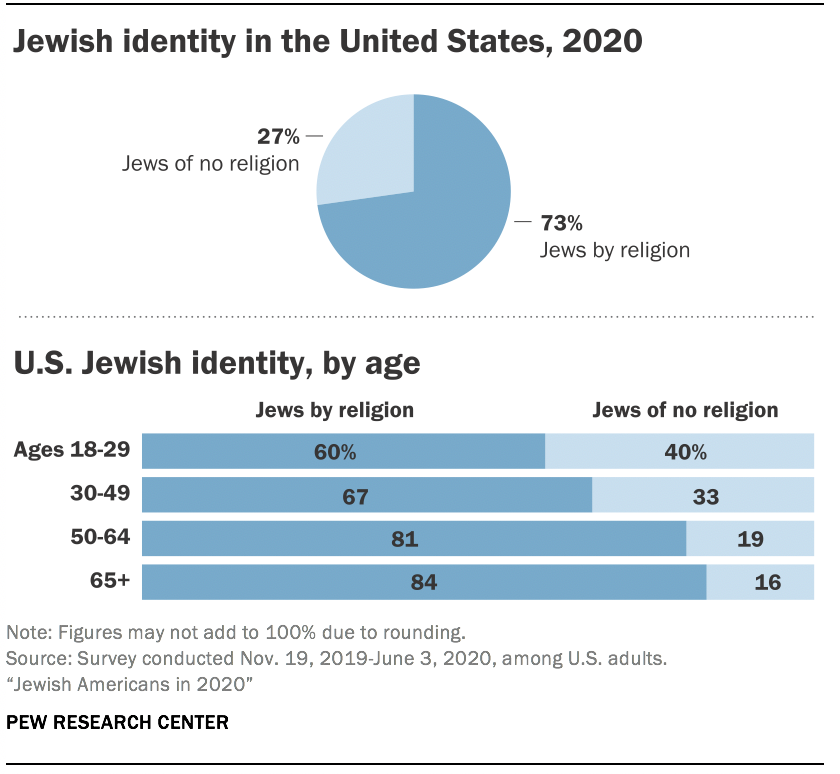
Overall, about a quarter of U.S. Jewish adults (27%) do not identify with the Jewish religion: They consider themselves to be Jewish ethnically, culturally or by family background and have a Jewish parent or were raised Jewish, but they answer a question about their current religion by describing themselves as atheist, agnostic or “nothing in particular” rather than as Jewish. Among Jewish adults under 30, four-in-ten describe themselves this way.
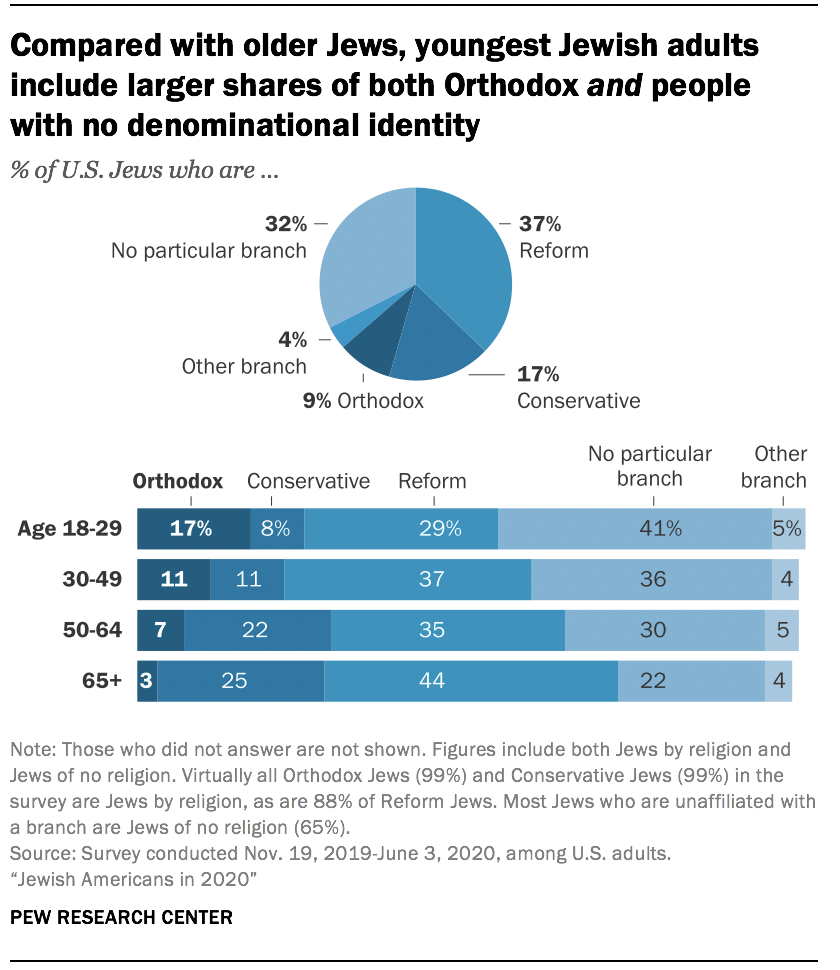
At the same time, younger Jewish adults are much more likely than older Jews to identify as Orthodox. Among Jews ages 18 to 29, 17% self-identify as Orthodox, compared with just 3% of Jews 65 and older. And fully one-in-ten U.S. Jewish adults under the age of 30 are Haredim, or ultra-Orthodox (11%), compared with 1% of Jews 65 and older.
Meanwhile, the two branches of Judaism that long predominated in the U.S. have less of a hold on young Jews than on their elders. Roughly four-in-ten Jewish adults under 30 identify with either Reform (29%) or Conservative Judaism (8%), compared with seven-in-ten Jews ages 65 and older.
In other words, the youngest U.S. Jews count among their ranks both a relatively large share of traditionally observant, Orthodox Jews and an even larger group of people who see themselves as Jewish for cultural, ethnic or family reasons but do not identify with Judaism – as a religion – at all. Many people in both groups participate, at least sometimes, in the same cultural activities, such as cooking traditional Jewish foods, visiting Jewish historical sites and listening to Jewish or Israeli music. Yet the survey finds that most people in the latter group (Jews of no religion) feel they have not much or nothing at all in common with the former group (Orthodox Jews).
There were some signs of this divergence in Pew Research Center’s previous survey of Jewish Americans, conducted in 2013. But it is especially evident in the 2020 survey, conducted during a polarizing election campaign.
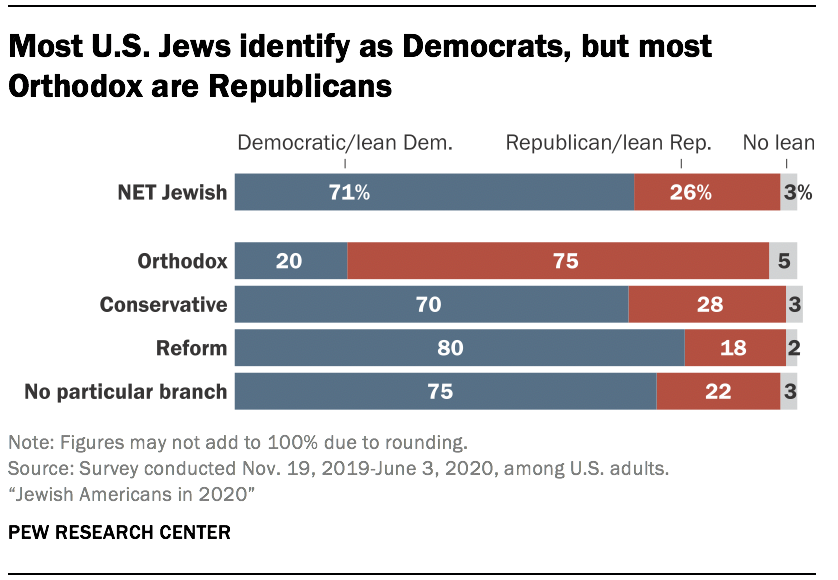
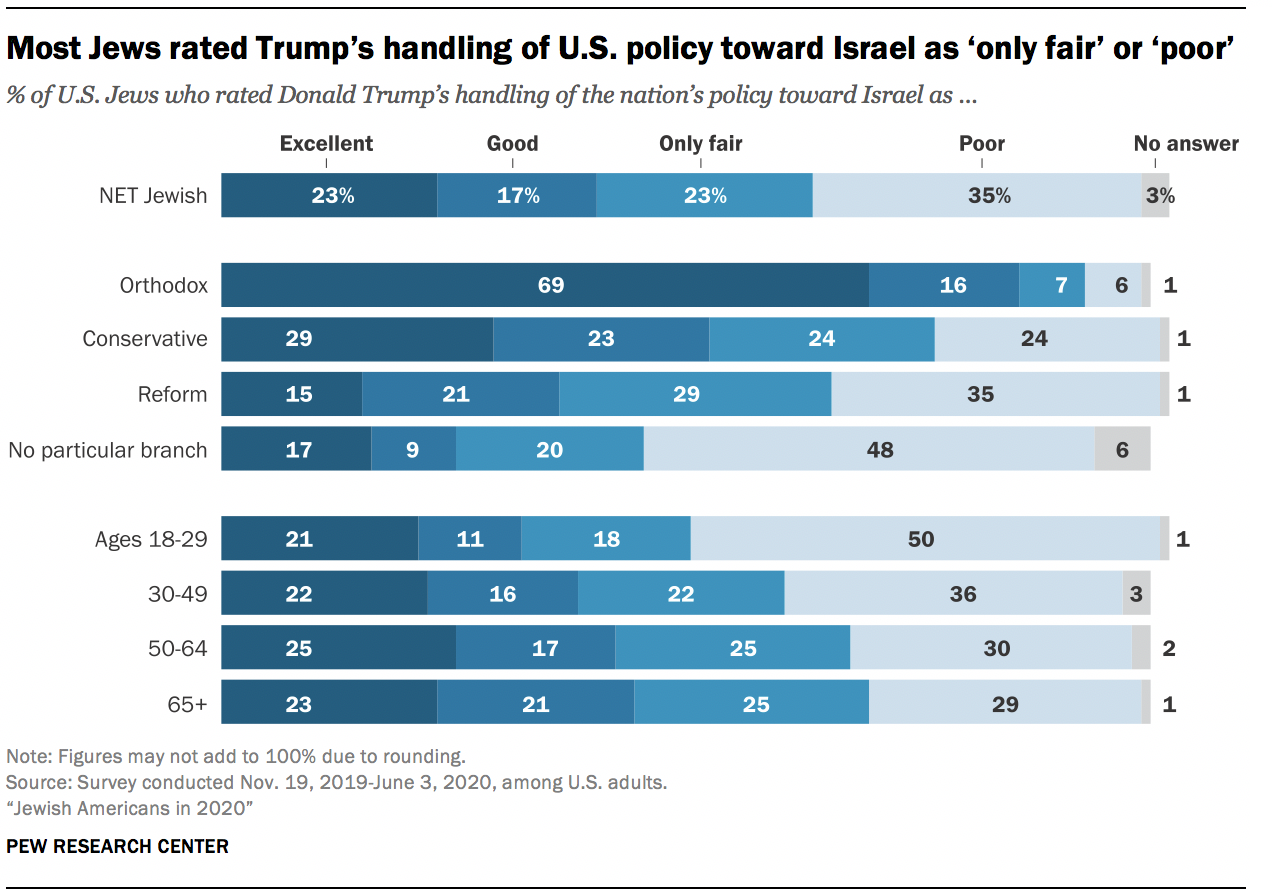
Politically, U.S. Jews on the whole tilt strongly liberal and tend to support the Democratic Party. When the new survey was fielded, from late fall 2019 through late spring 2020, 71% said they were Democrats or leaned Democratic. Among Jews of no religion, roughly three-quarters were Democrats or leaned that way. But Orthodox Jews have been trending in the opposite direction, becoming as solidly Republican as non-Orthodox Jews are solidly Democratic. In the run-up to the 2020 presidential election, 75% of Orthodox Jews said they were Republicans or leaned Republican, compared with 57% in 2013. And 86% of Orthodox Jews rated then-President Donald Trump’s handling of policy toward Israel as “excellent” or “good,” while a majority of all U.S. Jews described it as “only fair” or “poor.”
While these generational shifts toward both Orthodoxy and secular Jewishness have the potential, in time, to reshape American Jewry, the new survey paints a portrait of Jewish Americans in 2020 that is not dramatically different from 2013. Counting all Jewish adults – young and old, combined – the percentages who identify as Orthodox, Conservative and Reform are little changed. The size of the adult Jewish population is also remarkably stable in percentage terms, while rising in absolute numbers, roughly in line with the total U.S. population.
Pew Research Center estimates that as of 2020, 2.4% of U.S. adults are Jewish, including 1.7% who identify with the Jewish religion and 0.6% who are Jews of no religion. By comparison, the 2013 estimate for “net Jews” was 2.2%, including 1.8% who were Jews by religion and 0.5% who were Jews of no religion. (These figures are rounded to one decimal. Given the expected range of precision for two surveys of this size and complexity, it is safer to say that the adult Jewish population has roughly kept pace with change in the U.S. population than to focus on small differences in the 2013 and 2020 incidence rates.)
In absolute numbers, the 2020 Jewish population estimate is approximately 7.5 million, including 5.8 million adults and 1.8 million children (rounded to the closest 100,000). The 2013 estimate was 6.7 million, including 5.3 million adults and 1.3 million children. The precision of these population estimates should not be exaggerated; they are derived from a sample of the U.S. public that is very large compared with most surveys (more than 68,000 interviews) but are still subject to sampling error and other practical difficulties that produce uncertainty. Furthermore, the size of the Jewish population greatly depends on one’s definition of who counts as Jewish. For more details on the 2020 population estimates, including alternative definitions of Jewishness, see Chapter 1.
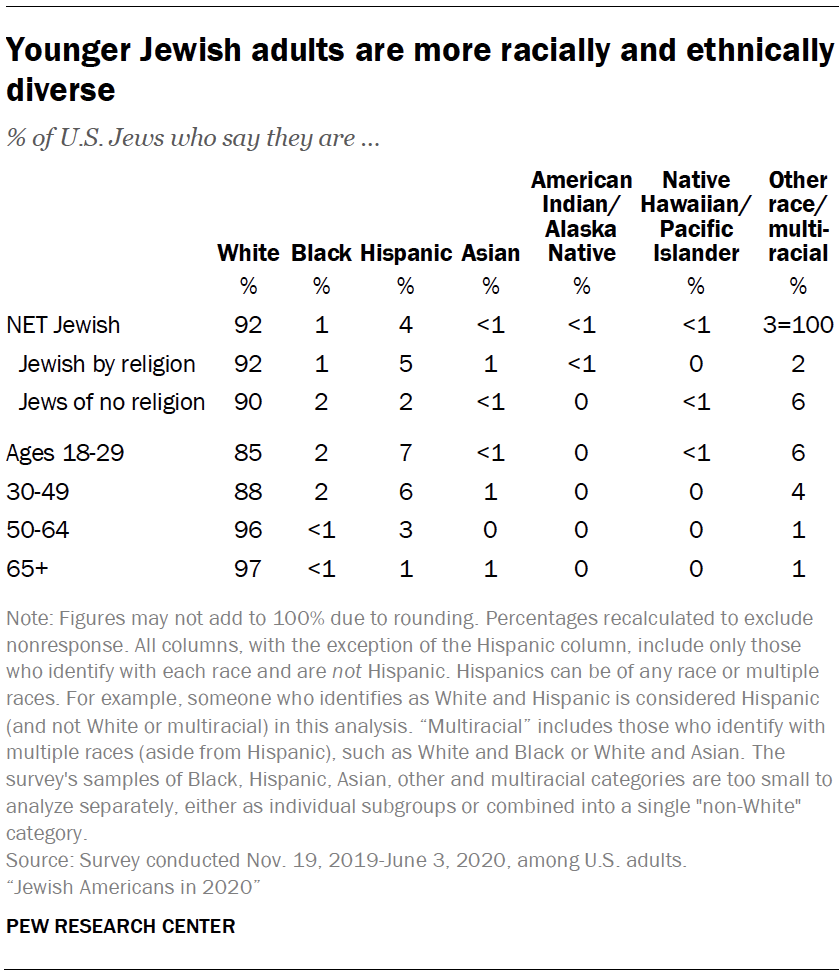
The new survey continues to find that Jewish Americans, on average, are older, have higher levels of education, earn higher incomes, and are more geographically concentrated in the Northeast than Americans overall. There is also evidence that the U.S. Jewish population is becoming more racially and ethnically diverse. Overall, 92% of Jewish adults identify as White (non-Hispanic), and 8% identify with all other categories combined. But among Jews ages 18 to 29, that figure rises to 15%. Already, 17% of U.S. Jews surveyed live in households in which at least one child or adult is Black, Hispanic, Asian, some other (non-White) race or ethnicity, or multiracial.
Although in many ways the U.S. Jewish population is flourishing, concerns about anti-Semitism have risen among American Jews. Three-quarters say there is more anti-Semitism in the United States than there was five years ago, and just over half (53%) say that “as a Jewish person in the United States” they feel less safe than they did five years ago. Jews who wear distinctively religious attire, such as a kippa or head covering, are particularly likely to say they feel less safe. But the impact on behavior seems to be limited: Even among those who feel less safe, just one-in-ten – or 5% of all U.S. Jews – report that they have stayed away from a Jewish event or observance as a result.
These are among the key findings of Pew Research Center’s new survey of U.S. Jews, conducted from Nov. 19, 2019, to June 3, 2020, among 4,718 Jews across the country who were identified through 68,398 completed screening interviews conducted by mail and online.
Comparisons between the new survey and the 2013 survey of Jewish Americans are complicated by a host of methodological differences. At the time the 2013 study was conducted, it used the best available methods for selecting a random, representative sample of Jews across the United States: dialing randomly generated telephone numbers and having live interviewers (real people, not recorded voices) ask a series of screening questions to identify respondents who consider themselves Jewish. By 2020, however, response rates to telephone surveys had declined so precipitously that random-digit dialing by telephone was no longer the best way to conduct a large, nationwide survey of a small subgroup of the U.S. public.
Instead, we sent letters to randomly selected residential addresses across the country, asking the recipients to go online to take a short screening survey. We also provided the option to fill out the survey on a paper form and return it by mail, so as not to limit the survey only to people who have access to the internet and are comfortable using it. These methods obtained a response rate (17%) similar to the 2013 survey’s (16%) and much higher than what telephone surveys now typically obtain (approximately 5%).
But, because of the differences between the ways the two surveys were conducted, this report is cautious about making direct comparisons of results on individual questions. For more information on how the new survey was conducted, see the Methodology. For guidance on whether 2020 survey questions can be compared with similar questions in the 2013 survey, see Appendix B.
Comparing 2020 survey results with 2013
Branches of American Judaism
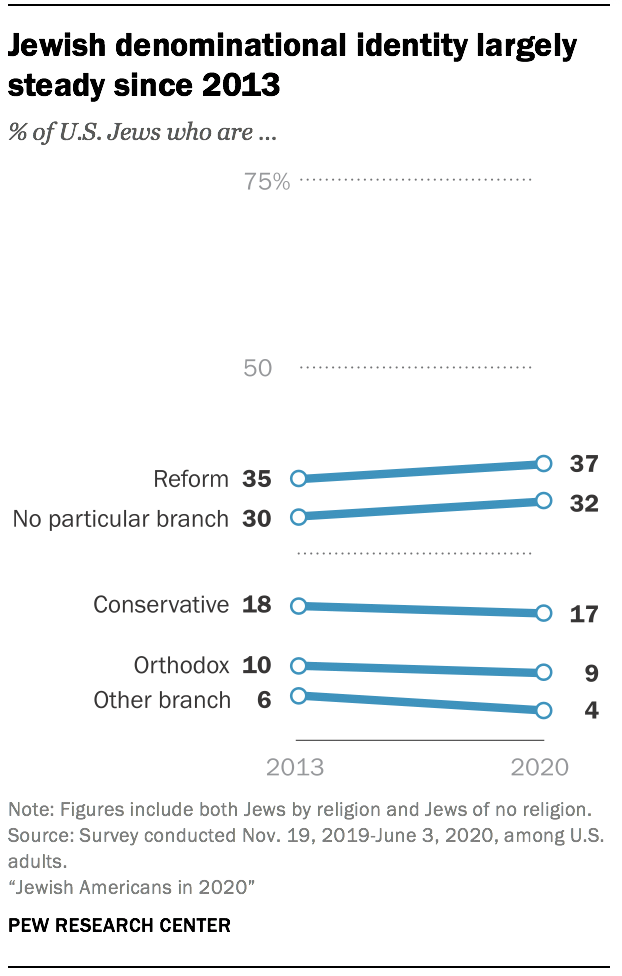
The 2020 survey finds that slightly over half of all U.S. Jews (54%) belong to the two long-dominant branches of American Judaism: 37% identify as Reform and 17% as Conservative. Those figures are essentially unchanged from 2013, when a total of 54% identified with either the Reform movement (35%) or Conservative Judaism (18%).
The share of all Jewish adults who describe themselves as Orthodox is also about the same in 2020 (9%) as it was in 2013 (10%). Other branches, such as the Reconstructionist movement and Humanistic Judaism, total about 4%, very similar to in 2013 (6%). And the share of Jewish adults who do not identify with any particular stream or institutional branch of Judaism is now 32%, roughly on par with the 2013 survey (30%).
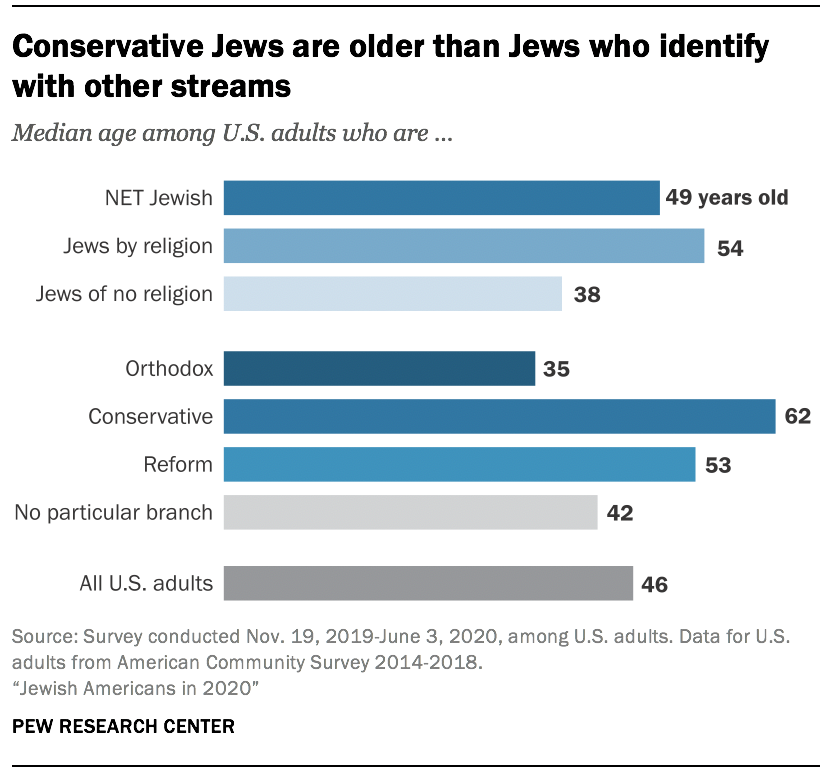
In broad strokes, the characteristics of these groups also are similar in 2020 to what they were in 2013. On average, the Orthodox are the most traditionally observant and emotionally attached to Israel; they tend to be politically conservative, with large families, very low rates of religious intermarriage and a young median age (35 years).
Conservative and Reform Jews tend to be less religiously observant in traditional ways, like keeping kosher and regularly attending religious services, but many in these groups participate in Jewish cultural activities, and most are at least somewhat attached to Israel. Demographically, they have high levels of education, small families, higher rates of intermarriage than the Orthodox and an older age profile (median age of 62 for Conservative, 53 for Reform).
There is a fair amount of overlap – though it is far from complete – between the 32% of Jewish adults who do not consider themselves members of any branch or denomination of American Judaism and the 27% who are categorized as “Jews of no religion.” Survey respondents who say their religion is Jewish are categorized as “Jews by religion” no matter what their branch identity or levels of observance. Those who describe their religion as atheist, agnostic or nothing in particular but who have a Jewish parent or were raised Jewish and say that aside from religion they consider themselves Jewish in some way – such as ethnically, culturally or because of their family background – are also fully included in the Jewish population throughout this report. Survey researchers call them Jews of “no religion” because they do not identify with Judaism or any other religion.
As in 2013, Jews of no religion stand out in 2020 for low levels of religious participation – particularly synagogue membership and attendance – together with comparatively weak attachments to Israel, feelings of belonging to the Jewish people and engagement in communal Jewish life. They tend to be politically liberal and highly educated, with relatively high rates of intermarriage and a low median age (38 years).
One way to illustrate the divergence between Jews at opposite ends of the religious spectrum is to widen the lens and look at religion in the United States more broadly. Orthodox Jews are among the most highly religious groups in U.S. society in terms of the share who say religion is very important in their lives (86%) – along with Black Protestants (78%) and White evangelicals (76%). Jews of no religion are among the country’s least religious subgroups – even more inclined than unaffiliated U.S. adults (sometimes called “nones”) to say that religion is “not too important” or “not at all important” to them (91% vs. 82%).
Who counts as Jewish in the survey
Sources of unity and division
While there are some signs of religious divergence and political polarization among U.S. Jews, the survey also finds large areas of consensus. For instance, more than eight-in-ten U.S. Jews say that they feel at least some sense of belonging to the Jewish people, and three-quarters say that “being Jewish” is either very or somewhat important to them.
As in 2013, the 2020 survey asked Jewish Americans whether a list of causes and activities are “essential,” “important but not essential” or “not important” to what being Jewish means to them. Because of methodological differences in the way the survey was conducted and the addition of one item to the list, the results from 2020 on particular items may not be directly comparable to 2013, but the broad pattern of responses is similar in many ways.
Seven-in-ten or more U.S. Jews say that remembering the Holocaust (76%) and leading a moral and ethical life (72%) are essential to their Jewish identity. About half or more also say that working for justice and equality in society (59%), being intellectually curious (56%) and continuing family traditions (51%) are essential. Far fewer consider eating traditional Jewish foods (20%) and observing Jewish law (15%) to be essential elements of what being Jewish means to them, personally. However, the observance of halakha – Jewish law – is particularly important to Orthodox Jews, 83% of whom deem it essential.
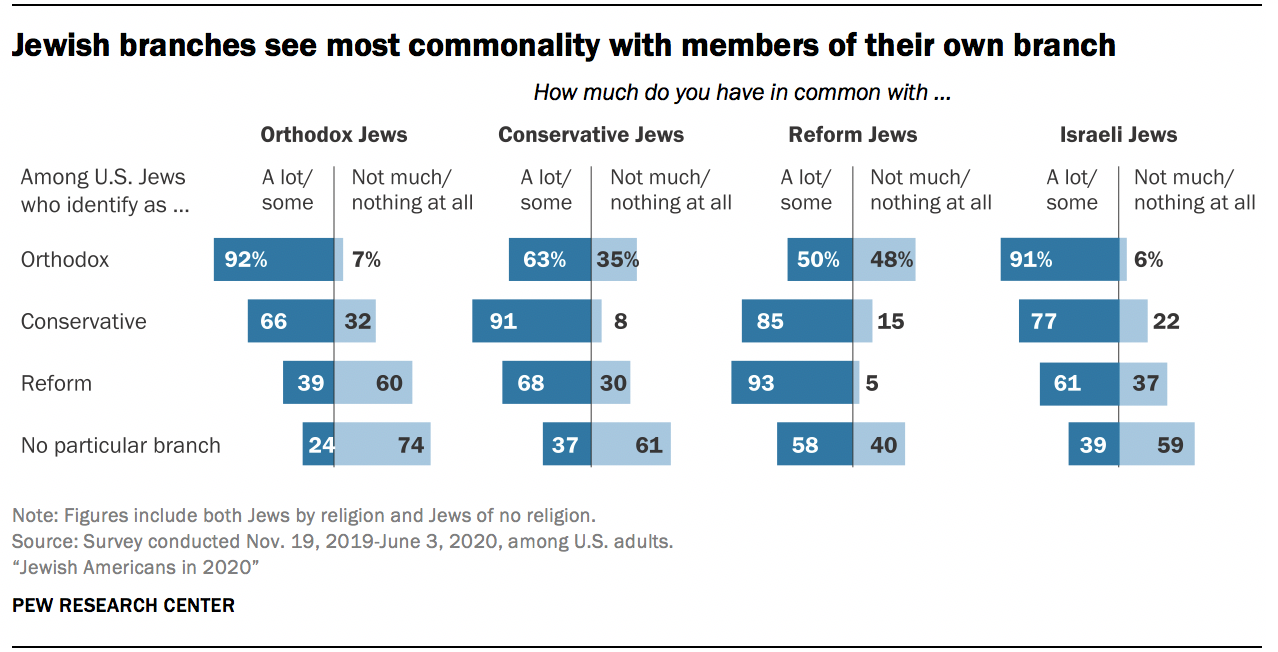
Views on halakha are just one of many stark differences in beliefs and behaviors between Orthodox Jews and Jewish Americans who identify with other branches of Judaism (or with no particular branch) that are evident in the survey, and that may affect how these groups perceive each other. For example, about half of Orthodox Jews in the U.S. say they have “not much” (23%) or “nothing at all” (26%) in common with Jews in the Reform movement; just 9% feel they have “a lot” in common with Reform Jews.
Reform Jews generally reciprocate those feelings: Six-in-ten say they have not much (39%) or nothing at all (21%) in common with the Orthodox, while 30% of Reform Jews say they have some things in common, and 9% say they have a lot in common with Orthodox Jews.
In fact, both Conservative and Reform Jews are more likely to say they have “a lot” or “some” in common with Jews in Israel (77% and 61%, respectively) than to say they have commonalities with Orthodox Jews in the United States. And Orthodox Jews are far more likely to say they have “a lot” or “some” in common with Israeli Jews (91%) than to say the same about their Conservative and Reform counterparts in the U.S.
U.S. Jews less religious than U.S. adults overall, but some Jewish trends reflect broader American context
When it comes to religion, U.S. Jews are in many ways distinctive from the wider U.S. public – and not just in their engagement with specifically Jewish beliefs and practices.
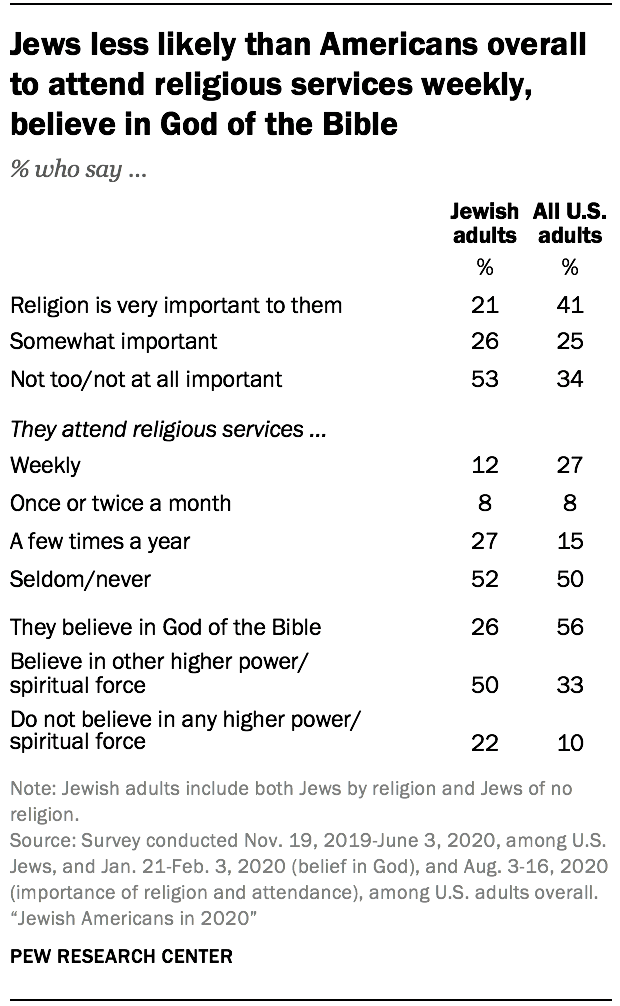
In general, Jews are far less religious than American adults as a whole, at least by conventional measures of religious observance in Pew Research Center surveys. For example, one-in-five Jews (21%) say religion is very important in their lives, compared with 41% of U.S. adults overall. And 12% of Jewish Americans say they attend religious services weekly or more often, versus 27% of the general public.
There are even bigger gaps when it comes to belief in God. A majority of all U.S. adults say they believe in God “as described in the Bible” (56%), compared with about a quarter of Jews (26%). Jewish Americans are more inclined to believe in some other kind of higher power – or no higher power at all.
At the same time, however, the trends playing out among American Jews are similar to many patterns in the broader population. The most obvious of these is growing religious disaffiliation: The percentage of U.S. Jews who do not claim any religion (27%) – i.e., who identify as atheist, agnostic or “nothing in particular,” religiously – is virtually identical to the percentage of U.S. adults overall in these categories (28%).
In addition, intermarriage is not just a Jewish phenomenon. Religious intermarriage also appears to be on the rise in the U.S. adult population more broadly. The same is true for rising levels of racial and ethnic diversity, which is happening in most U.S. religious groups as the country’s population as a whole becomes more diverse. Finally, the fact that Orthodox Jews tend to have more children aligns with a general pattern in which highly religious Americans have higher fertility rates than non-religious ones.
Why Jews go, or don’t go, to religious services
Left unanswered by the 2013 study was why many Jewish Americans, particularly in younger cohorts, rarely attend synagogue, and in what ways, if any, they connect with Judaism or other Jews.
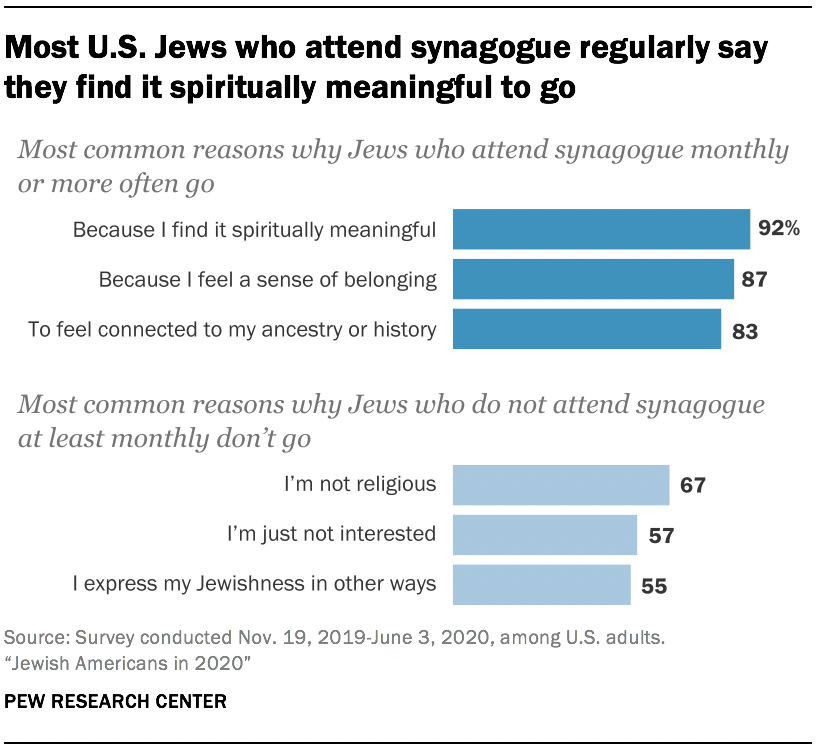
The 2020 survey includes some new questions designed to help explore those issues. To begin with, Jews who say they attend services at a synagogue, temple, minyan or havurah at least once a month – 20% of Jewish adults – were asked what draws them to religious services. Those who attend services a few times a year or less were asked what keeps them away; this group makes up nearly eight-in-ten U.S. Jews (79%).
Of nine possible reasons for attending Jewish services offered in the survey, the most commonly chosen is “Because I find it spiritually meaningful.” Nine-in-ten regular attenders say this is a reason they go to services (92%), followed closely by “Because I feel a sense of belonging” (87%) and “To feel connected to my ancestry or history” (83%). About two-thirds (65%) say they feel a religious obligation, and Orthodox Jews are especially likely to give this reason (87%). Fewer Jewish congregants say they go to religious services to please a spouse or family member (42%) or because they would feel guilty if they did not participate (22%).
Of 11 possible reasons for not attending religious services, the top choice is “I’m not religious.” Two-thirds of infrequent attenders say this is a reason they do not go to services more often. Other common explanations are “I’m just not interested” (57%) and “I express my Jewishness in other ways” (55%). Fewer say “I don’t know enough to participate” (23%), “I feel pressured to do more or give more” (11%), “I don’t feel welcome” (7%), “I fear for my security” (6%) or “People treat me like I don’t really belong” (4%).
The degree to which finances are a barrier seems to vary by age. Although some Jewish leaders believe that synagogue membership fees are keeping away young people, younger Jewish adults (under age 30) are somewhat less likely than those who are older to say they don’t attend religious services because “it costs too much” (10% vs. 19%). For perspective on this question from in-depth interviews with congregational rabbis, see the sidebar, “Most U.S. Jews don’t go to synagogue, so rabbis and a host of new organizations are trying to innovate” in Chapter 3.
For more analysis of these questions, see Chapter 3.
Cultural engagement
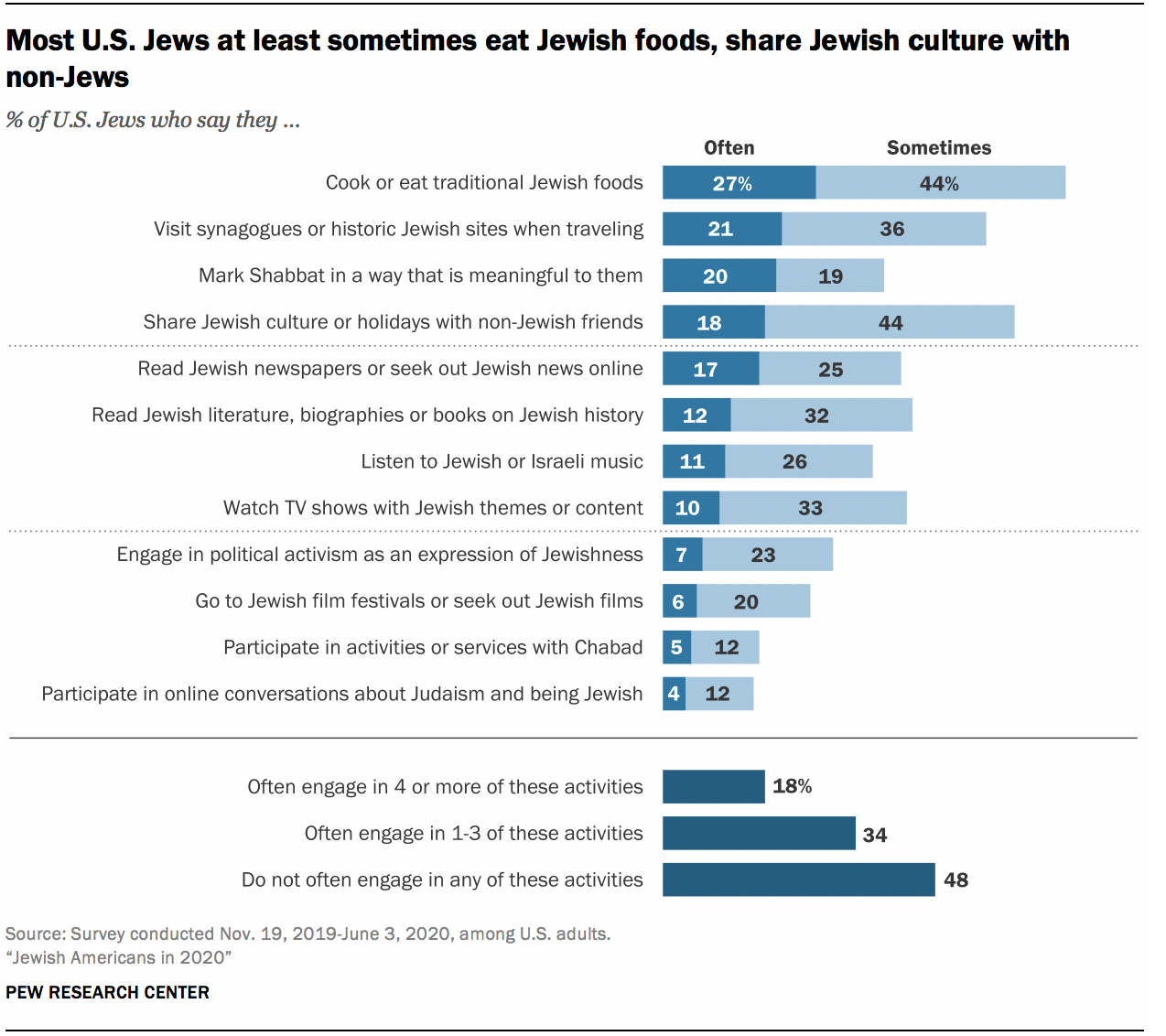
In addition to traditional forms of religious observance, such as attending a synagogue, many Jewish Americans say they engage in cultural Jewish activities such as enjoying Jewish foods, visiting Jewish historical sites and reading Jewish literature.
Young Jewish adults report engaging in many of these activities at rates roughly equal to older U.S. Jews. Among Jews ages 18 to 29, for example, 70% say they often or sometimes cook or eat traditional Jewish foods, identical to the percentage of Jews 65 and older who do the same. And 37% of the youngest Jewish adults say they at least sometimes mark Shabbat in a way that makes it meaningful to them (though not necessarily in a way that follows Jewish law, such as abstaining from work), as do 35% of Jews who are 65 and older.
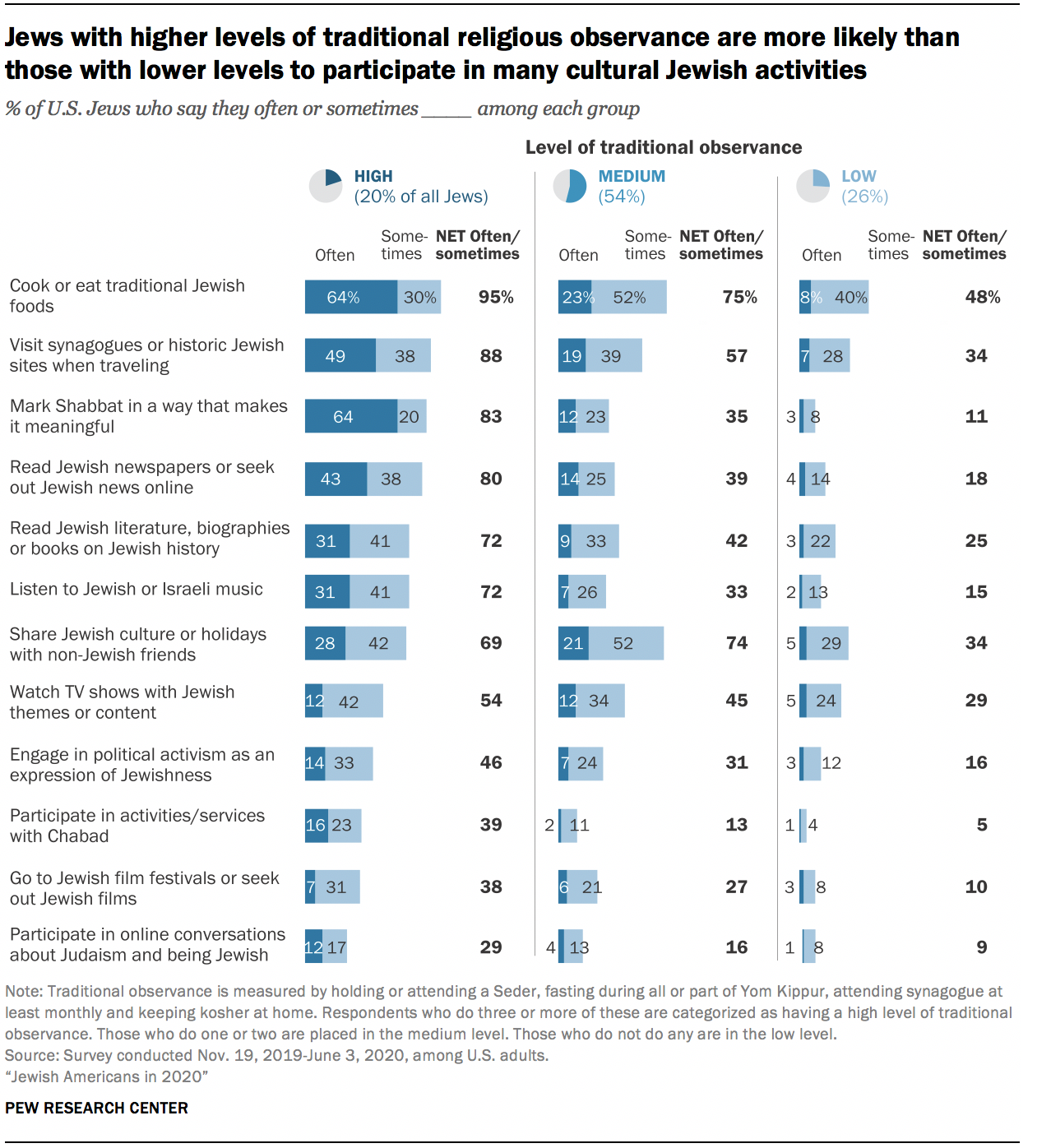
Overall, however, it’s not the case that Jewish cultural activities or individualized, do-it-yourself religious observances are directly substituting for synagogue attendance and other traditional forms of Jewish observance. More often, they are complementing traditional religious participation. Statistical analysis indicates that people who are highly observant by traditional measures – on a scale combining synagogue attendance, keeping kosher, fasting on Yom Kippur and participating in a Passover Seder – also tend to report the highest participation rates in the 12 cultural Jewish activities mentioned in the survey, such as reading Jewish publications, listening to Jewish music and going to Jewish film festivals.
Those who are low on the scale of traditional religious observance, meanwhile, tend to be much less active in the vibrant array of cultural activities available to U.S. Jews in the 21st century. In fact, no more than about one-in-ten low-observance Jews say they often do any of the dozen things mentioned in the survey.
For example, among highly observant Jews, 31% say they often listen to Jewish or Israeli music, compared with 7% of those with a medium level of traditional observance and just 2% of those who are low on the observance scale. There are similar patterns on other questions: 64% of highly observant Jews often cook or eat traditional Jewish foods, eight times the share of low-observance Jews who say the same (8%).
At the same time, the survey finds that many Jews who answered a different question by saying they don’t go to religious services because they “express [their] Jewishness in other ways” do engage in cultural activities, at least on occasion. About three-quarters report that they sometimes or often enjoy Jewish foods (77%) and share Jewish culture or holidays with non-Jewish friends (74%), while many also visit historic Jewish sites when traveling (55%) and read Jewish literature (47%).
See Chapter 3 for more analysis of these questions.
Most U.S. Jews perceive a rise in anti-Semitism
In the wake of a series of murderous attacks on Jewish Americans – at the Tree of Life synagogue in Pittsburgh in October 2018; Chabad of Poway synagogue in Poway, California, in April 2019; and a kosher grocery store in Jersey City, New Jersey, in December 2019 – the 2020 survey posed many more questions about anti-Semitism than the 2013 survey did.
More than nine-in-ten U.S. Jews say there is at least “some” anti-Semitism in the United States, including 45% who say there is “a lot” of anti-Semitism. Just 6% say there is not much anti-Semitism, and close to zero (fewer than 1%) say there is none at all.
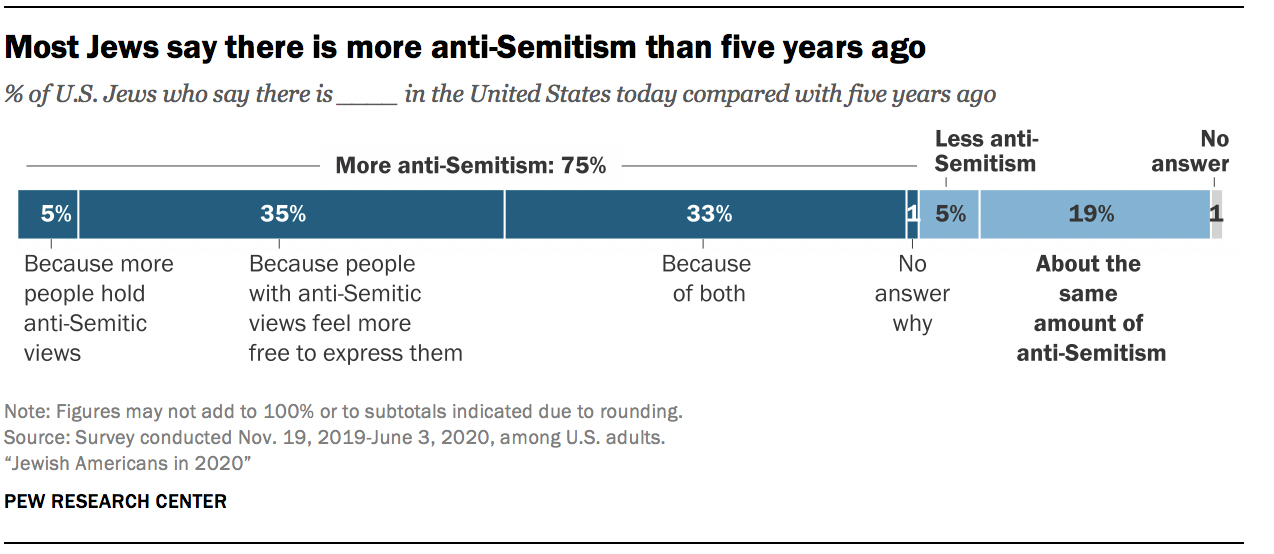
Moreover, three-quarters (75%) say there is more anti-Semitism in the United States than there was five years ago. Just 5% say there is less, and 19% perceive little or no change, saying there is about the same amount of anti-Semitism as there was five years ago.
Among those who perceive an increase in anti-Semitism over the last five years, relatively few (5% of all U.S. Jews) think it has occurred solely “because there are now more people who hold anti-Semitic views.” The vast majority say that anti-Semitism has increased in the United States either because people who hold anti-Semitic views “now feel more free to express them” (35%) or that both things have happened: The number of anti-Semites has grown andpeople now feel more free to express anti-Semitic views (33%).
The survey also sought to assess, in broad terms, the psychological impact of anti-Semitism on Jewish Americans and its possible chilling effect on Jewish community activities.
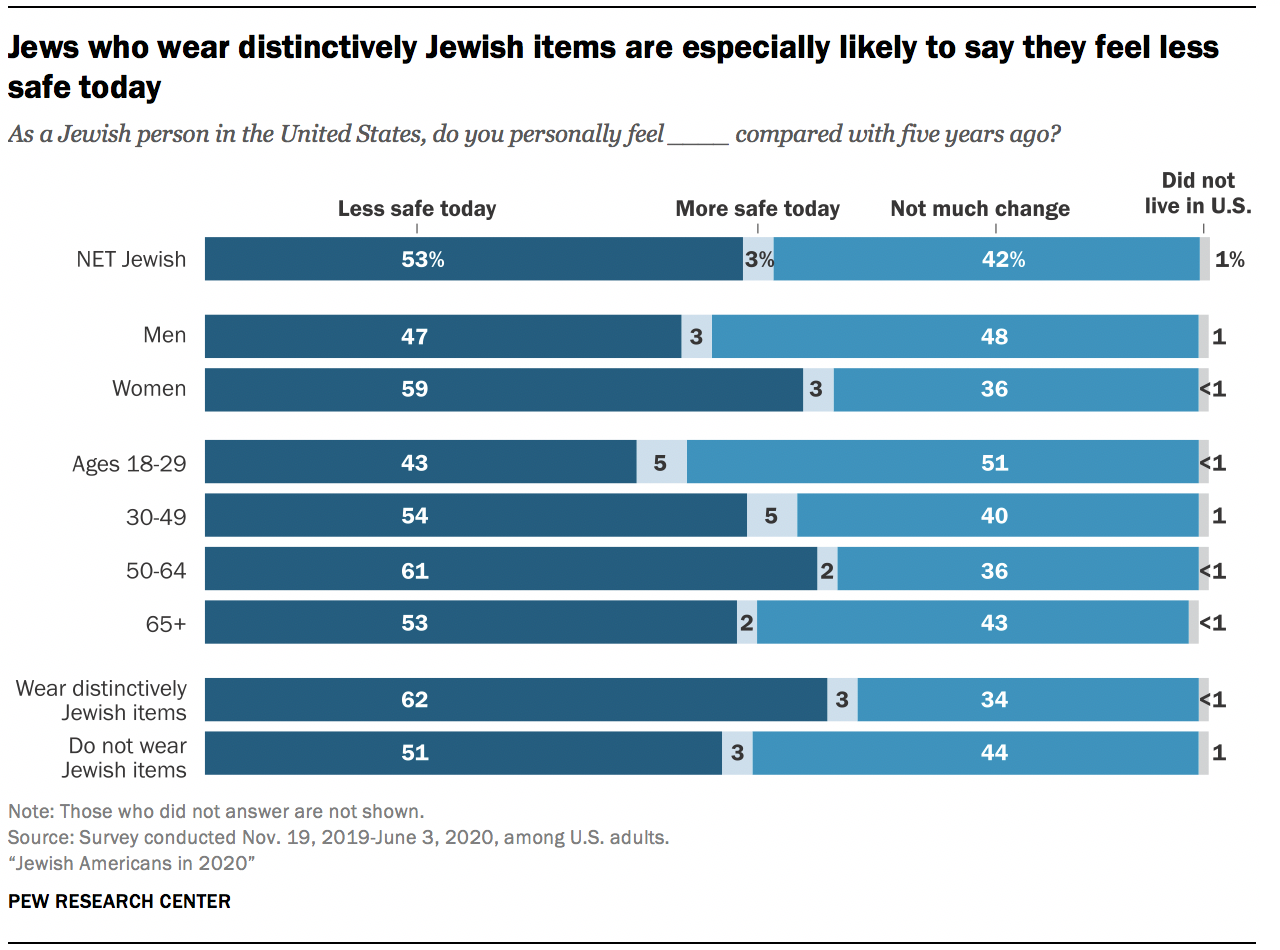
Slightly more than half of Jews surveyed (53%) say that, as a Jewish person in the United States, they personally feel less safe today than they did five years ago. Just 3% feel more safe, while 42% don’t sense much change. (An additional 1% say they did not live in the U.S. five years ago.) Jews who usually wear something in public that is recognizably Jewish (such as a kippa or head covering) are especially likely to feel less safe, as are Jewish women.
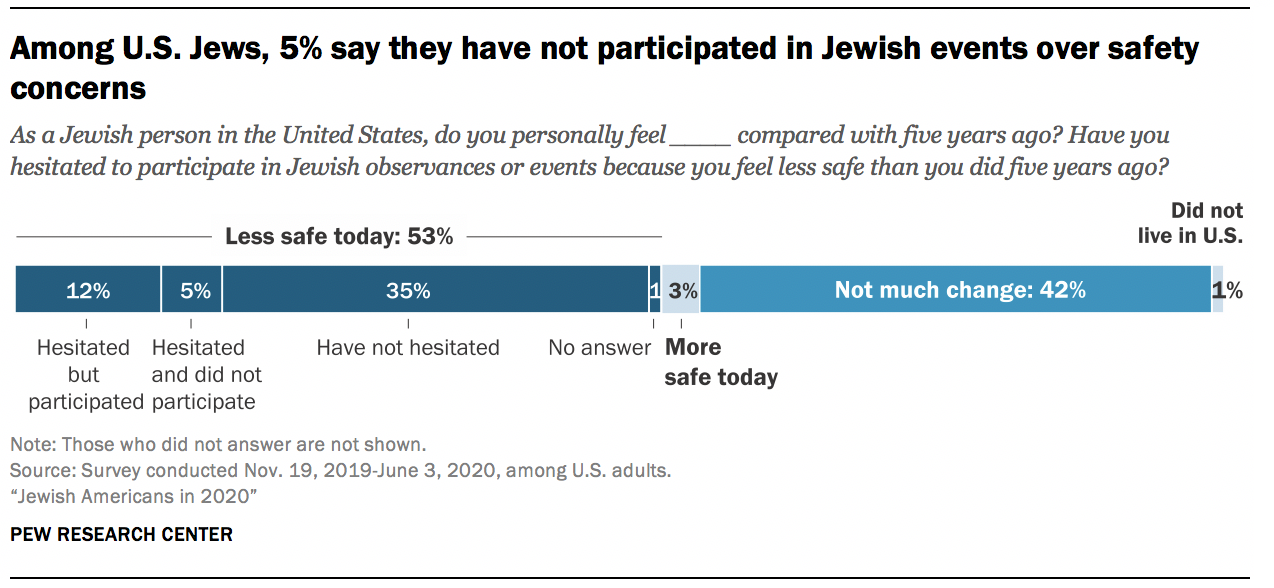
Those who say they feel less safe now were asked a follow-up question: Have you hesitated to participate in Jewish observances or events because you feel less safe than you did five years ago?
Two-thirds of those who feel less safe (or 35% of all Jewish adults) say they have not hesitated to participate in Jewish activities because of safety concerns. About one-quarter of those who feel less safe (12% of all U.S. Jewish adults) say they have hesitated but still participated in Jewish observances or events. And about one-in-ten Jews who say they feel less safe (5% of all U.S. Jewish adults) say they hesitated and chose not to participate in Jewish observances or events because of safety concerns.
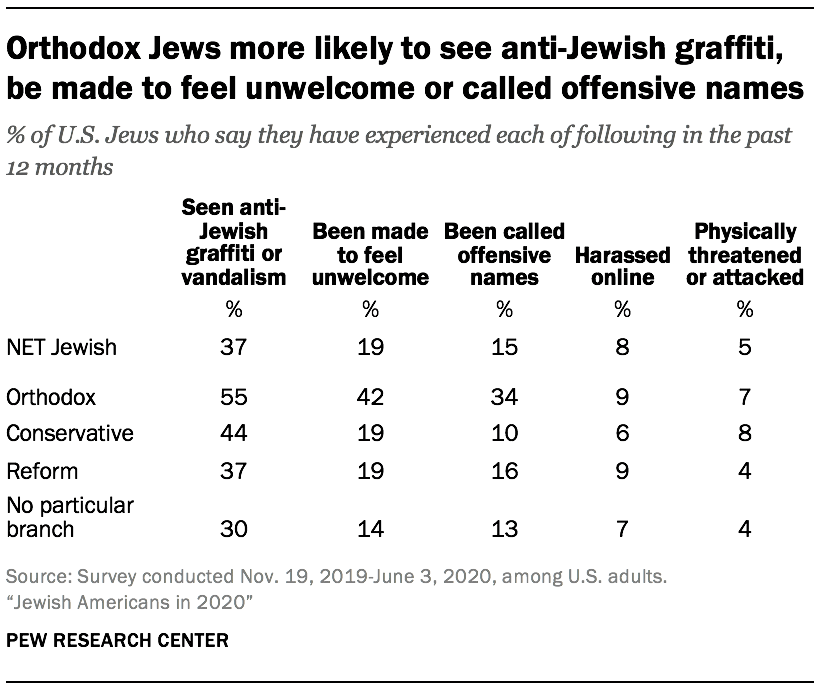
Jewish Americans report that they experience some forms of anti-Semitism much more often than other forms. For example, 37% say they have seen anti-Jewish graffiti or vandalism in their local community in the past 12 months, while 19% say they have been made to feel unwelcome because they are Jewish and 15% say they have been called offensive names. Fewer say that in the 12 months prior to taking the survey they have been harassed online (8%) or physically attacked (5%) because they are Jewish.
While reports of physical attacks are rare across the board, many of the other experiences of anti-Semitism are more common among younger Jews and Orthodox Jews (who often wear recognizably Jewish attire in public). For example, one-quarter of Jewish adults under the age of 30 say that in the past year they have been called offensive names because they are Jewish, compared with 10% of Jews ages 50 and older. And 55% of Orthodox Jews say they have seen anti-Jewish graffiti in their local community in the past year, compared with 37% of Reform Jews; this may be, at least in part, because Orthodox Jews are more likely to live in heavily Jewish neighborhoods.
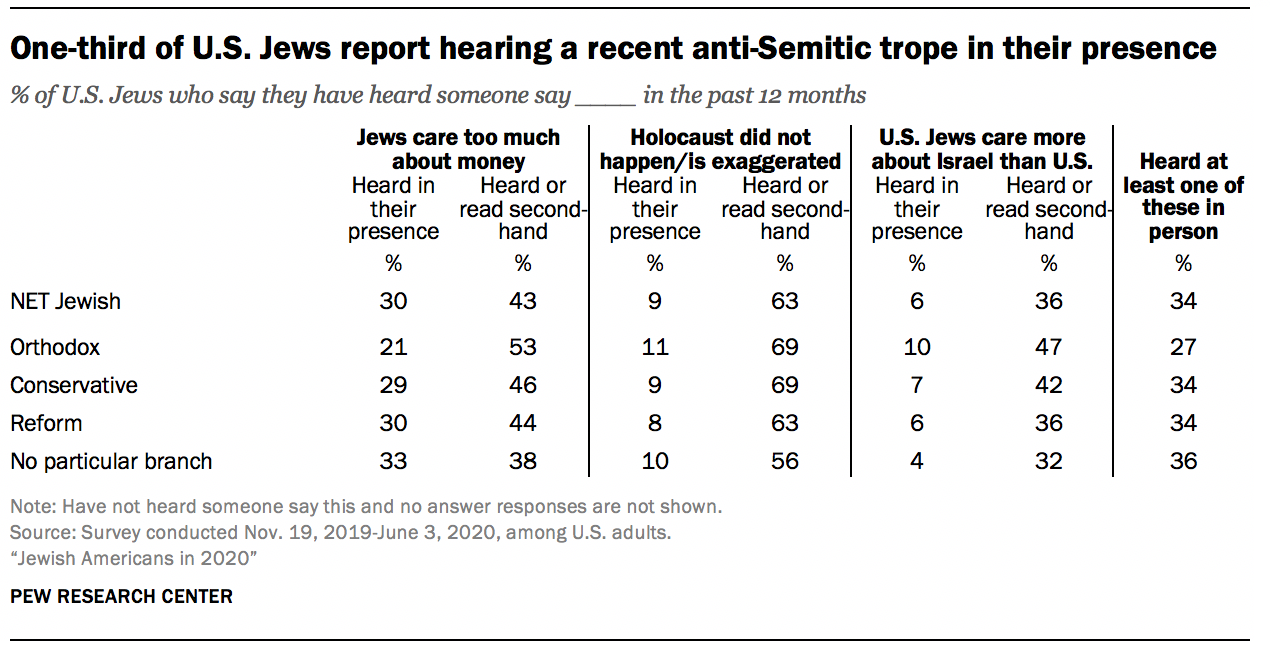
Most Jewish Americans also have been exposed in the past year to anti-Semitic tropes or stereotypes – though most report these as secondhand experiences, such as something they have seen on social media or read about in news stories. For example, about three-quarters of Jewish adults have heard someone claim that “Jews care too much about money,” including three-in-ten (30%) who say this was said in their presence in the past year and an additional 43% who say they have heard or read about this claim secondhand.
Similarly, 71% of U.S. Jews say they have heard or read about someone claiming in the past year that “the Holocaust did not happen or its severity has been exaggerated.” But most of these experiences have been secondhand (63%) rather than something said in their presence (9%). A smaller share of U.S. Jews have heard someone say that “American Jews care more about Israel than about the United States,” including 36% who have heard or read about this secondhand and 6% who have heard it directly in the last year.
Despite these experiences with anti-Semitism, Jewish Americans tend to say that there is as much – or more – discrimination in U.S. society against several other groups (including Muslim, Black, Hispanic, and gay or lesbian Americans) as there is against Jews. This was true in the 2013 survey and remains the case in 2020.
For more analysis of questions on discrimination and anti-Semitism, see Chapter 6.
Partisanship shapes views on Trump
Surveyed roughly five to 12 months before the 2020 presidential election, U.S. Jews expressed generally negative views of then-President Donald Trump: 73% of all Jewish adults (and 96% of Jews who are Democrats or lean Democratic) disapproved of his performance in office, while 27% gave him positive approval ratings (including 88% of Jews who are Republicans or lean Republican).
Jews were especially scornful of Trump’s handling of environmental and immigration issues: Eight-in-ten Jewish adults said he had done a “poor” or “only fair” job on the environment, and three-quarters said the same about his handling of immigration.
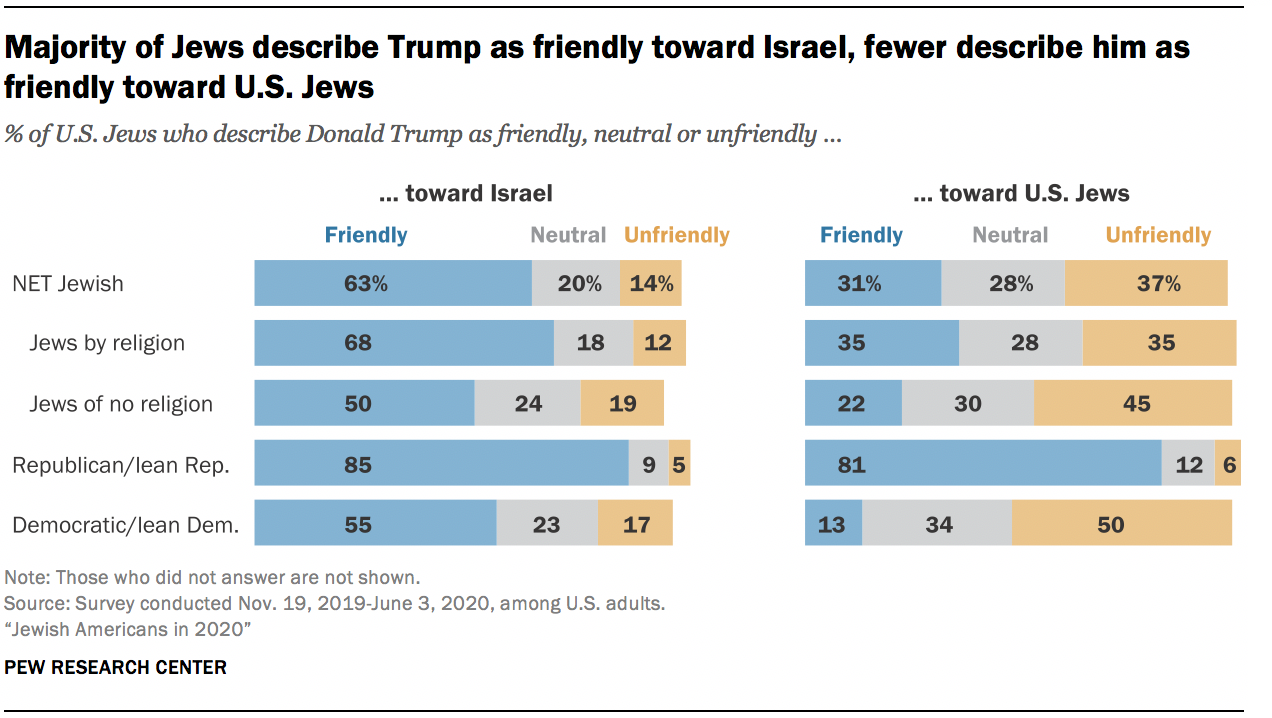
Most U.S. Jews perceived Trump as friendly toward Israel. About six-in-ten overall (63%) said this, including 55% of Jews who are Democrats or lean Democratic as well as 85% of those who are Republicans or lean Republican.
But there was less consensus among Jewish Americans over whether Trump was friendly toward Jews in the United States. About three-in-ten said he was friendly (31%), while 28% said he was neutral and 37% said he was unfriendlytoward U.S. Jews. These perceptions, however, were highly partisan: While a large majority of Jewish Republicans (81%) said Trump was friendly toward Jews in the United States, just 13% of Jewish Democrats agreed.
Even though most U.S. Jews perceived Trump as friendly toward Israel, that does not necessarily mean they looked positively on his policies toward the Jewish state. Indeed, most Jewish Americans rated Trump’s handling of U.S. policy toward Israel as “only fair” (23%) or “poor” (35%), while four-in-ten rated his handling of this policy as good (17%) or excellent (23%). Orthodox Jews were particularly inclined to give Trump high marks for his policies toward Israel (69% “excellent”).
In the 2013 survey, which took place during the administration of President Barack Obama, one-in-ten Jewish Americans said U.S. policy was “too supportive” of Israel. Most said U.S. policy was either “not supportive enough” of Israel (31%) or “about right” (54%).
Seven years later, during the final 14 months of the Trump administration, just over half of Jewish adults (54%) still said the level of U.S. support for Israel was about right. But, by comparison with 2013, fewer said the U.S. was not supportive enough (19%), and more said U.S. policy was too supportive of Israel (22%).
Among Jewish adults under the age of 30, about four-in-ten (37%) took the position in 2020 that U.S. policy was too supportive of Israel, and fully half said Trump was handling policy toward Israel poorly.
Levels of connectedness with Israel
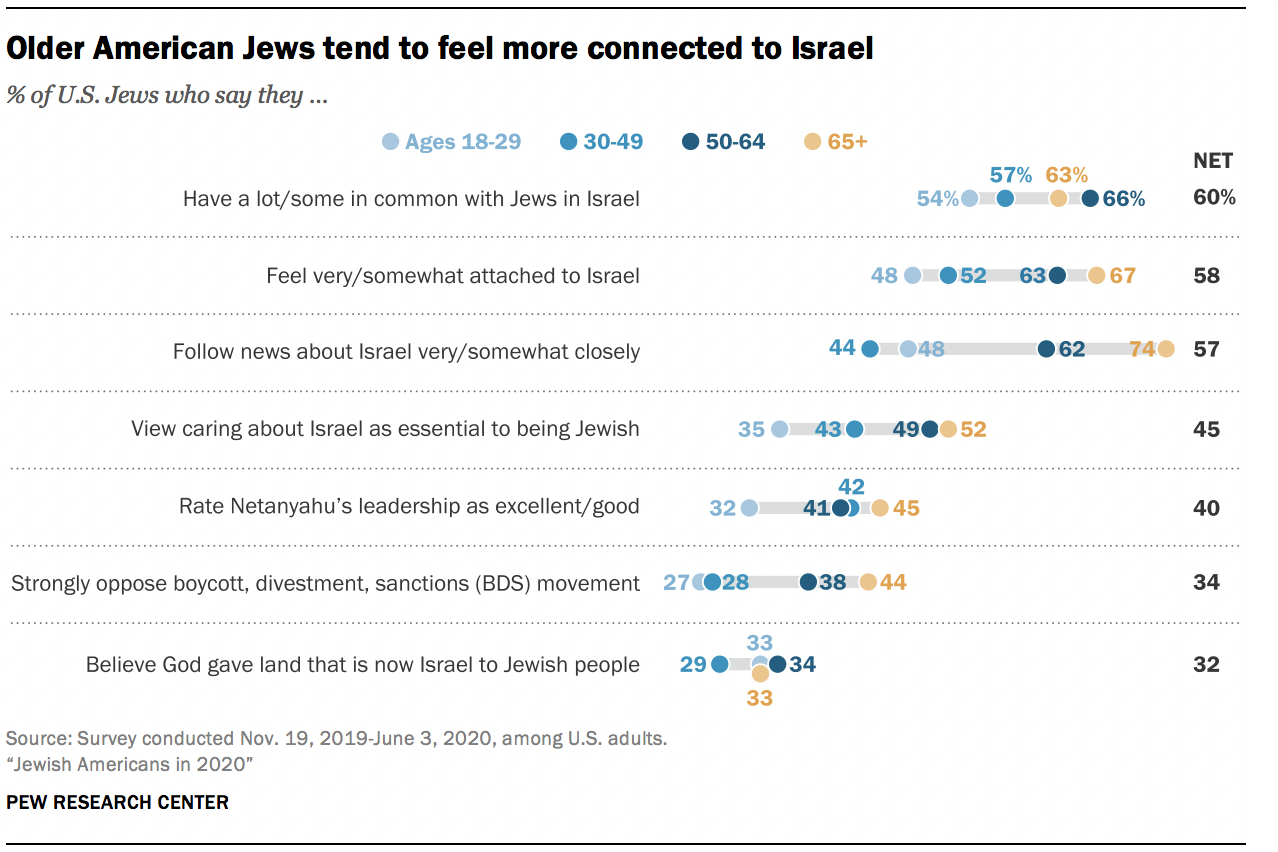
More broadly, young U.S. Jews are less emotionally attached to Israel than older ones. As of 2020, half of Jewish adults under age 30 describe themselves as very or somewhat emotionally attached to Israel (48%), compared with two-thirds of Jews ages 65 and older.
In addition, among Jews ages 50 and older, 51% say that caring about Israel is essential to what being Jewish means to them, and an additional 37% say it is important but not essential; just 10% say that caring about Israel is not important to them. By contrast, among Jewish adults under 30, one-third say that caring about Israel is essential (35%), and one-quarter (27%) say it’s not important to what being Jewish means to them.
The same pattern – lower levels of attachment to Israel among younger Jewish adults than among older ones – also was present in the 2013 survey. Because the 2013 survey was conducted by live interviewers over the telephone and the 2020 survey was self-administered by respondents online or on a paper questionnaire, the results on some questions are not directly comparable. This includes measures of attachment to Israel, and consequently it is difficult to know whether overall levels of attachment to Israel among Jewish Americans have changed over that seven-year period.
Racial and ethnic diversity among U.S. Jews
Being Jewish is an interconnected matter of religion, ethnicity, culture and ancestry. The survey sought to explore this dynamic by including questions about race and ethnicity (questions that are also intertwined with ancestry and culture), Jewish customs and geographic origin.
In the 2020 survey, roughly nine-in-ten U.S. Jewish adults identify as White non-Hispanic (92%), while 8% identify with all other categories combined. This compares with 94% White non-Hispanic and 6% in all other categories in the 2013 survey. In addition, there are other good reasons to think that the U.S. Jewish population, like the country’s population as a whole, is growing more racially and ethnically diverse over time, including a pattern of rising diversity by age.
Among Jewish adults under age 30, 85% identify as White (non-Hispanic), while 15% identify with all other categories, including 7% Hispanic, 2% Black (non-Hispanic) and 6% other or multiple races. That is much more racial and ethnic diversity than the survey finds among Jews ages 50 and older (97% White non-Hispanic).
Unlike in 2013, the 2020 survey also asked about the race and ethnicity of other adults and children in Jewish households. The data indicates that 17% of U.S. Jews live in households where at least one person – adult or child – is Hispanic, Black, Asian, another (non-White) race or ethnicity, or multiracial; this includes household members who may not be Jewish.
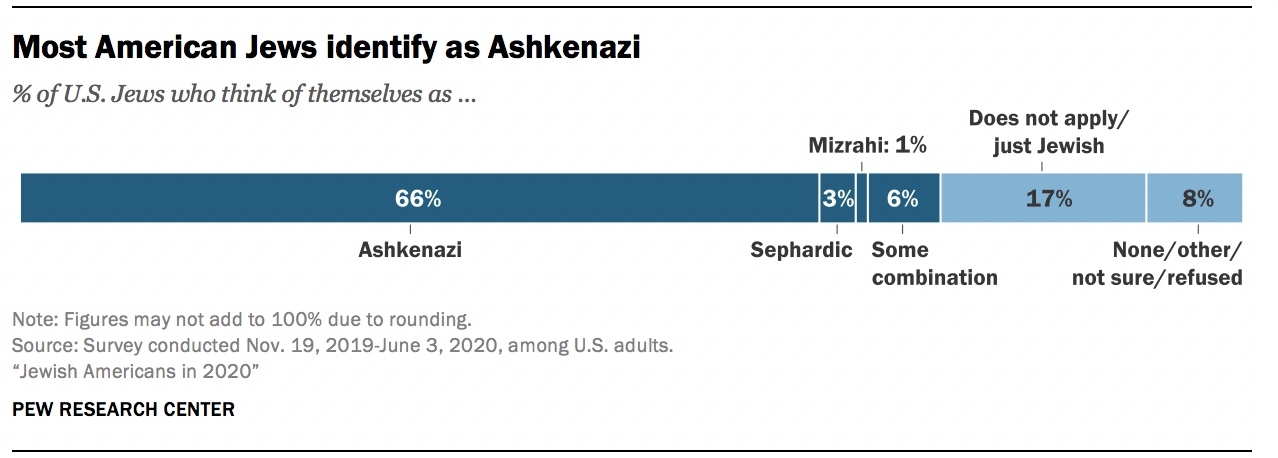
The survey also asked whether Jews think of themselves as Ashkenazi (following the Jewish customs of Central and Eastern Europe), Sephardic (following the Jewish customs of Spain), Mizrahi (following the Jewish customs of North Africa and the Middle East) or something else. Fully two-thirds of Jewish Americans consider themselves Ashkenazi, while relatively few consider themselves to be Sephardic (3%) or Mizrahi (1%). An additional 6% say they are some combination of these or other categories.
Despite the fact that most American Jews identify as following Jewish customs from Europe, nine-in-ten were born in the United States (90%), including 21% who are the adult children of at least one immigrant and 68% whose families have been in the U.S. for three generations or longer. One-third of Jewish adults (32%) are first- or second-generation immigrants, including 20% who were born in Europe or had a parent born in Europe and 4% who are first- or second-generation immigrants from the Middle East-North Africa region (including Israel).
Intermarriage and child rearing
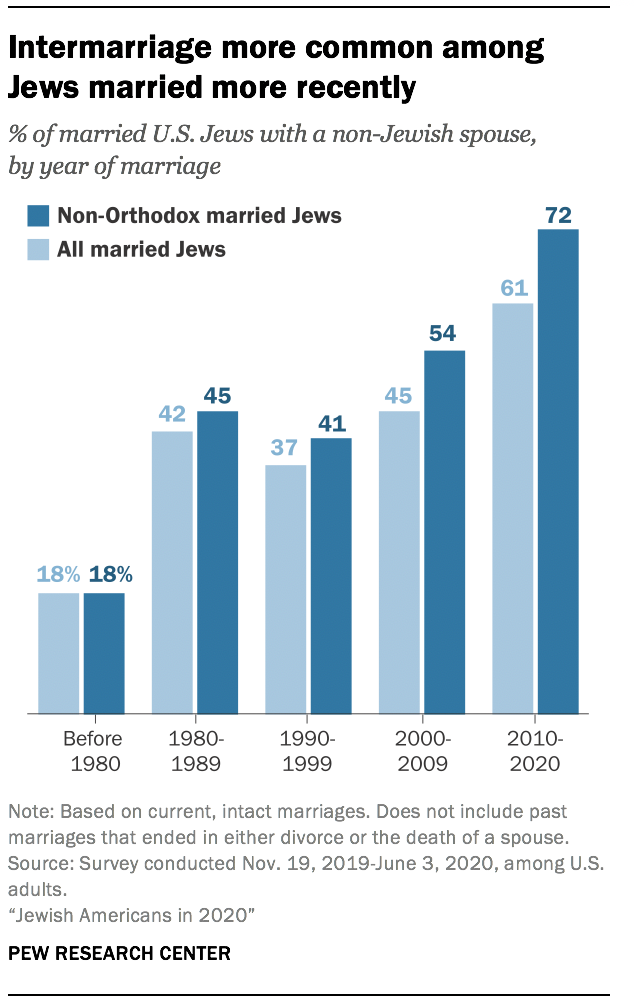
Rates of intermarriage between Jews and non-Jews in the United States are higher among Jews who have married in recent years than among those who married decades ago, a pattern broadly similar to what the 2013 survey found, though there is some variation between the decade-by-decade figures in the two surveys.
Among Jewish respondents who got married in the past decade, six-in-ten say they have a non-Jewish spouse. Among Jews who got married between 2000 and 2009, fewer (45%) are intermarried, as are about four-in-ten who got married in the 1990s (37%) or 1980s (42%). By contrast, just 18% of Jews who got married before 1980 have a non-Jewish spouse.
Intermarriage is almost nonexistent in the Orthodox Jewish community. In the current survey, just 2% of married Orthodox Jews say their spouse is not Jewish. By contrast, among married Jews outside the Orthodox community, about half (47%) say their spouse is not Jewish. And among non-Orthodox Jews who got married in the last decade, 72% say they are intermarried – virtually the same as the 2013 survey found in the decade prior to that study.
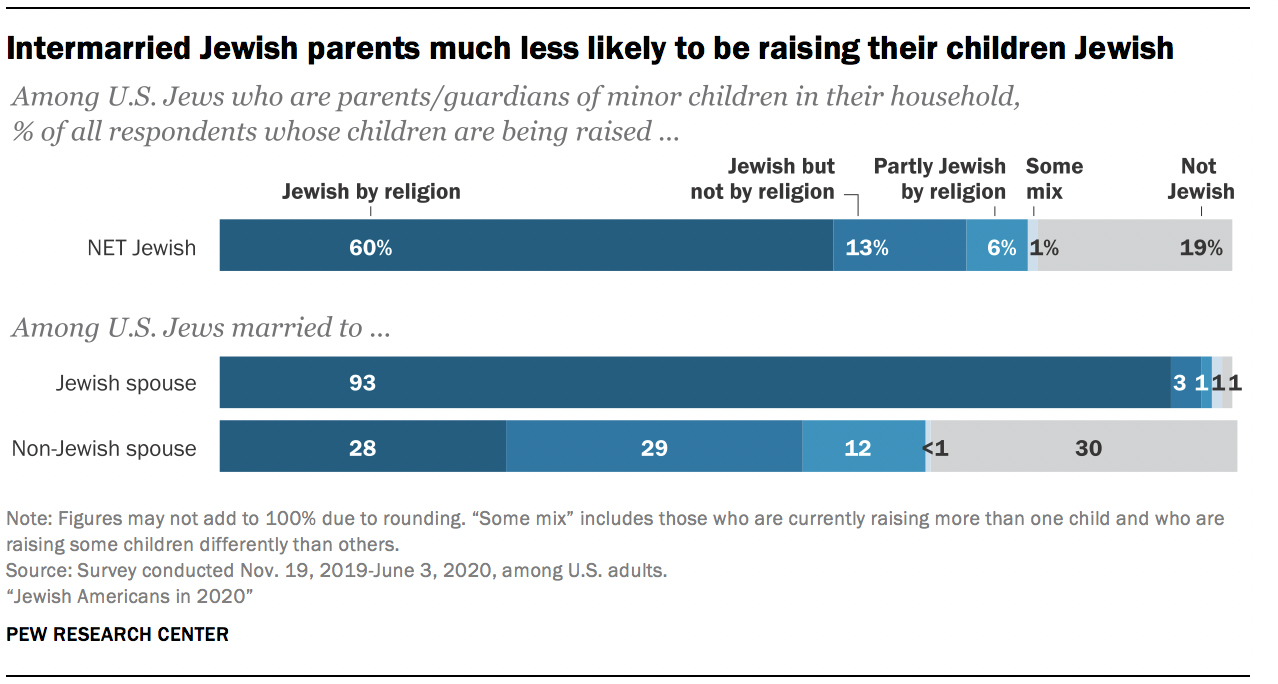
Intermarriage rates also have an intergenerational component: Adult Jews who are themselves the offspring of intermarriages are especially likely to intermarry. In the new survey, among married Jewish respondents who have one Jewish parent, 82% are intermarried, compared with 34% of those with two Jewish parents. Similarly, intermarried Jews who are currently raising minor children (under age 18) in their homes are much less likely to say they are bringing up their children as Jewish by religion (28%) than are Jewish parents who have a Jewish spouse (93%), although many of the intermarried Jews say they are raising their children as partly Jewish by religion or as Jewish aside from religion.
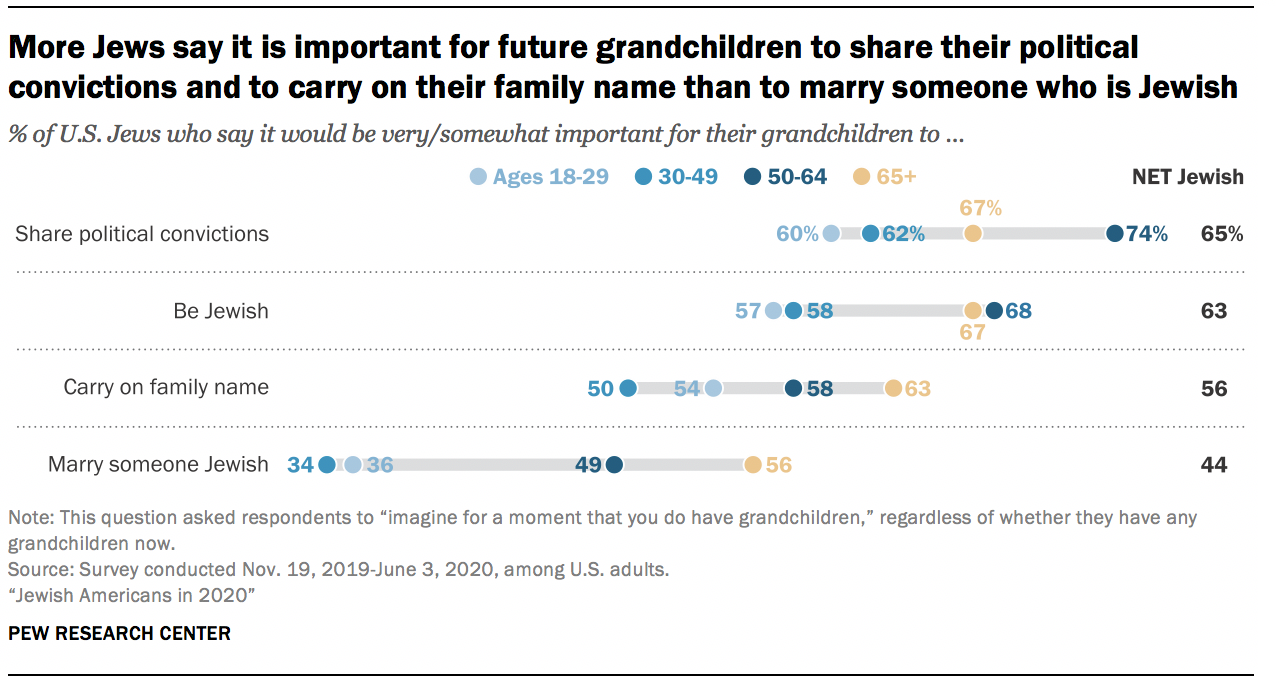
The 2020 survey included a new question aimed at helping to assess the importance to Jewish Americans of passing along their Jewish identity. Asked to imagine a time in the future when they have grandchildren of their own (if they do not currently have any), roughly six-in-ten U.S. Jews say it would be very important (34%) or somewhat important (28%) for their grandchildren to be Jewish. Smaller proportions say it would be very (22%) or somewhat (22%) important for their grandchildren to marry someone who is also Jewish.
The answers to these questions tend to vary by age, with older Jews generally assigning greater importance to Jewish continuity and in-marriage than younger Jews do. But, as previously noted in this report, there is also a kind of divergence taking place in the U.S. Jewish population, with a rising percentage of young Jewish adults who are Orthodox as well as a rising share who describe themselves – in terms of religion – as atheist, agnostic or nothing in particular.
The question about future grandchildren captures one element of this divergence. Three-in-ten Jewish adults under the age of 30 (31%) say it would be “not at all” important for their future grandchildren to be Jewish, which is significantly higher than the share who say this in any other age group. At the same time, 32% of the youngest Jewish adults say it would be “very important” for their grandchildren to be Jewish, which is on par with the share who say the same among older age groups. Among the Orthodox, 91% say it is very important for their grandchildren to be Jewish, compared with 4% among Jews of no religion.
Retention
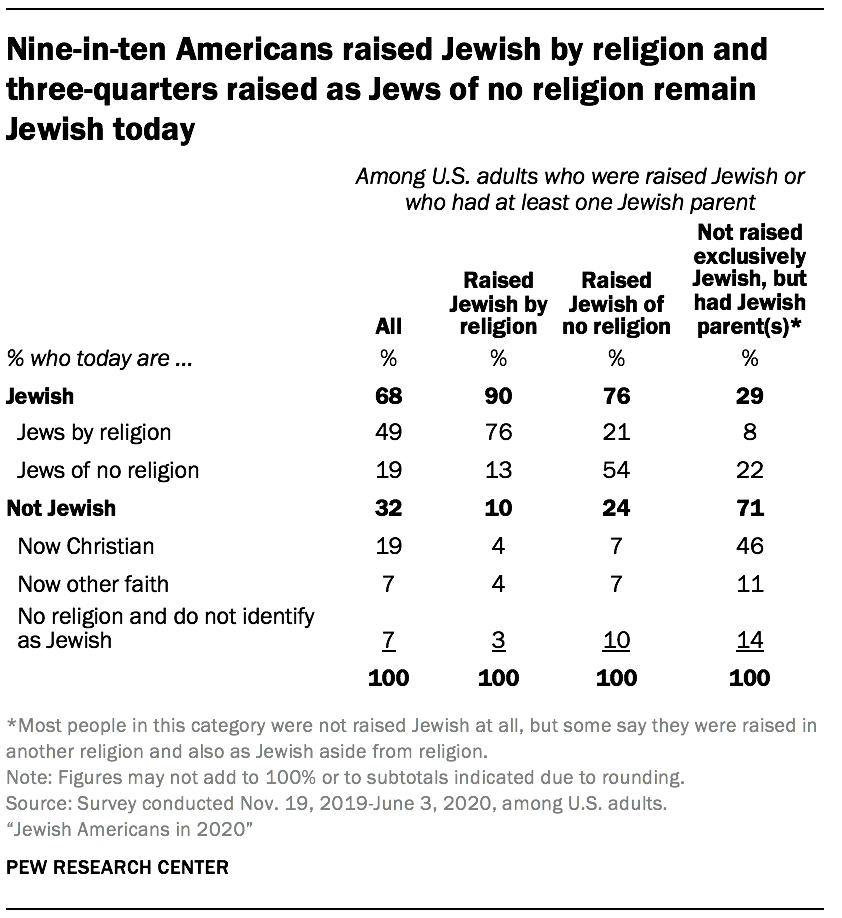
The survey estimates that roughly 8 million U.S. adults were raised Jewish or had a Jewish parent. Six-in-ten were raised Jewish by religion (58%), while 7% were raised as Jews of no religion; another 35% had at least one Jewish parent but say they were not raised exclusively Jewish (if at all), either by religion or aside from religion.
Overall, 68% of those who say they were raised Jewish or who had at least one Jewish parent now identify as Jewish, including 49% who are now Jewish by religion and 19% who are now Jews of no religion. That means that one-third of those raised Jewish or by Jewish parent(s) are not Jewish today, either because they identify with a religion other than Judaism (including 19% who consider themselves Christian) or because they do not currently identify as Jewish either by religion or aside from religion.
Among all respondents who indicate they have some kind of Jewish background, those who were raised Jewish by religion have the highest retention rate. Nine-in-ten U.S. adults who were raised Jewish by religion are still Jewish today, including 76% who remain Jewish by religion and 13% who are now categorized as Jews of no religion. By comparison, three-quarters of those raised as Jews of no religion are still Jewish today; roughly half are still Jews of no religion and about one-in-five are now Jewish by religion. Among those who had at least one Jewish parent but who say they were not raised exclusively Jewish (either by religion or aside from religion), far fewer are Jewish today (29%).
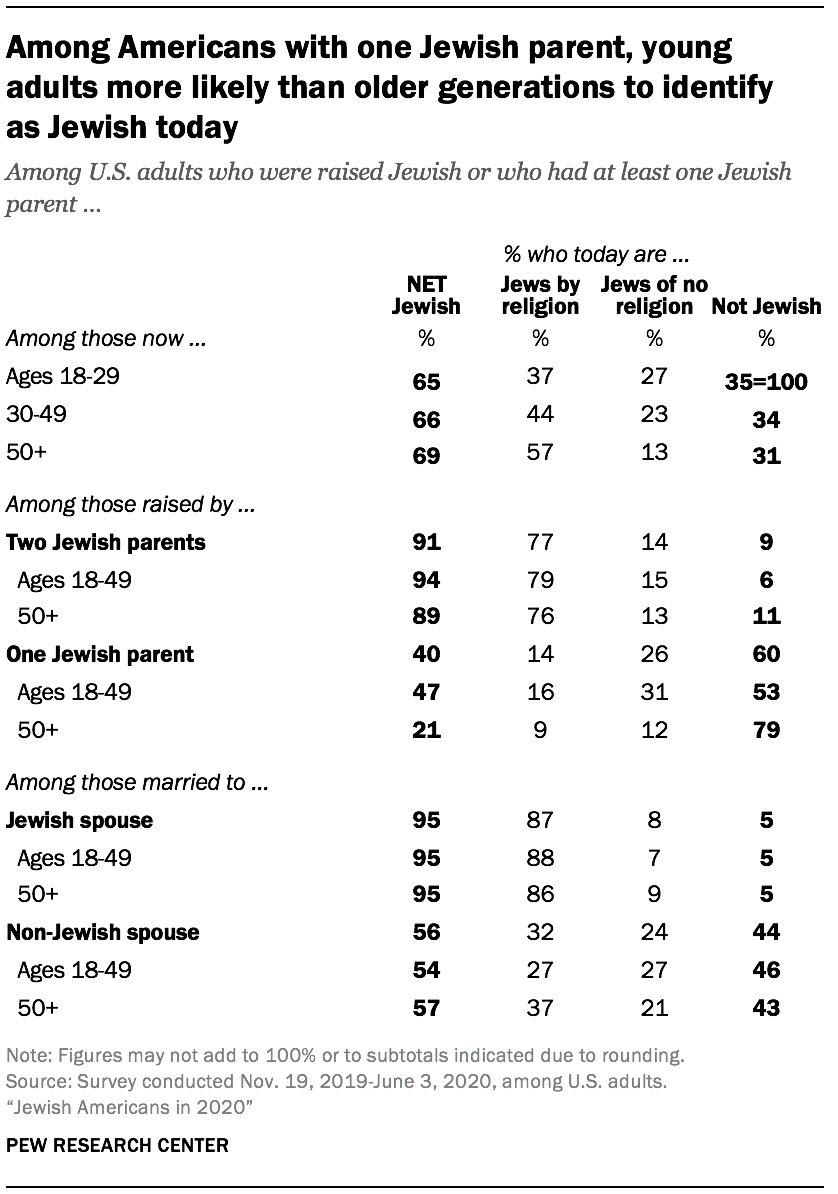
Among people who were raised with a Jewish background, the share who identify as Jewish today is similar across age groups. However, older adults who were raised Jewish or had at least one Jewish parent are more likely to identify as Jewish by religion, while larger shares of young adults say they are Jewish aside from religion. For instance, among those ages 50 and older with a Jewish background, 57% identify as Jewish by religion, compared with 37% among adults under 30.
The data also shows that people with two Jewish parents are more likely than those with just one Jewish parent to retain their Jewish identity into adulthood. However, among people who have just one Jewish parent, younger cohorts are more likely than those ages 50 and older to be Jewish as adults, suggesting that the share of intermarried Jewish parents who pass on their Jewish identity to their children may have increased over time. Or, put somewhat differently, the share of the offspring of intermarriages who choose to be Jewish in adulthood seems to be rising.
The vast majority of adults who were raised with a Jewish background and who now are married to a Jewish spouse identify as Jewish today (95%). By contrast, far fewer of those who have a non-Jewish spouse are Jewish today (56%). However, this does not necessarily mean that marrying a non-Jewish spouse pulls people away from their Jewish identity. The causal arrow could just as easily point in the other direction: People whose Jewish identity is relatively weak may consider it less important to marry a Jewish spouse.
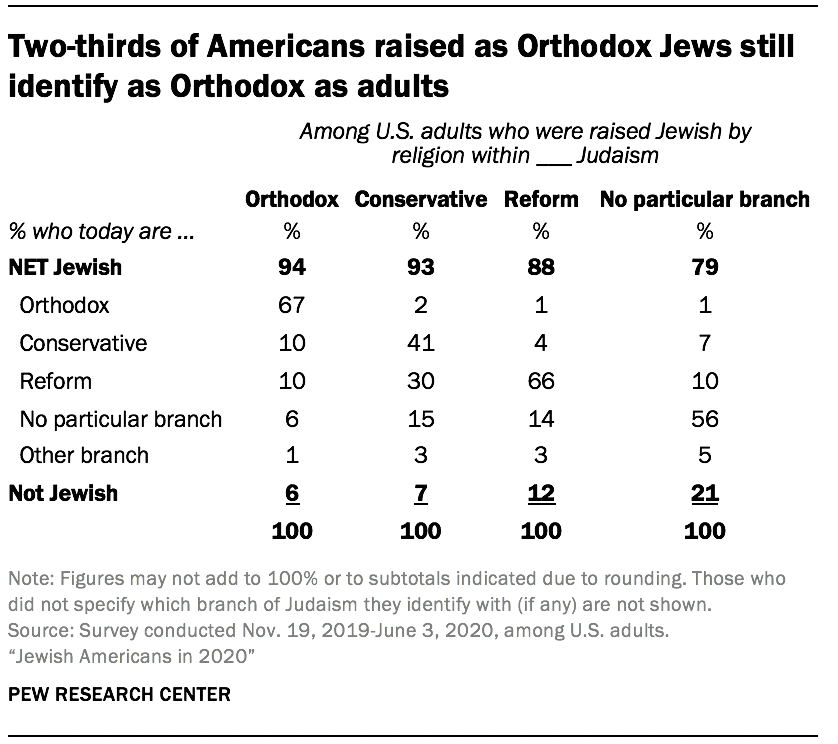
The survey also makes it possible to examine the retention rate of various institutional branches or streams of Judaism in America. Orthodox and Reform Judaism exhibit the highest retention rates of the major streams; 67% of Americans raised as Orthodox Jews by religion continue to identify with Orthodoxy as adults. Similarly, most people raised as Reform Jews by religion also identify as Reform today (66%). The retention rate for those raised within Conservative Judaism is lower; four-in-ten people (41%) raised as Conservative Jews by religion continue to identify with Conservative Judaism as adults, although fully nine-in-ten (93%) are still Jewish.
In some ways, these patterns resemble the findings from the 2013 study. In both surveys, adults who no longer identify with their childhood stream tend to have moved in the direction of less traditional forms of Judaism rather than in the direction of more traditional streams. For example, roughly half of people raised within Conservative Judaism now identify with Reform Judaism (30%), don’t affiliate with any particular branch of Judaism (15%) or are no longer Jewish (7%), while just 2% of people raised as Conservative Jews now identify with Orthodox Judaism. Similarly, about one-quarter of people raised within Reform Judaism now either have no institutional affiliation (14%) or are no longer Jewish (12%), while just one-in-twenty now identify with Conservative Judaism (4%) or with Orthodox Judaism (1%).
However, the share of adults raised within Orthodox Judaism who continue to identify as Orthodox is higher in the new study (67%) than it was in the 2013 survey (48%). This may be due (at least in part) to the fact that, in the new study, the sample of adults who say they were raised as Orthodox Jews includes a larger percentage of people under the age of 30. The 2013 study indicated that the Orthodox retention rate had been much higher among people raised in Orthodox Judaism in recent decades than among those who came of age as Orthodox Jews in the 1950s, ’60s and ’70s. The new survey included too few interviews with those raised as Orthodox Jews to be able to subdivide them by year or decade of birth.
Like other Americans, Jews have been hit hard by coronavirus
Because the survey was designed in 2019 and most of the interviewing was completed before the coronavirus pandemic hit the United States, the results by themselves do not paint a clear picture of the pandemic’s impact on Jewish Americans. However, subsequent polls conducted by Pew Research Center in August 2020 and February 2021 asked more than 10,000 Americans – including 348 and 265 Jews by religion, respectively – about their experiences in the pandemic.
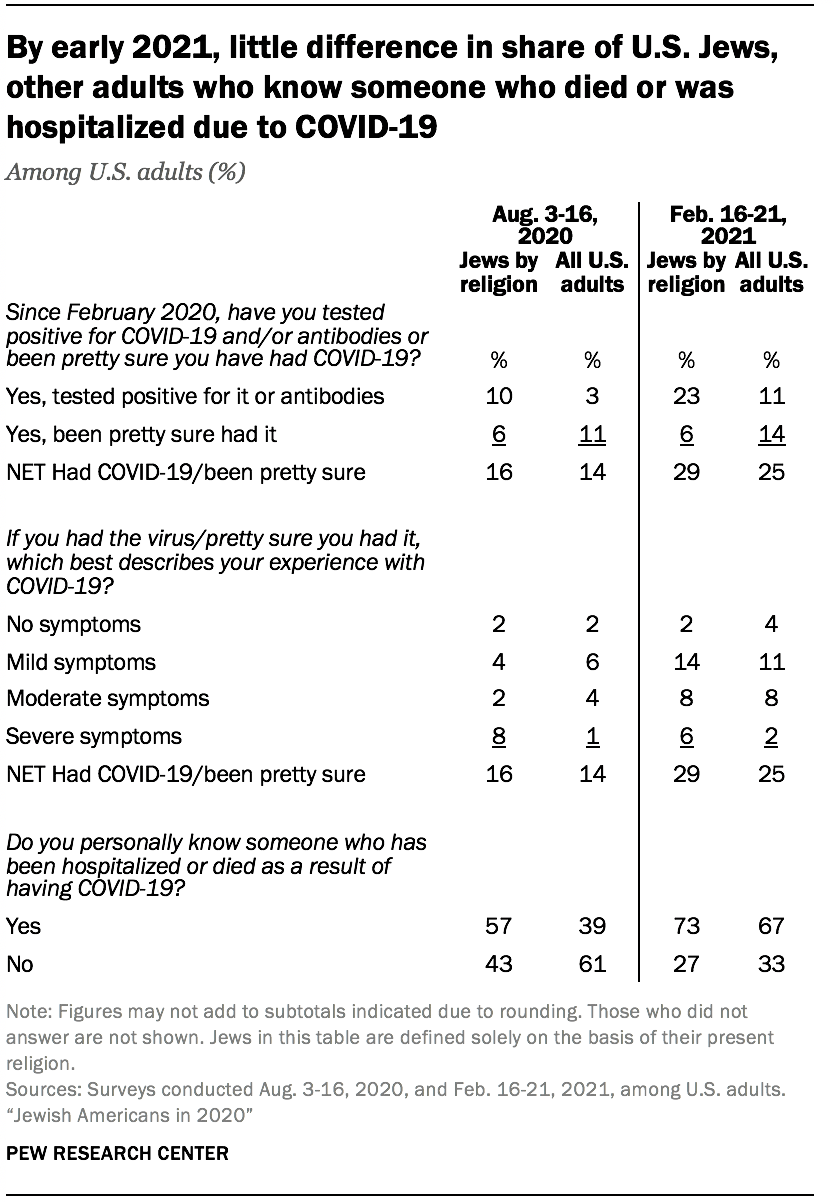
In August 2020, Jews by religion were substantially more likely than U.S. adults overall to say they knew someone who had been hospitalized or died as a result of COVID-19 (57% vs. 39%), likely because many Jews are concentrated in the New York City area, which had the highest number of COVID-19 cases in the country during the first few months of the pandemic. But both numbers had increased and the gap virtually disappeared by February 2021, when 73% of Jews and 67% of all U.S. adults said they personally knew someone who had been hospitalized or died from the coronavirus (the gap between these two figures is not statistically significant due to sample size limitations).
In February, Jews remained twice as likely as U.S. adults overall to say they had tested positive for COVID-19 or for antibodies to the disease (23% vs. 11%). But when looking at the combined share of people who say they have tested positive for the illness and those who say they are “pretty sure” they had it, even if they did not test positive, the difference between Jews (29%) and all U.S. adults (25%) is not statistically significant.
Other findings from Pew Research Center’s 2020 survey include:
Nearly four-in-ten U.S. Jews feel they have a lot (4%) or some (34%) in common with Muslims. Fewer say they have a lot (2%) or some (18%) in common with evangelical Christians. Jews who do not identify with any denominational branch are more likely to say they have at least some in common with mainline Protestants and Muslims than to say the same about Orthodox Jews.
Nearly two-thirds of U.S. Jews (64%) say rabbis should perform marriage ceremonies for interfaith couples (that is, between someone who is Jewish and someone who is not), and an additional 25% say “it depends.” Just 9% flatly object to rabbis performing interfaith weddings. Among Orthodox Jews, however, 73% say rabbis should not officiate at such weddings.
Seven-in-ten U.S. Jews (71%) say rabbis should officiate at same-sex weddings, while 13% say it depends. Just 15% oppose rabbis performing marriage ceremonies for same-sex couples. But among Orthodox Jews, 82% object.
About one-in-ten U.S. Jewish adults identify as gay or lesbian (4%) or bisexual (5%); 88% say they are straight, 1% say they are something else, 1% say they don’t know and 1% declined to answer the question.
Just under half of U.S. Jewish adults (45%) have been to Israel. Among Jews in the survey ages 25 to 34, one-quarter say that they have been on a trip to Israel sponsored by Birthright, an organization that provides free travel to Israel for young U.S. Jews.
Nearly one-in-five Jews say they often (5%) or sometimes (12%) participate in activities or services with Chabad. This is especially common among Orthodox Jews; 46% say they participate in Chabad activities at least sometimes, compared with 25% of Conservative Jews, 12% of Reform Jews and 8% of Jews who do not identify with any particular branch of Judaism.
Jews continue to have high levels of educational attainment. Nearly six-in-ten are college graduates, including 28% who have earned a postgraduate degree. By way of comparison, about three-in-ten U.S. adults overall are college graduates, including 11% who have earned a postgraduate degree.
One-in-four American Jews say they have family incomes of $200,000 or more (23%). By comparison, just 4% of U.S. adults report household incomes at that level. At the other end of the spectrum, one-in-ten U.S. Jews report annual household incomes of less than $30,000, versus 26% of Americans overall.
At the time of the survey (which was mostly fielded before the coronavirus outbreak in the United States), half of U.S. Jews described their financial situation as living “comfortably” (53%), compared with 29% of all U.S. adults. At the same time, 15% of Jewish adults said they had difficulty paying for medical care for themselves or their family in the past year, 11% said they had difficulty paying their rent or mortgage, 8% said they had a difficult time paying for food, and 19% had trouble paying other types of bills or debts.
Roadmap to the report
The remainder of this report explores these and other findings in more detail. Chapter 1 provides estimates of the size of the U.S. Jewish population using various definitions of Jewishness. Chapter 2 examines Jewish identity and beliefs, including affiliation with various branches of Judaism, what U.S. Jews consider essential to being Jewish, and where they find meaning and fulfillment. Chapter 3 explores Jewish practices and customs, including some traditional religious practices (such as synagogue attendance) and some more “cultural” Jewish activities. Chapter 4 looks at marriage and families, including rates of intermarriage, how Jewish survey respondents say they are raising their children, and whether respondents attended Jewish day schools or camps. Chapter 5 delves into measures of community and connectedness, such as how much responsibility U.S. Jews feel toward fellow Jews around the world and how much they say they have in common with other Jews. Chapter 6 describes experiences and perceptions of anti-Semitism, as well as perceived levels of discrimination against other groups in U.S. society. Chapter 7 analyzes U.S. Jewish attitudes toward Israel, prospects for a peace settlement with Palestinians, and the BDS movement. Chapter 8 focuses on U.S. Jews’ political affiliations and views, including on former President Donald Trump, who was still in office when the survey was conducted. Chapter 9 explores measures of race, ethnicity, Jewish heritage and country of origin among U.S. Jews. Chapter 10 describes how Jewish adults answered other demographic questions, including about their age, education, region of residence, fertility and sexual orientation. Chapter 11 looks at measures of economic well-being and vulnerability, including employment status and occupation. And Chapter 12 summarizes the survey’s findings on people of Jewish background and Jewish affinity – two groups that have a connection to Judaism but that are not classified as Jewish for the purposes of this report.
The CIA missed the mark once again with its latest “woke” recruitment ad (Twitter/@CIA)
The CIA is continuing its “woke-washing” recruitment campaign with a new video about a gay librarian who claims to be “stunned” by the agency’s inclusivity.
The heavy-handed “Humans of CIA” series was met with hilarity on both sides of the political spectrum as liberals and conservatives alike mocked the CIA’s attempt at co-opting progressive language and values.
The first awkward video starred a “cisgender millennial” Latina officer, but for the next instalment the HR team ramped up the saccharine levels to maximum.
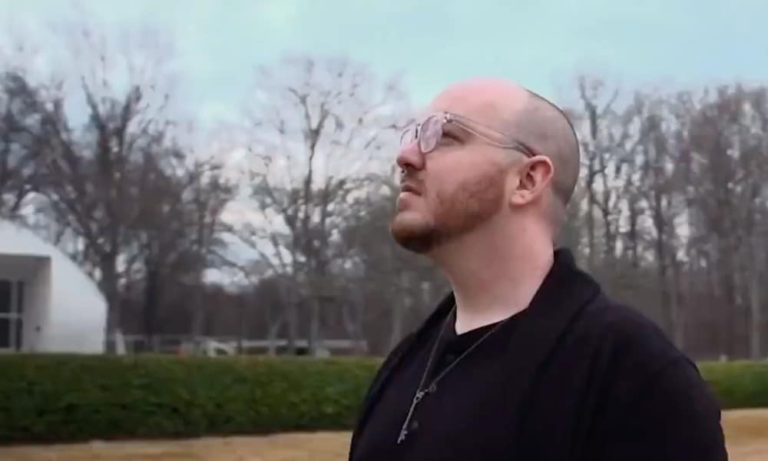
It opens on an unnamed employee who describes himself as an “agency librarian”. His voiceover is accompanied by a video montage of him at work, filmed in slow motion for extra wholesomeness.
“Growing up gay in a small Southern town, I was lucky to have a wonderful and accepting family,” he says in the clip. “I always struggled with the idea that I may not be able to discuss my personal life at work.
“Imagine my surprise when I was taking my oath at the CIA and I noticed a rainbow on then-Director [John] Brennan’s lanyard,” he continued.
He later learns it was designed by ANGEL, one of the CIA’s many employee research groups. “I remember being stunned,” he says.
“Officers from the top down work hard to ensure that every single person, whatever their gender, gender identity, race, disability, or sexual orientation, can bring their entire self to work every day.”
(Thread) The woke CIA is back with a whole set of new videos.
1.“Growing up gay in a small Southern town, I always struggled with the idea that I may not be able to discuss my personal life at work. Imagine my surprise when I noticed a rainbow on CIA Director Brennan’s lanyard.” pic.twitter.com/K9Hw7SOevl
“China is laughing at us,” tweeted Donald Trump Jr in response – and by the sounds of it, most of America is laughing too.
While conservatives like Trump were baffled by the inclusive messaging, liberals found it just as jarring to hear it from an agency notorious for its human rights violations.
Some of these violations were inflicted on queer people, who until relatively recently were “purged” from federal agencies – including the CIA – as they were deemed a threat to national security.
One Twitter user described the ad as “the most serious-looking satirical video I’ve ever seen,” but unfortunately, the CIA was deadly serious. And the internet was having none of it.
Aw… I’m just going to love having my rights raped by a diverse CIA.
“At first I was worried when we arrived at the blacksite, but when I saw that the piano wire was a rainbow pattern, I knew that I wouldn’t be murdered by bigots”
“Join the CIA, literally the most Evil Organization in the totality of the world, and now also the most Inclusive Evil Organization of the Modern Age. Here’s an Ad showing a Gay CIA Librarian playing with toys”
The CIA pushed back against the mounting criticism in a statement last week, telling Fox News that the controversial ad proved effective at helping attract candidates to the agency.
“2020 was a standout recruitment year for CIA despite the pandemic,” a CIA spokesman said. “Our 2021 incoming class is the third-largest in a decade.”
The CIA is continuing its “woke-washing” recruitment campaign with a new video about a gay librarian who claims to be “stunned” by the agency’s inclusivity.
The heavy-handed “Humans of CIA” series was met with hilarity on both sides of the political spectrum as liberals and conservatives alike mocked the CIA’s attempt at co-opting progressive language and values.
The first awkward video starred a “cisgender millennial” Latina officer, but for the next instalment the HR team ramped up the saccharine levels to maximum.
It opens on an unnamed employee who describes himself as an “agency librarian”. His voiceover is accompanied by a video montage of him at work, filmed in slow motion for extra wholesomeness.
“Growing up gay in a small Southern town, I was lucky to have a wonderful and accepting family,” he says in the clip. “I always struggled with the idea that I may not be able to discuss my personal life at work.
“Imagine my surprise when I was taking my oath at the CIA and I noticed a rainbow on then-Director [John] Brennan’s lanyard,” he continued.
He later learns it was designed by ANGEL, one of the CIA’s many employee research groups. “I remember being stunned,” he says.
“Officers from the top down work hard to ensure that every single person, whatever their gender, gender identity, race, disability, or sexual orientation, can bring their entire self to work every day.”
“China is laughing at us,” tweeted Donald Trump Jr in response – and by the sounds of it, most of America is laughing too.
While conservatives like Trump were baffled by the inclusive messaging, liberals found it just as jarring to hear it from an agency notorious for its human rights violations.
Some of these violations were inflicted on queer people, who until relatively recently were “purged” from federal agencies – including the CIA – as they were deemed a threat to national security.
One Twitter user described the ad as “the most serious-looking satirical video I’ve ever seen,” but unfortunately, the CIA was deadly serious. And the internet was having none of it.
The CIA pushed back against the mounting criticism in a statement last week, telling Fox News that the controversial ad proved effective at helping attract candidates to the agency.
“2020 was a standout recruitment year for CIA despite the pandemic,” a CIA spokesman said. “Our 2021 incoming class is the third-largest in a decade.”
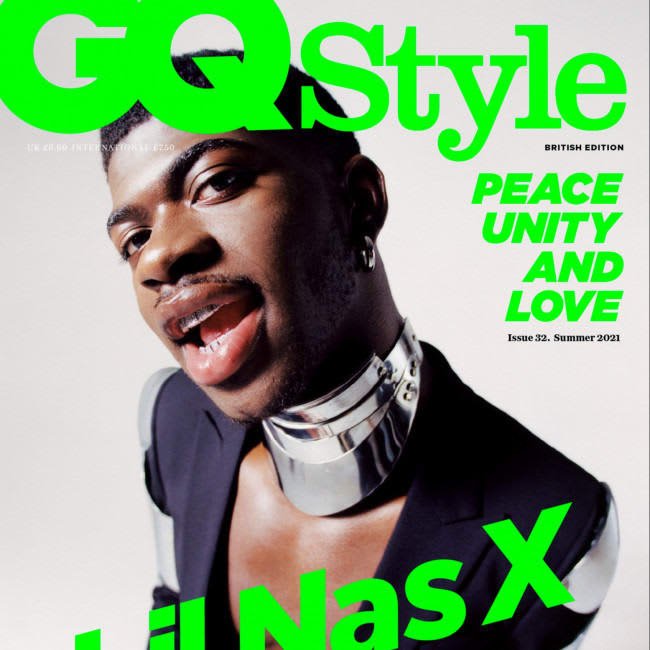
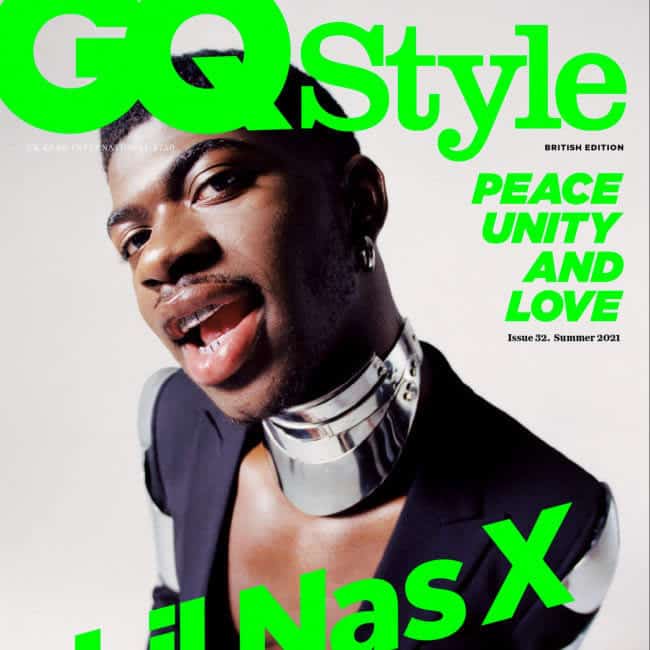
Lil Nas X has insisted it’s “not [his] job” to be a good role model.
The 22-year-old rapper – whose real name is Montero Lamar Hill – shot to fame in 2019 when he released his hit single, ‘Old Town Road’, and has said that whilst he originally felt “a sense of responsibility” to be a role model for his fans, he now “doesn’t care”.
When asked about being a good role model, he said: “At first I felt a sense of responsibility. But now I kind of just don’t care. It’s not my job. Of course I want to spread good ideals, but I’m not nobody’s parents. At the end of the day, I’m just doing me, and hoping everybody else is following the lead, and doing themselves.
“Part of my plan is to make sure people know I’m going to do whatever the f*** I want, when I want to, and if you’re mad at it, I’m going to laugh in your face.”
Nas X recently released his latest single, ‘Montero (Call Me By Your Name)’, and accompanied it with a note written to his 14-year-old self, in which he reflected on coming out as gay two years ago.
And now, the musician says he initially feared he would have to be “straight passing” if he wanted to continue his career.
Speaking to GQ Style magazine, he explained: “[I thought that I wouldn’t be] allowed to be really sensual or anything … like, I’m gay but I’m not ‘gay’ … like, I’m gay but I have to make sure you feel like I can be straight passing too.”
Nas X also reflected on his Christian upbringing, and admitted he “never wanted to be gay” when he was growing up because he thought it was “just a test” from God.
He added: “That was one of the main reasons why I never wanted to be gay; he says. ‘I even thought, “If I have these feelings, it’s just a test. A temporary test. It’s going to go away. God is just tempting me.’”
See the full feature in the GQ Style SS21 issue available on newsstands Thursday (13.05.21), and online at https://www.gq-magazine.co.uk/culture/article/lil-nas-x-interview-2021
Ghanaian actor, Nana Tarzan has recalled a time in his life where he believes he will never go back. He reveals that after years of having sexual relations with different men, he stopped because he realised it ’wasn’t normal.’
In an exclusive with SVTV Africa on May 10, Nana stated that he began to feel pain in his anus; with a foul smell. As a result, he visited the hospital where he was put on medication and eventually treated. According to Tarzan, the medication administered to him meant he could not visit the toilet for three months.
“He left me when he noticed the foul smell coming from my anus. I could not feel anything down there. So I had to wear pampers and most gay men still do,” Nana Tarzan.
The actor, who is now an anti-LGBTQI+ activist seeks to educate and share his experience with young adults in high schools and colleges especially.
“That lifestyle began in school for me and that is where the problem lies. They mostly come with money and promises but in the end, you lose,” he advised.
Rachael Ray is known to many as a connoisseur of 30-minute meals, a home cook who prefers things to be quick and simple. Ray has been a star on the Food Network for several decades and has published numerous bestselling books.
There’s no doubt that Ray lives a high-profile life, with many projects in the works at all times. Still, Ray likes to keep her home life calm, and fortunately, when she’s ready to escape the limelight, she can turn to the support of her husband, the successful musician John Cusimano, an artist who recently made headlines with a bold new musical venture.
When did Rachael Ray and her husband get married?
Rachael Ray (right) with husband John Cusimano | Alexander Tamargo/Getty Images for SOBEWFF
Ray was just beginning her rise to fame when she met Cusimano at a party. They hit it off quickly, although Ray didn’t initially see that their relationship would be romantic.
As she later described, “he told me what he had made himself for dinner the night before, and I assumed that if you’re not a chef and you made what he told me he made, that he was gay. So I was going to set him up with a friend of mine — another handsome Italian man — and he said, ‘Oh, I’m not gay!’ So we stayed out until 4 in the morning that really was our first date.”
Not long after they started dating, Ray and Cusimano moved in together, getting engaged on the day that they moved into their new apartment. Ray and Cusimano married in 2005, and have been together ever since, renewing their vows on several occasions.
Ray might be the only television star in the Ray-Cusimano household, but she’s definitely not the only one who works in the entertainment space. Cusimano is a popular musician, and for years, has headlined a band called The Cringe. As the lead singer for The Cringe, Cusimano has written several songs for his wife and has appeared on The Rachael Ray Show as a performer.
Cusimano has praised Ray as being the perfect supporter for his musical ambitions: “She’s our best and biggest fan, tremendously supportive whether it’s on social media or talking about it on the show, which is great.”
In recent months, Cusimano has made headlines with a different band — and he did so in an entirely unexpected way.
John Cusimano recently unveiled a new musical endeavor
In the early part of 2020, Cusimano and Ray went through several major traumas — losing their beloved pet dog Isaboo, and then, extensive damage to their New York home due to a fire. While Ray and Cusimano were both safe, the combined stress caused Cusimano to look into new means of creative expression.
Cusimano teamed up with his friends, fellow musicians Bob Schneider, Jonny Blaze, and Andrew Meskin, deciding to launch an entirely new band. Calling themselves Fastest Land Animal, Cusimano and his bandmates developed pseudonyms and recorded an entire album remotely.
Cusimano later revealed that he found the prospect of releasing music anonymously very exciting, stating “I was kinda thinking we should never do the big reveal. I’m almost inclined to just keep the mystery going.”
In March 2021, Fastest Land Animal released their debut album, receiving critical praise — and eventually, prompting the group to reveal their “secret” identities, via a music video on the group’s website. While the future of Fastest Land Animal remains uncertain, it seems as though the group definitely succeeded in what they set out to do — make headlines, surprise some fans, and make some good music.
Some groups say a ban could infringe on traditional religious teachings, such as the belief that all sex outside a heterosexual marriage is sinful. The Evangelical Alliance, which says it represents 3,500 churches, has suggested an “expansive definition” of conversion therapy could restrict religious freedoms.
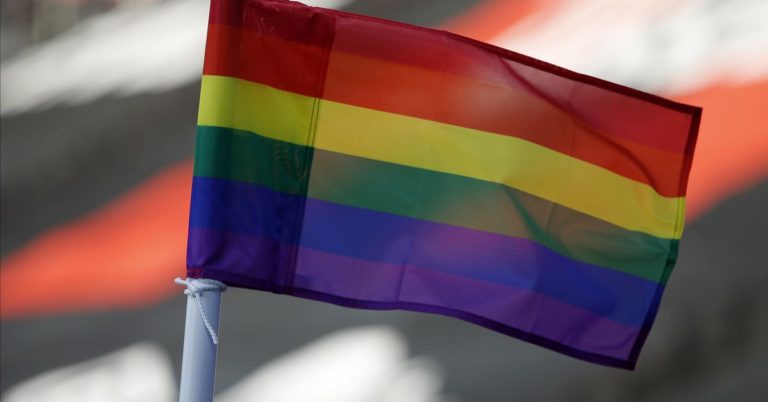
Soccer Football – Championship – AFC Bournemouth v Huddersfield Town – Vitality Stadium, Bournemouth, Britain – December 12, 2020 General view of a rainbow corner flag in support of the Stonewall campaign before the match Action Images/Andrew Boyers
Britain will move to ban conversion therapy and provide more support to those in the LGBT community who have undergone the treatment, as part of its post-pandemic government agenda.
Prime Minister Boris Johnson’s government said measures would be brought forward to prevent these “abhorrent practices which can cause mental and physical harm”, starting with a consultation on how best to protect people and how to eliminate coercive practices.
Johnson’s party has come under increasing pressure on the issue after former leader Theresa May vowed in 2018 to eradicate a procedure that aims to change or suppress someone’s sexual orientation or gender identity.
However some faith leaders had argued that a wide ban could implicate those who offer pastoral support including prayer.
Setting out the new parliamentary agenda in a briefing document alongside the Queen’s Speech, the government said: “We will ensure medical professionals, religious leaders, teachers and parents can continue to be able to have open and honest conversations with people.”
A 2017 National LGBT survey found that 5% of those who responded reported being ordered, and 2% reported having undergone, conversion therapy. In more than half of the cases the therapy was offered or conducted by faith organisations.
Things are certainly not all peace, love, and understanding in the world of LGBT activism, and no one knows this better than lesbians. Just like women’s locker rooms, their unique spaces are being erased by men who believe they are women. Indeed, The New York Times recently noted the death of the lesbian bars but delicately refused to connect the dots to why.
Also highlighted by The New York Times, The Lesbian Bar Project was founded last October to lament the fact there remains only a small handful of lady meet-up watering holes in the entire United States, where there used to be hundreds. Leftist California has precisely as many lesbian bars as backwater Alabama: one. New York tops the nation with three — all in Gotham. Most states, however, now have none.
So, what’s up? Are women losing interest in women? No, such spaces are dying because biological men who believe they are women are demanding full inclusion in lesbian spaces as unquestioned equals, insisting actual women put on a smile and adjust their plans accordingly.
This fact is unwittingly captured in the Lesbian Bar Project’s own definition of what a lesbian bar is:
We believe that what makes a bar uniquely Lesbian is its prioritization of creating space for people of marginalized genders; including women, non-binary folks, and trans men. … As these spaces aim to be inclusive of all individuals across the diverse LGBTQIA+ community, the label Lesbian belongs to all people who feel that it empowers them.
Yes, the capricious and unbending god of gender inclusion requires the Lesbian Bar Project to define “lesbian” right out of a lesbian bar because being lesbian turns out to be a bit too binary and “bioessentialist,” the new unpardonable sin in queer politics. The problem, however, is certainly not confined to lesbian bars.
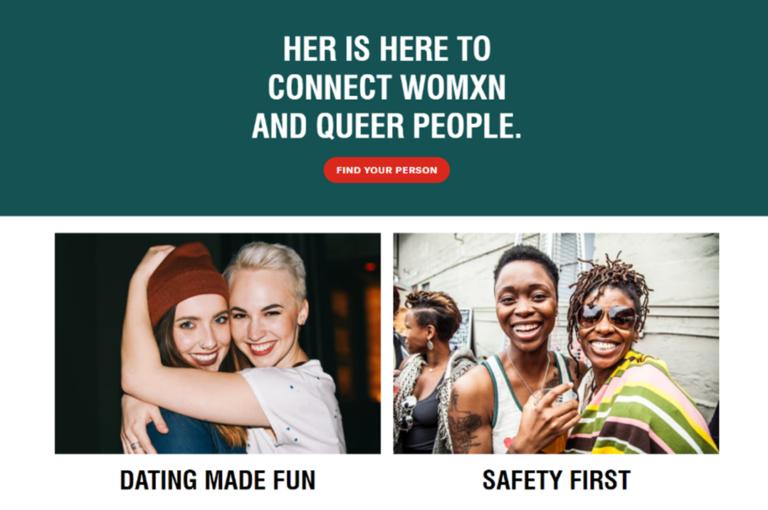
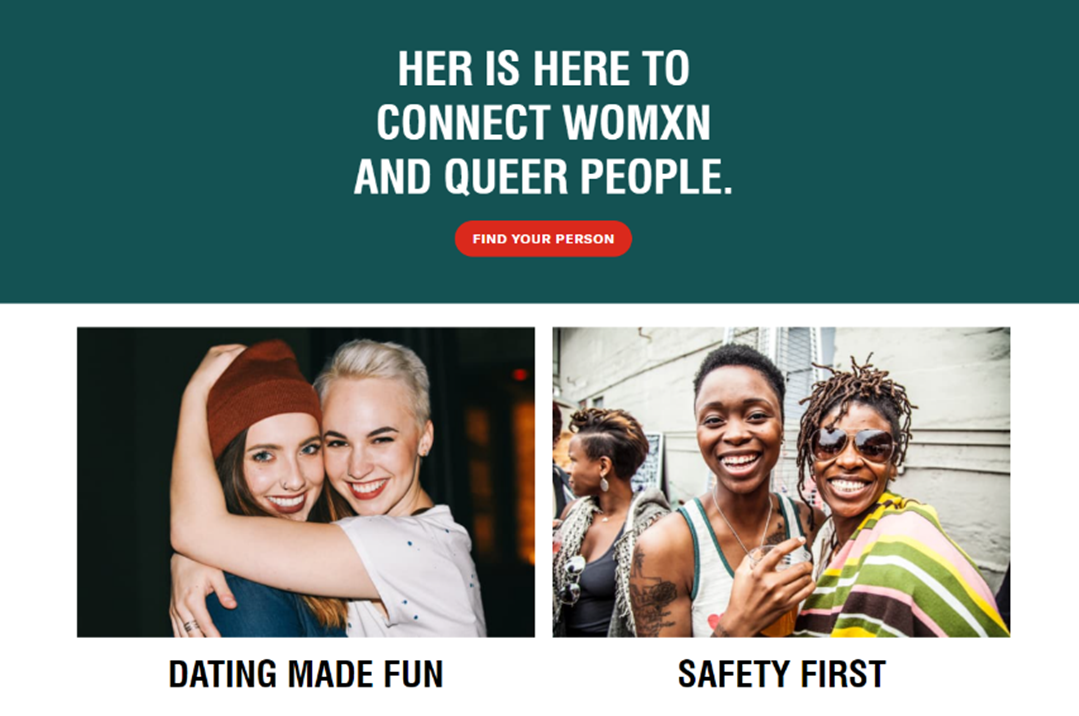
Zoe, one of the largest lesbian dating sites, proudly declares itself “the World’s Best Ranked Dating App for Queer Women.” The word “lesbian” is quickly falling out of fashion and is only used once on the entire website. They favor the term queer instead.
Her, another popular lesbian dating site, goes even further, banning both the L- and W-word, explaining they exist “for queer womxn, by queer womxn” and exist “to connect womxn and queer people.” Users enter by clicking the de-gendered red button marked “Find your person.” Inclusivity now excludes women.
Lesbians and other feminists have properly excoriated this erasure. But they are being told to hush and go along. The Washington Post recently charged in a banner headline that saying lesbians are going extinct is “the latest form of transphobia.”
The article trains both barrels on gay rights trailblazer Andrew Sullivan because he had the temerity to ask plaintively, “Where have all the lesbians gone?” Drawing attention to this inconvenient fact in queer politics today, Sullivan observes, “The social justice revolution has space for … dozens of pronouns, but not so much leeway for women who love women and not men.”
Sullivan is dead right on. Before our eyes, the trans movement is eclipsing the women’s movement. Literally and explicitly, gender studies have displaced women’s studies.
Of course, the false and wholly manufactured claim that “trans rights are human rights” cannot peacefully coexist with the inherently true claim that “women’s rights are human rights.” Exemplifying the very strange fork that queer politics has brought us to, J.K. Rowling has been called out in the most violent and misogynistic ways by trans activists for simply reminding the world we have a perfectly lovely word to describe “people who menstruate.”
Another feisty woman who knows about this all too well is Kellie-Jay Keen, a delightfully opinionated British women’s rights activist who heads Standing for Women. She was forced to take down a billboard she paid to have erected in Liverpool because its simple message asserting the most basic biological fact was deemed transphobic. What was so offensive? Her minimalist advert merely stated the word “woman” means “adult human female.”
The BBC reported a man succeeded in getting the billboard removed by simply claiming it was a “symbol that makes transgender people feel unsafe.” Keen deftly explained to Sky News why this man and his buddies were wrong, “I have led as much a transphobic campaign as you have led a misogynist one.” Yet the men in dresses prevailed.
In the blink of an eye, it’s evident biological men who believe they are women are far more favorably situated in the LGBT power differential than actual women. Just consider how President Biden’s day-one groundbreaking trans activism unwittingly erased what a Hillary presidency was supposed to have gained for women.
Abortion supporters have long and proudly claimed they stand for “women’s health care.” But we’re now told such language is transphobic and to be avoided because “We do pregnant people a huge disservice when we imply with our word choices that cisgender women are the only ones who need reproductive care.”
Pregnant people? Of course, because as HuffPost informs us, “Women aren’t the only people who get abortions” as “men and other gender non-conforming folks get abortions too.” Even the academic Journal of Women’s Health declares “It’s time for OBGYNs to care for people of all genders.”
Like the lesbian bar, you would imagine La Leche League would be another ultimate safe woman’s space. Not so. The organization officially explains that trans inclusion requires, “All nursing parents need support and La Leche League is a great place to find it.” Staff, volunteers, and clients are now encouraged to use the term “chestfeeding” to “express support for parents of all gender identities and all family structures.”
Yes, the word “breasts” can make trans men feel uncomfortable, so Le Leche even allows trans men to lead “chestfeeding” classes. One of the most famous is Canadian Trevor MacDonald, a goatee’d trans man who has written instructional materials for La Leche League and “new breastfeeding parents.” “Mother,” you see, is now a naughty word in the breastfeeding world.
Even Piers Morgan scolded CNN last summer for their silly public service announcement that “Individuals with a cervix are now recommended to start cervical cancers screening…”
Clearly, as it now goes in the LGBT social justice economy, old-fashioned misogyny clearly ranks well below trans-misogyny as an intolerable offense. Worse, misogyny is not only tolerated but enlisted as a weapon of choice in the internecine LGBT culture war.
Again, the overarching troubling dynamic is this: Trans rights and women’s rights cannot coexist and are inherently competing claims. Thus far during the current cannibalization of the LGBT political construct, the “Ts” and “Qs” are rapidly consuming the “Ls.”
All of this should have been easily anticipated by anyone who took the truth claims of gender theory seriously. If male and female are merely social constructs and binarity is the new flat earth, then the spectrum — and every possible new gender and sexual orientation it can dream up — must always prevail.
Ultimately, in this terribly problematic turn for a movement that is supposed to be all about advancing human rights, lesbians are the canaries in the coal mine.
The despisers of the body are at it again. In this case, they are in Kentucky, where the Democrat governor’s administration is trying to shut down a Baptist foster care and adoption agency for being, well, Baptist.
There are many similar cases across the country — including one under consideration by the Supreme Court — with Christian ministries penalized for adhering to Christian beliefs about sex and the sexes. Put simply, Christians believe that our physical embodiment as male or female matters, and therefore that men and women are not interchangeable for marriage and family.
Several lessons may be drawn from these cases. First, biblically-commanded care for the orphaned, abandoned, and neglected, including foster and adoption work, often requires involvement with, and even dependence upon, the government.
Second, these conflicts also reveal modern liberalism’s frailty. Under a broadly liberal regime — understood in the general sense wherein nations are described as liberal democracies — we’re promised a neutral framework in which those with radically different beliefs may nonetheless live peaceably together while pursuing the good as they see it.
Yet the government imposition of an anti-Christian orthodoxy regarding sex and gender belies this assurance. In such circumstances, Christians should appeal to our religious liberty rights, insisting that the American promises of tolerance and liberty for religious dissenters must be honored even by a political party that disagrees with us.
But we must not simply be content with protecting our rights. The Christian understandings of sex, gender, and marriage are rooted in more than idiosyncratic religious dogmas. They are based on the experiential reality of human embodiment. Christians, therefore, have a duty — not only on behalf of ourselves but for all — to combat modern ideologies that loathe our physical nature, especially the reality of biological sex.
The truth that our male and female embodiment matters far beyond our subjective preferences and identities is not just for Christians, nor is the corollary understanding of marriage as a union of male and female. Rather, they reflect the experiential reality of our embodied being. Christian groups that stand firm in proclaiming and living by these truths are doing so on behalf of everyone, not just Christians.
We may thereby provide a corrective to our culture’s curious relationship with the body, which simultaneously celebrates and despises it. Physical beauty is all but worshiped, and bodily pleasure — especially of a sexual nature — is treated as the highest good.
Yet the givenness and finitude intrinsic to embodiment are loathed, especially the sexual dimorphism of humanity. This double-mindedness is obvious in the disputes regarding same-sex marriage and gender identity.
Same-sex marriage, for instance, presumes that bodily sex is both essential and unimportant. The difference between male and female is treated as indispensable to the subjective choice of one’s partner, but irrelevant insofar as that choice dispenses with the connection between marriage and the sexual complementarity of humanity.
In a historic sense, this is all both radically distinctive and baffling. Other cultures have condoned some homosexual relations, but they did not confuse same-sex relationships with marriage and its union of the two halves of the human species, the physical aspect of which provides for the continuation of the species.
Indeed, we all owe our very existence to the embodied difference between men and women. And mothers and fathers matter for raising children, as well as begetting them. This is why faithful Christian adoption agencies do not place children with same-sex couples. Doing so deliberately deprives an already traumatized child of either an adoptive mother or a father.
The triumph of the same-sex marriage movement rested not only on the view that homosexual relations are morally licit, but that marriage is severable from the union of male and female. This disdain for the fundamental realities of bodily existence is why there has been such a seamless shift from the campaign for same-sex marriage to the transgender movement. The deliberate effacing of biological sex that was central to the campaign for same-sex marriage paved the way for the more radical claims of the transgender advocates.
Transgender ideology intensifies the dynamic of despising physical embodiment while still paying grudging tribute to it. Transgenderism presumes the reality of sex — otherwise, there would be nothing to transition from or toward — even as it works to efface it. The loathing of embodiment as imprisoning is much more evident, as healthy bodies are declared to be “wrong” and treated as mere material to be mastered and reshaped.
The absurdities that transgender ideology foists upon its adherents (such as using clumsy formulations such as “birthing person” instead of “mother” or “woman”) are efforts to escape the constraints of embodiment. Physical reality cannot be done away with, but, advocates hope, it can at least be stripped of all meaning.
So, for instance, they insist that sex is “assigned at birth” rather than revealed. According to their view, our bodies may be formed without our consent, but they are devoid of meaning and purpose until we assign it to them. In this view, our bodies are of value only insofar as they conform to our wills and satisfy our desires.
This is a rebellion against the givenness of our physical embodiment and the nature of our being. We are finite and limited, and receive existence on terms we did not dictate. Indeed, it is impossible to dictate the terms of our existence before it. S revolt against the structure of our existence will necessarily impose itself on others as it attempts to reorder reality.
Thus, those engaged in this revolt — those bent on remaking bodies, language, and society to accord with their desires — will not bother to persuade if they can command, or to reason if they can suppress. To take the case at hand, they will eagerly shut down foster care and adoption agencies to stick it to nonconformists and dissenters from their new orthodoxy.
Their efforts may beat down the opposition for a time. But the truth about our bodily existence will not go away, no matter how much it is hated. Those who would live, and live well, must do so in accord with the truth about our bodies.
Comedy shows on Italian television a notoriously unfunny. Their kitsch style and popular humour cater to an older generation of viewers who have yet to make the transition to online media. According to viewer data gathered by Auditel, 2.8 million people aged between 18 and 44 have stopped watching television. Only about 18% of adolescents aged between 20 and 24 watch cable TV, and prime-time audiences have diminished by 3.1 million since 2011.
This rapid decline in Italian television is a symptom of a deep generational chasm. Streaming channels and online video have upended traditional entertainment media, and Italian cable channels are struggling to keep up with the times. This chasm is paralleled by a difference in sensibilities. Younger generations have become quite sensitive to any form of perceived discrimination against a particular sexual or ethnic group, and find what their elders consider to be a banal and harmless quip to be a grave offense.
Striscia la Notizia, Italy’s best-known comedy talk show, is coming to terms with what this cultural divide entails. In a few weeks between March and April, it found itself having to deal with accusations of racism.
In the beginning of March, it caused a row when a sketch by Paolo Kessiglou, a comedian on the show, impersonated Laura Boldrini, a well-known politician of the PD party, and uttered what is called the ‘N word’. The two chief hosts of the programme, Gerry Scotty and Michelle Hunziker, laughed cheerfully. This sketch was seen as an instance of racism, and a number of polemics made their way into the tabloid press.
The second time the controversy directly involved the two hosts, who were accused of making a stereotypical and racist caricature of the Asian community, stretching their eyes with their fingers and mocking the fact that Asians struggle to roll their ‘r’ when speaking Italian. The echo of what happened reached the United States and was taken up by an Instagram account called Diet Prada.
Diet Prada is a blog that was born with the aim of denouncing plagiarism within the fashion world. Later it began a crusade to spread ‘inclusiveness’, denouncing and documenting, often in bright and provocative tones, episodes of racism and sexism. The most striking case was that concerning the fashion house Dolce & Gabbana. It is from Diet Prada that the complaint for racist commercials against the Italian Chinese community began. It cost the brand millions of euros and forced Domenico Dolce and Stefano Gabbana to give a public mea culpa — but they then sued Diet Prada for damages.
While sensitivity among the young has changed, especially since #MeToo and the Black Lives Matter movement, most generalist TV entertainment programs continue to insist on a now outdated type of comedy, with jokes that are too often condemned, irrespective of context, as racist, homophobic and sexist.
During the pandemic, Striscia la Notizia targeted the journalist Giovanna Botteri for her looks. This was labelled as ‘cat calling’, and the programme was unilaterally condemned. Staying with the channel Mediaset, where most popular comedy shows air, the game show Avanti Un Altro had a sketch where a contestant was referred to as a ricchione, which is a derogatory term for LGBT people. Someone protested on the web, but no one apologized. Similar controversies have also affected the programme Ciao Darwin, which has not changed its formula in twenty years and therefore often ends up overwhelmed by controversy.
Rai, the pubic broadcaster, has also found itself in the line of fire. Despite protests from rapper Ghali, the prime-time programme Tale Quale Show has made use of what is known in America as ‘blackface’, supported by progressive voices such as that of Luciana Littizzetto who denounced the “dictatorship of the politically correct” amid thunderous applause. These are relatively recent episodes, and show a grave difficulty on the part of Italy’s traditional entertainment class to gauge the social media revolution, which take into account new sensibilities — or magnifies all forms of outrage and removes context from speech, depending on the point of view.
Language has evolved, the world has changed, and the internet has conveyed new examples and ways of doing comedy. What one may call Silicon Valley values are those reinforced by the new media, and Italian television will have its feet held to the fire if it does not change its ways.
Support our independent project!
Italics Magazine was born from the idea of two friends who believed that Italy was lacking a complete, in-depth, across-the-board source of information in English. While some publications do a great job, writing about the latest news or focusing on specific areas of interest, we do believe that other kinds of quality insights are just as needed to better understand the complexity of a country that, very often, is only known abroad for the headlines that our politicians make, or for the classic touristic cliches. This is why Italics Magazine is quickly becoming a reference for foreign readers, professionals, expats and press interested in covering Italian issues thoroughly, appealing to diverse schools of thought. However, we started from scratch, and we are self-financing the project through (not too intrusive) ads, promotions, and donations, as we have decided not to opt for any paywall. This means that, while the effort is bigger, we can surely boast our independent and free editorial line. This is especially possible thanks to our readers, who we hope to keep inspiring with our articles. That’s why we kindly ask you to consider giving us your important contribution, which will help us make this project grow — and in the right direction. Thank you.
Alleged neo-Nazi Andrew Dymock called for “degenerate” homosexuals to be purged from society, a court heard, despite telling police that he himself identifies as bisexual.
Andrew Dymock, 23, is on trial at the Old Bailey for a string of terrorism offences after allegedly promoting the neo-Nazi System Resistance Network (SRN), a banned far-right group that preaches homosexuality is a “disease”.
He’s accused of attempting to incite a British “race war” against people of colour, which included “the expulsion of all minorities”, prosecutors said.
Jurors were shown a 2017 article entitled “homosexuality: the eternal social menace”, purportedly written by Dymock, which stated that gay people “are simply degenerate and must be purged from society for the greater good”.
The court also heard that an SRN video, which prosecutors say Andrew Dymock took part in and uploaded online, shows two masked figures plastering homophobic stickers around Southampton ahead of the city’s Pride parade.
The YouTube description said that it showed a visit to the Pride route “just hours before the event started” in order to “put up some friendly flyers”.
Another SRN video which encouraged people to “join your local Nazis” depicted masked men performing Nazi salutes, and showed a pumpkin with a Swastika cut into it sitting outside a Cardiff police station.
An examination of Dymock’s computer allegedly revealed longstanding extremist views dating back to when he was aged 17, with references to fantasies of “executing f****ts”.
Dymock, who wore two LGBT+ pride pins on his lapel as he appeared in court, claimed the accusations of Nazism were at odds with his own sexuality. In multiple police interviews he denied being a Nazi and said he identifies as bisexual.
“I am bisexual but lean towards being homosexual, in direct conflict with Nazism,” he told detectives, insisting that the Nazis were “not far right”.
However, jurors were shown ample evidence of his alleged Nazi beliefs, including several books, flags, clothes, flags and badges with links to the extreme right wing.
An email address Dymock used contained the phrase Blitz8814, a reference to the well-known neo-Nazi numerical code 1488, formed of a combination of white supremacist and Nazi slogans.
Dymock told detectives: “I know 88 means Heil Hitler…but basically to me it means Hulk Hogan or Hell Hoxsa, you know the Albanian Communist guy.”
He added: “14, uh, my birthday is due on the 14th and obviously 1488 is that thing.”
Dymock denies five charges of encouraging terrorism, four counts of disseminating terrorist publications, two of funding terrorism, and one each of stirring up racial hatred, hatred based on sexual orientation, possessing a terrorist document, and possessing racially inflammatory material.
A 20-year-old Iranian man has reportedly been killed — perhaps beheaded — by family members in the country’s southwest because of his sexual orientation.
Reports from Iran say Alireza Monfared was killed by his brother and cousins earlier this month after they discovered that he had been exempted from military service due to his homosexuality.
Some reports suggested he had been beheaded.
Up to three people were said to have been arrested in connection with the killing, which reportedly took place on May 4 near Ahvaz, the capital of Khuzestan Province.
Monfared’s partner, Aghil Abyat, told RFE/RL that Monfared had been due to travel to Turkey on May 8 to join him.
The BBC reported it had received audio recordings of Monfared saying he was in danger from family members and that he was planning to flee Iran.
Homosexuality is punishable by death in Iran, where sexual minorities have to hide their orientation.
Earlier this year, the UN’s special rapporteur on the situation of human rights in Iran expressed concern over reports that the country has subjected lesbian, gay, bisexual, and transgender (LGBT) children to “torture and cruel, inhuman, and degrading treatment.”
With reporting by Yahoo! News and the BBC
Copyright (c) 2018. RFE/RL, Inc. Republished with the permission of Radio Free Europe/Radio Liberty, 1201 Connecticut Ave NW, Ste 400, Washington DC 20036
LONDON (Reuters) – Britain will move to ban conversion therapy and provide more support to those in the LGBT community who have undergone the treatment, as part of its post-pandemic government agenda.
Prime Minister Boris Johnson’s government said measures would be brought forward to prevent these “abhorrent practices which can cause mental and physical harm”, starting with a consultation on how best to protect people and how to eliminate coercive practices.
Johnson’s party has come under increasing pressure on the issue after former leader Theresa May vowed in 2018 to eradicate a procedure that aims to change or suppress someone’s sexual orientation or gender identity.
However some faith leaders had argued that a wide ban could implicate those who offer pastoral support including prayer.
Setting out the new parliamentary agenda in a briefing document alongside the Queen’s Speech, the government said: “We will ensure medical professionals, religious leaders, teachers and parents can continue to be able to have open and honest conversations with people.”
A 2017 National LGBT survey found that 5% of those who responded reported being ordered, and 2% reported having undergone, conversion therapy. In more than half of the cases the therapy was offered or conducted by faith organisations.
(Reporting by Kate Holton. Editing by Andrew MacAskill)