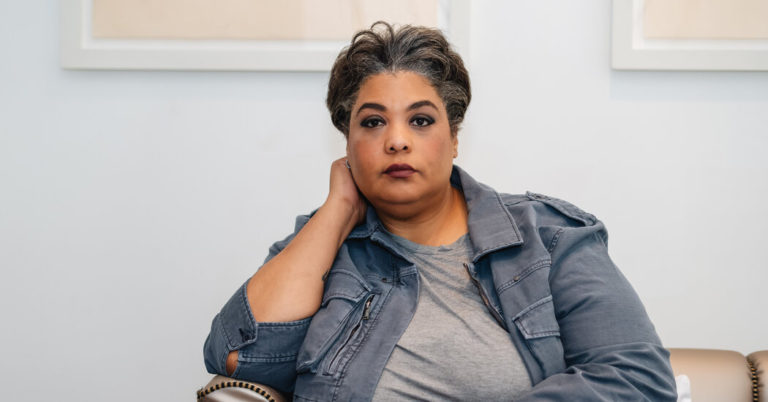
Roxane Gay wears many hats — professor, editor, social commentator, advice columnist — but she is perhaps most widely known as a best-selling writer, whose books include the essay collection “Bad Feminist” and a memoir, “Hunger.”
Now she is starting a book imprint. Roxane Gay Books will be part of Grove Atlantic, the publishing house announced Wednesday, with plans to release three titles a year, a mix of fiction, nonfiction and memoir, and a focus on underrepresented voices.
Gay has published books before, she said in a phone interview, though on a very small scale. She founded Tiny Hardcore Press in 2011, turning out 25 to 50 copies of each title along with e-books.
“This was when I was making absolutely no money,” she said. “Everything was very shoestring but well intended. And I always wondered what it would be like to publish books with an actual budget and actual promotion efforts behind it, like a marketing department and advances and things like that.”
Grove is one of the larger independent publishers in the United States and one of the most prestigious. It has published Gay’s fiction since 2014, starting with her first novel, “An Untamed State.” She said the company has committed to offering a minimum for advances at her imprint. (She and Grove declined to say what the minimum will be.) Her own first advance at Grove — which she said was too low — was $12,500.
Gay, who is based in Los Angeles, will make her first call for submissions this summer and plans to open her doors to writers with and without agents. She cautioned that that could change if the volume of manuscripts becomes overwhelming, but said it was worth a try.
“There are so many barriers and so many gates,” she said. “Let’s take them down.”
Grove also said Wednesday that it plans to offer a paid, one-year fellowship program that would serve as a crash course in publishing, for applicants without access to such jobs through traditional pathways.
Gay will select and edit the books her imprint publishes, but she will also work closely on these projects with Amy Hundley, an executive editor at Grove who edits Gay’s work. Hundley said that Gay’s eye for talent, in addition to the talent she herself possesses, was enormously appealing to Grove.
“She’s really interested in queer voices, she’s really interested in feminist voices, she’s really interested in voices on body size,” Hundley said, “all kinds of different conversations that are really exciting right now, and I think are the future.”
Kissimmee, Florida — More Snakes! More pirates! More water slides!
This summer, Kissimmee’s Gaylord Palms has a lot of “more.”
The vast resort, Summer of More, is not only a mix of tickets and free attractions, but also the impressive new Cypress Springs Water Park, which guests can use for free.
The highlights of the “Summer of More” are:
Explore the summer, a high-energy tour of the famous atrium that includes real facts about wildlife with fun fictional characters such as ghosts and pirates ($ 16.99 per person).
In the Secret Garden Escape Room, a family-friendly escape room near the arcade, a glaring garden witch turns you into a stone gnome ($ 18.99 per person) unless you can solve the mystery.
Encounters with animals, free encounters with crocodiles, snakes (that is, really big snakes) and other Bayeux residents.
For more information on Gaylord Palms and “Summer of More” click here.
Japan may not be able to enact a bill to promote citizens’ understanding of LGBT people before the current session of the Diet ends on June 16.
The delay comes as a result of persistent objections from conservative members of the ruling Liberal Democratic Party, making it unclear whether the LDP will be able to reach a consensus over the bill soon.
LDP executives have no plan to extend the Diet session, as the Tokyo Metropolitan Assembly election is scheduled for July 4, meaning that there is little time for deliberations on the bill for promoting understanding of lesbian, gay, bisexual and transgender people.
Tomomi Inada, who is the chair of the LDP’s Special Mission Committee on Sexual Orientation and Gender Identity and is in charge of the bill, aims to submit it to the Diet jointly with Komeito, the LDP’s coalition partner, and opposition parties after having the LDP approve it this week. But the bill needs to be approved unanimously by the LDP’s Policy Research Council and General Council and it is unclear whether that will be possible since both of them include members who are taking a cautious stance on the bill.
Conservative LDP lawmakers have voiced concerns over a wording of the bill that says “discrimination against LGBT people is unacceptable,” which was included following talks with the opposition. Those who oppose the wording worry that opinions based on traditional values may be condemned as discriminatory.
LDP lawmaker Kazuo Yana said during a party meeting last Thursday that members of the LGBT community went against the preservation of the species, while LGBT couples were not “productive” — remarks that drew objections from opposition lawmakers.
Another stumbling block is that conservative LDP members are demanding that the bill be discussed at Diet committees, a process that can be omitted for bills that are submitted jointly by the ruling and opposition sides.
If that is the case, the bill will need to be discussed at Cabinet committee meetings, but those committees will have their hands full until the end of the Diet session with discussions over a bill that would restrict the use of land deemed important for national security.
Short on time for deliberations, the enactment of the LGBT bill during the current Diet session is impossible, Diet affairs officials at the LDP said.
Some LDP members believe that enacting the bill during the current Diet session is unwise, as it would negatively impact the party during campaigning for the House of Representatives election later this year.
“The bill should not be enacted before the election,” a source close to Prime Minister Yoshihide Suga said. “Or we would lose our core conservative supporters.”
“The bill won’t help us gain more votes. It’s obviously a better idea to ensure votes from conservative supporters,” said a senior LDP member of the House of Councilors.
In a time of both misinformation and too much information, quality journalism is more crucial than ever. By subscribing, you can help us get the story right.
WASHINGTON, D.C. — While Americans maintain their support for transgender military service, a majority believe birth gender, rather than gender identity, should govern participation in competitive sports.
A solid majority of the public (66%) continues to favor allowing openly transgender men and women to serve in the U.S. military, though this figure is down slightly from Gallup’s previous measure in 2019, when 71% were in favor.
U.S. Support for Transgender People Serving in the Military, 2019 vs. 2021
Do you favor or oppose allowing openly transgender men and women to serve in the military? (% Favor)
2019
2021
Change
%
%
pct. pts.
U.S. adults
71
66
-5
Republicans
43
43
0
Independents
78
66
-12
Democrats
88
87
-1
Men
64
57
-7
Women
79
74
-5
18-29
84
76
-8
30-49
73
68
-5
50-64
66
63
-3
65+
66
57
-9
Gallup
These data — from Gallup’s annual Values and Beliefs survey, conducted May 3-18 — come weeks after the Pentagon reversed a Trump-era policy that banned openly transgender people from serving.
Democrats (87%) remain about twice as likely as Republicans (43%) to favor allowing openly transgender service members in the military; both groups are essentially unchanged from the 2019 poll. Political independents, meanwhile, have become less supportive than they were in 2019 — down 12 percentage points. Still, two in three self-identifying independents favor allowing openly trans people to serve.
Gallup has routinely found shifts in public opinion, particularly among political independents, during presidential transition periods — as has been the case for approval of the Affordable Care Act and support for labor unions.
Support for transgender Americans’ right to serve in the military is down at least slightly among all age and gender groups, though all groups maintain majority levels of support. Adults younger than 50 remain more in favor than adults aged 50 and older, and women remain more in favor than men.
Self-identified liberals (92%) are most supportive of transgender people’s right to serve in the military, while 73% of moderates and 42% of conservatives agree.
The current level of support for transgender military service is similar to past support for gay and lesbian military service, which ranged between 63% and 70% in 2004-2010 Gallup polls, prior to the repeal of the “don’t ask, don’t tell” policy.
Most Say Trans Athletes Should Play on Teams That Match Birth Gender
At the same time a solid majority of Americans endorse transgender military service, they favor restrictions on transgender athletes’ ability to play on teams that correspond with their gender identity. The issue is being debated in dozens of state legislatures, and five U.S. states have banned transgender girls, who were born male, from playing on girls’ sports teams.
A majority of Americans (62%) say trans athletes should only be allowed to play on sports teams that correspond with their birth gender, while 34% say they should be able to play on teams that match their gender identity.
Among party, gender and age subgroups, only Democrats (55%) express majority support for transgender athletes’ ability to play on teams matching their gender identity.
U.S. Views on Transgender Athlete Policies in Sports
Next, we have a question about policies for competitive sports that have separate teams for male and female athletes. Do you think transgender athletes — [ROTATED: should be able to play on sports teams that match their current gender identity (or) should only be allowed to play on sports teams that match their birth gender]?
Play on teams that match gender identity
Play on teams that match birth gender
No opinion
%
%
%
U.S. adults
34
62
4
Republicans
10
86
5
Independents
33
63
4
Democrats
55
41
4
Men
24
72
4
Women
43
53
4
18-29
35
59
6
30-49
34
64
1
50-64
38
58
5
65+
28
67
5
Gallup, May 3-18, 2021
Among political ideology groups, self-identified liberals (63%) are most supportive of allowing athletes to play on teams according to their gender identity, while 34% of moderates and 12% of conservatives have this view.
Half of Young Adults Personally Know Someone Who Is Transgender
About three in 10 Americans (31%) report having a friend, relative or colleague who is transgender.
Fully half of adults younger than 30 have a transgender person in their lives, but the rate falls with each older age cohort. Adults aged 65 and older (19%) are the least likely to know a transgender person.
Americans Who Say They Personally Know Someone Who Is Transgender
Do you have any friends or relatives or coworkers who have told you, personally, that they are transgender?
Yes
No
%
%
U.S. adults
31
69
18-29
50
50
30-49
31
68
50-64
24
76
65+
19
81
Gallup, May 3-18, 2021
Views on transgender athlete policies and right to serve openly in the military are slightly influenced by whether respondents personally know a transgender person. This is similar to what Gallup has found in the past about Americans who personally knew a gay person and their views on gay issues.
Those who know someone who is trans (40%) are more likely to say trans athletes should be able to play on a team of their gender identity than are people who do not know someone who is transgender (31%). Similarly, those who have a transgender person in their life (74%) are more supportive of transgender people’s right to openly serve in the military than are those who do not know someone who is trans (62%).
On one hand, strong majorities of Americans have supported transgender people’s right to openly serve in the military. Viewed alongside support for allowing openly gay and lesbian people to serve in the “don’t ask, don’t tell” era, it’s fair to say that most Americans believe that people who want to defend and fight for the U.S. should be allowed to, regardless of their identity.
On the other hand, the increasing rate of trans-identification among U.S. youth is challenging norms in ways that many Americans are not ready to question. Americans were split in separate polls taken in 2016 and 2017 on restroom policies for transgender people. With policies for interscholastic sports teams now gaining traction in state legislatures, the public leans against allowing these athletes to join teams of their gender identity. This opposition, juxtaposed against public support for transgender military service, suggests transgender sports participation may be seen as more of an issue of competitive fairness than of civil rights.
This political issue is fairly new to most Americans, though, and the public has changed its mind on LGBT issues in recent memory. So, while there is currently considerable resistance to letting athletes play on teams according to their gender identity rather than their birth gender, it’s possible that Americans may view the issue differently down the line. However, changes in views on LGBT issues are often driven by generational change, and at the moment, young Americans hold views similar to their elders’.
WASHINGTON, D.C. — While Americans maintain their support for transgender military service, a majority believe birth gender, rather than gender identity, should govern participation in competitive sports.
A solid majority of the public (66%) continues to favor allowing openly transgender men and women to serve in the U.S. military, though this figure is down slightly from Gallup’s previous measure in 2019, when 71% were in favor.
U.S. Support for Transgender People Serving in the Military, 2019 vs. 2021
Do you favor or oppose allowing openly transgender men and women to serve in the military? (% Favor)
2019
2021
Change
%
%
pct. pts.
U.S. adults
71
66
-5
Republicans
43
43
0
Independents
78
66
-12
Democrats
88
87
-1
Men
64
57
-7
Women
79
74
-5
18-29
84
76
-8
30-49
73
68
-5
50-64
66
63
-3
65+
66
57
-9
Gallup
These data — from Gallup’s annual Values and Beliefs survey, conducted May 3-18 — come weeks after the Pentagon reversed a Trump-era policy that banned openly transgender people from serving.
Democrats (87%) remain about twice as likely as Republicans (43%) to favor allowing openly transgender service members in the military; both groups are essentially unchanged from the 2019 poll. Political independents, meanwhile, have become less supportive than they were in 2019 — down 12 percentage points. Still, two in three self-identifying independents favor allowing openly trans people to serve.
Gallup has routinely found shifts in public opinion, particularly among political independents, during presidential transition periods — as has been the case for approval of the Affordable Care Act and support for labor unions.
Support for transgender Americans’ right to serve in the military is down at least slightly among all age and gender groups, though all groups maintain majority levels of support. Adults younger than 50 remain more in favor than adults aged 50 and older, and women remain more in favor than men.
Self-identified liberals (92%) are most supportive of transgender people’s right to serve in the military, while 73% of moderates and 42% of conservatives agree.
The current level of support for transgender military service is similar to past support for gay and lesbian military service, which ranged between 63% and 70% in 2004-2010 Gallup polls, prior to the repeal of the “don’t ask, don’t tell” policy.
Most Say Trans Athletes Should Play on Teams That Match Birth Gender
At the same time a solid majority of Americans endorse transgender military service, they favor restrictions on transgender athletes’ ability to play on teams that correspond with their gender identity. The issue is being debated in dozens of state legislatures, and five U.S. states have banned transgender girls, who were born male, from playing on girls’ sports teams.
A majority of Americans (62%) say trans athletes should only be allowed to play on sports teams that correspond with their birth gender, while 34% say they should be able to play on teams that match their gender identity.
Among party, gender and age subgroups, only Democrats (55%) express majority support for transgender athletes’ ability to play on teams matching their gender identity.
U.S. Views on Transgender Athlete Policies in Sports
Next, we have a question about policies for competitive sports that have separate teams for male and female athletes. Do you think transgender athletes — [ROTATED: should be able to play on sports teams that match their current gender identity (or) should only be allowed to play on sports teams that match their birth gender]?
Play on teams that match gender identity
Play on teams that match birth gender
No opinion
%
%
%
U.S. adults
34
62
4
Republicans
10
86
5
Independents
33
63
4
Democrats
55
41
4
Men
24
72
4
Women
43
53
4
18-29
35
59
6
30-49
34
64
1
50-64
38
58
5
65+
28
67
5
Gallup, May 3-18, 2021
Among political ideology groups, self-identified liberals (63%) are most supportive of allowing athletes to play on teams according to their gender identity, while 34% of moderates and 12% of conservatives have this view.
Half of Young Adults Personally Know Someone Who Is Transgender
About three in 10 Americans (31%) report having a friend, relative or colleague who is transgender.
Fully half of adults younger than 30 have a transgender person in their lives, but the rate falls with each older age cohort. Adults aged 65 and older (19%) are the least likely to know a transgender person.
Americans Who Say They Personally Know Someone Who Is Transgender
Do you have any friends or relatives or coworkers who have told you, personally, that they are transgender?
Yes
No
%
%
U.S. adults
31
69
18-29
50
50
30-49
31
68
50-64
24
76
65+
19
81
Gallup, May 3-18, 2021
Views on transgender athlete policies and right to serve openly in the military are slightly influenced by whether respondents personally know a transgender person. This is similar to what Gallup has found in the past about Americans who personally knew a gay person and their views on gay issues.
Those who know someone who is trans (40%) are more likely to say trans athletes should be able to play on a team of their gender identity than are people who do not know someone who is transgender (31%). Similarly, those who have a transgender person in their life (74%) are more supportive of transgender people’s right to openly serve in the military than are those who do not know someone who is trans (62%).
On one hand, strong majorities of Americans have supported transgender people’s right to openly serve in the military. Viewed alongside support for allowing openly gay and lesbian people to serve in the “don’t ask, don’t tell” era, it’s fair to say that most Americans believe that people who want to defend and fight for the U.S. should be allowed to, regardless of their identity.
On the other hand, the increasing rate of trans-identification among U.S. youth is challenging norms in ways that many Americans are not ready to question. Americans were split in separate polls taken in 2016 and 2017 on restroom policies for transgender people. With policies for interscholastic sports teams now gaining traction in state legislatures, the public leans against allowing these athletes to join teams of their gender identity. This opposition, juxtaposed against public support for transgender military service, suggests transgender sports participation may be seen as more of an issue of competitive fairness than of civil rights.
This political issue is fairly new to most Americans, though, and the public has changed its mind on LGBT issues in recent memory. So, while there is currently considerable resistance to letting athletes play on teams according to their gender identity rather than their birth gender, it’s possible that Americans may view the issue differently down the line. However, changes in views on LGBT issues are often driven by generational change, and at the moment, young Americans hold views similar to their elders’.
Former Kangaroo and State of Origin centre Israel Folau is under contract with Catalans Dragons for 2021; the 32-year-old has lodged an application to the Queensland Rugby League to play in the local Gold Coast competition
Last Updated: 26/05/21 12:58pm
Israel Folau is under contract with the Dragons for the 2021 season
Israel Folau’s hopes of returning to rugby league at amateur club Southport were thwarted on Wednesday with Queensland authorities refusing his registration due to a contract issue.
The dual-code international is looking to play with his two brothers at Southport Tigers in the Gold Coast amateur competition, two years after he was sacked by Rugby Australia for social media posts deemed discriminatory by Australian rugby union’s governing body.
The Queensland Rugby League (QRL) said on Wednesday it could not register Folau because he had not provided confirmation of his release from a contract with his previous team.
“The QRL cannot proceed with any registration approval until such time as the clearance is received,” they said in a statement.
The Dragons declined to comment on the matter when approached by Sky Sports News, but confirmed Folau is under contract with the club for 2021.
1:02 Sky Sports Brian Carney expects Catalans Dragons to allow Israel Folau to play for Queensland amateur club Southport Tigers – and believes the dual-code international will return to the NRL in the future
Sky Sports Brian Carney expects Catalans Dragons to allow Israel Folau to play for Queensland amateur club Southport Tigers – and believes the dual-code international will return to the NRL in the future
Speaking last week, Catalans coach Steve McNamara said he was in the dark about Folau’s plans to not return to France.
“I’ve not heard that,” McNamara said on Thursday. “There is no change in the current situation as far as we’re concerned.
“We have him registered as a player and, if his circumstances change and he was able to come back, we’d facilitate that. He’s welcome back but at the minute it’s not on the horizon.”
3:56 Highlights as Catalans Dragons became the first team to defeat St Helens in the Betfred Super League in 2021
Highlights as Catalans Dragons became the first team to defeat St Helens in the Betfred Super League in 2021
The QRL said it would clear Folau to play at a “community rugby league level and no higher” once they received his clearance.
Folau’s return has been backed by Southport’s team patron Clive Palmer, a billionaire mining magnate who earlier this week threatened legal action against the QRL if it refused to register the 32-year-old.
The league said it was “astounded… that public commentary has included threats of protracted legal action”.
Catalans Dragons vs Wigan Warriors
May 29, 2021, 4:55pm
Live on
Folau played rugby league for Australia before switching to Australian Rules in 2011, jumping codes once again to rugby union in 2013.
A fundamentalist Christian, Folau had his Wallabies and Super Rugby deals terminated in 2019 after posting on social media that hell awaited “drunks, homosexuals, adulterers” and others.
A return to the top-flight National Rugby League with the St George Illawarra Dragons was scuppered in February after reports of negotiations sparked a backlash from LGBT rights groups, some fans and sponsors.
The QRL said previous social media comments made by Folau “do not align to the beliefs of the game, or the QRL”.
WASHINGTON, D.C. — While Americans maintain their support for transgender military service, a majority believe birth gender, rather than gender identity, should govern participation in competitive sports.
A solid majority of the public (66%) continues to favor allowing openly transgender men and women to serve in the U.S. military, though this figure is down slightly from Gallup’s previous measure in 2019, when 71% were in favor.
U.S. Support for Transgender People Serving in the Military, 2019 vs. 2021
Do you favor or oppose allowing openly transgender men and women to serve in the military? (% Favor)
2019
2021
Change
%
%
pct. pts.
U.S. adults
71
66
-5
Republicans
43
43
0
Independents
78
66
-12
Democrats
88
87
-1
Men
64
57
-7
Women
79
74
-5
18-29
84
76
-8
30-49
73
68
-5
50-64
66
63
-3
65+
66
57
-9
Gallup
These data — from Gallup’s annual Values and Beliefs survey, conducted May 3-18 — come weeks after the Pentagon reversed a Trump-era policy that banned openly transgender people from serving.
Democrats (87%) remain about twice as likely as Republicans (43%) to favor allowing openly transgender service members in the military; both groups are essentially unchanged from the 2019 poll. Political independents, meanwhile, have become less supportive than they were in 2019 — down 12 percentage points. Still, two in three self-identifying independents favor allowing openly trans people to serve.
Gallup has routinely found shifts in public opinion, particularly among political independents, during presidential transition periods — as has been the case for approval of the Affordable Care Act and support for labor unions.
Support for transgender Americans’ right to serve in the military is down at least slightly among all age and gender groups, though all groups maintain majority levels of support. Adults younger than 50 remain more in favor than adults aged 50 and older, and women remain more in favor than men.
Self-identified liberals (92%) are most supportive of transgender people’s right to serve in the military, while 73% of moderates and 42% of conservatives agree.
The current level of support for transgender military service is similar to past support for gay and lesbian military service, which ranged between 63% and 70% in 2004-2010 Gallup polls, prior to the repeal of the “don’t ask, don’t tell” policy.
Most Say Trans Athletes Should Play on Teams That Match Birth Gender
At the same time a solid majority of Americans endorse transgender military service, they favor restrictions on transgender athletes’ ability to play on teams that correspond with their gender identity. The issue is being debated in dozens of state legislatures, and five U.S. states have banned transgender girls, who were born male, from playing on girls’ sports teams.
A majority of Americans (62%) say trans athletes should only be allowed to play on sports teams that correspond with their birth gender, while 34% say they should be able to play on teams that match their gender identity.
Among party, gender and age subgroups, only Democrats (55%) express majority support for transgender athletes’ ability to play on teams matching their gender identity.
U.S. Views on Transgender Athlete Policies in Sports
Next, we have a question about policies for competitive sports that have separate teams for male and female athletes. Do you think transgender athletes — [ROTATED: should be able to play on sports teams that match their current gender identity (or) should only be allowed to play on sports teams that match their birth gender]?
Play on teams that match gender identity
Play on teams that match birth gender
No opinion
%
%
%
U.S. adults
34
62
4
Republicans
10
86
5
Independents
33
63
4
Democrats
55
41
4
Men
24
72
4
Women
43
53
4
18-29
35
59
6
30-49
34
64
1
50-64
38
58
5
65+
28
67
5
Gallup, May 3-18, 2021
Among political ideology groups, self-identified liberals (63%) are most supportive of allowing athletes to play on teams according to their gender identity, while 34% of moderates and 12% of conservatives have this view.
Half of Young Adults Personally Know Someone Who Is Transgender
About three in 10 Americans (31%) report having a friend, relative or colleague who is transgender.
Fully half of adults younger than 30 have a transgender person in their lives, but the rate falls with each older age cohort. Adults aged 65 and older (19%) are the least likely to know a transgender person.
Americans Who Say They Personally Know Someone Who Is Transgender
Do you have any friends or relatives or coworkers who have told you, personally, that they are transgender?
Yes
No
%
%
U.S. adults
31
69
18-29
50
50
30-49
31
68
50-64
24
76
65+
19
81
Gallup, May 3-18, 2021
Views on transgender athlete policies and right to serve openly in the military are slightly influenced by whether respondents personally know a transgender person. This is similar to what Gallup has found in the past about Americans who personally knew a gay person and their views on gay issues.
Those who know someone who is trans (40%) are more likely to say trans athletes should be able to play on a team of their gender identity than are people who do not know someone who is transgender (31%). Similarly, those who have a transgender person in their life (74%) are more supportive of transgender people’s right to openly serve in the military than are those who do not know someone who is trans (62%).
On one hand, strong majorities of Americans have supported transgender people’s right to openly serve in the military. Viewed alongside support for allowing openly gay and lesbian people to serve in the “don’t ask, don’t tell” era, it’s fair to say that most Americans believe that people who want to defend and fight for the U.S. should be allowed to, regardless of their identity.
On the other hand, the increasing rate of trans-identification among U.S. youth is challenging norms in ways that many Americans are not ready to question. Americans were split in separate polls taken in 2016 and 2017 on restroom policies for transgender people. With policies for interscholastic sports teams now gaining traction in state legislatures, the public leans against allowing these athletes to join teams of their gender identity. This opposition, juxtaposed against public support for transgender military service, suggests transgender sports participation may be seen as more of an issue of competitive fairness than of civil rights.
This political issue is fairly new to most Americans, though, and the public has changed its mind on LGBT issues in recent memory. So, while there is currently considerable resistance to letting athletes play on teams according to their gender identity rather than their birth gender, it’s possible that Americans may view the issue differently down the line. However, changes in views on LGBT issues are often driven by generational change, and at the moment, young Americans hold views similar to their elders’.
Sportscaster Ron MacLean has apologized after hockey fans were thrown for a loop over a comment made Tuesday night that some interpreted as homophobic.
“I regret and apologize for what happened last night,” MacLean, host of “Hockey Night in Canada,” wrote in a statement posted on Twitter Wednesday afternoon.
During an intermission segment of the Sportsnet broadcast of Tuesday night’s Toronto Maple Leafs-Montreal Canadiens playoff game, analyst Kevin Bieksa was chiming in remotely and had a shelf of photos behind him, one of which featured a man drinking rum without a shirt.
MacLean quipped, “You have a photo of a guy with his tarp off, you’re definitely positive for something.”
Viewers on Twitter were puzzled by the comment, some wondering if it was a joke about an athlete failing a drug test, a comment on HIV status within the LGBTQ community and/or simply an inappropriate joke about the gay community.
MacLean explained that he was referring to the rum, and throwing back to a comment Bieksa made earlier about being the most positive guy on the commentator panel.
But, he continued, that he still has a responsibility to viewers to get his words right:
“The idea of language of intention, of personal responsibility, I have seen those concepts used as broad exoneration. It’s not enough. We have a contract with you, the viewer, that in us you see yourself.”
MacLean said he reached out to several “guiding lights in the equity seeking arena” and appreciates “the power of the voices who spoke to me last night and this morning … It’s how change works.”
One of whom was Brock McGillis, the first openly gay professional men’s hockey player.
He tells the Star, “there’s an opportunity here for a teachable lesson.”
While this didn’t have the same malice as some people may have assumed, McGillis said, “The language in hockey has deeply rooted ties to misogyny, to heterosexism, to homophobia, and because of that people see this and that’s automatically where they’re going to go.”
McGillis has appeared on MacLean’s show in the past speaking about LGBTQ issues in hockey. He spoke with MacLean last night after the comment stirred controversy.
“I don’t think the intent was malicious. I don’t think the intent was homophobic,” the former Ontario Hockey League player said, but there was a bit of homo-negative language, which McGillis said is all too common in the sport.
Loading…
Loading…Loading…Loading…Loading…Loading…
McGillis recalls the slew of off-the-cuff locker room talk that affected his self-image and career.
“All those things, you know, made me feel like I couldn’t be myself, made me feel like I was bad or wrong, and made me feel like I couldn’t be gay and play the sport I love,” he said.
His professional career was ultimately cut short, and “That’s why I do what I do now in the hopes that we can shift the culture and overhaul a culture that is in desperate need of it,” he said.
JOIN THE CONVERSATION
Anyone can read Conversations, but to contribute, you should be registered Torstar account holder. If you do not yet have a Torstar account, you can create one now (it is free)
Sign In
Register
Conversations are opinions of our readers and are subject to the Code of Conduct. The Star does not endorse these opinions.
For 23 years, the FLAG (Friends, Lesbians, and Gays) Flag Football League has called Dorchester home. Founded in 1998, FLAG Flag Football lists its mission as “tackling stereotypes, building community, and transforming lives through sport for the LGBTQ and ally community.”
After starting with about 20 players its first year, FLAG Flag Football now boasts several hundred members, making it the region’s premier football league for the LGBTQ community, and the largest gay sports league in New England.
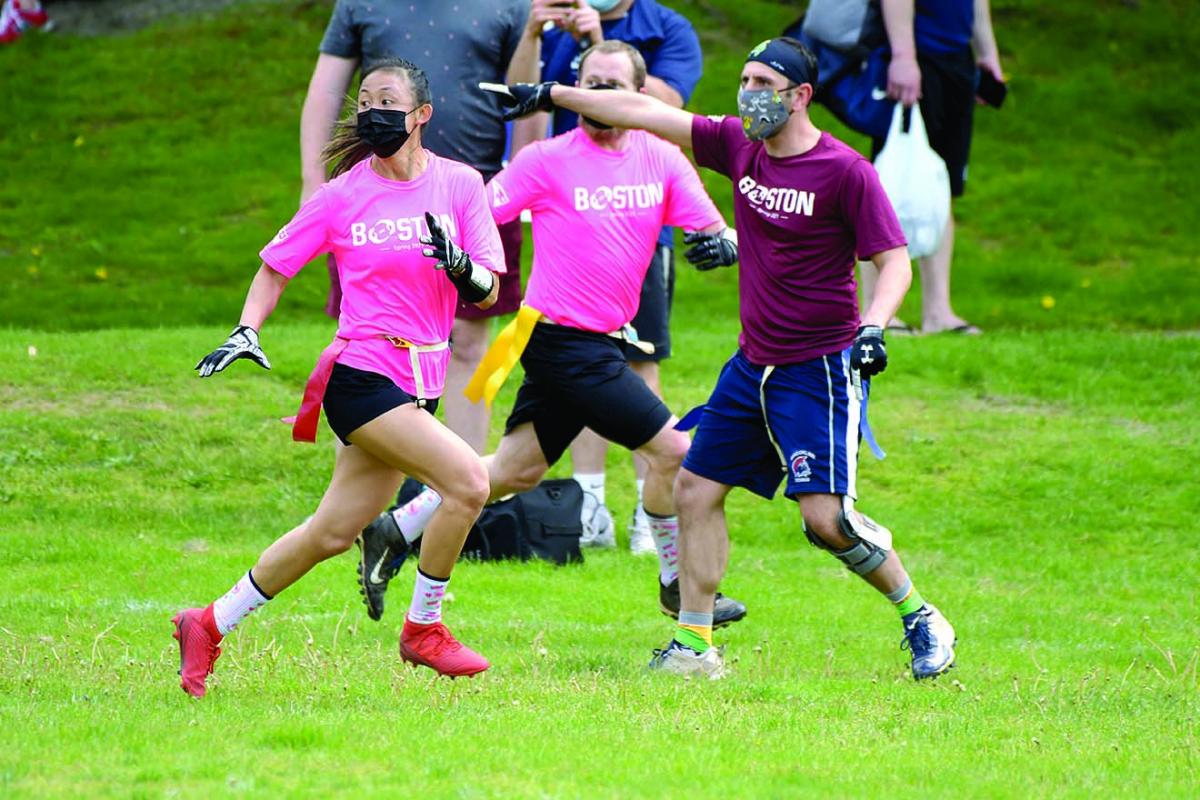
This spring, after missing two seasons to the pandemic, the games were back on the field every Saturday morning at Walsh Playground in Lower Mills.
“We’ve had a challenging year, as everyone has,” said Brian Teague, FLAG’s director of community outreach and external affairs. “Last year, we didn’t have a fall or spring season due to coronavirus.”
This year’s season, which ended last Saturday with the Rosie Bowl championship, was completed without any Covid-19 outbreaks.
On deck now for the league is a June 10 fundraiser at Dbar on Dot Ave. “We have our inaugural fundraiser specifically to support our scholarship foundation,” Teague said. “It’s the Marc E. Lewis Youth Scholarship [named in honor of a former board member]. The scholarship gives money to a graduating high school scholar-athlete who has made their school and/or community sports program safer and more inclusive for LGBTQIA community members, which is in line with the mission of our organization.”
He added: “It’s great to be able to see some of our veteran players go from not feeling comfortable in their high school locker rooms to now having 17- and 18-year-old players reach out to us—out players representing the LGBTQ community.”
Players and referees in the FLAG flag football league are shown in action at Walsh Park in Lower Mills last weekend. The Dorchester-based league has hundreds of players and is now in its 23rd year. Photo by Derick Lorrey-Parena
The event is sponsored by Joe Castro Real Estate and Dbar, with support from many other local and regional organizations. Teague offered a special shout-out to the Blarney Stone, our “post-game bar for years. They’ve just really opened up their doors and accommodated us.”
He added: “We are lucky to have great sponsors, including the New England Patriots. To have that sort of support from a national football team is dynamic, and it really makes a difference for visibility. A few years ago, they offered to underwrite the Gay Bowl.”
The Gay Bowl is the national championship for the National Gay Flag Football League (NGFFL), of which FLAG Flag Football is a member. The key to FLAG Flag Football’s success, Teague said, is its connection to the wider Dorchester community.
“We’ve worked with Boston Parks & Rec to stay in Dorchester,” he said. “We love it here. Many of the players in our league live in and around Dorchester in the Savin Hill, Jones Hill, and Uphams areas. It’s nice to have that commitment to people who live and work and play in Dorchester.”
In addition to providing the annual Lewis Youth Scholarship, FLAG Flag Football members contribute thousands of service hours at local organizations each year. This year, many members concentrated their efforts on the Dorchester Community Fridge and the Great Boston Food Bank.
“Volunteering is a cornerstone of the FLAG Flag community,” Teague said. “It’s another way to build community and give back what we can.” After nearly a quarter-century of sports and community engagement in Dorchester, FLAG Flag Football’s mission remains alive and well, according to Teague.
“I don’t think that we’re any different from the national trend toward a more inclusive America,” he said. “The shift from where we were 20 years ago on LGBTQ rights has certainly swung in the right direction.
“One of the things that’s interesting about our league is that many members didn’t have the chance to fully participate in sports in the past. It’s amazing to see how people are coming and saying, ‘I never wanted to play sports in high school or college. It didn’t seem like an inclusive place for me.’ And to see that shift when somebody becomes a standup athlete—it’s amazing to see people empowered to do something different.”
To learn more about FLAG Flag Football, donate to the League, or register for the fall season, visit FLAG Flag Football.
The more things change, the more they stay the same.
As manager Bill Rogan assembled the handful of players present for an early start to the Santa Fe Fuego’s preseason camp, he told the 15 men circled around him that part of Tuesday morning’s practice at Fort Marcy Ballpark would entail running the bases.
But first, he said, they needed to actually find the bases. Told they’d be in one place, they were eventually found somewhere else.
Welcome to the Pecos League, the lowest rung of professional baseball, but a rung that has found a happy, if not confounding home in the state capital. In what should be season No. 10 for the Fuego, last year’s shutdown due to the coronavirus pandemic means this is season No. 9.
It brings with it an entirely new roster, new coaching staff and even new uniforms. Same, too, for the surroundings. While Fort Marcy arguably looked better than it has for any opening practice in the team’s history, it took a while for the players to adjust.
After watching one of his batting practice cuts send a ball sailing into the elms that line the arroyo beyond Fort Marcy’s short porch to right, middle infielder Declan Peterson said he might have to rethink the whole power-hitting thing.
“I hit one homer my entire college career and it came in my senior year,” he said. “It’ll be interesting to see how this ballpark plays. First time I looked down the line to right, yeah, I start thinking that it can’t be more than 300 feet. The eyes get big.”
The Fuego open their season June 2 at Roswell. Between now and then, Rogan hopes to pare down the available talent into a 22-man roster that’s heavy on pitching — and pitchers willing to accept the fact that Santa Fe’s 7,000-foot altitude and (sorry, Peterson) 284-foot right-field fence are a hitter’s paradise and hurler’s nightmare.
“You keep the ball down here,” said pitching prospect Aaron McIntyre, swiping his right hand about 15 inches off the ground, “they’ll probably hit it on the ground and not have me turning around to watch it.”
Peterson and McIntyre are like most of those who call the Pecos League home; they came to Santa Fe from distant points on the U.S. map. McIntyre is from Houston, while Peterson’s last stop was in college ball in Ohio.
Two of the locals are Ben Tingen and Jared Gay. Tingen graduated from Mayfield High School in Las Cruces and spent four years at the University of the Southwest, an NAIA school in Hobbs. Gay lives in Albuquerque and has two younger brothers, Adam and Simon, who graduated from Volcano Vista and play football at the University of New Mexico.
With a father who’s 6-foot-5, a mom who’s 6-1 and a third brother who stands 6-7, Gay said he’s the smallest one in the family. Although he attended high school in Rochester, N.Y., he spent four years playing baseball at Eastern New Mexico and a senior year at Adams State.
At 6-foot-5 and 225 pounds, he is easily the most physically imposing player on Rogan’s roster. He was also the last player on the field, taking a handful of extra throws into the dirt at first base. During Tuesday’s batting practice he launched a ball that landed on the far side of the pedestrian bridge in right-center and rolled to a stop halfway across Magers Field.
“You hear the rumors about this place, and then you see it and it looks even smaller than people have been talking about,” Gay said. “It’s like a slow-pitch softball field. Put the barrel on the ball and it’s out of here. You look at the stats and the league leader had like 19 home runs and, you know, playing half your games here it almost seems low.”
Tingen is perhaps Rogan’s most prized recruit. Already earmarked as the starting centerfielder and potential leadoff man, he wowed his current skipper when they first crossed paths a couple years ago in the Pecos League.
Then the manager at Tucson, Rogan watched Tingen rob his team twice with amazing catches in center when he played for Bakersfield.
“I owe Bill for being here,” Tingen said. “If I don’t get the call from here I’m working my 9-to-5, building fences in Cruces. But that’s what the Pecos League is all about: Opportunities. You never know when one’s going to pop up and now that I have one, it’s my chance to get those numbers up and prove I can do this.”
Rogan expects to have as many as 25 players in camp by week’s end. That includes a player or two from a planned league-run tryout at 9 a.m. Wednesday at Fort Marcy.
“For first days, this was a good one,” Rogan said. “The enthusiasm level was there, they were excited and I thought they got along well. Now, that’s usually the case for the first practice so we’ll see how they come back the next day and the day after that. Will they still be gung-ho after four or five days? We’ll see.”
Injury bug: The news wasn’t all good. While running the bases, the team’s only available catcher, Dalton Martin, strained his left hamstring while rounding first in one of the final drills of the day.
Host families needed: The Fuego need the community’s help in finding host families for this year’s team. The club will host a cookout at Fort Marcy Ballpark from 6 to 7:30 p.m. Wednesday. Anyone interested in the team’s billeting situation is encouraged to attend. All players will be there.
Volunteers wanted: Fuego general manager Yvonne Encinias is seeking people willing to step up and fill various roles with the organization. The team needs volunteers to fill in as bat boy/girl, to sing the national anthem, to help take tickets and even serve as the team’s mascot.
Mascot: Speaking of the mascot, adios to Fireball. The flaming-head puppet head that made its debut in the 2019 season will not return to Santa Fe, Encinias said. The club will have its more familiar mascot, the fuzzy red dragon that has taken various names over the years.
NEW YORK (AP) — Paul Rudnick has written a romantic comedy with a royal twist.
In “Playing the Palace,” the playwright, screenwriter and novelist has a witty, engaging book about two unlikely lovers: A Jewish man from New Jersey and the crown prince of England.
“I’ve never written an all-out romantic comedy like this,” says Rudnick, who put the finishing touches to the manuscript during the pandemic. “It was so much fun to live in that world and to just try a complete celebration without a whole lot of trauma.”
“Playing the Palace” is told from the slightly insecure perspective of Carter Ogden, a unhappily single associate event architect “barreling toward 30” who adores Ruth Bader Ginsberg and IHOP. He believes that New York’s St. Patrick’s Cathedral being located between a Tiffany’s and a Saks is “a sign of God’s admiration for high-end retail.”
His chance meeting with the drop-dead gorgeous Prince Edgar, the Prince of Wales, triggers a romance with international implications and tons of snarky tabloid headlines. Can these two very different men make it?
“I’m a Jewish guy from New Jersey. I thought, ‘OK, that’s about as far away from the royal family as you can get,’ which made it sound like the most fun,” says Rudnick. “I also wanted a story about people of wildly different social status.”
Rudnick shares in the overwhelming fascination with the British royal family and weaves in references to Brexit, Buckingham Palace and “The Great British Bake Off.”
“What I really love about Paul is that he gives such specificity to his characters so that even if he’s making them larger to life, they still feel very human and relatable because it’s the details that really bring them to life,” said Cindy Hwang, his editor at Berkley, an imprint of Penguin Random House.
The book arrives on a wave of interest in the royals, especially in Prince Harry and his biracial American wife, Meghan, who are redefining who belongs in the House of Windsor.
“It just felt like there was something in the air,” says Rudnick. “There was sort of a sense of inevitability that, ‘OK, the royal family is progressing and this sort of romance is becoming far more possible.’”
Rudnick’s plays include “Jeffrey” and “I Hate Hamlet.” His screenplays include “Sister Act,”“Addams Family Values,”“Jeffrey” and “In & Out.” With the new book, he painted a cheerfully progressive, LGBTQ-respecting world.
“There are so many completely valid and very necessary stories of prejudice against gay people and the trauma of coming out and family oppression,” he says. “But there also needs to be a balance of completely joyous queer love stories and stories about people who are wildly and openly gay and that’s just a given.”
The book is not the first to portray a same-sex American-British royal love — think “Red, White & Royal Blue” — but it sparkles with Rudnick’s take, and his publisher hopes it attracts a large audience.
“We really do feel like a lot of different kinds of people can enjoy this book for a lot of different reasons. Obviously, a traditional romance reader, yes,” Hwang said. “But a lot of people who don’t really read romance I think would really enjoy this book.”
Rudnick approached the sex scenes in the same way he did the rest of the novel, with humor and heart. “I think sex scenes in any book can get very clunky and very embarrassing. And you want to avoid the cringe factor,” he says.
“In romance books, they can sometimes be absolutely pornographic or they can be completely only vaguely suggestive. I wanted to land somewhere in between the two.”
Rudnick also uses the figure of Edgar — a witty, charming self-aware royal who jokes privately “I could have you beheaded” — to explore the isolating nature of mega-fame and the expectations put on pioneering gay figures.
“Because he’s the first openly gay royal, that comes with the enormous responsibility of representation,” says Rudnick. “You have to satisfy everyone’s dream of a very powerful gay figure.”
Rudnick started thinking about a royal romance as long as two decades ago and even had the title. But he didn’t always know what form it should take — stage play, movie or novel.
“Nothing ever quite fit until I began working on it as a novel. And that’s one of the very few things I’ve learned in my career: Let the material dictate the form,” he said. “I always start from the point of ‘OK, let the characters say where they want to make a home.’”
Harvard will expand its undergraduate housing capacity on and near campus to accommodate “normal housing density” in fall 2021, even as it anticipates the largest matriculating class in its history, administrators wrote in an email to Faculty of Arts and Sciences affiliates Tuesday afternoon.
The administrators — University President Lawrence A. Bacow, FAS Dean Claudine Gay, Dean of the College Rakesh Khurana, and Graduate School of Arts and Sciences Dean Emma Dench — also shared that all graduate and undergraduate instruction will take place in the classroom, with the option of online supplemental instruction.
Gay first shared in a March interview with The Crimson that the University was “charting a path to a full return for our students, our faculty, and staff.” Weeks later, the College announced a planned return to “in-person learning” in the fall semester.
The administrators wrote in the email that both graduate and undergraduate residential programs will “return to normal campus operations” in the fall semester, including both full housing density and in-person dining for students in the College.
“Harvard College is anticipating the largest entering class in its history, having admitted a normal class size in addition to the large number of deferrals from last year,” they wrote. “To accommodate this larger student body, the College has expanded the undergraduate residential program and support system to include additional housing on campus and adjacent to campus.”
The College’s fall plans feature a staggered return to campus. The class of 2023 — the only class unable to return as a full cohort to Cambridge this previous year — will be the first class returning to campus, with move-in beginning Aug. 20. Meanwhile, first-years will be invited to campus starting on Aug. 25, with orientation held the following weekend. Classes will begin on Sep. 1.
International students “whose arrival has been delayed by visa processing or other barriers” may enroll as long as they can arrive on campus by Oct. 4. Some international students have expressed concern that they will be unable to obtain visas in time for the fall semester.
“The Office of International Education will contact these students and advise them in selecting courses that they can begin remotely and then join in person after arrival,” they wrote.
In the email, the administrators also wrote that instruction — including sections — will be hosted in person in the fall semester. Nonetheless, they acknowledged certain teaching approaches that could be carried over from a virtual year.
Advertisement
“The experience of the past year has demonstrated that technology can be a powerful pedagogical tool and instructors may use some pre-recorded materials to supplement their in-person teaching,” they wrote. “Instructors may hold office hours online if they feel this will better meet the needs of their students.”
Libraries and museums will be open for the fall semester, and all co-curricular events and programs, including athletics, are expected to resume.
Earlier this month, Bacow announced that Covid-19 vaccination would be required for all students on campus this fall. In Tuesday’s email, the administrators wrote that Harvard will help vaccinate anyone who has not been able to access the vaccine.
“We understand that access to the COVID-19 vaccine is variable across the world,” they wrote. “Harvard University Health Services (HUHS) will provide vaccination to any enrolled, full-time student who has not been vaccinated.”
In addition, the administrators shared that students living on campus “should expect a short arrival quarantine period.” However, the College will no longer operate under the color-coded reopening levels established this spring semester. Following the quarantine, all students will “move to regular campus access.”
Nonetheless, they acknowledged the volatility in public health guidance, as well as the continued effects of the pandemic. Detailed safety precautions “will be set closer to the start of the fall term,” they wrote.
“Harvard will establish public health protocols to keep the campus community safe and to protect against disruption of the academic mission,” they wrote. “These protocols are likely to include, at a minimum, regular viral testing and contact tracing.”
The administrators closed by calling upon staff, faculty, and students to bring a “spirit of experimentalism” into the fall semester to build “our way to a new normal.”
“Your unbridled academic ambition defines us as a learning community, and we welcome that ambition, along with your boldness, passion, and energy as we create a post-pandemic Harvard that honors our past while delivering on the full promise of our mission for the 21st century and beyond,” they wrote.
“We are truly excited to be with you this fall and invite you to view this short message of welcome as we eagerly await your arrival,” they concluded.
Advertisement
—Staff writer Andy Z. Wang can be reached at andy.wang@thecrimson.com.
A study by Monash University and Alfred Health found a 70 per cent reduction in one type of human papillomavirus (HPV) in gay and bisexual men after the implementation of the school-based HPV vaccination program.
The HYPER2 study, published in The Lancet Infectious Diseases, and led by Associate Professor Eric Chow, found there was a significant reduction in all four vaccine-preventable genotypes in gay/bisexual men aged 16-20 years following the introduction of the vaccine for boys in 2013.
Australia is one of the first and few countries that have both boys and girls vaccination programs for HPV. The vaccine covers four genotypes: 6/11/16/18. Genotypes 6/11 cause about 90 per cent of the genital wart cases and genotypes 16/18 cause about 70 per cent of cervical and anal cancers.
Related Stories
This is the first study to show that the implementation of the gender-neutral program can reduce high-risk anal HPV and potentially reduce the incidence of anal cancer in gay and bisexual men.
This repeated cross-sectional study recruited 400 gay and bisexual men with a median age of 19 years from sexual health clinics and the community in Melbourne.
The results are compared with the HYPER1 group of 200 gay/bisexual men pre-vaccination in 2010-2012 and the HYPER2 group of 200 gay/bisexual men post-vaccination in 2017-2018.
It showed a reduction in anal quadrivalent genotypes from 28 per cent down to 7.3 per cent and penile quadrivalent genotypes also lower in the post-vaccination group 6.1 per cent compared to 11.9 per cent.
Anal cancer incidence has increased globally among men over the last three decades. It is overrepresented among gay and bisexual men, particularly those living with HIV.
A meta-analysis estimated the incidence of anal cancer to be 45.9 per 100,000 among HIV-positive MSM. Results from the HYPER2 study suggest that male vaccination may lead to a potential reduction in anal cancer among gay and bisexual men in Australia, which is similar to the reduction in cervical cancer among Australian women after the HPV vaccination program launched in 2007.
Australia has a very successful HPV vaccination program for both boys and girls with high vaccine coverage.”
Eric Chow, Associate Professor, Monash University
“The vaccine is effective in reducing HPV-related diseases and showing some promising evidence that this may lead to a reduction in HPV-related cancer in the future.”
Chow, E. P. F., et al. (2021) Prevalence of human papillomavirus in young men who have sex with men after the implementation of gender-neutral HPV vaccination: a repeated cross-sectional study. The Lancet Infectious Diseases. doi.org/10.1016/S1473-3099(20)30687-3.
Japan may not be able to enact a bill to promote citizens’ understanding of LGBT people before the current session of the Diet ends on June 16.
The delay comes as a result of persistent objections from conservative members of the ruling Liberal Democratic Party, making it unclear whether the LDP will be able to reach a consensus over the bill soon.
LDP executives have no plan to extend the Diet session, as the Tokyo Metropolitan Assembly election is scheduled for July 4, meaning that there is little time for deliberations on the bill for promoting understanding of lesbian, gay, bisexual and transgender people.
Tomomi Inada, who is the chair of the LDP’s Special Mission Committee on Sexual Orientation and Gender Identity and is in charge of the bill, aims to submit it to the Diet jointly with Komeito, the LDP’s coalition partner, and opposition parties after having the LDP approve it this week. But the bill needs to be approved unanimously by the LDP’s Policy Research Council and General Council and it is unclear whether that will be possible since both of them include members who are taking a cautious stance on the bill.
Conservative LDP lawmakers have voiced concerns over a wording of the bill that says “discrimination against LGBT people is unacceptable,” which was included following talks with the opposition. Those who oppose the wording worry that opinions based on traditional values may be condemned as discriminatory.
LDP lawmaker Kazuo Yana said during a party meeting last Thursday that members of the LGBT community went against the preservation of the species, while LGBT couples were not “productive” — remarks that drew objections from opposition lawmakers.
Another stumbling block is that conservative LDP members are demanding that the bill be discussed at Diet committees, a process that can be omitted for bills that are submitted jointly by the ruling and opposition sides.
If that is the case, the bill will need to be discussed at Cabinet committee meetings, but those committees will have their hands full until the end of the Diet session with discussions over a bill that would restrict the use of land deemed important for national security.
Short on time for deliberations, the enactment of the LGBT bill during the current Diet session is impossible, Diet affairs officials at the LDP said.
Some LDP members believe that enacting the bill during the current Diet session is unwise, as it would negatively impact the party during campaigning for the House of Representatives election later this year.
“The bill should not be enacted before the election,” a source close to Prime Minister Yoshihide Suga said. “Or we would lose our core conservative supporters.”
“The bill won’t help us gain more votes. It’s obviously a better idea to ensure votes from conservative supporters,” said a senior LDP member of the House of Councilors.
In a time of both misinformation and too much information, quality journalism is more crucial than ever. By subscribing, you can help us get the story right.
David Landis, The Gay Gourmet, recently visited Rush Creek Lodge and Spa at Yosemite. While there he spoke with Rush Creek’s Chef de Cuisine, Joey Cabrero, who described some of the delicious dishes on offer.
If you enjoy visiting Yosemite too, don’t miss David’s The Gay Gourmet column for July 2021 in the San Francisco Bay Times!