Home Blog Page 149

Scott Norton Was The Face Of The Gay Community On PBA Tour – FloBowling

In addition to worrying about how to make the right adjustment on the bowling lanes and executing clutch shots against the best bowlers in the world, imagine you also felt this added layer of pressure that every move you made either added to or could change the perception of what the gay community is.

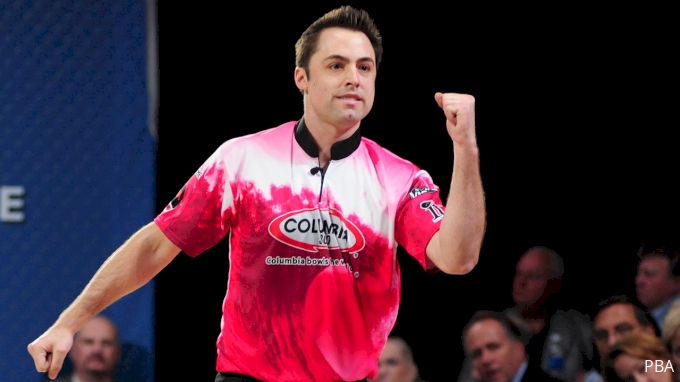
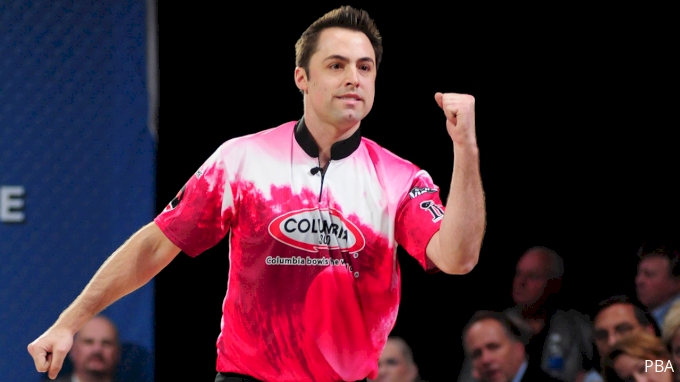
For Scott Norton, that is the weight he carried with him from the time he was a rising junior bowler in California to being the youngest member at the time on Team USA and then fulfilling his dream on the PBA Tour.

He would expend all his energy projecting an outgoing and friendly personality on the outside while inside he felt he was the face of the gay community. He was finally able to release some of the built-up anxiety at the 2012 World Series of Bowling Chameleon Championship.

“I had been married for a year and we had just bought a house together,” Norton said about his relationship with husband, Craig Woodward. “It was a lot of life stuff that happened, and I came in with a better mindset.”
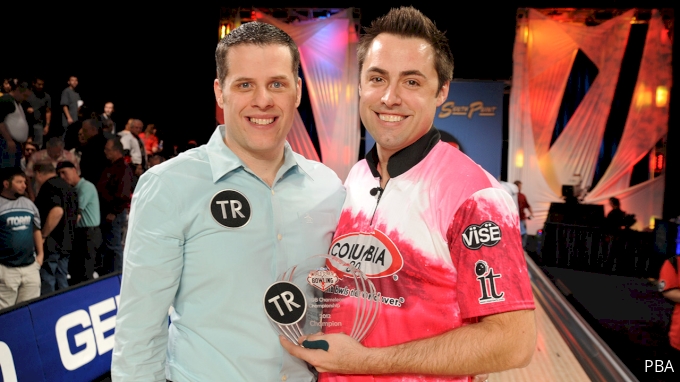
His arm swing was free. He was focused on each shot, and he was bowling at South Point in Las Vegas, which is the same center where he won the 2010 World Series of Bowling Chameleon Championship. It had been two years since the lefty had won a tournament, and he did everything he could in his final two frames to defeat defending champion Jason Belmonte for the title.

“I threw four of the best shots I’ve ever thrown in the most pressure-packed situation I had been in in my life at that point,” said the 2011 PBA Rookie of the Year. “I did my job. Everything else was out of my hands and then the rest is history.”

Belmonte needed a strike and six pins to win the tournament for the second year in a row. He threw the ball slightly right of his target, the pins mixed around, and a messenger flew across the deck and tapped the 10 pin. It didn’t fall and Norton won 227-223. A flood of emotions and the weight of feeling like an outsider in the sport he dreamed to compete in were released. He finally felt validated.

“Thinking back on it, I almost pity that person because I know where those tears came from,” he reflected. “Those tears came from a place of finally feeling good enough. They were almost more tears of worth than they were of happiness.”
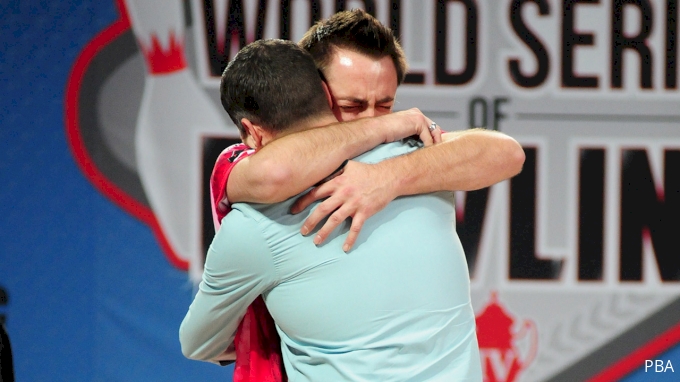
And then came a historic moment as Norton’s husband came out to congratulate him on the win. The spouses hugged and kissed each other just like other winners have done after winning a tournament. A few months after the show aired, an article by Outsports went viral announcing Norton’s winning moment was the first nationally televised same-sex kiss seen on ESPN.

“Honestly, it felt like such a momentous thing that should have helped bring a lot of attention to the sport and how unique and diverse the sport is,” he said. “I would be lying if I didn’t say I was a little disappointed. I was fully ready to carry the ball and show people our little world. But it never happened.

“Representation is what breaks down barriers,” he said. “To actually get faces out there of the people that are doing sports that allows people to see people instead of nameless communities. When you see the faces and you hear the stories of the people it is a lot harder to say bad things and demonize them.”
One of those iconic faces representing the gay community while crossing over into bowling is Billie Jean King, owner of the New York City Kingpins that competes in the PBA League. Norton was on the team owned by one of his role models. During the league’s inaugural season in 2013, they won and claimed the Elias Cup. King was there for the winning moment.

Norton got the chance to talk to tennis legend after the win while they waited at the airport to head home. He remembers her being genuinely excited for the whole team and the two of them also talked about being gay in sports.

“She was one of the first people that I knew was gay,” he said about King. “And then to be that successful and out was an inspiration.” 

He may not realize it, but he is an inspiration himself.

Back when he was living in Utah and going to school, he faced a challenging situation while he was a junior director at a Brunswick bowling center. There were parents who pulled their kids out his program because they didn’t want their children around him. He dedicated hours helping kids and they were getting better. Eventually, some of those parents changed their minds.

“It forces people to deal with these scary stereotypes they have been exposed to that have no basis in reality,” as he reflected on the experience. “Diversity is important and there is a place in this world for everybody. So, it was nice helping the kids and the parents open their eyes to the world.”

Prior to being on Team USA, Norton came out to another youth bowler who was also a friend.  

“I was like 15 or 16 and he was gay, too,” he said about this now more than 20-year friendship. “We were the first to be able to trust that information with each other. I don’t know that I can overstate the bond that creates when you are in such a vulnerable point in your life, and you find people that love and accept you no matter what.”

He credits having a strong husband and family, which includes his mother, Virginia, who is the USBC Hall of Fame, with helping him through the years. Another person who always accepted him was his best friend, PWBA champion Missy Parkin, who even roomed with him on the PBA Tour until the PWBA made a return in 2015. He refers to her as the Grace to his Will, a reference to the hit comedy show, Will & Grace. When she left the tour, he roomed by himself which he said was not easy, but he understood where the guys were coming from.

Even though Norton stopped bowling professionally in 2015 – after experiencing “severe burn out” – and he considers himself “basically retired,” he still has bowlers thanking him for being a role model and proving to them they can pursue a dream career in bowling just like he did.  He was recently thanked by a youth bowler and he is optimistic the younger generation will have a major impact on the diversity of the game moving forward.

“It is not just the LGBT player base,” he said. “It’s African-Americans, it’s Latinos, it’s Asians. There just needs to be outreach in the communities to give especially young people role models in those different categories to really show them bowling is for everybody and create excitement among all walks of life.”

The same-sex kiss was nine years ago but Norton feels like media outlets have become more comfortable showing those types of moments and openly talking more about diversity and representation. He would love to see media outlets take more chances by telling the stories of diverse athletes to give everyone the chance to see people like them and believe they can do it too.

“I remember what it was like for me, and I was taught from a young age to leave the world better than when you came into it,” he said on the impact he wants to leave. “That was the major driving factor to me wanting to stay out on tour and really show people that I was just like anybody else.”

For now, Norton and Woodward are living in Mission Viejo, California. Norton opened, Nerdy By Nature Escape Rooms in October 2019 and is seeing business pick up after the pandemic lockdown. And if given the opportunity, he would love to do commentary at a PBA event held at Bayside Bowl in Portland, Maine. If he ever gets the chance, he will likely nail it just like how he has handled other big moments in his life.
Tributes paid to Leviathen Hendricks from across LGBTQ+ in sports family – Sports Media LGBT+

“Loyal, fearless, and dedicated” – Leviathen Hendricks was an individual tour de force in the collective effort to make sports more inclusive for all LGBTQ+ people. Sports Media LGBT+ looks back at his life and legacy, with tributes and memories from those who knew him best…

By Jon Holmes

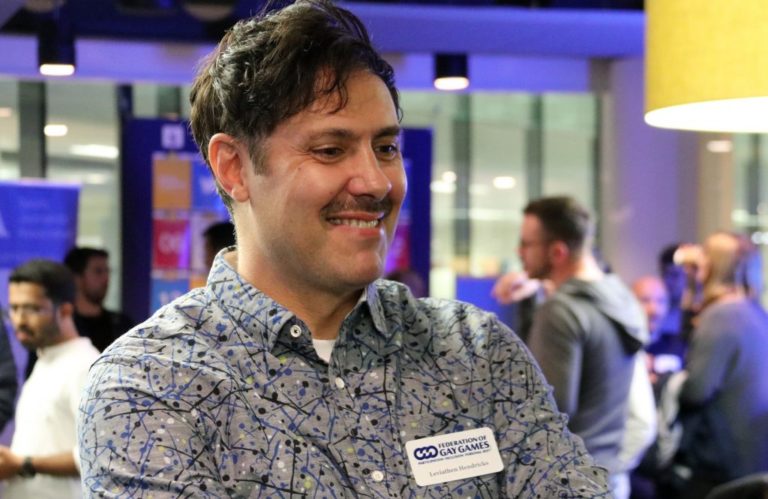
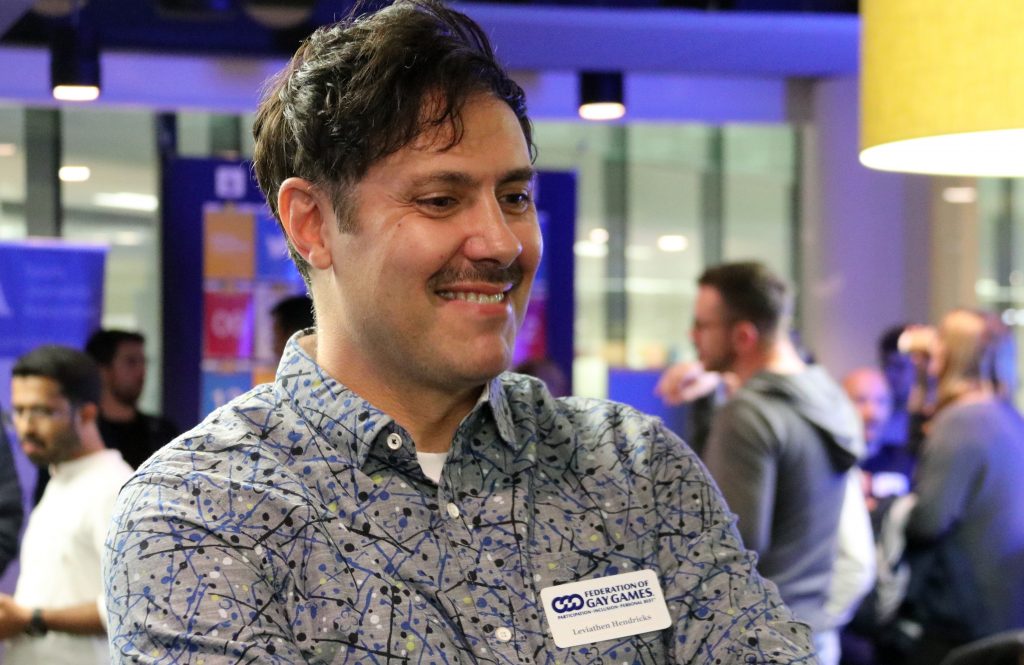
Leviathen Hendricks, pictured at Sports Media LGBT+’s #AuthenticMe event at Twitter HQ in London in October 2019

Friends and colleagues of Leviathen Hendricks, who has died aged 51, are paying tributes to a man who was a hugely influential figure in LGBTQ+ inclusion in sports for many years.

He passed away in Hoxton, London, on the morning of Friday, May 28.

His parents shared the following message with family and friends: “Leviathen fought a positive, determined and valiant battle against a brain tumour for over 26 years.

“We called him our miracle man! We will miss him more than we can say.”

Leviathen was previously a board member of the Federation of Gay Games (FGG) and worked as the organisation’s Officer of International Development until 2020.

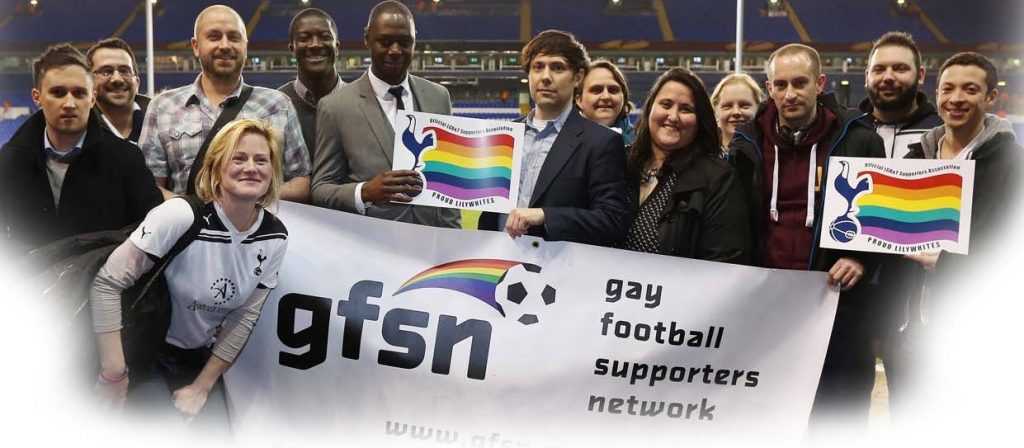
Through being part of the Gay Football Supporters’ Network (GFSN), he founded inclusive football club East End Phoenix, a role that also led to his involvement in the Justin Campaign – the forerunner of Football v Homophobia – and committee roles with Out For Sport and the European Gay and Lesbian Sport Federation.

Born David Streeter Hendricks in New York in December 1969 – later choosing the name Leviathen – he had spells living in Montreal and Scotland before moving to London to continue his studies in marketing, advertising and PR.

In an obituary of Leviathen on the Phoenix website, Niall Dumigan describes how he set up the club in 2008…

“Things started small, with Lev setting up training sessions held at Haggerston Park… [he] worked tirelessly week-in, week-out to build the club… with the first competitive game held against the Met Police LGBT team in May 2008. The following year, Phoenix entered the London Unity League for the first time, and the rest as they say is history.”

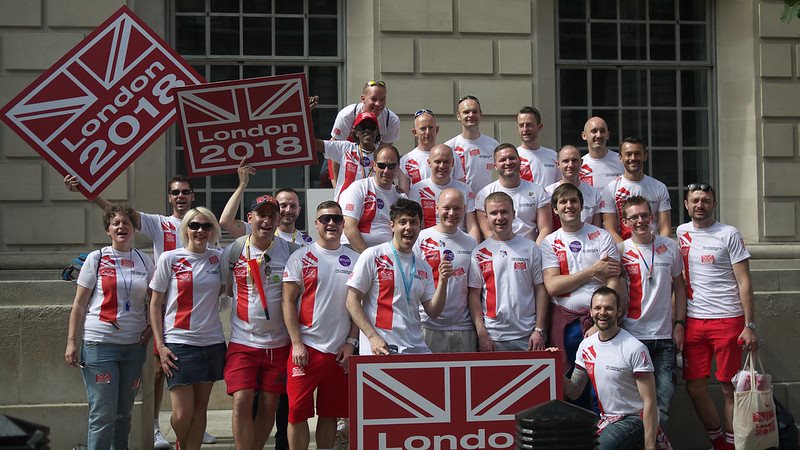
Leviathen played with a Justin Campaign team at the 2010 Gay Games in Cologne, and was on the committee that organised the Pride House at the London 2012 Olympics. At around the same time, he was also part of the London team bidding to host the Gay Games in 2018, which were eventually awarded to Paris.

In football, he took on the roles of fangroups co-ordinator and secretary with GFSN, helping to establish Proud Lilywhites (Tottenham) and Pride of Irons (West Ham) among others. He worked with the charity Stonewall to help bring the Rainbow Laces message to football in the campaign’s early days.

By 2014, he was increasingly involved with the FGG as a volunteer and travelled to Cleveland that year for the quadrennial Games. He knew better than most about the inherent power of inclusive sport to bring about social change – that Hong Kong will host the next iteration of the Gay Games was a source of great satisfaction to him.

In an interview with Sky Sports before Paris, after the host city for 2022 had been announced, Leviathen said: “LGBT movements in Asia are now at a phase where the West has been previously, so for the Gay Games to be of service in terms of the self-respect and confidence of Asian LGBT people is something I’m hugely proud of.”

As well as playing football with Phoenix and serving for a time as chair of the London Unity League, he played badminton with Goslings and supported all sports through OFS and other organisations.

His Instagram bio describes him as ‘activist, artist, athlete, aesthete’. He was a talented ceramicist and had a great eye for photography, as well as being an admirer of all that is creative – his social media feeds contain many examples of his passion for music and the arts. He travelled widely but held a special place in his heart for both NYC and London, the city that became his home.

My memories of Leviathen

I can’t remember exactly when I first met Leviathen – it may have been at a screening of the WONDERKID short film in 2016, around the time when Sky Sports signed up to be a partner on the Rainbow Laces campaign. Having been involved in LGBTQ+ inclusion in football for several years, he was incredibly well connected and an invaluable contact for me in those days, but he quickly became a respected friend too.

When the first conversations about setting up Sports Media LGBT+ began in summer 2017, he was a strong supporter and we would often exchange messages. It was wonderful to see him at our big #AuthenticMe event at Twitter HQ in October 2019 when over 100 LGBTQ+ people and allies joined us for a night of celebration, discussion, and drinks.

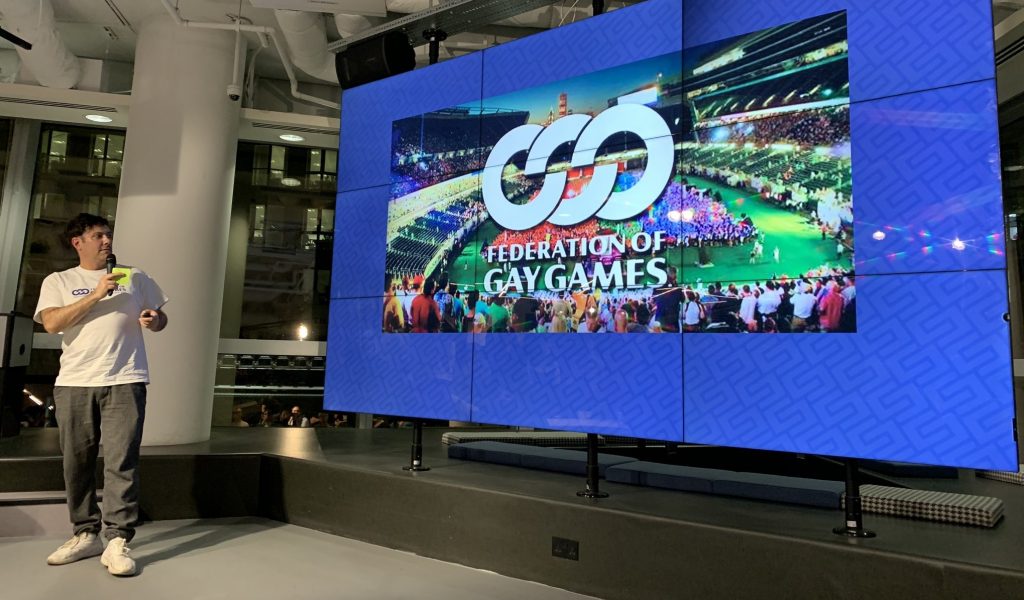
Leviathen presenting on Gay Games history at an Out For Sport / Chime Group event in November 2019

As the pandemic took hold in 2020, and meeting up in person happened a lot less often, he participated in Sports Media LGBT+’s virtual events too.

With Leviathen’s passing, both myself and our network group have lost a dear pal who we always looked forward to spending time with. The global movement for greater LGBT+ inclusion in sport has lost one of its most outstanding advocates. He is gone far too soon, but whether it’s the Phoenix that took flight in football or the Gay Games which he helped take to new territories, his legacy lives on.

Organisations pay tributes to Leviathen

Federation of Gay Games statement

“Leviathen was fiercely dedicated to justice and equality as evidenced by the number of different committee roles he held over the years, and his opinions! He was never a wallflower! His voice and insights were always appreciated.

“While those close to him will have known about his health issues, he never let them hold him back. He gave generously of his time and energy even when not feeling his best. He was loyal, fearless and dedicated. We will miss him.”

European Gay and Lesbian Sport Federation

“Always present at our Annual General Assemblies in his role as representative for the FGG, Leviathen made a point of getting to know everyone and had a great way of bringing people together. He was a willing volunteer, an active member of the Diversity Committee and always brought an interesting perspective to our community discussions.

“Leviathen was a hugely colorful character – exuberant and full of life – and will be sorely missed by all of us on the EGLSF Board. Our sincere condolences go out to Leviathen’s family, friends and colleagues. Safe travels.”

East End Phoenix FC

“Lev’s impact at East End Phoenix is impossible to measure or quantify. He created a wonderful football club that lives and breathes the inclusivity and kindness that Lev himself showed in everyday life. He also made lifelong friends at the club, all of whom will miss him dearly today and who will resolve to continue to develop the club in his vision.
“Lev, you were one of a kind. A truly special individual who it has been an honour to know and call our friend. Thank you for making Phoenix the club it is today.”

Out For Sport

“For a decade or more, Leviathen was a fixture of OFS, always ready to lean in. He held a number of different committee roles over the years, and if you didn’t meet him at an Assembly, then you may have met helping out with the annual sports fair, officiating at a sports day in Clapham, or flying the flag for London at international tournaments and conferences. Wherever you met him, I’m sure he left a lasting impression.

“He was a loyal friend, a fearless spokesperson for equality and he remains an ambassador for LGBT+ sport in London and beyond. Our thoughts and condolences go out to his family and friends.”

Personal tributes to Leviathen

Alex Davis, Chair, London 2018 Gay Games Bid committee

“Leviathen was a central member of the London 2018 Gay Games bid team. His confidence and enthusiasm in the London bid helped inspire many others to get involved, with Phoenix FC stepping forwards as one of the first clubs to formally back the bid. I’m saddened to hear of his passing and send my thoughts and condolences to all his family and friends.”

Ubaid-ul Rehman, Goslings

“Leviathen was a much-loved member of Goslings London Badminton Club. He had an energy on and off court. One of our members called it a “contagious” energy and another said he “was a great guy and was always fun on and off court.”

“Leviathen was involved in so many clubs and organisations and his influence goes so far. For example, one of our Goslings members met him when they played for Leftfooters FC together whilst another met him at a queer spiritual conference, describing Leviathen as an “inspiration and a beautiful spirit to work with.”

“Leviathen was a ball of energy, full of warmth and love. He always made people in the room feel welcome and included, introducing himself and learning about them. He wouldn’t be afraid to ask questions or challenge. But most of all he had this wit and humour that would make so many around him laugh out loud. He’ll be hugely missed because his energy will be missing in the room. We’ll leave a light on for him at Goslings. Rest in power, Leviathen.”

Emy Ritt, FGG Honorary Life Member, FGG Co-President Emeritas, Paris 2018 Director of International Relations

“Knowing Leviathen during the last decade or so was an immense privilege. His passion for the Gay Games and LGBTIQ Sport, while reaching out to under-represented communities around the world, was stellar. At one of his last FGG International Development Committee meetings, he had created a team with members based in Africa, Asia, South America, Europe, and North America. Leviathen’s hallmark sense of humour, even in the face of adversity, was ever-present. When not working with LGBTIQ sport associations, Leviathen was an accomplished artist and potter, creating ceramic masterpieces in his Camden studio. In sports and in the arts, Leviathen made his mark on all of us.”

Ed Connell, former chair of GFSN

“Lev served on the GFSN committee when I was Chair. He worked tirelessly to advance two of our campaigns – the second Rainbow Laces campaign where Lev proved invaluable in persuading Paddy Power to be more sensitive to the concerns of the LGBTQ+ Community. He also dedicated lots of his time helping set up football fan groups for many professional clubs. He was committed to making the sporting world more inclusive and he will be sadly missed.”

Cyd Zeigler, Outsports

“Every interaction I ever had with Leviathen over the last decade has come from his passion and commitment to building the LGBTQ sports community and helping people realize the possibility of participation and inclusion in sports. He truly dedicated his life to ensuring that all LGBTQ people around the world could find all the joy of sports in their own lives, and the loss of his hard work will be felt by people on every continent who will now never get to tell him “thank you.” He will be missed.”

Paul Amann, Kop Outs! (Liverpool FC LGBT+ and allies supporters group)

“A stalwart campaigner who I was privileged to have as a friend. He gave so much selflessly, taking a consensus approach and always seeking to build inclusively for our communities. I would always enjoy our work, as well as socialising when we could. I will miss his counsel and friendship. I have wonderful memories of him visiting Liverpool and hosting me in London, playing Scrabble at odd hours with mutual insomnia, a character who enriched our world immensely. Respects and condolences to all his family and friends.”

Hugh Torrance, LEAP Sports Scotland and EGLSF

“I shared many lovely times with Leviathen – we got a bit tipsy together on more than a couple of occasions.  I used to tell him that he’d be a great Rufus Wainwright tribute act if he could just stop being so happy! He had me in stitches whenever his eagerness to be helpful ‘clashed’ with his own friendly personality, such as one occasion when he had to count votes for us at an EGLSF assembly – he had to restart twice, then recount, as he kept getting distracted and chatting to people as he went around the room! We will all miss him hugely.”

Adrian Hyyrylainen-Trett, Officer of HR, Gay Games

“Over the course of many years, Leviathen has given his utmost to LGBTQ+ sport… I got to know Leviathen more with regards to the London 2018 Gay Games Bid and his undying perseverance and determination, even in the shadow of the greatest adversity. He was always trying to succeed, even in the most unlikely circumstances. Your positivity will always be remembered. RIP Leviathen.”

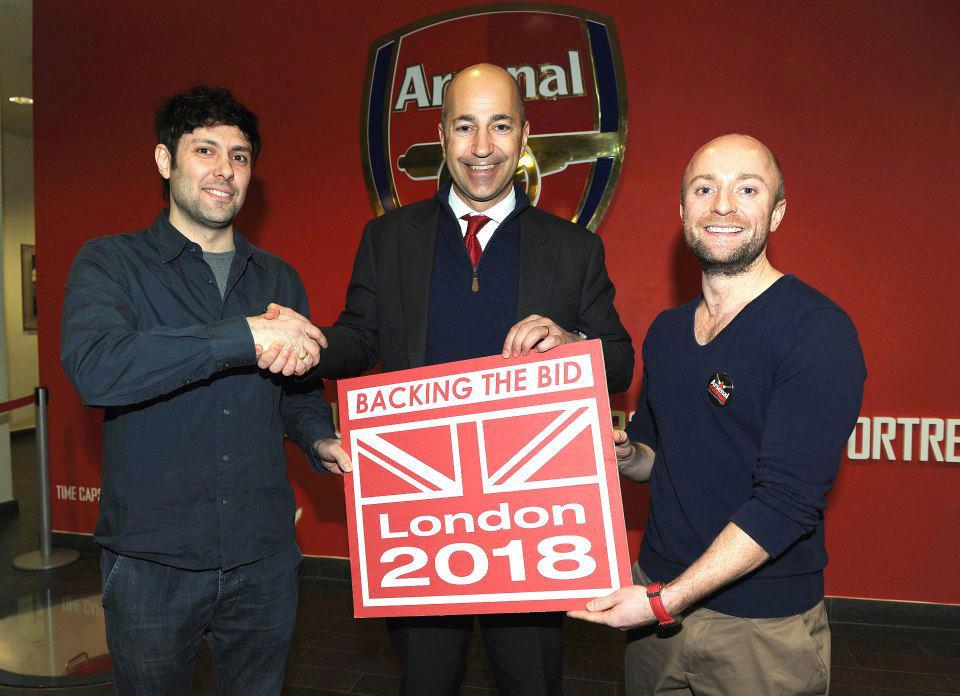
Leviathen pictured in 2013 with former Arsenal CEO Ivan Gazidis (c) and fellow London 2018 bid board member Chris Gibbons

Kimberly Hadley, FGG Officer of Sport

“I’m very sad to learn about my good friend and past fellow FGG Board Member Leviathen passing. He had a passion for making change and worked tirelessly to help give opportunities around the world for LGBTQ+ people so they could live a life full of acceptance. RIP brother.”

Sophie Cook, Rainbow Rovers FC

“Rainbow Rovers are heartbroken to hear of the passing of Leviathen. A tireless campaigner for increased diversity in sports, he was a member of the original Rovers squad [in August 2019]… he was a central member of the squad, enchanting everyone with his infectious enthusiasm and seemingly permanent smile.”

Darryl Telles, former chair of Proud Lilywhites

“It is with great sadness to hear that Leviathen has passed away. As a GFSN member, he was instrumental in establishing the Proud Lilywhites in 2014. Approached by Spurs, Leviathen advised the club on the setting up of the fan group and chairing the inaugural meeting. Put simply, if it wasn’t for his hard work as a volunteer, there wouldn’t be the Proud Lilywhites as we know it today. We owe him an enormous debt of gratitude.”

Sports Media LGBT+ extends our deepest sympathies to Leviathen’s family and friends.

If you would like to submit a tribute to Leviathen – either personal or on behalf of an organisation – please email jon@sportsmedialgbt.com

Leviathen marching with The FSF and fellow football fans to Premier League HQ in August 2014 (picture via @AnwarU01 on Twitter)

Sports Media LGBT+ is a network, advocacy, and consultancy group that is helping to build a community of LGBT+ people and allies in sport. We’re also a digital publisher. Learn more about us here.

LGBT+ in sports? Your visibility will inspire other people – sharing your story can be hugely rewarding and you don’t have to be famous to make a positive and lasting impact. We encourage you to start a conversation with us, in confidence, and we’ll provide the best advice on navigating the media as part of your journey so that you retain control of your own narrative.

Email jon@sportsmedialgbt.com or send a message anonymously on our Curious Cat.

Seattle man accused of trying to join ISIS, telling FBI he would be an ‘executioner’ – WLS-TV

0
A Washington state man has been arrested for alleged efforts to join the Islamic State group, federal prosecutors said.

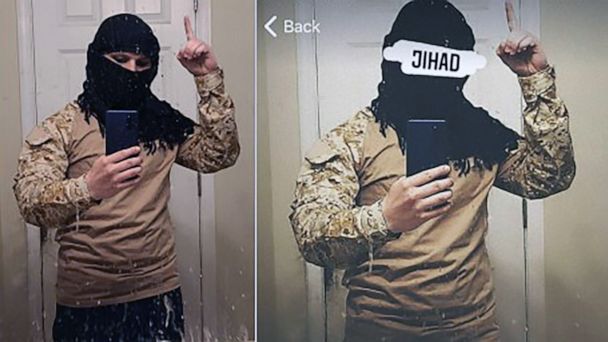
Elvin Hunter Bgorn Williams, 20, of Seattle, was taken into custody at the departure gate of the Seattle-Tacoma International Airport last Friday as he attempted to board a flight to Cairo, federal prosecutors said. After being arrested, Williams agreed to speak with agents of the Federal Bureau of Investigation and allegedly stated that he intended to become an “executioner” or a “machine-gunner” for ISIS, according to a criminal complaint unsealed Tuesday in the United States District Court for the Western District of Washington at Seattle.

“It doesn’t matter what you guys do to me. I get rewarded for it,” Williams told the FBI agents, according to the complaint. “I want to die. We love our deaths more than you love your lives.”

Williams was charged with attempting to provide material support to a foreign terrorist organization. He faces up to 20 years in prison if convicted, federal prosecutors said. He made an initial video appearance in court on Tuesday and was ordered detained pending further proceedings. A federal public defender who was appointed to represent Williams did not immediately respond to ABC News’ request for comment.

Williams, whom federal prosecutors described as “self-radicalized,” first came to the FBI’s attention when he was 16. Administrators at his high school contacted the FBI in 2017 to report that Williams was telling others he wanted to join ISIS and that the deadly terrorist attack on an Ariana Grande concern in England was justified because the singer dressed provocatively, according to the complaint.

At the time, Williams’ mother told FBI agents that he had been kicked off social media for terms of service violations related to pro-ISIS posts and that she had cut off the internet service at their home to keep him from accessing extremist websites and social media accounts. She also told the agents that her son had said he wanted to move to Syria or Iraq to fight for the jihadist group, according to the complaint unsealed Tuesday.

Last November, a member of a Seattle-area mosque contacted the FBI to report concerns about Williams. Federal investigators said the mosque had been looking after Williams for more than a year “as an act of charity” in an attempt to de-radicalize him — helping him with a place to live, food and tuition for a semester of college. The mosque also provided Williams with a cellphone and a laptop to help him find a job, but the members made clear he would have to abandon ISIS if he wanted their help, according to the complaint.

Williams was asked to return the phone after a member of the mosque saw him using it to watch ISIS propaganda videos and engage in online chats with other radicalized individuals. Members of the mosque reviewed the phone and were disturbed to find numerous ISIS-related videos that depicted scenes of graphic violence, including beheadings, as well as instructions on how to build a bomb, according to the complaint.

The FBI opened an investigation into Williams and used several confidential informants, some of whom posed as ISIS recruiters, to monitor his activity. Federal investigators said Williams swore an oath to ISIS in November 2020 and “became consumed with activities to join the cause overseas.”

In messages cited in the complaint, Williams expressed his willingness to become a martyr, how he would “love” to behead someone and his concern that he would get arrested at the airport. He also stated that he would commit an attack on U.S. soil if he was unable to travel abroad to fight for ISIS and discussed an unsuccessful attempt to convince a friend to help him carry out an attack on the upcoming Seattle gay pride parade, according to the complaint.

Earlier this year, Williams applied for a U.S. passport and worked at a job in the Seattle area to save up money for his travel expenses. He received his passport on May 6, according to the complaint.

“This defendant proved persistent in his efforts to join ISIS — speaking with enthusiasm about acts of horrific bloodshed in the Middle East and here at home,” Tessa Gorma, acting U.S. Attorney for the Western District of Washington, said in a statement Tuesday. “I want to commend those citizens who contacted law enforcement — including his family and faith community — expressing concerns about the defendant’s radicalization. Their courage to speak up and work with law enforcement was important to ensure public safety.”

Copyright © 2021 ABC News Internet Ventures.

2021 Philadelphia Pride calendar – The Philadelphia Inquirer

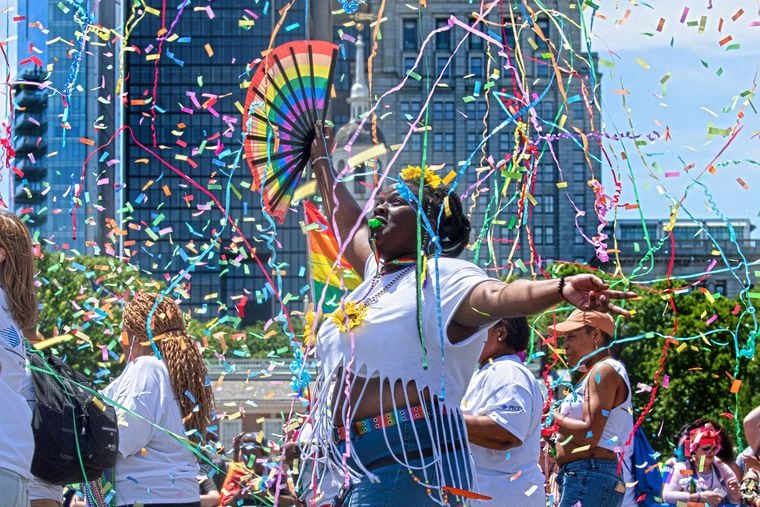
June marks Pride Month, a celebration of the LGBTQ community and the fight for rights, marking the anniversary of the Stonewall riots in New York City in June 1969.

In Philadelphia, the month is full of events that honor the contributions that LGBTQ community members have made to this city and bring awareness to the issues that queer people still face. And while there won’t be a parade this year (again), there are lots of Pride events happening in Philly all month long.

We’ll update this calendar as more events are announced.

» READ MORE: Do you have an event we should add? Let us know.

(Movies / virtual) Throughout June, PrideFlix, an annual LGBTQ film festival, presents an all-virtual film event in celebration of Pride Month. PrideFLIX started on June 1 and continues for five weeks with LGBTQ feature films, documentaries, and shorts, in addition to weekly discussions about the selections and talks about the LGBTQ experience. ($7-$10, June 1-30, goelevent.com)

(Art / virtual) Twenty-eight artists showcase their pandemic experiences in an online exhibition of works that represent the challenges that the LGBTQ community faced and the warmth of the community during a tough time period. The show is free to access online. (Free, June 1-30, waygay.org)

» READ MORE: How to support trans people in Philly, according to trans people

(Movies / in-person) The Philadelphia Film Society’s drive-in theater hosts a screening of the NC-17 (so, no kids allowed) John Waters’ classic Female Trouble. The drive-in movie is a fund-raiser for Philly AIDS Thrift, so your ticket price goes to a good cause. ($35 per vehicle, June 2, 9 p.m., Admiral Peary Way and League Island Boulevard, filmadelphia.org)

(Quizzo / in-person) Up on the roof at Christ Church Neighborhood House, find a drag queen-led quizzo show complete with a side of comedy. Drinks from Art in the Age will be available, in addition to a selection of snacks. ($25-$40, June 3, 6-8 p.m., 20 N. American St., christchurchphila.org)

(Drag / in-person) Parking lots aren’t usually too much fun, but from June 11 to 13, the parking lot at the King of Prussia Mall hosts drive-in drag shows featuring GottMik and Rosé, finalists from season 13 of RuPaul’s Drag Race, in addition to other talented drag queens. And, in anticipation of the opening of Lin Manuel-Miranda’s In the Heights, themed photo ops, and giveaways will take place during the show, too. ($75 per car of two people, June 11-13, 160 N. Gulph Rd., King of Prussia, tixr.com)

(Ceremony / in-person) On June 11, City Hall raises the pride flag during a free ceremony promising performances, remarks from city officials and members of the LGBTQ community, and an on-site coronavirus vaccination event. (Free, June 11, 3:30-5 p.m., 1400 JFK Blvd., phillygaycalendar.com)

(Drinks / in-person) Music and drink specials are both part of the afternoon-long Pride celebration at Parks on Tap’s more southern location at the end of the Schuylkill River Trail by South Street. Stop by for music from DJ Robert Drake, visits from local LGBTQ groups, and a drink special benefiting William Way LGBT Community Center, Philly Asian Queer, the Attic Youth Center, and Galaei. (June 12, noon-6 p.m., South Street and South 27th Street, parksontap.com)

(Fitness / in-person) A workout plus drag brunch makes a pretty good start to a Saturday. Bring your own yoga mat, water bottle, and mask to this event, which includes 45-minute workout from Come Alive 215, a performance from drag queens Vincelle Iris Spectre and Poochie, and a picnic brunch from Michael Solomonov. Look for swag bags, and lots of coffee, food, and other giveaways. ($50-$65, June 12, 9:15 a.m.-1:30 p.m., The Lawn at Park Towne Place, 2200 Benjamin Franklin Pkwy., eventbrite.com)

(Festival / in-person and virtual) In Doylestown, celebrations for Pride Month began with a flag-raising on June 1 and continue from June 12 to 19 with outdoor movie screenings (Gay Chorus Deep South and The Adventures of Priscilla, Queen of the Desert), a queer youth open mic night, a Zoom-based social justice discussion, and more. The event culminates with a music-filled party on Pine Street. (Varies, June 12-19, throughout Doylestown, dtownpride.com)

(Drag / in-person) An afternoon drag show goes down in Devil’s Den’s outdoor beer garden on June 13. Tickets get you access to the show, which features drag queens including Rosey Hart, Bev, and Lady Geisha-Stratton, and a beer. A portion of event proceeds benefit True Color United, an organization that supports LGBTQ youths and youths experiencing homelessness. ($30-$90, June 13, 1:30-4 p.m., 1148 S. 11th St., eventbrite.com)

(Fitness / virtual) This year’s Philly Pride Run, a 5K or 1K fun run, returns virtually with a weeklong opportunity for runners to take part in the 5K at their own pace and along whatever route they please. Registration proceeds benefit the William Way Community Center and its programs for the LGBTQ community in the area. Prizes are awarded for the fastest runners and the most festively dressed runners. ($30, June 13-20, runtheday.com)

(Museums / in-person) Scientists partner with drag queens in this day of performances and activities for all ages, including the science of bubbles and rainbows, music, and a joyful celebration of color that celebrates inclusivity and diversity for all LGBTQ people and allies. The museum also will celebrate Pride with a rainbow lighting display in the Benjamin Franklin National Memorial all month long. (Free with museum admission, $23 adults, $19 children, June 26, noon-4 p.m., 222 N. 20th St., fi.edu)

» READ MORE: Our best Philly tips: Read our most useful stories

Celebrate Pride Month: Meet Arizona’s most well-known LGBTQ Instagram influencers – The Arizona Republic

In honor of Pride Month, we are highlighting Instagrammers who identify as LGBTQIA and are well-known drag queens, advocates, influencers and nonprofit organizations.

These 11 Arizonans and Arizona-based groups have racked up thousands of followers with their variety of content. Scotty Kirby is known for his photography, Ashley and Malori for their aspirational relationship and Rose Montoya for her advocacy for visibility of transgender and other marginalized people.

This June marks the 52nd anniversary of the Stonewall Riots that took place June 28-30, 1969, as well as a slow return to in-person celebrations after most events went virtual due to the COVID-19 pandemic.

Phoenix Pride Parade and Festival 2021

Arizonans will have to wait a little longer for Phoenix’s biggest Pride celebration this year. Phoenix Pride is celebrating “40 years of fortitude” in November, rather than April, due to rescheduling.

“Pride committees commemorate the birth of the gay and lesbian rights movement each year across the country. They host rallies, parades, marches and festivals in the month of June, many on or around the 28th,” Phoenix Pride’s website says. “These activities keep the spirit alive and allow us to renew our energies toward educating the general public about our Pride in ourselves and our right to exist.”

In the meantime, check out these 11 Instagram accounts to celebrate the spectrum of people who make up Arizona’s LGBTQ community.

Astrud Elizabeth Aurelia, @astrudaurelia

Musician and singer/songwriter Astrud Elizabeth Aurelia found drag a way to “liberate myself from the traditional, sometimes suffocating nature of music school, where I studied jazz music,” according to a 2019 feature on Aurelia on World of Wonder Productions’ website.

“I’ve found the perfect way to blend my love of music, fashion, performance art and all things punk in one spot,” reads Aurelia’s bio.

You can find Astrud Elizabeth Aurelia performing for the Queer Agenda at Stacy’s @ Melrose on Tuesdays.

Where to find them: https://www.instagram.com/astrudaurelia.

Diné Pride, @navajo_nation_pride 

Diné Pride, which bills itself as the “largest Indigenous LGBTQIA+ Pride Celebration in the country,” takes place June 14-20 in Window Rock on the Navajo Nation. Last year, the Navajo Nation Council formally recognized the third week of June as Diné Pride Week.

“Diné Pride will reintroduce traditional knowledge & teachings that kept our LGBTQIA+ relatives safe and revered — the way our culture recognized at one point in history,” the organization’s website says.

The organization’s Instagram account shares upcoming roundtable discussions, panels and drag shows, many of which are accessible virtually, that highlight Indigenous members of the LGBTQIA+ community. Since 2005, same-sex marriage has been prohibited on the Navajo Nation.

Co-founders Brennen Yonnie and Alray Nelson are also founders of Diné Equality.

Where to find them: https://www.instagram.com/navajo_nation_pride, https://www.navajonationpride.com.

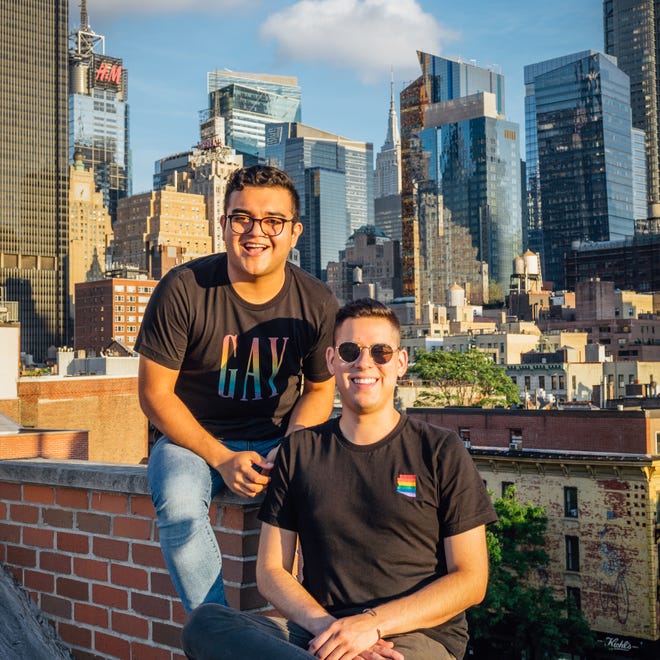
Jesus Gutierrez (left) and Sergio Aragon

Gay Pride Apparel, @gayprideapparel 

Sergio Aragon and Jesus Gutierrez are the West Valley-raised Arizonans behind Gay Pride Apparel.

The couple developed the “LGBT-owned and minority-owned” brand with designs such as “Sounds gay; I’m in” while living in New York City. Among their successes so far as a business is seeing “Riverdale” actress Lili Reinhart wear that design in a picture she posted on Instagram. Aragon and Gutierrez have since returned home to Phoenix. 

Gay Pride Apparel began as a “creative outlet and also as a way to kind of take back the Pride merchandise,” Gutierrez told The Arizona Republic in 2020. “A lot of the companies would come out with seasonal products, and we kind of felt that our community deserves better.”

He added: “We wanted to be present year-round.”

Where to find them: https://www.instagram.com/gayprideapparel, https://gayprideapparel.com.

‘Acceptance and equality for all’:A Phoenix love story sparked an LGBTQ pride clothing brand

Joey Jay, @joeyjayisgay 

This year, Joey Jay became the first drag queen from Phoenix to compete on “RuPaul’s Drag Race.”

Before Joey Jay’s season wrapped, crowning America’s 13th Drag Superstar, he talked to The Arizona Republic about his “filler queen” label, how he went on the show to “make moments” and how he uses his platform to educate his followers.

“I try to always remember even though drag can be fun I believe that you have a responsibility as a drag queen. You’re a walking political statement,” Joey Jay said. “And I don’t know what families tell their kids — I’m not in their households — but I just feel like especially right now with everything going on in the world — the pandemic, Black Lives Matter, trans lives matter — there’s a lot that needs to be talked about.”

Where to find them: https://www.instagram.com/joeyjayisgay.

Joey Jay Q&A:A ‘queen who loves to make fun of herself’

Malori and Ashley, @malleyinlove 

Ashley and Malori, a couple that met on Bumble two years ago, keep their 13,000 followers updated on their daily lives on their joint Instagram account, @malleyinlove. With their latest engagement announcements, fans can look forward to Ashley and Malori’s upcoming wedding in October 2022.

Where to find them: https://www.instagram.com/malleyinlove.

One.n.ten, @onentenphx 

Local nonprofit one.n.ten shares volunteer opportunities as well as educational, developmental and community-building events on its Instagram page.

According to the organization’s website, one.n.ten is a “nonprofit charitable organization dedicated to serving and assisting lesbian, gay, bisexual, transgender and questioning youth” that “envisions a world where all LGBTQ youth and young adults are embraced for who they are, actively engaged in their communities and empowered to lead.”

Where to find them: https://www.instagram.com/onentenphx, https://onenten.org.

More:How one.n.ten created a COVID-19 relief fund for LGBTQ youth

Piper M’Shay, @pipermshay 

Ariana Grande? No, that’s local Valley drag queen @pipermshay, but it’s easy to confuse the two.

M’Shay, who studied theater at Arizona State University and holds the title of Miss Arizona Gay Rodeo 2019, can often be found at gay bar and nightclub Charlie’s Phoenix. On her Instagram, she often shares her latest drag looks and videos from her latest performances.

Where to find them: https://www.instagram.com/pipermshay.

Rosalynne (Rose) Montoya is a model, makeup artist and public speaker who lives in metro Phoenix. In March 2021, Montoya’s video documenting how her airport security experience made her feel unsafe went viral on TikTok with more than 25 million views.

Rose Montoya, @rosalynnemontoya 

Rosalynne (Rose) Montoya is a model, actor, makeup artist and public speaker, according to her Instagram profile, and is transgender and gender nonbinary. Montoya uses the pronouns she and her as well as they and them.

In March, Montoya’s video documenting how her airport security experience made her feel unsafe went viral on TikTok with more than 25 million views.

“I always have an ‘anomaly’ between my legs that sets off the alarm,” she said in the video. “And my boobs set off the scanner, because of course. So I tried to make a joke of it and said there’s a lot of plastic in there; it’s fine.”

Montoya followed up with a 16-minute video documenting a phone conversation with TSA in which she relays her full experience, asks how their machines work and makes suggestions for “how to be more respectful of transgender people who are traveling.”  

Where to find them: https://www.instagram.com/rosalynnemontoya, http://www.rosalynnemontoya.com.

Scotty Kirby, AKA @scottykirbyphoto 

Drag, portrait and fashion photographer Scotty Kirby has worked with the who’s who of the drag scene in Phoenix — and beyond.

Kirby graduated from ASU with a degree in biology but turned to a full-time career in photography, soon finding himself able to “express his own individualism and talents” by photographing “the art of drag,” according to Kirby’s website.

Where to find them: https://www.instagram.com/scottykirbyphoto, http://www.scottykirby.com.

Shaun T, known for fitness programs such as INSANITY and Hip Hop Abs, is releasing a 30-day program called Let's Get Up! in May 2021.

Shaun Blokker, @shaunt 

Beachbody star Shaun T — whose full name is Shaun Blokker — lives in Mesa with his husband, Scott Blokker, and their two children. The trainer, who counts Lizzo among his fans, says he projects “fun, joy (and) realness” in his workouts.

In April, Shaun T told The Arizona Republic that the couple initially had some reservations about moving to Arizona shortly after getting married in New York City.

“One of our fears of moving here is we’re gay, and New York is so liberal,” he said. “So we had some reservations culturally, if you will, but (we) literally haven’t run into any issues in that way.”

Where to find them: https://www.instagram.com/shaunt, https://shauntfitness.com.

Exclusive interview:How Shaun T found strength in the toughest of times

Tempest DuJour performs during Miss Gay Arizona 2016 on June 26, 2016 in Phoenix. Tempest DuJour would finish runner-up in the competition.

Tempest DuJour, @tempestdujour

You might recall drag queen Tempest DuJour — and her early exit — on Season 7 of “RuPaul’s Drag Race.” DuJour, also known as Patrick Holt, was the costume designer for Arizona Theatre Company’s production of “The Legend of Georgia McBride” during the 2019-2020 season.

It appears the first “Drag Race” contestant to represent Arizona still lives and performs in Tucson but stays in touch with fellow Season 7 queens. You will also find family pictures and a variety of wildlife on her page, including emus, snakes and toucans.

Where to find them: https://www.instagram.com/tempestdujour.

Reach the reporter at kimi.robinson@gannett.com or at 602-444-4968. Follow her on Twitter @kimirobin and Instagram @ReporterKiMi.

Support local journalism. Subscribe to azcentral.com today.

Happy Pride: Get to know the lives and loves of these top LGBTQ Instagrammers from Arizona – The Arizona Republic

In honor of Pride Month, we are highlighting Instagrammers who identify as LGBTQIA and are well-known drag queens, advocates, influencers and nonprofit organizations.

These 11 Arizonans and Arizona-based groups have racked up thousands of followers with their variety of content. Scotty Kirby is known for his photography, Ashley and Malori for their aspirational relationship and Rose Montoya for her advocacy for visibility of transgender and other marginalized people.

This June marks the 52nd anniversary of the Stonewall Riots that took place June 28-30, 1969, as well as a slow return to in-person celebrations after most events went virtual due to the COVID-19 pandemic.

Arizonans will have to wait a little longer for Phoenix’s biggest Pride celebration this year. Phoenix Pride is celebrating “40 years of fortitude” in November, rather than April, due to rescheduling.

“Pride committees commemorate the birth of the gay and lesbian rights movement each year across the country. They host rallies, parades, marches and festivals in the month of June, many on or around the 28th,” Phoenix Pride’s website says. “These activities keep the spirit alive and allow us to renew our energies toward educating the general public about our Pride in ourselves and our right to exist.”

In the meantime, check out these 11 Instagram accounts to celebrate the spectrum of people who make up Arizona’s LGBTQ community.

Astrud Elizabeth Aurelia, @astrudaurelia

Musician and singer/songwriter Astrud Elizabeth Aurelia found drag a way to “liberate myself from the traditional, sometimes suffocating nature of music school, where I studied jazz music,” according to a 2019 feature on Aurelia on World of Wonder Productions’ website.

“I’ve found the perfect way to blend my love of music, fashion, performance art and all things punk in one spot,” reads Aurelia’s bio.

You can find Astrud Elizabeth Aurelia performing for the Queer Agenda at Stacy’s @ Melrose on Tuesdays.

Where to find them: https://www.instagram.com/astrudaurelia.

Diné Pride, @navajo_nation_pride 

Diné Pride, which bills itself as the “largest Indigenous LGBTQIA+ Pride Celebration in the country,” takes place June 14-20 in Window Rock on the Navajo Nation. Last year, the Navajo Nation Council formally recognized the third week of June as Diné Pride Week.

“Diné Pride will reintroduce traditional knowledge & teachings that kept our LGBTQIA+ relatives safe and revered — the way our culture recognized at one point in history,” the organization’s website says.

The organization’s Instagram account shares upcoming roundtable discussions, panels and drag shows, many of which are accessible virtually, that highlight Indigenous members of the LGBTQIA+ community. Since 2005, same-sex marriage has been prohibited on the Navajo Nation.

Co-founders Brennen Yonnie and Alray Nelson are also founders of Diné Equality.

Where to find them: https://www.instagram.com/navajo_nation_pride, https://www.navajonationpride.com.

Jesus Gutierrez (left) and Sergio Aragon

Gay Pride Apparel, @gayprideapparel 

Sergio Aragon and Jesus Gutierrez are the West Valley-raised Arizonans behind Gay Pride Apparel.

The couple developed the “LGBT-owned and minority-owned” brand with designs such as “Sounds gay; I’m in” while living in New York City. Seeing “Riverdale” actress Lili Reinhart wear that piece of apparel was a thrill. Aragon and Gutierrez have since returned home to Phoenix. 

Gay Pride Apparel began as a “creative outlet and also as a way to kind of take back the Pride merchandise,” Gutierrez told The Arizona Republic in 2020. “A lot of the companies would come out with seasonal products, and we kind of felt that our community deserves better.”

He added: “We wanted to be present year-round.”

Where to find them: https://www.instagram.com/gayprideapparel, https://gayprideapparel.com.

‘Acceptance and equality for all’:A Phoenix love story sparked an LGBTQ pride clothing brand

Joey Jay, @joeyjayisgay 

This year, Joey Jay became the first drag queen from Phoenix to compete on “RuPaul’s Drag Race.”

Before Joey Jay’s season wrapped, crowning America’s 13th Drag Superstar, he talked to The Arizona Republic about his “filler queen” label, how he went on the show to “make moments” and how he uses his platform to educate his followers.

“I try to always remember even though drag can be fun I believe that you have a responsibility as a drag queen. You’re a walking political statement,” Joey Jay said. “And I don’t know what families tell their kids — I’m not in their households — but I just feel like especially right now with everything going on in the world — the pandemic, Black Lives Matter, trans lives matter — there’s a lot that needs to be talked about.”

Where to find them: https://www.instagram.com/joeyjayisgay.

Joey Jay Q&A:A ‘queen who loves to make fun of herself’

Malori and Ashley, @malleyinlove 

Ashley and Malori, a couple that met on Bumble two years ago, keep their 13,000 followers updated on their daily lives on their joint Instagram account, @malleyinlove. With their latest engagement announcements, fans can look forward to Ashley and Malori’s upcoming wedding in October 2022.

Where to find them: https://www.instagram.com/malleyinlove.

One-n-ten, @onentenphx 

Local nonprofit one.n.ten shares volunteer opportunities as well as educational, developmental and community-building events on its Instagram page.

According to the organization’s website, one.n.ten is a “nonprofit charitable organization dedicated to serving and assisting lesbian, gay, bisexual, transgender and questioning youth” that “envisions a world where all LGBTQ youth and young adults are embraced for who they are, actively engaged in their communities and empowered to lead.”

Where to find them: https://www.instagram.com/onentenphx, https://onenten.org.

More:How one.n.ten created a COVID-19 relief fund for LGBTQ youth

Piper M’Shay, @pipermshay 

Ariana Grande? No, that’s local Valley drag queen @pipermshay, but it’s easy to confuse the two.

M’Shay, who studied theater at Arizona State University and holds the title of Miss Arizona Gay Rodeo 2019, can often be found at gay bar and nightclub Charlie’s Phoenix. On her Instagram, she often shares her latest drag looks and videos from her latest performances.

Where to find them: https://www.instagram.com/pipermshay.

Rosalynne (Rose) Montoya is a model, makeup artist and public speaker who lives in metro Phoenix. In March 2021, Montoya’s video documenting how her airport security experience made her feel unsafe went viral on TikTok with more than 25 million views.

Rose Montoya, @rosalynnemontoya 

Rosalynne (Rose) Montoya is a model, actor, makeup artist and public speaker, according to her Instagram profile, and is transgender and gender nonbinary. Montoya uses the pronouns she and her as well as they and them.

In March, Montoya’s video documenting how her airport security experience made her feel unsafe went viral on TikTok with more than 25 million views.

“I always have an ‘anomaly’ between my legs that sets off the alarm,” she said in the video. “And my boobs set off the scanner, because of course. So I tried to make a joke of it and said there’s a lot of plastic in there; it’s fine.”

Montoya followed up with a 16-minute video documenting a phone conversation with TSA in which she relays her full experience, asks how their machines work and makes suggestions for “how to be more respectful of transgender people who are traveling.”  

Where to find them: https://www.instagram.com/rosalynnemontoya, http://www.rosalynnemontoya.com.

Scotty Kirby, AKA @scottykirbyphoto 

Drag, portrait and fashion photographer Scotty Kirby has worked with the who’s who of the drag scene in Phoenix — and beyond.

Kirby graduated from ASU with a degree in biology but turned to a full-time career in photography, soon finding himself able to “express his own individualism and talents” by photographing “the art of drag,” according to Kirby’s website.

Where to find them: https://www.instagram.com/scottykirbyphoto, http://www.scottykirby.com.

Shaun T, known for fitness programs such as INSANITY and Hip Hop Abs, is releasing a 30-day program called Let's Get Up! in May 2021.

Shaun Blokker, @shaunt 

Beachbody star Shaun T — whose full name is Shaun Blokker — lives in Mesa with his husband, Scott Blokker, and their two children. The trainer, who counts Lizzo among his fans, says he projects “projects “fun, joy (and) realness” in his workouts.

In April, Shaun T told The Arizona Republic that the couple initially had some reservations about moving to Arizona shortly after getting married in New York City.

“One of our fears of moving here is we’re gay, and New York is so liberal,” he said. “So we had some reservations culturally, if you will, but (we) literally haven’t run into any issues in that way.”

Where to find them: https://www.instagram.com/shaunt, https://shauntfitness.com.

Exclusive interview:How Shaun T found strength in the toughest of times

Tempest DuJour performs during Miss Gay Arizona 2016 on June 26, 2016 in Phoenix. Tempest DuJour would finish runner-up in the competition.

Tempest DuJour, @tempestdujour

You might recall drag queen Tempest DuJour — and her early exit — on Season 7 of “RuPaul’s Drag Race.” DuJour, also known as Patrick Holt, was the costume designer for Arizona Theatre Company’s production of “The Legend of Georgia McBride” during the 2019-2020 season.

It appears the first “Drag Race” contestant to represent Arizona still lives and performs in Tucson but stays in touch with fellow Season 7 queens. You will also find family pictures and a variety of wildlife on her page, including emus, snakes and toucans.

Where to find them: https://www.instagram.com/tempestdujour.

Reach the reporter at kimi.robinson@gannett.com or at 602-444-4968. Follow her on Twitter @kimirobin and Instagram @ReporterKiMi.

Support local journalism. Subscribe to azcentral.com today.

Happy Pride: Get to know the lives and loves of these top LGBTQ Instagrammers from Arizona – AZCentral.com

In honor of Pride Month, we are highlighting Instagrammers who identify as LGBTQIA and are well-known drag queens, advocates, influencers and nonprofit organizations.

These 11 Arizonans and Arizona-based groups have racked up thousands of followers with their variety of content. Scotty Kirby is known for his photography, Ashley and Malori for their aspirational relationship and Rose Montoya for her advocacy for visibility of transgender and other marginalized people.

This June marks the 52nd anniversary of the Stonewall Riots that took place June 28-30, 1969, as well as a slow return to in-person celebrations after most events went virtual due to the COVID-19 pandemic.

Arizonans will have to wait a little longer for Phoenix’s biggest Pride celebration this year. Phoenix Pride is celebrating “40 years of fortitude” in November, rather than April, due to rescheduling.

“Pride committees commemorate the birth of the gay and lesbian rights movement each year across the country. They host rallies, parades, marches and festivals in the month of June, many on or around the 28th,” Phoenix Pride’s website says. “These activities keep the spirit alive and allow us to renew our energies toward educating the general public about our Pride in ourselves and our right to exist.”

In the meantime, check out these 11 Instagram accounts to celebrate the spectrum of people who make up Arizona’s LGBTQ community.

Astrud Elizabeth Aurelia, @astrudaurelia

Musician and singer/songwriter Astrud Elizabeth Aurelia found drag a way to “liberate myself from the traditional, sometimes suffocating nature of music school, where I studied jazz music,” according to a 2019 feature on Aurelia on World of Wonder Productions’ website.

“I’ve found the perfect way to blend my love of music, fashion, performance art and all things punk in one spot,” reads Aurelia’s bio.

You can find Astrud Elizabeth Aurelia performing for the Queer Agenda at Stacy’s @ Melrose on Tuesdays.

Where to find them: https://www.instagram.com/astrudaurelia.

Diné Pride, @navajo_nation_pride 

Diné Pride, which bills itself as the “largest Indigenous LGBTQIA+ Pride Celebration in the country,” takes place June 14-20 in Window Rock on the Navajo Nation. Last year, the Navajo Nation Council formally recognized the third week of June as Diné Pride Week.

“Diné Pride will reintroduce traditional knowledge & teachings that kept our LGBTQIA+ relatives safe and revered — the way our culture recognized at one point in history,” the organization’s website says.

The organization’s Instagram account shares upcoming roundtable discussions, panels and drag shows, many of which are accessible virtually, that highlight Indigenous members of the LGBTQIA+ community. Since 2005, same-sex marriage has been prohibited on the Navajo Nation.

Co-founders Brennen Yonnie and Alray Nelson are also founders of Diné Equality.

Where to find them: https://www.instagram.com/navajo_nation_pride, https://www.navajonationpride.com.

Jesus Gutierrez (left) and Sergio Aragon

Gay Pride Apparel, @gayprideapparel 

Sergio Aragon and Jesus Gutierrez are the West Valley-raised Arizonans behind Gay Pride Apparel.

The couple developed the “LGBT-owned and minority-owned” brand with designs such as “Sounds gay; I’m in” while living in New York City. Seeing “Riverdale” actress Lili Reinhart wear that piece of apparel was a thrill. Aragon and Gutierrez have since returned home to Phoenix. 

Gay Pride Apparel began as a “creative outlet and also as a way to kind of take back the Pride merchandise,” Gutierrez told The Arizona Republic in 2020. “A lot of the companies would come out with seasonal products, and we kind of felt that our community deserves better.”

He added: “We wanted to be present year-round.”

Where to find them: https://www.instagram.com/gayprideapparel, https://gayprideapparel.com.

‘Acceptance and equality for all’:A Phoenix love story sparked an LGBTQ pride clothing brand

Joey Jay, @joeyjayisgay 

This year, Joey Jay became the first drag queen from Phoenix to compete on “RuPaul’s Drag Race.”

Before Joey Jay’s season wrapped, crowning America’s 13th Drag Superstar, he talked to The Arizona Republic about his “filler queen” label, how he went on the show to “make moments” and how he uses his platform to educate his followers.

“I try to always remember even though drag can be fun I believe that you have a responsibility as a drag queen. You’re a walking political statement,” Joey Jay said. “And I don’t know what families tell their kids — I’m not in their households — but I just feel like especially right now with everything going on in the world — the pandemic, Black Lives Matter, trans lives matter — there’s a lot that needs to be talked about.”

Where to find them: https://www.instagram.com/joeyjayisgay.

Joey Jay Q&A:A ‘queen who loves to make fun of herself’

Malori and Ashley, @malleyinlove 

Ashley and Malori, a couple that met on Bumble two years ago, keep their 13,000 followers updated on their daily lives on their joint Instagram account, @malleyinlove. With their latest engagement announcements, fans can look forward to Ashley and Malori’s upcoming wedding in October 2022.

Where to find them: https://www.instagram.com/malleyinlove.

One-n-ten, @onentenphx 

Local nonprofit one.n.ten shares volunteer opportunities as well as educational, developmental and community-building events on its Instagram page.

According to the organization’s website, one.n.ten is a “nonprofit charitable organization dedicated to serving and assisting lesbian, gay, bisexual, transgender and questioning youth” that “envisions a world where all LGBTQ youth and young adults are embraced for who they are, actively engaged in their communities and empowered to lead.”

Where to find them: https://www.instagram.com/onentenphx, https://onenten.org.

More:How one.n.ten created a COVID-19 relief fund for LGBTQ youth

Piper M’Shay, @pipermshay 

Ariana Grande? No, that’s local Valley drag queen @pipermshay, but it’s easy to confuse the two.

M’Shay, who studied theater at Arizona State University and holds the title of Miss Arizona Gay Rodeo 2019, can often be found at gay bar and nightclub Charlie’s Phoenix. On her Instagram, she often shares her latest drag looks and videos from her latest performances.

Where to find them: https://www.instagram.com/pipermshay.

Rosalynne (Rose) Montoya is a model, makeup artist and public speaker who lives in metro Phoenix. In March 2021, Montoya’s video documenting how her airport security experience made her feel unsafe went viral on TikTok with more than 25 million views.

Rose Montoya, @rosalynnemontoya 

Rosalynne (Rose) Montoya is a model, actor, makeup artist and public speaker, according to her Instagram profile, and is transgender and gender nonbinary. Montoya uses the pronouns she and her as well as they and them.

In March, Montoya’s video documenting how her airport security experience made her feel unsafe went viral on TikTok with more than 25 million views.

“I always have an ‘anomaly’ between my legs that sets off the alarm,” she said in the video. “And my boobs set off the scanner, because of course. So I tried to make a joke of it and said there’s a lot of plastic in there; it’s fine.”

Montoya followed up with a 16-minute video documenting a phone conversation with TSA in which she relays her full experience, asks how their machines work and makes suggestions for “how to be more respectful of transgender people who are traveling.”  

Where to find them: https://www.instagram.com/rosalynnemontoya, http://www.rosalynnemontoya.com.

Scotty Kirby, AKA @scottykirbyphoto 

Drag, portrait and fashion photographer Scotty Kirby has worked with the who’s who of the drag scene in Phoenix — and beyond.

Kirby graduated from ASU with a degree in biology but turned to a full-time career in photography, soon finding himself able to “express his own individualism and talents” by photographing “the art of drag,” according to Kirby’s website.

Where to find them: https://www.instagram.com/scottykirbyphoto, http://www.scottykirby.com.

Shaun T, known for fitness programs such as INSANITY and Hip Hop Abs, is releasing a 30-day program called Let's Get Up! in May 2021.

Shaun Blokker, @shaunt 

Beachbody star Shaun T — whose full name is Shaun Blokker — lives in Mesa with his husband, Scott Blokker, and their two children. The trainer, who counts Lizzo among his fans, says he projects “projects “fun, joy (and) realness” in his workouts.

In April, Shaun T told The Arizona Republic that the couple initially had some reservations about moving to Arizona shortly after getting married in New York City.

“One of our fears of moving here is we’re gay, and New York is so liberal,” he said. “So we had some reservations culturally, if you will, but (we) literally haven’t run into any issues in that way.”

Where to find them: https://www.instagram.com/shaunt, https://shauntfitness.com.

Exclusive interview:How Shaun T found strength in the toughest of times

Tempest DuJour performs during Miss Gay Arizona 2016 on June 26, 2016 in Phoenix. Tempest DuJour would finish runner-up in the competition.

Tempest DuJour, @tempestdujour

You might recall drag queen Tempest DuJour — and her early exit — on Season 7 of “RuPaul’s Drag Race.” DuJour, also known as Patrick Holt, was the costume designer for Arizona Theatre Company’s production of “The Legend of Georgia McBride” during the 2019-2020 season.

It appears the first “Drag Race” contestant to represent Arizona still lives and performs in Tucson but stays in touch with fellow Season 7 queens. You will also find family pictures and a variety of wildlife on her page, including emus, snakes and toucans.

Where to find them: https://www.instagram.com/tempestdujour.

Reach the reporter at kimi.robinson@gannett.com or at 602-444-4968. Follow her on Twitter @kimirobin and Instagram @ReporterKiMi.

Support local journalism. Subscribe to azcentral.com today.

Bestsellers List Sunday, June 6 – Los Angeles Times

0

SoCal Bestsellers

Hardcover Fiction

1. While Justice Sleeps by Stacey Abrams (Doubleday: $28) A political thriller from the voting rights activist.

2. Project Hail Mary by Andy Weir (Ballantine: $29) A lone astronaut tries to complete a mission to save the sun and humanity.

3. Klara and the Sun by Kazuo Ishiguro (Knopf: $28) A view of a technologically advanced society from the perspective of a child’s artificial friend.

4. The Hill We Climb by Amanda Gorman (Viking: $16) A special edition of the poem delivered at President Biden’s inauguration.

Advertisement

5. The Plot by Jean Hanff Korelitz (Celadon: $28) A novelist teaching writing classes steals a story from a gifted student who died.

6. The Guncle by Steven Rowley (Putnam: $27) A fun-loving gay man is thrust into the role of guardian of his niece and nephew.

7. Whereabouts by Jhumpa Lahiri (Knopf: $24) A lonely woman begins a life-changing transformation.

8. The Midnight Library by Matt Haig (Viking: $26) A reader in an infinite library is torn between versions of the life she is leading and the life she could be leading.

9. The Invisible Life of Addie LaRue by V.E. Schwab (Tor: $27) In 1714 France, a desperate young woman makes a Faustian bargain to live forever but is cursed to be forgotten by everyone she meets.

10. Sooley by John Grisham (Doubleday: $29) The outbreak of civil war back home strands a teenage Sudanese basketball player in the U.S.

Hardcover nonfiction

1. The Anthropocene Reviewed by John Green (Dutton: $28) The novelist explores the current geologic age with a collection of essays adapted from his popular podcast.

2. Crying in H Mart by Michelle Zauner (Knopf: $27) A memoir from the Korean-born singer-songwriter of the band Japanese Breakfast.

Advertisement

3. World Travel by Anthony Bourdain, Laurie Woolever (Ecco: $35) An irreverent guide to some of the late travel writer and TV personality’s favorite locales.

4. Zero Fail by Carol Leonnig (Random House: $30) The Washington Post reporter’s definitive account of issues that plague the Secret Service.

5. The Bomber Mafia by Malcolm Gladwell (Little, Brown: $27) The bombing of Tokyo on the deadliest night of World War II.

6. Yearbook by Seth Rogen (Crown: $28) A collection of personal stories from the Hollywood writer-producer.

Advertisement

7. Notes on Grief by Chimamanda Ngozi Adichie (Knopf: $16) The author copes with the death of her father during the COVID-19 pandemic.

8. The Premonition by Michael Lewis (Norton: $30) A real-life thriller in which medical professionals who see a pandemic coming are ignored by political leadership.

9. Noise by Daniel Kahneman, Olivier Sibony, Cass R. Sunstein (Little, Brown: $32) The authors document a flaw found in many aspects of human judgment.

10. What Happened to You? by Oprah Winfrey, Bruce D. Perry (Flatiron: $29) Understanding past events leads to understanding — and fixing — one’s problematic behavior.

Advertisement

Paperback fiction

1. People We Meet on Vacation by Emily Henry (Berkley: $16)

2. Hamnet by Maggie O’Farrell (Vintage: $17)

3. Circe by Madeline Miller (Back Bay: $17)

4. The Song of Achilles by Madeline Miller (Ecco: $17)

Advertisement

5. Interior Chinatown by Charles Yu (Vintage: $16)

6. Where the Crawdads Sing by Delia Owens (Putnam: $18)

7. Fresh Water for Flowers by Valérie Perrin (Europa: $17)

8. Squeeze Me by Carl Hiaasen (Vintage Crime: $17)

Advertisement

9. Normal People by Sally Rooney (Hogarth: $17)

10. The Seven Husbands of Evelyn Hugo by Taylor Jenkins Reid (Washington Square: $17)

Paperback nonfiction

1. Braiding Sweetgrass by Robin Wall Kimmerer (Milkweed: $18)

2. The Body Keeps the Score by Bessel van der Kolk (Penguin: $19)

Advertisement

3. Hidden Valley Road by Robert Kolker (Anchor: $17)

4. The Four Agreements by Don Miguel Ruiz (Amber-Allen: $13)

5. Signs by Laura Lynne Jackson (Dial Press : $18)

6. Entangled Life by Merlin Sheldrake (Random House: $18)

Advertisement

7. Minor Feelings by Cathy Park Hong (One World: $18)

8. The Undocumented Americans by Karla Cornejo Villavicencio (One World: $17)

9. The Body by Bill Bryson (Anchor: $17)

10. Becoming by Michelle Obama (Crown: $19)

Imagine Dragons frontman had to ‘get FBI involved’ after receiving death threats for LGBT+ allyship – Yahoo Eurosport UK

Imagine Dragons lead vocalist Dan Reynolds has revealed that he had to ‘get the FBI involved’ after receiving death threats for being an outspoken LGBT+ ally.

Reynolds, who has worn an LGBT+ and trans Pride flag on stage numerous times, told Attitude that some people “are not happy” about him being an LGBT+ ally. He shared that he even had to get authorities involved after receiving “weird death threats” for supporting the LGBT+ community.

“I’ve had weird things happen, I’ve had weird death threats,” Reynolds said. “I’ve gotten the FBI involved.”

But he said that he has a “powerful team” who have “taken care of it”. He told Attitude that he is “not a martyr”, but it is the “reality” of being an ally. Reynolds said the “only reason” he mentioned the threats is “so people do understand this is a real problem still”.

“And if you don’t think it is, get involved, and you’ll see,” Reynolds said. “There are a lot of people who are very angry… and in the wrong.”

As part of his commitment to being an ally, Dan Reynolds founded LOVELOUD – a foundation and festival that advocate for LGBT+ youth – in 2017. The foundation has awarded grants to organisations that support queer youth including the Trevor Project, Encircle, the Tegan and Sara Foundation and GLAAD.

He told Attitude that the LGBT+ community are “looking for allies and support” – especially younger people who are “transitioning or have not come out to their families yet”. Reynolds said the community is just “looking for us [allies] to step up”.

“A lot of straight people I meet are like ‘but the pronouns are hard for me…’ It’s not at all, first of all,” Reynolds said.

“Second, the amount of patience from the queer community of… just try! Do the research, make a little effort. My kids can do pronouns!”

Earlier this year, the Imagine Dragons singer donated his childhood home so that it could be converted into an LGBT+ youth centre for advocacy group Encircle. The centre based in the Las Vegas property, which is worth $1 million, will help vulnerable queer youth.

Moses Lake boaters allegedly harassed another group over gay pride flags. Then their boat burst into flames. – The Seattle Times

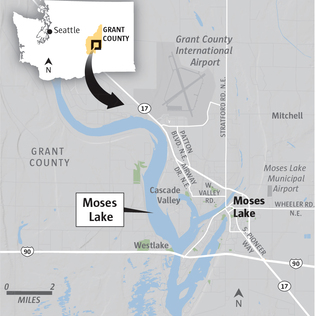
When another boat began circling their vessel on Moses Lake on Memorial Day, a group from Washington assumed they were trying to signal support for their gay pride flags.

But then someone on the other boat flipped a middle finger and yelled something about “gays” and “flags,” a passenger on the boat said. So the group started recording in case the situation escalated.

It did — but not how they might have expected.

Moments later, the other boat burst into flames, forcing passengers to jump into the lake — and leaving the victims to become rescuers as they filmed a moment that turned into a viral video this week.

“These people harassed my family because we were flying gay pride flags … by racing around us and shouting gay slurs,” tweeted a passenger named Robbie along with a video that has been viewed more than 620,000 times on Twitter as of early Wednesday. “Then, their boat literally blew up! #KarmaIsReal.

The Grant County Sheriff’s Office confirmed the incident took place on Sunday on Moses Lake, adding that the agency was working to interview the people involved before releasing more information. Police did not identify anyone onboard the two boats.

“We are currently interviewing the boat owners to determine if a crime occurred,” Sheriff Tom Jones told The Washington Post late Tuesday.

Advertising

Robbie, 32, told The Post in a statement that he, his brother and two other passengers had spent Sunday swimming, listening to music and tubing in the lake about 100 miles west of Spokane. (Robbie declined to provide his last name out of fear of retaliation.)

Around 7 p.m., the group stopped their boat, which carried a rainbow flag from one of Robbie’s first pride events, as well as another gay pride flag belonging to his brother.

That’s when they noticed a small vessel carrying three people speeding toward them. One of the other boat’s passengers, a woman, yelled something unintelligible before flipping her middle finger, Robbie said.

Then, as the boat seemed to speed away, it made a sharp turn and circled around them at least six times.

“At this point I could clearly hear the words ‘gays’ and ‘flags’ being shouted from their boat,” Robbie said.

By then, Robbie’s brother was recording with his phone. When the other boat noticed the group was filming, the driver attempted to hide his face before speeding away, leaving a cloud of smoke behind and waves that rocked Robbie’s boat back and forth.

Advertising

Moments later, the group heard a loud bang and sputter coming from the other boat, and saw a cloud of black smoke rising. “Holy crap! They blew up!” said Robbie’s brother, who was driving the boat.

Robbie’s brother steered toward the boat, which was consumed in flames.

“Help us! We’re burning!” shouted the woman who had flipped her middle finger at them moments earlier, Robbie said. Robbie and the rest of his group pulled the burning boat’s occupants to safety and then sped away before calling 911.

“The passengers were quite rude, shouting over us, ignoring my [inquiries] about their well being when on the 911 call and smoking a vape pen on our boat without even so much as asking if they could; several passengers of our boat have asthma,” Robbie told The Post.

Eventually, police arrived to extinguish the flames. The rescued boaters left to jump on a friends’ vessel without saying “thank you,” Robbie said.

Grant County Deputy Kyle Foreman told The Spokesman-Review it is not clear why the boat caught fire. The boat was eventually towed back to the shore, Foreman told the paper.

Robbie later tweeted a clip of two pride flags flying over the lake from his boat, writing, “And we’re back at it again! We will not hide our #pride.”

Listening to Naomi Osaka – The Wall Street Journal

On the matter of Naomi Osaka and the French Open: I suspect a day will come when people will look back upon this moment and be mystified by how agitated it all got, how a player opting out of routine press conferences and deciding to leave a tournament because of concern about her own mental health became such a global uproar. I suspect there will be a time in the future when an athlete’s revelation of depression and anxiety—or anyone’s revelation of depression and anxiety—won’t launch a zillion casual diagnoses or judgments about an alleged lack of mettle.

I think (I hope!) we’re going to reach a point that when a person says they’re in mental distress, we will just…listen.

But we’re not there yet. 

We’re not there yet because mental health in sports, like in many occupations and environments, remains a complicated, under-discussed subject, still wrapped in stigma and dated notions about toughness and “gutting it out.” We’re getting better, no doubt about it—more workplaces are offering mental health resources for employees, and in sports, Osaka has been preceded by star athletes like Michael Phelps, Abby Wambach, DeMar DeRozan and Kevin Love, who have openly discussed mental health battles of their own. 

It’s a work in progress, however. The awkward debate over Osaka’s departure signals that athletes and sports are still figuring this out. We’re not yet ready to nurture mental health in the way we do a pulled hamstring or badly sprained ankle.  

We might get there, though. 

“This is a huge step,” says Alexi Pappas, a former Olympic runner whose recent memoir, “Bravey,” chronicles her own battles with mental health. 

By acknowledging her depression and social anxiety, and stepping away, Osaka is taking action, Pappas says. “She’s taking measures to treat her mental health like someone would treat their physical health,” she says. 

It took Pappas a while to get there. The Dartmouth and University of Oregon All-American, who lost her mother to suicide, struggled to reconcile her inner duress the same way she treated her bodily injuries; amid the peak moment of her career, the sadness and turmoil in her head made her feel guilty. 

“I thought I was spoiled because, on paper, I had it all: I was successful, I’d just run the best race of my life, I was a national record holder and I didn’t think I deserved to feel the way that I felt,” she says. “I felt it was not allowed.”

Eventually, Pappas would come to view her mental health like she would any physical setback—that it was treatable and nothing to be ashamed of, and could heal, too. Now she shares that message with organizations like the Pentagon, which recently asked Pappas to speak to U.S. soldiers.

“We are very capable of doing amazing things, and telling ourselves that pain is just weakness,” Pappas says. “Sometimes we need permission to say, ‘The coach or doctor says no.’”

Alexi Pappas, center, in action during the 2016 Rio Olympics.

Photo: Simon Bruty /Sports Illustrated/Getty Images

As for the rest of the Osaka situation: miscommunication abounded here, but I think it’s pretty clear that tennis bungled the response. It’s utterly fair for the French Open to be irritated about Osaka stiffing the press, and to fine her, a penalty that Osaka expected. It’s also fair to worry about setting a precedent that other players might be enticed to follow. But to quickly align with the sport’s three other major events and threaten Osaka with suspension, which appears to have triggered her withdrawal, was a blunt overreaction—something the tournaments seem to have realized, judging from their far more humane statement on Tuesday.  

Pro tennis, an occupation rife with early burnout, ought to be especially attuned to mental health. The sport is such a grinding pressure cooker—players are removed at an early age from families and ordinary childhoods and thrust into global competition in adolescence or even before. Osaka, who is 23, has had spectacular financial and on-court success—she, too, appears to have it all—but depression and anxiety doesn’t work like that. It’s not linear. Free passes are not handed out to high achievers. Phelps, the most decorated Olympian of all time, regularly fell into depressive, self-destructive episodes after his gold medal triumphs. 

Mental difficulty can be mysterious, even to the sufferer. We’re also still amid a pandemic in which ordinary interactions with other people have been stifled, and routines and lives have been disrupted. If you’re doing OK, it’s tempting to think everyone else should be doing OK, too. That’s not the way it goes, however. A little bit of empathy can go a long way. 

At the same time, I think we should tap the brakes on all this doomsday rhetoric over media access and sports press conferences. As someone who has spent a fair bit of time in these press conferences, I agree that they can veer into the banal and cringeworthy, but they do retain value for reporters seeking to clarify facts and understand actions. They have particular value for sports like tennis, which are fighting to stay relevant, and can’t start walling off media coverage. Big stars have big social media platforms, but not every person and event does, and those stories should be told, too. 

Also: an athlete’s relationship with the media is not a static thing. It’s common to see a player who is hesitant with the media early in their career get to a far more comfortable place later in their journey. Some of the great quote machines in sports wanted nothing to do with the media as they were coming up. It’s possible Naomi Osaka gets there herself.

I’m sure there are some who remain dubious about the way this shook out, believing Osaka leaned on mental health as a cover to duck press obligations at a tournament where she was not considered a favorite. Her withdrawal shows she was clearly not playing around, and so the question becomes: what to do now? Giving someone who says they’re in pain the benefit of the doubt—and whatever space and assistance they need—feels like a low-risk, high-reward proposition. 

What is there to lose, really, by listening?

SHARE YOUR THOUGHTS

What do you think about Naomi Osaka’s decision to withdraw from the French Open?

Write to Jason Gay at Jason.Gay@wsj.com

Copyright ©2020 Dow Jones & Company, Inc. All Rights Reserved. 87990cbe856818d5eddac44c7b1cdeb8

How Portland’s Queer Culture Scene Got Through the Pandemic—and Where It Goes Now – Willamette Week

You can’t cancel Pride.

Cancel the parties, cancel the parades, cancel the rainbow-splattered corporate pandering. But while June has been designated as the month for publicly celebrating the LGBTQ+ community and its history, affirming queer identity is not something that happens only when the clubs are open, and it doesn’t stop when the calendar turns over. Not in a pandemic, and certainly not when companies stuff their flags back into storage.

That said, losing those parties hurt.

It’s often said that Pride began with a riot. More specifically, it started with a riot at a gay bar. Queer spaces have always been crucial to queer liberation. It’s not just about ecstatic celebration, although that’s part of it. It’s about having somewhere to go to experience the visceral feeling of acceptance, to give support and feel supported. Not to have that for an entire year—particularly this year, a time of both radical social upheaval and a barrage of legislative attacks on trans rights—left a wide void.

But again: Queerness, and queer culture, can’t simply be quarantined away.

Arriving once again at Pride Month, with the pandemic fading but not yet gone, we asked eight fixtures of Portland’s LGBTQ arts and nightlife community—from drag producers and performers to bar owners, DJs, dancers and standup comics—how they stayed connected over the past year, and what happens after the reunion.

“World’s Oldest Drag Queen,” founder of Darcelle XV Showplace in Old Town

WW: At the start of the pandemic, did you worry about the club’s survival?

Darcelle: That was very, very scary. I think it was, like, five months [closed] in the last year and this year together. That’s a lot of time with no income. I was certainly not ready to close Darcelle’s because it’s going to stay open forever, I hope. I just thought, “I should be working.” I made about 19 new costumes during that first shutdown.

When was the last time you went that long without performing?

Fifty-four years ago, before I had a club.

You ended up doing some outdoor drive-in shows at Zidell Yards this April. How was it?

That was wild and wonderful. We were approached by a producer, and we did five shows in three days. Most of the shows were sold out—I think 200 cars. It was fun, it was hard work, and it was also very, very cold. We were in tents. There were no dressing rooms. In between numbers, they brought me blankets, and I was all wrapped like I was in Alaska.

Darcelle’s was added to the National Registry of Historic Places last year. Could you have ever imagined that happening?

I would not have imagined that would ever happen. But I’m very humble about my success. I worked hard to get it there, and now that it’s there, we still work hard.

Now that you’re back performing in the club, do you have a sense of what it means for the audience to be able to see you up close again?

I can’t go down and talk to them like we used to, but I know from the reaction, without having to discuss it, that the reactions are wonderful. They’re so happy to have entertainment again. – MATTHEW SINGER.

WW: First off, you were diagnosed with ovarian cancer earlier this year. How are you doing?

Meghan Holmes: I’m going through six chemo treatments and I’ve gone through four, so I have two left and they’ll probably end just around Pride time.

When things first shut down last year, can you recall what was going through your head?

I had been going to DJ at least five times a month, so for things to go quiet was super-different. Queer nightlife is so important. People go out there for community and to see other people, and it’s really a nice time in their week to let go of whatever’s going on. To not throw Pride was pretty significant, I think. People are just so used to being able to at least have a little party at their house. To not even be able to have. That was pretty wild.

Did you end up doing streaming gigs?

We did a couple events, but we’ve been going pretty hard for about five years and realized maybe this was the time just to take a step back. There was a lot going on, nationally, and even just within Portland, that it felt like those things were more important.

Do you feel like, in a cultural sense, the queer community got hit particularly hard by the pandemic in terms of losing the ability to congregate and meet in these spaces?

I’m sure everyone had a really hard time with it, but I do think that in the queer community, it’s so important to have each other, to have dinners with each other, to go out for drinks with each other, to just kind of party with each other. It’s such an integral part of who we are and how we create.

Will it be difficult to readjust to going out again?

I don’t think anything will slow us down. As soon as we get the green light, I’m sure that it’s going to be a pretty explosive summer. The only thing that would hold people back is finding the venue to throw parties at if their venue doesn’t exist anymore. But I think that a lot of people are pretty hungry to throw a party. And I think it’ll probably be more exciting. I think people are going to appreciate each other more, and the spaces that they’re able to do things in. MATTHEW SINGER.

Standup comic, producer of the Portland Queer Comedy Festival

WW: What was your 2020-21 lockdown life like?

Dahlia Belle: For the first part of the pandemic, I was still working retail. That was not a good feeling. We were all very much aware that we were essentially guinea pigs for herd immunity. Like someone was saying, “You’re poor, you’re expendable. Let’s see what happens.” At first, people were nice. Tips got more generous. But as the pandemic wore on—and people were just holding on for dear life—the civility started to wane.

How did you react to a year without live, in-person comedy?

I’ve never really been much of a club comic. This year ultimately turned out fairly positive for me. More alternative venues and comedy scenes, like the queer and trans comedy scenes, expanded into online shows. So I was able to work directly with peers who I had always admired from afar but had never been able to share a stage with, like Mary Jane French in L.A. or KJ Whitehead from Chicago. To trans people, these are celebrities.

If you’re not a club comedian, where does your work exist?

Performing at gay bars? Online shows hosted by gay bars?

Both, but I don’t know that most of my online following knows I do comedy. On Instagram, people just think I’m a model. And on Facebook, people think I’m a political activist.

Do you think you gained anything from the pandemic year?

The good part was being able to focus on writing material that is truer to me and my life experiences. Because the only shows that were really available for me during the pandemic were online queer and trans showcases, I performed for a lot of activists and trans people. I didn’t have to qualify statements, justify them or disclose my medical status. Everyone was like, “Yes, I know exactly what you’re talking about.” So that part was great. But now it’s a little more complicated because live shows are coming back, and I worry I don’t know how to relate to straight people. I haven’t seen any in the last year. – SUZETTE SMITH.

Dance instructor, founder of the Kiki House of Ada

WW: What were you doing prior to the pandemic?

Daniel Girón: When I first moved to Portland, I spent the first three or four years training under anyone who would take me under their wing. It wasn’t until 2015 that I shifted all that focus into finally putting my skills out there. I’d been networking a lot, and I knew I had a good grasp on what the Portland scene was missing: When it comes to studio dancing, there wasn’t a space carved out for queer people, which I thought was weird because dancing is gay as fuck. I wanted to create an outlet that was for queer people who wanted to dance and that didn’t involve nightlife and alcohol. My vogue classes really brought that and helped build community. I taught those weekly lessons for six years until the pandemic hit.

What did the loss of these queer physical spaces mean to the community?

Everyone just took [the shutdown] in a very different way. I think it was very clear that because the clubs are often the place they can be [themselves], and that’s taken away from them, there’s the sense of being lost. I think it also might be a situation where it forces people to face some realities that might be really harsh. It’s kind of bittersweet, because in a way, it’s important to face those things and grow.

Do you feel you’ve carved out a virtual space to continue teaching and being a leadership figure in Portland? How has it changed the nature of your work?

Before the pandemic, I had all these plans of really diving less into the studio world and more into the club scene and event planning and creating a space for the queer Latinx community. I was starting to do a lot of that work and shifting into a leadership position. So although the pandemic put a stop to that, when it comes to my social media presence, I make sure that’s what I focus on: being this representation of queer, unapologetic Latinx vibes and connecting people to resources when needed.

Are you beginning to start teaching in person again as the state opens up?

For the last few months I’ve been teaching private [lessons], and although I’m known for vogue, I’m a well-rounded dancer. The people who reached out to me have been coming in with the intention to just move their bodies, to feel that connection again. The students I did privates with are all different ages and races, but they always had that in common.

What are your top videos you’ve made since the pandemic?

I made a Cinco de Mayo post where I got together with Portland Latinx dancers of all styles: waacker, crumper, light feet. A lot of times, people think of Portland as a really white place. I wanted to showcase that, no, people live here who aren’t white, and we’re thriving. – SOPHIE PEEL.

Owner of Sante Bar in downtown Portland

WW: The queer community is built on shared spaces. How has the isolation of the past year affected queer nightlife culture?

Veronique Lafont: I think, throughout the pandemic, what we were seeing was people who were so isolated they couldn’t get into their communities, they couldn’t be around people who were like-minded, they couldn’t feel love and gather in a shared space. It was very hard. And a lot of places, because of the pandemic, closed. So by the time we started reopening again, I was hearing from a lot of people saying, “I just had to get out.”

Now that Multnomah County is entering the lower-risk category, what sort of changes have you seen as people come back to bars and restaurants?

Now that we are at 50% capacity, I feel as though people within our community are still wanting to keep that 6-foot distance. A lot of my friends don’t feel comfortable sitting indoors and prefer to be outside, so I think we are still going to be distanced when it comes to contact. People are still very uncomfortable with hugging, even when vaccinated. I think the pandemic has changed the culture as a whole because people also don’t want to come out unless it’s a special event. It’s no longer getting drinks on the weekend—there has to be a reason why we are going out. And that’s creating a divide because people aren’t gathering like we used to. We used to have our live music, drag shows and spoken-word performances, and the place would be packed and people would sit together and talk. But we can’t do that now. You have to be at another table, yelling, and that really changes the dynamic of the venue.

This summer offers a little bit more optimism than last. What are you anticipating for Pride this year?

I am feeling like a seesaw on both ends. I am super-excited to have our drag performance on the 18th and a four-piece band on the 19th. I want people to come back and appreciate being together. But I am so concerned that there are still going to be those individuals who forget we are still in COVID because they are having so much fun, and those who are still a little apprehensive about COVID but want to have fun. I think there’s going to be a lot of emotions. And I am also concerned about the turnout. I want the community to know that as long as we are practicing safe practices and doing our part, we can still get back to that inclusion and out of this loneliness. – MEIRA GEBEL.

WW: I noticed a lot of writing about you doesn’t focus on what I might call your “journey with queerness.” Is that intentional?

Bobby Fouther: I don’t focus on my journey with queerness, I just do the work. [laughs] I’ve had lots of different experiences with my life, so claiming one thing over another just never really serviced me. I’ve fallen in love with different people, but it didn’t serve any purpose other than claiming names or things like that. It’s not relevant to me. Now, just let me rephrase for what I’m getting ready to say. I don’t think that doesn’t mean people’s issues and public awareness and social change is not valuable, so I’ve worked on plenty of issues and things like that, like for Brother to Brother, which was a gay Black agency years ago that morphed into several different things for several different generations. But I don’t focus on all that. I just do the damn work.

Would you say you’ve always been at peace with your identity?

My mom trained my sister and I that our identities belong to us, so it has really nothing to do with anyone else on the planet. She always respected us like that, she always gave us advice like that. I know when I was really young, my mom said, “You can do and be anything you want to be. Just remember there’s consequences for everything you do.” And that was the lesson, so I carefully set out to try everything I could. She watched me climb up the tree again—that’s my little joke to myself. It’s like I know my mom, I’d look at her and say, “OK, Mom, I’m getting ready to jump off the branch!” She’d say, “OK, baby!” And I know she was looking at me, saying, “I wonder when this boy’s gonna realize he ain’t got no feathers.”

You’ve been part of so many artistic communities: dance, theater, visual art, fashion—

Because that’s how I grew up. I’m from that world, you know? I was talking to someone about going to drag shows on Sunday, and it was like, “Well, it’s not that I love drag queens or anything like that, it’s just that’s live theatre that happens on a weekly basis that’s completely improvisational.” But people don’t look at it like that. It’s not my job to convince anyone of anything. I would die trying to go down that road. Anyway, was that what you asked me? [laughs]

A lot of what I want to talk about involves community, especially within the lens of the past year. How have you maintained your sense of community, within all your communities, and how have you grown them in the past year?

Contrary to some of my senior friends, I am on top of social media, like Facebook and Instagram. I have a little following, and that’s how I stay in community, particularly since I’ve ended up in this wheelchair and I can’t get out and about the way I used to. Like, I couldn’t protest, because if people fall down, I’m trapped. And I’m 70, I’m not running out of nothing, OK? So it became my online protest, where I do my little political posts and pieces and artwork. I get in where I can fit in, and usually I’m the person people call when everything else is messed up. If the person didn’t get the job done, they call Mr. Bobby. If they spent the money or don’t know where it went, they call Mr. Bobby. It’s just been like that forever. I’m the person with the safety pins. – ANDREW JANKOWSKI.

WW: In my mind, Portland Drag Brunch was the main, long-standing drag brunch in Portland. How long had it actually been running?

Justin Buckles: You know, I thought it ran for three years, but it turns out I only started producing it in April 2018, which was about a month into the show. We sold out 90% of those two years, though!

What happened when the shutdown hit?

Obviously, everything stopped immediately. Our last show was March 16 of last year. Financially, I was OK. I rode the wave a little easier than most people because I’m a homeowner. I was able to get a forbearance on my mortgage. So I am very privileged when it comes to that, and I recognize that immensely.

When did you decide to revitalize the show?

Well, I don’t own Portland Drag Queen Brunch. That was the owner of the Night Light. He owned the lounge and had a separate company for the brunch. But during the pandemic, all my performers and I stayed in touch. I started reaching out to venues, and Bit House was like, “Oh my gosh, we’d love to host this year.” We’re excited for that space. It’s bigger. It’s open. We’re at 50% capacity, and at 100%, the energy is going to be wild.

Those ceilings seem like a good idea, considering all the gymnastic moves we used to see at Night Light.

Oh yeah, that’s Jayla Rose. She tumbles. She does back handsprings and flips. My performers are slowly getting back into the groove of things. It feels so good. I actually just booked another show in Sun Valley, Idaho. They’re kicking off Pride in little, tiny Sun Valley, Idaho, and we’re going to be there.

What kind of precautions will be in place for Diva Drag Brunch?

All the performers will be wearing the face shields for the time being. The clear plastic ones. We’re going to ask everyone to throw tips on the ground.

I can only imagine a drag outfit planned around a face shield.

Yes. A lot of my performers have already bedazzled and put jewels on them. They’re going to be over the top, as all my performers are. – SUZETTE SMITH.

Graphic designer, creatorof the Progress Pride Flag

WW: Tell us about the inspiration for the Progress Pride Flag.

Daniel Quasar: It was a couple of days after Seattle had unveiled their version of the Pride flag, which basically took Amber Hikes’ “More Color, More Pride” Philadelphia flag and added the trans flag with three stripes on top of it. I felt compelled and had a big creative spark where I was like, “I want to see if I can do something with this and emphasize the message they’re going for and put my own spin on it that furthers what it’s trying to do.”

One article called the flag “a triumph for inclusiveness—a design disaster.” How did you handle the early criticism, and how have your own reactions changed as the flag’s become more famous?

I was overwhelmed by everything, so it was really hard for me to respond to just about any [feedback], just because I wasn’t prepared for that and I’m also a hugely anxious person. To go viral and realize “Oh, I can’t handle this mentally, at all.” [laughs] But I would say a good 95 to 99% of the comments are all super-positive.

Do you now get enough seasonal emails and checks to keep you comfortable the rest of the year?

[Laughs] The way the American copyright system works, you can’t copyright a flag. I have creator’s copyright because I made the thing, but I can’t file a copyright claim for it. At the same time, at least with the people I’ve spoken to, everyone understands the level of respect involved. They want to respect the work and respect the originator of that work, and I take it from that perspective. Regardless of whether or not I have copyright, it’s my thing and not in a way where I own it. I don’t want someone to think my deal is, “This is my thing and I’m greedy about it!” No! My thing is, I protect it. I’m protecting its message and its integrity as a symbol and what I created it for.

How did you maintain your communities over the past year?

I already was a hermit who stayed at home, took care of their cats, and worked from home. When the pandemic came around, nothing really changed for me, except for more of a reason not to go out and see people. [laughs] The first four months of 2020 were really rough for business. When Pride came around and everything was canceled, I think something happened in people where they were like, “I can’t go out to Pride, so I’m going to take Pride home.” My business blew up because people wanted to have stuff to have with them since they couldn’t go out and experience Pride at festivals. – ANDREW JANKOWSKI.

Owner of CC Slaughters, one of Portland’s oldest gay bars

WW: CC Slaughters closed in October, then reopened a few months later. What happened there?

Bruce Edward Rice: I was looking at the winter going, “There’s no way that I can make it through the winter.” With my rent and all my bills, with the restrictions, we just couldn’t do it. So I negotiated with my landlord and said, “Can I close down and not pay rent? If you want to rent it, and you can find someone, they can rent it. But in the spring, if no one’s renting it, I want to come back.” And they were OK with that.

What’s the energy like in there now?

I mean, we’re a dance club and we’re not able to dance yet. Until this pandemic is over, we can’t have a dance floor or anything like that. Pretty much, right now, we’re just a neighborhood bar.

Even before the pandemic, it felt like Portland’s queer spaces were disappearing. What’s your perception?

We’re not in the ’80s and ’90s anymore where, if you were gay, you really kind of needed to go to a gay club to feel inclusion. Portland has progressed so much. You can be gay holding your boyfriend’s hand in pretty much any club and it’s fine.

So what do you feel is the role of CC Slaughters in 2021?

I don’t think it’s changed much at all over the years. I’ve owned it for 18 years. But there’s just more inclusion. We’ve seen a lot more straight people in here, and I see a lot more gay people who just go to other clubs that aren’t necessarily gay. But other than that, nothing really has changed. We still have drag queens and we still dance.

How hopeful are you for the future coming out of the pandemic?

Right now, it’s going to take a while for downtown to come back. But I am definitely seeing a lot more cars, a lot more people walking around. So I’m really encouraged. I look back on the 1918 pandemic. What happened after that was the Roaring ’20s. I’m hoping everyone is just going to get crazy and have a whole bunch of fun after this is all done. – MATTHEW SINGER.

LELO and Marco Marco Celebrate Pride with Limited Collection Underwear Collaboration – PRNewswire

STOCKHOLM, June 2, 2021 /PRNewswire/ — LELO, the world’s leading designer of intimate lifestyle products, celebrates Pride Month by collaborating with renowned fashion designer, Marco Marco, to create a limited-collection of bold and unconventional body inclusive underwear. The provocative collection has been uniquely crafted by LELO and Marco Marco to honor and celebrate the LGTBQ community, inviting everyone to look and feel their best inside and outside of the bedroom. 

As a brand that is leading a self-care movement aimed at highlighting conversations related topics around gender and pleasure, LELO is dedicated to supporting Pride Month to continue the discussion about identity, equality and personal satisfaction. The partnership with Marco Marco helps LELO to further empower the public in their quest to discover their bodies without shame and to lead a fulfilled intimate life.

To amplify this message, LELO and Marco Marco collaborated with models and influencers from diverse backgrounds to further reinforce the inclusivity campaign celebrating love, pleasure, equality and acceptance among the LGBT community. These inspiring individuals share their personal stories of coming out to empower others as they are making a similar decision.

Additionally, the two brands will donate 15% of the sales from this collaboration to the Marsha P. Johnson Institute, continuing LELO’s 2020 pledge to support the black trans community.  

“At LELO, we believe that pleasure — in its many forms — is something to be celebrated,” said Luka Matutinovic, CMO at LELO. “We are honored to partner with iconic brand, Marco Marco, to amplify the LGBTQ+ perspective on sex & pleasure and create a collection that inspires confidence for every body.”

“What we’re trying to continue at Marco Marco, is the elevation of the people and the culture this brand was built around. We want queer people and their stories to be front and center of everything we do.  For us,” says designer Marco Morante, “visibility and representation aren’t just goals, they’re integral to who we are. It’s a legacy we’ve inherited from queer artists that came before us. Partnering with LELO during this Pride is truly an exciting opportunity to build on our platform of diversity and sexual freedom, while also telling the unique stories of our individual models and their personal journeys.”

LELO x Marco Marco’s limited edition underwear collection is now available on Marcomarcounderwear.com with a pouch / no pouch option in sizes small through extra large and retails for $28.00 with purchase possible until supplies last. For a chance to win a pair of underwear, visit https://lelo.leadfamly.com/lelo-x-marco-marco-for-pride. For more information on LELO and to explore the full roster of pleasure products visit www.lelo.com.

About LELO

LELO is the world’s leading designer brand for intimate lifestyle products. On launching in 2003, LELO transformed the look, feel and function of how personal massagers were perceived, and now applies the same commitment to quality and innovation through bedroom accessories and massage candles. LELOi AB is the Swedish company behind LELO, where offices extend from Stockholm to San Jose, and from Sydney to Shanghai. For more information on LELO please visit www.lelo.com.

About Marco Marco 

The Marco Marco Label is recognized globally as a brand whose ethos acknowledges the beauty and power of individuality across all gender identities and expressions.  Their eccentric fashion shows and high-profile clientele make them a go to brand for people in the know. For more on the brand, please visit Marco Marco at www.marcomarcounderwear.com/pages/about

Media Contact:
Denisa Caldova
213.225.4418
[email protected]

SOURCE LELO

Frank Kameny: Google doodle honours astronomer and gay rights activist – New Scientist News

New Scientist Default Image

Frank Kameny addresses a crowd as a street in Washington DC is named in his honour in 2010

Sarah L. Voisin/The Washington Post via Getty Images

Frank Kameny, a US astronomer who campaigned tirelessly for gay rights, has been honoured with a Google doodle in celebration of LGBTQ Pride Month, which is held in June.

In 1957, while working as an astronomer at the US Army Map Service, Kameny was arrested in a park in Lafayette Square in Washington DC, a popular cruising area at the time, and accused of being a “sexual pervert”. The police report was passed to his employers, and when he refused to discuss his sexual orientation with them, he was fired.

Unable to get another job, Kameny sued the US Civil Service Commission for unfair dismissal, arguing that civil rights could not be withheld due to sexual orientation. He lost twice in federal courts and his appeal was refused by the Supreme Court, but Kameny became a full-time campaigner.

Advertisement

He organised some of the first public protests for gay rights in the US. One notable achievement was his campaign for the American Psychiatric Association to stop classifying homosexuality as “mental disorder”, which it did in 1973. Two years later, the Civil Service Commission finally reversed its ban on LGBTQ employees. He also fought to repeal Washington DC’s sodomy laws, which didn’t happen until 1993.

Kameny served with the US Army in Europe during the second world war before completing his bachelor’s degree in physics at Queens College, New York, in 1948. He then obtained a master’s degree at Harvard University and worked as a teaching fellow there until completing his PhD in astronomy.

In 2009, his dissertation on semi-regular variable stars was rediscovered by the American Association of Variable Star Observers and his observations were added to the group’s database.

In the same year, Kameny finally received an apology for his firing from the Office of Personnel Management, and he was issued with its highest award. US president Barack Obama personally thanked him for his work.

Kameny died of a cardiac arrest in 2011, aged 86. The American Astronomical Society awarded him a posthumous certificate of appreciation at their 2012 meeting.

Sign up to our free Launchpad newsletter for a voyage across the galaxy and beyond, every Friday

More on these topics:

Fauci looks back on early days of AIDS 40 years after epidemic began – TODAY

Dr. Anthony Fauci, director of the National Institute of Allergy and Infectious Diseases, has spent the past 40 years of his career fighting the AIDS epidemic, but he can still remember one of the first times he encountered data about the disease, in June 1981.

“It was a particularly transforming time,” he told TODAY’s Joe Fryer in a segment aired on Wednesday for Pride Month. “I can remember very distinctly sitting in my office outside my lab in the clinical center hospital where I saw the first (report) describing the first five patients from Los Angeles with this curious new disease, with nobody knowing what was going on.”

The patients were all “otherwise previously healthy gay men,” Fauci said, which he found “rather curious,” until the following month, when another report on 26 patients came out, indicating that young, gay men in San Francisco and New York City were also showing signs of the disease.

Dr. Anthony Fauci at an August 1989 news conference detailing new researching findings for a drug for Americans infected with HIV. On the right is then-Health and Human Services Secretary Dr. Luis Sullivan.Bettmann Archive

“I remember sitting at my desk looking at that and literally getting chills up and down my spine saying, ‘Oh my God, this is a new disease. It has to be a new disease,'” he recalled. “I had no idea what it was or where it came from.”

“Everything was great, my career was going along well, and I said, ‘Wow, I’ve got to study this new disease because it looks like it’s an infection, and it looks like it’s destroying the immune system.’ So I made a decision right then that I would start and literally stop what I was doing.”

He went to work for the National Institutes of Health as a senior investigator. Some of his mentors questioned the decision, he added, because “nobody had any idea whether it was going to all disappear in a month or so … but that was the beginning of a journey that I’ve been on for the last 40 years now.”

In 1984, Fauci assumed his current role as the director of the National Institute of Allergy and Infectious Diseases, as the AIDS crisis was capturing national attention. He faced criticism from AIDS activists in the early years who believed he was ignoring the outbreak. At the time, Ronald Reagan was president, and through much of his first term, he did not acknowledge the virus’s existence.

Prominent gay activist Larry Kramer, who died in May last year, also accused Fauci of being too inexperienced to hold his position, though Kramer and the doctor eventually developed a friendship through their work to fight the disease.

July 1, 201902:26

Fauci told Fryer that Reagan’s stance on the AIDS epidemic was a challenge and that it “prompted me to be very forward and proactive in not only my own research but actually out there in the public speaking about it … trying to get people’s attention to it.”

“I never really had any aspirations to be the director of the institute, but it was clear to me that we were not paying as much attention to infectious diseases in general, but specifically to HIV,” he added.

In the early days, securing resources for the fight against AIDS was difficult.

“We were trying to convince people that this was not something that was going to go away, this was something that was gonna get worse and worse,” Fauci said.

The major funding started during George H.W. Bush’s presidency.

“I was fortunate enough to get to know him personally and become actually pretty friendly with him when he was vice president,” Fauci recalled. “He promised me that if he became president, he would really take a really close look at what we’re doing and see if we can improve it. … He kept his word when he became president.”

Since then, there have been several major milestones with preventing the spread of HIV, namely antiretroviral therapy, which can reduce the viral load of a person infected with HIV to the point that the individual won’t spread it, and drugs like PrEP, which can protect a non-infected individual from contracting the virus.

June 1, 202104:51

Fauci explained that the disease has gone from “almost an absolutely inevitable death sentence to people who are now living virtually normal lives.”

Antiretrovirals in particular, which led to the messaging, “Undetectable equals untransmissible,” were “totally transforming,” Fauci said.

“It was important for the people who were living with HIV to know that, scientifically, they did not pose a threat to anyone if, in fact, they took their medicines and their viral load remained low detectable,” he said.

“It helped to take some of the stigma away from persons living with HIV,” he added.

Fauci called PrEP, which stands for pre-exposure prophylaxis, “an extraordinary success.” The first drug of this kind for HIV, a pill called Truvada, was approved in 2012. Earlier this year, the Food and Drug Administration approved the first monthly shots, replacing daily pills, to help patients maintain their treatments more easily and with more privacy.

But the absence of an HIV vaccine still looms large in the fight against the disease. Fauci said that one isn’t available “was not for lack of trying” and that he doesn’t know when it might be. One major reason, he said, is that the the body doesn’t naturally produce an adequate immune response to the virus.

“We have highly effective vaccines against COVID-19 because we know the body can do it, and we induce the body to do it,” he explained. “With HIV, that’s not the case. We’ve got to do better than what natural infection does.”

“Hopefully some of the things we’ve learned from the … COVID-19 vaccines will ultimately help us to develop a successful and highly effective HIV vaccine. So we’re still hoping that that’s going to come to pass.”