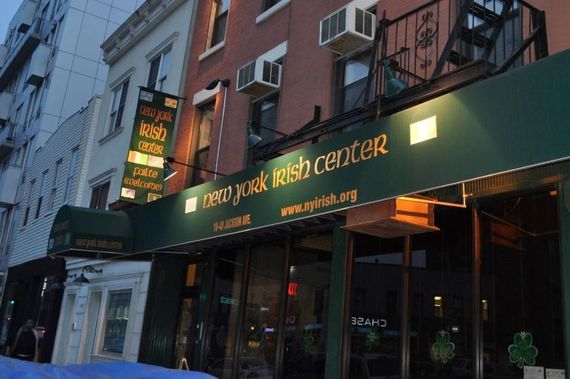
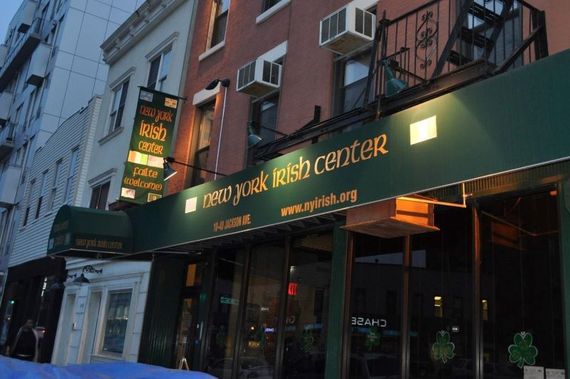
The CraicFest, the long-running New York Irish film and music festival will present (in association with New York Irish Center) Queer Ireland, a conversation on how Ireland has inspired our panelists on their LBGTQ journey on June 12 at the New York Irish Center in Long Island City, Queens
This discussion program will be part of the ongoing LGBT night at New York Irish Center (with the Craic LGBT film fest to be held later the same evening) and it will be moderated by Siobhan Ni Chiobhain.
Craic Fest founder Terence Mulligan told IrishCentral: “We are delighted to be working with George Heslin and the New York Irish Center (NYIC) on this Queer Ireland program on June 12. George and his staff are doing great things for the Irish community in Long Island City and we look forward to collaborating long term with the NYIC.”
4
The NYIC will host the LGBT Craic fest in association with Craic Fest, IFI Dublin, and Gaze Ireland, the Irish LGBT film festival.
“For three years Now York Irish Center has hosted our LGBTQ quarterly networking series The Story Continues where we celebrate and share stories from the community,” NYIC Executive Director George Heslin tells the Voice.
“This partnership is building on our commitment to diversity as we share stories through the lens of filmmaking while offering the next generation of Irish filmmakers a platform here in New York.”
“Prior to the 7 P.M. screening at 5 P.M., the NYIC will present a reception and panel discussion on how modern Ireland and its support for equality inspires our panelists to live their best lives.”
Panelist Joseph Jones, originally from Belfast, has been living in New York for five years. Joseph is an actor, model, and Creative Ambassador for a non-profit with victims of conflict and terrorism. A graduate of the Neighborhood Playhouse School of the Theatre, he has also walked runways in New York, Paris, and London.
He is a proud Gaeilgeoir, teaching at the Irish Arts Center in Manhattan, and is now working with Bloc TG4. He is also a recent contributor and interviewee on RTE Raidio na Gaeltachta, RTE 2fm, and BBC Gaeilge.
4
Panelist Marlow Murphy is a writer based in Brooklyn where she is an amateur student of Irish culture. Her father’s ancestors originally came from Wexford and emigrated from the County Clare townland of Kinturk during the Great Famine. Her mother’s father is descended from the Kanes of Ulster.
As a child of the Diaspora na nGael, she has worked to restore her connection to the culture of Ireland by studying the Irish language and folklore. Marlow is transgender and has professional and volunteer experience in LGBTQ advocacy and events.
Micheal Curtin is an Irish speaker, drama facilitator, and educator from Brooklyn. He currently directs a drama-in-education program at the CUNY Creative Arts Team. Previously, Micheal co-directed the Queer Youth Theatre with LGBT young people at The Door, a youth center in Manhattan.
In Ireland, Micheal has led periodic projects using drama as a teaching tool in schools to support Irish language acquisition. Micheal learned his Irish between New York and Ireland over the past few years. He is passionate about languages, particularly the ways in which language can connect people to their past and begin to heal the wounds of colonialism.
Sean O hAodha is Deputy Consul General of Ireland in New York. Sean previously worked in the Humanitarian Unit of Irish Aid, which administers the Irish Government’s humanitarian aid budget, leading on humanitarian policy, the Red Cross, and Western, Central, and Southern Africa.
Prior to this, he covered humanitarian and global health issues at the Irish Permanent Mission to the UN in Geneva. Previous assignments within the Irish Department of Foreign Affairs include Addis Ababa and Brussels. Originally from Dublin, Sean lives in Hell’s Kitchen with his husband, Sebastiaan.
4
Siobhan Ni Chiobhain is an award-winning Creative Content Producer and Brand-Builder from Ireland. She has produced TV and Radio programming for BBC, UTV, RTE, TG4, and Raidio na Gaeltachta among others.
She was selected as a “One to Watch” by the prestigious Guardian Edinburgh International TV Festival in 2014. In 2019, she was selected as one of The Irish Echo’s Top 40 Under 40. She also won The Irish Echo’s People’s Choice Award. She is a proud Gaeilgeoir and is co-founder of Gaeil Nua Eabhrac, a group that organizes Irish Language events in NYC.
For more information about the discussion and to hear more about the lineup of LGBT short films to be screened on the night visit www.craicfest.com.
Our home planet is inhabited by a diverse array of life, sexuality, gender, kinship, care systems, and strategies for living, being, and reproducting. The Earth’s varieties of fauna and flora are as expansive as are the many facets of our own humanity. That’s especially true for the environmental movement and outdoor community.
In honor of Pride Month and “Great Outdoors Month”—which President Biden proclaimed in honor of the importance of the outdoors for mental and physical health, and, to raise awareness about the climate and extinction crises—we’ve been celebrating. And because the year is 2021, we’ve also been scrolling. We’re psyched to recommend 14 social media feeds that lift up LGBTQI+ voices in the great outdoors and beyond.
Pınar Yaku Sinopoulos-Lloyd, the self-proclaimed “trans-Indigenous mutant,” “multi-species futurist,” and “neurodivergent psychonaut” who co-founded the mind-expanding @QueerNature account, launched @queerquechua to celebrate their heritage as well as pachamama, or as she’s known in Quechua, “world mother.” The Quechua peoples hail from the Peruvian Andes. Through this feed, Sinopoulos-Lloyd raises up Quechua traditional outdoor skill-building, as well as their relational model of co-existing with fellow animals and plant species. Their thoughtful and provocative posts lift up fluidity in all its forms (rather than “femme” or “masc,” Sinopoulous-Lloyd identifies as “riparian” and when asked, “Are you a boy or a girl?” responds, “I am a river”). They view gender-expansiveness as a form of Indigenous intelligence, as well as an ecological formation of place. This hypnotizing account encourages followers to see nature not as a place to recreate or escape but rather to practice “intimate accountability.” It will also inspire activists to “hack the settler industrialization project” and work toward “multi-species co-liberation.”
Growing up queer, Mexican American, vegan, and essentially zero waste (the latter because his family recycled for money and couldn’t afford to buy new things), Isaias Hernandez (the man behind @queerbrownvegan) wished he could’ve connected with other young people living similar lifestyles. “I felt so ashamed of my identity,” the environmental educator told Sierra. Hernandez found his community after launching @queerbrownvegan, through which he creates colorful graphics, illustrations, and videos for like-minded environmentalists to advance the discourse around the climate crisis, now with 90K+ followers. “We cannot liberate ourselves from the ecological crisis without our community,” Hernandez said. “Environmental education is essential in our fight against the ecological crisis.” Visit his feed for surprising insights into individual climate-mitigating actions and provacative thoughts about the larger environmental justice movement.
Join photographer, climber, writer, trans activist, and ambassador for Mountain Hardwear (among other brands) Nikki Smith (@nikkik_smith) as she documents her quest to create affinity spaces for marginalized folx in the Great Outdoors. Smith is candid about her own transition process, and has been instrumental in the formation of queer-specific outdoor gear guidance, classes, and outings. “What I hope people in the outdoors gain from following me and others who don’t fit the ‘outdoorsy’ stereotype is that the idea that ‘nature doesn’t care about your sexuality, gender, or race’ is the wrong way to view the outdoors,” Smith told Sierra. “We need to remember that our outdoor spaces are surrounded by and filled with people. While nature made us who we are, the people in and around it can make outdoor recreation dangerous or uncomfortable for those of us who are viewed as “different”.”
Adventurous teachers Bre and Laci of @theladiesvan met at a Los Angeles cafe in 2008. They started dating a year and a half later, dedicated their lives to traveling the world and making the outdoors more accessible, and in 2014 got married at a campsite in Malibu Creek State Park. Along the way they also became #vanlife mavens, and now provide an inexpensive conversion option for the van-curious. Bre also launched another account, Sēkr (@sekr.official), through which she helps people find outdoor community, and partners with organizations like the Leave No Trace Center and Tread Lightly to educate followers on responsible stewardship in the Great Outdoors. “Developing our passion for traveling in nature changed our lives significantly, and it is our main goal to help other people experience the same passion for lifestyle design by inspiring them to pursue their own dreams, whatever they may be,” Bre and Laci told Sierra. “We’re proud to say we’ve already helped hundreds of thousands of people get outside, with a big focus on underrepresented communities.”
Derived from “camper” and the Vietnamese word for explore, “Khám Phá,” Khámper is the perfect word to represent explorer/campers Honnie and Niki. The Northern Californian blogging couple launched @happykamper to inspire the LGBTQ community to explore safely—especially when traveling outside of places such as their own “Bay Area bubble.” They also aim to help followers build community, develop outdoor leadership skills, and plan awesome adventures (Honnie and Niki provide plenty of insights into gear and trip-planning). “As queer Asian-American women, we hope our content and stories will encourage others to spend more time in nature,” they told Sierra.
A self-identified “white, queer, fat femme taking body liberation outdoors,” Jenny Bruso (@jennybruso) is the founder of @UnlikelyHikers, a meet-up group/social media tour de force that celebrates the diversity of shapes, sizes, backgrounds, and appearances. The explosive popularity of the group (check out Sierra’s 2018 Unlikely Hikers profile) signaled a departure from the historically homogenous optics of the outdoor industry. Bruso’s personal feed—through which she shares the work she’s doing to help brands develop gear that better serves a range of identities and body types—is somehow even more celebratory of queer liberation, as well as body liberation. A powerful writer, Bruso regularly posts reminders like, “The sneakiness of body trends is a reminder that we are seen as for-profit. Weaponized to sell products and surgeries. Distracting us from our power.”
The vibrant feed of queer wildlife educator @jaunting.jay is rife with fun wildlife facts, including provocative thoughts about veganism and various species’ relationships with pansexuality and other forms of queerness. Jay writes with candor about growing up queer and Black, and regularly celebrates those queer and Black folx advancing science. And he has some fascinating thoughts about how interspecies interactions can actually stimulate brains and aid in the evolution of progressive thoughts and actions.
Deg Xit’an Dené/Sugpiaq (who also goes by Deenaalee) is an Indigenous, semi-nomadic, and queer-identifying fisherwoman. She’s the life force behind @go_barefoot and also a poet, writing, “As I walk this life path, I am looking forward to my introduction growing longer—mapping my linage within the constellations of Deg Xit’an and Sugpiaq cosmologies.” It’s a powerful feed that inspires followers to develop more holistic relationships with the lands they love.
You may remember Mikah Meyer (@mikahmey) as the first person to touch down on all 400+ NPS sites in a single journey (if not, check out Sierra’s 2017 story about the quest). The journey, which had him zooming across the country—including its less-than-gay-friendly regions—made him a queer pioneer, and a role model. “I realized that maybe, when some little queer kid would say, ‘I like to be outdoors, and I wonder if there are any gay people that do that’—I could be that person,” Meyer told Sierra. Afterward, he made a pact with himself to embark on an epic journey every five years. Follow along in real IG time as the funny and friendly native Nebraskan bikes across the state of Oregon.
Seeking regular reminders of the connections inherent between environmentalism and social justice? @goldengreengirl knows her way around the nuances of intersectional environmentalism—the movement that advocates for the protection of both the planet and its inhabitants—and she uses her feed to identify the vast connectedness between injustices experienced by marginalized communities, and those inflicted upon Mother Earth. She writes, “The are no problems for the future, all futures ripple from our present, and that means we CANNOT discount climate change and social justice.”
The sweeping @QueersforClimateJustice page offers another multi-faceted celebration of the intersections between the LGBTQ and environmental movements. It also fêtes the many queer-identifying activists who help all environmentalists reimagine our relationships to the living world and to one another. Follow for information about affinity activist events, film screenings, social gatherings, and for oodles of intersectional inspiration!
In a similar vein, @intersectionalenvironmentalist is a massive platform that uplifts a range of identities, honoring their contributions to environmental and social justice progress. It’s not queer-specific, but serves as a hub that’ll keep you in the know about the movers, shakers, and movement developments you’ll want to keep up on.
The world taught Erin Eden () that “adventurous and trans” wasn’t exactly a combo option. Already having ascended seven major mountain peaks, she took to the Instasphere to share her mountaineering adventures and transition process. Despite being a busy parent and pet steward, Eden labors to make the world an easier place for fellow trans adventurers to thrive (for instance, by petitioning NordicTrack to expand the binary gender options for at-home electronic exercise systems). Follow Eden as she attempts to summit Mt. Denali this month in honor of Pride. Fans will also enjoy her other, even more mountain-focused account, @transending7.
This list wouldn’t be complete without a shoutout to the one and only @Pattiegonia. Pattie was born in 2018 when photographer Wyn Wiley started uploading photos and videos of himself backpacking in platform heels. An outdoor community hungry to transcend traditional bounds of gender and sexuality responded emphatically to Pattie’s singular, al fresco (and often hilarious) celebration of queerness and gender fluidity. Today, Pattie enjoys upwards of 336k followers. Wyn/Pattie’s activism is only deepening over time. When Pattie’s not upcycling outdoor gear into fabulous costumes (fanny-pack bra, anyone?), and delivering tongue-in-cheek PSAs against littering, toxic masculinity, and fast fashion, Wyn is making cameos to share what it was like coming out in his (much-beloved) conservative home state of Nebraska and to educate followers about simple ways they can bank without supporting fossil fuel interests, and encouraging the practice of radical self-acceptance. Recently, Pattie’s created a job board for LGBTQI job candidates seeking careers in outdoor and environmental spaces. And earlier this week, she launched a scholarship for young queer folx seeking immersive outdoor NOLS experiences. The trail is indeed Pattie’s runway.
Seven years after an act of parliament made homosexuality a crime punishable by death, the anti-gay campaigners of Uganda are at it again. Last month, the parliament of my country once again voted to make homosexuality a criminal offence, this time with a 10-year prison sentence.
In 2014, I played a small part in making sure that anti-LGBTQI forces in Uganda do not succeed in writing their hate into law: I was one of the petitioners in the case that successfully overturned the infamous anti-gay law. Back then, we had the entire political system – every single legislator, both from the government and the opposition, save I and one other – against us. But with an independent and capable judiciary, the Act was annulled. The government chose not to appeal.
Fortunately, this time we are unlikely to need to go to such lengths. Passed in the final days of an outgoing parliament, through a private member’s bill introduced by an outgoing legislator, and without government support, this legislation needs assent. The government has already indicated this will not be granted, so the legislation will not become law.
The Ugandan government will not sign this anti-gay legislation into law in part because it was introduced by an outgoing legislator and approved by a now-dissolved parliament. But there is also the fact that granting assent to this law – not least when it was not legislation the government put forward – would trigger an outcry from the international community.
Indeed, after Uganda passed the “Kill the gays bill” – as it was dubbed locally – in 2014, its reputation on the international arena suffered. Not only did the British and American governments, encouraged by global rights groups and LGBTQI campaigners, raise the spectre of retaliation, but the World Bank decided to rescind a $90m loan to Uganda’s health system. Our sovereign credit rating also took a hit due to the passing of the anti-gay law. Certainly, after the experience of 2014 the Ugandan government is surely less willing to grant assent to similar legislation that would undoubtedly draw condemnation and an unwelcome response from the international community.
While the efforts of LGBTQI campaigners across the globe made it highly unlikely for Uganda to sign into law another “Kill the gays bill”, the fight for LGBTQI rights in the country and the rest of Africa is far from over.
The fear of retaliation from the international community may stop Uganda and other African countries from attempting to officially criminalise homosexuality, but it will not make being gay socially acceptable on the continent. Today, homosexuality is simply not accepted by the majority of African citizens. And the LGBTQI fight for equality and recognition in Africa will not be over until it is.
Ultimately, it will not matter how many court cases are won, or governments pressured to cease anti-gay legislation, or African leaders backed by western money and education elected with the expectation they will challenge public perceptions of homosexuality.
President Adama Barrow of Gambia reneged on his pledge to do so, despite being ushered into office by US Democratic lobbyists. Kenya’s President Uhuru Kenyatta did nothing to further LGBTQI rights in his country, despite his liberal Amherst College education. We must know by now that African politicians – just like their western counterparts – follow public opinion, rather than lead it.
Neither should we be so certain, as some are, that the pervasiveness of anti-LGBTQI sentiment in Africa is owing to some malignant and deceptive Christian influence. Most Africans are refusing to accept homosexuality not so much because of their Christian beliefs, but because they perceive it as a “Western value” being forcefully pushed upon their societies by malignant and invasive outside forces.
This may seem perverse given Christianity itself was brought to Africa by European colonial missionaries. But that was a long time ago. In the present, many Africans express their patriotism and defiance to the West by railing against what they perceive as “modern-day” western interference.
But all this does not mean there is no chance for widespread LGBTQI equality and acceptance in Uganda and on the continent. Times, and people, are changing. In 2014, only 17 percent of the Ugandan population had internet access. Today, nearly every adult in the country has the ability to go online. As a result, the minds of our people are rapidly opening to new ways of thinking and seeing the world.
This newfound access to knowledge, information and differing points of view is having a vast, transformational effect on the electorate. With our youthful population, so many young, knowledgeable Ugandans, who do not carry strong anti-gay sentiments, and even support LGBTQI rights, are joining the electoral roll in every election cycle.
We are already seeing the consequences of this gradual change. Two years after our legal victory against the “Kill the gays bill”, the Ugandan electorate had rewarded me for my efforts by turfing me out of parliament at the 2016 general election. This year, they turfed me back in by a landslide. Among those rejected at the polls this year was the MP whose anti-gay private members bill brought this issue back to parliament. Another was our country’s opposition leader, Bob Wine, who began his political career in 2014 singing pop songs about burning homosexuals. He was defeated this January by a margin of nearly 2.5 million votes.
Will Uganda pass another law criminalising homosexuality in the future? If it does, we will contest it again, fight it again, and overturn it again.
But I doubt another such bill will come to pass. The times are changing. The electorate is changing and, consequently, legislators are changing.
The parliament that voted for last month’s anti-gay bill is now replaced. The legislator that proposed the bill is no longer in parliament. And the current government clearly has no intention to die on the hill of criminalising homosexuality.
No, Uganda is not making it illegal to be gay (again). But being gay is still not socially acceptable in the country – nor, in reality, is it anywhere in Africa. And the LGBTQI fight for rights will not be truly over until it is.
The views expressed in this article are the author’s own and do not necessarily reflect Al Jazeera’s editorial stance.
FORT LAUDERDALE, Fla. — Martina Navratilova sat at a dockside restaurant in Florida this spring, wearing worn-out jeans, a denim button-down shirt that hung loosely at her waist and a 1619 cap that one of her five dogs had gnawed on. It’s her favorite hat these days.
Athletic tape wrapped a thumb and forefinger, not to buffer a tennis racket, but to cover a skin condition that causes discoloration. She has not played in a while — the pandemic, aching joints, the usual excuses.
A woman about Navratilova’s age, which is 64, said a star-struck “hello” on her way out of the restaurant. But a young waitress had no idea she had served a tuna salad platter with a side of asparagus to someone who, four decades ago, was working to become the model for the modern, socially aware athlete.
During Navratilova’s heyday in the 1980s, the world did not have much appetite foran outspoken, openly gay woman whose romantic partners sat courtside while she dominated her sport as no one else had — winning 18 Grand Slam singles titles and 59 in all, the last coming in 2006, when she was 49.
Nowadays, that combination of success and fearlessness canmake you an icon. Witness the empathy in recent days for Naomi Osaka, the four-time Grand Slam tournament winner who withdrew from the French Open, citing concerns for her mental health, after tournament organizers threatened to disqualify her if she did not appear at news conferences.
Navratilova — an enthusiastic supporter of Osaka and a vocal champion of causes including climate change and animal welfare — may simply have been born too soon. After paving the way for the modern athlete, Navratilova still has plenty to say, and the world seems more willing to listen now, though not everyone agrees with her.
She faced vehement backlash from L.G.B.T.Q. advocates when she argued in the Sunday Times of London in support of rules for transgender female athletes competing against other women, and was dropped from the advisory board of Athlete Ally, a group focused on supporting L.G.B.T.Q. athletes. And still, Navratilova wishes Twitter and Instagram had been around back in her playing days, consequences be damned.
As a child in Prague, Navratilova read the newspaper every day. She studied the atlas, imagining where life could take her. She believes now that living out loud helped turn her into the greatest player on the planet. Defecting from Czechoslovakia at 18 saved her soul, she said, and living as an openly gay superstar athlete set her free.
She has no shortage of thoughts and opinions, usually expressed on social media, even if the next day she is providing expert analysis on The Tennis Channel from the French Open.
“I lived behind the Iron Curtain,” she said, her eyes still capable of the glare that terrified opponents on the court. “You really think you are going to be able to tell me to keep my mouth shut?”
Whatever the political and social culture is buzzing on, Navratilova wants a piece of the action. She tosses Twitter grenades from the left, caring little about collateral, and sometimes self-inflicted, damage. There was this on the Republican Party last month. Do not get her started on vaccine conspiracy theories. And she could not resist weighing on the Liz Cheney fracas.
Do people change over time or just become more like themselves? Navratilova — who lives in Miami with her wife, the Russian model Julia Lemigova, their two daughters, five Belgian Malinois dogs, turtles and a cat — certainly has not changed so much as the world has.
As a newly arrived immigrant, Navratilova was called “a walking delegate for conspicuous consumption” by The New York Times in 1975. The article elaborated:
She wears a raccoon coat over $30 jeans and a floral blouse from Giorgio’s, the Hollywood boutique. She wears four rings and assorted other jewelry, including a gold necklace with a diamond insert shaped in the figure 1. The usual status symbol shoes and purse round out the wardrobe. She owns a $20,000 Mercedes-Benz 450SL sports coupe.
She was labeled a whiner and a crybaby (by Nora Ephron, no less) and a danger to her sport, because she was so much better than everyone else.
After Navratilova criticized the government of her adopted country, Connie Chung suggested during a CNN interview that she return to Czechoslovakia.
“She was always opinionated, and always principled,” said Pam Shriver, Navratilova’s close friend and longtime doubles partner. “It would have been so great for her and her fans not to have her voice filtered.”
Mary Carillo, the former player and tennis commentator, remembers being next to Navratilova in the locker room as a teenager at the West Side Tennis Club in Forest Hills and noticing sculpted arms “with raised veins and sinewy muscle barely holding them all together.”
“She was smart and quick and funny and emotional, with a game so strong and assertive that it seemed like fans automatically felt the need to cheer for the woman across the net,” Carillo said. “Like Martina’s game wasn’t … what? Feminine? Fair? That drove me nuts.”
The Evolution
Name the qualities that allow a professional athlete to transcend the game. Publicly challenging authority? Being an openly gay superstar? Transforming how people play and train for their sport? Navratilova checked each box.
She was a Wimbledon quarterfinalist in the summer of 1975, when her country’s Communist government was deciding whether to allow her to participate in the United States Open in New York later that year. She hated being unable to speak her mind, or tell anyone of her sexual attraction to women.
When she received permission to leave for the tournament, she told her father, who was also her coach, that she would not be coming back. She did not tell her mother.
After a semifinal loss to Chris Evert, she headed to a Manhattan immigration office to request asylum. Three hours later, she was free. By the time she woke up the next morning at the Roosevelt Hotel, the story of her defection was in The Washington Post.
Navratilova kept her sexuality private for six more years, because it might have disqualified her from becoming a U.S. citizen. After she was naturalized, a sports reporter tracked her down following an exhibition match in Monte Carlo and told her he planned to write about an off-the-record conversation they’d had about her being a lesbian.
She urged him not to. She said she had been told it would be bad for women’s tennis. The tour was managing a recent controversy with Billie Jean King, who had been sued for palimony by a former girlfriend. King at first denied the affair, then acknowledged it during a news conference with her husband at her side.
The reporter rejected Navratilova’s request, and after years of silence, she found herself shoved from the closet. From that moment on, though, Navratilova appeared with girlfriends and went about her life as she had always longed to.
“I didn’t have to worry anymore,” she said. “I didn’t have to censor myself.”
That September, Navratilova lost a third-set tiebreaker to Tracy Austin in the U.S. Open final and cried during the awards presentation. The crowd roared for Navratilova that day, but rarely afterward, even as she won the next three Grand Slam singles titles, and then 13 more after that. Along the way, Navratilova essentially changed not only the way people played the game, but also the way tennis players — men and women — went about their business.
Don’t believe it? Take a look at the physiques of male tennis players before Navratilova became Navratilova.
That evolution began in the spring of 1981, when Navratilova was at the Virginia Beach home of the basketball star Nancy Lieberman. She called Navratilova lazy and said she could train much harder.
Cross-training was barely a concept then, but soon Navratilova was playing an hour of one-on-one basketball with Lieberman several times a week. She played tennis for up to four hours a day, began weight training with a female bodybuilder and sprinted daily at a local track.
A nutritionist put Navratilova on a diet high in complex carbohydrates and low in fatty proteins. Her physique went from borderline lumpy to sculpted.
With the help of Renée Richards, a new coach who played professional tennis in the 1970s after undergoing transition surgery Navratilova learned a topspin backhand and a crushing forehand volley. Her game, powered by her lethal left-handed serve, became about aggression, about attacking the opponent from everywhere on the court.
In 1983, Navratilova played 87 matches and lost only once. In three Grand Slam finals, she lost zero sets and just 15 games.
Soon Evert started cross-training, and the next generation of stars looked a lot more like Navratilova. They adopted her fierce style on the court.
Tennis careers generally ended around age 30 back then. Navratilova won the Wimbledon singles title at 34 in 1990 and continued to win doubles championships until 2006, becoming a groundbreaker in longevity.
She has no doubt that her dominance on the court and her stridency off it worked hand in glove. “It lifts the pressure off you,” she said. “It’s like having a near-death experience. Once you go through it, you embrace life.”
The Commentator
The social and political commentary, and the requisite blowback, would come in time, starting almost by accident.
In 1991, when Magic Johnson announced he had been diagnosed with the virus that causes AIDS, saying he was infected through sex with women, Navratilova was asked for her thoughts. She questioned why gay people with AIDS did not receive similar sympathy, adding that if a woman caught the disease from being with hundreds of men, “they’d call her a whore and a slut, and the corporations would drop her like a lead balloon.”
Imagine dropping that in your Twitter feed.
In 1992, she campaigned against aColorado ballot measure that would have outlawed any legislation in the state that prohibited discrimination based on sexual orientation. She said President Bill Clinton had wimped out with his “don’t ask, don’t tell” policy for gays in the military. She demanded equal pay for women and bashed tennis parents who behaved badly.
The pushback reached critical mass in 2002 when a German newspaper quoted her saying policy decisions in America focus on money instead of “how much health, morals or the environment suffer.”
When Chung took her to task on CNN, Navratilova shot back, “When I see something that I don’t like, I’m going to speak out because you can do that here.”
Now her eyes light up when she discusses Coco Gauff, the 17-year-old budding tennis star who spoke forcefully at a Black Lives Matter rally near her Florida home last year after the murder of George Floyd. And when she thinks of Osaka — who wore a mask naming a Black victim of racial violence before each of her matches at the U.S. Open last year — Navratilova is certain the masks, and speaking out, helped Osaka win the championship. A protest doesn’t take energy away from you, Navratilova explained, it does the opposite.
She never knows where the blowback will come from, and knows that it won’t always be from the right. She will continue to write and tweet about her belief that elite transgender female athletes should have transition surgery before being allowed to compete in women’s events.
“It can’t just be you declare your identity and that’s it,” she said. She feels similarly about intersex athletes who identify as women.
The Black Lives Matter sticker on her car garners the occasional heckle. Navratilova said someone recently saw a photograph of her in the 1619 cap, then announced he was pulling out of a tennis camp where she was scheduled to appear.
That is fine, she said. She will keep wearing the cap.
The pews fill up quickly each Sunday at the Church of St. Paul the Apostle, a Roman Catholic parish in Midtown Manhattan, with worshipers who travel from all corners of the city to attend what it markets as its gay-friendly 5 p.m. Mass.
A similar dynamic plays out each Sunday at a handful of other churches across New York City, including the Church of St. Francis of Assisi in Midtown, the Church of St. Ignatius Loyola on the Upper East Side and the Church of St. Francis Xavier in Chelsea, whose parishioners march in the Pride Parade each June.
“I had to set aside my sexuality when I was in Catholic communities, and it means a lot to not have to do that here,” said Kevin McCabe, 37, a theologian and teacher who travels each Sunday to St. Paul’s from the Bedford-Stuyvesant section of Brooklyn.
Gay-friendly parishes are something that many Catholics, and many L.G.B.T.Q. people, do not know exist. They are scattered in cities and large towns across the country, with roughly a dozen concentrated in New York City. Here, parishes have drawn worshipers from across the region by starting L.G.B.T.Q. ministries; organizing events like spiritual retreats, hikes and happy hours at local gay bars; celebrating Masses and other events during Pride Month; and by speaking up for the gay community.
When the Vatican issued a statement in March that said priests could not bless same-sex unions, which it derided as a form of sin, these parishes and a handful of others in Manhattan issued statements of dismay or used homilies during Mass as an opportunity to comfort L.G.B.T.Q. parishioners.
The weekend after the statement was released, a deacon at St. Francis Xavier asked the congregation to pray “for our L.G.B.T.Q. brothers and sisters, that the Holy Spirit will confirm them in the knowledge that their life partnerships are a blessing not only for them but for the community.”
The city’s most outwardly gay-friendly parishes are concentrated in Manhattan, a center of both gay culture and efforts to build a gay-friendly Catholicism. It is also the seat of the powerful Archdiocese of New York, which is led by the conservative Cardinal Timothy M. Dolan.
The archdiocese allows these parishes to operate in its jurisdiction, many under the day-to-day management of independent religious orders with a more liberal attitude. Differences between the archdiocese and the orders rarely emerge, but when they do — as with the Vatican statement and the parishes’ response — the two partners coexist without public controversy.
Father James Martin, a Jesuit writer and well-known proponent of outreach to L.G.B.T.Q. Catholics, said liberal parishes like these had long played an important role as “safety valves” for the church by providing a space for Catholics who might chafe at its prevailing dogmas.
“They are places, as the saying goes, for people who are on their way into the church or who may be tempted to go on their way out of the church,” he said. “They can go to these parishes and feel at home.”
In his speeches, which have ballooned in number thanks to pandemic-era Zoom events, Father Martin often tells L.G.B.T.Q. audiences, “God loves you, and the church is learning.”
That is a message that L.G.B.T.Q. Catholics are eager to hear. Interviews with more than two dozen gay Catholics in New York revealed a powerful desire to reconcile their sexual identity with their faith in both God and an institution that has often approached them with hostility.
Christopher Browner, 26, sat with a group of gay men from Out at St. Paul, the L.G.B.T.Q. parish group in Columbus Circle, on a recent Sunday after 5 p.m. Mass.
Mr. Browner, who lives in Washington Heights and works at the Metropolitan Opera, said he discovered St. Paul’s because it was easy to attend Mass there during his lunch breaks on Holy Days of Obligation, religious feasts sprinkled throughout the year that tend to draw only the most devout.
One day he knelt in a confessional there and shared his inner struggle with a priest, who told him that “you have no sin in this, there is nothing to feel shame for,” he said. After that, he began taking communion for the first time in years.
“I think St. Paul’s probably accepts me right now more than I accept myself sometimes,” Mr. Browner said.
“Because the catechism of the church is so omnipresent, it is ingrained in us — or at least in me — that those are the rules,” he added. “I am still grappling with what the rule is versus what the message of St. Paul’s is. It is a process.”
Melinda Spataro, a member of the Catholic lesbian group at St. Francis Xavier, said the parish enabled her to live a full and authentic life. Her first date with the woman she married, also a parishioner, was a trip to a nearby cafe after Mass.
“If I had not found Xavier, I don’t think I would be Catholic,” Ms. Spataro said.
Stephanie Samoy, another member of the group, said the parish was “not just welcoming to gays and lesbians, they’re welcoming to women, they’re welcoming to minorities and people of color.”
Ms. Samoy said she had not been to Mass in 25 years before she found Xavier and was moved to tears during her first service there. “We really walk the walk of the Gospels,” she said.
Lesbian, gay and bisexual people are much less likely than heterosexuals to attend religious services, identify as a member of a religious group or believe that Scripture is the word of God, according to Pew Research Center survey data from 2014.
Almost 80 percent of people surveyed in that poll said they considered the Catholic Church to be “unfriendly” to the L.G.B.T.Q. community. Catholic teaching describes homosexual acts as “intrinsically disordered” and says that “under no circumstances can they be approved.”
In recent years, conservative Catholic hard-liners have blamed homosexuality for the clergy sex abuse scandal, falsely linking homosexuality and pedophilia, and further alienating L.G.B.T.Q. people and their supporters in the church.
It is against that backdrop that parishes like St. Paul’s and St. Francis Xavier endeavor to create a welcoming environment for L.G.B.T.Q. Catholics.
Father Kenneth Boller, the pastor at St. Francis Xavier, reassured parishioners in a homily this spring that the church was on a “journey” toward embracing “the dignity of all, regardless of gender, race or orientation.” He described the recent Vatican statement as “hurtful news.”
“Our church can be quite prophetic on some issues and complicitly silent on others,” he said from the pulpit. “We must stand against bias and hate crimes against any one of our sisters and brothers.”
These efforts to create a gay-friendly Catholicism highlight the careful path the Catholic Church and its clergy must walk in liberal places like New York, an important American religious center where churchgoers often look askance at the Vatican’s stances on sexuality.
Being administered day-to-day by more liberal, self-governing religious orders — including the Jesuits, the Paulist Fathers and the Franciscans — affords the parishes and their priests the freedom to do things like preach homilies that extol the dignity of gay people and the value of their relationships in a way that priests who work directly for the cardinal tend to avoid.
It also gives the archdiocese some distance from activities that traditionalists might oppose, like the Pride march participation of St. Francis Xavier, the gay happy hours organized by the Church of St. Paul the Apostle or the pre-Pride Mass held in June at St. Francis of Assisi in Midtown.
Indeed, while priests at those parishes were expressing dismay at the Vatican’s statement or reassuring L.G.B.T.Q. parishioners of God’s love for them, Cardinal Dolan was dismissive of the outcry. When asked about public criticism of the statement on his weekly podcast, the cardinal was curt.
“As if those folks pay a bit of attention to what the church is saying anyway,” he said.
“That goes back to the Book of Genesis,” he added. “That is pretty old, right? That is pretty traditional. It is hardly news that the Holy See would reaffirm the ancient revelation of God that marriage is between a man and a woman.”
Neither Father Rick Walsh, of Church of St. Paul the Apostle, nor Father Boller consulted with Cardinal Dolan before they publicly pushed back on the Vatican statement. Father Walsh likened his parish and the archdiocese to two saints — Peter and Paul — who did not always see eye to eye.
“There will be times when church officials in New York will not like what I am doing,” said Father Walsh, a member of the Paulist Fathers. “But if they see the big picture they will see it has always been this way and there is a place for this. Paul and Peter argued.”
Carlos Rosada and Luis Suarez, a married couple from Queens, said that was a distinction they appreciated. They came to St. Paul’s because they wanted their son to see that his family had a place in the church his fathers had grown up in, Mr. Rosada said.
“We are here. We are not going anywhere,” Mr. Rosada said. “I am Catholic. This is where I belong.”
Clark Ray, a longtime LGBTQ rights advocate who worked for four D.C. mayors and most recently served as executive director of the District of Columbia State Athletics Association, died at his home on Saturday, June 5, of unknown causes.
His husband, Aubrey Dubra, said Ray passed away in his sleep and the D.C. Medical Examiner’s Office, under standard procedures for unexplained deaths, conducted an autopsy and the results were still pending.
News of Ray’s passing, which first surfaced in Facebook postings on Saturday, drew dozens of messages of sympathy from friends and political associates who have known Ray through his more than 20 years of political and local government involvement in D.C.
Former Mayor Vincent Gray appointed Ray in 2012 as executive director for the then newly created District of Columbia State Athletics Association, an arm of the D.C. public school system that jointly works with D.C. charter schools and private parochial schools to coordinate school athletics programs, including high school sports competition in soccer, football, cross country track and other team sports. D.C. Mayor Muriel Bowser retained him for that position when she took office in 2015, and Ray held the position at the time of his passing.
In a statement released on Saturday, Bowser praised Ray for taking “extraordinary measures” during the COVID-19 pandemic to support the city’s student athletes and help the school athletics programs return to a safe place.
“We are heartbroken over the passing of Clark Ray,” Bowser said in her statement. “Clark was a loving father, husband, and friend who impacted so many lives and will be missed greatly,” the mayor said.
“For more than two decades, he served in a number of roles advancing recreation and athletics to build a sense of community,” the mayor’s statement says. “Serving four mayors, Clark’s legacy will include his tireless work to establish the D.C. State Athletic Association as well as the DCSAA Hall of Fame.”
Dubra told the Blade he and Ray had four adopted sons between the ages of nine and 21. The couple and their family lived in the 16th Street Heights neighborhood in Northwest D.C.
Ray’s LinkedIn page shows his earlier work includes service from 2007-2009 as director of the D.C. Department of Parks and Recreation and from 2006-2008 as senior director of strategy for the Greater Washington Sports Alliance. He served as director of external affairs for the D.C. Sports and Entertainment Commission from 2004 to 2007.
His LinkedIn page says he served from 2000 to 2004 as an official with the Office of Neighborhood Services in the Executive Office of then-D.C. Mayor Anthony Williams.
Gay Advisory Neighborhood Commissioner and longtime Shaw neighborhood activist Alex Padro said he got to know Ray at that time in Ray’s role as Williams’ Ward 2 coordinator.
“Clark was result-oriented, always looking for a way to get something done quickly and efficiently,” said Padro, who called Ray one of the best appointments Mayor Williams made.
Former D.C. Police Lt. Brett Parson, who headed the department’s LGBT Liaison Unit, said Ray served as a Reserve Police Officer assigned to then Gay and Lesbian Liaison Unit from 2003 to 2008.
“He was a friend, colleague, and mentor to all of us and made a huge difference in the lives of more people than he will ever know,” Parson said in a statement.
In 2010, Ray ran unsuccessfully for an at-large seat on the D.C. Council against then incumbent Phil Mendelson in the September Democratic primary.
A native of Arkansas, Ray worked in the administration of President Bill Clinton as director of strategic scheduling and advance for Tipper Gore, wife of Vice President Al Gore, in the Office of the Vice President, from 1997-1999.
Ray later served as chief of staff to Tipper Gore as part of the Al Gore for President Campaign from 1999 through the 2000 presidential election.
Ray graduated from Smackover High School in Smackover, Ark., in 1982, before receiving a bachelor’s degree in education from the University of Arkansas at Fayetteville in 1986. He received a master’s degree in Education and Sports Administration Management at Temple University in Philadelphia in 1988.
His LinkedIn page shows that his long involvement in the field of sports and recreation began during his studies at Temple when he served as a graduate assistant at the university’s Sports Medicine Department and worked for the Philadelphia Phillies and Philadelphia Eagles professional sports teams.
“Clark was the love of my life and a terrific father to our four children,” said Dubra. “He believed in adoption of D.C. children, not an international adoption,” Dubra said. “He was an advocate for making sure that D.C. kids had homes. And that was one of his big things that he wanted to support,” Dubra said. “And I supported him in that process as well because we have four wonderful boys. And they’re all doing very well. And we’ve been very, very fortunate to be able to share our home and our lives with them.”
Ray is survived by his husband, Aubrey Dubra and his sons Rahmeer, 21; Tajon, 18; Jamar,12; and Richard or Ricky, age 9.
Dubra said that to highlight Ray’s dedication to athletics and its positive impact on the city’s young people, he accepted an offer to hold Ray’s funeral service and viewing at the Southeast Tennis and Learning Center in Anacostia at 700 Mississippi Ave., S.E. on Saturday, June 12.
He said a public viewing will take place at the center from 9-11 a.m., at which time a service in celebration of Ray’s life will begin.
Dubra said plans for a burial were still being worked out as of late Monday. He said he and others close to Ray were also working on plans for establishing a foundation in Ray’s name to support foster care and adoption programs in Washington, D.C.
At airports across the country, security checkpoints are newly abuzz. Car rentals are selling out. Gas prices are rising as road trips rev up. Travel search website Kayak is seeing a steady rise in queries for summer travel. As more Americans get fully vaccinated, they are casting aside cabin fever and for the first time in over a year acting on their visions of vacations.
This will be the summer to dive into America — maybe literally, in one of our oceans or lakes.
Travel to many overseas destinations remains restricted. Returning to the U.S. from any other country requires a negative COVID-19 test. The Centers for Disease Control and Prevention issued a green light, then quickly shifted it to yellow when it clarified that while fully vaccinated people can travel, the agency doesn’t recommend it. Meanwhile, airlines facing a loss of business travelers are aiming their fleets at leisure destinations this summer. The situation means that domestic travel is hot.
Fortunately, Americans can hike across a glacier, watch the sunrise from atop a volcano, loll in Atlantic or Pacific waves and roam fascinating back roads — and never leave our own country.
Here are some top trip picks for summer 2021, from east to west. Some of these destinations are easier than ever to get to, serviced by new airline routes. All offer wide-open spaces or restorative outings in nature.
1. U.S. VIRGIN ISLANDS
Don’t miss the famous 99 steps in St.Thomas, Virgin Islands.
Shutterstock
With three main islands and 50 smaller cays, there is a lot to see. Why not go island-hopping via ferry or flight and get a taste of them all? Better yet, charter your own boat and sail this paradise in the Antilles. St. Thomas, the most popular entry point, has a little of everything: white sand beaches, rocky hills, luxury resorts, and dining and shopping in the port town of Charlotte Amalie. Next door, St. John is the quieter isle, home to Virgin Islands National Park with its jungle hiking, snorkeling and the acclaimed beach at Trunk Bay. Farther south, St. Croix is bigger and broader and formed from coral — and it’s the home of Cruzan Rum, served throughout the islands.
A Caribbean escape is often a winter pursuit, but the U.S. Virgin Islands have a few things going for them right now: They’re open to Americans with a negative COVID-19 test, and you won’t need a test to return. The U.S. territory has had fewer cases per capita than every state but Hawaii, and they’d like to keep it that way, with a strict mask mandate, even on beaches. The isles have also made great progress in rebuilding after the devastating hurricanes Irma and Maria in 2017, when many hotels were destroyed. And with the usual cruise traffic curtailed, you just might have more of the beach to yourself. (Though note, the peak of hurricane season is August through October)
Don’t miss: Locally sourced Caribbean chowder and curries; climbing the historic 99 Steps on St. Thomas; hiking at Virgin Islands National Park; snorkeling or diving at Buck Island Reef; horseback riding on St. Croix.
Note: Visitors must submit proof of a negative COVID-19 test, taken within five days of arrival, at usvitravelportal.com.
2. MARTHA’S VINEYARD
Gay Head Lighthouse in Martha’s Vineyard, Mass. Six distinct villages dot the island. Up-island towns include Chilmark, West Tisbury and Aquinnah, where this lighthouse marks the westernmost spot
Shutterstock
The Kennedys and Obamas famously visited Martha’s Vineyard, but so did Grant, Coolidge, Franklin Roosevelt, Nixon and Clinton. Sure, that is rarefied presidential air — but it’s the salty air that counts. Most visitors to this triangular island just south of Massachusetts’ Cape Cod come for the beaches and the laid-back lifestyle, away from the mainland. But they also get protected woods and marshes, villages of gingerbread cottages and clapboard mansions, harbors lined with working fishing boats and towering sailboats and a sandwich that defines summer in New England, the lobster roll. It is a beachy escape enveloped in pure Americana.
Six distinct villages dot the island. Based on old seafaring terms borrowed by islanders, the towns are either up-island or down-island. For the nautically naive, up-island means west and down-island means east, because the whaling ships that once dominated the harbor “headed up” when traveling west. Up-island towns include Chilmark, West Tisbury and Aquinnah, where the Gay Head Lighthouse marks the westernmost spot. Down-island places include Edgartown, the oldest town; Oak Bluffs, an early enclave for freed slaves and now the island’s tourist hub, and Vineyard Haven.
Don’t miss: For a nighttime sugar fix, head to the back door of Back Door Donuts, in Oak Bluff, where doughnut business by day is conducted in the storefront, but out the back door at night, a quirky, long and delicious tradition. Martha’s Vineyard Agricultural Society hosts the annual Livestock Show & Fair, slated for Aug. 19-22 in West Tisbury.
Note: Not all beaches are open to the public and all are carry-in and carry-out, which means you take your trash with you when you leave. Visitors to Massachusetts who have been fully vaccinated or have had a negative COVID-19 test 72 hours before arrival are good to go; others are urged to quarantine for 10 days.
3. SLEEPING BEAR DUNES NATIONAL LAKESHORE
A pathway leads to the shoreline at the Sleeping Bear Dunes National Lakeshore in Michigan in a 2011 file image. Ascend the Dune Climb to one of many panoramic overlooks.
Mandi Wright/Detroit Free Press/
Get a new perspective on the Great Lakes — from 450 feet above the shores of Lake Michigan. Towering bluffs of sand along 65 miles of Michigan coastline are the most famous feature of Sleeping Bear Dunes, now celebrating its 50th anniversary as a national lakeshore a year late due to the pandemic. As you ascend the aptly named Dune Climb to one of many panoramic overlooks, it’s easy to see why these wind-carved mounds reminded the Anishinaabe of a giant ursine slumberer.
With all that sand, you can almost always hike to your own private stretch of beach, most refreshingly under the July and August heat. Take a canoe out on one of two rivers, the inland Loon Lake or — for experienced paddlers — turquoise Lake Michigan itself. To get even more socially distant, ride the ferry from Leland, Mich., to the park’s Manitou Islands (aka the two legendary “cubs” of Sleeping Bear). The 15,000-acre North Manitou is a newly designated wilderness area with backcountry campsites and miles of trails. The smaller South Manitou has visible historic shipwrecks and (ironically) the park’s only lighthouse, an 1872 beauty.
Thirty miles across Lower Michigan’s “Little Finger” is Traverse City, the Cherry Capital, also known for wine, beer, restaurants and quality of life. The National Cherry Festival is set for July 3-10.
Don’t miss: Stargazing under truly dark skies; searching for (but not taking home) Michigan’s famous Petoskey stone, a fossilized coral; inland lakes, bogs and streams; brewery hopping in Traverse City.
Note: Michigan had the country’s highest rate of COVID-19 cases in April. Check media and government reports for the latest information before traveling.
4. MISSISSIPPI BLUES TRAIL
The facade of the famous Ground Zero Blues Club in Clarksdale, Mississippi, and part of the Blues Trail. The town has more juke joints than any other in the region, and is home to the Delta Blues Museum.
Shutterstock
When Robert Johnson sold his soul to the devil at a crossroads in Clarksdale for a chance to play the blues, as legend has it, he chose well. The town in the Mississippi Delta now has more juke joints than any other in the region, and it is home to the Delta Blues Museum. It is also at the heart of a land rich in alluvial soil and the musical tradition born of poverty and pain that came to be the root of so much American music, the Delta blues. Jazz, rock, country: all these musical genres owe some debt to the musical inspirations that sprung from this region in the 1920s and ’30s. It has influenced the likes of Woody Guthrie, Elvis Presley, the Beatles and Bob Dylan.
The Blues Highway, aka Route 61, passes through small towns and by important sites roughly parallel to the Mississippi River, but the Blues Trail best represents the importance of the entire region in the realm of musical history. It is a constellation of markers concentrated on the river’s alluvial plain. Among the more than 100 places with markers are Ground Zero Blues Club and the Delta Blues Museum in Clarksdale, Club Ebony and the B.B. King Museum in Indianola, Dockery Farms in Cleveland and the Blue Front Café juke joint in Bentonia. In Tunica, the Gateway of Blues Museum is not far from the Hollywood Cafe, where fried green tomatoes, catfish and pecan pie are on the menu.
Don’t miss: Check out the 44th annual Mississippi Delta Blues and Heritage Festival, slated to take place in Greenville, Miss., Sept. 18.
5. GLACIER NATIONAL PARK
Engineering marvel Going-to-the-Sun Road cuts through the middle of Montana’s Glacier National Park, but was designed to go relatively unnoticed. Dubbed “The Crown of the Continent,” the park is where snow-capped Matterhorn peaks, Pacific rainforest, northern woods and arid plains collide
Dreamstime
Dubbed “The Crown of the Continent,” regal Glacier National Park is where snow-capped Matterhorn peaks, Pacific rainforest, northern woods and arid plains collide; where grizzlies, black bears, mountain goats, moose and elk coexist. In summer, melting snow fields form cascades down stark cliff walls, feeding blue-green glacial lakes. (Those waters flow in three directions: to the Pacific and Arctic oceans and the Gulf of Mexico.) It might take a lifetime to explore all of this on the nearly 700 miles of trails — but you can start.
Established in 1910, the country’s eighth national park got a tourism boost as Minnesota’s James J. Hill sought to promote it as “America’s Switzerland,” forging a rail link between St. Paul and Seattle and building Swiss chalet-style lodges that bustle today. In 1932 the park opened the 50-mile Going-to-the-Sun Road, one of America’s great drives with hairpin turns, stone bridges and tunnels and vertigo-inducing lookouts. A visitor center at chilly Logan Pass marks the Continental Divide. With advance reservations required this summer, and the glaciers disappearing due to climate change, this may be the year to dive deeper into Glacier than ever before.
Don’t miss: A vintage Red Bus Tour on Going-to-the-Sun Road; hiking the M any Glacier trails; a stay at the classic Lake McDonald Lodge; a drink at the backcountry Northern Lights Saloon.
Note: An advance ticket, or a reservation for an in-park service — lodging, camping, boat rides, guided hikes, horseback rides, bus tours or park shuttles — is required to enter Going-to-the-Sun Road from May 28-Sept. 6. Tickets ($2 fee) will be released online up to 60 days in advance starting at 9 a.m. on April 29. A park pass ($35-$80) is also needed (nps.gov/glac).
The view from Eielson Visitor Center in Denali National Park in Alaska. The state remains the Last Frontier, occupied by more moose and bear than humans.
Jeffrey Kreulen/Dreamstime
As the most remote and wild place within the United States, the 49th state tops many bucket lists, even those not zeroing in on the U.S. In Alaska, visitors can trek on an ancient glacier, kayak along shoreline dotted with wildlife in the Inside Passage, hang with bear at Katmai National Park and Preserve and marvel at the immense beauty of Denali, North America’s highest peak. The state remains the Last Frontier, occupied by more moose and bear than humans. The rugged landscape and lively fishing towns are unlike anywhere elsewhere in the country or beyond, and a visit there is as easy as hopping on a plane. No passport, no currency exchange, just unfettered adventure.
Summertime, when the weather turns warm and the sun barely sets, if at all, marks a great time to visit. And this summer could be exceptional. Fewer cruise visitors will be disembarking at port towns, making Alaska’s wide open spaces more open than ever. Whether cruises sail to Alaska from Seattle this summer remains an open question since current law requires stops in Canada, and that country has banned cruise ships. A legislative push to change the law is underway but several cruise lines have already written off their 2021 Alaska cruises. For adventure seekers and wildlife lovers, Alaska promises an extra chill getaway in 2021.
Don’t miss: This summer, visitors in private vehicles will be able to gaze at Denali practically in its shadow. Denali National Park is offering access to a rest stop 15 miles closer to the famed peak than in previous years. A limited number of the Teklanika Road Permits became available April 20 at recreation.gov.
Note: Visitors should arrive with a negative COVID-19 test and register with the state or receive a test upon arrival and maintain social distancing until they receive their results.
Three Bears Falls along the Road to Hana on Maui in Hawaii. There’s more to see than just the beaches.
Shutterstock
Hawaii’s second-largest island tops the list of places Americans want to visit post-vaccine, according to a survey from flight-deal website Scott’s Cheap Flights. One of the top reasons: It’s pure tropical paradise, a dot in the Pacific, but still part of the U.S. More than 120 miles of shoreline and 80 sandy beaches ring the island, while colorful fish dart among the coral reef just offshore. There’s sheltered Kapalua Bay, with gentle waves; Napili Bay, great for snorkeling; and Makena Beach, where body surfers ride the waves.
In winter, Hawaii’s verdant landscape and relative warmth soothe winter-weary travelers, but summer just may be the best time to go. From April through November, the islands see less rain and warmer temperatures.
Before you settle into the new time zone, wake up early one day and watch the sun rise atop Haleakala, the largest dormant volcano in the world. From above the clouds, and with the ocean in the distance, it feels like you’re on top of the world. And since you’re on vacation in Hawaii, you are.
Don’t miss: If you can pull yourself away from the stunning beaches, consider a trip upcountry, which has a goat farm, a lavender farm and quiet towns. Consider looking for a hotel that engaged with a program called Malama, which means “care for” in the native language. Visitors volunteer by planting trees or making Hawaiian quilts for needy elders. At some hotels, the reward is a free extra night.
Note: Across Hawaii, travelers must show proof of a negative COVID-19 test taken within 72 hours of departure to the islands or quarantine for 10 days. Maui officials now require a free rapid test upon arrival at Maui’s airport for anyone on trans-Pacific routes, including from the mainland. Visitors must also download the AlohaSafe Alert app, an exposure notification app, on their mobile phones or face a mandatory 10-day quarantine.
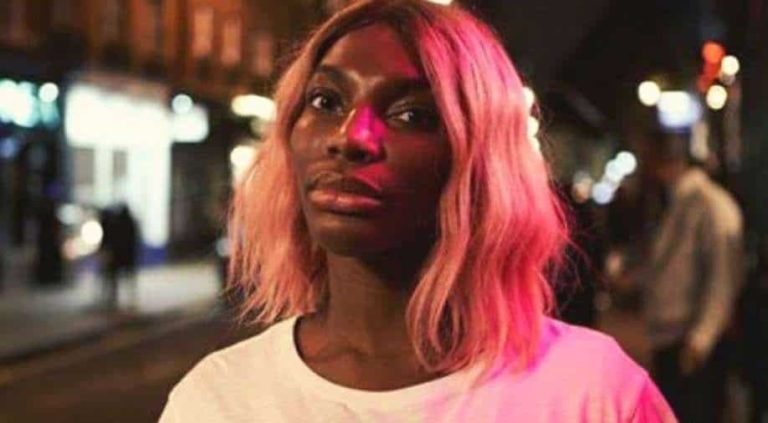
The hard-hitting British television series ‘I May Destroy You’, which depicts the impact of a sexual assault on a young woman, has won praise from real-life survivors of sexual violence.
The show, nominated for several of the UK’s prestigious Bafta TV awards handed out Sunday, chronicles a successful young black blogger and novelist piecing together details of the attack she suffered while at a London bar with friends.
The series ”changed my life”, said Karan Tripathi, a 25-year-old Indian man who was sexually harassed at work. It was only after watching the show that he acknowledged he was a victim, Tripathi said.
The series, which aired on the BBC and HBO in 2020, was written and directed by Michaela Coel, who also stars as the heroine Arabella. It is largely based on Coel’s own life experiences.
In a dozen intense episodes, Coel spares no blushes with her frank depiction of banal yet violent encounters. The show raises questions about the notion of sexual consent, particularly in the LGBTQ community, and strikes a powerful chord with survivors of violence.
Tripathi said the show helped him see he was a victim after a superior at work sexually harassed him and demanded favours from him.
“In my head I was like: ‘Okay, does it even qualify… Because at that moment I froze. I just couldn’t do anything. I couldn’t resist,” recalled Tripathi, who is gay.
“The show’s helped me to answer that question,” he added, noting in India there is no legal recognition that a man can suffer sexual harassment.
The show “gave me the courage to, you know, own up to things that I felt would make me vulnerable,” he said. “It gave me a voice, it gave me a language, it gave me the grammar to talk about sexual harassment.”
‘Demanding justice’ –
Tripathi learnt of the show from discussion in social media when it failed to win any nominations for the US Golden Globes awarded in March, despite calls for greater diversity.
However, Sunday’s Bafta TV ceremony will see the show nominated in six categories.
Coel is nominated for best actress, while Paapa Essiedu is nominated for best actor for his performance as Arabella’s gay best friend who himself has experienced sexual assault by a Grindr date. The acclaim for the show is well-deserved, said Marie Albert, a 26-year-old French journalist and feminist.
“I don’t remember ever seeing anything so empowering before,” she said, adding that it made her “feel really justified in demanding justice” over sexual attacks against her.
Albert said that after watching the show, she gathered up the courage to report the assaults in February, realising she “could not go back to life as it was before”.
Albert said she reported incidents of domestic violence, sexual assault and harassment at work.
She also reported she had been raped, something she only acknowledged while watching an episode of the show about “stealthing”, when the heroine’s partner removes a condom during sex without her knowledge.
‘Cathartic’ –
While sexual violence is “far too often… used as a plot device to elicit drama”, this show is “helpful and inspiring for survivors”, said a spokesman for The Survivors’ Trust, a British umbrella agency for rape and sexual abuse services.
The show portrays its heroine Arabella as “flawed and realistic”, he added, rather than making her “the typical victim stereotype”.
The show’s finale is a “cathartic experience”, according to the spokesman, sending the message that “although we cannot change the events that happen to us, we can move past them in our own way”.
Albert said: “These aren’t stereotyped situations of assault, but the banal situations that I’ve been in,” stressing that these are shown “with a lot of nuance, so that an attacker can in turn be assaulted.”
Tripathi also praised the series for depicting events in a way that is “authentic” and “just the way it is”. The show “transcends cultures,” he added.
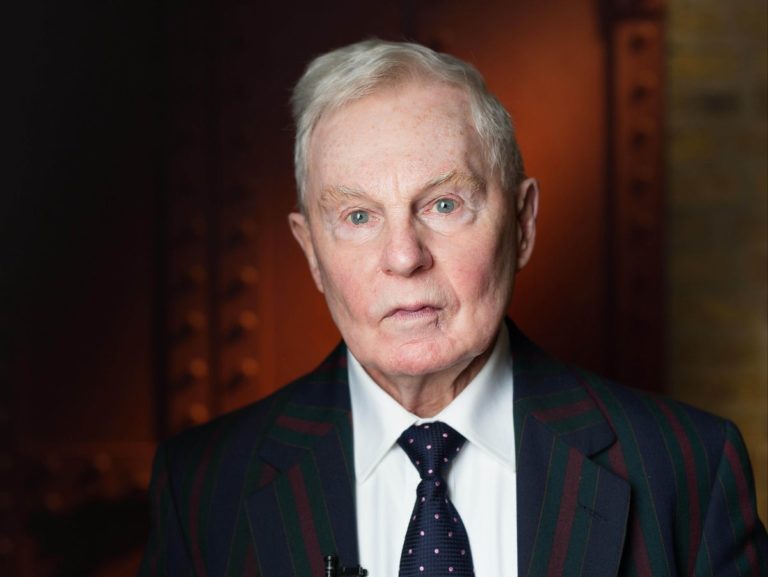
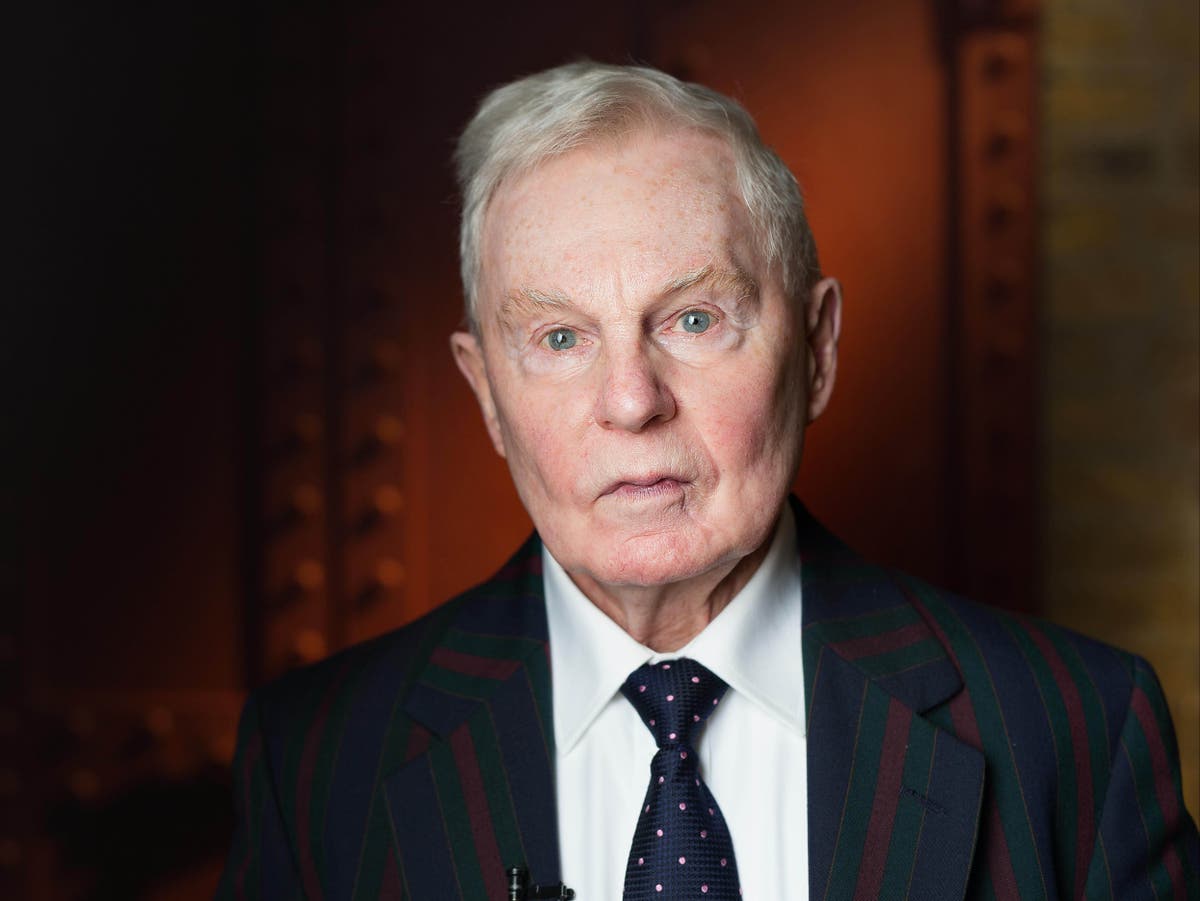
I was dreading you asking me what I think of Dominic Cummings,” says Sir Derek Jacobi. The prime minister’s former special adviser is in the news the day we speak, dishing the dirt on his former employers. It’s true Jacobi, 82, has spent plenty of time playing wizened leaders and shrewd advisers, from the emperor Claudius in I, Claudius to the senator Gracchus in Gladiator to the Duke of Windsor in The Crown via endless Hamlets and Lears and The Master in Doctor Who. But it hadn’t occurred to me to seek his opinion on the real-world political situation. Jacobi has never been outspoken. For all his Stakhanovite workload on screen and stage, he has been a reserved figure off it: famous but somewhat mysterious. We can talk about Dominic Cummings if he likes, I say. “No!” he replies, good humoured but emphatic.
Although he would never be so insensitive as to admit it, it sounds as though Jacobi has had a wonderful pandemic. In the autumn of his career, when others might content themselves with the odd valedictory performance, Jacobi appears to be speeding up. In the past 18 months there have been theatrical projects, film and TV pieces, interviews. Last summer, locked down at his house in France, he recorded the audiobook for Sir Captain Tom Moore’s memoir from a studio Jacobi’s husband, Richard, set up in the spare room. He read Shakespeare’s sonnets for the BBC’s Culture in Quarantine series. More recently he recorded a performance of Romeo & Juliet with the help of a green screen sent to his home.
His latest role is a guest appearance on Steve Pemberton and Reece Shearsmith’s BBC experimental horror-comedy, Inside No 9. Jacobi, confined to a bed for most of the half-hour, plays a truculent criminal defence barrister, anxious about his approaching death having made a Faustian pact at the start of his career. It’s a darkly comic turn, peppered with explosive cursing that Jacobi visibly enjoys. “I thought it was beautifully written and very funny,” he says. “Getting back into the studio was like getting back into a warm overcoat.”
“It’s all a bit strange, but I lived through the war,” he says. “I’m a war baby. So this is nothing.” There’s been no banana bread. “I can’t boil water. And I don’t have time for a hobby. I work a lot. At my age, that’s so lucky.” He has seen friends of a similar vintage, without a meaningful hobby or the sense of purpose afforded by work, start to slow down. “You have to make sure the body’s ticking over. If retirement means not doing anything except read a book, that’s a bit worrying.”
He talks a lot about luck and gratitude. The only child of a tobacconist and a draper’s secretary, he was born in 1938 and grew up in Leytonstone. After he won a scholarship to read history at Cambridge University, his early career was dominated by two pieces of good fortune. Three years after Jacobi graduated, Sir Laurence Olivier spotted him working in rep. On 22 October 1963, Jacobi celebrated his 25th birthday by appearing in the first performance at the National, as Laertes opposite Peter O’Toole’s Hamlet. A decent birthday. “It all came together that night,” he says. Then 13 years later, after steady theatre work, he was cast in I, Claudius, the BBC’s adaptation of Robert Graves’s 1934 novel about the titular Roman emperor. “[Claudius] changed everything for me,” he says. “I was blessed but I wasn’t known. Then Claudius came along and I was in people’s sitting rooms twice a week for six months.” Hollywood followed. It would be harder for something like I, Claudius to find an audience today, he says, with so much more choice available. “It was Roman history, it wasn’t Coronation Street,” he says. “We didn’t know if it was going to be a success.”
We speak soon after another octogenarian, Anthony Hopkins, has become the oldest man to win the Best Actor Oscar for his performance as a dementia sufferer in The Father. “Good on him!” Jacobi says. “I’ve always said Tony is the one actor from my generation whom I revere. He’s the best. I once took over from him playing Andre on a production of Three Sisters [Chekov’s famed 1900 play]. I couldn’t get anywhere near him.” He was offered the script of The Father before its original stage production, but passed. “I couldn’t understand it. It went on to win the Olivier for Ken Cranham and the Oscar for Tony. Worst decision I ever made.” It’s reassuring, I say, that after a career of more than 60 years he still can’t pick them. “I’ve always doubted my own judgement,” he says. “It’s always dogged me. I can find many people and become many things but with some parts I can’t see my way in. I don’t want to make a fool of myself and come a cropper.”
Derek Jacobi in the ground-breaking 1976 BBC production of I, Claudius
(Allstar/Alamy)
Nor is he tempted by the prospect of an Oscar. “Awards are lovely, and they go in the cabinet with the glass door so everyone can see them. But it’s not about that. They always want you to say something political or original. I prefer to keep my mouth shut. I’ve seen the terrible things it does to those who open their mouths too wide. I’ve never been a political animal. Most actors are. I’ve never marched for anything.”
Even on gay rights, he has been quieter than some of his contemporaries. He was surprised to see himself namechecked in Russell T Davies’s Aids drama, It’s a Sin, a series in which his actor husband Richard had a minor role. “Ian McKellen called me up and said, ‘I don’t know which is more prestigious, to be in something or namechecked in something.’” Around the time of the drama’s airdate, Davies said he thought gay roles ought to be played by gay actors. Jacobi disagrees. “Absolutely not,” he says. “I don’t think you have to be gay to be gay.”
Jacobi, who appears here with Reece Shearsmith, is bedridden for much of his Inside No 9 episode
(BBC)
You get the sense that Jacobi’s ability to compartmentalise has been one of the secrets of his longevity. He has not let himself be blown off course by activism or controversy. Unlike many younger actors, he has no interest in method. “That way madness lies,” he says. “There are very good actors who prefer to live the role and take the role home with them. I admire that but I can’t do that. I have to have my own life as well. It sounds hifalutin, but the art of acting is to turn it off, and not to have to adapt your entire life to the part you’re playing.”
At a time when the line between private and professional is being eroded by social media, especially for those in the public eye, Jacobi is an old-fashioned figure. There’s Jacobi the actor: generous, spry, happy to chat about the theatre and the work and the new Peloton gathering dust in his house. Then there’s Jacobi the private man, who will remain enigmatic, at least as long as there’s so much work to be done.
Jacobi’s episode of Inside No 9 airs on BBC Two at 9.30pm on Monday 7 June
As corporations debut more rainbow-streaked merchandise each year for Pride Month, small businesses and LGBTQ advocates want buyers and sellers to think more about where dollars are being spent and who benefits.
Target Corp. may be offering a rainbow suit this month — plus rainbow candles, a rainbow dog bandana and “Love is Love” T-shirts, but there’s also a community of small-scale, LGBTQ-owned entrepreneurs and artists in metro Detroit with gear for June who are trying to make a living and want to be seen.
“If you’re celebrating a heritage month or observation month you’ll want to do business within that community,” said Kevin Heard, president of the Detroit Regional LGBT Chamber of Commerce. “We want to make sure the money that you and I go and spend … is actually going back to an LGBT-owned business.”
Heading toward the 52nd anniversary of the historic June 1969 Stonewall uprising — a major origin of the fight for American LGBTQ rights — the way Pride Month is commemorated has been up for discussion for years. Participants have been reckoning with the inclusion of corporate interests in what originated as protests against violations by police and mainstream culture writ large; to what extent it’s OK that Pride Month has for many become a huge party; how to honor the many deceased activists of the movement, and more.
Huge, for many, is self expression: clothes, flags, patches, earrings and so-on.
So, who corners that market? It’s big: LGBTQ Americans’ buying power neared $1 trillion as of 2016, according to LGBT Capital. That is the most recent data readily available.
Small enterprises aren’t uncommon: The National LGBT Chamber of Commerce’s 2016 America’s LGBT Economy report, its latest, found that of certified LGBT-owned businesses, more than 40 percent were either sole-proprietor businesses or single-member LLCs.
But reporting statistics about LGBTQ-owned businesses and employment is challenging because data collectors like the U.S. Census Bureau gather little information on sexual orientation and gender identity issues.
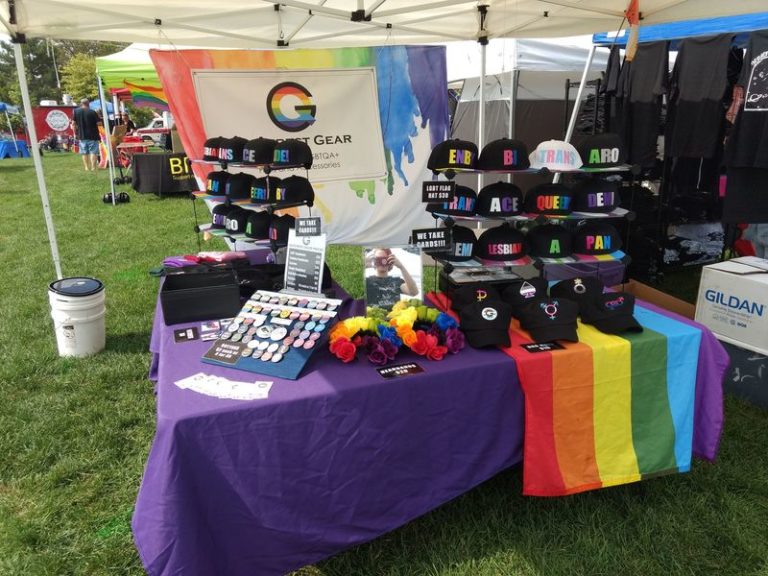
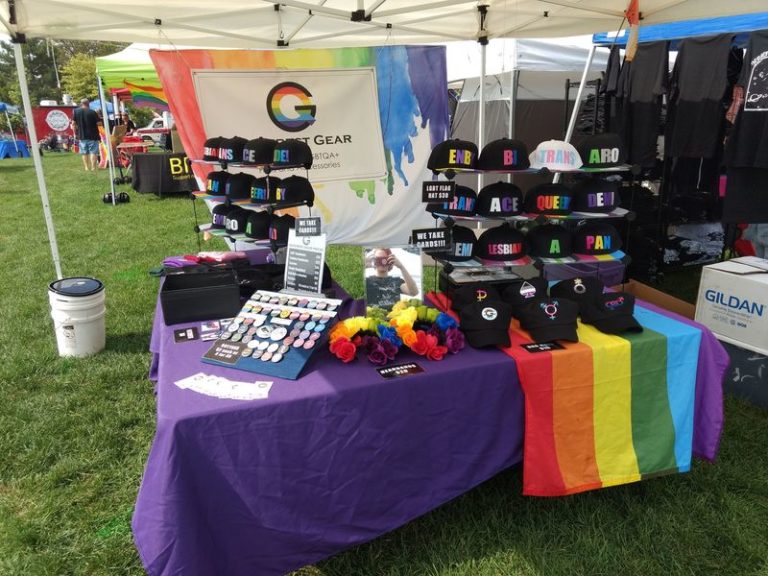
Milford resident Jasper Richter has been making LGBTQ merchandise full time for more than three years, since they graduated college. They first started while “wrangling with my own identity as a queer person” in their late teens, seeking pride apparel that met their needs at the time as nonbinary and pansexual and finding little.
“So I said screw it, I will make this myself,” Richter said.
While growing their shop, Queerest Gear, Richter has watched pride fashion expand over the years.
They call increased rainbow representation in big-box and designer collections a “double-edged sword.”
“It’s great, right, we’re seeing representation,” Richter said. “We’re being recognized as a group, but we are being recognized because we can be capitalized off of.”
Frankie Nuñez, a southwest Detroit native who designs pride merchandise, said he sees it as “disingenuous.”
“To me I always look at it, did they have queer people make this?” the Dearborn resident and artist said. “… They’re selling back to us what they think our experience is.”
Other than queer creators getting monetary support during pride, Nuñez said, what’s also important is what they bring to their products: an intimacy factor.
“I guess I can only speak for me, but I feel like when queer people make things, it comes from a certain part of them,” he said. “They understand what being gay is, or being nonbinary …”
Nuñez started selling his art in 2017, but ramped up the business with marketing, rebranding and regular product releases after he lost his job at the start of the COVID-19 pandemic last year. His shop, Chunkysequins, offers cheeky prints like “My Gay Agenda” on a notebook, as well as enamel pins, stickers, earrings and more. “I can reclaim (certain words) and process. ‘This is how I was treated,’ but ‘This is me showing I have power over it,'” he said.
Richter added that their entrepreneurship isn’t just a profession, it’s a way to connect with members of the community. Because of that, they are entrenched in these circles and have a line in to listen to what potential customers want, and how that changes over time.
Entrepreneurship is an essential facet of LGBTQ economic success, said Curtis Lipscomb, executive director of nonprofit LGBT Detroit.
LGBTQ Americans, and especially those who are Black, trans or other people of color, are especially vulnerable to economic instability. The pandemic, unsurprisingly, hasn’t helped. More LGBT Americans report they or someone in their home has lost a job during the pandemic than non-LGBT: 56 percent vs. 44 percent, a March Kaiser Family Foundation report found. Employment can be tough, between discrimination in hiring practices and difficulties faced in the workplace.
“So highlighting people who have talent who can make things is important to me, so we are highly interested in making sure those people have an economic opportunity to thrive,” Lipscomb said.
A question for many when it comes to pride commerce is: Where do the dollars go?
One local example is Detroit-based Shinola announced last week a special pride watch that’s $450, and the company is selling 1,969 of them (that number is the year of the Stonewall uprising). So the luxury goods maker will take in $886,050 from those sales, and plans to give the equivalent of around 13 percent of those profits, or $120,000, to nonprofits SAGE Metro Detroit and the Ruth Ellis Center, according to a news release.
“The Detrola Pride watch, and partnership with Shinola, will not only have an incredible impact on the hundreds of young people served by Ruth Ellis Center each year, but it honors the legacy of (namesake and lesbian activist) Ruth Ellis, who lived each day with pride,” said Mark Erwin, Ruth Ellis Center’s director of development and advancement.
Kate Spade, a designer brand with three metro Detroit retail locations, released a limited-edition selection and is giving 20 percent of profits to suicide prevention nonprofit The Trevor Project. Other brands debut pride-themed products then partner separately with advocates.
“If these big-box retailers are going to have a pride line, which I completely embrace, where are the proceeds going? The visual aspect of it is great but where is the humanitarian aspect in it? Where is the equitable aspect in it?” Heard asked. “Are they going to an LGBT nonprofit to fill in the gaps where government policy stops? Are you going to donate this to an LGBT homeless shelter?”
Retailers can also direct dollars back to the community by using LGBTQ-owned companies as suppliers, Heard said.
Activists and critics of corporate pride, like those in a 2019 Washington Post opinion piece “Pride for Sale,” also point to other considerations like how the corporations treat their LGBTQ employees.
While some companies make substantial contributions, Richter pointed out, the entrepreneur also sees single-proprietor businesses giving back. They called it frustrating seeing praise for a large company giving what Richter considers a smaller ratio of their earnings compared with how that company is benefiting.
Richter’s shop has grown through word of mouth, events and social media. They sell online through a website and Etsy, and at fairs. They’re best-known for their hats, including snapbacks with colorful brims displaying various identities: blue, pink and white for transgender pride, for example.
Richter doesn’t believe shopping at a big-box store is “automatically evil.” They’ve heard from youth whose parents won’t let them shop online, for example, or they don’t have a credit card, or the mall is more convenient.
“It’s very complicated and I don’t think (corporations selling pride merchandise) can or should be stopped … but I think just being aware and consuming from small queer creators when and where we can,” they said. “If possible, holding the big corporations responsible and pushing them a little bit.”
As corporations debut more rainbow-streaked merchandise each year for Pride Month, small businesses and LGBTQ advocates want buyers and sellers to think more about where dollars are being spent and who benefits.
Target Corp. may be offering a rainbow suit this month — plus rainbow candles, a rainbow dog bandana and “Love is Love” T-shirts, but there’s also a community of small-scale, LGBTQ-owned entrepreneurs and artists in metro Detroit with gear for June who are trying to make a living and want to be seen.
“If you’re celebrating a heritage month or observation month you’ll want to do business within that community,” said Kevin Heard, president of the Detroit Regional LGBT Chamber of Commerce. “We want to make sure the money that you and I go and spend … is actually going back to an LGBT-owned business.”
Heading toward the 52nd anniversary of the historic June 1969 Stonewall uprising — a major origin of the fight for American LGBTQ rights — the way Pride Month is commemorated has been up for discussion for years. Participants have been reckoning with the inclusion of corporate interests in what originated as protests against violations by police and mainstream culture writ large; to what extent it’s OK that Pride Month has for many become a huge party; how to honor the many deceased activists of the movement, and more.
Huge, for many, is self expression: clothes, flags, patches, earrings and so-on.
So, who corners that market? It’s big: LGBTQ Americans’ buying power neared $1 trillion as of 2016, according to LGBT Capital. That is the most recent data readily available.
Small enterprises aren’t uncommon: The National LGBT Chamber of Commerce’s 2016 America’s LGBT Economy report, its latest, found that of certified LGBT-owned businesses, more than 40 percent were either sole-proprietor businesses or single-member LLCs.
But reporting statistics about LGBTQ-owned businesses and employment is challenging because data collectors like the U.S. Census Bureau gather little information on sexual orientation and gender identity issues.
Milford resident Jasper Richter has been making LGBTQ merchandise full time for more than three years, since they graduated college. They first started while “wrangling with my own identity as a queer person” in their late teens, seeking pride apparel that met their needs at the time as nonbinary and pansexual and finding little.
“So I said screw it, I will make this myself,” Richter said.
While growing their shop, Queerest Gear, Richter has watched pride fashion expand over the years.
They call increased rainbow representation in big-box and designer collections a “double-edged sword.”
“It’s great, right, we’re seeing representation,” Richter said. “We’re being recognized as a group, but we are being recognized because we can be capitalized off of.”
Frankie Nuñez, a southwest Detroit native who designs pride merchandise, said he sees it as “disingenuous.”
“To me I always look at it, did they have queer people make this?” the Dearborn resident and artist said. “… They’re selling back to us what they think our experience is.”
Other than queer creators getting monetary support during pride, Nuñez said, what’s also important is what they bring to their products: an intimacy factor.
“I guess I can only speak for me, but I feel like when queer people make things, it comes from a certain part of them,” he said. “They understand what being gay is, or being nonbinary …”
Nuñez started selling his art in 2017, but ramped up the business with marketing, rebranding and regular product releases after he lost his job at the start of the COVID-19 pandemic last year. His shop, Chunkysequins, offers cheeky prints like “My Gay Agenda” on a notebook, as well as enamel pins, stickers, earrings and more. “I can reclaim (certain words) and process. ‘This is how I was treated,’ but ‘This is me showing I have power over it,'” he said.
Richter added that their entrepreneurship isn’t just a profession, it’s a way to connect with members of the community. Because of that, they are entrenched in these circles and have a line in to listen to what potential customers want, and how that changes over time.
Entrepreneurship is an essential facet of LGBTQ economic success, said Curtis Lipscomb, executive director of nonprofit LGBT Detroit.
LGBTQ Americans, and especially those who are Black, trans or other people of color, are especially vulnerable to economic instability. The pandemic, unsurprisingly, hasn’t helped. More LGBT Americans report they or someone in their home has lost a job during the pandemic than non-LGBT: 56 percent vs. 44 percent, a March Kaiser Family Foundation report found. Employment can be tough, between discrimination in hiring practices and difficulties faced in the workplace.
“So highlighting people who have talent who can make things is important to me, so we are highly interested in making sure those people have an economic opportunity to thrive,” Lipscomb said.
A question for many when it comes to pride commerce is: Where do the dollars go?
One local example is Detroit-based Shinola announced last week a special pride watch that’s $450, and the company is selling 1,969 of them (that number is the year of the Stonewall uprising). So the luxury goods maker will take in $886,050 from those sales, and plans to give the equivalent of around 13 percent of those profits, or $120,000, to nonprofits SAGE Metro Detroit and the Ruth Ellis Center, according to a news release.
“The Detrola Pride watch, and partnership with Shinola, will not only have an incredible impact on the hundreds of young people served by Ruth Ellis Center each year, but it honors the legacy of (namesake and lesbian activist) Ruth Ellis, who lived each day with pride,” said Mark Erwin, Ruth Ellis Center’s director of development and advancement.
Kate Spade, a designer brand with three metro Detroit retail locations, released a limited-edition selection and is giving 20 percent of profits to suicide prevention nonprofit The Trevor Project. Other brands debut pride-themed products then partner separately with advocates.
“If these big-box retailers are going to have a pride line, which I completely embrace, where are the proceeds going? The visual aspect of it is great but where is the humanitarian aspect in it? Where is the equitable aspect in it?” Heard asked. “Are they going to an LGBT nonprofit to fill in the gaps where government policy stops? Are you going to donate this to an LGBT homeless shelter?”
Retailers can also direct dollars back to the community by using LGBTQ-owned companies as suppliers, Heard said.
Activists and critics of corporate pride, like those in a 2019 Washington Post opinion piece “Pride for Sale,” also point to other considerations like how the corporations treat their LGBTQ employees.
While some companies make substantial contributions, Richter pointed out, the entrepreneur also sees single-proprietor businesses giving back. They called it frustrating seeing praise for a large company giving what Richter considers a smaller ratio of their earnings compared with how that company is benefiting.
Richter’s shop has grown through word of mouth, events and social media. They sell online through a website and Etsy, and at fairs. They’re best-known for their hats, including snapbacks with colorful brims displaying various identities: blue, pink and white for transgender pride, for example.
Richter doesn’t believe shopping at a big-box store is “automatically evil.” They’ve heard from youth whose parents won’t let them shop online, for example, or they don’t have a credit card, or the mall is more convenient.
“It’s very complicated and I don’t think (corporations selling pride merchandise) can or should be stopped … but I think just being aware and consuming from small queer creators when and where we can,” they said. “If possible, holding the big corporations responsible and pushing them a little bit.”
The Fort Gay High School Alumni Association recently announced that Bryan Frasher, FGHS Class of 1983 and graduate of Marshall University, has been selected as the recipient of the FGHSAA 2021 Distinguished Alumnus of the Year award.
Frasher is a 30-year veteran of the music industry. Over the past eight years he has been a member of the executive team at Red Light Management, the number one musical artist management company in the world, and he has managed the careers of multiple clients whose combined portfolios have values in excess of $95 million.
He oversees all aspects of their businesses such as strategic career planning, domestic and international tour and merchandise marketing, sponsorships and branding, creative endeavors, recording contracts and label relations, publishing, TV, radio and product development.
Current management clients include Craig Morgan, LOCASH (both alongside Gaines Sturdivant), The Cadillac Three, Kristian Bush from the band Sugarland and Caleb Lee Hutchinson.
Prior to coming to Red Light Management, Frasher was the vice president of BNA Records, a subsidiary of Sony Music, where he was responsible for national radio promotion and marketing for the BNA roster of recording artists. During this period, he ushered 26 singles to the number one spot on the U.S. country music charts and was an integral part of the executive team making decisions for Sony Music Nashville as a whole.
Frasher works closely with Operation Finally Home, which provides mortgage-free homes to disabled veterans. In addition, he is an advisor at The Nashville Entrepreneur Center, a member of Leadership Music’s class of 2012, and along with his wife, Traci, he is a founding member of Project Paper Doll, which funds the music therapy program at the Monroe Carell Jr. Children’s Hospital at Vanderbilt.
Frasher will receive the award at the annual FGHSAA Alumni Banquet set for Friday, Sept. 3, at the Louisa First Baptist Church Family Center.
Kevin Gausman never takes a pitch off. Each has a purpose. The heaters that are tough to catch up to, the split-fingered fastballs that are difficult to lay off, the sliders and changeups that keep ’em guessing.
Sometimes a pitch gets away. That’s what happened Saturday when Gausman flung a fastball to Patrick Wisdom, who crushed a two-run home run, a rare blemish for the Giants pitcher who hadn’t given up more than a run in 10 of his first 11 starts.
Gausman didn’t flinch. On an afternoon in which Pride Month was celebrated at Oracle Park, the right-hander pitched shutout ball the rest of his seven-inning, 97-pitch stint, and the Giants escaped a wild ninth inning to beat the Cubs 4-3 before 12,792.
Third baseman Evan Longoria exited in the ninth inning with a likely shoulder/collarbone injury after colliding with shortstop Brandon Crawford, both pursuing a grounder. The Cubs scored a run on the play and positioned runners at second and third with two outs, but Jason Heyward grounded out to end the game.
“Longo continues to work to keep his body healthy and is having such high quality at-bats and playing great defense, you feel he should get rewarded for all that with health,” manager Gabe Kapler said. “It really sucks to have what was an excellent game kind of soured slightly by that play.
S.F. Giants
“I’m really disappointed for him and have a ton of respect for both him and Craw for the way they went after that ball.”
Gausman struck out 10 batters, all swinging — nobody was hitting his splitter — including four in a row: Joc Pederson, Kris Bryant, Javier Baez and Anthony Rizzo. Baez struck out three times.
Other than the second-inning mistake to Wisdom, the pride of St. Mary’s College, it was vintage Gausman, another dominant performance by the ace whose ERA is 1.27, a splendid opening to June after the right-hander won National League Pitcher of the Month honors for May.
Gausman gave up two hits and walked none. His ERA dipped from 1.40 because the two runs were unearned, thanks to Crawford’s fielding error before Wisdom’s homer.
Alex Dickerson hit his second homer in two days to make the score 2-1. Fourth-inning singles by Chadwick Tromp and LaMonte Wade Jr. put the Giants ahead 3-2. Crawford’s double in the fifth scored Longoria with the Giants’ final run.
Jake McGee struck out two of three batters in the eighth, and Tyler Rogers pitched a strange ninth in which the usually reliable defense did some unusual things.
Second baseman Mauricio Dubón bobbled Rafael Ortega’s grounder for an error to open the inning and then dropped a feed from Crawford, who had picked up Bryant’s grounder, but a review showed Dubón had possession long enough for the out.
Baez’s single put runners at the corners, and Rizzo hit a grounder to the left side that led to the collision. Bryant scored, and Rogers struck out Willson Contreras, then got Heyward on the game-ending grounder.
“Torture baseball,” said Tromp, who caught all nine innings. “There’s no better way to explain it. It was a roller-coaster ride. But at the end of the day, we’ve got a group of guys calm and collected. For us, there was never a doubt we were going to get the job done.”
The Giants became the first team to wear Pride colors as part of their uniforms — the SF logo on their caps resembled a rainbow — and also wore Pride patches on their right sleeves.
Tom Ammiano, former San Francisco supervisor and the first openly gay teacher in the city, was honored before the game. Transgender activist Honey Mahogany performed the national anthem. The Pride Flag and Transgender Flag were raised. Palm trees in Willie Mays Plaza were wrapped in the 11 colors.
“Obviously, it was really exciting,” Gausman said. “The anthem before the game. The palm trees out front. Really, everything. It was pretty cool. Obviously, this is a city that’s very inclusive, so it was fun to be a part of. I’ve never worn a hat like that before, so that was cool.”
San Antonio’s City Council will soon look a lot different.
Four newcomers will sit on the council after Saturday’s runoffs for five council seats — nearly half the city’s governing body. For only the second time, the council will have an openly gay member. Two incumbents were ousted in an upset.
District 1
In the fight to represent the city’s urban core, challenger Mario Bravo ousted District 1 Councilman Roberto Treviño and denied the third-term councilman a fourth and final term.
Bravo, an environmental activist and project manager for the Environmental Defense Fund, grabbed 54 percent of the vote while Treviño had 46 percent.
Treviño did not concede Saturday despite being down more than 7 points against Bravo. Treviño left his watch party at The Lonesome Rose, a country bar on the St. Mary’s Strip, without addressing attendees. He’s expected to give a statement Sunday morning, spokeswoman Lawson Picasso said.
At Bravo’s election night party at the Backyard on Broadway, the mood was jubilant as supporters chanted the environmentalist’s last name: “Bravo! Bravo! Bravo!”
1of5
District 1 runoff candidate Mario Bravo addresses supporters at his election night party at Backyard on Broadway, 2411 Broadway St., on Saturday, June 5, 2021 after it appears he has defeated incumbent Roberto Trevino. Bravo won the election by 539 votes with 53.58% of the total votes cast.
Marvin Pfeiffer, San Antonio Express-News / Staff PhotographerShow MoreShow Less2of5
Confetti fills the air at Backyard on Broadway, 2411 Broadway St., when it appears District 1 runoff candidate Mario Bravo (second from right) has won the runoff election with incumbent Roberto Trevino on Saturday, June 5, 2021. Bravo defeated Trevino by 539 votes with 53.58% of the total votes cast.
Marvin Pfeiffer, San Antonio Express-News / Staff PhotographerShow MoreShow Less3of5
District 1 runoff candidate Mario Bravo addresses supporters at his election night party at Backyard on Broadway, 2411 Broadway St., on Saturday, June 5, 2021 after it appears he has defeated incumbent Roberto Trevino. Bravo won the election by 539 votes with 53.58% of the total votes cast.
Marvin Pfeiffer, San Antonio Express-News / Staff PhotographerShow MoreShow Less4of5
District 1 runoff candidate Mario Bravo celebrates with his girlfriend, Burgundy Hubbert, left, and parents Sissy Bravo and Armando Bravo at his election night party at Backyard on Broadway, 2411 Broadway St., on Saturday, June 5, 2021. Bravo defeated incumbent Roberto Trevino by 539 votes with 53.58% of the total votes cast.
Marvin Pfeiffer, San Antonio Express-News / Staff PhotographerShow MoreShow Less5of5
District 1 runoff candidate Mario Bravo, second from left, watches as the first election day votes are posted with senior policy advisor Tomas Larralde, from left, Anthony Cruz and Bert Santibanez,at his election night party at Backyard on Broadway, 2411 Broadway St., on Saturday, June 5, 2021. Bravo defeated incumbent Roberto Trevino by 539 votes with 53.58% of the total votes cast.
Marvin Pfeiffer, San Antonio Express-News / Staff PhotographerShow MoreShow Less
“This was about the community,” Bravo said. “I think the community stepped up, and they said they want something different. They want fresh leadership; they want a voice, and I intend to deliver that.”
Within the past two years, Treviño positioned himself as somewhat of a progressive insurgent on the council. He pushed for more direct financial aid and legal protections for renters and homeowners as well as small businesses while COVID-19 hammered the economy.
Treviño often bucked Mayor Ron Nirenberg on big policy issues during the pandemic, most prominently opposing Nirenberg’s Ready to Work initiative — the sales-tax funded program aimed at paying for out-of-work residents to seek higher-paying jobs through job training and college degree programs.
Treviño proved out of step with voters, including in his own district. The plan passed with nearly 77 percent of the vote in November.
Months later, Nirenberg kicked Treviño out of a pair of key leadership positions he held overseeing the $450 million overhaul of Alamo Plaza.
Treviño had soured on the project after a state panel blocked the relocation of the Cenotaph, a 1930s-era monument to the Alamo defenders — considered crucial to the project’s completion.
Treviño declared the project dead, but Nirenberg disagreed. He replaced Treviño with outgoing District 3 Councilwoman Rebecca Viagran and announced a “reset” to push a slightly scaled-down version of the makeover.
Some of Treviño’s stances alienated neighborhood groups. After the councilman converted his field office into a place where the homeless can seek help, nearby residents in the Dellview neighborhood complained Treviño was making the area less safe.
Bravo, who ran unsuccessfully for Bexar County commissioner in 2018, capitalized on that sentiment to get into a runoff with Treviño and run up the score in Dellview and other parts of the district. He snagged an early but slim lead when the early vote came in, a lead that grew steadily throughout the night.
District 2
In a contentious race on the East Side, District 2 Councilwoman Jada Andrews-Sullivan, 45, lost her bid for a second term to Jalen McKee-Rodriguez, a 26-year-old math teacher at James Madison High School and the councilwoman’s former communications director.
McKee-Rodriguez won by a wide margin, capturing 63 percent of the vote. Andrews-Sullivan had 37 percent of the vote.
He is the seventh person to represent the East Side council district since 2014. Andrews-Sullivan was first elected in 2019. She ran on a campaign that she would bring stability to the post with a second term.
“We understand that we’re going into this with a lot of work to do and we have a lot to prove,” McKee-Rodriguez said Saturday night. “I’m just so grateful that a district that is told that stability matters more than quality leadership has decided to place their trust in me and take that gamble.
More for you
“I do not take that lightly at all,” he added.
Shortly after the early vote results came in, showing McKee-Rodriguez with a commanding 62 percent of the vote, Andrews-Sullivan said in a statement: “We did the best for our community and we’re thankful for the opportunity.”
She and McKee-Rodriguez ended up in a runoff after fighting off 10 other candidates in the May election. McKee-Rodriguez received the most votes at 26 percent, while Andrews-Sullivan had 18 percent of the vote.
McKee-Rodriguez is the first openly gay man elected in San Antonio, and the first openly gay Black man elected in the state of Texas, according to LGBTQ Victory Fund.
The first gay person to serve on San Antonio’s city council was Elena Guajardo, who was elected in 2005 to represent District 7.
McKee-Rodriguez said his first priority will be to dissect the proposed budget and “make sure District 2 gets their fair share.”
He also wants to fight for infrastructure improvements such as sidewalks, drainage and streetlights, as well as a “fair and just police union contract to make sure that accountability is front and center.”
District 9
District 9 incumbent John Courage comfortably won a third term on City Council, aided by a better than 3-to-1 margin in mail ballots.
Courage, a progressive who has won over many conservatives in his North Side district, defeated challenger Patrick Von Dohlen by nearly 8 percentage points in Saturday’s runoff.
Based on unofficial returns from all precincts, Courage had 9,895 votes and Von Dohlen 8,476.
In ballots cast at polling sites on Saturday and during the early voting period for the runoff, Courage led Von Dohlen by just 114 votes. But the incumbent enjoyed a huge advantage in mail ballots, collecting 1,885 to Von Dohlen’s 580, according to figures posted by the Bexar County Elections Department.
“This vote tells me District 9 really measured me by what I provided for the district and not by the distractions and rhetoric of my opponent,” Courage said.
Von Dohlen is an investment firm owner and ardent social conservative who opposes abortion and LGBTQ rights.
He lost to Courage in 2017 and 2019, but during this year’s campaign his yard signs were big and plentiful. Even Courage supporters privately expressed concern that Von Dohlen’s relentless labeling of the incumbent as a “socialist” probably energized some supporters of former President Donald Trump, who carried District 9 in November’s presidential election.
Courage, 70, stuck with his political playbook – refraining from partisan attacks and emphasizing his reputation for being accessible and effective at dealing with nuts-and-bolts constituent concerns such as sidewalks, traffic and drainage.
A former Air Force police officer, special education teacher and Alamo Colleges District board member, Courage has forged friendships with the Council’s devout liberals as well as its only conservative, District 10 Councilman Clayton Perry, a monthly poker cohort who sits beside him on the dais.
Courage seemed exasperated at times by the vitriolic rhetoric of Von Dohlen, a father of nine who has refused to be vaccinated against the coronavirus, claims man-made climate warming isn’t a scientific fact and regularly excoriates gays.
Von Dohlen’s campaign manager did not respond to a request for comment.
District 3
On the Southeast Side, Phyllis Viagran trounced former state Rep. Tomas Uresti on Saturday for the District 3 seat vacated by Viagran’s younger sister.
The candidates, members of prominent families in the district, ran what was largely a clean, civil runoff to replace Rebecca Viagran, who reached the four-term maximum on City Council.
Uresti was unable to overcome Phyllis Viagran’s early commanding lead as the votes were counted. Throughout the night, Viagran had more than 60 percent of the vote.
“We worked really hard to get the vote out,” Phyllis Viagran said by phone from a watch party at Tandem.
Viagran, 48, was a civilian for seven years in the San Antonio Police Department’s domestic violence unit working with victims of family violence. She had also worked at Visit San Antonio, a public-private nonprofit that promotes the city to tourists and convention planners. She then went on to work at Senior Planet, which teaches elders how to use technology, and sat on the board of the charitable arm of the Brooks Development Authority.
This is her first elected position, and though she said she shares the same work ethic with her sister, she aims to bring a new approach.
“I think the difference I have is a fresh perspective,” she said. “I have been more in direct services with the community. I want more of their input in the process, especially with federal funds. It’s a completely different time from when Rebecca got elected eight years ago. Now we’re in an economic recovery from the pandemic.”
Uresti is the brother of Bexar County Tax Assessor-Collector Albert Uresti and former state Sen. Carlos Uresti, who is serving 12 years in federal prison for fraud, money laundering and public corruption.
District 5
Progressive reform candidate Teri Castillo soundly defeated retired city employee Rudy Lopez in the race to succeed Councilwoman Shirley Gonzales in District 5 on the city’s West Side.
Castillo had 58 percent of the vote, compared with 42 percent for Lopez, who received an endorsement from Gonzales.
The hard-fought runoff centered on affordable housing, historic preservation and ideas for stimulating economic and educational opportunities in one of San Antonio’s poorest council districts.
Already a lively race with Castillo’s criticisms of Gonzales framing her as the more anti-establishment candidate in the runoff, the contest grew heated in recent weeks. Lopez’s campaign put out a mailer last month stating Castillo “advocates for Socialist and Marxist ideals.” Castillo dismissed the flyer as an attempt by Lopez to sidestep real issues in the race.
Then, in a high-profile case involving the potential demolition of the 90-year-old Whitt Building in Cattleman Square Historic District, Castillo joined demonstrators, saying the city’s process for weighing concerns about the building’s structural integrity against efforts to preserve its historic architecture had been circumvented in the waning days of Gonzales’ last term. The city’s Historic and Design Review Commission decided in an emergency meeting Wednesday to let the owner remove the building’s damaged roof, but preserve the building’s concrete frame and facade.
Castillo, a 29-year-old educator who advocated for public input on city budget decisions, led the field of 11 candidates in the May 1 election with 30.7 percent of the ballots cast but didn’t have enough to escape a runoff. Lopez had 14.7 percent.
She said late Saturday that the outcome of the runoff was a sign that District 5 residents want a city “that works for all of us.”
“Folks are tired,” she said, referring to the feedback she heard from residents while block walking. “They’re ready for bold change, to meet the material needs of the established communities in District 5.”
Castillo said one of her immediate priorities will be neighborhood stabilization and helping homeowners rehabilitate their homes to prevent demolition.
Her endorsements included County Commissioner Justin Rodriguez, Councilwoman Ana Sandoval, former Mayor Julián Castro and former Councilwoman María Berriozábal.
This is a developing report. Check back with ExpressNews.com for updates.
WATERTOWN — The city will raise flags in front of City Hall to honor local Gay Pride and Juneteenth events on the same day this year.
Organizers of the Gay Pride events hope that the flag raising in front of City Hall on June 19 will attract the same kind of crowd it did in 2019. Last year, a smaller event was held to raise the Gay Pride flag because of the COVID-19 pandemic.
“It’s exciting just to see everyone in person and celebrate together,” said Mark Irwin, one of the organizers.
On the same day that the Gay Pride flag will be going up, a Pan-African flag will be raised in front of City Hall to honor Juneteenth, the annual holiday commemorating the end of slavery in the United States.
City officials said the flag-raisings will be held as one event. It’s the first time that the Pan-African flag will go up in front of City Hall, since the local Juneteenth celebration was first held in 2014.
City officials think the crowd will be bigger this year with the two held on the same day. The event will start at 9 a.m.
The Juneteenth celebration will be held online this year, which includes a guest speaker and videos of poetry readings, songs and music, and dance performances. C.R. Gibbs, a lecturer, author of six books and historian, will be the main speaker during the event that can be viewed online on June 19.
Bianca Ellis, a Juneteenth organizer, said she’s still putting together the schedule of events.
In its third year, Watertown Pride! has scheduled a weekend of events for the local LGBTQ community after last year’s weekend was canceled because of the pandemic. This year’s events will be June 18-20, with a kickoff at the Paddock Club.
After the flag raising, a color-blast fun 5K run will be held at noon in Thompson Park with vendors and other activities running until 3 p.m. A drag show will be held at 6:30 p.m., followed by fireworks at the Alex T. Duffy Fairgrounds at 10 p.m. A tea dance will held on Sunday at Garland City Beer Works.
Organizers are still looking for donations and to take a look at the events by texting NNYPride to 44321.
In 2019, between 400 and 500 people took part in the Gay Pride flag raising in front of City Hall. That year, a local man made a threatening remark against the local LGBTQ population.
Gay Pride Month was initially inspired by the 1969 Stonewall Uprising in New York City and works to achieve equal justice and opportunity for LGBTQ Americans. The purpose of the month is to recognize the impact that LGBTQ individuals have had on society locally, nationally and internationally.
Ms. Ellis mentioned that African Americans were involved in the Stonewall Uprising in 1969 and hoped community members can come together to celebrate both Gay Pride and Juneteenth.
“It’s an opportunity to demonstrate unity throughout the community,” she said.
Seven years ago, the local Juneteenth event was organized by Fort Drum soldiers, area veterans and churches and activities were held at the fairgrounds.
Last year, Juneteenth became a state holiday.
As an Amazon Associate I earn from qualifying purchases.