Home Blog Page 86

Jamestown To Host First Pride Fest Saturday | News, Sports, Jobs – Jamestown Post Journal

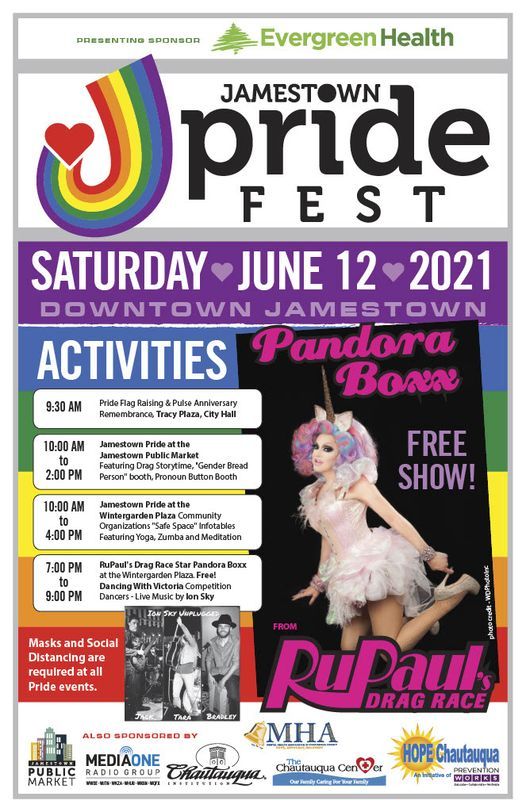
The Pride Flag after it was raised on Tracy Plaza on National Coming Out Day Oct. 11, 2020. The Pride Flag will again be raised on Tracy Plaza to start Jamestown’s first Pride Fest at 9:30 a.m. Saturday.
Submitted photo

The city of Jamestown’s first Pride Festival will also be the only in-person one held in Western New York this June.

Starting at 9:30 a.m. with a Pride Flag raising ceremony on Tracy Plaza at the Jamestown Municipal Building, the festival will continue throughout the day at the Jamestown Public Market along Third Street from 10 a.m. to 2 p.m.; a “Safe Space” area that will include yoga, zumba and meditation at the Wintergarden Plaza along North Main Street from 10 a.m. to 4 p.m.; and live performances start at 7 p.m. at the Wintergarden Plaza with the band Ion Sky and competitive dancers Dancing With Victoria. Capping off the festival will be a free performance at 8 p.m. by RuPaul’s Drag Race star and Jamestown native Pandora Boxx.

“We have the unique situation of having planned a smaller Pride, but being the only live (in-person) Pride Festival in Western New York,” said Sheridan Smith, Pride Fest coordinator. “We will have a huge spotlight on how we celebrate the LGBTQIA+ community. Being the first festival (for the city), I’m unbelievably filled with pride and happiness. Being the only festival happening this weekend will be wonderful, but a lot of work. I think Jamestown is up to it. We will have an incredible time.”

Jamestown Mayor Eddie Sundquist, an LGBTQIA+ elected politician, will take part in the flag raising ceremony at Tracy Plaza to start the festival.

“I’m delighted to be a part of the only in-person Pride Festival in Western New York,” he said. “Most have stuck to virtual ones, but with a lot of residents being vaccinated, we need to move forward and get back to business.”

The first Jamestown Pride Fest will be held this Saturday with several events held throughout the day.

During the flag raising ceremony, there will also be a remembrance because Saturday is the fifth anniversary of the Pulse nightclub shooting. Pulse was a gay bar, dance club and nightclub in Orlando, Fla., where on June 12, 2016, the club was the scene of the second worst mass shooting by a single gunman in U.S. history. Forty-nine people were killed and 53 others were injured.

“We can’t let that go unacknowledged,” Smith said about the anniversary of the Pulse nightclub shooting. “There are still places that are supposed to be safe for people living as themselves that are not safe. There are people who feel we should not be heard, be visible and there are still people who think we don’t have the right to be. That is why we continue to have pride to remind us that — while we have come a long way and fought and won a lot of battles — we are not done fighting for our rights and fighting for oppressed communities. To live freely and live with our families safely.”

The first Pride Festival in Jamestown was scheduled to happen last year. However, like many events, it was canceled due to the COVID-19 pandemic. Sundquist said it’s great that the organizers of the festival didn’t give up and continue to work to make sure the event will take place this year.

“It’s a testament to the folks who want to educate citizens and provide a safe space … and to let people be who they are,” he said. “Community organizations have been incredible in the face of the pandemic and through that adversity (Pride Fest planners) didn’t give up.”

Smith said even though there have been Pride-related events in the city before, Jamestown has never hosted a festival like larger cities — Buffalo and Erie, Pa. — have done.

“This Pride Festival will show the uniqueness of our community. We are showing what it’s like to be in Chautauqua County,” he said. “It means a lot for Jamestown to be hosting its first Pride Festival. We have a very vibrant LGBTQIA+ community.”

Most pride events occur around June to commemorate the 1969 Stonewall riots in New York City. The Stonewall riots were a series of spontaneous demonstrations by members of the gay community in response to a police raid that began in the early morning hours of June 28, 1969, at the Stonewall Inn in the Greenwich Village neighborhood of Manhattan.

Smith said festival organizers are encouraging people attending the festival to wear face masks and practice social distancing.

“We want to keep people as safe as possible, so we are encouraging (mask-wearing),” he said. “We’re encouraging people to bring their most expressive mask, and I’ve seen several.”

Additional events that will be happening during the festival includes drag storytime, “Gender Bread Person” booth, pronoun button booth and a special Escape Rooms Jamestown exhibit with a focus on Pride Fest at the Jamestown Public Market.

“I believe this community is a wonderful community to raise a family in. It’s a wonderful place to raise whatever kind of family you have,” Smith said. “I think it’s going to be great to highlight our pride.”

Today’s breaking news and more in your inbox

Chiefs lose OL Long to knee injury in voluntary workout – Jefferson City News Tribune

KANSAS CITY (AP) — The offensive line the Kansas City Chiefs aggressively overhauled this offseason has taken a hit with a knee injury to veteran Kyle Long during voluntary workouts that could require surgery and keep him out of training camp.

The 32-year-old Long came out of a one-year retirement designed largely to get him healthy to sign a one-year contract with the Chiefs, who completely recast their offensive line after it was decimated by injuries and opt-outs last season. But he failed to make it through three weeks of workouts before another injury sidelined him.

“We’ll just see how he does here. It doesn’t look like it’s ligaments, but we’ll see,” Chiefs coach Andy Reid said following the last of the workouts Thursday. “There’s a chance he has to have surgery on it, but we’ll see where it’s at.”

The Chiefs begin a three-day mandatory minicamp Tuesday, then are off until reporting to training camp in late July.

Long has spent most of his career at right guard, but he also was a Pro Bowl selection at right tackle, and the Chiefs were keen to see him play both positions. Now, they are looking at former starter Laurent Duvernay-Tardif returning from his opt-out to play right guard and veteran Mike Remmers or 2020 draft pick Lucas Niang to play right tackle.

The Chiefs are also high on Trey Smith, who fell to the sixth round of April’s draft due to his medical history.

“We’re lucky that we have some good players in there,” Reid said, “and then Larry is coming back. You add all of that in there with (Andrew) Wylie, who has a couple years of starting under his belt, and we should be OK.”

Duvernay-Tardif is expected at the mandatory minicamp, despite travel concerns due to COVID-19. He has been in his native Canada, where the trained physician spent last year helping people who contracted the coronavirus.

Despite the injury to Long, the Chiefs appear to be pleased with the work they put in the past three weeks, when several teams opted to skip voluntary workouts altogether. It was especially valuable for the past two crops of rookies, those who missed the entire offseason program last year because of COVID-19 and those just learning the NFL ropes.

“Of course it was tough for those guys that came in last year, to get their heads started in OTAs and minicamp,” said Chiefs linebacker Willie Gay Jr., who returned from a torn meniscus suffered in late January that kept him out of the Super Bowl.

“I’m catching onto things that I wasn’t catching onto last year,” he said. “It’s the basics that make good become great.”

III

Chiefs cornerback Charvarius Ward signed his restricted free agent tender, which means he will earn about $3.4 million for the coming season. The 25-year-old Ward was traded to the Chiefs just before the start of the 2018 season and has been a valuable contributor in the secondary, starting 31-of-43 games during the past three seasons.

The Chiefs put an original-round tender on Ward in mid-March. That meant any other team could sign him, but the Chiefs would have had the right to match any offer.

III

Reid has indicated the majority of players and staff have been vaccinated, though he has not gone out of his way to encourage players to get immunized. Rather, the Chiefs have provided information from the league and made physicians available to answer any questions.

“I’m doing what’s best for me: I’m getting vaccinated,” Gay said, “but it’s to help me to focus on things that are important, not worry about masks and having to catch COVID or anything like that. I’m just taking the information given.”

III

While the Chiefs were busy rebuilding their offensive line, they quietly added defensive tackle Jarran Reed to fortify their defensive line. The move could have even more of an impact than expected because the Chiefs are toying with using incumbent defensive tackle Chris Jones as an occasional edge rusher.

“Chris is a great guy. You can tell this is his team and we’re following suit,” Reed said. “He’s a great player, real funny. A real cool dude. It’s self-explanatory how he plays. One of the best in the league.”

Equality Act could put more churches at risk of lawsuits over gay rights – Deseret News

The Equality Act aims to improve the lives of gay and transgender Americans by banning many of the forms of discrimination they face.

If passed as written, the bill would add sexual orientation and gender identity to the list of personal characteristics protected by federal civil rights law and exponentially increase the number of businesses required to obey anti-discrimination rules.

Conservative people of faith have decried the Equality Act’s potential impact on faith-based colleges, charities and other organizations, and they’re also sounding alarms about how the bill’s approach to business regulations could lead to a surge in lawsuits against churches.

More specifically, the bill’s opponents claim it would lead the government to treat churches the same as convenience stores or restaurants and discourage houses of worship from opening up their building to offer food, shelter and other services to their communities.

“It tries to push religious people back behind a locked door and say ‘Don’t come out,’” said Mary Rice Hasson, who testified on the Equality Act before the Senate Judiciary Committee in March.

The bill’s supporters, on the other hand, believe these fears are overblown. Under the Equality Act, as in the past, churches would only be treated like places of public accommodation when they behave like secular businesses by, for example, renting out their community centers to nonmembers, said Katy Joseph, director of policy and advocacy for Interfaith Alliance.

Conservatives’ claims are “a matter of mobilization as opposed to an accurate representation,” she said. “It gets people to call their legislators when you make the case that your church doctrines are under attack.”

So should churches fear the Equality Act? Here’s what we know right now:

What is a public accommodation?

As it stands today, only a few categories of businesses are covered by the federal law that prohibits discrimination in places of public accommodation.

The list, which includes most hotels, restaurants, movie theaters and sports arenas, was carefully crafted, as legal scholar Garrett Epps wrote for The Atlantic in 2015. It took aim at the sites where racism most often occurred.

Policymakers did not include churches or other faith-based organizations in the list of covered businesses, but they also offered no blanket religious exemption.

Churches, like other establishments that aren’t listed, can be considered places of public accommodation when they behave like the ones named in the Civil Rights Act, said Sarah Warbelow, legal director for the Human Rights Campaign.

“Even under the narrow existing definition of places of public accommodation, there are instances where churches and religious institutions count,” she said.

When are churches public accommodations?

To explain how public accommodation status works, Warbelow offered a hypothetical example featuring a pool operated by a Jewish community center.

Like other private clubs, the Jewish community center has the right to limit its membership and allow only club members to use its pool. But if the center decided to have an open swim day in order to boost profits, it would need to abide by the laws that govern public pools, Warbelow noted.

“On days that its pool was open to the public, the Jewish community center couldn’t say they don’t allow Muslims or Christians. Once you’re open, you’re open,” she said.

However, when the open swim day ended, so, too, would the center’s time as a place of public accommodation. Nonmembers of the club wouldn’t have a right to swim on other days or access other center activities.

“The only thing nondiscrimination laws do is say when and where you open up to the public, you have to do so on an equal basis,” Warbelow said.

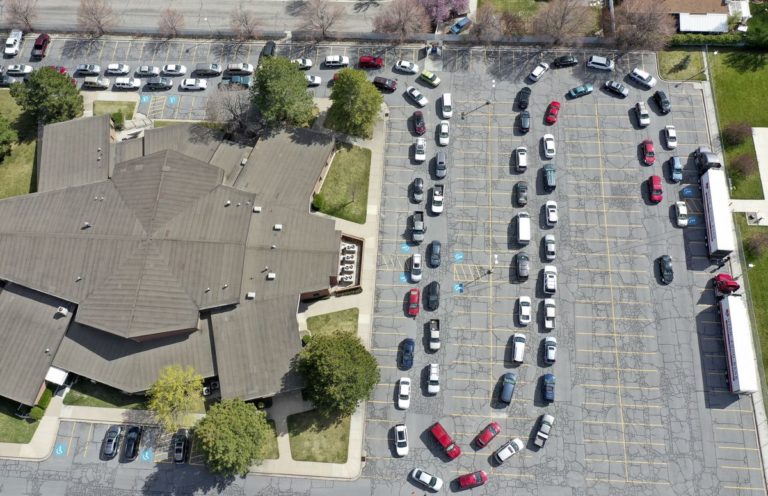
Vehicles snake around the parking lot of a chapel belonging to The Church of Jesus Christ of Latter-day Saints to pick up food from the Utah Food Bank in Taylorsville on Monday, April 13, 2020. The line continues on the street. The Utah Food Bank estimates they provided food to around 400 families at this location.
Vehicles snake around the parking lot of a chapel belonging to The Church of Jesus Christ of Latter-day Saints to pick up food from the Utah Food Bank in Taylorsville on Monday, April 13, 2020. Opponents of the Equality Act worry that churches that partner with or operate their own food banks would be treated like places of public accommodation.
Kristin Murphy, Deseret News

What would change about public accommodations under the Equality Act?

Under the Equality Act, many more businesses and types of retail activity would be subject to anti-discrimination law. It expands the list of covered public accommodations to include “any establishment that provides a good, service or program.”

Supporters have argued that such a change is necessary in order to root out discrimination.

The narrow scope of public accommodations protections in the Civil Rights Act “was and continues to be insufficient,” said Alphonso David, president of the Human Rights Campaign, during a Senate Judiciary Committee hearing in March.

The Equality Act would also broaden the scope of anti-discrimination law by adding sexual orientation and gender identity-based protections. Businesses would need to ensure that policies governing customer interactions, bathroom use or dress code do not single out gay or transgender people for mistreatment.

The bill would “greatly expand the potential field of liability,” said Hasson, who is the Kate O’Beirne fellow in Catholic Studies for the Ethics & Public Policy Center.

How would the Equality Act affect churches?

The Equality Act does not exempt religious organizations. Instead, it creates new opportunities for churches to be considered places of public accommodation by adding things like “public gatherings” and “food banks” to the list of covered activities and establishments.

“You could see how a church opening up its premises to give away free food could be seen as a public accommodation” and be subject to discrimination lawsuits, Hasson said.

This potential outcome of the bill came up often during the Senate hearing in March. Republican lawmakers warned the Equality Act would make it harder for churches to serve people in need.

“Over the course of the last year, we’ve seen houses of worship across the country … serve as locations for COVID testing and vaccine distribution, as well as offer food, clothing and rental assistance,” said Sen. James Lankford, R-Okla., adding that, if the bill passed, those churches could face “needless litigation.”

Republican Sen. Mike Lee of Utah said that houses of worship could be sued if they required men and women to sit in different places based on their sex. Sen. Lindsey Graham, R-S.C., worried the Catholic Church would be forced to allow women to become priests.

Warbelow and other policy experts paint a very different picture of what types of lawsuits would be possible under the Equality Act. Houses of worship would still only rarely be considered places of public accommodation, they said.

“If your AA meeting or food bank really is just for members of your faith, you are not then a place of public accommodation,” Warbelow said.

Still, churches would almost certainly face more lawsuits if the Equality Act became law, since many of them have policies that reflect their opposition to same-sex marriage and belief that gender identity is set at birth, Hasson said.

For example, a church with single-sex restrooms might require self-identified transgender males to use the women’s restroom. That could become a problem in those times when it’s serving the public.

Visitors “could allege discrimination,” Hasson said.

Homeless people gather on a parking lot at the First Presbyterian Church in Dallas on Tuesday, Oct. 9, 2007. In response to a police crackdown on the homeless, the church has opened its parking lot to homeless people, allowing as many as 150 of them to sleep on the pavement while a security guard keeps watch.
Donna McWilliam, Associated Press

What legal protections do churches have?

In addition to increasing the likelihood of legal action, the Equality Act would limit the application of existing religious freedom law.

It says the Religious Freedom Restoration Act, which limits government interference with religious activity, can’t be used to challenge or defend against anti-discrimination claims.

“The bill would keep churches from using this protection that’s been law now for decades,” Hasson said.

Although churches would still be able to cite the First Amendment’s religious exercise protections as a defense, their case wouldn’t be as strong as it could be, she added, arguing that the Equality Act’s supporters seem to want houses of worship to lose.

“They’re doing everything they can to stack the deck” against churches, she said.

LGBTQ rights advocates reject this claim. The goal of the limit on the Religious Freedom Restoration Act is restoring that law to its original intent, David said in March.

Religious freedom “is not meant to be used as a sword to impose your religious beliefs on others. It’s meant to be a shield against discrimination,” he said.

What counts as a religious activity?

Joseph emphasized that, under the Equality Act, the government would still have no right to interfere with activities that are clearly religious. Churches could continue to set eligibility requirements for membership and pastors could preach what they believe.

“A church would never be required to oversee or conduct a wedding that is not consistent with its doctrinal teachings,” she said.

However, Joseph acknowledged that broader public accommodations protections would raise new questions about churches’ rights. Courts would have to better define under what circumstances a house of worship is subject to anti-discrimination law.

“This has not been a hotly contested area until now,” she said.

Hasson’s fear is that legal uncertainty would lead many religious organizations to withdraw from public life. Instead of thinking, “How can I help?” amid a community crisis, churches would ask, “Can I help without getting sued?”

The Equality Act “puts faith-based organizations, including churches, on the defensive,” Hasson said.

One City One Pride, LGBTQ Arts Festival Continues through June 30 – Los Angeles Blade

WEST HOLLYWOOD – Each year the City of West Hollywood celebrates Pride with its One City One Pride LGBTQ Arts Festival, which runs from Harvey Milk Day (May 22) through the end of June Pride month.

The City of West Hollywood’s Mayor Lindsey P. Horvath officially declared May 23 as “Born This Way Day” in honor of the album of the same name by Lady Gaga in a small ceremony in front of The Abbey Sunday, also kicking off the City’s One City One Pride LGBTQ Arts Festival.

To commemorate and recognize its cultural impact, the City of West Hollywood is celebrating with a street painting on Robertson Blvd dedicated to Lady Gaga’s “Born This Way,” which celebrates its 10 year anniversary this year. The album shattered records around the world in sales and streaming and has had significant cultural impact as a quasi-anthem for LGBTQ people around the globe.

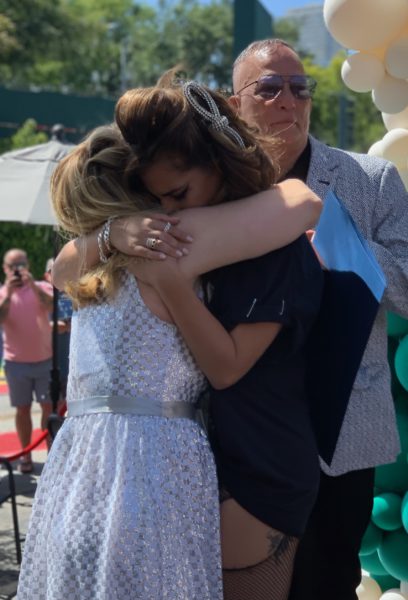
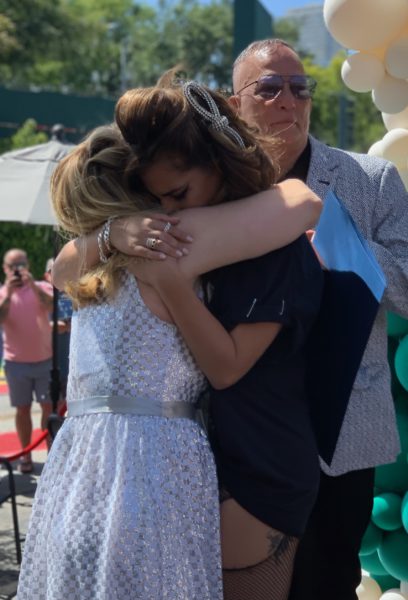
A crowd had gathered in front of the Abbey to witness Mayor Horvath, other city officials, and the owner of the Abbey, David Cooley greet Lady Gaga as she looked over the street painting. Mayor Horvath also presented a Key to the City to Lady Gaga Sunday with a note of thanks: “Thank you for encouraging us to love ourselves and be proud!

Photograph: Mayor Lindsey P. Horvath hugging Lady Gaga as the Abbey owner David Cooley looks on in the background. (Photo courtesy of Mayor Horvath)

When it was originally released in 2011, Born This Way shattered records around the world. To date, the album has more than 5.8 billion global streams, 5.2 million physical albums sold, and 31 million digital tracks sold. Born This Way was Lady Gaga’s first #1 album and it debuted at #1 in 25 countries. It was named one of Rolling Stone’s 500 Greatest Albums of All Time and is Certified 4X Platinum in the U.S.

Concurrent with the unveiling of the colorful street painting is the kickoff of Pride season in West Hollywood with the annual One City One Pride LGBTQ Arts Festival. The 2021 theme for One City One Pride is For the Record – LGBTQ stories of the past that have often been hidden or undocumented. One must read between the lines to find stories hidden behind “beard” marriages, coded language, and erased or destroyed evidence. This year, One City One Pride looks at some of these previously hidden stories.

In order to prioritize health and well-being, One City One Pride 2021 is taking place virtually/in a socially distant manner for 2021.

A partial list of some of the upcoming events and programs for the 2021 One City One Pride LGBTQ Arts Festival includes;

Sat, May 22, 20215:30 PM  Wed, Jun 30, 202110:30 PM, presented by Rogue Artists Ensemble.

Free. No RSVP Needed. Experience online or as a self-guided experience at Plummer Park, 7377 Santa Monica Boulevard West Hollywood, CA 90046

Rogue Artists Ensemble’s Love Note is a free, interactive, solo audio expedition of your heart, taking place in West Hollywood’s Plummer Park, where audience members can activate sonic narrative experiences at eight unique stops throughout the park. Using only your cell phone and headphones, you’ll discover and listen to stories about romance, compassion, and connection, leading to a secret phone line, where you are invited to share your own love story that will become part of the project’s archive.  The community-contributed stories recorded during the run will be then woven back into the experience to create an ever-evolving tapestry of voices calling out for love and belonging.

Love Note is a collaborative creation exploring the transcendence of love beyond identity, boundaries, and definitions. Significant contributions and performances are contributed by members of the LGBTQIA+ community.

Sat, May 22, 2021 6:30 PM  till Thu, Jun 30, 2021 7:30 PM

Outdoor exhibition on traffic median at Santa Monica Blvd. and Doheny Drive

Meringue is a temporary public art exhibition by LGBTQ artist Kim Kiduck. Meringue’s sensual curves invite touch, and the artist intends it to feel like a portal to travel without moving—that you travel when you come in contact with it, not physically, but in the imagination. The translucency of Meringue lets sunlight in to glow naturally during the daytime, and at night transforms Meringue into a mixing chamber of various light combinations. The exhibition will be lit up in rainbow colors for the duration of the City’s One City One Pride LGBTQ Arts Festival.

Fri, Jun 4, 20216:00 AM  till Wed, Jun 30, 202111:59 PM

Presented by ONE Archives Foundation

Outdoor temporary art exhibition on the construction fence at 687 Robertson Boulevard and other sites in the Los Angeles region.

ONE Archives Foundation presents “Pride Publics: Words and Actions,” a multi-site outdoor exhibition that examines the intersection between pride and publicness and examines themes central to queer public life while highlighting trailblazers and their visions. With free and accessible outdoor installations plus a digital guide, this exhibition aims to give visibility to LGBTQ life in the public through the lens of history, community, and activism.

This exhibition is curated by Rubén Esparza, a multidisciplinary artist, activist, and independent curator based in Los Angeles. Installations will be on view for the months of June (West Hollywood) and October (Los Angeles County) in 2021. 

“Pride Publics: Words and Actions” provokes questions central to queer public life: Who have been the LGBTQ movement leaders and trailblazers? What have they said? What have they done to advance the wellbeing of LGBTQ community? What key moments of change that have contributed to the public health, safety, education, rights, identity, and social belonging of queer life.

This exhibition is organized by ONE Archives Foundation. This program is supported by the City of West Hollywood’s Arts Division as part of the City’s One City One Pride LGBTQ Arts Festival.

You can view all 2021 events as a list here. Follow at www.facebook.com/wehopride or www.instagram.com/wehoarts to stay up to date.

One City One Pride is organized by the City of West Hollywood’s Arts Division. If you have additional questions about One City One Pride please email Mike Che, One City One Pride coordinator/City of West Hollywood’s Arts Coordinator at [email protected]

North Dakota lawmakers okay regulation banning Conversion Therapy – Los Angeles Blade

WASHINGTON – In a rare bipartisan move, a bill that designates the former Pulse nightclub in Orlando, Florida a national memorial was passed by unanimous consent in the U.S. Senate Wednesday.

Florida’s two U.S. Senators Marco Rubio (R-FL) and Rick Scott (R-FL) introduced Senate Resolution 265 recognizing the fifth anniversary and honoring the 49 victims of the mass shooting attack inside the Pulse Nightclub that occurred on June 12, 2016.

Companion Senate legislation also passed was authored by California U.S. Senator Alex Padilla (D-CA).

“It is my hope that this memorial will serve as an enduring reminder of the pain and loss felt in Orlando five years ago and as a testament to the resilience and strength of the LGBTQ+ community. It is also an important reminder of the need recommit ourselves to end the senseless cycle of gun violence that has touched too many families across the country and taken too many of our loved ones,” Senator Padilla told the Blade in an emailed statement.

“It’s an epidemic that has claimed far too many LGBTQ+ lives, particularly in Black and Latino communities. We will never let the memory of the victims of the Pulse Nightclub mass shooting fade away– and this memorial is an important part of their enduring legacy,” Padilla added.

Congressman Darren Soto’s (D-FL) House Resolution 49 that passed by voice vote on May 13 in the House was also passed by the Senate.

“The tragedy at Pulse rocked our community and served as a reminder of the work we have to do to uproot hate and bigotry. We’re proud of the bipartisan coalition of Florida Congressional leaders for leading the effort to recognize this hallowed ground as a national memorial site.,” Brandon J. Wolf, the Development Officer and Media Relations Manager for LGBTQ advocacy group Equality Florida and a Pulse survivor told the Blade. “Our visibility matters. May the 49 lives stolen never be forgotten. And may we always honor them with action.”

Wolf was inside the club at the time of the shooting and lost his two best friends, Juan Ramon Guerrero and Christopher Andrew (Drew) Leinonen, who were among the 49 murdered during the rampage. Wolf had managed to escape but the event has forever left him scarred.

Since that terrible night Wolf has been a force for advocacy in gun control and LGBTQ equality rights and is a nationally recognized leader in those endeavors to include by President Joe Biden.

“Pulse is hallowed ground and what happened on June 12, 2016 must never be forgotten. ” Wolf added.

Florida’s Senator’s both released statements:

“The terrorist attack at Orlando’s Pulse nightclub was a heinous act of violence and hatred against members of the LGBTQ community,” Marco Rubio said. “Forty-nine innocent lives were lost on that horrific day. As the fifth anniversary approaches, we must continue to honor the memory of those who were taken far too soon. And while work still remains to root out evil, I am inspired by Orlando’s continued resiliency, pride, and strength.”

Rick Scott, who was Florida’s governor at the time of the mass shooting said, “Nearly five years ago today, our state, nation, the City of Orlando, and Hispanic and LGBTQ communities were attacked, and 49 innocent and beautiful lives were lost. It was an unspeakable tragedy,” he said. 

“An evil act of terrorism designed to divide us as a nation and strike fear in our hearts and minds. But instead, we came together, and supported each other through heartbreak and darkness, to preserve and rebuild. Today, we still stand strong, together, to remember the 49 young lives lost that tragic day and honor their memory with passage of our resolution and our bill to establish the ‘National Pulse Memorial.’ It is my hope that this memorial will forever serve as a tribute to the victims and a reminder for us all to always stand for love and kindness over hate and evil in this world.”

Although the United States Senate marked the upcoming fifth anniversary by honoring the victims and shooting survivors with passage of the legislation which now goes to President Joe Biden for his signature, in Florida, Repuiblican Governor Ron De Santis has taken a different tack.

Last week, DeSantis vetoed funding for LGBTQ programs from the state budget including money earmarked for mental health programming to support survivors of the Pulse Massacre, to house homeless LGBTQ children, and for Orlando’s LGBTQ Community Center. 

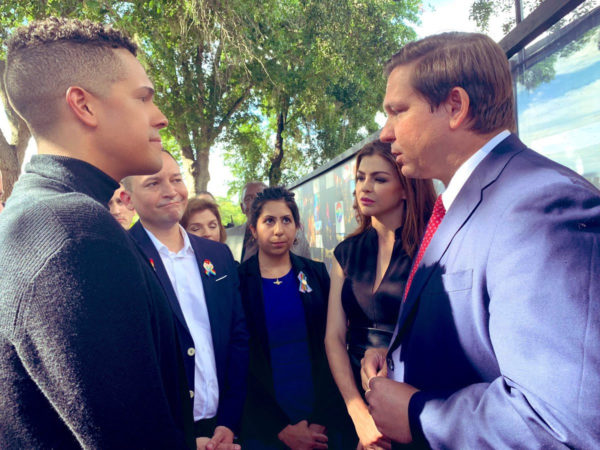
Brandon Wolf (L) speaking with Florida Governor DeSantis (R) at PULSE Memorial 2019 (Photo courtesy of Brandon Wolf)

These actions following his signing a bill on June 1, the start of LGBTQ Pride month- an education bill amended to include a previous stand alone bill, specifically targeting transgender girls and young women, banning them from playing on female sports teams.

“Let’s be clear about what this is: Governor DeSantis has declared war on Florida’s LGBTQ community.” said Wolf. “Before the 2019 Remembrance Ceremony, Governor DeSantis stood on hallowed ground, steps from where I escaped the building in 2016, and promised me that he would always support those of us impacted by the Pulse nightclub shooting. Today, almost two years later to date, he vetoed mental health services for us. I will never forget.”

How our opinions on gay marriage have changed – Yahoo News

When former President Barack Obama campaigned against gay marriage in 2008, the majority of his party agreed with him. Traditional marriages between one man and one woman were still considered the backbone of a healthy society; the nuclear family was still his ideals.

Five years later, Obama’s publicly expressed opinion on the matter changed dramatically, as did that of most Democrats’. The reason was obvious: Public opinion was also shifting. By 2011, the number of people who supported legalizing gay marriage finally overtook the number of people who opposed it. And just two years later, the Supreme Court issued its Obergefell v. Hodges ruling, cementing into law a new definition of marriage, one that included same-sex couples.

Since the court’s ruling, public acceptance of gay marriage has continued to grow in America, even among Republicans, many of whom vehemently opposed Obergefell. A new poll released this week found that 70% of the public believes that marriages between same-sex couples ought to be recognized as “valid” with “the same rights as traditional marriages.” Among Republicans, support for gay marriage reached 55%, marking the first time in the poll’s history that a majority of the GOP was in favor of it.

Why has the public’s opinion on this matter changed so dramatically in such a short time? Perhaps because the younger generation, which is much more likely to accept liberal viewpoints, is now entering the public square. But that doesn’t explain why people of all ages have become more accepting of same-sex marriage over the past decade.

Obergefell, however, does. As soon as the court issued its ruling, legal and legislative challenges to same-sex marriage began to drop like flies. Legally, they no longer had much of a case, and culturally, pressure from liberals made it extremely difficult for conservatives to keep trying. No one wants to be the reason marriage equality fails; no one wants to be smeared as a bigot.

Perhaps the legalization of gay marriage was inevitable. Maybe it was long overdue. Regardless, it is obvious that our views, more than we realize, are shaped by cultural tides, which in turn can be shaped by the law.

Washington Examiner Videos

Tags: LGBT, Gay Marriage, Polls, Supreme Court, Democratic Party, Republican Party, Barack Obama

Original Author: Kaylee McGhee White

Original Location: How our opinions on gay marriage have changed

Reverend shares why Pride Month is important, LGBTQ youth at increased risk for suicide and trafficking – KAIT

JONESBORO, Ark. (KAIT) – The month of June is a chance for members of the LGBTQ+ community to show their pride. But, it’s also a chance for family and friends to support those most at risk of suicide and human trafficking.

“We remember a lot of the struggles that the LGBTQ community had to go through to get any sort of acceptance in common culture,” said the Reverend Kevin Gore, director of communications for Northeast Arkansas Pride.

Gore, who is the rector for St. Mark’s Episcopal Church, says that it’s harder for LGBTQ people living in the South to find support.

“Conservative religious ideology, I think, in this particular region of the South, and that tends to be what folks grow up with, it tends to be their paradigm,” Gore said. “They get into a situation where they don’t know there is anything else.”

For those who say being a Christian and supporting LGBTQ+ people don’t mix, Gore has a message: “One interpretation of the gospel is not the only interpretation. Jesus’s whole message has everything to do with grace and love and forgiveness, and reconciliation.”

He said acceptance is especially important for mental health.

Every 45 seconds in the United States, an LGBTQ youth attempts suicide, and they do that because they’re not supported. So, it doesn’t take a lot of support,” said Gore. “One adult in the life of an LGBTQ youth who is supportive reduces that by 40 percent, reduces the risk of suicide.”

Hope Found of Northeast Arkansas says that lack of support is why LGBTQ+ youth are at a higher risk of being trafficked because they are often alienated from their family and even kicked out of their home.

“All of those types of vulnerabilities make them more susceptible to the tricks and lures of a trafficker. Tricks and lures, such as love or protection,” said Megan Brown, executive director for Hope Found of NEA.

Gore says the best way the community can help is just to be kind.

“When you approach another person, maybe you don’t agree with or understand with the way that they are by recognizing their humanity and ask questions,” said Gore. “Be willing to listen to what they have to say, be willing to offer them the same respect you would anyone else.”

For more on resources from NEA Pride, click here.

For more on resources from Hope Found of NEA, click here.

Copyright 2021 KAIT. All rights reserved.

LGBTQ: The podcast telling Singapore’s hidden gay stories – BBC News

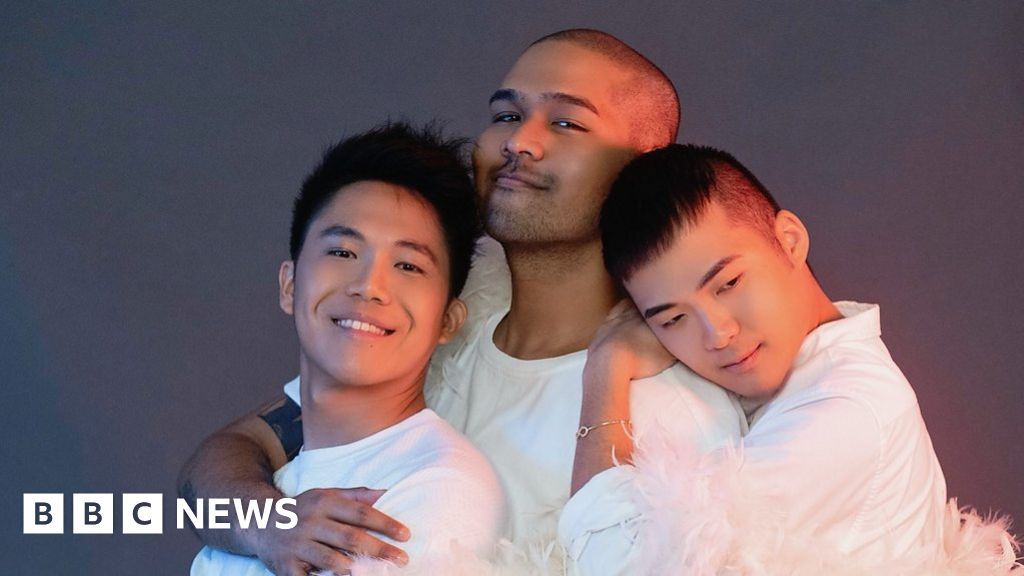
Joshua, Kennede and Sam Jo call themselves The SG Boys. They have started one of the first LGBTQ podcasts in Singapore – where gay sex is still illegal.

Singapore’s government argues that the ban must remain to reflect society’s conservative views, and as a compromise it has said it will not enforce the law.

But LGBTQ activists argue that as long as it remains, it perpetuates a stigma and fuels discrimination.

The SG Boys tell the BBC about the challenges of living as a gay person in Singapore, and how they hope their podcast will spread love and empathy for their community.

Video by Tessa Wong.

Celebrate Pride on the North Fork with these events happening throughout June – Northforker

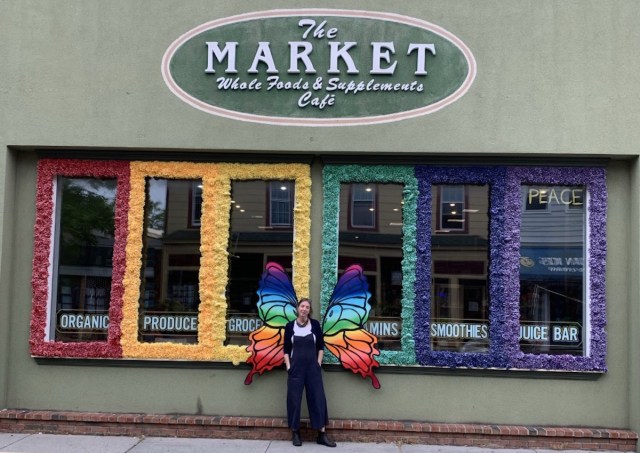
The Market Pride month display (credit: The Market).

It’s Pride month and shops all around the North Fork are showing their support for the LGBTQ+ community in many ways. In Greenport, spots including the Times Vintage, D’latte Cafe, the Market and Kate’s Cheese Shop, have decorated their exteriors in rainbows and Pride flags. Other businesses are hosting Pride events like trivia and yoga to celebrate and donate proceeds to a LGBTQ+ organization.

The Times Vintage Pride month display (credit: Lizzy Sweigart).

Sunday, June 13, 6 p.m. to 9 p.m.

Pride 2021 Picnic & Trivia Event at Terra Vite Vineyards
Celebrate Pride picnic style with their BYOB (bring your own blanket) event. Little Ram Oyster Co. will be there and test your Pride knowledge with Hollywood trivia. Tickets are $55 per person and include an aperitivo welcome cocktail, one glass of wine, half a dozen shucked oysters, two rounds of trivia and one ticket to enter the door prize raffles. A portion of the proceeds from this event will be donated to Long Island LGBT Community Center.

Tuesday, June 22, 6 p.m

Pride Pop Culture Trivia at North Fork Brewing Co.
This brewery is no stranger to a good trivia night — they host them a few times a month. From Pandemic-themed to the Office, North Fork Brewing knows how to test your skills. This month, it’s all about Pride with a Pride Pop Culture Trivia night to test your knowledge. Tickets are $10 for a barrel or bar top seat for up to two people and $30 for a table for up to six people. Proceeds will go the Trevor Project for LGBTQ+ suicide prevention.

Sunday, June 27, 7 a.m.

Pride Yoga and Ride at Solntse Hot Yoga
This Wading River yoga studio is collabing with Mobile Body Boutique, a transient fitness studio that moves all throughout Suffolk County. Together they are hosting Pride Yoga and Ride, a spin class followed by a yoga class all outdoors at the Shoppes at East Wind. Tickets are $30 per person and you can sign up on the Mobile Body Boutique website. Fifty percent of the profits will be donated to the Trevor Project

Know of another Pride event happening this month on the North Fork? Email [email protected]

Booze News: A New Sports Bar, Pride Month With Jing-A, and Free Coffee – The Beijinger

Thirsty? Wet your whistle with Booze News, our wrap-up of the week’s best deals, parties, concoctions, industry gossip, and more.


Xindong Lu gets a new sports bar

We start this week with news of a new sports bar in Xindong Lu opening this Friday from the people behind Jiaodaokou’s Wonderwall bar. The aptly named Winner Club will have drink specials throughout the holiday and screenings of Euro 2020 group stages (see the full schedule here). Head down to 新东路东首开铂郡北区B1 to catch the action.

Celebrate Pride Month with Jing-A

Jing-A are embracing Pride Month with a new beer and the return of their Keg Egg Pride Tour. Part of the proceeds from the former, dubbed Pow Pow IPA (6.3 percent ABV), will go towards the Beijing LGBT Center “to help raise funds and awareness for their vital, path-breaking work.” The beer is a white IPA, “combining the flavors of a Belgian witbier with a juicy, hazy IPA,” according to Jing-A. “Mandarina Bavaria hops provide notes of sweet citrus, while cryo Mosaic and Sabro bring a bouquet of pine and floral aromas.”

Meanwhile, the team will be hitting the streets later in the month as part of their 2021 Keg Egg Pride Tour. The tour will stop at locations special to Beijing’s queer history, “celebrating the places and people that made this city more vibrant, more inclusive, and more colorful.” To participate, simply turn up at one of the stops with a two-liter-or-less container and get a pay-what-you-want beer refill. All proceeds go towards funding a charity curated by the Beijing LGBT Center. Full details of the tour will be released via their WeChat account later in the month.

Xiamen’s FatFat Beer Horse tap takeover at Slow Boat

Over at Slow Boat Maizidian, they’ve invited Xiamen’s FatFat Beer Horse Brewing Company for a one-off tap takeover next Wednesday, Jun 16. The brewer is a long-time friend of Slow Boat, so this time round they’re bringing a full six of their unique German-style beers for the party, including a Gin Sour, Tropical Illusion, and a Seaweed Gose. Each pour will only cost RMB 35 throughout the day.

Happy hour at Lobby Lounge and Bar

Lobby Lounge and Bar at the Regent Beijing have launched a couple of new specials to keep the good times flowing. The first is their three-day happy hour, every Wednesday to Friday, 7-9pm, where all drinks are buy one, get one free (at RMB 108 each), including cocktails, house wine, beer, and spirits. Also on Friday, ladies are eligible for two hours of free-flow house wine, sparkling wine, spirits, and beer between 7-9pm for RMB 98. Add RMB 18 to get unlimited access to their cocktail menu as well.

Free coffee at Great Leap

Finally, it might not be boozy, but it certainly helps. In a clever promotional twist, Great Leap is now luring beer drinkers into their Sanyuanqiao #45 venue with the promise of a free cup of coffee. Simply post the poster found in this WeChat post onto your Moments, show a member of staff, and receive a free Americano, latte, cappuccino, or espresso any day of this month between noon and 5pm. Belissimo!

New in the Neighborhood: Latest Spots in Sanlitun

Images: Thomas Serer (via Unplash), courtesy of the organizers

Uprising at Milwaukee gay bar remembered 60 years later – FOX 6 Milwaukee

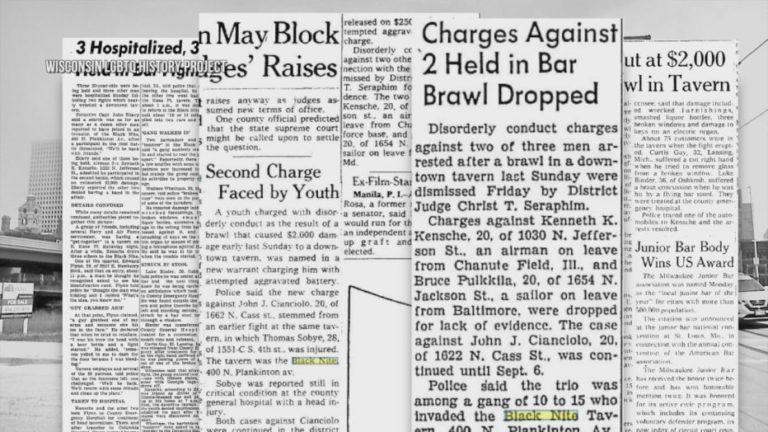
June is Pride Month, and some Milwaukeeans want to shed light on what they say was an uprising against homophobia, raising awareness of what’s called the “Black Nite Brawl.”

Aug. 5, 1961 is a day the Wisconsin LGBTQ History Project doesn’t want to be forgotten.

“A known gay bar called the Black Nite had a bit of an uprising,” said Michail Takach, curator.

Takach said a group of sailors went into the bar with bad intentions.

“And tried to bully people and tried to start fights,” said Takach.

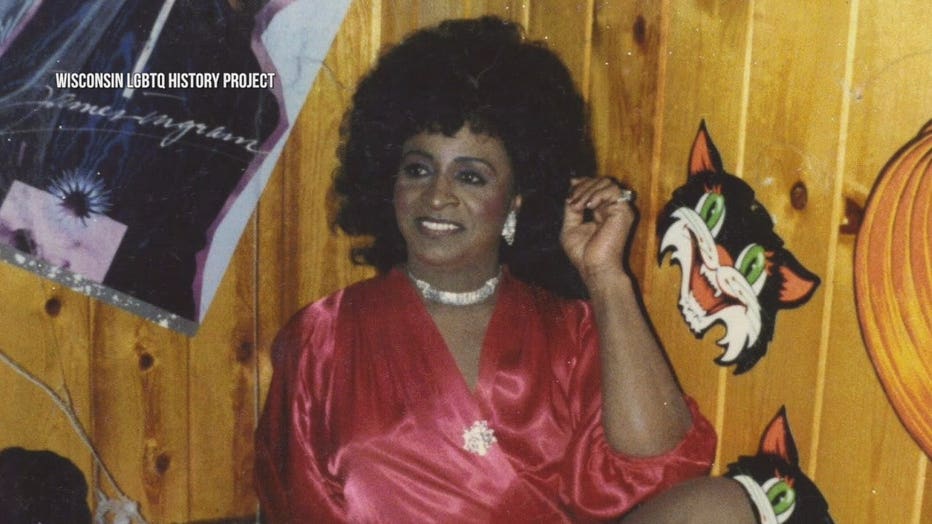
The men were thrown out, according to Takach and Josie Carter, a pioneer in Milwaukee’s gay community, chased the sailors away.

“Josie Carter then stayed at the bar and kind of rallied the troops because she said, ‘You know, enough is enough,’” said Takach.

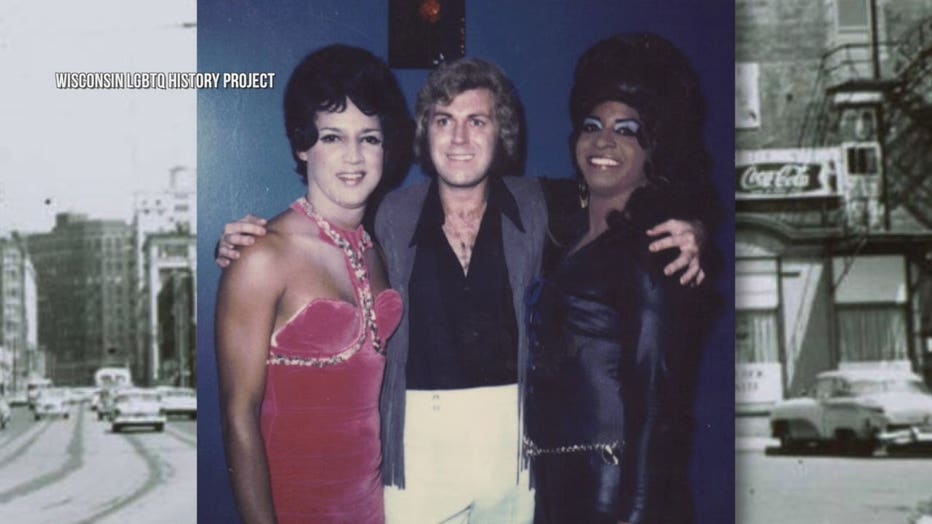
Black Nite was more than just a bar. Takach said the bar was a space for Milwaukee’s gay community to feel safe and be open and free.

“When the sailors returned, the entire bar had been rallied into battle and they fought off 10 to 15 sailors who had come back to fight and to, ‘Clean up the Black Nite,’ as they put it,” said Takach.

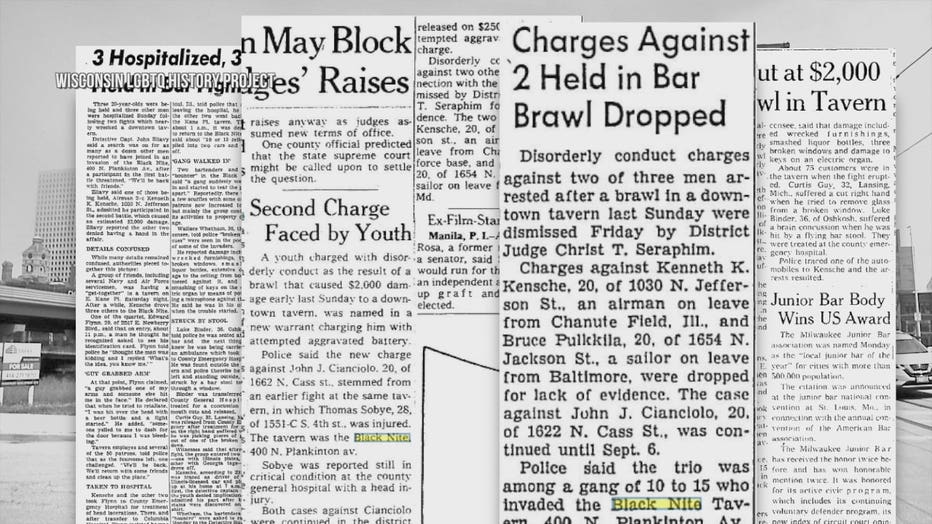
Takach shared newspaper clippings from that night.

FREE DOWNLOAD: Get breaking news alerts in the FOX6 News app for iOS or Android

“For the first time in recorded Wisconsin history, gay people fought back, and they knew that they could be arrested,” said Takach.

Eventually, charges against the sailors were dropped and Black Nite was forced to close.

“Their place was taken away, and I think that was the greater punishment,” said Takach.

The history of this moment lives on, and BJ Daniels, a local historian, talked about the Black Nite Brawl’s significance.

“To have this relatable history and have something for young people to look back at and be proud of,” said Daniels.

Aug. 5, 2021, will mark the 60th anniversary of the Black Nite Brawl. One way the Wisconsin LGBTQ History Project wants to honor the event is by adding a historical sidewalk marker at the site of the former bar. The group would also like to light the Hoan Bridge in pride colors and have a mayoral proclamation. 

‘We’re proud of our gay community’: Long Beach Mayor Robert Garcia on new LGBTQ lifeguard tower – KCRW

A lifeguard tower honoring LGBTQ-plus pride was unveiled in Long Beach this afternoon. The brightly colored structure replaces one that was destroyed in a blaze in early March, which investigators this week classified as arson. 

Long Beach Mayor Robert Garcia tells KCRW the restoration of the tower servers as a symbol: “We’re absolutely sending a message that you could try to bring your hate here. … But we’re going to rebuild, and we’re proud of our gay community.”

City lifeguards painted and installed the tower, which is located on the beach near Shoreline Way and 12th Place. 

Garcia says there are plans to make it bigger than it currently is: “We’re also looking forward to even adding two towers. There’s a lot we’re having conversations right now about, adding some historical markers and additional flag poles. We’re going to add perhaps even some event space there.”

Investigators are still searching for more information about the arson that burned down the last tower, which was installed as a part of last year’s Long Beach Pride Week festivities.

“Lifeguard towers have existed here for many decades, there have not been any fires, it’s very hard to light one on fire,” says Garcia. “And it’s very … I think it’s awful that the one that was painted in pride colors is the one that they burned down. So to me, that’s very clear what people were trying to do, and we’re looking forward to hopefully be able to catch whoever did this.”

Anyone with information about the fire is urged to reach out to the Long Beach Fire Department’s investigative hotline at 562-570-2582.

LGBT Center opening of Community Training & Technology Center. – Reading Eagle

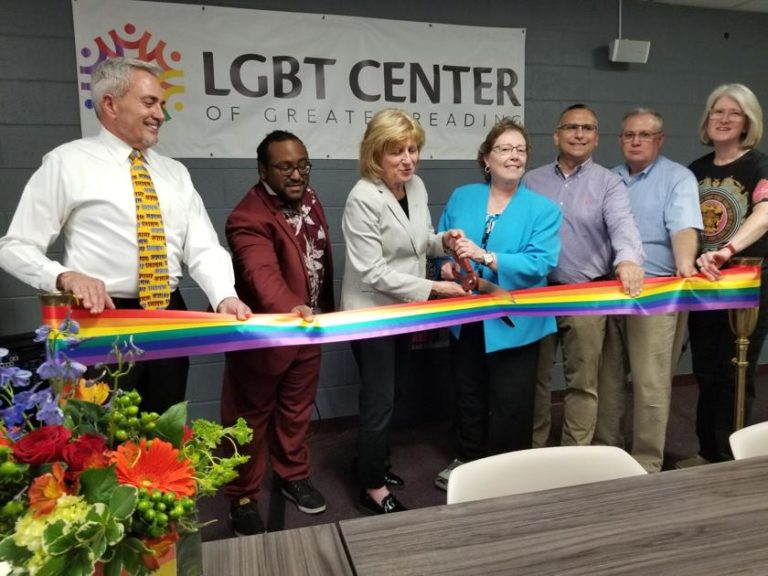
From left, Tim Greusel, president; Michael Molina, board member; state Sen. Judy Schwank; Michelle Deck, executive director; and board members Benjamin Wilson, Michael Shaffer and Lynette Matson cut the ribbon Thursday at the grand opening of the LGBT Center of Greater Reading’s new community training and technology center.

Kid Rock repeats homophobic slur in tweet about gay friends – Los Angeles Times

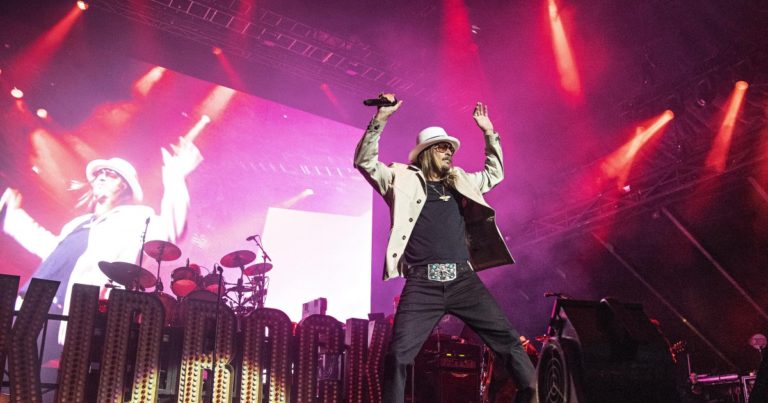
Is Kid Rock sorry for the homophobic slur he hurled during a weekend performance in Tennessee? Not one bit. The singer just doubled down on the hateful word in a mocking tweet about loving his gay friends.

“If Kid Rock using the word f— offends you, good chance you are one,” the singer tweeted Wednesday afternoon. “Either way, I know he has a lot of love for his gay friends and I will have a talk with him. Have a nice day. -Bob Ritchie.”

The name at the end of the tweet is the one the performer was born with, so any offended folks can likely expect only a brief conversation. He usually signs his own tweets with the initials “KR.”

Replies to the tweet? Well, those are all over the map, with many people informing the singer that his word choice was offensive and unacceptable and others arguing that he is a good guy who has spent the pandemic raising and donating money for those in need.

Advertisement

The Kid used the slur initially onstage over the weekend at FishLipz Bar & Grill in Smithville, Tenn., where he got annoyed by the crowd’s ubiquitous cellphones.

“You f— f— with your iPhones out!” he said in video posted by TMZ. He also directed the audience to record his crotch, if they’d like. The outlet previously posted footage from a drunken Nashville episode in late 2019 where Kid Rock went on a profane rant about Oprah Winfrey.

That earlier time around, he also came back afterward on Twitter: “My people tried to get me to do The Oprah Winfrey show years ago and her people wanted me to write down 5 reasons why I loved her and her show… I said f— that and her,” he tweeted back then, including a rainbow-flag emoji in his explanation of why he hates the talk host. “End of story.”

Kid Rock, a Trump supporter, has often referred to himself as a libertarian who is socially liberal but fiscally conservative and previously has expressed his support for gay marriage.

In another recent move guaranteed to tick off a number of people,
Kid Rock invited untouchable country musician Morgan Wallen to perform at his Nashville honky-tonk in May, right before Wallen posted a new song, “Thought You Should Know,” on Instagram.

It was the mullet-sporting singer-songwriter’s first shot at a public performance since his industry-wide cancellation in February, which came after he hollered the N-word at a buddy after a drunken night out.

Ann Rostow: Double Trouble for Second City’s Gay Cat – San Francisco Bay Times – San Francisco Bay Times

By Ann Rostow–

Double Trouble for Second City’s Gay Cat

On Monday, June 7, I strolled into the SCOTUSblog livestream to await the 10 am release of High Court opinions. Surely our long-awaited ruling in Fulton v City of Philadelphia will be handed down today, I thought wrongly. It was argued in early November, for God’s sake. I know it’s a difficult case—although it shouldn’t be—but still, we only have two weeks left in the session. If not now, when? 

(Um, maybe any one of the several remaining announcement dates?)

The result, whether for good or for ill, will have a major impact on our community’s legal posture going forward, ergo, when it eventually appears, my column will basically write itself. This week would have been convenient timing for such a scenario since I’m here in Connecticut visiting my adorable grandchildren and their lovely parents so I’m distracted. And plus, I don’t see a whole hell of a lot of other stuff to write about. No scandals, no political shenanigans, or discrimination lawsuits. No crazed lesbians running amok forcing their partners to drive them down the M5 at knife-point. 

No, it’s all anti-trans lawmakers, Pride this, Pride that, and things happening overseas where we’ll probably never set foot again thanks to mutant strains of Covid that will break through our vaccine defenses and kill us all before we have a chance to book our tickets to paradise. So, it seems I might have no choice but to rely on random subjects with no particular connection to our shared struggle for equality and human rights. 

Then, to my horror, I checked my last column and noticed that it too was filled with inane anecdotes that had nothing to do with gay law or politics, like the story about the cat who jumped out of the fifth floor Chicago apartment or the one about the calico lobster rescued from a Virginia restaurant. Is it possible that I will now have to offer my readers two intellectually lightweight efforts in a row?

Not only is it possible, but it is happening. And to kick it off, I’d like to report that the cat who jumped out of the Chicago apartment in mid-May, “Hennessy,” was an indoor feline who was escaping a fire. Hennessy was seen on video landing safely in a bush and running off, but as far as I can tell this cat has never been seen again. Someone else out there with time to burn, please dig a little deeper and find out if Hennessy ever returned home. If not, this feel-good news item (“Miracle Cat Survives Hundred Foot Fall”) is going to turn very dark, very fast. (Lost On Chicago’s Mean Streets, Pet Cat Fades From Headlines.) Maybe Hennessy was gay or bi or questioning. If so, we’re back on topic.

What Does Winning Look Like?

You know, of course, why we’re all waiting anxiously for Fulton v City of Philadelphia. The GLBT battle of this decade will be the fight over religious “freedom” versus gay and trans civil rights, and I use the word freedom advisedly because nobody is actually preventing Jane or Joe Christian from going to church or believing in the resurrection. They are trying to prevent said Christians from running a public business or organization that illegally discriminates on the basis of sexual orientation or gender identity. 

No one would allow a proprietor to insist that their faith requires racist business practices based on, I don’t know, the “Curse of Ham” or something. Yet the exact same principle is at stake in the Philadelphia foster care case and all those bakery and florist cases that we see down the line. Tell me, why should race-based civil rights laws (rightly) be sacrosanct, while gay-based laws are optional to people of so-called faith? 

I won’t belabor the point, I’m just anxious to see what transpires and particularly interested to see what Amy Coney Barrett does with her first GLBT decision.

Meanwhile, there’s a big new book out on my favorite subject, marriage equality, called The Engagement: America’s Quarter-Century Struggle Over Same-Sex Marriage, by Sasha Issenberg. I think it’s 900 pages, so no, I haven’t read it yet.

Writing in the Washington Post, Issenberg argues that marriage equality was a relatively easy civil rights lift because giving marriage rights to gay couples didn’t take anything away from other people. And unlike the conflicts over abortion or even race, once the matter was settled by the High Court, the subject was more or less closed. The sky did not fall, as marriage attorney Evan Wolfson put it, and life went on.

“Ultimately,” wrote Issemberg, marriage equality “doesn’t create any losers, which may be one reason those who lost the battle over marriage rights have flocked to religious-liberty cases championing people who claim that being forced to acknowledge the change in law violates their beliefs. In cake bakers and foster-care agencies, gay-marriage opponents finally found people who felt they had something to lose.”

I would agree were it not for the fact that Monday morning legal analysis is just as tempting and erroneous as replaying the proverbial football game from Sunday afternoon. Marriage equality is profoundly in line with deep social values of family, love, commitment, and respect. Abortion, by contrast, is disliked by all of us, including those who support a woman’s right to choose how to conduct her pregnancy. 

No one “likes” abortion. Quite aside from any religious thoughts on the matter, the practice terminates what would otherwise likely become a specific individual. The question is not whether abortion is good or bad, the question is who makes the hard decision whether to have an unplanned child, the mother or some religious mucky mucks? 

It’s no wonder this fraught social issue continues to plague us, yet those who oppose abortion rights don’t have any more “to lose” than those who opposed marriage equality. No one is forcing them to have abortions; they are only disturbed by their own judgments much as antigay activists felt the same. Again, it’s because marriage equality is a sweet lovely dream while abortion is a sad necessity that the former is more or less settled law and the latter continues to rile our society. 

Get That Child Off My Bridge

What else is new? Do you remember Wil Wheaton from Star Trek Next Generation? I hated the obnoxious Wesley Crusher, but grew to admire the actor Wheaton, who has dined out on his precocious teenaged character for several decades. While Wheaton is straight, there was something a little gay about Wesley, particularly when he wore those super swishy sweaters. 

“Over the years, I’ve met several men who have told me that their childhood crush on Wesley Crusher was a big part of them coming out and living their lives with joy and love and pride,” Wheaton wrote recently. “I cannot even begin to tell you how much this means to me. I love it so much that I, and some of my work, were there for people … who needed a safe place.” 

I know I’m only writing to a select few of you now, those that watched Star Trek Next Generation. But I have to wonder which of you guys out there actually saw know-it-all Wesley as crush-worthy. Really? That said, I applaud Wheaton for his generous outreach for Pride. Come sit in the captain’s chair, Wil.

Lake Woah Be Gone

Let’s see. You probably saw the video of the motorboat that was flying the rainbow colors out on a lake somewhere in Washington state. Another boat circled around them five or six times, yelling antigay things and giving them the finger. A few minutes later, the mean boat left, burst into flames for reasons unclear, started to sink, and the gay boat had to rescue all the unpleasant people from the mean boat.

Usually, I would actually check a few things out before reporting this incident. I only saw the gay side of the story in a video. Was the other boat antigay? Or was there a secondary altercation on the water that had nothing to do with sexual orientation? Who shot the finger, and was it actually sent as a homophobic gesture? What did the crew of the burning boat say when they were rescued? Did these people know each other beforehand?

That’s just to say that I have not checked any of this out, but the story is so neat and moralistic that I send it along without further research. I will also note that someone close to me who will remain nameless suggested that the burning boat people should have been left to swim ashore. I disagreed. (Did I really marry this person?)

Cookie Monsters Unite

Do you recall from earlier in this column that, in theory, I could be discussing anti-transgender state lawmakers, Pride news, and a range of international GLBT subjects? That’s true, but for one thing, I’ve lost track of the anti-transgender state laws. All I know now is that this session is the worst in many years for our community and that transgender Americans, specifically transgender women and girls, are getting the worst of it. Sasha Issenberg is correct that the antigay right has ceded the battle for marriage equality. But they are all in when it comes to transgender kids and antigay bakeries. 

Basically, they’re looking for any simplistic cultural trigger on which to fundraise. The country is now filled with happy gay and lesbian married couples who don’t seem that different from anyone else. So instead, let’s raise the alarm on men in ladies’ bathrooms, boys dominating girls’ sports teams, or devout Christians forced to celebrate gay sex. You get the picture.

As for Pride, some of it is still virtual, but I don’t feel like determining what’s happening where. I’ve already complained about the politically correct New York Pride organizers who have disinvited the gay and lesbian police group from marching in the parade. Ridiculous and counter-productive. I won’t repeat myself.

There are also several Pride-related stories just because it’s June. For example, there’s a bakery in Lufkin, Texas, that created a little rainbow Pride cookie. “Confections” bakery drew a far-right backlash after posting photos of the cookies and writing: “More LOVE. Less hate. Happy Pride to all our LGBTQ friends! All lovers of cookies and happiness are welcome here.” 

In their next post, the bakers said they had lost an order for five dozen cookies that they had just finished icing, and that they had received angry feedback. And you can guess the happy ending, right? Orders came in from all over the country and Confections had a line around the block of customers showing their solidarity. The entire store was quickly sold out and donations flowed in from other contributors. It’s the classic Pride season story, and the moral is: for every one of Them, there are ten of Us, “Us” being our community and our allies.

A Prayer for Meridian

And speaking of a ten-to-one ratio of friend versus foe, I enjoyed the video of a recent ex-gay “rally” in Washington, D.C., the other Saturday, because it looked as if there were about a dozen people in attendance. “Join our diverse group of former LGBTQ individuals in worshipping, sharing our testimonies, and celebrating freedom in Christ publicly on the Mall in Washington,” urged something called the “Changed Movement” in an Instagram post. Well, good luck with that, everyone.

And in other antigay religious news, you’ll be pleased to hear that the Family Policy Alliance has sent around a prayer so that all of our loving, but disapproving, straight friends and family can bow their heads on our behalf. Called “A Prayer for our LGBT Neighbors,” the group hopes that we can spontaneously reject our own faiths and identities and embrace the alternatives they are proposing.

“As Christians, we are saddened by the celebrations of this month, because not only do we know that Pride Month is a celebration of sin, but we also know that we will never be free until we find our identity, salvation, and hope in Jesus Christ,” the group warns piously. 

In Pride month, they pray that “our hearts are heavy for those who identify as LGBT. Your Word is clear about both sin and salvation—and our own consciences testify to this truth—yet so many live with the hope that they will find their ‘true self’ or even their worldly salvation in a broken identity.” It goes on in that vein, until we reach a childish scrawl signed: “Meridian.”

You know what, Meridian? In the spirit of Pride month, we pray back at you. Here’s hoping that your Christian faith, or whatever, opens your heart to other people who don’t think exactly like you, and gives them a little credit. Amen.

arostow@aol.com

Published on June 10, 2021