Home Blog Page 50

Michael Kors, Big Gay Ice Cream to Team Up Friday for Pride Month – WWD

Michael Kors and Big Gay Ice Cream are teaming up to celebrate Pride and the #MKPride capsule.

On Friday, customers who make a purchase at Michael Kors’ Rockefeller Center store and/or sign up for the brand’s KorsVIP program will receive a complementary treat from Big Gay Ice Cream at the co-branded ice cream truck parked outside the store. The truck will be there from noon to 6 p.m. at 49th Street and the corner of Fifth Avenue.

Customers will be able to choose from a variety of flavors (vegan options available), including a special flavor made exclusively for #MKPride: pink and yellow birthday cake swirl. Other offerings include vanilla soft serve, twist soft serve, novelty ice cream sandwich and vegan paletas in a variety of fruit flavors.

The #MKPride capsule, which will be featured throughout the store, includes a range of rainbow-adorned women’s, men’s and gender-neutral pieces. Items include shorts and sweatshirts with rainbow heart patches, as well as accessories and outerwear in an allover rainbow-striped design. Retail prices range from $24 for the wavy rainbow stretch cotton face mask to $498 for the Hudson graphic logo backpack.

Customers who purchase the special-edition #MKPride Rainbow Badge T-shirt, available in gender-neutral sizing and in both white and heather gray for $68 will be contributing to a good cause. All profits from the sale of this T-shirt benefit OutRight Action International, a leading global human rights organization fighting for the rights of LGBTQ people around the world.

The #MKPride capsule will be carried in other Michael Kors stores as well.

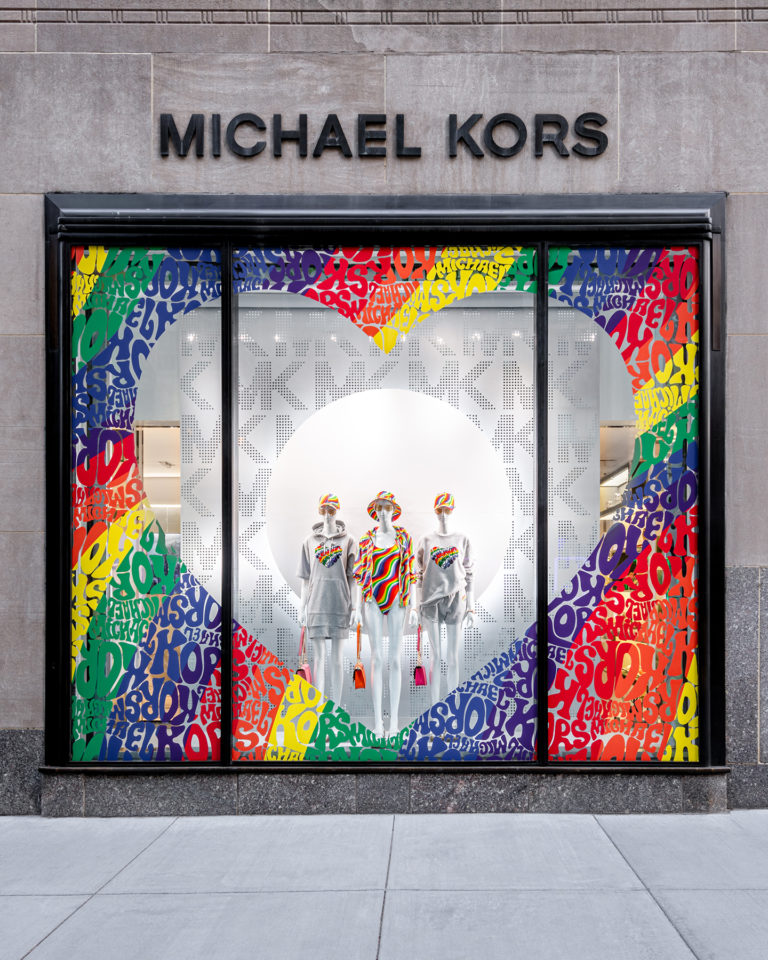
The #MKPride takeover of the Rockefeller Center store has been set up for the entire month of June. On the Fifth Avenue facade, there are flags and heart-shaped window decals emblazoned with the distinctive rainbow Michael Kors logo lettering. Around the corner on 49th Street, video screens display the #MKPride capsule campaign created in partnership with Paper Magazine. The video stars four queer TikTok content creators, Tyshon Lawrence, Ve’ondre Mitchell, Mad Tsai and Soph Mosca, using the rainbow products to showcase their personalities and express their authentic selves.

FOR MORE STORIES: 

Michael Kors to Present Live Runway Show During NYFW in September

Broadway Baby: Michael Kors on 50 Years of Opening Nights, Diva Crushes and a Dream Revival

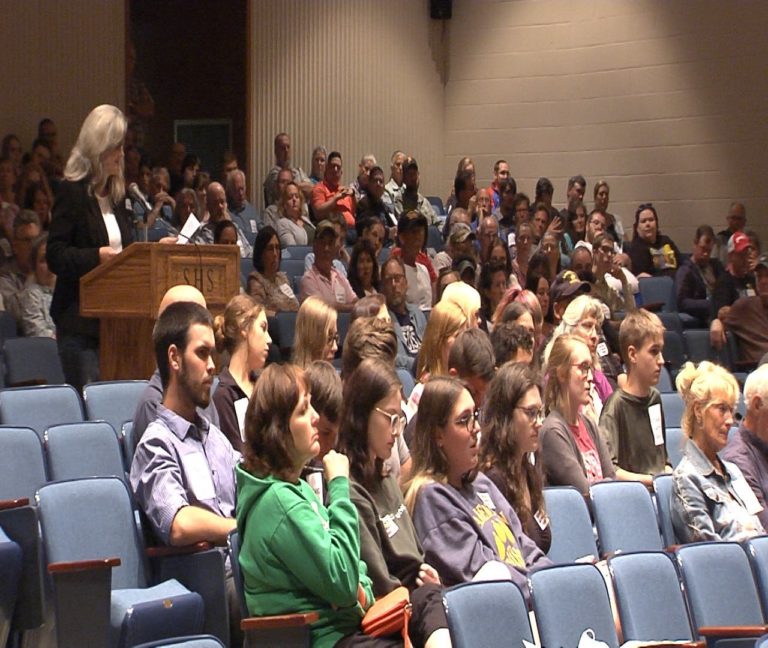
PENNCREST School Board Meets and Controversy continues over LGBTQ Comments Made by Board member on Facebook – erienewsnow.com

“He’s been a good friend of mine, he’s been a good friend of my church and bible study in the area and he’s been someone I’ve always respected for standing by his belief and standing for what he’s always held is important which is his faith,” Caleb McCarthy said. “So when he sees something that goes against his faith, he calls it out and he can’t support it.

LGBT hate crimes on the rise – Yahoo News Canada

The Canadian Press

The latest numbers on COVID-19 in Canada for Wednesday, June 16, 2021

The latest numbers of confirmed COVID-19 cases in Canada as of 4:00 a.m. ET on Wednesday, June 16, 2021. There are 1,404,093 confirmed cases in Canada. Canada: 1,404,093 confirmed cases (14,923 active, 1,363,198 resolved, 25,972 deaths).*The total case count includes 13 confirmed cases among repatriated travellers. There were 809 new cases Tuesday. The rate of active cases is 39.27 per 100,000 people. Over the past seven days, there have been a total of 8,683 new cases. The seven-day rolling ave

Neena Gupta says her friend tried to get her married to a gay man when she was pregnant with Masaba Gupta – Hindustan Times

Neena Gupta has made many revelations in her autobiography, Sach Kahun Toh. She has talked about her life as an actor and the challenges she had to face as an unmarried pregnant woman.

Neena Gupta had fallen for former West Indies cricketer Vivian Richards and gotten pregnant with their daughter Masaba. Vivian did not agree to leaving his wife and family for her and Neena was left in a difficult situation.

An excerpt from her book reveals how a friend suggested that she should marry a gay banker from Mumbai’s Bandra. Neena said that her friend Sujoy Mitra told her that the man wanted to get married to avoid societal pressures. She would have been allowed to say that the child was his but he would not be a part of her or her daughter’s lives.

“I laughed them off because I didn’t feel right about getting married just to avoid controversy. I knew I would have to answer very difficult questions. Being a public figure meant that our lives, mine and my child’s, would always be up for speculation. But I told myself I would cross that bridge when I come to it. Until then, I would hide behind loose clothes for as long as I could,” Neena said about the ‘offer’, as per a report in Zoom.

Neena also revealed that filmmaker Satish Kaushik had offered to marry her too. Satish told her, “Don’t worry, if the child is born with dark skin, you can just say it’s mine and we’ll get married. Nobody will suspect a thing.”

Also read: Anushka Sharma shares fresh-faced, post-workout selfie from London

Neena did not get married and raised her daughter on her own. Masaba Gupta is now a successful fashion designer and made her acting debut with Masaba Masaba on Netlfix. Masaba and Neena, who also starred on the show, will be seen on the second season of the show soon.

SHARE THIS ARTICLE ON

Related Stories


Neena Gupta with daughter Masaba.

Neena Gupta with daughter Masaba.

Neena Gupta revealed in her autobiography Sach Kahun Toh that her good friend Satish Kaushik offered to marry her when she was pregnant with daughter Masaba.


Neena Gupta poses with Masaba Gupta.

Neena Gupta poses with Masaba Gupta.
  • Neena Gupta during the launch event of her autobiography told Kareena Kapoor a ‘traumatic’ story about how she and Masaba Gupta ‘saved’ each other’s lives once upon a time.

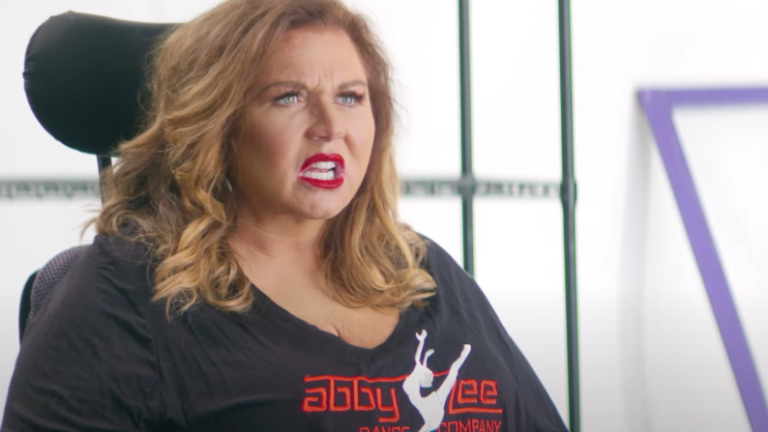
Dance Moms ‘Abby-Lee Miller’ Revealed She Experienced ‘Gay For Stay’ In Prison – KIIS1065

Kyle & Jackie O spoke to the infamous Abby Lee Miller this morning and oh boy, she’s lived a life.

In the last few years, she’s been to prison, got a diagnosis for cancer, she’s been stuck in a wheelchair but now she’s back to what she’s doing best… choreography.

Tune in below to hear her talk to Kyle and Jackie about her time in prison!

You can watch her feature and choreograph in Fake’s new music video ‘RIP Youth’ below.

Love this? You’ll love this bit from Will & Woody – catch the boys weekdays from 4PM on KIIS 1065

‘Pray Away’ Film Review: Powerful Documentary Explores ‘Ex-Gay’ Movement – TheWrap

John Paulk and his wife Anne appeared on the cover of Newsweek magazine in 1998 as the face of Christian ex-gay therapy. In “Pray Away,” a wide-ranging documentary from director Kristine Stolakis, Paulk is interviewed today, and he is unrecognizable as the man on that cover. Even though he was much younger when he posed with his wife, the contemporary Paulk looks so relaxed and comfortable with himself that it really is like looking at a totally different and much more appealing person.

Such visual reenforcement is constant in “Pray Away,” as we see footage of Paulk and many other so-called “ex-ex-gays” when they were being tortured by their ministries alongside footage of them looking far happier after they escaped. Stolakis carefully and patiently charts the rise and fall of Exodus, an ex-gay ministry founded in 1976 and disbanded in 2013 after its president, Alan Chambers, went to listen to a group of ex-ex-gays and came out of that meeting very shaken by what he had heard.

“Pray Away” focuses mainly on religious ex-gay therapy starting with Exodus, but Stolakis does include a section on one of the figureheads of its secular counterpart, a doctor named Joseph Nicolosi. From what we see of a therapy session here with Nicolosi and a male patient, the psychoanalytic version of ex-gay therapy is far scarier and more insidious when it lacks a religious component. This would seem to call for some elaboration, but it’s a topic so large that it likely would need a separate documentary to do it justice.

The religious ex-gay therapy as practiced by Exodus and also by a group called Living Hope, which was run by a man named Ricky Chelette, is a bastardized and near-comic version of the psychotherapy doled out by Nicolosi and his ilk, with a leaning on clichés about childhood trauma as the explanation for everything. On a list of causes of homosexuality shown on screen, we see “exposure to pornography” and further down on the list is “exposure to the occult,” which lets us grasp just how low a level of superstition we are dealing with here.

Paulk was famously caught visiting a gay bar in 2000, after which he was ousted from Exodus, though his wife Anne is still active in a diminished iteration of it called Restored Hope Network. During their marriage, Anne kept asking her husband why he couldn’t just be “obedient,” but such obedience could lead to crime and horror.

The most disturbing story told in “Pray Away” comes from Julie Rodgers, first seen here preparing for her wedding to another woman. Rodgers was brought to Living Hope as a teenager and put under the care of Chelette, who soon saw that Rodgers could be an effective speaker for the group. He took advantage of her confidence, and he eventually took advantage of her sexually, pressuring her to use a rape at college as a part of her story at speaking engagements. Rodgers was so beaten down by all of this that she began burning herself regularly.

Stolakis is not afraid of complication. Yvette Cantu Schneider, who used to be a key speaker for Exodus, is still married to her husband and has come to terms with being bisexual. The most complex case here is young Jeffrey McCall, who has started his own ex-gay group with some anti-trans messaging used prominently as an attempt to stay new and relevant. McCall seems to sense that being anti-gay is somewhat old hat, but if he can get people riled up about children “chopping up their bodies,” then he might bring more members into his fold.

As “Pray Away” goes on, and the old ex-gay ministries start to fall apart and regroup only as weakened versions of themselves, there is the sense that this will soon be a dead issue, or at least an issue so small that it at least won’t hurt as many people as it once did. At the end of the movie, we see Rodgers getting married, and she is wearing a sleeveless dress so that some scars on one of her arms are visible. She looks beautiful and happy, but those scars are a reminder for us of the price she had to pay to get to this point in her life.

This is a very moving image, and emblematic of what has happened to too many young people in this country who have been taken advantage of by older people who seek obedience not for God’s purposes but for their own.

“Pray Away” premieres on Netflix in August.

Utah lawmakers continue to mull restrictions for transgender youth – Salt Lake Tribune

As they consider legislation affecting transgender youth, Utah lawmakers on Wednesday heard on one hand from a University of Utah doctor who runs a clinic serving hundreds of teens who are exploring or undergoing a transition.

On the other side of the issue was a selection of non-physicians, who offered up research from a group that links being gay with pedophilia and compares adolescent transgender health care to “child abuse.”

But in the end, some Utah legislators said they remained torn about who they should listen to as they think about limiting youth access to medication that suppresses puberty and other gender-affirming health care.

“Truth is, I don’t know who to believe,” Sen. Jake Anderegg, R-Lehi, said during the committee hearing. “And the truth is, I don’t know that I believe either of you. And the truth is, I think we don’t have enough information.”

No decisions came out of the hearing — although lawmakers have said they do plan to introduce future legislation on adolescent health care and how transgender students participate in school sports. Instead, Wednesday’s meeting was supposed to serve as an open forum for discussion and questioning experts about what legislators acknowledged are sensitive and potentially divisive topics.

Their examination of these issues follows this year’s unsuccessful bid in the Legislature to bar transgender girls from female school sports and to prevent physicians from inhibiting puberty or performing a “sex characteristic-altering procedure” on a patient 16 or younger. These types of bills have passed in state Legislatures across the nation in the past year, pushed by socially conservative groups that have found these measures energize their supporters.

Those leading the charge in Utah say their objective is to preserve the fairness of girls’ school sports and protect children from making premature medical decisions.

“Our children are so important, and we love them, and we don’t want to do irreversible damage,” Rep. Rex Shipp said. “Sometimes we just have to say, you know, let’s wait on this. Maybe you’re going to be fine, and then they can transition later.”

But the outcome of this debate in the state could have life-or-death consequences, said Sue Robbins, of Equality Utah’s Transgender Advisory Council. This group is at far higher risk of suicide, Robbins noted, with one survey of transgender individuals finding that 41% had attempted suicide at some point in their lives.

Further stigmatizing these youth in doctor’s offices and on playing fields would only endanger them more, Robbins argued.

“We feel like our existence is under attack,” she told state lawmakers. “We have a significant amount of our precious youth that will be impacted by what we do here.

What happens in Utah when a transgender adolescent or teen seeks gender-affirming care?

Dr. Nicole Mihalopoulos, medical director of the University of Utah’s adolescent and young adult medicine clinic, told legislators Wednesday that about 15 to 20 new patients each month come to her office seeking care for gender dysphoria — or feelings of distress that arise when a person’s internal gender identity doesn’t match their sex assigned at birth.

Most families arrive with “tremendous caution,” she explained, with parents eager to be caring and supportive but also wanting time to understand what their child is experiencing.

In supporting these young patients, she said, physicians follow best practices crafted by an array of major medical organizations, including the American Academy of Pediatrics, the World Professional Association for Transgender Health and the Endocrine Society.

One early step is to help young people transition socially by using pronouns and other gender signifiers that align with their identity. Physicians might then prescribe medications that “temporarily and reversibly” pause puberty and later might move the patient to testosterone or estrogen treatments, Mihalopoulos said.

While researchers haven’t concluded these medications cause infertility, patients and physicians discuss precautionary fertility preservation options before the start of hormone treatments.

No one under the age of 18 in Utah is getting gender-affirming genital surgery, she said, but a small number of teenage patients undergo “chest masculinization” procedures — more commonly called “top surgery.”

“At the University of Utah, in our transgender health program, that is a decision that is vetted by many,” she said. “A patient has to undergo a pretty significant process to reach a place where they are going to have chest masculinization surgery.”

Before qualifying for one of these surgeries, a patient participates in regular therapy sessions and takes testosterone for at least a year, she said. Two parents would have to consent to the procedure, which would even then still be at the discretion of the surgeon.

Mihalopoulos said her clinic’s youngest patient was 8 years old. While they did not prescribe any hormones to the child at that age, the doctor said the onset of puberty generally determines when physicians might begin prescribing puberty blockers.

Who wants to restrict this health care?

During the last legislative session, Shipp, R-Cedar City, sponsored legislation that would make it unprofessional conduct for a physician to “perform a medically unnecessary puberty inhibition procedure or a sex characteristic-altering procedure” on a minor.

That measure failed, but Shipp is continuing his push, arguing that children and teens experiencing gender dysphoria should wait until adulthood for hormone treatments and gender-affirming surgeries.

“I believe that this dysphoria is real and causes an extreme stress,” he said. “But my concern is we’re treating symptoms and not getting to the root of the problem, which is a mental health issue. It has nothing to do with the physical body.”

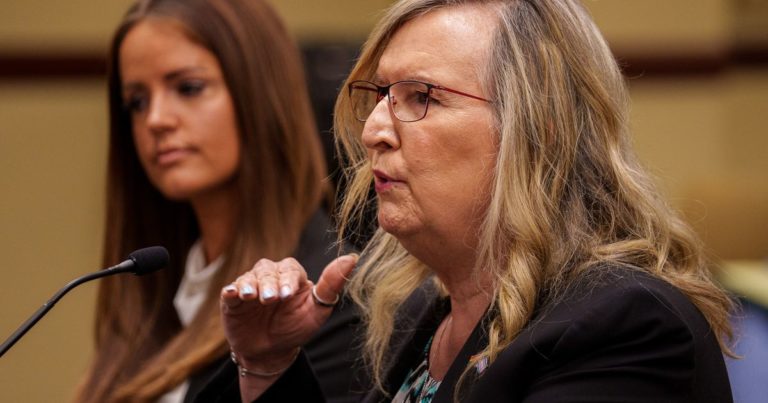
(Trent Nelson | The Salt Lake Tribune) Rep. Rex Shipp, R-Cedar City, speaks at a meeting of the Health and Human Services Interim Committee at the State Capitol in Salt Lake City on Wednesday, June 16, 2021. Transgender treatment for minors and participation by transgender youth in school sports were the topics of discussion. At left is David Pruden.

The legislator supplied the health and human services committee with a report that listed examples of people who regretted their gender transition and reversed it. The report drew on contributions from nearly 20 individuals, several from the American College of Pediatricians — an organization deemed an anti-LGBTQ hate group by the Southern Poverty Law Center.

The group has characterized gender-affirming care as “conditioning children into believing a lifetime of chemical and surgical impersonation of the opposite sex is normal and healthful” and condemns it as “child abuse.” It has also argued that LGBTQ advocates have “pedophilia intrinsically woven into their agenda.”

Shipp said during Wednesday’s hearing that he was unaware that the group was designated as a hate group.

He brought with him a couple others who want to limit transgender health care, including one woman who said she identified as a boy when she was young but after receiving mental health care concluded her gender dysphoria was the result of a sexual assault from her early childhood.

“Far too many children who suffer from gender dysphoria these days are not so lucky,” said Erin Brewer, who introduced herself as having a doctorate in instructional technology and learning science. “They are told that they’re inherently flawed and that the only solution is to damage their healthy bodies by medically transitioning.”

However, Mihalopoulos said out of about 700 patients, her clinic has only had one who has asked to stop taking hormones.

While there is a scarcity of data about the long-term health effects of gender-affirming treatment, she said studies have linked this care to mental health benefits. And she — like the American Medical Association and other prominent health care groups — urged lawmakers not to block youth from accessing care that in some cases “is necessary to keep many of these kids alive and to have a good mental health outcome.”

How do transgender students currently participate in school sports?

The later portion of the hearing focused on transgender girls competing in female school sports.

A failed bill sponsored this year by Rep. Kera Birkeland would’ve excluded these transgender students from female athletics, and she has already said she’s bringing back a proposal on this issue in the 2022 legislative session. On Wednesday, she told her colleagues that both cisgender and transgender female athletes need the state to provide clear guidelines so everyone can feel confident that no one has an unfair advantage.

“These games are about competition,” the Morgan Republican said. “And they are about winning.”

(Trent Nelson | The Salt Lake Tribune) Dave Spatafore holds up the UHSAA’s policy on transgender athletes, with Rep. Kera Birkeland, R-Morgan, at a meeting of the Health and Human Services Interim Committee at the State Capitol in Salt Lake City on Wednesday, June 16, 2021. Transgender treatment for minors and participation by transgender youth in school sports were the topics of discussion.

The NCAA and the Utah High School Activities Association already have policies in place for transgender athletes, according to Wednesday’s testimony.

David Spatafore of the Utah High School Activities Association said the organization allows transgender girls to participate in sports matching their gender identity, so long as the student has completed at least a year of hormone treatment. The association hasn’t gotten any complaints about the policy in the year since releasing it, he said, and he asked for state protection against litigation if the Legislature decides to change course.

“We’ll pay our defense costs under our policy,” he said. “If you pass legislation, we would ask that our costs be paid for by the state.”

Spatafore also told lawmakers his organization has had “no experience of working with transgender youth” in any of its activities — an assertion that could support the argument of LGBTQ advocates who say bills such as Birkeland’s strike at a non-existent problem.

“The strong concerns about this being a large issue are misplaced in my mind,” said Robbins, who added that “targeting the only transgender girls who are successful across all states would indicate that any success by our community would be met with attempts to take that small level of pride and inclusion away from us.”

However, Birkeland said the biggest concern over transgender sports participation is unfolding at the junior high level, which does not have a set policy for these athletes. She said she knows of several transgender athletes in Utah schools but would not provide details about them.
Pride Month History: Kansas City had foundational role in LGBT movement nationwide – KSHB

KANSAS CITY, Mo. — Barney Allis Plaza in downtown Kansas City, Missouri, is home to a bronze marker that many passers by likely have never taken the time to notice.

That bronze marker signifies the city’s LGBT activism that not only changed the future of Kansas City, but the rest of the nation.

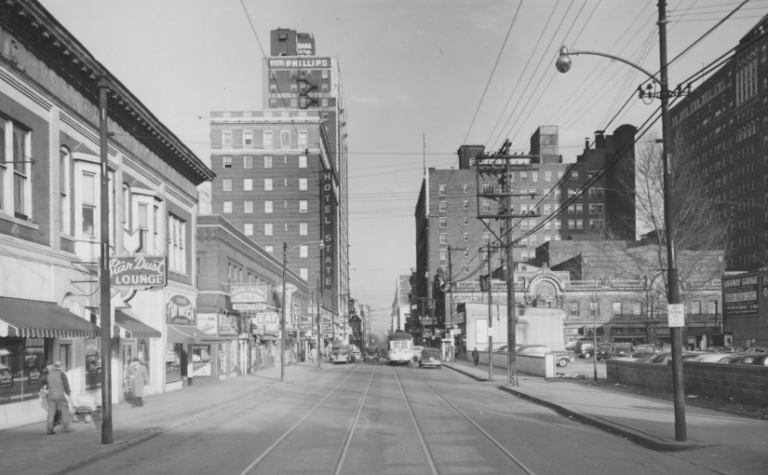
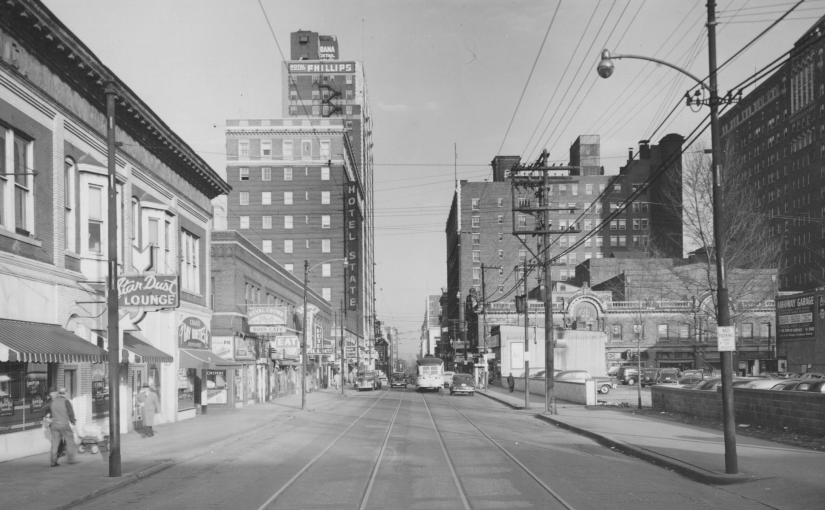
What happened at the State hotel that once stood at the corner of W. 12th Street and Wyandotte Street didn’t go down in history like the Stonewall riots, but historians say it laid the foundation.

State Hotel 1966

The State Hotel, on the left, was the location for the first-ever meeting between LGBT activists in 1966.

“We are standing next to a marker that commemorates the first-ever gathering of national gay and lesbian civil rights leaders that took place in 1966,” Stuart Hinds, Curator of Special Collections and Archives at the University of Missouri – Kansas City, said in a recent interview at the marker.

Hinds works at GLAMA, Gay and Lesbian Archives of Mid-America, to preserve this history.

You can see their online exhibit: Making History.

“These were the Martin Luther Kings, the Cesar Chavez’s, the Gloria Steinems of this particular civil rights movement,” Hinds said.

Many of the organizations had already been around for 15-20 years. They chose Kansas City because of its central location and vibrant LGBT cultural scene.

KC gay scene 1960s

Ads from Kansas City’s gay scene in the 1960s

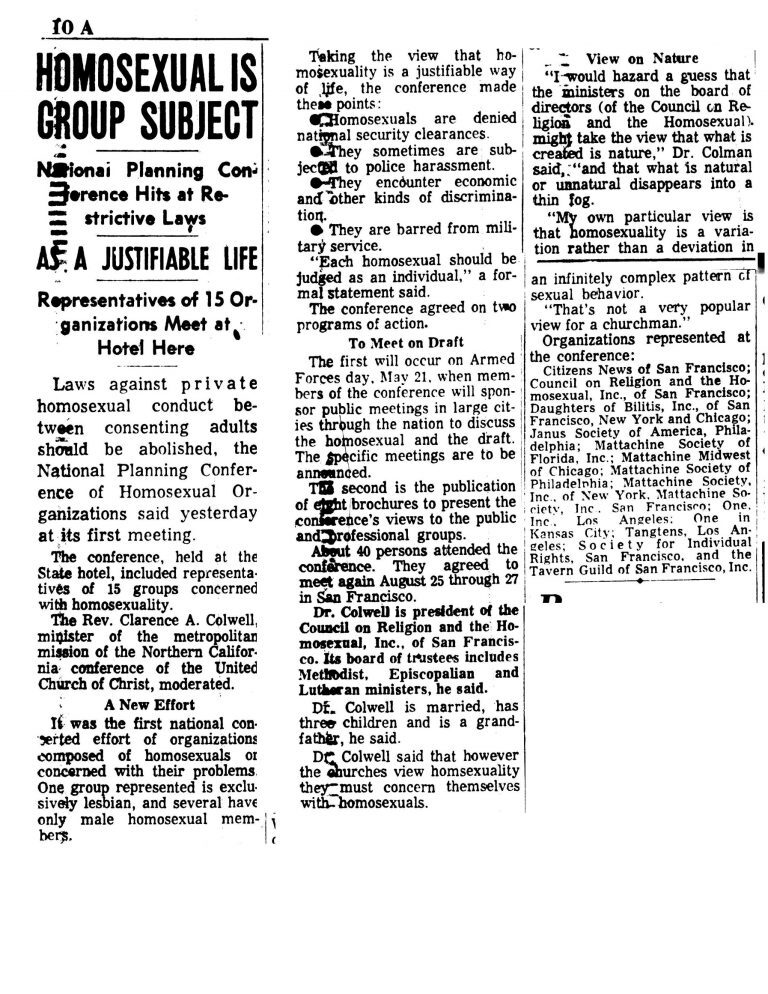
And so, the National Planning Conference of Homophile Organizations met during a time where you could be fired from your job, arrested for being in a bar, institutionalized, and worse for your sexual orientation.

NACHO article 1966

An article in the KC Times in 1966 details the first meeting between gay and lesbian civil rights activists.

“They started a legal defense fund because at the time you could get into all sorts of legal issues for being a gay person,” Hinds said. “They planned the first nationally coordinated protest against the U.S. military.”

President Dwight D. Eisenhower passed an executive order in 1952 that barred gay and lesbian people from working in the federal government. Soon after, thousands of people were forced out of their jobs.

“It was just a really, really challenging time for gay men and women in this country during those two decades,” Hinds said. “That’s why you start to see this really organized means of trying to address some of those conditions.”

The organizations continued to grow afterward, meeting as the North American Conference of Homophile Organizations (NACHO, pronounced Nay-Ko) in San Francisco six months after the Kansas City planning meeting.

Drew Shafer, one of the attendees, helped form the Phoenix Society for Individual Freedom in Kansas City.

Drew Shafer

Drew Shafer, one of the founders of the Phoenix Society for Individual Freedom in Kansas City.

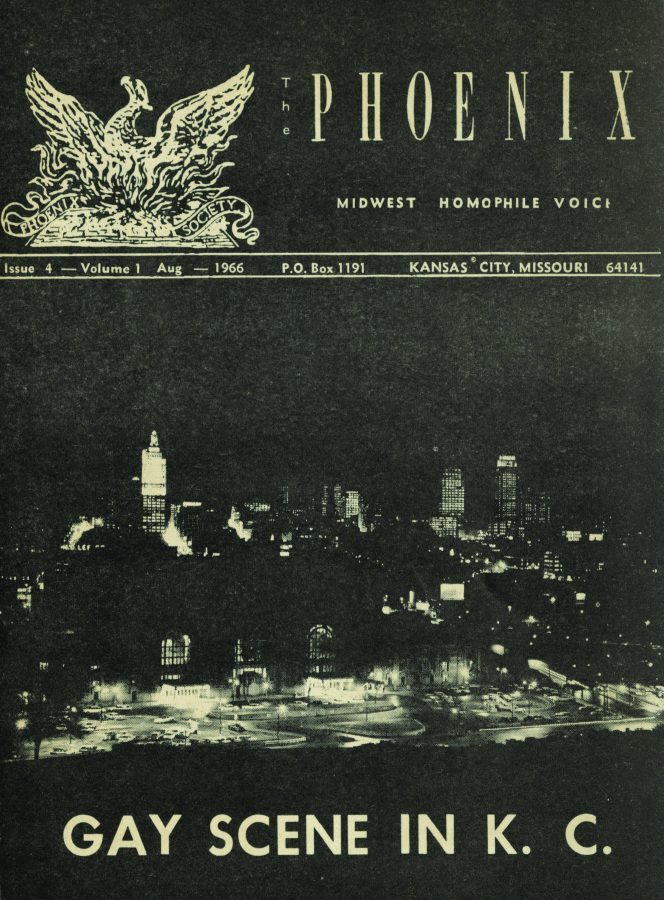
They created a newsletter and magazine that addressed political and personal issues around being gay, while showcasing artwork and poetry from local subscribers.

Phoenix gay magazine

A 1966 issue of the Phoenix magazine, an outlet for gay and lesbian issues.
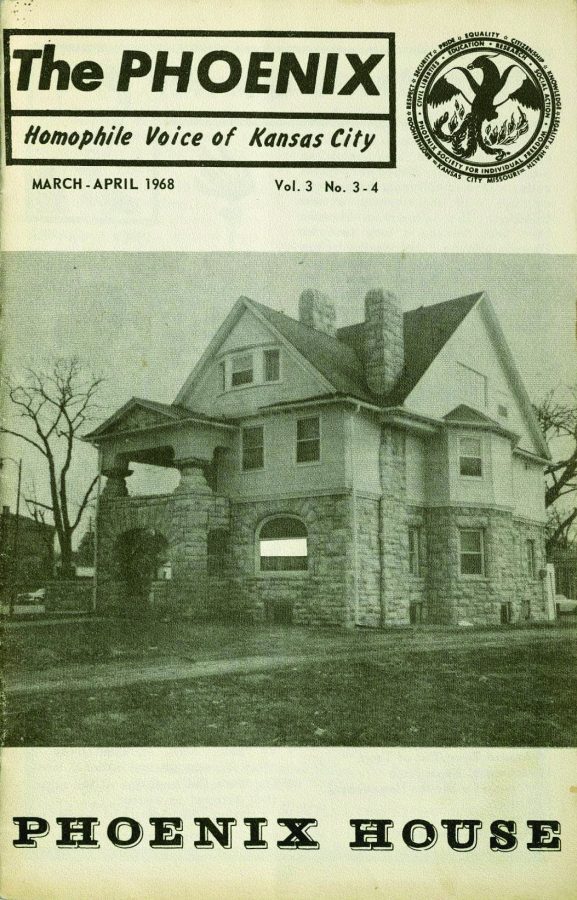
Phoenix House

A 1968 issue of The Phoenix magazine showing the new Phoenix House.

They opened the Phoenix House, a center where people could gather and feel welcome.

“This is all at least three years before Stonewall,” Hinds said.

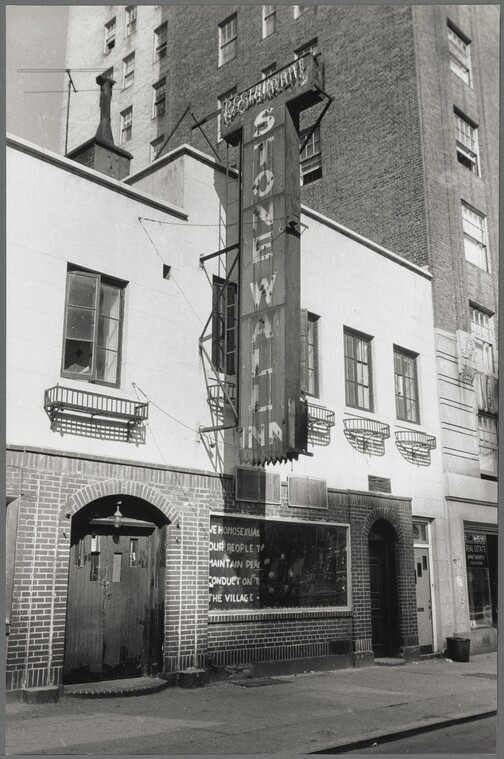
The Stonewall riots of 1969, where patrons at the Stonewall Inn bar in New York physically fought against discriminatory police raids, gave way for a new wave of gay liberation movements.

Stonewall Inn

Stonewall Inn in New York City

The Homophile movements died down after this. More young activists jumped in, taking a more militant approach to fighting for rights.

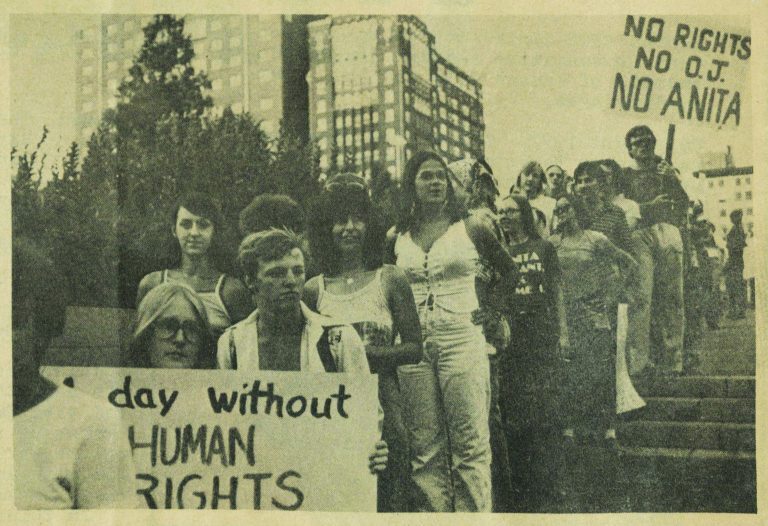
1977 LGBT protest KC

LGBT protest in Kansas City against Anita Bryant, 1977

“I think a lot of times we look around and it’s still tough, but we sometimes forget how difficult it was back then for them to do that, that trailblazing for us,” Suzanne Wheeler, executive director of the Mid-America LGBT Chamber of Commerce, said.

Wheeler said those activists made it possible to thrive personally and economically.

Wheeler is from Kansas City and, after retiring from a 30-year military career, thought about going to either the east or west coast to make a living but realized it was possible at home.

“We stay proud in who we are, that’s part of what the month of Pride is, to demonstrate to everyone else that the LGBT community deserves the same rights, same respects that every other citizen has,” Wheeler said.

Wheeler says the chamber’s goal is to lift up every marginalized member of the community.

The historical marker at Barney Allis Plaza was installed in 2016 to mark the 50-year anniversary of the meeting.

Hinds says you can drive by the marker and be proud of how far Kansas City has come and the activism still at work.

“It’s a completely different world and the thing that is so astounding is, this meeting – I was 4 years-old. These changes have taken place in the course of one lifetime,” Hinds said. “I think it’s hard for people who are activists, engaged in fighting the good fight to not get discouraged because they don’t see change happen that week, right. And the thing is, once you get 10, 20, 30 years down the road and you turn around and look behind you, you see the massive, massive changes that occurred because of that day-to-day work.”

Whatley Health Services offers COVID-19 vaccine to Hay Court residents in Tuscaloosa – WBRC

TUSCALOOSA, Ala. (WBRC) – Being wheelchair-bound makes some things difficult for Ed Jackson, especially when it came to getting vaccinated for COVID-19.

“I was planning on getting it. But I didn’t know where I was going to get it or if I was ever going to get it or not,” 76 year-old Jackson said.

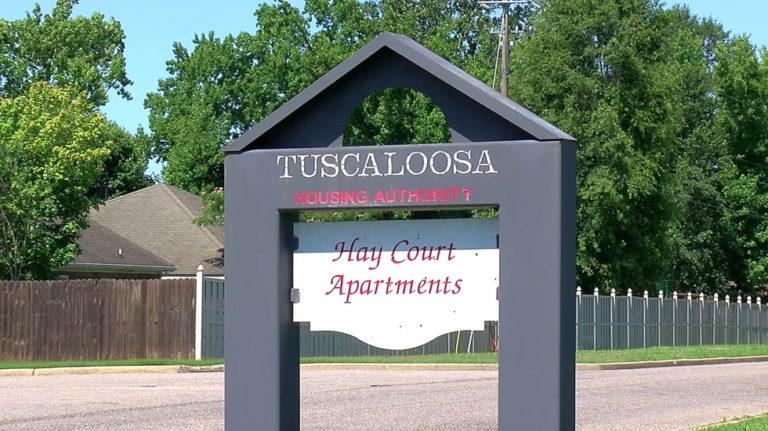
But, Whatley Health Services COVID Response Team traveled to Hay Court Apartments Wednesday to offer shots of the Moderna vaccine to Jackson and his neighbors.

Jackson was able to drive his electric wheelchair to the Hay Court Apartments Office and receive his vaccination.

“All people who can’t get around need it. They really need vaccinations,” Jackson said.

David Gay, Whatley’s Director, explained why they were making such an effort to vaccinate people in the community. “I feel like if people won’t come to us, we should go to them. We got a charter, we got a chance to go out into the community to make it happen,” Gay said.
People living in all three Tuscaloosa Housing Authority communities have now had the opportunity to get vaccinated where they live.

Copyright 2021 WBRC. All rights reserved.

Weekend Best Bets: June 17-20 – Minnesota Monthly

0
The Stone Arch Bridge Festival returns

Photo by Gina Reis, Courtesy of The Stone Arch Bridge Festival and Meet Minneapolis

Pride Month: Join the Chorus

What: Twin Cities Gay Men’s Chorus: “TCGMC Sings Back”
When: Friday, June 18, 7 p.m.
Where: Online via YouTube

Celebrate Pride Month 2021 with the Twin Cities Gay Men’s Chorus this Friday. The group will be hosting a concert on their YouTube page featuring various songs from blockbusters, including An American Tail, CAMP, Willy Wonka & the Chocolate Factory, and Meet Me in St. Louis. Join the free concert as the Men’s Chorus wraps up its 40th season.
Ring in Juneteenth

What: Juneteenth events
When: June 19
Where: Various locations

Juneteenth is this Saturday, celebrating slavery’s end in the United States and officially a city holiday as of this year. City programming that celebrates Juneteenth this year includes music at Bethune Park, featuring DJ D.I.M.E., Jovonta Patton, Royal Family and Music Group, along with a kite flight from 1-3 p.m. At 9 p.m., Jumanji: The Next Level shows at Webber Park outdoors.

At Target Field Station, bring a yoga mat for a day of “breathing, healing, and getting stronger together” that takes place starting at 1 p.m., free to attend and presented by Choose Love Minnesota in partnership with Lifetime National Community Relations.

A Black bike ride for healing and liberation takes place on Saturday starting at Wirth Lake Access, assembling at 4 p.m.. Find more info on the event and how it got started here.

You can also find other Juneteenth events throughout the metro area.

Staging the Golden Age

What: “The Best of The Worst of Old Time Radio” presented by the Mysterious Old Radio Listening Society
When: Saturday, June 19, 7 p.m.
Where: North Garden Theater, 929 Seventh St. W., St. Paul

Take the opportunity to get out of the house and attend the “Best of the Worst of Old Time Radio.” Although the radio era is behind us, the Mysterious Old Radio Listening Society revives that tradition by staging plays that revisit seemingly unbelievable stories. Purchase your tickets now to get the best seats in the house.

Rock-Solid Tradition

What: Stone Arch Bridge Festival
When: Saturday, June 19, 10 a.m.-7 p.m.; Sunday, June 20, 10 a.m-5 p.m
Where: West River Parkway, from Portland Ave. to N. Fourth Ave.

Kick off your Father’s Day weekend by attending a Twin Cities tradition: the Stone Arch Bridge Festival. Although it’s been held on the east side of the Mississippi River for 25 years, this year the festival takes place on the west side. Don’t miss out on the annual Collector’s Poster Reveal, designed by local artist WASCO, with live music and other art pieces also on display.

Super Cheesy

What: Curd Fest
When: Saturday, June 16, 11: a.m.-6 p.m.
Where: Jer-Lindy Farms/Redhead Creamery, 463rd Ave., Brooten

Calling all cheese heads! This year’s third annual Curd Fest begins this weekend at the Redhead Creamery in central Minnesota, about a two-hour drive from the Twin Cities. Join 13 vendors in celebrating the amazing creation of the cheese curd with live music, food, and drinks available for all ages. 

Art Adventure at the Walker

What: Open-Air Art for All
When: June 17, 6-9 p.m.
Where: Walker Art Center, 725 Vineland Pl., Minneapolis

Let your creative spirit run loose this Thursday at the Walker Art Center. Learn from local artists as they host their own teaching stations to help visitors create various pieces of artwork. From kite making to sculpture constructing, the decision is yours on what you’d like to create this Thursday.

Gay back at full health at Chiefs mini-camp – Blue Springs Examiner

St. Joseph News-Press

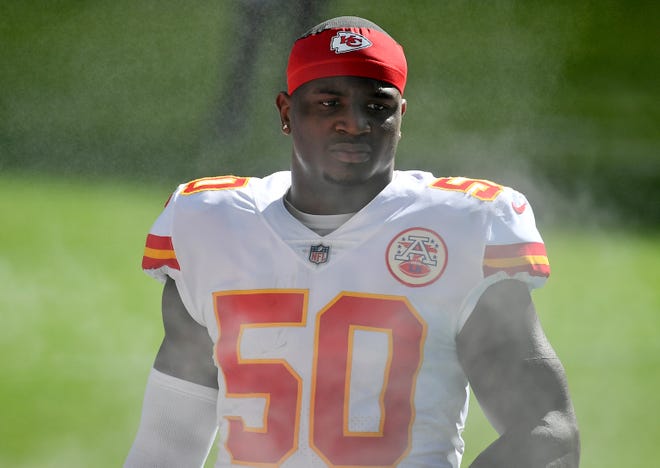
Kansas City Chiefs linebacker Willie Gay Jr. (50) says he feels healthy again during mini-camp this week.

Nothing was ordinary about Willie Gay Jr.’s rookie season in the NFL. 

The 2020 second-round pick didn’t have organized team activities to prepare for the regular season because of the COVID-19 pandemic. 

His training camp was abbreviated, and he had to try to learn Steve Spagnuolo’s defense on the fly. 

Injuries in the regular-season finale and on the road to Super Bowl LV shelved him late in the year. Now, he feels fully healthy at mandatory minicamp. 

“All I do know is during this offseason period with this training staff, we’ve been working nonstop, me and (Chiefs assistant athletic trainer) Ms. Julie (Frymyer) and all her help that she has,” Gay said. “It’s been a real grind and that’s why I’m here today, 100 percent.” 

In the final game of the season, Gay suffered a high-ankle sprain. He later suffered a knee injury during build-up throughout the postseason, sidelining him for the Chiefs’ second-straight Super Bowl appearance. 

“I don’t even know what really happened with it,” Gay said. “I tore my meniscus; I don’t even know if it was at practice or just walking around after.” 

Six months later, Gay was a full participant throughout OTAs last week. 

Now with a chance to find an expanded role in the linebacking corps, health and time are to his benefit this offseason. 

“Of course it was tough for us that came in last year,” Gay said. “To only see the playbook for the first time during training camp, it was hard. To get that head start right now in OTAs and minicamp, it’s definitely helping a lot. I’m catching on to the things that I didn’t catch onto last year. I learned the basics. Now, it’s the small details that make good great. It’s coming along pretty good.” 

Gay appeared in 16 games with eight starts last year, tallying 39 tackles, one sack, three passes defended and a forced fumble, playing on 25% of the team’s snaps. 

As part of his group, the Chiefs must replace Damien Wilson, though second-round pick Nick Bolton joins Gay, Anthony Hitchens and Ben Niemann as the team’s notable contributors. 

With high expectations and a chance to compete for an immediate starting job, Gay is using the remainder of the offseason to build off last year’s strides. 

“Really all I want to do is just my job,” Gay said. “Be able to be counted on and just do what I do to the best of my ability. Whether it’s tackling, whether it’s covering guys, blitzing, just continue to improve each and every day on the details of plays and execute every little detail that I do have with my assignments and all.” 

LGBT Students, Athletes Score Win Against Bias in Schools (1) | Bloomberg Government – Bloomberg Government

Lesbian, gay, bisexual and transgender students are protected under an almost five-decades-old law that prohibits sex discrimination in schools that receive federal money, the Education Department said.

The agency’s guidance Wednesday marks its latest reversal of actions by the Trump administration, which scrapped 2016 guidance protecting those students under Title IX and said states could decide. The Biden administration put forth the new guidance as states are seeking measures to restrict transgender students from participating in girls’ and women’s sports.

President Joe Biden in an executive order directed agencies that a U.S. Supreme Court decision from last year on LGBT workplace rights should be interpreted to apply to areas such as schools, housing, and immigration.

The high court ruled in Bostock v. Clayton County that workplace discrimination protections under Title VII of the 1964 Civil Rights Act cover LGBT workers. Courts have frequently interpreted the reasoning in Title VII decisions to apply as well to those under Title IX, enacted in 1972.

Photographer: Chip Somodevilla/Getty Images

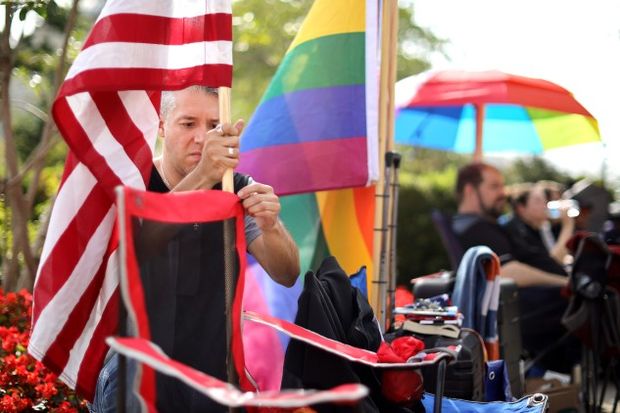
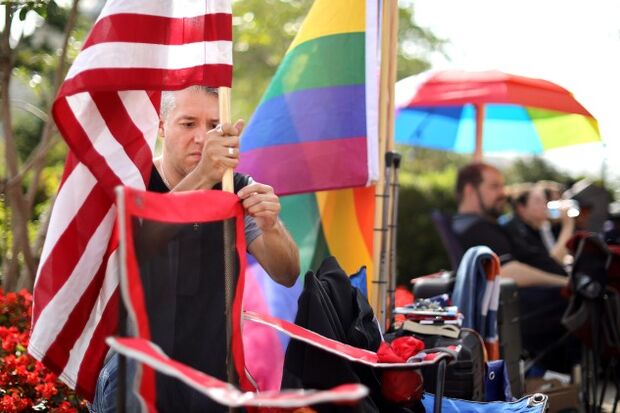
Eddie Reynoso of San Diego, Calif., attaches an American flag his chair while waiting in line outside the U.S. Supreme Court to hear arguments in Bostock v. Clayton County in October 2019.

“The Supreme Court has upheld the right for LGBTQ+ people to live and work without fear of harassment, exclusion, and discrimination—and our LGBTQ+ students have the same rights and deserve the same protections,” Education Secretary Miguel Cardona said in a statement. He said he “directed the Office for Civil Rights to enforce Title IX to protect all students from all forms of sex discrimination.”

Restrictions in States

LBGT students’ rights have been targeted in scores of states. Several, backed by national religious and conservative groups, have passed laws restricting transgender students’ ability to participate on school sports teams matching their gender identities.

Transgender School Athletes Barred in Growing Number of States

LGBT advocates are pushing the Senate to pass legislation to codify protections for LGBT people in areas like housing and employment. The House passed the bill, known as the Equality Act (H.R. 5), by a 224-206 vote in February.

The Education Department this month held hearings on the enforcement of Title IX, the first step toward rewriting Trump administration regulations governing the response to sexual misconduct in schools. New Title IX regulations could encompass issues such as protections for transgender students.

Bobby Scott (D-Va.), chair of the House Education and Labor Committee, said the guidance will offer strong and clear protections against bias in schools.

“This announcement reflects our shared commitment to providing all students a safe and welcoming environment, and it aligns the Education Department’s interpretation of civil rights law with the definition established by the Supreme Court last year,” he said in a statement.

The Education Department’s Title IX interpretation “will guarantee every student a truly equitable experience in school and school sports, no matter their gender identity,” Noreen Farrell, executive director of the women’s rights group Equal Rights Advocates, said in a statement.

Christiana Holcomb, legal counsel at the Alliance Defending Freedom, a conservative group that’s backed state restrictions on transgender students, disagreed. The guidance is politically motivated and “another example of government overreach,” she said in an email.

To contact the reporter on this story: Andrew Kreighbaum in Washington at akreighbaum@bgov.com

To contact the editors responsible for this story: Anna Yukhananov at ayukhananov@bloombergindustry.com; Sarah Babbage at sbabbage@bgov.com; Robin Meszoly at rmeszoly@bgov.com

Oregon House passes over-the-counter HIV prevention drugs bill – Los Angeles Blade

0

By Karen Ocamb | LOS ANGELES – Before the CDC’s first report on AIDS, there was news from the New York Native,  a biweekly gay newspaper published in New York City from December 1980 until January 13, 1997. It was the only gay paper in the City during the early part of the AIDS epidemic and it pioneered reporting on AIDS.

On May 18, 1981, the newspaper’s medical writer Lawrence D. Mass wrote an article entitled “Disease Rumors Largely Unfounded,” based on information from the Centers for Disease Control and Prevention  scotching rumors of a “gay cancer.”

“Last week there were rumors that an exotic new disease had hit the gay community in New York. Here are the facts. From the New York City Department of Health, Dr. Steve Phillips explained that the rumors are for the most part unfounded. Each year, approximately 12 to 24 cases of infection with a protozoa-like organism, Pneumocystis carinii, are reported in New York City area. The organism is not exotic; in fact, it’s ubiquitous. But most of us have a natural or easily acquired immunity,” Mass wrote. He added: “Regarding the inference that a slew of recent victims have been gay men. . . . Of the 11 cases . . . only five or six have been gay.”

Eighteen days later, on June 5, 1981, the world turned when the CDC published an article by Dr. Michael Gottlieb in Morbidity and Mortality Weekly Report (MMWR) on AIDS symptoms, including cytomegalovirus (CMV) infection and candidal mucosal infection, found in five gay men in Los Angeles. By then, 250,000 Americans were already infected, according to later reports.

Gottlieb’s CDC report was picked up that same day by the Los Angeles Times, which published a story entitled ”Outbreaks of Pneumonia Among Gay Males Studied.” A slew of similar reports followed and on June 8 the CDC set up the Task Force on Kaposi’s Sarcoma and Opportunistic Infections to figure out how to identify and define cases for national surveillance. On July 3, the CDC published another MMWR on pneumocystis carinii pneumonia (PCP) and Kaposi’s Sarcoma (KS) among 26 identified gay men in California and New York. The New York Times’ story that day — “Rare Cancer Seen in 41 Homosexuals” – stamped the disease as the “gay cancer.” GRID (Gay-Related Immune Deficiency) came next. In the new Reagan/Bush Administration, dominated by homophobic evangelical advisors such as Gary Bauer, funding to investigate the new disease was scarce. 

Two years later, the New York Times finally put AIDS on the front page, below the fold, with a May 25,1983 headline that read: “HEALTH CHIEF CALLS AIDS BATTLE ‘NO. 1 PRIORITY.’”  By then 1,450 cases of AIDS had been reported, with 558 AIDS deaths in the United States; 71 percent of the cases were among gay and bisexual men; 17 percent were injection drug users; 5 percent were Haitian immigrants; 1 percent accounted for people with hemophilia; and 6 percent were unidentified. 

But Health and Human Services Assistant Secretary Dr. Edward N. Brandt Jr. told reporters that no supplemental budget request had been made to Congress. ”We have seen no evidence that [AIDS] is breaking out from the originally defined high-risk groups. I personally do not think there is any reason for panic among the general population,” he said.

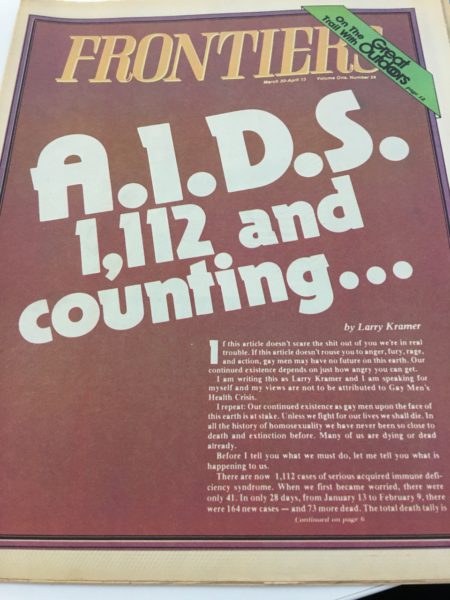
Frontiers Magazine Cover Story by Larry Kramer (Photo Credit: Karen Ocamb)

Gays in denial seemed to accept feigned governmental concern. Others were deathly afraid. The HHS news conference was just 10 weeks – and 338 more cases – after the March 14 publication of playwright Larry Kramer’s infamous screed on the cover of the New York Native: “1,112 and Counting…”

“If this article doesn’t scare the shit out of you, we’re in real trouble. If this article doesn’t rouse you to anger, fury, rage, and action, gay men may have no future on this earth. Our continued existence depends on just how angry you can get,” Kramer wrote. “I repeat: Our continued existence as gay men upon the face of this earth is at stake. Unless we fight for our lives, we shall die. In all the history of homosexuality we have never before been so close to death and extinction. Many of us are dying or already dead.”

Too many gay men were not scared shitless. When LA gay Frontiers News Magazine re-published Kramer’s article as their March 30 cover story, bar owners threw the publication out, lest it unnerve patrons. Meanwhile, gay men wasted away and died, often alone, sometimes stranded on a gurney in a hospital hallway; sometimes – if lucky – with family or friends crying at their bedside as in the intimate photo taken by Therese Frare as her friend AIDS activist David Kirby died.  

None of this was new or startling to Gottlieb or fellow AIDS researcher and co-author, Dr. Joel Weisman.   

Gay San Francisco Chronicle reporter Randy Shilts dubbed Weisman “the dean of Southern California gay doctors” in his AIDS opus, “And the Band Played On.” In 1978, as a general practitioner in a North Hollywood medical group, Weisman treated a number of patients with strange diseases, including a gay man in his 30s who presented with an old Mediterranean man’s cancer, Kaposi’s sarcoma.

In 1980, Weisman opened his own Sherman Oaks practice with Dr. Eugene Rogolsky and identified three seriously ill gay patients with strange fevers, dramatic weight loss from persistent diarrhea, odd rashes, and swollen lymph nodes, all seemingly related to their immune systems. He sent two of those patients to Gottlieb, a young UCLA Medical Center immunologist studying a gay male patient with pneumocystis pneumonia and other similar mysterious symptoms, including fungal infections and low white blood cell counts. 

“On top of these two cases,” Shilts wrote, “’another 20 men had appeared at Weisman’s office that year with strange abnormalities of their lymph nodes,’ the very condition that had triggered the spiral of ailments besetting Weisman and Rogolsky’s other two, very sick patients.”

LGBTQ activist David Mixner, former U.S. Ambassador Jim Hormel, Dr. Joel Weisman at an amfAR event (Photo by Karen Ocamb)

Weisman later recalled to the Washington Post that “what this represented was the tip of the iceberg. My sense was that these people were sick and we had a lot of people that were potentially right behind them.”

There were other missed signs, such as the CDC getting increasing requests for pentamidine, used to treat pneumocystis pneumonia. Gottlieb says that after his first report, the CDC’s Sandra Ford confirmed that she was sending increasing shipments of Pentamidine around the country. “But I’m not sure any infectious disease doctor there knew or investigated why they were seeing a run on pentamidine or asked what that meant,” Gottlieb told the Los Angeles Blade. Later pentamidine became “the second line therapy for pneumocystis,” after Bactrim. 

Pentamidine “caused kidney problems, so we didn’t like it. Eventually, aerosolized Pentamidine became one of the preventatives. We didn’t realize at first that pneumocystis would happen in multiple episodes. Like a patient would have pneumocystis, we treated, it would clear and they’d go home for a month and then they’d get it again. We didn’t learn until later that we had to do something to prevent recurrences. And that’s where aerosolized Pentamidine came in doing a monthly breathing treatment.” 

Though being gay was highlighted as a high-risk factor, race was largely left out of reports until 1983, despite the fact that Gottlieb’s fifth patient in his June 5, 1981 CDC article was Black. Gottlieb remembers him as a previously healthy 36-year-old gay Black balding man named Randy, referred to him in April by a West Side internist. 

But Randy’s race was not included in that first report, nor was the omission caught by the MMWR editors, probably, Gottlieb speculates, because they were focused on collecting disease data while they struggled  to save their dying patients. Gottlieb views the absence of race “as an omission and as an error” because demographic data is “good form as a doctor because it is important.” If race was not included in the MMWR, it was an unconscious omission.”

Karen Ocamb is the Director of Media Relations for Public Justice, a national nonprofit legal organization that advocates and litigates in the public interest.

The former News Editor of the Los Angeles Blade, Ocamb is a longtime chronicler of the lives of the LGBTQ community in Southern California. 

Editor’s note; The photo of a dying David Kirby in Ohio in 1990 by photographer Therese Fare was labeled by LIFE Magazine as the photo that changed the face of AIDS. To read the story and to see a gallery of addition photos visit here; (LINK)

This is Part 2 of a series on AIDS @40. Part 3 looks at Rep. Henry Waxman’s congressional hearing in LA and the creation of AIDS Project Los Angeles.

#AM_Equality: June 16, 2021 – HRC – Human Rights Campaign

EVERY LGBTQ PERSON NEEDS HEALTH INSURANCE: HRC President Alphonso David and Out To Enroll’s Founder Katie Keith write, “More can and must be done to improve LGBTQ health, but there has never been a better time for our community to get the health insurance we need and deserve.” More from Advocate.

KAMALA HARRIS CALLS FOR PROTECTIONS FOR LGBTQ PEOPLE AT DC PRIDE WALK: “There’s so much more to do,” Vice President Kamala Harris said (@VP). “We celebrate all of the accomplishments — finally marriage is the law of the land. Now we need to pass the Equality Act, we need to make sure that our transgender community and our youth are all protected.” More from Metro Weekly.

THE NEW WAVE OF ANTI-TRANS LEGISLATION IS BASED ON VERY OLD ARGUMENTS AND IDEAS: For decades, transgender Americans have taken to the courts to fight for their rights. The most recent wave of anti-trans legislation across the country is based on antiquated arguments that trans people are a “threat.” More from The Washington Post.

DC GAY BAR HIT WITH PROTESTS AFTER VIDEO SHOWS BLACK WOMAN ASSAULTED: “We have a responsibility to vehemently reject white supremacy at every turn,” said HRC President Alphonso David (@AlphonsoDavid, he/him). “We must show up for, and protect, the members of our marginalized communities — especially in LGBTQ-focused businesses that we expect to be safe spaces for all.” More from HuffPost and HRC.

‘I’M A GAY, CHRISTIAN PEDIATRICIAN AND HAVE NO DOUBT: JESUS WOULD REJECT ANTI-TRANS LAWS’: In an opinion piece, pediatrician Terrance Weeden discussed their experience working with young adults of all gender identities, gender expressions and sexual orientations in Chicago as it relates to their Christian identity. More from The Washington Post.

MENTAL HEALTH AND HOUSING INSTABILITY WORSENED FOR LGBTQ YOUTH DURING PANDEMIC, REPORT SAYS: A new report from the Massachusetts Commission on LGBTQ Youth found that 68% of non-binary respondents and 62% of transgender respondents said that they experienced more than 15 days of poor mental health over the course of the last year. More from Boston Globe.

📍 IN THE STATES

MOBILE LGBTQ VACCINATION SITE COMING TO HUNTSVILLE AS PART OF FAITH & VACCINATION CAMPAIGN: “The LGBTQ community still has concerns about vaccines and limited access to receiving one, especially LGBTQ people of color,” said HRC President Alphonso David. “LGBTQ affirming faith communities have always led in the fight for our civil rights, and now are fighting to make sure our communities are vaccinated and safe. May this effort lead us toward that long awaited moment of joining back together, safely and joyfully.” More from Alabama Reporter.

📺 GET CULTURED

📻 PROUD RADIO IS YOUR NEW GO-TO PLACE FOR LGBTQ+ COUNTRY MUSIC: Apple’s radio channel “Apple Music County” features Hunter Kelly’s Proud Radio, a two-hour program that spotlights queer artists and their influence on country music. More from Out.

🌍 GLOBAL EQUALITY

HUNGARY’S PARLIAMENT PASSES ANTI-LGBTQ LAW AHEAD OF 2022 ELECTION: Yesterday, Hungary’s parliament passed legislation that bans any promotion of LGBTQ content in schools that is deemed to promote homosexuality and transgender issues. More from Reuters, NBC and CNN.

Have news? Send us your news and tips at AMEquality@hrc.org. Click here to subscribe to #AM_Equality and follow @HRC for all the latest news. Thanks for reading!

Utah state attorney apologizes for expletive-laden email sent to gay Asian-American councilman – New York Daily News

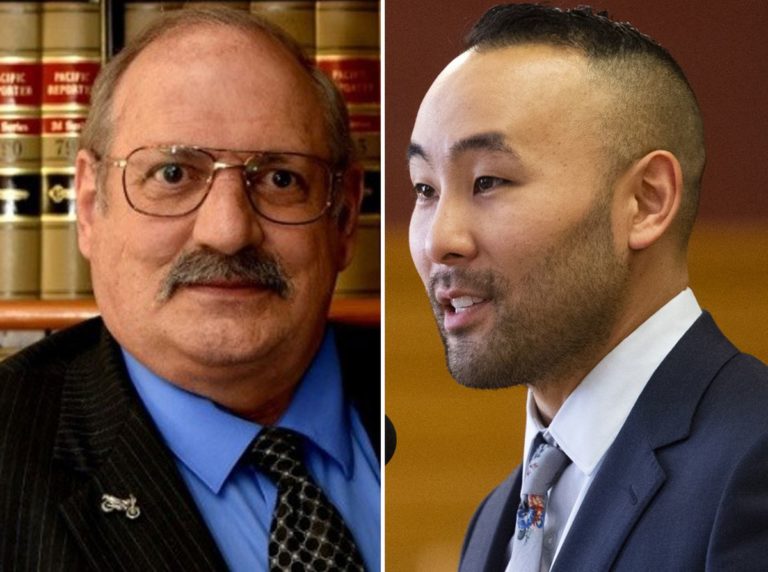
Earlier this week he posted a screenshot of the email on his Facebook page, writing that,“as an Asian American and member of the LGBTQ+ community, I must stand up against hate speech and call it out when I see it. As a City Councilmember and a candidate running for election, it’s my duty to reach my constituents, listen to what is important to them and make informed decisions.”