Home Blog Page 429

Gay: What it takes to heal from COVID-19 – The Register-Guard

0

I am one of millions of people still fighting to regain their full health months after surviving COVID-19. But this is not a story about sickness. This is a story about the small army of people who are helping me heal.

There are the pulmonologists, a team of two brilliant, brave women who have treated COVID-19 patients in the ICU throughout the pandemic. One of them is around my age — early 30s. “You will get there,” she assured me recently as if she had read my worried mind. Our faces were masked, but I could see the confident smile in her eyes. “It’s just slow,” she said, using profanity that I can’t repeat here but that made me laugh.

There are the physical therapists. Two times each week, Noah Greenspan and Marion Mackles of the Pulmonary Wellness Foundation cheer me on as I step onto a sharply pitched treadmill, hooked up to oxygen and other machines, and climb what I swear feels like a mountain.

I am acutely aware that I have received care and support that many COVID survivors don’t have access to. Beating a novel disease in a broken health care system means finding the right doctors and asking the right questions. That takes professional skills, time and resources that many people don’t have.

I also have good health insurance and was able to take paid time off from work, no questions asked. I have an acupuncturist. About once a month, I’m able to get a lymphatic massage, aimed at reducing the lingering inflammation in my throat.

To take our lives back, many COVID-19 survivors need more help. There is plenty that the incoming Biden administration and others can and should do.

Survivors need access to top medical care from the doctors who know this disease best, regardless of where they live or their ability to pay. Many providers with the most experience in treating COVID-19 patients and survivors are based in New York. But with the disease spreading uncontrolled across the United States, the need will be widespread.

Many survivors, like me, will need physical therapy, and likely emotional support as well. Although the COVID-19 survivor groups that have popped up in recent months have been a good resource for many people, they can also be overwhelming and aren’t a substitute for individualized care or dedicated research efforts.

Above all, these survivors need access to new and safe treatments that can help in their recovery.

Many of us were in perfect health before COVID. Some of us are athletes. Now, many months later, many are living with a constellation of symptoms that most people would consider intolerable. For some, it is shortness of breath. For others it’s brain fog, or headaches, or nerve pain, or digestive issues.

Over the past year, many of us have watched family and friends recover from the virus that ripped through our bodies. We have seen politicians who mocked mask mandates quickly recover after receiving experimental antibody treatments, even as many people were denied any treatment at all when they first became ill.

We are angry. We are scared. We are grateful to be alive. But many of us are still in the battle of our lives.

When you are fighting a serious illness for a long time, it can be a hard and lonely place. But at least once in their lives, most people will find themselves in a soul-shaking season of trauma, tragedy or loss. It could be a sickness or a shooting, an accident or the loss of a great love, a betrayal, the death of a child. When you are in your darkest winter, you’ll find strength from the people who are willing to go to the hard, messy places with you until you come out on the other side.

This year, many people have walked through that season with me. Some had been friends since before we were old enough to drive. Others I had never met before.

They pushed me to keep going in those moments when I wanted to give up. They prayed with me, and cried with me, and checked in on me. They coaxed me into taking up yoga, a form of exercise that I had long resisted but that has done for me what many medications could not. They cooked my favorite foods. They walked me to the emergency room. They made sure my prescriptions got to me, which in one case involved a boat. They stood with me in the middle of the street when I stopped to catch my breath.

Among my favorite possessions now is a hot pink hand-painted card made for me by Chelsea, my college roommate, and her 3-year-old daughter, Maya. Chelsea also happens to be a health care worker and is a huge support. “Tía Mara,” the card says. “Slow and steady wins the race.”

You don’t have to wear scrubs to bring encouragement and hope to someone who is suffering.

One day this summer, I was sitting alone in a frigid Manhattan emergency room when I saw a man standing in the hallway outside, waving at me through the glass.

I recognized him instantly. Not even an hour earlier, we had walked into the hospital together, two strangers, afraid, stepping into a place we hoped we would never need. I wondered if he was still struggling with the effects of COVID-19 months later, like I was.

When I waved back, he put his hands on his heart, stared into my eyes and nodded. It was as if I could hear him saying, “You can do this. I am with you.”

I am feeling so much better these days. I am running again, and breathing easier all the time. I am stronger every day, and well on my way to recovery.

But I can’t do it alone. None of us can.

Mara Gay writes for The New York Times.
“You’re nothing more than a plague rat,” social media users take on gay NYE parties – Los Angeles Blade

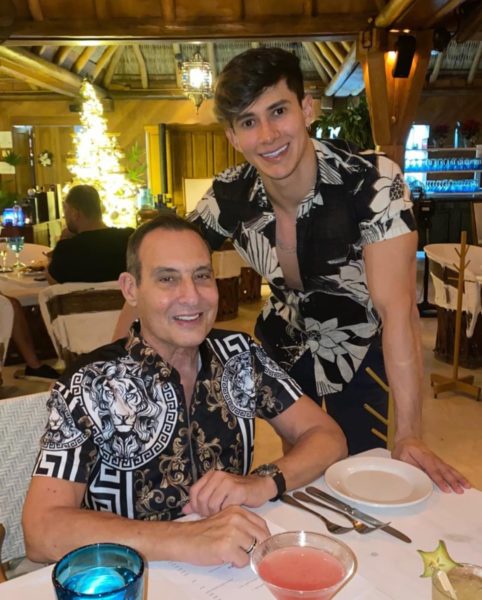
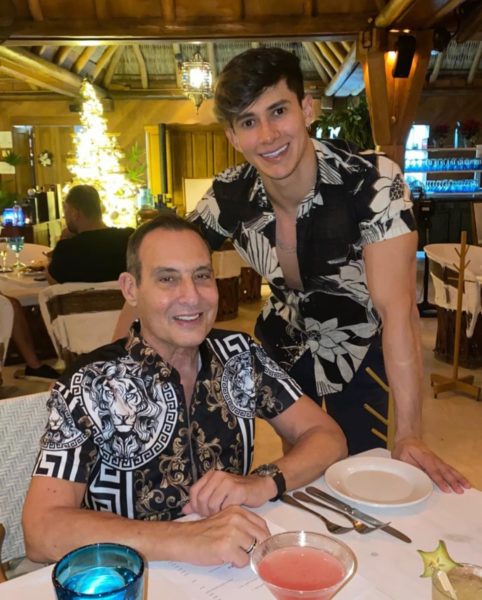
Gay circuit party impresario Jeffrey Sanker and an unidentified male friend earlier this year via Sanker’s Instagram

PUERTO VALLARTA – The disgust, anger, and recriminations over gay New Year’s Eve parties in this seaside resort area of the Mexican state of Jalisco and neighboring Riviera Nayarit, continues to spread in gay online social media- particularly in numerous Twitter threads and on Instagram. One Instagram account, @gaysovercovid has repeatedly called out party goers and party organizers.

Local media outlets in Jalisco and many Mexican social media users are also outraged.

The @gaysovercovid Instagram account has faced a wave after wave of backlash from gay influencers many of who are now embroiled in the controversy after having their Instagram posts publicly disclosed and then shamed by the anonymous account holder. There have been financial rewards offered to anyone who can unmask the account owner’s identity.

The account used the built-in abilities for tracking the influencers’ Facebook locations and Venmo transactions in an effort to uncover where they were attending parties. That brought about severe condemnation from those exposed while many other people celebrated that the account exposed the bad behavior of gay men.

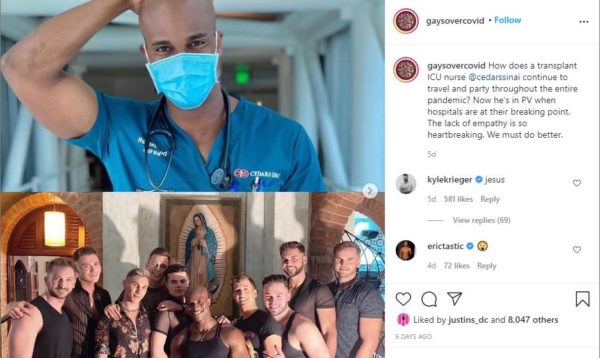
In one example, in response to a social media post that depicted a West Hollywood area ICU registered nurse as a participant, social media users tracked the pictures to an Instagram account (@legstrong) listed for 25 year old Armstrong Nworka. The Blade determined from online searches Tuesday, including Facebook using the handle ‘@legstrong’ and his surname, Nworka had profiled himself as gay, an RN, and employed at Cedars-Sinai in Beverly Hills.

Instagram post showing (@legstrong) via @gaysovercoid Instagram

One of the comments [left on his page] read; “Disgusting, you give us gay people a bad name. You’re truly nothing more than a plague rat.” Nworka has since taken his Instagram account private. Nworka did not respond to a Blade request for comment.

The Blade also reached out to Cedars-Sinai and was told that there would be no comment on personnel matters.

The ‘plague rat’ comment was mild in comparison to the thousands of other vitriolic responses to other party attendees and especially organizers- labeled by critics as ‘super-spreaders,’ who openly defied both U.S. and Mexican Public Health authorities mandates and restrictions to help stem the spread of the COVID-19 coronavirus.

Palm Springs resident and gay circuit party impresario Jeffrey Sanker held the largest New Year’s Eve weekend bash, which included several events. Originally set to take place in Puerto Vallarta, apparently ignoring the pleas from local health authorities, elected officials as well as residents, Sanker’s White Parity Entertainment company was forced to move the event to neighboring Riviera Nayarit after the Jalisco state government banned mass gatherings and implemented more restrictive coronavirus measures.

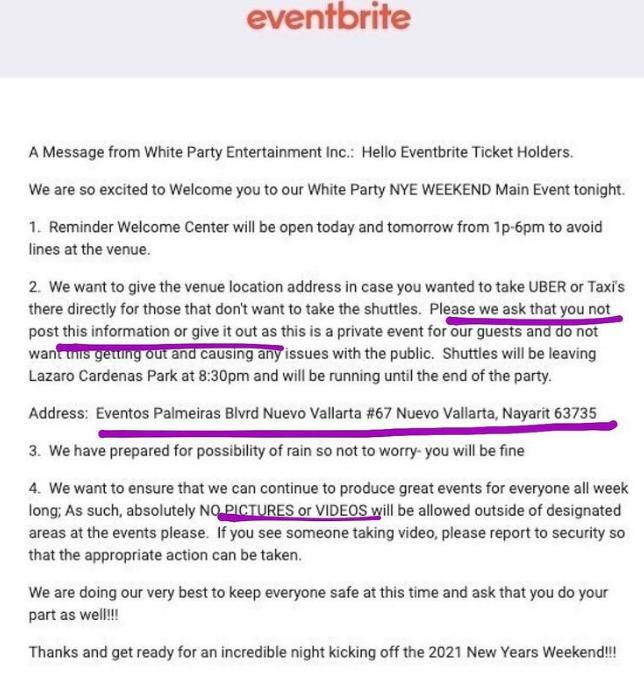
In a text to ticket holders, Sanker’s company told attendees to not reveal the location of the party.  Nor could they take any photos or videos of the event.  The text said the steps were necessary because they “do not want this getting out and causing any issues with the public.”

That text was screenshot and then posted by @gaysovercovid as well as other accounts which prompted one local news outlet in Puerto Vallarta, the Puerto Vallarta News, to editorialize on its social media accounts prior to the events;

“If you are interested in still visiting the COVID Superspreader New Years Eve Celebration where foreigners come to our community and throw big parties and leave COVID while causing our businesses to close and people lose their jobs- […] COVID isn’t causing businesses to suffer, it’s the actions of people. We are tired of it. We have supported this event in past years and given it positive coverage, but this year it’s irresponsible and should be canceled.​”​

In a phone call with an editor at PVN on Tuesday, the Blade was told that the area’s main healthcare facility, Puerto Vallarta Hospital was at 100% occupancy with COVID-19 patients – and that the state of Jalisco had reached 65% positivity rate.

Officials in Jalisco uniformly condemned the fact that so many had traveled from the United States just to party without seeming to care about the consequences to the local residents, many of who are employed as staff in the restaurants, bars, hotels and transportation systems.

“They came to have sex- to dance it seems and to make party without regard to spread of COVID,” one government source told the Blade. “They have no sense of responsibility- don’t care about peoples here,” he added.

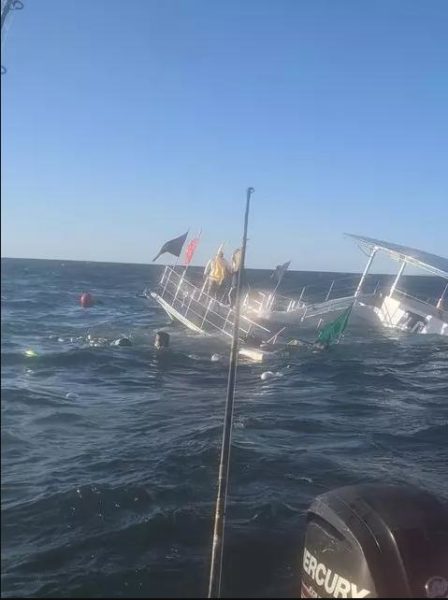
As part of the weekend long event​ the PV Delice, a catamaran boat that featured a live band and open bar, began taking on water and sank off the coast of Puerto Vallarta on December 31, 2020 around 5 p.m. while crew frantically called for help to rescue passengers.  Video posted on Instagram, Tik-Tok and Facebook documented at least 10 other boats rushing to aid the sinking vessel and plucking 60 victims out of the choppy water. 

Witnesses to the sinking told local news outlets that the boat was filled with White Party celebrants and was overcrowded. The boat sank to the bottom of the bay and there were no reports of injuries.

Screenshot from @gaysovercoid Instagram

One passenger, a gay man from Chicago, Illinois, Emilio Blanco told the local LGBTQ news outlet, Out and About PV, “It was like the Titanic, it went all down slowly. I think the crew just didn’t know how to maneuver the catamaran very well, the sea was not very rough nor was it too windy. We were about to sail back to Puerto Vallarta, but the catamaran barely moved. I saw at least 10 small boats coming to help, I jumped in a private boat whose owners were graceful enough to send their captain help out. It was quite a scary situation.”

A spokesperson for Adrián Bobadilla García, head of the municipal agency, of Puerto Vallarta told the Blade Tuesday that the municipal government had made numerous notifications to the public regarding mandatory use of masks and maintaining social distance in public. He said that the boardwalk during the holiday however, wasn’t closed nor were the beaches. He conceded that enforcement was not as stringent as it should have been.

A majority of gay parties attendees reportedly stayed in Puerto Vallarta.  As a result, beaches were jammed wall to wall mostly with maskless celebrants.  One local resident who provided pictures and video to NBC Palm Springs said it was a “superspreader nightmare.”

Beaches of of Puerto Vallarta Saturday. (Screenshot via NBC Palm Springs)

“It is with sadness and anger that we have Americans at the height of a pandemic surge travel to Mexico to participate in New Year’s Eve parties knowing that people of color are disproportionately impacted by the COVID-19,” said City of Huntington Park, California Councilman Eddie Martinez who also heads the  Latino Equality Alliance.

“The action of these travelers has now put hotel workers, servers, janitors, and drivers at risk for the disease as well as to possibly put an additional strain on the hospital system in both Mexico and the United States. Party promoters and sponsors need to be held accountable if their actions result in more deaths for families, especially within the LGBTQ community,” Martinez added.

Washington D. C. based journalist Zack Ford documented a majority of Twitter responses to the controversy in a thread he published Sunday. (Link)

Cayman Islands Approves Gay Couple’s Marriage In Immigration Battle – Instinct Magazine

0
Photo by Sandy Millar on Unsplash

Gay rights activists and allies of both same-sex marriage and love are celebrating a win in the Cayman Islands.

According to the Cayman Compass, a Cayman Islands couple has won the right to have their same-sex marriage, which took place abroad, recognized by the immigration authorities. Paul Pearson and Randall Pinder legally married in Ireland. Developer Pearson then applied to have Pinder acknowledged as a “spouse of permanent residency holder” to help with Pearson’s immigration. Originally, that application was denied by the Caymanian Status and Permanent Residency Board because the Cayman’s Constitution defines marriage as between a man and woman. The couple then took the case to court.

Last week, the Immigration Appeals Tribunal ruled to overturn the board’s earlier decision. The appeals tribunal did so with the understanding that failing to allow the application would be an act of discrimination. The tribunal then ordered that Pinder be granted “spouse of a PR holder” status, which grants him the right to remain on the island with Pearson without a separate work permit. The Workforce Opportunities and Residency Cayman office was also ordered to pay the couple’s $6,000 legal bill.

“Recognizing opposite-sex foreign marriages and failing to recognize same-sex foreign marriages would be affording different and unjustifiable treatment to different persons on the grounds of sexual orientation,” stated the ruling.

The couple then said in the statement after the ruling, “While it is sad and unnecessary that this fight had to happen, we are extremely grateful that right has prevailed and going forward there should never be a question about the rights of all people in the Cayman Islands to have their love recognised. Love Wins.”

Again, the British territory’s constitution states that marriage is between a man and a woman. In 2019, Cayman Islands Grand Court Chief Justice Anthony Smellie attempted to remove the territory’s same-sex marriage ban, which was a holdover from British colonialism. Unfortunately, the Cayman Islands Court of Appeal then overturned the ruling a few months later. To compensate, the territory’s Civil Partnership Law took effect this past September.


Source: Cayman Compass,

Review: Robert Jones Jr. sheds light on lives of enslaved gay men in ‘The Prophets’ – USA TODAY

Homosexuality is at least as old as the Old Testament, but outside of a handful of scholarly reads that explore homosexuality (“A Desired Past,” “Intimate Matters” and “Zami: A New Spelling of my Name,” among others), the overall body of work shedding light on Black queer life is scant. 

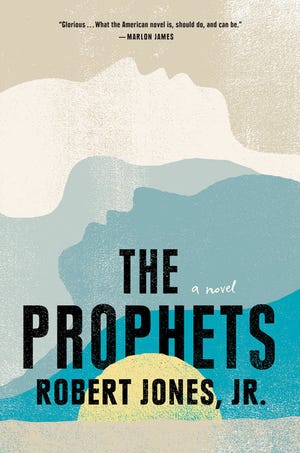
Along comes Robert Jones Jr., who taps into his brilliant dome to unearth an engrossing and magically written debut novel, “The Prophets” (G.P. Putnam’s Sons, 400 pp., ★★★★ out of four). Jones’ freshman opus takes readers into the lives of two enslaved men, Isaiah and Samuel, who manage to sustain a romantic relationship on a Mississippi plantation. 

Residing on Halifax Plantation – known as Empty because of its rural Mississippi location, and an allusion for the hollow existence of slave life – enslaved stable workers Isaiah and Samuel indulge in a romance that’s not as hidden as they believe. Right away, Jones borrows from celebrated scholar Robin D.G. Kelley, who writes about race and resistance, by re-creating small acts of slave rebellion. “The Prophets” begins with Isaiah, who is more aggressive than his lover, trying to make love to Samuel. “So, you risk whupping, then?” Samuel asks. “You forget? We ain’t even gotta do this much to risk whupping,” Isaiah responds.  

Book review:Anna North’s thrilling ‘Outlawed’ rewrites the myth of the Western

“The Prophets,” by Robert Jones Jr.

Rebellion is one of the themes that stitches together the fabric of “The Prophets.” Maggie, a fellow slave, wet nurse and cook, indirectly takes part in the gay couple’s rebellion. “There were many ways to hide and save one’s self from doom and keeping tender secrets was one of them,” Maggie says. “People rarely deviated from their nature, and although it pained her to admit, she found a tiny bit of comfort in the familiarity.” Not only does Maggie enjoy queer men intimately bonding with each other, she also enjoys watching them at night. 

Paul Halifax, the plantation owner, is unaware of the homosexual men until he attempts to have them produce children. After several whippings that fail to “cure” the couple, he recruits Amos, the plantation preacher, to scare them with the wrath of God, to no avail. 

Adding another layer of suppression to Black queer life, Timothy, a closeted gay man and heir of Halifax clan, becomes attracted to Isaiah and Samuel. An abolitionist sympathizer, Timothy believes his connection to the gay couple could offer them liberation: “Together we can be set free,” Timothy surmises. But Samuel is fully aware of the uneven playing field because Timothy is a free white man: “Giving them pleasure while all they give in return is grief.”

5 books not to miss:Feminist Western ‘Outlawed,’ Robert Jones Jr.’s ‘The Prophets’

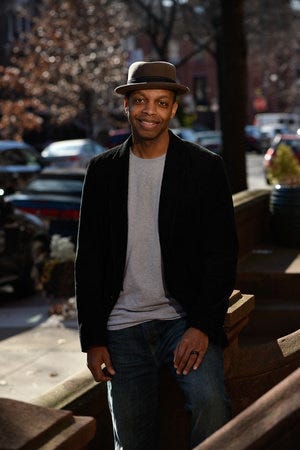
Author Robert Jones Jr.

In addition to the LBGTQ  and rebellious themes throughout “The Prophets,” Jones also plays with historical content with his creation of Kosongo, a mythical land in Africa ruled by a woman, King Akusa. Kosongo is most likely inspired by Kosovo, part of the Ottoman Empire, which legalized same-sex relationships in 1858.

“The Prophets” is packed with otherworldly and supremely artful storytelling, and readers will surely get lost in a radiant romance. But most important, Jones adds to the growing body of literature that reimagines slavery – Colson Whitehead’s

“The Underground Railroad,” Ta-Nehisi Coates’ “The Water Dancer” – and to queer theory, in which Jones’ predecessor James Baldwin shed light on, disrupted and intersected with race. 

A class apart – The New Indian Express

Express News Service

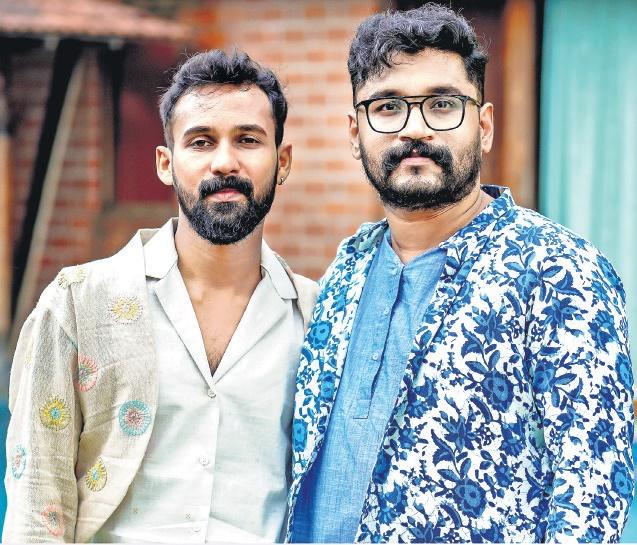
KOCHI: Fashion line ‘ERA’ created by gay duo Jijo Kuriakose and  Ajmal Aju is inclusive, diverse and non-conforming. Its maiden collection reflects the fearless self-expression evident in the dressing choices of the LGBTQ community

For decades, there have been debates on the purported democratic nature of fast fashion. The globalised economy capitalised on factory outlets, claiming that access to cheaper clothing, was undoubtedly democratic. Despite these claims, fashion for the longest time has catered only to a minor category of people across the world. Tall, skinny, white women and men adorned glossy magazines. However, times have slowly changed. People of all colours and sizes are welcomed, if not warmly, into the industry. Despite this, there still exists an evident divide.

So, when Jijo Kuriakose, an artist approached trans person Amna Plinku for his fashion line created along with designer Ajmal Aju, Jijo highlighted that they didn’t need professional models. “He told me he wanted plus size models and those from the LGBTQ community. The most fundamental thing to be noticed about ‘ERA’, his fashion line, is its inclusiveness. Though I’ve been a regular participant in trans pageants and fashion shows, I’ve faced rejection for not being the stereotypical model. Simultaneously, the outfits available are almost indistinguishable. As a trans person, I’m not able to find the vibrant colours I love wearing,” says Amna, one of the models for ERA.

ERA- Garments for All, rose out of the possibility of entrepreneurship, according to the gay duo. “Ajmal and I live nearby with a great bond over food and fashion. When the pandemic affected our incomes, we decided to capitalise on either of the things we loved most. With our substantial experience, we realised that venturing into fashion is what could work best.

Instead of randomly launching miscellaneous clothing, we decided to design outfits for 12 different people as per their personal styles and desires. We approached a few and tried including as many people as we could, for diversity and inclusiveness, what we have always stood for. However, Covid restrictions did play spoilsport in getting more people on board,” says Jijo.

ERA’s first collection that was launched two weeks ago is undoubtedly inclusive, diverse and non-conforming. The outfits range from aesthetics of dark and pastel hues to whimsical motifs, floral patterns, the occasional sheer top and beige tones. Queer fashion has been the forebearer of individualised styles, personal artistic reflection and fearlessly breaking stereotypes. While Jijo stressed that ERA wasn’t a queer label, the fact that the makers hail from the LGBTQ community, definitely speaks volumes about its design ethos that digresses from the norm. 

ERA also hopes to focus on menswear, and shift gaze the other way. Equipping themselves to diversify men’s clothing beyond the socially ciphered machismo codes, is the plan for 2021, according to Jijo. The queer dressmakers agreed that fashion was indeed welcoming towards the LGBTQ community in the state. “I wouldn’t say that the fashion industry in our state lacks inclusion, but I believe as gay dressmakers we can bring more diverse representations,” adds Ajmal.

Models for ERA included Adarsh Mohanan, Maya Krishnan, Ferha Azeez, Amna Plinku, Anand Ampeethara, Arya M, Indhuja Prakash, Qanishqah Paul, Sidharth and Younas Mariyam. Ashok Edapally was the makeup artist while Jinish Mathew took charge as the portfolio photo specialist.

Follow the label on Instagram @eraforall

A New Year’s Eve Gay Cruise Sank in Puerto Vallarta, and Gay Instagram Is Exploding – Rolling Stone

0

When the world rang in 2021, we thought we would be leaving much of the malaise of the previous pandemic year behind. But alas, there is no vaccine for one of our favorite pursuits: good old-fashioned social media shaming, which has been rampant thanks to an anonymous Instagram account and a party cruise sinking that went down over New Year’s Eve weekend.

Many on Instagram who follow popular models and influencers on the circuit party scene were surprised to see photos and videos being posted of a New Year’s Eve circuit party in Puerto Vallarta, Jalisco, Mexico. The party, organized by gay circuit scene impresario Jeffrey Sanker, received massive criticism on social media, where many pointed out that hospital ICU beds in Jalisco were at 100-percent capacity and that, due to the pandemic raging in the area, local officials were capping event attendance at eight people.

In fact, the latter regulation is what ultimately prompted Sanker to move at least one of the parties associated with the event to the neighboring state of Nayarit, which has much more lax restrictions, according to reporting from the Los Angeles Blade. “The best party with the hottest sex will be held at an estate in Puerto Vallarta and I’m going. I don’t have Covid. Like, I can’t infect someone with something I don’t have,” one anonymous partygoer told the Blade. “If I get it I’ll let you know, but who cares. I’m 23 years old and a girl’s gotta live.”

The social-media backlash to the event was primarily fueled by @GaysOverCovid, an anonymously run Instagram account with more than 88,000 followers as of press time. Since last summer, the anonymous proprietor behind @GaysOverCovid has been doing aggressive sleuthing work, posting photos of gay parties during the pandemic as well as the personal information of many of the attendees. In one post, @GaysOverCovid outed a health care worker who had received the COVID-19 vaccine and then traveled to Puerto Vallarta for the party. “White privilege at its absolute finest. Privileged enough to be vaccinated two days ago, now this medical professional is on a beach in Puerto Vallarta without a care in the world. Meanwhile the CDC begs people to stay home and not travel,” the caption read, accompanied by an image of tanned, fit men frolicking on the beach. “I will never understand this lack of empathy.”

On New Year’s Eve, a boat carrying about 60 of the attendees of the Puerto Vallarta party sank. Though no one was hurt during the incident, video footage showing the revelers being rescued surfaced on Twitter, leading to an onslaught of schadenfreude and extensive memeification, as well as comparisons to the sinking of the Titanic. “Here were all these people flouting all these precautions and it was sort of like karma to watch them get a little bit of comeuppance,” says Zack Ford, a former LGBTQ editor at ThinkProgress who authored a viral thread about the controversy surrounding the Puerto Vallarta event and @GaysOverCovid. He says that the demographic that the Puerto Vallarta event attracted — primarily, white cisgender male influencers with conventionally attractive physiques — also contributed to much of the schadenfreude, viewing the story through the lens of “who holds power and privilege” within the gay community.

Not everyone, however, was laughing at the memes. Puerto Vallarta attendees, some of whom had been outed by @GaysOverCovid, were enraged by the account, with one post on the Facebook page for CircuitBitch.com offering a $500 bounty for anyone able to reveal the identity of the person behind the account. “For so long they have been hiding the screen, trying to out fellow gays, making our community as divisive as ever,” the post read. “If they believe what they’re doing is right, why be a coward and let us know who they really are.” The post concluded with the hashtag #GaysOverKarens, a reference to a trope of an entitled white woman bullying members of marginalized communities.

Others expressed concern that the shaming tactics used by the @GaysOverCovid account were ineffective and would drive irresponsible behavior further underground, or that it would serve as fuel for the fire of homophobes who viewed the behavior of the Puerto Vallarta attendees as reflective of the gay community at large. (GaysOverCovid did not immediately respond to requests for comment.)

James Greig, a writer who parsed out the controversy for a Huck Magazine piece, does not necessarily agree with the tactics utilized by GaysOverCovid, objecting in particular to previous posts on the account lauding the police for shutting circuit parties down. “I’m not sure that shaming individuals is an effective way of influencing behavior in a public health crisis,” he says. “I think people are more likely to get defensive and double down.” Yet he agrees that openly flouting social-distancing regulations in the face of a pandemic is contemptible behavior, though it shouldn’t be pathologized or viewed through the lens of being a phenomenon exclusively to gay circuit party attendees: “straight people are breaking lockdown to go on holiday all the time and I don’t see this as meaningfully different.”

Ford similarly does not think that the behavior exemplified by the Puerto Vallarta revelers is reflective of anything but a tiny sliver of the gay community, or that this is necessarily a story about gay circuit party culture in general, comparing their behavior to churchgoers who refuse to practice social distancing. “We really just have an issue across the entire society of people who don’t think their actions impact others and don’t think they have to care that their actions impact others,” he says. “I don’t see this story as about circuit party culture. It’s just this emblem of how extremely people can disregard the responsibility they have to others around them and no one is talking about the sacrifices others are making.”

A Q&A with three Caribbean tourism experts on 2021 trends – Travel Weekly

0
Gay Nagle Myers

Gay Nagle Myers

It was one helluva year, but we have finally said farewell and good riddance to 2020, a year that took its toll on millions of individuals, families and industries in hundreds of countries.

The pandemic continues to slam all of us across the board and borders: exhausted healthcare workers; struggling business and restaurant owners; travel advisors who are juggling cancellations and ever-changing entry regulations; housekeeping staff furloughed with no hotel rooms to clean; and beach vendors with no wares to sell or tourists to buy their coconut bowls and hand-woven straw hats.

One of my memories of the terrible 2020 is personal and probably very selfish, also very minor compared to the real suffering and losses of so many others. A trip to the Caribbean was finally in the offing late in October but I was told that where I live (Virginia) was a high-risk state and that I was a high-risk traveler and therefore not welcome on that island at that time.

For thoughts and insights on the year that’s been and the year we’re now in, I turned to three industry leaders: Frank Comito, director general and CEO of the Caribbean Hotel and Tourism Association (CHTA); Karolin Troubetzkoy, executive director, marketing and operations of Anse Chastanet and Jade Mountain Resorts in St. Lucia and immediate past president of the CHTA, and Brad Dean, CEO of Discover Puerto Rico.

I interrupted their much-needed holiday breaks with my questions, but they broke from their R ‘n R to share their responses with me — and you.

Q: How would you best describe the year 2020?

Comito: Without question, it’s been the most challenging year globally, and specifically for the Caribbean given the significant role that tourism plays in the region’s economies.  It was a year that tested the mettle of our people  and by and large, we passed the test, often excelling.

We saw a level of commitment and collaboration locally and regionally by government and tourism industry leaders and health authorities unlike we’d ever seen before: to safeguard our industry, minimize the pandemic threat on visitors and residents and move towards our recovery.

Troubetzkoy: The never-ending and exhausting pandemic pandemonium tested our sanity and our optimism. My motto became: “Do not let what you cannot do interfere with what you can do.” (John Wooden).

Dean: 2020 was tumultuous, arduous and unpredictable — the year travel stopped.

Q: What’s your forecast/prediction/hope/forecast for 2021?

Comito: We anticipate a very slow recovery continuing through the first and second quarters. We expect business to steadily improve as we approach summer, as consumer confidence returns with more people getting vaccinated and testing technology, availability and costs improve as well.

Forecasts vary, and we are in a continually shifting environment. Even with that, nearly half the traveling public anticipates they will be ready to travel sometime this year.

Average occupancies for the region this past fall ran 20% to 40%. We hope to see an improvement in Q1 building up to an average 40% to 60% as we approach summer.

Room rates have been running close to that which we experienced pre-pandemic and are expected to hold, perhaps with a small decline.

Troubetzkoy: Cautiously optimistic. Cautious because the situation is still so very fluid and it is too soon to understand how quickly the vaccine can reach a broad spectrum of the population. Optimistic because Anse Chastanet and Jade Mountain are two small boutique resorts on our own 600-acre estate with two beaches and lots of on-site activities, the sort of environment that travelers are looking for nowadays.

Dean: 2021 will launch the Great Recovery of travel and tourism. While the year begins deep in the midst of the pandemic, there’s a heightened sense of optimism as vaccinations have begun. The first few months will continue to present challenges for our industry, but the outlook for the remainder of the year is encouraging, with pent-up demand for travel growing.

Q: What trends are you seeing that will carry forward into 2021?

Comito: People desperately want and need to escape. That’s an overriding motivating factor, which will drive demand across most travel sectors, except for any sizable groups. Travelers want destinations that allow them to enjoy the outdoors. They will cherish places that allow them to heal their body, mind and spirit, which the Caribbean does so well and tops it off with some of the best spa and wellness experiences anywhere.

Travelers want someplace close to home, familiar but which offer new travel experiences.

I challenge anybody to think of any place that fits that bill better than the Caribbean, for a long weekend escape, a week’s getaway or an extended work and play experience.

Troubetzkoy: Health protocols and tourism will continue to be closely connected. Travelers and their travel advisors want to be confident that both their destination of choice and resort of choice keep everyone safe. There will be new focus on responsible tourism and travel.

Responsible tourism must, more than ever, embrace the full spectrum of operating sustainably, beginning with the protection and preservation of the environment to allow maximum economic benefit to stay in the host country and facilitate the traveler’s exposure to the history, art and culture of the host community.

Travelers will make an effort to choose their vacation destination responsibly and thoroughly understand the places they visit.

Dean: The nonstop changes in safety protocols and related health measures have kept travelers on edge and compressed the already-short booking window even more. This will continue this year until a vaccine is widely available. At the destination level, we’ve been widely challenged to manage the intersection of travel and public health throughout the entire travel continuum like never before. That’s not changing this year. Enhanced standards of sanitation, cleanliness and customer service are the price of admission.

For tourism marketers, 2021 is another challenging year, although the emerging recovery should bring about improved results.

Depleted budgets, expanded digitalization and the immense challenge of balancing value propositions, inspirational content and health-related messaging will demand adaptive innovation.

Q: What is your message for travel advisors and tour operators regarding travel in 2021?

Comito: We are ready for you. We have some of the most effective health safety protocols in the world. Thousands of employees in the industry have undergone health and safety training since last June, and this is ongoing. The tourism industry in the Caribbean has had a unique partnership between tourism and health for years, which prepared us for these difficult times between the Caribbean Public Health Agency, CHTA and the Caribbean Tourism Organization.

Since last spring, Caribbean hoteliers put in place flexible cancellation policies, and many offer travel protection that provides coverage for Covid-19 related circumstances.

Don’t just listen to us; listen to what thousands of travelers who visited our shores since last June said in online reviews about their experiences: overwhelmingly positive and grateful for the opportunity to safely escape.

Troubetzkoy: We need to support each other more than ever to build back confidence in travel. Information sharing and quick access to that information are critical for all parties. As hoteliers, we understand the importance to upkeep maximum flexibility with our reservation terms and policies.

Dean: Every crisis brings opportunity, and this year is no exception. With so much pent-up demand for travel and optimism spurred by vaccines, those who are agile and responsive to the consumers’ needs and desires will gain an upper hand.

We are likely facing a multiyear recovery, but considering what we all have been through, 2021 will ignite an amazing comeback story for our industry.

The 21 Biggest Health and Fitness Trends Of 2021 – Men’s health UK

0

These days, it’s hard to predict what will happen tomorrow, let alone in the coming months. But if anybody knows what lies ahead – in wellness, at least – it’s our specially assembled MH advisory board. One thing is certain: those invested in safeguarding your well-being will not down tools. This is how you’re going to be shaping up.

1 You’ll Bring Awareness to Your Breath

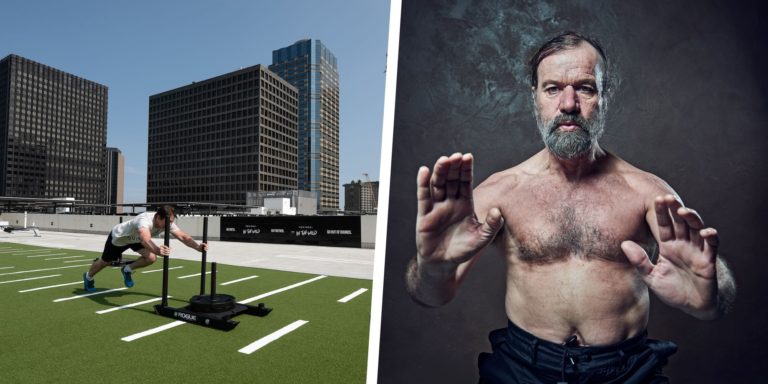
A rampant respiratory disease and mandatory mask-wearing will do that, true. But so will bookshop shelves and Amazon order-pickers wheezing under the expanding volume of pulmonology-heavy publications: The Wim Hof Method by the Iceman himself, Exhale by Richie “the Breath Guy” Bostock and Breath by journalist James Nestor. Controlled breathing techniques can confer “a number of positive health and performance benefits, from reducing anxiety to delaying fatigue”, says Equinox’s innovation manager, Matt Delaney. Even slight adjustments can be “transformative”, agrees the Global Wellness Institute’s director of research, Beth McGroarty. Promising science is adding weight to many of theclaims – but some may yet prove to be hot air.

2 Hybrid Models Will be the Driving Force

Back in 2019, MH published a feature titled “The Gym in 2029”, which predicted greater synergy between physical facilities and virtual home workouts. Well, that escalated quickly. Locked-down gyms pivoted more furiously than Ross in Friends to keep their clientele fit (and to keep them, full-stop). Even after reopening, reduced capacity and the caution of members are hastening the rollout of Fitness 2.0, “in which people can work out wherever and whenever they want”, says Les Mills’s CEO, Clive Ormerod (restrictions allowing). Senior editor of Welltodo, Laura Hill speaks of an “omnichannel approach”, which means that geography is no longer a barrier. Drop into one of Foundry’s live and on-demand classes or head (virtually) overseas to New York boxing studio Rumble.

3 Mental Health and Fitness Will Be Front of Mind

Les Mills’s yoga-themed Bodybalance workouts were up 600% after lockdown. “A year of mental and economic stress in 2020 has made coping and mindfulness even more of a persistent message,” says the founder of nutrition research group examine.com, Kamal Patel, though he warns meditation alone is no magic pill: it places the onus on you to be more resilient, when the problem isn’t always just in your head. But more robust and proactive solutions, such as online talking therapies, are already proving valuable.

4 Contactless Will Be a Currency

Touch is fundamental to wellness. There’s the rub – or not – in our brave new socially distanced world. Modern society’s “touch hunger” has become a physical contact famine that negatively impacts our health. McGroarty is keeping an eye on the hands-free alternatives: air chamber and sound-wave bed massages, fingernail-mounted “haptic interfaces” that can simulate the feel of skin and hair, even whole sensor gloves. The future: clothes that adjust the body positioning of the wearer.

5 Exercise Will Be Preventive Medicine

Until we all get a jab of the vaccine, exercise is, along with hand sanitiser, one of our best defences against illness and a key determinant of outcomes. Hence there will be a renewed emphasis on the first half of the phrase “health and fitness”, which sports scientist and trainer Luke Worthington says has “gotten a little lost”. There’ll also be a reversion to the tried and tested – and an aversion to the new and spurious. “I’m seeing more people wanting quantifiable results: asking for fitness and body composition assessments, then tracking their progress so they know they’re mitigating their risk factors,” says Worthington. Many gyms now offer these services. “It’s how the industry was 10 years ago, before Instagram,” he points out.

6 Sweatboxes Will Shop for New Premises

Some gyms may spring back to their pre-pandemic shape, but the outlook is less bright for those in office catchment areas, with limits on occupancy biting hard even without the continued appetite for working from home. “It’s exactly the same as for Pret and other retailers that opened to cater for huge numbers,” says LeisureDB’s director, David Minton. As well as relocating to residential areas, gyms could find a new home on the high street, thanks to change-in-usage legislation to reinvigorate ghost-town centres and a fall in rents. This could lead to a spread of studio-style options, which lend themselves to smaller retail units – so you can go shopping for your workout of the day.

7 Covid-19 Recovery Plans Will Spread

Only time will tell what the full repercussions of the coronavirus will be. But the consequences for sufferers so far include lung scarring and reduced capacity, muscular deconditioning and pain, chronic fatigue syndrome, and gut, kidney and heart problems. All of which make returning to exercise difficult – even without the mental health fallout. With the Royal Gwent Hospital’s Respiratory Team, the Geraint Thomas National Velodrome of Wales has devised a bespoke programme for post-ventilation patients: 90-minute sessions of indoor cycling, treadmills, boxing and Pilates, plus support services such as dietetics, physio and psychology.

8 You’ll Drink Less and Hydrate More

“Eight glasses of water a day” is a myth: the ideal intake depends on the individual. And without electrolytes, it’ll go down the pan. “Mainstream hydration” will permeate, says the founder of plant-based nutrition and education platform Form Nutrition, Damian Soong. “It’s always been big for athletes, but it’s becoming more ‘lifestyle’.” With up to three times as many electrolytes as standard sports drinks, plus fruit juice, US hydration mix Hydrant is drunk first thing. Which you won’t be, as “nolo” or no- and low-alcoholic drinks will also be “massive”, adds Soong.

9 15-Minute (No Equipment) Calorie Burning Workout

You don’t need to spend hours working out to burn calories, especially if you’re working hard enough. This workout, created be trainer Bradley Simmonds, is designed to stoke your fat-burning into overdrive and will carry on burning calories long after you’ve finished

10 You’ll Get Politically Active

Minton predicts a “global fitness response” to the pandemic: countries such as China and Japan are already urging their populations to be more active. This has yet to spread to the UK. “But I think there’s a movement there,” he says, particularly as the Prime Minister suffered COVID-19, admitted he was “too fat” and hired a PT. Not everyone has that luxury, so lower-income communities may pool resources to save imperilled leisure centres. Minton says that the issue will become politically “charged”.

11 Steady-state Will Be Back in the Running

“Whether or not you like cardio, it’s impossible to deny its myriad health benefits,” says Delaney, who anticipates a shift in programming to prioritise the often unloved exercise form. Running might have overtaken other forms of training because of lockdown, but it will hold its position in 2021. HIIT rose in popularity fast, but it can have a detrimental effect on our well-being if done too frequently. Delaney predicts there’ll be a greater focus on “energy expenditure and renewal”, with those who are focused on gains “swapping out an extra high-intensity session for some lower-intensity cardio, or an extra rest day”.

12 Gyms Won’t Just Sell Memberships

Just as pubs all started to serve food because they couldn’t generate enough profits through booze alone, the pandemic has starkly demonstrated that gyms can’t rely solely on a steady flow of punters. So, as well as remote workouts, they will increasingly begin to tap other revenue streams: food and drink, body scans and health checks, and IRL and online shopping for active wear and training equipment. The purchase of gym chains Xercise4Less and DW Sports by JD Sports and the Frasers Group (Sports Direct’s parent company) hints at a hybrid retail model, says Minton – coming to a high street near you.

13 Big Tech Will Go Big on Wearables

Wearable tech has topped the American College of Sports Medicine’s annual survey of global fitness trends in four of the past five years. Now, the major players are muscling in. “Apple, Google, Amazon et al will tighten their grip on the space, with new technology, ecosystems and features,” says Hill. Apple’s Fitness+ subscription platform will host classes built around its Watch and Music – which may be an issue for less powerful fitness content creators. Amazon’s Halo band detects your mood from your tone of voice, while serving ads for stuff you talk about (sarcasm alert).

14 You’ll Take a Salubrious City Break

Hunching over a laptop while your sofa moulds to your body feels a long way from “digital nomadism”. With remote set-ups likely to remain a part of working life, we’ll rethink what constitutes a viable WFH venue to include anywhere with Wi-Fi (even those of us who aren’t lifestyle design bloggers). More of us are escaping crowded cities, even just to the suburbs, seeking nature and a cheaper lifestyle, says McGroarty. Related to this is the rise of the “workcation” among those who can’t afford to switch on the out-of-office. Tell your boss that Parisian vista is just a very lifelike Zoom background.

15 Wellness Will Move into the House

At times, our homes may have felt like prisons – but they are also becoming “highly policed sanctuaries”, says McGroarty. All of that time indoors is turning our thoughts from unfinished DIY to optimising the “home biome”: air and water purification; germ-killing UV lighting that is more in sync with our circadian rhythms; “wellness rooms” and “disinfection cupboards”. The need to compartmentalise (“Daddy’s working!”) is replacing the vogue for open-plan with an appreciation of modular set-ups, while lockdowns have made us appreciate the value of outdoor space.

16 Your Run Will Be Low Emission

While other trainer brands are taking steps to reduce their footprint, Allbirds is making strides. The first fashion label to print a calorie-style “carbon count” on its products, the Kiwi company believes that consumers will start to watch CO2 like they do calories. Alongside Adidas, it aims to launch the first carbon-neutral performance shoe this year. Swiss firm On Running will also pioneer a subscription service called Cyclon: for less than £30 monthly, you can send back your old pair of recyclable kicks (made mostly from castor beans) and receive a “new” one, so you’re always in an up-to-date model with low mileage. It’s like leasing a car but better for the environment – and you.

17 Fitness Will Be More Diversified

“The push towards greater diversity and equal opportunity remains a pressing priority for the whole of the fitness industry,” says Ormerod of Les Mills, which has set itself the goal of ensuring that women and people of colour constitute more than 50% of its senior leadership team. There’ll be “more diverse, inclusionary and relevant” solutions made for and by black and other underserved communities, says Hill, and a boom in LGBT fitness, says Leisure DB’s Minton, citing “the strength of the ‘pink pound’”.

18 Fitness Trackers Will Also Be Tracers

Your wearable will be an early-warning system telling you to self-isolate. In February, the Scripps Research Institution published a study undertaken before the pandemic showing that Fitbit heart rate info better reflected the real-time spread of flu-type illnesses than data from the US Centers for Disease Control and Prevention. In May, West Virginia University revealed that Oura ring data was 90% accurate at spotting COVID-19 three days before symptoms. The NBA has since bought 2,000 of the hoops for its players.

19 Kettlebells Will Go on the Boil

No other piece of fitness equipment challenges your strength, cardiovascular capacity and coordination like a kettlebell, says Delaney: “With so many people looking for workout options that require minimal space while delivering maximum benefit, the kettlebell will take centre stage.” But it won’t take up much of it – which explains the global shortage during last spring’s lockdown. Wolverson’s bells are competition-quality and they came out swinging in MH’s product tests. Delaney advises approaching a coach, virtual or otherwise, for some tutoring.

20 Outside Will Be the Safest Bet

More than half of the respondents to Form Nutrition’s COVID-19 survey last April and May said they planned to get out more after lockdown, says Soong. And it’s not just cabin fever making fresh air so appealing: according to one study, coronavirus is 18.7 times more transmissible in an enclosed environment than in an open one. Industry publication Health Club Management reports that resourceful gyms have responded to pandemic-related restrictions by taking classes and equipment outside. It forecasts that “creatively weather-proofed” al fresco fitness will be a regular part of what clubs offer. In LA, Equinox – which needs no excuse for such creativity – has opened its first fully outdoor gym.

21 Immunity Will Become Big Business

The ’rona has lit a rocket under anything claiming to “boost” immunity (not quite possible, but that won’t stop the hype). “Immunity will become its own lane,” says McGroarty. Trial results on supposed anti-COVID supps will drop in 2021, says Patel, and there’ll be demand for them. Any wellness destination worth its Himalayan salt will tout “immunity-boosting” programmes, and disciplines from weightlifting to breathwork will preach “hormetic” or “positive” stress. The difference between medicine and poison? The dose.

22 Streaming Will Get a Lot Slicker

It was so nice of all those instructors to hold free virtual sessions during lockdown, says Minton: “But none of them seemed to have any idea how boring it was when they kept talking… Just get on with it!” Now that we’ve grown accustomed to streaming, we’ll expect far more, says Ormerod. “Thrilling, cinematic experiences that make users feel like they’re in the middle of a buzzing studio will prove more popular than a cheap video shot in someone’s garage.” Peloton, one of the pandemic’s big winners, understands the worth of high production values. It’s slated to open a (filming) studio in London in early 2021.

This content is created and maintained by a third party, and imported onto this page to help users provide their email addresses. You may be able to find more information about this and similar content at piano.io

Top 21 LGBTQ Travel Destinations for 2021 – TravelPulse

0

After nearly a year of hunkering down, many queer travelers are eager to get out on the road again and explore. 2021 promises to be a strange travel year, as some regions will become accessible more quickly than others, depending on the timing and rollout of vaccines. Domestic travel in the U.S. still looks to be a hot option, with many LGBTQ people rediscovering cities large and small that are a short car trip away. Here are 21 places that you should consider spending some time in—safely—during 2021.

LGBTQ+ consumers value brand support beyond Pride Month – eMarketer

0

By conservative estimates, LGBTQ+ individuals make up approximately 4.5% of the US population, but account for 8%—approximately $1 trillion—of the country’s disposable income, according to a 2020 report from Kearney. In a recent analysis, the consulting firm reported that households with LGBTQ+ couples have higher median household incomes ($92,000 versus $86,000) and higher percentages of dual employment (61% versus 50%) than households with non-LGBTQ+ couples. They also account for a higher percentage of households with incomes over $100,000 (46% versus 42%).

LGBTQ+ consumers also are more likely than members of other groups to seek out brands that represent and include them, to reward those that show sustained support of LGBTQ+ friendly media and causes, and to remain loyal to brands that are loyal to them. A May 2019 survey by YouGov found that LGBTQ+ consumers were more apt than their non-LGBTQ counterparts to consider buying a product from a company running an ad featuring a same-sex couple. And in its “14th Annual LGBTQ Community Survey,” Community Marketing and Insights (CMI) found that 72% of LGBTQ respondents were more likely to purchase from companies that advertised in LGBTQ digital and print media.

Brands miss the mark

Despite these insights, many brands miss the mark when engaging with LGBTQ+ consumers. Some are “not sold on the importance of building bridges to the LGBTQ+ community,” according to Corey Chafin, the Kearney report’s author and a principal in the firm’s Consumer Industries and Retail Practice Group. Others–sometimes inadvertently—exclude, misrepresent, and stereotype LGBTQ+ people and make halfhearted attempts to reach them. A 2018 report by Hornet and Kantar found that ad revenue targeted at this diverse, growing community remains a fraction of that devoted to reaching other minority groups. These brands are “potentially jeopardizing millions—and possibly billions—of dollars,” in business, Chafin said.

But winning over the LGBTQ+ community is complicated and involves much more than portraying LGBTQ+ people in ads, paying lip service to LGBTQ+ causes, or churning out rainbow-themed products in June. “It is not enough to put a rainbow on a product and call it a marketing strategy,” Sarah Kate Ellis, president and CEO of GLAAD, an organization that works to counter discrimination against LGBTQ+ individuals and promote acceptance in the media, told Think with Google in 2019.

More importantly, it involves extending sincere and authentic support beyond Pride month, taking extra care to avoid the perception of being opportunistic or exploitative, and not treating June as an annual event to peddle pride-themed products. “You can’t just throw up a couple of ads or say we’re here for June and disappear,” Tim Bennett, a marketing consultant and former marketing executive at Subaru who led the company’s groundbreaking LGBTQ+-focused marketing campaign in the 1990s, told TNW in August 2020. “People are going to call nonsense on that,” he said. “You have to have some sort of consistency or at least a plan of continuity.” 

According to Chafin, brands achieve more meaningful engagement with LGBTQ+ consumers and their allies by “connecting, displaying, and advocating,” in “deeper and more authentic ways.” This includes—but is not limited to—donating to and advocating for LGBTQ+ causes, supporting LGBTQ+ employees, sponsoring LGBTQ+ events, celebrating diverse LGBTQ+ figures in ads, and celebrating Pride month. “Authentic representation should be table stakes, but brands also need to show dedication and support to the community, to the cause itself, and to further and advance and improve the quality of life for its members.”

“The LGBTQ+ community doesn’t take anything at face value and holds a high standard of scrutiny for any attempt to attract its business,” Chafin added. “Just by doing something that has a facade of representation in advertising is good and important, but if it’s not backed up by authentic and lived values, they won’t support it.”

SF Nurse Who Barely Survived COVID Sparks Online Anger for Allegedly Attending New Year’s Circuit Party – SFist

0

A San Francisco nurse who posted photos of himself last May as a warning to others about how COVID-19 had ravaged his body over the course of six weeks in the hospital has attracted negative attention after apparently posting online about attending a gay circuit event in Mexico over the New Year’s Eve holiday.

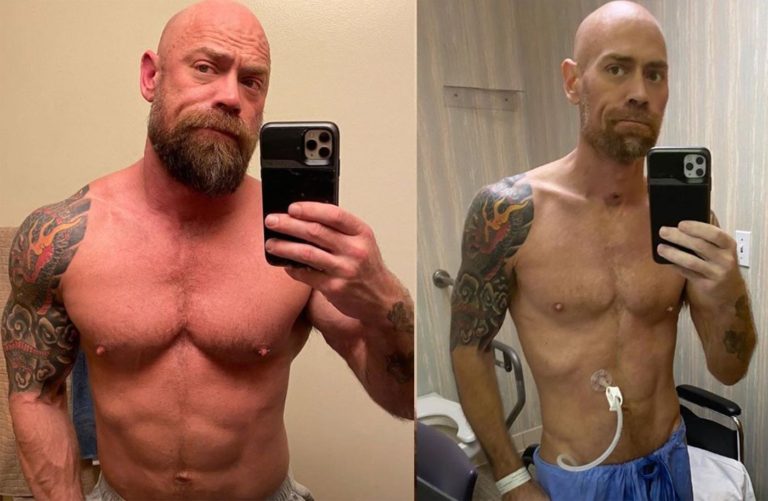
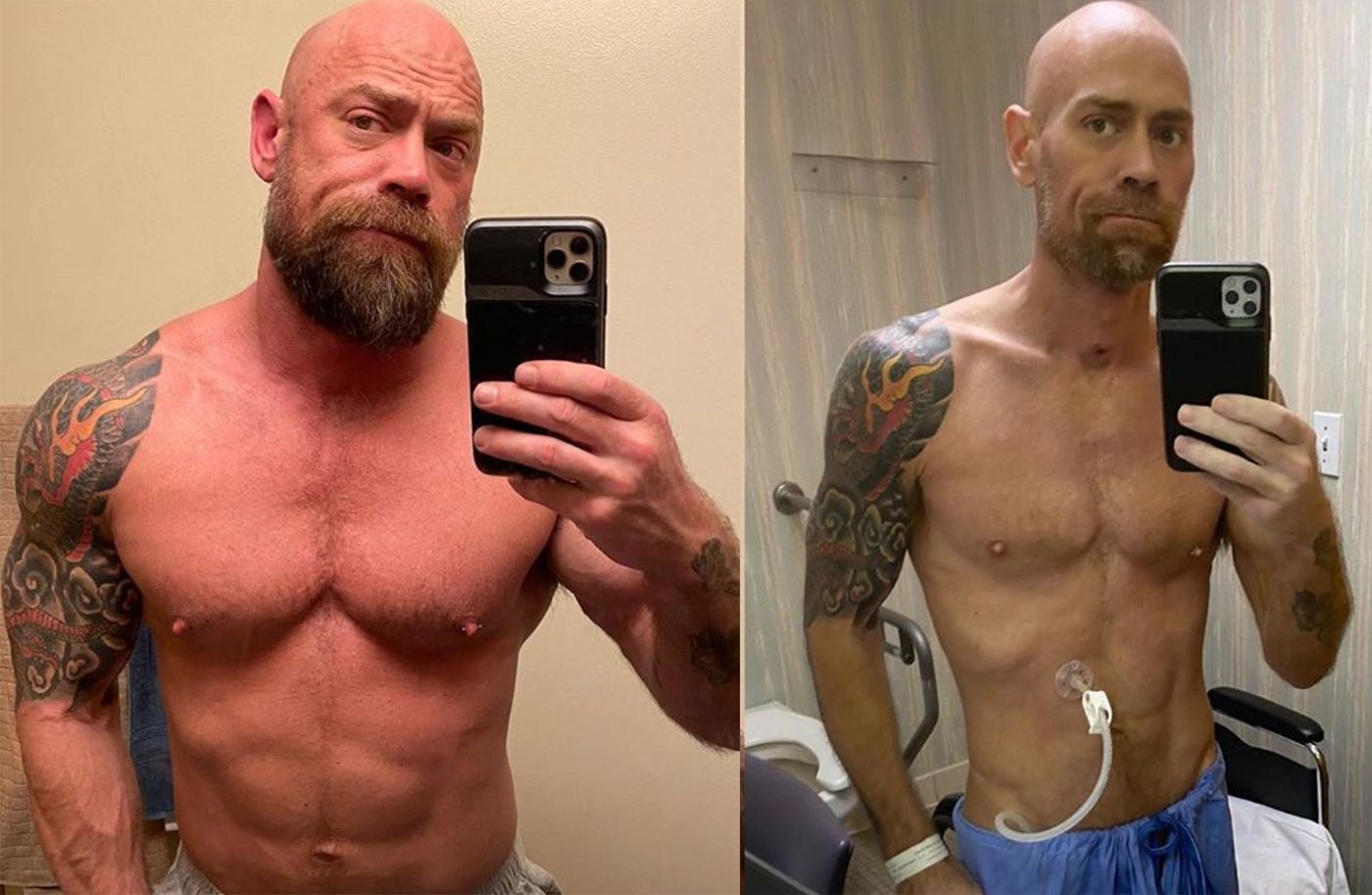
43-year-old registered nurse Mike Schultz made national headlines after posting before and after photos of himself — in one, he’s well-muscled and tan, the picture of the fit type of gay man who frequents annual dance events around the world known as circuit parties; in the other, following six weeks of being sedated and on a ventilator at a hospital in Boston, he’s gaunt and much thinner, having lost 50 pounds, and he said he was so weak he could barely stand to take the mirror selfie. He was featured on BuzzFeed, CNN, and on SFist, and he spoke about the pneumonia he suffered, brought on by the coronavirus, had perhaps permanently reduced his lung capacity.

The side-by-side images Schultz posted to Instagram in May.

Schultz was one of at least 38 gay men believed to have contracted COVID-19 at one of the last circuit parties to occur before the pandemic prompted worldwide lockdowns and the cancellation of most travel. The Winter Party in Miami, which occurred between March 4 and March 10 of last year, was a nationally noted super-spreading event among others that occurred in the weeks leading up to pandemic lockdowns, including Spring Break in Florida and Mardi Gras in New Orleans. But given the fact that COVID cases were already being widely reported by the time the Winter Party Festival occurred, organizers were called out in the gay media especially for not canceling the event — and Miami Beach City Manager Jimmy Morales later told the Miami Herald, after several deaths were linked to the party, that he wished he had decided to shut down the event in retrospect.

Last week, LGBTQ social media lit up with a scandal involving an Instagram account called @GaysOverCovid, which for weeks had been reposting other people’s photos and stories and shaming gay men who appeared to be continuing to gather in large groups, mostly maskless, despite surging coronavirus cases in California and elsewhere. The scandal began bubbling over in connection with one New Year’s Eve circuit party in particular that had already been shut down by the city of Puerto Vallarta in Mexico, just as the region’s ICU beds were filling up with COVID cases. Los Angeles-based promoter Jeffrey Sanker, the founder of the White Party in Palm Springs, went ahead with the event after selling thousands of tickets, relocating it to the nearby community of Nuevo Vallarta, and @gaysovercovid went about shaming Eventbrite for continuing to sell tickets to the weekend’s events, and shaming various attendees who posted photos of themselves in Mexico — including this ICU nurse from Los Angeles, and others.

Subsequently, a $500 reward was offered for anyone who could “out” the person or persons behind the GaysOverCovid account.

The party — and a schadenfreude moment in which a cocktail cruise boat carrying some attendees capsized on Friday — prompted wide-ranging discussions and debates about whether online shaming was appropriate when many of us have taken mitigated risks to celebrate holidays and escape the isolation that nine months of the pandemic has brought on. But in the case of healthcare workers especially, attending an event like this seems highly questionable, even if masks were ostensibly required for entry, given that the potential for further spreading the virus within the community and beyond is obvious.

Setting aside the fact that Schultz may still have antibodies and therefore immunity to the coronavirus (as a healthcare worker he also may have already received a vaccine dose), it seems irresponsible to publicly boast about going to Puerto Vallarta when public health officials far and wide are warning against travel and large gatherings, and to allegedly repost what you see below, as Instinct Magazine reports, in which another Instagram user calls out “haters” for raining on their fun, and refers to “survival of the fittest” with regard to the New Year’s Eve event.

Schultz’s Instagram story about heading to Puerto Vallarta, allegedly posted in early December, was screencapped and posted by Twitter user The Blessed Canadian on December 11. SFist can not independently confirm that the post was done by Schultz, but that appears to be him in the photo. His Instagram account, @thebearded_nurse, has been private since last May, because he said he was the victim of cyberbullying at the time.

Zack Ford, the press secretary for Alliance for Justice and a self-described queer social justice warrior, posted a thread to Twitter over the weekend about the Puerto Vallarta party/GaysOverCovid scandal. He specifically mentioned Schultz, saying, “Despite his stirring narrative about why we should take COVID seriously, Schultz apparently not only went to the PV party, but endorsed that it was ‘survival of the fittest,’ and is now trying to help out GaysOverCovid.” The gay blog CocktailsandCockTalk subsequently posted about Schultz and the Puerto Vallarta party, saying, “And that’s the thing with these personality types; as much as they dislike being ‘cancelled’, they like the attention even more. They think posting to their stories that they’re going on holiday during a pandemic makes people envious… it doesn’t.”

We can’t confirm whether Schultz actually ended up attending the party, but Instinct Magazine noted that he was apparently back at a circuit event somewhere just a month after leaving the hospital last May.

Hopefully Schultz and everyone else traveling back from Mexico are properly quarantining! And hopefully no one falls ill.

Opinion: LGBTQ+ discrimination and persecution in Eastern Europe requires international attention – The Eagle

0

In March of 2019, the leader of Poland’s ruling Law and Justice party, Jaroslaw Kaczynski, said in a speech to party leaders that the official platform on LGBTQ+ rights was, “not about tolerance,” ending his thoughts by emphatically yelling, “Stay away from our children!” In January 2019, the Russian LGBT Network reported that Chechen authorities detained at least 40 people in the previous weeks and killed two in a purge against LGBTQ+ residents

While it’s easy to dismiss these as similar but isolated incidents, they stand as a testament to the broader trend across Eastern Europe of persecuting LGBTQ+ persons under the guise of “traditional values.” Often cemented in religious or nationalist ideals, conservative parties such as Law and Justice in Poland and United Russia have evoked traditional values as a means of justifying discriminatory and often outright hateful agendas. 

What’s become increasingly clear over the last decade or so is a strong relationship between the rise of authoritarian regimes along with the evocation of “traditional values” in Eastern Europe and the scapegoating and persecution of LGBT persons and other sexual minorities. Less clear is what we can do to end the systematic human rights abuses or bring any meaningful form of justice. 

We’ve seen these values have been invoked in the passage of the infamous 2013 “gay propaganda” legislation in Russia, which obstensively banned any pro-LGBTQ+ sentiments in media or public discourse. The law has served as an anchorpoint for the intersection of traditional values and homophobia with lawmakers and activists alike using the law as validation that LGBTQ+ people pose a threat to the safety of their children and society as a whole. Similar homophobic overtones defined the declarations made by hundreds of municipalities in Poland that they were “LGBT-ideology free” areas. 

In politics, faith and public discourse, ‘traditional values’ have successfully managed to other LGBTQ+ persons, making them prime targets for persecution and abuse. Existing international human rights frameworks, such as the United Nations’ Convention on the Prevention and Punishment for the Crime of Genocide, fail to grant protected group status for gender and sexual minorities. This gap in protective status leaves LGBTQ+ people uniquely vulnerable to bias-motivated violence encouraged by far-right, authoritarian ideologies that identify homosexuals and gender nonconforming individuals as the source of nations’ misfortunes.

Tolerance for homosexuality varies considerably throughout the world, though the stark contrasts between public attitudes in Eastern and Western Europe highlight a significant point of concern for the future of anti-discrimination norms that outlaw violence against LGBTQ+ persons in the EU. Pew Research Center 2019 survery data assessing acceptance of homosexuality reveal median scores of 86% for Western European states and 46% for Central and Eastern European states.

Additionally, an analysis of legislation throughout Europe showcases another significant divergence between post-communist Europe and Western Europe. Conor O’Dwyer conducted a study of legislation using the International Lesbian, Gay, Bisexual, Trans and Intersex Association-Europe’s rights index, concluding that Europian Union member states are significantly more protective of LGBTQ+ persons.

While this legal analysis is confined to Europe, the results speak to potential implications for the future of LGBTQ+ rights globally. Article 21 of the EU Charter of Fundamental Rights explicitly prohibits discrimination on the basis of sexual orientation, and Article 19 of the Treaty on the Functioning of the EU allows action to be taken to prevent such discrimination in member states. However, Poland President Andrzej Duda has campaigned using rhetoric that called the LGBT “ideology” worse than communism, while municipalities throughout the country continue to implement so-called LGBT-free zones.

The response from the leadership of the EU has been inadequate in preventing further discrimination, and the decisions that the institution makes now in response to Poland’s aggression will chart the course for the trajectory of LGBTQ+ rights in Europe and beyond.

When nations assault LGBTQ+ rights with impunity within the world’s leading coalition of democracies, we set the stage for the perpetuation of atrocities similar to those currently underway in Chechnya, where the Russian government has aided in the facilitation of torture and execution of gay men under the reign of Ramzan Kadyrov, who heads Chechnya. 

Mass atrocity warning signs have mounted considerably since Russia’s anti-gay propaganda legislation went into effect and efforts were made to legitimize discriminatory actions under the facade of moral sovereignty. Should the international community fail to intervene now, the foundations for the erasure of LGBTQ+ identities through cultural and physical genocide will be irreversibly cemented in the same region as the Holocaust of WWII.

Jack Winstanley and Matthew Burke are master’s students in the School of International Service. Their opinions are their own and do not necessarily reflect the views of The Eagle and its staff.


More from The Eagle

SF gay bathhouse rule change delayed – Bay Area Reporter, America’s highest circulation LGBT newspaper

0

San Francisco health officials were supposed to rescind by January 1 the restrictions that have kept traditional gay bathhouses from operating in the city since the mid-1980s. But they failed to meet that deadline and have asked for a 30-day extension.

The Bay Area Reporter had inquired with the city’s Department of Public Health last week prior to the new year about the status of the rule revision for adult sex venues. Due to the holiday, with staff out on vacation, the department responded January 4 that it needed more time.

“DPH has requested a one-month extension for this work,” stated the department.

It did not explain the reason for the delay, but health officials have been dealing with a surge in COVID cases since November. As it is, bathhouses will not be allowed to operate in San Francisco until after the coronavirus outbreak subsides.

Local health officials have indefinitely extended their order requiring all nonessential employees to remain home and for residents to avoid traveling outside of the Bay Area. Those who do travel are asked to quarantine for 10 days upon their return.

Nearly a year ago gay District 8 Supervisor Rafael Mandelman instituted the process to revise the city’s bathhouse rules following decades of demands from gay men that they no longer made sense in light of advancements in preventing HIV transmission. People can now take PrEP to help keep them negative, while people living with HIV who are taking medication to control their viral loads are considered to be unable to transmit the virus.

Mandelman told the B.A.R. he has no issue with the delay in seeing the rule revision take place.

“With COVID-19 cases surging, the Department of Public Health understandably has more urgent priorities than updating the bathhouse rules,” Mandelman responded to a request for comment. “A one-month extension is a reasonable request and should still provide plenty of time for prospective operators to open new businesses that can be a part of the City’s economic recovery when it is safe to do so.”

Since the Board of Supervisors adopted the ordinance in July, Mandelman has received several messages attacking him for pushing to revise the bathhouse rules amid a global health pandemic. One message posted online in August by a group calling itself Recall California accused Mandelman of hypocrisy as “gym, salons, schools, churches closed. But, let’s go f**k some strangers.”

In an interview last month, Mandelman had told the B.A.R., “We are not reopening bathhouses while keeping restaurants closed.”

Coming during the height of the AIDS epidemic, the city’s bathhouse regulations required the businesses not to have private rooms with locked doors and to monitor the sex of their patrons. It in effect banned gay bathhouses from operating in San Francisco, leaving residents to have to travel to such businesses in Berkeley and in San Jose.

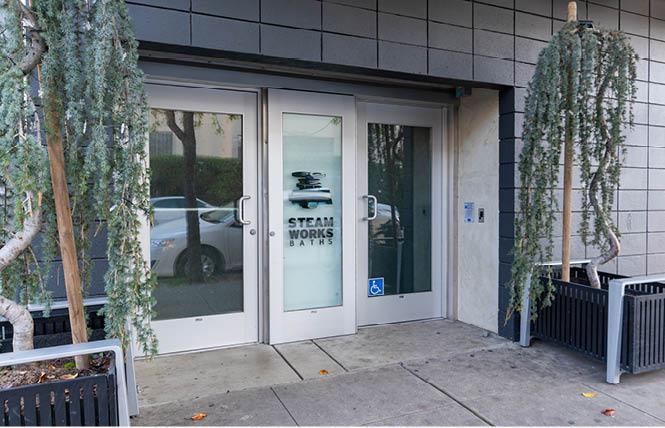
While The Watergarden in the South Bay shuttered for good last year due to the COVID pandemic requiring it to close, Steamworks in Berkeley is expected to reopen when the health crisis subsides. To date, there have been no announcements of a gay bathhouse operator wanting to open in San Francisco.

Blow Buddies, which had been one of San Francisco’s last two adult gay sex clubs, closed its doors last year because of COVID. Eros, the gay sex club in the Castro, had briefly reopened its doors when the city allowed certain businesses to reopen in late summer but at reduced capacity only for solo-play with patrons required to wear masks and remain socially distanced.

It is once again closed temporarily because of the rising COVID cases in San Francisco. A note on its website tells customers it is unknown when the Market Street sex club will be able to reopen.

When it does it is not expected to transition to being a bathhouse. The owners of Eros had told the B.A.R. last year they were unlikely to add locked, private rooms to their location.

Last month, Mandelman had suggested one location in the Castro that would be an ideal space for a gay bathhouse to seek permits to open in.

“The empty 24 Hour Fitness seems like an ideal site,” said Mandelman, referring to the now shuttered gym that happens to be a block away from Eros near the intersection of Market and Church streets.

UPDATED 1/4/2021 with comment from Supervisor Mandelman about the delay request.

Help keep the Bay Area Reporter going in these tough times. To support local, independent, LGBTQ journalism, consider becoming a BAR member.

Developers apologize for whitewashing LGBTQ activist mural in Philly – Billy Penn

0

💌 Love Philly? Sign up for the free Billy Penn email newsletter to get everything you need to know about Philadelphia, every day.


Developers who painted over the visage of an influential Latina LGBTQ activist in Philly’s ever-gentrifying Gayborhood apologized to the community on Monday.

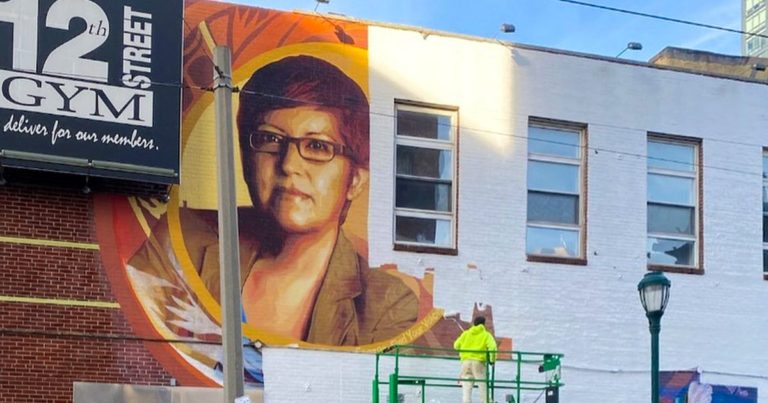
The late Gloria Casarez dedicated her life to helping people of color, queer people and those with HIV/AIDS. After her death, her image looked over the Gayborhood as a work of art, commemorated in a mural that graced the old 12th Street Gym for more than five years.

Until building owner Midwood Investment & Development whitewashed the brick wall at 12th and Walnut just before Christmas.

The move stunned LGBTQ activists and public art supporters in the city, even though the pending demolition of the building was known. Advocates had struck a deal with the developers to replace the Casarez mural with an even bigger tribute to queer people and people of color, but they’d hoped to salvage some of the original.

Midwood claims it did nothing unexpected. But outcry over the issue was loud enough that the situation was covered by national media outlets, including the Today Show. On the first day back at the office after the holidays, the company offered an apology.

“We are truly sorry for the pain we’ve caused Gloria’s family and the local LGBTQ community,” spokesperson James Yolles told Billy Penn.

Demolition on the building has reportedly begun, and Midwood says it’s still planning to move forward on the replacement tribute.

So who was Gloria Casarez? How long was the mural there? Will a new one get painted? Here’s how we got to this point, and how things stand going forward.

Gloria Casarez is known for ushering in a new era for LGBTQ equality in Philadelphia.

Born in South Philly and raised by a single mom, Casarez left a huge mark. She worked as executive director of the Philadelphia queer Latin@ org GALAEI for a decade and helped found the Philly Dyke March.

In 2008, she was appointed Philadelphia’s first director of the Office of LGBT Affairs. Casarez pioneered the tradition of raising a rainbow flag at City Hall during pride month, and she shepherded a comprehensive LGBTQ rights bill through City Council in 2013. With that bill, Philly became the first in the U.S. to provide tax credits for companies that offered domestic partner and trans health care benefits.

That’s not all. Casarez’s list of accomplishments is lengthy, and includes:

  • Advocating for the removal of gender stickers on SEPTA transpasses
  • Distributing an LGBTQ resource guide throughout Philadelphia public schools
  • Lobbying for tighter anti-bullying policy that was adopted by the School Reform Commission in 2009

HIV/AIDS nonprofit Philadelphia FIGHT recognized her instrumental work, bestowing her the Kiyoshi Kuromiya award for HIV/AIDS activism in 2011. They specifically called out her activism on behalf of queer Latinx youth as a major service to the community.

Casarez married her wife in 2011. Just three years later, she died at 45 years old from breast cancer. Since then, an LGBTQ affordable housing center was named after her — and the mural was painted in her honor.

In 2015, Philly artist Michelle Angela Ortiz was commissioned by Mural Arts to paint Gloria Casarez on the side of the 12th Street Gym. The tribute shows her face on the left, bathed in warm sunlight, next to activists and queer couples on the right.

It was the only mural depicting an LGBTQ woman of color in Philadelphia, a city with more than 3,000 such artworks.

Tourism bureau Visit Philly recommended newcomers check out the mural when visiting the city. It also became a regular location for LGBTQ activism — last year’s Transgender Day of Remembrance was hosted outside next to the artwork.

A little random, sure, but a mural honoring an LGBTQ icon actually made sense there.

The building on 12th Street south of Walnut was a historic Gayborhood spot. The 12th Street Gym was open nearly 30 years, and it was one of few welcoming fitness centers for gay men in the city. It often served as a safe meeting place for LGBTQ folks, which was rare in its early days.

Before that, the building was home to the Camac Baths — a spa-type space popular among Jewish men.

NYC-based Midwood bought the building in January 2018. By the end of the month, the 12th Street Gym had closed.

The exact reason the gym shut down is unclear, though the building’s handful of code violations likely had something to do with it.

Mural Arts executive director Jane Golden immediately expressed concern over the fate of the mural. She told the Inquirer she planned to repaint it somewhere else if the building were demolished.

The next two years were full of folks lobbying the developer to keep the mural in some way — but Midwood insisted it wanted to tear down the entire structure and build an apartment complex. Finally in 2020, Mural Arts and Midwood made a compromise.

Unwilling to abandon its plan to raise a new building, Midwood promised to make new art honoring Casarez.

Midwood released a December statement saying it had reached a deal with Ortiz, the artist, and Mural Arts to create something new. The company would pay $655,000 for the fresh artwork, which would honor Casarez and other “BIPOC [Black/Indigenous/People of Color] LGBTQ ancestors.” There’d be a tribute to abolitionist Henry Minton, who reportedly once owned the building.

Ortiz told the Inquirer she met with company CEO John Usdan in November to discuss salvaging some parts of the mural before the building were demolished.

Midwood spokesperson Yolles also said the company offered ground floor space to the LGBTQ community free of charge.

On Dec. 23, without any prior warning, people working for Midwood Investment & Development painted over the Casarez mural, turning the space into a blank white wall.

The incident shocked supporters, and Ortiz and Golden issued a joint statement. “Casarez was a beacon of hope and possibility for the LGBTQ and Latinx community,” they said. “With the loss of this iconic mural, we mourn the loss of Gloria all over again.”

Unclear. We reached out to Midwood, and they said the demolition had been publicly planned for nearly six months — but they didn’t explain why they painted over the mural first.

The developers told WHYY that they “intend to honor our agreement with Mural Arts. This process and demolition has been planned and approved for months.”

Everyone! A ton of people in Philly were outraged by the whitewashing of the Casarez mural.

The artist, Ortiz, showed up the same day with a projector and shined the beloved artwork on its old home. The Keep Gloria on 12th Street Facebook page posted a pic of a “Midwood sucks” sign on the fence surrounding the property.

Elected officials like Mayor Jim Kenney and Councilmember Mark Squilla expressed their surprise and disappointment over the artwork’s sudden disappearance.

Media outlets all over the world picked up the story, including the New York Daily News, the TODAY Show, and the Gay Times of the UK picked up the story.

Artist Ortiz and Mural Arts say they have backed out of their six-figure public art deal with Midwood.

“After this unexpected development, we cannot in good conscience move forward,” Golden’s statement read. “We are consumed with deep sadness shared by Gloria’s family, the community, and the artist.”

However, per the most recent statement provided Billy Penn, Midwood seems to believe the future collab will still come to fruition.

“We have worked actively in Philadelphia for more than two decades,” spokesperson Yolles said, “and look forward to fulfilling our agreement to honor the memory and legacy of Gloria Casarez and Henry Minton.”

Waves of people accuse out fashion designer Alexander Wang of being a sexual predator – LGBTQ Nation

Famed out fashion designer Alexander Wang is facing a wave of drug, rape, and assault accusations from several people in the fashion industry, going back as far as 2014. It started with model Owen Mooney, who shared his accusation on TikTok.

Since, more and more accusers stepped forward against Wang, with social media accounts dedicated to fashion industry research compiling them together over the holiday season.

Related: Kevin Spacey releases a strange Christmas video once again for those “who might be suffering”

In December, Mooney posted that while trying to maneuver the crowd at a party, an individual had began groping him, “fully up my leg, in my crotch.” He turned to see it was “really famous fashion designer,” who he did not name initially.

Responding to a follower’s question, Mooney shared the story of how a celebrity “was groping my dick in the club” in 2017.

“I was in a club in New York City, and … I was by myself at one point and this guy next to me obviously took advantage of the fact that no one could fucking move,” he recalled.

Mooney continues, “and he just started touching me up, fully up my leg, in my crotch, it made me freeze completely because I was in so much shock. And then I looked to my left to see who it was and it was this really famous fashion designer and I just couldn’t believe that he was doing that to me, it made me go into even more shock.

“It was really fucked up, and I just had to slowly move myself away.”

It was only later that Mooney shared that the designer in question was Alexander Wang, the founder of his self-named million-dollar fashion label, and a once-creative director of the luxury brand Balenciaga.

“I thought in the previous video, the better thing to do was just to not mention any names, but… turns out, Alexander Wang is a massive sexual predator, and there’s been a load of people he’s done this to. So, in that case, he needs to be exposed,” Mooney said in reaction to other users guessing and naming Wang as the likely perpetrator. Later, Mooney would add that Wang tried to hug and lean on him after trying to grope him.

“Alexander Wang is a sexual predator, pass it on,” Mooney captioned the TikTok post.

Trans model Gia Garison then came forward, accusing Wang of attempting to grope and undress her in 2017. “He tried to pull my panties down and expose my genitals in the VIP area… he was chilling with his posse and then reached for my bikini bottoms I was wearing and tried to tug them downwards.

These were not the first accusations made against Wang, who turned 37 on December 27th. As far back as 2019, Rapper Azealia Banks, among others, publicly shared stories they had learned of accusing Wang of harassing, raping, and sexually assaulting several people, specifically trans people and models.

Ryan Korban, an interior designer, was accused of being Wang’s “greasy sidekick” in at least one of the alleged acts.

Recent accusations to come to light also allege that Wang has drugged people, as he would give unknowing people “Molly water,” or liquid spiked with MDMA, a common form of ecstasy.

Accounts were found to recall events happening as far back as 2014, when Wang was still at Balenciaga and also collaborating with H&M. In 2015, Wang departed Balenciaga by “mutual consent” as opposed to renewing his contract, a press release read at the time.

“Alexander Wang is an alleged sexual predator, many male models and trans models have come out and spoken about the alleged sexual abuse that Alexander Wang has inflicted upon them,” the Instagram page @shitmodelmgmt wrote in a post this week.

From there, several in the modeling and fashion world or at organizations began distancing themselves from the famed fashion star. “We at the Model Alliance stand in solidarity with those who have shared accusations of sexual abuse by Alexander Wang,” the fashion advocacy organization wrote in an Instagram post.

Reports on the accusations began picking up. Business of Fashion reported speaking to five men who had similar alleged experiences where Wang took advantage of them. The Guardian spoke to a man known as Nick that accused Wang of drugging him and then performing fellatio on him.

Finally, Wang began issuing responses through statements on New Year’s Eve. Besides denying the accusations as “baseless and grotesquely false,” he derided the social media accounts relaying the mostly-anonymous claims.

“Seeing these lies about me being perpetuated as truths has been infuriating,” his statement through a representative read. “I have never engaged in the atrocious behavior described and would never conduct myself in the manner that’s been alleged. I intend to get to the bottom of this and hold accountable whoever is responsible for originating these claims and viciously spreading them online.”

In further comments, representatives for Wang said Mooney’s accusations of groping were incorrect. “Mooney is mistaken about who allegedly groped him,” they contend.

Mooney stands by his accusations, speaking further about the experiences. “It was not a case of him accidentally touching me because we were next to each other,” he asserted in emails with TODAY.com.

The NYPD declined to tell the New York Daily News whether or not they were prepared to start an investigation, or if any complaints had been filed.

“The NYPD takes sexual assault and rape cases extremely seriously, and urges anyone who has been a victim to file a police report so we can perform a comprehensive investigation, and offer support and services to survivors,” a department spokeswoman said.