
Home Blog Page 415

Rita Ora Leads Epic Entertainment Line-up For 2021 Sydney Gay And Lesbian Mardi Gras Parade | Scoop News – Scoop.co.nz

International chart-topping pop star Rita
Ora
heads up a superstar line-up of entertainment
planned for the 2021 Sydney Gay and Lesbian Mardi
Gras Parade
on Saturday 6 March
2021
.

The UK powerhouse behind hit tracks
“Anywhere” and new release “Big”, Ora
will light up the Sydney Cricket Ground
with her performance. Transforming the venue into a
sparkling showcase of LGBTQI+ culture and community, further
entertainment on the night will include soulful electronic
duo Electric Fields, ARIA Award-winning
art-pop songwriter Montaigne, and indie pop
darling G Flip presented by
TikTok.

“The Parade is such a special event for the
community,” said Mardi Gras CEO Albert
Kruger.
“It is a loud, proud and welcoming
celebration of community spirit and
connectedness.”

“The move to the SCG has presented
us with a unique opportunity to add to the spectacle of the
Parade with some truly awe-inspiring performances and we are
thrilled to have a world-wide superstar in Rita Ora join
this once-in-a-lifetime Parade. As always we have a few more
surprises in store for the night, so keep an eye out” said
Kruger.

The fun begins at 4pm when gates open to the
public. Audiences will be treated to two hours of pre-Parade
entertainment featuring renowned local DJs Kitty
Glitter
and Dan Murphy on the
decks. Hosts with the most, Bob Downe and
Julie McCrossin will add to the exciting
atmosphere with witty banter, historical anecdotes and more
than a few laughs, before crossing over to Nell
Schofield
and Kyle Olsen who’ll
voiceover the Parade live.

A very special
Welcome to Country curated by Ben
Graetz will be performed at 6pm featuring
Aunty Yvonne Weldon, singer/songwriter
Scott Hunter, plus Koomurri
dancers, NAISDA dancers,
and Buuja
Butterfly dancers.

Then at 6:30pm the crowd
will be revved up as the Dykes on Bikes
take to the stadium on their hogs to perform a lap,
heralding the start of the glittering Parade, led with the
First Nations and 78ers
floats.

A limited final release of tickets to
watch the Parade live from the Sydney Cricket Ground go on
sale from 2pm AEDT today at www.mardigras.org.au.

For
those that can’t join the action at the SCG,
Parade partner SBS will be broadcasting the
Parade live so audiences around Australia can watch from
home, or at one of many Parade viewing events taking place
in venues across the country.

THE
DETAILS

What: 2021 Sydney Gay and
Lesbian Mardi Gras Parade
Where: Sydney
Cricket Ground (SCG) + live broadcast on
SBS
When: Saturday 6 March,
2021
Tickets: Adults $20, Group bookings
of four $50, Children under 15 or concession
$15
More info: www.mardigras.org.au

Watch
the
2021 Sydney Gay and Lesbian Mardi
Gras
live on Saturday 6 March from 6pm
AEDT on SBS On Demand, or catch the full Parade at 7:30pm
AEDT on SBS and NITV.

ABOUT SYDNEY
GAY AND LESBIAN MARDI GRAS

Sydney Gayand
Lesbian Mardi Gras is the non-for-profit member-based
organisation that produces the Sydney Gay and Lesbian Mardi
Gras Parade and Festival as well as a number of other events
throughout the year. SGLMG exists primarilyto develop the
Sydney Gay and Lesbian Mardi Gras for the benefit of
Sydney’s LGBTQI+ community, the enjoyment of a wider
audience and as a global beacon of diversity, acceptance and
LGBTQI+ rights.

ARTIST BIOS

Rita
Ora

Rita Ora is an international critically acclaimed
singer-songwriter with four #1 UK singles and holds the
record for the most Top 10 singles for a British female
artist in the UK in history with a total of 13. In 2021, she
launched the global collaboration Bang, with GRAMMY
nominated Kazakh DJ and record producer Imanbek. Written and
produced over Zoom by Rita and Imanbek and featuring David
Guetta, Gunna and Argentinian rapper KHEA, the four track EP
is a mix of modern pop, 80s and 90s club culture and
floor-filling house. The EP is the follow up to her album
Phoenix, which has amassed over 3.7 billion streams
worldwide, spawned 3 platinum singles and includes “Lonely
Together,” her collaboration with Avicii which won “Best
Dance” VMA at the MTV Video Music Awards. In addition, her
debut album, Ora, debuted at #1 on the UK charts and
was certified platinum.

G Flip

If you aren’t
familiar with G Flip yet, you will be soon. The Melbourne,
Australia based drummer, singer producer, and self-taught
writer has been making waves overseas for the past 2 years.
Since her debut hit ‘About You’ took her from Melbourne
bedroom producer to national superstar earning global
attention from triple j, Pitchfork, Pigeons & Planes,
Gorilla vs. Bear, and Line of Best Fit.

Fast forward 2
years and G has sold out all 5 of her Australian headline
tours, been nominated for 3x ARIA awards (Australian
equivalent to the Billboard Music Awards) and has played
across the world at festivals like Neon Lights,
Lollapalooza, Splendour In The Grass, Laneway Festival,
& SXSW.

Her debut album ‘About Us’ (August
2019) debuted at #1 on the ARIA vinyl charts & #6
digitally, was a triple j feature album of the week and
earned praise from Rolling Stone, NME and
more–earning over 110 million streams globally.

In
2020, G Flip returned with singles ‘Hyperfine’, ‘You
& I’ and ‘I’D RATHER GO TO BED’ and has remained
a radio darling and fan favorite back home in Australia. In
2021, G Flip goes global with a few international
collaborations tucked under her sleeve. The first of which
kicks off in January 2021, features US indie pop darling
mxmtoon, the two join together on female anthem ‘Queen’.
The song which is inspired by drag culture is produced by
Rostam Batmanglij (HAIM,
Clairo).

Montaigne
The voice of
the new generation, Sydney based artist Montaigne (born Jess
Cerro) at only 24 has become a major name in Aussie indie
music. The past few years have seen her recognised for her
work with multiple spots on the triple j’s Hottest 100, an
ARIA award for ‘Best Breakthrough Artist’ and a further
nomination for ‘Best Female Artist’ in 2016, plus
J-Award nominations. Her debut album ‘Glorious Heights’
(produced by Tony Buchen) hit the charts at #4 and her
sophomore album ‘COMPLEX’ was released in 2019 to rave
reviews. Singles such as ‘Ready’ gained extensive
commercial radio play and propelled her even further into
prominence. As Craig Mathieson of the Sydney Morning Herald
put it, ‘Montaigne creates music that has a thrilling
waywardness, baroque pomp and storm-the-stage
energy.’

Just off her third national tour, Montaigne
has played notable festivals like Splendour in the Grass,
Lost Paradise, Woodford Folk Festival, Groovin the Moo,
Party in the Paddock, Field Day and WOMADelaide. Having
opened for international acts like Cindy Lauper and Blondie,
this young performer continues to garner high praise for her
stunning live presence. ‘Her performance will go down as
one of the best concerts of the year, without a doubt,’
wrote The Music of her most recent Sydney show, ‘and we
were lucky to bear witness to the chrysalis.’

Having
just taken out the Eurovision: Australia Decides 2020
competition, Montaigne will be bringing her latest single
‘Don’t Break Me’ to represent Australia on the world
stage at Rotterdam in May of next year. Her challenging and
inspiring lyrics are reminiscent of the philosopher who
inspired her moniker. With melodies to get lost in, and the
most energetic of live performances – Montaigne represents
the next generation of artists who march to the beat of
their own drum.

Electric Fields

Multi-award
winning Electric Fields create a striking and
haunting merging of living traditional culture with
electronic music, bringing moments of breathtaking beauty
and power to the stage. Featuring the rare and beautiful
voice of Zaachariaha Fielding – who often sings in his
traditional languages of the Anangu people – and the
brilliance of producer Michael Ross – Electric Fields
music ranges from soulful pop, to epic-scale electronic
works, through to intensely intimate story-songs. Named as
finalist for the ARIA Awards 2019’s Best Australian
Live Act, Electric Fields
took out 7 awards in Dec 2019
– the 3 top spots for the National Live Music Awards:
Best Live Act, Best Live Voice, and Electronic Act
of the Year;
the National Dreamtime Award; the
Corner Award,
and two South Australian Music Awards.
Coming close 2nd in Eurovision: Australia Decides,
they trended worldwide on Twitter at #7 within minutes
of their performance. Featured in Vogue Magazine as
movers for Next Gen, during 2019 they played for
Apple, the APRA Awards, SPOTIFY’s Front Left
showcase, Splendour in the Grass, Vogue
Magazine, and launched their first self-curated
national tour, with sell-out shows across
Australia.

Julie McCrossin

Julie McCrossin
gets people talking. After over 20 years as a broadcaster
with ABC Radio National, ABC TV and Network Ten, she is now
a freelance journalist and broadcaster. Julie also
facilitates conferences and seminars. Julie has
qualifications in the arts, education and law. After
treatment for stage four throat cancer in 2013, Julie is now
an Ambassador for Head & Neck Cancer Australia (formerly
BeyondFive), Targeting Cancer and TROG Cancer Research.
Julie hosts the podcast series, The Thing About Cancer and
The Thing About Advanced Cancer for Cancer Council NSW.
Julie also hosts the new podcast series produced for
patients and family members by Head & Neck Cancer
Australia. In 2019, Julie was awarded a Member of the Order
of Australia for significant service to the community,
particularly through LGBTIQ advocacy roles and to the
broadcast media.

Bob Downe

Bob Downe is one of
Australia’s most loved and enduring comedy characters, the
creation of journalist, comedian, actor and broadcaster MARK
TREVORROW.

Mark created BOB DOWNE in September 1984 at
the Glebe Food Fair in Sydney, and has toured the world as
the Prince of Polyester ever since – including a nomination
for Best Newcomer at the inaugural Melbourne International
Comedy Festival (1987), a Glasgow Mayfest Award (1994),
consecutive Melbourne Green Room Awards for Best Cabaret
Artiste (1999 & 2000), five sellout Sydney Opera House
seasons and 18 Edinburgh Fringe festivals. In 2013 he was
presented with another Green Room Award, for Lifetime
Achievement in Cabaret. Bob’s 2014 production show, BOB
SWEAT & TEARS was nominated for four more Green Room
Awards.

Bob has been headlining regularly since 2016
on P&O Comedy Cruises around Australia and
NZ.

Bob’s multiple Australian and U.K. television
credits include hosting the SYDNEY GAY & LESBIAN MARDI
GRAS PARADE broadcast a total of nine times. Other TV
credits include hosting KARAOKE DOKEY (Foxtel, 2007), THE
BOB DOWNE SHOW (TV1/Foxtel Australia, 2000-01), FABULOUS,
FAMOUS & FORGOTTEN (Network Ten, 2000), BOB DOWNE ALL
OVER BRITAIN (BBC/UK Play, 1998), THE BOB DOWNE SPECIAL (ITV
UK, 1996), THE ROYAL VARIETY PERFORMANCE (ITV, 1995) and BOB
DOWNE UNDER (LWT,
1991).

© Scoop Media

Rita Ora Leads Epic Entertainment Line-up For 2021 Sydney Gay And Lesbian Mardi Gras Parade – Scoop.co.nz

International chart-topping pop star Rita
Ora
heads up a superstar line-up of entertainment
planned for the 2021 Sydney Gay and Lesbian Mardi
Gras Parade
on Saturday 6 March
2021
.

The UK powerhouse behind hit tracks
“Anywhere” and new release “Big”, Ora
will light up the Sydney Cricket Ground
with her performance. Transforming the venue into a
sparkling showcase of LGBTQI+ culture and community, further
entertainment on the night will include soulful electronic
duo Electric Fields, ARIA Award-winning
art-pop songwriter Montaigne, and indie pop
darling G Flip presented by
TikTok.

“The Parade is such a special event for the
community,” said Mardi Gras CEO Albert
Kruger.
“It is a loud, proud and welcoming
celebration of community spirit and
connectedness.”

“The move to the SCG has presented
us with a unique opportunity to add to the spectacle of the
Parade with some truly awe-inspiring performances and we are
thrilled to have a world-wide superstar in Rita Ora join
this once-in-a-lifetime Parade. As always we have a few more
surprises in store for the night, so keep an eye out” said
Kruger.

The fun begins at 4pm when gates open to the
public. Audiences will be treated to two hours of pre-Parade
entertainment featuring renowned local DJs Kitty
Glitter
and Dan Murphy on the
decks. Hosts with the most, Bob Downe and
Julie McCrossin will add to the exciting
atmosphere with witty banter, historical anecdotes and more
than a few laughs, before crossing over to Nell
Schofield
and Kyle Olsen who’ll
voiceover the Parade live.

A very special
Welcome to Country curated by Ben
Graetz will be performed at 6pm featuring
Aunty Yvonne Weldon, singer/songwriter
Scott Hunter, plus Koomurri
dancers, NAISDA dancers,
and Buuja
Butterfly dancers.

Then at 6:30pm the crowd
will be revved up as the Dykes on Bikes
take to the stadium on their hogs to perform a lap,
heralding the start of the glittering Parade, led with the
First Nations and 78ers
floats.

A limited final release of tickets to
watch the Parade live from the Sydney Cricket Ground go on
sale from 2pm AEDT today at www.mardigras.org.au.

For
those that can’t join the action at the SCG,
Parade partner SBS will be broadcasting the
Parade live so audiences around Australia can watch from
home, or at one of many Parade viewing events taking place
in venues across the country.

THE
DETAILS

What: 2021 Sydney Gay and
Lesbian Mardi Gras Parade
Where: Sydney
Cricket Ground (SCG) + live broadcast on
SBS
When: Saturday 6 March,
2021
Tickets: Adults $20, Group bookings
of four $50, Children under 15 or concession
$15
More info: www.mardigras.org.au

Watch
the
2021 Sydney Gay and Lesbian Mardi
Gras
live on Saturday 6 March from 6pm
AEDT on SBS On Demand, or catch the full Parade at 7:30pm
AEDT on SBS and NITV.

ABOUT SYDNEY
GAY AND LESBIAN MARDI GRAS

Sydney Gayand
Lesbian Mardi Gras is the non-for-profit member-based
organisation that produces the Sydney Gay and Lesbian Mardi
Gras Parade and Festival as well as a number of other events
throughout the year. SGLMG exists primarilyto develop the
Sydney Gay and Lesbian Mardi Gras for the benefit of
Sydney’s LGBTQI+ community, the enjoyment of a wider
audience and as a global beacon of diversity, acceptance and
LGBTQI+ rights.

ARTIST BIOS

Rita
Ora

Rita Ora is an international critically acclaimed
singer-songwriter with four #1 UK singles and holds the
record for the most Top 10 singles for a British female
artist in the UK in history with a total of 13. In 2021, she
launched the global collaboration Bang, with GRAMMY
nominated Kazakh DJ and record producer Imanbek. Written and
produced over Zoom by Rita and Imanbek and featuring David
Guetta, Gunna and Argentinian rapper KHEA, the four track EP
is a mix of modern pop, 80s and 90s club culture and
floor-filling house. The EP is the follow up to her album
Phoenix, which has amassed over 3.7 billion streams
worldwide, spawned 3 platinum singles and includes “Lonely
Together,” her collaboration with Avicii which won “Best
Dance” VMA at the MTV Video Music Awards. In addition, her
debut album, Ora, debuted at #1 on the UK charts and
was certified platinum.

G Flip

If you aren’t
familiar with G Flip yet, you will be soon. The Melbourne,
Australia based drummer, singer producer, and self-taught
writer has been making waves overseas for the past 2 years.
Since her debut hit ‘About You’ took her from Melbourne
bedroom producer to national superstar earning global
attention from triple j, Pitchfork, Pigeons & Planes,
Gorilla vs. Bear, and Line of Best Fit.

Fast forward 2
years and G has sold out all 5 of her Australian headline
tours, been nominated for 3x ARIA awards (Australian
equivalent to the Billboard Music Awards) and has played
across the world at festivals like Neon Lights,
Lollapalooza, Splendour In The Grass, Laneway Festival,
& SXSW.

Her debut album ‘About Us’ (August
2019) debuted at #1 on the ARIA vinyl charts & #6
digitally, was a triple j feature album of the week and
earned praise from Rolling Stone, NME and
more–earning over 110 million streams globally.

In
2020, G Flip returned with singles ‘Hyperfine’, ‘You
& I’ and ‘I’D RATHER GO TO BED’ and has remained
a radio darling and fan favorite back home in Australia. In
2021, G Flip goes global with a few international
collaborations tucked under her sleeve. The first of which
kicks off in January 2021, features US indie pop darling
mxmtoon, the two join together on female anthem ‘Queen’.
The song which is inspired by drag culture is produced by
Rostam Batmanglij (HAIM,
Clairo).

Montaigne
The voice of
the new generation, Sydney based artist Montaigne (born Jess
Cerro) at only 24 has become a major name in Aussie indie
music. The past few years have seen her recognised for her
work with multiple spots on the triple j’s Hottest 100, an
ARIA award for ‘Best Breakthrough Artist’ and a further
nomination for ‘Best Female Artist’ in 2016, plus
J-Award nominations. Her debut album ‘Glorious Heights’
(produced by Tony Buchen) hit the charts at #4 and her
sophomore album ‘COMPLEX’ was released in 2019 to rave
reviews. Singles such as ‘Ready’ gained extensive
commercial radio play and propelled her even further into
prominence. As Craig Mathieson of the Sydney Morning Herald
put it, ‘Montaigne creates music that has a thrilling
waywardness, baroque pomp and storm-the-stage
energy.’

Just off her third national tour, Montaigne
has played notable festivals like Splendour in the Grass,
Lost Paradise, Woodford Folk Festival, Groovin the Moo,
Party in the Paddock, Field Day and WOMADelaide. Having
opened for international acts like Cindy Lauper and Blondie,
this young performer continues to garner high praise for her
stunning live presence. ‘Her performance will go down as
one of the best concerts of the year, without a doubt,’
wrote The Music of her most recent Sydney show, ‘and we
were lucky to bear witness to the chrysalis.’

Having
just taken out the Eurovision: Australia Decides 2020
competition, Montaigne will be bringing her latest single
‘Don’t Break Me’ to represent Australia on the world
stage at Rotterdam in May of next year. Her challenging and
inspiring lyrics are reminiscent of the philosopher who
inspired her moniker. With melodies to get lost in, and the
most energetic of live performances – Montaigne represents
the next generation of artists who march to the beat of
their own drum.

Electric Fields

Multi-award
winning Electric Fields create a striking and
haunting merging of living traditional culture with
electronic music, bringing moments of breathtaking beauty
and power to the stage. Featuring the rare and beautiful
voice of Zaachariaha Fielding – who often sings in his
traditional languages of the Anangu people – and the
brilliance of producer Michael Ross – Electric Fields
music ranges from soulful pop, to epic-scale electronic
works, through to intensely intimate story-songs. Named as
finalist for the ARIA Awards 2019’s Best Australian
Live Act, Electric Fields
took out 7 awards in Dec 2019
– the 3 top spots for the National Live Music Awards:
Best Live Act, Best Live Voice, and Electronic Act
of the Year;
the National Dreamtime Award; the
Corner Award,
and two South Australian Music Awards.
Coming close 2nd in Eurovision: Australia Decides,
they trended worldwide on Twitter at #7 within minutes
of their performance. Featured in Vogue Magazine as
movers for Next Gen, during 2019 they played for
Apple, the APRA Awards, SPOTIFY’s Front Left
showcase, Splendour in the Grass, Vogue
Magazine, and launched their first self-curated
national tour, with sell-out shows across
Australia.

Julie McCrossin

Julie McCrossin
gets people talking. After over 20 years as a broadcaster
with ABC Radio National, ABC TV and Network Ten, she is now
a freelance journalist and broadcaster. Julie also
facilitates conferences and seminars. Julie has
qualifications in the arts, education and law. After
treatment for stage four throat cancer in 2013, Julie is now
an Ambassador for Head & Neck Cancer Australia (formerly
BeyondFive), Targeting Cancer and TROG Cancer Research.
Julie hosts the podcast series, The Thing About Cancer and
The Thing About Advanced Cancer for Cancer Council NSW.
Julie also hosts the new podcast series produced for
patients and family members by Head & Neck Cancer
Australia. In 2019, Julie was awarded a Member of the Order
of Australia for significant service to the community,
particularly through LGBTIQ advocacy roles and to the
broadcast media.

Bob Downe

Bob Downe is one of
Australia’s most loved and enduring comedy characters, the
creation of journalist, comedian, actor and broadcaster MARK
TREVORROW.

Mark created BOB DOWNE in September 1984 at
the Glebe Food Fair in Sydney, and has toured the world as
the Prince of Polyester ever since – including a nomination
for Best Newcomer at the inaugural Melbourne International
Comedy Festival (1987), a Glasgow Mayfest Award (1994),
consecutive Melbourne Green Room Awards for Best Cabaret
Artiste (1999 & 2000), five sellout Sydney Opera House
seasons and 18 Edinburgh Fringe festivals. In 2013 he was
presented with another Green Room Award, for Lifetime
Achievement in Cabaret. Bob’s 2014 production show, BOB
SWEAT & TEARS was nominated for four more Green Room
Awards.

Bob has been headlining regularly since 2016
on P&O Comedy Cruises around Australia and
NZ.

Bob’s multiple Australian and U.K. television
credits include hosting the SYDNEY GAY & LESBIAN MARDI
GRAS PARADE broadcast a total of nine times. Other TV
credits include hosting KARAOKE DOKEY (Foxtel, 2007), THE
BOB DOWNE SHOW (TV1/Foxtel Australia, 2000-01), FABULOUS,
FAMOUS & FORGOTTEN (Network Ten, 2000), BOB DOWNE ALL
OVER BRITAIN (BBC/UK Play, 1998), THE BOB DOWNE SPECIAL (ITV
UK, 1996), THE ROYAL VARIETY PERFORMANCE (ITV, 1995) and BOB
DOWNE UNDER (LWT,
1991).

© Scoop Media

Trump Years Were Terrifying For Gay Asylum-Seeker – NPR

Liam at a golf course in his college town shortly after he arrived in the United States. courtesy of Liam hide caption

toggle caption

courtesy of Liam

Liam at a golf course in his college town shortly after he arrived in the United States.

courtesy of Liam

Liam first realized he liked men while watching the music video for Ricky Martin’s “Livin’ La Vida Loca” as a young child.

“I knew there was something wrong because everyone was talking about the girls, but I didn’t find them attractive. I was just looking at Ricky Martin,” he says.

Liam is not his real name. We’re using it because exposing his sexuality could put his family in danger back home. Azerbaijan, where he grew up, is a small, predominantly Muslim country. It’s a conservative, authoritarian state where honor killings still occur. Although homosexuality was legalized in 2000, LGBTQ advocacy group ILGA Europe has repeatedly rated it the worst country for gay people in Europe. In 2017 and 2019 Azerbaijani police carried out a series of anti-LGBTQ+ raids in the capital Baku.

Tamara Grigoryeva is a U.S.-based Azerbaijani journalist and former human rights activist who documented the raids.

“At any time, you can be exposed. At any time, someone you think is a friend can betray you, call the police or out you to the public,” she says.

Liam suffered a lot as a child and adolescent. His father found personal messages exposing Liam’s sexuality and threatened to kill him. By the time he graduated from high school, Liam felt he wouldn’t survive if he stayed in Azerbaijan.

“I was thinking what do I do? How do I leave this country?” he says.

He decided to go to college in the United States. At age 21, he applied for political asylum.

“I was feeling so happy you can’t even imagine,” he says.

It was 2016, Barrack Obama was still president, and Liam felt confident about his case.

Corey Offsey, who worked as an asylum officer in the New York area from 2016 to 2018, says Liam had every reason to feel that way, “that, on paper, is a slam dunk case.”

But a lot has changed since Liam applied. The Trump administration overhauled the asylum system, making it much more difficult to qualify. In 2018, U.S. Citizenship and Immigration Services switched to a “last in first out” policy, which prioritized recent arrivals over pending applications like Liam’s and extended interview waits to as long as six or seven years for some asylum seekers. Liam, who’s been waiting for more than four, says he was so terrified by the Trump administration’s policy changes and rhetoric that he was plagued by insomnia, thinking,

“What’s going to happen at night? Will ICE come and arrest me or, are any rules going to be changed tomorrow?” he says.

Liam’s attorney, Sumaiya Khalique, says the past four years have been agonizing for her asylum clients.

“You can’t relax because one day you think you have a strong claim and then the next day it’s not. And what do you do? It was a very discouraging and disheartening time,” she says.

The Biden administration has promised to reverse the changes, but it’s unclear how long the process will take. A federal court recently blocked a last-minute asylum rule that was scheduled to take effect in January. It would have been detrimental for cases like Liam’s, and difficult to repeal. But, there are other last-minute changes that may go through.

Liam is feeling optimistic with Biden officially in the White House. But, he says the stress of awaiting asylum during the Trump years has taken a physical toll. He’s gained more than 100 pounds and it’s causing health problems — diabetes, trouble breathing, pain in his ankles.

“I feel like since applying for asylum, I got older, like for 20 years. That’s how I feel mentally, because that’s so exhausting,” he says.

Miami Heat rumors: Team interested in Rudy Gay trade ahead of 2021 trade deadline – Sportsnaut

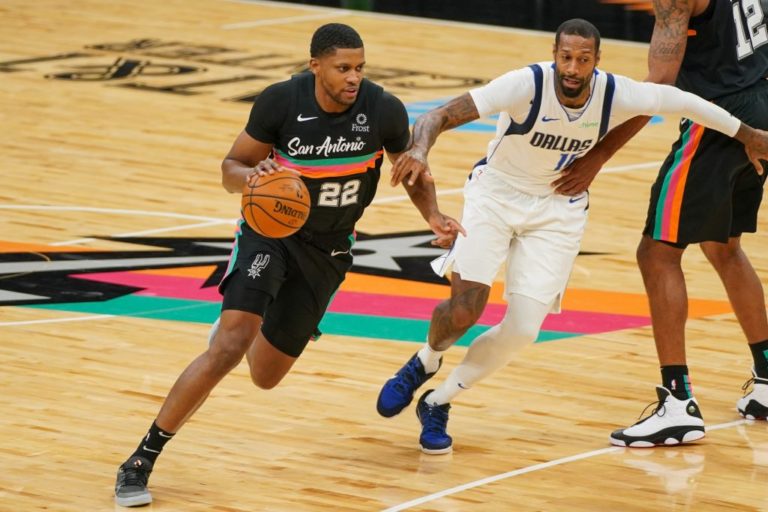
Jan 15, 2020; Miami, Florida, USA; San Antonio Spurs forward Rudy Gay (22) is guarded by Miami Heat forward Jimmy Butler (22) at American Airlines Arena. Mandatory Credit: Steve Mitchell-USA TODAY Sports

The Miami Heat take on the Golden State Warriors as they look to turn around their luck after two losses to the Utah Jazz and an under-manned Los Angeles Clippers team. After these two losses, Heat fans have been clamoring for a trade to improve the team and according to one network, the Heat are interested in just that.

According to Five Reasons Sports Network, the Miami Heat are interested in a trade for San Antonio Spurs forward Rudy Gay. The 34-year-forward has averaged 11.2 points, 5.2 rebounds, and 1.5 assists in 22.0 minutes off of the bench for the Spurs.

The Heat trading for Gay would solve their situation at power forward, as he is 6 feet and 8 inches, with great defensive play. On the flip side, how Gay would help Miami’s offense is a big question.

Read More: Miami Heat showing interest in Sacramento Kings forward Nemanja Bjelica

How would Rudy Gay help the Miami Heat on offense and defense?

Rudy Gay has been pretty good defensively this season, but the offense is where it is lacking. Gay is shooting 41.9% from the field and 36.6% from beyond the arc. That would the lowest field goal percentage for Gay since the 2012-2013 season.

That would not be something the Miami Heat would like considering they need significant help on offense most nights. If this was their only move of the trade deadline, maybe they could solely focus on the defensive end and try to make do on offennse the rest of the season.

Gay has been good on defense in the 22.0 minutes he has played per game this season. Gay has a 98.7 defensive rating, which would rank as the best rating on the Heat this season, even over superstar Jimmy Butler. While Gay hasn’t played that much compared to Butler, it’s still notable to point out.

Gay also has a defended field goal percentage of 42.8, which is the same as his Spurs teammate Patty Mills. For comparison, Butler has a defended field goal percentage of 39.4%. When you look at it, the Heat would definitely bring in Gay because of his tremendous defensive abilities.

Related: NBA defensive rankings – Thibs’ Knicks No. 1, Lakers hang tough

What would the Miami Heat need to trade for Rudy Gay?

What would the Miami Heat need to trade for Rudy Gay?
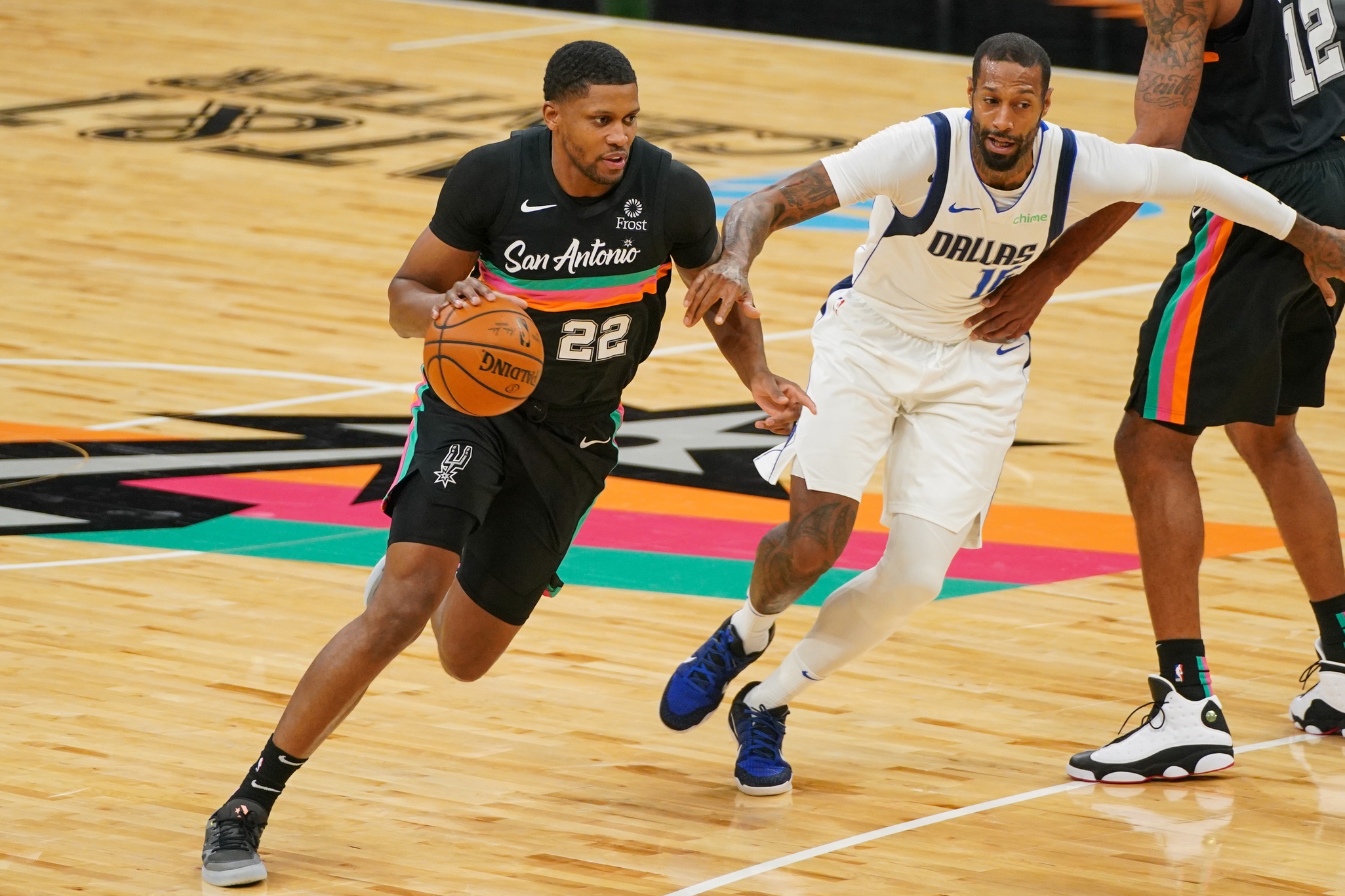
Jan 22, 2021; San Antonio, Texas, USA; San Antonio Spurs forward Rudy Gay (22) drives past Dallas Mavericks forward James Johnson (16) in the first half at the AT&T Center. Mandatory Credit: Daniel Dunn-USA TODAY Sports

Rudy Gay is on an expiring contract with a $14.0 million salary for the rest of the 2021 season. There is a good chance that Kelly Olynyk could be included in a deal due to his salary matching up with Gay at around $12.0 million. That’s an idea situation for the Miami Heat.

The Heat could send Olynyk, KZ Okpala, and a 2022 second-round pick to the Spurs for Gay straight up, and call it a good deal. The Spurs would most likely want some compensation for Gay and it’s clear that Olynyk and a second-round pick aren’t enough, unless there are no other offers.

The deal can be done without Okpala, but if there are other teams involved, it would look to be okay to have him included. Maybe, the Heat don’t feel the same way, but that’s what makes sense from an outside viewpoint when you are looking at the trade.

It’s clear the Miami Heat need some help at the power forward position, which is what I touched on in a previous piece, so it would make sense that the team is looking at Gay or possibly his teammate LaMarcus Aldridge.

There are still many hurdles because Gay isn’t going to fix the team. The Heat will need to be active on the trade market and buyout market if they want to truly contend this season. If the Heat would truly be interested in Andre Drummond if he was bought out, that would be one of the biggest pickups they can make.

The Heat also need another scorer, which Victor Oladipo could solve. Oladipo has eyed Miami for years now and it’s clear that he would love to be here. It’s up to the Heat to make moves and not stand pat if they want to really compete for another NBA Finals this season.

Related: NBA games today – TV schedule, best bets and fantasy picks

‘Twilight’s Kiss’ review: A tender Hong Kong gay love story – Los Angeles Times

Although numerous films and TV shows have featured older LGBTQ couples — “Cloudburst,” “Love Is Strange,” “Vicious” and the current “Supernova,” to name a few — the Hong Kong locale of “Twilight’s Kiss” makes writer-director Ray Yeung’s gently observant, deliberately-paced drama about two aging gay men feel uniquely profound.

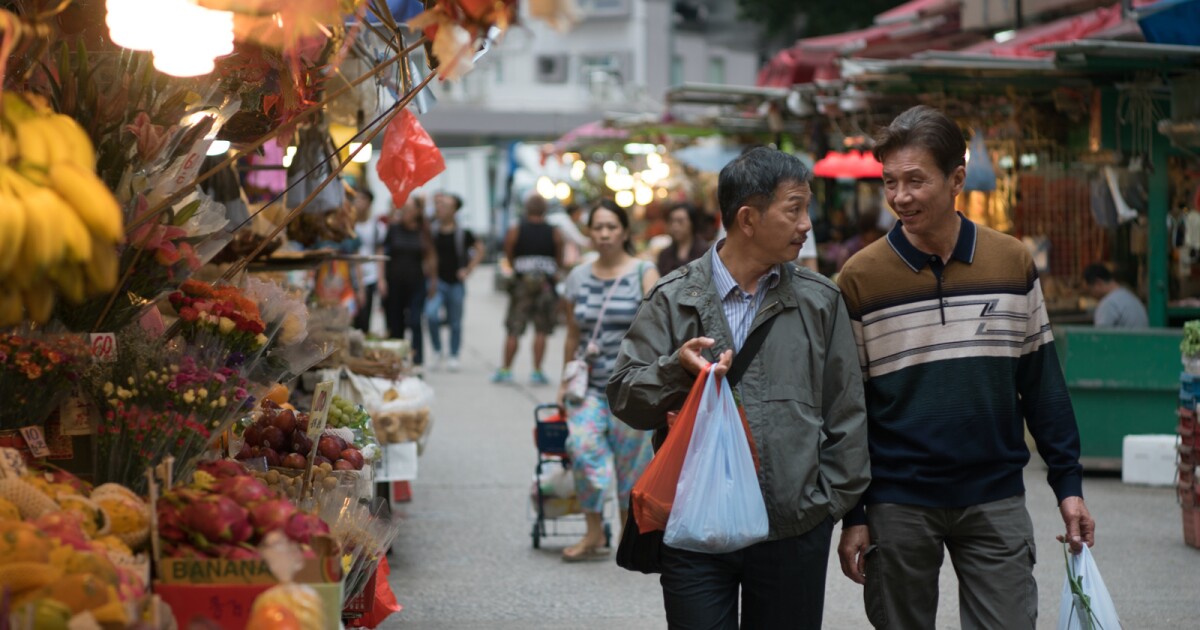
Pak (Tai Bo) is a pragmatic 70-year-old taxi driver on the cusp of semi-retirement. He’s married to the sour and suspicious Ching (Au Ga Man Patra), with whom he has two children and a sweet grandchild (with a second on the way). It’s been a simple, contained life except for one thing: his furtive attraction to men. But he has stayed closeted due not only to societal and generational constraints, but because of the pride and comfort he’s enjoyed as a family man.

Enter Hoi (Ben Yuen), whom Pak tries — unsuccessfully — to pick up while cruising in the local park. The kindly, livelier Hoi is 65, retired, long divorced, and lives with his rigid, devoutly Christian son, Wan (Lo Chun Yip), and Wan’s wife and young daughter. Hoi is also closeted to his family but has much more experience than Pak in the gay world including being part of the Mature Tongzhi Society, a supportive circle of senior gay men.

Pak and Hoi meet up again and slowly enter into a tender and joyful romance, filled with small adventures and stolen moments, though the shadow of secrecy and familial pressure looms large. Can these two kindred spirits somehow find a path to long-term happiness?

Advertisement

Viewers hoping for a definitive answer may be disappointed, even if you can extrapolate one or two options from the closing shot.

Some may also wish this low-key film spent more time with Pak and Hoi together than it does with them apart. Yet this approach lends the story a kind of mosaic quality, effectively fleshing out our protagonists vis-a-vis their friends, family members and home lives. How Pak tends his beloved cab speaks volumes.

The movie also offers a vivid view of Hong Kong and its environs, with a discreet peek into the city’s gay social scene. Fine performances all around as well.

‘Twilight’s Kiss’

In Cantonese with English subtitles

Not rated

Running time: 1 hour, 32 minutes

Playing: Starts Feb. 19, Laemmle Virtual Cinema; also on PVOD

British L.G.B.T. Veterans Stripped of Medals Can Get Them Back – The New York Times

0

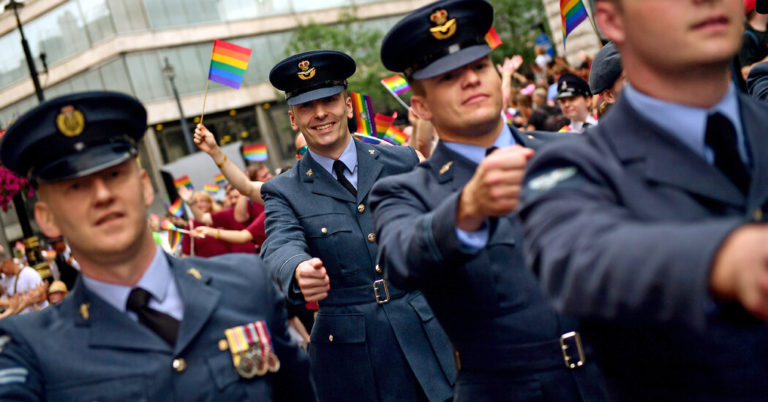
LONDON — For decades, L.G.B.T. members of Britain’s military were systematically dismissed from the ranks and stripped of their medals. Now, after years of campaigning by those targeted by the policy, the government has outlined a pathway for them to get their medals back.

The defense ministry, which has acknowledged that the practice was “wrong, discriminatory and unjust,” said in a statement on Tuesday that it was taking a further step in addressing that injustice.

Annabel Goldie, a minister of state in the Defense Ministry, said it was “deeply regrettable” that some members of the armed forces had been treated “in a way that would not be acceptable today” because of their sexual orientation. “I am very pleased now to be in a position to address this wrong and to invite any personnel affected or, in some circumstances, the families of those who are deceased to apply to have their medals returned,” she said in a statement.

The military has not released figures on how many people were affected before Britain lifted a ban on gay people serving in the military after the European Court of Human Rights ruled in 2000 that the policy violated basic human rights.

Until then, military personnel could be dishonorably discharged from service and stripped of their medals for their sexual orientation.

Some were also convicted under legislation that outlawed homosexual acts. Even as laws in the nation gradually changed, gay military personnel could still be jailed until 1994. Homosexual acts were only decriminalized in the country beginning in 1967.

“Today, L.G.B.T.+ veterans are finally beginning their journey back to the military family,” Fighting With Pride, a group that advocates for military personnel, said in a statement.

The group added that it looked forward “to a better future for them, where they are recognized for their service, their health needs are supported and they are recompensed for the wrongs of the past.”

The reversal comes after Joe Ousalice, a Falklands war veteran, campaigned for the return of a medal taken from him when he was forced out of the Royal Navy in 1993 for being bisexual.

Mr. Ousalice was a radio operator in the Navy for 18 years and also served in the Middle East and Northern Ireland.

He recalled the moment when an officer cut his medal for long service and good conduct from the chest of his uniform with a large pair of scissors.

“It was devastating,” he told the BBC last month.

The military returned his medal last year after nearly three decades. And although he told the BBC he was “over the moon” to have prevailed in his struggle, he said it was “a shame that it’s taken 27 years to get it.”

His fight, however, paved the way for the new policy that was outlined in detail on Tuesday.

That policy will allow anyone who was dismissed from service for their sexual orientation and had their medals revoked to have their case considered by the defense ministry. Families of deceased veterans who were discharged from military service on those grounds may also apply for the return of their medals.

Military personnel who were convicted for sexual offenses that have since been decriminalized can apply to the government to have the charges officially revoked and then can apply for their medals to be restored. This avenue does not apply in the case of deceased veterans.

Rights groups welcomed the new policy and said it was important to ensure that the government address broader discrimination against L.G.B.T. veterans.

Prime Minister Boris Johnson said the change addressed a “historic wrong.”

“Those who serve in our Armed Forces deserve every recognition for their service,” he wrote on Twitter. “It was a very great injustice that this was denied to some members simply because of their sexuality.”

Human Rights Body Calls for Repeal of Jamaica’s Anti-LGBT Laws – Human Rights Watch

0

The Inter-American Commission on Human Rights today made public a decision calling on Jamaica to repeal laws prohibiting consensual same-sex conduct.

The commission’s conclusions in Gareth Henry and Simone Carline Edwards v. Jamaica are by some measures a no-brainer. Petitioners argued that Jamaica’s 1864 Offences Against the Person Act, which punishes the ‘abominable crime of buggery’ and acts of ‘gross indecency’ between males with up to ten years in prison with hard labor, violates rights protected under the American Convention on Human Rights. The commission, an autonomous organ of the Organization of American States that is authorized to examine complaints of human rights violations, has already called on states to repeal laws that discriminate based on sexual orientation and gender identity. The Inter-American Court of Human Rights, the tribunal charged with interpreting the American Convention, has established that the convention prohibits “any regulation, act or practice considered discriminatory based on a person’s sexual orientation,” and that sexual orientation is an aspect of private life that cannot be subject to state interference.

So it’s no surprise the commission concluded in its December 31st decision that Jamaica’s laws violate rights to privacy and equal protection under the convention. It also found that discriminatory legislation contributes to violence by members of the public – like the murder attempt on petitioner Simone Edwards, and death threats against Gareth Henry. Human Rights Watch submitted an amicus in the case based on similar findings in our 2014 report, Not Safe at Home, which documented pervasive anti-LGBT violence in Jamaica and is cited by the commission: “Many [LGBT Jamaicans] live in constant fear. They are taunted; threatened; fired from their jobs, thrown out of their homes; beaten, stoned, raped, and even killed.”

Recognizing that decriminalization is not a magic wand, the commission called on Jamaica to gather data on violence and discrimination against LGBT and intersex people, train public officials on addressing such cases, and provide comprehensive sexuality education that is inclusive of sexual and gender diversity.

Jamaica should not just accept but embrace the decision, viewing it as an opportunity to break from the past, build a more inclusive society, and lead other Caribbean countries in shedding discriminatory laws that date to British colonialism. “I hope the Jamaican government will, for the first time, do what is right by the LGBT community,” Henry said in a video recorded by Human Dignity Trust.

Simone Edwards and Gareth Henry both live in exile. It’s time for the Jamaican government to ensure that LGBT Jamaicans are safe at home.

Mental health disorders and alcohol misuse more common in LGB people – EurekAlert

0

Lesbian, gay and bisexual (LGB*) people are significantly more likely to have mental health conditions and report alcohol and drug misuse than heterosexual people – according to a new study led by UCL researchers in collaboration with the University of East Anglia and City, University of London.

The findings, published today in Psychological Medicine, come despite apparently more tolerant societal attitudes towards same-sex relationships.

Given this continued disparity, the report’s authors are now calling for Government action to ensure equity in health and social care services. They highlight the need for improved awareness among health professionals to the mental health needs of sexual minority groups and are calling for policies that improve societal understanding, starting with encouraging schools to intervene earlier to encourage tolerant attitudes towards sexual minorities across the whole school community.

The research analysed data from the 2007 and 2014 Adult Psychiatric Morbidity Surveys** (APMS), which had a combined sample of 10,433 people in England aged 16-64.

The surveys are completed via face-to-face interviews and/or computer self-completion and contain data relating to sexual orientation, common mental disorders (CMD), hazardous alcohol use, and illicit drug use. Further information is collected on experiences of bullying and discrimination, religious identification and childhood sexual abuse.

In this analysis of 2007 and 2014 data the researchers found there had been no change (ie no improvement) between 2007 and 2014, with LGB people remaining at higher risk of poorer mental health when compared to heterosexuals.

The prevalence of depression and anxiety disorders among bisexual people was 40%, and for lesbian and gay people it was 28%, which was significantly higher than that for heterosexuals at 16%. Similarly, illicit drug use was highest among bisexual people, at 37%, while for lesbian and gay people it was 25% and heterosexuals, at 10.5%. Alcohol misuse was highest in lesbian and gay people, at 37%, compared with bisexual people at 31%, and heterosexuals, at 24%.

Researchers found evidence to suggest that exposure to bullying and discrimination may help explain the observed poorer mental health in lesbian women and gay men but not in bisexual people.

No evidence was found to support any apparent contribution of differences in religious affiliation or experiences of adversity such as childhood sexual abuse in the association between sexuality and mental health problems.

Lead author, Dr Alexandra Pitman (UCL Psychiatry), said: “What this study highlights is the significant and ongoing disparity in mental health between LGB people and heterosexual people, as evidenced by higher levels of mental health problems and alcohol and drug misuse.

“In order to reduce this persistent inequality in society, we must ensure that health and social care professionals are better trained to identify and care for the wellbeing and mental health needs of sexual minority groups, who are often made to feel invisible within national health systems.

“Furthermore, secondary schools must implement policies and practices that create supportive environments for sexual minority students, including providing (and actively promoting) access to a member of staff who is a designated minorities contact person, who students can talk to in confidence about experiences of discrimination, bullying, or mental health difficulties. Schools in the UK can also learn from positive experiences of Gay Straight Alliance (GSA) clubs in US high schools, where students benefit from access to a hub for socialising, support, and activism.

“More can also be also be done to implement anti-discrimination strategies and policies in health care institutions. This might include: the use of positive images of LGB people in health service marketing material; ensuring that equal opportunities statements include grounds of sexual orientation; taking a LGB-affirmative stance in psychotherapy (with implications for training of therapists); and training all professionals not to assume heterosexuality.”

Senior author, Professor Michael King (UCL Psychiatry), said: “Our research shows that stigma and social exclusion on the basis of sexual orientation may be more subtle and enduring than we imagine. Despite greater public acceptance and legal changes to ensure equality, the lived experience of a proportion of LGB people remains negative. We would emphasise however that these data also show that the majority of LGB people have robust mental health and lead happy lives.”

Co-author, Dr Joanna Semlyen (The University of East Anglia), said: “We know that sexual minorities are at increased risk of poor mental health than the heterosexual population. What this paper shows is that those inequalities did not change between the two study collection points of 2007 and 2014.

“This is really important because it shows that, despite some changes in societal attitudes, people who are lesbian, gay and bisexual continue to experience poor mental health.

“What we need to do now is not only continue to monitor health in sexual minority populations as standard but also to design studies to understand what causes these inequalities and develop interventions to reduce them.”

###

* The next survey in the APMS series is being planned, with gender identity highlighted as an important topic to cover. This will mean that future analyses will be able to look at both gender and sexual identity, and therefore investigate mental health in LGB groups as well as transgender and gender diverse groups.

** Further information on the sampling strategy and findings of the APMS surveys is available here: https://digital.nhs.uk/data-and-information/publications/statistical/adult-psychiatric-morbidity-survey

Disclaimer: AAAS and EurekAlert! are not responsible for the accuracy of news releases posted to EurekAlert! by contributing institutions or for the use of any information through the EurekAlert system.

3 Tips for Taking a Slower, More Progressive Approach to Fitness – Greatist

0

It goes without saying that getting fit for your own well-being is both an extremely worthwhile and an excruciating endeavor. On one hand, you know exercise holds a slew of benefits, even unexpected ones. On the other hand, sweating sucks and you want to eat what you want. What to do?

I was faced with this precise conundrum when I launched my journey toward better fitness. It was the waning years of my twenties, and I’d begun to put on weight fast, so I was motivated to take action and make some changes.

My early attempts were unsuccessful, to say the least. But with a bit of experimentation, I found that taking three simple, low pressure approaches revolutionized my fitness endeavors.

The first time I went for a run, I told myself I’d do a mile, but I didn’t get anywhere near that. It was a truly dismal display, verging on shameful. As a result, I felt terrible about myself and decided to avoid future failures by avoiding running altogether. Problem solved.

Eventually I tried again, but this time I made an adjustment. Instead of setting some arbitrary goal that would almost certainly come with added pressure, I simply ran for as long as I could. The next day, I hit the treadmill again, this time with the intention of running for 20 seconds longer than I had the day before. After around 10 days of these incremental gains, my 3 minutes of running had doubled. Two weeks later, it had doubled again.

Forget about forcing yourself to run for a mile or for 30 minutes. Just do whatever you’re capable of doing, and then push yourself just a little farther the next time. Build progressively.

My earliest trips to the gym were kind of embarrassing. I had this idea that I’d go in, throw a couple of 45-pound plates on the bar, and press away. Buff bod, here I come.

Instead, I grunted and struggled through a few sets of the lamest-looking bench presses you’ve ever seen. My form was nonexistent, I could barely get the bar back on the rack, and I generally had more potential to hurt myself than to get stronger.

This went on for some weeks, and it wasn’t until a friend suggested I significantly dial down the weight that I started to experience any real growth.

Instead of thinking about what you should be lifting, start with what you can lift. Weightlifting is all about progressive overloads, which means you start small and increase the weight over time.

Don’t get ahead of yourself. This is your process, not anyone else’s. Focus on getting the correct form down and developing some foundational strength, and then build up from there.

When I made my first forays into fitness, I took the stereotypically dramatic step of throwing out all my junk food and replacing it with vegetables. By the next day, I was eating chips. Within a week I was back to nothing but frozen pizza and Doritos.

The problem with these attempts at cold-turkey crash diets is that they have too much of a whiplash effect on your lifestyle. One craving sends you to the corner store for some Oreos, and the dam bursts. The next thing you know, a week has passed and you’ve sustained yourself entirely on Bugles and ice cream bars.

Phasing out foods you don’t want while phasing in some alternatives is the way to go. Start by incorporating at least one nutrient-rich meal per day, and trade your regular snacks in for healthier options gradually instead of all at once.

Use a calorie tracking app to get an idea of how much you’re actually eating. You might find that some of your individual meals contain enough calories for an entire day. If that’s the case, don’t slam on the brakes. Ease up on the throttle by cutting out 100 calories per meal or a few hundred per day.

When it comes to fitness, building a workable routine is about acknowledging where you are and then gradually working to extend your threshold in a way that makes sense for your body. Making major, abrupt changes might seem like the fastest route to success, but without a clear and sustainable plan, you’re just putting unnecessary pressure on yourself to meet unrealistic expectations.

You don’t climb a mountain by starting at the top, but it gets closer with each step.

Nick Hilden is a travel, fitness, arts, and fiction writer whose work has appeared in the Los Angeles Times, Men’s Health, Thrillist, Vice, and more. You can follow his travels and connect with him via Instagram or Twitter.

Ari Gold, Pioneering Dance Artist And Gay Nightlife Icon, Dies At 47 – HuffPost

Ari Gold, a trailblazing gay musician and New York DJ, died Sunday after battling leukemia. He was 47. 

Gold’s death was confirmed by World of Wonder, the Los Angeles-based production company behind “RuPaul’s Drag Race” and other shows. 

The news prompted an outpouring of condolences from stars, including “Sex and the City” actor-comedian Mario Cantone, RuPaul and Laverne Cox, as well as GLAAD and other LGBTQ advocacy groups. 

“So many people have come and gone from my life over the past 25 years but you have been a constant,” Cox wrote on Instagram. “I’m so utterly devastated that you’ve moved on today. But I know you’ll be watching over me as you always have. I’m so grateful to have known you.. I’m better because you have been a part of my life.. My brother!” 

“I never would have dreamed that we’d not only become close friends later but be tied together through our love of music, Madonna and Wonder Woman,” wrote “RuPaul’s Drag Race” veteran Peppermint. “You inspired and mentored me in ways that you will never know. Right now I so desperately want the world to know everything you did. I want them to celebrate you.” 

Gold, a Bronx, New York, native, began his performing career as a child, voicing characters in the 1985 TV movie “The Life & Adventures of Santa Claus” and the animated series “Jem and the Holograms.” 

He came out as gay to his Orthodox Jewish family when he was 18. As an adult, he sang backup for Cyndi Lauper and Diana Ross, and opened for Boy George and Chaka Khan. He released his self-titled debut album in 2001, and six years later, his music video for the single “Wave of You” reportedly became the first by an openly LGBTQ artist to premiere on the Logo TV network. 

Gold released six more studio albums, including 2004’s “Space Under Sun” and 2015’s “Soundtrack to Freedom,” independently. His live performances on the Manhattan club scene garnered him a cult following, and his 2007 track “Where the Music Takes You” was a hit on Billboard’s Top 10 Hot Dance/Electronic Songs Chart.

Still, mainstream stardom largely eluded him. In a 2006 essay for The Advocate, he wrote candidly of his frustrations, noting his work had been praised by several music executives who were nonetheless reluctant to sign an openly gay artist at the time. 

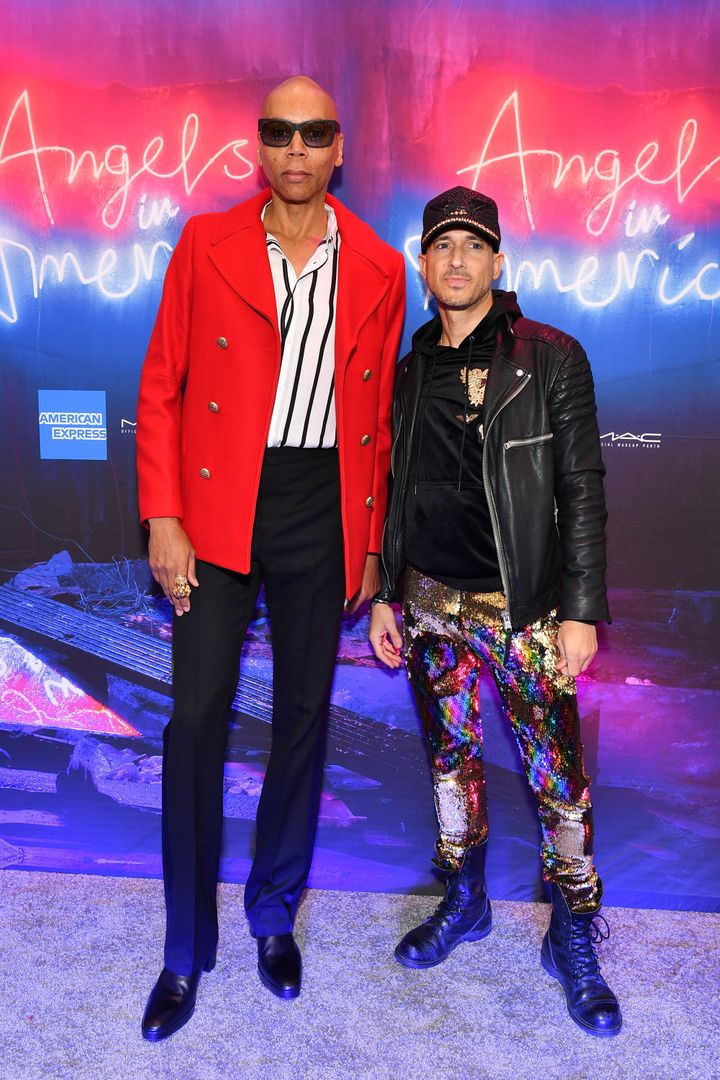
Gold (right) with RuPaul in 2018. 


Gold (right) with RuPaul in 2018. 

“The personal is political,” he wrote. “And in art, it is the specificity of our experience that is universal. Is being gay all of who I am? Of course not. But at this particular moment, while our rights are still being contested and while we are still learning to accept ourselves, I will continue to emphasize that part of me… even if it means having to do it on my own.”

Gold ― who also performed under the names Sir Ari and GoldNation ― was diagnosed with myelodysplastic syndrome, a blood cancer treatable with a bone marrow transplant, in 2013. He was declared cancer-free in 2019, and that same year launched a podcast titled “A Kiki from the Cancer Ward” that featured interviews with Cox and RuPaul. 

“I lived each day of my closeted adolescence thinking that who I was would disappoint, scare, and upset all the people I loved in my life,” he wrote in a 2018 NewNowNext essay after going public about his diagnosis. “Who I was could have excommunicated me from my community and even my own family. But I vowed to devote my entire adult life to making sure kids (and adults) didn’t feel like I did growing up.” 

British children in limbo over gender therapy after court ruling – Reuters

0

LONDON (Thomson Reuters Foundation) – Almost as soon as she could speak, Nina told her parents she was not a boy and she has lived as a girl since she was seven. Until recently, she was happy.

But now aged 12 and wanting to stop the onset of male puberty, a ruling by Britain’s High Court has plunged Nina and dozens of other children struggling with gender dysphoria into limbo by restricting access to puberty-blocking drugs.

The judges ruled that under-16s were unlikely to be able to give informed consent to such medication, and doctors must now get a judge’s approval – a so-called “best interests order” – to prescribe them to adolescent patients.

Days after the ruling, Nina’s appointment the following week with specialists – whom she hoped would prescribe the medication – was cancelled and no new date was scheduled.

With the court ruling leaving a void in treatment, some parents are now filling the gap left by seeking drugs for their children from privately funded services.

“I feel like I’m living in a nightmare,” said Nina’s mother, Juliet, whose daughter has attended England’s sole youth gender clinic – the Gender Identity Development Service (GIDS) – since she was five.

“If in your head you are female but your body starts to develop as a male in your teenage years, it just must be the most horrendous thing,” said Juliet, whose name – along with those of all parents and children in this article – has been changed to protect their identities.

The ruling came as rising numbers of adolescents globally seek to change gender, dividing those who fear doctors are too hasty in prescribing puberty blockers and cross-sex hormones and those worried about access to medication they deem life-saving.

Puberty blockers, which are used to prevent the onset of sexual maturity, have become the focus of a fierce global debate about the age at which a child can decide to transition gender.

In Britain the number of children referred to GIDS has risen nearly 30-fold in the past decade and waiting lists are more than 18 months long.

About 2,660 under-18s were referred to GIDS in the year to March 2020, while 161 were referred on by GIDS to specialist endocrinologists who prescribe puberty blockers, according to the clinic’s data.

The World Professional Association for Transgender Health, a U.S.-based body of doctors specialised in treating trans people, said puberty blocking drugs can be used to help alleviate gender dysphoria and give children time to consider future options.

The medication can stop irreversible physical changes for patients, such as their voice breaking, WPATH’s guidelines state.

But the drugs’ use is controversial. There is little research about the long-term effects and critics say they are prescribed too freely – putting sometimes-vulnerable children on a course to more permanent transition treatments.

Keira Bell, who took puberty blockers aged 16, testosterone at 17 and had a double mastectomy at 20, brought the court case that resulted in puberty blockers being restricted after coming to regret the medical treatment she had to transition.

Bell, now 23, told reporters after the Dec. 1 judgment that she was delighted by the outcome and wished it had been made before she “embarked on the devastating experiment of puberty blockers”.

‘ABSOLUTELY DEVASTATED’

Tom, a 12-year-old patient of the London-based youth gender clinic run by the Tavistock and Portman NHS Foundation Trust, had been waiting for an appointment with an endocrinologist when the High Court issued its ruling, said his mother, Naomi.

“When the (court) outcome came, he was just absolutely devastated,” she said. “Straight away he just went completely down. And since then he’s stopped eating.”

Some former staff and parents of children with dysphoria, however, have welcomed tighter restrictions on the use of puberty blockers at GIDS, voicing concern about whether children as young as 10 can be sure about their gender identity.

“No child can be born in the wrong body,” said David Bell, a retired adult psychiatrist and a former staff representative on the Tavistock and Portman NHS Foundation Trust’s Council of Governors.

While he said he had not worked with trans children specifically, Bell said he was contacted in 2018 by 10 former and then-current GIDS clinicians who were concerned puberty blockers were being prescribed too easily.

But another GIDS clinician, who spoke anonymously because of not being authorised to speak publicly, disputed the assessment of the medical professionals who raised concerns with Bell.

“The idea that people are being rushed into decisions is simply not true,” the clinician said. “As a service we are actually very conservative in the way we approach gender identity.”

‘TIME TO THINK’

Like Nina, Tom’s mother Naomi said he had been “adamant” about being a boy since he started to talk, but COVID-19 had delayed his assessments for medication even before the court ruling.

“I’m just pinning all of my hopes on the best interests (court) order,” said Naomi, referring to the new requirement for patients aged under 16 to secure a judge’s approval to access the medication.

Parents such as Naomi told the Thomson Reuters Foundation they had received little guidance so far on how to seek a court order, and so far none have been issued.

A Tavistock and Portman NHS Foundation Trust spokeswoman said patients such as Nina and Tom, who were referred to endocrinologists before Dec. 1 but had not started taking the drugs, would soon be advised on applying for the court orders.

The trust is appealing against the High Court ruling, which prompted England’s National Health Service (NHS) to tighten its rules on accessing the drugs.

The High Court “set out a clear need for an additional layer of safeguarding for children which is why the Tavistock and Portman NHS Foundation Trust themselves decided not to make new referrals”, an NHS spokeswoman said by email.

Caroline’s daughter Lily starting living as a girl at the age of six, having said she was a girl from the age of three.

Lily was due to have an endocrinology appointment when she turns 12 in March, but now that is in doubt Caroline has paid a private gender care service to secure puberty blockers for her daughter.

She said she would continue to skirt NHS channels to secure supplies of the drug while the uncertainty triggered by the court ruling continued.

“She knows her body, she’s not stupid,” Caroline said. “It’s giving her time to think about it, to discover herself and think about it. We’re not opposed to her going back to being a boy. She can do what she likes.”

Reporting by Rachel Savage @rachelmsavage; Editing by Belinda Goldsmith; Please credit the Thomson Reuters Foundation, the charitable arm of Thomson Reuters, that covers the lives of people around the world who struggle to live freely or fairly. Visit news.trust.org

Diagnosis bias of borderline personality disorder high among LGB community – University of Michigan News

0

Cropped image of depressed man at the psychotherapist. Doctor is making notes while listening to his patient. Image credit: iStock

Some health care professionals allow their bias toward lesbian, gay and bisexual persons to show when diagnosing borderline personality disorder, says a University of Michigan researcher.

This bias for borderline personality disorder, or BPD—a chronic mental illness known for impulsive behavior, people’s uncertainty about themselves and relationship difficulties—is more pronounced for sexual minorities than heterosexual individuals, says Craig Rodriguez-Seijas, U-M assistant professor of psychology.

“LGB persons are more likely to be given the diagnosis particularly when health care professionals are not paying attention to whether or not the behaviors observed among LGB persons cause any significant distress or impairment,” said Rodriguez-Seijas, lead author of a study that appears in the online journal Assessment.

Rodriguez-Seijas and Brown University colleagues used data from the National Epidemiologic Survey on Alcohol and Related Conditions-III to compare the differences in BP diagnosis among lesbian, gay and bisexual persons with heterosexual persons. The survey, conducted in 2012-2013, involved responses from more than 36,000 participants between 18 to 90 years old. About 1,100 (3%) identified as lesbian, gay or bisexual, while the rest were heterosexual.

BPD was diagnosed in 11% of the entire sample. The prevalence of the illness was almost double among sexual minorities (20%) compared with heterosexual (11%) individuals. However, when the diagnosis was made with specific attention to whether or not the symptoms of BPD cause significant distress or impairment, the prevalence was comparable for sexual minority (2%) and heterosexual (1%) individuals.

Health care professionals evaluating patients for factors linked to BPD might ignore environmental stressors that LGB persons face or be unable to competently assess the extent to which the behaviors signify BPD or normative reactions to stress, Rodriguez-Seijas says.

For example, BPD can involve struggles with one’s identity, he says. LGB persons might change the way they present differently to other people for safety reasons, such as avoiding discrimination, bullying or even murder. Such behaviors help manage the impressions that other people have and are relatively normative for LGB persons since they grow up and exist in stigmatizing environments, he says.

If health care professionals fail to ask the right questions to disentangle this protective way of managing one’s identity from pathological and impairing struggles with identity they may not accurately diagnose the patients, according to Rodriguez-Seijas.

In addition, the research showed that sexual minority individuals reported a greater prevalence of nonsuicidal self-injury and impulsive sexual and financial behavior problems.

The findings offer implications for treatment. Rodriguez-Seijas says that while there are helpful evidence-based interventions for individuals diagnosed with BPD, some approaches to treatment might inadvertently re-stigmatize LGB persons by disproportionately attributing genetic variables as the causes of BPD symptoms.

However, this fails to factor in that some maladaptive behaviors—which might prevent a person from making changes in their own best interest, such as avoidance or withdrawal—represent ways that LGB persons learn to cope with a continually stigmatizing social environment, he says.

The study is a follow-up of previous research by Rodriguez-Seijas and colleagues that found that health care providers show bias in diagnosing BPD among LGB patients in actual practice. In one partial hospital setting, psychiatrists and psychologists diagnosed BPD among LGB patients at higher rates than heterosexual patients, regardless of any true differences in BPD pathology based on sexual orientation.

Other authors include Theresa Morgan, clinical assistant professor of psychiatry and human behavior at Butler Hospital, and Mark Zimmerman, professor of psychiatry and human behavior at Rhode Island Hospital. Both Morgan and Zimmerman are faculty at the Warren Alpert Medical School at Brown University.

More information:

SNL’s Passive-Aggressive “Pelotaunt” Commercial Is Made For Anyone Who Hates Peppy Workouts – POPSUGAR

0

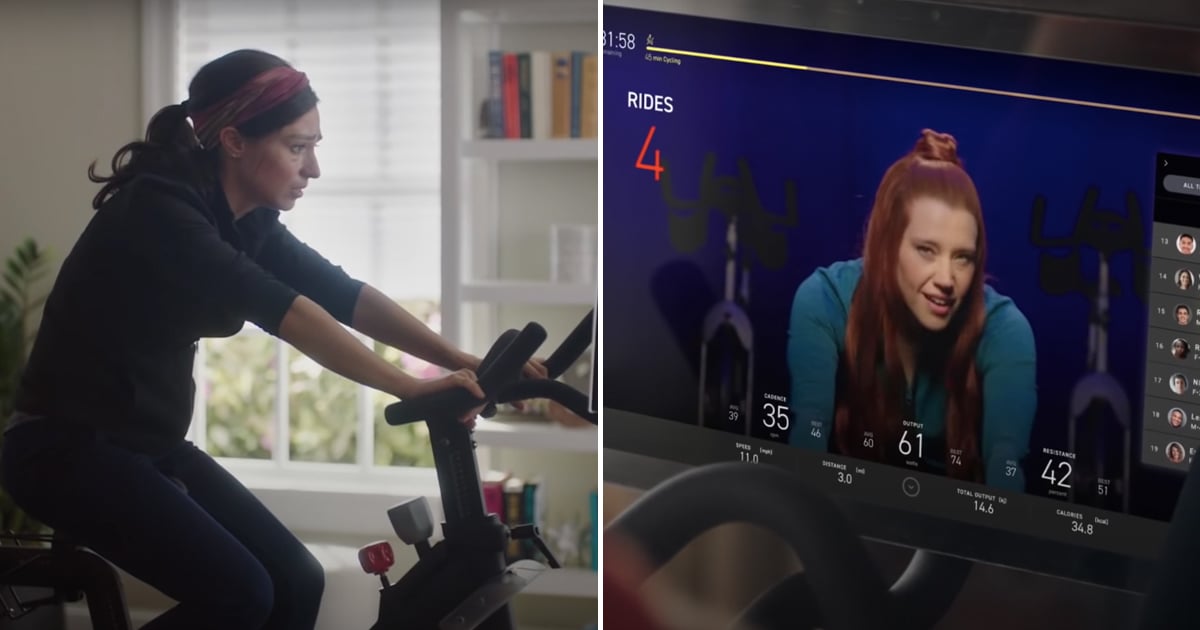
I’m all for an energetic coach or motivational at-home YouTube workouts, but every so often, I’m not in the mood for someone else’s pep. If I come to a workout with a five energy level and the instructor greets me with a 1,005, it’ll take all my strength to not turn around, walk away, and crawl back in bed. Clearly, the writers at Saturday Night Live feel similarly, and they’ve infused those vibes into a hilarious sketch poking fun at Peloton specifically.

During Feb. 13’s episode, SNL cast members Kate McKinnon, Bowen Yang, Ego Nwodim, Beck Bennett, and more imagine a world where “Pelotaunt” instructors try to humiliate and, by default, motivate exercise bike users. “I feel mentally broken down, but hey, I can see my abs,” Bennett quips. The skit certainly resonated with viewers online, who joked they’d try out the Pelotaunt IRL — we’ll unpack what that means later, I guess. In the meantime, check out the unfortunately funny skit in full above.

Embracing ‘The Diversity Of God’: Harlem Church Engages, Affirms Queer Members – NPR

0

Michael Walrond, Jr., senior pastor at First Corinthian Baptist Church, tells NPR’s Scott Simon that his church hopes to repair the trauma institutionalized religion inflicted on LGBTQ communities.

SCOTT SIMON, HOST:

This month, we’ve been looking at organizations across the country that work in Black communities and are helping to shape Black history for the future. First Corinthian Baptist Church is one of the largest churches in Harlem. It has more than 10,000 members, and many are gay, lesbian, bisexual and transgender. The church has been inclusive while also challenging anti-queer beliefs and practices that have long existed in the Baptist tradition.

(SOUNDBITE OF ARCHIVED RECORDING)

MICHAEL WALROND JR: So many who claim to be Christian have looked upon our brothers and sisters who have been seeking to live an authentic life, and we have used our own hypercritical, graceless moralism to judge. Somehow, the Christians could not handle the diversity of God.

SIMON: Michael Walrond Jr. is the senior pastor at the First Corinthian Baptist Church and joins us now. Pastor Mike, thanks so much for being with us.

WALROND: Thank you for having me. It’s a pleasure to be on with you today.

SIMON: Tell us, sir, about your community there and what you do to try to affirm queer people.

WALROND: I’ve been blessed for the past 17 years to serve as the senior pastor. Part of what drives us, what galvanizes us is our commitment not only to the teachings of Jesus, but really being shaped and guided by the underlying ethos of the Jesus movement, which is love. For me to be a follower of teachings of Jesus on some levels mean that I lead with love and I honor the nature of love. But I honor what I call the inherent dignity of all human beings.

SIMON: Do some people, many people come to your church after they’ve suffered indignity and even trauma?

WALROND: You know, one of the things that often goes unspoken and not talked about is the amount of religious trauma that many people suffer with, people who have found themselves coming to churches, coming to Christianity, looking for a way forward, a way to affirm themselves, a way to learn to abide in their own sense of humanity. And oftentimes, many Christians can be hypercritical and hyperjudgmental And in that doing, we end up damaging a lot of people who we deem as other or different. And in that way, I don’t believe we honor the creativity and the imagination of God if we believe that God is the creator of all. And that means we honor God’s creativity and imagination for diversity. And that diversity, I think, includes even sexual orientation.

And so I don’t want to say we’re the only ones, but I know we may be among the very few, if not the only church, that has opened up a mental health facility. We call it the HOPE Center, seeking to meet needs with therapy and also doing group therapy to really help people cope.

SIMON: In this country, historically, Black spiritual communities have often been in the forefront of civil rights struggles and the struggle for racial justice, but they have not always been sympathetic to Black queer people. Is that a fair way to put it?

WALROND: That is fair. I’ve often said, you know, you cannot think of any social justice movement – you certainly cannot think of the abolitionist movement, you can’t think of modern civil rights movement without thinking about the place the Black church has had. The Black church was the one space going from slavery even up until now that was considered ours. It was a place that belonged to us.

But at the same time, there have been some blind spots that have sought to undermine some of our work. Those blind spots, if we’re honest, have been connected to the way women are treated in the church, in many ways as second-class citizens, persons who can support the church with all their resources but in many churches are not honored in their leadership. So that’s one blind spot.

And the other blind spot is with the queer community. And there are many who have been vehemently opposed to queer people and have used scripture to justify their attitude. They’ll either pull something from the Old Testament or some of the writings of Paul, but never, never quote the teachings of Jesus. Jesus doesn’t talk about it. But what Jesus does talk about is how we honor one another’s humanity.

SIMON: Pastor Mike, I wonder what you hope First Corinthian’s inclusiveness might help build for the future in your community and add to the story of Black history in this country.

WALROND: If churches in general, but our churches, African American congregations, are going to survive and thrive in the future, a future which we know now – some reports say about close to 50% of millennials make no claim to any kind of religious institution, but they do believe in God, and they are deeply spiritual. And I think if the churches are going to be relevant in the future, we have to be intentional about what that means. Being inclusive and affirming in many ways adds to the inclusivity.

I think about our congregation when I arrived there 17 years ago was a traditional Baptist church. And there’s a tremendous story of a gentleman who came to the church. And he would be considered, you know, anti-gay. And he’s been serving in the church for some years now. And last year, he came to me and said, Pastor, I want to share something with you. He said, when I started coming here, I was against people who were gay. I was against, he said, homosexuality. His daughter was queer. She was gay. And they did not have a good relationship because of his attitude towards her. And his daughter is now a transgender man. And he said to me on this occasion – he said, I want to thank you for the teachings. I want to thank you for this community. My son and I now have a relationship that my daughter and I never had.

SIMON: Michael Walrond Jr., senior pastor at the First Corinthian Baptist Church in Harlem. Pastor Mike, thanks so much.

WALROND: Thank you for having me. My pleasure.

(SOUNDBITE OF MUSIC)

Copyright © 2021 NPR. All rights reserved. Visit our website terms of use and permissions pages at www.npr.org for further information.

NPR transcripts are created on a rush deadline by Verb8tm, Inc., an NPR contractor, and produced using a proprietary transcription process developed with NPR. This text may not be in its final form and may be updated or revised in the future. Accuracy and availability may vary. The authoritative record of NPR’s programming is the audio record.

Chicago Gym Member Arrested After Assaulting Trainer In Anti-Mask Tirade: ‘You’re Ruining My F—king Country!’ — WATCH – Towleroad

0

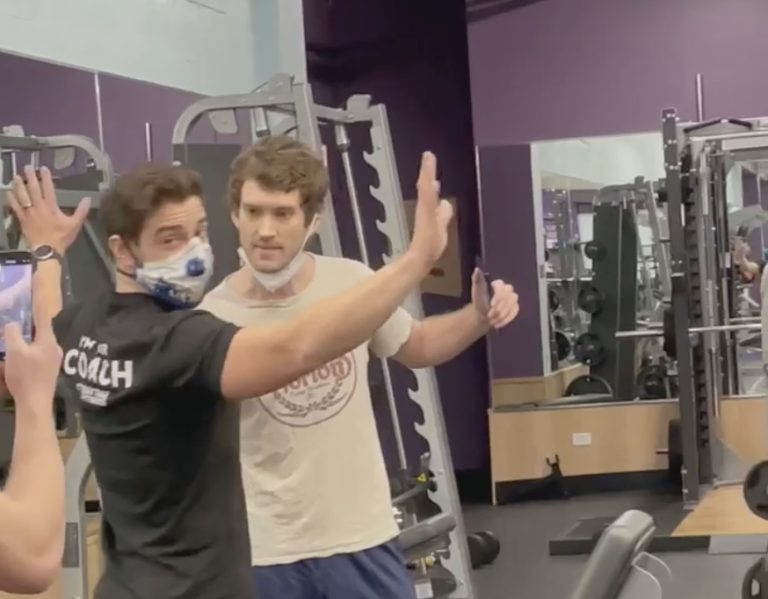
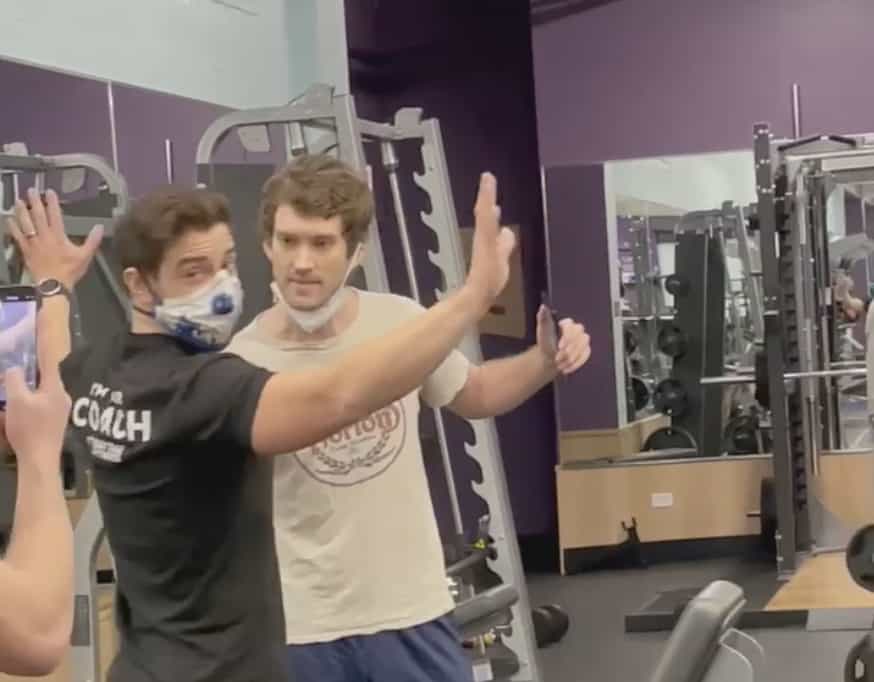
An anti-mask gym patron assaulted a trainer at Anytime Fitness in Chicago and caused a major scene before being arrested for violating COVID protocols on Thursday. And his tantrum was caught on video (below) that’s now going viral across social media.

“It’s a joke. You’re ruining my f**king country,” the male gym “Karen” yelled at the trainer and other members before aggressively poking and pushing the trainer, who was trying to keep the anti-masker away from the other members.

Trainer Adrian Aguilar wrote on Facebook that he spotted the maskless gym patron wandering around violating the gym’s mask policy.

Wrote Aguilar: “As I approached him, his mask was at his throat, not near his face. I said, ‘yo! I need you to put your mask up in the building, man.’ He whirled around and immediately said I was too close to him and that I was within 6 feet of him. I don’t think I was and according to footage, I wasn’t, but like a normal human I took a big step backwards and said, ‘sorry about that! I need you to put your mask up if you’re in the building.’”

Aguilar said the man then launched into the unhinged tirade and refused to put his mask on. The gym’s owner was called and the gym patron was told his membership had been revoked and he had to leave. A small crowd of members had gathered.

“I then went and positioned myself between the members and the trouble, just in case,” wrote Aguilar.

“Hooboy he REALLY didn’t like that,” added Aguilar. “That was what led to this video. I kept far from him and continuously kept my hands high or behind my back to indicate that I meant him no harm. I also continuously told him, ‘I’m not going to touch you or do anything to you.’ Despite all of that, he closed the distance and got physical. At some point, he called the cops himself and told them that I was a threat and a danger and that he didn’t feel safe in my presence…🤷‍♂️

Aguilar said that when police arrived the gym patron tried to convince them that he was the victim, but the cops weren’t persuaded given the video evidence.

Wrote Aguilar: “Eventually, a combination of us filing a report for battery against me, and trespassing against the gym (the owner) he was arrested and led out of the gym around 5:15pm. It’s worth nothing that on his way out, in the most low-budget, Scooby-Doo villain, hilarious way, he said ‘This isn’t over…’ It’s also worth noting that WHILE I was writing that sentence, he called the gym and threatened me. Just now! In real time! Very cool. Anyway, his name is Austin Tony Myers and that is all I care to know. Do with that information what you will. I think he is a very sick individual and I hope that he receives some help from somewhere, very soon.”

Another stream of the same video.