Home Blog Page 41

A gay couple faced harassment for 5 years. Handwriting analysis led to a suspect: A neighbor. – Sports Grind Entertainment

The first one came in February 2016 — a magazine subscription under a homophobic fake name. At first, LeeMichael McLean and Bryan Furze tried to ignore it. But then the harassment kept coming.

McLean, 44, called the mail “an insidious way for a harasser to get inside your house.”

“It brought me back to being a little kid and getting teased for my voice or my appearance,” he told USA TODAY. “We were being picked on because we were gay, and it had followed me into my 40s. I couldn’t believe it.”

During more than five years of harassment, about 30 pieces of mail with homophobic names on them were sent to the couple’s home in Massachusetts. But after their community rallied behind them to find suspects, McLean and Furze say handwriting analysis led them to the perpetrator.

Furze, 45, said they feared the hate mail would escalate into something more physical. They worried about when their son would learn to read the harassment himself. And even as they tried not to let it affect their everyday lives, they became scared of checking their mail and being in their own home.

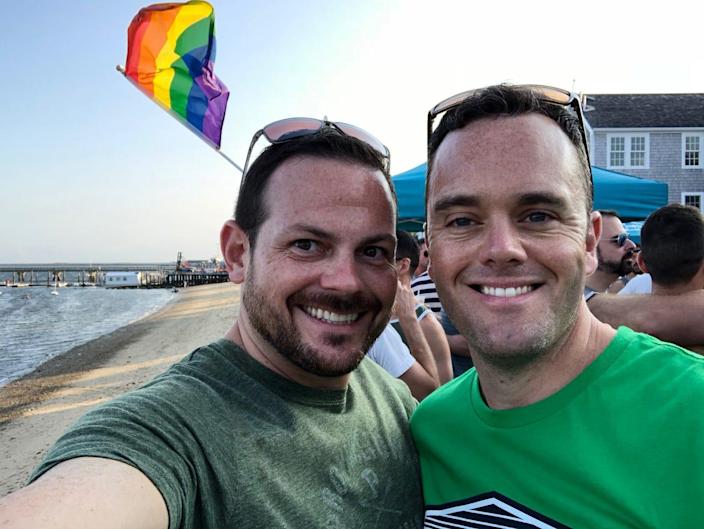
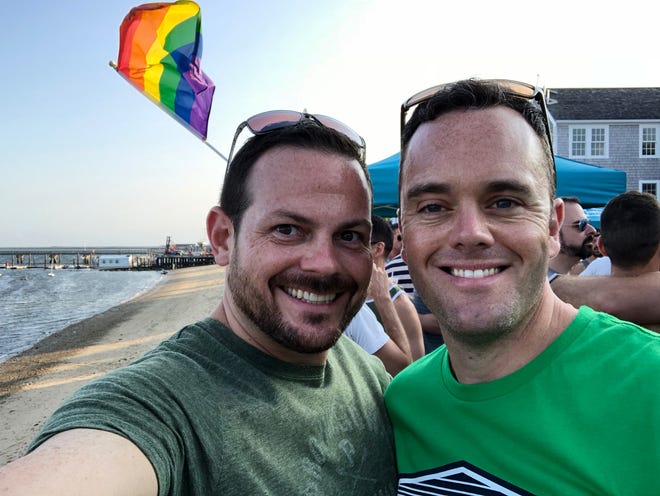
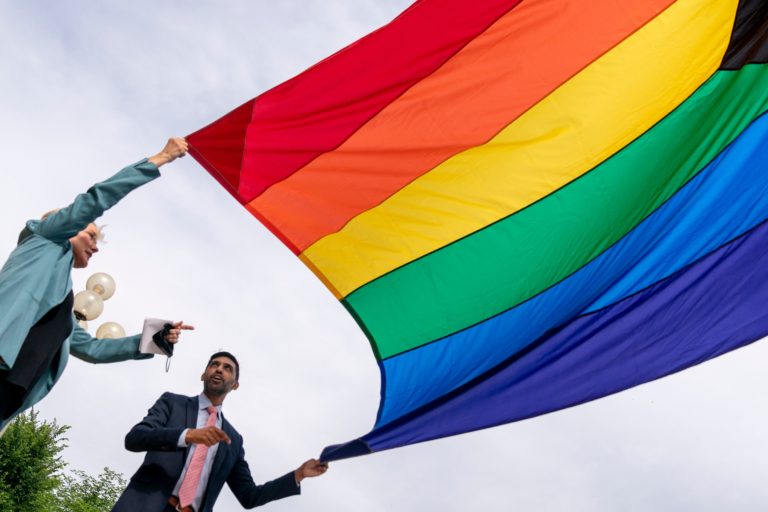
LeeMichael McLean and Bryan Furze pose in front of a Pride flag. During more than five years of harassment, about 30 pieces of mail with homophobic fake names on them were sent to the couple’s home in Milton, Massachusetts.

“It was something that was always in the back of our minds, but we had no control over it,” he said. “So we had to tolerate it and live on.”

When they reported the harassment to the police, they say officers took the allegations seriously but there weren’t many clues to lead to a suspect.

The couple spoke with several law enforcement professionals who told them the perpetrators in these cases are usually someone you can see from your house. But all their neighbors were so nice that they began to think it couldn’t possibly be true.

“For five years, we were living here and wondering which of our neighbors, who were all being kind and neighborly to us, is actually harassing us,” McLean said.

Then the perpetrator made a mistake.

The suspect, who has not been publicly identified, signed the couple up for a Boston Globe subscription, but the McLean and Furze already had a subscription. When the newspaper sent back the order request, made under the name “Michelle Fruitzey,” McLean realized it was handwritten.

More: Much of our slang comes from the Black community. Not acknowledging that perpetuates racism.

McLean brought the handwriting sample to the police station and gave a statement, walking through the years of harassment. He quickly realized the stress and anxiety he had been internalizing for years.

“I walked out of there feeling like a foot shorter because I had so much weight on me,” he said. “It was horrible. I was anxious, depressed. Having to recount those details was incredibly painful.”

McLean also posted the handwriting sample on a local Facebook group, asking the community to help them identify any suspects. Stunned by the homophobic language from the subscription cards, the couple’s neighbors sprung to action, and the hashtag #IAmMichelleFruitzey began trending on social media as locals searched for who was responsible.

“We didn’t realize we’d get love and support and cheers from every corner of town, from people we’d never met to close friends and neighbors,” McLean said.

LeeMichael McLean and Bryan Furze pose with their son. During more than five years of harassment, about 30 pieces of mail with homophobic fake names on them were sent to the couple’s home in Milton, Massachusetts.

One community member scoured town election records to find the matching handwriting. He found a match, and a suspect was arrested May 13, McLean said.

During questioning, the suspect admitted to sending the mail and called it a prank that he didn’t think would require police involvement, officers told the couple. The suspect told the detective he sent the subscriptions because he didn’t like how outspoken McLean and Furze were and how the two, both elected Town Meeting members, voted.

“This person was intimidating and trying to silence us,” Furze said.

Milton Police chief James O’Neil would not comment on the identities of the victims or suspect but did confirm that the police department has filed a criminal complaint seeking to charge an adult male with criminal harassment. No charges have been filed.

More: LGBTQ joy is more important than ever this Pride Month. Here’s why.

The couple said the suspect was friendly and never displayed any outward hostility.

To them, it has become a lesson that discrimination can come from anywhere, even in a progressive town like theirs.

“Most people in our area are incredibly supportive, but you can never really be too careful because there are people who are willing to inflict harm in a way that’s invisible,” Furze said.

LeeMichael McLean and Bryan Furze pose with their son. During more than five years of harassment, about 30 pieces of mail with homophobic fake names on them were sent to the couple’s home in Milton, Massachusetts.

The couple had long kept the harassment from their son, now 7 years old, but when news of it broke, they told him that one of their neighbors had been unkind.

“There’s no question that it bothers him because every couple days he’ll ask more questions about why,” McLean said of his son. “And how do you answer that ‘why?’ There’s no good explanation except that we are who we are.”

Furze said their son has always been proud of having two dads, but “he’s finally seeing that some people don’t see his dads the same way he does.”

After a suspect was identified, McLean said he struggled with depression, anxiety and anger. A therapist told him he needed a positive outlet for his emotions.

They decided to make #IAmMichelleFruitzey T-shirts and sell them to donate to Gay Straight Alliance organizations at local schools.

People in Massachusetts, Texas, California and Virginia have already ordered T-shirts, and the first 150 are set to ship soon, Furze said. The couple have so far raised $22,000.

“We wanted to take something that was really tough and use it as a way to support and empower young people,” Furze said. “We want to turn Michelle Fruitzey into a superstar and allow her to spread the message that bullying, in all its forms, is not OK.”

Furze said he hopes their story encourages others, including their son, to stand up to bullies who target marginalized people. But he also hopes it serves as a reminder that hateful people may exist in any community, no matter how accepting most people may seem.

“They are among us, and we need to be vigilant to protect our children, our peers and each other,” he said.

For resources for LGBTQ+ youth facing bullying and harassment, GLAAD has compiled a list here.

The Trevor Project offers a 24-hour helpline for gay and questioning teens at 866-488-7386. It also offers TrevorChat and TrevorText to confidentially message with a Trevor counselor.

Contact News Now Reporter Christine Fernando at [email protected] or follow her on Twitter at @christinetfern.

This article originally appeared on USA TODAY: Gay couple harassed for years; handwriting analysis led to suspect

Summer Book Week 2021 – WXXI News

0

What’s on your summer reading list? Are you looking for suggestions?

Summer Book Week is back on Connections June 21 through June 25!

During every 1 p.m. hour June 21-25, WXXI’s Scott Fybush will host conversations with authors, literary and publishing professionals, and readers about books and trends in the literary world. 

You can join the conversation by emailing your book recommendations or questions to Scott at sfybush@wxxi.org.

Here’s a preview of some of the books we will discuss. Be sure to borrow these titles at your local library or purchase them from your local bookstore:

———————-

Discussing the state of the literary and publishing industries, post-pandemic

Monday, June 21 at 1 p.m.

Our guests include:

———————-

“Susan, Linda, Nina, and Cokie: The Extraordinary Story of the Founding Mothers of NPR” 

Tuesday, June 22 at 1 p.m.

Our guest is author Lisa Napoli.

In the years after the Civil Rights Act of 1964, women in the workplace still found themselves relegated to secretarial positions or locked out of jobs entirely. This was especially true in the news business, a backwater of male chauvinism where a woman might be lucky to get a foothold on the “women’s pages.” But when a pioneering nonprofit called National Public Radio came along in the 1970s, and the door to serious journalism opened a crack, four remarkable women came along and blew it off the hinges.

“Susan, Linda, Nina, and Cokie” is journalist Lisa Napoli’s captivating account of these four women, their deep and enduring friendships, and the trail they blazed to becoming icons. They had radically different stories. Cokie Roberts was born into a political dynasty, roamed the halls of Congress as a child, and felt a tug toward public service. Susan Stamberg, who had lived in India with her husband who worked for the State Department, was the first woman to anchor a nightly news program and pressed for accommodations to balance work and home life. Linda Wertheimer, the daughter of shopkeepers in New Mexico, fought her way to a scholarship and a spot on-air. And Nina Totenberg, the network’s legal affairs correspondent, invented a new way to cover the Supreme Court. Based on extensive interviews and calling on the author’s deep connections in news and public radio, “Susan, Linda, Nina, and Cokie” will be as beguiling and sharp as its formidable subjects.

———————-

“The Engagement: America’s Quarter-Century Struggle Over Same-Sex Marriage”

Thursday, June 24 at 1 p.m.

Our guest is author Sasha Issenberg.

On June 26, 2015, the United States Supreme Court ruled that state bans on gay marriage were unconstitutional, making same-sex unions legal throughout the United States. But the road to victory was much longer than many know. In this seminal work, Sasha Issenberg takes us back to Hawaii in the 1990s, when that state’s courts first started grappling with the question, through the emergence of the Defense of Marriage Act in 1996 that raised marriage to a national issue, to the first legal same-sex weddings in Massachusetts, to the epic face-off over California’s Proposition 8, and finally to the landmark Supreme Court decisions of Windsor and Obergefell. On June 26, 2015, the U.S. Supreme Court ruled that state bans on gay marriage were unconstitutional, making same-sex unions legal across the United States. But the road to that momentous decision was much longer than many know. In this definitive account, Sasha Issenberg vividly guides us through same-sex marriage’s unexpected path from the unimaginable to the inevitable.

It is a story that begins in Hawaii in 1990, when a rivalry among local activists triggered a sequence of events that forced the state to justify excluding gay couples from marriage. In the White House, one president signed the Defense of Marriage Act, which elevated the matter to a national issue, and his successor tried to write it into the Constitution. Over twenty-five years, the debate played out across the country, from the first legal same-sex weddings in Massachusetts to the epic face-off over California’s Proposition 8 and, finally, to the landmark Supreme Court decisions of United States v. Windsor and Obergefell v. Hodges. From churches to hedge funds, no corner of American life went untouched.

This richly detailed narrative follows the coast-to-coast conflict through courtrooms and war rooms, bedrooms and boardrooms, to shed light on every aspect of a political and legal controversy that divided Americans like no other. Following a cast of characters that includes those who sought their own right to wed, those who fought to protect the traditional definition of marriage, and those who changed their minds about it, “The Engagement” is certain to become a seminal book on the modern culture wars. 

———————-

What’s new and popular in young adult and middle grade literature?

Friday, June 25 at 1 p.m.

Our guests include:

———————-

Support for Summer Book Week on Connections is provided in part by Book Culture.

The LGBT Center of Reading to host pop-up vaccine clinic – 69News WFMZ-TV

READING, Pa. | The LGBT Center of Greater Reading is hosting a vaccination clinic Friday afternoon in Centre Park, according to officials.

The vaccine clinic will be set up from 4 p.m. – 8 p.m., according to the Center’s press release. This clinic is open to everyone, it said.

The Center says it has partnered with the Latino Connection, who will be providing the Moderna and Johnson & Johnson vaccines.

Anyone may register via the website OR can choose to simply, “walk-in”.

In addition to the vaccine, food vendor Devour Catering, DJ Evelyn and the following community organizations will be on hand with resources and information, the Center stated.

Early signs that you have a spending problem, and what to do about it – CNBC

0

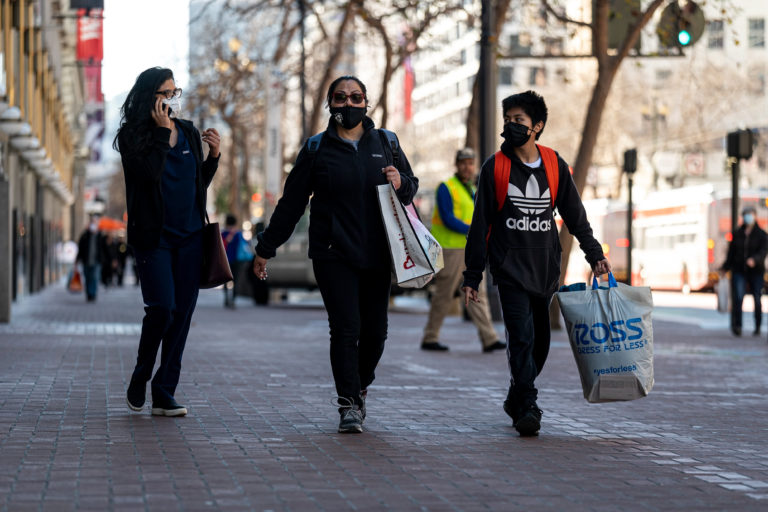
Pedestrians wearing protective masks carry shopping bags in San Francisco, California, on Wednesday, Feb. 17, 2021.

David Paul Morris | Bloomberg | Getty Images

For many Americans, the post-pandemic normal is exciting.

After more than a year stuck inside and forgoing travel, entertainment and more to curb the spread of Covid-19, many people are ready to get back out in the world.

That excitement, however, could lead to overspending and a debt hangover in the coming months.

“We are now coming out of a cave, basically, and there’s a lot of emotions around that,” said Susan Greenhalgh, an accredited financial counselor who runs Mind Your Money LLC in Rhode Island.

Here are some red flags that financial experts say may signal a spending problem.

You’re piling up debt

An early sign that you might have a problem with spending is that you’re piling on debt, especially with high-interest credit cards.

This is especially concerning if you suddenly find that you can’t make a full payment at the end of the month, or reduce the amount you owe, or even pay the minimum amount, according to Jacqueline Schadeck, a certified financial planner based in Atlanta.  

Of course, it’s likely that credit card balances will increase after a year of not spending much on going out, said Greenhalgh. Having a higher bill one month isn’t immediate cause for concern, but is something to monitor for the next few credit cycles and consider if you need to reestablish a budget.

“We were kind of getting used to very low credit card statements every month, and now they’ve gone up considerably,” she said.

While it’s fine to treat yourself on occasion, the key to doing so is to be within your budget and comfort zone, said Greenhalgh.

Your credit score suddenly dips

Another thing to watch for that could indicate you’re spending above your means is if your credit score suddenly dips.

This is because a component of the score is your credit utilization, which is how much you’ve spent against your total limit. As your credit utilization ticks up, meaning you’re taking on debt, your score will likely fall to reflect that, said Greenhalgh.

“If all of a sudden you’ve now put travel and clothes and restaurants on it and you’re not thinking about it, don’t surprised if your credit score goes down,” she said.

More from Invest in You:
How to avoid overspending in this hot housing market
How to vet budgeting and investing apps
Monthly child tax credit payments start July 15. What to know

You’re letting your emotions guide spending

After a year of not doing many of the things we’d like to do, it can be tempting to let our emotions take over and spend without limits. This may be especially difficult amid an uneven recovery, where the pandemic was beneficial or net-neutral for some Americans but very damaging for others.

“You see some people get in trouble around this because they’re using spending as a way to just be accepted and keep up,” said Adam Blum, a licensed psychotherapist and the founder of the Gay Therapy Center. He added that this has particularly been noticed as a problem among gay men.  

“When we go unconscious and don’t think about what we’re doing, it’s more likely we’re going to make mistakes that we regret,” said Blum.

You’ve tried to budget or curb spending, but are having trouble

Of course, some things post-pandemic will cost more due to inflation and overloaded supply chains.

If your spending is boosted as a result of this, it might be undesirable, but it isn’t necessarily a problem, said George Blount, a financial therapist and managing partner at nBalance Financial in Cambridge, Massachusetts.  

On the flip side, if your spending has become uncontrollable, that’s a red flag, he said. And, if you’ve tried to budget using a system or a product that just isn’t working for you, that’s also cause for concern.

“You have to use the tools and you have to use them effectively,” said Blount.

In addition, if you make a lot of money but just aren’t sure where it’s going, that could signal overspending, according to Schadeck.

We are now coming out of a cave, basically, and there’s a lot of emotions around that

Susan Greenhalgh

accredited financial counselor, Mind Your Money LLC

The solution? Mindful spending

To solve a spending problem, financial experts recommend getting well acquainted with the details of where your money is going and the emotions behind purchases.

“I always encourage people to get mindful about their money,” said Greenhalgh. That means looking at their spending for a few months in a row, she said.

Set aside some quiet time with your bank account and credit card statements and really see where the money is going, she said. Then, assess what you feel good about, and what you’re not so happy about. This could include comparing expenses to a pre-pandemic budget, identifying any shifts in spending and course correcting if needed.

Being connected to where you’re spending can help you form new habits, she said.

If you’re still having trouble with spending or feel it might be tied to emotions you’re struggling to control, seeking help from a therapist or financial therapist can help you work through those issues.

You can also do certain exercises such as checking in with your emotions before making any purchase, said Blum.

“Everything we do has an emotional component, and if we don’t know what those are, we’re kind of operating at a loss, we’re stuck,” he said. By asking yourself why you’re making a purchase before swiping your credit card, you can become more aware of the emotional component and address it.

SIGN UP: Money 101 is an 8-week learning course to financial freedom, delivered weekly to your inbox.

CHECK OUT: How to make money with creative side hustles, from people who earn thousands on sites like Etsy and Twitch via Grow with Acorns+CNBC.

Disclosure: NBCUniversal and Comcast Ventures are investors in Acorns.

Tensions Remain High Between Florida Governor, State’s LGBT Community – WUFT

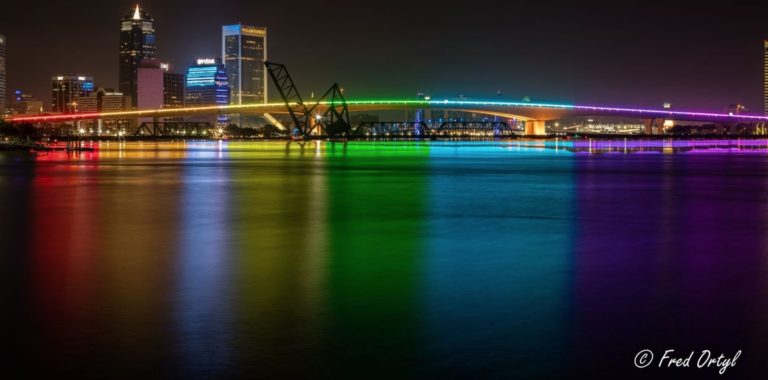
Distancing himself from a controversial order from the state Transportation Department to turn off a Pride Month light display on a Jacksonville bridge, Gov. Ron DeSantis said he isn’t personally involved in such decisions.

“I’m not involved in bridge lighting,” he said last week. 

There is evidence that contradicts the governor: In 2019, a Republican former business executive asked DeSantis to consider pink lights for Tampa Bay’s Sunshine Skyway, in honor of breast cancer awareness month.

Janet Cook, the former president of Estee Lauder North America, said the governor’s office directed her to reach out to FDOT with its blessing and separately sent a message to a maintenance engineer in the Transportation Department to follow-up on Cook’s request.

Months later, in October 2019, Tampa Bay’s bridge went pink. 

The incident in Tampa was confirmed in an interview this week with Cook and was originally reported in 2019 by the Tampa Bay Times

That example doesn’t dispute the governor’s statement that he was not involved in the Jacksonville decision, which was widely regarded as the latest sleight by his administration against the LGBTQ community in Florida. Yet it fueled suspicions – voiced so far without evidence – that the department moved against the Pride Month display in ways the governor’s politics would have favored. 

The governor’s office, Florida Transportation Department and Jacksonville Transportation Authority have not yet fully responded to public records requests to release internal records, including emails, that would lay out what happened behind the scenes during last week’s bridge decision.

So far, the official explanation offered was this: The Transportation Department received five phone complaints, then ordered the Jacksonville Transportation Authority to take down the display, citing permit violations. After criticism, the rainbow lights returned the next day, as “it is obviously a matter of broad community interest,” the department said.

The incident highlighted the deep divisions in Florida between DeSantis, an ardent conservative who’s increasingly tackled social and cultural issues, and the state’s LGBTQ community, which as a voting bloc skews heavily Democratic.

Florida has one of the highest populations of LGBTQ people in the country, but despite the community’s size, it remains a weak political force in the state, where Republicans control both houses of the Legislature and the governorship.

On June 1, the governor signed the “Fairness in Women’s Sports Act,” which restricts young transgender women from playing on women’s sports teams. The next day, DeSantis vetoed $1.5 billion in line-items from the state budget, including $1 million set aside for two Orlando LGBTQ organizations. Following the bridge lighting controversy, his administration said it wasn’t singling out the LGBTQ community.

The governor is a leader for all Floridians, spokesperson Christina Pushaw said, and that includes the LGBTQ community. “Framing his actions to benefit the entire state, as though they’re attacks on a specific group, is a baseless political narrative.”

Cook said she believed the governor decided to help her because he is a family man. She said she made another request to turn a bridge blue for Earth Month, but it was denied. 

“At the end of the day,” Cook said, “I do think it’s FDOT’s decision.”

When it comes to the trans athlete bill, the governor’s office said it is anti-discriminatory toward cisgender women. The governor, Pushaw said, doesn’t want women and girls to lose opportunities for recognition “because they’re competing against biological males who they have no chance to compete against.” 

Pushaw acknowledged that complaints about this are rare in Florida but said DeSantis wants to prevent it from happening here the way it happened to the young Connecticut athlete, Selina Soule. 

Soule, who spoke at the press conference for the bill signing, said that allowing trans women to compete caused her to lose opportunities in high school track competitions. 

Pushaw said Desantis didn’t sign the bill on June 1 – the first day of Pride Month – to send a message. “It was because it was the first day [Soule] could join us.” Her lawyer confirmed there were scheduling conflicts earlier. 

To Jon Harris Muerer, the public policy director of Equality Florida, the timing made no difference. This is the first explicitly anti-LGBTQ law passed in Florida in 24 years, he said, and DeSantis did not meet with trans youth before signing it. Muerer said one woman from Connecticut shouldn’t make this a legislative priority in Florida.

Democratic state Rep. Carlos G. Smith said the bill was cruel and unnecessary, and there was an opportunity cost in time spent debating it.

Smith is the state’s first openly LGBTQ representative and serves east Orlando. He has championed progressive causes, especially ones that affect the LGBTQ community. In the time spent on the trans athlete ban, Smith said lawmakers could have focused more on important policy issues like affordable housing and lowering private insurance rates.

“By banning trans girls from competing on girls teams, they are taking away opportunities from trans girls to be part of a team, to be able to learn from their peers, to feel included.”

Orlando resident Joél Morales said that in 2019, DeSantis visited the Pulse Night Club Memorial and promised the crowd he would always support survivors. On a message board at the ceremony, the governor wrote, “Florida will always remember these precious lives.”

As a gay Puerto Rican man, Morales was deeply impacted by the largest attack on LGBTQ in the history of the country. Of the 49 lives lost on June 12, 2016, 90% were Latinx and more than half were Puerto Rican. An anti-terrorism grant helped the community estbalish crisis and trauma centers, including the city’s LGBTQ Center. Morales works there at the Orlando United Assistance Center, where he’s been helping since Day One. 

They currently serve 68 Pulse-affected clients, providing a range of mental health and legal services. But now, the grant has run out, and the center’s mental health services are fully booked. Democratic lawmakers Linda Stewart and Anna Eskamami helped the center request $150,000 in appropriations to keep their doors open. Community donations alone wouldn’t be enough. The Zebra Coalition, an Orlando organization that shelters homeless LGBTQ youth, similarly requested $750,000. 

DeSantis’ vetoes amounted to $1.5 billion, with the lines for the Orlando organizations making up only .06% of the cuts. Pushaw said there will still be a $212 million increase in funding towards community-based mental health service, for a total of over $1 billion.

“That funding that was requested as an earmark this year was new, not something that was part of the organization’s operating budget in previous years and then removed,” she said. 

The budget also includes funding for safe affordable housing and homelessness crisis prevention. LGBTQ organizations, along with any other in the state, may apply through those channels, Pushaw said. The Zebra Coalition could find funding through the Department of Children and Families. 

“If you see a headline that says DeSantis vetoes funding for Pulse survivors, it’s just a gut punch emotionally,” Pushaw said.  “So I understand … why it’s been used to portray him as some, you know, terrible homophobic person, but that’s not the case.”

Smith said that the suggestion that general funding for mental healthcare was sufficient is “an extremely callous attitude to take towards an extremely vulnerable group of people.” Pulse survivors need culturally competent care, he said. 

There’s no guarantee that the organizations will be approved for the funding, Smith said. DCF made news in 2016 for rolling back protections for LGBTQ youth in foster care. They reinstated them after lobbying from LGBTQ groups like Equality Florida. Smith said having to apply is just another bureaucratic hurdle.

As far as the Acosta Bridge controversy, the Democrat said that for anyone who doesn’t believe DeSantis was involved, “I’ve got a bridge to sell you.” FDOT answers to DeSantis, he said.

For now, the trust has been broken. The LGBTQ Center will attempt to raise money from the community to extend its services and hire more mental health counselors. Fred and Maria Wright, parents of one of the 49, pledged $25,000 in a campaign to raise money for the center. 

Morales believes they will reach their goal, because he doesn’t want to think about the alternative. He believes the governor can still help, if he’s willing to talk and have conversations.

___

This story was produced by Fresh Take Florida, a news service of the University of Florida College of Journalism and Communications. The reporter can be reached at avaloomar@ufl.edu.

A gay couple faced harassment for 5 years. Handwriting analysis led to a suspect: A neighbor. – USA TODAY

The first one came in February 2016 — a magazine subscription under a homophobic fake name. At first, LeeMichael McLean and Bryan Furze tried to ignore it. But then the harassment kept coming.

McLean, 44, called the mail “an insidious way for a harasser to get inside your house.”

“It brought me back to being a little kid and getting teased for my voice or my appearance,” he told USA TODAY. “We were being picked on because we were gay, and it had followed me into my 40s. I couldn’t believe it.”

During more than five years of harassment, about 30 pieces of mail with homophobic names on them were sent to the couple’s home in Massachusetts. But after their community rallied behind them to find suspects, McLean and Furze say handwriting analysis led them to the perpetrator.

Furze, 45, said they feared the hate mail would escalate into something more physical. They worried about when their son would learn to read the harassment himself. And even as they tried not to let it affect their everyday lives, they became scared of checking their mail and being in their own home.

LeeMichael McLean and Bryan Furze pose in front of a Pride flag. During more than five years of harassment, about 30 pieces of mail with homophobic fake names on them were sent to the couple’s home in Milton, Massachusetts.

“It was something that was always in the back of our minds, but we had no control over it,” he said. “So we had to tolerate it and live on.”

When they reported the harassment to the police, they say officers took the allegations seriously but there weren’t many clues to lead to a suspect.

The couple spoke with several law enforcement professionals who told them the perpetrators in these cases are usually someone you can see from your house. But all their neighbors were so nice that they began to think it couldn’t possibly be true.

“For five years, we were living here and wondering which of our neighbors, who were all being kind and neighborly to us, is actually harassing us,” McLean said.

Then the perpetrator made a mistake.

The suspect, who has not been publicly identified, signed the couple up for a Boston Globe subscription, but the McLean and Furze already had a subscription. When the newspaper sent back the order request, made under the name “Michelle Fruitzey,” McLean realized it was handwritten.

More:Much of our slang comes from the Black community. Not acknowledging that perpetuates racism.

McLean brought the handwriting sample to the police station and gave a statement, walking through the years of harassment. He quickly realized the stress and anxiety he had been internalizing for years.

“I walked out of there feeling like a foot shorter because I had so much weight on me,” he said. “It was horrible. I was anxious, depressed. Having to recount those details was incredibly painful.”

McLean also posted the handwriting sample on a local Facebook group, asking the community to help them identify any suspects. Stunned by the homophobic language from the subscription cards, the couple’s neighbors sprung to action, and the hashtag #IAmMichelleFruitzey began trending on social media as locals searched for who was responsible.

“We didn’t realize we’d get love and support and cheers from every corner of town, from people we’d never met to close friends and neighbors,” McLean said.

LeeMichael McLean and Bryan Furze pose with their son. During more than five years of harassment, about 30 pieces of mail with homophobic fake names on them were sent to the couple’s home in Milton, Massachusetts.

One community member scoured town election records to find the matching handwriting. He found a match, and a suspect was arrested May 13, McLean said.

During questioning, the suspect admitted to sending the mail and called it a prank that he didn’t think would require police involvement, officers told the couple. The suspect told the detective he sent the subscriptions because he didn’t like how outspoken McLean and Furze were and how the two, both elected Town Meeting members, voted.

“This person was intimidating and trying to silence us,” Furze said.

Milton Police chief James O’Neil would not comment on the identities of the victims or suspect but did confirm that the police department has filed a criminal complaint seeking to charge an adult male with criminal harassment. No charges have been filed.

More:LGBTQ joy is more important than ever this Pride Month. Here’s why.

The couple said the suspect was friendly and never displayed any outward hostility.

To them, it has become a lesson that discrimination can come from anywhere, even in a progressive town like theirs.

“Most people in our area are incredibly supportive, but you can never really be too careful because there are people who are willing to inflict harm in a way that’s invisible,” Furze said.

LeeMichael McLean and Bryan Furze pose with their son. During more than five years of harassment, about 30 pieces of mail with homophobic fake names on them were sent to the couple’s home in Milton, Massachusetts.

The couple had long kept the harassment from their son, now 7 years old, but when news of it broke, they told him that one of their neighbors had been unkind. 

“There’s no question that it bothers him because every couple days he’ll ask more questions about why,” McLean said of his son. “And how do you answer that ‘why?’ There’s no good explanation except that we are who we are.”

Furze said their son has always been proud of having two dads, but “he’s finally seeing that some people don’t see his dads the same way he does.”

After a suspect was identified, McLean said he struggled with depression, anxiety and anger. A therapist told him he needed a positive outlet for his emotions. 

They decided to make #IAmMichelleFruitzey T-shirts and sell them to donate to Gay Straight Alliance organizations at local schools.

People in Massachusetts, Texas, California and Virginia have already ordered T-shirts, and the first 150 are set to ship soon, Furze said. The couple have so far raised $22,000.

“We wanted to take something that was really tough and use it as a way to support and empower young people,” Furze said. “We want to turn Michelle Fruitzey into a superstar and allow her to spread the message that bullying, in all its forms, is not OK.”

Furze said he hopes their story encourages others, including their son, to stand up to bullies who target marginalized people. But he also hopes it serves as a reminder that hateful people may exist in any community, no matter how accepting most people may seem.

“They are among us, and we need to be vigilant to protect our children, our peers and each other,” he said.

For resources for LGBTQ+ youth facing bullying and harassment, GLAAD has compiled a list here.

The Trevor Project offers a 24-hour helpline for gay and questioning teens at 866-488-7386. It also offers TrevorChat and TrevorText to confidentially message with a Trevor counselor.

Contact News Now Reporter Christine Fernando at cfernando@usatoday.com or follow her on Twitter at @christinetfern.

Creating a Literary Culture: A Short, Selective, and Incomplete History of LGBT Publishing, Part III – lareviewofbooks

0

IN THE FIRST installment of this series, I explored the paltry and frequently pathologized literature available to gay and lesbian readers between 1940 and 1980, a period when homosexuality was still deemed a mental disease and criminal behavior. In the second installment, I looked at the explosion of gay and lesbian books between 1980 and 1995, a boom that reflected the emergence of a self-affirming gay and lesbian community that perceived its struggle as a civil rights struggle and the crisis of the AIDS epidemic. This section picks up the story, which is now more complicated and more nuanced that in previous eras. Between small presses, self-publishing platforms, and renewed interest by big publishers, there are more LGBTQ books available to readers than ever and, as that acronym suggests, those books include a growing body of transgender, bisexual, and nonbinary literature. At the same time, however, the market is increasingly saturated and balkanized. Moreover, the tone of much of queer literature has changed from politically and socially engaged works to less ideological and confrontational material. So, whither queer lit? That is precisely the question.

¤

Picking Up the Pieces: Queer Publishing Now

At the beginning of the 21st century, the big publishers and the literary establishment virtually abandoned books by queer writers after the great outpouring of gay and lesbian literature between 1980 and 1995 failed to deliver bottom-line balloons. This queer equivalent of the Harlem Renaissance owed its existence to a robust network of gay and lesbian media and bookstores as well as the tectonic social and cultural shifts ushered in by the AIDS epidemic, which dramatically brought the gay and lesbian community and its stories of suffering and heroism into public consciousness. By the late 1990s, a new generation of drugs had transformed HIV infection from a death sentence to a chronic, but manageable illness (though not for everyone, of course). Simultaneously, the networks of gay and lesbian media and bookstores began to collapse, displaced by the internet, on the one hand, and by big chain bookstores and Amazon on the other. Many of the most important small presses that had been the backbone of queer publishing also disappeared. The result was that fewer queer books were being published.

That has, as you already know, changed. The advent of easy self-publication and online distribution via platforms like Amazon’s Kindle Direct Publishing, the emergence of new small queer presses, and a renewed if tokenistic interest in queer writers by the remaining big publishers has opened the floodgates to a fresh stream of LGBTQ books. But more books means greater competition for the attention of an LGBTQ community that also finds itself increasingly represented across other cultural platforms — TV, movies, and most significantly, social media — that to some extent have displaced literature as the community’s main source of self-validation and self-identification. Then, too, there has been a rather striking change in the tone of much queer literature. Historically, queer literature was the literature of the Outsider, a sphere inherently engaged in the political and social questions distinctly associated with homosexuality. Now, with the apparently greater acceptance of queer people, much of the literature being produced — especially by Big Publishing — tends toward the introspective, apolitical, and non-ideological. It’s here, it’s queer, and it’s already over it, I suppose.

As such, the past decade has been both the best and the worst of times for LGBTQ publishing and writers. Authors can now bypass the gatekeeping publishing apparatus completely by producing and marketing professional-looking print copies or ebooks through the self-publishing options available to them on the internet. Many queer writers have taken this option, even as it comes with a number of significant challenges, not least of which is finding a way to stand out amid a crowded marketplace. Between self-publication, publication by the remaining LGBTQ small presses, and publication by the Big Five publishers, it’s probably safe to say there are more LGBTQ books in print at this moment than at any other time in publishing history. This includes a growing body of transgender fiction that encompasses every genre from speculative fiction, literary novels, romance, erotica, and crime fiction.

The sheer volume of all new titles released every year — hundreds of thousands — and the simultaneous balkanization of the reading public to smaller and smaller niches makes it more difficult for queer writers to preach beyond the choir. Preaching to the choir has its advantages of course; it means there is a market of sympathetic and engaged readers. But most writers like to think that, at whatever corner of human experience they begin, there is some universal aspect to their work. In a world of niche markets and marketing, constantly flooded by new titles clamoring for attention, it is harder and harder to break through the noise and reach those readers outside the ambit of a writer’s specific community.

It may also be true that for younger generations of the queer community, books have lost some of the urgent importance that they held for older gays and lesbians. While still at essentially tokenistic levels, young queers can see other LGBTQ people of all stripes on television and in the movies; they can listen to their music, and follow them on streaming services and social media. And it’s not only white gay men that the community needs to be satisfied with anymore; the past several years have seen a welcome surge in the representation of queers of color, the transgender community, bisexuals, asexuals, and nonbinary folk. There are also, one hastens to add, any number of “dating” apps that help connect queers with one another in the way that bars or bathhouses used to — and often with the same forms of anticipatory, utopian inclusion that meets the reality of harsh exclusion. Additionally, as David Groff observes, “Queer life has become privatized, with fewer institutions like bars, bookstores, and magazines to adhere us; we tend to create and find ourselves via personal, not public communities.”

This inwardness may also be a function of the greater acceptance of LGBTQ people; at least some of them, at least in some quarters of society. One reason that older generations of gay and lesbian people were so exposed to public censure and ridicule was because their behavior had been criminalized and pathologized by sodomy laws and the classification of homosexuality as a mental disease. In that circumstance, a genuinely private life — as opposed to a secret, closeted one — was impossible, since the state actively sought to expose homosexuals. Necessarily, then, the gay and lesbian literature of those times was forced to engage with social condemnation of homosexuality; it was the literature of the oppressed. Now, however, many LGBTQ people have won what Justice Brandeis once called “the most comprehensive of rights,” that is, “the right to let alone.”

In addition to this new privatization of queer life, current literary trends also promote styles and narratives antithetical to traditional queer writing. These trends are reflected in the lists put out by the big publishers and embraced by the literary establishment and their counterparts in the commentariat of reviewers for newspapers and magazines. They are, in part, the result of the stunning growth of MFA programs in creative writing and their dominance over the publishing industry in the more than half a century since the end of World War II. The website of the Associated Writers and Writing Programs lists 999 academic institutions that offer a degree in some field of creative writing; 404 for fiction alone. These programs promote, if not a uniform style, a certain ethos as to what constitutes “serious” and worthy literature.

Anis Shivani, a fiery critic of MFA programs, accuses them of producing fiction that is apolitical and unengaged, filled with “prettified” language that “promotes grief, paralysis and inaction.” Shivani characterizes MFA fiction as a “culture of confession” where “time after time, the hope triumphs that there is something in the muck of memory that might, after all, salvage the writer from his struggles with telling a good, full-blooded story packed with real people and real events.” Harsh, perhaps, but he has a point about the inwardness of much “literary fiction” produced by MFA graduates who are overwhelmingly white, cis, straight, and middle or upper middle class. Such apolitical, non-ideological literature is the antithesis of traditional queer literature that forced authors and readers alike to grapple with the cultural, social, and political powers that sidelined queer people to the margins and sought to keep them there.

For many queer writers who still embrace the traditional oppositional model, the doors of Big Publishing and the Literary Establishment are closed. One writer acquaintance, himself on the faculty of a creative program, remembers how a prominent New York agent responded when the writer told him he was working on a novel that had the AIDS epidemic as a backdrop. “AIDS,” the agent said, “is over.” Certainly, the challenge that many esteemed gay and lesbian writers of the 1980s and 1990s have had in getting published in the new millennium supports the view that Big Publishing has concluded the literature of political engagement is neither marketable nor culturally relevant.

Additionally, like the false trope of a “post-racist society” that followed the election of Barack Obama, the notion that, with marriage equality, we now live in a “post-homophobic” culture has also had a detrimental impact on LGBTQ writers. This is especially true of trans writers and queer writers of color who understand all too well that the claim of victory over bigotry is premature. If polite society, gay and straight, has now concluded that homosexuals are just like everyone else — having babies, shopping at Ikea, getting mortgages, and sizing up their portfolios from startup IPOs — it’s unlikely that Big Publishing will publish queer writers whose work challenges and upsets this charming applecart by reminding the reading public that the suffering of the queer community is real and ongoing, that reminds them that we haven’t yet reached the horizons glimpsed in the 1970s, 1980s, or 1990s.

Furthermore, the emergence of MFA programs as the pipeline to Big Publishing has created a class divide among aspiring writers: not only queer but also, significantly, writers of color. An article in Inside Higher Ed pegs the average cost of an MFA as between $20,000 and $30,000 while some programs — it cites Columbia University — will cost as much as $120,000. This is, of course, in addition to the costs of an undergraduate degree. Almost inevitably, matriculating into an MFA program requires taking on more student debt. For many working-class and even middle-class students, the costs of obtaining an MFA degree are prohibitive, depriving them of an academic credential that increasingly seems to be a prerequisite for the possibility of being promoted by Big Publishing. Queer literature has always been enriched by writers from the working and lower middle classes — John Rechy, Leslie Feinberg, Dorothy Allison, and Gil Cuadros come immediately to mind — and by writers who worked other careers to support themselves. (I, for example, coming from a working-class Mexican American family, went to law school and practiced law for 30 years.) Would these writers be published today without an MFA degree? How many young queer writers without the means to attend an MFA program will find the already steep climb to publication virtually impossible?

It is true that in recent years, New York publishers, now down to the so-called Big Five, have begun to publish some younger queer writers. One of the most acclaimed, Garth Greenwell, notes that

mainstream publishers are much more open to queer books than even five years ago. And by more diverse writers — Bryan Washington, Akwaeke Emezi, Nicole Dennis-Benn, Carmen Maria Machado, just to name a few. It remains the case that too few trans writers are finding a place at the table, maybe especially trans women.

David Groff agrees that “[mainstream] publishers have recently become more open to certain emerging LGBTQ authors,” but, he cautions,

in the winner-take-all, increasingly consolidated world of mainstream publishing houses, the door to entry is narrower, admitting fewer than before. Books by and about lesbians remain under-published. Many venerated LGBTQ mainstream writers are dogged by modest sales (easily tracked these days, thanks to Bookscan) and have trouble sustaining their careers. Our books still must prove themselves, title after title, as if each is nearly the first of its kind; there is no presumption of success based on the LGBTQ category. One successful book does not open the gate for similar books to pass through.

Tokenism remains an issue. The writers Greenwell mentions, and Greenwell himself, are immensely talented and fully deserving of their success. Still, their books cumulatively represent only a small stream in the deluge of titles annually published by mainstream publishers. As Sarah Schulman argued in her 2018 speech accepting the Bill Whitehead Award for Lifetime Achievement in LGBTQ literature given by the Publishing Triangle: “For, too often, the introduction of some queer person of great gifts into the reward system produces tokenism instead of cultural expansion, because that person’s individual success does not represent a paradigm shift, but actually enhances the gatekeepers’ power.”

The attention lavished on the handful of books by LGBTQ writers published by Big Publishing also obscures the fact that the real number of such books is infinitesimal. In 2019, Penguin Random House, the largest of the Big Five, published 85,000 print and digital books; if we assume conservatively that 10 percent were novels, that would be 8,500 new works of fiction. How many of those were by queer writers? One, five, 10? There is nothing in Big Publishing today like Michael Denneny’s Stonewall Inn Editions at St. Martin’s in the 1990s, a line that was dedicated to publishing gay male authors. In terms of actual numbers of queer books published by the Big Five, we are closer to the trickle of the 1950s than the flood of the 1990s.

Smaller presses continue to pick up the slack. A quick Google search reveals that not only are some of the older small presses still in business, but newer ones continue to pop up. They publish the LGBTQ writers whose work addresses the effects of oppression and the broader issues of social justice that intersect with the concerns of the queer community. They also preserve the literature of the past. I want to mention two new small presses in particular, one that is quite personal to me because I am its managing editor.

In 2019, I was approached by Bywater Books, a respected lesbian press founded in 2004, about taking over a new imprint it had started called Amble Press. The goal of Bywater’s publisher was to expand beyond lesbian writers and publish, as they put it, “writers across the queer spectrum.” I took the job because I knew from my own experience how vital the small press has always been to LGBTQ writers. I also hoped to give other writers the start that Sasha Alyson had given me when his small press, Alyson Publications, accepted my first novel after it had been turned down by 13 other publishers. (Incidentally, I am not paid for this work, I do it as a volunteer.)

In 2021, Amble will publish the first books I have acquired: Amble’s first book, acquired before I started, was the AIDS novel As If Death Summoned by Alan E. Rose, which was published in December 2020 to glowing reviews. Matthew Clark Davison’s debut novel, Doubting Thomas, will be published in June 2021; Joe Okonkwo’s collection of short stories Kiss the Scars on the Back of My Neck is due out in August; and Casey Hamilton’s MENAFTER10 is scheduled for September. Next year, Amble will publish Faux Queen, Monique Jenkinson’s memoir of the San Francisco drag scene in the 1990s, Orlando Ortega-Medina’s novel The Fitful Sleep of Immigrants, a novel about a Latinx immigration lawyer who becomes enmeshed with a client even as his own immigrant partner faces deportation; Knock Off the Hat, a mystery by veteran mystery writer Richard Stevenson set in Philadelphia in 1947 in the midst of police raids on gay bars; Hell-Bent, an unusual coming-out tale by Calista Lynne in which a teenage girl summons a demon to journey into hell in search of her movie star crush; and Army of Lovers, K. M. Soehnlein’s novel about the early days of ACT-UP.

These books illustrate the great range of excellent queer writing by accomplished writers abandoned by the risk-averse culture of Big Publishing. While Hamilton and Jenkinson are debut authors, the others are not. Davison teaches in the creative writing department of San Francisco State University, has published widely in places like Guernica and The Atlantic and anthologies like Empty the Pews, and is the recipient of awards and grants that recognize his talent. But even with this pedigree and a literary agent, he struggled to find a publisher for his first novel, which follows a gay teacher at an elite, private school falsely accused of inappropriately touching one of his students and its aftermath. Okonkwo’s first novel, Jazz Moon, won the Publishing Triangle’s Edmund White Award for outstanding first novel and he too was represented by a distinguished literary agent for his superb collection of short stories about gay Black life. Ortega-Medina has published three previous books, the first — Jerusalem Ablaze — was shortlisted for the Polari First Book Prize awarded by the United Kingdom’s National Centre for Writing. Both Stevenson and Soehnlein are recipients of a Lambda Literary Award. These awards, given by the LGBTQ community itself, demonstrate that there is an audience for queer books and a still-existing (although diminished) framework to support LGBTQ writers. (The Lambda Literary Foundation does far more than give out awards — it supports emerging queer writers with a two-week writing workshop and mentorship, reviews queer books through its literary review, and brings queer writers into the classroom.) Still, Big Lit continues to largely ignore the LGBTQ literary community.

Each book, in its own way, continues the tradition of an engaged queer literature. These are narratives set against the reality and effects of oppression and marginalization. They are not polemical. Rather, they are subtle and beautifully written, weaving into their stories the sense of Otherness that has always been the hallmark of queer literature. This Otherness is not as simple as a sense of personal alienation and anxiety. The best LGBTQ writers have recognized that Otherness can also be a position of privilege from which one can observe the structures of oppression invisible to the oppressor and the continual hypocrisies and cruelties that sustain that structure and thereby expose it.

At the other end of the small press spectrum is ReQueered Tales, founded in 2016 by Justene Adamec, Alexander Inglis, and Matt Lubbers-Moore — respectively a lawyer, a retired telecommunications executive, and a writer-librarian. Unlike Amble, ReQueered’s mission is not to publish emerging writers, but rather, to recover LGBTQ literary heritage by bringing back to life books and writers who have gone out of print. They include writers of the AIDS era like Stan Leventhal and Jay B. Laws, who died during the plague, and those who are very much alive today, like John Morgan Wilson, author of eight crime novels featuring gay journalist Benjamin Justice, and whose first novel, Simple Justice, won an Edgar Award, and Nikki Baker, who whose protagonist is a Black lesbian working in Chicago’s financial industry. ReQueered’s mission of preserving the LGBTQ literary heritage is every bit as vital as the mission of presses like Amble, to expand that heritage with new work and new writers. Crucially, these presses continue to be mission-driven rather than profit-driven; they exist chiefly to give queer writers a platform for their work whether it is literary fiction or romance; for their publishers, editors, and writers, they are passion projects.

They are also indispensable because a mature literary culture is diverse, inclusive, and deep. It’s a culture that includes works of writerly brilliance and works that speak to the circumstances of their readers’ lives or that exist simply to entertain and provide pleasurable escapism. What difference does it make, one might ask, whether a mystery features a gay protagonist or a straight one if the main purpose of the book is to provide a few hours of relief from “real life”? If you live in a world where the cultural products continue to mostly exclude you, it makes an enormous difference. Queer readers have always sought not just diversion from their literature, but validation, and even now, in this era of greater acceptance of LGBTQ lives, that’s still true. We, as readers, identify with those works that have at least a passing relationship to our own specific human experience, which includes our conceptions of gender and sexual orientation.

The future of queer publishing, whether from the independent presses or the mainstream publishers, is tied in part to the future of books — are we, as is sometimes said, entering a post-literary world? More crucially, however, the future of queer publishing is inextricably tied to the future of queer self-conception itself. Older gays and lesbians experienced themselves as part of an embattled minority, alternately ignored and demonized by society at large; this was no academic argument — they often bore the stripes to prove it, as well. In the 1950s and 1960s, there were so few cultural accounts of our lives that when we stumbled across a book that provided one, even if it was marred by the obligatory tragic ending, queer readers seized upon it like a Holy Grail, proof that they existed and were not alone. Even later, in the 1980s and 1990s, this enormous need for validation drove gay and lesbian publishing: we needed to tell and to hear stories about and by ourselves, particularly during the AIDS epidemic. Books were not mere escapes, they were manifestos, and writing our lives and experiences was an act of political activism, even if your subject was a gay vampire.

Is this still true? Do younger generations of LGBTQ folk experience themselves as threatened and erased and in need of self-validation? And if they do, will they look for themselves and a better future in books? Or will they find it on their smartphone screens? Or some revolutionary, bio-integrated technology yet to be devised? Or in a shift of cultural consciousness in which gender identity and sexual orientation truly become private and morally neutral aspects of personality? Will writers no longer feel the need to write books with the same polemical passion that drove the writers who created the LGBTQ vast literary culture? Whatever the future brings, one thing is certain: the compulsion to tell stories that arise from the deepest sense of ourselves, however those stories may be told, will not disappear, and foremost among those storytellers will be our queer voices.

¤

Michael Nava is the author of a groundbreaking series of novels featuring gay Latino criminal defense lawyer Henry Rios.

¤

Banner image: “LGBT pride section at Powell’s Books, Portland, 2016” by Another Believer is licensed under CC BY-SA 3.0. Image has been cropped and darkened.

Celebrate Pride Month With Beauty Trends Inspired By The Rainbow Flag – Femina

0

makeup

Image: Instagram

Pride month just got the vibes in check and we are so glad that an entire month is claimed to celebrate the rights of the LGBTQIA+ community. With all the awareness being raised and people being vocal about it, we also can’t get over the fact that much of what sparks these discussions amongst those who aren’t aware are in fact rainbow-inspired beauty and fashion trends.

For those who are still confused, no, people aren’t rocking rainbow makeup and accessories because it is the monsoon season. In fact, the rainbow flag is a symbol of lesbian, gay, bisexual, transgender, queer and questioning, intersex, and asexual (LGBTQIA+) pride and LGBT social movements because the rainbow with its many colours best reflects how diverse the community is. So whether you identify with the community or are just all in support of making this world a better place for everyone by supporting the movement, you can try rocking some of these beauty trends this pride month.

makeup

Image: Instagram


Rainbow Nail Art

Get a fresh rainbow mani! There are tons of designs to choose from and the easiest way to have your nails reflect the pride flag for the month.

makeup

Image: Instagram


Cut Crease Rainbow Eye Makeup

Get the spectrum of rainbow colours on your lids with eyeshadow and highlight it with a white line at the crease of your lids. 


Beauty

Image: Instagram


Rainbow Liner

If you have small eyes but still want to make a statement with rainbow eye makeup, try this creative look with liner. The liner is used above the crease line so that it doesn’t smudge and the lids sport bubblegum pink. It will definitely draw attention.
 

Beauty

Image: Instagram

Rainbow Blush Art

It isn’t excessive at all! You can try this rainbow blush look and get your creative side to play with this trend. Apply the different colours horizontally on your cheeks and nose; just don’t go and blend out everything at the end because of habit as that will just ruin all your hard work.

 
Beauty

Image: Instagram

Rainbow Hair Colour

Rainbow hair is such a beautiful trend to sport anyway. Even if you don’t want to commit to hair colour, you could always try extensions. If you are all for vibrant hues then, go out and experiment with rainbow highlights or an ombré style.


Also read: Split Hair Colour Is The Anime Beauty Trend That We Are Obsessing Over!

Subscribe to our YouTube channel

Gay Agenda • June 18, 2021 – Dallas Voice

The Gay Agenda

Have an event coming up? Email your information to Managing Editor Tammye Nash at nash@dallasvoice.com or Senior Staff Writer David Taffet at taffet@dallasvoice.com by Wednesday at 5 p.m. for that week’s issue.

The Gay Agenda is now color-coded: Red for community events; blue for arts and entertainment; purple for sports; green for nightlife and orange for civic events and holidays.

Every Monday: THRIVE

Resource Center’s THRIVE Support Group for people 50 and older meets virtually from 11:45 a.m.-1 p.m. led by a SMU Intern from their counseling program. Email THRIVE@myresourcecenter.org to request the link.

Every Tuesday: Totally Tuesdays

A night of totally fetch throwbacks hosted by Marissa Kage. Masks required. 11 p.m. at The Round-Up Saloon, 3912 Cedar Springs Road.

Weekly: Frontrunners

Meet in Lee Park where the old statue stood on Wednesdays at 7:15 p.m. and Saturdays at 9 a.m. for a one-hour walk/run on the Katy Trail.

Biweekly: Hope Cottage Foster Parent Information Meeting

Hope Cottage holds information meetings for those interested in becoming foster parents. The meetings are held alternately on Saturdays at 10 a.m. and Thursdays at 6 p.m. For information email Clyde Hemminger at chemminger@hopecottage.org.

JUNE

June 18: Federal Club

HRC DFW Federal Club cocktails and conversation as members and guests meet virtually. DFWFederalClub.org for details.

June 18: Pride Party +

Virtual kickoff of Dallas Arts District’s Pride Party + with Terry Loftis as Master of Ceremonies, Miss Dallas Southern Pride, Porsche Paris, Dezi 5, and Miss Southern Pride, Kennedy Davenport. 6:30-7:30 p.m. Vimeo.com/showcase/prideparty

June 18: Name and gender change workshop

Lambda Legal discusses what the process looks like in Texas to secure state and federal identity documents. Lawyers can receive CLE credit. Meeting via Zoom. LambdaLegal.org.

June 18: Crystal Methyd

RuPaul’s Drag Race star Crystal Methyd appears at 9 p.m. at Urban Cowboy, 2620 E. Lancaster, Fort Worth.

June 18: The History of Juneteenth

Lunch & Learn, a virtual presentation about the annual celebration of emancipation from slavery in the United States. Join Dr. George Keaton, Jr., Founder and Executive Director of Remembering Black Dallas and the Dallas Holocaust and Human Rights Museum for a discussion of the history of Juneteenth, its particular significance in Texas, and how the holiday has evolved over the last 150 years. DallasHolocaustMuseum.secure.force.com/ticket/?_ga=2.159861565.1288647804.1621266823-1628326263.1593529452#/events/a0S6e00000e9hKOEAY

June 18: Music in the Park

Brianne Sargent & Friends String Trio performs at 8:15 p.m. at Samuell-Grand Amphitheater, 6200 E. Grand Ave. Tickets at ShakespeareDallas.org.

June 18-20: Juneteenth Unity Weekend 2021

Hosted by Dallas Southern Pride. Free. Sheraton Suites Market Center, 2101 N. Stemmons Freeway is the host hotel. Code DSP for $89 rate. Ultimate Mega Party at Gilley’s Dallas, 1135 S. Lamar St. on Saturday from 10 p.m.-3 a.m.

June 18-24: Rooftop Cinema

Summer series of outdoor films at Dallas Heritage Village, 1515 S. Harwood St. June 18: The Breakfast Club, Friday the 13th. June 19: Love Jones, Get Out. June 20: Breakfast At Tiffany’s. June 21: Ferris Bueller’s Day Off. June 22: The Greatest Showman. June 23: Pulp Fiction. June 24: The Great Gatsby. Tickets at RooftopCinemaClub.com/heritagevillage.

June 18-Sept. 5: Jurassic World: The Exhibition

You’ve seen the films. Now experience them in real life at Jurassic World: The Exhibition. Educational, immersive, interactive and most of all, awesome, the Exhibition will thrill audiences of all ages as they come face to face with these mighty and sometimes vicious creatures. Grandscape, 5752 Grandscape Blvd, The Colony.

Through June 19: Rusty Scruby

Gay artist Rusty Scruby has a solo exhibit called Comfort at Cris Worley Fine Arts, 1845 E. Levee St. Suite 110. Open house on May 15 from noon-4 p.m. CrisWorley.com.

June 19: Music in the Park

Bobby Sparks, Cure for Paranoia and The Grays perform at 8:15 p.m. at Samuell-Grand Amphitheater, 6200 E. Grand Ave. Tickets at ShakespeareDallas.org.

June 19: Pride Party +

Pop-up performances on the Sammons Park Community Stage including Kennedy Davenport, Uptown Players, Bandan Koro and Dezi 5 from 3-5 p.m. Programming at the Crowe Museum of Asian Art, Dallas Museum of Art and Nasher Sculpture Center. 11 a.m.-7 p.m. Full schedule at DallasArtsDistrict.org/pridepartyplus.

June 19-Sept. 19: Off-Site Nasher

The Nasher Sculpture Center announces its second offsite Nasher Public project: Lauren Cross’s A Moment of Silence/Let Freedom Ring presented in partnership with For Oak Cliff, an organization and community center that works to liberate the South Dallas neighborhood of Oak Cliff from systemic oppression. For Oak Cliff, 907 E. Ledbetter Drive.

June 20: Pride Party +

Virtual and on-site programming from the Crowe Museum of Asian Art, Dallas Museum of Art and Nasher Sculpture Center. from 11 a.m.-5 p.m. Full schedule at DallasArtsDistrict.org/pridepartyplus.

June 20: Teen Pride

Art activities, live performances, advocacy training free for ages 13-19 from 11 a.m.-3 p.m. at the Dallas Museum of Art.

Through June 20: Frida Kahlo: Five Works

Five works by Frida Kahlo from a private collection including four paintings and a drawing will be on display in the atrium on level 4 at the Dallas Museum of Art, 1717 N. Harwood St. DMA.org.

June 22: Get Centered tour

Virtual Resource Center tour streams for free at 5 p.m. Registration required. MyResourceCenter.org.

June 23: Inspiring Inclusion

North Texas Commission presents Inspiring Inclusion in n Evolving World. Join Wendy John, head of global diversity and inclusion at Fidelity Investments for a “less talk, more action” session on why inclusion (for all) matters. 11 a.m. via Zoom. Register at form.jotform.com/211545298862161.

June 23: Pride Game Speakers Series

The Dallas Wings presents its annual Pride Game Speakers Series. Panelists include local community leaders. 6:30 p.m. Contaact Jodan Baccus at 817-900-3014 or jbaccus@dallaswings.com.

June 25: Dine with Pride

Virtual event with the Dallas Wings in conjunction with HRC. 6:30 p.m. $40. DallasWings.com.

June 24-Sept. 25: Becoming featuring Valerie Gillespie
Becoming is an aesthetic exploration of the truth and illusion behind the often times unfortunate actions that stem from human nature. African American Museum, Fair Park. AAMDallas.org.

June 25: Lessons from our community

Lessons from our community: Stories about the fight for equality at 5 p.m. at Liberty Lounge,515 S. Jennings Ave., Fort Worth.

June 25: Divine Miss Diva Show

Return of the Devine Miss Diva Show at 11 p.m. at Club Changes, 2637 E. Lancaster Ave., Fort Worth.

June 25-July 1: Rooftop Cinema

Summer series of outdoor films at Dallas Heritage Village, 1515 S. Harwood St. June 25: Mean Girls, House Party. June 26: Closed. June 27: Coming To America. June 28: The Goonies. June 29: Dirty Dancing. June 30: Love & Basketball. July 1: Independence Day. Tickets at RooftopCinemaClub.com/heritagevillage.

June 25: Swan Song

Swan Song premieres at the Oak Cliff Film Festival. Filmmaker Todd Stephens and star Udo Kier will be in attendance. Texas Theatre, 231 W. Jefferson Blvd.

June 26: Musical Moments

Coalition for Aging LGBT presents a virtual concert series featuring LGBTQ artists and allies the last Saturday of the month at 3 p.m. To register, visit cfa.lgbt/musicalmoments.

June 26: AIDS Walk South Dallas

The 5K walk/run kicks off at 8 a.m. in observance of National HIV Testing Day. This year’s theme “Intensifying The Fight for Health and Rights” extends the mission which is to inspire, educate and galvanize the community of South Dallas and surrounding areas to continue to curb the spread of HIV/AIDS and assist those impacted. Martin Luther King Jr. Community Center, 2922 MLK Jr. Blvd.

June 26: Dallas Wings Pride game

WNBA’s Dallas Wings face the Washington Mystics at noon. During the Pride game there will be a few special additions to the arena that Wings officials say haven’t been done anywhere before. The national anthem will be sung by Voices of Hope from Cathedral of Hope. College Park Center, 600 S. Center St., Arlington. Promo code Pride21 for ticket discount. Tickets at tix.axs.com/5ThCMgAAAABfCrYoAgAAAADW%2fv%2f%2f%2fwD%2f%2f%2f%2f%2fA3V0YQD%2f%2f%2f%2f%2f%2f%2f%2f%2f%2fw%3d%3d/shop/restrictions.

June 26: Dallas 101 – Oak Lawn

It’s a beautiful day in the neighborhood! Take a tour of Dallas neighborhoods and learn more about what makes Dallas special. On this tour you’ll get the inside scoop on Dallas’ weekly LGBT-focused newspaper: Dallas Voice, hear from special guests from Alexandre’s Bar and the Rose Room and learn so much more about Oak Lawn’s history. 11 a.m.-noon. Register for online program at DallasLibrary.LibraryMarket.com/events/dallas-101-oak-lawn?fbclid=IwAR2vV0BITiK8_EHzslZhVrKFqqb1ia9T8EZOhkH9Dajr94Zics1HieaEaDM

June 26: Trinity Pride

A hybrid celebration will consist of a live stream of Virtual Trinity Pride Fest on Facebook Live as well as at official Trinity Pride Partner locations throughout Fort Worth at 7 p.m.

June 26-Sept. 12: Men of Change: Power. Triumph. Trusth
This powerful, immersive exhibition uses art, photography, stories, quotes and historical materials to affirm the power of the African American journey and, ultimately, the American experience. Men of Change profiles revolutionary men – Muhammad Ali, James Baldwin, Ta-Nehisi Coates, W.E.B. Du Bois, Kendrick Lamar, Lebron James and more – who have altered the history and culture of this country. African American Museum, Fair Park. AAMDallas.org.

Through June 26: A Solitary Man: The Music of Neil Diamond

Selling over 10 million records worldwide with 38 top 10 hits, Neil Diamond is one of the best-selling musicians of all time. From halls of fame to lifetime achievements, Diamond’s career has spanned six decades and reaped dozens of awards. Casa Manana, 3101 W. Lancaster Ave. Fort Worth. Ticket start at $65 and can be purchased at CasaManana.org.

June 27: Turtle Creek Chorale

The Turtle Creek Chorale returns to live performance with Holidays Interrupted at 8 p.m. in the Fair Park Band Shell at Fair Park. $30. Tickets at TurtleCreekChorale.com.

June 27: Pride Night at FC Dallas

Get specially priced tickets to the annual Y’all Means All game against the New England Revolution. The LGBT Chamber recommends buying seats in sections 131 and 132 near the Supporters’ Section. Tailgate at 6 p.m. Game at 8 p.m. at Toyota Stadium, 9200 World Cup Way, Frisco. Tickets at tix.axs.com/x3mzIgAAAABoHei7AgAAAABT%2Fv%2F%2F%2FwD%2F%2F%2F%2F%2FCEZDRGFsbGFzAP%2F%2F%2F%2F%2F%2F%2F%2F%2F%2FBExHQlQ=/shop/search.

June 27-Sept. 5: Buddha, Shiva, Lotus, Dragon

The Kimbell Art Museum presents Buddha, Shiva, Lotus, Dragon: The Mr. and Mrs. John D. Rockefeller 3rd Collection at Asia Society, a collection of sculptures, bronzes, ceramics and metalwork. Kimbell Art Museum, 3333 Camp Bowie Blvd., Fort Worth. KimbellMuseum.org.

June 30: AIDS Walk South Dallas

Tenth anniversary AIDS Walk South Dallas 5K run/walk kicks off at 8 a.m. This year’s theme “Intensifying The Fight for Health and Rights” extends the mission which is to inspire, educate and galvanize the community of South Dallas and surrounding areas to continue to curb the spread of HIV/AIDS and assist those impacted. MLK Jr. Community Center, 2922 MLK Jr. Blvd. From $25.

June 30: Austin & Nashville “Pride in Local Music”

The Austin and Nashville LGBT chambers of commerce join forces to produce the second Pride in Local Music, a livestream event at 6 p.m. streamed at PrideInLocalMusic.com.

June 30: Ty Herndon

Dallas’ Ty Herndon hosts For Love and Acceptance, an online event that includes the Brothers Osborne, Kristin Chenoweth, Terri Clarke, Brooke Eden and more at 7 p.m. Central on CMT’s Facebook and YouTube channels and at F4LA.org/concert.

June 30-July 4, July 8-11, July 15-18 and July 22-24: The Complete Works of Shakespeare (Abridged)

Shakespeare Dallas presents parodies of the plays of William Shakespeare performed in comically shortened form by three actors at Samuell-Grand Amphitheatre, 6000 E. Grand Ave. at 8:15 p.m.

JULY

July 2-3: Rooftop Cinema

Summer series of outdoor films at Dallas Heritage Village, 1515 S. Harwood St. July 2: Stand By Me, Friday. July 3: The Sandlot. Wet Hot American Summer. Tickets at RooftopCinemaClub.com/heritagevillage.

July 3-Sept. 4: Together

The MAC presents its 23rd annual membership exhibition, Together, in its new home in The Cedars. The MAC, 1503 S. Ervay St. The-MAC.org.

July 4: Independence Day

Through July 4: The Music Man

Theatre Three presents a 10-person, boutique production of The Music Man outdoors at Coppell Senior Center

345 W Bethel Road, Coppell on June 3–13, in Oak Lawn at Union Coffee Shop, 3705 Cedar Springs Road from June 16–27 and Texas Discovery Gardens, 3601 MLK Blvd. on June 30– July 4. Tickets are $75 for a 2-person socially distant square. Theatre3Dallas.com.

July 8: PFLAG Dallas

Virtual support meeting for parents, family and friends of LGBTQ people meets the second Thursday of the month at 7 p.m. Register for link at PFLAGDallas.org.

July 9-10: Lucky Leaf Cannibis Hemp CBD Expo

Educational sessions and live demos. More than 100 CBD and hemp exhibitors. Irving Convention Center, 500 W. Las Colinas Blvd., Irving. 10 a.m.-5 p.m. LuckyLeaf Expo.com.

July 10: Queer Reads

Queer Reads is an online book club meets the second Saturday of every month from 6:30-7:30 p.m. Register at dallaslibrary.librarymarket.com/events/queer-reads-book-club-0.

July 10-Aug. 28: Juried exhibition

Contemporary 2D and 3D works selected by juror Caleb Bell, curator at the Tyler Museum of Art, will be included in the Texas Juried Exhibition at Artspace111, 111 Hampton St., Fort Worth. By appointment. ArtSpace111.com.

July 15: Working: A Musical

Gay and Lesbian Fund for Dallas attends the Dallas Theater Center production of Working: A Musical at 8:30 p.m. at Annette Strauss Square, 2403 Flora St. GLFD.org.

July 16: Federal Club

The history of LGBTQ in North texas, Part 2. Dr. Stephen Pounders discusses the history of the AIDS crisis in North Texas. For information, visit DFWFederalClub.org.

July 16: Name and gender change workshop

Lambda Legal discusses what the process looks like in Texas to secure state and federal identity documents. Lawyers can receive CLE credit. Meeting via Zoom. LambdaLegal.org.

July 16: Cheers to Summer

Virtual beer tasting benefiting LifeWalk hosted by Texas Ale Project. $40 ticket includes a sex pack of Texas Ale Project beers, souvenir glass and more. Eventbrite.com/e/lifewalk-virtual-beer-tasting-tickets-154605580453.

Through July 10: Lonesome Dove: Photos by Bill Wittliff

Lonesome Dove — Larry McMurtry’s epic novel of two aging Texas Rangers who drive a herd of stolen cattle 2,500 miles from the Rio Grande to Montana to found the first ranch there — truly captured public imagination. The Lonesome Dove Miniseries, which first aired on CBS in 1989, lassoed an even wider audience. Capturing the sweeping visual imagery of the original miniseries, the Lonesome Dove exhibition presents classic images taken during filming by Bill Wittliff, renowned photographer, writer, and executive producer of Lonesome Dove. The images, however, are worlds apart from ordinary production stills, depicting an extraordinary union of art, literature, and history. Dupree Lobby, Irving Arts Center, 3333 North MacArthur Blvd., Irving.

Through July 24: Confederate Currency: The Color of Money

The exhibition investigates the importance of slavery in the economy of the South. Artist John W. Jones has researched and documented 126 images of slavery depicted on Confederate and Southern States money. The juxtaposition of the framed Confederate currencies, which the acrylic paintings inspired the slave images on the currencies, makes a very powerful statement on the contributions of enslaved Africans to the American economy. African American Museum, Fair Park. AAMDallas.org.

July 25: Celebration of life of Michael Champion

The Miss Gay Texas State Pageant System will be holding a Celebration of Life and Legacy of Michale Champion aka Sable Alexander on Sunday July 25 at 5 p.m. at the Rose Room, 3911 Cedar Springs Road. Doors will open at 4 p.m. and show at 5 p.m. All money raised will benefit the Miss Gay Texas State Pageant System & LGBTQ SAVES.

Through July 25: Cubism in Color: The Still Lifes of Juan Gris

First U.S. exhibit of cubist Juan Gris in 35 years with more than 40 of his paintings and collages. Dallas Museum of Art, 1717 N. Harwood St. DMA.org.

July 27: Name and gender change workshop

Lambda Legal discusses what the process looks like in Texas to secure state and federal identity documents. Lawyers can receive CLE credit. Meeting via Zoom. LambdaLegal.org.

AUGUST

Aug. 3: Name and gender change workshop

Lambda Legal discusses what the process looks like in Texas to secure state and federal identity documents. Lawyers can receive CLE credit. Meeting via Zoom. LambdaLegal.org.

Aug. 3-Sept. 5: Wicked

Dallas Summer Musicals is back with a return of the musical Wicked, a look at what happened in Oz from a different angle. The Music Hall at Fair Park. DallasSummerMusicals.org.

Aug. 12: PFLAG Dallas

Virtual support meeting for parents, family and friends of LGBTQ people meets the second Thursday of the month at 7 p.m. Register for link at PFLAGDallas.org.

Aug 13: Name and gender change workshop

Lambda Legal discusses what the process looks like in Texas to secure state and federal identity documents. Lawyers can receive CLE credit. Meeting via Zoom. LambdaLegal.org.

Aug. 20-21: New Media Artworks

New media artworks by Refik Anadol and Quayola commissioned by Fort Worth will premiere as the first of four major public art projects at Will Rogers Memorial Center. Free.

Through-Aug 22: Tomoo Gokita: Get Down

Dallas Contemporary presents Japanese artist Tomoo Gokita’s first North American museum exhibition: Get Down. Dallas Contemporary, 161 Glass St. DallasContemporary.org.

Aug. 24: Get Centered tour

Virtual Resource Center tour streams for free at 5 p.m. Registration required. MyResourceCenter.org.

Aug. 29: Songs of Strength and Survival

The Turtle Creek Chorale Small Ensemble Showcase sings about the healing power of live music that was absent as we made our way through the pandemic. Cathedral of Hope, 5910 Cedar Springs Road. Tickets at TurtleCreekChorale.com.

Aug. 30: Name and gender change workshop

Lambda Legal discusses what the process looks like in Texas to secure state and federal identity documents. Lawyers can receive CLE credit. Meeting via Zoom. LambdaLegal.org.

SEPTEMBER

Sept. 3: Name and gender change workshop

Lambda Legal discusses what the process looks like in Texas to secure state and federal identity documents. Lawyers can receive CLE credit. Meeting via Zoom. LambdaLegal.org.

Sept. 9: PFLAG Dallas

Virtual support meeting for parents, family and friends of LGBTQ people meets the second Thursday of the month at 7 p.m. Register for link at PFLAGDallas.org.

Sept. 14-July 10, 2022: Slip Zone: A New Look at Postwar Abstraction in the Americas and East Asia

Featuring works from the Museum’s collection, Slip Zone charts the significant innovations in painting, sculpture, and performance that shaped artistic production in the Americas and East Asia in the mid-20th century. Dallas Museum of Art, 1717 N. Harwood St. DMA.org.

Sept. 14-July 10, 2022: Bosco Sodi: La fuerza del destino

Installed in the Museum’s Sculpture Garden, this exhibition features approximately 30 sculptures by Mexico City-born, New York City-based artist Bosco Sodi. The artist’s large-scale spherical and rectangular sculptures are created from clay sourced at his studio in Oaxaca. Dallas Museum of Art, 1717 N. Harwood St. DMA.org.

Sept. 24: Awards luncheon

The LGBT Chamber’s 2021 Business & Community Excellence Awards Luncheon.

Sept. 24: Wynonna Judd and Cactus Moser

Wynonna Judd and Cactus Moser perform live at The Kessler, 1230 W. Davis St. Tickets at Prekindle.com.

Sept. 24-26: Dallas Black Pride

Sept. 24-26: LGBTQ Outdoorfest

LGBT Outdoors camping weekend will feature hands-on outdoors workshops and that magic community building that can only take place outdoors around a campfire. Rainbow Ranch in Groesbeck.

Sept. 25: North Texas Pride “Come As You Are” Festival

North Texas Pride Foundation brings the community together to celebrate Pride in diversity. Sponsor and vendor booths, food and beverage, give aways, adult and kid activities, bands, DJ, dancing and entertainment. 11 a.m.-7 p.m. Saigling House, 902 E. 16th St., Plano. Free.

Sept. 25: Texas Latinx Pride Fest 2021

Live entertainment and special guests from 3-9 p.m. in Reverchon Park, 3501 Maple Ave.

Sept. 25-Jan. 9: Anila Quayyum Agha: A Beautiful Despair

Introducing a dozen new ornate works by the multidisciplinary artist, Anila Quayyum Agha: A Beautiful Despair will open this fall at the Amon Carter Museum of American Art (the Carter). The exhibition debuts the latest evolution of Agha’s luminous lantern-like sculptures—two site-specific installation pieces commissioned by the Carter—alongside a corresponding series of drawings that elevate practices traditionally assigned as female handiwork, such as embroidery. Amon Carter Museum, 3501 Camp Bowie Blvd., Fort Worth. Free. CarterMuseum.org.

OCTOBER

Oct. 3: LifeWalk

Prism Health is hoping for an in-person walk this year.

Oct. 14: PFLAG Dallas

Virtual support meeting for parents, family and friends of LGBTQ people meets the second Thursday of the month at 7 p.m. Register for link at PFLAGDallas.org.

Oct. 17-Feb. 6, 2022: Van Gogh and the Olive Groves

Co-organized by the DMA and the Van Gogh Museum in Amsterdam and making its world premiere at the DMA, Van Gogh and the Olive Groves is the first exhibition dedicated to Vincent van Gogh’s important olive grove series, created between June and December 1889 during his stay at the asylum of Saint-Rémy-de-Provence. Reunited for the first time, the paintings reveal Van Gogh’s passionate investigation of the expressive powers of color and line, and his choice of the olive groves as an evocative subject. The exhibition highlights exciting new discoveries about the artist’s techniques, materials, and palette that emerged from a collaborative conservation and scientific research project covering all 15 paintings in the series. Dallas Museum of Art, 1717 N. Harwood St. DMA.org.

Oct. 20: Andrea Bocelli

Legendary tenor Andrea Bocelli brings his Believe World Tour to Dallas. 7:30 p.m. at American Airlines Center. Tickets at ATTPAC.org.

Oct. 22-24: Ben Folds

Ben Folds performs solo piano and orchestral performances he’s dubbed his “In Actual Person Live For Real Tour.” Meyerson Symphony Center, 2301 Flora St. BenFolds.com.

Oct. 26: Get Centered tour

Virtual Resource Center tour streams for free at 5 p.m. Registration required. MyResourceCenter.org

NOVEMBER

Nov. 1: Bianca Del Rio

RuPaul’s rag Race champion Bianca Del Rio brings her Unsanitized Comedy Tour to Dallas. Majestic Theater, 1925 Elm St. Tickets and info at TheBiancaDelRio.com.

Nov. 3: Enrique Iglesias and Ricky Martin

Enrique Iglesias and Ricky Martin tour comes to American Airines Arena. Tickets through Ticketmaster.com.

Nov. 4-7: National Strength Conference

Sixth National Strength Conference for men living with HIV. $50. Dallas Marriott Suites, 2493 N. Stemmons Freeway. AIDSWalkSouthDallas.com.

Nov. 6: Alton Brown: Beyond the Eats

Author and Food Network star Alton Brown visits the Theatre at Grand Prairie with “more cooking, more comedy, more music and more potentially dangerous science stuff” for two hours of entertainment including “things i’ve never been allowed to do on TV.” Tickets go on sale March 5 at 10 a.m.

Nov. 11: PFLAG Dallas

Virtual support meeting for parents, family and friends of LGBTQ people meets the second Thursday of the month at 7 p.m. Register for link at PFLAGDallas.org.

Nov. 13: Black Tie Dinner

Nov. 21: Transgender Day of Remembrance

Nov. 23: Get Centered tour

Virtual Resource Center tour streams for free at 5 p.m. Registration required. MyResourceCenter.org.

Nov. 25: Thanksgiving

DECEMBER

Dec. 1: World AIDS Day

Dec. 9: PFLAG Dallas

Virtual support meeting for parents, family and friends of LGBTQ people meets the second Thursday of the month at 7 p.m. Register for link at PFLAGDallas.org.

Dec. 17-19 Sure Stars Shining

The Turtle Creek Chorale wraps up its 41st season with a return to Moody Performance Hall for its holiday concert. Tickets at TurtleCreekChorale.com.

Dec. 18-April 17: Sandy Rodriguez in Isolation

A selection of new works on paper conceived by the Los Angeles–based painter during her Joshua Tree Highlands Artist Residency in Southern California at the height of COVID-19. The exhibition features more than 30 landscapes, protest scenes, maps, and botanical studies, created using Rodriguez’s hand-processed inks and watercolors, which she derived from plants and mineral pigments native to the region. Amon Carter Museum, 3501 Camp Bowie Blvd., Fort Worth. CarterMuseum.org.

Dec. 25: Christmas

Dec. 31: New Year’s Eve

Pride history: He couldn’t marry his lover. He adopted him. – Chicago Tribune

Robert Allerton, who donated more than $2 million to the Art Institute of Chicago, during a visit to the Art Institute while passing through Chicago on July 15, 1963. He is sitting in front of a painting of himself by Glyn W. Philpot titled “Portrait of a man in black, Allerton, 1913.” (Al Phillips / Chicago Tribune)

Massachusetts GOP chair Jim Lyons battling party members over ‘sickened’ anti-gay email – MassLive.com

In a state where Republicans struggle against lopsided odds, Massachusetts GOP Party Chair Jim Lyons has found himself in a scorched political battle — not with Democrats, but with members of his own party, including the state’s top Republican, Gov. Charlie Baker.

The latest dust-up came when Lyons, a former state lawmaker, refused to sanction a GOP official for saying in an email that she was “sickened” that a gay Republican congressional candidate had adopted two children with his partner.

The internecine brouhaha erupted after the May 15 email from GOP committeewoman Deborah Martell was made public. In the email, Martell said of Republican congressional candidate Jeffrey Sossa-Paquette: “I heard he was a ‘married’ homosexual man, who adopted children. I was sickened to hear this.”

The comments drew swift condemnation, including from inside the party. Baker called them “disgusting and unacceptable.”

“I’ve been a Republican here in the commonwealth of Massachusetts for 40 years. I’ve run statewide three times. And I’ve gotten to know the nature and views of the vast majority of the Republican Party in Massachusetts and people of Massachusetts. And those comments, those ideas, do not represent the views of Republican Party or people in Massachusetts, period,” Baker said last week in response to Martell’s e-mail.

“If you want to be in public life, it’s important you appreciate that you are part of a big fabric,” he added, “Bigotry has no place in the commonwealth.”

Martell didn’t respond to an email seeking comment. Sossa-Paquette has said he won’t tolerate any bigotry coming out of his party.

Baker wasn’t alone in calling for Martell to step down.

Nearly every elected Republican in the state Legislature — including 29 of 30 House Republicans — has also called for Martell’s removal from the 80-member state committee.

“These comments are totally unacceptable because they are divisive and offensive,” GOP state Sens. Patrick O’Connor and Senator Ryan Fattman said in a statement. “Anyone who would make such statements is not suited to serve in a position of leadership in the Massachusetts Republican Party.”

The conservative Lyons, however, refused to pressure Martell to resign, saying he was standing up for free speech and religious freedom and was opposed to what he labeled “cancel culture.”

“Members of the Massachusetts House Republican caucus are demanding that I force a woman of deep Catholic faith to resign from the Massachusetts Republican State Committee,” he said in a written statement. “I acknowledge that she wrote in a manner that was offensive. However, Massachusetts Republican Party bylaws are clear: freedom of speech and religious liberty are values that are unbending and uncompromising.”

Lyons said he hoped that “both individuals involved in this controversy can and will unite behind our shared values” and respect the fact that “not everybody holds the same views, as each individual’s faith affects and shapes their beliefs.”

“We as Republicans must not act as the far-left wants us to,” he added.

There’s not a lot of love lost between Lyons and Baker. In the wake of the controversy, Lyons backed off a plan to exclude Baker and other elected Republicans from the state party’s executive committee.

The increasingly bitter infighting comes as the party struggles for political relevance in a state where every statewide office — other than the governor’s and lieutenant governor’s — is held by Democrats.

Democrats also claim both U.S. Senate and every congressional seat and overwhelming majorities in both the Massachusetts House and Senate. Republicans make up less than 10 percent of the state’s electorate.

The one bright spot in recent decades for Massachusetts Republicans has been the governor’s office. Those Republicans who have successfully won the top seat have largely been seen as more moderate compared to the national party as a whole.

Baker famously distanced himself from former President Donald Trump, refusing to vote for him in 2016 and 2020. During his first unsuccessful bid for governor in 2010, Baker ran on a ticket with an openly gay member of the Legislature, fellow Republican Richard Tisei.

Vanguard Renewables Names Joel Gay Chief Executive Officer – waste360

BOSTON – Vanguard Renewables, the U.S. leader in organics to renewable energy, today announced the appointment of Joel Gay as its Chief Executive Officer.  

“Vanguard is in the midst of an aggressive expansion plan to deploy more than 100 new anaerobic digester projects across 30 states, representing nearly $2.5 billion of digester facilities. As the scale of the business grows, our team is expanding to include some of the most talented project developers and operators in the industry,” said George Polk, Chairman of Vanguard Renewables. “Joel is an accomplished, results-driven leader, with the proven ability to inspire growing teams and businesses to reach new heights. I am very excited for Joel to lead Vanguard Renewables forward.”

“We are thrilled to have Joel take the helm as we continue to accelerate the growth of our successful renewable energy production platform,” said John Hanselman, Founder and Chief Corporate Development Officer of Vanguard Renewables. “Joel has the right skills to drive us further in achieving our mission to increase the nation’s renewable fuel supply, while supporting America’s farm families.”

Prior joining Vanguard Renewables, Mr. Gay was President and CEO of Energy Recovery, a global manufacturing and technology company serving multiple industrial markets. Under his leadership, Energy Recovery more than quadrupled its equity value as he led the company through a strategic and operational transformation including the creation of an extensive research and development program, the invention of new technology, and through that, expansion into new markets.  At 37, Mr. Gay became one of the youngest CEOs of a Russell 2000 company, the youngest Black CEO of a publicly traded company, and was later named one of Fortune’s40 under 40 in 2016.  Mr. Gay holds an MBA from the University of Chicago Booth School of Business and a BA from St. Thomas University.

Vanguard Renewables is the national leader in the development of food and dairy waste-to-renewable energy projects. The Company develops, owns, and operates farm-based anaerobic digestion facilities that produce renewable natural gas (RNG) from recycled food waste and farm manure. Its manure-only division develops and operates farm-based anaerobic digesters to produce renewable natural gas for the low carbon fuel standard market.

“Vanguard has been a bona fide disruptor within the clean-tech and renewable energy markets through its creation of the most scalable RNG platform in the world – a differentiated commercial model incorporating vertical integration that contemplates the most valuable components of the renewable energy and waste management value chains.  This groundbreaking model has forged a truly circular economy that prevents waste and pollution, captures clean energy for beneficial use, and creates value for all stakeholders. In sum, this equates to an incredibly unique and timely opportunity that I am keen to further scale and monetize.  Vanguard’s founders, John Hanselman and Kevin Chase, have well-positioned the Company for its next phase of growth and value creation,” said Joel Gay, CEO of Vanguard Renewables. 

Vanguard Renewables was founded in 2014 by John Hanselman and Kevin Chase, who grew the Company’s footprint from a project in Massachusetts to a nationwide enterprise. Mr. Hanselman will continue to lead partnerships with major corporate, utility, and agricultural stakeholders. Mr. Chase will continue to serve as the leader of Vanguard’s Ag business. 

Mr. Gay added, “My passion has long been creating and accelerating the development of technologies that solve hard problems and make both industries and the environmental economy in which they reside more sustainable.  Alongside the founders and the existing team, I am massively excited to help make Vanguard and RNG the most viable, scalable, and economically sensible solution to materially reduce our collective carbon footprint while supporting American farmers, industries, and consumers.”  

About Vanguard Renewables

Vanguard Renewables is the national leader in the development of food and dairy waste-to-renewable energy projects. The Company is committed to advancing decarbonization by reducing greenhouse gas emissions from farms and food waste and supporting regenerative agriculture best practice on partner farms. In December 2020, Vanguard launched the Farm Powered Strategic Alliance alongside food industry leaders Dairy Farmers of America, Unilever, and Starbucks. The Alliance commits to developing a circular solution for food waste reduction and recycling and decarbonization of manufacturing and the supply chain. Vanguard Renewables owns and operates 6 anaerobic digester facilities in the northeast, has 10 under construction or in permitting nationwide, and will develop 100 in the top 20 U.S. markets by 2025. Vanguard’s established renewable natural gas offtake agreements with national utilities including Dominion Energy and ONE Gas and its strategic alliance with 14,500-dairy member cooperative, Dairy Farmers of America, position the Company to significantly impact U.S. production and delivery of renewable natural gas to commercial and residential customers across the country. Vanguard received the 2020 Energy Vision Leadership Award. Please visit vanguardrenewables.com to learn more.

Only a true gay icon is getting 20/20 on this gay icons lyrics quiz – The Tab

Pride isn’t Pride without music. And music wouldn’t be music without gay icons!

So many queens and kings of pop have graced us with Pride anthems over the years. When Pride rolls around, every girl, gay and they across the country is whipping up a Pride playlist filled with banger after banger that makes us feel euphoric, confident and, well, proud!

Madonna. Whitney. Kylie. Britney. Mariah. We still blast their bops to this day. But the gay icons keep on coming, with Rina Sawayama, MNEK, Lil Nas X and Olly Alexander continuing to make music more represented, more queer and more iconic. Music is going from strength to strength with LGBTQ+ representation, and with Call Me By Your Name being one of the biggest songs of the year in 2021 it feels like we are finally seeing some real advancements in mainstream queer music.

But how well do you REALLY know the lyrics to the bangers you’re shouting along to? Can you tell your Madonna classics from your Mariah? Do you know your Troyes from your Ollys?

Test yourself on our gay icons lyrics quiz!

The Tab’s Pride reporting series is putting a focus on highlighting LGBTQ+ issues and celebrating queer voices across UK campuses.

If you or someone you know has been affected by this story you can contact Switchboard, the LGBTQ+ helpline, on 0300 330 0630 or visit their website. You can also find help through The Mix

If you’ve got a story you’d like to tell us – whether it’s an incident of homophobia on campus, an experience you’d like to share, or anything you think we should hear, get in touch in confidence by emailing [email protected]

Read more from The Tab’s Pride series:

• Take this quiz to find out how much you actually know about LGBTQ+ history

• Unis aren’t actually abandoning Stonewall, in Pride Month, over a trans rights controversy

• We asked young LGBTQ+ people to tell us their queer icons and heroes

How Joe Biden became the most LGBTQ-friendly president in U.S. history – USA TODAY

WASHINGTON – For two men on a street corner in Delaware, it was a simple goodbye kiss.

For young Joe Biden, it was an awakening to the then-taboo issue of gay rights.

The future president was a young man fresh out of high school when, one day in the early 1960s, his father drove him into Wilmington to pick up an application for a summer job as a lifeguard at one of the city’s public pools. As Biden got out of the car, he saw two men dressed in suits kissing each other goodbye.

“I hadn’t seen that before,” Biden recalled during a CNN Town Hall in Los Angeles in 2019. “I looked at my dad, and he just looked at me. He said, ‘It’s simple. They love each other.’”

Biden has told variations of the story multiple times over the years to help explain how he came to be an unapologetic advocate for the LGBTQ cause.

‘Your President has your back’: President Biden addresses transgender Americans

President Joe Biden urged Congress to pass the Equality Act to protect transgender Americans’ rights.

Associated Press, USA TODAY

Like many men and women of his era, Biden’s evolution on gay issues has been filled with twists and turns – at times to the consternation of those at the forefront of the movement. But by the time he took office in January as the nation’s 46th president, Biden’s support for equality was so unequivocal that activists were hailing him as the most pro-LGBTQ president in U.S. history.

“When you look at the breadth and the scope of his support for LGBTQ rights, I think it’s fair to say that he is the most pro-equality president that we’ve ever had,” said Alphonso David, president of the Human Rights Campaign, the nation’s largest LGBTQ advocacy group.

Other presidents, namely Bill Clinton, have publicly professed their support for the LGBTQ movement but have been wary of the politics of gay rights, former Houston Mayor Annise Parker said.

“Strictly on what he has been able to accomplish in office, (Biden) already has eclipsed previous presidents,” said Parker, president and CEO of the LGBTQ Victory Fund, which is dedicated to electing LGBTQ people to all levels of government.

Energy Secretary Jennifer Granholm and Department of Energy Chief of Staff Tarak Shah, right, help raise the Progress Pride Flag outside the Department of Energy in Washington, Wednesday, June 2, 2021. Shah is the first person of color, first Indian-American and first openly LGBTQ person to serve as Chief of Staff for D.O.E.

On his first day in office, Biden signed an executive order on LGBTQ rights that the Human Rights Campaign hailed as “the most substantive, wide-ranging” in history.

The order affirmed the Biden administration’s support for gay rights and declared that every person should be treated with “dignity and respect” and be able to live without fear “no matter who they are or whom they love.”

More than that, though, was its real-life impact. The order fully recognized a Supreme Court decision last summer establishing that LGBTQ people are protected from employment discrimination under Title VII of the Civil Rights Act of 1964.

Donald Trump’s administration had largely ignored the high court’s decision. Biden, however, directed federal agencies to make sure that statutes covering sex discrimination also bar discrimination on the basis of sexual orientation and gender identity. That meant LGBTQ individuals would be protected from discrimination in employment, education, housing, health care and credit.

Biden’s actions could potentially impact the daily lives of 11 million LGBTQ adults and millions of young people across the country, the Human Rights Campaign said.

Texas bakery sells out after facing backlash for its Pride rainbow cookies

What’s Trending, What’s Trending

Biden “believes that advancing equality is something that everyone in his administration should be committed to and should be working toward it as a result,” said Reggie Greer, the White House director of priority placement and senior adviser on LGBTQ issues.

Building on his promise to have an administration that looks like America, Biden has hired LGBTQ individuals for some key federal jobs.

Of the 1,500 political appointees he has named so far to various positions, more than 200, or roughly 14%, identify as LGBTQ. They include high-profile officials such as Transportation Secretary Pete Buttigieg, the first openly gay cabinet member confirmed by the Senate, and Assistant Health Secretary Rachel Levine, the first transgender federal official to win Senate confirmation.

By comparison, President Barack Obama had appointed 37 people who identify as LGBTQ at this point in his administration, according to the Victory Fund.

“Our administration is always going to have your back,” Biden promised in a videotaped message he and first lady Jill Biden posted Monday on the @POTUS Twitter account in honor of Pride month in June.

LGBTQ activists say many of Biden’s early actions have been aimed at undoing what they see as the damage done by the Trump administration, which barred some transgender people from serving in the military, removed gay content from federal websites and proposed allowing homeless shelters to deny transgender people access to their facilities.

“Some of us are still experiencing PTSD going through the past four years,” David said. “The Biden administration sees our dignity. The Trump administration didn’t see us as human beings.”

But even as they celebrate what Biden already has done to further their agenda, activists are pressing him to do more.

Of the 1,500 political appointees Biden has named so far to various positions, more than 200, or roughly 14%, identify as LGBTQ. They include high-profile officials such as Transportation Secretary Pete Buttigieg, the first openly gay cabinet member confirmed by the Senate, and Assistant Health Secretary Rachel Levine, the first transgender federal official to win Senate confirmation.
Getty Images

Their to-do list includes passage of the Equality Act, which would expand protections under the Civil Rights Act to bar discrimination on the basis of sex, sexual orientation and gender identity. The legislation has cleared the House but is stalled in the Senate. Biden vowed during his Pride month video that he would fight to get it passed.

The Human Rights Campaign also has compiled a list of some 85 policies it would like to see the administration pursue, including more data collection on sexual orientation and gender identity and ensuring that transgender people are treated consistently with their gender identity in federal prisons.

LGBTQ activists consider Joe Biden the most pro-equality president in U.S. history.

LGBTQ activists consider Joe Biden the most pro-equality president in U.S. history.
Brendan Smialowski / AFP via Getty Images

Activists also want Biden to continue to appoint LGBTQ people in positions across the government, including ambassadorships. More than a dozen gay men have served as U.S. ambassadors, but no lesbian has ever been named to one of the diplomatic posts. The Victory Fund has resumés from dozens of qualified candidates, Parker said, and the group is pressing Biden to make history by appointing an LGBTQ woman, person of color or transgender individual as ambassador.

Daniel O’Donnell, who in 2002 became the first out gay man elected to the New York State Assembly, said he has been frustrated in the past by elected officials who have promised to put gays and lesbians in government positions but then failed to live up to that commitment.

“You can’t just pay lip service and say yes and then not be able to find an LGBTQ person who’s qualified to be fill-in-the-blank,” he said. “You don’t have to give all of the jobs to the gays, but you have to treat us as if we are in fact equal by considering us at all levels of government.”

Greer said Biden is committed to a diverse administration and has charged everyone in the White House “to go out in the community and find qualified people to serve.”

“We won’t stop working to ensure that LGBTQ+ people from all walks of life – especially transgender candidates, non-binary candidates, LGBTQ+ women – are being considered in every position throughout government,” he said.

Though now regarded as a reliable ally of the LGBTQ community, Biden’s five-decade political career has included moments and votes that gays and lesbians considered offensive and even harmful to their cause.

In 1973, he suggested in response to a reporter’s question that gays and lesbians might be a security risk. In 1994, as a senator from Delaware, he voted in favor of a measure that would cut off funding for schools that taught acceptance of homosexuality.

Two years later, he backed the Defense of Marriage Act of 1996, which gays and lesbians regarded as one of the most significant setbacks in the fight for equality. The measure, which Clinton signed into law, defined marriage as the union of one man and woman for the purpose of awarding federal benefits and allowed states to refuse to recognize same-sex marriages granted under the laws of other states.

By 2012, as American attitudes on marriage and other gay-rights issues had started to change, Biden, too, had a change of heart. In a stunning about-face, Biden, by then vice president, declared during a Meet the Press interview that he was “absolutely comfortable” with men marrying men or women marrying women. He even got ahead of his boss, Obama, who followed days later with his own public endorsement of same-sex nuptials.

LGBTQ participants march in downtown to recognize the rich culture of Washington, Saturday, June 12, 2021, in Washington.

LGBTQ participants march in downtown to recognize the rich culture of Washington, Saturday, June 12, 2021, in Washington.
Jose Luis Magana, AP

Activists now regard Biden’s endorsement as a watershed moment in the fight for marriage equality.

“Joe Biden’s support for marriage equality was a sea change, not only in the public discourse, but within the political landscape within the country,” David said. “You have the vice president of the United States saying I see same-sex couples as deserving of equal rights as different-sex couples. That changed the conversation overnight.”

Three years later, in 2015, the Supreme Court would nullify the Defense of Marriage Act and legalize same-sex marriage across the country. “I take full credit for everything,” Biden later joked at a Freedom to Marry gala in New York City, hailing the ruling as equal to the court’s Brown v. Board of Education decision that desegregated schools.

Leading activists have forgiven Biden for his past transgressions. What’s important, they say, is the “totality” of his record, which besides marriage equality includes support for transgender rights and helping pass the Affordable Care Act that improved access to care and treatment for people with HIV.

“We can’t ignore the history,” David said, “but we have to recognize the importance of his contribution to the LGBTQ community and to LGBTQ equality writ large.”

People understand that Biden, 78, “was a man of his time and that people grow and change – and opinions change and the world changes,” Parker said.

“What you’re wary of in a politician is when they have a midnight epiphany and they go from one position to the next,” she said. “Biden is pretty transparent. You can kind of see the thought process as he talks about things that cause him to re-evaluate his previous positions. I think he’s a great reflection of the post-Stonewall changes in attitudes and opinions in America.”

On stage and off, Biden’s message about LGBTQ equality is the same, said Sarah McBride, who last November made history as the nation’s first transgender state senator when she was elected to the Delaware Senate.

McBride, who worked with Biden’s son Beau and is a close friend of the family, said she has seen tears in Biden’s eyes when he has talked about violence against transgender women.

“His support for LGBTQ equality is the real deal,” McBride said. “He not only understands it. He not only believes it. When you talk to him, you can see that he feels it. He is passionate about these issues.”

WASHINGTON, DC - JUNE 12: U.S. Vice President Kamala Harris and husband Doug Emhoff wave as they join marchers for the Capital Pride Parade on June 12, 2021 in Washington, DC. Capital Pride returned to Washington DC, after being canceled last year due to the Covid-19 pandemic. (Photo by Anna Moneymaker/Getty Images)

McBride senses that passion is rooted in Biden’s empathy for those who have suffered and in his own staggering loss. His first wife, Neilia, and one-year-old daughter died in a car crash just six weeks after he was elected to the Senate in 1972. Beau Biden died of brain cancer in 2015.

“As someone who has been through such unimaginable loss, he sees and feels people’s pain in a way that is far more genuine than so many elected officials who we have celebrated for that political skill in the past,” McBride said. “For him, it’s not a skill. It’s just who he is.”

Almost six decades after his eyes were opened by the sight of two men kissing in Delaware, Biden helped personally seal the union of two men in love. He officiated at a same-sex wedding.

Brian Mosteller got to know Biden when he and his then-fiancé, Joe Mahshie, both worked in the Obama White House. Mosteller, who worked just down the hall from Biden’s office, mentioned to Biden’s secretary one day that he and Mahshie were looking for a venue to hold a small, low-key wedding.

Biden showed up at Mosteller’s desk two days later and announced, “We’re going to do this. I’ll marry you,” Mosteller recalled.

Biden registered as an officiant, and the civil ceremony was held at the vice president’s residence at the Naval Observatory in Washington on Aug. 1, 2106. Biden caused a sensation when he tweeted a photo of the ceremony. In the pic, Mosteller appears to be putting a ring on Mahshie’s finger. Both men are smiling. So is Biden, who is standing next to them as he performs the ceremony.

“It was exactly what a wedding about love should be,” Mosteller said. “It was not a political statement.”

After Biden was elected president, Mosteller told him again just how much his gesture had meant.

“Every day, I get to look at my hand and see a wedding ring and know that our leader helped me to be able to love whoever I want to love,” Mosteller said. “I’m fortunate that I have a reminder on me – and forever will – of what he has done.”

Michael Collins covers the White House. Follow him on Twitter @mcollinsNEWS.

Religious freedom vs. LGBTQ rights: Supreme Court sides with Catholic foster care agency

Conan O’Brien is leaving late-night TV, but he’ll always be Theodore Roosevelt’s biggest fan – Newsday

The 99th annual meeting of Long Island University’s Theodore Roosevelt Association at the Harvard Club was expected to be much like the prior 98 annual meetings of the association, which was founded just three days after the death of the 26th President in 1919.

Until the guest speaker arrived.

He was a towering redhead with spindly legs and a thatch of hair that defied gravity. He had pale skin, light blue eyes and a nasally voice without a discernible accent. Most of the assembled “Tedheads” recognized him but couldn’t quite place him. A comic maybe?

The speaker role “is usually reserved for a historian, so I think some of the members were surprised,” recalls Tweed Roosevelt, great-grandson of TR and President of the Roosevelt School at LIU, who had booked Conan O’Brien for that fall night event in 2018.

But they were all about to become more surprised. O’Brien gave an “excellent, well-researched and very insightful” speech about TR’s use of humor. The presentation even yielded a memorable take-away line: O’Brien called Roosevelt, with those famed teeth and Pince-nez glasses, “the first emoji.”

“Conan is an example of somebody we would not normally think knows a lot about TR, but in fact he knows a tremendous amount,” says Roosevelt who had reached out to him when he found out about his passion for all-things-TR, including his Cove Neck home, Sagamore Hill, which he had visited often. “People who are huge fans of TR are ‘Tedheads’– I’m not using that in the pejorative way — and Conan’s a Tedhead.”

Who knew? Faithful Conan fans, maybe, who have stayed with him these past 27-plus years and will say goodbye Thursday when his final edition of “Conan ” airs on TBS. Longtime colleagues definitely. O’Brien has a bust of TR in his home office, and a plaque on his office door on the Warner lot that reads “President Theodore Roosevelt.” When he registers at hotels, he signs his name “Theodore Roosevelt,” or sometimes just “POTUS.” While a certified Tedhead, O’Brien is also a presidential history nerd, and has been since his days at Harvard where he graduated summa cum laude with a degree in English literature and U.S. history.

That obsession has occasionally leaked out on the air. During a pandemic show outtake posted on YouTube, O’Brien referred to a bust of TR over his left shoulder, a Dwight D. Eisenhower pencil-holder, and a line drawing of Lincoln over his right shoulder:

“They mean … better times are coming,” he explained. “That’s why I have these people back here.”

Beyond that Harvard pedigree, there are comparisons with Roosevelt that might explain this obsession. Both are (were) hyper-overachievers bursting with nervous energy and a drive to occupy center stage. They are (were) hams and master storytellers practiced in the art of self-deprecating humor. Tweed Roosevelt further elaborates: “It’s very easy to find something you like about TR and it’s very easy to find something you do not like about TR.” Clearly, O’Brien has found much to like.

Life is funny, those paths-not-taken too. If NBC hadn’t picked a talented but especially green no-name to succeed David Letterman almost 28 years ago, that no-name might have gone on to teach college-level history. Harvard — where else? — with a specialty in Who Else?

Obsessions are funny too, and as O’Brien leaves the late-night stage he’s held — at times precariously — since 1993, his obsession with TR offers a way to assess that long run. He beat the odds, TV critics, quixotic network suits, and shifting audience tastes. He learned and — this is particularly Teddyesque, says his great-grandson, Tweed — O’Brien absorbed. Never inclined to run in place, he built a particularly good show (“Late Night”) out of his own early, raw efforts. “Seize the moment!” demanded Teddy. “Man was never intended to become an oyster.” O’Brien was no oyster.

O’Brien’s “Late Night” success lead to the singular late night prize, “Tonight,” only to lose that seven months later amid a crushing avalanche of media hype and bad feelings. Like Roosevelt, humiliation was not something to be worn lightly then discarded. Anger replaced the comedy. That lilly-white skin, never thick to begin with, got even thinner.

O’Brien made certain everyone knew he was quitting on principle, after NBC suggested he move his “Tonight Show” to 12:05, making room for an 11:35 return for Jay Leno.

“The Tonight Show” must never air at 12:05, he presidentially declared — and therefore, I must be going.

O’Brien was mad but no one likes a sore loser, least of all that guy who charged up San Juan Hill, so he also made certain that he would leave on a high note: “Please do not be cynical,” he told viewers in the closing seconds of his ill-fated “Tonight.” “I hate cynicism. Nobody in this life gets exactly what they think they will get but if you work hard, and are kind … amazing things will happen.” Roosevelt couldn’t have said it better himself, and in a way, already had, many times before. (“It is hard to fail, but it is worse never to have tried to succeed!”)

NBC paid O’Brien $40 million to go away, and not appear on TV for a year. Wounded, he launched his Legally Prohibited from Being Funny on Television Tour, which was to become one of his “four stages of anger,” as he would later put it. He lashed out at NBC and Leno, and — in the film documenting that strange period (“Conan O’Brien Can’t Stop”) — his own staffers and himself too.

Whom to blame? In hindsight, most likely no one. His “Tonight” was good but also the sort of acquired taste that the show’s typical viewer was never going to acquire. O’Brien was always meant for the stage — just a smaller one.

He’d get that these past 11 years at TBS, where he thrived. Better yet, he branched out, with a thoughtful online interview series (“Jibber Jabber”), hit podcast (“Conan Needs a Friend”) and series of weeklong trips to various countries that expanded — brilliantly — the palette of what a late-night TV show could do.

Coco — like TR, he had lots of nicknames — is leaving late night, but not TV, and will launch a weekly streaming show on HBO Max in the near future. This might seem like a comedown or sideways move, but a former President (the 26th one) long ago advised, “Do what you can, with what you have, where you are.”

Fans can be certain this older, wiser Tedhead will do just that.

CONAN O’BRIEN: A SHORT HISTORY

Twenty-seven-plus years is a long time for anything, but nearly (if not quite) a record for a late-night TV host. As Conan O’Brien steps down this Thursday, here are some of the key moments in this remarkable run:

1987-1991: Writer on “Saturday Night Live”

1991-93: Writer on “The Simpsons”

Sept. 13, 1993-Feb. 20, 2009: Host of NBC’s “Late Night with Conan O’Brien,” succeeding David Letterman

June 1, 2009-Jan. 22, 2010: Host of NBC’s “Tonight Show”

2010: A hiatus year, when he performed stand-up in “The Legally Prohibited from Being Funny on Television Tour”

Nov. 8, 2010-June 24, 2021: Host of TBS’ “Conan” — VERNE GAY

CONAN’S CLASSIC OLD BETHPAGE PIECE

While he was still host of “Late Night,” one of Conan O’Brien’s all-time favorite field pieces was taped on or about June 21, 2004 (and aired June 25, 2004) — right here on Long Island, at Old Bethpage Village Restoration. This unusual remote reflected a couple of his passions: Baseball and old-timey stuff, in this instance, Long Islanders who cosplayed baseball in 1864 uniforms, and who spoke in 1864 vernacular. (O’Brien got into the spirit, too: When a jet flies over, he beckons skyward: “What is that demonry …?”)

O’Brien — in handlebar mustache (red, naturally) — took up bat and ball himself, swinging or “hurling” wildly away, when not flirting with bystanders, including one “Nell” who had a compelling back story (her “husband” was off fighting in the Civil War).

This found-comedy gold was in fact based on a real Old Bethpage Village Restoration tradition that goes back to at least 1979 when vintage baseball — or base ball — was played as part of a Civil War re-enactment. And yes indeed, old-timey baseball remains very much alive and well today, with its own roster and schedule (the Farmingdale Modocs, for example, will be facing off against the Manetto Hill Surprise July 4, weather permitting).

O’Brien loved the piece, often replays it (almost certainly it’ll air this week during one of his farewell editions). And who knows? Maybe he’ll return for a nostalgic look back (so, if you happen to see a tall dude, with a red handlebar mustache, camera crew in tow …) — VERNE GAY