Home Blog Page 341

Polsinelli Says Gay Lawyer Seeks Publicity, Must Arbitrate (1) – Bloomberg Law

A gay former partner improperly lodged bogus sexual orientation and other job bias claims in court to “attract media attention” and must instead arbitrate under the agreement he signed when he was hired, Polsinelli PC told a federal court in Houston.

Trey Monsour also failed to mention the real reasons he was terminated, including mistreating female colleagues, the firm said Tuesday in asking the U.S. District Court for the Southern District of Texas to dismiss his March 30 lawsuit under Title VII of the 1964 Civil Rights Act and the Age Discrimination in Employment Act.

The motion also seeks to compel Monsour to submit his claims to the American Arbitration Association.

Because Monsour “disregarded his obligations” under his employment contract, he should be required to reimburse the firm for its costs in bringing the motion, Polsinelli said.

Monsour alleges that Polsinelli’s push to increase diversity and inclusion was a smokescreen meant to help shed its image as a Midwestern, “good old boys” firm. That includes its recent creation of a chief diversity and inclusion officer position, he said.

The suit cited reports that in 2019, at least 72% of Polsinelli partners were White heterosexual males and 22% were White heterosexual females. Less than 2% of partners were LGBTQ community members, no more than 7% were members of other minority groups, and none were disabled, Monsour said.

But the firm said Monsour’s “salacious and untrue statements” are the real smokescreen.

Monsour failed to live up to his billing when he joined the firm in June 2017 as an equity partner, Polsinelli said.

He “patently misrepresented” the size of the book of business he would be bringing with him, generating business at a fraction of those levels and causing it to switch his status to income partner the following year, the firm said.

He also “caused a number of problems during his employment,” including underperforming and failing to collect from clients, the firm said.

It had to write off nearly 40% of Monsour’s time on one client matter during fiscal years 2019-2020 and 58% of his time across his entire book of business in fiscal year 2020, Polsinelli said.

But it was Monsour’s mistreatment of a female associate and a female shareholder “that tipped the scale” and caused the firm to fire him, the firm said.

It noted that Monsour “was both gay and 54 years old” when he was hired.

“Our client believes this filing is a transparent attempt by Polsinelli to deflect attention away from its treatment of members of the LGBTQ community by disparaging its former partner,” William A. Brewer III of Brewer, Attorneys & Counselors in Dallas told Bloomberg Law in an email Wednesday. “Not only are the statements regarding his performance false, but he treated colleagues with respect and courtesy at all times.”

Gordon Rees Scully Mansukhani LLP represents Polsinelli.

The case is Monsour v. Polsinelli PC, S.D. Tex., No. 4:21-cv-01046, motion to dismiss, compel arbitration 4/27/21.

Beloved DC bartender Howard Bivins dies at 77 – Washington Blade

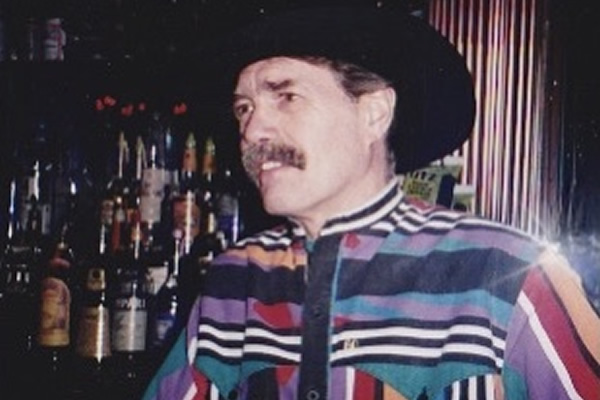
C. Howard Bivins Jr., gay news, Washington Blade

C. Howard Bivins Jr.

C. Howard Bivins Jr., a bartender who worked for six D.C. gay bars over a period of 35 years and became known as a congenial conversationist with many of his customers, died on April 12 at his home in Burke, Va., from complications associated with the lung illness known as chronic obstructive pulmonary disease, according to his partner of 39 years Perry Morehouse. He was 77.

Morehouse and others who knew Bivins said his regular customers at some of D.C.’s most popular gay bars often sought his advice and viewed him as an avid listener to whatever was on their minds.

“He loved to talk over the bar,” said Morehouse. “And he knew everyone’s name. He knew where everybody came from. He was very congenial,” Morehouse said. “He was always leaning over the bar talking to people. He was not the type of bartender that would make a drink and walk away.”

Morehouse said Bivins was born and raised in Richmond, Va., and was a 1963 graduate of Richmond’s Manchester High School, where he became known as a good dancer at the school’s student dances.

He worked in various positions in Richmond, including at Reynolds Metals, according to Morehouse, before moving to D.C. in the early 1980s. Morehouse noted that a number of the bars where Bivins started out as a bartender are no longer in business.

Among them were the Dupont Circle gay bar Fraternity House, where Bevins worked from 1982 to 1986. From 1986 to 2000, Bevins tended bar at the Capital Hill gay country western bar called Remington’s. And from 2000 to 2002 Bevins moved to another gay country western bar a few blocks away near the U.S. Marine barracks called Sheridan’s.

During part of the time he worked at Sheridan’s, Bivins also worked on different nights at the gay nightclub Ziegfeld’s-Secrets at its original location on the unit bock of O Street, S.E. up until 2006, when the club was displaced by construction of the Washington Nationals stadium.

Morehouse said Bivins then began bartending at the nearby gay nightclub Wet before that club was also displaced a year or two later by development related to the new baseball stadium. From there, according to Morehouse, Bivins returned to the former Fraternity House which had been renamed Omega. He tended bar there until Omega closed its doors in 2012.

“When Omega closed in 2012, he retired at the age of 68,” said Morehouse.

“Howard was always a spitfire and kept things lively and real,” said gay activist Robert York in a posting on Morehouse’s Facebook page. “Treasure the memories and know he will be missed by our community,” York wrote. “No doubt he’s keeping heaven on their toes and pouring shots for break times. Rest in power Howard.”

Morehouse said Bivins had a special place in his heart for Morehouse’s grandson Henning. “Trying to figure out how he was to be referred, he came up with the name 3-Pa, the third grandpa,” Morehouse recalls.

“He loved eating out and traveling, always surrounded by his close friends Craig, Mike, Ed, Carl, Greg, Chas, and Harry,” said Morehouse.

Bivins was predeceased by his parents. He is survived by Morehouse, his partner of 39 years, and his siblings Dorothy, David, and Beverly, and numerous nieces and nephews.

Contributions may be made in Bivins’ name to the D.C.-area hospice service Capital Caring Health at cpitalcaring.org/get-involved/donate.

The art of queer health sciences: U-M students translate research through art in new exhibition – University of Michigan News

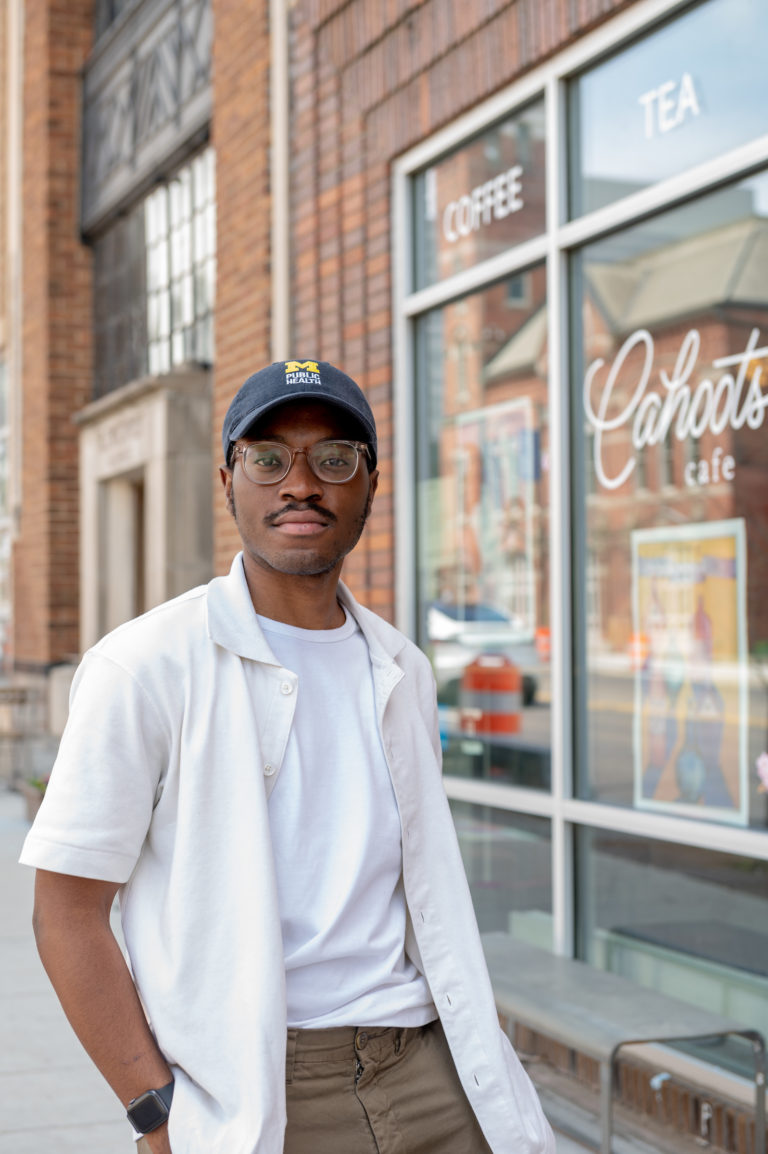
Tanaka Chavanduka project manager at the University of Michigan Center for Sexuality and Health Disparities and curator of "The art of queer health sciences" poses in front of Cahoots. The exhibition is on view at several downtown Ann Arbor businesses through the first week of May and at queeringart.com. Image credit: Eric Bronson/Michigan Photography.

Tanaka Chavanduka was inspired to reconsider his communication methods after a trip to a national conference on HIV in Washington, D.C. While there, he also visited the National Portrait Gallery and the National Museum of African American History and Culture.

“I’m often exposed to the emotions, sadness and healing behind the numbers—and my experience on this trip made it clear that traditional ways of sharing research aren’t designed to express emotion in the same way art is,” said Chavanduka, project manager at the University of Michigan Center for Sexuality and Health Disparities.

“If our work as researchers took up space in the same way art does, that could help the people we work with feel seen. We expect communities to be vulnerable with us when participating in research, so why not also create a pipeline for creatives who exist in those communities to process that vulnerability and share it in a way that’s respectful, disarming and accessible?”

This question inspired him to organize a new community art exhibition to explore what happens when science prioritizes empathy. In addition to highlighting queer experiences, his goal was to help individuals rethink how art can transform communities, generate healing and share knowledge.

The exhibition, “The Art of Queer Health Sciences,” will be on view on the windows of several downtown Ann Arbor businesses until May 5. Locations include Cahoots, Abracadabra, Vault of Midnight, Vinology, Thrive Juicery, Avalon Cafe, Bløm Meadworks and Zingerman’s Greyline.

The project was funded by the U-M Arts Initiative as part of their “exploration pilot grants” awarded in September 2020.

The artwork included in the exhibition aims to communicate research findings from the Center for Sexuality and Health Disparities, whose mission is to improve sexual and reproductive health and reduce health disparities in marginalized communities—with a specific focus on sexual and gender minorities.

“Traditionally, this type of research makes its way into the world via academic journals and conference presentations—so the information that is most valuable to marginalized communities doesn’t always make it to those communities,” Chavanduka said.

Chavanduka worked with Renee Pitter, CSHD research programs manager and exhibition coordinator, to hand select four student artists from the U-M Penny W. Stamps School of Art & Design—all of whom self-identify as queer—to participate.

The artists were challenged to create artwork based on four research projects chosen by CSHD faculty. Chavanduka and Pitter then facilitated several workshops in which the students and researchers came together to learn more about each other’s work and practices.

Michelle Munro-Kramer, assistant professor of nursing, worked with student artist Noe Conahan to present her research on the dynamics of power and control tactics among college students.

Through interviews with students, 13 categories of maintaining power and control in a relationship, such as emotional abuse or using privilege/identities, were revealed. The students saw these different forms of power and control as distinct puzzle pieces—which are represented in Conahan’s artwork—that come together in unique ways depending on the individual relationship.

“The highlight for me has really been in seeing how others interpret my research. I’m very focused on practical results, but I don’t always have the opportunity to talk with others about how they understand and see my work,” Munro-Kramer said. “Working with artists allowed me to really see this and encouraged me to be more creative in the way I disseminate my work so that it is accessible to different populations and learners.”

Akshay Sharma, assistant professor of nursing, researched the acceptability and feasibility of self-collecting biological specimens for HIV and other sexually transmitted infections, specifically among gay, bisexual, and other men who have sex with men. Sharma worked with student artist Shalin Berman.

Shalin Berman, University of Michigan Stamps School of Art & Design student, poses with their art at Bløm Meadworks. Berman's work is part of "The art of queer health sciences," an exhibition on view at several downtown Ann Arbor businesses and at queeringart.com. Image credit: Eric Bronson/Michigan Photography.

Shalin Berman, University of Michigan Stamps School of Art & Design student, poses with their art at Bløm Meadworks. Berman’s work is part of “The art of queer health sciences,” an exhibition on view at several downtown Ann Arbor businesses and at queeringart.com. Image credit: Eric Bronson/Michigan Photography.

“Collaborating with Shalin enlightened me on how a talented artist can bring emotions to life,” Sharma said. “What I found most surprising is how beautifully they captured and conveyed the spirit of a moment that was being experienced by a participant—such as feeling empowered or overwhelmed—despite Shalin’s limited engagement during the actual conduct of the study.”

Other pairings included Rob Stephenson, professor of nursing and CSHD director, who worked with student artist Jenna John to interpret research related to an intervention he created called Stronger Together for serodiscordant male couples (one is HIV positive, one is HIV negative) that focuses on teaching them to work together toward common goals.

Jenna John, a dual major in art and design and ecology and evolutionary biology at the University of Michigan, poses in front of her installation at Zingerman's Greyline in downtown Ann Arbor. John's work is part of "The art of queer health sciences," an exhibition on view at several downtown Ann Arbor businesses and at queeringart.com. Image credit: Eric Bronson/Michigan Photography.

Jenna John, a dual major in art and design and ecology and evolutionary biology at the University of Michigan, poses in front of her installation at Zingerman’s Greyline in downtown Ann Arbor. John’s work is part of “The art of queer health sciences,” an exhibition on view at several downtown Ann Arbor businesses and at queeringart.com. Image credit: Eric Bronson/Michigan Photography.

“For my project, I talked to Dr. Stephenson a lot about the narratives surrounding the relationships of gay and bisexual men, and I was really inspired by symbiosis and mutualism in nature,” said John, who dual majors in art & design and ecology and evolutionary biology. “The lichen and coral species, which you can see in my artwork, are symbiotic because they exist together, much like two males in a relationship working toward a shared vision that depends on mutual support—they both make each other healthier.”

Sarah Peitzmeier, assistant professor of nursing, also worked with student artist Coyne Gatto to interpret her study that aims to understand what sexual violence against transgender and nonbinary college undergraduates looks like. The study will be used to create an intervention designed to prevent unwanted sexual experiences and sexual assault specifically for trans and nonbinary undergraduates.

Coyne Gatto, University of Michigan Stamps School of Art & Design student, poses in front of his work at Zingerman's Greyline. Gatto's work is part of "The art of queer health sciences," an exhibition on view at several downtown Ann Arbor businesses and at queeringart.com. Image credit: Eric Bronson/Michigan Photography.

Coyne Gatto, University of Michigan Stamps School of Art & Design student, poses in front of his work at Zingerman’s Greyline. Gatto’s work is part of “The art of queer health sciences,” an exhibition on view at several downtown Ann Arbor businesses and at queeringart.com. Image credit: Eric Bronson/Michigan Photography.

According to Pitter, for the marginalized communities that scientists and researchers work with, art can be used to dismantle the intellectual gatekeeping that’s so often associated with those fields, and it can even promote healing for marginalized communities.

“We are hoping this project will help to start to bridge the gap between science and art, particularly in the area of social sciences,” Pitter said. “I have very much enjoyed watching the relationship between faculty and students and being engaged myself in the creative process with students.”

Chavanduka and Pitter hope this project will inspire other scientists and researchers to think about how science can drive empathy and knowledge by engaging with art. And with greater collaboration between researchers and artists, both groups will have the chance to share their work in spaces with audiences they may not have been able to reach otherwise.

Written by Jennifer Quartararo.

Tshibaka writings from college supported gay conversion therapy organization – Alaska Public Media News

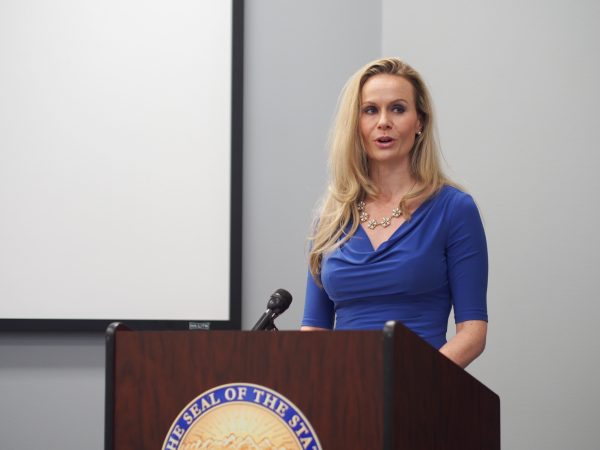
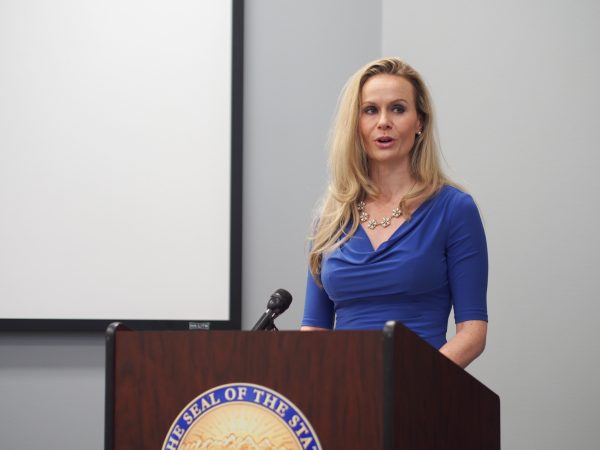
Woman with blonde hair in a purple dress stands at a podium
Alaska Department of Administration Commissioner Kelly Tshibaka speaking at the Atwood Building-in-Anchorage in 2019.

Kelly Tshibaka, a candidate for U.S. Senate in Alaska previously wrote articles in support of an organization that espoused gay conversion therapy, questioned the integrity of elections and described the “Twilight” books and movies as evil.

Many of the articles, blogs and posts by candidate Kelly Tshibaka have been deleted but some are available through archived internet pages, as first reported Tuesday by CNN.

Tshibaka said in an email to The Associated Press that the CNN article “is just proof that our campaign is gaining momentum, which has Lisa Murkowski and her allies scared to death.”

“Nothing frightens the DC political insiders more than the thought of a strong, independent Alaskan leader in their ranks,” she said.

Tshibaka formerly worked in several offices of inspector general in the U.S. government before becoming the commissioner of the Department of Administration in Alaska under Gov. Mike Dunleavy in 2019. She quit last month to enter the Senate race.

U.S. Sen. Lisa Murkowski, a Republican who has held the Senate seat since 2002, has filed a statement of candidacy with the Federal Election Commission, which allows her to raise money. Murkowski, who reported having $1.3 million available as of March 31, has not formally announced whether she’s seeking re-election.

Murkowski filed the FEC statement, as a Republican, a week before state Republican party leaders censured her for voting to convict former President Donald Trump at his impeachment trial earlier this year. The party also said it did not want Murkowski to identify as a Republican in the 2022 election.

Messages sent to Murkowski’s press aides were not immediately returned to the AP.

Days after major news organizations, including the AP, declared Joe Biden the winner of the 2020 election, Tshibaka posted on Instagram: “Eyewitness testimony of voting impropriety, fraud, tampering or oppression in states like PA, MI, GA, NV, and AZ constitutes ‘evidence.’”

In the November election, Alaska voters approved Proposition 2, an initiative that would do away with party-run primaries and send the top four vote-getters, regardless of political affiliation, to the general election.

General elections would then use a new ranked-choice voting system. Some see this as a boost for Murkowski, who in 2010 lost her party primary but went on to win the general election as a write-in candidate.

Tshibaka also tweeted about a Texas lawsuit challenging changes to election laws because of COVID-19, which was dismissed by the U.S. Supreme Court because Texas did not have standing to sue. She said if Texas were to win, then Alaska’s election laws could also be challenged.

“Imagine what this could mean for Proposition 2 (where absentee ballots tipped votes in favor of the jungle primary) and for certain state Legislature races? Alaska can throw out all absentee ballots without a witness signature, for example,” she tweeted.

She told the AP on Tuesday that “allegations regarding voting integrity should be investigated and fully examined.”

When Tshibaka was at Harvard Law School, she wrote “The Right Side: Coming Out of Homosexuality,” for The Harvard Law Record, an independent newspaper at the law school, in December 2001.

“Today is National Coming Out of Homosexuality Day, a day dedicated to helping homosexuals overcome their sexual tendencies and move towards a healthy lifestyle,” she wrote in the article under her maiden name Kelly Hartline.

In the article she touts the work of Exodus International, a group that advocated gay conversion therapy. The group a decade later closed and apologized for the harm it did to the gay community.

“Homosexuals can come out of homosexuality because their preference is not biologically mandated.” Tshibaka wrote in 2001. “Unlike race or gender, homosexuality is a choice.”

She also later apologized to readers who were upset over the article, saying she did not intend to offend.

Tshibaka said she was assigned the article by an editor as a counterpoint piece. “I don’t hold that view today,” she told the AP.

When asked if same-sex marriage is settled law, she said: “I personally believe that marriage is between a man and a woman, but the Supreme Court has ruled that same-sex marriage is the law of the land.”

In blog posts, she said the “Twilight” vampire movies and books are “evil and we should not read or watch it.”

“Some say this book is harmless, that it promotes Christian values, and that it does not promote anything wicked at all,” she wrote. “But Satan does not usually look repulsive, horrific, and evil on the outside.”

She told the AP that children should read more, but the “Twilight” books don’t hold a candle to Dr. Seuss.

“I think Alaskans will care more about who will protect their gas and oil jobs than they do about young adult vampire fiction,” she said.

The state elections office says others who have registered for Senate include Dustin Darden with the Alaskan Independence Party, Huhnkie Lee, who is undeclared, and Republicans Samuel Little and Karl Speights.

Ewan McGregor Defends His Casting As Legendary Gay Designer Halston – Vulture

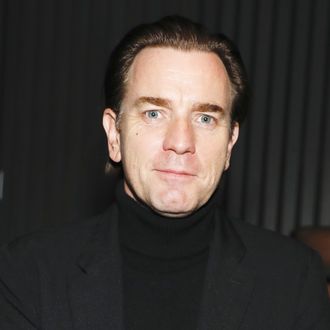
Photo: Gregory Pace/Shutterstock

Jedi daddy Ewan McGregor has played gay characters before, most notably in Todd Haynes’s Velvet Goldmine in 1998 and opposite Jim Carrey in 2009’s I Love You Phillip Morris. But in a new cover story for The Hollywood Reporter, McGregor addressed the possible controversy surrounding writer-director Dan Minahan casting him as the title character in an upcoming biographical Netflix miniseries about the 1970s fashion designer Halston. McGregor identifies as straight, and Halston was an out gay man in the public eye whose contributions to queer culture — from his close friendship with Liza Minnelli to his designs that defined the look of the Studio 54 disco era — are inseparable from his story.

During the interview, THR quoted Billy Porter at a 2019 Actors Roundtable saying, “Straight men playing gay — everyone wants to give them an award.” McGregor responded, “If it had been a story about Halston’s sexuality more, then maybe it’s right that gay actors should play that role. But in this case — and I don’t want to sound like I’m worming out of this, because it’s something I did think a lot about — I suppose, ultimately, I felt like it was just one part of who he was.” Viewers can make up their own minds when Halston premieres on Netflix on May 14.

Pixar’s Luca isn’t a gay romance, or a romance at all, says director – Polygon

When Pixar first revealed the plot synopsis of its upcoming movie Luca — a tale of two sea-monster boys named Luca and Alberto, and an “unforgettable” summer on the Italian Rivera — many people quickly compared it to Call Me By Your Name, the 2017 gay romance that also took place during an unforgettable summer in Italy. The first trailer, where the two boys run around an idyllic seaside town, cemented that general vibe — though it also revealed a female character, one potentially there to make the boys jealous.

Still, online commenters hoped Luca would possibly be Pixar’s first queer love story for the theater. The studio has notoriously inserting blink-and-you’ll-miss-them LGBT characters who are easily edited out. But in 2020, Pixar released “Out” through its SparkShorts program, which centered around a gay couple. Eager for representation, many fans have clung to the possibility that Luca might give them openly gay main characters, and not just one-note side characters.

But those fans will have to wait, because Luca isn’t a queer love story. In fact, according to director Enrico Casarosa (who also helmed the Pixar short La Luna), Luca won’t be a love story at all — not a straight one, not a queer one, not one with love triangles or schoolyard crushes. Casarosa specifically wanted to focus on the intimate bonds of childhood friendship.

“I was really keen to talk about a friendship before girlfriends and boyfriends come in to complicate things,” he told Polygon during a press day in April.

luca and alberto looking out at a town in the evening Image: Pixar

According to Casarosa, the team considered what would happen once Giulia, the girl the boys meet on land, came into the picture, and how traditionally the story would veer toward romance. But they actively decided to set the story in a nebulous time of the characters’ lives, before they’re aware of romance, hormones, and other complicated entanglements.

“This was about their friendship in that pre-puberty world,” he laughs.

Luca follows young Luca and Alberto, two young sea monsters who turn into humans when out of the water, as they venture into the surface world for the first time after being cautioned how dangerous it is for their kind. Footage provided on the press day revealed a lushly animated Italian coastal town, one where the animators worked to break photorealism in order to capture a specific storybook-like feeling. After encountering a cocky Vespa owner, the boys want to buy a scooter of their own, and they team up with plucky Giulia to enter the town’s annual race. One hiccup? Giulia also happens to be the local fishmonger’s daughter.

The movie was specifically inspired by Casarosa’s own summers growing up, particularly the close friendship he had with his friend Alberto, whom he named the character after. Both the real Alberto and the character he inspired are big, bright, larger-than-life personalities who pushed their shy friends out of their shells.

“The type of friendship that is gonna push you into trouble,” says Casarosa. “Push you into change, push you into finding yourself.”

giulia, luca, and alberto eating pasta Image: Pixar

But at the same time, Casarosa says, while Alberto inspires Luca, Alberto also gets much-needed validation from Luca. Their bond isn’t romantic, but it’s still deeply emotional and transformative, and just as important as a first romance. All three of the kids at the core of Luca find something in one another at this pivotal moment of their lives, when they step out from the comfort of their family bubble for the first time.

“We wanted to make sure they see each other, they bring something to each other,” explains Casarosa. “They’re both lonely, there’s a loneliness at the heart of it that is filling a void in all these kids because they feel a little bit odd and lonely. Giulia is the same thing. We wanted to make sure there’s a little loneliness so there’s the space that gets filled with an important friendship.”

Luca will premiere on Disney Plus on June 18.

Gay Navy Pilot Leaves Service (San Diego News Now) – KPBS

A harassment incident during a Marine Corps Birthday Ball pushed one pilot’s career into limbo, a decade after the Don’t Ask, Don’t Tell policy ended. Meanwhile, Escondido Police have released the names of the man killed in last week’s police shooting and the officer who shot him. Plus, a new book tells the story of the mysterious death of 32-year old Rebecca Zahau at the Spreckels mansion in Coronado 10 years ago.

Good Morning, I’m Annica Colbert….it’s Wednesday April 28th.

>>>>

One of the few openly gay pilots is leaving the Navy

More on that just after the headlines….

######

Fully Vaccinated people can go outside without a mask, and can gather in small groups outside maskless. That’s the latest guidance from the CDC on covid-19 protocols. Masks are still recommended for indoor settings. Dr. Abi Olulade with Sharp Rees-stealy says relaxing restrictions is certainly good news but she’s worried people will let their guard down too much.

outdoor transmission risk is quite low but i’m also worried because the risk is not zero… i think it is important to give people an incentive because studies show the vaccines are protective against infection and also from dying.

State and county health officials say they are working to align their local guidance with federal officials.

########

Covered California officials are urging the public to take advantage of cheaper insurance prices available thanks to the American Rescue Plan. Officials says all current customers will see lower premiums starting in May. There’s a special open enrollment period, but it ends this friday.

#######

A magnitude 3.5 earthquake shook Borrego Springs at 3:50 this morning. According to maps from the US Geological Survey, light shakes could be felt in Poway, San Diego, Spring Valley, Lemon Grove, El Cajon Alpine and Jamul.

#########

From KPBS, you’re listening to San Diego News Now.

Stay with me for more of the local news you need.

Don’t-Ask-Don’t-Tell ended 10 years ago. And yet, one of Naval Aviation’s few openly gay pilots is on his way out. The Marines substantiated his claims of harassment, after an incident following a west coast Marine Corp Ball.

KPBS Military Reporter Steve Walsh tells us why it wasn’t enough to save his career.

For most of his six years in the Navy, Lt. Adam Adamski says he felt supported as an openly gay pilot. He can tell you when that changed.
“November of 2019.”
Adamski is a helicopter pilot for a Navy search and rescue squadron. The group works closely with the Marines. Adamski was invited to a west coast Marine Corps Birthday Ball at a local casino. He came back to the hotel room where Marines had been holding an after party.
“So when I walked in the room. I knew something wasn’t right. The TV had been moved, like on a pivot to face the doorway. And I saw my dress whites draped over and around the TV and there was hard core gay porn playing.”
His uniform wrapped around a TV, playing pornography. It didn’t feel like a harmless prank — it felt like something else. Some of the other Marines in the squadron wanted to find those responsible. But Adamski says he was getting ready for his first deployment as a pilot — he wanted to shrug it off, and let the matter go. But word had spread.
“I received numerous calls from people who were in the closet, in that squadron,
both men and women and openly gay service members. Telling me that they are upset. That the climate, especially for pilots, is not a good climate and they think that I should report it.”
The Don’t ask Don’t Tell policy, allowing LGBT service members to serve openly, ended a decade ago. But a study in the journal Sexuality Research and Social Policy found 59 percent of service members still don’t feel comfortable coming out to their peers. Sasha Buchert is a former Marine and attorney with the civil right organization Lambda Legal. She says changing the law didn’t change the culture.
“It’s one thing to have don’t ask, don’t tell removed. It’s another thing to have a culture where people feel safe being who they are and not have to worry about being discriminated against. …And a lot of this comes from the top down.”
Eighteen months after Adamski reported the incident, he still hasn’t received final word on his case. His version of events has been substantiated by the squadron commander in charge of the three Marines found culpable and later by an inspector general’s report. Initially, the squadron commander even offered to pull their pilots wings for the incident. Adamski thought that was too severe.
“I want an in person apology from all three of them. I want a meeting, in which they are there and I can talk to them.”
He also wanted something in their permanent record. The incident continued to eat at Adamski.
He was in a serious relationship with an Air Force pilot who was talking about coming out of the closet. They broke up after he saw Adamski’s experience.
“I lost a lot. I’m not happy. I no longer feel I’m an effective leader, an officer, a pilot. I don’t feel part of the military anymore. I feel segregated.”
Adamski has been called into the headquarters for Naval Air Command more than once to address his decision to speak publicly about his case. The Navy says it is up to the Marines to comment. Major Alex Lim, spokesman for 3d Marine Aircraft Wing, says the Marines initially acted quickly on the complaint.
“Marines, sailors, in our units are treated in a culture of dignity and respect. We want to prohibit any activity where these individuals would be harassed.”
Adamski stopped logging flight hours as the case dragged on. Last spring, he had a road accident that made it even tougher to qualify to fly. He was given the option — as a Navy officer – to retire. Adamski took it — in the next couple of months his six-year career as a Navy pilot will end. But not his quest for some kind of recognition that what happened to him wasn’t right .
“Most people back down because of all this hassle and I won’t. I’m not someone who will back down easily or ever. I’m not going to do it.”
At this point, he says, he has nothing left to lose.

And that was KPBS Military Reporter Steve Walsh. This story was produced by the American Homefront Project, a public media collaboration that reports on American military life and veterans. Funding comes from the Corporation for Public Broadcasting

##########

Escondido Police have released the name of the man killed in last week’s police shooting, along with the name of the officer who shot him. KPBS’ Jacob Aere has the new details.

The Escondido Police Department says 59-year old Steven Olson had been hitting cars with a 2-foot-long crowbar near the intersection of Broadway and Second Avenue when Officer Chad Moore approached him shortly after 7 a.m. on April 21st.
After the officer gave Olson multiple commands to drop the tool, the department said Olson continued to advance towards the officer, who was backing away. Olson was ultimately shot and killed by Officer Moore.
Police video of the incident still hasn’t been released. In a Monday news release, the Escondido Police Department said:
“It is anticipated that a critical incident video, which will include Body Worn Camera footage of the incident, will be released later this week.”
Escondido police say they were aware Olsen was living on the streets and he had previously been booked into county jail nearly 200 times since 2002 as well as being involved in more than 20 service calls this year.
Andrea Felix’s grandfather was friends with Olsen. She said Olson struggled with his cognitive abilities and mental health, but he was not a threatening presence.
“Steve was never aggressive, at least in front of me. He’s never been aggressive and to me he was harmless. The only thing I can say is Steve was not able to cognitively put together or articulate a complete sentence…
“It was very apparent that you knew he was mentally diabled or he had some type of mental illness.
Greg Anglea of Interfaith Services says the current system of having police officers address individuals in mental health crisis is a broken one.
“When somebody’s in a mental health crisis and they’re experiencing homelessness, oftentime police are the only response a community has, in the moment. And it’s just not fair to law enforcement and it’s also not fair to the individuals in crisis to have that be the only option. We really need mental health professionals to also be there.”

And that was KPBS’ Jacob Aere.

##########

San Diego could become the first border county in the nation to do what immigration advocates have been asking for — provide legal aid to immigrants facing deportation. KPBS Racial justice & Equity reporter Cristina Kim has more. She starts with County Supervisor Terra Lawson-Remer.

ID: Terra Lawson-Remer, San Diego County Supervisor
“Everyone in this nation whether you are a citizen or not has an established right under the US Constitution to be represented by legal counsel.Today we are launching a movement to ensure that immigrants facing deportation have a fair day in court.”
CK: Lawson-Remer’s proposed program…. will help alleviate the current backlog of over one million cases waiting to be heard nationwide.
Michael Garcia … chief deputy at the Office of the Public Defender… whose office would oversee the program… says streamlining the court process makes fiscal sense.
ID: Michael Garcia, Office of The Public Defender
“As a border community we have a responsibility to make sure that that justice prevails in our adversarial immigration courts it’s the socially moral thing to do and at the same time it’s economically prudent for our businesses and our tax base.”
CK: Immigrants with legal counsel are ten times more likely to avoid deportation than those with no legal representation, according to a 2015 study.
It’s something Mustafe Hassan… a refugee from Ethiopia …. who was formally detained at the Otay Mesa Detention Center knows all too well. He was able to get legal help from Partners For Advancing New Americans.
ID: Mustafe Hassan, Refugee from Ethiopia
“Through that attorney and that help and that guidance that’s how I get my case succeeded that’s how I get my green card now or residential card. And now I am working and in good condition.”
The Supervisors will vote on whether to proceed with the proposal on May 4th. If it advances… the board will review it again during budget hearings in late June.
And that was KPBS Racial Justice and Equity reporter, Christina Kim.
##########

An abandoned theater in downtown San Diego is being redeveloped into apartments and a hotel. KPBS metro reporter Andrew Bowen says the City Council approved the project on Tuesday.

AB: The California Theatre at the corner of C Street and 4th Avenue has been vacant and deteriorating since 1990. Development firm Caydon plans on tearing it down and building a high rise with condos and a hotel. The theater’s historic facade would also be reconstructed. Critics said the final project didn’t have enough affordable housing. But councilmember Stephen Whitburn said the pros outweighed those concerns.
SW: It’ll activate and revitalize this downtown transit corridor that is used by our city employees, by our local workforce, downtown residents and visitors to our great city.
AB: Construction is expected to be completed as soon as 2023. Andrew Bowen, KPBS news

##########

Tens of millions of dollars are still available for San Diegans struggling to pay rent, but many who need help the most, aren’t applying for it. KPBS reporter John Carroll has more.

Thanks to federal and state COVID relief programs, The San Diego Housing Commission has a lot of money available to help people struggling to pay rent… about $83,000,000.
CG: Azucena Valladolid/San Diego Housing Commission
“To provide past due rent, past due utilities and upcoming rental assistance.”
Azucena Valladolid is the Vice President of Rental Assistance for the San Diego Housing Commission. She’s very much aware of statistics like this…
Latinx people make up 57% of all renters in California, but only 35% have applied for rental assistance statewide.
“We are still looking at ways to improve the number of applications that we’re receiving, specifically from the Latino community.”
Valladolid says the Housing Commission is leaving no stone unturned with targeted outreach to the community.
1:37 – “Advertisements in English and in Spanish on both TV and radio” 1:42
1:52 – “Advertisements in Spanish community newspapers” 1:54
1:56 – “Spanish postcards to 170,000 households throughout the City of San Diego” 2:01
2:03 – “Spanish inserts in both the city public utilities department and SDG&E utility bills” 2:10
2:12 – “Posted advertisements on the MTS system” 2:15
2:27 – “We’ve even contracted with several community based organizations.” 2:30
One of those community organizations is the Chicano Federation. Nancy Maldonado is its President and CEO. I asked her what’s behind the hesitancy among many in the Latinx community to ask for rental assistance.
“Fear and mistrust is one concern, but I think there’s a variety of factors at play.”
Maldonado says plenty of renters in the community owe money, but many don’t owe it to their landlord.
CG: Nancy Maldonado/Chicano Federation President & CEO
“They either borrowed from friends and family or took out a loan or figured out a different way to come up with the money and pay their rent.”

That reporting from KPBS John Carroll. You can find out more about pandemic aid available locally by going to covid assistance dot S-D-H-C dot org.

##########

Coming up….

“There are a lot of people who have looked at this case from the outside and said there are flaws in the investigation there are holes in the investigation and there was problems with the methodology of the collection of the DNA.”

A new book takes a look at the mysterious death of Rebecca Zahau at the Spreckles Mansion in Coronado. We’ll have that story next, just after the break.

It’s been almost 10 years since the mysterious death of 32-year old Rebecca Zahau at the Spreckles mansion in Coronado. A judge has recently agreed to hear arguments in a lawsuit the family has filed against the San Diego Sheriff’s Department for documents that they believe will open a new investigation.

KPBS’s Maya Trabulsi spoke with bestselling author and San Diego local Caitlin Rother, who has released a new book called “Death On Ocean Boulevard.” It details the circumstances surrounding the death and what went on behind the scenes.

And, a warning, the subject matter discusses suicide which may be disturbing to some listeners

Cailin Rother is author of the book, “Death on Ocean Boulevard”, the story of the death of Rebecca Zahau. She was speaking with KPBS’ Maya Trabulsi.

That’s it for the podcast today. Be sure to catch KPBS Midday Edition At Noon on KPBS radio, or check out the Midday podcast. You can also watch KPBS Evening Edition at 5 O’clock on KPBS Television, and as always you can find more San Diego news online at KPBS dot org. I’m Annica Colbert. Thanks for listening and have a great day.

Black Va. man shot 10 times by police is gay: report – Washington Blade

Three transgender people allege they suffered abuse at a Miami jail last year after police arrested them during Black Lives Matter protests.

The Transgender Legal Defense and Education Fund in a letter it sent to Miami-Dade County Mayor Daniella Levine Cava on Wednesday notes Christian Pallidine, a college student who identifies as a trans man, was attending a Black Lives Matter protest in downtown Miami on May 31, 2020, when Miami-Dade police officers arrested him and charged him with violating a county-wide curfew.

Pallidine arrived at the Turner Guilford Knight Correctional Center a short time later, and the letter notes personnel abused him because of his gender identity.

“The staff at TGK subjected Mr. Pallidine to degrading and outrageous treatment because he is transgender,” it reads. “TGK staff forced him to strip and display his genitals in front of a group of officers — part of a series of invasive, pseudo-medical, sexualized procedures conducted on him for no legitimate purpose. TGK staff also belittled Mr. Pallidine, publicized his transgender status to others, asked gratuitous questions about his anatomy, and called him derogatory names.”

The letter, among other things, notes Pallidine underwent an examination that “focused solely on his transgender status” and it “took place in a public area where others could easily see and hear him and the person questioning him.” The letter says the officer who conducted the exam asked him “multiple questions about his genitals and plans for future medical care, such as, ‘Do you want a penis in the future?’”

Pallidine alleges he was forced to take a pregnancy test “because of his genitals” and officers mocked him because of his gender identity. Pallidine also says officers forced him to undergo a strip search and placed him in solidary confinement before his release.

Jae Bucci and Gabriela Amaya Cruz on July 19, 2020, attended a rally and march for Black trans women in downtown Miami. Miami-Dade police officers brought them to the Turner Guilford Knight Correctional Center after they arrested them.

Bucci, who is a teacher and makeup artist, on Wednesday during a virtual press conference that TLDEF, the Southern Poverty Law Center and the Harvard LGBTQ+ Advocacy Clinic organized, said the gender marker on her ID is female and the Miami-Dade Police Department processed her as such. Bucci noted Turner Guilford Knight Correctional Center personnel also processed her as female, but she said an officer told her, “Aha, I knew it. That’s what I was looking for” after she disclosed her gender identity.

Bucci said her friends were not able to find her because officers had reclassified her as male. Bucci told reporters that officers placed her with male prisoners and, like Pallidine, forced her to undergo an “illegal strip search in front of several officers.”

“They tugged at my piercings, drawing blood, and forcibly tried to remove my hair, assuming it to be a wig,” said Bucci.

“They forced me to sit with men … I was put in danger,” she added. “I needed protection. I asked to be seated with other women, but the guards were only hyper-focused on my genitals, repeatedly calling me a man.”

Bucci said she was later placed in solitary confinement “for hours with no contact, food, water, leading to a panic attack where I began to self-harm and contemplate suicide.” Bucci said officers also forced her to wear men’s clothing “with my breasts clearly visible.”

Jae Bucci (Photo by Emely Virta)

Amaya Cruz — a barista, artist and activist — said she suffered many of the same abuses that Bucci and Pallidine described once she arrived at the Turner Guilford Knight Correctional Center.

Amaya Cruz told reporters the officers did not know whether to place her with female or male inmates once she disclosed her gender identity to them.

She said officers forced her to remove her wig before they took her mugshot.

Amaya Cruz said she objected to male officers patting her down, and they told a female colleague that “he’s saying he’s a woman, but he’s a man. He has a dick still.”

Amaya Cruz said the female officer did her pat down and allowed her to fill out paperwork in which she disclosed her gender identity. Amaya Cruz said the officer allowed her to sit with other female inmates.

Amaya Cruz was born with ectrodactyly, a rare genetic disorder that limits finger movement, but she was subject to “excessive force” during the pat down and when guards took her fingerprints.

Amaya Cruz said the female officer who did her pat-down told her to change into a pair of basketball shorts and a white t-shirt before her release.

“I was so uncomfortable and I just complied because my only reaction was I don’t want to be here any longer,” said Amaya Cruz. “At that point I felt uncomfortable, humiliated, my gender was being yelled out the entire night. My gender identity was not being taken seriously in any way.”

Gabriela Amaya Cruz (Photo by Sonya Revell/Southern Poverty Law Center)

TLDEF Staff Attorney Alejandra Caraballo told reporters the “health and safety of our clients were jeopardized by the willful and wanton treatment by the officers at TGK.”

“The current policies followed at TGK are woefully inadequate and are discriminatory on their face, which will inevitably lead towards the targeted harassment of trans people in custody,” added Caraballo.

Harvard LGBTQ+ Advocacy Clinic Founding Director Alexander Chen also took part in the press conference alongside Arianna Lint, chief executive officer of Arianna’s Center, an organization that serves trans women in South Florida. Tatiana Williams, co-founder and executive director of Transinclusive Group, which also works with trans people in South Florida, also participated.

“The change has to happen, as we all mentioned, structurally,” said Williams. “It has to happen at the top.”

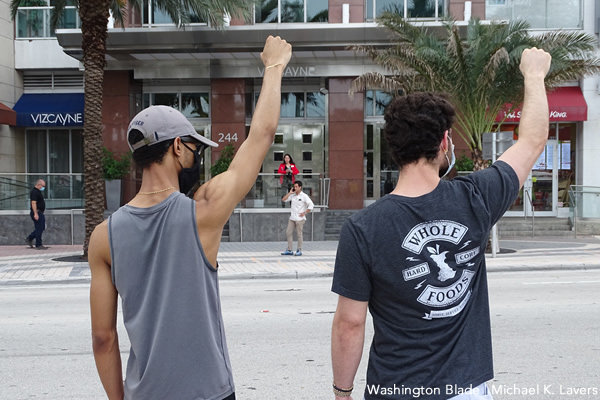
Two men hold their fists in their air during an anti-police brutality protest in downtown Miami on June 1, 2020. (Washington Blade photo by Michael K. Lavers)

The letter to Levine Cava calls for her office to “reach a resolution” with Pallidine, Bucci and Amaya Cruz without litigation that specifically addresses several points:

1) “Policy and procedure updates to address the issues faced by our clients and other transgender community members.”

2) “Meaningful accountability measures for MDCR (Miami-Dade Corrections and Rehabilitation Department) staff that go well beyond what Internal Affairs currently provides.”

3) “Appropriate discipline for the MDCR staff involved in the inappropriate treatment of our clients.”

4) “Updates to county records concerning our clients and their gender.”

5) “Compensation to our clients as allowed by law; and reasonable attorneys’ fees and costs as allowed by law.”

“We have achieved similar results working with officials elsewhere in the country, and are confident we can do the same here,” reads the letter.

Chen echoed this point during the press conference.

“We have every expectation that we will be able to come to an accord with the county that will both do justice to our plaintiffs and protect transgender people in the county going forward,” he said.

Lint, like Chen, noted Levine Cava championed LGBTQ rights when she was a member of the Miami-Dade County Commission until she succeeded now-Congressman Carlos Giménez last November.

“I am calling on Mayor Levine Cava to continue this support for the transgender community by taking steps to address the mistreatment of transgender individuals in Miami-Dade County jails,” said Lint. “Arianna’s Center is committed to working with Mayor Levine Cava to eradicate prejudice against the transgender community in our prisons, jails, detention centers and through the whole criminal justice system.”

Levine Cava’s office has not returned the Washington Blade’s request for comment.

AP Sportlight | Sports – Quad-Cities Online

1901 — His Eminence, ridden by Jimmy Winkfield, wins the Kentucky Derby by 1 1/2 lengths over Sannazarro in the only Derby ever raced in April.

1961 — ABC’s “Wide World of Sports,” debuts.

1970 — Los Angeles Lakers guard Jerry West hits a 60-foot desperation shot at the buzzer to tie Game 3 of the NBA Finals against the New York Knicks. The Knicks outscore the Lakers 9-6 in the overtime for a 111-108 win.

1985 — Tony Tubbs captures the WBA heavyweight title with a unanimous 15-round decision over Greg Page in Buffalo, N.Y.

1986 — Roger Clemens set a major league record by striking out 20 batters as the Boston Red Sox defeated the Seattle Mariners 3-1.

1988 — The Baltimore Orioles end their 21-game losing streak by winning their first game of the season, 9-0 over the Chicago White Sox.

1990 — Pat Riley becomes the winningest coach in NBA playoff history as the Los Angeles Lakers beat the Houston Rockets 104-100. Riley’s 100th victory put him ahead of Red Auerbach.

1998 — For the first time in the 124-year history of the Kentucky Derby, a redraw is ordered during the post-position draw. Churchill Downs officials allowed ESPN to control the announcing of the draw. Commentator Chris Lincoln called the No. 15 pill twice while picking the draft order for post positions.

2000 — Lennox Lewis knocks down Michael Grant three times in the first round and knocks him out at 2:53 of the second at Madison Square Garden in New York to retain his WBC and IBF heavyweight titles. The combined weight of 497 pounds made it the heaviest title fight ever.

2003 — Indiana outscores Boston 5-0 in overtime for a 93-88 victory, cutting the Celtics’ first-round series lead to 3-2. It’s the first overtime shutout in NBA playoff history.

2007 — Phoenix guard Steve Nash has 23 assists, one shy of the NBA playoff record, to help Phoenix to a 113-100 victory over the Los Angeles Lakers.

2010 — The NCAA’s Board of Directors approve a 68-team format for the men’s basketball tournament beginning next season. It’s the first expansion since 2001 when the tourney went from 64 to 65 teams.

2013 — NBA veteran center Jason Collins becomes the first male professional athlete in the major four American sports leagues to come out as gay. Collins writes a first-person account posted on Sports Illustrated’s website. The 34-year-old free agent played for six NBA teams in 12 seasons.

2014 — Los Angeles Clippers owner Donald Sterling is banned for life by the NBA in response to racist comments he made in an audio recording. The Clippers’ owner is also fined $2.5 million, the maximum amount allowed under the NBA Constitution.

Copyright 2021 The Associated Press. All rights reserved. This material may not be published, broadcast, rewritten or redistributed without permission.

Savage Love: Film’s homophobic bits okay for gay son to see – The Georgia Straight

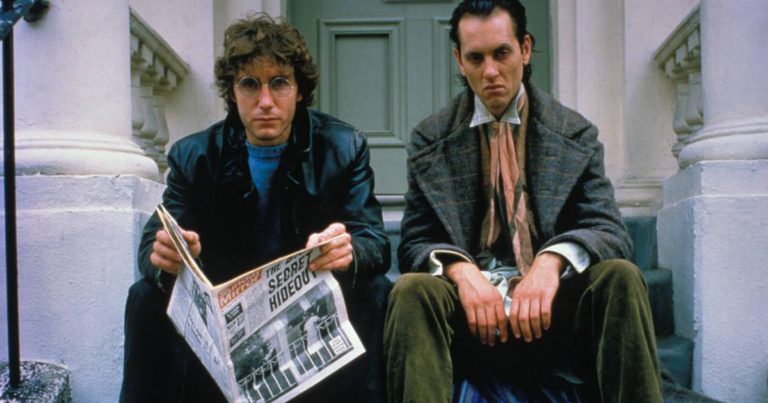
I have a cult fascination with the film Withnail and I. Okay, I love this film. But I am troubled by the perspective this film offers on homosexuality. It’s not what one would call a “modern perspective”. I believe the film’s portrayal of homosexuality can be seen as funny or alarming or a cultural reference point. I think it’s all three.

My son is gay, and with some introductory apologies, I want to tell him to watch the film. Apologies for “trial ballooning” something like this with you, Mr. Savage, and I know you are not the standard-issue gay, as if such a thing exists. But have you seen the film? And, if so, your thoughts?

– Friend Of Withnail

I’ve never seen the film but a quick Google search of “Withnail and I” and “homophobic” brings up nearly 100,000 results.

Apparently, one of the film’s main characters (Uncle Monty) is a “predatory homosexual” who makes an unwelcome series of advances on one of the male leads.

“Is the film homophobic? Yes, undoubtedly,” Philip Caveney writes at Bouquets & Brickbats. Richard Griffiths, the actor who plays Monty, “somehow manages to evoke genuine sympathy for a tragic character who is, more than anything else, lonely—but all the talk about buggery by force does make you feel rather uncomfortable.”

The film was released in 1987—which in no way excuses the homophobia, of course, but you’d be hard-pressed to find a popular film released in 1987 that wasn’t deeply homophobic, either by commission (the hateful portrayal of gay characters) or by omission (the complete absence of gay characters). Still, the film doesn’t portray homosexuality, FOW, it portrays an individual homosexual.

It was, doubtless, a damaging portrayal at the time, as there were so few other representations of gay characters on TV or in film back then. But viewed now—viewed at a time when there are more representations of gay people in film and television than ever before—it doesn’t have the power to do the same damage.

So go ahead and recommend the film to your son, FOW, with the appropriate qualifiers and apologies.

I have a quick question about bisexuality. What if one has a preference for dating straight individuals?

As a straight woman, I am only interested in dating straight men. Is that some kind of phobia? Or is it okay for that to be a preference? I’ve always wanted to ask someone this but I’m afraid of being thought of as having a phobia.

– Nervously Asking Dan Something

I think you’re fine, NADS, so long as you’ve taken a moment to think about why you are burdened with this “preference”. Our sexual attractions, orientations, and preferences are easily distorted and limited by prejudice.

If you reflect on what might be at the root of your “preference” for men who are straight (or for men who’ll tell you they are), NADS, you might be able to open yourself up to more partners. But a person can reflect day and night for decades and still feel the same way.

At the very least, though, we can all be thoughtful about our erotic and/or sexual biases, take responsibility for them, be considerate about how we express them, and—perhaps most importantly—do our best not to transit them.

I’m not into shame, but not finding a particular group of people attractive for whatever reason is something we can keep to ourselves—not just to avoid doing harm to people we aren’t attracted to but to avoid passing our erotic biases and limitations on to the next generation.

My wife and I (lesbian moms together) have been invited to her cousin’s wedding. And she’s marrying the son of a former Republican statewide official who, in the early 2000s, turned the power of his state against gays, especially gay parents. His son hasn’t renounced his views—in fact, he’s converted his fiancée, my cousin-in-law, to Trumpism.

If it’s relevant, they’re more country-club homophobes than rednecks; they want to be seen as mainstream and pleasant; and they now live in a very liberal city and hide their views so they’re not pariahs. Not sure how to handle—simply not responding? Citing his father’s views in the RSVP? Never going to any family function where they will be, ever?

I really don’t want my kid around these people, but also, I feel like maybe I should go to set an example. But then, wearing my best suit and tie to a Trump wedding deep in a red state makes me worried for my physical safety. What would you do?

– No name supplied

I would send my regrets along with a broken toaster and the wrong receipt.

I just got dumped in a pretty brutal and inconsiderate way by a guy I really liked. He didn’t want to tell me it was over he just pulled away and left me to figure it out on my own.

We were dating for a year and he even started dating someone else and didn’t bother to inform me but didn’t hide it from me either. I feel depressed and really sad because I still like him and I miss him and I don’t know what to do.

– Sad And Depressed Over New Ending

If he did that—if he broke up with you like that—you didn’t like him. Not really. You liked the idea of him you formed in your head. He gave you the outline of a decent guy and you filled that outline in with everything you hoped he was, i.e., a kind, loving, decent guy who was as into you as you were into him. Or, at the very least, SADONE, a guy who cared enough about your feelings to end things in a kind and considerate manner if it came to that.

You can and should feel sad about losing the guy you hoped he was, but don’t feel sad about losing the guy he turned out to be. Because that guy was an asshole.

I was just listening to the Savage Lovecast (Episode 750) and you were responding to a fella who was ejaculating sooner than he would like. I wanted to say that I, a female, had a male partner who always came twice.

Once was quick, and he played it cool and just owned that that was how he operated. We switched to a new condom and could go for much longer the second time! Own it, guys! No need for shame about your body’s functionality.

– Come And Come Again

It’s good advice for men who suffer from premature ejaculation (PE)—don’t try to stop that first orgasm and you’re likely to last longer as you build to a second—but that advice works better for younger men with shorter refractory periods.

The older a man gets, the longer his refractory period becomes; if your partner’s second orgasm took 12 to 24 hours to arrive, well, that’s a long time to wait, no condom or no new condom.

Older guys with premature ejaculation might want to try low-dose SSRIs, i.e., antidepressants; one of the side effects of SSRIs is delayed ejaculation, and studies have shown that they are a pretty effective treatment for PE.

I saw your response to DTFOMBNB, the gay man who wanted an emotionally intimate, sexless relationship and the freedom to seek casual sex elsewhere.

You mentioned asexuals and cucks as potential partners for the intimate-but-sexless-relationship part, Dan, but I wanted to mention another possibility: I’m a gay guy in my 50s, and I learned relatively late in life that I’m on the autism spectrum. Specifically, I have Asperger’s syndrome.

That diagnosis was part of what resulted from my first long-term cohabiting relationship, during which I found that I couldn’t manage intense emotional intimacy and physical intimacy at the same time. I loved my boyfriend and cherished a lot of what we shared. I loved conversations, cuddling, traveling, et cetera. But adding sexual intimacy on top of all that just felt overwhelming.

I can’t say that my experience reflects those of all people with autism, but to me what DTFOMBNB describes is similar to how I’ve envisioned any future relationship I might enter into. The bad news is that pretty much all of the relationship-oriented guys I’ve encountered on dating sites are looking for a relationship that combines emotional and sexual intimacy, so it’s not an easy ask. But there are definitely men like me out there looking for what DTFOMBNB wants.

– A Sexual Partnership Isn’t Essential

Considering how many people wind up in sexless relationships, ASPIE, it stands to reason that some significant percentage of the population wants a sexless relationship. But so long as people who want intimate-but-sexless relationships don’t feel comfortable asking for it—so long as guys like you and DTFOMBNB assume no one else could possibly want what you’re offering and so you don’t offer, e.g., you don’t put it out there on the dating apps—you’re going to have a hard time finding each other.

More
Zachary Quinto and Jim Parsons on gay role model pressure – attitude.co.uk

Zachary Quinto and Jim Parsons have reflected on the pressures that come with being two of Hollywood’s most high-profile gay stars as they lend their voices to a new documentary charting the lives of two legendary gay writers.

Quinto and Parsons, co-starred in last year’s Ryan Murphy remake of The Boys In the Band, are once again exploring 20th queer works as they voice Tennessee Williams and Truman Capote respectively in Truman & Tennessee: An Intimate Conversation.

The new documentary from Lisa Immordino Vreeland charts the lives of Capote and Williams, whose fractious relationship and rare status as out gay figures during the mid-20th century is explored through archive footage and voiceover from Quinto and Parsons. 

Both Capote and Williams were catapulted to fame in the 1950s, sparking a friendship and rivalry spanning nearly 40 years until their deaths within a year of each other: Capote in 1984 following years of alcohol abuse; Williams in 1983 following an overdose of barbituates in 1981.

In conversation with Attitude and author Paul Burston, Quinto and Parsons reflect on how Capote and Williams’ struggles with addiction and isolation compare to their own experiences as gay men blazing a trail in entertainment more than half a century later.

“I can’t pretend to fully understand what it was like to be a gay person in that era, but at the same time, I do feel that five percent more broken open in my mind about it”, muses Parsons, 48.

“It’s so non-note-worthy to see two gay men in these interviews the way we’re watching in this movie, right now, but it was a different era back then.

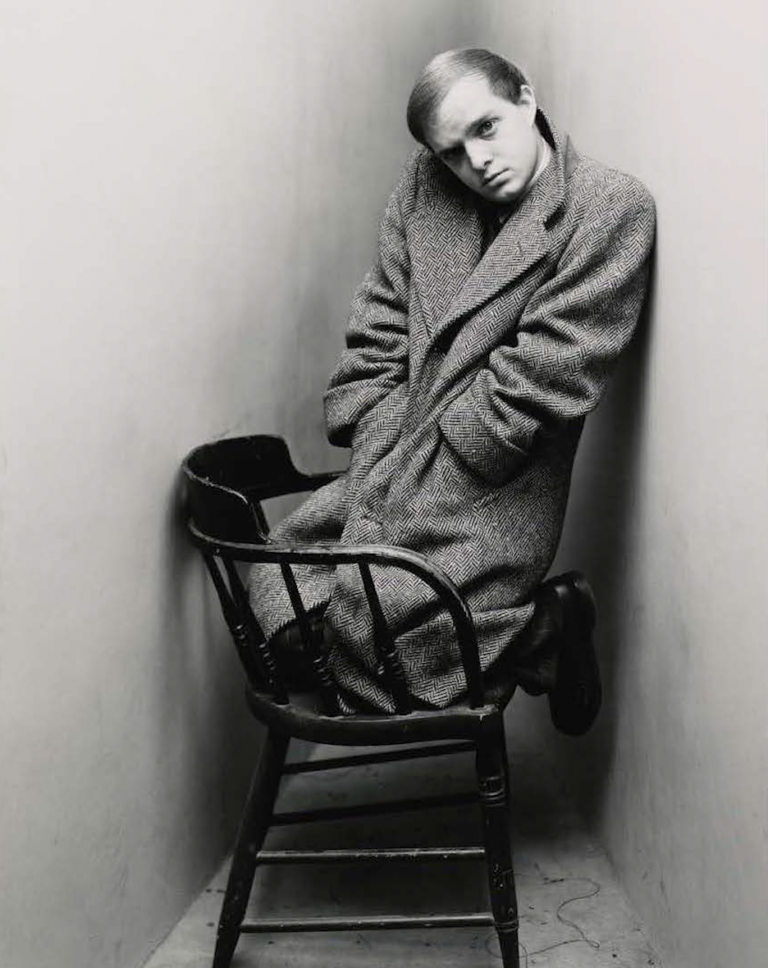
Truman Capote, 1948 by Irving Penn © The Irving Penn Foundation

“I don’t know what the average audience member was thinking when they were watching them, but I’m certain it was different that it is now, and they had less experience and less exposure to people like Truman and Tennessee.

“It fascinates me, and it fascinates me [how] being gay in that time affected their work and their art.”

“I wouldn’t trade the life I’m living through right now and the time I’m living through right now for the world, but I am intrigued by that idea of the degree to which they were pushed into their choices by things more strongly out of their control than what I’m living through right now.”

Star Trek actor Quinto, 43, highlights how his own “tendency” towards addiction is more understood and supported by those around him compared to Williams, whose iconic works include 1947’s A Streetcar Named Desire and 1955’s Cat on a Hot Tin Roof.

“As a sober person myself, I really feel like I have a relationship to, certainly the tendency towards that behaviour, but I’m living in a time where I think there are many more resources that I’ve been able to utilise to really address and look at those parts of myself that might otherwise find [an] outlet in self-destructive ways”, he reflects.

“We are encouraged in our contemporary society I think to more fully talk about our experiences, whether they relate to our sexual or gender identity or just the social pressures of the time.

Photo of Tennessee Williams Courtesy by Clifford Coffin

“I think there’s more of an integrated sense of self-examination now than there was then. And I do think that Truman and Tennessee among some of their other contemporaries were bearing a certain kind of burden for society, where their sexuality was an unspoken but undeniable part of their personas and who they were.

“And so I do think there comes a unique pressure with that, at that time in particular.”

Asked about whether the pressure to be a “good gay role model” as a gay man in the public eye in any way compromises their personal lives, Parsons, 48, replies: “I don’t feel compromised by it, but I think anybody – not even just LGBTQ+ people –  right now who has any platform for any reason at all feels a certain obligation [to speak out].

“And many times, I’ll be blunt about [it], it’s fear: ‘I’m just trying to speak honestly, am I saying something wrong that’s going to cause me big issues?’

“To me, that can be a worrying aspect of being somebody who’s known by other people.”

Parsons, who came out publicly in 2012 at the height of his fame as The Big Bang Theory’s Sheldon, continues: “That being said, at a very personal level, it’s the kind of thing that’s allowed me to – both in my career and in my life – have experiences that I would never have had otherwise, so I would never complain about it.

“Well, in the privacy of my own home of course I would – not in an interview with you!”

Quinto, who came out shortly before Parsons in October 2011, explains that after years of frequently speaking out on LGBTQ issues, he’s also learned that “there’s value sometimes in just shutting up.”

“For me I feel, the whole last year has taught me, among other things, how much I have to learn, and how sometimes the best tool of learning can be – not necessarily silence, because I feel like I’ve always been someone who will acknowledge thigs if I feel like I need to acknowledge them, I’ll step up to something if I feel like I need to step up to it, socially or personally or politically – but there’s a lot of shifts happening in our culture right now that I think deserve space and consideration”, he says.

“So, I’ve been interested in looking at that and rather than just throwing myself into a fray of a controversy or a conversation or a public discourse, actually considering for myself, ‘Well, what do I add to that conversation, how can I actually make a difference in that conversation?’ And we’ve been given many opportunities in the last year to really see that.

“But I also think that pendulum swings the other way, and like Jim said there is this kind of, people are quick to respond and rush into judgments about things now in a way that I think feels a little volatile.

“So for me, I’ve certainly been full of observation and full of contemplation and wanting to make sure I’m contributing to things in a way that I feel reflects my integrity and my authenticity, but also makes things better where possible.

“And if it doesn’t, I understand there’s value sometimes in just shutting up.” 

Truman & Tennessee: An Intimate Conversation is available on Dogwoof on Demand and other platforms in the UK and Ireland from 30 April.

Supreme Court Rejects Texas’s Lawsuit Against California Over LGBTQ Adoption Law – Lavender Magazine

0

Photo courtesy of BigStock/aquir


LGBTQNation reports that in a 7-2 decision, the Supreme Court rejected a request by the state of Texas to allow them to file a complaint against the state of California for banning state-funded travel to the Lone Star State in response to an anti-LGBTQ law.

Read the full story at LGBTQNation 

NCAA Says States With Anti-Trans Laws, Like Michigan, Might Lose Out on Championship Games – pride source.com

0

The National Collegiate Athletics Association made its position clear. The Association does not support legislative attempts to disenfranchise trans student-athletes and states enacting such legislation will lose out on hosting lucrative NCAA championship games.

“When determining where championships are held, NCAA policy directs that only locations where hosts can commit to providing an environment that is safe, healthy and free of discrimination should be selected,” read in part a letter signed by the NCAA’s board governors.

In a March press release, the HRC revealed that 2021 has been a record year for anti-trans legislation. More than 80 bills have been introduced in the 2021 state legislative session.

“State lawmakers around the country should pay attention: discriminating against transgender students is wrong, against the law, and costly,” said Chase Strangio, deputy director of trans justice for the American Civil Liberties Union. “If you continue to pass these misguided laws state taxpayers risk not only costly litigation but the loss of revenue from these tournaments.”

Michigan is among the states at risk of losing out. Last month Republican legislators introduced Senate Bill 218, a bad bill that would ban trans youth from participating in high school sports based on their gender.

“We can obviously see a trend here,” said ACLU-Michigan’s LGBT Project Staff Attorney Jay Kaplan. “It’s an attack on transgender youth and it’s politics at its most cynical. This is not a problem. It’s a way to create a problem to score some very cheap political points at the expense of probably the most vulnerable members of our community, transgender young people. And the need for that legislation is not there. Trans kids do not have an inherent advantage over cisgender kids in sports.”

Kaplan said that trans students “participate in sports for the same reasons other young people do: to challenge themselves, improve fitness and be part of a team. Excluding trans students from participation deprives them of opportunities available to their peers and sends the message they are not worthy of a full life.”

“Senate Bill 218 not only discriminates against trans youth in ways that compromise their health, social and emotional development and safety, but it violates state and federal constitutional guarantees of equal protection,” Kaplan continued. “Our policymakers should be focused on protecting Michigan’s children by creating safe and welcoming environments rather than launching baseless attacks to score political points.”

The NCAA, while not singling out Michigan, said much of the same, stating that their position of supporting all athletes, regardless of gender identity, “is grounded in our values of inclusion and fair competition. Our clear expectation as the Association’s top governing body is that all student-athletes will be treated with dignity and respect.”

Discrimination against LGBT Costs Dear to Eastern Europe – Novinite.com

Discrimination against lesbian, gay, bisexual and transgender people costs Eastern European countries almost 2% a year in economic growth, a coalition of dozens of global companies promoting LGBT+ inclusion said on Tuesday (27 April).

Hungary, Poland, Romania and Ukraine are losing billions of dollars each year due to the lack of equal workplace rights for LGBT+ people and factors such as higher health costs related to HIV/AIDS and depression, said Open For Business (OFB).

They are also facing a “brain drain” of skilled workers and struggling to win foreign investment, found OFB, which is backed by tech giants Google and Microsoft, Barclays and Deutsche Bank, spirits group Diageo and accounting firms PWC, EY and KPMG.

“Countries that are more open (in terms of LGBT+ rights) are generally speaking financially and economically in a much better place,” the report’s lead author George Perlov told the Thomson Reuters Foundation.

Gay sex is legal in all four countries, but none allow same-sex marriage and LGBT+ people have faced physical attacks, which make it hard to live openly.

In Poland, about 100 municipalities have signed declarations saying they are free of “LGBT ideology”, leading the European Union (EU) last year to withhold funding

European Commissioner for Equality, Helena Dalli, who was behind the EU decision, said tackling discrimination against LGBT+ people would be beneficial economically, not just in terms of equality and fairness.

“It will also give companies that embrace it a competitive edge in attracting and retaining talent,” she said in a statement.

The report, which was part-funded by Google, also found a majority of local companies in the four countries backed LGBT+ equality and diversity in the workplace.

Billy Eichner | Entertainment | bakercityherald.com – Baker City Herald

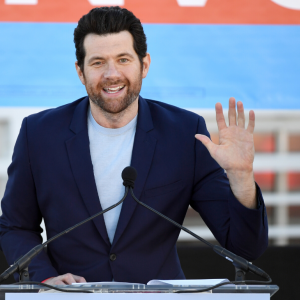
In addition to being a brazen funnyman, Billy Eichner uses his vocal volume to fight for LGBTQ+ rights. He frequently tries to rally his millions of followers to be more politically active, according to Variety. He is also a huge proponent of developing more relatable characters for gay people in the media. He told Variety that while watching “Love, Simon,” a love story with a gay protagonist, he realized, “Straight people go to the movies and literally see themselves all the time. It was so unusual to have a connection to what was happening on-screen instead of being a step or two removed.”