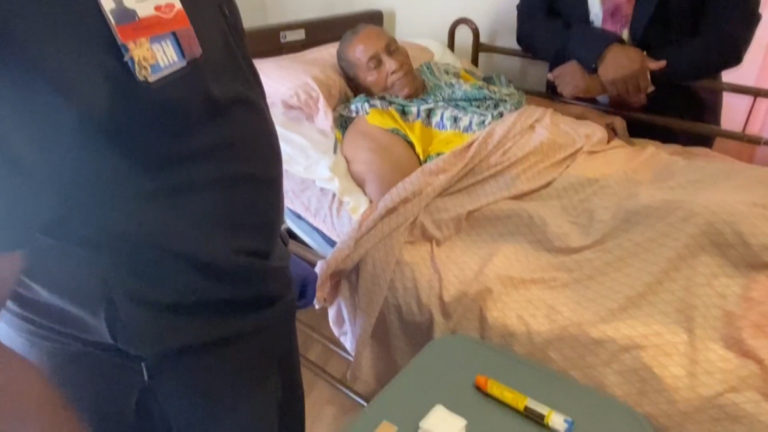
The center recently received federal funding so they can visit patients’ homes and administer the vaccine.
“We are in 10 counties throughout West Alabama,” said Whatley Health Services CEO David Gay. “If they can’t make it, we come to them.”
Her son, Thaddeus Steele, helps care for his mother, who is homebound. He answered questions on her behalf, saying he hopes she will serve as an example for others to follow.
“She understands most importantly if she is seen getting the shot in this form, then it will open the door for so many others who are like her and cannot come out and speak for themselves,” he said.
If you have a relative, friend or loved one who is homebound and would like to receive the COVID-19 vaccine at no charge, contact the Whatley Health Center at 205-758-6647.
Recently there’s been a lot of blowback to the organizers of NYC Pride for their abrupt decision to ban LGBTQ police officers from the city’s future pride marches. It’s an apparent protest against the current state of policing, plagued with claims of brutality against the LGBTQIA, among other marginalized groups. However, a few openly gay cops have also accused the city’s police force of workplace discrimination in the past, so on the one hand, the mere existence of gay police officers would seem like a positive change, right?
Ultimately though, what it boils down to is from the LGBTQ community
It appears the HOP’s decision to bar cops from the march, revolves around exactly that. Despite the new era of openly gay officers, the decades-long lack of trust represents a continued tumultuous relationship between law enforcement and the LGBTQ. One astute person on Facebook also pointed out in defense of the police ban, “Let’s not forget, Stonewall happenedbecause of abuse from the police that had reached a boiling point.”
We can argue all day if the relationship between the community and cops is as volatile today as it was on that fateful night in 1969. However, today, we as gay people are still experiencing bias and discrimination from many officers in law enforcement.
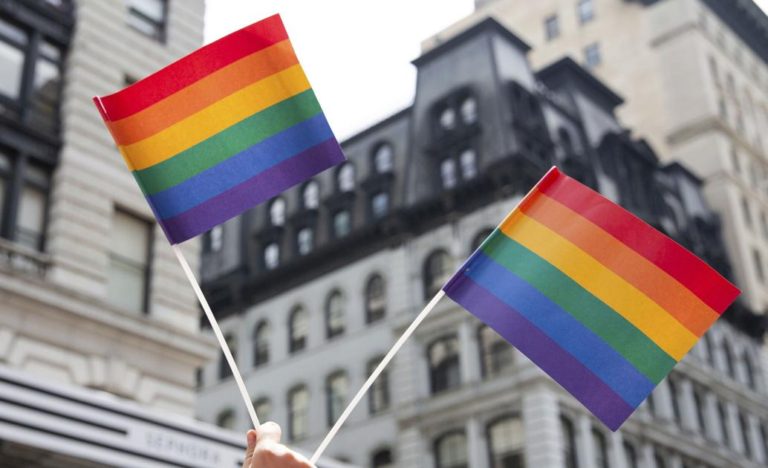
For example, just a few days ago, LGBTQ advocates and police union members called out the City Council president and police commissioner in Long Beach on Long Island,NY. The outcry stems from an incident whereby city officials sided with a restaurant whose owner complained about a Pride flag visibly flying outside their establishment —but on someone else’s private property.
The City Council president and police commissioner told the flag owner to take it down.
David Kilmnick, executive director of the LGBT Network of Long Island, said city officials are in the wrong and responded,
“The rainbow flag is not going to be in the back of the bus. It is not going to be behind everything else. We are not putting it in the closet,” Kilmnick said. “It is going to be where it should be.”
Over the weekend, a large crowd turned out at the beach boardwalk to protest and support the flag remaining on display. In retaliation, the city said it would consider a defamation lawsuit against protest organizers for labeling them with the terms “homophobic and discriminatory.” City officials claim the flag must come down because it violates a city code and has nothing to do with homophobia.
However, Kilmnick’s nonprofit network is embroiled in another pending case with the city in which he further accuses the officials of bias. At the heart of that fight is Kilmnick’s refusal to pay $70,000 for services during multiple Pride on the Beach festivals on the city boardwalk. The network said it withheld payment because it discovered other organizations that held similar events on the beach were not charged for these services by the city.
As I see it, we must call out homophobia and acts of bias. Suppose Kilmnick can gather the ‘receipts’ to prove the city discriminately charged his LGBTQ network for event services. In that case, it raises the question: Is the town also expressing homophobia against the Pride flag? Welp, stranger things have happened —especially on Long Island.
PENDLETON, Ind. — Officials of an Indiana school district have created an uproar after three high school teachers were ordered Tuesday to remove LGBT pride flags from their classrooms.
The rainbow flags were removed from the classrooms of Spanish, French and art teachers at Pendleton Heights High School because South Madison Community Schools officials said they violate the district’s “political paraphernalia” policy.
School board President Bill Hutton emailed a statement to students, parents and staff.
“The issue with displaying the flag in a school is a double-edged sword,” he said. “If an LGBTQ+ flag is allowed to be displayed, then any other group would have the same ability. That could include such flags as supporting white supremacy, which is in direct conflict with LGBTQ+. I hope we can model equality and support through our actions.”
LGBT students, including Tai Wills, disagree that the flags are political.
“Why would you compare a racist flag?” Wills asked. “Those two have nothing to do with each other.”
Student Bryce Axel-Adams has started a Change.org petition to present at the district’s next board meeting. By mid-afternoon Wednesday, it had reached the 2,500 signatures sought.
Wills, 16, who identifies as LGBT, said the hanging of the pride flag can’t be reasonably compared to the hanging of a symbol of white supremacy.
“One is about inclusiveness and the other is about hate and exclusion, and I don’t think that’s the same thing at all,” the sophomore said.
Wills said she worries about the mental health and educational success of her classmates. South Madison’s schools during the 2018-19 school year had a rash of suicides and suicide attempts, some of which involved LGBT students.
“It’s already hard dealing with bullying and judgmental kids, and now you can’t even have a flag saying, ‘We support you in the classroom,’” she said.
Wills is able to identify six LGBT students at Pendleton Heights but believes there are many more who fear coming out because of the reactions of their parents or harassment by their peers.
“I know there are a lot who aren’t out because they don’t feel safe,” she said. “My friend last year was bullied and harassed.”
The flags had hung in the classrooms since last school year, Wills said.
“They had them up all year last year, but I don’t know why it’s just now being a problem,” she said.
Though her own family is supportive, Wills said, many of her LGBT classmates aren’t as lucky.
“A lot of my friends, a lot of my peers don’t have that safe space,” she said. “When they see that flag, it is a sign of hope.”
Pendleton Heights has not been supportive of its LGBT students, according to Wills. For instance, last year she started the Gay-Straight Alliance but was told they could not post fliers and raise money like other clubs.
“Their only excuse was, ‘It’s a sensitive topic,’” she said. “It didn’t really feel like we were a club because we weren’t allowed to do much.”
Missy Darr, who is a step-parent to an LGBT student at Pendleton Heights, said she learned about the flag removal directive from one of the teachers affected, who came forward on a social media page.
“I’m trying to see it from both sides,” she said. “But the problem is the school is seeing this as a political issue. This is my child’s life. They were born this way — frankly, the same way I was. I myself am pansexual.”
Darr said supporting LGBT causes is not political because people are born that way and can’t change what they are.
“You aren’t born a white supremacist. You aren’t born QAnon,” she said. “However, I was born American. I was born pansexual. I was born white.”
PENDLETON — Officials at South Madison Community Schools have created an uproar after three teachers at Pendleton Heights High School were ordered on Tuesday to remove LGBT pride flags from their classrooms.
The rainbow flags were ordered removed from the classrooms of Spanish, French and art teachers because district officials said they violate the “political paraphernalia” policy.
Pendleton Heights Principal Connie Rickert said the school prides itself on creating a welcoming environment for all. She said the district celebrates students and does not tolerate harassment or discrimination based on any protected class, which includes LGBT students.
“Teachers are legally obligated to maintain viewpoint neutrality during their official duties to ensure all students can focus on learning and we can maintain educational activities and school operations,” she said. “Our counselors are trained to respond to any student who desires support.”
South Madison Board of Trustees President Bill Hutton went further with an emailed statement sent to students, parents and staff.
“The issue with displaying the flag in a school is a double-edged sword,” he said. “If an LGBTQ+ flag is allowed to be displayed, then any other group would have the same ability. That could include such flags as supporting white supremacy, which is in direct conflict with LGBTQ+. I hope we can model equality and support through our actions.”
However, LGBT students, including Tai Wills, disagree that the flags are political.
“Why would you compare a racist flag?” Wills said. “Those two have nothing to do with each other.”
Student Bryce Axel-Adams, for instance, has started a Change.org petition to present at the district’s board meeting at 7 p.m. Thursday. By mid-afternoon Wednesday, it reached the 2,500 signatures sought.
Wills, 16, who identifies as LGBT, said the hanging of an LGBT pride flag can’t be reasonably compared to the hanging of a symbol of white supremacy.
“One is about inclusiveness and the other is about hate and exclusion, and I don’t think that’s the same thing at all,” the sophomore said.
Wills said she worries about the mental health and educational success of her classmates. South Madison’s schools during the 2018-19 school year had a rash of suicides and suicide attempts at all grade levels, some of which did involve LGBT students.
“It’s already hard dealing with bullying and judgmental kids, and now you can’t even have a flag saying, ‘We support you in the classroom,’” she said.
Though she is able to identify only six LGBT students at Pendleton Heights, Wills said she believes there are many more who fear coming out because of the reactions of their parents or harassment by their peers.
“I know there are a lot who aren’t out because they don’t feel safe,” she said. “My friend last year was bullied and harassed by the same guy.”
The flags had hung in the classrooms since last school year, Wills said.
“They had them up all year last year, but I don’t know why it’s just now being a problem,” she said.
Though her own family is supportive, Wills said, many of her LGBT classmates aren’t as lucky.
“A lot of my friends, a lot of my peers don’t have that safe space,” she said. “When they see that flag, it is a sign of hope.”
In reality, Wills said, Pendleton Heights has not been supportive of its LGBT students. For instance, last year she started the Gay-Straight Alliance but was told they could not post fliers and raise money like the other clubs.
“Their only excuse was, ‘It’s a sensitive topic,’” she said. “It didn’t really feel like we were a club because we weren’t allowed to do much.”
Missy Darr, who is a step-parent to an LGBT student at Pendleton Heights, said she learned about the directive from one of the teachers affected, who came forward on a social media page.
“I’m trying to see it from both sides,” she said. “But the problem is the school is seeing this as a political issue. This is my child’s life. They were born this way — frankly, the same way I was. I myself am pansexual.”
Darr, who said she will be meeting with Rickert about the matter on Thursday, said supporting LGBT causes is not political because these people are born that way and can’t change what they are.
“You aren’t born a white supremacist. You aren’t born QAnon,” she said. “However, I was born American. I was born pansexual. I was born white.”
Award-winning author Brian Broome has been sober for eight and a half years. Before his sobriety, his struggle with depression and anxiety caused him to turn to alcohol and drugs until addiction landed him in rehab. It was there where he began to write his newly released memoir, Punch Me Up to the Gods.
Broome’s coming-of-age memoir is a collection of narrative essays, detailing what he calls “watershed moments” from throughout his life that were symbolic of how he ended up in rehab.
“It covers my struggles as a Black gay man to navigate a world of homophobia, racism, sexism, and addiction,” he told Georgia Voice. “These are cautionary tales. These stories are embarrassing and cringeworthy… I want to show people that there is help available. If I can get sober, anyone can get sober.”
His stories cover themes of race and masculinity, inspired in part by Gwendolyn Brooks’ poem “We Real Cool.”
“I found that poem late in life, just a few years ago,” Broome said. “When I read it, it spoke to me as kind of a treatise on Black masculinity. It talks about what ‘cool’ is: being good at sports, drinking, all these things that are stereotypically masculine things… Every line of the poem spoke to me and plugged into the story that I was already writing.”
Broome experienced a disconnect between him and traditional masculinity growing up that made him question what masculinity truly is, something he says is a common experience among Black men.
“The way that I viewed [masculinity] growing up was just as this unattainable thing that has all these rules and regulations and restrictions that I couldn’t live up to,” he said. “I don’t think that’s particularly because I was gay, I think a lot of Black men, regardless of sexuality, feel this way. I just stared to question: what does this idea of masculinity, and in particular hyper-masculinity, mean? With Black men, there’s more pressure to be more masculine than men in general, as a result of American racism.”
Broome will be discussing these themes and more in conversation with fellow author and friend Deesha Philyaw on Friday, May 21 at 7:30pm. The virtual conversation is hosted by Charis Books and More. The event is free and open to everyone, but donations to Charis Circle, Charis’ programming non-profit, are encouraged and appreciated. The conversation will take place via Crowdcast, Charis’ virtual event platform.
“I expect [Philyaw] to really dig deep into the content of the book, why I wrote it this way, and what it means to me,” Broome said of the event. “I think we’ll talk about race, sexuality, gender identity, and masculinity. I think we’ll cover it all. I expect it to be a great conversation.”
You can register for the event here, and you can buy Brian Broome’s book Punch Me Up to the Gods: A Memoir online at charisbooksandmore.com.
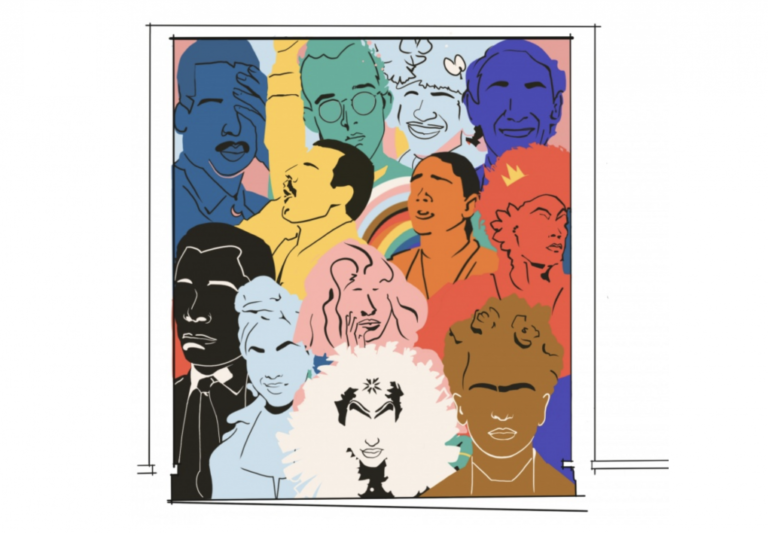
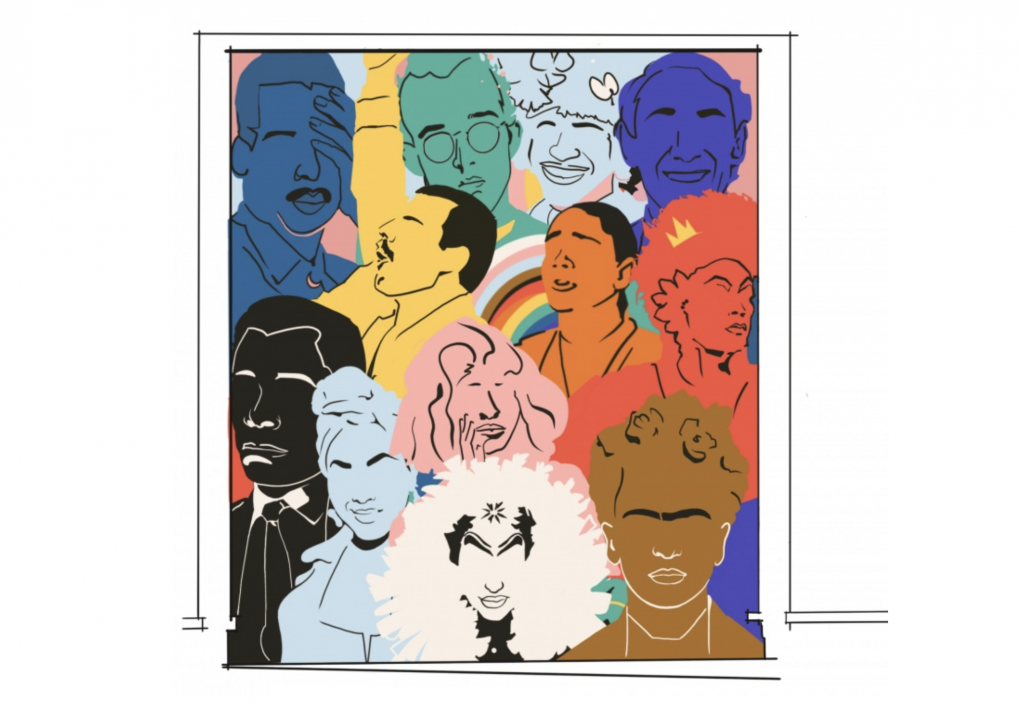
Queeroes honors four figures from Bay Area LGBTQ+ history: Harvey Milk, Honey Mahogany, Juanita MORE! and Sister Roma of the Sisters of Perpetual Indulgence. It also features international icons including Freddie Mercury, Frida Kahlo, Marsha P. Johnson, Keith Haring, Chavela Vargas, James Baldwin, Sylvia Rivera and Willi Ninja. The piece incorporates the colors of the Progress Pride Flag.
Both Carmona and Malvaez identify as Latinx and queer, and say their work is impacted by their experiences as immigrants. On his website, Carmona says his work also reflects “the intersection of the LGBTQI and Latino communities of San Francisco.” Malvaez and Carmona finished a separate mural of Juanita MORE! earlier this month at Alamo Square. That piece is part of the Painted Gentlemen Project—a series of artworks painted on plywood and affixed to a chainlink fence at 804 Steiner. The project is curated and managed by fnnch.
Company logo of law firm Polsinelli is seen in their legal offices in Manhattan, New York, April 27, 2021. REUTERS/Andrew Kelly
A Dallas-based bankruptcy partner at Fox Rothschild is withdrawing a federal bias lawsuit against his ex-firm Polsinelli and will instead take his discrimination claims to arbitration.
Plaintiff Trey Monsour’s Tuesday concession represents a victory for Polsinelli, which denied Monsour’s claims that he was forced out of the firm due to his sexual orientation and his age and argued that he was required to arbitrate any claims against the firm. Monsour, who is gay, was 58 years old when he filed the lawsuit in March.
In conjunction with its bid to compel arbitration, Polsinelli asserted that Monsour, now a partner in Fox Rothschild’s Dallas office, was terminated in March 2020 because he misrepresented the size of his book of business and that mistreated two of his female colleagues.
Monsour sued Polsinelli in Houston federal court in March. U.S. District Judge Gray Miller had not made any substantive rulings in the case before Tuesday’s withdrawal.
Monsour joined Polsinelli in June 2017 as an equity partner in its bankruptcy and financial restructuring group in Houston. While other attorneys received the “red carpet treatment,” Monsour alleged he did not.
His lawsuit alleged that he was isolated and deprived of professional support for years. He called Polsinelli’s commitment to diversity a “marketing ploy,” and alleged he heard the firm’s former chair making derogatory comments about how two other gay Polsinelli attorneys at the firm should be paid cumulatively, rather individually, because they were domestic partners.
In late 2019, Polsinelli began to nudge Monsour out of the firm by hiring a younger, straight, female bankruptcy attorney who introduced herself as “the Texas bankruptcy partner to whom other attorneys, as well as clients, should direct their communications,” the lawsuit alleged. Monsour claimed the attorney also tried to dig up dirt on him in an effort to get him fired.
Monsour alleged that when Polsinelli terminated him in March 2020, the firm was vague and unclear about its reasons. But Polsinelli countered in an April 27 filing that Monsour was terminated, in part, because of his “poor treatment” of a second-year female associate who asked to be transferred and a female shareholder.
Monsour also misrepresented the size of his book of business, Polsinelli alleged. He became an equity partner at the firm because he said his book of business was valued between $1.2 million and $2.3 million, when in fact he raked in less than $135,000 in fiscal year 2018, the firm said.
As a result, he lost his equity and saw his compensation shrink, Polsinelli asserted. Monsour in his lawsuit said he “performed at a high level, scoring legal victories and adding value to the firm.”
Monsour’s attorney, William Brewer III, a founding partner at Brewer, Attorneys & Counselors, said in a statement last month that Polsinelli’s filing was “a transparent attempt… to deflect attention away from its treatment of members of the LGBTQ community by disparaging its former partner.”
A representative for Polsinelli did not respond to a request for comment.
The case is Trey Monsour v. Polsinelli PC, U.S. District Court for the Southern District of Texas, 4:21-cv-01046.
For Trey Monsour: Robert Millimet, William Brewer III and William Brewer IV, of Brewer, Attorneys & Counselors
For Polsinelli: Laura DeSantos and Mercedes Colwin, of Gordon Rees Scully Mansukhani
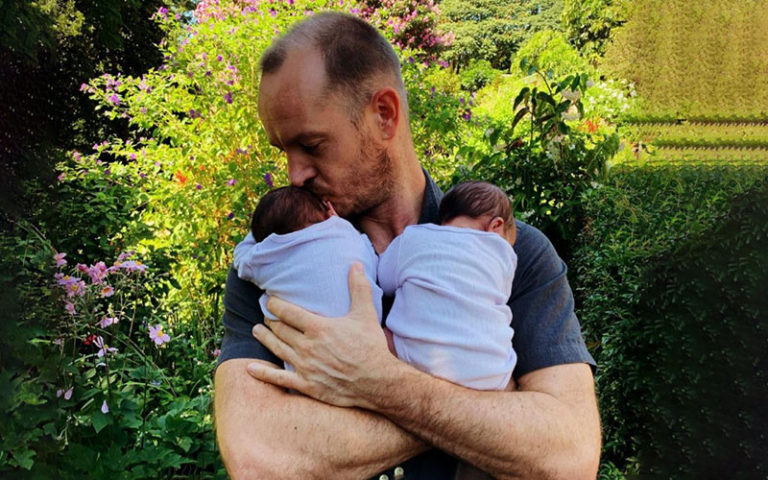
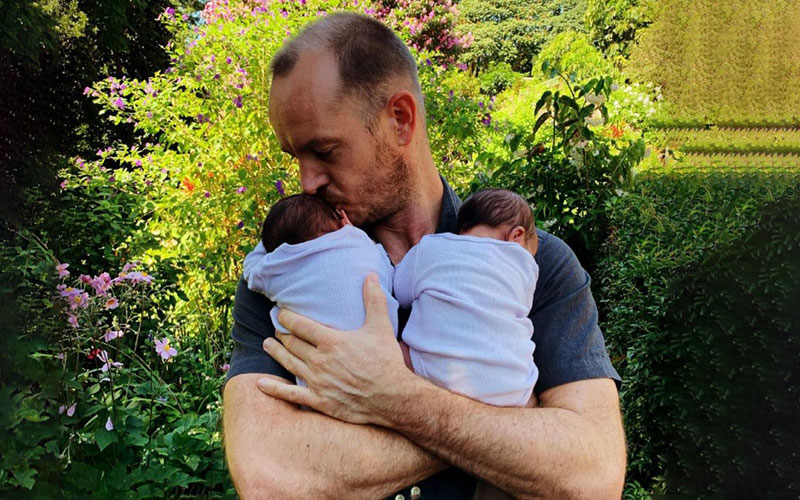
The Namibian government has issued travel documents to the twin infant daughters of a binational gay couple who were born in South Africa in March, after initially denying the children citizenship.
The decision comes after a new Minister of Home Affairs and Immigration was appointed on April 21. In a press release dated May 18, the Ministry notes that its decision to issue emergency travel certificates for the twins has been done without conceding either case filed by the family seeking citizenship recognition for the twins, and citizenship of the couple’s other son.
While the family’s legal battles continue, they will finally be allowed to reunite, and the twins will finally meet their other father and older brother.
Original Story from April 20, 2021:
A Namibian court ruled Monday against a gay couple demanding the right to bring their infant daughters home after being born to a surrogate in South Africa. The Namibian Ministry of Home Affairs says the girls are not Namibian citizens, despite being born to a Namibian father.
Namibian Phillip Lühl hasn’t been able to bring his twin daughters home to meet the rest of their family since they were born in Durban, South Africa, in March. (Photo courtesy of Phillip Lühl via Instagram.
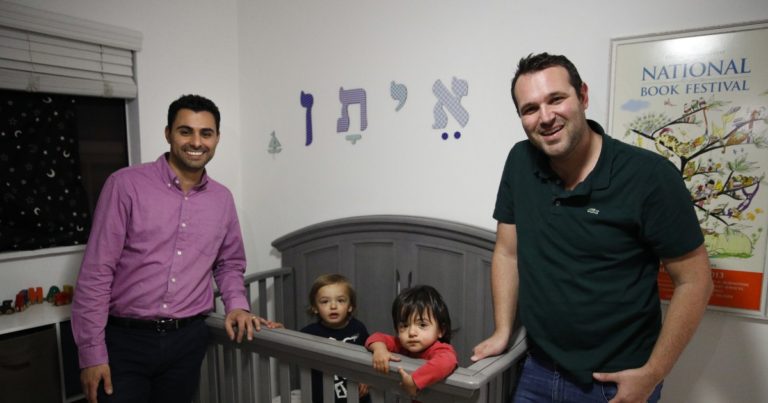
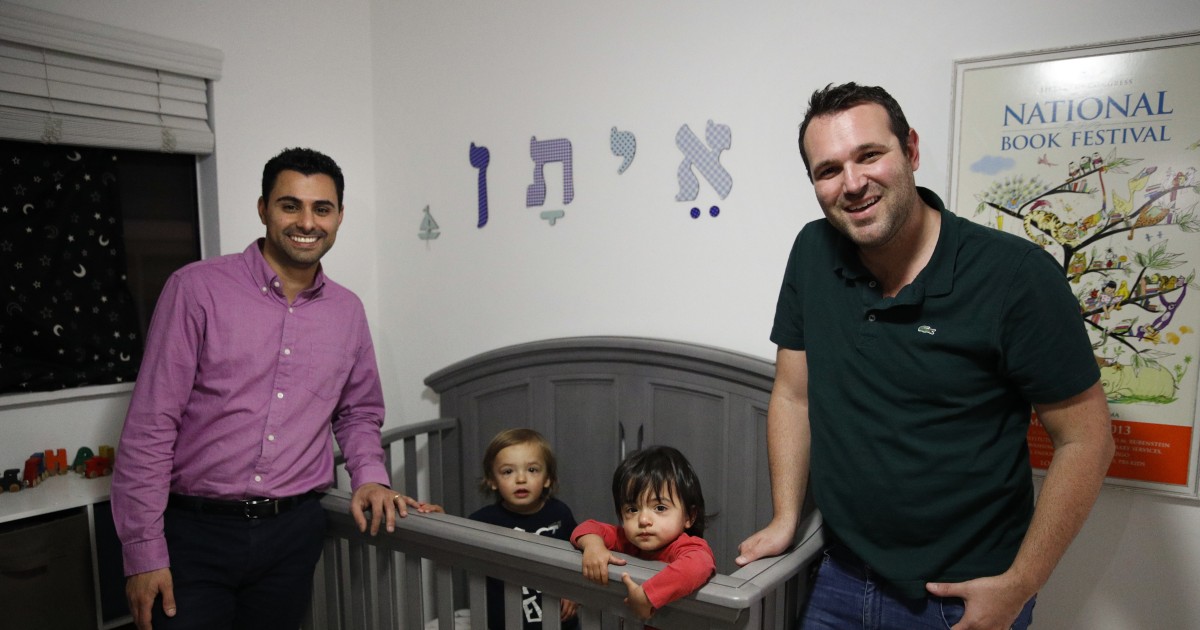
Phillip Lühl is a Namibian citizen married to Guillermo Delgado, a Mexican national. Together they also have a two-year-old son who was also born to a South African surrogate. Right now the family is separated because their twin daughters were born in Durban, South Africa, and the Namibian government has refused to issue travel documents to them. Lühl is in South Africa with their daughters and Delgado is in Namibia with their son.
Lühl said the couple is deciding on its next steps.
“(It’s an) unexpected judgment and, on a personal level, quite a big blow to us,” he said after the decision.
Namibia does not recognize same-sex marriage or permit surrogacy arrangements. Namibia also maintains a prohibition against sodomy under its common law system, although the government is not believed to have pursued charges of sodomy in over 25 years. In 2019, the Ombudsman of Namibia echoed calls from the United Nations Human Rights Committee for the sodomy ban to be repealed.
South Africa does recognize surrogacy and has issued birth certificates to all three children with both Lühl and Delgado listed as parents. But the Namibian government is insisting that the couple prove a genetic link between the children and Lühl before issuing citizenship documents. Lühl says there is no basis for the requirement of proof of a genetic link in Namibian law.
“We rejected the notion that a genetic link or DNA test will prove my parentage,” Lühl said to Reuters. “We rejected that because of the fact that one of us has to have a genetic link. It doesn’t mean that one of us is a parent. We are both parents legally.”
Lühl says that’s discriminatory, since heterosexual families are not required to prove genetic links to their own children in order to pass on their Namibian citizenship.
The judgement effectively leaves all three children stateless. They would be entitled to Mexican citizenship through Delgado, but they would have to apply at the embassy in Pretoria, South Africa, and their son cannot cross the border to reach Pretoria because he lacks travel documents.
Lühl and Delgado are no strangers to the Namibian court system. They already have separate cases before the court seeking continued right of Delgado to reside in Namibia and recognition of the Namibian citizenship of their son.
Additionally, three other cases are before the High Court of Namibia seeking recognition of same-sex marriage.
The United States has ended a policy that denied U.S. citizenship to some children born abroad to gay Americans.
The State Department announced Tuesday that children born outside the United States to married parents, at least one of whom is an American citizen, “will be U.S. citizens from birth if they have a genetic or gestational tie to at least one of their parents.” Previously, the department required children born abroad to have a biological tie to a U.S. citizen.
For example, under the previous policy, a child born in Mexico to an American woman and her Mexican wife could be denied U.S. citizenship if the child had no biological tie to the American, even if the two women were legally married in the U.S. before the child was born.
The State Department said its updated interpretation and application of the Immigration and Nationality Act “takes into account the realities of modern families” and advances in assisted reproductive technology, or ART.
Immigration Equality, an LGBTQ immigrant rights organization, filed several lawsuits against the State Department on behalf of same-sex married couples whose children were denied American citizenship, despite one parent being a U.S. citizen. The group’s executive director, Aaron Morris, called this week’s policy change “a remarkable moment for all the LGBTQ families who fought the U.S. State Department’s unconstitutional policy.”
“It demonstrates that when our community is united, and relentlessly pushes back against discrimination, we win,” Morris said in a statement Tuesday. “We have once again affirmed that it is not biology but love that makes a family.”
Immigration Equality said all of the children of the couples they represented eventually won U.S. citizenship, except for one: U.S. citizen Allison Blixt and Italian citizen Stefania Zaccari, whose case is still pending. Tuesday’s announcement came as welcome news to Blixt and Zaccari, whose son, Lucas, is awaiting an American passport.
“We are relieved and thankful that our fight for our family to be recognized by the government has finally ended,” Blixt said in a statement shared by Immigration Equality. “We knew we would succeed eventually, as trailblazers before us fought and won marriage equality. Our marriage is finally recognized and treated equally. Lucas, who made me a mother, will finally be treated as my son and recognized as American.”
Gay Marie Gillispie passed away at the age of 81, peacefully in the comfort of her home. She was born to Mike and Zoma Mulligan. Gay graduated from Morton High School in 1957. She then married Donald Gillispie July 26, 1957. Since then, she has been a long time resident of Glenoma, where her and husband built their family and their life together of almost 64 years. Together, Gay and Don had three children, Kevin, Tony, and Kathy. Throughout the years, she attended hundreds of sporting events, family dinners, birthdays, camping trips, and more. As a coaches wife of many years, and between her children and grandchildren, there was not hardly a ball game that she missed. Gay acquired a love for the game, but most importantly a love to watch, support, and cheer each and everyone of them on. She was our biggest fan. Gay also worked as a store clerk at Redmon’s Grocery for many years. That is where she came to know many of the community members and made a lifetime of friends. The love and devotion that she had for her family was inevitable. Gay loved each and everyone of them dearly and they were her life. Her devotion, generosity, encouragement, and beautiful smile will be deeply missed by all who knew her. She touched so many lives and had such a caring and giving heart. Her beauty and kindness will live on in the hearts and minds of everyone she knew, forever. Gay is survived by her husband, Donald Gillispie; sons, Kevin (Heidi) Gillispie and Tony (Leah) Gillispie; daughter, Kathy (Greg) Lamping; 12 grandkids; and 24 great-grandkids. Her siblings preceding her in death are Togue Dodrill, Jean McCain, Doris Person, Mickey Kelly, and Mike Mulligan. Friends are invited to attend a potluck celebration of life for Gay at the Family Worship Center in Randle, Saturday, May 22, 2021, at 1 p.m. Graveside service will follow at the Rainey Creek Cemetery in Glenoma.
NASHVILLE — Tennessee Gov. Bill Lee has signed the nation’s first law mandating businesses and government post warning signs on multi-stall public restrooms if they allow people of both sexes as well as transgender people to use facilities associated with their gender.
Lee on Monday signed House Bill 1182, which critics call the “Business bathroom bill,” on Monday. It goes into effect July 1.
On Tuesday, he signed SB126/HB1027. The amended bill would prohibit a health care professional from prescribing hormone treatment to address issues for “prepubertal minors” except in cases of growth deficiencies or other diagnoses “unrelated to gender dysphoria or gender incongruency.” It was viewed by some as a less draconian approach to another measure favored by some socially conservative lawmakers who wanted to raise the age restriction to 18.
The bill is one of five bills Lee has now signed, passed by his fellow Republicans in the General Assembly, that target LGBTQ people. Two of them are bathroom measures, the first one (applying to public schools) he signed earlier this month.
They are the first two bathroom bills targeting transgender people to pass since 2016 when North Carolina passed a law restricting bathroom use for transgender people. That led to boycotts by national sports leagues that charged it was discriminatory, and Tar Heel State lawmakers repealed it a year later.
Officials with the Human Rights Campaign, a national group that advocates on behalf of LGBTQ people, denounced Tennessee’s second bathroom bill as “unprecedented: It requires businesses that don’t actively prevent transgender people from using the restroom consistent with their gender identity to post an offensive and outrageous sign warning that transgender people might be inside.”
“Gov. Lee has made Tennessee a pioneer in anti-transgender discrimination by signing the first and second bathroom bills since HB2 [the North Carolina law] in recent days,” said Human Rights Campaign President Alphonso David.
The Human Rights Campaign, the Tennessee Equality Project and the Nashville LGBT Chamber charge that the measures, now law, are part of a “Slate of Hate” that targets them, and especially transgender people, being pushed by “national extremist groups and peddled by lawmakers in Tennessee in an effort to sow fear and division.”
The measure requires businesses and other entities to post a sign on the entrance to multi-stall restroom facilities open to the public. It mandates the sign must be at least 8 inches by 6 inches with one third of the sign to contain a background color of red with the word “NOTICE” in yellow text.
It also requires the following message in block-type letters covering the sign’s bottom two thirds: “THIS FACILITY MAINTAINS A POLICY OF ALLOWING THE USE OF RESTROOMS BY EITHER BIOLOGICAL SEX, REGARDLESS OF THE DESIGNATION ON THE RESTROOM.”
Another original bill provision using language from the federal Americans for Disabilities Act was scratched after the National Federation of Independent Business in Tennessee became concerned, NFIB-Tennessee Executive Director Jim Brown said in an interview.
Brown said the concern was businesses could be “carpet bombed” with lawsuits. He thanked the bill’s sponsors for listening to businesses’ concerns.
The bill’s sponsor, Rep. Tim Rudd, R-Murfreesboro, did not respond to a request for comment.
In a March 23 meeting of the House State Government Government Committee, Rudd was pelted with questions from concerned Republican and Democratic colleagues.
Rudd said he brought the legislation after a constituent spoke to him about the bathroom issue “at a charitable fundraiser several years ago. I’m not prepared to sit by and wait for a woman to be scared or raped.
“We just need a minimal warning to women,” he added.
While not mentioning the criminal sanction had been stripped out, Rudd stressed the amendment should address some members’ concerns.
The House’s only two openly gay members, Reps. Eddie Mannis, R-Knoxville, and Torrey Harris, D-Memphis, split on the final floor vote, with Mannis voting for it and Harris voting no.
Bills that Lee has already signed
Lee has now signed five bills that the LGBTQ groups say target them.
Among them, HB1233/SB1367, the first “bathroom bill,” was enacted last week. It allows public schools to be sued if officials allow transgender students, teachers and staff to use multi-person bathrooms, locker rooms or changing facilities that don’t match the gender listed on their birth certificates. It also requires schools to provide “reasonable accommodations” for transgender students by providing them alternative facilities such as single-occupant or faculty restrooms.
Senate Judiciary Committee Chair Mike Bell, R-Riceville, the bill’s Senate sponsor, told the Times Free Press last week in response to questions whether he had concerns it might prompt businesses to cancel plans to come to Tennessee that “I think at some point that the people of this state and the Legislature have got to decide whether we bow down to corporate people or bow down to the LGBTQ crowd. Or do what we think is best for Tennesseans.”
The NCAA has indicated it may withdraw sports championship games from states such as Tennessee with laws such as the bathroom measures, and businesses have expressed similar concerns.
Last week, Lee put his name on a measure restricting who transgender student athletes can compete against in sporting events, requiring it be determined by a student’s biological sex as stated on his or her birth certificate.
A second measure Lee signed last week, SB1229/HB529, sponsored by Rose and Rep. Debra Moody, R-Covington, requires schools to provide parents or guardians of students a heads-up before beginning “instruction of a sexual orientation or gender identity curriculum.” It also gives adults the option to opt their children out of such instruction.
In response to the alarms raised by the private sector about the business and government bathroom bill, Lee said, “at the end of the day, I think it really matters what our business community thinks. I think it matters what organizations think, I think it matters what the citizens think. And at the end of the day, the people of Tennessee, through their elected officials, decide what the law is and that’s how it should work and that’s how it does work.”
The governor added that “elected officials weigh what organizations or what businesses think about individual issues before they make those decisions. But that’s what the General Assembly’s job is, and they’ve done that.”
Contact Andy Sher at asher@timesfreepress.com or 615-255-0550. Follow him on Twitter @AndySher1.
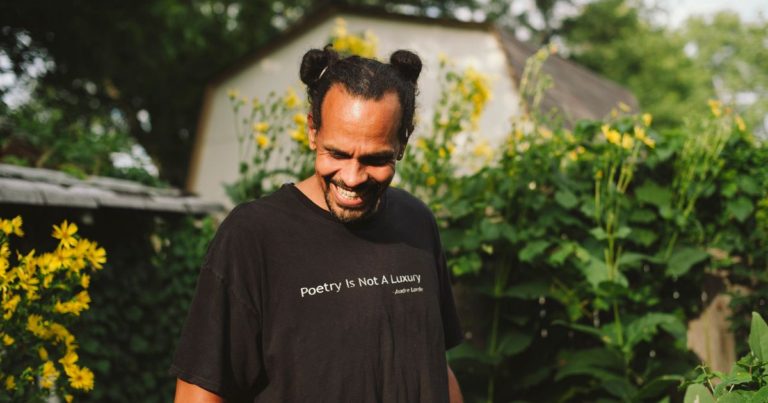
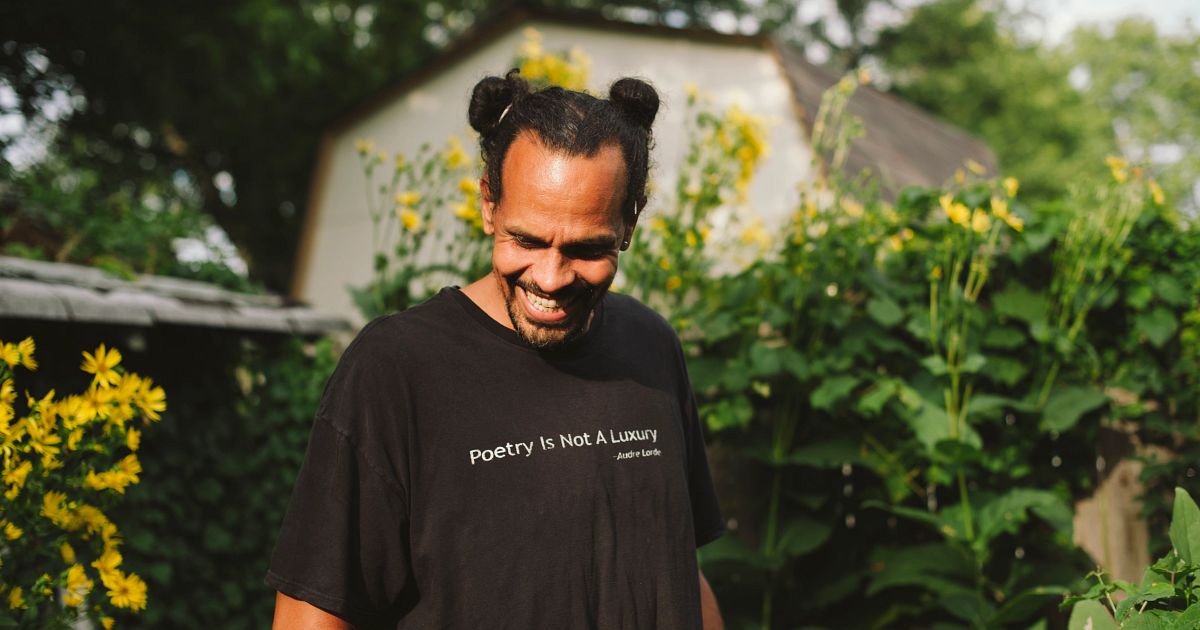
The annual Indiana University Writers’ Conference will be held virtually for the first time in its 81-year history. The four-day event will also feature English professor Ross Gay, who recently won the 2021 PEN/Jean Stein Book Award for his book “Be Holding: A Poem.”
In 2020, conference organizers were ready to celebrate 80 years of continual operation since the event’s founding by Herman B Wells in 1940, but the COVID-19 pandemic cut those plans short. This year, conference director and senior lecturer in English Bob Bledsoe and associate director and third-year MFA candidate L. Renée plan to pick up the celebration where it left off and have made the event more accessible.
“In some ways the pandemic has allowed us to broaden the reach of the conference,” Renée said. “We are registering writers from all over the country who are trying to make art and find meaning during this time, and they will be able to join in a community with people who are doing the same.”
Rates for workshops and classes, which will take place June 3 to 6, are reduced for the virtual conference, and the number of scholarships available has increased this year.
The conference will feature poetry, fiction and memoir workshops, as well as writing craft classes and evening readings online in live/synchronous gatherings. Award-winning conference workshop faculty for the event include ZZ Packer (fiction), Maggie Smith (poetry) and Jaquira Díaz (memoir). Classes will be taught by Joseph Cassara (fiction), Tiana Clark (poetry), Hannah Bae (creative nonfiction), Brando Skyhorse (publishing) and Shawna Ayoub (writing through trauma).
In honor of the 81st anniversary of the conference, Gay will lead a special class for conference participants on lyric archiving, which will feature writing experiments, drawing and collage.
“A successful class for me would be that care happened, listening happened, laughter happened, and probably something that you wouldn’t have made otherwise happened,” he said. Every time he works with writers, Gay said, “I witness people make things that are more beautiful than anything I could ever imagine, and that I could never have coached someone up on making.”
Gay will also be leading a special evening event to read some of his own work and answer questions from attendees. All evening readings are free and open to the public, not just to those enrolled in conference classes or workshops.
The selection of these diverse, award-winning workshop faculty reflects the diversity of the participants in the nation’s second-oldest, continually operating writers conference, Renée said.
“Our conference is open to writers at every part of their journey,” she said. “It allows emerging writers, K-12 teachers and parents, as well as Ph.D. and MFA students and professional writers, to meet with different types of people.”
The conference also provides workshop participants with valuable feedback from faculty and their workshop colleagues, since they submit manuscripts in advance of the conference for review.
“We’re excited for the opportunity to celebrate the history of bringing creative people from all over the world together for this conference and to make these renowned professional writers available to such a wide range of participants,” Bledsoe said.
Casey Johnson lives in Pittsburgh’s North Shore, a couple of blocks from one of the most colorful buildings in the nation, Randyland, a utopian-esque public art installation with walls, chairs, and trinkets in every possible shade and hue.
When apartment shopping in the Steel City, Johnson, who is pansexual, gender non-binary and uses non-gendered pronouns, searched to find a neighborhood that was the “most accepting.” North Shore, they said, fits the bill.
But if Johnson were ever to move back home to West Virginia, where they grew up, they know that acceptance isn’t certain and often a matter of where someone chooses to live.
Johnson was raised inside the city limits of Martinsburg, one of just over a dozen cities in the state to protect LGBTQ individuals from discrimination in housing and employment.
Their mother now lives outside city limits in Berkeley County, where no protections exist.
“If I were to move in next door to my mother, I can be evicted from an apartment because I’m queer,” said Johnson. “I could be fired from a job because I’m queer. And I’m not protected at the state level.”
Johnson wants to see lawmakers create statewide protections for LGBTQ West Virginians. A bill to do so has been introduced in the statehouse for the last two decades.
The most recent proposal — known as the Fairness Act — died in committee this year without a single vote. At the same time, state Republican lawmakers joined a half dozen other states and passed a transgender athletes ban.
“It hurts to come from a place where we preach how much we love people and how much we care about people, and then we don’t see that in practice,” Johnson said.
This story is part of our series, “Plugging the Brain Drain” about young West Virginians deciding whether or not to leave the state.
After graduating from West Virginia University last year, Johnson moved to Pittsburgh for an entry-level software development job and said they don’t see themselves moving back home with the current lack of protections.
“The thought of living somewhere that I could raise kids who one day would turn out to be queer, and the place wouldn’t accept them, you know, they wouldn’t be able to get health care, they will be turned away from even like schools and things like that, that alone is enough reason to move away from a place for me,” Johnson said.
Advocates started this year’s legislative session with the hope that this would be the year the Fairness Act passed.
During a 2020 gubernatorial debate, Republican Gov. Jim Justice said he supported the legislation. That moment was heralded in October by former Republican Senate President Mitch Carmichael as “a significant turning point in the political landscape of West Virginia as it relates to the LBGT community.”
When the state legislature convened in February, there was a noticeable lack of decisive change on the issue.
The Fairness Act didn’t make it onto the legislative calendar in the Republican-controlled statehouse.
However, the GOP lawmakers joined over 20 other states in considering a ban on transgender girls competing on sports teams consistent with their gender identity.
This proposal passed and became law.
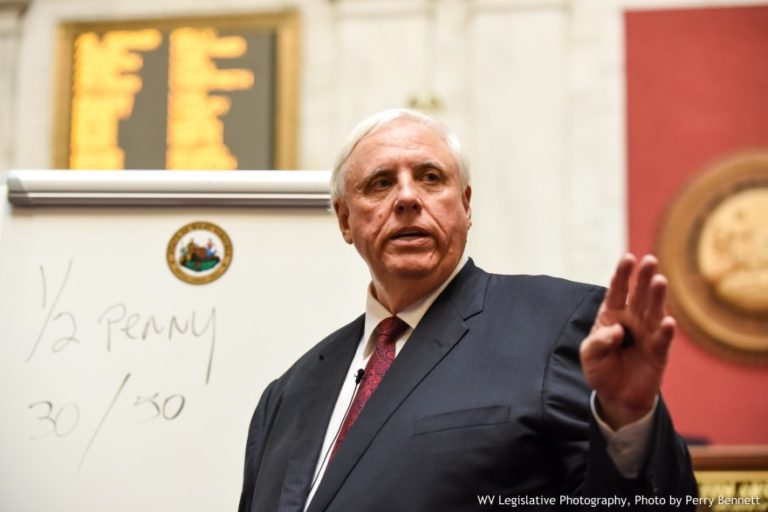
Perry Bennett
“I’m going to sign it proudly because I really believe that that is the right thing to do,” Justice said just days before signing the ban into law.
This dichotomy of priorities rankled Democrats in the statehouse and sparked protests and outrage among some young West Virginians, a group more progressively-minded on social issues.
“I’m sure to have transgender students,” said David Laub, a WVU graduate student who is studying to be an English teacher. “And it’s really frustrating to me, that I would have to sit by and just watch them not be able to do the things that they care about potentially in school — one of them being sports.”
David Laub
He’s also a former high school athlete and said he doesn’t see the need to legislate whether or not transgender girls can play sports.
Laub acknowledged that he and his friends are all pretty liberal and among the minority in West Virginia, a state with Republican supermajorities in both the chambers of the legislature.
Political disagreements are a part of life but Laub said some of the legislation proposed this past year by Republican lawmakers went beyond politics.
“When it comes to matters of not being able to discuss systemic racism, and not being able to discuss sexism in the classroom, because they’re divisive concepts, or not being allowed to strike to get a fair wage, or transgender students in my classes not being able to just play sports,” said Laub. “That’s an eye-opener that is so far removed from my personal everyday reality.”
He went to WVU on a full-ride scholarship and said he owes everything in his professional life to the school and by extension the people of West Virginia.
Still, when he thinks about where he wants to live, it comes back to acceptance. David has close friends who are LGBTQ.
“I don’t want to put them in a situation where they feel kind of threatened just for existing or unable to exist in an authentic way without fear of like employment discrimination or other kinds of discrimination,” Laub said.
Almost every Republican — and a few Democrats — in the statehouse voted for the transgender sports ban. However, support is not unanimous.
“I think that anytime lawmakers do something that is a hindrance for young people or hindrance for minorities, it really does turn people away,” said Del. Joshua Higginbotham, R-Putnam, the lead sponsor of the Fairness Act this year and the only Republican delegate to vote against the transgender sports ban.
Perry Bennett
Joshua Higginbotham, R-Putnam, speaks in the statehouse earlier this year.
In the state Senate, several GOP members voted against the measure. Those who spoke said they agreed with the idea but feared the NCAA’s threat to move revenue-producing regional and national championships to other states without transgender sports bans.
“I don’t think that my colleagues were motivated out of bigotry,” said Higginbotham. “I don’t think they were motivated out of hatred. I think it was a lack of understanding. Most people, especially in the Republican Party, have not met an LGBT person. And I find that to be very disappointing.”
A 2017 national study from The Williams Institute found that West Virginia has the highest percentage of transgender teens with 1.04 percent. The national average is .73 percent.
Higginbotham was first elected to the statehouse in 2016 at the age of 19 and is now just 24. He said many of the people he went to high school with are in college, in jail, or have left the state.
“When I talk to a lot of the people who have left, they remind me that it’s the culture,” Higginbotham said.
He said state lawmakers should do “everything we can” to deregulate and pass tax reforms that will attract businesses.
”But ultimately, if we don’t change the image of our state, if we don’t change the stereotypes…people aren’t going to want to move here,” Higginbotham said. “And more young people will try to leave.”
When Generation Z and millennials become the largest voting bloc, Higginbotham said he expects a cultural shift in West Virginia and the nation.
A study last year from the Center for American Progress found that the 2024 election will likely be the first where these two younger generations outnumber the Baby Boomers.
He points to a poll from the Public Religion Research Institute released earlier this year that found — for the first time — half of Republicans support gay marriage.
“Ten years ago, that would have been an impossibility,” Higginbotham said. “And I think that as we replace some of the Baby Boomers, some of the greatest generation, we’re gonna see these cultural changes.”
Lance Bass might have come out as part of the LGBTQ community almost 20 years ago, but he still can relate to modern coming out stories. The former NSYNC member had plenty to say about the former lead of The Bachelor, Colton Underwood, coming out as gay. Now, he’s pointing out something he has in common with the former football player.
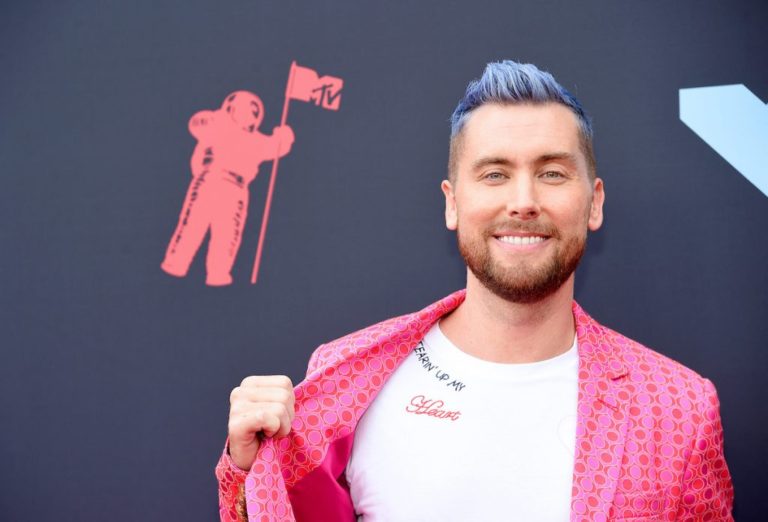
Lance Bass | Jamie McCarthy/Getty Images for MTV
Colton Underwood came out as gay on ‘Good Morning America’ in 2021
Underwood, more than a year after trying to find love with women on The Bachelor, came out as gay on Good Morning America. The lead dropped the announcement about his sexuality following his split from former girlfriend Cassie Randolph as well.
“This year’s been a lot for a lot of people,” Underwood stated. “It’s probably made a lot of people look at themselves in the mirror and figure out who they are and what they’ve been running from or what they’ve been putting off in their lives.”
“I hated myself for a long time,” he continued. “I’m gay and I came to terms with that earlier this year and have been processing it. The next step in all of this was letting people know. I’m still nervous, but yeah it’s been a journey for sure.”
Lance Bass related to Colton Underwood’s coming out story
Bass recently went on the On the List podcast with Brett Gursky on the Bleav Podcast Network and discussed the news story about Underwood coming out. He claimed that he related to the former bachelor.
“I relate to a lot of the things that he grew up with and the reasons why he stayed closeted so long and I wish him the best of luck,” Bass said. He claimed that people will call Underwood “just another privileged white guy that we get to see this coming out story, we’ve seen that so many times.”
Bass stated: “I think the community’s like, ‘Can we have more variety of the stories that we tell of our community of people coming out?’ And, you know, I understand that. But also you can’t ignore how big that coming out is.”
“He’s Bachelor franchise royalty,” Bass continued. “So I hope he does the right thing. You gotta sit back, you gotta listen to the community. It’s a brand new experience for him, so I know he probably doesn’t think he’s gonna be leading the charge and doing all the parades and everything. I think he’s gonna sit back and listen and learn about what’s going on and educate himself and hopefully will be a great part of the community in the future.”
Days after Underwood came out, Bass went on the The Ben and Ashley I Almost Famous podcast and discussed the news. He paralleled Underwood’s experience with his own, due to NSYNC.
“I can really relate to his experience because in a way, I was kind of like in a Bachelor Nation situation where 90 percent of my fans were women and they all thought I was straight,” he expressed. “And I made my money off of women, right, and singing about love and using that market.”
Bass commented: “So, me coming out, it was scary because I was like, ‘Oh crap, now everyone is going to see me as a liar, and why did I do this to them?’ You start telling yourself all these just the worst-case-possible scenarios of everything.”
Bass also related to Underwood for both of them growing up being involved in Christianity.
In the mid-1960s, my dad served on the school board in Cortez, in rural southern Colorado. He recalled that at one meeting he said something a little too liberal because a fellow board member invited him to “step outside.”
Fast forward some 55 years and not much has changed in this town of 8,500 in Montezuma County. Cortez still has its Old West traditions of doing things as they’ve always been done for decades, though more than one quarter of residents are now Hispanic or Native American. It’s a gun rights stronghold, and to say residents are mostly conservative is putting it mildly.
But what surprised me this year was a painful public example of outright intolerance.
I don’t know Lance McDaniel, 64, well, but I’ve learned that he went to high school here, then left to grow a career and a family elsewhere in Arizona and California. When he moved back he felt a need to serve his community, so stepped up in 2018 to fill a vacancy on the school board. He says he soon realized he wasn’t fitting in, but things came to a head a few months ago.
It all began with pizza. McDaniel and others from a local church had been reading about how difficult it was for LBGTQ+ students to fit into middle school. So the group decided to show the kids that there were friendly people around by delivering free pizzas to three Rainbow Clubs established for LBGTQ+ students in the schools.
The group figured the kids needed community support, having read that several national surveys showed that “four out of five gay and lesbian students say they don’t know one supportive adult at school.”
As for the students, their reaction to the outside support for their get-togethers combined gratitude and relief: “It’s nice to have a place (to eat pizza) where we can hang out with no judgment,” said one student. “It’s nice to be able to talk with people my own age,” said another. McDaniel says it was clear that the kids liked the attention, “always thanking everyone involved” when the pizza showed up.
Somehow, though, as social media began telling the story, “pizza parties” of gender-fluid students were repeatedly mentioned in a negative way. It all came to a head when a virtual school board meeting was interrupted by people complaining loudly about these odd “pizza parties.” Worse, McDaniel and his family became the targets of threats and denunciations on social media.
Then last July, a petition to oust McDaniel from the school board began to circulate, with a recall election slated for February 16, 2021, if passed.
The petition charged that in several of his posts on social media about social justice, McDaniel had “proven to be a poor role model for our children.” The petition added, “We need school board members that understand leadership and the power of mentoring, and know not to voice their personal, political, or social opinions that could influence children.”
McDaniel told the local press that he stood by his social media posts. “My personal opinion is that (conservatives) have bullied us long enough, and that we don’t need to be quiet. If I see racism, I’ll point it out; if I see someone being oppressed, I’ll say something about it,” he said to local radio station KSJD.
McDaniel lost the recall by a two-to-one vote in an election that cost the school district $21,000. He could have been voted out for free, as his appointed seat was up in November.
Still, this punitive recall failed to silence McDaniel’s voice. On social media he still sticks up for the underdog and likes to share a quote from Charles Dickens: “Never … be mean in anything; never be false; never be cruel. Avoid those three vices…and (we) can always be hopeful.”
And McDaniel and his church friends continue to drop off pizzas for kids at their Rainbow Clubs.
But there’s a new problem: Stories are circulating that the school board wants to close down the Rainbow Clubs. To head that off, some community members presented a petition to the board on May 11, asking for support of the clubs and the students who enjoy getting together.
Let’s let them eat pizza in peace.
Laura Roberts McHenry | Writers on the Range
Laura Roberts McHenryis a contributor to Writers on the Range, writersontherange.org, an independent nonprofit dedicated to spurring lively conversation about Western issues. She says she wrote this column because “prejudice is hurting children and nothing could be worse than that.”