Home Blog Page 217

Community members challenge removal of LGBT pride flags from Pendleton Heights classrooms – Terre Haute Tribune Star

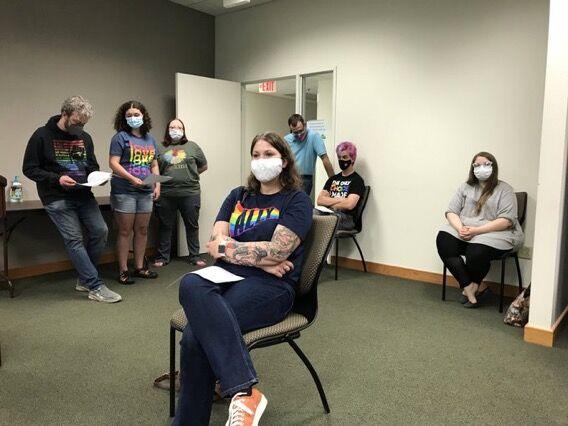
PENDLETON — Clad in rainbow shirts, several community members attended Thursday night’s South Madison school board meeting to voice opposition to three teachers being ordered to remove LGBT pride flags from their classrooms.

Principal Connie Rickert and board president Bill Hutton maintained that the action was about enforcement of a catch-all policy against political viewpoints being expressed by teachers in the classroom.

Several parents and students contended that LGBT pride flags are not a political message but rather a message of inclusiveness and support for students of all orientations and genders.

The Herald Bulletin will update this story.

Community members challenge removal of LGBT pride flags from Pendleton Heights classrooms – The Herald Bulletin

PENDLETON — Clad in rainbow shirts, several community members attended Thursday night’s South Madison school board meeting to voice opposition to three teachers being ordered to remove LGBT pride flags from their classrooms.

Principal Connie Rickert and board president Bill Hutton maintained that the action was about enforcement of a catch-all policy against political viewpoints being expressed by teachers in the classroom.

Several parents and students contended that LGBT pride flags are not a political message but rather a message of inclusiveness and support for students of all orientations and genders.

The Herald Bulletin will update this story.

The coded messages in hit songs – BBC News

“Music should speak of the times. My music does talk to what’s happening now,” Ajudha tells BBC Culture. “A contemporary artist should be writing about what’s going on the world, because that’s a marker of history; you can’t erase a song that people love. So much of history is erased, but pop music is subversive; it does bring people together to create change.

“When I went to university, and I studied gender, anthropology and contemporary trends in society, being emboldened by the knowledge of incredible writers and thinkers made me realise what I wanted to write about and sing about: that was about feminism, social issues, my mixed-race heritage. It was about identity, because it plays such a big role in how we see ourselves and how society sees us. I think that just grew, the more I wrote songs, and I saw how people were reacting to them. It felt like it was making people feel less alone. I realised, ‘this is why I wanna do this; this is what music is about’ – we’re supposed to be connecting, sharing experiences, and getting through shit together. I don’t want my music to just comment on how difficult things are, I want them to feel empowered to do something, regardless of what the world tells them, to change the difficulties that they face.”

In tracks such as Strong Woman, Ajudha also argues that there is a coded strength in expressing personal challenges: “Artists carry a lot of emotion; we allow people to be vulnerable through our vulnerability. It’s kind of a blessing and a curse; it means that we’re very dramatic, but it also means that we get to feel the fullness of life, which can be overwhelming at times, but also very beautiful.”

As contemporary pop becomes increasingly globalised, its coded messages and connections feel more expansive than ever, beyond a Western worldview. Where English has traditionally been the lingua franca of mainstream pop culture, the meaning of pop has broader possibilities than ever for contemporary fans – whether they’re learning new vocab and social perspectives while following their favourite K-pop, Afrobeats or Latin stars, or posting responses to Billie Eilish’s “hidden message” in a multiplicity of scripts.

“Pop taps into the idealism of youth; it raises awareness of gender, race, emotion, with elements you can interpret as you want,” says Kadis. “The fact that it translates across the world, across different languages and cultures – that’s the power of pop music.” 

If you would like to comment on this story or anything else you have seen on BBC Culture, head over to our Facebook page or message us on Twitter.

And if you liked this story, sign up for the weekly bbc.com features newsletter, called The Essential List. A handpicked selection of stories from BBC Future, Culture, Worklife and Travel, delivered to your inbox every Friday.

The coded messages in pop songs – BBC News

“Music should speak of the times. My music does talk to what’s happening now,” Ajudha tells BBC Culture. “A contemporary artist should be writing about what’s going on the world, because that’s a marker of history; you can’t erase a song that people love. So much of history is erased, but pop music is subversive; it does bring people together to create change.

“When I went to university, and I studied gender, anthropology and contemporary trends in society, being emboldened by the knowledge of incredible writers and thinkers made me realise what I wanted to write about and sing about: that was about feminism, social issues, my mixed-race heritage. It was about identity, because it plays such a big role in how we see ourselves and how society sees us. I think that just grew, the more I wrote songs, and I saw how people were reacting to them. It felt like it was making people feel less alone. I realised, ‘this is why I wanna do this; this is what music is about’ – we’re supposed to be connecting, sharing experiences, and getting through shit together. I don’t want my music to just comment on how difficult things are, I want them to feel empowered to do something, regardless of what the world tells them, to change the difficulties that they face.”

In tracks such as Strong Woman, Ajudha also argues that there is a coded strength in expressing personal challenges: “Artists carry a lot of emotion; we allow people to be vulnerable through our vulnerability. It’s kind of a blessing and a curse; it means that we’re very dramatic, but it also means that we get to feel the fullness of life, which can be overwhelming at times, but also very beautiful.”

As contemporary pop becomes increasingly globalised, its coded messages and connections feel more expansive than ever, beyond a Western worldview. Where English has traditionally been the lingua franca of mainstream pop culture, the meaning of pop has broader possibilities than ever for contemporary fans – whether they’re learning new vocab and social perspectives while following their favourite K-pop, Afrobeats or Latin stars, or posting responses to Billie Eilish’s “hidden message” in a multiplicity of scripts.

“Pop taps into the idealism of youth; it raises awareness of gender, race, emotion, with elements you can interpret as you want,” says Kadis. “The fact that it translates across the world, across different languages and cultures – that’s the power of pop music.” 

If you would like to comment on this story or anything else you have seen on BBC Culture, head over to our Facebook page or message us on Twitter.

And if you liked this story, sign up for the weekly bbc.com features newsletter, called The Essential List. A handpicked selection of stories from BBC Future, Culture, Worklife and Travel, delivered to your inbox every Friday.

Gay Exec Can’t Rejoin Bias Suit Against People’s United Bank – Law360

Law360 (May 20, 2021, 6:20 PM EDT) — A Massachusetts federal judge refused to let a gay former bank executive try to rejoin a discrimination lawsuit he and five other workers lodged against People’s United Bank, finding Thursday that his claims were filed too late.

U.S. District Judge Allison D. Burroughs shot down a bid from former senior-level banking executive Jason DeMello to try to plug his Title VII sexual orientation discrimination allegations back into the year-old race, sex, age and religious bias battle after she had kicked him out of the lawsuit in April. 

The judge concluded last month that DeMello, who claimed that he faced homophobic slurs…

Orlando joins historic study of blood-donor policy for gay men – South Florida Sun Sentinel

Current FDA policy requires men who have had sex with other men to wait three months from their last sexual encounter before donating because of lingering concerns over HIV, or human immunodeficiency virus, the infection that causes AIDS. But all donated blood is already screened for HIV, along with roughly a dozen other illnesses, and technology can now detect even infections so new that the person hasn’t yet developed antibodies, the researchers said.

‘Love, Victor’ Season 2 Trailer Hints At Gay Teen Romance, Family Drama – HuffPost

Victor Salazar may have come out as gay to his conservative family, but he’s about to learn that the road to living as his authentic self might still take a few detours. 

Hulu on Thursday unveiled the trailer for Season 2 of its LGBTQ teen series, “Love, Victor,” showing its titular character (played by Michael Cimino) at odds with how to present himself as “the perfect level of gay that will keep everyone happy.” 

From the looks of it, Victor’s Creekwood High School classmates will experience similar growing pains when the show returns June 11. His ex, Mia (Rachel Hilson), isn’t sure how she feels about her father remarrying and welcoming another child. Meanwhile, his best friend, Felix (Anthony Turpel), is deeply smitten with new girlfriend, Lake (Bebe Wood), but facing a troubling reality at home. 

Fortunately, it isn’t all gloom and doom, as Victor appears to be gearing up to take his relationship with boyfriend Benji (George Sear) to the next level. Indeed, snippets of the couple holding hands as they stroll through Creekwood’s corridors are almost too cute for words. 

Michael Cimino (left) and George Sear in "Love, Victor," which debuts its second season June 11 on Hulu.


Michael Cimino (left) and George Sear in “Love, Victor,” which debuts its second season June 11 on Hulu.

After a shaky rollout, “Love, Victor” debuted on Hulu last year to respectable reviews. The series is a spinoff of the 2018 movie “Love, Simon,” which was billed as Hollywood’s first mainstream comedy to focus on a gay teenager

In an interview with HuffPost last year, showrunner Brian Tanen said he aimed to look beyond the privileged (and mostly white) world of “Love, Simon” to ensure the series would reflect “the real stories of people whose experiences are not always ideal.”  

“Victor’s journey will feel familiar in that he has religious ideas and cultural expectations to contend with,” he said at the time. “There are complications to this character being himself. … It’s also about a kid who has relationships and explores the sexual parts of his identity. So it’s our hope that Victor will experience those things as he gets older, like a real young adult.”

Catch the trailer for Season 2 of “Love, Victor” below.

Zenith – Back to 1971 – Trends and style – WorldTempus

When the El Primero calibre made its groundbreaking debut in 1969, Zenith chose to house it in two broad but distinct watch categories. On one hand, there were sportier models in tonneau-shaped steel cases, such as the A384, and on the other, more classical round cases in steel or gold, most notably the A386.

Released in 1971, the A3817 was the exception to the rule. It combined the sportier steel tonneau shaped case of the earliest steel El Primero references with the striking tri-colour dial of the A386, resulting in a unique and appealing aesthetic that continues to resonate with vintage chronograph enthusiasts. Given that only 1000 of the A3817 were ever produced, it remains one of the most distinguished, elusive and sought-after references among the early El Primero watches.

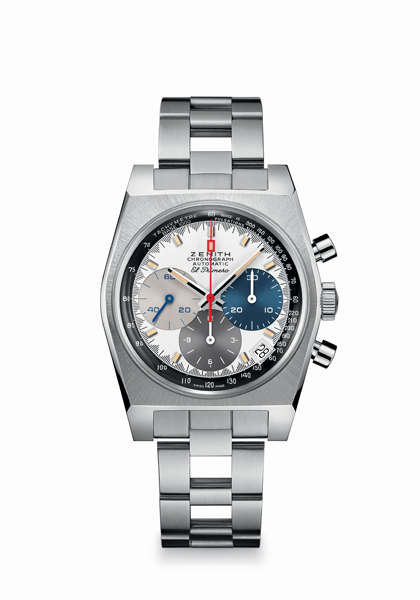
The Chronomaster Revival A3817 is crafted in the same angled tonneau-shaped case with pump-style pushers as the original, using historical blueprints and reverse-engineering to preserve the original proportions and finishes. Zenith waited two years after the launch of the El Primero in 1969 before introducing the iconic tri-colour dial to its sportier tonneau case, albeit with a slightly different execution in both function and aesthetic when compared to the A386. Like its progenitor of 1971, the Chronomaster Revival A3817 features a white lacquered dial with chronograph counters done in the instantly recognizable tones of grey and blue, with the running seconds counter at 9 o’clock done with blue markers, indicated by the single blue hand on the dial. The outer tachymeter scale also serves as a pulsometer, an especially handy and precise function provided by the high frequency 5Hz (36’000 VpH) escapement of the El Primero movement. The seconds track is done in a pyramid pattern affectionately nicknamed the “shark tooth” scale, which enhances legibility with a distinctly retro touch.

Back to 1971

Chronomaster Revival A3817 © Zenith

Through the open display case back, one of the few differences between the original A3817 with a solid steel case back and the Revival model, one can admire the legendary El Primero high frequency automatic chronograph calibre that has remained a staple among chronograph movements for over 50 years.

Completing the retro look and feel of the Chronomaster Revival A3817, two strap options are proposed: the first is the steel “ladder” bracelet, a modern remake of the Gay Frères bracelets that became emblematic of the early El Primero watches; and the other is a light brown calf leather strap that will develop a patina unique to each wearer.

Back to 1971

Chronomaster Revival A3817 © Zenith

The Chronomaster Revival A3817 is undoubtedly a welcome addition to the collection for those who appreciate one of the rarer early steel El Primero references, faithfully reproduced with all the charm and performance of the original.

The Chronomaster A3817 is exclusively available at Zenith Boutiques around the world as well as its online shop from May 2021.

Talk Hole: Virtue & Vice – Interview – Interview – Interview – Interview

Talk Hole is the bi-weekly spoken column of New York’s alt-comedy darlings Eric Schwartau and Steven Phillips-Horst, offering their oracular powers of cultural analysis on all corners of the zeitgeist (high, low, top, bottom). From a Zoom call in Brooklyn, Schwartau and P-H (as Steven is lovingly referred) prove talk is chic and drop references to hot trends, hotter temperatures, and scalding political debates. This time around, Talk Hole sees (Ella Emhoff) and gets seen (by the Secret Service.)

———

ERIC SCHWARTAU: Do you like my hair?

STEVEN P-H: I love your haircut.

SCHWARTAU: I decided it was time to shape up or ship out. 

P-H: A renewed quest for relevance. That’s why you’re wearing a wrinkly Bernie tee from 2019?

SCHWARTAU: I thought my screen-printed DIY ‘Bernie in Berghain’ font tee-shirt would go over well with the pro-Palestine folks.

P-H: It’s definitely giving Gaza over Tel Aviv.

SCHWARTAU: Berghain is kind of the Palestine of Berlin. There’s a line to get in, no pictures allowed, some Israelis destroyed the sewer system.

P-H: That tracks. Every Israeli guy I’ve slept with is a top who pees on the seat. Although I will point out that Germany is very pro-Israel. They still feel guilty about the whole Holocaust thing, and Israel is the legal and physical embodiment of their contrition. 

SCHWARTAU: The physical embodiment of my contrition is the bags under my eyes.

P-H: From Berghain?

SCHWARTAU: From writing this column. 

P-H: I’m reading Elizabeth’s Taylor excellently divulgent book Elizabeth Takes Off right now, about her struggles with weight loss and gain, and there’s one photo of herself where she says, “And you can tell by my haircut—or lack thereof—that I had no self-esteem.” A good haircut is actually a marker of good self-esteem.

SCHWARTAU: My haircuts usually reflect the barber’s self-esteem. 

P-H: My haircuts reflect the generous tip I give my barber for maintaining my combover.

SCHWARTAU: Whenever I walk down the street after getting a haircut, I think everyone is so horny for me. I guess it’s because a haircut is basically staring at yourself in the mirror for an hour. You really internalize the viewer’s gaze.

P-H: This brings us to the question of re-entry and social anxiety. I will paraphrase a thread I saw from someone who seems very smart: we are all so hyper-aware of how we’re perceived, so cognizant of our interactions, who we talk to, when it’s recorded, and how it will play later on social media, that we are essentially controlling video game versions of ourselves. We’re hovering above our bodies, watching our avatar interact with others in the third person. Which makes socializing a very high-stakes situation. And that makes us wanna do it less.

SCHWARTAU: We’ve been avatars of ourselves for a while, though. Every gay guy is a dog emoji now, thanks to Scruff. I think of the ’50s housewife archetype as the mediated version of  the self. Her identity is sold back to herself and amplified. She becomes more and more doll-like. 

P-H: True, but being recorded is new. Sally Housewife wanted to look a certain way for her husband, but she was not thinking about how she would look 45 minutes from now on an Instagram story to 2,658 other people.

SCHWARTAU: But there was still a lot of pressure in terms of how she would look to her peers, even going to the grocery store. It was just a smaller network.

P-H: And now when people go to the grocery store, they look like shit.

SCHWARTAU: I’m definitely not my best avatar when I’m in a hoodie getting Ben and Jerry’s and a bag of carrots at 1AM.

P-H: I hope you’re not pairing those.

SCHWARTAU: Not unless Ben & Jerry’s launches a hummus flavor.

P-H: Ben & Jerry’s Himbo Hummus.

SCHWARTAU: It seems plausible. They do have a lot of flavors. Perhaps too many?

P-H: Thanks for bringing that up. I hope the gluttonous carnival of choice is something we can address in the context of global warming. We always hear, “Oh, there’s too much plastic!” but it begs the question: Do we need 31 Baskin Robbins Flavors? 40 shades of Fenty? 86 flavored pumps at Starbucks? 500 laps at Daytona?

SCHWARTAU: I mean, there are lots of different skin tones, so the Fenty one makes sense. Whereas all 31 of those ice cream flavors look like the same love handles. 

P-H: The same 16 handles.
SCHWARTAU: Which brings us back to this question of identity and how we are perceived.

P-H: I choose not to perceive my love handles. 

SCHWARTAU: It’s always a balancing act between the individual and the collective. You gravitate toward looking like your peers, but you want to differentiate yourself. I was talking to this gallerist at an art opening, and he was saying how he saw this group of teens walking down the street in the East Village, talking about going to NYU, and they all looked exactly the same.

P-H: Talking about NYU is a huge pillar of the NYU community.

SCHWARTAU: And then I looked around the opening—specifically at you and another gay both wearing canvas caps and Carhartt—and I thought, doesn’t everyone here look the same? Maybe people within a community are just perceiving tiny differences more clearly, while an outsider might glance in the window and say, “Wow, everyone looks the same. A bunch of NYU Students.”

P-H: You’re more attuned to nuance within your peer group. I was walking through Greenpoint the other night, past outdoor bars chock-full of straightfolk stuffed into their little plaid shirts, with their Weezer glasses and Bon Iver beards. They all seemed the same to me. But they were probably like, “Dude! You’ve got the Boba Fett tee instead of the Han Solo tee!” and then his comrade goes, “Whoa man! You’ve got little embroidered tacos on your polo instead of hamburgers.” And that’s meaningful to them.

SCHWARTAU: Straight guys have always had a limited clothing menu.

P-H: Speaking of menus, we need to talk about the Ella-phant in the room.

SCHWARTAU: You’re referring to our dinner last week with Ella Emhoff.

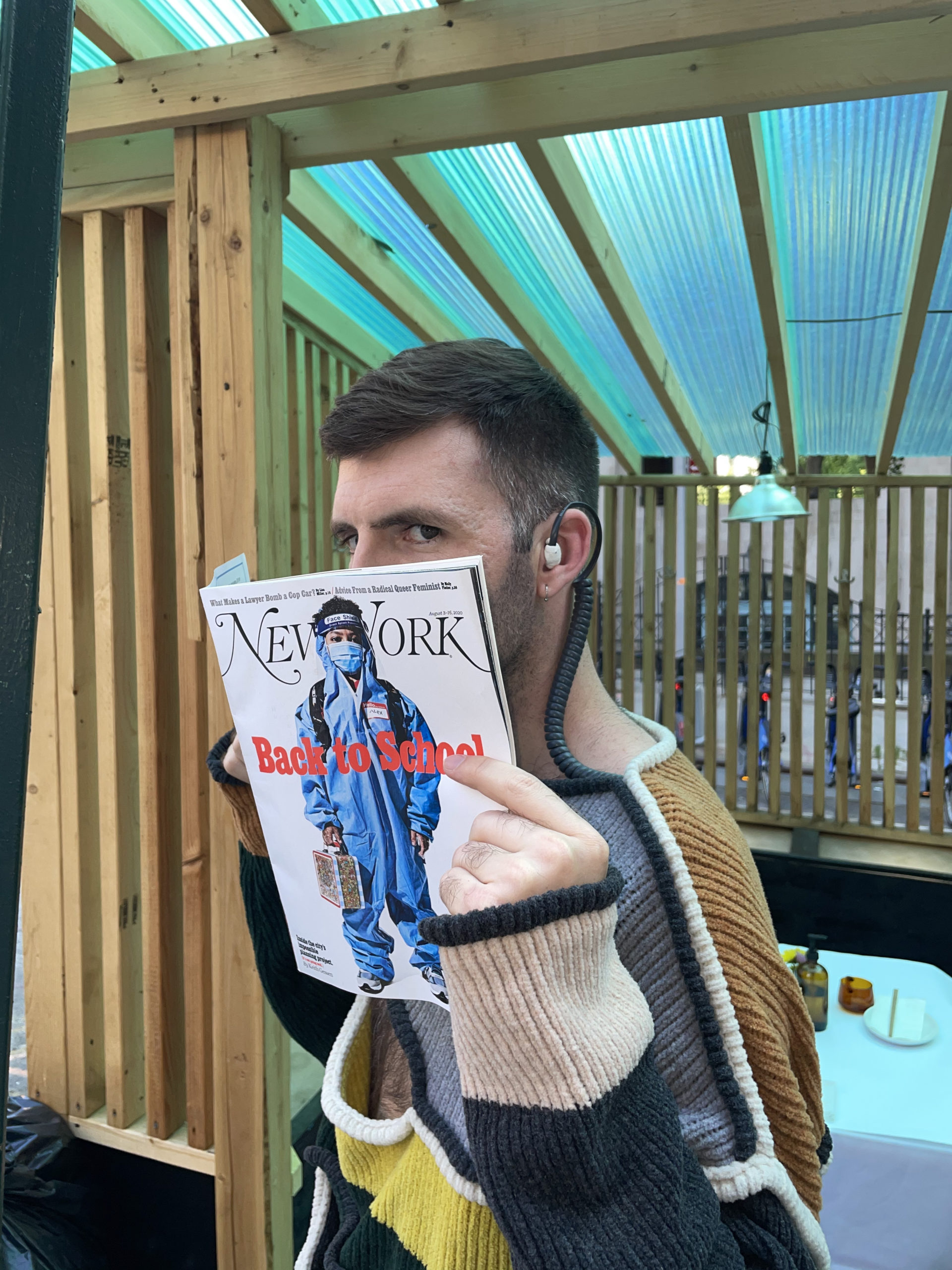
P-H: And all her Secret Service. I can’t believe it finally happened. I felt like we spoke it—or tweeted it—into existence. 

SCHWARTAU: It was inevitable. That evening was full of hyperverbal Gen Z avatars and preening fashionistas. Anna Delvey ciphers on every corner.

P-H: There was Adderall in the air.

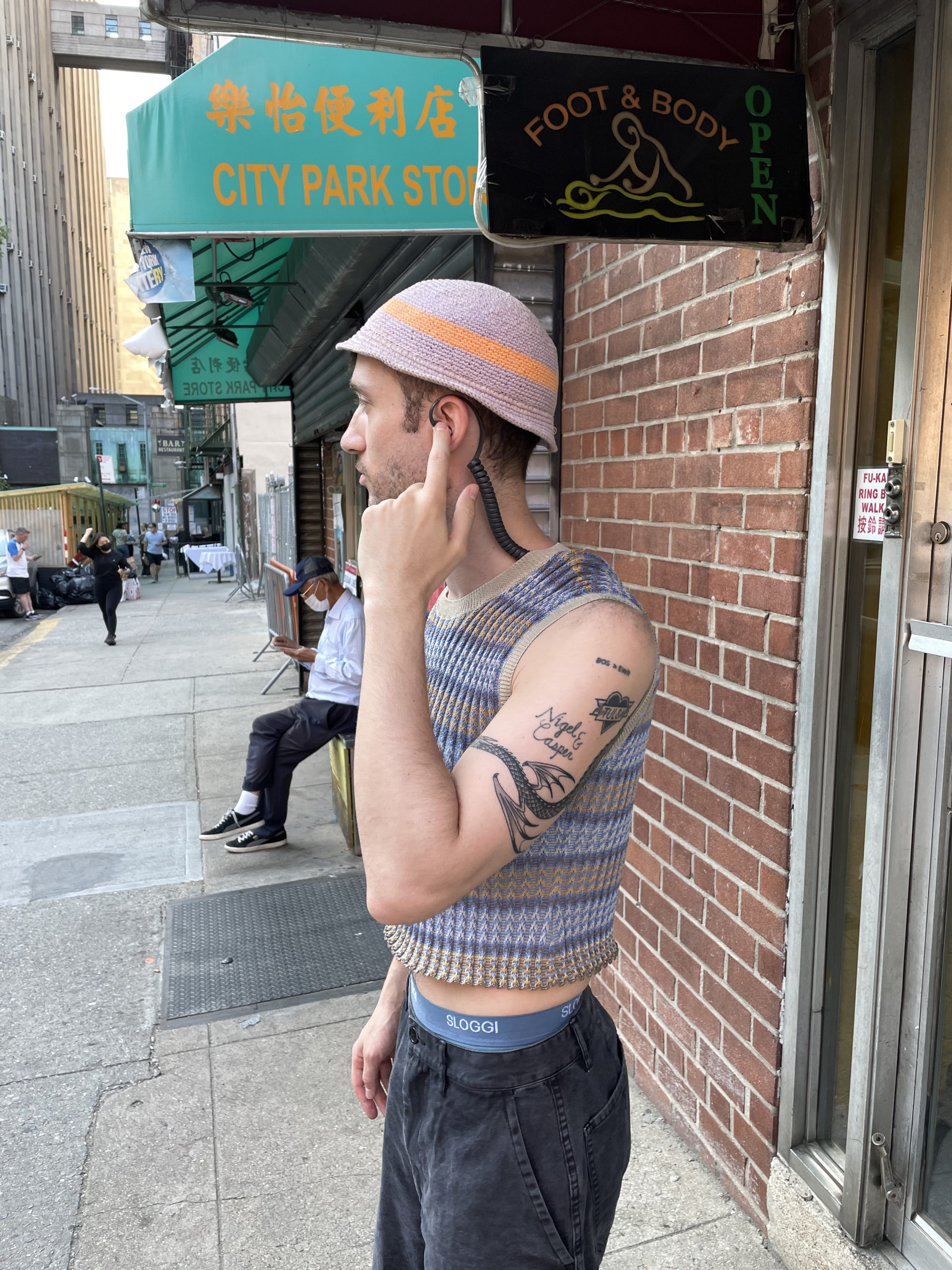
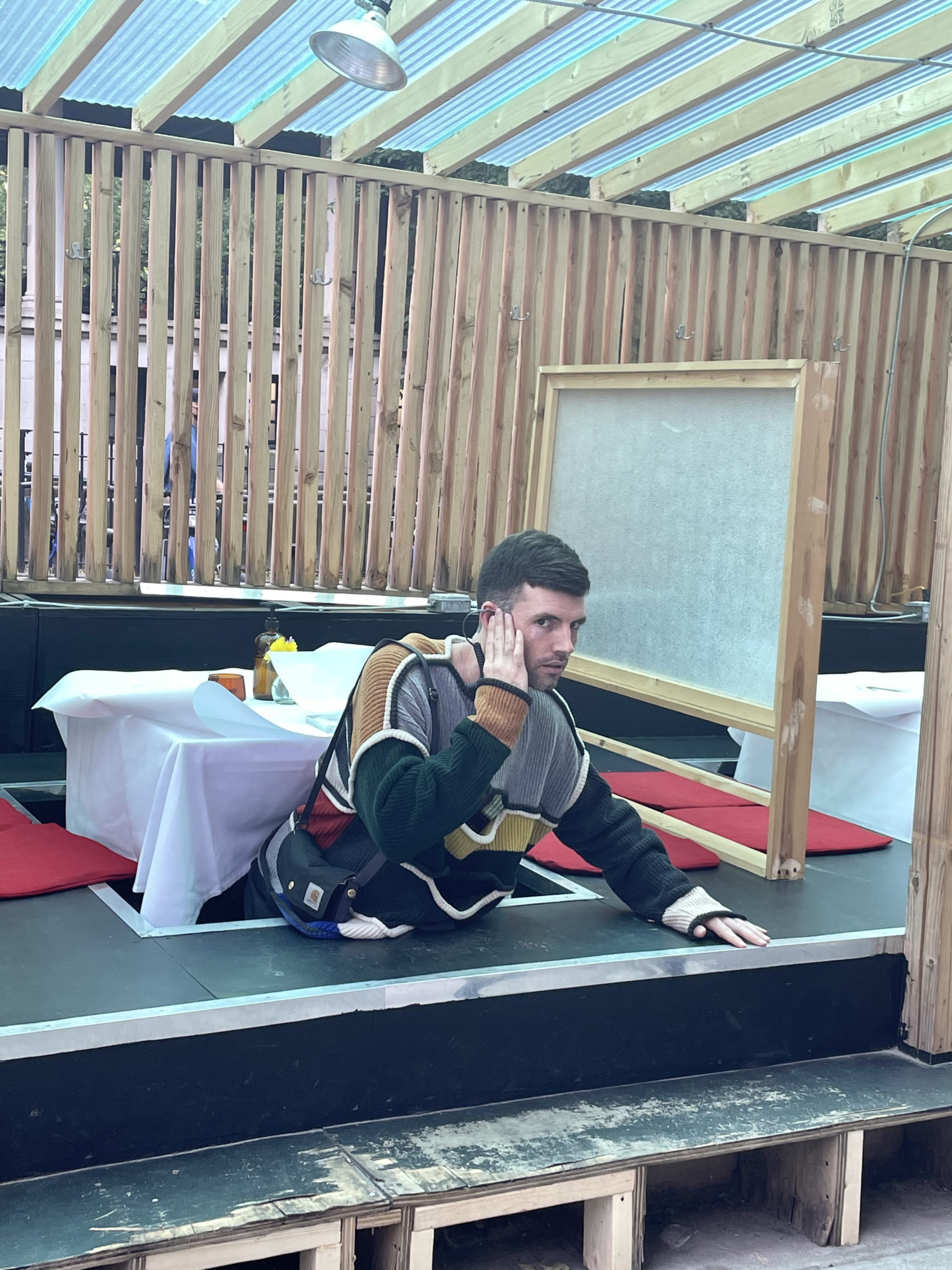
SCHWARTAU: I was following you to the restaurant, we walked past the jail, and then I see this guy with an earpiece in, and then bam—Ella tucked into her kotatsu blanket at Dr. Clark.

P-H: It was very full circle. That same block is where we used to host Talk Hole—when it was a comedy show—at Asia Roma. Then it became more notorious when Chelsea Clinton murdered Epstein in his jail cell just down the road. And now it’s where Ella Emhoff enjoys conceptual Japanese cuisine. 
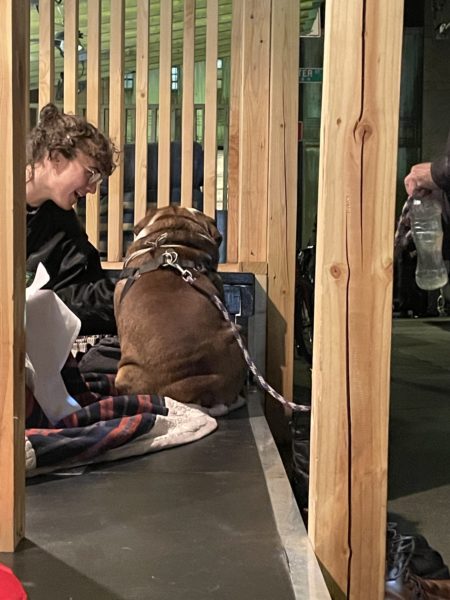
Emhoff at Dr. Clark with a Secret Service agent. Photo by Sarah Nechamkin.

SCHWARTAU: That block is just jail after jail. First, it’s the Talk Hole holding cell in a basement karaoke lounge, then it’s the Ghislaine and Jeffrey suite at the correctional facility, and now Ella can’t get out of her kotatsu table. 

P-H: You are really trapped under that traditional Japanese dining blanket. And your shoes are off, which adds another 30 seconds to your escape time. And the Secret Service are watching your every move! Drop one chopstick and you’ve got a crosshair on your back.

SCHWARTAU: And I’m already so hard on myself about using chopsticks properly. 

P-H: I think the Second Daughter’s Secret Service is a little too noticeable. They’re in fleece finance bro vests with gingham shirts and bootcut jeans—not to mention the earpieces. They stand out like sore thumbs. If they’re gonna traipse around Dimes Square, can we get them some better disguises? They should’ve gone to the Eckhaus sample sale.

SCHWARTAU: Agent Dimes would fit right in wearing the $300 sweater I bought. I know it’s almost summer, but I’m telling myself I’ll wear it in L.A.

P-H: Maybe Telfar can produce an earpiece like he did the White Castle uniforms. 

SCHWARTAU: Waiting for the Telfar-Secret Service collab to drop.

P-H: Some of the Telfar bags are really big—maybe they could hide inside.

SCHWARTAU: Chloe Wise was also at Dr. Clark but not with Ella. Maybe she’s Secret Service, or is every downtown girl under protection?

P-H: Does it extend to Ella’s GQ editor boyfriend? GQ interns? Where does the line of succession end?

SCHWARTAU: I’m also wondering if she tips the Secret Service—I mean, these guys are on hour four. 

P-H: We actually have to tip, because we’re the taxpayers.

SCHWARTAU: Wrap it up Ella, overtime’s about to kick in and you haven’t even seen the dessert menu.

P-H: So this is gonna go on for all four years? It just seems—

SCHWARTAU:—like we’re paying ransom. Or pre-emptive protection, so we don’t have to pay ransom to whoever nabs Ella Enchanted when she’s slurping up shishito peppers. That gas pipeline just paid a $5 million ransom to some hackers. The last thing we need is Kamala trying to “have that conversation.”

P-H: But that’s a real security threat. I don’t think Ella Emhoff is ever going to make enough knitwear to power the grid of the Southeast.

SCHWARTAU: Get this girl a cotton gin! 

P-H: I mean, the fact that Hunter Biden can smoke crack at 3AM in a Motel 6 outside Nashville—isn’t that more of a security liability than Ella Emhoff paying $200 for sashimi?

SCHWARTAU: Weren’t his emails hacked though?

P-H: But he didn’t have the Secret Service following him when he was shoving Chore Boy down his crack pipe in a rented Chevy Lumina.

SCHWARTAU: And yet we still know exactly what he was doing because he wrote a detailed book about it.
P-H: What do we think Ella’s Secret Service codename is? I think it should be Ladybird. 

SCHWARTAU: “Ladybird’s on the move. Looks to be nesting at Bacaro.”

P-H: “We’ve got a Code White. Ladybird’s been in the bathroom at Kiki’s for 15 minutes.”

SCHWARTAU: What about “Shishito?” 

P-H: “Shishito’s at Clando. Call for backup.”

SCHWARTAU: Does an agent have to taste test all the food?

P-H: I hope so. Dr. Clark could be whipping up quite the nefarious concoction back there in the lab.

SCHWARTAU: When I hear Dr. Clark, I think of shoe insoles or glacial hydrating creams. I don’t think restaurant. 

P-H: Well, the wellness trend is booming. Everyone wants to be well. Everyone wants a doctor. Everyone wants to be told by a medical professional that what they’re doing is good.

SCHWARTAU: Actually, Dr. Clark just called, and he said our column test results came back positive for himbo.

P-H: This brings us to my next topic—I think the driving concept behind the new roaring 20s is “virtuous hedonism.” Natural wine is very emblematic of that. Indulge—but without sulfates. Get blasted—but first hear the intimate story of the winemaker and her husband, and the volcanic ash they grew the grapes on.

SCHWARTAU: Get laid—but first hear the guy’s long story about his co-worker’s going away drinks.

P-H: The other day I was at a party and this French guy was showing me his texts with his coke dealer—and the coke dealer had a menu of different countries you could order from! Peruvian, Colombian, Bolivian. With different prices, and quality grades. The same organic, artisanal know-your farmer ethos we’ve applied to Hudson Valley hens, we’re now doing with coke.

SCHWARTAU: I’m sorry, where is the virtue part of this? 

P-H: The virtue is French-American interaction. And doing someone else’s drugs.

SCHWARTAU: The key ingredient to any international treaty.

P-H: I do hope that the expectation of having artisan drugs means that the fentanyl era is ending. 

SCHWARTAU: People not dying from poison—well, worse poison—is definitely the best argument in favor of legalizing drugs.

P-H: That, and freeing up bathroom lines.

SCHWARTAU: Although drugs will get more expensive. Weed’s gotten out of hand. I don’t need the purest of the pure green Irish flower.

P-H: Yeah, I miss the old stuff. We need more carpet fuzz back in the mix.

SCHWARTAU: I guess I’m a little wary of the hedonism and everyone complaining about Uber prices and bad coke. We were all supposed to have changed for the better during the pandemic, and now everything’s inflated and inflamed—it’s inflationary hedonism. 
P-H: We’ve expanded bars into the street, but at what cost?

SCHWARTAU: Aren’t we supposed to be building back better? A smarter, gentler, more thoughtful world? Instead we’re careening towards oblivion even faster. More consumption. More clothes. More travel. More gasoline. More alcohol. More drugs. More Revels. More paying people to Revel drugs to you.

P-H: As a society, we’ve looked death in the eye and said, “Bitch, we’ll see you in the morning! Don’t wait up.”

SCHWARTAU: At least the restaurants are happy. 

P-H: And street seating makes the city more hostile to cars, which is great.

SCHWARTAU: The urban landscape is definitely feeling like it’s at capacity. Were there always this many people? The streets are teeming. Tables as far as the eye can see. Dogs for days. Revelers in every direction. It’s increased the feeling that you’re putting on a show, or that you’re in one.

P-H: You really are on display. In the old days, you sat inside the restaurant, and even at a buzzy hotspot, you would only see-and-be-seen-by those who were also inside. Now you’re getting perceived by everyone walking by. Everyone on their way to a co-worker’s going away drinks. Everyone getting tackled by the Secret Service.

SCHWARTAU: Speaking of security, we need to talk about Israel and Palestine.

P-H: I’m ready for a rigorous geo-political discussion.

SCHWARTAU: Okay. Who’s Israel and who’s Palestine?

P-H: I go to the gym 5 days a week, so I guess I’m Israel.

SCHWARTAU: It’s pretty clear I’m Palestine.

P-H: I’m the toxic Girlboss with the Blink membership and you’re the scraggly academic.

SCHWARTAU: You’ve also had a lot of Israeli weapons inside you.

P-H: Yes, and I give great Iron Dome.

P-H: My take is that this current violence feels like a shift from previous intifadas. Western liberals seem less sympathetic to Israel, and are starting to see them if not as occupiers, then at least as the more powerful party. They see the imbalance of the catastrophic destruction in Gaza, the wildly disproportionate response. I saw eternally blue-pilled Debra Messing posting about “both sides,” but there was Kathy Najimy in the comments, saying she disagreed! So, a shift.

SCHWARTAU: But how much pressure can the Najimys of the world apply via comments? I’ve seen a lot of posts saying, “Please go to this protest if you can,” which has the underlying implication of “I’m actually kind of busy this week, but you should go!” The protest vibes are not as strong this season.

P-H: I don’t think any protest is gonna pop off as much as BLM 2020, because people had just been in quarantine for four months.

SCHWARTAU: Israel and Palestine are also far away. It’s not as tangible. Which makes it great for infographics, but less for action.

P-H: It’s a very geography-driven conflict, so maps come into play, which adds fuel to the infographic fire.

SCHWARTAU: What they really need is to add some fact-checkers to the fire. What about the two-state solution? Did that ship sail?

P-H: I think the ship sailed, got beached in the Suez Canal, then sunk. Settlement expansions over the years and the dwindling territory of Gaza has really shattered the trust. Palestinians wouldn’t be happy with what little they have now, and why should they? 

SCHWARTAU: I’m happy in my railroad apartment but I still have Right of Return (to my parent’s house).

P-H: Right of Return is a valid question. Palestinians should be able to go back to whatever home their families were kicked out of, but what if there’s people on that very block? What then? 

SCHWARTAU: This is why god invented the high-rise.

P-H: Precisely. The solution is a secular democratic state with Palestinians and Israelis living in high-rises and participating equally in society.

SCHWARTAU: They can use the private rooftop deck together. 

P-H: They can join each other at Dr. Clark.

SCHWARTAU: Maybe they’re not sitting at the same booth. But they can perceive each other, and perceive each other enjoying different small plates.

P-H: Tapas is the answer.

SCHWARTAU: People come together over food.

P-H: Ben & Jerry’s Hamas Hummus. It’s in the pipeline.

SCHWARTAU: And so is my invoice! See you at Dr. Clark.

P-H: If the Secret Service doesn’t kill me first.
Talk Hole: Virtue & Vice – Interview – Interview – Interview

Talk Hole is the bi-weekly spoken column of New York’s alt-comedy darlings Eric Schwartau and Steven Phillips-Horst, offering their oracular powers of cultural analysis on all corners of the zeitgeist (high, low, top, bottom). From a Zoom call in Brooklyn, Schwartau and P-H (as Steven is lovingly referred) prove talk is chic and drop references to hot trends, hotter temperatures, and scalding political debates. This time around, Talk Hole sees (Ella Emhoff) and gets seen (by the Secret Service.)

———

ERIC SCHWARTAU: Do you like my hair?

STEVEN P-H: I love your haircut.

SCHWARTAU: I decided it was time to shape up or ship out. 

P-H: A renewed quest for relevance. That’s why you’re wearing a wrinkly Bernie tee from 2019?

SCHWARTAU: I thought my screen-printed DIY ‘Bernie in Berghain’ font tee-shirt would go over well with the pro-Palestine folks.

P-H: It’s definitely giving Gaza over Tel Aviv.

SCHWARTAU: Berghain is kind of the Palestine of Berlin. There’s a line to get in, no pictures allowed, some Israelis destroyed the sewer system.

P-H: That tracks. Every Israeli guy I’ve slept with is a top who pees on the seat. Although I will point out that Germany is very pro-Israel. They still feel guilty about the whole Holocaust thing, and Israel is the legal and physical embodiment of their contrition. 

SCHWARTAU: The physical embodiment of my contrition is the bags under my eyes.

P-H: From Berghain?

SCHWARTAU: From writing this column. 

P-H: I’m reading Elizabeth’s Taylor excellently divulgent book Elizabeth Takes Off right now, about her struggles with weight loss and gain, and there’s one photo of herself where she says, “And you can tell by my haircut—or lack thereof—that I had no self-esteem.” A good haircut is actually a marker of good self-esteem.

SCHWARTAU: My haircuts usually reflect the barber’s self-esteem. 

P-H: My haircuts reflect the generous tip I give my barber for maintaining my combover.

SCHWARTAU: Whenever I walk down the street after getting a haircut, I think everyone is so horny for me. I guess it’s because a haircut is basically staring at yourself in the mirror for an hour. You really internalize the viewer’s gaze.

P-H: This brings us to the question of re-entry and social anxiety. I will paraphrase a thread I saw from someone who seems very smart: we are all so hyper-aware of how we’re perceived, so cognizant of our interactions, who we talk to, when it’s recorded, and how it will play later on social media, that we are essentially controlling video game versions of ourselves. We’re hovering above our bodies, watching our avatar interact with others in the third person. Which makes socializing a very high-stakes situation. And that makes us wanna do it less.

SCHWARTAU: We’ve been avatars of ourselves for a while, though. Every gay guy is a dog emoji now, thanks to Scruff. I think of the ’50s housewife archetype as the mediated version of  the self. Her identity is sold back to herself and amplified. She becomes more and more doll-like. 

P-H: True, but being recorded is new. Sally Housewife wanted to look a certain way for her husband, but she was not thinking about how she would look 45 minutes from now on an Instagram story to 2,658 other people.

SCHWARTAU: But there was still a lot of pressure in terms of how she would look to her peers, even going to the grocery store. It was just a smaller network.

P-H: And now when people go to the grocery store, they look like shit.

SCHWARTAU: I’m definitely not my best avatar when I’m in a hoodie getting Ben and Jerry’s and a bag of carrots at 1AM.

P-H: I hope you’re not pairing those.

SCHWARTAU: Not unless Ben & Jerry’s launches a hummus flavor.

P-H: Ben & Jerry’s Himbo Hummus.

SCHWARTAU: It seems plausible. They do have a lot of flavors. Perhaps too many?

P-H: Thanks for bringing that up. I hope the gluttonous carnival of choice is something we can address in the context of global warming. We always hear, “Oh, there’s too much plastic!” but it begs the question: Do we need 31 Baskin Robbins Flavors? 40 shades of Fenty? 86 flavored pumps at Starbucks? 500 laps at Daytona?

SCHWARTAU: I mean, there are lots of different skin tones, so the Fenty one makes sense. Whereas all 31 of those ice cream flavors look like the same love handles. 

P-H: The same 16 handles.

SCHWARTAU: Which brings us back to this question of identity and how we are perceived.

P-H: I choose not to perceive my love handles. 

SCHWARTAU: It’s always a balancing act between the individual and the collective. You gravitate toward looking like your peers, but you want to differentiate yourself. I was talking to this gallerist at an art opening, and he was saying how he saw this group of teens walking down the street in the East Village, talking about going to NYU, and they all looked exactly the same.

P-H: Talking about NYU is a huge pillar of the NYU community.

SCHWARTAU: And then I looked around the opening—specifically at you and another gay both wearing canvas caps and Carhartt—and I thought, doesn’t everyone here look the same? Maybe people within a community are just perceiving tiny differences more clearly, while an outsider might glance in the window and say, “Wow, everyone looks the same. A bunch of NYU Students.”

P-H: You’re more attuned to nuance within your peer group. I was walking through Greenpoint the other night, past outdoor bars chock-full of straightfolk stuffed into their little plaid shirts, with their Weezer glasses and Bon Iver beards. They all seemed the same to me. But they were probably like, “Dude! You’ve got the Boba Fett tee instead of the Han Solo tee!” and then his comrade goes, “Whoa man! You’ve got little embroidered tacos on your polo instead of hamburgers.” And that’s meaningful to them.

SCHWARTAU: Straight guys have always had a limited clothing menu.

P-H: Speaking of menus, we need to talk about the Ella-phant in the room.

SCHWARTAU: You’re referring to our dinner last week with Ella Emhoff.

P-H: And all her Secret Service. I can’t believe it finally happened. I felt like we spoke it—or tweeted it—into existence. 

SCHWARTAU: It was inevitable. That evening was full of hyperverbal Gen Z avatars and preening fashionistas. Anna Delvey ciphers on every corner.

P-H: There was Adderall in the air.

SCHWARTAU: I was following you to the restaurant, we walked past the jail, and then I see this guy with an earpiece in, and then bam—Ella tucked into her kotatsu blanket at Dr. Clark.

P-H: It was very full circle. That same block is where we used to host Talk Hole—when it was a comedy show—at Asia Roma. Then it became more notorious when Chelsea Clinton murdered Epstein in his jail cell just down the road. And now it’s where Ella Emhoff enjoys conceptual Japanese cuisine. 

Emhoff at Dr. Clark with a Secret Service agent. Photo by Sarah Nechamkin.

SCHWARTAU: That block is just jail after jail. First, it’s the Talk Hole holding cell in a basement karaoke lounge, then it’s the Ghislaine and Jeffrey suite at the correctional facility, and now Ella can’t get out of her kotatsu table. 

P-H: You are really trapped under that traditional Japanese dining blanket. And your shoes are off, which adds another 30 seconds to your escape time. And the Secret Service are watching your every move! Drop one chopstick and you’ve got a crosshair on your back.

SCHWARTAU: And I’m already so hard on myself about using chopsticks properly. 

P-H: I think the Second Daughter’s Secret Service is a little too noticeable. They’re in fleece finance bro vests with gingham shirts and bootcut jeans—not to mention the earpieces. They stand out like sore thumbs. If they’re gonna traipse around Dimes Square, can we get them some better disguises? They should’ve gone to the Eckhaus sample sale.

SCHWARTAU: Agent Dimes would fit right in wearing the $300 sweater I bought. I know it’s almost summer, but I’m telling myself I’ll wear it in L.A.

P-H: Maybe Telfar can produce an earpiece like he did the White Castle uniforms. 

SCHWARTAU: Waiting for the Telfar-Secret Service collab to drop.

P-H: Some of the Telfar bags are really big—maybe they could hide inside.

SCHWARTAU: Chloe Wise was also at Dr. Clark but not with Ella. Maybe she’s Secret Service, or is every downtown girl under protection?

P-H: Does it extend to Ella’s GQ editor boyfriend? GQ interns? Where does the line of succession end?

SCHWARTAU: I’m also wondering if she tips the Secret Service—I mean, these guys are on hour four. 

P-H: We actually have to tip, because we’re the taxpayers.

SCHWARTAU: Wrap it up Ella, overtime’s about to kick in and you haven’t even seen the dessert menu.

P-H: So this is gonna go on for all four years? It just seems—

SCHWARTAU:—like we’re paying ransom. Or pre-emptive protection, so we don’t have to pay ransom to whoever nabs Ella Enchanted when she’s slurping up shishito peppers. That gas pipeline just paid a $5 million ransom to some hackers. The last thing we need is Kamala trying to “have that conversation.”

P-H: But that’s a real security threat. I don’t think Ella Emhoff is ever going to make enough knitwear to power the grid of the Southeast.

SCHWARTAU: Get this girl a cotton gin! 

P-H: I mean, the fact that Hunter Biden can smoke crack at 3AM in a Motel 6 outside Nashville—isn’t that more of a security liability than Ella Emhoff paying $200 for sashimi?

SCHWARTAU: Weren’t his emails hacked though?

P-H: But he didn’t have the Secret Service following him when he was shoving Chore Boy down his crack pipe in a rented Chevy Lumina.

SCHWARTAU: And yet we still know exactly what he was doing because he wrote a detailed book about it.

P-H: What do we think Ella’s Secret Service codename is? I think it should be Ladybird. 

SCHWARTAU: “Ladybird’s on the move. Looks to be nesting at Bacaro.”

P-H: “We’ve got a Code White. Ladybird’s been in the bathroom at Kiki’s for 15 minutes.”

SCHWARTAU: What about “Shishito?” 

P-H: “Shishito’s at Clando. Call for backup.”

SCHWARTAU: Does an agent have to taste test all the food?

P-H: I hope so. Dr. Clark could be whipping up quite the nefarious concoction back there in the lab.

SCHWARTAU: When I hear Dr. Clark, I think of shoe insoles or glacial hydrating creams. I don’t think restaurant. 

P-H: Well, the wellness trend is booming. Everyone wants to be well. Everyone wants a doctor. Everyone wants to be told by a medical professional that what they’re doing is good.

SCHWARTAU: Actually, Dr. Clark just called, and he said our column test results came back positive for himbo.

P-H: This brings us to my next topic—I think the driving concept behind the new roaring 20s is “virtuous hedonism.” Natural wine is very emblematic of that. Indulge—but without sulfates. Get blasted—but first hear the intimate story of the winemaker and her husband, and the volcanic ash they grew the grapes on.

SCHWARTAU: Get laid—but first hear the guy’s long story about his co-worker’s going away drinks.

P-H: The other day I was at a party and this French guy was showing me his texts with his coke dealer—and the coke dealer had a menu of different countries you could order from! Peruvian, Colombian, Bolivian. With different prices, and quality grades. The same organic, artisanal know-your farmer ethos we’ve applied to Hudson Valley hens, we’re now doing with coke.

SCHWARTAU: I’m sorry, where is the virtue part of this? 

P-H: The virtue is French-American interaction. And doing someone else’s drugs.

SCHWARTAU: The key ingredient to any international treaty.

P-H: I do hope that the expectation of having artisan drugs means that the fentanyl era is ending. 

SCHWARTAU: People not dying from poison—well, worse poison—is definitely the best argument in favor of legalizing drugs.

P-H: That, and freeing up bathroom lines.

SCHWARTAU: Although drugs will get more expensive. Weed’s gotten out of hand. I don’t need the purest of the pure green Irish flower.

P-H: Yeah, I miss the old stuff. We need more carpet fuzz back in the mix.

SCHWARTAU: I guess I’m a little wary of the hedonism and everyone complaining about Uber prices and bad coke. We were all supposed to have changed for the better during the pandemic, and now everything’s inflated and inflamed—it’s inflationary hedonism. 

P-H: We’ve expanded bars into the street, but at what cost?

SCHWARTAU: Aren’t we supposed to be building back better? A smarter, gentler, more thoughtful world? Instead we’re careening towards oblivion even faster. More consumption. More clothes. More travel. More gasoline. More alcohol. More drugs. More Revels. More paying people to Revel drugs to you.

P-H: As a society, we’ve looked death in the eye and said, “Bitch, we’ll see you in the morning! Don’t wait up.”

SCHWARTAU: At least the restaurants are happy. 

P-H: And street seating makes the city more hostile to cars, which is great.

SCHWARTAU: The urban landscape is definitely feeling like it’s at capacity. Were there always this many people? The streets are teeming. Tables as far as the eye can see. Dogs for days. Revelers in every direction. It’s increased the feeling that you’re putting on a show, or that you’re in one.

P-H: You really are on display. In the old days, you sat inside the restaurant, and even at a buzzy hotspot, you would only see-and-be-seen-by those who were also inside. Now you’re getting perceived by everyone walking by. Everyone on their way to a co-worker’s going away drinks. Everyone getting tackled by the Secret Service.

SCHWARTAU: Speaking of security, we need to talk about Israel and Palestine.

P-H: I’m ready for a rigorous geo-political discussion.

SCHWARTAU: Okay. Who’s Israel and who’s Palestine?

P-H: I go to the gym 5 days a week, so I guess I’m Israel.

SCHWARTAU: It’s pretty clear I’m Palestine.

P-H: I’m the toxic Girlboss with the Blink membership and you’re the scraggly academic.

SCHWARTAU: You’ve also had a lot of Israeli weapons inside you.

P-H: Yes, and I give great Iron Dome.

P-H: My take is that this current violence feels like a shift from previous intifadas. Western liberals seem less sympathetic to Israel, and are starting to see them if not as occupiers, then at least as the more powerful party. They see the imbalance of the catastrophic destruction in Gaza, the wildly disproportionate response. I saw eternally blue-pilled Debra Messing posting about “both sides,” but there was Kathy Najimy in the comments, saying she disagreed! So, a shift.

SCHWARTAU: But how much pressure can the Najimys of the world apply via comments? I’ve seen a lot of posts saying, “Please go to this protest if you can,” which has the underlying implication of “I’m actually kind of busy this week, but you should go!” The protest vibes are not as strong this season.

P-H: I don’t think any protest is gonna pop off as much as BLM 2020, because people had just been in quarantine for four months.

SCHWARTAU: Israel and Palestine are also far away. It’s not as tangible. Which makes it great for infographics, but less for action.

P-H: It’s a very geography-driven conflict, so maps come into play, which adds fuel to the infographic fire.

SCHWARTAU: What they really need is to add some fact-checkers to the fire. What about the two-state solution? Did that ship sail?

P-H: I think the ship sailed, got beached in the Suez Canal, then sunk. Settlement expansions over the years and the dwindling territory of Gaza has really shattered the trust. Palestinians wouldn’t be happy with what little they have now, and why should they? 

SCHWARTAU: I’m happy in my railroad apartment but I still have Right of Return (to my parent’s house).

P-H: Right of Return is a valid question. Palestinians should be able to go back to whatever home their families were kicked out of, but what if there’s people on that very block? What then? 

SCHWARTAU: This is why god invented the high-rise.

P-H: Precisely. The solution is a secular democratic state with Palestinians and Israelis living in high-rises and participating equally in society.

SCHWARTAU: They can use the private rooftop deck together. 

P-H: They can join each other at Dr. Clark.

SCHWARTAU: Maybe they’re not sitting at the same booth. But they can perceive each other, and perceive each other enjoying different small plates.

P-H: Tapas is the answer.

SCHWARTAU: People come together over food.

P-H: Ben & Jerry’s Hamas Hummus. It’s in the pipeline.

SCHWARTAU: And so is my invoice! See you at Dr. Clark.

P-H: If the Secret Service doesn’t kill me first.

Talk Hole: Virtue & Vice – Interview – Interview

0

Talk Hole is the bi-weekly spoken column of New York’s alt-comedy darlings Eric Schwartau and Steven Phillips-Horst, offering their oracular powers of cultural analysis on all corners of the zeitgeist (high, low, top, bottom). From a Zoom call in Brooklyn, Schwartau and P-H (as Steven is lovingly referred) prove talk is chic and drop references to hot trends, hotter temperatures, and scalding political debates. This time around, Talk Hole sees (Ella Emhoff) and gets seen (by the Secret Service.)

———

ERIC SCHWARTAU: Do you like my hair?

STEVEN P-H: I love your haircut.

SCHWARTAU: I decided it was time to shape up or ship out. 

P-H: A renewed quest for relevance. That’s why you’re wearing a wrinkly Bernie tee from 2019?

SCHWARTAU: I thought my screen-printed DIY ‘Bernie in Berghain’ font tee-shirt would go over well with the pro-Palestine folks.

P-H: It’s definitely giving Gaza over Tel Aviv.

SCHWARTAU: Berghain is kind of the Palestine of Berlin. There’s a line to get in, no pictures allowed, some Israelis destroyed the sewer system.

P-H: That tracks. Every Israeli guy I’ve slept with is a top who pees on the seat. Although I will point out that Germany is very pro-Israel. They still feel guilty about the whole Holocaust thing, and Israel is the legal and physical embodiment of their contrition. 

SCHWARTAU: The physical embodiment of my contrition is the bags under my eyes.

P-H: From Berghain?

SCHWARTAU: From writing this column. 

P-H: I’m reading Elizabeth’s Taylor excellently divulgent book Elizabeth Takes Off right now, about her struggles with weight loss and gain, and there’s one photo of herself where she says, “And you can tell by my haircut—or lack thereof—that I had no self-esteem.” A good haircut is actually a marker of good self-esteem.

SCHWARTAU: My haircuts usually reflect the barber’s self-esteem. 

P-H: My haircuts reflect the generous tip I give my barber for maintaining my combover.

SCHWARTAU: Whenever I walk down the street after getting a haircut, I think everyone is so horny for me. I guess it’s because a haircut is basically staring at yourself in the mirror for an hour. You really internalize the viewer’s gaze.

P-H: This brings us to the question of re-entry and social anxiety. I will paraphrase a thread I saw from someone who seems very smart: we are all so hyper-aware of how we’re perceived, so cognizant of our interactions, who we talk to, when it’s recorded, and how it will play later on social media, that we are essentially controlling video game versions of ourselves. We’re hovering above our bodies, watching our avatar interact with others in the third person. Which makes socializing a very high-stakes situation. And that makes us wanna do it less.

SCHWARTAU: We’ve been avatars of ourselves for a while, though. Every gay guy is a dog emoji now, thanks to Scruff. I think of the ’50s housewife archetype as the mediated version of  the self. Her identity is sold back to herself and amplified. She becomes more and more doll-like. 

P-H: True, but being recorded is new. Sally Housewife wanted to look a certain way for her husband, but she was not thinking about how she would look 45 minutes from now on an Instagram story to 2,658 other people.

SCHWARTAU: But there was still a lot of pressure in terms of how she would look to her peers, even going to the grocery store. It was just a smaller network.

P-H: And now when people go to the grocery store, they look like shit.

SCHWARTAU: I’m definitely not my best avatar when I’m in a hoodie getting Ben and Jerry’s and a bag of carrots at 1AM.

P-H: I hope you’re not pairing those.

SCHWARTAU: Not unless Ben & Jerry’s launches a hummus flavor.

P-H: Ben & Jerry’s Himbo Hummus.

SCHWARTAU: It seems plausible. They do have a lot of flavors. Perhaps too many?

P-H: Thanks for bringing that up. I hope the gluttonous carnival of choice is something we can address in the context of global warming. We always hear, “Oh, there’s too much plastic!” but it begs the question: Do we need 31 Baskin Robbins Flavors? 40 shades of Fenty? 86 flavored pumps at Starbucks? 500 laps at Daytona?

SCHWARTAU: I mean, there are lots of different skin tones, so the Fenty one makes sense. Whereas all 31 of those ice cream flavors look like the same love handles. 

P-H: The same 16 handles.

SCHWARTAU: Which brings us back to this question of identity and how we are perceived.

P-H: I choose not to perceive my love handles. 

SCHWARTAU: It’s always a balancing act between the individual and the collective. You gravitate toward looking like your peers, but you want to differentiate yourself. I was talking to this gallerist at an art opening, and he was saying how he saw this group of teens walking down the street in the East Village, talking about going to NYU, and they all looked exactly the same.

P-H: Talking about NYU is a huge pillar of the NYU community.

SCHWARTAU: And then I looked around the opening—specifically at you and another gay both wearing canvas caps and Carhartt—and I thought, doesn’t everyone here look the same? Maybe people within a community are just perceiving tiny differences more clearly, while an outsider might glance in the window and say, “Wow, everyone looks the same. A bunch of NYU Students.”

P-H: You’re more attuned to nuance within your peer group. I was walking through Greenpoint the other night, past outdoor bars chock-full of straightfolk stuffed into their little plaid shirts, with their Weezer glasses and Bon Iver beards. They all seemed the same to me. But they were probably like, “Dude! You’ve got the Boba Fett tee instead of the Han Solo tee!” and then his comrade goes, “Whoa man! You’ve got little embroidered tacos on your polo instead of hamburgers.” And that’s meaningful to them.

SCHWARTAU: Straight guys have always had a limited clothing menu.

P-H: Speaking of menus, we need to talk about the Ella-phant in the room.

SCHWARTAU: You’re referring to our dinner last week with Ella Emhoff.

P-H: And all her Secret Service. I can’t believe it finally happened. I felt like we spoke it—or tweeted it—into existence. 

SCHWARTAU: It was inevitable. That evening was full of hyperverbal Gen Z avatars and preening fashionistas. Anna Delvey ciphers on every corner.

P-H: There was Adderall in the air.

SCHWARTAU: I was following you to the restaurant, we walked past the jail, and then I see this guy with an earpiece in, and then bam—Ella tucked into her kotatsu blanket at Dr. Clark.

P-H: It was very full circle. That same block is where we used to host Talk Hole—when it was a comedy show—at Asia Roma. Then it became more notorious when Chelsea Clinton murdered Epstein in his jail cell just down the road. And now it’s where Ella Emhoff enjoys conceptual Japanese cuisine. 

Emhoff at Dr. Clark with a Secret Service agent. Photo by Sarah Nechamkin.

SCHWARTAU: That block is just jail after jail. First, it’s the Talk Hole holding cell in a basement karaoke lounge, then it’s the Ghislaine and Jeffrey suite at the correctional facility, and now Ella can’t get out of her kotatsu table. 

P-H: You are really trapped under that traditional Japanese dining blanket. And your shoes are off, which adds another 30 seconds to your escape time. And the Secret Service are watching your every move! Drop one chopstick and you’ve got a crosshair on your back.

SCHWARTAU: And I’m already so hard on myself about using chopsticks properly. 

P-H: I think the Second Daughter’s Secret Service is a little too noticeable. They’re in fleece finance bro vests with gingham shirts and bootcut jeans—not to mention the earpieces. They stand out like sore thumbs. If they’re gonna traipse around Dimes Square, can we get them some better disguises? They should’ve gone to the Eckhaus sample sale.

SCHWARTAU: Agent Dimes would fit right in wearing the $300 sweater I bought. I know it’s almost summer, but I’m telling myself I’ll wear it in L.A.

P-H: Maybe Telfar can produce an earpiece like he did the White Castle uniforms. 

SCHWARTAU: Waiting for the Telfar-Secret Service collab to drop.

P-H: Some of the Telfar bags are really big—maybe they could hide inside.

SCHWARTAU: Chloe Wise was also at Dr. Clark but not with Ella. Maybe she’s Secret Service, or is every downtown girl under protection?

P-H: Does it extend to Ella’s GQ editor boyfriend? GQ interns? Where does the line of succession end?

SCHWARTAU: I’m also wondering if she tips the Secret Service—I mean, these guys are on hour four. 

P-H: We actually have to tip, because we’re the taxpayers.

SCHWARTAU: Wrap it up Ella, overtime’s about to kick in and you haven’t even seen the dessert menu.

P-H: So this is gonna go on for all four years? It just seems—

SCHWARTAU:—like we’re paying ransom. Or pre-emptive protection, so we don’t have to pay ransom to whoever nabs Ella Enchanted when she’s slurping up shishito peppers. That gas pipeline just paid a $5 million ransom to some hackers. The last thing we need is Kamala trying to “have that conversation.”

P-H: But that’s a real security threat. I don’t think Ella Emhoff is ever going to make enough knitwear to power the grid of the Southeast.

SCHWARTAU: Get this girl a cotton gin! 

P-H: I mean, the fact that Hunter Biden can smoke crack at 3AM in a Motel 6 outside Nashville—isn’t that more of a security liability than Ella Emhoff paying $200 for sashimi?

SCHWARTAU: Weren’t his emails hacked though?

P-H: But he didn’t have the Secret Service following him when he was shoving Chore Boy down his crack pipe in a rented Chevy Lumina.

SCHWARTAU: And yet we still know exactly what he was doing because he wrote a detailed book about it.

P-H: What do we think Ella’s Secret Service codename is? I think it should be Ladybird. 

SCHWARTAU: “Ladybird’s on the move. Looks to be nesting at Bacaro.”

P-H: “We’ve got a Code White. Ladybird’s been in the bathroom at Kiki’s for 15 minutes.”

SCHWARTAU: What about “Shishito?” 

P-H: “Shishito’s at Clando. Call for backup.”

SCHWARTAU: Does an agent have to taste test all the food?

P-H: I hope so. Dr. Clark could be whipping up quite the nefarious concoction back there in the lab.

SCHWARTAU: When I hear Dr. Clark, I think of shoe insoles or glacial hydrating creams. I don’t think restaurant. 

P-H: Well, the wellness trend is booming. Everyone wants to be well. Everyone wants a doctor. Everyone wants to be told by a medical professional that what they’re doing is good.

SCHWARTAU: Actually, Dr. Clark just called, and he said our column test results came back positive for himbo.

P-H: This brings us to my next topic—I think the driving concept behind the new roaring 20s is “virtuous hedonism.” Natural wine is very emblematic of that. Indulge—but without sulfates. Get blasted—but first hear the intimate story of the winemaker and her husband, and the volcanic ash they grew the grapes on.

SCHWARTAU: Get laid—but first hear the guy’s long story about his co-worker’s going away drinks.

P-H: The other day I was at a party and this French guy was showing me his texts with his coke dealer—and the coke dealer had a menu of different countries you could order from! Peruvian, Colombian, Bolivian. With different prices, and quality grades. The same organic, artisanal know-your farmer ethos we’ve applied to Hudson Valley hens, we’re now doing with coke.

SCHWARTAU: I’m sorry, where is the virtue part of this? 

P-H: The virtue is French-American interaction. And doing someone else’s drugs.

SCHWARTAU: The key ingredient to any international treaty.

P-H: I do hope that the expectation of having artisan drugs means that the fentanyl era is ending. 

SCHWARTAU: People not dying from poison—well, worse poison—is definitely the best argument in favor of legalizing drugs.

P-H: That, and freeing up bathroom lines.

SCHWARTAU: Although drugs will get more expensive. Weed’s gotten out of hand. I don’t need the purest of the pure green Irish flower.

P-H: Yeah, I miss the old stuff. We need more carpet fuzz back in the mix.

SCHWARTAU: I guess I’m a little wary of the hedonism and everyone complaining about Uber prices and bad coke. We were all supposed to have changed for the better during the pandemic, and now everything’s inflated and inflamed—it’s inflationary hedonism. 

P-H: We’ve expanded bars into the street, but at what cost?

SCHWARTAU: Aren’t we supposed to be building back better? A smarter, gentler, more thoughtful world? Instead we’re careening towards oblivion even faster. More consumption. More clothes. More travel. More gasoline. More alcohol. More drugs. More Revels. More paying people to Revel drugs to you.

P-H: As a society, we’ve looked death in the eye and said, “Bitch, we’ll see you in the morning! Don’t wait up.”

SCHWARTAU: At least the restaurants are happy. 

P-H: And street seating makes the city more hostile to cars, which is great.

SCHWARTAU: The urban landscape is definitely feeling like it’s at capacity. Were there always this many people? The streets are teeming. Tables as far as the eye can see. Dogs for days. Revelers in every direction. It’s increased the feeling that you’re putting on a show, or that you’re in one.

P-H: You really are on display. In the old days, you sat inside the restaurant, and even at a buzzy hotspot, you would only see-and-be-seen-by those who were also inside. Now you’re getting perceived by everyone walking by. Everyone on their way to a co-worker’s going away drinks. Everyone getting tackled by the Secret Service.

SCHWARTAU: Speaking of security, we need to talk about Israel and Palestine.

P-H: I’m ready for a rigorous geo-political discussion.

SCHWARTAU: Okay. Who’s Israel and who’s Palestine?

P-H: I go to the gym 5 days a week, so I guess I’m Israel.

SCHWARTAU: It’s pretty clear I’m Palestine.

P-H: I’m the toxic Girlboss with the Blink membership and you’re the scraggly academic.

SCHWARTAU: You’ve also had a lot of Israeli weapons inside you.

P-H: Yes, and I give great Iron Dome.

P-H: My take is that this current violence feels like a shift from previous intifadas. Western liberals seem less sympathetic to Israel, and are starting to see them if not as occupiers, then at least as the more powerful party. They see the imbalance of the catastrophic destruction in Gaza, the wildly disproportionate response. I saw eternally blue-pilled Debra Messing posting about “both sides,” but there was Kathy Najimy in the comments, saying she disagreed! So, a shift.

SCHWARTAU: But how much pressure can the Najimys of the world apply via comments? I’ve seen a lot of posts saying, “Please go to this protest if you can,” which has the underlying implication of “I’m actually kind of busy this week, but you should go!” The protest vibes are not as strong this season.

P-H: I don’t think any protest is gonna pop off as much as BLM 2020, because people had just been in quarantine for four months.

SCHWARTAU: Israel and Palestine are also far away. It’s not as tangible. Which makes it great for infographics, but less for action.

P-H: It’s a very geography-driven conflict, so maps come into play, which adds fuel to the infographic fire.

SCHWARTAU: What they really need is to add some fact-checkers to the fire. What about the two-state solution? Did that ship sail?

P-H: I think the ship sailed, got beached in the Suez Canal, then sunk. Settlement expansions over the years and the dwindling territory of Gaza has really shattered the trust. Palestinians wouldn’t be happy with what little they have now, and why should they? 

SCHWARTAU: I’m happy in my railroad apartment but I still have Right of Return (to my parent’s house).

P-H: Right of Return is a valid question. Palestinians should be able to go back to whatever home their families were kicked out of, but what if there’s people on that very block? What then? 

SCHWARTAU: This is why god invented the high-rise.

P-H: Precisely. The solution is a secular democratic state with Palestinians and Israelis living in high-rises and participating equally in society.

SCHWARTAU: They can use the private rooftop deck together. 

P-H: They can join each other at Dr. Clark.

SCHWARTAU: Maybe they’re not sitting at the same booth. But they can perceive each other, and perceive each other enjoying different small plates.

P-H: Tapas is the answer.

SCHWARTAU: People come together over food.

P-H: Ben & Jerry’s Hamas Hummus. It’s in the pipeline.

SCHWARTAU: And so is my invoice! See you at Dr. Clark.

P-H: If the Secret Service doesn’t kill me first.
History study of gay blood ban recruits men in Orlando – Orlando Sentinel

Current FDA policy requires men who have had sex with other men to wait three months from their last sexual encounter before donating because of lingering concerns over HIV, or human immunodeficiency virus, the infection that causes AIDS. But all donated blood is already screened for HIV, along with roughly a dozen other illnesses, and technology can now detect even infections so new that the person hasn’t yet developed antibodies, the researchers said.

Golden: The Spurs’ season over, Gregg Popovich’s career decision looms in San Antonio – Austin American-Statesman

0
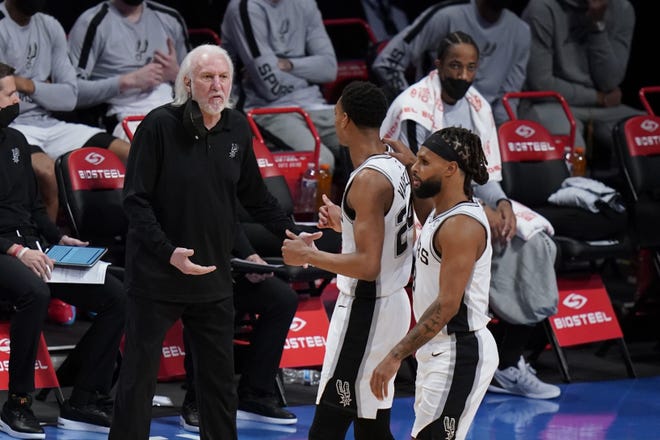
San Antonio coach Gregg Popovich talks to his players during a May 12 game against the Brooklyn Nets. The Spurs missed the playoffs for the second straight year after Wednesday's loss at Memphis. Now Popovich must decide if he wants to return for a 26th season.

Gregg Popovich can walk away with zero regrets.

He has nothing left to prove.

Only Red Auerbach and Phil Jackson have won more NBA titles as head coaches, and unlike Popovich, they did it with the trappings that come with major media markets. Pop, to his credit, made the world take notice of the San Antonio Spurs long after James Silas, George Gervin, Larry Kenon and the Bruise Brothers took their leave.

Those five titles wouldn’t have been possible without great leaders such as Avery Johnson and David Robinson and transcendent talents such as the Admiral, Tim Duncan, Tony Parker, Manu Ginobili and Kawhi Leonard (before he left). But Pop was the constant who held it all together.

Bohls, Golden: All eyes on the Brooklyn Nets as this year’s NBA Playoffs tip off

South Texas’ most high profile renaissance man grew out his white hair during the last two seasons and had to show more patience with his youngest team in 25 years as it grew under his watch.

And, just like that, it could all be over.

Pop could call it a career.

Wednesday’s 100-96 road loss to Memphis in a playoff play-in game would not go down as the most storybook exit, but Pop has had so many great moments since taking the helm in 1996. Despite the disappointing finish, he enjoyed this latest group because it spoke to his love of teaching the game the right way.

“They just stuck with it, no matter what the travel was or how many games we had to play down the stretch,” Popovich told reporters Wednesday night. “It was tough on them, but they didn’t complain. They made no excuses. They did the best they could.”

If this was it, it was it, even if he isn’t divulging any plans for now.

San Antonio Express-News scribe Tom Orsborn, a veteran Spurs reporter, has long been the one writer who always dared to ask the toughest questions to a coach who has routinely gotten a pass for being surly and sometimes rude during interviews. After the ESPN broadcast team failed to delve into whether we were watching Pop’s final game, Orsborn asked in the postgame interview.

“Not gonna go there,” Popovich said. “The season just ended. We’ve got a lot of time for that.”

Pop, at a spry 72 — he’s like the cool old dude who stays up late to play Call of Duty with his college grandsons  — could coach another five or 10 years. He’s in great shape and loves teaching.

The question has to be whether he’s ready to stick around and put in the work it will take to get young pieces such as Lonnie Walker IV (22 years old), Dejounte Murray (24), Luka Samanic (21) and Keldon Johnson (21) to develop in the manner he helped develop the aforementioned franchise greats en route to those titles.

Even with a nice mix of youth with 30-something veterans Rudy Gay, DeMar DeRozan and Patty Mills — the lone holdover from the glory years — these Spurs just weren’t up to the full task against the Grizzlies. They dug a 27-6 hole in the first quarter and moved heaven and earth just to make it interesting — actually taking a 98-97 lead down the stretch — before succumbing.

Seven-foot center Jonas Valančiūnas chewed up the Spurs’ interior with 23 points and 23 rebounds and guard Dillon Brooks was an absolute truck going to the bucket. The young Spurs are simply not good enough at this point of their development.

San Antonio went 65-78 these last couple of years and missed the playoffs in consecutive seasons for the first time since Gerald Ford was president. The 2-11 finish to the season came after a promising 18-13 start took a huge gut punch from COVID-19.

Added challenges came after the release of LaMarcus Aldridge — who subsequently retired from the Brooklyn Nets due to a heart issue — and the late-season loss of guard Derrick White, who was limited to 36 games in a breakout season in which he averaged 15.4 points.

Golden: LaMarcus Aldridge is leaving the NBA with plenty gas left in tank

The wins didn’t happen with enough regularity, and Popovich made more headlines for his unwavering criticisms of President Donald Trump’s administration and, closer to home, Texas Gov. Greg Abbott than he did for anything on the court. Pop never held his tongue when it came to issues outside of sports because he understands the importance of using his platform to fight for fair treatment of everybody.

Spurs coach Gregg Popovic and Tim Duncan collaborated on five NBA titles in their 20 seasons together. Duncan thanked his former coach during his Hall of Fame speech Sunday.

“Thank you for teaching me about basketball, but even beyond that, teaching me that it’s not all about basketball,” Duncan said to him during Sunday’s Hall of Fame acceptance speech. ”It’s about what’s happening in the world; it’s about your family. Thank you for everything.”

Under his watch, the Spurs were an omnipresent power with a record 22 straight playoff appearances starting in 1998, an era of consistent dominance that included five championships. Pop added to his legacy by hiring Becky Hammon as the first full-time female assistant in the history of the four major professional leagues. She went on to become the first head coach of a NBA Summer League team and actually coached the Spurs after Pop was ejected during a 2020 game.

Golden:Is this the start of a new golden era for Texas sports?

Gregg Popovich made Becky Hammon the first full-time female assistant coach in any of the four major professional leagues.

He’s on to coach the USA national team now and will presumably be in Tokyo this summer if the Olympics take place as planned. As for coming back or hanging them up, he won’t worry about anyone’s clock on any kind of announcement, but it isn’t in him to leave the organization in purgatory between now and when training camp starts in October.

I can’t see him waiting too long to either make an announcement or quietly tell general manager R.C. Buford that he’s coming back for a 26th season.

If the end is here, Pop’s successor will inherit a roster loaded with potential and the largest pair of coaching shoes in the Association.

Good luck following a legend.

Gay Activist Shot, Set Ablaze In Brazil – Star Observer

The body of a 25-year-old teacher, Professor Lindolfo Kosmaski, who was active in his local LGBTQI community was found on April 30th, shot and burnt alive in his car in São João do Triunfo in the southern region of Brazil, in what locals suspect was a hate crime.

The local police have arrested three suspects, aged 20, 33, and 39 years old. The police have confirmed that accused were known to the victim, who was allegedly shot twice while tied down with ropes and left inside his burning vehicle.

Advertisement

However, what is most gruesome is that police are yet to conclude whether Kosmaski died from his gunshot wounds or the fire.

“We will have several other stages of data analysis, which is a more technological stage, in order to bring together all the elements necessary to hold those responsible for this nefarious crime to account,” Michel Leite Pereira da Silva, the police officer investigating the case, told Globo.

Activist Had Received Death Threats

According to his cousin, on the night of his disappearance, Kosmaski was last spotted in a bar in Coxilhão where he paid for a round of beer before he suddenly left the venue, leaving his cell phone at the establishment.

Speaking with local media, his cousin confirmed that Kosmaski had “received death threats days before he was murdered.”

An active participant in the Landless LGBT Collective and the Agroecology Days, Kosmaski was also a member of the Marxist group the Brazilian Landless Rural Workers’ Movement.

The group demanded in a statement that “the appropriate entities move quickly to investigate and find those responsible for this heinous crime.”

Advertisement

“He was a person known for affection and care; with a frank smile and an open heart, with a cheerful look, that captivate hugs and love. One of those beings who roam the world with a pounding heart, open to the challenge of learning, teaching and sharing and who wanted to make a difference in the world.”

The statement added that they are committed to fighting for a society “without LGBTphobia, where all types of love are respected and protected. LGBT blood is also Landless blood.”

A Teacher and An Activist

A valued member of his community, at the time of his death Kosmask was teaching in four different schools in the Paraná State Education Network.  Kosmaski had also run as a candidate for the City Council of São João do Triunfo on the Workers’ Party ticket in 2020 but failed in his bid to get elected.

A detailed probe on the matter is now underway as authorities look too sure up the motive behind the odious killing.

If you feel distressed reading the story, you can reach out to support services.

For 24 hour crisis support and suicide prevention call Lifeline on 13 11 14

For Australia-wide LGBTQI peer support call QLife on 1800 184 527 or webchat.

Study examines blood donation waiting period for gay men – News 13 Orlando

ORLANDO, Fla. — Blood donations from the LGBTQ community became a focal point in Orlando following the Pulse Night Club massacre in 2016.

Five years later, a nationwide analysis of how people are screened before donating blood could bring significant change for men who have sex with men (MSM).


What You Need To Know

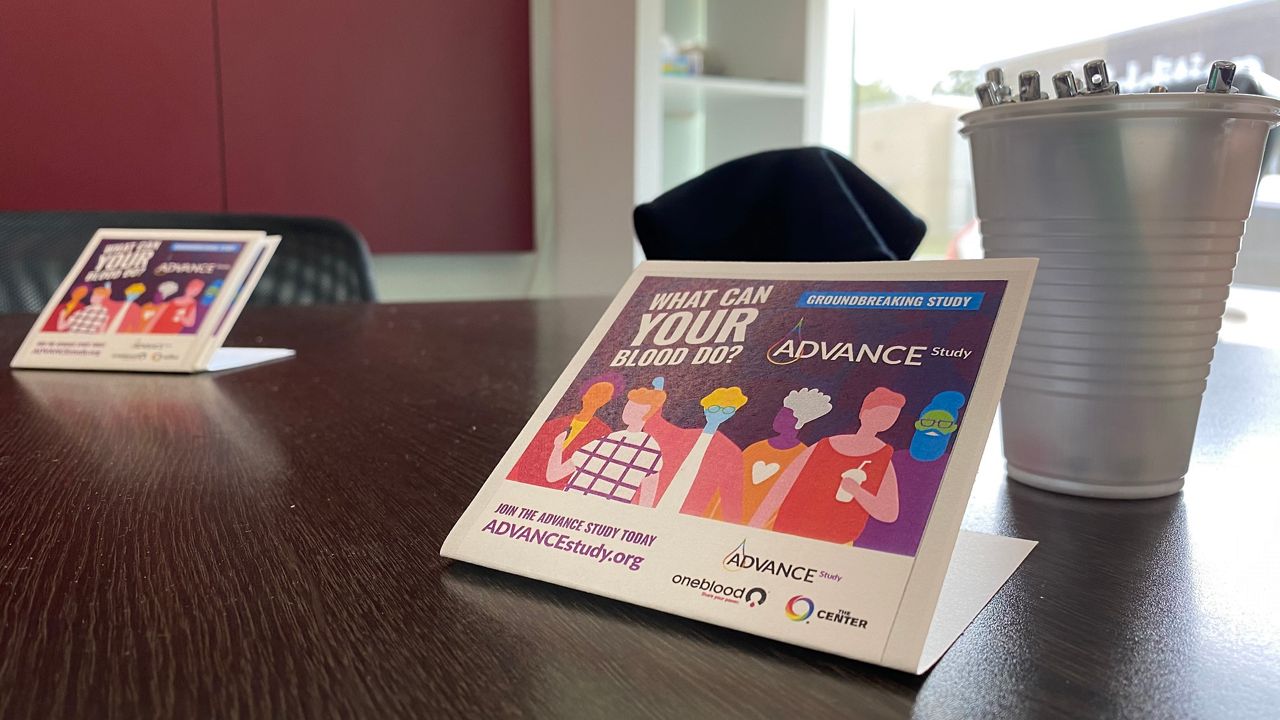
  •  The ADVANCE study is looking for more participants
  •  Organizers hope to have full enrollment by mid-summer
  •  Experts want to know if the current 3-months without sex before donating blood requirement is necessary for men who have sex with men

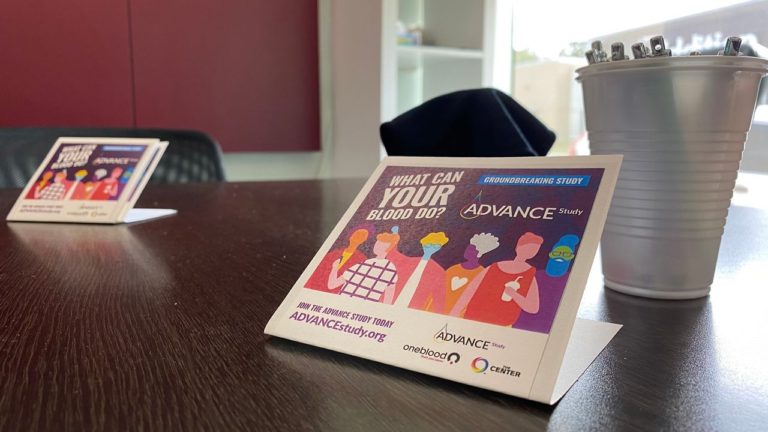
Announced in late 2020, the ADVANCE Study seeks to determine if the current method of having MSM wait for at least three months without sex with a man is necessary. 

The Assessing Donor Variability And New Concepts in Eligibility (ADVANCE) Study was commissioned by the U.S. Food and Drug Administration is being conducted in 10 cities across the country, including in Orlando. 

Danny Garcia, the vice president of the board at the LGBT+ Center in Orlando, said having Orlando take part in this process is personally important.

“One of the things that this Pulse tragedy has proved is that the Orlando LGBT community and the Latinx community is very strong,” he said. “We’re very vocal and this is a great way to honor their memory. And at the same time, I feel that it’s a great representation of what we can do.”

OneBlood is partnering with Vitalant and the American Red Cross for the study. 

The FDA policy of MSM waiting three months began in April 2020 amid the pandemic and the need it generated for more blood donations. Previously the waiting period was 12 months.

The study seeks to understand if a questionnaire alone can determine risk of transmitting HIV when someone donates blood.

“We’re looking at individual behaviors rather than the amount of time between sexual contact,” said Dr. Rita Reik, the chief medical officer for OneBlood in Orlando. “So, we’re asking a lot of very specific questions. I believe there’s about 84 in there or so about what types of behaviors you have as an individual. And those will be used to determine whether there might be a more suitable way to screen donors for HIV risk.”

Reik said not all of the 84 questions would necessarily appear in the final version of the screening questionnaire that the public would get, but that has yet to be determined. 

She says they hope to have some preliminary results of the study by the end of 2021. 

Those interested in participating can click here for more information.