There is a time in many people’s lives when the cartoon mascots on cereal boxes are a thing of utmost importance. For those who care deeply about whether or not the Trix Rabbit actually had its feelings hurt, or whether Toucan Sam’s nose really is that powerful, that time usually ends somewhere in the vicinity of first grade. And then there’s Newsmax host Grant Stinchfield, a middle-aged television personality whose apparent obsession with Tony the Tiger, Count Chocula, and the rest of the crew, has only intensified over the years.
During an only-sort-of tongue in cheek screed against “woke” culture (” [it’s] annoying, folks”), the recently accidentally-on-purpose antisemitic Stinchfield addressed perhaps the most important topic facing America’s youth today: whether or not the Lucky Charms leprechaun is gay.
“He wears high heels shoes, prances around in tights … ” a chuckling Stinchfield mused. “Leads me to believe, probably, that little Lucky Charm leprechaun might be gay!”
Stinchfield’s bizarre obsession with a cartoon (not real) leprechaun (again, not real) and its entirely hypothetical, non-existent (once more: not real) love interests came as part of a longer screed against Kellogg’s recent introduction of a Pride-themed, heart-shaped “Together” cereal which — much to Stinchfield’s chagrin — includes a place on the box for people to write their own pronouns if they so choose.
“Nothing like forcing our kids to be confused about their gender first thing in the morning with their breakfast,” a very somber Stinchfield intoned.
In many ways, this is a perfect encapsulation of conservative media’s reliance on straw-man outrage as its animating force. Is anyone holding a gun to Stinchfield’s head and demanding he buy a limited edition breakfast cereal primarily marketed toward children? Of course not. Does the existence of this cereal in any way complicate Stinchfield’s life? Not a chance — unless the sheer act of thinking about someone other than himself counts as a life complication, in which case, buddy, I don’t know what to tell you.
No, the only reason on Earth that Stinchfield cares about a cereal box whose message is basically “we’re a huge company with a limited-time gimmick celebrating basic human dignity” is so he can complain about it, thereby staking out his territory as “the guy who has an opinion on this now.”
“The moral of the story is, switch your kids to granola — it’s healthier anyway,” Stinchfield urged in the closing moments of the segment. “You cut the sugar, okay? And then you don’t have to buy products from woke companies like Ben and Jerry’s, Coke, and Kellogg’s.” Sure seems like breakfast at the Stinchfield house is a real joy.
Oregon has become the 14th state to ban the LGBTQ panic murder defense after out bisexual Governor Kate Brown signed the bill into law.
The defense allowed a defendant to claim they attacked their victim after they found out that the victim was gay or trans, sending them into a “panic” about their own heterosexuality. The maneuver is usually attempted when an LGBTQ person is killed by someone they recently had sex with.
“When we finally see justice for Aja’s murder, we can ensure that, when we show up to the courtroom, her memory won’t be insulted by someone trying to use the panic defense to justify her death,” her sister Dana Spears said in a statement after the House passed the bill. “I’m thankful to everyone in the community who used their voice for Aja, and saw this bill passed.”
“This legislation states, unequivocally, in Oregon, there is never an excuse for violence against transgender people,” said Basic Rights Oregon’s Mikki Gillette in a statement.
The American Bar Association adopted a resolution calling for an end to the defense in 2013. Earlier this year, Vermont and Virginia added themselves to the list of 13 states that have banned the LGBTQ panic defense. The District of Columbia has as well, but that law has been delayed due to the fence erected around the Capitol following the insurrection by Trump supporters.
The gay panic defense has been used in several prominent cases. It gained national attention in a 1995 case where a gay man, Scott Amedure, told his straight friend Jonathan Schmitz that he was attracted to him on the Jenny Jones Show.
Three days later, Schmitz shot Amedure and turned himself into police, and he argued in court that he was “embarrassed” on national TV. He avoided a first-degree murder conviction and was convicted of second-degree murder.
The use of the gay panic defense received more public attention with the murder of Matthew Shepard, where his killers claimed that Shepard had “come onto” one of the duo. Similarly, the “transgender panic” defense gained prominence in the way of the 2004 murder of Gwen Araujo in Newark, California.
🥳 Good news! @OregonGovBrown has signed into law a bill ending the so-called LGBTQ “panic defense.”
White House principal deputy press secretary Karine Jean-Pierre made history on Wednesday, becoming the first openly gay woman and only the second Black woman to ever lead a White House press briefing.
Answering reporters’ questions from the White House podium on Wednesday, Jean-Pierre said it was a “real honor just to be standing here today” and that she appreciated the “historic nature” of the moment.
“It’s not about one person, it’s about what we do on behalf of the American people,” the deputy press secretary said, adding that “clearly” President Joe Biden “believes that representation matters” and that she was proud to be part of the most diverse administration in U.S. history.
In addition to being the first openly gay spokeswoman to answer reporters’ questions from the podium, Jean-Pierre became the first Black woman in three decades to do so.
The first Black woman ever to lead a White House briefing was Judy Smith, who did so in 1991 as deputy press secretary to former President George H.W. Bush.
Late last year, Smith told Yahoo News that she “didn’t think” about the historic position she was in “at the time” and was focused on the “incredible opportunity” of working at the White House.
“I didn’t understand the significance of what that was, getting up, briefing at that moment, seeing a Black woman behind the podium, speaking on behalf of the president to the American public,” Smith said.
Smith’s work later inspired the hit Shonda Rhimes TV show “Scandal.”
RELATED…
Calling all HuffPost superfans!
Sign up for membership to become a founding member and help shape HuffPost’s next chapter
RADNOR, Pa., May 26, 2021 (GLOBE NEWSWIRE) — The law firm of Kessler Topaz Meltzer & Check, LLP reminds investors that a securities fraud class action lawsuit has been filed in the United States District Court for the Southern District of New York against Ebang International Holdings Inc. (NASDAQ: EBON) (“Ebang”) on behalf of those who purchased or acquired Ebang securities between June 26, 2020 and April 5, 2021, inclusive (the “Class Period”). Investor Deadline Reminder: Investors who purchased or acquired Ebang securities during the Class Period may, no later than June 7, 2021, seek to be appointed as a lead plaintiff representative of the class. For additional information or to learn how to participate in this litigation please contact Kessler Topaz Meltzer & Check, LLP: James Maro, Esq. (484) 270-1453 or Adrienne Bell, Esq. (484) 270-1435; toll free at (844) 887-9500; via e-mail at info@ktmc.com; or click https://www.ktmc.com/ebang-international-class-action-lawsuit?utm_source=PR&utm_medium=Link&utm_campaign=ebang Ebang is a leading application-specific integrated circuit chip design company and a leading manufacturer of Bitcoin mining machines. The Class Period commences on June 26, 2020, when Ebang filed its prospectus in connection with its initial public offering (the “IPO”). On October 23, 2020, Ebang filed its registration statement on a Form F-1 for an offering of Class A ordinary shares and warrants to purchase Class A ordinary shares. It was subsequently amended on October 26, 2020, November 6, 2020, and November 16, 2020 before Ebang filed a related prospectus on a Form 424b4 on November 20, 2020. According to the complaint, on April 6, 2021, before the market opened, Hindenburg Research published a report alleging, among other things, that Ebang was directing proceeds from its IPO last year into a “series of opaque deals with insiders and questionable counterparties.” According to the report, Ebang raised $21 million in November 2020, claiming the proceeds would go “primarily for development,” and that instead the funds were directed to repay related-party loans to a relative of Ebang’s Chief Executive Officer, Dong Hu. The report also noted that Ebang’s earlier efforts to go public on the Hong Kong Stock Exchange had failed due to widespread media coverage of a sales inflation scheme with Yindou, a Chinese peer-to-peer online lending platform that defrauded 20,000 retail investors in 2018, with $655 million “vanish[ing] into thin air.” Following this news, Ebang’s share price fell $0.82, or approximately 13%, to close at $5.53 per share on April 6, 2021. Then, on April 6, 2021, after the market closed, Ebang issued a statement stating that, though it believed the report “contain[ed] many errors, unsupported speculations and inaccurate interpretations of events,” the “Board, together with its Audit Committee, intends to further review and examine the allegations and misinformation therein and will take whatever necessary and appropriate actions may be required to protect the interest of its shareholders.” Following this news, Ebang’s share price fell $0.12, or 2.17%, to close at $5.41 per share on April 7, 2021. The stock price continued to decline over the next trading session by $0.38, or 7%, to close at $5.03 per share on April 8, 2021. The complaint alleges that, throughout the Class Period, the defendants failed to disclose to investors that: (1) the proceeds from Ebang’s public offerings had been directed to low yield, long term bonds to an underwriter and to related parties rather than used to develop Ebang’s operations; (2) Ebang’s sales were declining, and Ebang had inflated reported sales, including through the sale of defective units; (3) Ebang’s attempts to go public in Hong Kong had failed due to allegations of embezzling investor funds and inflated sales figures; (4) Ebang’s purported cryptocurrency exchange was merely the purchase of an out-of-the-box crypto exchange; and (5) as a result of the foregoing, the defendants’ positive statements about Ebang’s business, operations, and prospects were materially misleading and/or lacked a reasonable basis. Ebang investors may, no later than June 7, 2021, seek to be appointed as a lead plaintiff representative of the class through Kessler Topaz Meltzer & Check, LLP or other counsel, or may choose to do nothing and remain an absent class member. A lead plaintiff is a representative party who acts on behalf of all class members in directing the litigation. In order to be appointed as a lead plaintiff, the Court must determine that the class member’s claim is typical of the claims of other class members, and that the class member will adequately represent the class. Your ability to share in any recovery is not affected by the decision of whether or not to serve as a lead plaintiff. Kessler Topaz Meltzer & Check, LLP prosecutes class actions in state and federal courts throughout the country involving securities fraud, breaches of fiduciary duties and other violations of state and federal law. Kessler Topaz Meltzer & Check, LLP is a driving force behind corporate governance reform, and has recovered billions of dollars on behalf of institutional and individual investors from the United States and around the world. The firm represents investors, consumers and whistleblowers (private citizens who report fraudulent practices against the government and share in the recovery of government dollars). The complaint in this action was not filed by Kessler Topaz Meltzer & Check, LLP. For more information about Kessler Topaz Meltzer & Check, LLP please visit www.ktmc.com. CONTACT: Kessler Topaz Meltzer & Check, LLPJames Maro, Jr., Esq.Adrienne Bell, Esq.280 King of Prussia RoadRadnor, PA 19087(844) 887-9500 (toll free)info@ktmc.com
(WASHINGTON) — In advance of the one-year anniversary of George Floyd’s murder, Secretary of State Antony Blinken authorized all U.S. embassies and consulates overseas to fly the Black Lives Matter flag on their official flagpole this year, according to an internal memo obtained by ABC News.
All U.S. diplomatic posts are “strongly encouraged” to use the department’s resources “to promote policy objectives to advance racial equity and support for underserved communities,” especially on May 25 and during June to commemorate Juneteenth, according to Blinken’s memo.
That includes support for using “the term ‘Black Lives Matter’ in messaging content, speeches, and other diplomatic engagements with foreign audiences to advance racial equity and access to justice on May 25 and beyond.”
That push to promote racial justice and equality has been a cornerstone of Blinken’s short time at the agency, rankling critics, including his predecessor Mike Pompeo.
Last year, demonstrations in the U.S. that started over Floyd’s murder and spread to protest racial injustice were swiftly swept overseas to dozens of countries, often addressing local issues as well. In Colombia, for example, protesters denounced the killing of Floyd and Anderson Arboleda, a young Afro-Colombian man whose family said he was beaten by police and later died, while in France, Floyd’s killing reignited mass demonstrations over the death of Adama Traoré, who died in French police custody.
In a video released Tuesday, Blinken said the U.S. can only be a “credible force for human rights around the world” if it faces “the realities of racism and hatred here at home.”
The video, which includes U.S. ambassador to the United Nations Linda Thomas-Greenfield and other senior U.S. officials, was shared by U.S. posts around the world.
“We can’t sweep our shortcomings under the rug or pretend they don’t exist. We need to face them openly and honestly, even if that’s ugly — even if that’s painful,” Blinken says in it, under photos of protests held around the world last year.
His internal memo encourages embassies and consulates to plan events and messaging around that theme, but “as appropriate and depending on local context.”
The phrase “Black Lives Matter” and the surrounding issues can be a source of greater sensitivity in certain countries, including Colombia where protests against tax reform in April have more recently taken on police violence after police used deadly force against demonstrations. But the Colombian government remains a critical U.S. partner in Latin America, making any political statements by the U.S. embassy there more difficult in a fraught political environment.
“On the anniversary of George Floyd’s killing, we reaffirm that what distinguishes the U.S. is not that we are perfect. It is that we face our flaws and challenges openly to move forward, defend our core values, and demonstrate the resilience of our democracy,” the U.S. embassy in Bogotá tweeted Tuesday, mirroring Blinken’s words.
Back in Washington, the top U.S. diplomat has unveiled some of his own policies to do just that, speaking repeatedly about the need to diversify the State Department’s historically white and male ranks. Last month, Blinken announced that he had tapped veteran diplomat Gina Abercrombie-Winstanley to be his chief diversity and inclusion officer, the department’s first ever.
His push also contrasts with Pompeo, who in his final days in office criticized “multiculturalism,” tweeting that it is “not who America is.” He also blasted the New York Times’ “1619 Project” as a “disturbed reading of history” based in “Marxist ideology” that made the Chinese Communist Party “gleeful.”
Last June, as George Floyd protests swept across the U.S., former President Donald Trump’s ambassador to South Korea Harry Harris hung a Black Lives Matter banner and a LGBT Pride flag on the U.S. embassy — both of which were later removed, reportedly at Washington’s instruction.
(NEW YORK) — Esmée Silverman, an openly transgender senior in Massachusetts, says her high school experience “had a lot of its ups and downs … mostly downs.”
Silverman, 19, came out to her close friends and family in her freshman year amid the Trump administration’s rollback of protections for the transgender community. Then-President Donald Trump rescinded protections that allowed transgender students to use restrooms that matched their gender identity and placed a ban on transgender troops in the military. She said these laws furthered anti-trans sentiment among her peers, and the pressures from the national political climate have made life as a young transgender teen harder.
The recent wave of anti-transgender legislation has reignited that pain and fear, she said.
Even in the progressive state of Massachusetts, which has laws in place to protect transgender students, Silverman said she feels the burden of the legislation that has been popping up in states throughout the nation and fears for her friends who are in states with anti-trans policies.
“I’ve been able to avoid a lot of these bills, but I can’t avoid the heartache,” Silverman said. “I can’t avoid the shared empathy that I have for my fellow trans siblings.”
More than 100 bills designed to restrict the rights of transgender people have been introduced in at least 33 states, according to the Human Rights Campaign, an LGBTQ advocacy group that has called 2021 a record-breaking year for anti-trans legislation.
The effects of anti-trans legislation — and the rhetoric that accompanies it — is often seen in classrooms and schools across the country, where students such as Silverman combat discrimination, fear and harassment.
Transgender youth are three times more likely to attempt suicide than their cisgender peers, according to the Centers for Disease Control and Prevention.
“My overall experience dealing with these bills has been the horrible thought that I’m going to have to see another one of my friends get buried in the ground,” Silverman said. “The thought of seeing another one because of these harmful, harmful bills … it’s just a fight I can’t bear.”
Andy Marra, the executive director of the Transgender Legal Defense & Education Fund, told ABC News that this legislation is worsening the already-tense school environment and making it hard for students to focus on their education.
“It is hard enough being a student in the time of COVID, when it is difficult for any of us to feel safe, healthy and included,” Marra said, “but for transgender students living in states where their very lives are under attack, it can be near impossible to focus on much else but surviving.”
In Arkansas, the state legislature recently banned gender-affirming treatment for minors. HB 1570 prevents young trans people from receiving hormone therapy, puberty blockers and similar treatments. The state calls the bill the “Save Adolescents from Experimentation (SAFE) Act,” referring to medical treatment to affirm one’s gender identity as “experimentation.”
However, medical organizations including the American Psychological Association, the American Psychiatric Association and the American Academy of Pediatrics have argued that gender-affirming treatment can be beneficial to the mental and physical well-being of young transgender people.
Shortly after the Arkansas bill prohibiting gender-affirming medical practices was signed into law on April 6, reports of suicide attempts among trans youth in the state brought the emotional and mental toll of these laws to the forefront. Dr. Michele Hutchison, who runs the largest provider of hormone therapy in the state, told the Associated Press that she’s seen an uptick in suicide attempts in her office since the passing of the bill in April. The Arkansas bill was the first bill of its kind signed into law in the U.S.
Arkansas Gov. Asa Hutchinson, a Republican, vetoed the bill, citing the potentially dangerous consequences for trans youth in the state and telling reporters that the bill was “a vast government overreach” and “a product of the cultural war in America.” His veto was overturned by the state legislature.
Republicans who back the bill say they want to protect children. The bill claimed that “the majority [of trans youth] come to identify with their biological sex in adolescence or adulthood,” but there is no evidence in the bill to support that theory.
The sponsor of the bill, state Rep. Robin Lundstrum, did not respond to ABC News’ requests for comment, but on the state House floor, she argued, “Some of them may choose to be transgender when they’re older. That’s OK. That’s their choice. But when they’re under 18, they need to grow up first.”
“We just feel like it’s good public policy that kids shouldn’t even have the option to do that before they become an adult,” Krause said, according to Spectrum News Austin. “It’s not about trusting the parents one way or the other. It’s about good public policy for Texas.”
Meanwhile, at least 31 states have introduced bills that would ban trans athletes from competing in sports that correspond with their gender identities. Arkansas, Mississippi and Tennessee have already signed them into law.
There is no evidence that trans athletes are disproportionately dominating sports that correlate with their gender identity or that they have an advantage in their sport. The National Collegiate Athletic Association (NCAA), the Olympics and the governing bodies for U.S. national gymnastics, soccer and hockey leagues all allow transgender athletes to compete.
Legislation preventing transgender athletes from playing in school sports has been supported by groups such as the Concerned Women of America (CWA), who say male athletes could claim to be women to gain advantages in sporting competitions.
“Title IX’s purpose and benefit are negated for women whenever the playing field is accessible to male athletes claiming status as women,” a statement from the CWA reads. “Title IX’s prohibition of sex discrimination is based on sex — male and female. It does not define sex based on ‘gender identity.’ It does not sanction males, with distinct physiological advantages regardless of treatment, to compete in female sports.”
Silverman said she’s already felt and seen the pain the bills are causing.
“I’ve seen so many LGBT kids message me saying that they’re scared because they’re going to get their hormones taken away. I’ve seen people messaging me crying because they’re not gonna be able to play on the team that they want to play on,” Silverman said. Her message to legislators is: “Your actions or lack of actions are going to have dire consequences for an entire group of people.”
The toll of discrimination in schools
Schools have become a battleground for the fight for transgender rights. Students face pressure from elected officials, school administrations and peers as they navigate life as openly trans young people.
Marra said that even though students already carried the burden of discrimination before these bills were introduced, this legislation is exacerbating the social and emotional hurdles in the lives of students and student-athletes, who are directly targeted in these bills.
“Like any other student, trans young people just want to stay healthy, go to school and spend time with their friends and loved ones,” Marra said. “However, these bills make that incredibly difficult.”
According to research from the Trevor Project, a nonprofit that provides suicide prevention services to LGBTQ youth, 86% of LGBTQ youth said recent politics have negatively impacted their well-being.
From 2019 to 2020, 28% of trans students were prevented from using the bathrooms that aligned with their gender identity, the Trevor Project reported, and 27% were barred from using the correct locker rooms. Almost 23% were prevented from using their chosen names and pronouns.
Silverman can attest to the harsh reality of living while trans — “I’ve lost friends. I’ve had family question my decision. I have painful situations where I’ve been discriminated against, and I’ve been profiled,” she said.
Ian Anderson, legal services project manager at the Transgender Law Center, said these laws only further anti-trans sentiment and discrimination on an already vulnerable population.
“The reality on the ground is that trans students in many walks of life are facing discrimination, bias, violence, from the level of microaggressions to extreme instances of discrimination, regardless of laws that protect us, because, of course, in our society, legal recourse demands a lot of energy and resources,” Anderson said.
“We have heard reports of everything from misgendering and deadnaming, which is a term for when people address a trans person by the name they were assigned but don’t identify with or use,” Anderson. said.
Young trans Americans have long been affected by intolerance and inaccessibility, according to the Trevor Project, which also reported that more than half of transgender or non-binary people surveyed had strongly considered ending their lives.
For many transgender youth, asking for help and advocating for themselves amid the onslaught of anti-trans legislation can be a challenge.
Transgender rights are protected under Title IX, according to legal experts, which is a federal civil rights law that protects students and athletes against gender-based discrimination. The law states that no one can be subject to discrimination on the basis of sex in federally funded education programs.
“You can’t discriminate against someone for being transgender or for going through gender transition or for being perceived as transgender even, without discriminating against someone on the basis of sex,” Anderson said.
If a transgender student is going to file legal action against a school for discrimination, Anderson recommended documenting all forms of discrimination in journal entries, text conversations, letters to the school administration and other ways.
Human Rights Campaign Legal Director Sarah Warbelow noted that one course of action is to file a complaint with the U.S. Department of Education, which now accepts complaints from LGBTQ students. She said schools can be held liable for discrimination against transgender students — whether it comes from school officials or other students.
Warbelow said students should speak to administrators or the school board to notify them of any kind of harassment and put them on notice.
“Providing respect to students is a baseline that all of us can meet,” Warbelow told ABC News. “When they tell you who they are, accept and respect it.”
Warbelow and Anderson both agree that legal recourse isn’t the only path forward. Finding allies in and out of the school environment, such as a teacher or counselor, a student-run organization or a local support group, can help students advocate for themselves and feel supported.
“To all the trans people who may not have the most welcoming environment out there, you always have a family with us,” Silverman said. “We may not be able to see each other, we may not be able to even talk to each other in person. But regardless of that, you are always going to have a community of people who love and value you for every second of the day.”
Local 1199 SEIU United Healthcare Workers East, the largest union in New York and the nation’s largest healthcare union, today endorsed community activist Lynn Schulman for election to City Council District 29.
“Lynn Schulman is a life-long champion for healthcare workers’ rights and a fierce advocate for improving healthcare access in Queens,” said 1199 SEIU Political Director Gabby Seay.
“As we continue to battle this pandemic and face the challenges ahead, we need experienced leaders like Lynn Schulman to stand up for frontline healthcare workers, fight for access to high quality healthcare for all, and ensure an equitable recovery.”
Schulman, who previously held posts at the Woodhull Medical Center in Brooklyn and Gay Men’s Health Crisis, currently works as a senior community and emergency services liaison in the office of New York City Council Speaker Corey Johnson.
1199SEIU represents over 250,000 healthcare workers in downstate New York and more than 450,000 healthcare workers on the East Coast. Its members work in home care, nursing homes, hospitals, and clinics and have been on the frontlines throughout the COVID-19 pandemic.
“I am honored to be endorsed by 1199SEIU, and as your next Council Member for District 29, I will use my vast experience in healthcare to ensure that our community has access to preventive and emergency medical care when it is needed,” Schulman said.
“Queens was the epicenter for the pandemic because of a lack of hospital capacity and the consequences have been devastating, with many lives needlessly lost. I have a vision for our community that will ensure we have a system that provides access to the healthcare that we deserve and provide our healthcare heroes with the support they need.”
Schulman has racked up several endorsements from local officials, including Council Members Karen Koslowitz and Danny Dromm, State Sen. John Liu and Assembly Member Andrew Hevesi. She has also got the support of Congresswoman Grace Meng.
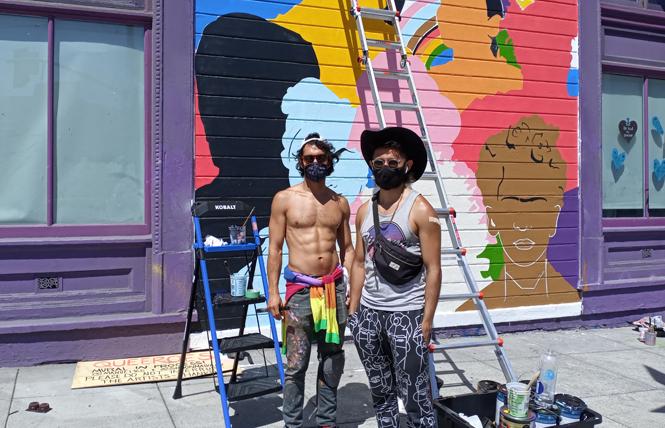
Two queer San Francisco artists have finished work on a new mural on the side of the San Francisco LGBT Community Center just in time for the start of Pride Month in June.
As the Bay Area Reporter previously reported, the center chose the two artists to replace a honey bear mural by fnnch, a straight artist, that had been defaced after he was criticized over describing himself as an “immigrant” to San Francisco since he hails from the state of Missouri. (He later apologized.)
On May 19, the center announced that those two artists are Juan Manuel Carmona and Simo?n Malvaez. The mural they worked on — titled “Queeroes” — calls attention to a diverse slate of LGBTQ community heroes.
The mural features depictions of local, national, and international luminaries, living and deceased. They include lesbian singer Chavela Vargas; bisexual singer Freddie Mercury; bisexual artist Frida Kahlo; gay San Francisco supervisor Harvey Milk; and gay writer James Baldwin.
Others featured include San Francisco nightlife event producer, DJ and drag star Juanita MORE!; AIDS activist Keith Haring; queer, trans nonbinary likely-incoming San Francisco Democratic Party chair Honey Mahogany (the election for which is to be held after this B.A.R. issue goes to press May 26); drag queen and activist Marsha P. Johnson, a prominent figure in the early LGBTQ liberation movement in New York City; fellow New Yorker and trans activist Sylvia Rivera; San Francisco drag artist Sister Roma of the Sisters of Perpetual Indulgence; and gay vogue godfather Willi Ninja.
Carmona is receiving a $7,000 commission and Malvaez is volunteering, the center stated.
There will be some event to commemorate the completion of the mural, but according to Miguel Raphael Bagsit, the communications manager for the center, the center does not “have clear insight” yet as to what that will entail.
Speaking with the B.A.R., Carmona, 34, said he brought up to MORE! in September 2019 the idea of painting the mural on the side of the center, at the intersection of Market Street and Octavia Boulevard in the Upper Market neighborhood.
“I approached her and said, ‘I want to put a mural on that purple wall.’ She introduced me to Roberto,” Carmona said, referring to Roberto Ordeñana, the center’s deputy executive director. MORE! told the B.A.R. that Carmona is part of her chosen family.
“I met Manuel when he moved to San Francisco in 2011 and took him to the Lucky Penny on Geary Street to feed him,” MORE! stated in an email. “I immediately took him in as part of my chosen family. It is tough to survive in this city as an artist. I loved his artwork and believed in his ability to create and share it here in his newfound home.
“In 2019, I asked him if he would create the poster artwork for my annual Pride event,” MORE! continued. “He jumped on it and began building a story of how he wanted to interpret me. When I got to see it, I immediately said — that is a mural! His instantaneous response was that he wanted to paint a mural. So I reached out to my friend and business owner, Todd Barkett [of the former Unionmade space], and asked if we could paint on the side of his building at 18th and Sanchez. It has become an iconic image that I am very proud to have in the Castro district.”
Barkett did not return a message seeking comment.
MORE! confirmed that she spoke with Ordeñana, president of the city’s arts commission, about Carmona.
“Ordeñana reached out to me to talk about the mural project on the side of the center’s building in 2019,” she stated. “I have long been a champion of local queer artists and was happy to share some thoughts with him about getting a mural on the side of the historical site of the Victorian building. Manuel’s work came up in the conversation.”
However, the mural Carmona was envisioning couldn’t go forward because of the onset of COVID-19.
Malvaez also worked on a mural of MORE!’s.
“Malvaez started collaborating on another mural of me with Manuel — curated by local artist fnnch to support other artists. The project is called the ‘Painted Gentlemen’ and remains up for six months and then gets rotated out with new artists’ artwork. Together they created a new piece at Alamo Square revolving around the message of getting vaccinated,” MORE! explained. “Then it was time for the center’s project of having a new mural at the beginning of every Pride Month, and Manuel reached out to me with his thoughts on the icons he would depict. He mentioned wanting to include me, and I tried to push him to have other trailblazers who I considered much more worthy. But, here I am — getting honored with another piece of art in San Francisco. I’m not mad.”
Center officials pleased Ordeñana told the B.A.R. that the center is “thrilled” to collaborate with Carmona and Malvaez.
“We are thrilled to partner with Juan Manuel Carmona and Simo?n Malvaez, two incredibly talented local artists from the Latinx and queer communities,” Ordeñana stated. “Since 2002, the center has exhibited work from a diverse array of over 200 visual artists. We believe in the importance of art and the critical questions art raises and we are delighted that Juan Manuel and Simon chose the center as a platform for them to celebrate and honor who they are and the communities they represent.”
Center officials have previously stated that they intend to replace the mural on the side of its wall annually, and that the one fnnch painted featuring honey bears in 2020 in the midst of the pandemic, was to be replaced around this time in 2021. Carmona said his idea for a mural would not have worked in a time of social distancing because he wanted people to interact with it physically.
“We wanted to have a party,” Carmona said. “That was one of the main plans; it’s just been a complicated year-and-a-half now.”
Carmona, who has a master’s of fine arts from Academy of Art University in San Francisco, said he has been drawing all his life but started doing public art in 2017 with the aforementioned mural of MORE! in the Castro neighborhood.
“Our first idea was a Mexican and American soldier kissing,” Carmona said, describing how they brainstormed what they’d like to paint on the side of the center. “But as much as I’m a Mexican American, it didn’t represent the center. We wanted to have something that speaks to the entire community, not just gays, for example.”
Malvaez, 29, joined him to do work on murals at the Mission neighborhood bars Bondies Bar and El Rio. Malvaez told the B.A.R. he has been doing art for the last year. Malvaez said eventually three or four proposals were made.
“One of those we are painting today, using each one of the colors of the Pride Progress flag because each is a character and icon to represent the community,” Malvaez said.
Carmona said that “we chose people that people could identify with,” such as Milk, Khalo, and Mahogany.
“We wanted to represent as much diversity as we could,” he explained, “which is why we have African Americans, as well as people of color.”
Malvaez said that each month the center will highlight one of the queeroes in the mural. “The center will display on social media each of the individuals, so if you don’t know who they are, you can find out,” Malvaez said.
“Our community of queer heroes is so beautifully expansive and goes far beyond this list of icons,” the center stated in a blog post highlighting its social media campaign. “We all have a personal list of heroes we admire — whether it’s chosen family, an inspiring community member, or a cultural icon. While one mural could never encompass all the stories of our diverse community, we hope it will serve as a launchpad for all of us to connect, knowledge-share and discover rising Queer heroes in our communities through one another — and we want to spotlight your heroes throughout Pride month!
“Using the hashtag, #Queeroes, tag us in social media posts that you’re dedicating to your personal Queeroes or send your photos/dedications to press@sfcenter.org for a chance to be featured on our channels. We’d love to celebrate the people who uplift you!” the center added.
Early next year, the center plans to hold an application process for artists who want to paint the next mural.
“We are committed to equity and inclusion as core tenets of our work, and our goal with this mural project is to spotlight a variety of LGBTQ+ and BIPOC perspectives, art and?artists representing our diverse communities in the years ahead,” Bagsit stated in an email.
When asked if Black, Indigenous, and other people of color and LGBTQ people will be prioritized in future artist selection (fnnch was none of these, which elicited some community controversy), Ordeñana repeated Bagsit’s above-quoted statement verbatim.
Roma told the B.A.R. it was surprising to be included in the project, calling it “epic.”
“When Simon [Malvaez] reached out about featuring me in the Queeroes mural, I almost said ‘Do you have the wrong number? This is Roma,'” Roma recalled. “I mean, never in my life did I expect to be featured alongside such talented, impactful, accomplished, and beloved queer icons. I’m honored and seriously humbled, but also not so secretly thrilled. In fact, I would like to apologize in advance for all of the photos and videos I plan to share on social media, but come on, this is epic!”
Mahogany was also honored, and gave ideas about who else could be featured in a mural.
“I’m honored to be included in this work,” Mahogany stated. “Of course, I know there are many more people, past, present, who could have been included: [gay San Francisco drag queen and Imperial Court founder] José Sarria, [lesbian San Francisco writer] Alice B. Toklas, and more. There are so many who have given so much to our city, so I am grateful to have been chosen to be included.”
Help keep the Bay Area Reporter going in these tough times. To support local, independent, LGBTQ journalism, consider becoming a BAR member.
Evan, Kane, Roro, Gold, Medgar, Dylan, Nick and Allen are locked up in Cameroon’s Yaoundé Central Prison, serving sentences for whom and how they love. You can help get them out.
Yaoundé Central Prison — exterior
Those eight gay and lesbian Cameroonians are serving sentences ranging from 18 months to two years after being convicted on homosexuality charges amid the nation’s renewed crackdown on its LGBT citizens. After their prison sentences end, they will go free — but only if they can pay fines and court costs ranging from $315 to $370 that were imposed on them as part of their sentences.
None of them has the money to pay those fines, so they face the prospect of working off the fines by remaining a further four to six months in their cells.
That’s where you come in. Project Not Alone 2021, organized by the Erasing 76 Crimes news site, is raising money to pay their fines and set them free early. The financial sponsor for the project is the St. Paul’s Foundation for International Reconciliation, which supports LGBTQ+ rights advocacy journalism, including the Erasing 76 Crimes news site.
Project Not Alone 2021 is also raising money for deliveries of food and hygiene items for LGBT prisoners, because the dirty, crowded prison forces inmates to live on one small meal per day. The deliveries will be made by activists from Erasing 76 Crimes and the local LGBTQ advocacy group Camfaids.
The project is also seeking funds to pay the expenses for attorneys from Defenders Without Borders who have agreed to work pro bono to defend three other imprisoned victims of Cameroon’s homophobia. The three are Ford and Bill, a gay couple who have been at the prison awaiting trial since March 2020, and Nicky, a trans man who has been imprisoned there without trial since February 2020.
None of the 11 prisoners has been charged with any criminal offenses other than homosexuality.
Project Not Alone 2021 is seeking $7,226. That’s $3,014 to pay the eight LGBT men’s fines; $1,982 for a series of four bimonthly deliveries of food and hygiene items to all 11 LGBT prisoners; and $2,230 for the expenses of pro-bono legal representation for Ford, Bill and Nicky. (For each of those three men, the estimated legal expenses include $367 for initial court filings and copies of court documents, $321 in fees and other follow-up expenses, and $55 for a required security deposit. Their attorneys will work for free.)
U.S. tax-deductible donations to Project Not Alone 2021 may be made via:
By sending a check to St. Paul’s Foundation, 21 Marseille, Laguna Niguel CA 92677 USA.) Please write “Project Not Alone” on the memo line.
Links to articles about the previous three phases of Project Not Alone are below.
This design of three women behind bars represented the three prisoners at Bertoua Central Prison who were helped in Phase 3 of the Not Alone / Pas Seul Project.
Articles about Phase 3 of the Not Alone / Pas Seul Project in eastern Cameroon
Images representing the three gay prisoners in northern Cameroon who were freed early through the work of Phase 2 of the Not Alone / Pas Seul project and its donors.
Articles about Phase 2 of the Not Alone / Pas Seul Project in northern Cameroon:
Images representing the three gay prisoners in Yaounde whose only crime was being gay. Through Phase 1 of the Not Alone / Pas Seul project, they received much-needed deliveries of food and hygiene supplies.
Articles about Phase 1 of the Not Alone / Pas Seul Project in Yaoundé:
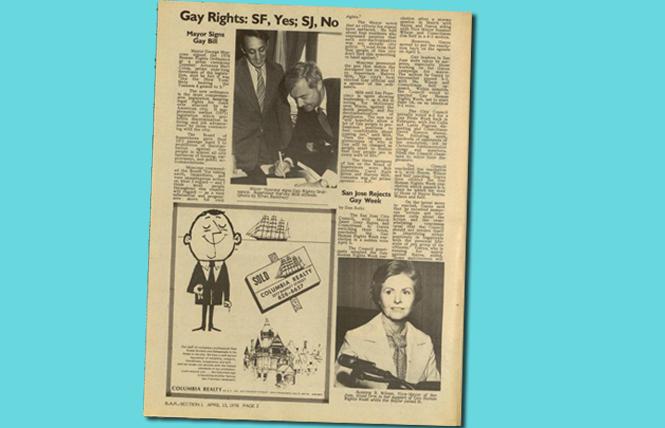
The April 13, 1978 issue of the Bay Area Reporter included a news article headlined “Gay Rights: SF Yes; SJ No.” It reported on then-San Francisco mayor George Moscone signing a gay rights ordinance that prohibited discrimination against gay people in almost all city instances of housing, employment, and public accommodations. In the South Bay, however, the story was different. There, the City Council rescinded a gay human rights ordinance in a sudden vote. It had previously passed the legislation on a close 4-3 vote. To view the issue, click here.
Help keep the Bay Area Reporter going in these tough times. To support local, independent, LGBTQ journalism, consider becoming a BAR member.
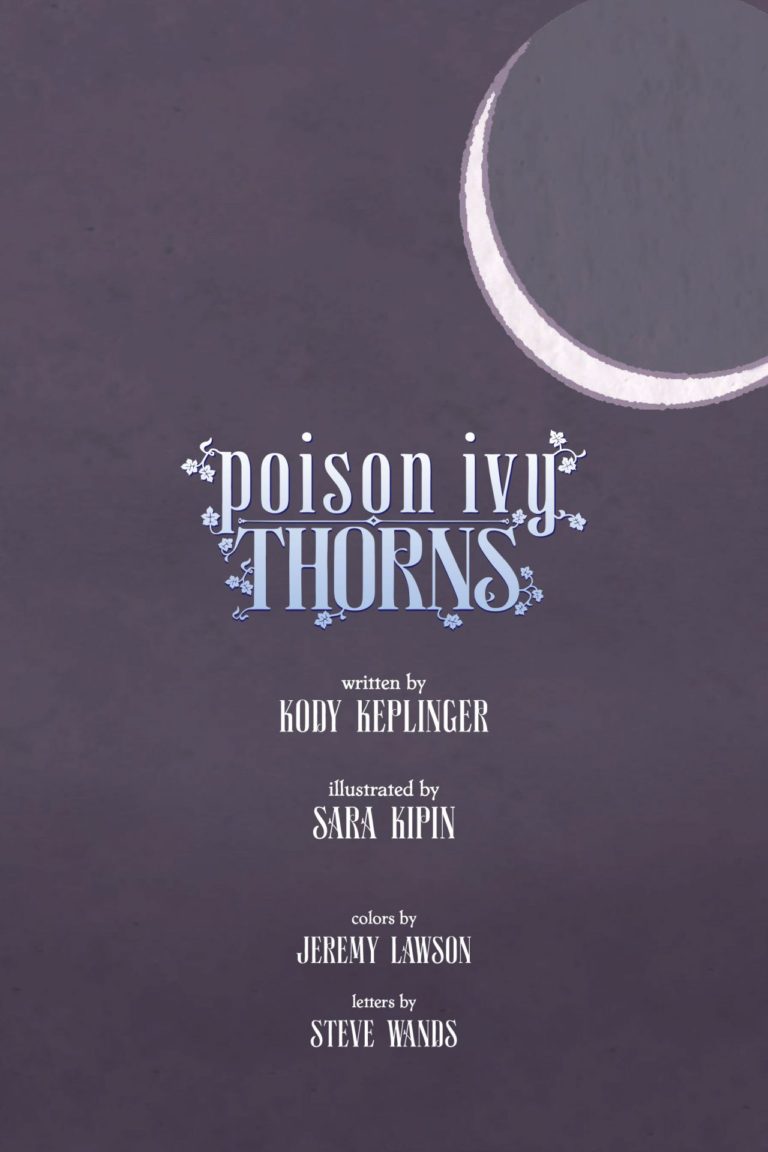
Poison Ivy is already a queer comics icon. Since her introduction in 1966’s Batman #181, Pamela Isley’s fabulous style and chaotic powers have made her a favorite among queer comics fans. But that particular headcanon has been transferred from the head to the page. As any DC Comics reader knows, Ivy is now canonically queer and has been for a while. And in a new YA OGN, Poison Ivy: Thorns, from writer Kody Keplinger, artist Sara Kipin, colorist Jeremy Lawson, and letterer Steve Wands, we get a gothic take on her origin that leans into her queerness. And it’s darkly delightful.
DC Comics
The origin story centers on a young Pamela as she traverses high school. Living in a huge creepy house with her father, the young girl is keeping a dark secret. But the arrival of a new friend in the young, bright Alice Oh changes her life and fate forever. Poison Ivy: Thorns began life as a conversation between DC and Keplinger. The author was chatting to the publisher about the potential of doing a YA story for them, but she only had one character she really wanted to write. “I was like, ‘Listen, I’m gay and I’m a vegan. Let me tell you why I could write a Poison Ivy story,’” Keplinger laughed as they Zoomed with Nerdist.
DC Comics
DC Comics
While the story changed from her original pitch, something that hit with DC was the B-movie tone they saw in the piece. But in their responses Keplinger saw something else. “What I’m hearing from you is less a B-horror movie and more modern Gothic. They were like, ‘Oh yeah, do that.’ It’s a favorite genre of mine. I really pulled from my love of things like Jane Eyre and just a variety of Gothic literature. Especially with reference to things like Sarah Waters books like Fingersmith; queer gothic literature. I wanted to pull that into the modern day and make creepy plants be a part of it.”
She continued. “Luckily for me, Sara Kipin’s art just really captures that vibe. I was so delighted with how she illustrated the plants in particular. So many of my panel descriptions were just like ‘the plants are kind of sinister.’ And I didn’t know if that was gonna be helpful at all. Then she did it; the plants are sinister and creepy and it’s amazing!”
DC Comics
DC Comics
Artist Kipin was just as excited about the collaboration and the chance to shape a new story for Ivy. “It was an incredible experience,” the artist told Nerdist via email. “I found Pamela to be relatable while reading the script, so it was easy to project on her and use my own life experience as a way to round her out. Being a moody LGBT teen will do that!”
That aspect of the creative process was clearly a satisfying one for both of the team. “It was so cool because we were sending the sections to her in chunks so that she could get started illustrating even as I was still scripting. It was really neat to see some of the art come back while I was still scripting later sections of it,” Keplinger explained. “I really liked it!” Kipin exclaimed. “Quarantine definitely isolated me a little more than usual, but personally working off of a script kept me excited about the story. Often I was drawing thumbnails of panels in reaction to reading the scripts. It felt more raw that way.”
DC Comics
DC Comics
DC Comics
For Keplinger, the project was a chance to dig into something deeper too. “One of the main things I really wanted to explore in this book was how in our society men, whether they realize it or not, seem to feel as if they have a strong sense of ownership over female bodies. Both in a romantic or sexual way, but also in a parental way. And I really wanted to kind of tackle that and explore that in a way that I hope is entertaining to readers.”
Her collaborator also shared what she wanted readers to take away from the book. “I hope readers get to enjoy a spooky story centered around characters that might be a bit more like them,” Kipin shared. “It’s hard to find LGBT horror stories, especially ones in mainstream media, so I hope this gets the chance to resonate with more people.”
Poison Ivy: Thorns will be available from DC Comics beginning June 1.
Sharon Brackett, a Maryland businesswoman and transgender rights advocate who played a lead role in the successful effort to persuade the Maryland Legislature to pass transgender rights legislation in 2014, died on May 24 at her Baltimore home. She was 59.
Her son, Steven Brackett, told the Baltimore Sun she had “chronic illnesses that manifested themselves in cardiac arrest.”
Brackett’s LinkedIn page says she helped to start five companies over the past 20 years and was named by the Maryland Department of Commerce in 2016 as one of Maryland’s Top Women in Tech.
With a degree in computer engineering from Syracuse University in New York, Brackett served as president and CEO for the Laurel, Md., based tech company Tiresias Technologies, Inc. from 2011 to 2019. She served from 2019 to 2021 as founder of Baltimore Design Works, Inc., an engineering and design company, according to her LinkedIn page.
In a YouTube interview in March of this year conducted by a student intern, Brackett said that after encountering what she considered discrimination in the business world as a transgender woman she joined other trans activists in 2011 as co-founder of Gender Rights Maryland, a statewide group that advocates for transgender rights. Bracket served as chair of the group’s board from 2011 to the time of her passing this week.
LGBTQ activists in Maryland have said Brackett also became involved in the broader LGBTQ rights movement. She served as co-chair for the National LGBTQ Task Force’s Creating Change conference in Baltimore in 2012. She also served on the boards of the Point Foundation, a national LGBTQ scholarship organization; and OutServe-SLDN, an advocacy group for LGBTQ people in the military.
As if that were not enough, Brackett co-founded Trans Parent Day and served as a volunteer co-moderator for a gender identity support group of the Gay and Lesbian Community Center of Baltimore. In prior years, she served as a mentor for high school students interested in tech-related projects and was a scout master in the Boy Scouts of America.
In 2018, Brackett won election to the Baltimore City Democratic State Central Committee, becoming the first transgender person to be elected to any political office in Maryland. She was later named as chair of the LGBTQ+ Diversity Leadership Council of the Maryland Democratic Party.
Brackett appeared to sum up her career as a businesswoman and her role as an activist in a campaign website post when she ran as a candidate for the Democratic committee position.
“Yes, I am an Engineer, Entrepreneur, Corporate Executive, Roboticist, Rocketeer, Maker, and sometimes Activist,” her campaign write-up says. “I also just happen to be trans. If that’s a showstopper for you then I’m probably not your candidate,” she stated.
“But if you consider my challenges and experience. My support of diversity and inclusion. My on the ground experience in Annapolis. I think you will find I’ve honed all the tools for this job and then some,” she stated.
“Sharon was a dedicated champion of equality for all and gave much of her time, heart and soul to the fight for equality for all Marylanders,” said College Park Mayor Patrick Wojahn, who’s gay. “Her passing is a true loss for the whole LGBTQ+ community,” Wojahn said.
Sara Law, Brackett’s partner for the past seven years, was the first to announce Brackett had passed away in a Facebook posting.
“She left this world so much better than she found it,” Law wrote. “That was one of her goals, and she met it many times over – be it Boy Scouts, or gender rights, or robotics, or local politics.”
The Baltimore Sun reported Brackett was born in Batavia, N.Y., and lived in Laurel, Md., before settling in Baltimore.
Survivors include her partner, Sara Law; her son, Steven Brackett; and daughter, Jess Brackett. No immediate plans were announced for funeral or memorial services.
The Capital Pride Alliance, the group that organizes D.C.’s annual LGBTQ Pride events, says it adopted a policy in 2018 to ban uniformed D.C. police officers from marching in the Capital Pride Parade.
Some LGBTQ community members contacted by the Washington Blade, including D.C. Black Pride organizer Earl Fowlkes, have said they were unaware of the Capital Pride policy of not allowing police participation in the parade and other Capital Pride sponsored events.
Fowlkes, who serves as executive director of the D.C.-based Center for Black Equity, which supports Black Pride events throughout the country, said D.C. Black Pride has had police presence at some of its events over the past 30 years and has no plans to ban police from its activities.
Ryan Bos, the Capital Pride Alliance executive director, sent the Blade a statement he said Capital Pride posted on its website in June of 2020 formally announcing the police policy. The statement came five days after an earlier statement posted on the group’s website expressing strong solidarity with the Black Lives Matter movement.
“In 2018 the decision was made that MPD [D.C. Metropolitan Police Department] would not participate as a contingent in the Pride Parade, and has not since,” says the statement, which was posted on June 8, 2020. “Going forward, CPA will not permit any uniformed and armed police officers to march in the Pride Parade or participate in CPA-sanctioned events,” the statement continues.
“As required by the city government, MPD has jurisdiction to close and clear the streets,” the statement says. “The MPD will continue to manage street closures as outlined in permit requirements. When needed, CPA will hire private security as has been done previously.”
The statement concludes by saying Capital Pride Alliance was committed to having “further talks with its LGBTQ+ partners and other organizations and the city to address the on-going concerns that have been raised by the community.” It adds that Capital Pride Alliance “will take additional actions in the coming days and weeks.”
Although the statement did not say so directly, it was referring to the earlier statement discussing Capital Pride’s support for the nationwide protests in June 2020 over the murder of Minneapolis resident George Floyd at the hands of a police officer who was later convicted of second-degree murder and manslaughter for Floyd’s death.
“Pride this year comes on the heels of a global pandemic and a nation confronting the murder of George Floyd at the hands of Minneapolis police officers,” the earlier statement posted on June 3, 2020, says.
“This horrific tragedy, and the murders of Breonna Taylor, Tony McDade, and Ahmaud Abrery by police and white vigilantes, have created a nationwide uprising crying out for racial justice and the protection of Black life,” the statement says.
“As members of the Black and Brown communities have stood with the LGBTQ+ community, the Capital Pride Alliance stands in complete solidarity to unite against those disparities that impact communities of color,” says the statement. “We pledge that we will work together to find solutions and make the positive changes that are so desperately needed to end inequity, injustice, and violence against people of color.”
In prior years, uniformed members of the D.C. police LGBT Liaison Unit have marched as a contingent in the Capital Pride Parade. During some prior years going back to the 1990s, D.C. police chiefs have joined the parade in police vehicles or watched the parade while standing along the parade route.
D.C. police spokesperson Dustin Sternbeck did not respond to a request by the Blade for comment on the Capital Pride policy of banning uniformed police participation in Pride events.
Gay retired D.C. Police Lt. Brett Parson, who served as director of the department’s Special Liaison Branch, which oversees the LGBT Liaison Unit, declined to comment on the Capital Pride ban on D.C. police participation.
Some LGBTQ activists have expressed the view that D.C. police participation in Pride events, especially participation by high-level police officials, was a sign of the D.C. police department’s strong support for the LGBTQ community.
But other activists, including members of the local transgender community, have said police crackdowns on sex workers, including transgender female sex workers of color, have involved what they believe to be a misplacement of police priorities. The local transgender and sex worker advocacy group No Justice No Pride has long called on Capital Pride to ban police from participation in all Pride-related events.
In the years since Capital Pride adopted its police policy, other cities, including Seattle, Denver, and just last week New York City’s Pride organization adopted policies banning police participation in their Pride parades and other Pride events.
Bos of Capital Pride said that similar to last year, due to COVID restrictions in place earlier this year, the traditional D.C. Pride Parade and festival will not be held in June this year. Although D.C. Mayor Muriel Bowser earlier this month removed all restrictions on large outdoor events beginning June 11, Bos said Capital Pride did not have time to organize a parade and festival for June. He said a Capital Pride Parade and festival are under consideration for October of this year.
The Capital Pride website includes information about a number of smaller Pride events for June, both in-person and virtual events. Among them will be a caravan of cars and vehicles decorated with Pride displays scheduled to travel across the city on June 12 to view houses and businesses that will display Pride decorations on their buildings or in their front yards.
Fowlkes said D.C. Black Pride organizers also fully support the Black Lives Matter movement and have condemned the incidents of police abuse, including the George Floyd murder in Minneapolis. But he said Black Pride organizers see no reason for banning police participation, especially the LGBT police officers who regularly attend Black Pride events.
“We’ve never had a problem,” he said. “Our members have never voiced a problem in dealing with the police,” according to Fowlkes.
“We know a lot of queer police officers and I welcome their presence,” Fowlkes said. “As long as they behave, I welcome everyone’s presence. It’s open to everybody. I can’t see eliminating the police any more than if people come in an Army uniform.”
David Johns, executive director of the D.C.-based LGBTQ group National Black Justice Coalition, has taken a different position than that of Black Pride.
“The D.C. Capital Pride Alliance was right to ban uniformed police from participating in the Pride Parade when it made its decision back in 2018,” Johns told the Blade in a statement. “For too many members of the LGBTQ+ community, especially Black LGBTQ+ and same-gender loving people, the presences of armed, uniform police make us feel less safe,” he said.
“It is important that the D.C. Capital Pride Alliance recognized that the struggle for civil rights for all must uplift all parts of us all of the time – including Black LGBTQ+ people who have too often been sidelined or excluded from the important discussions facing our community,” Johns said.
In yet another indication that the LGBTQ community is divided on the police issue, Washington Post columnist Jonathan Capehart, who’s gay and African American, wrote a column published in the Post on Monday expressing strong disagreement with the New York City Pride organization’s decision last week to ban LGBTQ police officers from marching in the New York Pride parade next month.
Capehart wrote that he fully understands the concerns over police abuse in New York and other cities in the past and in recent times. But he said he believes the New York Pride organizers made a “really bad call” in banning the NYPD Gay Officers Action League or GOAL from marching in this year’s parade.
“If you’ve been to a pride parade, you know it’s a celebration of acceptance and inclusion,” said Capehart in his column. “That’s why it’s beyond troubling that a community made up of so many who’ve been rejected by their families because of who they are is now turning on its own members because of what they do for a living,” he states. “This is wrong. This is shortsighted. This is a mistake.”
Poison Ivy Gets a Gay Origin Story in Reimagined ‘Batman’ Comic
Beloved botanical bisexual badass and Batman villain Poison Ivy is getting a queer origin story in the upcoming comic, Poison Ivy: Thorns!
Written by Kody Keplinger and illustrated by Sara Kipin, the new series “reimagines the origin story of the iconic Batman villain Poison Ivy,” according to Queerty.
Born Pamela Isley, we see Ivy’s teen years in Thorns, and how, after meeting a classmate named Alice, romance blossoms for the iconic, beloved DC Comics villainess.
The graphic novel goes on sale June 1. Watch the trailer below!
I hadn’t spent much time in Provincetown, Massachusetts, before last summer, but I had been given to understand that it’s a place not entirely like the rest of Cape Cod. If Cape Cod is beach-club conservatism and navy-blue-striped American prep, Provincetown is glitter and magic, poets and painters and queens—or so the hearsay went.
My partner, Lora-Faye, and I arrived by car and were greeted not by glitter, but by a warren of narrow lanes lined with tidy houses and gardens bursting with spectacular beds of flowers. Through these lanes strolled men, usually young but sometimes middle-aged or older, walking hand in hand, evidently on their way to the beach or returning to their own hydrangea-thick front yards. Lora-Faye and I live in New York City, where there is no shortage of gay couples, but there was something remarkable about seeing only gay people on a street lined with white picket fences and American flags.
Lora-Faye looked out the windshield, astonished. “What kind of colonial gay Disneyland is this?” she asked.
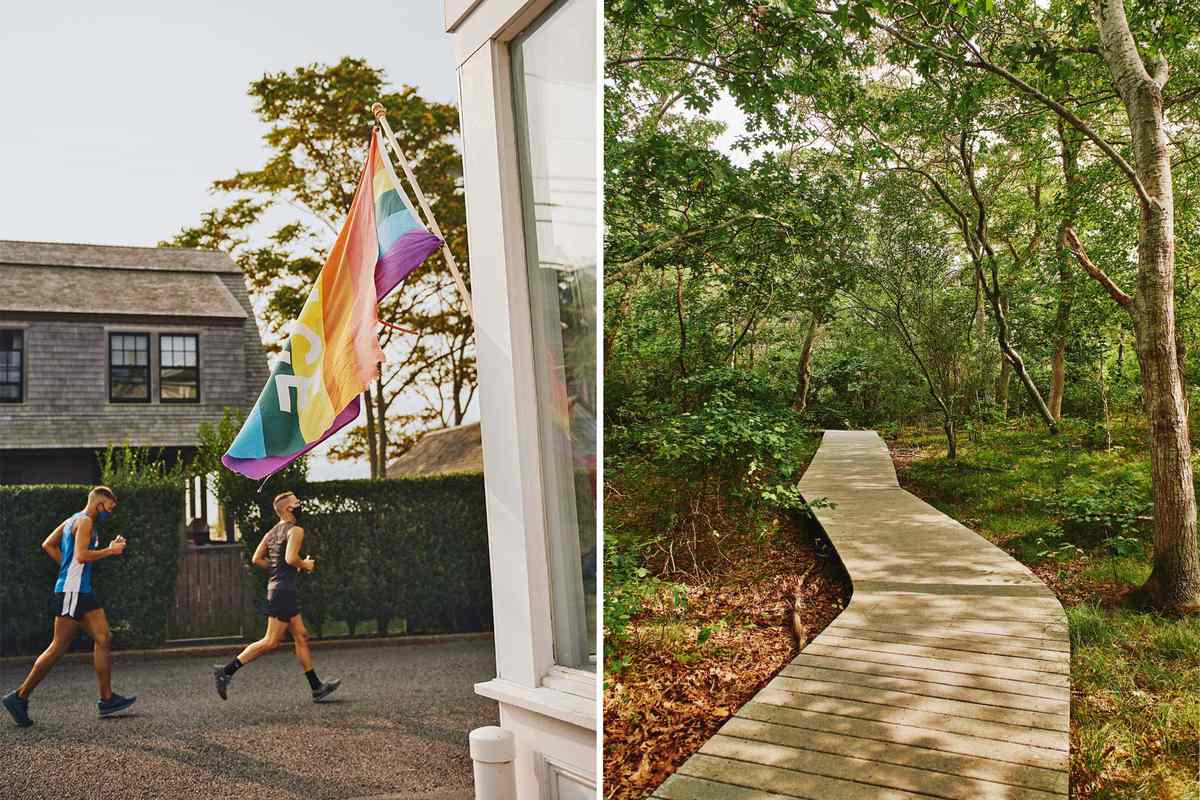
Pair of photos from Provincetown, showing runners along the town’s main street, and a boardwalk in a wooded area
From left: Staying beach-body fit on Commercial Street; a boardwalk at Cape Cod National Seashore, a reserve surrounding Provincetown. | Credit: Tony Luong
The cognitive dissonance of this sight is central to Provincetown’s overall ethos. Its geography and aesthetics are that of an 18th-century fishing village, but over the past 50 years, it has served as a beacon for the gay community—especially gay men. In the 1980s, this became the rare place where people suffering from HIV/AIDS could live without discrimination and with community support, and it has retained its reputation as a haven. Provincetown is probably the only place I’ve ever been where the roads are given over to elderly lesbians out for a walk and groups of muscled young men in vibrant swimming trunks pedaling toward the beach at a leisurely pace, a portable speaker blasting Whitney Houston’s “I Wanna Dance with Somebody” in the basket of a bicycle.
When it comes to getting around, bicycles, we quickly learned, are the done thing. Pedestrians and cyclists—many of whom take the 90-minute ferry ride from Boston—command the space, making driving a slow and sort of silly venture. This is nice, actually—the relative dearth of cars and the custom of hopping on your bike to go wherever you want makes running around town feel like a reversion to some real or imagined childhood.
We ditched our car as soon as we could and checked in to the Red Inn. This former whaling captain’s house was built in 1805 near the spot where the Pilgrims first docked the Mayflower, and has operated as a hotel since 1915. Our room, which overlooked the beach at Provincetown Harbor, had a deck that hung above the sand and, when the tide came in, above the water.
The custom of hopping on your bike to go wherever you want makes running around town feel like a reversion to some real or imagined childhood.
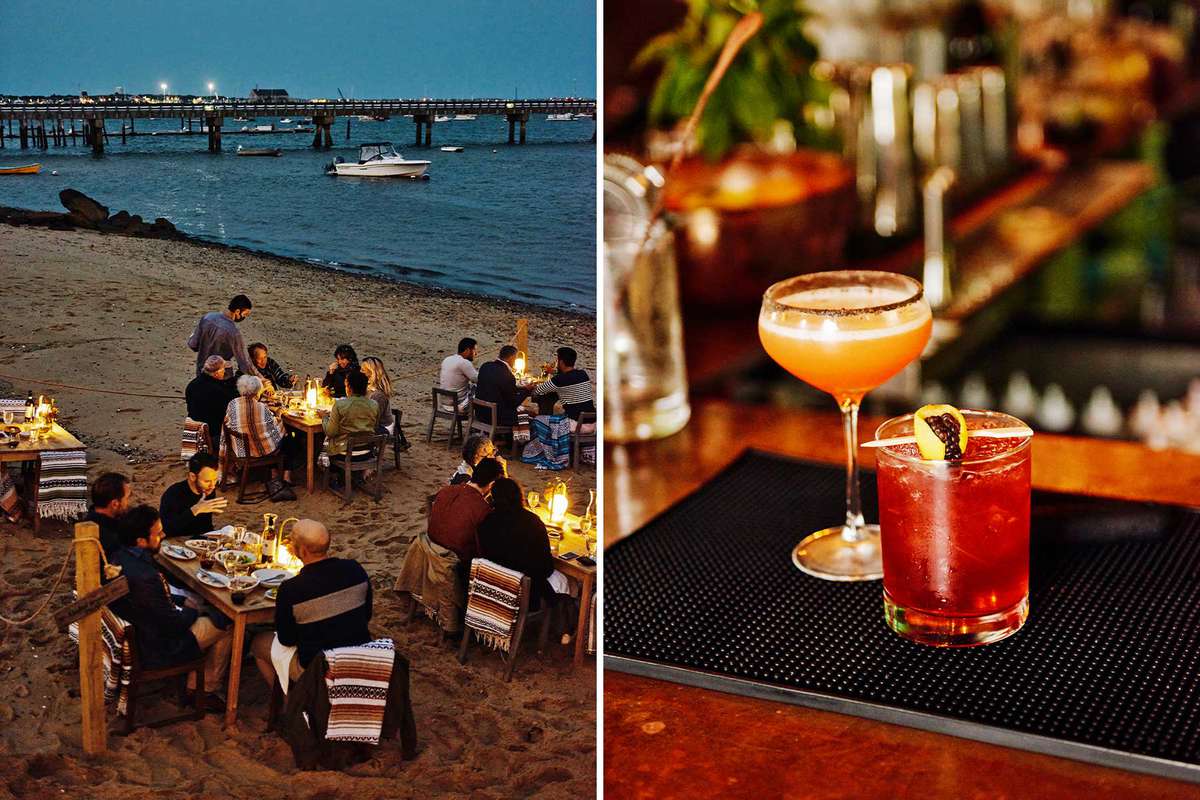
Lora-Faye and I arrived in the evening with no fixed plans, so we decided to walk around and find something to eat. We had heard that Sal’s Place, a homey Italian restaurant on the beach, was so popular that we would be unlikely to get a table. We stopped by anyway, and got lucky. It was our loveliest evening in town. The host walked us behind the building, where the staff had jammed wooden tables into the sand at the water’s edge, and brought us successively more delicious plates of food: burrata and corn salad, a Caesar with shaved cauliflower, a perfect bowl of linguine with fresh clams.
As we ate, the sun went down and the tide rose. The diners sitting closest to the water kept moving their tables back or abandoning them—by the time we were done with our pasta, the water was lapping at our ankles and we’d perched our shoes next to us on our chairs. Eventually, we too ditched our table, and the waiter invited us to bring our glasses of wine back up to the deck, where we sat happily, barefoot, amid the bustle of the staff, who were cheerfully carrying tables out of the water’s reach.
Afterward we decided to continue our walk through town, which was by then dark and quiet, and scented with those extravagant front-garden flowers. Because much of Provincetown’s architecture dates back to the 17th and 18th centuries, the buildings and streets aren’t quite what we now think of as life-size. They were built for a population that was a few inches shorter, on average, than modern Americans, which gives the place a slightly fantastical aspect, as if it were a fairy village or a movie set.
The town is miraculously free of mosquitoes, which adds to the sense that it is a charmed place, exempt from the banal irritants of normal life, like bugs or homophobia. The streets had the hushed quality of small towns after hours in summer, when the air is so thick and warm it seems to have sound-dampening qualities. Friends called to each other from bicycles or stopped to chat across garden fences. Most people seemed to know most people.
Pair of photos from Provincetown, including an outdoor beach dinner scene, and cocktails at a bar
From left: Sal’s Place, a beloved beachside Italian restaurant; seasonal cocktails at Strangers & Saints. | Credit: Tony Luong
This was not a typical summer evening in Provincetown. In August, during a normal year, the town sees 60,000 visitors a day—a fact that, considering its size and infrastructure, seems flat out impossible. Those weeks are Carnivalesque: people come from all over the world for drag shows and queer dance parties, clubbing, parades, costumes, and raucousness. All of this was impossible under pandemic conditions.
When we were there, the clubs were closed, and the famous tea dance at the Boatslip had been postponed until 2021. Restaurants and bars were only serving outside, and just a few of the veteran performers (Miss Richfield 1981, Varla Jean Merman) were still doing their acts—on outdoor stages. The streets, normally shoulder-to-shoulder with visitors, were relatively subdued, and a team of “community ambassadors” wearing red pageant sashes reminded folks to keep their masks on.
It was all extremely pleasant, even with the masks and the odd dance of maintaining six feet from everyone. We wandered the shops and galleries displaying the work of the generations of painters who have come to the Provincetown Art Colony. (The oldest in the country, it has played host to Jackson Pollock, Helen Frankenthaler, Robert Motherwell, and others.) One afternoon, we dropped by the Lobster Pot, a favorite seafood spot, for a peculiar-sounding but mouthwatering buffalo-shrimp roll, and another day we ate at the Canteen, which serves fat lobster rolls at picnic tables in its pleasant backyard.
Guests wait in line outside the red neon lights of The Lobster Pot restaurant in Provincetown
The Lobster Pot, a 43-year-old Provincetown favorite. | Credit: Tony Luong
Many of the area staples were still humming: the Atlantic House, one of the oldest dives in town (and one of a few establishments open through the desolate winter months), was still serving pints and peanut butter and jelly sandwiches on its porch, and the tiny History of Sex Museum at the front of the sex shop Toys of Eros still had its merkins and vintage vibrators on display. The Provincetown Portuguese Bakery continued to crank out plain-looking but miraculously textured malasadas.
There is a real wildness to the landscapes around Provincetown, which seemed to come into sharper relief in the absence of crowds or nightlife.
Provincetown is also a writer’s town—it has been home to Eugene O’Neill, Norman Mailer, Mary Oliver, Mark Doty, and many more—and we made several trips to Tim’s Used Books, a dreamy little cottage on Commercial Street piled with an excellent selection of secondhand volumes and rare editions. It is run by Tim Barry, who has been in Provincetown since the 1990s and who told us that it was basically unchanged except for the influx of millionaires, who have scooped up the historic real estate over time, charmed by the beaches and the town’s quirky serenity.
Pair of photos from Provincetown, including a detail of sea grasses, and a Caesar salad on a picnic table
From left: Wild grasses at Cape Cod National Seashore; cauliflower Caesar salad at Sal’s Place. | Credit: Tony Luong
We started each day by drinking coffee on the deck of our room at the Red Inn and marveling at the tides, which are unusually dramatic because the beach in Provincetown is so shallow. At low tide, the ocean withdraws and leaves the sand lacquered as far as the eye can see. Slowly, then, the water returns, like creeping lace, until the beach disappears. This was the point at which we would grab our swimsuits and bicycles and pick up breakfast from Relish, a bakery on a residential corner of Commercial Street that was taking telephone orders and handing paper bags full of croissants and egg sandwiches out of its screen door.
Several times we wound up eating on the causeway, a giant rock breakwater that stretches from Pilgrim’s First Landing Park across to Long Point. The lee side, a few locals told us, is the best spot for swimming; the sunny rocks were a good place for picnicking and watching birds eat clams and people picking their way carefully along the stone path to Long Point Beach.
There is a real wildness to the landscapes around Provincetown, which seemed to come into sharper relief in the absence of crowds or nightlife. One afternoon, we took a spectacular bike ride along the trails that trace the protected marine lands outside town. Our route took us through a wilderness of dunes, ponds, tall grasses, and a hidden forest of beech trees. Out in the dunes, too far off the path for us to see, are shacks that were originally built for shipwrecked sailors who had washed up on shore and that the artists’ colony has turned into studios.
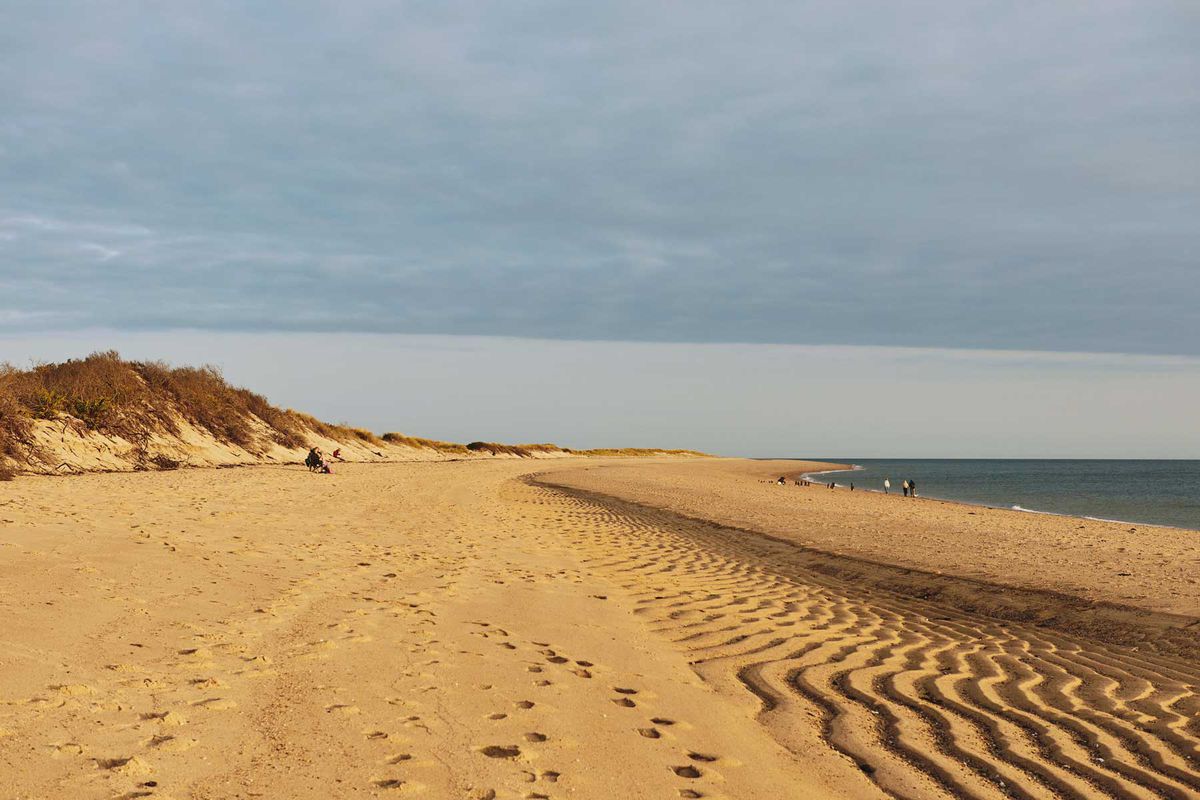
A wide beach near Provincetown, on the Atlantic Ocean
A stretch of the 21-mile coastline that envelops the town. | Credit: Tony Luong
Another afternoon we took the long way to Herring Cove Beach, which involved walking three-quarters of a mile through a wide lagoon bed and wading at points. As we followed the footsteps of several young men ahead of us, we didn’t realize that the tide was coming in. Suddenly, the ocean was flooding steadily in our direction, and by the time we turned back the paths were underwater. The terrain, which we’d been mapping by dunes and footprints, was unfamiliar. Up to our shins in water, we ran into a large coyote on a sand bank, who had squared off in front of her three pups. She tracked us as we retreated carefully to the ocean and walked back to our bikes.
“The lunar stillness that pervades out there is difficult to describe. It involves a repose that is pleasurable without being exactly comforting,” Michael Cunningham writes in his book Land’s End: A Walk in Provincetown. This seems to be the town’s favorite text, so ubiquitous that I was, initially, stubbornly reluctant to read it. This obstinate streak usually ensures that I’m pointlessly late to something wonderful. Cunningham’s book is wonderful. In the landscape, Cunningham writes, “you feel as if you are in the eye of something. You are aware—I am aware, anyway—of the world as a place that doesn’t know or care that it’s beautiful…it lives according to geological time.”
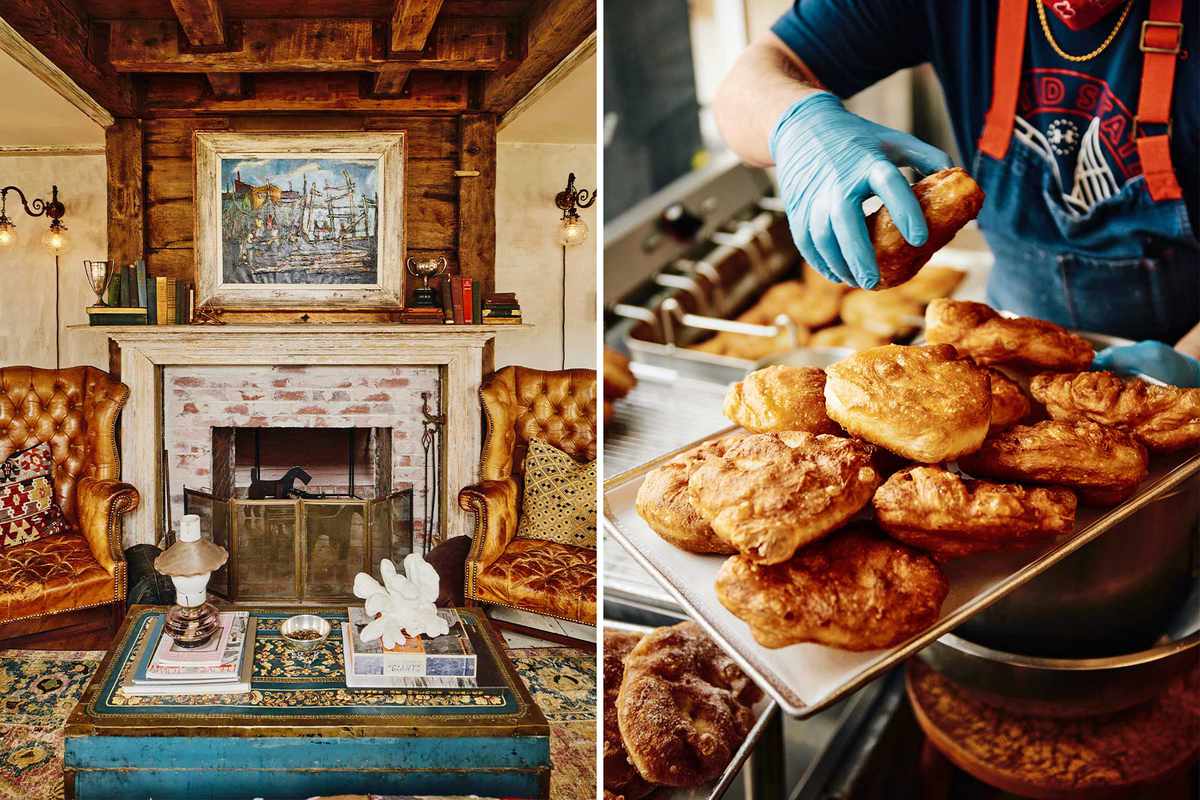
Pair of photos from Provincetown, including an interior of the Vorse house, and a tray of fried Portuguese dough at a bakery
From left: The sitting room at the Mary Heaton Vorse house; malasadas, a fried dough specialty made at the Provincetown Portuguese Bakery. | Credit: Tony Luong
The person who finally convinced me to read Land’s End was Ken Fulk, the celebrity interior designer who has recently taken over the Mary Heaton Vorse house, an important specimen of local history. Vorse was a writer and labor journalist who made Provincetown her home in 1907 and was at the center of the town’s transition from a whaling port to a hub for the creative avant-garde. She died in 1966, leaving the house to her family. A few years ago, her granddaughters sold the house to Fulk and his husband, Kurt Wootton, who set about restoring the property and offering it to the community as an artists’ residence, exhibition space, and center for lectures, fundraisers, and other cultural events. (Their own house is across the street.)
Fulk, who is an enthusiastic champion of both Provincetown and Vorse, walked Lora-Faye and me around the house, extolling the virtues of a town that has survived on its quirkiness and scrappiness, its embrace of outsiders and free self-expression. He read to us from Vorse’s memoir of her life in Provincetown, Time and the Town:
“It is not quaint. It is a serious town; the way it is built has to do with the difficult and dangerous manner in which its living has always been earned…. People here have been nourished by beauty and change and danger.”
Pair of photos from Provincetown, including a rainbow colored welcome sign, and the interior of a small grocery store
From left: Rainbow style on Commercial Street; picnic provisions at Angel Foods. | Credit: Tony Luong
Its earliest industries, fishing and whaling, were precarious, Fulk pointed out, and its later residents were experimental artists and outcasts. It has survived more than one plague. At various points in history there has been concern that the town would be overtaken by migrating dunes.
Some of these edges have been softened: the primary industry is now tourism instead of whaling; the town’s gay culture feels squarely mainstream and commercialized. (Ryan Murphy has a house here.) Nevertheless, there remains an oddball, edge-of-the-world charm. After leaving the Mary Heaton Vorse house, we stopped across the street at Angel Foods, a winsome little grocery that’s been there for decades, and bought a jar of pickles for no other reason than that they had a picture of the maker on the lid, a giant kosher pickle cocked jauntily between his teeth.
Even last summer, during a time of uncertainty and loss, Provincetown retained its knack for dancing in the face of hardship and, like the queer community it champions, meeting existential threats with a defiant insistence on pleasure and joy.
After the Puritans displaced and decimated the Nauset people who had lived on the land, Provincetown became the domain of Portuguese fishermen and whalers, who enjoyed humor and dancing, and are credited for the fact that the town is less conservative than the rest of Cape Cod. Even last summer, during a time of uncertainty and loss, Provincetown retained its knack for dancing in the face of hardship and, like the queer community it champions, meeting existential threats with a defiant insistence on pleasure and joy.
On our last afternoon we returned our bicycles and walked back to our car through the quiet streets. From somewhere we could hear a man’s voice singing: “Ooh, life is juicy, juicy, and you see I’ve gotta have my bite, sir.” It was the Barbra Streisand classic “Don’t Rain on My Parade.” We could hear the man belting it out all the way down the block, maybe singing in the shower, maybe rehearsing for a cabaret act that he would perform masked and at a distance. “I simply gotta march, my heart’s a drummer! Nobody, no, nobody is gonna rain on my parade.”
Plan the Perfect Provincetown Trip
Where to Stay
The Red Inn: An old whaling captain’s house converted into an eight-room inn with antique furnishings and a beachfront restaurant. Doubles from $345.
Where to Eat
Angel Foods: This small grocery is the best place to pick up picnic provisions.
The Canteen: Lobster rolls and other high-end lunchtime fare. entrées $8–$22.
Relish: This popular breakfast spot, known for its baked goods, sells a great egg sandwich.
Sal’s Place: A local favorite serving seafood and housemade pastas. Entrées $23–$39.
Strangers & Saints: Inventive New American food (plus excellent cocktails) served in a scenic backyard. Entrées $18–$34.
Where to Shop
Outermost: One-of-a-kind artworks, pottery, wooden bowls, and handmade furniture.
Respoke: Handcrafted espadrilles and accessories made from vintage silk scarves.
Tim’s Used Books: A well-curated collection in a cottage set back from Commercial Street. 242 Commercial St.; 508-487-0005.
Toys of Eros: An exuberant, LGBTQ friendly spot that carries adult toys.
What to Do
A version of this story first appeared in the June 2021 issue of Travel + Leisure under the headline Small Town, Big Heart.














 100vw, 569px”><figcaption id=) Yaoundé Central Prison — exterior
Yaoundé Central Prison — exterior 100vw, 866px”><figcaption id=) This design of three women behind bars represented the three prisoners at Bertoua Central Prison who were helped in Phase 3 of the Not Alone / Pas Seul Project.
This design of three women behind bars represented the three prisoners at Bertoua Central Prison who were helped in Phase 3 of the Not Alone / Pas Seul Project.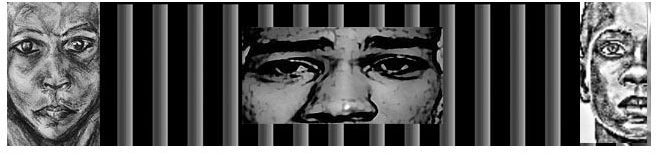
 100vw, 674px”><figcaption id=) Images representing the three gay prisoners in Yaounde whose only crime was being gay. Through Phase 1 of the Not Alone / Pas Seul project, they received much-needed deliveries of food and hygiene supplies.
Images representing the three gay prisoners in Yaounde whose only crime was being gay. Through Phase 1 of the Not Alone / Pas Seul project, they received much-needed deliveries of food and hygiene supplies.