This article was written by associate professor of English and gender, sexuality, and women’s studies Jules Gill-Peterson for The Conversation. Faculty members and researchers who want to learn more about publishing in The Conversation can read about the process here.
In 1942, a 17-year-old transgender girl named Lane visited a doctor in her Missouri hometown with her parents. Lane had known that she was a girl from a very young age, but fights with her parents over her transness had made it difficult for her to live comfortably and openly during her childhood. She had dropped out of high school and she was determined to get out of Missouri as soon as she was old enough to pursue a career as a dancer.
The doctor reportedly found “a large portion of circulating female hormone” in her body during his examination and suggested to Lane’s parents that he undertake an exploratory laparotomy—a surgery in which he would probe her internal organs in order to find out more about her endocrine system. But the appointment ended abruptly after her father refused the surgery, feeling “the doctor did not know what he was talking about.”
I first encountered Lane’s story buried among the papers of an endocrinologist, but her brief encounter with a doctor during her teenage years was typical of many transgender children like her in the early to mid-20th century. These stories form a key thread of the first several chapters of my book, “Histories of the Transgender Child,” and they point to the tremendous obstacles these kids faced in a world where the word “transgender” didn’t even exist.
The living laboratories of gender
In the first half of the 20th century there was nothing like today’s gender-affirming pediatric care model, which involves building a social support network and can include treatments like hormone blockers. Doctors simply did not allow trans patients to transition.
That doesn’t mean doctors and researchers weren’t interested in seeing children like Lane as patients. But instead of supporting their wishes and hopes, doctors tended to see them as canvases for experimentation—to see how their growing bodies responded to various surgeries or hormonal cocktails. In my research I tracked several decades of this kind of medical research, beginning in the early 20th century at research hospitals like the Johns Hopkins Hospital in Baltimore.
In fact, medical researchers were particularly interested in treating still-developing LGBTQ youths as a way to refine their techniques for forcing a binary sex on intersex children or carrying out conversion therapy—which aims to coerce a heterosexual or gender-confirming behavioral outcome—on gay children.
In this climate, Lane’s father may have unwittingly saved her from a harmful attempt at “corrective” surgery or hormones to try to prevent her from being trans. Even though Lane left home at age 18 to live as a woman, she would have to wait over a decade before finally obtaining access to hormones and surgery in the mid-1950s.
Trans childhoods before trans medicine
The struggles of trans children in the era before modern transgender medicine show not just how trans youths are far from a new phenomenon, but also how tenacious and forward-thinking they were compared with their parents and doctors.
Two stories of other trans people like Lane show how clinicians’ refusal to let them transition never stopped them from being trans. Both of them found their way to the Johns Hopkins Hospital, which, during the first seven decades of the 20th century, was widely regarded as the one institution in the U.S. for people with questions about their sex and gender.
When psychologists at Johns Hopkins interviewed a retired trans woman from the Midwest in 1954, she told them about her childhood in the 1890s. Even then, without any concept or term for being trans, this woman—by then in her 60s—told them it was obvious to her that she was a girl.
“I wanted a doll and buggy very much,” she reminisced of her intense attachment to the toys given only to girls. While her wish to be a girl never waned, her life had never afforded her the opportunity to transition to living full time as a woman until she retired.
Five years later, the clinicians at Johns Hopkins met a trans man who was then in his 30s. He had come to them seeking top and bottom surgery. Growing up in rural upstate New York in the 1930s, he had been forced to drop out of school “because of the excruciating sense of embarrassment at being obliged to wear girls’ clothes.”
Unlike the trans woman from the Midwest, this trans man, as a teenager, found a path to living openly as a boy: manual labor at a lumber mill. By working in a men’s profession and proving his masculinity through showcasing his strength, his presentation as a boy was embraced by his community. Decades later, he sought out the doctors at Hopkins only to confirm what had long been true in his life: that he was a man.
Growing up despite every obstacle
Each of these three children—like the countless more from this early 20th-century era—had to wait until adulthood to finally transition.
Yet the failure of doctors and other gatekeepers to stop them from transitioning as children, and their inability to access any form of gender-affirming medical treatment, hardly prevented them from being trans or growing up to be trans adults.
This is all the more remarkable given that before the 1950s, very few Americans had access to any concept or information about trans life. While small communities of adult trans people are evident as far back as the turn of the 20th century, most children would not have had access to these discreet social worlds, which tended to exist in major cities like New York and San Francisco. Without any media to supposedly influence them and without role models, these remarkable young people were able to stay true their inner feelings en route to living trans lives.
They’re a reminder that conversion therapy, attempts to suppress or limit transness and gatekeeping through legislation don’t work.
They didn’t work a century ago and they won’t work today.
[June is Pride Month, and this year we’re celebrating by honoring 30 LGBTQ firsts. To see the full list, visit nbcnews.com/pride30.]
Upon being unanimously confirmed as a California Supreme Court justice in November, Martin J. Jenkins made history as the first openly gay justice and third Black man to serve on the state’s highest court.
“There were others before me who were qualified and who weren’t out or weren’t selected. So being the first, and being an African American man, too, is a big responsibility,” he said. “I know how being in the minority feels, and so my plan is to do the job as well as I can. Hopefully, I’ll have the ability to shine a light on the possibilities for people who look like me or have the same orientation as I do. I think it’s also important to make sure you conduct yourself with honor and integrity with the way you do your work.”
Born and raised in San Francisco, Jenkins grew up helping his father, a clerk and janitor with the city and county of San Francisco, clean office buildings and churches, according to a statement issued by California Gov. Gavin Newsom after he selected Jenkins for the state’s highest court. As a young man, Jenkins briefly played in the NFL after signing with the Seattle Seahawks. But after realizing “his true calling was becoming a lawyer,” he enrolled in the University of San Francisco School of Law and obtained his degree in 1980, according to the statement. Jenkins later became a civil rights attorney with the Civil Rights Division of the Department of Justice where he “pursued cases involving police misconduct and cross burnings,” and also worked to “promote gender equality through cases on pregnancy-related leave and sex discrimination.”
Prior to joining the state Supreme Court, he served for over 30 years as a state and federal judge, according to the official California Supreme Court Twitter account. In an interview with Law.com, Jenkins, now in his late 60s, said that accepting himself as gay was “bar none” his greatest challenge.
“The most important thing is making sure that I see myself as I am, the best self I can be,” he said in the interview. “That’s what I’ve always tried to do, and I don’t see any reason to change that formula now.”
[June is Pride Month, and this year we’re celebrating by honoring 30 LGBTQ firsts. To see the full list, visit nbcnews.com/pride30.]
Quince Mountain, the Iditarod’s first openly transgender dog musher, is using his popularity on social media to combat anti-trans sports bills in his home state, Wisconsin, as well as a slew of similar bills introduced in dozens of states. The two Republican-backed measures being debated in the Wisconsin Legislature seek to ban trans students from participating on sports teams that match their gender identities.
“I don’t think I’ve been angrier about an issue than I am about this sports thing,” said Mountain, 41.
Mountain became the first out transgender musher to compete in the 1,000-mile Iditarod Trail Sled Dog Race through Alaska in March 2020 (he was forced to stop about 250 miles shy of the finish line because of the Covid-19 pandemic). Now, Mountain, who has garnered a sizable following on social media, is racing to educate the public and state lawmakers about the potential dangers of anti-trans sports bills.
“It sends a message to trans kids that they’re a problem to be dealt with, and that message, I think, is lethal,” he said. “This is so punitive. It’s using kids as a political cudgel.”
Quince Mountain pets one of the dogs on his team in Anchorage, Alaska, on March 7, 2020.Ash Adams / for NBC News
Mountain put his anger into action last month, testifying against the proposed sports bills alongside other advocates at a hearing before Wisconsin legislators. He said the bills would affect all students, not just the small number of transgender athletes. “If I’m not on your team, you lose, too, not just me,” he testified.
He also teamed up with actor and photographer Rachel Crowl to produce a short video titled “Let Kids Play” to spread a message that for youths, playing sports is about learning teamwork and making friends, not coming in first place. The video features a number of transgender and cisgender people — including local elected officials and artists — who talk about how sports shaped them into who they are today. Mountain called on the Ugly Dogs, a group of mushing enthusiasts who follow him and his wife, fellow musher Blair Braverman, on social media, to raise nearly $4,000 to produce the video.
Mountain came out publicly as trans in 2019 on the Discovery Channel’s “Naked and Afraid” survival reality TV show, where contestants compete in the nude. He said he used to describe himself as a “reluctant trans person” because of his hesitation to be public about his identity.
“Now, I’m not a reluctant trans person,” he said. “Now, like, f— you, I want to tell everybody.”
Choking back tears, he said he gets notes from parents at least twice a week thanking him for showing their trans children that “you can have a life beyond” being trans and that it “doesn’t have to be all negative.”
Anti-trans sports bills are personal for Mountain. While he didn’t transition until he was in his 20s, he was “often read as male” as a teenager, he said. Despite being a good softball player, he was cut from the girl’s softball team at the high school he attended in suburban Chicago, he said. The coach, he said, told him she cut him because he would be bad for “team cohesion,” suggesting, he suspects, that she felt his presence on the team would play into the stereotype that softball players are gay.
Getting cut was “devastating,” he said. “I was indignant, but I also felt like I couldn’t do anything, and I just gave up. I mean, it made me this, like, cynical, angry person.”
Quince Mountain drives his team during the restart of the Iditarod in Willow, Alaska, on March 8, 2020.Lance King / Getty Images
Mountain pursued adventure sports as an adult, including horseback riding and, later, dog mushing — individual sports in which he didn’t have to rely on anyone but himself. The discrimination he dealt with in childhood, he said, gave him a useful skill: the ability to endure.
“It’s easy for me to be focused on only the voice in my own head, which, I don’t know, I think it’s something a lot of people have to learn,” he said.
Mountain chose not to compete in this year’s Iditarod. One of the reasons, he said, was that he felt the Covid-19 pandemic put the small villages that dot the Iditarod’s trail — many of them home to Indigenous people — at risk. But he said he hopes to compete in the 400-mile John Beargrease Sled Dog Marathon in northern Minnesota and the 325-mile Canadian Challenge, Canada’s premier dog sled race.
Mountain said Pride is about overcoming the “crucible” of being LGBTQ in a society that doesn’t always accept you.
“Once you work through that, that’s what Pride is,” he said. “I hope everybody can find that pride, whether they’re trans, whether that’s just being who you are, sharing who you are, and not being threatened by other people being who they are, even when that’s different.”
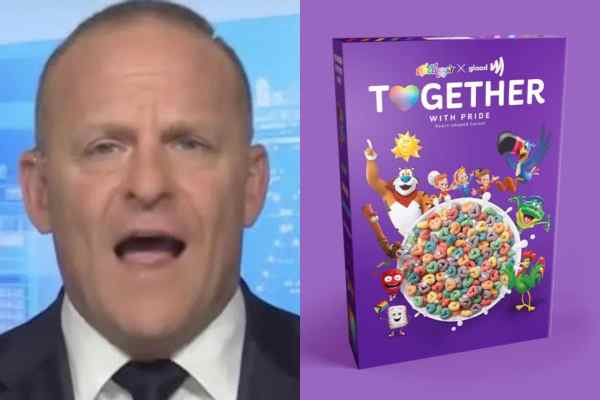
Newsmax’s Grant Stinchfield complained about Kellogg’s “woke” Together with Pride cereal
A host on pro-Trump, right-wing cable channel Newsmax spent a segment ranting about “woke” LGBTQ cereal and Lucky Charms’ “gay leprechaun” mascot.
Grant Stinchfield, who was last month pulled off-air after outcry over antisemitic remarks he made during a broadcast, railed against Kellogg’s recently launched “Together with Pride” cereal.
Created to celebrate LGBTQ Pride month, the berry-flavored cereal has an edible glitter coating and resembles heart-shaped Froot Loops.
Stinchfield apparently isn’t a fan, claiming that the “woke” cereal will force children to be “confused about their gender” over breakfast.
“Come on man,” the Newsmax host complained last week. “The cereal is Rainbow hearts, covered in edible glitter. How nice. Give me a break. Here’s the worst part, the cereal slogan, ‘too amazing to put into a box,’ and then lists a space for kids to write in their own pronouns.”
Stinchfield then turned his attention to General Mills’ Lucky Charms and its “gay” mascot Lucky the Leprechaun.
“Isn’t Kellogg’s a little late to this woke game by the way? General Mills has, I think General Mills has a gay leprechaun, right?” Stinchfield said. “Well, my producer Carly asked me, ‘is that leprechaun really gay?’ I said I don’t know, maybe: he wears high heeled shoes, prances around in tights, leads me to believe, probably, that little Lucky Charm leprechaun might be gay.”
Stinchfield, perhaps anticipating that his comments wouldn’t be well-received, asked those who “want to vilify me” if they’re not “just as offended by the flamboyant rainbow hearts and glitter as a symbol of gayness?”
“See, there are two standards here,” he continued. “Nothing like forcing our kids to be confused about their gender first thing in the morning with their breakfast.”
Stinchfield then offered a solution to parents worried that a breakfast cereal might make their child LGBTQ.
“Switch your kids to granola. It’s healthier anyway,” he said. “You cut the sugar, okay, and then you don’t have to buy products from woke companies.”
Watch Stinchfield’s rant below:
“I think General Mills has a gay leprechaun, right?…He wears high heels shoes, prances around in tights – leads me to believe, probably, that little Lucky Charm leprechaun might be gay” pic.twitter.com/THaBfIWtZ3
These are challenging times for news organizations. And yet it’s crucial we stay active and provide vital resources and information to both our local readers and the world. So won’t you please take a moment and consider supporting Metro Weekly with a membership? For as little as $5 a month, you can help ensure Metro Weekly magazine and MetroWeekly.com remain free, viable resources as we provide the best, most diverse, culturally-resonant LGBTQ coverage in both the D.C. region and around the world. Memberships come with exclusive perks and discounts, your own personal digital delivery of each week’s magazine (and an archive), access to our Member’s Lounge when it launches this fall, and exclusive members-only items like Metro Weekly Membership Mugs and Tote Bags! Check out all our membership levels here and please join us today!
The uprising at the Stonewall Inn in June, 1969, sparked a liberation movement — a call to action that continues to inspire us to live up to our Nation’s promise of equality, liberty, and justice for all. Pride is a time to recall the trials the Lesbian, Gay, Bisexual, Transgender, and Queer (LGBTQ+) community has endured and to rejoice in the triumphs of trailblazing individuals who have bravely fought — and continue to fight — for full equality. Pride is both a jubilant communal celebration of visibility and a personal celebration of self-worth and dignity. This Pride Month, we recognize the valuable contributions of LGBTQ+ individuals across America, and we reaffirm our commitment to standing in solidarity with LGBTQ+ Americans in their ongoing struggle against discrimination and injustice.
The LGBTQ+ community in America has achieved remarkable progress since Stonewall. Historic Supreme Court rulings in recent years have struck down regressive laws, affirmed the right to marriage equality, and secured workplace protections for LGBTQ+ individuals in every State and Territory. The Matthew Shepard and James Byrd, Jr. Hate Crimes Prevention Act broadened the definition of hate crimes to include crimes motivated by sexual orientation or gender identity. Members of the LGBTQ+ community now serve in nearly every level of public office — in city halls and State capitals, Governors’ mansions and the halls of the Congress, and throughout my Administration. Nearly 14 percent of my 1,500 agency appointees identify as LGBTQ+, and I am particularly honored by the service of Transportation Secretary Pete Buttigieg, the first openly LGBTQ+ person to serve in the Cabinet, and Assistant Health Secretary Dr. Rachel Levine, the first openly transgender person to be confirmed by the Senate.
For all of our progress, there are many States in which LGBTQ+ individuals still lack protections for fundamental rights and dignity in hospitals, schools, public accommodations, and other spaces. Our Nation continues to witness a tragic spike in violence against transgender women of color. LGBTQ+ individuals — especially youth who defy sex or gender norms — face bullying and harassment in educational settings and are at a disproportionate risk of self-harm and death by suicide. Some States have chosen to actively target transgender youth through discriminatory bills that defy our Nation’s values of inclusivity and freedom for all.
Our Nation also continues to face tragic levels of violence against transgender people, especially transgender women of color. And we are still haunted by tragedies such as the Pulse Nightclub shooting in Orlando. Ending violence and discrimination against the LGBTQ+ community demands our continued focus and diligence. As President, I am committed to defending the rights of all LGBTQ+ individuals.
My Administration is taking historic actions to finally deliver full equality for LGBTQ+ families. On my first day in office, I signed an Executive Order charging Federal agencies to fully enforce all Federal laws that prohibit discrimination on the basis of gender identity or sexual orientation. As a result, the Federal Government has taken steps to prevent discrimination against LGBTQ+ people in employment, health care, housing, lending, and education. I also signed an Executive Order affirming all qualified Americans will be able to serve in the Armed Forces of the United States — including patriotic transgender Americans who can once again proudly and openly serve their Nation in uniform — and a National Security Memorandum that commits to supporting LGBTQ+ Federal employees serving overseas. My Administration is also working to promote and protect LGBTQ+ human rights abroad. LGBTQ+ rights are human rights, which is why my Administration has reaffirmed America’s commitment to supporting those on the front lines of the equality and democracy movements around the world, often at great risk. We see you, we support you, and we are inspired by your courage to accept nothing less than full equality.
While I am proud of the progress my Administration has made in advancing protections for the LGBTQ+ community, I will not rest until full equality for LGBTQ+ Americans is finally achieved and codified into law. That is why I continue to call on the Congress to pass the Equality Act, which will ensure civil rights protections for LGBTQ+ people and families across our country. And that is why we must recognize emerging challenges, like the fact that many LGBTQ+ seniors, who faced discrimination and oppression throughout their lives, are isolated and need support and elder care.
During LGBTQ+ Pride Month, we recognize the resilience and determination of the many individuals who are fighting to live freely and authentically. In doing so, they are opening hearts and minds, and laying the foundation for a more just and equitable America. This Pride Month, we affirm our obligation to uphold the dignity of all people, and dedicate ourselves to protecting the most vulnerable among us.
NOW, THEREFORE, I, JOSEPH R. BIDEN JR., President of the United States of America, by virtue of the authority vested in me by the Constitution and the laws of the United States, do hereby proclaim June 2021 as Lesbian, Gay, Bisexual, Transgender, and Queer Pride Month. I call upon the people of the United States to recognize the achievements of the LGBTQ+ community, to celebrate the great diversity of the American people, and to wave their flags of pride high.
IN WITNESS WHEREOF, I have hereunto set my hand this first day of June, in the year of our Lord two thousand twenty-one, and of the Independence of the United States of America the two hundred and forty-fifth.
From rights and laws to registering a partnership and tying the knot, we explain all you need to know about gay marriage in Switzerland.
While still not as progressive as other countries in Europe, Switzerland has come a long way when it comes to LGBT+ rights. And, as of December 2020, this includes the legalization of gay marriage in Switzerland. This followed the parliamentary amendment to the Swiss Civil Code to define marriage from “a union between a bride and a groom” to a “union between two people”.
This marked an important victory for same-sex couples in the country; especially as it came several years after most other western European states had already passed the law. That said, it was also met with a fair amount of criticism. In fact, in April 2021, opponents of gay marriage even gathered enough signatures to force a binding referendum on the matter. This might end in the overturning of the law. At the time of writing, the referendum “against marriage for all” is set for September 26, 2021.
To help you navigate the current – and, hopefully, future – rights around gay marriage in Switzerland, this guide covers the following:
Gay marriage in Switzerland
The history of gay marriage in Switzerland is relatively new. The country is one of the safest in the world for the LGBT+ community. It guarantees some key rights to its LGBT+ citizens. This covers everything from ensuring equal treatment before the law to deeming discrimination on the basis of sexual orientation and identity illegal.
That said, it has also had some serious catching up to do in terms of same-sex relationships. The Swiss government recognized same-sex unions in 2007 and legalized same-sex marriage in December 2020. By comparison, the Netherlands first recognized gay unions in 2001; followed by France in 2013, England and Wales in 2014, and Germany in 2017.
The passing of the new bill – which now includes wording that allows gay and lesbian couples to tie the knot – has been the result of multiple rounds of debate since 2013. It finally succeeded after a vote of 136 to 48 with nine abstentions in the National Council (lower house); plus 24 to 11 with seven abstentions in the Council of States (upper house).
But the recognition of gay marriage in Switzerland is also a result of shifting attitudes among Swiss people. In a November 2020 poll conducted by the LGBT umbrella organization Pink Cross, for instance, 82% of respondents expressed approval of same-sex marriage in strong or mild terms; an increase from 69% in 2016.
Besides legalizing gay marriage in Switzerland, the amendment also grants lesbian couples access to sperm donation. This also extends the role of parent to the woman not carrying the child. Furthermore, it allows same-sex couples that are currently in a registered partnership to convert their union into a marriage; thus opening up a whole new set of rights for both parties.
Advertisement
The laws on gay marriage in Switzerland
Requirement and rights in Switzerland
For a gay couple to tie the knot in Switzerland, both parties must be over 18 years old and have the capacity to consent. In addition, one or both individuals must be a Swiss national or reside in Switzerland.
Unlike same-sex civil partnerships, marriage provides the rights to obtain citizenship and the joint adoption of children. The ‘official’ union also facilitates a series of social and legal rights that two partners living together outside of marriage or in a registered partnership do not have access to.
For instance, marriage – hetero or gay – makes it easier for the parents of a child to be granted parental authority. Unmarried couples, on the other hand, must make a joint written declaration in order to establish joint parental authority. Married couples are also taxed jointly, have the right to inherit in case of their spouse’s death, and don’t have to sign a cohabitation agreement when they live together; something unmarried couples must do.
With the new bill, lesbians can also access sperm donation. This represents a major change from the previous legislation in Switzerland. That specified that sperm donation was only allowed for married heterosexual couples; not for unmarried couples, singles, or homosexual couples. That said, the referendum, which is planned for September 2021, might bring this recently achieved progressive shift to a crashing halt.
Opposition to the gay marriage bill
Indeed, under Switzerland’s direct democracy system, new laws can be challenged and put to a referendum if more than 50,000 valid signatures are collected within 100 days. Opponents of the gay marriage bill gathered more than 60,000 valid signatures; decrying gay unions as “fake marriages,” and insisting that only a man and a woman could wed.
The Swiss People’s Party (SVP), the Democratic Christian Party (CVP), and the Federal Democratic Union (EDU) are all in favor of the same-sex referendum. They have been campaigning with the slogan, “Yes to marriage and family, no to marriage for everyone.”
However, Operation Libero, a liberal political movement that launched in the aftermath of the Swiss immigration referendum in October 2014, is currently campaigning to keep the law in place. In April, it gathered 100,000 signatures for a petition that stated, “it is important that people in Switzerland can get married irrespective of their sexual orientation or gender identity.”
Advertisement
Attitudes towards gay marriage in Switzerland
Attitudes and opinions towards gay marriage in Switzerland really vary, ranging from the progressive to the still extremely conservative; hence the current controversy over the same-sex marriage bill.
Public opinion on gay marriage in Switzerland
Like in most Western countries, attitudes towards gay marriage in Switzerland differ depending on several factors. This includes people’s political inclinations, religious beliefs, and upbringing. However, overall, the Swiss have been increasingly supporting LGBT+ rights, particularly in recent years. Shortly after voters backed an anti-gay discrimination law in February 2020, a survey by Pink Cross showed that four out of five people were in favor of extending the right to marry to same-sex couples.
In November 2020, the organization released another survey, indicating that 82% of the country’s residents supported marriage for same-sex couples. Such support is especially strong in cities like Zurich, Geneva, and Basel, the centers of gay life in Switzerland.
Zurich Pride, 2019
Despite this, gay individuals and couples continue to endure hostility from the most conservative factions of the country. This is namely members of the Swiss People’s Party (SVP), the Democratic Christian Party (CVP), and the Federal Democratic Union (EDU). They all look down on gay rights and are currently campaigning against gay marriage.
Sadly, this hostility has sometimes turned physical. After the anti-gay discrimination law passed, for instance, members of the gay community told Switzerland’s 20 Minuten paper that they were often physically attacked, and some even hospitalized. Other groups of young men told the same paper that they felt it was okay to hit openly gay couples, even suggesting that they could be “cured with a few blows”.
Religious attitudes towards gay marriage in Switzerland
Sexual orientation is no longer a burning issue in Switzerland, except for among some conservative religious groups which may demonstrate their opposition. That said, they do so in a peaceful manner. Still, gay couples can’t marry in a church, and with the country being predominantly Catholic, some opposition to gay marriage continues to exist due to religious beliefs. Moreover, members of the Democratic Christian Party (CVP) have often shown overt hostility towards gay people. Some politicians have even gone as far as tweeting statements like “man plus man doesn’t go”.
Getting married in Switzerland
The process that same-sex couples need to follow in order to tie the knot in Switzerland is not unlike that of heterosexual couples. Here is an outline of that process.
Applying for a marriage license in Switzerland
Gay couples planning to get married in Switzerland have to submit an application for preparation of marriage at the Registry Office where they intend to tie the knot. They must do this at least three months in advance of their wedding date.
Besides the application form, the future newlyweds must also sign a special declaration concerning the conditions for the marriage. This declares that they meet the requirements to get married; i.e. they are both over 18, not previously married, and not related to each other. They must also declare that the documents presented are up to date, complete, and true. The fee for the application is between CHF 300 and CHF 400 throughout Switzerland.
The Civil Registrar then performs the marriage publicly in the town hall in the presence of two adult witnesses. You can find more information about the legal requirements and paperwork in our Guide to getting married in Switzerland.
Advertisement
Registering a same-sex partnership in Switzerland
Registering a same-sex partnership in Switzerland is fairly straightforward. That said, partnerships don’t provide the same rights as marriage. This includes the right to obtain citizenship and the joint adoption of children.
Registering a same-sex partnership in Switzerland
To register a same-sex partnership in Switzerland, the couple has to apply at the Civil Registry Office of their place of residence; or that of their partner. Depending on the circumstances, couples need to present different documents. The Civil Registry Office can specify these and you can also find details on the information sheet on registered partnerships.
Should they want to host their ceremony in a place other than their Civil Registry Office district, the couple can request so once their application has been processed. They must then follow this through within three months, with their identity documents and authorization in hand.
Witnesses don’t have to be present for same-sex partnership proceedings. At the end of the ceremony, the registrar will issue a deed of partnership, which the couple has to sign and can take home. In some registry offices, it is also possible to exchange vows and rings after the official ceremony. The cost of registering a partnership in Switzerland is between CHF 400 and CHF 500.
Advertisement
Recognition of gay marriage by other countries
Notably, gay marriage still isn’t recognized everywhere. Below is a list of countries that do and do not consider civil unions and registered partnerships made in Switzerland valid in their own country.
Countries that do recognize gay marriage in Switzerland
Currently, 31 of the 50 countries and the 8 dependent territories in Europe recognize some type of same-sex union. Most of them are members of the European Union. As it is part of the EU, Switzerland marriages are therefore valid in these countries, too.
Besides Switzerland, same-sex marriages are legally valid and performed in Austria, Belgium, Denmark, Finland, France, Germany, Iceland, Ireland, Luxembourg, Malta, Netherlands, Norway, Portugal, Spain, Sweden, and the United Kingdom.
Furthermore, Andorra, Croatia, Cyprus, the Czech Republic, Estonia, Greece, Hungary, Italy, Liechtenstein, Monaco, Montenegro, San Marino, and Slovenia recognize some form of same-sex civil union. In addition, Bulgaria, Lithuania, Romania, and Slovakia recognize same-sex marriages performed within the EU and grant legal residence to couples with an EU citizen.
If you plan to take up residence in Switzerland after marrying or registering a partnership, bear in mind that your foreign spouse or partner will need a residence permit and may require an entry visa.
Countries that don’t recognize gay marriage in Switzerland
Several European countries don’t recognize any form of same-sex union. Those are Armenia, Belarus, Bulgaria, Croatia, Georgia, Hungary, Latvia, Lithuania, Moldova, Montenegro, Poland, Russia, Serbia, Slovakia, and Ukraine. Of these, however, Croatia, Hungary, and Montenegro recognize same-sex partnerships, while Armenia recognizes same-sex marriages performed abroad.
It is important to note that should you travel to these countries with your spouse, then your legal civil status as a married couple won’t hold any official value in the eyes of the law.
Useful resources
The Library of Congress – read more about parliament votes to allow same-sex marriage in Switzerland
Pink Cross – the official website of Switzerland’s national umbrella organization of gay and bisexual men
Regenbogen Familie – a website for the umbrella organization for LGBT+ families in Switzerland
In the groundbreaking documentary “Changing the Game” an athlete named Sarah Rose Huckman states a basic truth.
“Being transgender is not a choice,” said Huckman. “From the very beginning, I knew I was a girl.”
Huckman, a teen skier from New Hampshire, enjoys hanging out with her friends and posting makeup tutorials on YouTube. While the powerful and emotional documentary examines the more than 100 transgender state bills introduced in 2021 alone, all aimed to restrict the human rights of people like Huckman, the film goes beyond ideology when it shows the humanity of the athletes themselves.
The documentary will make its streaming debut on HULU on Tuesday at the start of Pride Month. “Changing the Game,” by Emmy award-winning filmmaker Michael Barnett, explores the intricate lives of three transgender high school athletes and how their fight for acceptance goes far beyond their sports.
School athletics are often a safe space for students as they navigate into young adulthood. However, with numerous discriminatory and anti-transgender legislation popping up all across the country, that safe space is shrinking.
“Someone like Sarah who just likes to ski and likes to teach it, may not be winning gold medals but that’s not why she’s doing it,” Alex Schmider, one of the film’s producers, told USA TODAY Sports. “That’s not why most of these students are participating in sports. They’re doing it for the life-saving aspects of being a part of the community, like learning how to win and learning how to lose. Some are finding out what it means to dedicate yourself and have discipline and be able to trust and be in teams with other people.”
Although hard-working and talented at Nordic skiing, Huckman says she often finds herself withholding her full ability in fear that others will discredit her wins against other female skiers because she was an assigned male at birth.
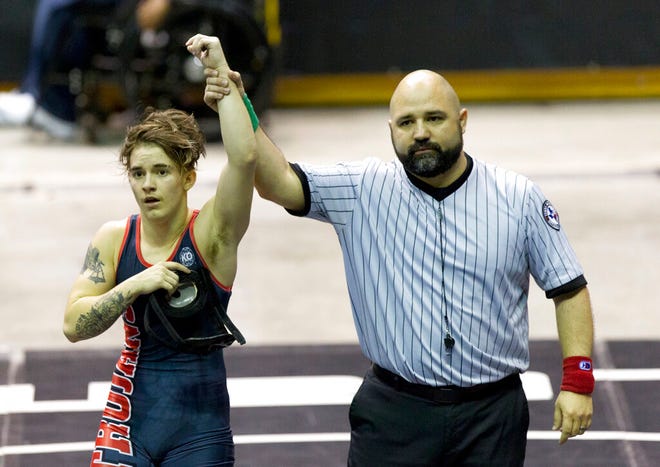
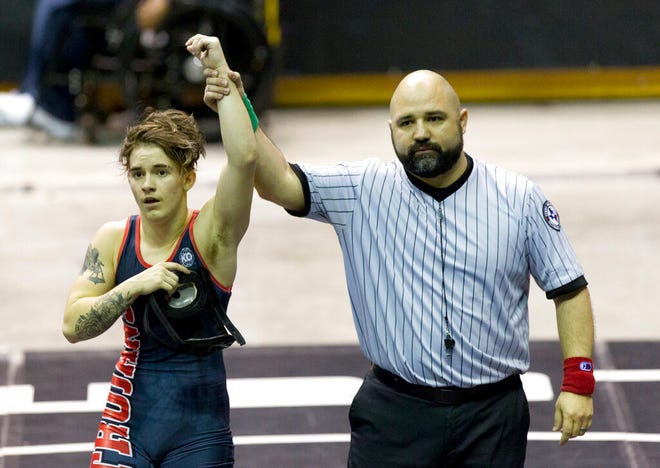
Mack Beggs, who made national headlines in high school when he became the Texas State Champion in girls wrestling, found himself questioning the fairness of his participation on his route to an undefeated season his senior year. The University Interscholastic League, which oversees sports in Texas public schools, ordered Beggs to continue competing in the girls’ division, as the Washington Postreported in 2017.
The film shows how Beggs always thought it would make more sense to compete against boys. “I don’t think it’s fair. I don’t think it’s fair to anybody,” said Beggs.
The support that Beggs receives from his grandparents who raised him — who are self-proclaimed “southern Baptist to the core” and Republican — is a message of acceptance that Schmider hopes viewers take away.
When Beggs told his grandparents that he was a boy, Beggs’ grandmother searched her bible in hopes of finding scripture to affirm her belief that what her grandson was doing was wrong. She says in the movie she found nothing and thus became one of his biggest advocates.
Another poignant part of the film Schmider hopes will resonate with viewers is that through moments of hatred and bigotry — often from parents of athletes these children were competing with — there is a sense of hope and resiliency transgender students rely on to push through their daily battles.
Andraya Yearwood, a track athlete in Connecticut who competed on the girls’ track team, was often met by furious parents in the bleachers who threw hateful, transphobic comments her way.
“Where do you locate that so-called ‘right to be included.’ They don’t have a right. They aren’t girls,” a father in the movie asked in disbelief.
Yearwood, who has become an inspiration to other Black transgender women, said she loves that she can compete as who she is, and not be excluded from an activity everyone should have the right to access. .
“Certain bodies are celebrated and certain bodies are regulated,” said Schmider. “We need to understand the intersectionality and what it means to be a girl and woman in this society or a boy and man. We need to understand what it means to have your body under a microscope and policed, especially if you are Black and Brown.
“If you don’t perfectly conform to gender expectations, it affects all of us. It’s about self-definition and self-determination and being accepted for who you are and being able to live safely and fully yourself. I hope people understand that this is their fight, too.”
Contact Analis Bailey at aabailey@usatoday.com or on Twitter @analisbailey.
A number of brands including Ugg, Puma, Abercrombie & Fitch and Apple have teamed up with LGBT+ artists and activists.
Today (1 June) officially marks the start of Pride Month, and many big companies have released Pride clothing collections – as is now traditional.
It’s a month for LGBT+ people to celebrate how far we’ve come while also recognising the work that still needs to be done.
Every year, big name brands take part in Pride celebrations – usually with the launch of clothing collections embossed with rainbows.
However, some brands come under fire for chasing after the “pink pound” with their Pride clothing and ignoring LGBT+ people for the rest of the year.
In order to combat this, in recent years a number of brands have collaborated with LGBT+ artists and highlighted exactly how much money they’ll be donating to LGBT+ charities, and which charities will benefit from the Pride clothing sales.
2021 sees the likes of Converse, Dr. Martens, Adidas, Ugg, Disney, Levi’s and Calvin Klein all release collections for Pride.
There’s also a host of very famous LGBT+ faces appearing in their campaigns from Lil Nas X to Cara Delevingne, not to mention influencers and activists.
Below we’ve compiled a list of big name brands that are celebrating Pride 2021, and most importantly where they’re donating to.
This article contains affiliate links, PinkNews may earn revenue if you click through and purchase products through the links.
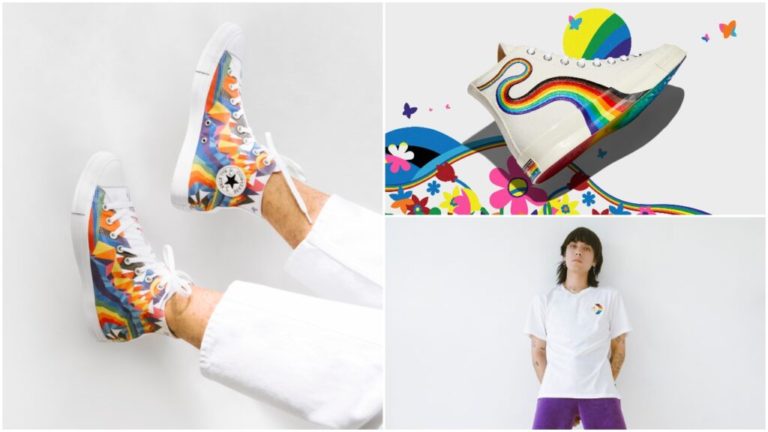
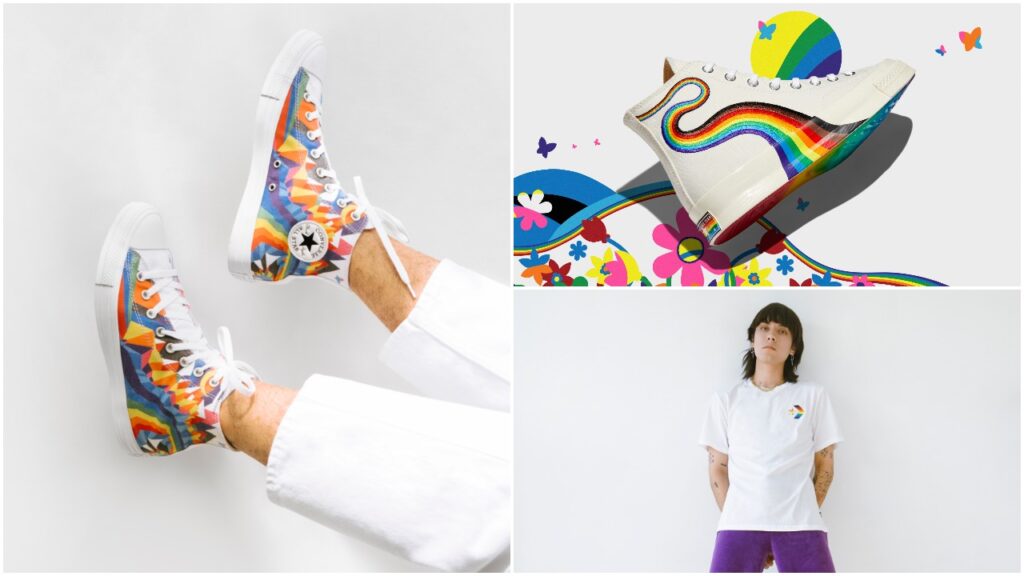
Converse
The Converse Pride collection features All-Star, 70 and Run-Star high tops. (Converse)
This year’s Converse collection for Pride features new designs of the Chuck 70, Chuck Taylor All Star and Run Star Hike shoes, new sliders and t-shirts.
It sees the brand team up with young LGBT+ creatives who worked alongside 50 LGBTQIA+ Converse teammates and their allies from concept to realisation.
Converse will donate to the It Gets Better Project, Ali Forney Center, BAGLY and OUT MetroWest.
Dominique Morgan the first Black trans woman to sit on GLSEN’s national board, appears in the Apple Watch Pride Edition campaign. (Apple)
Apple has launched a new edition of its Apple Watch for Pride 2021 that features the colours of the inclusive flag for the first time.
Apple has confirmed it will donate proceeds to International Lesbian, Gay, Bisexual, Trans and Intersex Association (IGLA), The Trevor Project, and LGBT+ youth charity GLSEN, and that they will also support Encircle, Equality North Carolina, Equality Texas, Gender Spectrum, Human Rights Campaign, PFLAG National, the National Center for Transgender Equality, SMYAL, as well as ILGA World internationally.
The US store features t-shirts, training shoes and crop tops in the Pride collection. (Reebok)
Reebok teamed up with the iconic House of Ninja for its Pride 2021 “All Types of Love” capsule collection.
The legendary ballroom house appear in the campaign for the collection which features new footwear pieces and apparel such as graphic t-shirts, crop tops, bike shorts and tights.
The brand is donating $75,000 to the Sylvia Rivera Law Project, an organisation that works to guarantee that all people are free to self-determine their gender identity and expression, regardless of income or race, and without facing harassment, discrimination, or violence.
For 2021 the Vans Pride collection features its Old Skool, Classic Slip-On, SK8-Mid and SK8-Hi shoes, apparel and accessories with rainbow embellishments including Vans iconic checkered logo reimagined in rainbow.
Vans has also confirmed it will donate $200,000 to four organisations from around the world including GLSEN, Casa 1, Where Love is Illegal and Tokyo Rainbow Pride “to support and uplift their personal stories and mission.”
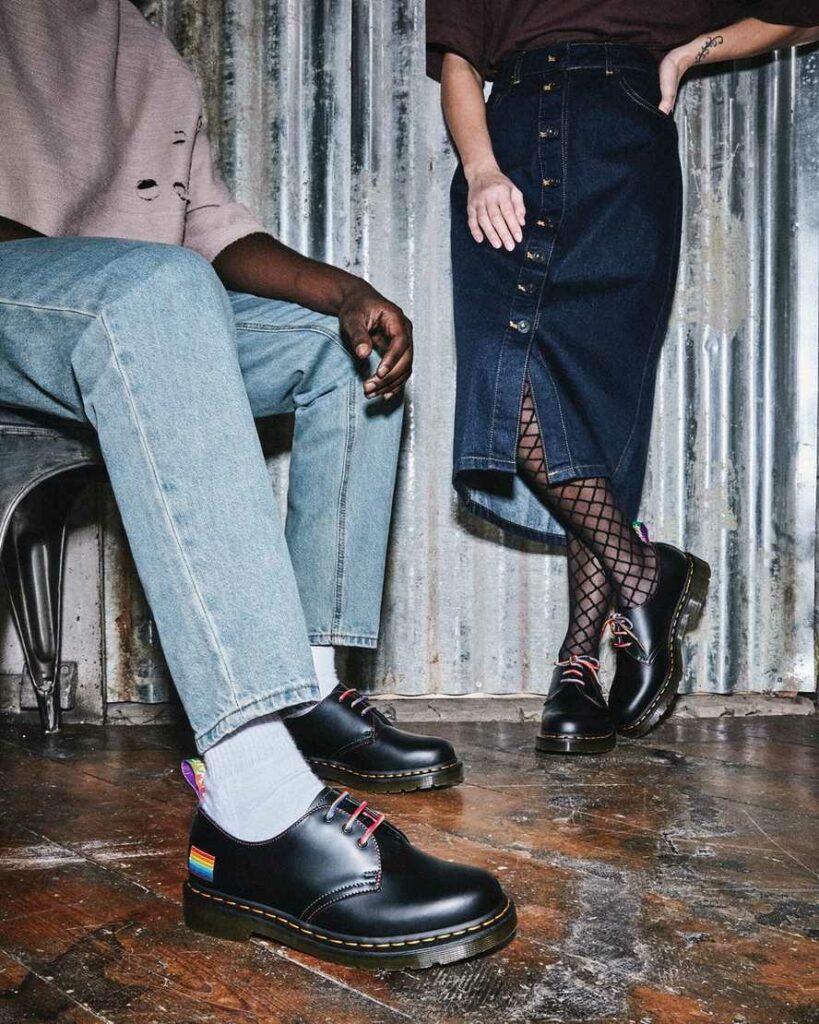
The new Pride shoes in Dr Martens’ classic 1461 design. (Dr Martens)
Dr. Martens has released a Pride edition of its 1461 leather shoes which feature an embroidered rainbow flag, rainbow laces and heel loop as well as multi-coloured stitching.
The brand has confirmed that it will be donating to three charities in Europe including akt, Jugend Gegen Aids and Le Refuge.
Disney’s Pride collection features the inclusive, trans, bi and lesbian flags for the first time. (Disney)
Disney has launched its Pride collection for 2021 which features the inclusive, trans, bi and lesbian flags for the first time ever on its pins, while face masks, mugs, t-shirts and more are also available.
Disney will donate to organisations including GLSEN, Diversity Role Models, Minus18, BeLonG To Youth Services, ARELAS, diversity München e.V., It Gets Better Project and Nijiiro Diversity.
PopSockets have teamed up with Henry Holland for Pride 2021. (PopSockets)
PopSockets have teamed up with designer Henry Holland for three exclusive PopGrip designs.
Each of them feature a quote including “Love is Love” and “Proud AF” alongside the colours of the inclusive rainbow flag.
The brand will donate 50% of all proceeds to the Albert Kennedy Trust throughout 2021, and you can purchase them from popsockets.co.uk/poptivism.
Andersen Press
Elmer the Patchwork Elephant features on a Pride t-shirt. (TruffleShuffle)
Andersen Press publishes some of the most beloved names in the world of children’s books and that includes Elmer the Patchwork Elephant, created by David McKee.
For Pride 2021 they have created two t-shirts for adults and children featuring multi-coloured Elmer with the quote “Love Your Colours”.
They will be donating 100% of the proceeds to Just Like Us, the LGBT+ young people’s charity that empowers school staff and pupils across the UK to make education more inclusive.
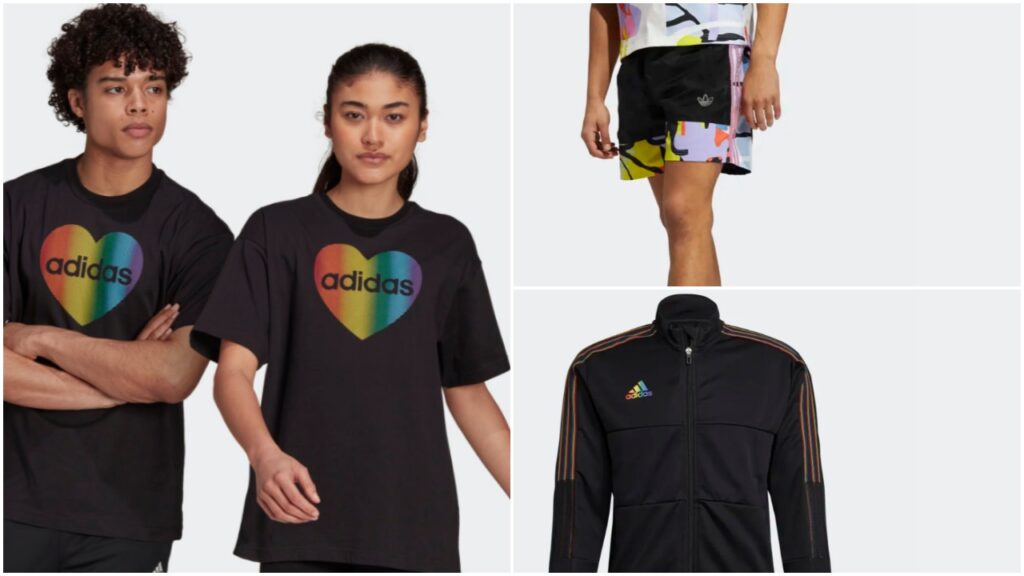
Adidas has released its ‘Love Unites’ Pride collection for 2021.
Adidas have released an apparel collection entitled ‘Love Unites’ which is inspired by the LGBT+ community’s DIY spirit. It features classic Adidas silhouettes, jumpsuits, track tops, sports bras, caps and bucket hats.
Adidas will make its annual donations to Athlete Ally and Stonewall, in an effort to help co-develop initiatives aimed at ending systemic oppression and promoting inclusion worldwide.
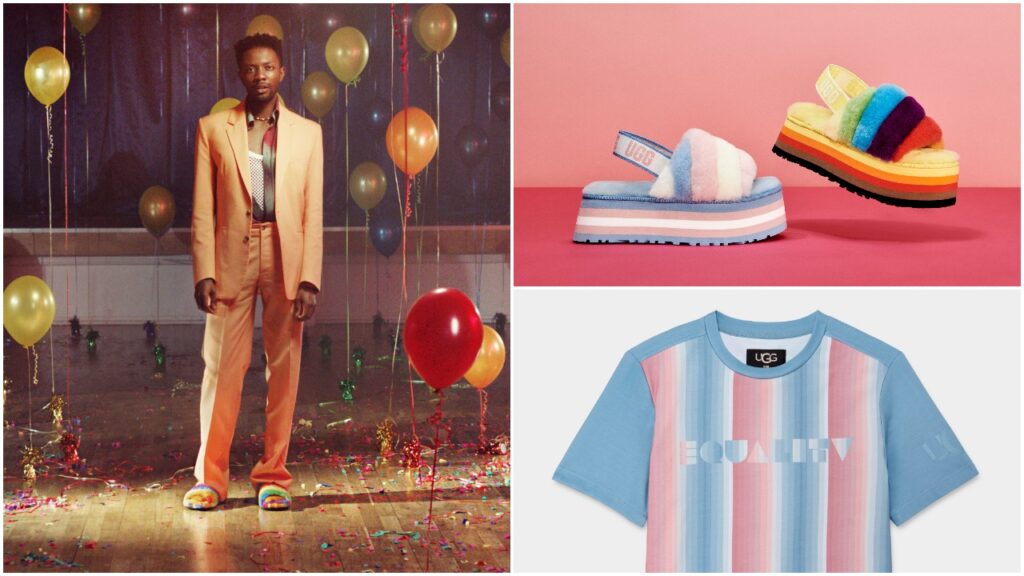
It’s A Sin’s Omari Douglas also appears in the campaign. (Ugg)
Ugg has teamed up with Lil Nas X and It’s A Sin’s Omari Douglas for its 2021 Pride campaign, which features new slides and apparel.
This includes the Disco Stripe Slide, which comes in the colours of the LGBT+ and trans flags, as well as with a platform sole.
The brand will donate $25 of every sale of the Disco Stripe Slide to GLAAD, while also making additional donations to Terrence Higgins Trust in the UK and the Organisation for Human Health and Happiness (Ohhh! Foundation) in Germany.
Levi’s Pride collection for 2021 is demanding “respect for all pronouns”. (Levi’s)
Levi’s Pride campaign for 2021 focuses on the importance of respecting people’s pronouns.
The collection features staple denim pieces reimagined for Pride, with phrases including “they/them, she/her, he/him, we” embellished throughout.
They will be making a donation to OutRight Action International, working to advance human rights for LGBT+ people all over the world.
Every purchase made will equal a donation made to the charity and you can shop the collection via the US Levi’s website here or the UK Levi’s website here.
Stoli
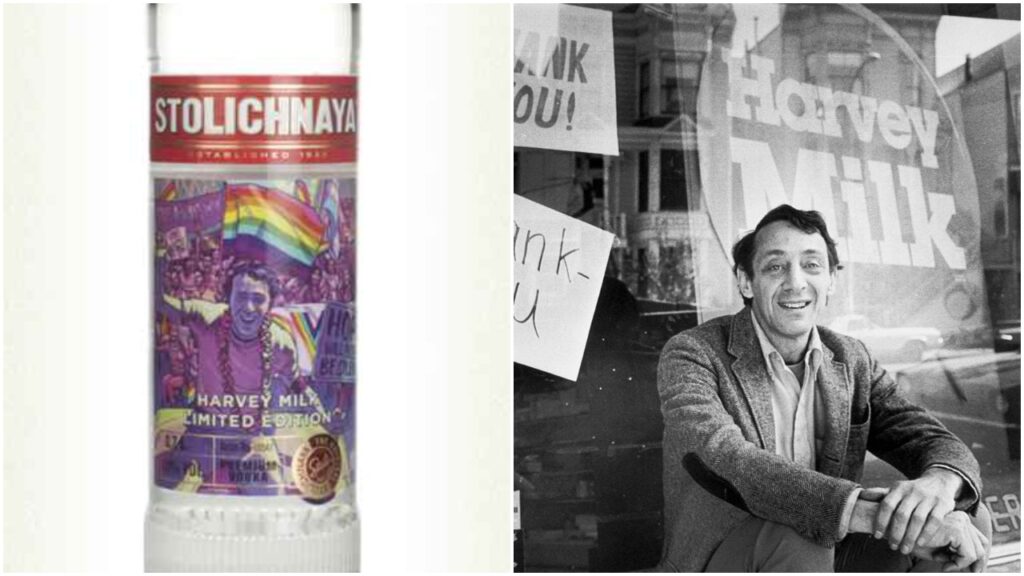
The Harvey Milk Foundation has teamed up with vodka brand Stoli on the limited edition bottle. (Bettmann)
Vodka brand Stoli has teamed up with the Harvey Milk Foundation to celebrate the gay pioneer.
The special edition vodka, which comes with a bottle design featuring Milk and one of his iconic quotes “Hope Will Never Be Silent”, is being released in time for Pride and Harvey Milk Day.
Proceeds will be donated to The Harvey Milk Foundation to help support its LGBT+ initiatives in Eastern Europe and the Baltic states and it’s available from Master of Malt in the UK and Reserve Bar in the US
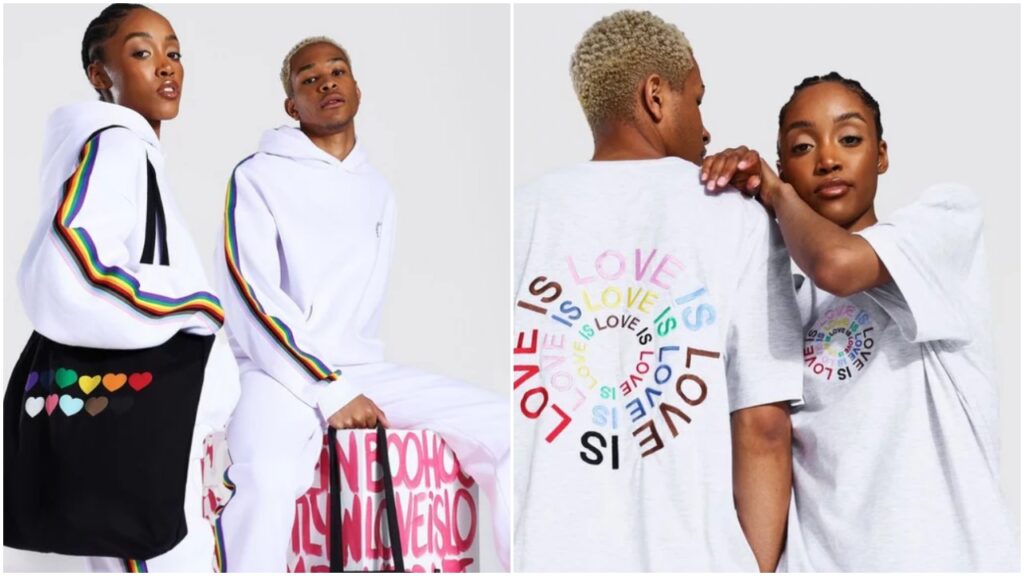
Boohoo
The Boohoo Pride collection sees the brand donate proceeds to It Gets Better. (Boohoo)
Boohoo unveiled its summer-ready collection featuring hoodie and short combos in tie dye, acid wash and pastel colours.
The ‘Crafted With Pride’ line features slogans such as “Love is Love” and “I Love Being Exactly Who I Am” as well as the inclusive Pride flag colours on apparal, bags, caps and socks.
The online fashion brand will donate 10 per cent of the proceeds from the collection to global charity It Gets Better.
The range is priced between £6-£40 and you can shop it at boohoo.com.
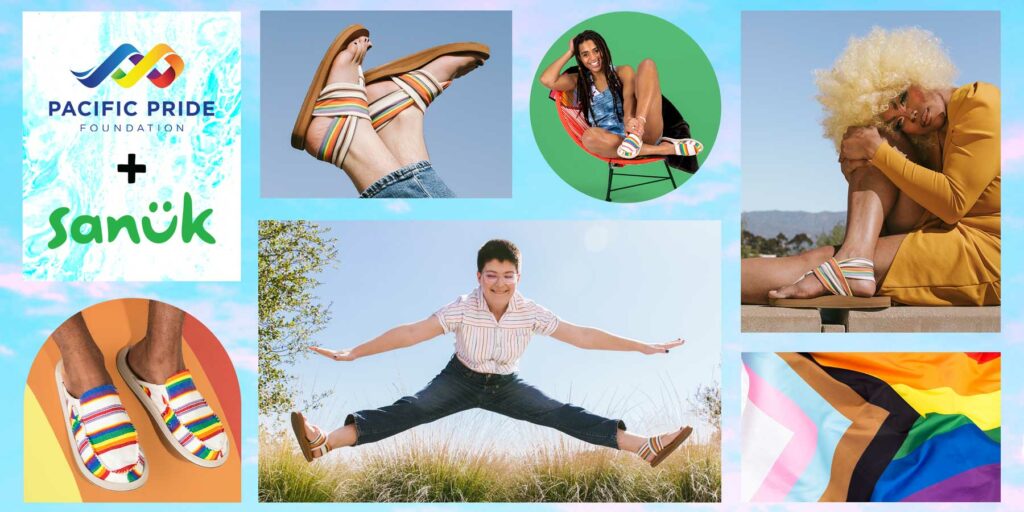
Sanuk
The gender neutral footwear collection from Sanuk.
Sanuk has released two new gender neutral styles to its catalogue for Pride 2021. This includes the Sling ST, with cushy yoga mat soles and We Got Your Back, a lightweight outdoor slipper style.
Plus they both feature colourways in the style of the Pride flag.
They are donating $10,000 to Pacific Pride Foundation and an additional $3 for every sale of a pair from the collection, up to a guaranteed total donation of $40,000.
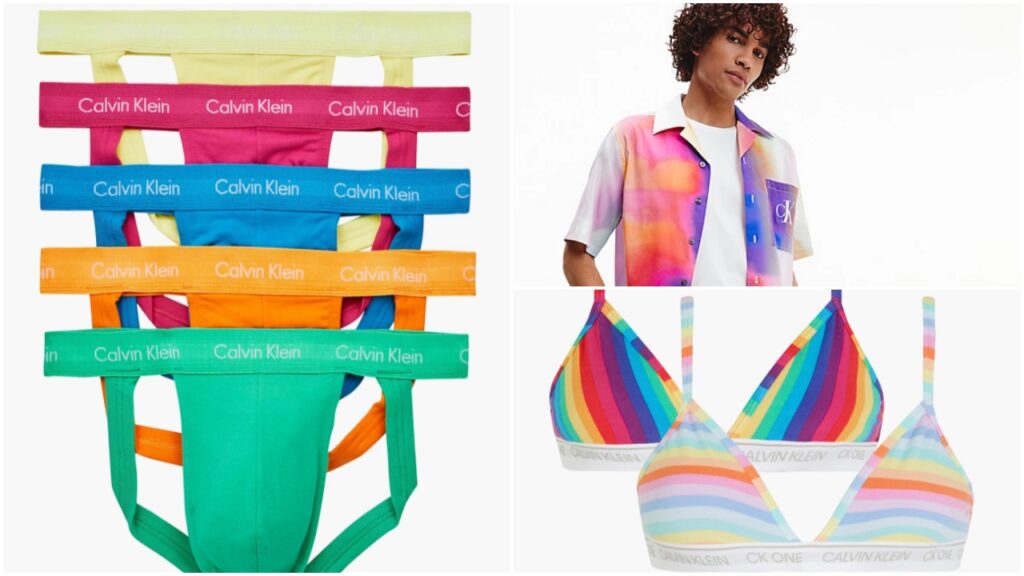
The Calvin Klein collection features underwear, apparel and accessories. (Calvin Klein)
The brand has released its #ProudInMyCalvins collection which features rainbow jockstraps, thongs and bras as well as apparel and accessories including bags so you can be Pride ready.
They have also confirmed they’ll be supporting ILGA World’s advocacy, communications and capacity building work to aid more than 1,700 organisations from 160 countries in their fight for LGBT+ equality.
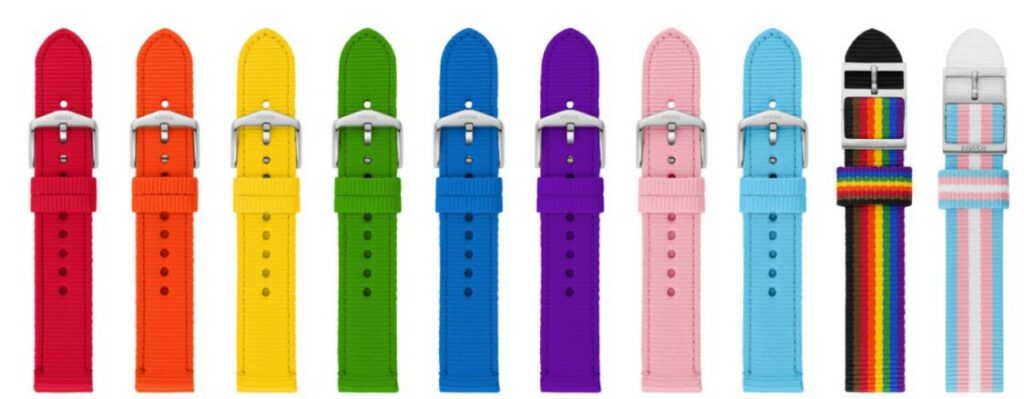
The collection features the Aaren watch with designs in the Pride flag colours. (Skagen)
Skagen has launched a limited edition Pride collection to celebrate the spirit of love and equality. The range features the Aaren watch with a selection of designs featuring the inclusive Pride and trans flag colours.
This year, Skagen is partnering with InterPride, which promotes LGBT+ Pride on an international level, pledging to make a minimum donation of $25,000 to the organisation.
Zenni has released a collection of rainbow frames for Pride 2021. (Zenni)
Online eyewear retailer Zenni has launched a collection of rainbow frames for Pride 2021.
The Pride clothing range starts at $12.95 and includes eight frames in various styles including a kids pair, plus new for 2021 is two rainbow cases, and a rainbow lens cloth.
Zenni has confirmed it will be donating a portion of the proceeds from the collection to the It Gets Better Project for the fourth consecutive year.
The rainbow nipple sweatshirt for Pride 2021 is available in four colours. (The Spark Company)
The Spark Company has an LGBT+ merch section for Pride, this includes the rainbow nipple sweatshirts above, as well as apparel featuring the trans, bi, pan, non binary and lesbian flag colours.
The online retailer donates proceeds from the Pride clothing collection to the Albert Kennedy Trust and Bloody Good Period all-year round from its sales. This includes its LGBT+ section.
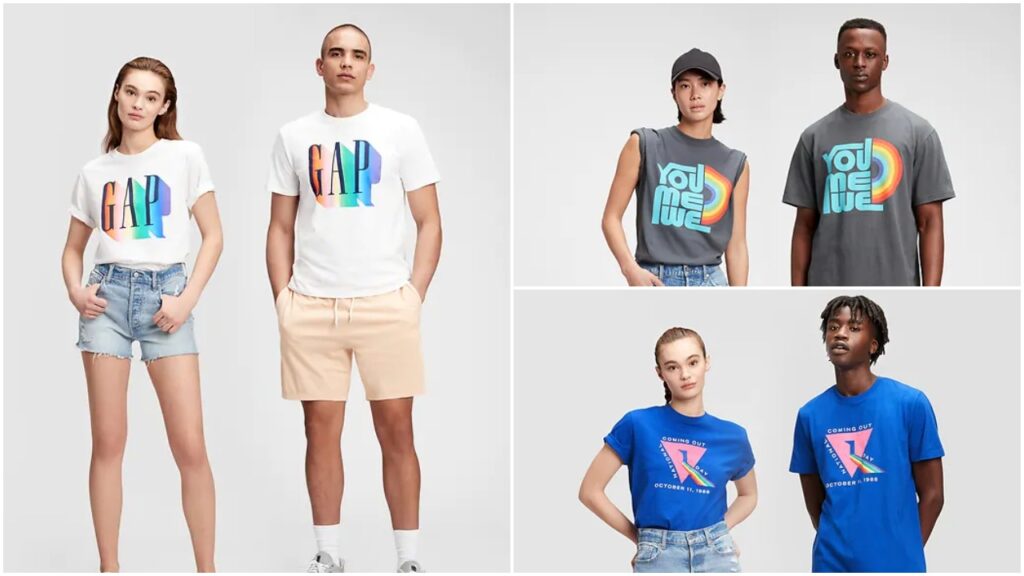
Gap’s Pride collection features t-shirts created by LGBT+ artists. (Gap)
Gap have released an exclusive collection of t-shirts created by LGBT+ artists, with a confirmed donation of $50,000 to GLAAD.
The collection is 100 per cent organic and features designs including the Gap logo in rainbow, a “You Me We” slogan, “The Lesbian Avengers” t-shirt, and a design featuring the pink triangle to celebrate National Coming Out Day.
Abercrombie and Fitch have teamed up with LGBT+ artists and influencers for the campaign. (abercrombie.com)
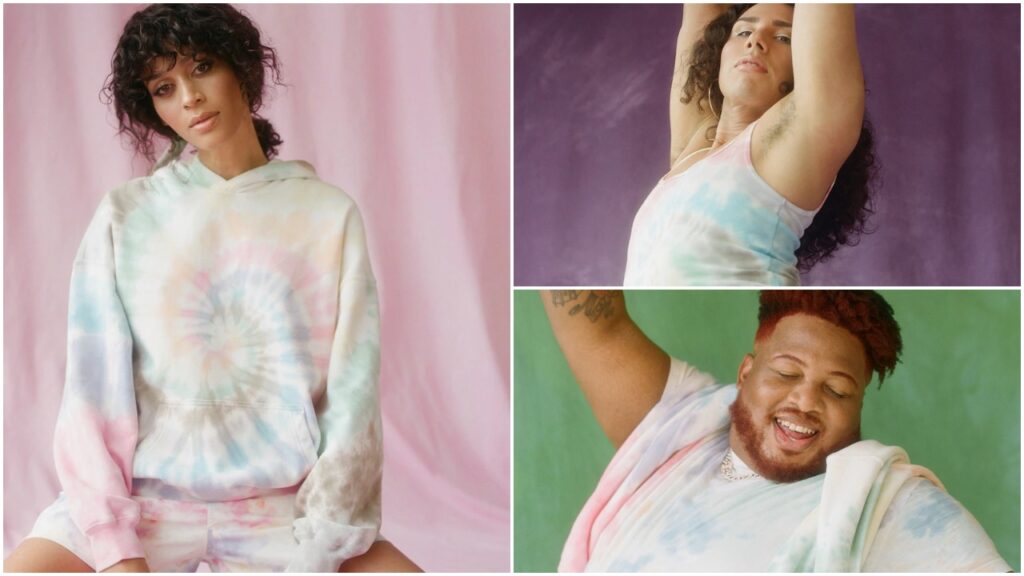
Abercrombie and Fitch have released a rainbow tie-dye collection for Pride 2021 in collaboration with The Trevor Project.
The Pride clothing range features sweatshirts, t-shirts, shorts, vest tops and more in the tie-dye design alongside paint splatter shirts and shorts in the trans flag colours, a rainbow sequin t-shirt and new cologne entitled ‘Fierce’.
They will also be donating $200,000 to The Trevor Project as part of their ongoing partnership.
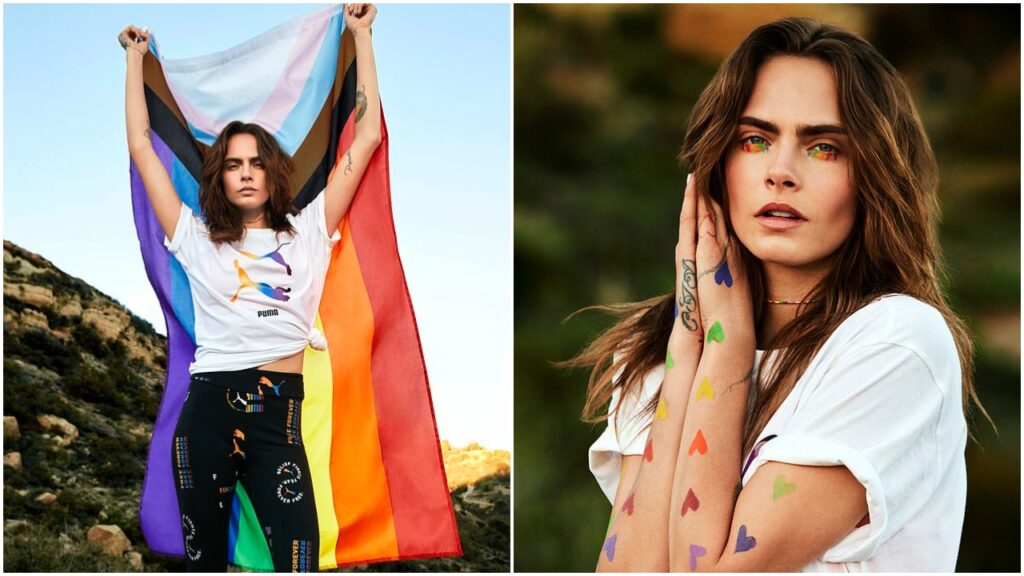
Cara Delevingne and Puma team up for the ‘Forever Free’ 2021 Pride collection. (Puma)
Puma has teamed up with Cara Delevingne for its 2021 Pride collection entitled ‘Forever Free’.
They’ve created a range featuring sustainable apparel, including the colorful leggings modelled by the pansexual star in the campaign, new sneakers, slides and accessories.
Puma will donate 20 per cent of the proceeds from their Pride clothing to the Cara Delevingne Foundation, a project of the Giving Back Fund and used to support LGBT+ charities around the globe.
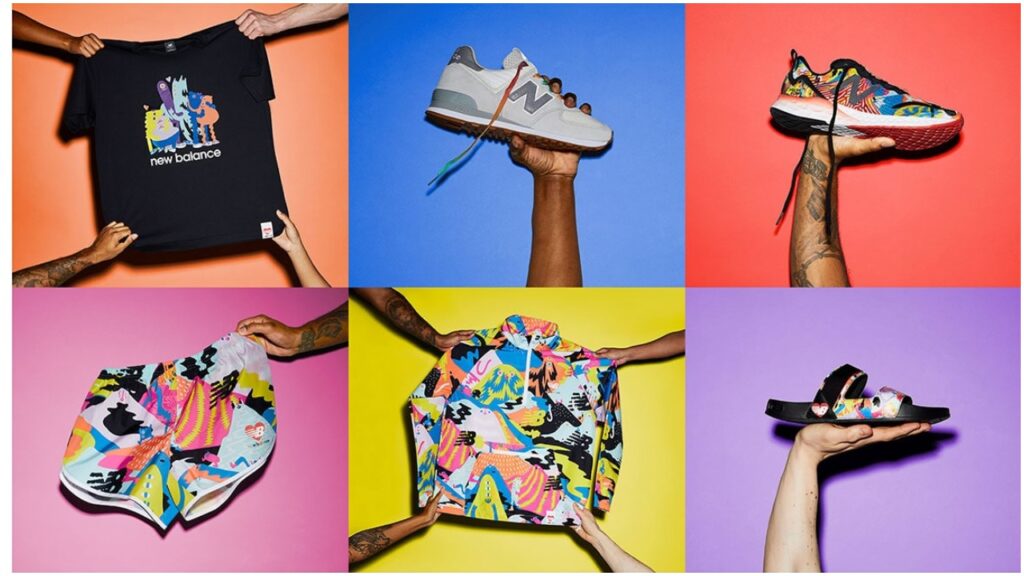
New Balance has released the “Everybody’s Welcome” collection for Pride 2021. (New Balance)
New Balance has released the “Everybody’s Welcome” collection to celebrate Pride 2021.
It’s been designed by Hong Kong-based artist Zioe Lam and is inspired by the community’s vibrancy. The collection features apparel and footwear including a grey pair of trainers with rainbow laces.
The brand will continue ts support of GLSEN and its “Changing the Game” program, which is designed to create safer school environments for all K-12 LGBTQIA+ athletes with a $100,000 donation over the next two years.
The 49ers are the first NFL team with a gender neutral clothing line. (49ers Pride)
The San Francisco 49ers have become the first NFL team with a gender neutral clothing line following the release of its Pride collection.
Led by 49ers PRIDE, the official fan club of 49ers Faithful who identify as LGBTQ+ and allies, the collection features apparel and accessories including flags and pins, all featuring the 49ers logo redesigned for Pride.
Plus 100 per cent of the proceeds will go to San Francisco LGBT Center, Oakland LGBTQ Center, and The LGBTQ Youth Space: San Jose.
This is part one in a two-part series about VA care for Veterans with Lesbian, Gay, Bisexual and Transgender (LGBT) and Related Identities. Part two will run June 8, 2021.
Navy Veteran Marilu Fanning and Army Veteran Dylan Liebhart have followed different journeys through life. Different upbringings, generations and military services. Yet, the two share a passion for helping fellow Veterans receive the care they’ve earned. They have advice for fellow LGBT and Related Identities Veterans.
Military service
Fanning went into the Navy right out of high school in 1970. She served one shore duty enlistment on the East coast.
Fanning poses for a photo during boot camp.
“Somehow I just lucked out that I was never in any kind of danger, but then there was no adventure or world sightseeing either,” she said.
Liebhart came from a Catholic family, joining the Army in 2002. He served for just over seven years with military police at Fort Rucker, Alabama, and Fort Riley, Kansas. Liebhart also deployed to Iraq for 15 months from September 2006 to December 2007. Serving during Don’t Ask Don’t Tell, Liebhart could not reveal sexual orientation.
“There was one occasion where someone casually mentioned my sexuality, and I was told in no uncertain terms that if my command sergeant major ever heard word about it again, I would be out of the military,” he said.
LGBT journey
Fanning said she was “clueless” about her gender and sexuality issues until already married. She said she had a slow journey of self-discovery.
“I really did not accept the truth of who I was until after my two children were grown,” she said.
She transitioned to female in 2006. In 2015, she turned to VA for care.
At the time a woman, Liebhart told a close friend in high school about her sexuality. The reception was poor, forcing Liebhart back into the closet. Liebhart lived as a female-presenting lesbian for many years, marrying another lesbian. Liebhart reached a point accepting the truth: she was not a woman.
“I thought I was fine,” Liebhart said. “But in time I came to see that who I was did not match the container I held myself in. I came out to my family and close friends as a trans man in my mid-30s and swiftly began the transition process.”
Now fully surgically transitioned, Liebhart said he lives “a complete and honest existence.” His lesbian wife and he still have a happy marriage.
“For me, my VA experience has been all positive,” Fanning said. “Everyone at Hines treats me with the same respect as everyone else, whether I am here for a regular appointment or as an admitted patient.”
Fanning has used multiple health care services. This includes hormone treatment, group therapy and speech therapy. She said the speech therapy has been especially helpful, especially being a tall transgender woman with a deep voice.
“Having tried to affect a ‘feminine voice’ for so long on my own, and never having any real success, I had all but given up on being able to develop one in this lifetime,” Fanning said. “But the prospect of having access to real, professional vocal coaching certainly was an opportunity I could not pass up.”
Results
Fanning said while the therapy challenges her, the results boosted her confidence.
“After years of unsuccessfully trying on my own to speak in a more feminine voice I found out just how difficult it is,” she said. “Even with professional guidance it has not been easy. It was six to eight months of frustration before I started to have any amount of success at all. Then, those Improvements came in small, even subtle increments. These days, I mostly stay in what is now my real voice, all day, with few slip ups. Finally, my voice has become a true vocal representation of just who I am.”
“I have found Truman VA to be very accepting,” he said. “The environment is one of general openness and inclusion. This is not to say that providers themselves are always inclusive, but it gives one the sense of hope that you can find one who will be.”
Advice for others
Fanning, who received health care for years outside of VA, said she encourages all Veterans, including LGBT, to use VA.
“I find Hines to be first rate and far better than any private sector care that I have ever received,” she said.
Liebhart said like any health care system, finding the right provider is critical.
“For instance, when I approached my primary care provider about starting HRT, I was met with absolute support and guidance,” he said. “In fact, every step of the transition process was made smoother by the support of various providers.”
He said VA providers aren’t always ready to deal with transgendered patients.
“I shocked the pants off of an EKG tech once when I took off my shirt off, and he wasn’t able to easily compose himself,” he said. Liebhart also said providers have not always agreed on courses of action because of inexperience with transgender care. He said his best advice for others is to advocate for care they’ve earned.
“I would tell other LGBT Veterans to be bold about advocating for themselves, and not to become complacent or quelled into acceptance of less than they deserve,” he said. “They should be open and honest with their providers, so that they can receive the highest quality of care, because a doctor can’t help you when you give them half the truth. Assume good intentions from your providers, and if you’re met with anything less, then use your resources. The patient advocate, LGBT coordinator and safe zone allies are excellent support systems.”
Fanning added she’s found the care for non-LGBT Veterans is just as good as the care for LGBT Veterans. Liebhart, too, encourages non-LGBT Veterans to treat others with respect and be open.
“Be respectful,” he said. “We are all human and deserving of dignity. If you’re curious about something, ask.”
Resources for LGBT and Related Identities Veterans
Treatment and prevention of sexually transmitted infections/PrEP
Intimate partner violence reduction and treatment of after-effects
Heart health
Cancer screening, prevention and treatment
Suicide prevention programs
Learn about health risks and talking to a provider about sexual orientation identity, birth sex, and self-identified gender identity in the fact sheets below.
Learn about the resources and support available for Veterans who have faced challenges related to coming out as a person with a lesbian, gay, bisexual, transgender or related identity.
Today, President Biden issued a proclamation affirming June 2021 as Lesbian, Gay, Bisexual, Transgender, and Queer (LGBTQ+) Pride Month, marking a time a time of hope, progress, and promise for LGBTQ+ Americans across the country. After four years of relentless attacks on LGBTQ+ rights, the Biden-Harris Administration has taken historic actions to accelerate the march toward full LGBTQ+ equality. From protecting the civil rights of every LGBTQ+ American, enabling all qualified Americans – including transgender Americans – to serve their country in uniform, ensuring that LGBTQ+ Americans are leaders at every level of the federal government, to protecting and defending the human rights of LGBTQ+ persons around the world, the Biden-Harris Administration is a consistent and reliable partner in the fight for equality at home and abroad.
Too many LGBTQ+ Americans across our nation continue facing discrimination and hate, especially LGBTQ+ people of color and transgender Americans, and some states are attempting to roll back the clock on equality with discriminatory bills that target LGBTQ+ people and families. The Biden-Harris Administration reaffirms that no one should face discrimination or harassment because of who they are or whom they love. As President Biden said during his first joint address to Congress, the President has the back of LGBTQ+ people across the country and will continue fighting for full equality for every American – including through continuing to urge the U.S. Senate to pass the Equality Act and provide overdue civil rights protections to LGBTQ+ people and families across the country.
This Pride Month, the Biden-Harris Administration celebrates the historic progress made towards LGBTQ+ equality since President Biden took office, including:
Signing One of the Most Comprehensive Executive Orders in History on LGBTQ+ Rights on His First Day in Office. Within hours of taking the oath of office, President Biden signed an Executive Order Preventing and Combating Discrimination on the Basis of Gender Identity or Sexual Orientation. The Executive Order established that it is the official policy of the Biden-Harris Administration to prevent and combat discrimination against LGBTQ+ individuals, and to fully enforce civil rights laws to prevent discrimination on the basis of gender identity or sexual orientation. The President directed all federal agencies to implement fully all federal laws that prevent discrimination on the basis of sex, to include sexual orientation and gender identity. This Executive Order is one of the most consequential policies for LGBTQ+ Americans ever signed by a U.S. President. As a result of that Order, agencies have already taken key steps to advance LGBTQ+ equality.
The Department of Health and Human Services (HHS) announced it will interpret and enforce Section 1557 of the Affordable Care Act and Title IX to prevent discrimination on the basis of sexual orientation and gender identity.
To address the pervasive discrimination LGBTQ+ families continue to face in housing, the Department of Housing and Urban Development announced it will interpret the Fair Housing Act to prevent discrimination in housing and rental assistance against LGBTQ+ people. HUD will require state and local jurisdictions who receive funding through its Fair Housing Assistance Program to apply the same protections.
In response to the continuing discrimination many LGBTQ+ individuals face in credit and lending services, the Consumer Financial Protection Bureau announced that it will enforce against discrimination on the basis of sexual orientation or gender identity in credit and lending services.
The Department of Justice issued new guidance to agencies clarifying that Title IX sex discrimination protection includes protection on the basis of sexual orientation and gender identity.
To ensure that LGBTQ+ Veterans are treated with dignity and respect, the Department of Veterans Affairs (VA) has undertaken an agency-wide review of its policies and practices to remove barriers that transgender veterans and their families face.
To advance protections for incarcerated individuals who are transgender, the Department of Justice filed a statement of interest in litigation clarifying that it is DOJ’s position that transgender prisoners should be assigned to housing that aligns with their gender identity, and that transgender prisoners should receive medically-necessary gender affirming care.
Launching a Whole-Of-Government Initiative to Advance Equity and Justice for Underserved Communities, Including LGBTQ+ Communities. On his first day in office, President Biden signed a historic Executive Order establishing a cross-government initiative to advance equity and justice for communities who have been left behind, underserved, or discriminated against by federal policies, laws, and programs, including LGBTQ+ communities. The President directed all agencies to take steps to advance equity by taking comprehensive action to root out bias from federal programs and policies, engage with underserved communities, and ensure that federal resources equitably reach all Americans, including LGBTQ+ Americans.
Enabling All Qualified Americans to Serve Their Country in Uniform. In his first week in office, President Biden signed an Executive Order reversing the ban on openly transgender servicemembers serving in the Armed Forces, enabling all qualified Americans to serve their country in uniform. President Biden believes that gender identity should not be a bar to military service, America’s strength is found in its diversity, and an inclusive military strengthens our national security As a result of his Executive Order, the Department of Defense issued new policies which prohibit discrimination against transgender servicemembers, provide a path for transgender servicemembers to access gender-affirming medical care, and require that all transgender servicemembers are treated with dignity and respect. Patriotic transgender servicemembers are once again able to openly and proudly serve our Nation in uniform.
Advancing an Equitable Recovery from COVID-19 for LGBTQ+ Americans across the Country. President Biden knows that LGBTQ+ individuals and families have been disproportionately burdened by the COVID-19 health crisis and economic crisis. Even before COVID-19, LGBTQ+ Americans were more likely to be uninsured and unemployed, and were more likely to experience poverty, have a pre-existing condition, and experience food insecurity. These barriers have posed unique risks to the physical and financial health of LGBTQ+ people during this crisis. The President’s American Rescue Plan makes significant investments in an equitable recovery, and is helping LGBTQ+ families across the country recover from COVID-19 by:
Addressing food insecurity among LGBTQ+ communities by increasing the value of nutrition assistance by 15 percent.
Advancing health equity for LGBTQ+ Americans, who remain more likely to be uninsured, by improving access to and affordability of health coverage through the Marketplace, and expanding mental health resources.
Supporting LGBTQ+ Americans, who are more likely to experience unemployment and continue to face discrimination in the job market, by extending unemployment insurance benefits critical to helping many families, including LGBTQ+ families, stay afloat.
Addressing the disproportionate rates of housing insecurity and homelessness faced by LGBTQ+ Americans, especially transgender youth, by expanding emergency rental assistance programs.
Signing and Leading Implementation of a Presidential Memorandum on Advancing the Human Rights of Lesbian, Gay, Bisexual, Transgender, Queer, and Intersex Persons Around the World. President Biden directed all agencies engaged abroad to ensure that United States diplomacy and foreign assistance promote and protect the human rights of LGBTQ+ persons. His Memorandum establishes that it “shall be the policy of the United States to pursue an end to violence and discrimination on the basis of sexual orientation, gender identity or expression, or sex characteristics, and to lead by the power of our example in the cause of advancing the human rights of LGBTQ+ persons around the world.” As previously highlighted by the White House, Departments and Agencies are already making progress in areas towards the goals outlined in the Presidential Memorandum, including: strengthen existing efforts to combat the criminalization by foreign governments of LGBTQ+ people and expand efforts to combat discrimination, homophobia, transphobia, and intolerance on the basis of LGBTQ+ status or conduct; protect vulnerable LGBTQ+ refugees and asylum seekers; help ensure the Federal Government has a swift and meaningful response to serious incidents that threaten the human rights of LGBTQ+ persons abroad; and build coalitions with like-minded nations to counter discrimination against LGBTQ+ people around the world.
Establishing the White House Gender Policy Council to Advance Gender Equity and Equality. President Biden signed an Executive Order establishing the White House Gender Policy Council to advance gender equity and equality across the whole of the government, including by addressing barriers faced by LGBTQ+ people, in particular transgender women and girls, across our country.
Ensuring Educational Environments are Free from Sex Discrimination and Protecting LGBTQ+ Students from Sexual Harassment. President Biden signed an Executive Order recommitting the Federal Government to guarantee educational environments free from sex discrimination, including sexual harassment and including discrimination on the basis of sexual orientation or gender identity, and directing the Department of Education to review and as necessary consider revising agency actions that are inconsistent with that policy. The Executive Order charged the Department of Education with reviewing the significant rates at which students who identify as LGBTQ+ are subject to sexual harassment, including sexual violence.
Signing a National Security Memorandum Supporting Federal Employees Serving Overseas, including LGBTQ+ Employees. President Biden signed a National Security Memorandum on Revitalizing America’s Foreign Policy and National Security Workforce, Institutions, and Partnerships. The Memorandum directs agencies to take steps to retain, develop, promote, and support LGBTQ+ and other national security employees, and employees with LGBTQ+ family members.
Ensuring Transgender Americans Can Access Emergency Shelter That Dignifies and Respects Their Identity. The Department of Housing and Urban Development restored protections for transgender individuals seeking emergency shelter and homeless services. HUD reaffirmed its commitment that no person be denied access to housing or other critical services because of their gender identity.
Creating a Historically Diverse Cabinet and Administration. The Biden-Harris Administration includes barrier-breaking LGBTQ+ leaders, including Secretary of Transportation Pete Buttigieg, who is the first openly gay Cabinet Secretary confirmed by the U.S. Senate, and Assistant Secretary for Health Dr. Rachel Levine, who is the first openly transgender person ever confirmed by the U.S. Senate. President Biden has assembled the most diverse Administration in our Nation’s history, and is proud to serve alongside the 14 percent of all appointees who identify as lesbian, gay, bisexual, transgender, and queer.
Issuing the First White House Proclamation for Transgender Day of Visibility. On March 31, 2021 President Biden became the first U.S. President to issue a proclamation commemorating Transgender Day of Visibility. The proclamation honored and celebrated the achievements and resiliency of transgender individuals and communities, and recognized the generations of struggle, activism, and courage that have brought our country closer to full equality for transgender and gender non-binary people in the United States and around the world.
Ensuring Pride Flags Fly on U.S. Embassies Around the World. The State Department announced it will allow U.S. diplomatic outposts to fly the Pride flag on the same flagpole as the U.S. flag at their embassy or consulate, demonstrating that the United States will lead on LGBTQI+ human rights around the world.
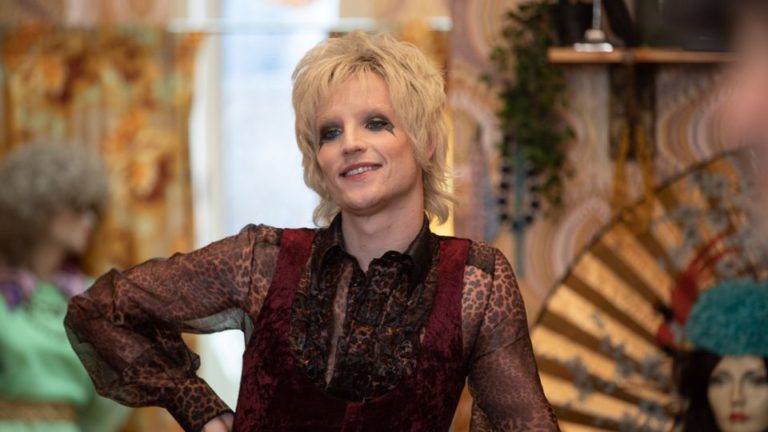
‘The new Disney Cruella with Emma Stone just ruined my childhood with an openly flamboyant gay in the movie,’ an American politician complained over the weekend. I say ‘politician’: his record is not strong. Omar Navarro is currently standing for Congress in the state of California for the fourth time, which suggests that potential voters don’t exactly see him as a viable option. I can understand why. He does not exactly exhibit a sense of proportion, his tweet adding his rage that ‘Disney persist [in] shoving the LGBT agenda down our throat.’ His issue? The fact that the film, starring Emma Stone as the iconic villain, has a character who appears to be gay.
Is this person spotted in a same-sex embrace? Has Disney gone R-Rated? Of course not. He’s just coded as queer in that vague, cliched way. But that’s enough to put Omar off his popcorn.
It’s June. It’s Pride Month. Disney has done the absolute bare minimum in including a could-be-gay man in a film set in the fashion world. And yet it’s still causing a furore in small pockets of the community. So to be completely explicit, in a different way to what the God-fearing folk like Omar may be worried about, if seeing a gay character in a film or TV programme in 2021 makes you feel uncomfortable, or angry, then you are a homophobe. It really is that simple.
It’s not as if the person in question – Artie, played by John McCrea – has a montage in which he goes cruising on Hampstead Heath, leaving Cruella to smoke a cigarette on a tree stump while he gets his end away. He simply dares to run a clothes shop. ‘In one of the original scripts he was a drag queen, so I think he was always intended to be queer-representing I suppose,’ John said in an interview. ‘Or somehow a member of the LGBTQ community. I imagine that was always the case.’
Omar is, actually, a little bit obsessed. Pink News reports that he had a similar reaction in 2019, to a Disney Channel programme called The Owl House. ‘I don’t agree with this crap being pushed down our throats,’ he wrote online. ‘What people do at home is there [sic] business but publicly I shouldn’t have to be forced. Will Christians please stand up?’ Is Omar under the impression that he is, actually, being ‘forced’ to watch a children’s programme? Has a gay Californian tied him to a chair in front of The Owl House? Or is he seeking out controversy for Twitter likes?
Cruella, in case you need reminding, is an evil woman who seeks to steal, kill and skin 101 spotty dogs in order to make a single coat. Her name is literally a pun on Cruel Devil. She is the most famously anti-PETA person in the world, and she doesn’t even exist. If you can put her murderous ways aside for the sake of escapism and nostalgic fun – it’s not real, guys – but can’t handle the fact that her mate might kiss a boy at the Royal Vauxhall Tavern once in a while, then your bigotry is clear. It’s a villainy that is, in some ways, worse than that exhibited by Cruella herself. At least the nature of her evil is interesting.
A gay character does not have the power to ruin your childhood unless you are actively seeking to be angry. Omar’s homophobia is akin to the racism many Brits are currently displaying in mocking the casting of Jodie Turner-Smith, a talented Black woman, as Anne Boleyn. If Cruella, Anne Boleyn or any other similar instance is upsetting or angering you, then it’s time to realise that these actors and those who cast them are absolutely not the problem. Your prejudice is showing, and it’s not pretty.
Janet says she thinks she’s watched everything Netflix has to offer. But did you know they have more than 70,000 extremely precise sub-genres that can be identified by a number code. Like if you were looking for “Witty movies directed by Woody Allen,” you would use the number code 2535. Other secret categories include “heartflet Tearjerkers” “Campy Zombie Movies,” “Film Noir,” “Mind-Bending Fantasy Movies,” “Quirky Independent Movies Based on Books,” and even “Scary Italian Crime Movies from the 1970’s.” So what special programming are you looking for? We bet you can find it. Here is the full list of the Netflix hidden codes, along with their categories. Have a great day of binging!!
When asked who the young people are who are inspiring her, she points to Bowen Yang or Lil Nas X, who excite her with their hyper-queer art.
“It’s very gay from an Asian American perspective,” she said of Yang’s work on “Saturday Night Live.” “Talk about silenced? That has been silenced, the gay Asian experience really is unheard.”
“I love that song and that video,” she said. “I wanted his drop of blood sneakers so bad. It’s so fabulous. Like, how fun and beautiful to embrace that and it’s just really fantastic. To me, that’s really the future, it makes me feel really young. It makes me feel really seen as a queer elder. I love that they’re feeling free and living their lives. So many of us couldn’t come out for so long and kids are like having a different time of it and I’m so proud of them for it.”
Today, Cho is dating both men and women. She’s not quite single, but definitely living alone.
“I don’t have that kind of relationship where I can’t see other people but you slow down.” Albert Sanchez
“I am dating,” she said. “It’s really grown, and it’s very adult and yet, I’m very happy living alone. I think that’s really the biggest fear for a lot of people, is being alone, but I love it. You know, I think it’s really what I’ve been searching for. I have relationships that I love but it’s also really easy and it’s really adult.”
Cho said that she believes in polyamory, the practice of openly dating numerous people at the same time, and that it’s something she upholds in her relationships, but doesn’t actually happen often.
“I don’t have that kind of relationship where I can’t see other people but you slow down,” she said. “I just want things to be simpler. So yeah, I love polyamory, but it’s just so much talking and a lot of work. I can’t do it. I always end at one even though in my mind, I am poly, but I’m too, too, too busy.”
Related
Or too lazy? She laughed and answered, “Both!”
Cho said she also wants the LGBTQ community to reclaim a controversial term used to refer to gay people: “fruit.”
“I think that’s a really good one that we need to bring back,” she said. “What are you up to fruity? I’m really fruity.”
This LGBTQ Pride Month 2021, TODAY is highlighting the LGBTQ trailblazers in pop culture who paved the way, along with the trendsetters of today who are making a name for themselves. By examining their experiences individually, we see how all of their stories are tied to one another in a timeline of queer history that takes us from where we were to where we stand today.
Alexander Kacala is a reporter and editor at TODAY Digital and NBC OUT. He loves writing about pop culture, trending topics, LGBTQ issues, style and all things drag. His favorite celebrity profiles include Cher — who said their interview was one of the most interesting of her career — as well as Kylie Minogue, Candice Bergen, Patti Smith and RuPaul. He is based in New York City and his favorite film is “Pretty Woman.”
Members of the far-right group Noua Dreapta (New Right) wave National Romanian flags and New Right flags during a rally in Bucharest, June 2011. Archive photo: EPA/ROBERT GHEMENT
The European Court of Human Rights ruled on Tuesday ruled that Romania failed to uphold the prohibition of discrimination when far-right homophobes stormed an LGBT film screening in Bucharest in February 2013.
The Strasbourg-based court also ruled that Romania failed to uphold the right to respect for private and family life and the right to freedom of assembly and association, which are all protected by the European Convention of Human Rights.
The screening of the film about a gay family was part of LGBT History Month. A protest against event was held by extremist groups near the venue at the Museum of the Romanian Peasant.
Despite the presence of police, around 45 protesters thought to be part of the fringe far-right party Noua Dreapta stormed the cinema and threatened viewers by shouting homophobic slogans and hurling insults at them. At the time of the attack, the audience numbered no more than 20.
Members of Noua Dreapta (New Right) have been responsible for many incidents of homophobic violence in Romania since the party’s founding in 2000. Noua Dreapta has also made a habit of protesting against the Bucharest Pride parade every year. It has never won seats in parliament.
The investigation into the incident was closed in October 2014 by a Bucharest prosecution body, which described the attack as “an exchange of views”.
Another investigation, into the use of fascist symbols during the raid, was also discontinued by Romanian authorities in August 2017, and none of the perpetrators have been indicted.
LGBT rights group ACCEPT and five individuals who were present at the screening subsequently took their case to the European Court of Human Rights.
The Strasbourg court concluded that the Bucharest authorities “failed to offer adequate protection in respect of the individual applicants’ dignity… and to effectively investigate the real nature of the homophobic abuse directed against” the applicants.
“The authorities thus discriminated against the applicants on the grounds of their sexual orientation,” the judges added in their verdict.
They ordered the Romanian state “to pay 7,500 euros to the applicant association and 9,750 to each individual applicant”.
The 3,264 euros spent by the applicants to bring the legal proceedings must also be covered by Romania, the court said.

 I first encountered Lane’s story buried among the papers of an endocrinologist, but her brief encounter with a doctor during her teenage years was typical of many transgender children like her in the early to mid-20th century. These stories form a key thread of the first several chapters of my book, “Histories of the Transgender Child,” and they point to the tremendous obstacles these kids faced in a world where the word “transgender” didn’t even exist.