Robbie, 32, told The Post in a statement that he, his brother and two other passengers had spent Sunday swimming, listening to music and tubing in the lake about 100 miles west of Spokane. (Robbie declined to provide his last name out of fear of retaliation).
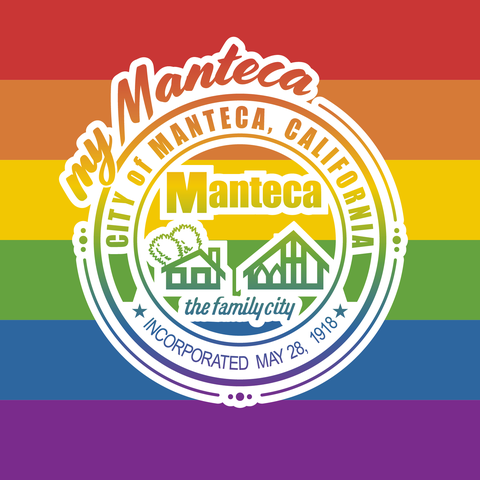
The red white and blue City of Manteca logo has a temporary makeover in white with a rainbow background in recognition of June as being Gay Pride or LGBT Pride month.
The logo first appeared Tuesday on the city’s Facebook page with the message, “The #CityofManteca wishes you a Happy Pride Month! To our LGBTQ+ community: know that you are valued and respected. In recognition of our community’s vibrant diversity, the City will be celebrating all month long with a special logo.”
The message was posted in both English and Spanish.
The Pride Month logo included the slogan “My Manteca” the city has been using to brand itself during interactions with the community’s 87,000 residents. It marked the first time the city has recognized Lesbian, Gay, Bisexual, and Transgender (LGBT) Pride Month in an official manner.
Mayor Ben Cantu said he liked the temporary logo the city is using on its various social media sites.
That said Cantu would like the 41-year-old city seal — what municipalities historically referenced their logos as — to be updated.
“It needs something that represents commerce besides just housing and churches,” Cantu said.
The current logo is in the traditional circle of a city seal using vibrant red and blue against a white background. It encompasses the city motto “The Family City” as well as the date of incorporation of May 28, 1918 along with the wording “City of Manteca, California.” The center of the seal includes the name “Manteca” again along with two objects — a house with two trees behind it and what appears to be a larger house next to it.
If you look closer at the larger “house” you will notice two windows shaped as if they were stained glass windows on a church. That’s because the original seal had a church. The church was neutered about 22 years ago when the city — without public fanfare — removed a steeple with a cross presumably to avoid the city being accused of promoting religion.
In advance of having nearly 40 wayfaring signs made and installed throughout Manteca, the city conducted a contest in 2019 for a possible replacement logo.
There were 60 entries in the city sponsored contest.
The logo used on everything from city stationary and employee clothing to the side of municipal vehicles will be changed as supplies are depleted and equipment replaced.
To contact Dennis Wyatt, email dwyatt@mantecabulletin.com
AUDACY LOS ANGELES is kicking off a 6 month “Fill The Fridge” campaign with a PRIDE theme this month. The campaign to fight hunger in the Southern CALIFORNIA area will have AUDACY partnering with local supermarkets RALPHS and FOOD 4 LESS throughout the month of DECEMBER.
To celebrate PRIDE Month, AUDACY LA will support local non-profits dedicated to supporting the LGBTQ community, including the LOS ANGELES UNIFIED SCHOOL DISTRICT (LAUSD), LOS ANGELES LGBT Center’s PRIDE PANTRY and PROJECT ANGEL FOOD. LAUSD helps students in food insecure households in need of a nutritional meal. The LGBT Center provides services for more LGBT people than any other organization in the world, offering programs, services and global advocacy. PROJECT ANGEL FOOD was founded in 1989 in response to the AIDS crisis and today prepares and delivers medically tailored meals to 2,306 critically ill people each day – over one million meals each year to the LA community.
Regional Pres/AUDACY SOCAL, JEFF FEDERMAN said, “We’re proud to utilize our resources to help make a difference in our community for those who need it. All donations will go directly toward helping to end hunger in our community and we look forward to serving as a champion for these selfless organizations alongside our loyal consumers.”
Are you in search of a destination that is LGBTQ+ friendly? You may want to consider South Africa on your bucket list.
According to MyDatingAdviser.com’s The Best Countries for LGBTQ+ Travel in 2021 report, South Africa has been named one of the best countries for LGBTQ+ travel.
The report aims to raise awareness of global attitudes for LGBTQ travellers- in time for Pride Month. The country ranked 11th with the LGBTQ+ travel index score of 86.2 (out of a possible 100 points).
MyDatingAdviser.com revealed that 54% of the South African public accepted homosexuality, according to a Global Attitudes & Trends survey by Pew Research. In terms of civil union rights, the country enforced same-sex marriage since 2006, and adoption rights have been legal since 2002. The Constitution bans all anti-gay discrimination.
The findings
MORE ON THIS
To determine the most gay-friendly travel destinations, MyDatingAdviser compared 34 countries across eight key indicators of LGBTQ+-friendliness. It looked at categories like society acceptance towards homosexuality, sexual activity rights, civil union rights, marriage rights, adoption rights, military service rights, anti-discrimination laws and gender-identity laws.
Sweden claimed the top spot (98.2), followed by Netherlands(97.6), and Spain (89%). Other destinations featured on the list included France, UK, Germany, Canada, Australia, Brazil, Argentina, Italy, Israel, the US and Mexico.
Meanwhile, in a study by Small Business Prices this year, Luxembourg took the top spot as the world’s most friendly working holiday spot for LGBTQ couples. Small Business Prices researched cities around the world and assessed them based on their legalities around civil partnership, same-sex marriage, public acceptance and nightlife to work out the most LGBTQ+ friendly cities for workers.
Luxembourg claimed the top spot, thanks to its strong support of same-sex marriage, with 85% of residents in support of it.
Visit https://mydatingadviser.com/best-countries-for-lgbtq-travel/ for the full study.
The culprit is HIV, the virus that causes AIDS. It took the life of Steve and so many gay men of my age group who I have come to define as the AIDS Generation.
June 5, 2021, marks the 40th anniversary of the initial report by CDC that described the death of 5 men in Los Angeles from a rare lung infection known as Pneumocystis carinii pneumonia, an opportunistic infection that is one of the illnesses that define a person living with HIV as having AIDS.
Since that time, complications from HIV have resulted in more than 700,000 deaths in the United States and 40 million deaths worldwide. As recently as 2019, 690,000 succumbed to the ravages of the disease.
Although more slow acting in its devastation than SARS-CoV-2, HIV continues unabated with no cure in site. Despite 4 decades of efforts to control this disease, some 40,000 Americans, mostly gay and mostly men of color, continue to become infected annually. And unlike the emergence of 3 vaccines to combat COVID-19 in record time, one is left to wonder, why has this same sense of urgency not been directed toward a vaccine for HIV? Most such efforts have resulted in botched results.
I would be remiss to not describe the advances that have been made to combat and control AIDS since the first decade, at which time a culture of blame, confusion, and fear evolved in the United States, akin to what we have witnessed in reaction to the COVID-19 pandemic.
In the last 25 years, HIV/AIDS has been transformed into a chronic, somewhat manageable disease due to the proliferation of antivirals developed by pharmaceutical companies. A person whose infection is detected early and who takes a combination of antiviral treatments, known as ART, every day without missing doses and lives a relatively healthy lifestyle, cannot spread the disease sexually and has a relatively fair possibility of having a somewhat normal life expectancy.
However, this is a hypothetical and ideal scenario, which few with HIV will likely experience, and these treatments are not cures.
Steve was detected to be living with HIV after the advent of ART. Despite his best efforts to control the virus in his body through treatment, exercise, and diet, he was struck down by non-Hodgkin lymphoma, another complication for those living and aging with HIV. Truly, Steve’s death and the death of all those who have succumbed to AIDS indicate that controlling the complications of this pathogen are less well understood and managed than is being portrayed by pharmaceutical companies’ exuberant and promising TV and print ads for ART—particularly among older adults.
My own research has documented the life experiences of those gay men who have been living with HIV for decades who are now seniors. While they continue to survive, few of them fully thrive physically, emotionally, socially, and financially. You see, HIV, like SARS-CoV-2, is caused by a biological agent, but both AIDS and COVID-19 are hardly simply biomedical phenomena.
Both viruses disproportionately impact and overburden marginalized groups like people of color, sexual and gender minorities, older adults, and other populations because of the social and structural underpinnings of these epidemics—a well-known fact to those of us in public health, less well appreciated or reported by those in medicine. It also speaks clearly to how ill prepared we are to address HIV in elderly adults whose lives are already overburdened by myriad other life challenges.
I have long believed that as a country, we know little about how to provide services to a new generation of older Baby Boomers and Gen Xers and near nothing about those who like Steve are over 50 and gay and HIV positive.
In the United States today, more than 50% of those living with HIV are over age 50. This percentage will only continue to grow, mainly due to the existing and evolving pharmaceutical advances. While yes, this can be heralded as an amazing breakthrough—considering all of my 6 other close friends died of AIDS complications in their 30s prior to the advent of ART, including my partner, Robert Massa, who was the AIDS editor of TheVillage Voice—there is much work to be done.
Aging with HIV is as complex as the physical manifestations of aging, and inflammation due to the virus in one’s body, coupled with the daily bombardment of treatments, leave many susceptible to unknown consequences. I scoff at those who have refused the COVID-19 vaccine fearing its emergency approval will cause long-term damages.
To them I say, “Look at us.” There are people of my generation who take daily doses of medications to simply stay alive and are living a life of experimentation unaware of what these drugs will do in the long run.
During the height of the Trump administration, 6 members of the Presidential Advisory Council on HIV/AIDS resigned in protest of President Donald Trump’s health policies in June 2017, and the remaining 10 members were dismissed by Trump at the end of that year. Although the group was reconvened in 2019, HIV/AIDS has remained relatively ignored by the Biden-Harris administration—understandably so, given the nation’s battle with COVID-19, terrorism due to white supremacy, and the economic burdens caused by an administration that failed to control COVID-19 throughout 2020. But now we are well on our way to controlling that virus in part because we have taken up biological, social, political, psychological, and financial arms to fight it.
The war on HIV/AIDS requires the same arsenal.
As we commemorate the 40 years since AIDS was first detected and we celebrate Pride Month in the United States this June, I call upon President Joe Biden and Vice President Kamala Harris to forge a call to arms to renew our battle against HIV with a focus on HIV and aging.
Many of us would be willing and ready to join the fight so that we truly can bring an end to HIV/AIDS. We want to help people not only survive but to age and thrive, so that millions of others do not have to continue to be retraumatized at the loss of those whom we cherish. Do it for those living with and affected by HIV; do it for our nation; do it for Steve.
The influence of RollingRay on the culture is undeniable. His vocabulary, his voice, his image — rightfully or not — has completely changed the way Gen Z communicates in person and virtually. One of his most famous contributions has been introducing “purr” into the larger language, reshaping the onomatopoeia into a statement of confidence and affirmation. On hit single “BigPurrrr,” released Apr. 16, RollingRay defends his creation from Coi Leray who made the word the centerpiece of her hit single, “BIG PURR (prrdd) ft. Pooh Shiesty,” and has attempted to brand herself the “big purrr.”
Musically, RollingRay’s “BigPurrrrr” is not written, produced, or rapped particularly well, but make no mistake — RollingRay is not a rapper, he is an icon. And the song is iconic.
If there is one thing RollingRay is not, it is silent. Some of his most prominent moments of fame have come from his commitment to his boisterous personality and swagger. Who can forget his legendary appearance on Divorce Court, when he rolled up and down the courtroom isle cussing out his then boyfriend Christian to Judge Toler. Or his Twitter beef with Saucy Santana and City Girls which lead to Santana releasing an alleged diss track against RollingRaycalled “Walk.” RollingRay also has a history of using his clout for social change: During the protests of summer ‘20, RollingRay was on the frontlines of the DC movement, promenading in front of DC police, and ramming into barricades with his wheelchair.
RollingRay always sits on the precipice of controversy and prominence, but by doing so as a Black, gay, and disabled icon, RollingRay has also been the victim of considerable ableism, racism, homophobia, and digital blackface. His photos are turned into memes, his sayings are appropriated, his presence is made fun of. Most recently, this has been expressed with “purr,” a word RollingRay excitedly brought into the mainstream that has since been manipulated and appropriated by others. This behavior has been seen most recently with Coi Leray and Pooh Shiesty, who created viral hit songs with his language without crediting his work.
The lyrics of “BigPurrrr” let us know what RollingRay’’s thoughts are on the theft. He swipes the “He call me big purr/ Gon’ make this p*ssy purr” hook directly from Coi Leray’s track, but follows it with lines about how “Everybody knows [he] Sh*ts on her” and how Coi Leray is “taking words like this sh*t is hers.” RollingRay expresses his resentment for stealing his words by attempting some disses like bringing up Coi’s controversial father, Benzino, and threatening violence, but there is little creativity beyond rhyming thank with spank and shank. The whole song sits on a beat straight out of a seventh grade garage band project, so bar for bar, chord for chord, Coi is the clear musical victor.
However, the song finds its importance far beyond musicality. It is a public and prominent cry against intellectual theft against marginalized groups. RollingRay himself said this abstraction was his intention, claiming in an Instagram Live that he was tired of gay artists having thier ideas stolen, and he wanted to prevent the same thing from happening to “Purr.”
Is “BigPurrrr” a little ridiculous, a little troll-y, a little ad-hoc? Absolutely, but so is RollingRay. Songs do not need to be “good” to have relevant messages and “BigPurrrrr” has never been more relevant. In a time where non-Black individuals are trying to rebrand AAVE into “internet slang” and Black songs and traditions into “TikTok trends,” “BigPurrrrr” stands as a silly, but critical critique, and since the song was charting above Coi Leray’s appropriation, it seems like people are listening.
MARSHALL — A deadline for the Marshall Public School district to respond to a lawsuit filed in Minnesota District Court is approaching next week, court documents said.
Both MPS and Marshall Middle School principal Mary Kay Thomas have until June 7 to file responses to a lawsuit filed after a rainbow LGBT pride flag was included in a display of flags at the middle school cafeteria last year.
The lawsuit claims the school district violated a student’s First Amendment rights by taking away a petition he had started in support of removing the rainbow flag. The lawsuit also claims the school district’s policies on flag displays are not “viewpoint neutral.”
The plaintiffs in the lawsuit, a group called Marshall Concerned Citizens and Grant Blomberg, are demanding a jury trial, court documents said.
The lawsuit was filed April 22, and MPS and Thomas originally had until May 17 to file responses. However, court documents said they requested a time extension, and a new deadline of June 7 was set.
In case you missed it, there’s an app that people can use to meet up and have gay sex! (Google docs tried to autocomplete that sentence to “meet up and have a conversation” — slow down, Google: That’s third base in Grindr speak.) I joined about a month ago, but worry not, because I haven’t “given in” to the more toxic sides of the app. On the contrary, the experience has provided me the opportunity to practice an established research method: ethnography — specifically, an ethnography of Grindr that you never wanted, and never asked for, but that I hope you won’t regret giving web traffic.
Wait, what?
The Cambridge Encyclopedia of Anthropology provides the following definition of ethnography: “the recording and analysis of a culture or society, usually based on participant-observation and resulting in a written account of a people, place or institution.” The goal is ethnographic immersion among the research participants, bringing certain attunements for later analysis. Ethnography has been loftily described as the iterative process of getting lost and finding oneself again, and the written product that emerges. This description raises questions about objectivity and the identity of the ethnographer, which we’ll get into later. In this case, the ethnographer will be (to quote Taylor Swift) “ME-e-e!”
Traditionally, ethnography was defined by the “us versus them” dialectic, meaning someone with training in the Western academy would go to a far-away place to marvel at the foreigners’ oh-so-different lives. Only recently has the academy realized that Western contexts are bizarre, and worthy of ethnography. Make no mistake: I’m not some specialized “us” making sense of the gay “them.” Rather, I’m in the thick of things myself, and decided to call myself an ethnographer after the fact, for my own sanity and as clickbait. (Things are pretty thick over here, but I haven’t dislocated my jaw yet.) Enjoy!
Opening the app
For more context — Grindr is a queer social networking app that launched in 2009. The cultural script for using it in a positive and healthy way, however, is still in beta, as you tech geeks would say.
It might be helpful to start with something that my friends in Symbolic Systems pointed out: The Grindr user interface is terrible — clunky, glitchy, battery-draining. Maybe that’s what we deserve for the unspeakable acts that the app facilitates? If we’re going to commodify physical intimacy, maybe we shouldn’t glorify it with cute graphics and intuitive design. But, unlike SymSys majors, not all of us get horned up when we see a good user interface. If anything, the terrible experience is even more incentive to get off the app as quickly as possible — either to go meet someone and get railed, or to put your phone away and wallow in self-loathing.
Once you’re using the app, it’s the Wild West. No swiping, no matching, no endless feed; instead, the app goes, *boom* — here are all the gay people in your area, so take it or leave it. Or, here are all the gay torsos in your area — if the profile has any photos at all. To show interest in a particularly scrumptious torso, you can “tap” or message its owner. You can even send pictures to any user who appears in your grid — and that’s exactly what you think it’s like. You can also change the age listed on your profile at any time, or list no age at all. And unless the user opts out, you can see how many feet away they are from your location, because I guess we’re still using the Imperial System.
If you use Grindr, maybe you’re turned on by now? If you’re literally anyone else, you probably feel like taking a shower.
Anonymity is the running theme of Grindr. When I first made my profile, only a naive young gay one month ago, I included my first name because I wasn’t worried about being outed by randos on the Internet. (Now that you’re reading this article, I guess that ship has sailed anyway.) Yet when confronted with the sea of profiles without names, including those of people I recognized, I felt pressured into removing my own. Also, I thought it would be best to respect the conventions of my research participants. But I left my first initial, a small vestige of my personhood to mark the walking meat-sack that I hath become in the eyes of my gay peers!
Still, the user will often name their profile with something. Often they express their identity with a single emoji, either quirky (peace sign) or suggestive (peach). Sometimes, they name their purpose for being on the app — and the mix of purposes is striking. For example, the profile of “Hung4now” might appear next to the profile of “cuddles?” which might appear next to “Thesis advisors?” Reading these nearly gave me whiplash!
Also, let’s take a moment. This man felt the need to clarify that his penis hangs, but I’m not sure there are many other configurations, unless it “floats” or “wanders.” And if the penis hangs, does it ever “vibe” or “chill,” too? On the other hand, I like the ephemerality of “Hung4now,” as it acknowledges that hanging later is no guarantee.
Next, cuddles are a reasonable ask. But if you are looking for a thesis advisor on Grindr, then I hate to break it to you: Your department has failed you. How many alternatives did you exhaust before things reached this point? Or, if you’re looking for a thesis advisor role-play situation, then I’m not here to kink-shame, but I do believe this kink could use some workshopping. If you set up a Zoom meeting with your department’s Student Services Officer to ask about thesis advising, you might find that the fantasy is broken — the whole process is rather unsexy.
In summary, expect to see torsos from any which angle on Grindr, but don’t expect to learn names. If having a conversation is “third base,” then perhaps learning someone’s real name is second base? Actually, I take that back: The “bases” analogy might not work for gay people, because we don’t know anything about sports.
A note on methodology
To be clear, Grindr users have a range of identities, including many who are not mostly male-identifying and gay or bi. And while it’s fun to throw around the idea of gay sex, the app also has many recognized purposes other than hook-ups. With this in mind, I won’t ground my findings in anyone’s positionality but my own: a cis, gay man who recently became un-scared of sex and now has to deal with other men. (Though being a “man,” giggle, won’t stop me from having soft hands and doing Kegels.) Likewise, don’t expect to find identifying information about anyone but myself.
But more deeply, this project is mostly an excuse to talk about myself. Then why call it an “ethnography of Grindr”? I consider Grindr an interface between the internal and external, a touchpoint between myself and the queer male community. In one direction, using Grindr allows me to connect my experience to a larger pattern. In the other, it allows me to try to see myself in the Grindr fishbowl from the outside — hence, saving my sanity.
Further, I suggest that ethnography done well should in part be auto-ethnographic. By questioning and observing, we actively create our objects of study. There is no mind-independent “queer male community” out there, waiting to be accessed from my limited perspective, but rather something that I play a role in creating through my actions around it. Thus, it would be irresponsible to erase myself from the process, speaking as if from “everywhere and nowhere” in the name of objectivity. Instead, transparency is the name of the gayme. My positionality will shape any findings I present — rather than trying to hide it, I may as well openly explore what it might reveal.
I can think of a few more reasons for calling this an ethnography of Grindr. For one, even while the very existence of Grindr is subversive in a heteronormative society, using it for my own purposes serves as my small resistance to the toxicity that it perpetuates. Also, the pun opportunity of writing about Grindr for The Grind was too good to pass up — I check both “on the daily.” If I hypothetically worked hard on this article while manually crushing pepper onto my meal, would that make me a person “on Grindr, grinding while grinding for The Grind”?
But mostly, I’ve spent the last several months navel-gazing while my brain slowly turned into scrambled eggs, so it would be nice to know that something coherent came out of it. Grindr was the culmination and the start of more reflection, sometimes at the expense of my other responsibilities. In any case, buckle your seatbelts, friends, because we’re about to thrust forward, at full-throttle, into some very gay thoughts about this very gay life!
This article is part of a series on sex, love and relationships in the digital age and during the pandemic.
Contact The Daily’s The Grind section at thegrind ‘at’ stanforddaily.com.
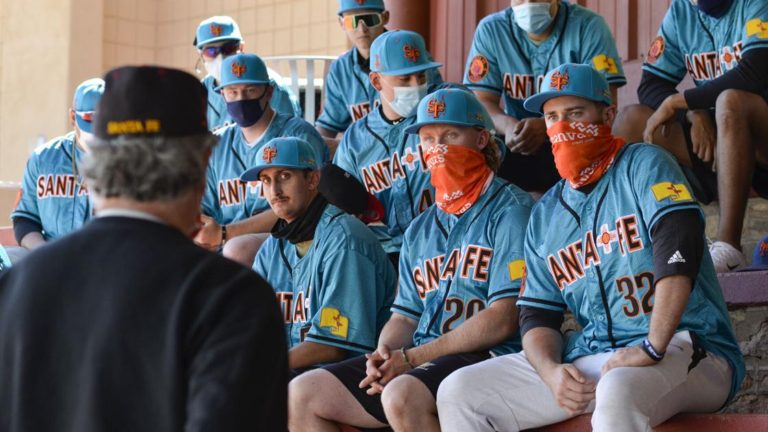
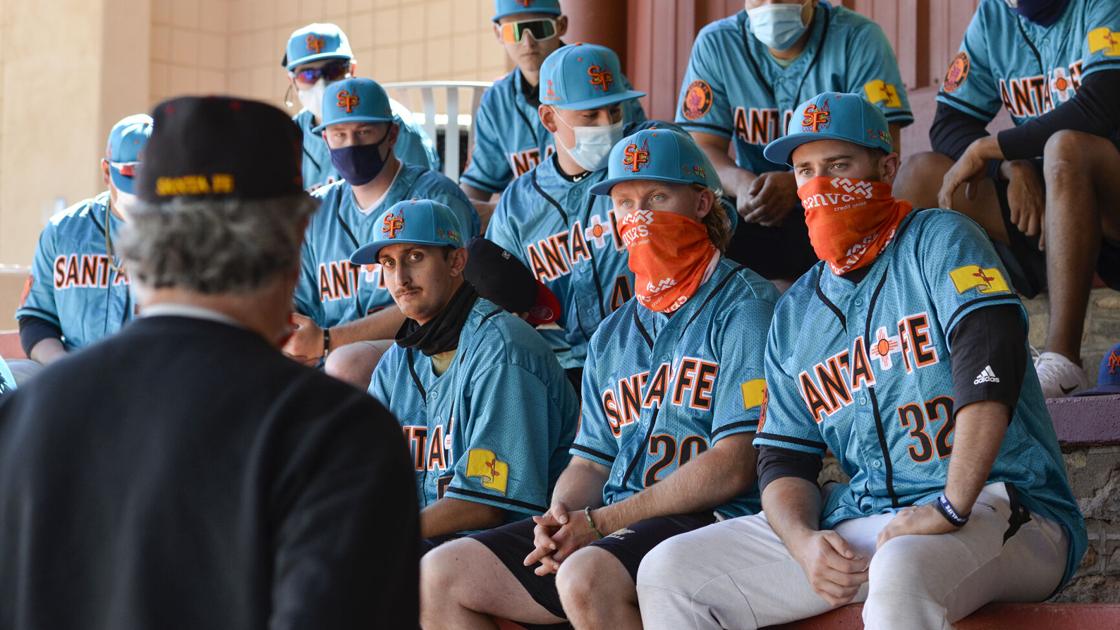
After months of breadcrumbs hinting about the style of the team’s new identity, the Santa Fe Fuego broke out their 2021 game uniforms in an impromptu jersey draft for the players and a handful of fans Tuesday afternoon at Fort Marcy Ballpark.
New team, new roster, new season … same familiar look.
Promised black jerseys and caps, the kits the players will wear are no different than those worn the last time the Fuego took the field in the pre-pandemic 2019 campaign.
“I mean, yeah, at least it’s not red, because every team I’ve played on has worn red,” said Fuego pitcher Aaron McIntyre, the staff ace and the starter for Wednesday’s opener at Roswell.
The Fuego will embark on a 61-game regular season that ends the first week of August, playing 34 of those games in downtown Santa Fe. They’ll do so wearing the same turquoise jerseys and caps they’ve made their own over the past few years.
Fuego manager Bill Rogan said the plan all along was to wear black jerseys with the same rounded script across the chest. Those jerseys actually arrived, he said, but several had matching numbers while others had one number on the front and a different one on the back.
The fallback was turquoise, which the team will wear in Rogan’s first year as skipper. In fact, it’s the first year for everyone in the dugout — all except for the youngest guy on the team.
Mike Hernandez is a 19-year-old from Santa Fe who will serve as the team’s bullpen catcher. The Santa Fe High graduate, who played two seasons on the Demons’ varsity team for coach Ian Farris, said he started coming to Fuego games when he was a kid and wanted more than anything to wear the team’s colors now that he’s an adult.
For a game or two, he was down in the dugout serving as a batboy, doing whatever he could to be around the team he grew up watching.
“I was never much of a player, but I’ve always loved the game,” Hernandez said, stroking both open hands down the length of his No. 48 jersey. “It means so much to wear this thing, to be a part of this team.”
Given the chance to pick which number they wanted based on seniority, the players were called one at a time to take a look at the jerseys laid out on the Fort Marcy seats and claim the one they wanted.
Third in line was Manny Cachora, a Las Cruces native who spent time at Luna Community College in Las Vegas, N.M. Like a handful of others, the third baseman picked his number based on his love of hoops. After teammates Jared Gay took No. 25 and Ben Tingen claimed No. 22, Cachora made a beeline for No. 23.
“Ahhh, Don Mattingly’s number,” Rogan said. “Good choice.”
“Who?” Cachora said. “No, it’s LeBron’s number.”
Outfielder Harrison Moore was up next, taking No. 24 in honor of Kobe Bryant.
And so it went, one at a time each player grabbed a jersey and cap, then chatted with a handful of fans who were there to watch.
For better or worse, the Fuego will set sail with an opening-day allotment of 19 players, three shy of the league maximum of 22. They’ll play two games in Roswell, then be at Fort Marcy for a pair of games against those same Invaders on Friday and Saturday.
While help is on the way in terms of at least three additional players, Rogan is confident he has the top eight position players at his disposal for Wednesday’s game. Tingen, the team’s calm and pragmatic Pecos League veteran, will play center and bat leadoff while Moore will be in left and bat second.
Phil Buckingham will start at short and bat third while Gay, the tight end-sized first baseman whose family lives in Albuquerque, will bat cleanup. Catcher Ryan Bernardi bats fifth while Cachora is sixth.
Second baseman Declan Peterson and rightfielder Parker Depasquale, who played one season under former New Mexico Highlands coach Steve Jones at Texas A&M-Texarkana, round out the position players.
McIntyre will start on the mound with Ryan Norris and Troy Mowen on the hill the next two games.
“Every team in America is worried about their middle relief, and we’re no different,” Rogan said. “We’re always going to be looking to add the best arms we can, but right now we’re going with what we’ve got.”
What Rogan expects out of this club is what every single Fuego manager has dealt with since the club’s inception in 2012: Don’t fall in love with the long ball. With a postage stamp for a field, he wants his lineup to find gaps and manufacture runs with contact hitting rather than the long ball.
What he hopes for from his pitching staff is avoiding the beer league softball scores that are the norm at Fort Marcy, a field that seems to look smaller every single year.
“The idea isn’t to think about stuff like that,” McIntyre said. “The key for me — for every pitcher, really — is disrupting the timing of a hitter. If I can change speeds and keep the ball down, I know I can do this. Every guy can hit, but not every pitcher can do that.”
Rogan took Santa Fe Mayor Alan Webber on a tour of the Fort Marcy infield during Tuesday’s meet-and-greet. He said Webber promised to replace a portion of the chain-link fence that serves as a backstop immediately behind home plate. The bottom lip of the fence has curled up and away from the ground, leaving a small gap where balls can squeeze through or, worse, injure a player. … Augie Voight will be the team’s closer. … Rogan’s dream for Fort Marcy? The Screen Monster. He would like to see the city or the Pecos League develop a giant screen that stretches from the rightfield foul pole all the way to center, standing about 25 to 30 feet high. It would serve as an extended wall, much in the way the Green Monster does at Boston’s Fenway Park. The idea, he said, would be to sell advertising to generate revenue and keep the bloated Fort Marcy home run numbers down.
Photo courtesy of the George H.W. Bush Presidential Library
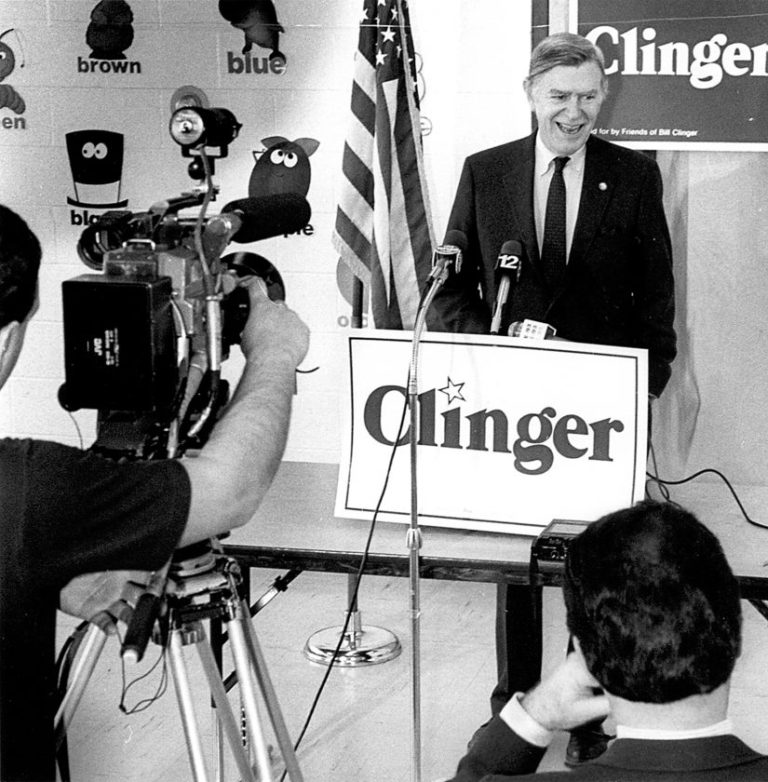
Then Vice-President George Bush stands with Representative William Clinger in an event held in Warren at the Woman’s Club in the 1980s. Clinger passed away on May 28 at the age of 92.
Longtime Warren County Congressman William Clinger has passed away.
According to his daughter, Clinger died at the age of 92 on May 28.
“We are devastated,” Bijou Clinger said in a Facebook post, “but know he is still noble, brave and hopeful.”
William Floyd Clinger, Jr. was born in Warren on April 4, 1929. He graduated from Johns Hopkins University in Baltimore in 1951 and then served as a lieutenant in the U.S. Navy from 1951 until 1955.
He worked at the New Process Co. from 1955 until 1962 until he went to law school at the University of Virginia.
Times Observer file photo
Congressman William Clinger at a campaign event. Clinger represented Warren County from 1979 until 1997.
Admitted to the Pennsylvania bar in 1965, Clinger worked in private practice here in Warren as well as in Washington under the auspices of the Economic Development Administration until his election to the 96th Congress in 1979.
His political engagement grew during that period as he served as a delegate to the Pennsylvania state constitutional convention in 1967 and then as a delegate to the Republican National Convention in 1972.
He would go on to serve in each Congress from the 96th through the 104th, retiring at the end of that Congress in January 1997.
One of his good friends in Warren was Bob Sokolski — it was the Sokolskis that actually introduced Clinger when he announced his candidacy for Congress.
“The space was open. I obviously knew him extremely well,” Sokolski said. “(He was) one of my best friends. He was my attorney and my company’s attorney.”
He praised Clinger’s work in that role and said that “made me think — if he were to become a Congressman, (he would) do a real good job at that also which he did do.
“I always found him to be a very reasonable person,” Sokolski said, calling it “easy to get behind him.”
He said Clinger ultimately retired from Congress because there “wasn’t enough non-partisanship stuff.”
To show that bipartisanship, Sokolski said Clinger was friends with both John Kasich, former Congressman and Republican governor of Ohio, and Al Gore.
Add Tom Ridge to that list.
Ridge, former Pennsylvania governor and Congressman, spoke highly of Clinger in a Twitter post.
“Bill Clinger was a kind, thoughtful and honorable man — a model of integrity, bipartisanship and civility that all those in public office would do well to emulate,” Ridge tweeted on Monday. “He was my congressional neighbor and I will always be grateful for his friendship.”
Sokolski said Clinger met his wife, Judy, at Chautauqua Institute — their parents both had homes there. Clinger’s father was in the oil industry in the county. They lived in Alexandria once he retired from Congress before moving to Florida.
But Chautauqua was always a happy place for them.
“Basically, they would go back every year to Chautauqua,” he explained “They had a home there. It was a big part of their life.”
He highlighted a speech Clinger gave on gerrymandering and dark money in politics as recently as a couple years ago at Chautauqua.
“He was active,” Sokolski said. “He’d had health problems for quite a while.”
Clinger was the last Congressman to live here and represent the area — the county has since been presented by John Peterson (Pleasantville) and Glenn Thompson (Centre County).
From 1979 to 1993, his district was Pensnylvnaia’s Twenty-Third, switching to the Fifth for his last two terms.
In the 104th Congress, he was chairman of the Committee on Government Reform and Oversight.
“You may not agree with his principles or his thinking but you knew where Bill Clinger stood,” Ash Khare said. “If he believes, he’s going to do that. You may or may not like it.”
Khare said the Warren post office is actually named after Clinger.
“I can tell you one thing,” Khare added. “In this day of politics the way politics is today, I don’t think people like Clinger can get elected…. He was a straight shooter, a moderate thinker.”
That may be best exemplified by a very public break with GOP standard bearer and former President Donald Trump.
He signed on to a letter endorsing Joe Biden last September and also broke ranks with Trump prior to the 2016 election.
About a month prior to the 2016 general election, Clinger was one of 30 former Republican members of Congress that signed off on a letter which suggested that Trump “has proven himself manifestly unqualified to be president.”
“We blew it by not encouraging others to run,” Clinger said when that letter was released. “He was the only anomaly with a totally different agenda. People were looking for change. There is a deep wellspring of anger…. He is crazy with some sort of a neurological problem. He is a narcissist. The party is in a very bad position…. It is very unfortunate. He has hijacked the Republican Party….”
Timothy Gay, a 1972 Warren Area High School graduate and Clinger’s original campaign manager and first congressional press secretary, remembered Clinger as a Renaissance man who roamed the halls of Congress.
“Bill Clinger was a kind and caring soul,” Gay said. “He was a Renaissance man with a great passion for public policy and thoughtful debate. Sadly, he was among the last of what is now a nearly extinct breed: an enlightened and compassionate Member of Congress for whom public service was an honor, not a blood sport.”
Gay also shared a story about Clinger’s choice in vehicles while he was campaigning for Congress for the first time. While one would think Clinger would have been traveling in style from stop to stop on the campaign trail, reality was a little bit different.
“Bill looked and behaved a lot like the Fred McMurray character in the ‘Absent-Minded Professor’ movies,” Gay said. “He could have afforded any car he wanted, but he chose to campaign in ’77 and ’78 in one of the ugliest vehicles ever made: a bright blue AMC Pacer that was always on the verge of breaking down. I think voters took a look at that car and concluded that Bill could be trusted with their tax dollars. Later, I was always embarrassed to see the Pacer in Bill’s space in the House parking garage but it didn’t bother him at all.”
Khare said he once organized a fundraiser for the county GOP that centered on “roasting” Clinger.
“Everybody was telling all kinds of goofy… Bill Clinger jokes.”
Khare added Clinger was never seriously challenged in an election until he decided not to run and said his staff always did a “very fine job” managing the district offices.
“He was good. He was principled,” he added. “He was an approachable guy.”
Michael E. Hill, Chautauqua Institution president, said the Chautauqua Institution family will miss Clinger, who served as the institution’s board president from 2000 to 2006.
“Bill Clinger was a towering figure in the life of our nation and of Chautauqua Institution,” Hill said. “As an elected official, he served our neighbors in Warren County with tenacity and grace. Current and future public servants would do well to look to his example of moral leadership. At Chautauqua, Bill’s steady hand as chair guided the Institution through some difficult days and prepared it for the heights of mission fulfillment we’re striving toward and realizing today. My heart goes out to Bill’s children Bijou, Will, Jim and Julia, and I join our Chautauqua family and regional community in both mourning a great loss and celebrating an extraordinary legacy. I adored the man, felt lucky to call him my friend, and will miss him greatly.”
“We are all pretty broken up by him leaving us but the outpouring of condolences and praise for him has been wonderful and somewhat comforting,” his daughter, Bijou Clinger, told the Times Observer.
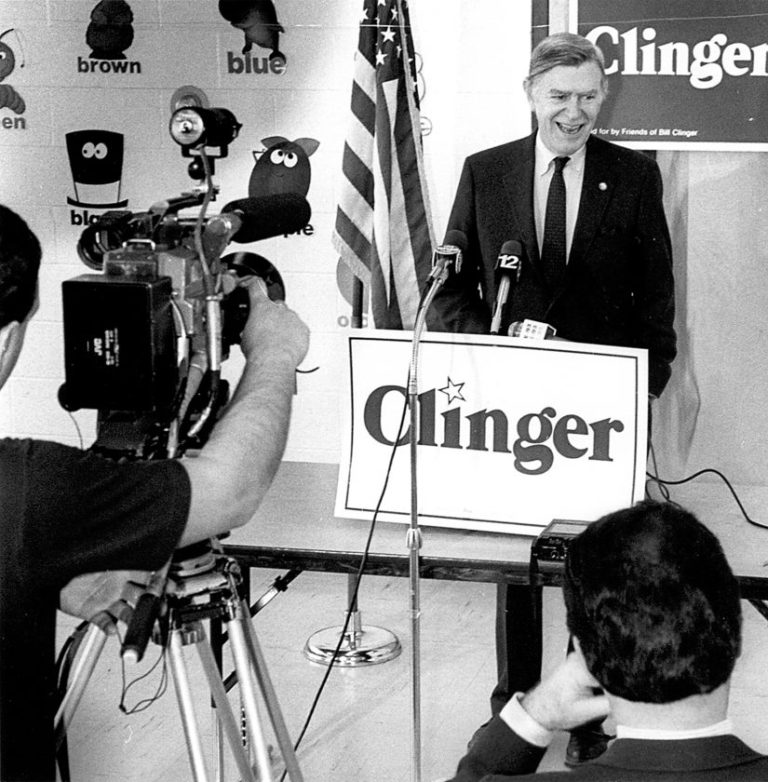
Then Vice-President George Bush stands with Representative William Clinger in an event held in Warren at the Woman’s Club in the 1980s. Clinger passed away on May 28 at the age of 92.
Photo courtesy of the George H.W. Bush Presidential Library
Longtime Warren County Congressman William Clinger has passed away.
According to his daughter, Clinger died at the age of 92 on May 28.
“We are devastated,” Bijou Clinger said in a Facebook post, “but know he is still noble, brave and hopeful.”
William Floyd Clinger, Jr. was born in Warren on April 4, 1929. He graduated from Johns Hopkins University in Baltimore in 1951 and then served as a lieutenant in the U.S. Navy from 1951 until 1955.
He worked at the New Process Co. from 1955 until 1962 until he went to law school at the University of Virginia.
Congressman William Clinger at a campaign event. Clinger represented Warren County from 1979 until 1997.
P-J file photo
Admitted to the Pennsylvania bar in 1965, Clinger worked in private practice here in Warren as well as in Washington under the auspices of the Economic Development Administration until his election to the 96th Congress in 1979.
His political engagement grew during that period as he served as a delegate to the Pennsylvania state constitutional convention in 1967 and then as a delegate to the Republican National Convention in 1972.
He would go on to serve in each Congress from the 96th through the 104th, retiring at the end of that Congress in January 1997.
One of his good friends in Warren was Bob Sokolski — it was the Sokolskis that actually introduced Clinger when he announced his candidacy for Congress.
“The space was open. I obviously knew him extremely well,” Sokolski said. “(He was) one of my best friends. He was my attorney and my company’s attorney.”
He praised Clinger’s work in that role and said that “made me think — if he were to become a Congressman, (he would) do a real good job at that also which he did do.
“I always found him to be a very reasonable person,” Sokolski said, calling it “easy to get behind him.”
He said Clinger ultimately retired from Congress because there “wasn’t enough non-partisanship stuff.”
To show that bipartisanship, Sokolski said Clinger was friends with both John Kasich, former Congressman and Republican governor of Ohio, and Al Gore.
Add Tom Ridge to that list.
Ridge, former Pennsylvania governor and Congressman, spoke highly of Clinger in a Twitter post.
“Bill Clinger was a kind, thoughtful and honorable man — a model of integrity, bipartisanship and civility that all those in public office would do well to emulate,” Ridge tweeted on Monday. “He was my congressional neighbor and I will always be grateful for his friendship.”
Sokolski said Clinger met his wife, Judy, at Chautauqua Institute — their parents both had homes there. Clinger’s father was in the oil industry in the county. They lived in Alexandria once he retired from Congress before moving to Florida.
But Chautauqua was always a happy place for them.
“Basically, they would go back every year to Chautauqua,” he explained “They had a home there. It was a big part of their life.”
He highlighted a speech Clinger gave on gerrymandering and dark money in politics as recently as a couple years ago at Chautauqua.
“He was active,” Sokolski said. “He’d had health problems for quite a while.”
Clinger was the last Congressman to live here and represent the area — the county has since been presented by John Peterson (Pleasantville) and Glenn Thompson (Centre County).
From 1979 to 1993, his district was Pensnylvnaia’s Twenty-Third, switching to the Fifth for his last two terms.
In the 104th Congress, he was chairman of the Committee on Government Reform and Oversight.
“You may not agree with his principles or his thinking but you knew where Bill Clinger stood,” Ash Khare said. “If he believes, he’s going to do that. You may or may not like it.”
Khare said the Warren post office is actually named after Clinger.
“I can tell you one thing,” Khare added. “In this day of politics the way politics is today, I don’t think people like Clinger can get elected…. He was a straight shooter, a moderate thinker.”
That may be best exemplified by a very public break with GOP standard bearer and former President Donald Trump.
He signed on to a letter endorsing Joe Biden last September and also broke ranks with Trump prior to the 2016 election.
About a month prior to the 2016 general election, Clinger was one of 30 former Republican members of Congress that signed off on a letter which suggested that Trump “has proven himself manifestly unqualified to be president.”
“We blew it by not encouraging others to run,” Clinger said when that letter was released. “He was the only anomaly with a totally different agenda. People were looking for change. There is a deep wellspring of anger…. He is crazy with some sort of a neurological problem. He is a narcissist. The party is in a very bad position…. It is very unfortunate. He has hijacked the Republican Party….”
Timothy Gay, a 1972 Warren Area High School graduate and Clinger’s original campaign manager and first congressional press secretary, remembered Clinger as a Renaissance man who roamed the halls of Congress.
“Bill Clinger was a kind and caring soul,” Gay said. “He was a Renaissance man with a great passion for public policy and thoughtful debate. Sadly, he was among the last of what is now a nearly extinct breed: an enlightened and compassionate Member of Congress for whom public service was an honor, not a blood sport.”
Gay also shared a story about Clinger’s choice in vehicles while he was campaigning for Congress for the first time. While one would think Clinger would have been traveling in style from stop to stop on the campaign trail, reality was a little bit different.
“Bill looked and behaved a lot like the Fred McMurray character in the ‘Absent-Minded Professor’ movies,” Gay said. “He could have afforded any car he wanted, but he chose to campaign in ’77 and ’78 in one of the ugliest vehicles ever made: a bright blue AMC Pacer that was always on the verge of breaking down. I think voters took a look at that car and concluded that Bill could be trusted with their tax dollars. Later, I was always embarrassed to see the Pacer in Bill’s space in the House parking garage but it didn’t bother him at all.”
Khare said he once organized a fundraiser for the county GOP that centered on “roasting” Clinger.
“Everybody was telling all kinds of goofy… Bill Clinger jokes.”
Khare added Clinger was never seriously challenged in an election until he decided not to run and said his staff always did a “very fine job” managing the district offices.
“He was good. He was principled,” he added. “He was an approachable guy.”
Michael E. Hill, Chautauqua Institution president, said the Chautauqua Institution family will miss Clinger, who served as the institution’s board president from 2000 to 2006.
“Bill Clinger was a towering figure in the life of our nation and of Chautauqua Institution,” Hill said. “As an elected official, he served our neighbors in Warren County with tenacity and grace. Current and future public servants would do well to look to his example of moral leadership. At Chautauqua, Bill’s steady hand as chair guided the Institution through some difficult days and prepared it for the heights of mission fulfillment we’re striving toward and realizing today. My heart goes out to Bill’s children Bijou, Will, Jim and Julia, and I join our Chautauqua family and regional community in both mourning a great loss and celebrating an extraordinary legacy. I adored the man, felt lucky to call him my friend, and will miss him greatly.”
There’s a famous scene from Lewis Carroll’s classic “Alice in Wonderland” in which Alice is staring silently at a hookah-smoking caterpillar. The larva finally breaks the standoff with a question: “Who are you?” Alice hems and haws until the caterpillar asks again, this time more pointedly: “You! … Who are you?”
This question is the most pressing of our time. And its answer holds the power to shape society. Indeed, the source of today’s deepest and most worrying political conflicts ultimately is grappling with differing definitions of what it means to be human — to be a person.
Carroll’s children’s book prefigured our modern problem. And so, too, did the 20th century philosopher Sydney Shoemaker when he imagined a fictional scenario where a surgeon operated on the brains of two men, Brown and Robinson. At the end of the operation, his assistant replaced the brains in the wrong bodies. Unfortunately, one of the men dies.
The survivor, however, now has the body of Robinson and the brain of Brown. He does not recognize himself in the mirror but he thinks of himself as Brown, has Brown’s memories, is still in love with Brown’s wife. And as he slowly recovers from the operation, he slowly but surely starts to act exactly as Brown used to act.
The immediate question, of course, is: Who is he? Is he Brown, trapped in the body of Robinson? Is he Robinson but just with the wrong brain? Is he some hybrid of the two? Or is the human body simply a tool for expressing inner identity and of no significance for who we are beyond that? The answer to these questions rests upon a prior understanding of what it is that gives us our identities. What is the real “us”: Is it our psychological states, our feelings, our bodies or something else?
In the years since Shoemaker’s thought experiment, the political culture of the United States has tilted strongly toward a psychological construction of human identity. In short, public policy is increasingly driven by the assumption that private psychological states or feelings are the basic foundation for personal identity — for who we think we are. The idea that bodies can contain the wrong mind and that bodies ought to be fashioned to our inner will and feelings is now widespread.
The political significance of this might not be obvious at first glance but becomes very clear when we reflect upon how our culture is changing as a result. Take, for example, the idea of freedom as traditionally understood in America. Freedom of religion and freedom of speech are — or were — basic to the American experiment. They are enshrined in the First Amendment of the Bill of Rights, a placement which surely points to the priority they held in the minds of the founders.
These ideas, though, were also rooted in a certain understanding of humans: that they were made in the image of God and that they were deserving of life, liberty and the pursuit of happiness. Yet these truths — once thought self-evident — are under increasing scrutiny as new, and even revolutionary, ideas of the human person are sweeping Western culture.
And the alarming news for many is that, as much as religious conservatives might want to view this current trend as a simple battle of good versus evil or us versus them, Americans from across the ideological spectrum are all deeply implicated in the modern revolution of human selfhood. The way out will demand that we capture an older and more truthful understanding of who we are.
This new debate over the “self” has emerged as a central battleground in the ongoing culture war. It’s sometimes called “expressive individualism,” a bit of jargon used by modern philosophers to explain how we think of ourselves these days. “Expressive individualism,” the American sociologist Robert Bellah explains, “holds that each person has a unique core of feeling and intuition” that must be expressed “to be realized.” In other words, our inner space, our thoughts and feelings, our emotions, are what constitute the real “us.” And that to be the true “us” we must give expression to those inner feelings. As we’ll see, this idea carries profound implications.
Certainly, human beings have always had an inner space. This is obvious. The Psalms contain emotion and introspection. The dramatics of Greek tragedy depend on the agonies of soul. Shakespeare’s masterpiece “Hamlet” is an extended glimpse into the inner mind of a melancholy prince. But the rise of “expressive individualism” is not simply about humans having an inner life. No, “expressive individualism” is concerned with the authority — and the importance — we ascribe to our inner life. Today, the power of our inner life is nearly absolute. Psychological feelings — more than even biology — often play the decisive role in determining personal identity.
One of the most important sources in influencing society’s move to prioritizing inner feelings is the 18th century Genevan philosopher Jean-Jacques Rousseau. Rousseau’s most famous saying was “Man is born free, yet everywhere he is in chains.” This memorable statement is a neat summary of his philosophy that individuals left alone in a “state of nature” are the most authentic humans. By “state of nature,” Rousseau means “free of social conventions.” In short, Rousseau’s thought is emblematic of the tradition of thinking that sees society — and collective norms — as the source of human ills.
Rousseau articulated this philosophy in numerous works, including his autobiography, “The Confessions,” which focused on his own inner life and demonstrated how the various wicked acts he had committed over the years — from stealing a neighbor’s vegetables to framing a co-worker for another theft he committed — were really the result of the environment in which he was raised. And in “Emile,or On Education,” he wrote what was to become a foundational text in modern child-centered approaches to education: The purpose of education, he argued, was not to press the child into being that which society demanded but to allow the child to develop according to the voice of nature, undamaged by society.
The artists, poets and composers of what is now called the Romantic movement built on Rousseau’s ideas. When William Wordsworth and Samuel Taylor Coleridge published their poetry collection, “Lyrical Ballads,” in 1800, they included a preface that explained why their poems largely focused on ordinary, rural characters and scenes: It was because they were unspoiled by social artificiality. Their poetry was not simply entertainment; it was designed to help readers become truly authentic, appealing directly to “natural” emotions.
At the heart of this project is an assumption that humans are best when untainted by their community.
But what if that assumption is wrong?
Friedrich Nietzsche and Sigmund Freud identified the inner space of the human psyche not as the home to universal human empathy but rather as an often dark and potentially destructive space. For Nietzsche, the desire for power and control, and the exhilaration of humanity’s creative and destructive urges, were central to the inner life of humans. With no God, in his view, there was nobody to whom humans were accountable except this potentially dark inner self. As for Freud, the inner voice was more often consumed with — and defined by — extravagant sexual desires. Happiness in this view was found in embracing and giving full expression to such desires.
After Freud, then, sex was not something we did, but something we were.
These three ways of thinking — Rousseau, Nietzsche, Freud — have come to influence today’s brand of “expressive individualism.” It’s why we are slightly more individualistic, hedonistic and impatient about external authority. We are self-creating in profound ways, but we are also troublingly self-orienting toward psychological states of our choosing — from curated social media bubbles to ideologically affirming news feeds.
Modern technology and modern consumerism both make us feel like masters of the universe. Ever more impressive technology allows us to construct identities of our choosing, whether online or in person. Consumerism permits us to pick (and perhaps even design) what we buy and what we wear and, therefore, in a certain sense, who and what we claim to be.
Ubiquitous pornography encourages us to view others as instruments to our own pleasure. Elective abortion allows us to think of babies in the womb as intruders into our bodies and lives. All of these things, and more, are predicated on the notion that what we feel or desire is fundamentally who we are, and is of the highest importance.
Thomas Jefferson’s “pursuit of happiness” clause has slowly, and ironically, become a foundation for social disintegration rather than cohesion. It’s read today as an invitation to do as you please, rather than a uniting mantra aimed at shared ideals and the common good. Even our own bodies are now negotiable in the context of a notion of selfhood in which inner feelings have supreme authority in shaping our sense of purpose and happiness. Does your inner self feel uncomfortable in your body? Then the body should be significantly altered to fit the real you.
Some of these trends might seem innocuous or even benevolent. After all, shouldn’t we foster freedom for people to make meaningful choices, to govern their own lives and to help different people feel a sense of self-determination and self-ownership? These do seem like beneficial goals. But, as conservative writer Rod Dreher has observed in reference to Dante’s “Divine Comedy”: “In Dante, sinners — and we are all sinners — are those who love the wrong things, or who love the right things in the wrong way.” Modern society’s impulse on matters of personhood is, at its best, a well-intentioned effort at inclusivity that becomes strangely tyrannical when not properly harmonized with other worthy concerns.
Indeed, while these trends would suggest that society is tilting in a fully individualistic and libertarian direction, the paradoxical truth is that it is actually driving us toward a new and worrying ideological authoritarianism. The emerging consensus in many influential circles is not that all “identities” are made equal, but that some identities are actually incompatible with a healthy society (i.e., those whose identities may offend another’s identity.)
In some ways we intuitively get this: The “inner life” and “identity” of, say, a serial killer, is rightly deemed illegitimate, and we attach drastic legal sanctions for any person who gives expression to this inner life. Other identities, however, we privilege and protect in more subtle ways. For example, any action that seems to not affirm someone’s identity — say, by refusing to bake a cake for a gay couple’s wedding — can become a matter of public concern that merits punishment.
For Jefferson, if something neither picked his pocket nor broke his leg, he did not think it something that the government should take an interest in regulating. But once the self becomes defined not by property or by a physical body but by an inner psychological space, the words and actions that hurt start to become rather more alarming.
That is why wars over words — pronouns, epithets — now dominate the public square, and why a careless tweet can ruin a career or reading the wrong Dr. Seuss book might get you canceled. And it is why society is becoming more authoritarian in the name of protecting the vulnerable. To protect the pursuit of happiness in a time when each decides what that means, some individuals and groups need to be suppressed so that others may flourish, especially if one group chooses to not privilege another’s chosen inner identity.
This is particularly difficult for religious conservatives. When traditional attitudes toward sexual behavior collide with modern notions of identity, religious conservatives may be labeled as anti-social or harmful to the sexual identity of others. When the belief that bodies are fundamental to who we are, and therefore no one can be “born in the wrong body,” crashes up against the notion of inner identities, those who hold such views are considered bigoted.
The causes for this are not entirely the election results over the last two decades or the consequences of a few liberal appointments to the Supreme Court. They are much more long-standing and deep-rooted. What we are witnessing today in the new culture wars is the latest stage in that inward, psychological turn of the human self. Only by recognizing this intellectual error can we find a way forward.
The new way forward, however, is in many regards an old way. It’s restoring the common understanding of personhood that once united disparate colonies at the nation’s founding. As Bari Weiss recently wrote in Deseret, this “consensus view relied on a few foundational truths that seemed as obvious as the blue of the sky: the belief that everyone is created in the image of God” and “everyone is equal because of it.”
This doesn’t mean abandoning our inner life, which is fundamental to who we are, but it means placing it within the balance of the outer life that hopefully reaches toward family, community, country and God. The Jewish and Christian understanding of creation and hope of the resurrection point to this: “We” are created as bodies; and our salvation is the salvation of the whole, body and soul. This identity is divine and calls upon us to be better and rise above our dark desires and ambitions.
Flowing from an acknowledgment of our bodily identity, we must confront our necessary dependence upon others. As bioethicist Carter Snead has argued, we humans are always characterized by dependence. As babies and children we are utterly dependent upon others. As we grow, we become less dependent to a degree, but then as we reach old age, we become more dependent once again. At no point are we ever the free-standing autonomous creatures of Rousseau’s thought experiment. And it is our bodies that are the source of this dependence, our physical constitutions that connect to others and define the nature of those connections. Acknowledging this reality should transform how we think both of ourselves and of others.
“Others” do not exist for “our” satisfaction or self-actualization. Rather we all exist for the sake of one another. And that, of course, has implications for sexual morality and behavior. To those who acknowledge their bodies as who they are, not simply the raw material of self-creation, and who understand the rational, dependent nature of our life, sex can never be simply a means of personal pleasure whereby others are reduced to being mere instruments of our own satisfaction. Nor can it come to occupy a central place in how identity is understood. It is not sexual desire that defines us but the relationships of which sexual activity is a meaningful part.
None of this may make a great bumper sticker, but it has this in its favor: It is the full account of what it means to be human. Expressive individualism is a distortion, because we are not born free but rather interdependent and embodied. This may not be the modern self we want, but it’s this true self that we must ultimately confront to answer the caterpillar’s penetrating question to Alice — the question we all must confront as we look into the mirror.
Carl R. Trueman is a professor of religious studies.
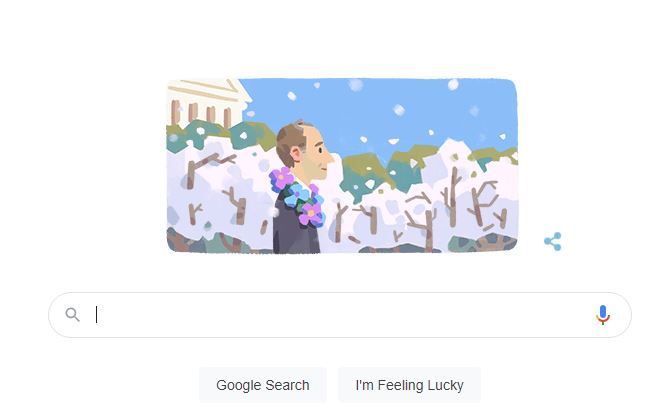
Google celebrated Pride month on Wednesday by honouring the American LGBTQ rights activist Dr. Frank Kameny, who is known as the most prominent figure of the LGBTQ rights movement. He was also an astronomer and veteran. He died in 2011 at the age of 86.
Google describes Kameny as “one of the most prominent figures of the US LGBTQ rights movement” and thanks him “for courageously paving the way for decades of progress”.
The picture on Google’s homepage shows Kameny wearing a colourful garland, paying a fitting tribute to him as we enter the month of June, which is celebrated globally as ‘Pride Month’.
Google Doodle on American LGBTQ rights activist Dr. Frank Kameny
Frank Kameny and his journey
Franklin Edward Kameny Born in Queens, New York, on May 21, 1925. He studied physics at Queens College when he was 15. He served the army during World War II and after his return to the U.S., he obtained a doctorate in astronomy at Harvard University.
He became an astronomer in 1957 with the Army Map Service, but after a few months, he was fired on an executive order effectively barring members of the LGBTQ community from federal employment. He had challenged the firing at the Supreme Court and organized the first gay rights protests outside the White House in the 1960s.
Kameny and 10 others became the first to stage a gay rights protest in front of the White House and later at the Pentagon in the year in 1965. A few years before the Stonewall Riots, Frank Kameny organized one of the country’s first gay rights advocacy groups.
In the early ‘70s, He had successfully challenged the American Psychiatric Association’s classification of homosexuality as a mental disorder, and in 1975, the Civil Service Commission finally reversed its ban on LGBTQ employees. He became the first openly gay candidate in 1971 for the US Congress when he ran in the District of Columbia’s first election for a non-voting Congressional delegate. After his defeat, Kameny and his campaign organization created the Gay and Lesbian Alliance of Washington, DC, an organization that continues to lobby the government and press the case for equal rights.
More than 50 years after his dismissal, Kameny received a formal apology from the U.S. government in 2009. In June 2010, Washington D.C. named a stretch of 17th Street NW near Dupont Circle “Frank Kameny Way” in his honor.
Watch Google’s special ode here –
Get the latest entertainment news from India & around the world. Now follow your favourite television celebs and telly updates. Republic World is your one-stop destination for trending Bollywood news. Tune in today to stay updated with all the latest news and headlines from the world of entertainment.
The Biden administration has officially ended a policy that forced asylum seekers to pursue their cases in Mexico.
The previous White House’s Migrant Protection Protocols program, which became known as the “Remain in Mexico” policy, took effect in 2019. Advocates sharply criticized MPP, in part, because it made LGBTQ asylum seekers who were forced to live in Tijuana, Ciudad Juárez, Matamoros and other Mexican border cities even more vulnerable to violence and persecution based on their gender identity and sexual orientation.
The White House in January suspended enrollment in MPP shortly after President Biden took office.
Homeland Security Secretary Alejandro Mayorkas on Tuesday in a memo he sent to acting U.S. Customs and Border Protection Commissioner Troy Miller, acting U.S. Immigration and Customs Enforcement Director Tae Johnson and acting U.S. Citizenship and Immigration Services Director Tracy Renaud that announced the end of the Trump-era policy said roughly 11,200 asylum seekers with MPP cases have been allowed into the U.S. between Feb. 19 and May 25. Estuardo Cifuentes, a gay man from Guatemala who ran Rainbow Bridge Asylum Seekers, a program for LGBTQ asylum seekers and migrants in Matamoros that the Resource Center Matamoros, a group that provides assistance to asylum seekers and migrants in the Mexican border city, helped create, is among them.
“MPP does not adequately or sustainably enhance border management in such a way as to justify the program’s extensive operational burdens and other shortfalls,” wrote Mayorkas in his memo.
“In deciding whether to maintain, modify, or terminate MPP, I have reflected on my own deeply held belief, which is shared throughout this administration, that the United States is both a nation of laws and a nation of immigrants, committed to increasing access to justice and offering protection to people fleeing persecution and torture through an asylum system that reaches decisions in a fair and timely manner,” he added. “To that end, the department is currently considering ways to implement long-needed reforms to our asylum system that are designed to shorten the amount of time it takes for migrants, including those seeking asylum, to have their cases adjudicated, while still ensuring adequate procedural safeguards and increasing access to counsel.”
Steve Roth, executive director of the Organization of Refuge, Asylum and Migration, a Minnesota-based organization that works with LGBTQ refugees and migrants around the world, welcomed the end of MPP.
“We’re very happy to see, at long last, the termination of the dangerous and illegal ‘Remain in Mexico’ policy that was put in place by the Trump administration in early 2019,” Roth told the Washington Blade in a statement. “This policy forced asylum seekers at our Southern border — including many LGBTIQ individuals — to spend months and sometimes years in dangerous Mexican border towns while they waited for their asylum cases to be processed.”
Roth added MPP “was not in keeping with the United States’ commitments to international asylum law and it was not reflective of who we are as a country.”
“We’re grateful to President Biden and his administration for overturning this policy and for their commitment to a just and humane immigration and asylum system,” he said.
Ending MPP is the latest in a series of steps the Biden administration has taken to reverse the previous White House’s hardline immigration policies.
Vice President Kamala Harris is among the administration officials who have publicly acknowledged that anti-LGBTQ violence is a “root cause” of migration from Central America. Texas Congresswoman Veronica Escobar, whose district includes the border city of El Paso, and others have noted to the Blade that Title 42, a Centers for Disease Control and Prevention rule that closed the Southern border to most asylum seekers and migrants because of the coronavirus pandemic, remains in place.
Congress has yet to consider a comprehensive immigration reform bill that Democrats introduced in February.
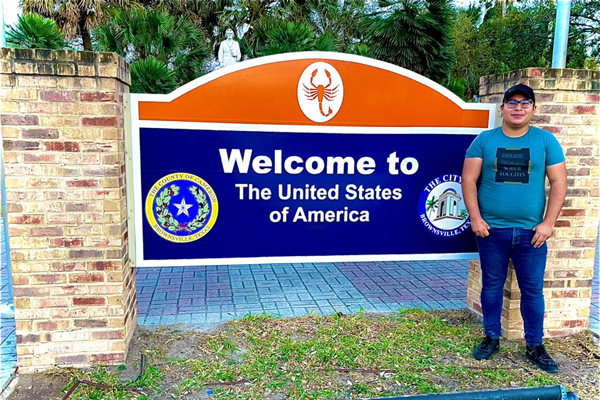
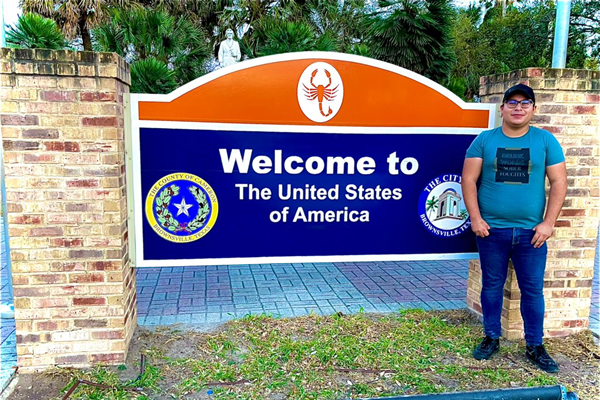
Estuardo Cifuentes outside a port of entry in Brownsville, Texas, on March 3, 2021, shortly after he entered the U.S. (Photo courtesy of Estuardo Cifuentes)
In observance of Pride Month, Doodle on Wednesday honoured prominent gay rights activist and American astronomer Dr Frank Kameny. The picture on Google’s homepage shows Kameny wearing a colourful garland.
(SocialLY brings you all the latest breaking news, viral trends and information from social media world, including Twitter, Instagram and Youtube. The above post is embeded directly from the user’s social media account and LatestLY Staff may not have modified or edited the content body. The views and facts appearing in the social media post do not reflect the opinions of LatestLY, also LatestLY does not assume any responsibility or liability for the same.)