Home Blog Page 126

Richard John Mintken | News, Sports, Jobs – Daily Mining Gazette

THE VILLAGES, Fla. — Richard John Mintken, 76, of The Villages, Florida, was born on July 29, 1944 in Fremont, Nebraska, to Curtis Mintken and Wilma Krohn Mintken.

Rich was raised on a farm near Fremont with his parents and five siblings. In 1962, Rich graduated Hooper High School as a four-sport athlete.

Rich attended Wayne State College, earned a B.A. in education in 1967 and lettered in football. He continued his education earning his master’s degree from Lesley College in 1995. While at Wayne State, Rich met his best friend, Genie Block, from Nemaha, Indiana, and they enjoyed 55 years of marriage.

Rich and Genie moved to Milwaukee, where he began his 32-year teaching and coaching career in West Allis with the West Milwaukee Schools. He worked as physical education teacher and head coach for football, wrestling, and weightlifting at West Milwaukee High School. Rich made a lasting impact on many students that lasted a lifetime. Rich founded the Milwaukee YMCA Barbell Club and organized many weightlifting, powerlifting and physique meets at the YMCA, Summerfest, and Wisconsin State Fair.

In 1975, Rich and Genie moved to Delafield, Wisconsin. They were active members of the Nagawicka Lake Yacht Club, where Rich served as commodore. They were also active members of Christ the King Lutheran Church.

Rich loved life on the lake where he and his family enjoyed sailing, fishing and boating. Over the years, Rich and Genie opened their home to countless friends & family.

Upon retirement in 1999, Rich and Genie moved north to the Upper Peninsula of Michigan (U.P.) where they embraced life as Yoopers for over 20 years. They made countless friendships across the Keweenaw and volunteered at every opportunity. Rich filled his schedule as a docent at the Eagle Harbor Lighthouse, a trustee on the KCHS Board, and volunteered countless hours restoring the historic Gay School in Gay.

Rich enjoyed his weekly gatherings with the Posse running group and cherished their friendship. Yearly, the Posse ran the first five miles of the Michigan Torch Run. Rich and Genie lived on the shores of Lake Superior, and again, opened their doors to more family and friends. They loved sharing campfires on the beach and watching the sunsets.

Starting in 2004, they divided their time between the U.P. and Florida. The snowbirds quickly developed new friends and found more opportunities to contribute at Rail’s End in Wildwood. In 2014, they moved to The Villages to enjoy an active lifestyle, nightly music and golf courses. Golf became a passion for this active couple. They played countless holes of league play, along with casual outings with family & friends. In May, 2020, they both celebrated hole-in-ones. Rich and Genie were active in the Lake Deaton United Methodist Church.

Over the years, Rich remained true to his roots, cheering on his Huskers and Packers. He loved traveling and exploring the U.S. and Canada. Rich remained dedicated to athletics throughout his life. Even during retirement, Rich refused to slow down. He was an accomplished athlete and qualified for eight National Senior Games in the shot put, discus, hammer and powerlifting events and won many gold medals. He also competed in two Huntsman World Games. He continued as a volunteer coach for the Wildwood Middle School Track & Field throwers and as a member of the Wildwood Middle School Booster Club. “Do your best, it is the best you can do. The rest will all work out.” – Coach Mintken.

Rich had competed and coached the day before a sudden brain tumor diagnosis. Rich and family are grateful for numerous friends and family that came to visit. He was blessed with loving care from family, Shands Hospital and Cornerstone Home Hospice. Rich passed away peacefully May 30, 2021, with Genie, Randy and Tamera at his side.

Rich is survived by his wife, Genie; their children, Randy (Quanmin, Nicky), Tamera (Scott, Cal, Sam); sisters, Cindy (Dan), Donna (Greg), Judy; sister-in-law, Joyce; sister-in-law, Merilyn (Mike); brother-in-law, Tom (Bev); nieces, Maria, Melanie, Monique and Laurie; and nephews, Mike and Alex.

Rich was preceded by his parents; in-laws, Merlyn and Betsy; brothers, Gary, infant brother, Larry, and Stanley; brother-law, Kent; and a niece, Dawn.

We will always remember Rich’s big heart & generous spirit. He will continue to inspire and guide us. Thank you for being part of his journey. Honor him by living life to the fullest. Details for a celebration of life will be shared at a later date.

In lieu of flowers, memorial donations may be sent to: KCHS Gay School Museum, Gay School Museum, 670 Lighthouse Road, Eagle Harbor, MI 49950, Mohawk United Methodist: P.O. Box 76, Mohawk, MI 49950, or Grace United Methodist, 201 Isle Royale Street, Houghton, MI 49931.

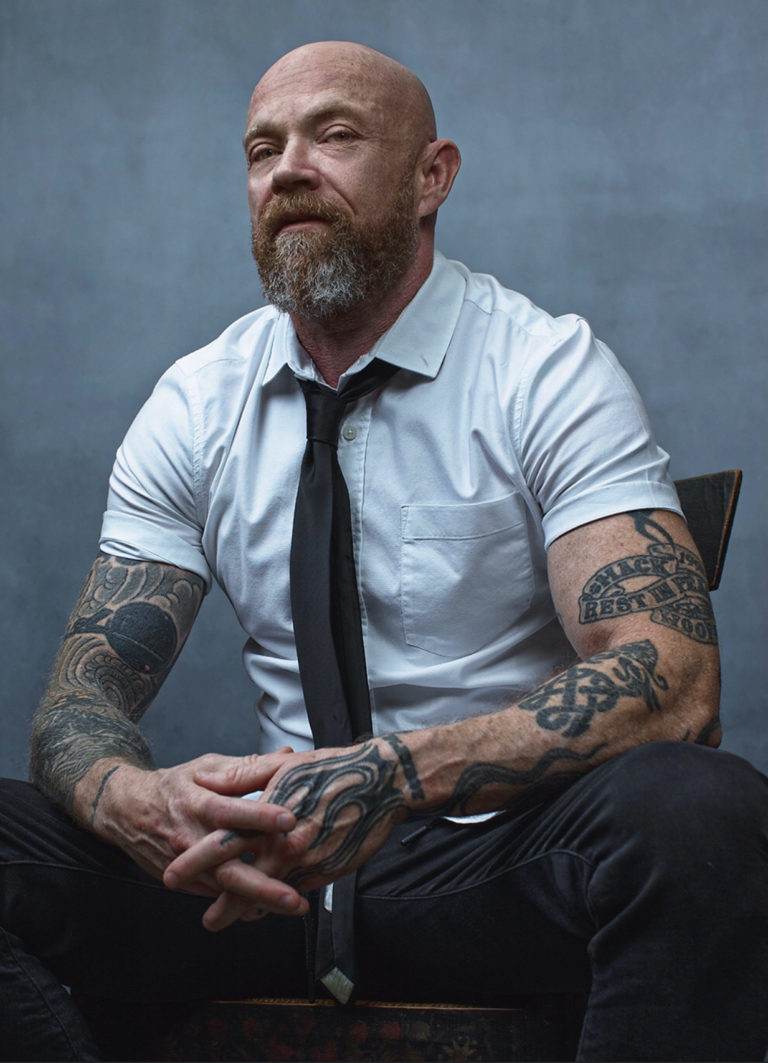
LGBT icon Buck Angel | ‘Growing up in world where people and fellow friends didn’t accept me – it was difficult’ – WGN Radio – Chicago

LGBT icon Buck Angel | ‘Growing up in world where people and fellow friends didn’t accept me – it was difficult’ | WGN Radio 720 – Chicago’s Very Own


LGBT icon Buck Angel|’Growing up in world where people and fellow friends didn’t accept me – it was difficult’ – WGN Radio – Chicago

LGBT icon Buck Angel|’Growing up in world where people and fellow friends didn’t accept me – it was difficult’ | WGN Radio 720 – Chicago’s Very Own


Looking back at transgender progress one year after the murder of Rem’mie Fells | Analysis – Pennsylvania Capital-Star

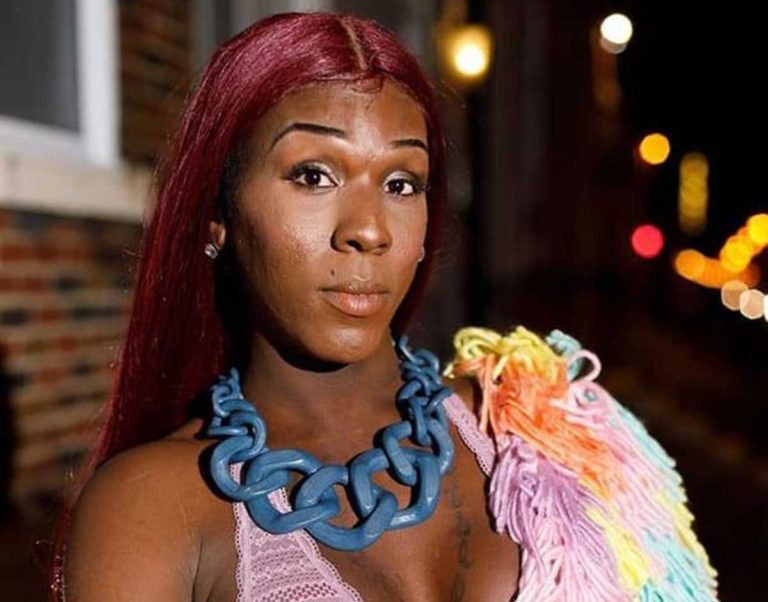
PHILADELPHIA — Next Wednesday, June 9, marks one year since Dominique “Rem’mie” Fells, a beloved Philadelphia transgender woman of color, was murdered.

One year later, society has gone through a global pandemic, a resurgence of the Black Lives Matter (BLM) movement, a Republican-to-Democrat transition of presidential power and, sadly, a continued uptick in the epidemic of transgender murders, particularly Black and Brown transgender women. Fells became an icon within the BLM movement, in communities fighting for transgender lives, and in intersections of the two.

This past year has seen much change for transgender communities locally and nationally, but it hasn’t all been devastating.

“We’re having very serious conversations on a state legislative platform that are very pro-LGBTQ, very pro-transgender, such as having LGBTQ+ identified individuals be regarded as a protected class under Pennsylvania’s existing hate crimes statute,” said transgender activist Kendall Stephens.

Pennsylvania’s hate crimes law does not yet include sexual orientation or gender identity, but Philadelphia protects those classes via an ordinance.

In response to LGBTQ-targeted crimes that happen in Philadelphia, employees of the District Attorney’s Office (DAO) devised a keyword-driven system to track crimes targeted toward queer folks in the city. The goal is to provide better resources for queer and transgender crime victims. DA Larry Krasner also recently added the LGBTQ+ Advisory Committee to the DAO.

Celena Morrison, Executive Director of Philadelphia’s Office of LGBT Affairs, cited Darius McLean’s leadership as director of the Arcila-Adams Trans Resource Center at William Way as another local asset in providing resources for transgender communities.

In a written statement, Morrison said McLean’s appointment “has helped raise awareness of the support available to those in need, and his leadership has served as an anchor to the community at a time when it was needed most.”

Part of the programming that McLean is planning will comprise job readiness-centric educational services, resume-building, and interview skills. He also plans to roll out a financial literacy course that will teach folks the basics of home ownership and entrepreneurship, workshops on navigating intimate partner violence, and a podcast focusing on Black and Latinx communities.

At least 26 trans people have been killed in the U.S. this year. This is who they are

“I feel like jobs and housing are two of the biggest areas that trans folks don’t have a lot of access to,” McLean said. “Though we have laws against discrimination in Philadelphia and Pennsylvania, it doesn’t mean that they’re enforced. So creating the ability for our community to make space for themselves and jobs and careers for themselves [is important]. The hope is to do that in collaboration with other organizations and community members.”

Transgender healthcare has also seen a lot of changes over the past year.  On one level, the pandemic’s financial toll has affected trans students’ ability to get university funds that would help them through their gender transitions. PGN previously reported that an influx of transgender students were applying for the University of Pennsylvania’s Townsend Munro Fund this past year, which helps foot the bill for medical supplies needed for transition.

Furthermore, when Penn closed down and most students returned home for online classes, some trans students struggled to hold onto friendships they had forged when they lived on campus. Others felt they needed to conceal their trans identities when they returned home.

Pa. GOP House bill would ban transgender athletes from women’s interscholastic athletics

Conversely, some aspects of pandemic life have proven beneficial to members of the transgender community. Deja Lynn Alvarez, director of community engagement World Healthcare Infrastructures and candidate for the state House of Representatives, told PGN that she has noticed that many transgender folks feel safer “going” to non-emergency healthcare appointments virtually.

“A lot of trans people [were] able to maintain their appointments, to stay on their medications,” she said. She pointed to the barriers that many trans people face just traveling to a doctor’s office. “You may have to get on public transportation, you may have to go into an area that you’re not familiar with where you don’t feel safe, [or] you walk into a building where you come across people that have a personal bias against trans people. All of that can be a deterrent from trans people accessing the care that they need.”

Nationally, transgender healthcare protections have been thrown on a bit of a roller coaster in the last year. President Biden recently reinstated nondiscrimination protections for LGBTQ Americans in healthcare settings — Obama-era regulations that the Trump administration undermined during the pandemic.

But despite federal pro-transgender policies, state lawmakers are attacking transgender rights by introducing bills that seek to bar young transgender women from playing school sports and prevent transgender youth from getting gender-affirming care.

‘Say Her Name’: Philly Protesters seek justice for Black, trans women

“At a time when anti-trans legislation — specifically targeted against our trans and gender non-conforming youth — is sweeping state legislatures across the country, it is clear that the work of municipalities like here in the City of Philadelphia is more critical than ever to ensure equal protections under the law for our most vulnerable communities,” Morrison said in her statement.

The Office of LGBT Affairs has churned out its own set of queer and transgender-centric resources over the past year. The team created the Coping during COVID Resource guide, collaborated with local LGBTQ health organizations to facilitate vaccine clinics in underserved communities, and helped with the Trans Resilience Fund, an initiative of the Gender Justice Fund.

On top of the pandemic widening health inequities and the bevy of transphobic legislation from state lawmakers, trans people are still being murdered at high rates, especially Black and Brown transgender women. Rem’mie Fells’ murder, in tandem with the murders of Mia Green, Tatiana Hall, Michelle ‘Tamika’ Washington and many other transgender individuals, drove people to the streets in protest.

“[Rem’mie] was a disrupter,” Stephens said. “She looked the status quo in the eye and defied it with every waking moment of her life. Now after her death, her voice is still reigning boldly. It’s still causing a stir in a positive way and impacting the lives of her trans brothers, sisters and others. I wish she could be here to see the work that is being done for the trans community.”

McLean cautioned that those bursts of civil rights assemblies often escalate and subside like fads. He clarified that communities should be fighting for minority rights all the time.

“The fact that that’s how that works limits us in how much we can do,” he said. “Unfortunately I feel like sometimes we have to capitalize off of those things so we can get support for our community while people are willing to do it. Again, it goes to visibility every day.”

In the spirit of continuing to uplift transgender and BIPOC communities, occupational therapy students and an alumni mentor from Thomas Jefferson University started a scholarship fund in Fells’ name. They met her while collaborating with the staff of Morris Home, where Fells was living at the time, to facilitate wellness and recovery sessions for the center’s transgender and nonbinary residents. The scholarship is the first of its kind that the university offers exclusively for transgender and gender non-conforming BIPOC students.

The scholarship fundraising page reads in part, “while one scholarship will not create the change needed at this level, it will act as a first step in the right direction.”

Fells’ mother, Terri Edmonds, is also quoted on the fundraising page, saying “I’m so grateful that during her short life here on earth, she was able to touch your lives with her genuine and loving self.”

Michele Zipkin is a reporter for the Philadelphia Gay News, where this story first appeared

Events, tourism return to Iowa as worker shortage continues – Marshalltown Times Republican

contributed photo
Fairgoers ride the Skyglider at the Iowa State Fair in August 2014.

As COVID-19 restrictions lift, Iowa will see more events and tourism returning to regular scheduling in the summer of 2021.

“People weren’t able to get out as much as they might have preferred last year, so we’re anticipating a lot of people hitting the road,” said Jessica O’Riley, spokesperson for the Iowa Tourism Office. “I think there’s a lot of pent-up demand and people are going to want to get out of their home, and travel especially as they’re vaccinated and feel more comfortable getting out and about with other people.”

Most travelers are somewhat uncomfortable with flying and are looking toward road trips this summer, she said, which is beneficial for states like Iowa.

With some events and festivals returning across the state, O’Riley said she anticipates tourism returning in much higher numbers than 2020, but she doubts 2019 numbers will return.

Many events are coming back to Iowa, including the Des Moines Arts Festival, which will take place during the fourth weekend of June. Planning the event has been a roller coaster ride, Stephen King, festival executive director, said.

He said there are several changes to the festival that participants may not notice, including more distanced tents. The festival will also hold its film festival in person and stream the films online.

“We’re still a few weeks out from the festival, so anything could change at any time in terms of COVID protocol,” he said. “We will have the usual array of visual and performing artists, live music, and food. It will look a little different because things are spread out a little bit more.”

King said the decision to hold the festival in person has been received well by the public and he’s excited to see the event return for artists and art lovers in the state.

The Iowa State Fair is also preparing to return in full force in August. Gary Slater, CEO of the fair, has been watching the state and federal guidelines closely over the last year to make the best decisions for the fair.

He said there will be more hand sanitizer and hand-washing stations available to fairgoers, but everyone’s favorite parts of the fair are returning.

“The pandemic disrupted a traditional part of being an Iowan,” he said. “We love living in Iowa and we celebrate it at the Iowa State Fair.”

Outdoor recreational activities and sports coming back with

support from the public

Events aren’t the only reason more travel is happening within the state. Sporting events are inviting fans back. The Iowa Cubs season began in May and will end in September. The Principal Charity Classic is taking over the Wakonda Club this weekend.

Sporting events are leading to an increase in hotel bookings this summer, said Susan Koch, director of sales and marketing at the DoubleTree Hilton in Cedar Rapids.

“Multiple citywide sporting events are contributing to compression in the market,” she said. “… Since April, we’ve seen bookings continuing to ramp up and there is a summer surge starting early for us hotels this year. There’s a lot of pent-up demand for weddings, sporting events, and corporate travel this year.”

Statewide bicycle ride RAGBRAI is making its return in July after postponing the event in 2020. The map remains almost the exact same as the one planned for last year, Marketing Director Anne Lawrie said, but construction did force the route to change slightly.

About 15,000 riders from all 50 states and a few other countries are registered for the event. Lawrie said host towns will be increasing hand-sanitizing stations and more portable toilets across the route. She hopes the community aspects of the ride will come back while the event continues to encourage social distancing when not riding.

“We’re hoping the sense of community and camaraderie that everyone has felt at the event as well as the spirit of RAGBRAI is maintained even though we’ve been off for a year,” Lawrie said. “It’s the same experience.”

The RAGBRAI team is beginning its route inspection on June 5.

Cancellations aren’t uncommon

Events celebrating Pride month will also look different across the state this June. Iowa City, Sioux City, and the Quad Cities both delayed their LGBT events alongside other events in the state. Des Moines’s Capital City Pride consists of 30 days of events instead of the traditional weekend-long festival. SUX (pronounced “Sioux”) Pride is one of the festivals pushing ahead with its two-day event.

80/35, a music festival held in Des Moines, is postponed for the second year in a row, as other music events like Hinterland return to the state. The festival plans to return with a strong lineup in 2022, Emily Steele of the Des Moines Music Coalition said in an email to Iowa Capital Dispatch.

Hiring issues plague events

Some events are struggling to find volunteers and workers to assist in programming this summer as worker shortages are worsening all over the country and within the state.

During a difficult year for the entertainment industry, Michael Silva, the executive director of VenuWorks in Cedar Rapids, said it has been a challenge to find staff during a record year for shows at the venues he manages.

Hiring fairs have helped businesses like his find part time workers for the summer, but he said full time positions are another story thanks to the derecho and COVID.

“The industry was just decimated for a year and a half and now we’re going to come charging out of the barn,” he said. “And we have seasoned professionals on staff ready to go, but we have fewer people doing the work of many. It’s a little bit of a crunch time right now.”

Events, tourism return to Iowa as pandemic, worker shortage continue

Today’s breaking news and more in your inbox

Ryan Philip Harpold | News, Sports, Jobs – Parkersburg News

Ryan Philip Harpold

Ryan Philip Harpold of Ripley was born March 30, 1979, and died on June 3, 2021.

He was preceded in death by his grandparents, Asa and Dorothy McClain Harpold and Robert and Beulah Watkins Carney.

He is survived by his parents, Philip and Linda Carney Harpold.

Ryan was born an Army Brat in Huntington. He then moved with his parents to Geilenkirchen, Germany, Heidelburg, Germany, Fort Devens, MA and Franklin, TN. In 1991 he and his parents moved back to Ripley, West Virginia.

He loved being around children and spending time with his cousins. His last evening was spent at dinner with his cousin, Ashley. The following morning, at breakfast, his very last comments were about how much fun he had at dinner.

Among his fondest memories were hiking in the mountains around Heidelburg, Skiing in New Hampshire and Vermont and camping all over New England.

Ryan with his blue eyes, red hair and cheerful personality, will be sorely missed by all that knew and loved him.

Ryan was a member of the Epworth United Methodist Church, and was a devoted follower of his God and Savior, Jesus Christ.

A funeral service will be held at 6 p.m. Sunday, June 6, 2021, at the Waybright Funeral Home, Ripley with John Gunther presiding. Burial will follow in the Harpold Cemetery, Gay, WV. Friends may call from 5 p.m. until the time of service on Sunday at the funeral home.

Memories and condolences may be shared with the family by visiting www.waybrightfuneralhome.com.

15 finish chamber leadership program | News, Sports, Jobs – Altoona Mirror

Graduation ceremonies will be held Thursday for the Leadership Blair County Class of 2021.

This year’s 15 members bring the total number of people who have completed the program, sponsored by the Blair County Chamber of Commerce to 535.

This is the 26th class.

The program is designed to develop and enhance community leadership by preparing individuals from diverse backgrounds to assume more active roles in addressing communities needs.

Each class selects a community service project.

The 2021 LBC Class raised money for the Blair County COVID-19 Response Fund managed by The United Way of Blair County.

This year’s class includes:

Jaime Bianconi of Altoona, branch coordinator, Reliance Bank, 1119 12th Ave., Altoona; community service activities: Relay For Life

Eammon Clarke of Bedford, director of petroleum distribution, CLI Transport LP, 5700 Sixth Ave., Altoona; community service activities: AMBUCS board member, Bedford High School football and wrestling booster, Special Olympics polar plunge, Faith Assembly small group leader

Rebecca Culp of Hollidaysburg, team administration, Berry Solutions Group, 3900 Industrial Park Drive, Suite 11, Altoona; community service activities: Cresson Lake Playhouse costume shop cleanup, St. Leonard’s Home various events and holiday celebrations, local veterans organization events

Jessica Fisher of Duncansville, attorney, McQuaide Blasko Inc., 601 Hawthorne Drive, Suite 2A, Hollidaysburg; community service activities: United Way of Blair County, Blair Chamber of Commerce Young Professionals, Blair County Bar Association, Young Lawyers Division

Morgan Fochler of Duncansville, manager of process unvolvement, Ward Transportation & Logistics, 1436 Ward Trucking Way, Altoona; professional interests: Volunteer work, development of management skills

Ashely Gay Vocco of Duncansville, victim services program director, Family Services Inc., 2022 Broad Ave., Altoona; community service activities: Chair of the Legislative Public Policy Committee at PCADV

Jared Keller of Hollidaysburg, civil designer, Keller Engineers Inc., 420 Allegheny St., Hollidaysburg; community service activates: Blair County Chamber of Commerce Young Professionals Steering Committee and Public Policy Committee, Hollidaysburg Area Community Partnership, Bishop Guilfoyle assistant track coach, Hollidaysburg Rotary

Aaron Lantzy of Altoona, AVP/business banker, Altoona First Savings Bank, 203 N. Logan Blvd., Altoona; community service activities: Tyrone Chamber, Big Brothers/Big Sisters, F&A Masons, Jaffa Shrine, We Care Foundation

Benjamin Miller of Roaring Spring, CPA, Young Oakes Brown & Co, PC, 1210 13th St., Altoona; community service activities: Sunrise Rotary Altoona Club

Elizabete Mills of Altoona, banquet manager, Blair County Convention Center, One Convention Center Drive, Altoona; community service activities: Blair County Headstart chairman of Policy Council, Child Advocates of Blair County

Ashley O’Neil of Bellwood, accounting assistant, P. Joseph Lehman Inc, Consulting Engineers, 117 Olde Farm Office Road, Duncansville; community service activities: Logan Valley Baptist Church deacon president and pulpit committee chair, Lehman Engineers Trail Ride Silent auction coordinator

Scott Robertson of Altoona, endpoint unit manager, Sheetz Inc., 243 Sheetz Way, Claysburg; community service activities: Altoona Area baseball coach

Kaitlyn Tomlinson of Hollidaysburg, mortgage loan originator, First Commonwealth Bank, 1913 N. Juniata St., Hollidaysburg; community service activities: Treasures for Children, Thanksgiving turkey drives, the Altoona Salvation Army

Kate Whysong of New Paris, VP/commercial banking officer, CNB Bank, 107 Lampost Lane, Duncansville; community service activities: Friends of Shawnee State Park, YEA! mentor

Grant Wills of Altoona, GIS coordinator, Blair County, 423 Allegheny St., Hollidaysburg; community service activities; Google Local guides

Today’s breaking news and more in your inbox

Nebraska education officials promise changes to proposed health standards – Norfolk Daily News

Facing a hailstorm of criticism over the first draft of health education standards for Nebraska schools, state officials Friday suggested that they will make changes in a second draft.

They only hinted at what might be changed.

They gave no indication that they’re going to scrap the sex education topics in the standards, as Gov. Pete Ricketts and many opponents want.

The first draft of the standards, made public in March, calls for teaching children as young as first grade about gender identity and gender stereotypes.​

Members of the State Board of Education took testimony for about 3½ hours Friday during their monthly meeting in Kearney.

Once again, a large crowd leaning heavily in opposition to the standards showed up and filled the room where the board met. The last two meetings saw similar turnout.

About 70 people testified against the standards Friday, while a handful spoke in support.

“These are the people of Nebraska,” said Sen. John Lowe of Kearney, testifying in opposition. “They’re talking to you. They’re asking you, please don’t do this. It’s important to us. It’s important to Nebraska. It’s wrong. Simply wrong.”​

The second draft is now expected to be made public in early fall.

Board members told opponents that they’re listening to the concerns.

Board Vice President Patsy Koch Johns said she had never seen such crowds turn out on an issue. She pushed back on critics who she said suggested that her mind’s made up and the standards are a done deal.

“I’d like to assure you that I’m conflicted about so many things in this,” Koch Johns said. “I have grandchildren, and I love them with all my heart, like so many of you have told me. And so I want to make sure whatever we do is good for them.”

Under the proposed standards, kindergartners would be taught about different kinds of family structures, including “cohabitating” and same-gender families.

Fourth graders would be taught the difference between sex assigned at birth and gender identity. Fifth graders would be taught that gender expression and gender identity exist along a spectrum.

Sixth graders would learn what sexual identity is and learn about a range of identities related to sexual orientation, among them heterosexual, bisexual, lesbian, gay, queer, two-spirit, asexual and pansexual. They would learn the differences between cisgender, transgender, gender nonbinary, gender expansive and gender identity.

Lacey Peters, a health and physical education specialist in the department, outlined some general areas being considered for change in the second draft, based on feedback so far:

* Reinforcing the importance of families, guardians and caregivers in health education. 

* Evaluating the standards to ensure developmental appropriateness across the entire document, with special attention to the elementary level.

* Looking at the overall length of the document and examining repetition.

* Looking at the level of detail in each indicator and ensuring that the specificity of them is consistent and appropriate.

* Reevaluating whether the standards are measurable.

The writing team will begin working this summer on the second draft.

None of the board members offered any specifics about what they think of the first draft.

Board member Robin Stevens said that when people ask him where he stands, he gives a “canned response.”

​”As soon as I get a document that is worthy of our debate and our discussion, you will know where I stand,” he said.

Opponents have argued that introducing young children to sexual topics would sexualize them, encourage promiscuity, confuse children and leave them vulnerable to sexual predators. They say the standards don’t reflect the values of most Nebraskans.

Opponents have further suggested that language in the standards amounts to comprehensive sex education that would open the door for teaching kids about abortion.

Backers of the standards have argued that educating children about consent and proper terms for body parts would arm them to fend off abuse.

They say teaching schoolkids about gender identity and sexual orientation will stem bullying, prevent suicide and make schools a welcoming place for all students, regardless of their gender identity or nontraditional family structure.

Nebraska currently has no state health standards. The standards, if approved, would only be recommended for adoption by local districts.

Gay bashing on Moses Lake ends in flaming boat – Lynnwood Times

MOSES LAKE, Wash., June 4, 2021 – A TikTok video has gone viral with almost 11 million views of an apparent gay bashing incident at Moses Lake, ending in the assailants’ boat bursting into flames and its occupants being rescued by their LGBTQ victims.

According to the video the LGBTQ family was being harassed by the boaters for flying a Pride flag. The female occupant of the boat could be seen making obscene gestures and it is alleged that she shouted gay slurs. Then suddenly the boat with the harassers catches fire, resulting in the occupants diving into the water to be rescued by the LGBTQ family.

@uhohbigboi

We safely got them out of the water immediately. We were nicer than they were. ##pride ##lgbtq ##boat ##Fail ##Karma ##Gay ##hate ##sorrynotsorry

♬ Oh No – Kreepa

In a second video, which has at least 1 million views, the female passenger of the gay bashing incident on Moses Lake, now rescued and crying uncontrollably, was being consoled by one of the male assailants.

“Baby, baby, it’s ok. We’re alive. We’re ok.”

The person filming can be heard telling a Grant County Deputy
Sheriff patrolman, “That was some funny karma. They came out and did a bunch of
circles around us to stir-up the water around us while we were just sitting
there.”

Another can be heard saying, “They were harassing us; then
we saved their ass!”

@uhohbigboi

Reply to @dark_umbre0n Part two with my two best friends @retro_ushi_ and @nova.starr96 ##Gay ##hate ##sorrynotsorry ##Karma ##Fail ##boat ##lgbtq ##pride

♬ original sound – UhOhBigBoi

According to the video, none of the boaters ever thanked the LGBTQ
family for rescuing them nor apologized for their actions.

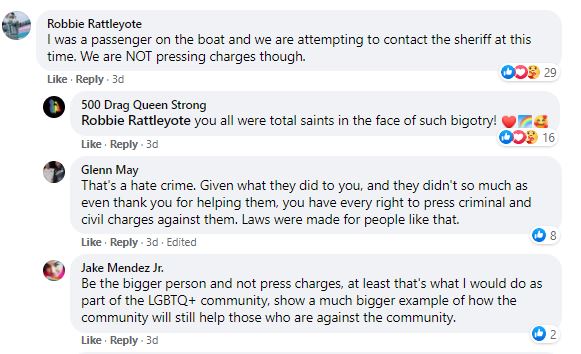
Facebook user, Robbie Rattleyote, alleging to be one of the rescuers, states that he and the other victims will not pursue charges.

Source: Grant County Sheriff’s Office Facebook Post

According to the Yakima Herald, it is unclear how the boat caught on fire; however, Grant County Deputy Kyle Foreman did confirm that two men and one woman were the occupants of the boat and are safe. Emergency services extinguished the fire, and the vessel was towed back to the west shore of Moses Lake.

The Grant County Sheriff’s Office released the following
statement regarding the incident:

“The
Grant County Sheriff’s Office has viewed a viral video that seems to show an
incident that happened on the waters of Moses Lake on May 30, 2021.

“The
incident appears to show a blue vessel circling another vessel, and an occupant
of the blue vessel extending a middle finger toward the person recording the
incident. The video also shows the blue vessel ablaze and the occupants of the
blue vessel swimming toward the vessel recording the incident.

“As
of right now, we are trying to make contact with the occupants of the vessel
being circled so we can interview them to find out what happened. We would like
to know more, and once we can interview people, we will be able to know more
without relying solely on a brief video.

“Our
agency has a long-established history of transparency and sharing information.
Please watch our social media pages for continuing updates on this incident.”

Struggling to Fall Asleep? These Soothing Bath Soaks Will Help You Unwind – POPSUGAR

Restful nights of sleep can be few and far between. Whether your joints ache or you feel anxious about everything you need to do the next day, falling asleep — and staying asleep — can seem nearly impossible at times. Personally, I like to unwind before bed by taking a warm bath. My friends sometimes tease me over how much I love baths, but they’re so calming and cozy 一 and experts say that showering or bathing in warm water before bed can help lower your core body temperature, making it easier to fall asleep. So if you’re struggling to get those Zs, you might consider adding a bath to your nightly routine as well. For an even more soothing bedtime ritual, try one of these top-rated bath soaks.

Conservatives Score Big Against NCAA – Daily Signal

For the refused-to-be-canceled crowd, it was a headline to celebrate. “The NCAA threatened states over anti-transgender bills,” the big print of The Washington Post read. “But the games went on.”

It was the surest sign in a post-Georgia, Coke-boycotting world that fed-up conservatives were the newest force to be reckoned with. It’s also the most recent evidence—out of piles of examples—that the right side may be winning the woke wars.

For the far left, the retreat of a major sports league is a public defeat that it can’t seem to reconcile. After 2016, when the NCAA was the most powerful leverage liberals had in states like North Carolina, they’d begun to count on these hardcore allies to help them beat back local attacks on their often dangerous LGBT agenda.

It worked until recently, when Americans—sick of being force-fed transgender politics—suddenly decided to take the momentum from their stand on election reform and start applying it across the board. Their unofficial mantra—refuse to be intimidated—began working.

Suddenly, the tough talk about retaliation from corporations and other organizations were being exposed for what they were: empty threats from big-mouthed bullies.

Just two months ago, the NCAA had promised to boycott states that protected girls sports or banned gender experimentation on minors. That all fell apart just a few weeks later, when so many states had passed conservative legislation that the league finally realized it had nowhere to go. Suddenly, tournaments that weren’t supposed to be awarded to places like Arkansas, Alabama, and Tennessee got the news that they would still be hosts after all.

GLAAD and other LGBT groups, who are used to these leagues’ blind allegiance, have been hysterical ever since. They’ve accused the NCAA of “going back on its word” to choose locations that were “safe, healthy, and free of discrimination.”

Human Rights Campaign President Alphonso David had even harsher words, insisting that the “NCAA should be ashamed of themselves for violating their own policy … ” Their “failure to take action here,” he went on, “means that they are part of the problem.”

Internally, the hand-wringing at places like the Human Rights Campaign has to be even worse. For years, the LGBT crowd has relied on scare tactics to move its agenda forward since it’s always lacked broad public support. If the NCAA won’t do its bidding, then the damage—especially now, as the demand for these bills keeps growing—is severe.

In a letter from far-left activists to the NCAA, Athlete Ally asks, “What changed?” One thing did, The Washington Times points out: the states that are passing these laws “are no longer outliers.”

In Florida, the latest state to protect girls sports, the threat from the NCAA more than backfired. Instead of frightening leaders away, it motivated conservatives to pass a bill even faster.

The governor told one news anchor that he remembers the day the letter from the sports league was issued. “I called the speaker of the House in Florida and said, ‘Did you hear what they said?’” And he replied, “Now we’ve definitely got to get this done.” There, as in other states, the rally cry seemed to be, “We’ll show them!”

And to the delight of commonsense Americans all across this country, they have. Last week in Louisiana, despite the governor’s warnings, the Legislature passed another bill to save girls sports by bipartisan, veto-proof majorities: 29-6 in the Senate and 78-17 in the House.

Then, in a major punch to the left’s gut, Oklahoma—one of the few states that was openly worried about the NCAA’s threat—realized the league was bluffing, went back to the drawing board, and passed its proposal out of the House.

When Oklahoma state Rep. Justin Humphrey, R-Lane, realized that the NCAA was scheduling tournaments in states with policies based on biology, he said, “I kind of laughed.” LGBT activists were appalled. “It was really scary to know that so many lawmakers in Oklahoma [saw] this as a reversal to the NCAA’s earlier statement,” one said. “That had been the only thing that persuaded folks [to back off these] girls sports bills.”

When the NCAA announced that Florida would host a softball championship this spring, Republicans could barely contain their glee. “I guess the NCAA boycott of Florida is over after two weeks,” state Rep. Chris Latvala, R-Clearwater, tweeted. “Go Knights!”

The news for conservatives was even sweeter when the state’s bill became law on the first day of LGBT Pride Month. Turns out, the tug of the left may be strong, but so is the $730 million in revenue from the Southeastern Conference.

Our influence as red states, Texas Gov. Greg Abbott, a Republican, pointed out, is bigger than we think. “Will they even be able to have sports events anymore in the United States [if they boycott us]? I don’t think so.”

In the end, Beth Stelzer, president of Save Women’s Sports, says, most of these states would have moved forward even if it did cost them a few collegiate events. They, like the majority of Americans, had already made up their minds: “We need to do the right thing and stand up for females. People over profits. Facts over feelings.”

Who would have thought at the start of this legislative season that protecting girls sports would be the issue that separated the leaders who had courage and the leaders who are cowards? But it did.

Originally published in Tony Perkins’ “Washington Update,” which is written with the aid of Family Research Council senior writers.

The Daily Signal publishes a variety of perspectives. Nothing written here is to be construed as representing the views of The Heritage Foundation.

Have an opinion about this article? To sound off, please email [email protected] and we’ll consider publishing your remarks in our regular “We Hear You” feature. Remember to include the url or headline of the article plus your name and town and/or state.

Japan LGBTQ activists push for equality law before Olympics – San Mateo Daily Journal

TOKYO (AP) — Japanese sexual minority groups and their supporters, in a last-ditch effort to get long-sought equality legislation passed before the Tokyo Olympics, submitted requests on Friday to the governing Liberal Democratic Party, whose conservative members have stalled the bill.

The groups also have widened their campaign to gain corporate support for their cause in hopes of pressuring Prime Minister Yoshihide Suga’s pro-business party to support the legislation.

“In order to protect the lives and livelihood of sexual minorities, enacting a LGBT law that states discrimination is not tolerated is an indispensable first step,” said Kane Doi, Japan director for the New York-based group Human Rights Watch.

“An enactment of such a law in Japan ahead of the Olympics is also necessary for the international community,” Doi said, adding that Japan needs to demonstrate its commitment to ensuring equality for LGBTQ athletes, journalists and other participants in the Olympics, set to begin July 23.

Support and awareness of sexual diversity has slowly grown in Japan, but there is still a lack of legal protections for lesbian, gay, bisexual and transgender people. Japan does not legally recognize same-sex partnerships, and LGBTQ people often suffer discrimination at school, work and even at home, causing many to hide their sexual identities.

“Japan is far behind the international standard,” said Yuri Igarashi, co-chair of the Japan Alliance for LGBT Legislation. She noted growing support from the business community, including Panasonic, which on Friday became the 23rd company pledging support for the cause.

Rights groups are pushing for the passage of the equality act as international attention falls on Tokyo as it hosts the Olympics. The International Olympic Committee also issued a statement stressing the importance of inclusivity in sports.

Prospects for passage of the legislation before the current parliamentary session ends on June 16 are uncertain because of strong resistance from conservatives in Suga’s party.

On Friday, members of LGBTQ groups and supporters submitted requests at the governing party’s regional headquarters in Tokyo, Osaka, Aichi and other areas.

Remarks by some party members during discussions of the bill last month sparked outrage from rights groups.

Lawmaker Kazuo Yana was quoted as saying in an closed-door session that same-sex relationships “defy the preservation of the species, go against the biological basis.”

Eriko Yamatani, known for her support of traditional gender roles and paternalistic values, called it “ridiculous” that transgender people with male bodies say they have female hearts and want to use women’s restrooms or participate in women’s sports.

This story has been corrected to show the current parliamentary session ends on June 16.

HIV at 40: Amazing Advances but Challenges Remain – POZ

On June 5, 1981, the Centers for Disease Control and Prevention’s Morbidity and Mortality Report (MMWR) published the first report of AIDS, describing five cases of unusual Pneumocystis pneumonia (PCP) among previously healthy young gay men in Los Angeles.

On July 1, his first day on the job, Paul Volberding, MD, then age 31, saw the first Kaposi sarcoma (KS) patient admitted to San Francisco General Hospital (SFGH). Two days later, a second MMWR report described 10 more cases of PCP among gay men in Los Angeles and San Francisco, as well as 26 cases of KS. A follow-up report in August included more than 100 cases.

Conant, Volberding, UCSF, HIV, AIDS

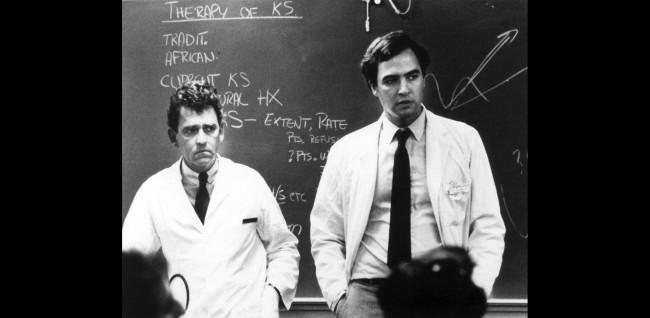
Marcus Conant, MD, and Paul Volberding, MD. Source: UCSF Library AIDS History CollectionCourtesy of UCSF

Volberding, a medical oncologist, and Marcus Conant, MD, a dermatologist, soon started the nation’s first KS clinic at the University of California, San Francisco (UCSF). As a growing number of mostly gay men presented with a range of illnesses linked to immune system collapse, Volberding teamed up with infectious disease specialist Constance Wofsy, MD, Donald Abrams, MD, and others to start the nation’s first HIV outpatient clinic. Ward 86 at SFGH opened on January 1, 1983, followed that summer by the first inpatient AIDS unit, Ward 5B.

Multidisciplinary medical providers collaborated with community organizations to offer a full range of care and services to people with AIDS, many of whom had been rejected by their families of origin and treated badly by the medical establishment.

“I don’t think we ever had a great strategic plan—it was really quite organic,” Volberding told POZ. “We in the medical community benefited from the information networks that were out there in the gay community. We knew that we couldn’t deliver the at-home services our patients needed, but organizations in the community could. We had our different roles, and we respected each other in those roles.”

Although it was dubbed the “San Francisco model” of HIV care, similar collaborative efforts took place across the country, especially in other cities with large gay communities. Michael Gottlieb, MD, who coauthored that first MMWR report, recently spoke with Mark S. King about those early days in Los Angeles. Kenneth Mayer, MD, of the Fenway Institute, wrote a threepart series on the early epidemic in Boston. And in The Lancet, Chris Beyrer, MD, MPH, recalls the advent of AIDS when he was a medical student in New York City.

Many of the doctors and researchers who spearheaded the early AIDS response were at the start of their careers, in the same age group as the young people they were seeing with the vexing new disease.

“Those of us who are running these programs are largely products of the sixties,” Volberdng recalled in an interview for the University of California’s San Francisco AIDS Oral History Project. “We were very young, and I think prepared to think outside of the usual channels, prepared to do things that weren’t completely kosher, like multidisciplinary programs…We felt free to redefine ourselves at the drop of a hat.”

The LGBT community stepped up to provide services ranging from food delivery to buddy programs to hospice care. The nation’s first AIDS organization, Gay Men’s Health Crisis, was started by author Larry Kramer and others in January 1982. A few months later, Volberding, Conant, activist Cleve Jones and others founded the Kaposi’s Sarcoma Research and Education Foundation, which later become the San Francisco AIDS Foundation.

Groups such as Project Inform in San Francisco (started by Martin Delaney and Joseph Brewer in 1985) and the PWA Health Group in New York City (founded by Thomas Hannan, Michael Callen and their doctor Joseph Sonnabend, MD in 1987) educated the community about the new disease and helped people with AIDS access experimental and alternative therapies.

ACT UP, AIDS activism

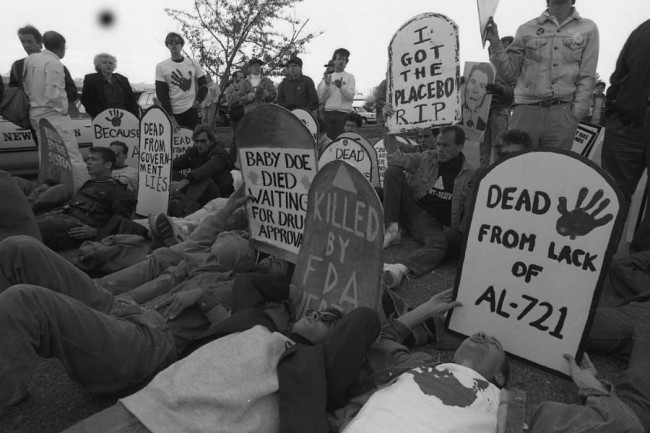
AIDS activists protest at Food and Drug Administration’s headquarters in Rockville, Maryland, on October 11, 1988Rick Gerharter

People with AIDS and their allies engaged in increasingly militant activism, demanding more government funding for research and services, urging faster development of new treatments, fighting discrimination and defying state laws to start the first needle exchange programs.

As early as 1983, a group took the stage at the National AIDS Forum in Denver, asserting that they were not “victims” or “patients,” but “people with AIDS.” In October 1985, people with AIDS and what was then called AIDS-related complex chained themselves to the doors of the federal building in San Francisco, leading to the ongoing AIDS/ARC Vigil that continued for a decade. The best known AIDS activist group, ACT UP/New York, started in March 1987 and spawned the Treatment Action Group (TAG) in 1992.

The Denver Principles led to lasting changes in the relationship between people living with medical conditions and the health care system. ACT UP’s protests against the Food and Drug Administration and the National Institutes of Health—coupled with insider meetings—resulted in other long-term advances, including new mechanisms for accelerated drug approval.

The combined efforts of researchers, clinicians, public health officials, activists and people living with HIV produced spectacular breakthroughs in prevention and treatment (see a timeline here). Today, a single daily pill or monthly injections can prevent HIV and keep the virus under control. And people who start treatment promptly and receive good care can expect a normal lifespan.

But challenges remain. AIDS revealed long-standing disparities in access to care that persist to this day. Gay and bisexual men account for two thirds of new HIV cases, and young men are especially at risk. Black and Latino people, who bear the brunt of the epidemic in the United States, are less likely to use pre-exposure prophylaxis (PrEP) and more likely to acquire HIV, but they are less likely to receive adequate care, start treatment and achieve an undetectable viral load. People experiencing homelessness and people who inject drugs are particularly disadvantaged.

On the global level, it took years after the advent of effective combination therapy in the United States and Europe before the drugs reached people living with HIV in low-income countries—and many still do not have access to treatment. And after decades of research, there is still no vaccine for HIV and a cure remains elusive.

AIDS activism, South Africa

People with HIV and allies call for access to antiretroviral drugs at the 2009 International AIDS Society conference in Durban, South AfricaLiz Highleyman

“We knew before HIV that we lived in a desperately unequal country. The disparities in American society were in your face. They thought of us as disposable people,” ACT UP and TAG veteran Gregg Gonsalves, PhD, now an assistant professor of epidemiology at the Yale School of Public Health, told POZ. “The [2000] Durban AIDS conference was a wake-up call for a lot of people who had not focused on the global epidemic and the stark inequalities in access to drugs. It changed the consciousness of a whole generation of researchers, activists and people living with AIDS in the Global North.”

Today, some of the same people—now senior scientists, veteran clinicians and activist mentors—are leading the response to COVID-19. And some of the same challenges are once again at the forefront. People of color and low-income people have been hit hardest by the new pandemic. And as we saw with antiretrovirals, the effective vaccines that are pulling the United States out of its epidemic are still not widely available worldwide.

“The two epidemics have a lot to learn from each other,” Volberding says. “I would love to have seen a vaccine for HIV the way we have now for COVID. On the other hand, I’d also love a treatment for COVID that was as effective as the ones we have for HIV.”

“Think how far we’ve come with HIV treatment. We can certainly remember the bad days of the epidemic when either we didn’t have anything that worked or we had things at worked but were incredibly toxic,” he continues. “I think we’re sometimes lulled into complacency because of our success. We have one pill once a day or even one injection once every two months. The range of options is growing, and we’re now seeing drugs being developed that might work in completely different ways and offer hope to the people that have become very resistant. Our drugs are available even in some of the most resource-limited settings. We did that because political leaders’ feet were held to the fire. Now we need to do that for the COVID vaccines.”

Fatima Hassan and Gregg Gonsalves call for global COVID-19 vaccine access at CROI 2021 opening plenary

Fatima Hassan and Gregg Gonsalves call for global COVID-19 vaccine access at CROI 2021 opening plenaryCROI 2021 screenshot

Gonsalves is among the many HIV activists and scientists who have turned their attention to COVID-19 vaccine equity. “Now we’re in a sort of 1996 situation where we have vaccines that work for us, but people around the world are dying for lack of access to them. We’re again seeing the same medical apartheid we screamed about 20 years ago with AIDS drugs,” he says. “In the old days, people could say, ‘Oh, treatment access in Africa is a nice thing, but it doesn’t affect me directly.’ But a raging viral epidemic outside the U.S. that can come back with variants resistant to current vaccines should concern everybody. If we can put a rover on Mars, we can set up a global network of companies that can make enough vaccines to protect the planet from a new pandemic.”

***

To commemorate the 40th anniversary of AIDS—as well as HIV Long-Term Survivors Awareness Day—the National AIDS Memorial will host a National Day of Remembrance on June 5. The livestream, beginning at 2:30 pm PT/5:30 pm ET, will feature national leaders including House Speaker Nancy Pelosi and Congresswoman Barbara Lee, researchers, faith leaders, long-term survivors and young leaders in today’s movement.

The Centers for Diseases Control and Prevention will host a series on “40 Years of Progress: It’s Time to End the HIV Epidemic” with virtual live discussions on Long-Term Survivors (June 5, 2:00pm ET), 40 Years of Federal Leadership (June 17 at 1:00pm ET) and 40 Years of Prevention (June 22, 4:00 pm ET).


10 Yoga Workouts That Will Help You Feel Calm and Centered in Just 15 Minutes – POPSUGAR

For most of us, the day looks something like this: wake up in the morning, make some coffee, rush out the door or get right to work at home, then spend the evening with family or friends or catching up on everything you couldn’t do during the day. Among all of the hustle and bustle, how are we supposed to remember to take a break and prioritize our mental health?

While it may seem like a simple solution, taking 15 minutes each day to practice yoga really can help you reset. Not only will you (and your muscles) feel more relaxed, but carving out some time for yourself can also help you feel more focused when you need to be. So, take a deep breath and try out these 15-minute yoga workouts on YouTube for your daily dose of wellness.

Non-Binary 12-Year-Old Beaten at Florida Picnic For Wearing LGBT Pride Flag – Newsweek

LGBTQ Pride Flag Middle School Hate Florida
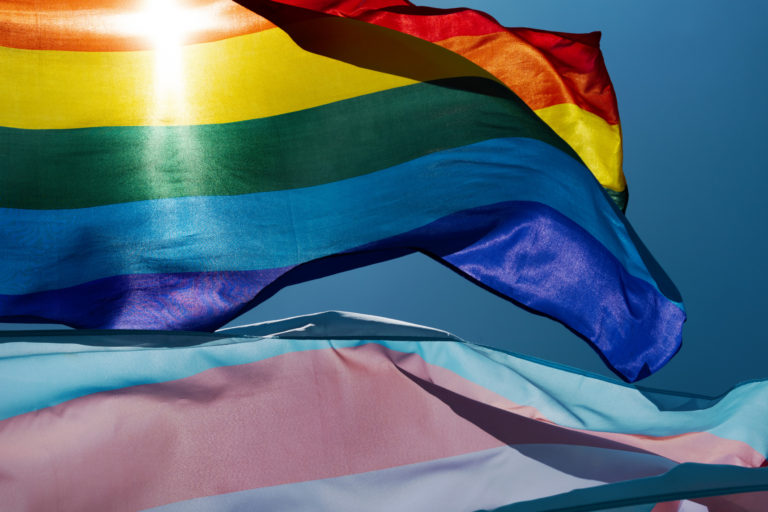
A 12-year-old non-binary student was allegedly assaulted for displaying a LGBTQ pride flag during a school picnic in Florida last week. This undated file photo shows a rainbow LGBTQ pride flag flying next to a blue, pink and white transgender flag.
nito100/Getty

Florida police are investigating an incident last week that involved a non-binary 12-year-old student being physically attacked after displaying an LGBTQ pride flag at an outdoor school picnic.

Leo Hoffman and their friends were enjoying the picnic when a male student grabbed the rainbow flag and threw it into a trash can last Friday, Leo’s father Benjamin Hoffman told Bay News Nine.

When Leo retrieved the flag and draped it across their back like a cape, they were allegedly pushed to the ground, stomped on, doused with water and dragged across the ground while wrestling for control of the flag with the same student and other assailants.

“Leo was frightened,” Benjamin Hoffman told the outlet. “Not so much for themselves but for their friends. Leo is very strong and would do anything to protect their friends.”

A spokesperson for the Pinellas County Sheriff’s Office told Newsweek on Friday an investigation into the incident is “active and ongoing” but declined to provide any further details or comment before the investigation is completed.

The students believed to be responsible for the attack were suspended from the school, with some expelled and reassigned to different schools. Benjamin Hoffman said he was not pleased “to see someone’s kid expelled from school” but it was “just not acceptable” to “lay your hands on another person.”

“The students’ behavior was inappropriate and unacceptable, and they were quickly disciplined,” Pinellas County Schools Public Information Officer Isabel Mascareñas said in a statement to WTSP. “Pinellas County Schools does not tolerate this behavior.”

“Pinellas County Schools welcomes everyone, and we teach students to accept and respect others for who they are,” she added. “The district values diversity and promotes inclusion.”

A video posted to social media by Leo’s older sister Ashleigh alongside the hashtag #justiceforleo on Tuesday captures part of the melee. Children can be heard shouting, with some laughing, as the physical struggle over the flag is taking place.

A follow-up tweet from Ashleigh thanks “everyone who has called” the school in response to the video before sharing that the school principal had “just let us know that the five main boys involved have been suspended and that they are pursuing a full investigation.”

This is a video of my little sibling Leo who is non-binary being drug to the ground, stomped on, and covered in water just for wearing a pride flag at school. Please call Seminole Middle and request #justiceforleo at 727-547-4520 pic.twitter.com/VwNRidkeuj

— Ashleigh 🏳️‍🌈 (@Mermaid_Lover_) June 1, 2021

“My oldest daughter posted the video on Twitter and it just blew up, hundreds of thousands of views,” Benjamin Hoffman told WTSP. “People started calling the school and the Sheriff’s Office and then things started happening.”

Over 80 percent of LGBTQ students say that they have been harassed or assaulted in school, most often due to their perceived sexual orientation or gender expression, according to a 2019 national survey from GLSEN.