Home Blog Page 111

Meet the Pandemic’s Newest Doctors, Who Quickly Became Pros – The New York Times

LIFE ON THE LINE
Young Doctors Come of Age in a Pandemic
By Emma Goldberg

In her new book, “Life on the Line,” the journalist Emma Goldberg focuses on six young doctors during the Covid-19 surge in New York City last spring. There’s Sam, a gay man all too aware of American medicine’s homophobic past; Gabriela, a Hispanic woman raised by a mother who never went to college; Iris, a first-generation Chinese-American woman whose family is skeptical of white doctors; Ben, an amateur bartender fascinated by end-of-life care; Elana, who grew up on Long Island in an observant Jewish family; and Jay, whose father wanted her to marry and start a family instead of going to medical school. (“That’s not women’s work,” he explained to her.)

These newly minted doctors represent the vanguard of American medicine. Socially conscious and with a streak of activism, they are committed to serving patients who have been marginalized in what Goldberg calls the “whitewashed, wealth-washed” American medical system. In this spirit, they volunteer, as fourth-year medical students, to graduate early and begin internships at New York City hospitals besieged by the pandemic. They do not think of themselves as heroes, but in their commitment to their profession, even in the face of personal risk, one would be hard-pressed to see them any other way.

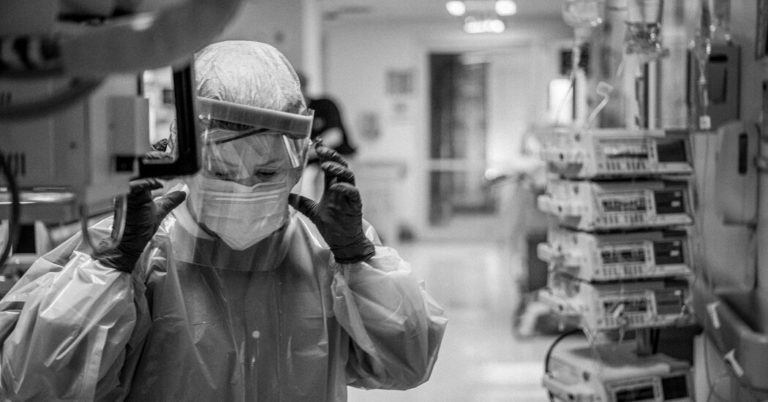
When they arrive on the wards, these young doctors discover that hospital care in a pandemic poses a grim set of challenges. Patients are dying at alarming rates. A code, signifying cardiac arrest, is being called every few minutes. Moreover, new rules to prevent infections among health care workers limit the time they can spend at the bedsides of the sick and dying. How do you care for patients when you cannot examine or even speak with them? It was a dilemma faced by many doctors on the front lines.

In one of the cruelest aspects of the pandemic, new doctors learn that patient isolation extends even to the dying process. “Before the pandemic, a patient’s death in the hospital might include up to 35 family members packed into a room with musical instruments and prayers,” Goldberg writes. “During Covid, it was more likely to involve a nurse holding up an iPhone.”

One of the most poignant stories in the book involves Manny, a 38-year-old with Down syndrome, whose father dies of Covid in the hospital, leaving him an orphan. The father had planned to outlive his disabled son. Now, doctors and social workers must figure out what to do with the bereaved young man.

This is the kind of story that gives life to books about medical training. Unfortunately, there are too few of them here. The back story of the various characters takes too long. Drawn-out digressions on medical racism or the history of the internship system further disrupt the narrative flow. By the time we get to the wards, the book is nearly a third over. Goldberg would have done better, I think, to start the book when the internships begin and fill in the back story later. How Gabriella’s mother started her hair salon isn’t as interesting to us as the sounds, smells and action on the front lines.

When the action does begin, the stories are often truncated. We thirst for more details. We want to know more about what these young doctors were thinking in life-or-death situations. We yearn for a glimpse into their souls as they come of age in their new profession. On this measure, the book falls a bit short.

Still, I believe the book is a valuable chronicle of what interns and residents went through fighting the pandemic this past year. They served courageously, even as the actions of the public and public officials made their jobs harder.

In this vein, Goldberg reminds us of this clueless boast from Gov. Andrew Cuomo in March 2020, just as Covid was beginning to surge in New York City: “We think we have the best health care system on the planet right here in New York,” he said, before adding of the pandemic, “We don’t even think it’s going to be as bad as it was in other countries.” As Goldberg’s young doctors can attest from their experience last year, in some ways it was worse.
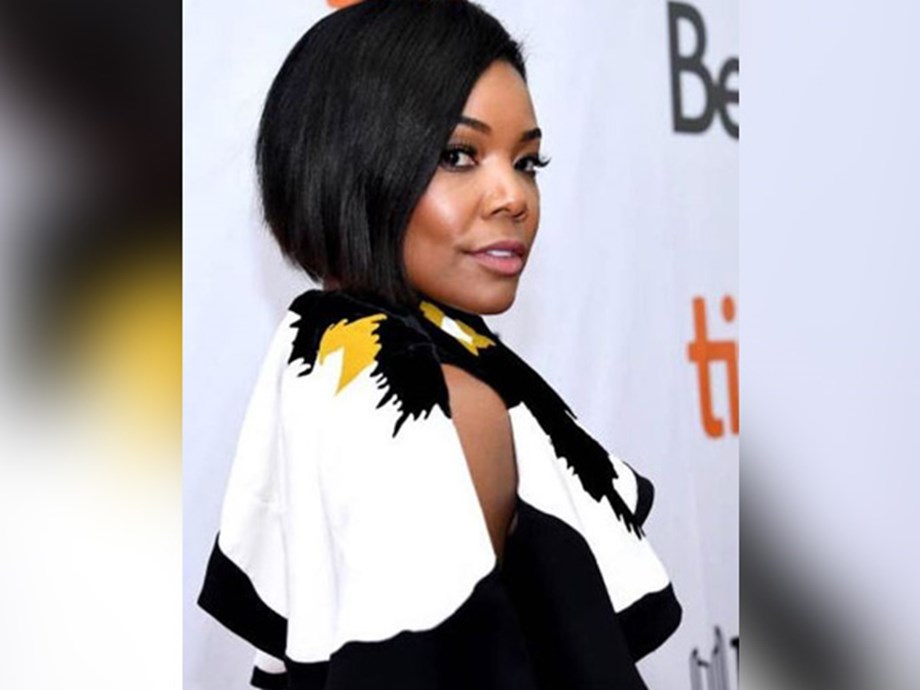
Gabrielle Union set to star in ‘The Inspection’ – Devdiscourse

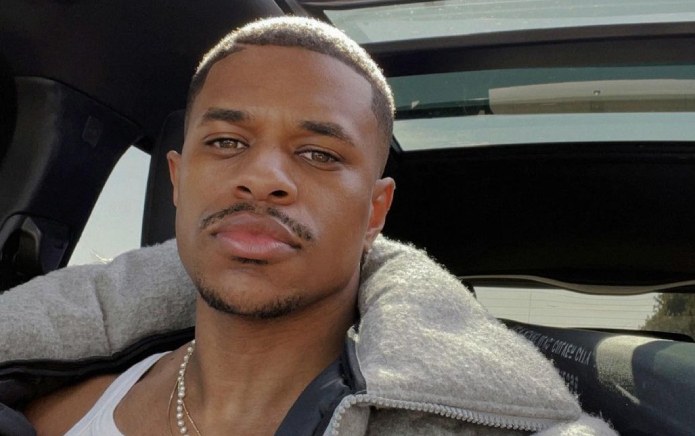
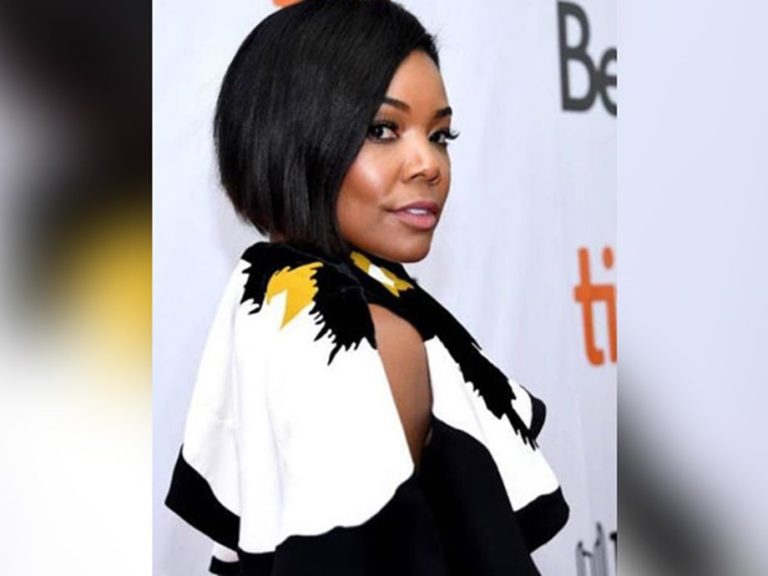
Gabrielle Union and Jeremy Pope will star in the A24 movie ‘The Inspection’, based on the life of filmmaker and Marine Corps veteran Elegance Bratton. As per Variety, Bratton is writing the screenplay and directing the film in his feature debut. It will begin shooting later this summer.

Pope will portray a young gay man who enlists in the Marines. Union will play the mother whose approval he seeks. Bratton began making films as a US Marine after spending a decade homeless because he was kicked out of his house for being gay. He recently won an Independent Spirit Award for his documentary ‘Pier Kids’, and has previously directed the short films ‘Walk for Me’ and ‘Buck’.

A24 will handle the worldwide distribution of ‘The Inspection’ and will co-finance the movie with Gamechanger Films. Effie T. Brown will produce on behalf of Gamechanger Films. Chester Algernal Gordon will also serve as a producer via their Freedom Principle shingle.

Commenting on the casting of Union and Pope, Brown said, “Elegance brings authenticity, heart and a fresh perspective to this compelling autobiographical story and we are thrilled to have Jeremy Pope and Gabrielle Union on board to bring it to life.” Pope had received Tony Award nominations for ‘Ain’t Too Proud’ and ‘Choir Boy’, as well as Emmy recognition for Ryan Murphy’s miniseries ‘Hollywood’.

Next up, Pope is set to play Sammy Davis Jr. in ‘Scandalous!’ from director Janet Mock. Union is currently working on the ‘Cheaper by the Dozen’ remake for Disney+, which she is also executive producing. (ANI)

(This story has not been edited by Devdiscourse staff and is auto-generated from a syndicated feed.)

Bishop apologizes to fired LGBT Catholic educator at theology gathering – National Catholic Reporter

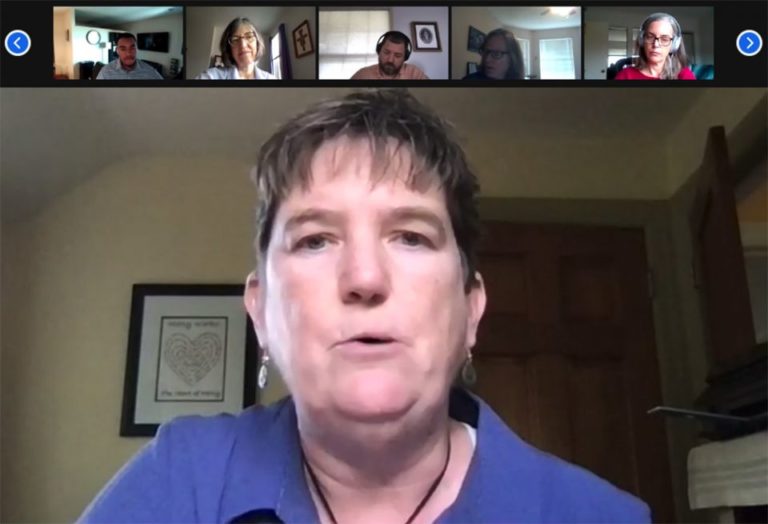
Margie Winters, a former educator at Waldron Mercy Academy in Merion, Pennsylvania, who was fired because she is married to a woman, speaks June 4 during a session of the College Theology Society's annual gathering. (NCR screenshot)

Margie Winters, a former educator at Waldron Mercy Academy in Merion, Pennsylvania, who was fired because she is married to a woman, speaks June 4 during a session of the College Theology Society’s annual gathering. (NCR screenshot)

After eight years serving as the director of religious education at a Catholic school in Pennsylvania, Margie Winters was fired in 2015 because of her marriage to a woman.

Her story is similar to those of a number of other Catholic educators in the U.S., fired because their relationships violate the church’s teaching against same-sex marriage. But on June 4 this year, Winters received something different: a clerical apology for the way she was treated.

As part of a discussion during the annual gathering of the College Theology Society, held virtually, Bishop John Stowe of Lexington, Kentucky, told Winters: “You tell a story that has happened to you and so many others … to be betrayed by an institution that you love.”

“As part of [the] male hierarchy, I apologize for the pain it has caused you,” he said.

Stowe, who has become one of the most vocal U.S. bishops in support of LGBTQ Catholics, also said that his own Catholicism “cannot be reduced to a morality clause.”

“There is a hierarchy of truths and values that constitute the core of Catholicism,” said the bishop, who has led his diocese since 2015. “Catholic institutions have to be focused on the Gospel itself and on the extension of the reign of God … in ways that lead people to a deeper relationship with the Triune God.”

Bishop John Stowe of Lexington, Kentucky, speaks June 4 during a session of the College Theology Society's annual gathering. (NCR screenshot)

Bishop John Stowe of Lexington, Kentucky, speaks June 4 during a session of the College Theology Society’s annual gathering. (NCR screenshot)

Winters was fired from Waldron Mercy Academy in Merion, a Philadelphia suburb, after parents at the school raised complaints about her relationship. She told Stowe and theologians taking part in the online discussion that “being fired from a community you love and trust is devastating.”

“I want the church to know that I have seen and felt its darkness,” said Winters. “My heart has been broken and continues to grieve the break in relationship.”

It is unknown exactly how many LGBTQ Catholic educators in the U.S. have been fired because of their relationships, although new cases have appeared to flare up in recent years. A pair of schools in Indiana drew national attention in 2019 after one fired an educator in a same-sex marriage, and the other refused to do the same.

The school that refused, Brebeuf Jesuit Preparatory, appealed to the Vatican, which has prevented Indianapolis Archbishop Charles Thompson from rescinding the school’s Catholic status as it reviews the case.
Winters and Stowe were speaking at one of dozens of sessions at the June 3-5 gathering, which brought together theologians from across the country for discussions focused on the theme “The Human in a Dehumanizing World: Reexamining Theological Anthropology and Its Implications.”

Many of the sessions at the event were punctuated by open conversations about difficult issues — such as how the Catholic Church limits discussions on topics like same-sex marriage and women’s ordination, and cases of sexual harassment and abuse of graduate students at Catholic institutions.

An earlier session on June 4 was focused on discussing Donna Freitas’ 2019 Consent: A Memoir of Unwanted Attention, which detailed her experience suffering harassment and stalking from a priest professor in the 1990s at the Catholic University of America.

Novelist and theologian Donna Freitas speaks June 4 during a session of the College Theology Society's annual gathering. (NCR screenshot)

Novelist and theologian Donna Freitas speaks June 4 during a session of the College Theology Society’s annual gathering. (NCR screenshot)

Freitas told theologians at the session that discussions about abuse in the church often only focus on the problems of the abuser, and treat victims and survivors as if they are “characters in a book, frozen in time.”

“I want you to look me in the face and see the casualty that I am,” she told her colleagues. “My abuser is the product of a system, a system you are part and product of now.”

The issue of women’s leadership in the church was raised in another session by Annie Selak, a theologian at Georgetown University. She evaluated Pope Francis’ recent decisions to change the church’s canon law to make explicitly clear that women can serve as readers and altar servers at liturgical celebrations, and to open up a new ministry of catechist to both men and women.

“How should we react to something that should have been this way all along?” asked Selak.

Georgetown University theologian Annie Selak speaks June 4 during a session of the College Theology Society's annual gathering. (NCR screenshot)

Georgetown University theologian Annie Selak speaks June 4 during a session of the College Theology Society’s annual gathering. (NCR screenshot)

“A framework that makes people beg for scraps from the table like dogs is dehumanizing,” she continued. “The call to justice in the church involves rearranging, expanding the table, so that entire groups of people are no longer dependent on crumbs.”

The College Theology Society, founded in 1954, is one of two primary associations of Catholic theologians in the U.S., along with the Catholic Theological Society of America.

Brian Flanagan, a theologian at Marymount University in Arlington, Virginia, who will serve as the College Theology Society’s president for 2021-22, told NCR that the group is known for creating an atmosphere of collegiality, where academics can speak openly with one another.

“That allows us to create an atmosphere of trust and openness to frank and friendly dialogue,” said Flanagan.

Enter your email address to receive free newsletters from NCR.

Wade Neal Roznik | News, Sports, Jobs – Daily Mining Gazette

MOHAWK — Wade Neal Roznik “Mitty,” 58, passed away peacefully at home on Wednesday, June 2, 2021, surrounded by friends and family following a courageous battle with cancer.

Wade was born July, 17, 1962, in Kenosha, Wisconsin, a son of Frank Roznik and Betty (Fox) Kausie.
Wade attended and graduated from Calumet High School with the class of 1980. He served in the U.S. Army and loved to tell stories about his time in Germany.

Wade was a former driver for Thurner’s Bakery for 17-plus years and later McCabe’s distributing.

He was married to Joyce Ann Lahnala on July 20, 2007, in Eagle River.

Wade was known for his smart wit, always being on the move, helping his family friend’s and neighbor’s without being asked. He spent most of his time at his property in Gay, loved his gardening and had a green thumb. What he loved most was spending time with his pug Gus Gus.

Wade was preceded in death by his father Frank Roznik, mother Betty Kausie, step father John Kausie and sister Robin Rappana.

He is survived by his wife, Joyce Roznik; daughter, Tanya (Craig) Bastian; granddaughter, Kailee (Christopher) Outinen; great granddaughter, Paisley Outinen; brother, Frank (Sue) Roznik; sisters, Marie Roznik (Nick Rajacic) and Renee (Pete) Tuoriniemi; uncle, Charles Fox; numerous nieces, nephews, cousins, and friends, Wes Aho, John Jewell, and many more.

At Wade’s request a celebration of life will be held at his property in Gay on his birthday July, 17, 2021, at 3 p.m.

Condolences for the family may be sent to P.O. Box 267, Mohawk, MI 49950.

‘RHOSLC’: Heather Gay Finally Breaks Silence on Jen Shah’s Arrest for Fraud – Showbiz Cheat Sheet

Jen Shah is in for a rough season on The Real Housewives of Salt Lake City. Bravo will premiere the second season of the fan-favorite later this year and Shah’s indictment and fraud charges will be featured on the show. Co-Star Heather Gay is finally breaking her silence on the ordeal plaguing the reality series and teasing what’s to come on the show.

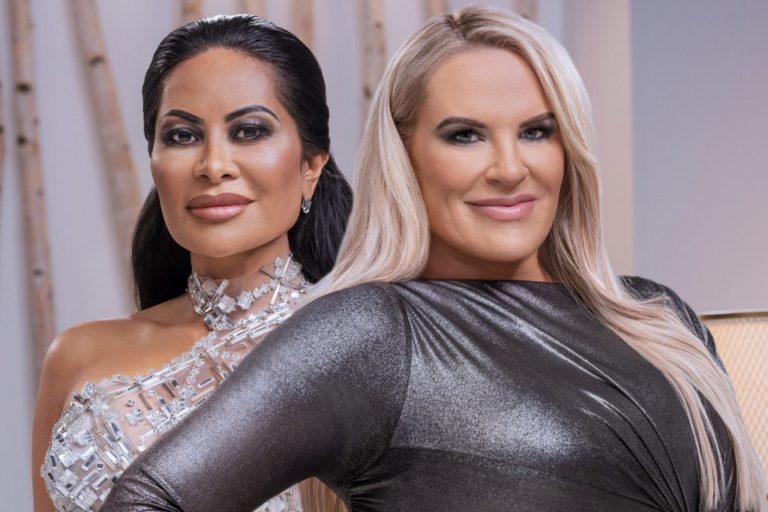
Jen Shah and Heather Gay in their 'RHOSLC' Season 1 official photos

Jen Shah and Heather Gay | Chad Kirkland/Bravo

Why did Jen Shah get arrested?

Shah was one of the breakout stars of RHOSLC after a first season that left fans wanting more. What viewers didn’t realize is that Shah was allegedly involved in a fraud scheme and has recently indicted. The Bravo star has been accused by federal authorities, along with her assistant Stuart Smith, of conning old people out of money.

“Shah and Smith flaunted their lavish lifestyle to the public as a symbol of their ‘success.’ In reality, they allegedly built their opulent lifestyle at the expense of vulnerable, often elderly, working-class people,” HSI Special Agent-in-Charge Peter C. Fitzhugh said in a statement. “As alleged, disturbingly, Shah and Smith objectified their very real human victims as ‘leads’ to be bought and sold, offering their personal information for sale to other members of their fraud ring.”

Out on bail, if Shah is found guilty of the charges she is being accused of, she could face up to 50 years in prison. Shah’s case is expected to start trial in October of this year.

Jen Shah crying during the 'RHOSLC' Season 1 reunion

Jen Shah | Heidi Gutman/Bravo

RELATED: ‘RHOSLC’ Star Meredith Marks Slams Fans Saying Son Brooks Was Shading Jen Shah After Arrest

What does Heather Gay say about Jen Shah’s arrest?

Gay and Shah had a solid friendship at the beginning of the RHOSLC Season 1. However, by the time the show wrapped, their relationship was rocky. Despite their differences, the two seemed to have worked things out and Gay is being a supportive friend.

“It does feel like we’re 10 years into [the show], but we’re only [in the] second season, and everything plays out in real-time,” Gay said on the So Bad It’s Good with Ryan Bailey podcast. “We are in it with her. We are going through it as friends, [and] as people who for the first time in [our] lives are public figures. And for the first time in [our] lives, we have to answer to not only [our] family and friends, but to a worldwide audience, and to also see [our] trials and struggles played out and subject to public opinion.”

The entrepreneur explained that “this is the biggest, hugest thing that has happened” in the Salt Lake City community. “I mean, this is big, and it’s real,” she added.

Gay also teased what fans can expect from the sophomore season saying, “It is all the five horsemen of drama. You’ve got intrigue, and crime, and passion, and loyalty, and friendships all on the backdrop of Salt Lake City, Utah.”

Lisa Barlow, Mary Cosby, Heather Gay, Jen Shah, Whitney Rose, and Meredith Marks in the 'RHOSLC' Season 1 cast photo

Lisa Barlow, Mary Cosby, Heather Gay, Jen Shah, Whitney Rose, and Meredith Marks | Chad Kirkland/Bravo

RELATED: ‘RHOBH’ Stars Kyle Richards, Teddi Mellencamp Invested in Jen Shah’s Arrest Drama Like All ‘RHOSLC’ Fans

Jen Shah reflects on her friends

One thing that Shah has seemingly reflected during this difficult time in her life is learning who her real friends are. After getting indicted, Shah has posted cryptic messages on Instagram as well as thanking all her fans that are supporting her.

“Thank you for being loyal, believing in me, and not believing the hype,” Shah wrote in reply to her fan. “This journey has showed [sic] me who my true friends are. All my love.”

In an Instagram Stories update she added, “Thank you to those of you who that have shown my family and I real friendship, unconditional love & true loyalty during this difficult time. Thank you for not judging me and not believing everything you read online. I asked Allah to show me who my real friends are and he has. Allah Akbar.”

Bravo has not revealed when RHOSLC would return to the network but it will be sometime this fall.

I’m A Black, Gay Physician. I’m Here Today Because My Friends Saw Me — All Of Me – WBUR

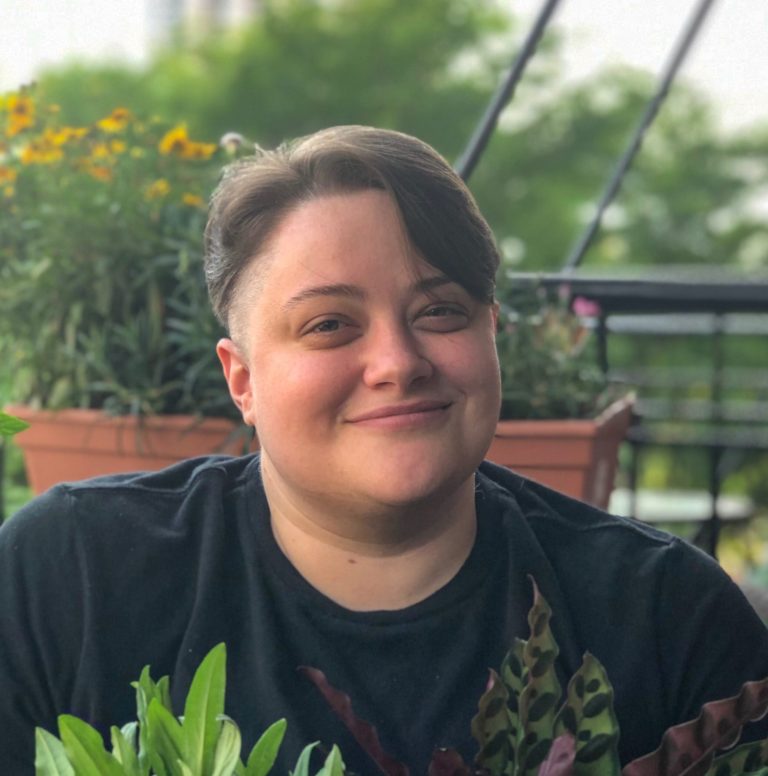
On my phone’s lock screen is a photo I draw strength from daily. On the steps of the pantheonic building where I attended college and graduate school, I stand with over a dozen close friends. Our hands intertwine; our arms fondly encircle each other’s shoulders. We wear the button-up shirts and dresses of college grads, but on our heads, each one of us sports a tiara.

We stand as chosen family, one month before I leave Massachusetts to start medical school in Chicago. I don’t know it then, but what I learned from them will save my life in the years to come.

These friends validated my identity and helped me unshackle the self I’d been hiding, or had been forced to hide. They taught me that being African-American and gay were beautiful aspects of my entire self, and that I was so much more than I ever dreamed possible.

Seven years later, I’m now a pediatric psychiatrist. I’m trained in the science and the literature. But, through this chosen village, I also understand how the power of community can heal.

There are statistics about how a sense of connection is essential for minoritized individuals. In 2015, 4.5 times as many LGB-identified high school students attempted suicide compared to non-LGB students. Forty percent of transgender individuals report having made a suicide attempt. Black children are dying by suicide at increasing rates as they face a rise in the number of hate crimes in America. In the Asian American community, anxiety and depression have spiked due to racism during the coronavirus pandemic. For minoritized people, a lack of community and support can be lethal.

I experienced how a life could change when people stood for you and with you.

The statistics for the power of community to save lives are just as impactful. The Trevor Project noted that “LGBTQ youth having at least one accepting adult were 40% less likely to report a suicide attempt in the past year.” Using a transgender individual’s chosen name can decrease suicidal behavior by 56%, and suicidal ideation by 29%. Connectedness between individuals increases their ability to cope during times of stress and when facing adversity, as does someone feeling connected to their university or community organizations.

Validating someone’s existence can save their life. But those are numbers on a page. How do the statistics play out in real time?

When a friend told someone to stop pejoratively mimicking my hand motions — and that person did — I began to feel as though I mattered. Parts of myself I had shut away because of fear flourished when another friend laced my eyes with eyeliner and gold eyeshadow before a fraternity party, a party where brothers in the fraternity remarked on how pretty the makeup looked. A friend sharing that she also suffered from depression let me know I wasn’t alone.

My fragmented heart healed when friends validated my experiences around discrimination. Being part of a campus where we celebrated our diversity of religion, sexual orientation, gender, race, and so many other facets of identity rebuilt my soul in ways I’d once only dreamed could happen.

My friends saw me. Their companionship showed me how what the world too often says about the minoritized is wrong in every way. Each one of them, without hesitation, reached out a hand and intuitively taught me how to sit in the chaos in which I was drowning. I experienced how a life could change when people stood for you, and with you.

A banner showing solidarity and support flies at MIT, where the author attended college and graduate school, after the Pulse nightclub shooting in June, 2016. (Courtesy)

When I released my internal shields crafted to protect myself, I had the distinct pleasure of seeing others do the same. Knowledge of my educational, economic and other privileges led to my leveraging those advantages for others. I became the person I always wanted to become: a unicorn-phoenix who did anything and everything I could to help those around me feel seen, loved, and that much more able to let themselves dream.

Everything during those six years wasn’t perfect. I was rejected from a fraternity when I first arrived at college, because I was gay. I was many people’s first openly gay friend, which came with necessary conversations around bias, and I had to have discussions around why people shouldn’t use the N-word.

In this photo, too, I have no idea that I’m about to be crushed during medical school. I’ll lose my hard-won voice. At the end of those four years, I’ll race back to my friends in Boston for psychiatry residency, but, even then, too many days will be a never-ending cycle of damaging microaggressions and overt aggressions which fracture my sense of self and force me to work through a speedy recovery to prepare for each new day.

While I’ll struggle, sometimes deeply, with depression and suicidal thoughts during both medical school and residency — including two moments of true crisis — memories and moments with those who truly saw me will safeguard me from becoming the one statistic I wouldn’t be able to come back from.

These friends validated my identity and helped me unshackle the self I’d been hiding or had been forced to hide. 

What I learned from my chosen family about leading with my heart will help me maintain enough of my sense of self to survive — enough, even, to learn to thrive. Their presence will create a safe sphere outside of work that will allow me to tackle issues around diversity and to create a similar safe sphere inside work. Honest conversations with them and others will help me see through the gaslighting I and so many others experience, teach me to find true allies and avoid false ones, and even remind me how to feel joy as changes begin to occur.

Seven years later will find me in San Francisco as I train to be a child and adolescent psychiatrist. My depression is in remission for the third time in my life, and I feel safe in a way I haven’t since posing for this photo. Not only am I lucky enough to be working with kids around their mental health struggles and coming to terms with their identity, but I’m also writing about minority stress and collaborating with others to hopefully reach those who need to know, like I did, that they are never alone.

Though many of us are separated by distance now, we constantly stay in touch. We’ve had weddings, vacations, triumphs, losses, deaths in our families, successes in finding our place in the world, and, most recently, a baby shower over Zoom. We may never gather on those steps again, but I will never forget how they shared pieces of their hearts with a young man who didn’t know if he would ever find true acceptance.

I would not be where I am now without the people in that photo who first saw me for who I truly am. Because of them, with them, for them, I will always be a young man who was once upon a time — and still is — fondly nicknamed Dream.

Follow Cognoscenti on Facebook and Twitter.

Pose star Jeremy Pope to play gay marine in new drama Pope will play a gay – Gay Times Magazine

Jeremy Pope will star alongside Gabrielle Union in The Inspection.

The drama will mark the feature-film debut of filmmaker and photographer Elegance Bratton, who also serves as writer and director.

The Inspection will reportedly be based on an autobiographical story of Bratton, who won universal acclaim for his documentary last year about homeless trans youth, Pier Kids.

Pope will play a young gay man enlisting in the Marines who is desperate to win the approval of his mother, who will be portrayed by Union.

Dear White People’s Effie T. Brown will produce and co-finance on behalf of Gamechanger.

A24 will also co-finance and handle worldwide distribution while Chester Algernal Gordon will produce via Freedom Principle.

In a statement, Brown said: “Elegance brings authenticity, heart and a fresh perspective to this compelling autobiographical story and we are thrilled to have Jeremy Pope and Gabrielle Union on board to bring it to life.

“I’ve long admired the excellent work of our partners at A24 and it’s exciting for Gamechanger to partner with a company that is equally committed to bringing diverse and captivating stories to the forefront of entertainment.”

Pope recently rose to fame in Ryan Murphy’s Netflix miniseries Hollywood, which earned him a Primetime Emmy Award nomination for Outstanding Lead Actor in a Miniseries or Movie. He recently reunited with Murphy for the third season of Pose as the boyfriend of Blanca (Mj Rodriguez).

The actor also made history in 2019 when he earned two Tony nominations for Choir Boy and Ain’t Too Proud, becoming the first Black performer to do so. For the latter, Pope also earned a Grammy Award nomination.

Last year, it was also announced that he will team up with Pose writer and director Janet Mock for a biopic on Sammy Davis Jr. called Scandalous.

Ricky Martin worries that being gay is stopping him from getting acting work – Metro Weekly

ricky martin
Ricky Martin: Photo – Nino Muñoz

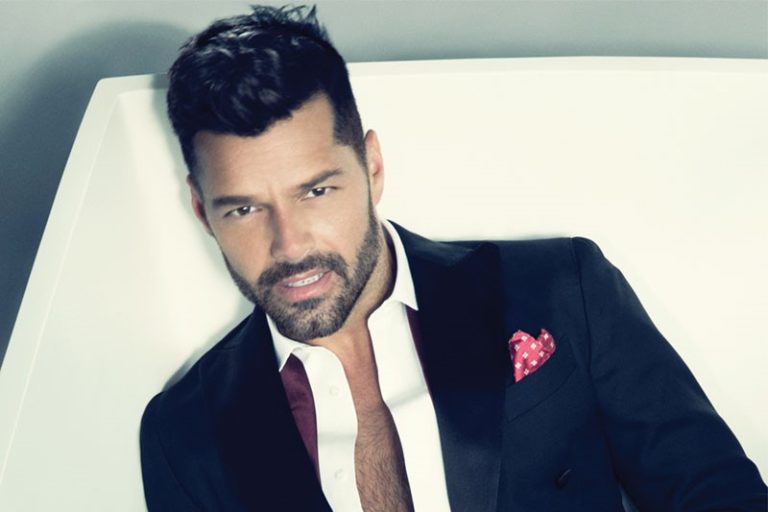
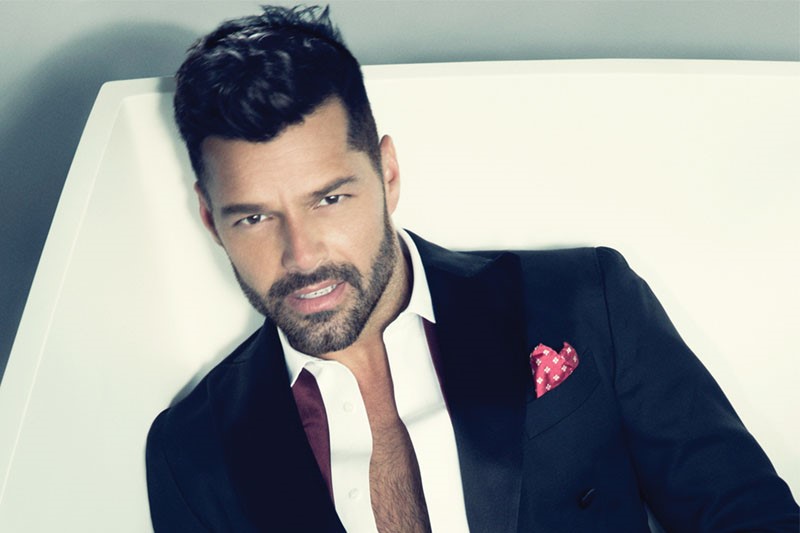
Ricky Martin has spoken out about the “disappointing” lack of acting roles available to him and whether being gay is having an impact on his career.

The Grammy-winning singer is also an Emmy-nominated actor, praised for his starring role in 2018’s The Assassination of Gianni Versace and with appearances on Glee, General Hospital, and Broadway’s Les Misérables and Evita.

But in an interview with People, Martin, 49, said he would be “really sad” if his sexuality had led to a relative drought in acting roles in recent years.

“I love acting. I’m waiting for those scripts, for those great scripts,” he said. “I can play gay, I can play straight, I can play a serial killer. I can play Latin, but I can also play European. I am ready. Just give it to me, man. Give it to me.”

Martin said he wants to “tell a story” and “change the way people see life in general towards some more optimistic way.”

However, he recalled a conversation with a music executive a few years ago, who told Martin that he would have sold more records if he hadn’t come out as gay in 2010.

The Puerto Rican native is one of the best-selling Latin music artists of all time, with more than 70 million records sold.

However, while Martin said the executive was later fired, the comment “really affected me…. It hit me hard.”


He then questioned if that same attitude was preventing him from being considered for acting roles.

“I don’t know if I’m not getting parts because I’m gay,” he said. “But if that’s the case, it’s really sad. I’m going to keep working until life is different.”

Read More:

Rufus Wainwright commemorates Pride with a ‘Rufus Does Judy’ livestream

Chick-fil-A won’t stop funding anti-gay causes, so Burger King is stepping in to help

Fourth man pleads guilty to using Grindr to assault and rob gay men

Support Metro Weekly’s Journalism

These are challenging times for news organizations. And yet it’s crucial we stay active and provide vital resources and information to both our local readers and the world. So won’t you please take a moment and consider supporting Metro Weekly with a membership? For as little as $5 a month, you can help ensure Metro Weekly magazine and MetroWeekly.com remain free, viable resources as we provide the best, most diverse, culturally-resonant LGBTQ coverage in both the D.C. region and around the world. Memberships come with exclusive perks and discounts, your own personal digital delivery of each week’s magazine (and an archive), access to our Member’s Lounge when it launches this fall, and exclusive members-only items like Metro Weekly Membership Mugs and Tote Bags! Check out all our membership levels here and please join us today!

Record-High 70% in US Support Same-Sex Marriage – Gallup Poll – Gallup Poll

Story Highlights

  • Support for gay marriage at 70% for first time
  • A majority of Republicans now support same-sex marriage
  • Support among older adults has reached the 60% mark

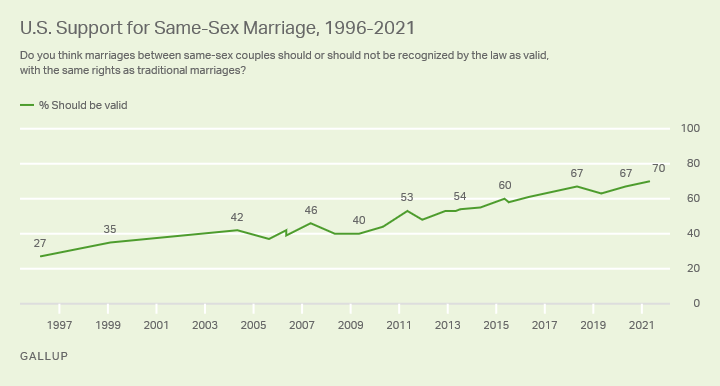
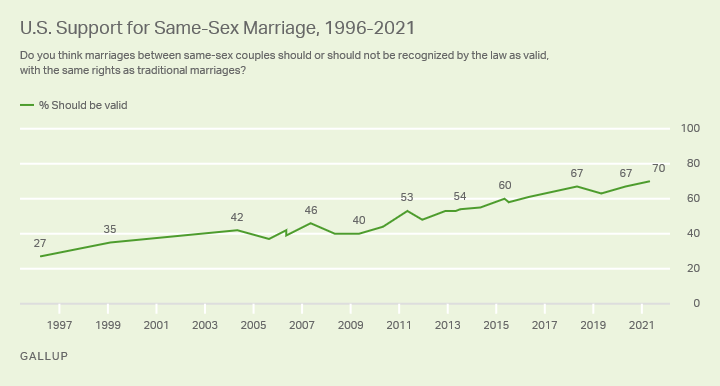
WASHINGTON, D.C. — U.S. support for legal same-sex marriage continues to trend upward, now at 70% — a new high in Gallup’s trend since 1996. This latest figure marks an increase of 10 percentage points since 2015, when the U.S. Supreme Court ruled that all states must recognize same-sex marriages.

Line graph. The percentage of Americans who say same-sex marriage should be recognized by law as valid. 70% of Americans in the latest poll, from 2021, say this.

These data are from Gallup’s annual Values and Beliefs poll, conducted May 3-18.

Today’s 70% support for same-sex marriage marks a new milestone in a trend that has pointed upward for a quarter of a century. A small minority of Americans (27%) supported legal recognition of gay and lesbian marriages in 1996, when Gallup first asked the question. But support rose steadily over time, eventually reaching the majority level for the first time in 2011.

By the time of the Supreme Court’s Obergefell v. Hodges decision in 2015, support for gay marriage had reached 60%. Since then, the issue has been less prominent in U.S. politics, and public support for same-sex marriage has continued to increase.

Gallup has recorded other shifts in Americans’ ideas on marriage over time, historically, including expanded support for interracial marriage, which had 87% approval as of Gallup’s 2013 update.

For the First Time, a Small Majority of Republicans Support Gay Marriage

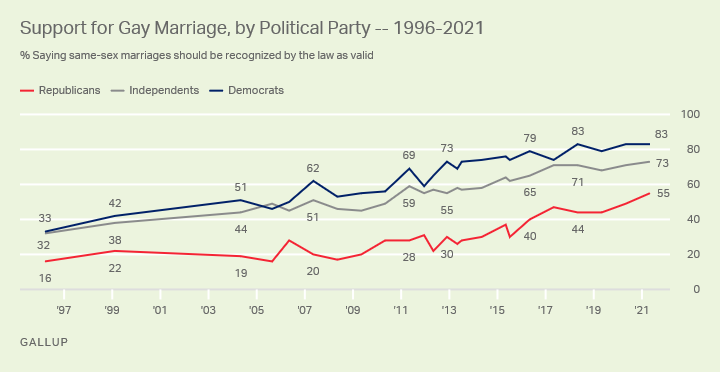
Republicans, who have consistently been the party group least in favor of same-sex marriage, show majority support in 2021 for the first time (55%). The latest increase in support among all Americans is driven largely by changes in Republicans’ views.

Democrats have consistently been among the biggest supporters of legal same-sex marriage. The current 83% among Democrats is on par with the level of support Gallup has recorded over the past few years. This could suggest that support for gay marriage has reached a ceiling for this group, at least for now. Meanwhile, support among political independents, now at 73%, is slightly higher than the 68% to 71% range recorded from 2017 to 2020.

Line graph. The percentage of Americans who say same-sex marriage should be recognized by law as valid, by political affiliation. 83% of U.S. Democrats, 73% of independents and 55% of Republicans in 2021 say same-sex marriage should be recognized by the law as valid.

Growth in Support for Same-Sex Marriage Continues Across Age Groups

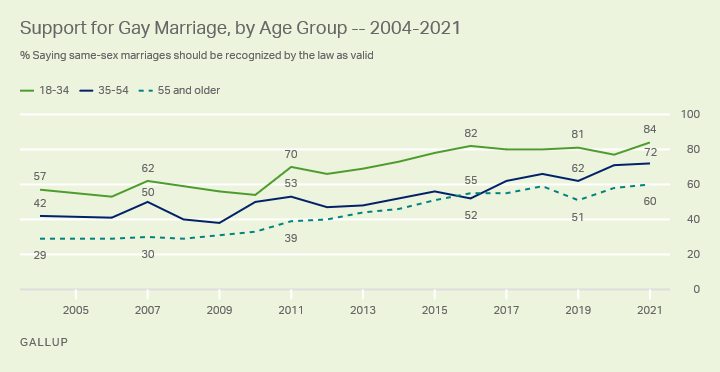
As would be expected at a high-water mark in national support for same-sex marriage, all age groups are the most supportive they have been to date. Still, age differences remain, with 84% of young adults, 72% of middle-aged adults, and 60% of older adults saying they favor same-sex marriage.

Line graph. The percentage of Americans who say same-sex marriage should be recognized by law as valid, by age group. 84% of Americans aged 18-34, 72% of those aged 35-54 and 60% of those 55 years of age or older in 2021 say same-sex marriage should be recognized by law as valid.

Bottom Line

Once opponents of legalization, Republicans have mostly come to back it. Court and legislative challenges to the legal status of same-sex marriage have simmered down since the Supreme Court issued its decision. Meanwhile, older U.S. adults, who were once holdouts in support for gay marriage, now come down on the same side of the issue as young adults.

Gallup’s trend illustrates that Americans’ views can shift in a relatively short time span, creating a new consensus — even as polarization on other measures intensifies.

View complete question responses and trends (PDF download).

Learn more about how the Gallup Poll Social Series works.

Related Is weed gay?: An abbreviated cultural history – Leafly

Is weed gay?: An abbreviated cultural history | Leafly


Loading…

LGBTQIA+ people and cannabis enthusiasts share similar experiences when it comes to legal progress, political challenges, and a continued quest for equality.


Weed is not attracted to other same-sex weed. A nug cannot have a gay wedding. A joint does not identify as genderqueer. An edible cannot talk with me about the new L Word: Generation Q.

However, weed is core to the experience of many queer people. In fact, one study says that queer people consume cannabis at higher rate than straight and cis people.

In this series, part of Leafly’s celebration of Pride month, we’ll explore some of the connections between queer people and cannabis in terms of history, health, culture. 

Long before modern attempts to further queer rights, queer people existed. Cultures across the world began mentioning the presence of a third gender, two-spirit individuals, and other alternate gender presentations centuries ago.

Egyptian royal manicurists Niankhkhnum and Khnumhotep depicted in an intimate nose-touching posture in 2400 B.C.

In ancient societies like Greece, Rome, and Egypt, it wasn’t unheard of for same-sex pairs to be depicted together in a romantic sense in art or mythology or even buried together. And while it’s hard to draw direct conclusions from the little information we have about queer people in ancient society, there is mention of queer people in visual arts and literature going back thousands of years.

  • 1688: Japan’s first gay bar opens
  • 1790s: Monaco, The Kingdom of Prussia, Luxemburg, and Belgium decriminalize sodomy
  • Late 1800s and early 1900s: the concept of a “Boston marriage”, or the long-term partnership between two women, appears in American high society.

But despite centuries of existence, many modern religions and societies struggled to accept LGBTQIA+ people – perpetuating false ideas that they were dangerous or morally corrupt.

Cannabis has a history just as ancient. People in Central Asia have known about its power, including it in tales since as early as 2737 B.C. Cannabis seeds have been found in the graves of shamen in both China and Siberia as early as 500 B.C. And we also know there is a vibrant history of edible usage during the Islamic Golden Age.

Related

Weed rituals: a cross-cultural connection to calm

Hemp played a vital role in helping America become an industrial and agricultural powerhouse from its inception. But eventually, taxation and fear won over.

The US government passed legislation like the 1937 Marijuana Tax Act and The Controlled Substance Act of 1970 – leading to federal cannabis prohibition. Once cannabis was criminalized in this way, it was easy for many people to write weed off as a danger.

Both the LGBTQIA+ community and cannabis have more than their ancient history in common. They have been unfairly demonized in the public forum, where cannabis prohibition and anti-LGBTQIA+ policy have been used as moral imperatives instead of intentional political choices.

Closeup of Cannabis female plant in flowering phase
(Adobe)

The shift towards the more fair and compassionate treatment of both cannabis users and queer people has been a welcome change in recent years.

Nearly two decades after the Defense of Marriage Act was signed in 1996, gay marriage became nationally legal. But only after a string of states legalized it on their own. While gay marriage isn’t the only issue facing LGBTQIA+ people, its legalization helped speed up other protections for queer people for things like housing, employment, parenting, and medical care.

Weed has followed a similar blueprint towards national legalization, with an increasing number of states legalizing either medical or recreational cannabis. There’s pressure on the current administration to consider a path forward for national legalization, and the passage of every state’s cannabis program helps provide cannabis users with more protection and care. Sound familiar?

Hate goes up in smoke

Friends wearing colorful accessories and makeup share a bowl of cannabis
(Cannaclusive)

Today, the majority of Americans support both the rights of queer people and comprehensive cannabis legalization. 76% of Americans say they are pro-LGBTQ+, while 68% of Americans support cannabis legalization.

Related

Dear Joe Biden: Here’s the data, now it’s time to embrace marijuana legalization

We’ve got a long way to go, but it’s important to celebrate the little victories and appreciate activists in both cannabis legalization and LGBTQIA+ rights. They are the people that have helped us get to where we are today. 

The future is brighter, safer, and more just for cannabis users and for queer people, as long as we never stop fighting for what’s right and never stop confronting the work we still need to do as a community and as a country.

C. Merten's Bio Image

C. Merten

C. Merten is a Chicago-based writer, creative, and cannabis enthusiast. Their passions include breakfast, 70’s music, pina coladas, and getting caught in the rain.

View C. Merten’s articles

This Harry Styles-Inspired Couple Is Going Viral For Exchanging Clothes and Kisses – VICE

When Indian groom Shardul Kadam wore a mangalsutra – a necklace that is traditionally worn by the bride – on his wedding day, he was aggressively trolled for months. 

“People trolled me for wearing a mangalsutra by saying wear a saree and nose ring also, without realising that even in the pre-Victorian era, colourful outfits, gold jewellery and the concept of making yourself beautiful was not determined by gender,” Shardul Kadam told VICE. 

In South Asia, especially India, expressions of non binary identity can become targets of trolling and homophobic hate speech. 

But for Kadam, Instagram couples like Komal Pandey and Siddharth Batra send a clear message that despite the trolling, Indians do not have to restrict themselves to the social lens of gender.

With over a million followers on Instagram, Komal Pandey is an established fashion vlogger in her own right. However, videos with her boyfriend Siddharth Batra, where the couple is seen exchanging everything from clothes to kisses, truly stand out. 

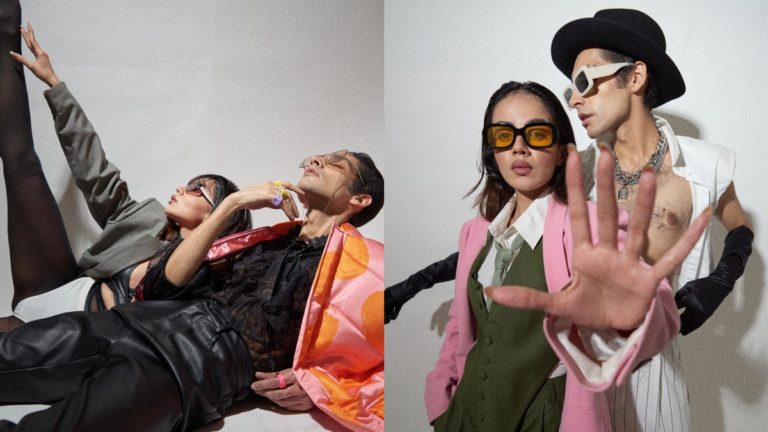
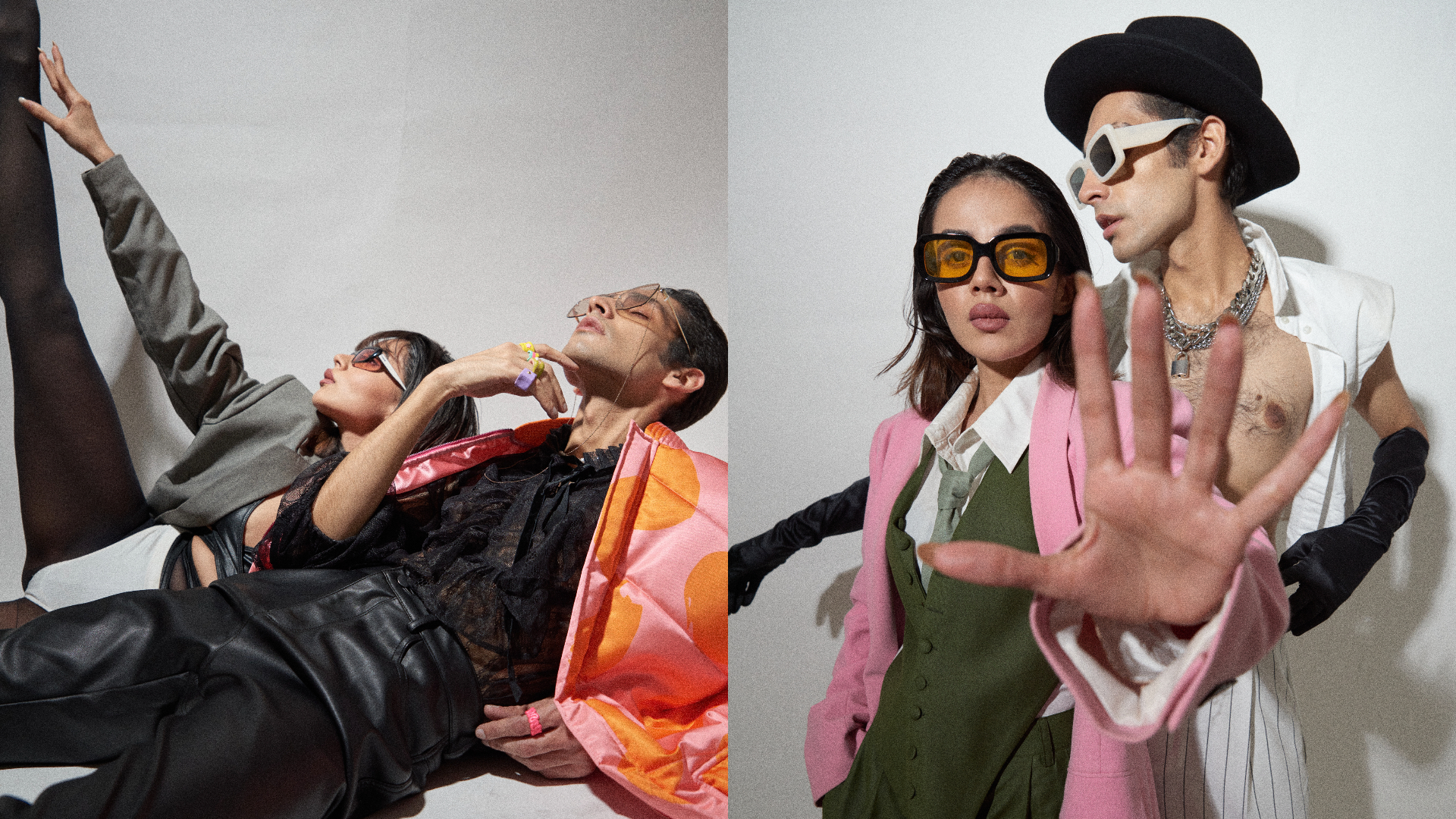
Together, Batra and Pandey are are twinning in androgynous looks and normalising the concept in cis-heteronormative spaces while they’re at it.  “When I started wearing blazers and dad shirts, I didn’t even know it was called androgynous fashion. I just wanted to wear clothes that made me feel powerful, which these pieces did,” Pandey tells VICE.

In February, when internationally renowned Indian designer Sabyasachi shared his new collection with American luxury brand Bergdorf Goodmans, he was also excessively trolled for featuring a man wearing a dress and heels. 

Even Ranveer Singh, one of India’s most popular Bollywood actors, faced homophobic slurs for wearing heels during a photoshoot.  

“In Persian history, which India is heavily influenced by, heels were seen as a high status symbol… for men,” Payal Arora, an anthropologist, author and professor at Erasmus University, Rotterdam, tells VICE. “They were worn by men to sit on horse stirrups and were a symbol of power and warfare for the elite”. Arora points out that heels were made for men and, in fact, appropriated by women, instead of the other way around. While this nullifies the argument that high heels are only worn by women, Arora points out that years of patriarchal conditioning have led to the rise of regressive beliefs in India. 

For Batra, his motivation to be a “rule-wrecker”, as well as his maximalist and fluid approach to fashion comes from a childhood where he had the privilege and freedom to express his identity. 

“Right from my childhood, my family never told me that something was not for me just because it went outside the quintessential male spectrum,” says Batra. “I was always encouraged to play games like cricket as well as kho kho or [with] kitchen [toys] growing up, even though these are traditionally seen as ‘girls’ activities in India.” 

While women are relatively less abused for sporting traditionally masculine items, they regularly face trolling for their choice of clothing. 

While Komal’s videos generally veered towards themes of affordable fashion, body and sex positivity, collaborating with her boyfriend allowed Pandey to experiment with blurring gender lines. 

He also credits his genderless fashion identity to his fashion education, and was heavily inspired by a blog called Kate Loves Me. “I would see Pelayo Diaz, the blogger behind Kate Loves Me, wear accordion pleated skirts with a blazer and a fedora, and I felt it was a great blend of how I saw myself getting dressed everyday.”

While Batra began his journey of content creation working at MensXP, an Indian male-focused fashion and lifestyle platform, he began establishing his individuality as a creator in 2019 by launching a video series that showed men how to do their own makeup. 

“I would see my mum and [female] friends wearing concealer and foundation, so my inlet to beauty began when I started experimenting with their makeup,” he said. “I began my #guybeauty series with the intention of sharing my own beauty routine, and promoting the idea of beauty for all. But after my first video got more than 200,000 views, even when I barely had 17,000 followers, I realised I could [use it to] drive a conversation in my community that could lead to an evolution in people’s self-inflicted ideologies.”

Batra is no stranger to trolls, having faced homophobic hate speech himself. But instead of letting it faze or discourage him, he takes the criticism as a sign to be more sensitive towards Indian women or members of the LGBTQ community who regularly face violent atrocities.

“I was recently wearing Komal’s skirt, and she was wearing my suit,” he says. “I was completely ogled at. That’s not even one percent of what women in our country go through everyday, which is something I’ll never be able to understand even if I wear their clothes. There are bigger problems in this world than what I choose to wear.”
 

While Batra and Pandey have faced their fair share of trolling, they have managed to develop a thick skin to overcome it. 

“Sometimes people don’t understand us because they don’t come from the same place as us, or are conditioned through movies, books or society [to believe that what we’re doing is wrong]. But we have to be empathetic and work towards breaking it,” said Pandey. 

Batra agrees. “Our society has taught us to be people who blend in, even if it makes us mediocre. I hope I can inspire others to choose to stand out and be whoever they want to be if it’s true to themselves.”

Despite the trolling, as anthropology expert Arora points out, these creators have been able to build an army of followers to defend their identities. “You don’t cultivate an audience by destroying things. You get one by creating solidarity. In this case, they use the resonance that Bollywood references and pop culture icons enjoy to challenge patriarchal norms.” 

Using the example of Neel Ranaut, a genderless fashion creator who hails from a conservative Indian village, Arora adds that the success of this content is a testament to the power of fashion as a communication tool. 

“The diversity of storytelling and audiences that social media allows has laid the path for gender free fashion,” said Arora. “Now, creators are catering to a generation that expects the personal to be political.” 

Follow Shamani on Instagram and Twitter.

Correction: This story inaccurately used the term gender bending. We regret the error.

Pride Month: The must-see LGBT films of 2021 – My London

Most gay people will remember when they first came to realise their sexual orientation. They may have been scared or frightened, believing life would get worse if they acted on their desires or were publicly known as LGBT.

Depictions of this in films can really help a person with their identity and with the coming out process. It’s a daunting time for anyone, but representation in movies builds character and self-esteem.

There are a number of standout LGBT films which explore key themes including love, relationships and courage.

Not every film involves rainbow flag-waving, however, as some look at the tough realities of being LGBT, even today.

There are still lots of countries where being gay is criminalised, leaving some who are forced to flee their home nation.

Even in places where it’s safer, some LGBT people still struggle with shame and stigma, and suffer family problems or mental health issues as a result. Movies, even if only touching on LGBT life, can assist in lifting this and helping LGBT people to live their lives happily.

So, what are some of the top films exploring themes around LGBT life? Here’s our lowdown of some of the must-sees this year.

The Half Of It

In this movie, Chinese American teenager Ellie (Leah Lewis) writes a letter as a favour for a boy, Paul (Daniel Diemer), who is trying to impress a girl, Aster (Alexxis Lemire).

Paul knows Ellie is good at writing, but when Ellie does so, Ellie realises she has feelings for Aster herself.

Ellie has been lonely in her life up until now, succumbing to the school bullies. However, she never realised she would develop a same-sex attraction, at least not in this way. The film explores the three of them as they navigate this love triangle.

The Half of It is available to watch on Netflix, and was released for viewing on the platform in May.

The Boys In The Band

In this film, a group of gay men gather in a New York apartment in time for a birthday party. One friend of Michael’s, Alan, tells Michael he has to speak to him immediately, so Michael invites him to the bash.

But there’s a problem for the group as Alan, played by Brian Hutchinson, doesn’t know about Michael’s sexual orientation. Michael, played by Jim Parson, has kept his homosexuality secret from him.

It later turns out that Alan has his own secrets, after allegedly being in a relationship with a boy when he was in college.

The film explores the identities of the men and how they came to be where they are in life today.

The Boys In The Band is available now to watch on Netflix. It is based on the play by Mart Crowley.

The Prom

In The Prom, a teenager Emma (Jo Ellen Pellman) wants to attend her high school prom with her girlfriend, Alyssa (Ariana DeBose).

The annual event had been cancelled after Emma made this declaration, against the wishes of many around her.

Rallying around to save the day, a group of Broadway stars come to the small Indiana town where the film is set in an attempt to let Emma and her girlfriend attend the prom.

Prom stars James Corden, Meryl Streep and Nicola Kidman, and has divided viewers on social media. Still worth a watch, though. It’s available on Netflix.

Like the My East London Facebook page


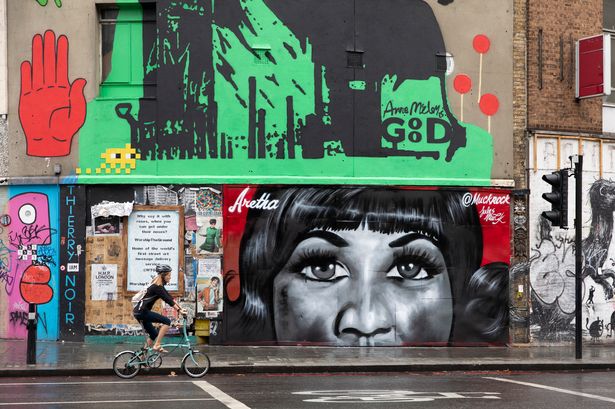
Aretha Franklin mural in Shoreditch

To keep up-to-date with all the latest breaking news, stories and events happening across East London, give the My East London Facebook page a like.

We will provide you with the latest traffic and travel updates, including updates on train and London Underground services, in areas including Tower Hamlets, Waltham Forest, Redbridge, Barking, Dagenham, Stratford and the Docklands.

The latest breaking news will be brought straight to your news feed including updates from the police, ambulance and fire brigade. We will also bring you updates from our courts and councils, as well as more lighthearted long reads.

We also publish your pictures and videos, so do message us with your stories.

Like the My East London Facebook page here.

You can also follow us on Twitter here.

Your Name Engraved Herein

In this movie, on the cusp of graduating, A-han (Edward Chen), speaks to the priest at his school, Father Oliver (Fabio Grangeon). He is the only person A-han can trust with his secrets.

The film then goes back to when A-han met Birdy (Jing-Hua Teng). Birdy isn’t so worried about keeping his sexuality a secret and the pair cause some trouble.

In later scenes, Birdy gets a girlfriend, Banban (Mimi Shao), and there are suggestions that A-han should get one too. But A-han doesn’t want a girlfriend, so he declines.

Your Name Engraved Herein is available to watch on Netflix now, and has been on the platform since 2020.

The film explores homophobia, the pressures of families and social discrimination. It is also one of Taiwan’s most popular LGBT films, so worth a watch.

Supernova

Supernova follows the life of partners Sam (Colin Firth) and Tusker (Stanley Tucci) as the latter develops dementia.

The pair travel across England in a camper van, visiting friends and family members. They live happily, until their relationship becomes tested when they start revealing their secret plans.

Supernova can be seen in cinemas from Friday, July 9, 2021. This one’s definitely worth a watch over the summer.

Pandemic threatens gay-focused eateries – Arkansas Online

Scott Frankel’s favorite memories of New York gay restaurants aren’t about food.

Universal Grill cranked “Dancing Queen” on birthdays. There was that incredibly hot Italian waiter at Food Bar. Florent was around the corner from a notorious sex club in the meatpacking district. Manatus was so gay, it had a sobriquet: Mana-tush.

Gay restaurants, said Frankel, Tony-nominated composer of the musical “Grey Gardens,” “made you feel like you belonged.”

But all those places he so fondly remembers are long closed, as are Harvest, Orbit’s and several others listed in an article, headlined “Restaurants That Roll Out the Welcome Mat for Gay Diners,” that ran in The New York Times 27 years ago. It now reads like an obituary.

Restaurants fold all the time, perhaps nowhere more so than in New York, and perhaps never as much as during the covid-19 era. The pandemic hit the country’s urban gay restaurants especially hard, said Justin Nelson, president of the National LGBT Chamber of Commerce. MeMe’s Diner, a popular gay restaurant in Brooklyn, permanently closed in November, citing shutdown measures and a lack of government support.

IDENTITY CRISES

Gay restaurants, like gay bars, are also facing crises of identity and purpose in a time that is in many ways more welcoming than the past, when gay people sought out gay restaurants because they offered safety and acceptance that couldn’t be found elsewhere.

Lesbians went to Bloodroot, a still-busy vegetarian restaurant in Bridgeport, Conn., that sprang from the lesbian feminist movement of the 1970s. Gay men frequented places like Orphan Andy’s, a campy diner from the same decade that’s still in business in the Castro neighborhood of San Francisco. Atlanta had Waterworks, which a 1992 newsletter for the group Black and White Men Together called the city’s “only Black-owned gay restaurant.”

Today, many LGBTQ Americans feel free to be their full selves in almost any setting. And shifting conceptions of sexuality and gender extend beyond what words like gay, lesbian, male or female can accommodate. A gay restaurant can just sound fuddy-duddy.

“Many of the more privileged young queer people have grown up with inclusion, so they don’t feel the need to be in a place where you’re sheltered from heterosexism,” said Julie Podmore, an urban geographer at Concordia University in Montreal.

That may be the case in New York, where gay restaurants are going the way of dinosaurs (if not yet extinct — Elmo and other spots are still keeping their gay fan base fed).

But elsewhere in the country, many gay restaurants are thriving — as treasured local businesses, de facto community centers, refuges from continuing anti-gay violence and potential paths forward for a restaurant industry in recovery.

Bloodroot, a vegan and vegetarian restaurant in Bridgeport, Conn., has roots in the lesbian and feminist civil rights movements of the 1970s. Many gay restaurants have closed in a time of growing inclusion and more fluid sexual identities but in several places around the country, they remain anchors of safety and community. (The New York Times/Gabriela Herman)

Bloodroot, a vegan and vegetarian restaurant in Bridgeport, Conn., has roots in the lesbian and feminist civil rights movements of the 1970s. Many gay restaurants have closed in a time of growing inclusion and more fluid sexual identities but in several places around the country, they remain anchors of safety and community. (The New York Times/Gabriela Herman)

AT HOME AT ANNIE’S

On a recent Saturday night in the Dupont Circle neighborhood of Washington, Annie’s Paramount Steak House was busy, and it was gay. Two dads and their two kids ate at a table in an outside area festooned with rainbows. Three 20-something gay men shared fries. An older couple smiled as they watched a clip from the classic musical “White Christmas” on a phone.

Overseeing the hubbub was Georgia Katinas, the general manager, who is 33 and straight. Her grandfather, George Katinas, the son of Greek immigrants, opened Annie’s in 1948 at a different location as the Paramount Steak House. Katinas says nobody in her family is gay, yet Annie’s surely is. That seed was planted by her great-aunt Annie Kaylor.

Annie was beyond supportive of the gay community and became, for many of the restaurant’s racially diverse diners, a mother figure before her death in 2013. In 2019, when Annie’s received an America’s Classics award from the James Beard Foundation, restaurant critic David Hagedorn wrote of how, in its early days, Annie “went up to two men holding hands under the table and told them they were welcome to hold hands above it.”

Now that indoor dining has resumed, Katinas said, “people are coming back with tears in their eyes” because they “missed being in a space where they’re not the only gay people.”

Derrin Andrade and Zack Sands weren’t looking for a gay restaurant when they moved to Dupont Circle four years ago. Now the biracial married couple are regulars at what Sands, 30, called “a home more than a restaurant.”

“You can sense the loyalty at Annie’s, and it makes you want to concede to that,” he said. “You want to be part of it when you see people are coming back for a reason.”

For Steve Herman, 79, who has eaten at Annie’s since 1976, that reason is the fact that Dupont Circle isn’t as gay as it once was.

“I think it’s a great thing that gay people are more mainstream and comfortable going other places,” he said. “But I miss having one neighborhood and one restaurant that was mine.”

ROCKY HISTORY

Historian George Chauncey traces gay eating places in New York back to the cheap urban dining halls that catered to unmarried workers in the late 19th century. In the 1920s and ’30s, police often raided cafeterias like Horn & Hardart, where gay men gathered to “ridicule the dominant culture that ridiculed them, and construct an alternative culture,” as Chauncey writes in his book “Gay New York.”

In 1959, 10 years before the Stonewall riots, what historians consider the first gay uprising in modern America broke out at Cooper Donuts in Los Angeles, where LGBTQ people pushed back against a police roundup by using coffee and doughnuts as projectiles.

In the 1980s, Florent was a refuge for gay New Yorkers during the worst years of AIDS. The owner, Florent Morellet, recalled that after learning he was HIV-positive in 1987, he posted his T-cell counts on repurposed menu boards that faced the dining room — a coded message of solidarity to his customers.

“I have met many times people who said, ‘Florent, you don’t know me, but at that time I was positive and in the closet and didn’t tell anybody,'” said Morellet, 67. “They said, ‘When I came to your restaurant where you put your T-cell numbers on the board, I felt everything was OK.'” He tried to say more but choked up.

A WAY FORWARD

If there’s a restaurant that points a way forward for gay dining, it’s Laziz Kitchen, in Salt Lake City. Moudi Sbeity founded the Mediterranean restaurant in 2017 with Derek Kitchen, then his husband, who was elected to the Utah State Senate a year later.

Sbeity, 33, prefers to call Laziz a queer, not gay, restaurant to signal “that we are inclusive in love.” The Pride flag flying outside is the redesigned version with stripes added for the trans community and people of color. The bathrooms are all-gender. A poster at the entrance welcomes refugees.

Not even red-state politics comes between a customer and Laziz’s grilled halloumi.

Nan Seymour, a regular, swears by the hummus, beet and muhammara trio. She dines there often, sometimes with her trans daughter, and feels she should support the restaurant’s mission.

“The default in our current culture is cisnormative, ­heteronormative white supremacy, and it’s not safe for people who aren’t in those majority privileged groups,” said Seymour, her voice breaking. “It’s essential for us to know that we can be at a restaurant and not worry about how it will go for my daughter when she goes to the bathroom.”

Jen Jack Gieseking, an urban cultural geographer at the University of Kentucky, Lexington, said that like Laziz, future gay restaurants will be intersectional, especially about gender. Servers won’t assume pronouns. Men won’t necessarily be given the check.

“We’ll see more consideration for how to create an anti-racism space,” said Gieseking, author of “A Queer New York.” “People will consider who’s delivering your food and who made your food.”

“Not all of these restaurants will be great,” he added. “But they will be projects that make change, and that’s exciting.”

Commemorate Pride by visiting these 10 LGBTQ+ movie filming locations – The Points Guy

0


10 LGBTQ+ movie filming locations to visit this summer


Advertiser Disclosure


Many of the credit card offers that appear on the website are from credit card companies from which ThePointsGuy.com receives compensation. This compensation may impact how and where products appear on this site (including, for example, the order in which they appear). This site does not include all credit card companies or all available credit card offers. Please view our advertising policy page for more information.

Editorial Note: Opinions expressed here are the author’s alone, not those of any bank, credit card issuer, airlines or hotel chain, and have not been reviewed, approved or otherwise endorsed by any of these entities.

DC Pride Walk and Rally set for June 12 – Washington Blade

0

Some owners of D.C. gay bars have said Mayor Muriel Bowser’s announcement on May 10 that the city’s restaurants and bars could resume operations at full capacity and return to pre-pandemic operating hours on May 21 caught them by surprise.

After several months of business shutdowns followed by a partial reopening with strict limits of only 25 percent of the normal number of customers inside bars and restaurants, a ban on standing in bars or being served while sitting at a barstool, the mayor’s reopening order left many bars and restaurants short on servers and bartenders.

But nearly everyone associated with D.C. gay bars who spoke with the Washington Blade — including owners, employees, and customers — have said they were ecstatic to see a full reopening after more than a year of COVID-related restrictions and hardship.

“We didn’t really open at a 100 percent capacity,” said John Guggenmos, co-owner of the D.C. gay bars Trade and Number 9, immediately after Mayor Bowser issued her full reopening order. Like other bar owners, Guggenmos said Trade and Number 9 had to bring back employees who had to be let go due to the shutdowns and operating restrictions over the past year.

“But you know, seeing people again, hearing the stories of some of the struggles they went through, and our customers just talking to each other and saying how glad they are to be back gave us a sense of our community and how much we are more than just four walls and some chairs and music,” Guggenmos said.

Dito Sevilla, who works as bar manager at the 17th Street restaurant Floriana, and as longtime host of the restaurant’s lower-level space known as Dito’s Bar, said the May 21 lifting of COVID restrictions has returned business to pre-pandemic levels.

“We were not fully staffed on day one either,” Sevilla told the Blade. “Everyone had to work a little extra,” he said. “And that was OK with them because they had gone without working for so long that working some extra shifts that week wasn’t going to hurt anyone. They were thrilled to do it.”

Doug Schantz, owner of the U Street, N.W. gay sports bar Nellie’s, said he too was caught off guard by the short advance notice of the mayor’s May 21 full reopening of restaurants and bars but like other bar owners said he is pleased that the full reopening has come to D.C.

He said Nellie’s put in place a “soft” reopening on May 21, with operations limited to his second-floor space that has a roof deck and he continued to close at midnight instead of the resumption to normal closing times with the mayor’s order at 2 a.m. on weekdays and 3 a.m. on weekends.

Schantz said he timed his full reopening to take place this weekend to coincide with the kickoff of the city’s LGBTQ Pride events. And by July 1, he said, Nellie’s will resume its popular drag brunch.

“We’re taking it one step at a time, but so many people were happy to be back,” he said. “They want to be back to normal.”

David Perruzza, owner of the Adams Morgan gay sports bar Pitchers and its adjoining lesbian bar A League of Her Own, said he and his regular customers, many of whom continued to show up at the two bars during the height of the pandemic restrictions, are delighted over the full reopening. Like several of the other bar owners, Perruzza said he will continue to operate outdoor seating under the “streetery” program the city established when indoor seating was initially banned and later resumed at just 25 percent capacity.

One COVID-related rule remaining in place for bars and restaurants, which is expected to be lifted soon, is the requirement that bars and restaurants obtain a name and phone number for at least one person entering as part of a group and for each individual entering for contact tracing purposes in the event someone tests positive for COVID on the day the customer was present. The city’s Alcoholic Beverage Regulation Administration, which initiated the requirement during the height of the pandemic, was expected to end the requirement in the next few weeks, according to sources familiar with ABRA.

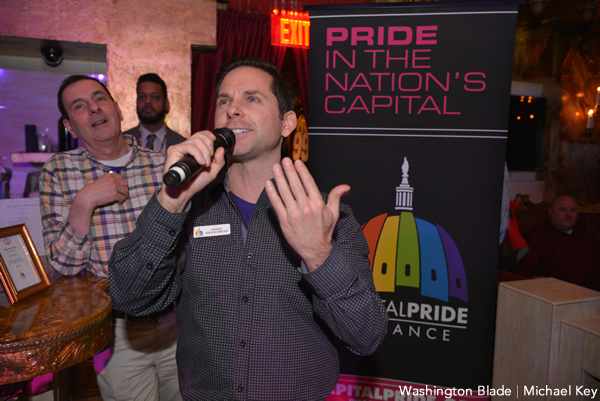
In addition to the full reopening of bars and restaurants on May 21, the city has cleared the way for the full resumption of large indoor and outdoor events on June 11, including parades and sports stadiums. That development has prompted D.C.’s Capital Pride Alliance, the group that organizes the city’s LGBTQ Pride events, to add to this week’s Pride events a June 12 Pride Walk, which will begin at Dupont Circle at noon and travel to Logan Circle before heading south to Freedom Plaza, where a rally will take place.

“The excitement has been palpable since bars and restaurants in D.C. recently reopened at full capacity and without limit or activity restrictions,” said Mark Lee, coordinator of the D.C. Nightlife Council, a local trade association representing bars, restaurants, and nightclubs.

“The enthusiasm is especially evident at LGBT venues, with long lines common after a long period of shutdowns and slowdowns,” Lee said. “The celebration will expand on June 11 when nightclub-licensed dance clubs fully reopen, and large music venues begin hosting tour acts and special shows in the coming days.”

But Lee said a “flip side” to the reopening celebrations is the reality that many bars, restaurants, and nightclubs must grapple with a massive debt burden of back-rent owed to landlords that threatens their survival.

Lee and others point out that the forced shutdowns and capacity restrictions that these mostly small businesses have faced during the pandemic resulted in a drastic reduction in revenue that forced them to rely on local D.C. and federal COVID moratoriums on evictions for commercial and residential tenants. With the moratoriums ending, the businesses must now repay the back rent owed that Lee says often exceeds $100,000 or more.

“That’s why the D.C. Nightlife Council and the Restaurant Association of Metropolitan Washington are urging Mayor Bowser and the D.C. Council to utilize a small portion of the city’s federal relief monies to create a Rent Relief Fund for local establishments facing unsustainable past-due lease obligations,” Lee said.

Perruzza said that in addition to facing back rent payments related to the pandemic, he and other bar and restaurant owners had to pay D.C. property taxes under their lease agreements at a time when their revenue was greatly suppressed from the pandemic. He said he believes he will be able to cope with the rental payoff, but the relief fund proposed by Lee and others would be immensely helpful for his and other struggling small businesses.

Bowser and members of the D.C. Council have said they were considering the relief proposal.

“We’re thankful for the support the community showed throughout the pandemic and the eagerness to want to get back to us,” said Guggenmos of Trade and Number 9. “We are thrilled and it’s great seeing everyone, but it doesn’t mean the sleepless nights are over,” he said in referring to the rental debt and other COVID-related expenses that his clubs continue to face.

Among the other D.C. gay bars whose representatives or customers said they are pleased over the reopening at full capacity include Uproar, Dirty Goose, JR.’s, Larry’s Lounge, Window’s, Annie’s Paramount Steakhouse, Duplex Diner, and Freddie’s Beach Bar in Arlington, Va.

Lee said the downtown D.C. nightclub Sound Check at 1420 K St., N.W., was scheduled to resume its weekly Avalon Saturday “gay” nights on June 12. Before being put on hold during the pandemic, the event featured drag shows and dancing.