Home Blog Page 110

LGBT Veteran care evolves, continues to improve – VAntage Point – VAntage Point Blog

This is part two in a two-part series about VA care for Veterans with Lesbian, Gay, Bisexual and Transgender (LGBT) and Related Identities. To see part one, visit https://blogs.va.gov/VAntage/89324/lgbt-veterans-describe-va-care-provide-advice-others/.

Lorry Luscri is one of VA’s many Lesbian, Gay, Bisexual and Transgender Veteran Care Coordinators (each VA medical center has one). She has a very straightforward message for Veterans with LGBT and related identities: “You do not have to be afraid to come to VA for care,” she said. “You are and have always been welcome here and should take advantage of all the great services available through VA for all Veterans.”

Evolving LGBT care

Even though VA did not have policies barring care for LGBT Veterans, the military did. Don’t Ask, Don’t Tell ended in 2011, and only recently have transgender service members been allowed to serve openly again.

“Sexuality and gender identity are important features of health,” said Michael Kauth, director of VA’s LGBT Health Program. “Everyone has a sexuality and gender identity, and LGBT Veterans have unique health needs that should be addressed.”

Road to improved care

Anna Craycraft has personally seen the changes. She’s an LGBT Veteran Care Coordinator at Oklahoma City VA. Craycraft said VA has continually updated policies to ensure equitable care for LGBT Veterans. This includes improved policies guaranteeing access to affirming treatment. Also, VA staff receive training on how to deliver high quality affirming care and services. This training helps address the unique health care needs of LGBT patients.

“The medical and mental health care that VHA provides to LGBT Veterans focuses on doing what VA does best: connecting providers for wrap-around care, thinking through all the minute details of access and equity, and putting methods and steps into place to make sure no one falls through the cracks,” she said.

Luscri said Hines VA started LGBT Veteran-specific programming in 2013 with focus groups. Staff asked LGBT Veterans about their experiences in receiving care and how they could improve.

“At that time there was a reluctance from many of our LGBT Veterans to participate,” Luscri said. “It was made clear from those who did that we had some work to do at Hines to create a more welcoming environment.”

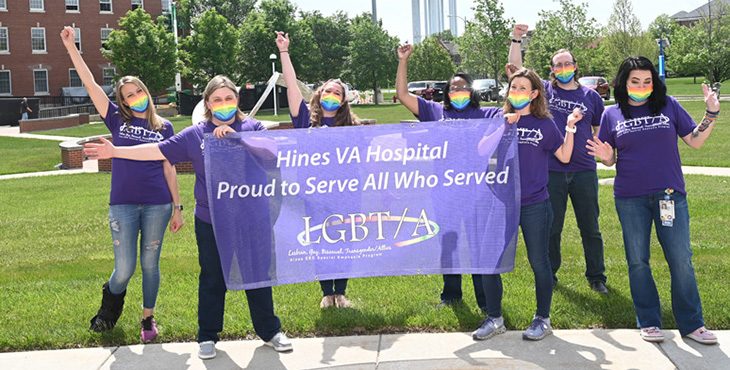
Staff members at Hines VA Medical Center show their support for LGBT and Related Identities Veterans.

Staff members at Hines VA Medical Center show their support for LGBT and Related Identities Veterans.

Care now

“Veteran Care Coordinators are central in improving LGBT care,” Kauth said. “The LGBT Veteran Care Coordinator’s role is to serve as a point-of-contact for LGBT Veterans who are seeking services or having difficulty accessing the services they need. These coordinators are instrumental in changing local culture to become more welcoming to LGBT Veterans.”

Craycraft said her fellow LGBT Veteran Care Coordinators love what they do.

“LGBT VCCs around the country are excited, passionate folks who are fully engaged in the work they are doing for LGBT Veterans,” she said.

Luscri said Hines VA provides several LGBT-specific services for Veterans. These include two support groups: Service and Pride and Transgender Veteran Support Group; they started in 2015 and 2016. LGBT Veterans can get care in both, including primary care clinics, community-based outpatient clinics, or the women’s health clinic.

Another important step is staff training. Hines, like all VA facilities, offers continuing education for staff. This training focuses on improving care and becoming better allies for LGBT Veterans.

“Ultimately, LGBT Veterans are looking for a patient-centered experience where they feel a connection to their health care team and other Veterans, like most Veterans seeking care at VA,” Luscri said.

Continuing to improve

Kauth said improving LGBT Veteran care is a constantly improving process. One early example is VA ensuring protection from discrimination. This protection also extends to family members and takes a broad definition of whom the patient or resident considers to be family.

“VA is increasing efforts across clinical programs to provide high quality clinical care in a culturally responsive, welcoming environment,” he said. “This care includes appropriate primary care and mental health services, support groups, gender counseling, hormone therapy, prosthetics, fertility evaluations, and evaluations for gender affirming surgeries, to name a few.”

Luscri said most of recommendations for improvement come from Veterans.

“The majority of the changes we have made at Hines came from recommendations made by our Veterans,” Luscri said. “Many of them are equally engaged in helping us to create and maintain a welcoming environment”

Better care helps others

Craycraft said many LGBT Veterans who experience good care offer support to the larger community in Oklahoma City. She said they want to return the favor to those around them in need. She recalled an Oklahoma City Veteran in his early 60’s who identified as gay and was in a long-term relationship with a male partner when he began attending support groups.

“At that time, he was living with chronic pain and using a walker,” she said. “He rarely left his house and was afraid to come out to his family, as he anticipated that they would not accept him or his partner. Since he began attending our support groups, he has begun attending weekly yoga, dramatically reduced his chronic pain and opioid use, come out to his family – who were all accepting – and married his long-time partner.”

Luscri said an important part of the relationship includes LGBT Veterans talking to their providers.

“It’s an important part of your health care to disclose your sexual orientation and gender identity, and VA works to make sure you feel safe to do so,” she said.

People walk in a pride parade in Illinois.

People walk in a pride parade in Illinois.

Expectations

Both Luscri and Craycraft said LGBT Veterans have a simple and reasonable expectation: receive the care they deserve.

“LGBT Veterans are some of the most grateful, flexible and motivated patients I’ve worked with in my time as a psychologist at Oklahoma City VA,” Craycraft said. “I fully expected these LGBT Veterans to experience some bitterness over the ways they’ve been excluded or discriminated against in the past. Instead, they express their thankfulness over and over for actions as simple as following up about care.”

She added much like any other social setting, LGBT Veterans want to be accepted like any other peer.

“LGBT Veterans simply want to be treated with the respect and dignity that they deserve,” she said. “That means that they want friendly, engaging conversation with non-LGBT Veterans as well. Essentially – treat LGBT Veterans just like you’d like to be treated.”

Luscri echoed that sentiment.

“Every Veteran has their own story and their own experiences, but you all share the common ground of being a Veteran,” she said. “Listen to your fellow Veterans, treat them with respect, and honor their experiences. All Veterans deserve respect and care, regardless of sexual orientation or gender identity.”

Resources for LGBT and Related Identities Veterans

Find an LGBT VCC at https://www.patientcare.va.gov/LGBT/VAFacilities.asp.

VA health care includes, among other services:

  • Hormone therapy
  • Substance use/alcohol treatment
  • Tobacco use treatment
  • Fertility evaluations
  • Treatment and prevention of sexually transmitted infections/PrEP
  • Intimate partner violence reduction and treatment of after-effects
  • Heart health
  • Cancer screening, prevention and treatment
  • Suicide prevention programs

Learn about health risks and talking to a provider about sexual orientation identity and self-identified gender identity. The fact sheets and directives below include information to help Veterans. Expect your VHA provider to ask about your sexuality and gender identity to address your health care needs. VA provides training to providers to keep your conversations confidential. You can also ask that this information stays out of your medical record. Medically necessary information must go in your medical record, such as a medical diagnosis. Finding a provider you are comfortable with is essential to your health and wellness.

Support

Learn about the resources and support available for Veterans who have faced challenges related to coming out.

Liberty Bank Partners with Payrailz For Smart Payments Experience – Business Wire

GLASTONBURY, Ct.–()–Payrailz®, a digital payments company offering smarter, more engaging payment experiences to banks and credit unions across the United States, announced that Liberty Bank of Middletown, CT, one of the largest mutual banks in the country, has selected Payrailz’ full platform to power its digital payments vision.

Liberty Bank, in its effort to continually raise the bar when it comes to delivering extraordinary customer experiences, recognized that its customers want a more personalized, proactive and engaging payments experience. They will be deploying Payrailz’ full platform of intelligent and sophisticated payment technology, including consumer and business bill pay, bill negotiation services, P2P and A2A money transfer services.

According to BCG’s 2020 Retail Banking Advisory Survey, 37% of respondents want their bank to be more like Amazon, followed by an additional 29% of respondents who want their bank to be more like a personal shopper. To achieve a greater level of personalization that meets these expectations, Liberty Bank conducted a nationwide evaluation and chose to work with Payrailz.

Bank executives cited Payrailz’ innovative payments platform that leverages modern AI and machine learning technology as keys to being able to offer personalized experiences to their customers. The bank also anticipates being able to roll out proactive and actionable recommendations to customers to help them better manage their finances with a key focus on financial wellness.

“At Liberty Bank we pride ourselves on our ability to drive continuous innovation in our digital engagement. Our goal isn’t just to keep pace with current trends; our goal is to offer a money movement experience that sets us apart from the abundance of competition, from large money center banks, to the new Fintech players. Payrailz’ revolutionary payments platform will be the foundation for Liberty to execute on our payments vision now and into the future,” said David Mitchell, EVP, GM, and Chief Digital Officer at Liberty Bank.

“Liberty Bank is an industry recognized leader that is constantly making incredible strides toward innovation. We love working with banks like Liberty who share our vision to constantly push forward and not become complacent with their payment solutions,” said Fran Duggan, CEO of Payrailz. “Liberty embraces technology to provide exceptional service to its customers particularly in today’s ‘Do It for Me’ driven culture. We are proud that they selected Payrailz and our single platform to offer a payments experience that prioritizes ease of use, personalization, actionable insights and helps their customer better manage their financial health.”

About Liberty Bank

Established in 1825, Liberty Bank is Connecticut’s largest mutual bank with more than $7 billion in assets and 62 banking offices across Connecticut. As a full-service financial institution, Liberty offers consumer and commercial banking, cash management, home mortgages, business loans, insurance and investment services. Named a ‘Top Workplace’ for nine consecutive years, Liberty maintains a longstanding commitment to superior personal service and unparalleled community involvement. For more information about Liberty Bank, visit www.liberty-bank.com.

About Payrailz®

Payrailz is a digital payments company offering advanced payment capabilities and experiences including consumer and business bill pay, external and internal transfers, new account funding, P2P, B2B, B2C and other related solutions to banks and credit unions. In a society that increasingly has become focused on a “do it for me” culture, Payrailz’ smart technology makes the difference. Payrailz creates smarter payment experiences for the financial services industry that are predictive and more engaging than currently available alternatives. Financial institutions can confidently embrace Payrailz’ API-first and cloud-native technology engine, to offer unique payment solutions to their consumers and businesses. Payrailz helps financial institutions meet the payment expectations of today and the payment innovation needs of tomorrow. For more information, visit payrailz.com, follow them on Twitter @Payrailz, Facebook or LinkedIn, or contact Mickey Goldwasser at 860.430.9245.

We need to celebrate LGBTQ joy this Pride Month. Lives depend on it. – USA TODAY

Imagine your high school baseball team banning you from playing. Your local DMV barring you from changing the name on your driver’s license. Your neighbors darting their eyes away from you in public.

The transgender community faces hardships like these on a daily basis – not to mention a wave of discriminatory legislation. Trans people are like Sisyphus, forever barreling a boulder up a never-ending hill.

But what if that hill wasn’t so intimidating after all, and they were given encouragement, smiles and support along the way? 

In the face of trauma, trans people – and the LGBTQ community at large – often persevere and find joy. Experts say the two are inextricably linked, and putting emphasis on LGBTQ joy this Pride month is especially crucial given the wave of persecution against the community. 

‘We’re all human’: Transgender teen writes children’s book about inclusivity ahead of Pride

This transgender teen co-wrote “A Kids Book About Being Inclusive” with the hopes of inspiring children everywhere.

Staff Video, USA TODAY

“It is not only important but essential to celebrate,” says Sara Warner, director of Cornell University’s LGBT studies program. “Our pleasure is our resistance to the hate, homophobia/transphobia, and fearmongering aimed at LGBT individuals and communities.”

Joy will help the community thrive, but first they must survive – especially younger people. According to The Trevor Project, 42% of LGBTQ young people “seriously considered” suicide this past year. More than half of them were transgender and nonbinary.

At least 28 transgender or gender nonconforming people have been killed in 2021, according to the Human Rights Campaign. Black and Latina transgender women are most at risk. 

“Our survival depends on us finding ways to create joy for ourselves, ways to laugh together and sharing insights that can only come from truly knowing ourselves,” says Alex Schmider, GLAAD’s associate director of transgender representation.

June, which is Pride Month, is as good a time as any to explore joy.

In the face of persecution, trans people – and the LGBTQ community at large – persevere, in order to find the joy buried in the trauma. Experts say the two are inextricably linked.

In the face of persecution, trans people – and the LGBTQ community at large – persevere, in order to find the joy buried in the trauma. Experts say the two are inextricably linked.
Vladimir Vladimirov, Getty Images

Pride started as a protest outside the Stonewall Inn in 1969 in New York. The word “protest” may not evoke joyful images – but it should. 

“We know that when the first brick was thrown at Stonewall, that was also portrayed as angry, or antagonist, or resistance and rising up. But that also was an act of joy,” says SA Smythe, an assistant professor in the Department of African American Studies at UCLA.

Warner adds: “When police, outfitted with tactical gear, stormed the Stonewall Inn, patrons – many of them homeless youth and trans women of color – fought back with the most potent weapons they had: their sense of humor. Some linked arms in a chorus line and sang dirty songs, while others led police on a wild goose chase through the byzantine streets of the West Village.”

SA Smythe, an assistant professor in the Department of African American Studies at UCLA
This is exactly the time where we find queer kinship and queer causes and celebrate that collectively.

Pride provides a time to celebrate and sit with this history, surrounded by fellow LGBTQ people.

“This is exactly the time where we find queer kinship and queer causes and celebrate that collectively,” Smythe says. “Because we don’t just then get joy, we also get to figure out what it is that we’re about, how we move in solidarity with each other. And that’s a super-joyous exercise.”

The idea of finding joy amid trauma is linked to the civil rights movement and Black Lives Matter. “For Black, Indigenous, and LGBTQ people of color, oppression is compounded by the violence of white supremacy, systemic discrimination and anti-Black racism,” Warner says.

It's important to see LGBTQ joy represented in TV, movies

Don’t let the rainbow flags fool you: Joyful representations of queer people in entertainment are scarce.

TV series and movies focusing on transgender people historically home in on tragedy – think “Boys Don’t Cry” and “Dallas Buyers Club.” The same can be said for the greater LGBTQ community, as with “Brokeback Mountain.”

“I would love to see more programming that celebrates gaiety, joy and pleasure,” Warner says. “With so many publishing outlets, television, channels, subscription series and public modes of broadcast, this is happening.”

Series like “Saved by the Bell” on Peacock and “First Day” on Hulu are challenging this negative narrative, according to Schmider.    

Series like "Saved by the Bell" on Peacock (pictured) are challenging the negative transgender narrative.

Series like “Saved by the Bell” on Peacock (pictured) are challenging the negative transgender narrative.
Chris Haston/Peacock

“When facing a world that makes it so unnecessarily challenging to be ourselves, seeing trans joy, laughing together, appreciating who we are, can help lead us through these times,” Schmider says. “Inviting people to connect with our experiences and laugh with us, not at us, which has historically been the case.” 

Grey’s Anatomy” star Jake Borelli watched all of “RuPaul’s Drag Race” during the pandemic and is always looking for LGBTQ entertainment to consume. He also starred in the Freeform’s movie “The Thing About Harry” last year.

“That, to me, was the perfect amount of joy,” Borelli said of the film. “It was the perfect queer story, in the sense that it was about queer people, but then it didn’t deal with shame and didn’t deal with coming out. It dealt with love. And I hope that more movies like that get made or more larger story arcs on television shows. That would be wonderful.”
As in real life, joy and heartbreak intertwine in complicated knots.

“Joyful queer content can contain pain and trauma. It is important to acknowledge our history,” Warner says. “The issue is how we address injury and how we celebrate our flourishing in spite of this.”

Schmider agrees and says more diversity behind the scenes will only push that notion further.

Watching a trans kid hit a home run onscreen could fuel further acceptance offscreen.

“Trans people, and everyone, need to see us living our lives and thriving despite the harm being propelled onto us, showcasing our resilience and our refusal to bow and bend to the pressures of being inauthentic to ourselves,” Schmider says.

Published

Updated

Tuesday’s letters: State’s ‘unwelcome’ mat, mean-spirited decisions, voting system unbroken – Sarasota Herald-Tribune

Last year, the John Ringling Causeway Bridge was hung with red, white and blue lights to honor patients suffering from COVID-19 at Sarasota Memorial Hospital.

The state’s mean-spirited decisions

The Florida Department of Transportation’s rejection of requests to illuminate the John Ringling Causeway Bridge and the Sunshine Skyway Bridge with rainbow lights to mark Pride Month constitutes yet another mean-spirited decision by the DeSantis administration (“No rainbow lights for bridge,” June 5).

An FDOT spokesman attributed the decision to workload, but the department’s policy, as the Herald-Tribune reported, allows for rejection of requests it “deems offensive or not in the public’s best interest.”

Here’s what I find offensive and not in the public’s best interest: 

More:How to send a letter to the editor

• That the department would put out the unwelcome mat to nearly 1 million Floridians.

• That the governor, Ron DeSantis, would choose to sign the callous ban on transgender athletes on June 1, the beginning of Pride Month.

• That DeSantis would order state flags lowered to half-staff to honor the extremist blowhard Rush Limbaugh.

• That – in an unrelated but typical incident – Pam Bondi, Florida’s former attorney general, in praise of DeSantis on Fox News, would say that, because of his handling of the pandemic, “You wouldn’t even know COVID had happened here.” She should share that observation with the families of the 37,000 Floridians killed by COVID.

Richard J. Strafford, Bradenton

Gay people welcomed by city, not state

Gov. Ron DeSantis continues to marginalize the gay community by refusing our request to light the Ringling Causeway Bridge in rainbow colors in honor of Pride Month (“No rainbow lights for bridge,” June 5).

My husband and I moved to Sarasota in 2007 and hoped we would be welcomed by our 55-plus community and the city in general. Our hopes were realized! Our community could not have been more accepting, and the city proved to be a safe haven as well. 

We are responsible adults who have served on the board of the Education Foundation of Sarasota County, volunteered at The Pines and currently serve on the boards of Project Pride and Also Youth.

We are blessed to live in this beautiful city. Now if only the state of Florida would get on the bandwagon, we’d be complete! 

Louis DeCongelio, Sarasota

Florida GOP ‘fixes’ unbroken voting system

Re “Writer underestimates will of voters,” a May 31 letter: Gov. Ron DeSantis in February was praising how smooth and trouble-free Florida’s election was in 2020. The system wasn’t broken and didn’t need fixing. 

Voters aren’t lazy. We just don’t need voting to get more complicated. This new GOP law makes voting more difficult for all voters.

As far as Russia and the Mueller Report go, Attorney General Bill Barr lied to the public. The investigation found there were more than 100 contacts between Donald Trump or 18 of his associates with Russian nationals and WikiLeaks, or their intermediaries.

Robert Mueller did not exonerate Trump of obstruction of justice. He left a roadmap of at least 10 charges that Congress could follow up on.

Both impeachments were because Trump tried to rig the system. First by trying to get Ukraine to falsify accusations against Joe Biden, and second by causing a deadly riot Jan. 6 in an attempt to stop the Electoral College vote.

It’s true, most Republicans will not work with Biden to move us forward. But with no Republicans voting for the COVID-19 Relief Package, look how many GOP senators are taking credit for it as if they had.

Bob Rustigian, Bradenton

Praise for aiding in conservation

The June 4 article “Bird, tortoise habitat funding secured,” about a conservation lot purchased by the Environmental Conservancy of North Port to protect gopher tortoises and the Florida scrub jay, made my day.  

Congratulations to all those who contributed to the purchase of the lot. This positive, exciting article should inspire all of us to work in whatever way we can to protect our environment and the flora and fauna in these undeveloped areas. Perhaps some of us will be inspired to plant our home landscapes with native trees, shrubs and wildflowers.

Developers and legislators please note: We care about our beautiful Florida, our wildlife, our native trees and wildflowers, our ponds, springs and rivers. We do not want the state to become one vast developed area; this would be a disaster for residents and visitors alike.

Naomi Voit, Venice

Save Bobby Jones before it’s too late

The Bobby Jones golf course has been a jewel in Sarasota. For years it has provided entertainment for all ages, residents and visitors. The facility needs to reopen soon or it will be too late to save it. 

Golf is a wonderful way for people to exercise and enjoy the outdoors. 

I suggest that the City Commission hire an outside business to manage, market and maintain the course and facilities. 

Mike Bommer, Sarasota 

Miami Beach Invites LGBTQ Travelers for Pride 2021 – FTNnews.com

0

Miami Beach, recognized as a top travel destination for LGBTQ travelers, is hosting an array of events, including the Miami Beach Gay Pride Parade and Pride Bar Crawl, along with virtual networking events.

Miami Beach is home to organizations like the LGBTQ Visitor Center in Miami Beach and the Miami-Dade Gay & Lesbian Chamber of Commerce, a testament to the city’s diversity, unity, and equality for all. Celebrating pride this month and throughout the year, Miami Beach welcomes LGBTQ travelers and locals to celebrate pride month.

“Miami Beach embraces all travelers with open arms,” said Steve Adkins, Chairman of the Miami Beach Visitor and Convention Authority (MBVCA).

“Our city includes a large LGBTQ population, so we aim to provide safe and inclusive events, hotels, restaurants, and attractions that cater specifically to the LGBTQ community.”

For those traveling to Miami Beach to celebrate pride month, there are several must-see, must-do attractions, and events that are perfect picks for LGBTQ travelers, including:

  • “Faces of Pride” Virtual Panel Discussion: Working together to tackle social injustices affecting the LGBTQ+ community will kick off the month during a free Facebook Live discussion called “Faces of Pride.” Hosted by Miami Beach Pride, the live stream will take place on June 8th, and viewers are encouraged to add their voices to the conversation during the broadcast.
  • LGBTQ+ Chamber Cross Country Pride Event: The Miami-Dade Gay & Lesbian Chamber of Commerce (MDGLCC) invites the community to a night of virtual networking on June 15th via Zoom. This event will bring together allied business owners, employees, and fellow LGBTQ+ chambers from across the country. Spots are limited, and registration is currently open.
  • Pride Bar Crawl: Celebrate Pride Month on June 16th, starting at 7 p.m., by enjoying five free drinks at the top LGBTQ bars on South Beach, including Bar Gaythering, Axel Beach, Nathan’s Bar, PALACE, and Twist. Tickets are just $25, and participants will receive a free drink at each bar. Ticketholders will have the chance to enter a giveaway and win a grand prize valued at $1,200, which includes hotel stays, dinners, bar tabs, and VIP bottle service at destination bars.
  • Miami Beach Gay Pride Parade and Festival: Miami Beach Pride returns September 10 – 19, 2021, and will feature a host of events, including Miss Miami Beach Pride Drag Queen Competition, Queer Art Pop-up Showcase, Pride Lights the Night, and more. The iconic festival and parade will also return at Lummus Park with the theme ‘one.’ A full COVID-19 Safety Plan will be in place and includes touchless transactions, increased tent sizes, open spaces, mandatory masks, temperature checks, and sanitizing stations to keep attendees safe.
  • AxelBeach Miami: This premier boutique hotel located in the heart of Miami Beach’s Art Deco District is a top choice for gay travelers. Just steps away from the beach, travelers can enjoy a host of amenities, including the Sky Bar that overlooks Washington Avenue, the spa, and the Alibi Monkei Bar for tasty food and drinks. In addition, guests who book seven days in advance will receive complimentary breakfast throughout their stay.
  • PALACE South Beach: As a year-round LGBTQ-friendly destination, activities at this famed restaurant are a must-do for locals and travelers. Enjoy great food and spectacular entertainment like live drag shows and exclusive special guests.

“The LGBTQ community brings a vibrancy to Miami Beach that shines through in our arts, culture, and culinary scenes,” said Grisette Marcos, Executive Director, MBVCA.

“Our pride month celebrations are second to none, and we’re inviting locals and visitors to head to Miami Beach for a celebration they won’t forget.”

For more information about LGBTQ events on Miami Beach, follow @ExperienceMiamiBeach on Facebook, Instagram, and @EMiamiBeach on Twitter.

Fourth man pleads guilty to using Grindr to assault and rob gay men – Metro Weekly

grindr, target, rob, gay, daniel jenkins, texas
Daniel Jenkins, one of four Texas men who used Grindr to target and rob gay men — Photo: Dallas County Sheriff’s Office

A man in Dallas, Tex., has pleaded guilty to federal hate crime charges after using Grindr to entrap gay men and commit violent crimes against them.

Daniel Jenkins, 22, is the fourth and final person to plead guilty for participating in the scheme, KSAT reports. Three others, Michael Atkinson, Pablo Cineceros-Deleon, and Daryl Henry, pleaded guilty in 2019.

According to prosecutors, the men created fake profiles to lure gay men to an apartment in East Dallas. Jenkins would meet the men and invite them inside, where the gay men were held at gunpoint, beaten, and robbed of their wallets, car keys, and cell phones.

At least one victim was sexually assaulted with an object, while at least two were urinated on and had feces wiped on them.

Jenkins pleaded guilty to five counts, including hate crime and hate crime conspiracy.

“These defendants brutalized multiple victims, singling them out due to their sexual orientation,” acting U.S. Attorney Prerak Shah said in a statement. “We cannot allow this sort of violence to fester unchecked.”

Shah added that the Department of Justice is “committed to prosecuting hate crimes. In the meantime, we urge dating app users to remain vigilant. Unfortunately, predators often lurk online.”

Using Grindr to poach crime victims is not an original idea, and has been utilized in several different instances in recent years.

Police in Atlanta issued a warning to gay men earlier this year after a string of robberies in which victims were held at gunpoint and carjacked by people they met using the gay dating app Grindr.


In February, a Houston man was charged with capital murder after using Grindr to arrange a meeting with a man who he robbed and strangled to death.

Last year, a teenager was arrested after lethally shooting a man and wounding two others after meeting them through Grindr.

In June 2020, a Louisiana student was left in critical condition after he was stabbed in the neck by a man he met through Grindr who reportedly admired serial killer Jeffrey Dahmer.

Earlier that year, a New York man was pistol-whipped and robbed at gunpoint after arranging to meet a man through Grindr. And in March, a British man was accused of stabbing a gay teenager more than 100 times after meeting one another through Grindr.

In North Texas in 2018, four men either pleaded guilty or were found guilty of using Grindr to arrange meetings with men at their houses in order to rob them.

A similar case in Baltimore saw three suspects use the app to trick at least four unsuspecting victims into meeting with them with the intent of robbing them.

In Oklahoma, police arrested a man — thought to have worked with at least two other men and a woman — who was accused of using Grindr to arrange meetings with gay men at a “house of horrors” where multiple men were forced to lie on the dirty floor of a garage strewn with trash and old mattresses while their attackers stole their personal belongings and attempted to withdraw money from their bank accounts.

Related:

Louisiana man who tried to dismember Grindr date indicted on federal hate crime and kidnapping charges

Father jailed for beating son after finding Grindr on his phone

Grindr faces $12 million fine for allegedly sharing users’ personal data

Read More:

Pentagon maintains Trump’s ban on Pride flags at military bases

Texas bakery ‘overwhelmed’ by support after customers canceled orders over Pride cookies

Chick-fil-A won’t stop funding anti-gay causes, so Burger King is stepping in to help

7 Pride Events You Cannot Miss This June – Houstonia Magazine

Sure, Pride Houston is postponed this year, but that’s not stopping Houstonians from celebrating Pride Month all June long. Around the Bayou City this June, expect a number of events to attend, including pool parties, markets, performances and so much more.

Montrose Makers Pride Market

Support LGBTQ+ vendors by stopping by the Montrose Makers Pride Market. As you wander the South Beach Houston parking lot-turned-market, expect to see a variety of Pride-themed crafts, painting, wall art, and locally made fashion accessories that you just cannot live without. H-Town-area artists include Lovely Lilah’s Soap, CTK Creations, Leona’s Bakeshop, and many more. Also, make sure to purchase a Pride T-shirt, the proceeds of which will benefit Pride Pantry.

11 a.m. to 4 p.m. June 12. Free. 810 Pacific St. 713-628-0780. More info at facebook.com.  

Young, Proud, and Free

We all like a makeover from time to time. This Juneteenth, a local organization called Say Her Name has partnered with Pride Houston to host a makeover event for queer youth of color on June 19. Say Her Name is committed to addressing the oppression faced by Black LGBTQ+ community members. Youth will be given a makeover and a safe space for conversation.

2 p.m. to 5 p.m. June 12. Free. Montrose Grace Place, 2515 Waugh Dr. More info at sayhernametexas.org.

Night Out at the Movies: A Reel Pride Pop-Up

For the cinephiles: The Montrose Center is hosting a movie night of must-see films that celebrate the LGBTQ+ community. A highlight of this evening includes the local premiere of Ailey. First shown at the Sundance film Festival, Ailey is about dancer and choreographer Alvin Ailey, whose work in dance focused on spreading awareness of the Black experience in America. Other can’t-miss films include All Boys Aren’t Blue and I’m With Harrison.

6 p.m. to 9 p.m. June 12. From $10. The Montrose Center, 401 Branard St. More info at eventbrite.com.

Pride Art Show at Hardy & Nance Studios

If you have a passion for art and equality, visit Hardy & Nance Studios on June 19 for its Pride Art Show, which will celebrate the talent of the local artistic community. Artists across Houston were invited to submit work that celebrate positive social change. Note: Masks are required.

5 p.m. to 9 p.m. June 19. Hardy & Nance Studios, 902 Hardy St. More info at hardyandnancestudios.com/event/pride.

Kinky Circus

If you love the theatrical and the circus, this Numbers Nightclub and Kinky Collective event—which supports circus performers and local vendors—will make a fun night out on June 19. Gert ready for awesome aerial work and incredible costumes.

9 p.m. to 2 a.m. June 19. From $20. Numbers Nightclub, 300 Westheimer Rd. More info and tickets at eventbrite.com.

Pride in Business Celebration

Hosted by the Greater Houston Chamber of Commerce, this event celebrates local LGBTQ+ businesses and recognizes the impact and importance of these businesses on the local economy. Don’t miss keynote speaker Louis Vega, Dow’s North American president and vice president of Government Affairs and Advocacy.

11:30 a.m. to 1 p.m. June 24. Free. The Greater Houston LGBT Chamber of Commerce, 5340 Weslayan St. More info at houstonlgbtchamber.com.

Pride, Love Wins

It’s summer, so you’d better believe there’s a pool party going on. Head to Pride, Love Wins, a very all-day event, to mingle, get some food, maybe win some prizes, and dance (there’ll be DJs). There should also be some vendors selling wares, and–in what’s sure to be the highlight—an Envy Pride King and an Envy Pride Queen will be crowned. Start preparing your stump speech now.

11 a.m. to 1 a.m. June 26. Free. Holiday Inn N.W. Houston Beltway 8, 3539 Sam Houston Pkwy. More information and tickets at eventbrite.com.

ACLU Files Complaint Over LGBT Discrimination ⋆ 715Newsroom.com – 715Newsroom.com

The ACLU of Wisconsin says Chippewa Falls schools didn’t do enough to stop the bullying of LGBT students.

The ACLU yesterday announced an administrative complaint against the school district for ‘pervasive discrimination.’ The ACLU says it’s working with the Cultivative Coalition, which is a group of current and former Chippewa Falls students who want the school to do more about ‘discrimination and harassment of students of color and LGBTQ+ students.’

The ACLU says it wants Chippewa Falls schools to develop new policies. The school district says it’s looked into some of the students’ complaints in the past, and is looking into others going forward.

Guest Opinion: How the VA has illegally denied health care to thousands of veterans – GoErie.com

A veteran with a fever and hacking cough that suggest a possible coronavirus infection tries to make a doctor’s appointment, only to be turned away by a receptionist who personally decides the would-be patient can’t see a physician.

A former service member and sexual assault survivor at risk of suicide is denied access to mental health services by a bureaucratic gatekeeper stationed at the therapist’s front desk.

These are two of thousands of examples of veterans seeking the Veterans Affairs health care they’re legally entitled to — and being wrongly refused it. This is due to a pervasive misunderstanding, and misapplication, of the rules regarding other-than-honorable discharges.

Among veterans this refusal is based on what is known as having “bad paper.” The “bad paper” designation can be based on minor misconduct, such as being late to morning formation, showing disrespect to a superior or one-time drug use.

Being turned away is an institutional shortcoming that can be easily remedied — not by an act of Congress, or time-consuming changes to federal rules, but instead through administrative corrective steps that can be taken at the Department of Veterans Affairs.

An estimated 400,000 former service members are at risk of wrongly being denied VA health care and other benefits, according to a 2020 study by OutVets, a group of LGBTQ+ military veterans. It showed that gay and lesbian veterans and victims of military sexual assault are disproportionately at risk. So are veterans who served in the Navy or Marines, the wars in Iraq and Afghanistan, and those with post-traumatic stress disorder.

Once burdened with “bad paper,” such veterans are more likely to be homeless and suffer mental health problems, and are at greater risk of suicide.

Here’s how the denial of care happens. Veterans who receive other-than-honorable discharges — a designation applied to roughly 7% of them since 1980 — can still qualify for VA health care and are legally entitled to individualized eligibility reviews and written notification of the determination.

Though that group includes some with bad conduct and dishonorable discharges, which can involve the commission of serious crimes while in uniform, more than 80% of them bear the burden of an administrative determination made without full due process.

The majority of “bad paper” veterans includes many of the estimated 100,000 LGBTQ service members discharged for purported misconduct between the end of World War II and the 2011 official repeal of the “don’t ask, don’t tell” policy that banned gay people from openly serving in the military.

Though there should be consequences for military misconduct, they shouldn’t include an across-the-board denial of health care — especially if a person has a service-related disability, is experiencing homelessness or dealing with the effects of military sexual trauma or PTSD.

Yet the OutVets study found that VA gatekeepers in more than a dozen states — including California, Florida, Missouri, New York, Pennsylvania and Texas — incorrectly told “bad paper” veterans they were ineligible for benefits.

In one case, a Vietnam veteran endured untreated PTSD for more than 50 years after he was wrongly told he didn’t qualify for VA health care. The situation was rectified only after a pro bono lawyer intervened. Just as no one should need a lawyer to apply for a driver’s license, or enroll a child in public school, a veteran shouldn’t need an advocate solely to access VA health care for which they qualify.

A new report released recently by Legal Services Corp.’s Veterans Task Force further documents the lingering stain of “bad paper” on veterans. The report notes that, often because of service-related mental health conditions and other hardships, these veterans are often in greater need of supportive services. Yet their “bad paper” status prevents them from receiving the vital assistance they need to recover and reintegrate into civilian society.

In response to the OutVets report, VA officials described an “updated enrollment system” that would better identify and track those with other-than-honorable discharges. Such promises aren’t enough.

The VA must also work to overhaul the training, guidance and oversight of its staff and improve how it communicates with veterans. Its outreach to those who have been unlawfully refused care should include social media campaigns and easy-to-understand letters that outline who is eligible to receive care.

Congress and the military have started to take notice of the need for reform. In April, a federal court in Connecticut approved a class-action lawsuit settlement requiring the Army to reconsider thousands of less-than-honorable discharges issued over the last 20 years after failing to properly account for whether mental health conditions played a factor in those discharges. A similar class-action suit on behalf of Navy and Marine Corps veterans is pending.

Military service members dedicate their lives to defending our country. Once they return home, they shouldn’t have to fight for access to justice and basic benefits earned from their selfless service.

Dana Montalto is a clinical instructor at Harvard Law School’s Veterans Legal Clinic, which published the OutVets report “Turned Away” with Veterans Legal Services.

John Paul Brammer transformed ‘notoriously unhinged’ advice column into memoir ¡Hola Papi! – USA TODAY

It all started with a distinct ping. And by distinct ping, we mean a Grindr message.

“It was on this app that, for the first time ever, some white guy greeted me by saying, ‘Hola papi,'” John Paul Brammer writes in his memoir, out Tuesday, that was inspired by this message and his advice column of the same name.

The mixed-race Mexican-American writer created the column several years ago and channeled the format into an essay-filled memoir “¡Hola Papi! How to Come Out in a Walmart Parking Lot and Other Life Lessons” (Simon & Schuster, 206 pp.). Expect, above all else, vulnerability.

Menacing middle school bullies who prompt Brammer’s suicidal thoughts. A “one that got away”-style love story. And as the sub-headline in the title suggests: Coming out in a Walmart parking lot. Consider it par for the author’s meandering-but-methodical course.

“I love the idea of portraying what’s going through someone’s mind, the moment they make a decision, or the moment that they experience an emotion,” Brammer, who is from rural Oklahoma but now lives in Brooklyn, New York, tells USA TODAY. “I just really like putting those things into words, because I think that’s the most ambitious, beautiful thing that language can really do, it can sort of put someone else into the experience or the life of someone else. And I like using my own life to that end, because I think that’s so intimate.”

Hmm:Is coming out as a member of the LGBTQ community over? No, but it could be someday.

“¡Hola Papi!: How to Come Out in a Walmart Parking Lot and Other Life Lessons,” by John Paul Brammer.

How the column ¡Hola Papi! became a memoir

¡Hola Papi! has lived at a series of different companies and publications including queer dating app Grindr (yes, the irony), Condé Nast, Out Magazine and now at Substack (and is syndicated in The Cut).

“That’s not so much a reflection of my commitment issues, which I do have, but more of a reflection of instability in the media world,” he says.

Brammer wasn’t sure if letters would ever come in when he launched the column, but oh boy, did they.

A sampling of recent ones: “How do I stop comparing myself to other people?” “Papi, am I secretly hideous?” “Papi, can I be proud of where I’m from? Even if it sucks?”

That said, the column is known to be “notoriously unhinged,” Brammer says. Nothing beats his favorite letter from a man whose boyfriend was pretending to be Colombian. “I reread it three times thinking, ‘How did I get such a gem in my inbox?'” he says with a laugh. (He advised they break up.)

Brammer structured his memoir as a series of advice columns to pay tribute to the column.

“I’ve always thought of it as a vehicle for my writing, and not my biggest aspiration in life or anything, but I wanted to pay homage to the format and the medium, because I’m so thankful for it and there’s no guarantee that I would have found the readers that I did,” he says.

Oooh:The gay royal romance novel is having a moment: ‘Everybody deserves a happy ending’

On writing about your life: ‘You should know how you feel about it, but you often don’t’

Brammer sticks to the old adage: Write what you know.

“If I’m writing about something, it pretty much means I’m at peace with it,” he says.

“I’m not one of those people – and I really admire these people – who haven’t quite figured out how they feel about something and they use writing to help them figure it out, almost like in the process of writing it so it helps them realize, ‘Oh, okay, these are my feelings.'”

He tenses up otherwise. “I find it difficult to write about things that I haven’t quite figured out or that I’m still struggling with or that still bring me anxiety or fear,” he says.

To that end, the book offers zoomed-in snapshots into Brammer’s life as opposed to a panoramic view. He details one incident of sexual assault, for example, but chose to not include an incident where the first official man he started dating raped him.

“I wanted to write that story so badly but at the end of the day, I find him to be such an uninteresting person,” Brammer says. “And I find that whole experience was really heavy and intense, yes, but I couldn’t quite feel the emotional intensity I was looking for that I needed to write something about it.”

Brammer joked with his friends about it a few days later, then realized he needed to take it seriously – only to bury it, and once again revisit it years later.

“It’s such a weird, interesting activity to look back at the facts of your own life, which, obviously, you’re the expert, you live through it, you should know how you feel about it, but you often don’t,” he says. “Social trends and conversations and culture can re-contextualize how you see the facts of your own life. And that’s something that’s very uncomfortable to acknowledge because we want to feel like we have a good handle on the things that have happened to us, and that we know our own story. But with new information comes reshuffling of the narratives. And that’s often a painful process, it’s often very fraught.”

Please and thank you:10 new LGBTQ books to celebrate Pride Month: Gay ‘Great Gatsby,’ ‘Queer Bible,’ more

Brammer is already at work on his next book

Brammer misses his pre-pandemic writing routine. And we may have missed out on more quality quillwork from the author.

“Not being able to work in coffee shops has – I’m not going to say that it’s robbed this country of some cultural treasures, but maybe so, because I haven’t been able to write the way I have been for a year and a half now, because I just can’t sit my butt in a coffee shop,” he says.

Brammer is starting on his next book now, which is a fictional take on a chapter that didn’t make it into the memoir about his first gay house party when he was still coming to terms with himself.

“It’s all coming together a little bit right now, just throwing words to a Google doc and seeing if they stick,” he says. “If it works, I’d be really happy. If it doesn’t, I’ll move on to something else.”

Our advice? Devour whatever Brammer cooks up.

If you are a survivor of sexual assault, you can call the National Sexual Assault Hotline at 800-656-HOPE (4673) or visit hotline.rainn.org/online and receive confidential support.

The Trevor Project helps LGBTQ+ people struggling with thoughts of suicide at 866-488-7386 or text 678-678.

The LGBT National Help Center National Hotline can be reached at 1-888-843-4564.

If you or someone you know may be struggling with suicidal thoughts, you can call the U.S. National Suicide Prevention Lifeline at 800-273-TALK (8255) any time day or night, or chat online.

Crisis Text Line also provides free, 24/7, confidential support via text message to people in crisis when they dial 741741.

Noted:What if ‘The Great Gatsby’ was unquestionably queer? This author went there

Survey Finds LGBT Students Still Feel Unsafe in Schools – Total Slovenia News

STA, 8 June 2021 – The results of a survey by Legebitra, an advocacy group for LGBTI rights, have shown that schools are not safe spaces for members of the LGBT community. One in four LGBT students reported of having often heard homophobic remarks at school, and in more than half of the cases, school staff did not intervene.

In a study entitled LGBT Youth – Breaking the Silence in Schools, which was conducted in 2019, Slovenian LGBT students presented their experiences of discrimination at schools. The results showed that 11% of LGBT students did not intend to complete their secondary education.

According to the study, students who have often been targets of attacks and remarks because of their sexual orientation are less likely to continue their education. One in four surveyed LGBT students reported often hearing homophobic remarks at school.

Only 13% of respondents said that school staff always or almost always intervened when homophobic remarks were made, 54% of them reported that school staff never intervened, and 33% of students observed school staff intervening occasionally.

Meanwhile, 41% of LGBT students felt that school staff responses to reports of harassment or assault were ineffective. Only around 11% of students felt that school staff responded to reports of harassment or assault very effectively, while 48% of students felt that their intervention was somewhat effective.

Legebitra also warned in a press release that homophobic, biphobic, transphobic and sexist language and other prejudice-based remarks create an unsafe school environment that can lead to LGBT people not fulfilling their potential.

The study involved 602 people aged 16-21. The average age of the participants, who came from all regions of Slovenia, was 17.4 years.

Review – DC Pride #1: An All-Star LGBT Celebration – GeekDad

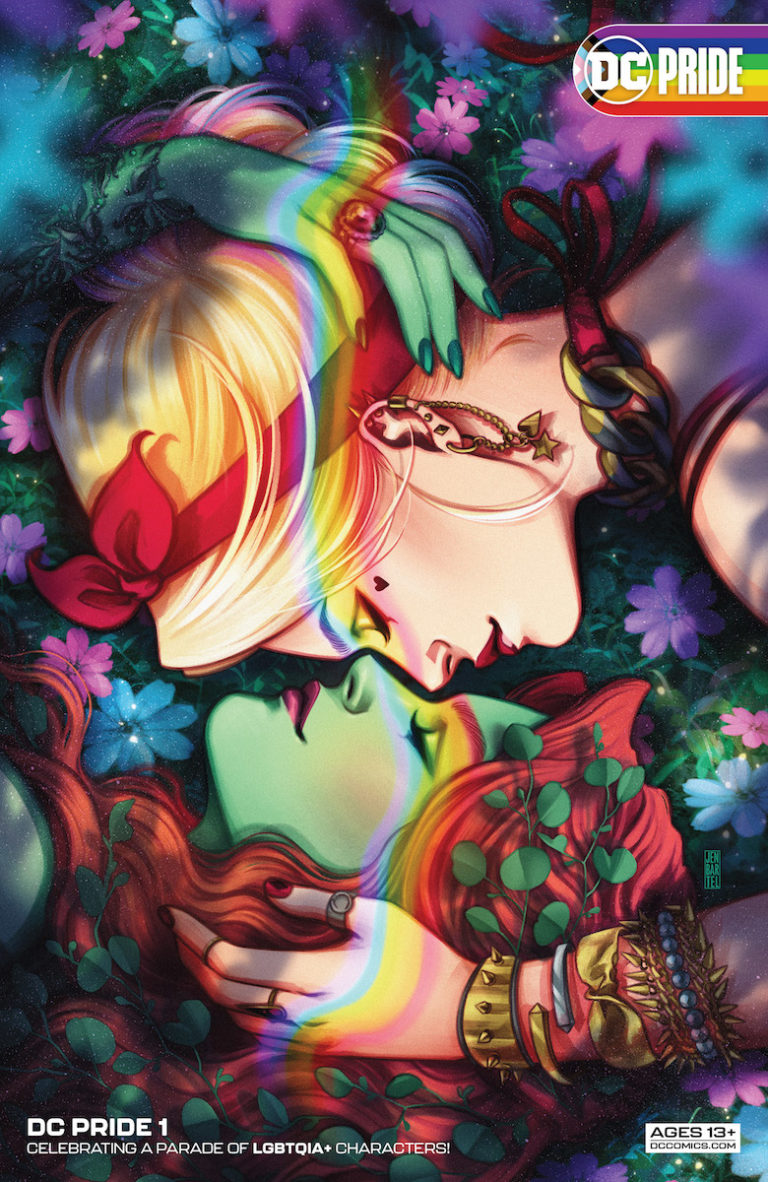
DC Pride #1 variant cover, via DC Comics.

DC Pride #1 – James Tynion IV, Steve Orlando, Vita Ayala, Mariko Tamaki, Sam Johns, Danny Lore, Sina Grace, Nicole Maines, Andrew Wheeler, Writers; Trung Le Nguyen, Stephen Byrne, Skylar Partridge, Amy Reeder, Klaus Janson, Lusa Sterle, Ro Stein/Ted Brandt, Rachael Storr, Luciano Vecchio, Artists; Jose Villarrubia, Marissa Louise, Dave McCaig, Enrica Eren Angiolini, Rex Lokus, Colorists

Ray – 9.5/10

Creative teams. Via DC Comics.

Ray: DC’s latest anthology is one of its most important—a celebration of its strong collection of LGBT characters. Like the recent Festival of Heroes, it’s timed to a month designed to celebrate the underrepresented and actually brings a new player into the DCU. It also features an entirely LGBT creative roster. So how do the stories stack up?

Written by top DC writer James Tynion IV and drawn by indie sensation Trung Le Nguyen, “The Other Side of the Looking Glass” isn’t just a great start—it’s one of the best DC stories I’ve read in a very long time. It focuses on Kate’s complex relationship with her sister Beth, going back to a game they used to play and how Kate never felt in sync with her sister. When Beth is presumed dead, Kate continues to feel out of step with her twin—never feeling like the girl she’s supposed to be. It’s a fascinating look at Kate as not just a lesbian but as at the very least gender-nonconforming, and the storybook-like art is absolutely stunning. It also seems to hold out more hope for Beth/Alice’s sanity than most stories featuring her. It’s a long story, over ten pages, and honestly makes this a must-buy right out of the gate.

Kate Kane, haunted. Via DC Comics.

“By the Victors,” by Steve Orlando and Stephen Byrne, takes the opposite take. Starring John Constantine, Extrano, and Midnighter, this is a bawdy brawler of a tale that starts with Constantine trying to pick up Extrano in a bar and dovetails into a flashback to the wild time Extrano and Midnighter fought a Nazi vampire. There’s no deep social message here, except, “We’re here, we come in all types, and we’re all ready to kick Nazi ass.” It’s funny and the perfect story to combine some of DC’s rougher-edged LGBT heroes.

“Try the Girl” by Vita Ayala and Skylar Partridge is a quick but satisfying story focusing on Renee Montoya, as the unlucky-in-love Question goes in search of a missing woman. A defense attorney turned progressive City Council candidate, the missing woman has made a lot of enemies and has ties to Renee’s past. While much of this story is a straight-forward Gotham action tale, the ending gives hope that maybe, Renee’s past romantic mistakes with Batwoman among others won’t repeat themselves.

The boldface creative team of Mariko Tamaki and Amy Reeder get to handle probably the most popular LGBT characters at DC—Harley and Ivy. And as you would expect for these two, it’s chaotic, hilarious, and adorable. Harley and Ivy have accidentally created a giant plant monster that is rampaging around the city, at the same time Ivy wants to have a serious relationship conversation. This short story does a great job of showing how Harley’s past relationship issues may make her the more cautious of the two in some ways, but it also shows just how deep their bond goes even if it isn’t conventional. Can we have more of this in canon?

Sam Johns and Klaus Janson tackle the recently out-of-the-closet Alan Scott and his son Obsidian in a follow-up to the recent Infinite Frontier story. This is another longer story, and it focuses on Alan meeting his son’s longtime boyfriend for the first time. But at the core of this story is a powerful tale about growing up gay in different generations. We get a lot of backstory on Alan’s first love, who lost his life in the train crash where Alan found the lantern, and on the secret bar which was one of the only places Alan could truly express himself post-war. It’s great to see a story that pays tribute to LGBT elders.

Danny Lore and Lisa Sterle’s story focuses on DC’s newest LGBT hero—the non-binary Flash of the future, Jess Chambers. This is a pretty light story, focusing on Jess as they get ready for a date with their girlfriend Andy Curry. But they just need to remember three things—and keep on getting sidetracked by a robbery at the Flash Museum and the appearance of a new Mirror Master. I think my favorite thing about this story is how normal it is—it’s really not about LGBT issues, it’s about a day in the life of a non-binary hero and their girlfriend, and that’s progress too.

“Be Gay, Do Crime,” by Sina Grace and the art team of Ro Stein and Ted Brandt, also adds a new LGBT character to the DCU in the chaotic Drummer Boy. This new vigilante is looking to rob a gala to raise money to save businesses in Central City’s “Gayborhood” being forced out by a corrupt landlord, and Pied Piper steps in to stop him and offer a different way. It’s a good look at the frequent conflict between older LGBT people and a new, more politically radical generation.

Maybe the most significant story in this issue introduces the transgender heroine Dreamer to the DCU, fresh off her debut in Supergirl, and is actually written by the character’s actress Nicole Maines and drawn by Rachel Stott. Although it does seem like this still takes place in the Supergirl TV show continuity, I’m hoping it’ll lead to more for the character. The plot, where she tries to stop a League of Shadows attack in time for a date with Brainiac 5, is fun if a little slight and feels like it could be a missing scene from the show.

Finally, it’s Andrew Wheeler and Luciano Vecchio on a story that introduces the first all-LGBT superhero team, JLQ. Obviously there’s some controversy about this property and we won’t get into this here, but this is mostly focusing on Jackson Hyde as he attends his first Pride parade with his date—who happens to be the protege of Extrano. But when a cursed rain starts to fall, courtesy of Eclipso, Aqualad jumps into action—and is joined by a diverse group of LGBT heroes. We get our first look at the roster here, and it has a lot of promise. There’s obviously a good amount of interest in this concept, so DC should go ahead and greenlight it.

Overall, this may be the best anthology, top to bottom, that DC has ever put out. Near-perfect with stories ranging from good to spectacular.

To find reviews of all the DC issues, visit DC This Week.

GeekDad received this comic for review purposes.

Liked it? Take a second to support GeekDad and GeekMom on Patreon!

How the 2022 Midterms Could Be Shaped by a Few Easy-to-Ignore Elections This Year – Mother Jones – Mother Jones

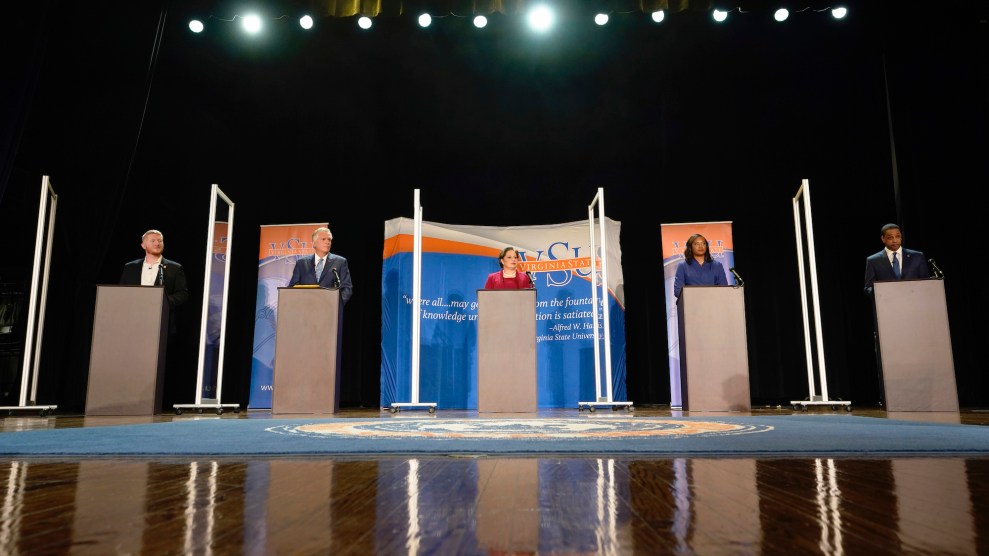
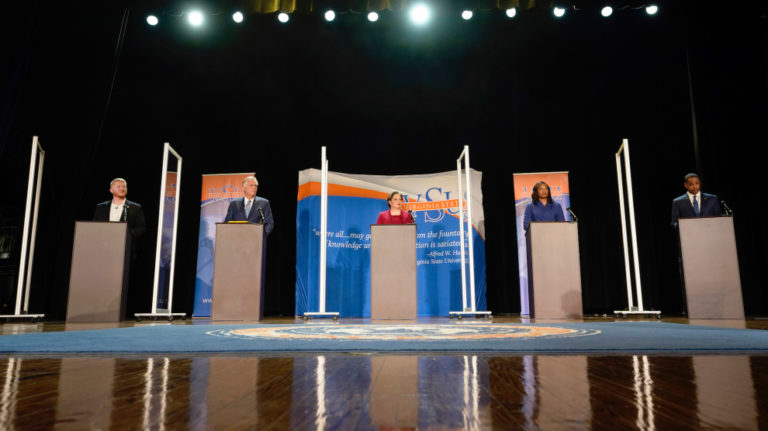
Democratic candidates for Governor of Virginia debate at Virginia State University on April 6, 2021.Steve Helber/AP

Let our journalists help you make sense of the noise: Subscribe to the Mother Jones Daily newsletter and get a recap of news that matters.

On most Tuesdays for the last five years, a gaggle of protesters have regularly gathered on a grassy hillside along a main drag in Sterling, Virginia, a far-flung suburb northwest of Washington, DC. In the early days of the Trump administration, as many as 40 people would congregate, brandishing signs that criticized former Rep. Barbara Comstock (R-Virginia) for her voting record that aligned almost perfectly with the positions of President Donald Trump. Some of their work, combined with efforts from an army of freshly enraged grassroots activists, led to the success of Democrat Jennifer Wexton, then a Virginia state senator, who defeated Comstock in the 2018 midterms. As Trump’s reelection bid loomed, the protests continued—particularly, in support of the Movement for Black Lives in the wake of George Floyd’s murder last summer.

In the months since President Joe Biden defeated Trump in Virginia, a much smaller group showed up to the usual spot, and the signs they carried have strayed from being missives of discontent. “The message was more like ‘Call this number to get vaccinated,’ different things like that,” Lana Reed, a leader of Sterling’s local Indivisible group, tells me.

After all, there’s not much for Virginia Democrats to gripe about. The party took control of the governor’s mansion in 2017 and flipped the General Assembly two years later, delivering Richmond entirely into Democrats’ control. Since then, state lawmakers have passed some of the most progressive reforms in the country, including abolishing the death penalty, enacting sweeping voting rights reforms, and raising the minimum wage to $12 an hour. Both the presidential and the off-year state elections had been a measure of the revulsion Trump’s victory inspired among broad swaths of the electorate. And Democrats’ success in Virginia during those off-year state elections, heralded as a bellwether by political watchers, foreshadowed the realignments of both major political parties during Trump’s tenure.

But now what? Trump, of course, is no longer the president, which is both a cause for relief but also concern among Democrats who relied on anti-Trump fervor to propel the party’s recent successes. But the nation’s first statewide Democratic party of the President Joe Biden era shows that the Trump hangover didn’t disappear after the new president’s inauguration. There have never been this many Democrats running for state office in Virginia in recent history, but polling, political experts, and trends suggest voters are eager to stick with the status quo.

A crowded field has emerged in the fight for the governor’s mansion—including two candidates, former state delegate Jennifer Carroll Foy and state Sen. Jennifer McClellan, vying to be the first Black woman governor in US history. Ditto the lieutenant governors’ race with its six Democratic hopefuls, one of whom may succeed to be Virginia’s first Muslim, or Hispanic, or Jewish, or openly gay official to be elected statewide. Fourteen of the 55 Democrats in the House of Delegates have a primary challenge; during the last primary elections in 2019 only four faced a primary opponent. 

There’s a straightforward explanation for Democrats’ increased interest in running for state office. “With a majority in Richmond, a lot of Democrats are inclined to think the office is worth having,” says Stephen Farnsworth, a professor of political science at the University of Mary Washington and an expert in Virginia politics. With a unified Democratic majority for the first time in a quarter decade, the party’s priorities are moving through the General Assembly with ease. Chaz Nuttycombe, the director of Virginia-based election forecaster CNalysis, explains, “Democrats wouldn’t be in the majority in the Virginia House if Trump had lost in 2016.”

But all of that robust interest still tends to favor the known quantity. Terry McAuliffe, a Clinton associate who previously served as governor from 2014 through 2018—but was barred from immediately seeking reelection by Virginia’s unusual incumbency laws—has been heavily favored to replace Gov. Ralph Northam since he entered the race in December. A recent Roanoke College poll found half of Democratic voters are backing him—more than four times the number who said they’re supporting Carroll Foy, who garnered just 11 percent of support. Nuttycombe expects that most of the incumbent Democratic state lawmakers also will prevail on Tuesday.

McAuliffe benefits from what is, effectively, incumbent status, with the advantage of name recognition and experience none of the other candidates possess. But the instinct to choose him again is another lingering effect of Trump’s presidency, says veteran Democratic strategist Joe Trippi. He likens Virginia’s Democratic primary voters to their counterparts in California in 2010, when they chose Jerry Brown as their gubernatorial candidate after eight years of Republican Gov. Arnold Schwarzenegger. “They wanted someone who could run the damn governors’ office,Trippi explains, “who knew where the damn light switch was.”

It’s the same impulse—“Give me the old shoe,” as Trippi puts it—that drove Democratic primary voters to Biden in 2020 after they flirted with every flavor of Democrat in another historically diverse field. In early 2019, Virginia Democrats suffered the added misery of multiple scandals in Richmond when a photograph of Northam donning blackface in college surfaced—just as lieutenant governor Justin Fairfax, who is also running for governor, faced accusations of sexual assault.

But the scandals never gained sustained traction facing the headwinds of Trumpism, and Democrats continued to thrive, leading to 2021’s broad, diverse field. “The bench of people running in Virginia is so much deeper and more diverse than it’s ever been in my lifetime,” Tom Perriello, a former Democratic Virginia congressman who ran to the left of Northam during the 2017 primary, tells me. Candidates “are not waiting to be the future of the Democratic Party in Virginia, regardless of whether they sit in the legislature, advocacy groups, or statewide office.”

The range of ideas has continued to force the party leftward—even if the candidates proffering those ideas don’t survive their primaries. The 2017 gubernatorial primary offers a precedent for progressive policies flourishing in Virginia in part as the legacy of past Trump-era primaries. Northam, for example, closed the gap between himself and Perriello by adding several of his rival’s reforms, such as a $15 minimum wage and debt-free community college, to his platform. Versions of both proposals became law once Democrats took control of the legislature.

McAuliffe faces “a new generation of candidates,” says Atima Omara, a Democratic political consultant based in Virginia, ones with “a more progressive vision for American that is multiracial and multiethnic.” For example, Carroll Foy has staked out a lane to McAuliffe’s left, while McClellan has called herself a “practical progressive.” Neither have taken up the mantle of the Squad, but their positions have forced McAuliffe to react accordingly. During his last stint in the governor’s mansion, he promised to “always going to come down on the side of law enforcement;” these days, he emphasizes his achievement as governor to restore the voting rights of more than 150,000 convicted felons. He also refused to accept campaign money from Dominion Energy, the Virginia utility behemoth and major political donor—a source of funds more of the Commonwealth’s Democrats have been swearing off as the party moves leftward.

Omara compares McAuliffe’s approach to Biden’s. Just as the president came into the Democratic presidential primary as a more moderate voice but shifted toward more progressive stances, so too has McAuliffe. “The changing electorate has moved Terry McAuliffe to respond to economic and racial justice,” Omara says. “He’s much more obliged to respond to that than he was before.”

In the end, Virginia may no longer claim its status a bellwether for much of anything anymore, Trippi says. Its increasingly blue tinge with each passing election since Obama’s 2008 victory has all but eliminated its swing-state status. And while Trump probably accelerated Virginia’s moves to the left, those changes had already been underway, explains Annie Weinberg, a veteran elections strategist who has advised Virginia candidates and voter turnout efforts. She points to the “electorate-transforming” campaigns won by candidates of color, such as current and former Dels. Carroll Foy, Elizabeth Guzmán, and Hala Ayala, all of whom organized voters who hadn’t received regular attention from party officials. “Some of these shifts are happening over the long term and are divorced from the Trump effect,” Weinberg says.  “It’s not just about people being energized to go out and fight him.”

The open question now is whether grassroots activism stays strong. Reed, of Sterling’s local Indivisible group, is preparing for what happens after Tuesday, when she and her fellow activists will begin filling in the names of the primary winners on get-out-the-vote postcards they’ve already penned for November’s general election. As for those protests? They’ve ceased entirely. But who knows for how long. “If an issue comes up that we want people to act on,” Reed says, “it will start again.”

How the Hangover from Trump’s Presidency Is Shaping Democratic Primaries – Mother Jones

Democratic candidates for Governor of Virginia debate at Virginia State University on April 6, 2021.Steve Helber/AP

Let our journalists help you make sense of the noise: Subscribe to the Mother Jones Daily newsletter and get a recap of news that matters.

On most Tuesdays for the last five years, a gaggle of protesters have regularly gathered on a grassy hillside along a main drag in Sterling, Virginia, a far-flung suburb northwest of Washington, DC. In the early days of the Trump administration, as many as 40 people would congregate, brandishing signs that criticized former Rep. Barbara Comstock (R-Virginia) for her voting record that aligned almost perfectly with the positions of President Donald Trump. Some of their work, combined with efforts from an army of freshly enraged grassroots activists, led to the success of Democrat Jennifer Wexton, then a Virginia state senator, who defeated Comstock in the 2018 midterms. As Trump’s reelection bid loomed, the protests continued—particularly, in support of the Movement for Black Lives in the wake of George Floyd’s murder last summer.

In the months since President Joe Biden defeated Trump in Virginia, a much smaller group showed up to the usual spot, and the signs they carried have strayed from being missives of discontent. “The message was more like ‘Call this number to get vaccinated,’ different things like that,” Lana Reed, a leader of Sterling’s local Indivisible group, tells me.

After all, there’s not much for Virginia Democrats to gripe about. The party took control of the governor’s mansion in 2017 and flipped the General Assembly two years later, delivering Richmond entirely into Democrats’ control. Since then, state lawmakers have passed some of the most progressive reforms in the country, including abolishing the death penalty, enacting sweeping voting rights reforms, and raising the minimum wage to $12 an hour. Both the presidential and the off-year state elections had been a measure of the revulsion Trump’s victory inspired among broad swaths of the electorate. And Democrats’ success in Virginia during those off-year state elections, heralded as a bellwether by political watchers, foreshadowed the realignments of both major political parties during Trump’s tenure.

But now what? Trump, of course, is no longer the president, which is both a cause for relief but also concern among Democrats who relied on anti-Trump fervor to propel the party’s recent successes. But the nation’s first statewide Democratic party of the President Joe Biden era shows that the Trump hangover didn’t disappear after the new president’s inauguration. There have never been this many Democrats running for state office in Virginia in recent history, but polling, political experts, and trends suggest voters are eager to stick with the status quo.

A crowded field has emerged in the fight for the governor’s mansion—including two candidates, former state delegate Jennifer Carroll Foy and state senator Jennifer McClellan, vying to be the first Black woman governor in US history. Ditto the lieutenant governors’ race with its six Democratic hopefuls, one of whom may succeed to be Virginia’s first Muslim, or Hispanic, or Jewish, or openly gay official to be elected statewide. Fourteen of the 55 Democrats in the House of Delegates have a primary challenge; during the last primary elections in 2019 only four faced a primary opponent. 

There’s a straightforward explanation for Democrats’ increased interest in running for state office. “With a majority in Richmond, a lot of Democrats are inclined to think the office is worth having,” says Stephen Farnsworth, a professor of political science at the University of Mary Washington and an expert in Virginia politics. With a unified Democratic majority for the first time in a quarter decade, the party’s priorities are moving through the General Assembly with ease. Chaz Nuttycombe, the director of Virginia-based election forecaster CNalysis, explains, “Democrats wouldn’t be in the majority in the Virginia House if Trump had lost in 2016.”

But all of that robust interest still tends to favor the known quantity. Terry McAuliffe, a Clinton associate who previously served as governor from 2014 through 2018—but was barred from immediately seeking reelection by Virginia’s unusual incumbency laws—has been heavily favored to replace Gov. Ralph Northam since he entered the race in December. A recent Roanoke College poll found half of Democratic voters are backing him—more than four times the number who said they’re supporting Carroll Foy, who garnered just 11 percent of support. Nuttycombe expects that most of the incumbent Democratic state lawmakers also will prevail on Tuesday.

McAuliffe benefits from what is, effectively, incumbent status, with the advantage of name recognition and experience none of the other candidates possess. But the instinct to choose him again is another lingering effect of Trump’s presidency, says veteran Democratic strategist Joe Trippi. He likens Virginia’s Democratic primary voters to their counterparts in California in 2010, when they chose Jerry Brown as their gubernatorial candidate after eight years of Republican Gov. Arnold Schwarzenegger. “They wanted someone who could run the damn governors’ office,Trippi explains, “who knew where the damn light switch was.”

It’s the same impulse—“Give me the old shoe,” as Trippi puts it—that drove Democratic primary voters to Biden in 2020 after they flirted with every flavor of Democrat in another historically diverse field. In early 2019, Virginia Democrats suffered the added misery of multiple scandals in Richmond when a photograph of Northam donning blackface in college surfaced—just as lieutenant governor Justin Fairfax, who is also running for governor, faced accusations of sexual assault.

But the scandals never gained sustained traction facing the headwinds of Trumpism, and Democrats continued to thrive, leading to 2021’s broad, diverse field. “The bench of people running in Virginia is so much deeper and more diverse than it’s ever been in my lifetime,” Tom Perriello, a former Democratic Virginia congressman who ran to the left of Northam during the 2017 primary, tells me. Candidates “are not waiting to be the future of the Democratic Party in Virginia, regardless of whether they sit in the legislature, advocacy groups, or statewide office.”

The range of ideas has continued to force the party leftward—even if the candidates proffering those ideas don’t survive their primaries. The 2017 gubernatorial primary offers a precedent for progressive policies flourishing in Virginia in part as the legacy of past Trump-era primaries. Northam, for example, closed the gap between himself and Perriello by adding several of his rival’s reforms, such as a $15 minimum wage and debt-free community college, to his platform. Versions of both proposals became law once Democrats took control of the legislature.

McAuliffe faces “a new generation of candidates,” says Atima Omara, a Democratic political consultant based in Virginia, ones with “a more progressive vision for American that is multiracial and multiethnic.” For example, Carroll Foy has staked out a lane to McAuliffe’s left, while McClellan has called herself a “practical progressive.” Neither have taken up the mantle of the Squad, but their positions have forced McAuliffe to react accordingly. During his last stint in the governor’s mansion, he promised to “always going to come down on the side of law enforcement;” these days, he emphasizes his achievement as governor to restore the voting rights of more than 150,000 convicted felons. He also refused to accept campaign money from Dominion Energy, the Virginia utility behemoth and major political donor—a source of funds more of the Commonwealth’s Democrats have been swearing off as the party moves leftward.

Omara compares McAuliffe’s approach to Biden’s. Just as the president came into the Democratic presidential primary as a more moderate voice but shifted toward more progressive stances, so too has McAuliffe. “The changing electorate has moved Terry McAuliffe to respond to economic and racial justice,” Omara says. “He’s much more obliged to respond to that than he was before.”

In the end, Virginia may no longer claim its status a bellwether for much of anything anymore, Trippi says. Its increasingly blue tinge with each passing election since Obama’s 2008 victory has all but eliminated its swing-state status. And while Trump probably accelerated Virginia’s moves to the left, those changes had already been underway, explains Annie Weinberg, a veteran elections strategist who has advised Virginia candidates and voter turnout efforts. She points to the “electorate-transforming” campaigns won by candidates of color, such as current and former Dels. Carroll Foy, Elizabeth Guzmán, and Hala Ayala, all of whom organized voters who hadn’t received regular attention from party officials. “Some of these shifts are happening over the long term and are divorced from the Trump effect,” Weinberg says.  “It’s not just about people being energized to go out and fight him.”

The open question now is whether grassroots activism stays strong. Reed, of Sterling’s local Indivisible group, is preparing for what happens after Tuesday, when she and her fellow activists will begin filling in the names of the primary winners on get-out-the-vote postcards they’ve already penned for November’s general election. As for those protests? They’ve ceased entirely. But who knows for how long. “If an issue comes up that we want people to act on,” Reed says, “it will start again.”

A U.N. Declaration on Ending AIDS Should Have Been Easy. It Wasn’t. – The New York Times

The United Nations on Tuesday adopted new targets for ending AIDS as a public health threat by 2030, seemingly a goal most countries could easily have agreed to. But consensus had been elusive.

In early negotiations over the agreement, called a political declaration, the United States and the European Union fought to ban policies and laws that stigmatize, or even criminalize, high-risk groups — and drastically scaled back moves to relax patent protections for H.I.V. drugs.

The U.N. declaration sets priorities for the global AIDS response and guides policies at a national level. It also gives global health groups and civil society organizations leverage to pressure governments to honor their commitments.

After several days of heavy edits by delegates from some countries and deft negotiations by others, member countries accepted a final version of the declaration on Tuesday morning. Included in the final draft is an important new goal of having most nations reform discriminatory laws, so that less than 10 percent of the world’s countries would have measures that unfairly target people at risk of, or living with, H.I.V.

“Those laws are driving people most affected by H.I.V. away from H.I.V. prevention and treatment,” said Matthew Kavanagh, director of the Global Health Policy and Politics Initiative at Georgetown University. “This could be a critical tool in getting the world back on track to ending AIDS.”

On Monday, Dr. Kavanagh and his colleagues published new work showing that countries that criminalize same-sex relationships, drug use and sex work have had much less success in turning back H.I.V.

But the declaration does not move the needle on patent protections. The United States was among those nations whose delegates significantly watered down — or moved to cut — language to relax patents to allow for greater access to affordable H.I.V. drugs in low- and middle-income countries, a stance at direct odds with the Biden administration’s support of patent waivers for Covid vaccines.

“The mixed messaging from the administration, given recent support for Covid-19 vaccine patent waivers, is confusing and disappointing,” said Annette Gaudino, director of policy strategy at Treatment Action Group, an advocacy organization in New York. “This would be far from the first time the U.S. has put pharmaceutical companies’ profits over people and public health.”

The U.N. brings together heads of state, health ministers and nongovernmental organizations to set priorities for tackling the H.I.V. pandemic every five years. At a similar meeting in 2016, member countries agreed to aim for fewer than 500,000 new H.I.V. infections annually, fewer than 500,000 AIDS-related deaths and eliminating H.I.V.-related discrimination by 2020.

The world did not meet those targets: About 1.5 million people became infected with H.I.V. in 2020, and about 690,000 died.

Ending AIDS by 2030 was an aspirational target adopted in 2015 by the U.N., part of a broader agenda regarding sustainable development. But without more progressive policies and laws, the goal is not achievable, Dr. Kavanagh said.

“To end AIDS by 2030, governments must commit to take a people-centered, rights-based approach to H.I.V., to work on policy and law reform, to engage and support communities, and to end inequalities,” Winnie Byanyima, executive director of U.N.AIDS, said in an emailed statement.

The initial draft of the declaration, dated April 28, included a commitment to end “punitive laws, policies and practices, stigma and discrimination based on H.I.V. status, sexual orientation and gender identity.”

Delegates from some countries, including the Africa group, China, Russia and Iran, tried to delete allusions to sexual or gender identity, or to sex education for girls. They succeeded only partially: The current text calls for prevention approaches tailored to high-risk groups, including sex workers, men who have sex with men, drug users and transgender people.

Delegates from African countries successfully inserted language asserting “the sovereign rights of member states” and stressing that commitments in the declaration would be implemented “consistent with national laws, national development priorities and international human rights.” About half of the countries where homosexuality is illegal are in Africa.

The declaration, in its current form, also urges countries to “empower women and girls to take charge of their sexual and reproductive health and reproductive rights,” a section that Saudi Arabia, Russia and the Holy See tried to scrub from the text.

Representatives from Belarus, China and Russia also deleted a section that asked member countries to recognize citizens’ autonomy on matters related to sexuality; their substituted text encouraged “responsible sexual behavior, including abstinence and fidelity.” The final document reverted to the original text.

Including the language about high-risk groups is critical to success, some experts said. Gay men and other men who have sex with men, people who inject drugs, and female sex workers have a nearly 30-fold higher risk of H.I.V., compared with the general population.

If those groups cannot access the preventive therapies, clean needles, condoms or education they need, “we are going to erode the possibility of actually ending AIDS by 2030,” said Eric Sawyer, an advocate for people with H.I.V. and long-term survivor.

An early draft of the declaration also contained a lengthy section on relaxing patent protections. Under current global rules, only the 50 least developed countries are allowed to eliminate patents on pharmaceutical products in order to distribute them to citizens.

The draft called for “an indefinite moratorium on international intellectual property provisions for medicines, diagnostics and other health technologies.” Representatives of the United States and Switzerland deleted that section. A representative of the European Union said, “This is not the place to discuss these general issues.”

The United States also added language to the scaled-back version to recognize the “importance of the intellectual property rights regime in contributing to a more effective AIDS response.”

Activists said taking a stance against patent waivers was entirely consistent for the European Union, which also opposed a waiver for patents on Covid vaccines. Vaccine manufacturers have argued that patent protections are essential for driving innovation.

But citing the urgent need for vaccines, officials in the Biden administration have said that they would back a patent waiver that allows companies to make cheaper versions of the vaccines for the rest of the world.

Given that development, “it would be really inconsistent for the U.S.” to oppose relaxing patent protections for H.I.V. drugs, said Brook Baker, a law professor at Northeastern University and senior policy analyst at the Health Global Access Project, an advocacy organization.

“Why in the world would the U.S. be talking out of two sides of its mouth on what seems to be nearly an identical issue?”