Home Blog Page 104

Priyanka Chopra celebrates Pride Month with new social media post – WION

As the calendar turns to June, LGBTQIA+ communities and their allies across the world mark Pride Month. On Tuesday, global star Priyanka Chopra Jonas also celebrated the occasion on social media.

The `Baywatch` actor posted a happy sunkissed video of her on Instagram and extended Pride Month wishes in her caption. 
She wrote, “Love is….Take a video sharing what love means to YOU and tag me so I can see! #HappyPrideMonth,” followed by pride-themed heart emojis.

Bollywood actor Zareen Khan dropped several emotions in the comments section of the post that garnered more than 2 lakh likes.
June marks a time when millions of people come together to support the LGBTQ community. It was first celebrated in the US in 2000 when then US President Bill Clinton issued a presidential proclamation designating the month.

 To celebrate it, people come out on the streets for pride parades, marches, rallies.Pride is about people coming together, to show and celebrate how far gay rights have come and how much is still left to achieve. 

Pride month is about equality, teaching acceptance, education in pride history and above all, love. This year, celebrations across the globe will resume gradually as COVID-19 restrictions are lifted and more people get vaccinated.

On the work front, Priyanka is currently working on the spy series `Citadel`. It also stars Richard Madden. The project is backed by Amazon and helmed by the Russo Brothers of `Avengers` fame.

The actor has finished shooting `Text for You` with Sam Heughan, Celine Dion, Russell Tovey, and Omid Djalili. Priyanka will also be seen in an Indian wedding comedy with Mindy Kaling, which she will co-produce and feature in. She also has `Matrix 4` and a film based on the life of Maa Anand Sheela in the pipeline. 

Former Team USA member rolls historic perfect game at 2021 USBC Open – Bowl.com

LAS VEGAS – Dan Patterson of Milwaukee may have been out of the national spotlight for a while, but he picked the perfect time to reemerge.

The former Team USA member rolled a historic 300 game June 1 at the 2021 United States Bowling Congress Open Championships. It was a first for his group of more than 60 teams and the 900th perfect game in 117 years of tournament history.

It also was a special way to kick off Pride Month for Patterson and his fellow competitors, many of whom started their visit to Las Vegas this year with the International Gay Bowling Organization’s IGBO Annual 2021, before making their way to South Point for the USBC Open Championships.

IGBO Annual is one of two national IGBO events and features a week of meetings, celebration and competition. The events travel each year to different bidding cities, and 2021 allowed the unique opportunity for a two-tournament crossover.

“It’s very special to be a part of history and to shoot a significant 300 in the event’s history,” Patterson said. “This is an awesome playing stage, and to come here and do it in front of your friends, on a great squad and with people who are supporting you, there’s really nothing better than that.”

It was support, and advice, from his teammates during the six games of doubles and singles at the South Point Bowling Center, that helped Patterson finish his 21st Open Championships appearance with the highest series of his tournament career.

The 45-year-old right-hander rolled games of 217, 212 and 300 for a 729 total, his best on the championship lanes by eight pins.

“Jay (Nephew) told me to switch balls, and I hesitated, but then I did, and the pins just all magically went down,” said Patterson, a member of Team USA from 2005-2007. “The shots weren’t that much better than the other five games. I was not throwing the ball phenomenal, but I got a lot of breaks. If you look at the 10th and 11th shots, they probably shouldn’t have carried, but that’s bowling, and I’m grateful they did.”

Bowling has been part of Patterson’s life for three decades, and it’s an environment that consistently has provided him with satisfaction and support – as an up-and-comer, as an elite athlete with Team USA and now as an owner of Sabre Lanes in Menasha, Wisconsin, with his husband, Marcus.

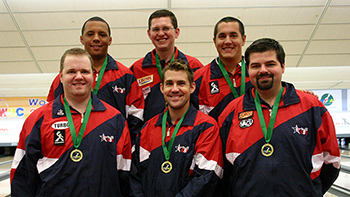
Patterson2006USAForWeb300x197In 2006, Patterson had the opportunity to represent the United States on the lanes and help Team USA to its first team gold medal at the International Bowling Federation World Men’s Championships in 35 years. There’s an amazing sense of pride in that.

Being able to represent the gay community on the lanes and find success at the Open Championships also was an incredibly proud moment.

“I do appreciate that this is on the first day of the month of pride and it was on a gay squad, and I didn’t really put that into perspective until now, but it really is very special,” Patterson said. “From my experience in the gay community, in bowling, I can’t tell you how inclusive it always has been for me. As long as you’re going in there and you’re passionate, having fun and trying to succeed, you will be supported.

“I’ve always been attracted to environments that have benefited me, from the people to the coaching to the bowling center and all of that stuff. I don’t think there’s anything about bowling that will separate you based on your race, color, creed or sexual orientation.”

Patterson added sets of 660 in team and 600 in doubles this year for a 1,989 all-events total. His overall performance helped Shady Unicorns of Chula Vista, California, to a 3,189 team score and 9,283 Team All-Events total, both top-50 scores this year.

He was joined by Charlie Esteban (1,960), Nephew (1,840), Robert Raymond (1,777) and Timothy Yaeger (1,717).ShadyUnicornsForWeb2021OC350x197

Their team is one of 68 organized by Jim Costello, who started with four teams in 2009 and has doubled the group’s size multiple times. While many of the bowlers are gay, he describes it more as a gay-friendly group of friends and friends of friends who like to bowl and have a good time.

The contingent includes bowlers of all ages and skill levels, from Patterson’s ultra-competitive quintet down to bowling beginners. Fifty teams competed at the South Point Bowling Plaza and South Point Bowling Center this week, while the final 18 teams will take the lanes in July.

Typically, the group bowls in mid-April, but being able to shift the time frame in 2021 allowed many of the competitors the opportunity to experience both the Open Championships and IGBO Annual.

Costello encouraged the bowlers to visit both tournaments and even used the chance to educate and recruit IGBO bowlers who may not have been familiar with the Open Championships, as he does anytime he’s on the lanes or in a bowling center.

CostelloForWeb637Ultimately, the longtime member of the Captain’s Club loves bowling and competing and enjoys doing the work that may have prevented team members from enjoying the Open Championships sooner or more frequently.

Also, seeing his bowlers have positive and memorable experiences often is all the reward Costello needs for his efforts, but being present for Patterson’s run at the record book had his heart swell with emotion and pride.

“I know a few people in our group have had the potential and skill to roll a 300 or an 800 here, and I was actually kind of emotional about it because I knew it was going to happen, I just didn’t know which person. We’ve come so close so many times, and it was just a matter of time. The fact that it’s a historic one makes it even more special. I’m proud that we did it. And what a way to kick off Pride Month.”

At times, in his own life, Costello has faced stigmas about gay men and women and their ability to play sports, whether it be bowling or softball or volleyball or any other competition, but it’s not something that has held him back.

The pins don’t know if you’re a man or woman, gay or straight. Bowling is a game of strategy and skill, and he’s ready to compete every time the lane lights come on.

“Bowling is a great social activity, and people love to bowl and compete, but there’s sometimes the stigma that it’s not something everyone can do or do well, and we’ve all faced it as some point,” Costello said. “Every time I put my shoes on and the lanes come on, I’ll show you I’m a bowler and ready to compete.”

As Open Championships surveys sometimes show, one of the main reasons bowlers don’t start competing sooner is because they’re simply not invited or they’re intimidated by the steps and commitment required to be a team captain.

There’s also the misunderstanding that the tournament is for elite players, and it sometimes takes seeing it for the first time for bowlers to completely grasp the magnitude and diversity. With three average-based divisions, bowlers of all skill levels have the chance to compete against their competitive peers.

“It really is word of mouth, and I didn’t even know about it until 15 or 16 years ago, when someone asked us to go,” said Costello, who made his 13th Open Championships appearance this week. “Sometimes it just takes someone to organize it, and I enjoy being that person. Some people don’t understand why I want to do all this, but it’s because I love helping people have this experience. There’s nothing like seeing someone compete for the first time and then want to stay.”

Costello and Patterson both considered the dual-event week a success, filled with chances to reunite after two years apart, as well as compete on a variety of lane conditions.

As they return home, Costello already is looking ahead to next year and his group’s return to South Point for the 2022 Open Championships.

In the short-term, Pride Month will be filled with opportunities to celebrate, educate and support the LGBTQ community, and countless activities (parades, parties, picnics, workshops, memorials, concerts, and more) will be held in communities across the country.

The tradition began in 1970 as a way to commemorate the riots held in reaction to a police raid of the Stonewall Inn in New York in 1969. The event was a turning point in the fight for LGBTQ liberation in the United States.

This story about Patterson and Costello is about their dedication and success at the Open Championships and is part of an ongoing digital media campaign recognizing various groups, organizations and bowlers that make up the USBC membership, while also bringing attention to topics that affect the world on a larger scale.

USBC will continue to expand its diversity and inclusion topics and welcome the opportunity to showcase the people and other areas that are important to the members.

If you know someone who is a standout or inspiration, or you’d like to suggest a topic close to you, please let us know more by sending an email to PR@bowl.com.

For more information about USBC and its programs and partnerships, visit BOWL.com/Diversity.

Visit us on Facebook at the official USBC Open Championships Facebook page.

Tennis Player Investigated Over Homophobic On Court Expletives – Gay Nation

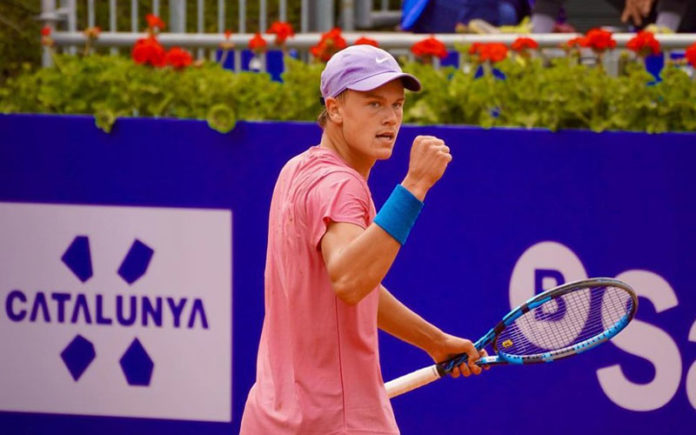
Holger Rune (Instagram)

3 min read

Danish tennis player Holger Rune has caused an uproar and forced the ATP Tour to open an investigation into homophobic expletives that the 18-year-old player screamed during a semi-final match in Biella, Italy.

Playing a Challenger tournament in the Northern Italian city, Rune uttered the phrases ‘you are a pussy player’ and ‘you are playing like a faggot ass.’ Shortly after saying those phrases, he shouted ‘Allez, faggot’ when winning a point during a match which he eventually won and then went on to win the overall tournament.

The former World Number One Junior’s comments prompted backlash on social media with many fans criticising him for his choice of words. On his official Instagram account, Rune stated that his words were directed at himself and nobody else.

Advertisement

Rune also issued a statement to TV2.dk where he apologised for the remarks and to anybody who he might have offended by his words. He also apologised on his Instagram account.

“I’m young and I need to learn. Not that that allows me to say crap like that. I was taught a lesson, and I think it’s fair that people criticise (me). I’m really sorry and hope people will accept my apology,” he said.

However, on the same day as Rune issued his statement his mother accused TV2 of ‘harassing’ her son for what she described as a ‘wrong comment.’ Aneke Rune, who is also the manager of the tennis player, hit out at those who she claims are trying to ‘make news and gossip from a hard working young man.’

“If you are a man you can apologise as Holger did if anyone felt offended by his words to himself in the match. Do NOT harass Holger for a wrong comment TV2 and who else is out there trying to make news and gossip from a hard working young man,” Aneke wrote on Instagram.

In a statement issued to TV2 on Monday, the ATP has confirmed that they are investigating the incident under the official code of conduct (section 8.04).

“ATP is committed to ensuring an inclusive environment for all players, staff and fans, and there is absolutely no room for homophobic remarks in tennis,” a statement reads.

“According to section 8.04 N.2 of the Player Code of Conduct, ATP is in the process of investigating the comments of Holger Rune during a match on Saturday 5 June 2021 in ATP Challenger 80 in Biella.”

Holger Rune (Instagram)

Christian Bigom is the chairman of Pan Idræt, a multi-sports club in Copenhagen which focuses on ‘inclusion of people with a special focus on sexual orientation and gender diversity.’ Speaking about Rune’s comments Bigom argues the focus shouldn’t be on the individual but why these phrases are being used in the first place.

“I think it’s fine that Holger Rune has said sorry. That is really good,” he said to Ubitennis.net.

“I would rather ask a question about why it is these words that are used. To me, it testifies to a very negative language used in the world of sports. Not only in tennis, but certainly also in football.”

18-year-old Rune is currently ranked 291st in the world. He claimed the French Open boys’ title in 2019 and recently won his maiden Challenger title in Biella on Sunday.

Last Updated on Jun 9, 2021


The news team for Gay Nation love tips from our readers. Got tips or a news story that you would like published? Go here to tell us something.
Visit the Gay Nation store Now

Atty’s Anti-Gay Slur For Judge Broke Ethics Rules, Court Says – Law360

Law360 (June 8, 2021, 9:59 PM EDT) — A Colorado attorney violated a state ethics rule by using an anti-gay slur to refer to a judge in an email he sent to his clients, the state’s highest court has ruled.

The full Colorado Supreme Court on Monday affirmed an earlier determination by a hearing board of the Office of the Presiding Disciplinary Judge that Robert E. Abrams violated Rule 8.4(g), which bars attorneys from referring to an individual involved in the legal process with language that demonstrates “bias or animus” towards sexual orientation.

Abrams had argued that the rule violates the First and Fourteenth Amendments because it allegedly is…

Terry McAuliffe wins Va. Democratic gubernatorial primary – Washington Blade

Some owners of D.C. gay bars have said Mayor Muriel Bowser’s announcement on May 10 that the city’s restaurants and bars could resume operations at full capacity and return to pre-pandemic operating hours on May 21 caught them by surprise.

After several months of business shutdowns followed by a partial reopening with strict limits of only 25 percent of the normal number of customers inside bars and restaurants, a ban on standing in bars or being served while sitting at a barstool, the mayor’s reopening order left many bars and restaurants short on servers and bartenders.

But nearly everyone associated with D.C. gay bars who spoke with the Washington Blade — including owners, employees, and customers — have said they were ecstatic to see a full reopening after more than a year of COVID-related restrictions and hardship.

“We didn’t really open at a 100 percent capacity,” said John Guggenmos, co-owner of the D.C. gay bars Trade and Number 9, immediately after Mayor Bowser issued her full reopening order. Like other bar owners, Guggenmos said Trade and Number 9 had to bring back employees who had to be let go due to the shutdowns and operating restrictions over the past year.

“But you know, seeing people again, hearing the stories of some of the struggles they went through, and our customers just talking to each other and saying how glad they are to be back gave us a sense of our community and how much we are more than just four walls and some chairs and music,” Guggenmos said.

Dito Sevilla, who works as bar manager at the 17th Street restaurant Floriana, and as longtime host of the restaurant’s lower-level space known as Dito’s Bar, said the May 21 lifting of COVID restrictions has returned business to pre-pandemic levels.

“We were not fully staffed on day one either,” Sevilla told the Blade. “Everyone had to work a little extra,” he said. “And that was OK with them because they had gone without working for so long that working some extra shifts that week wasn’t going to hurt anyone. They were thrilled to do it.”

Doug Schantz, owner of the U Street, N.W. gay sports bar Nellie’s, said he too was caught off guard by the short advance notice of the mayor’s May 21 full reopening of restaurants and bars but like other bar owners said he is pleased that the full reopening has come to D.C.

He said Nellie’s put in place a “soft” reopening on May 21, with operations limited to his second-floor space that has a roof deck and he continued to close at midnight instead of the resumption to normal closing times with the mayor’s order at 2 a.m. on weekdays and 3 a.m. on weekends.

Schantz said he timed his full reopening to take place this weekend to coincide with the kickoff of the city’s LGBTQ Pride events. And by July 1, he said, Nellie’s will resume its popular drag brunch.

“We’re taking it one step at a time, but so many people were happy to be back,” he said. “They want to be back to normal.”

David Perruzza, owner of the Adams Morgan gay sports bar Pitchers and its adjoining lesbian bar A League of Her Own, said he and his regular customers, many of whom continued to show up at the two bars during the height of the pandemic restrictions, are delighted over the full reopening. Like several of the other bar owners, Perruzza said he will continue to operate outdoor seating under the “streetery” program the city established when indoor seating was initially banned and later resumed at just 25 percent capacity.

One COVID-related rule remaining in place for bars and restaurants, which is expected to be lifted soon, is the requirement that bars and restaurants obtain a name and phone number for at least one person entering as part of a group and for each individual entering for contact tracing purposes in the event someone tests positive for COVID on the day the customer was present. The city’s Alcoholic Beverage Regulation Administration, which initiated the requirement during the height of the pandemic, was expected to end the requirement in the next few weeks, according to sources familiar with ABRA.

In addition to the full reopening of bars and restaurants on May 21, the city has cleared the way for the full resumption of large indoor and outdoor events on June 11, including parades and sports stadiums. That development has prompted D.C.’s Capital Pride Alliance, the group that organizes the city’s LGBTQ Pride events, to add to this week’s Pride events a June 12 Pride Walk, which will begin at Dupont Circle at noon and travel to Logan Circle before heading south to Freedom Plaza, where a rally will take place.

“The excitement has been palpable since bars and restaurants in D.C. recently reopened at full capacity and without limit or activity restrictions,” said Mark Lee, coordinator of the D.C. Nightlife Council, a local trade association representing bars, restaurants, and nightclubs.

“The enthusiasm is especially evident at LGBT venues, with long lines common after a long period of shutdowns and slowdowns,” Lee said. “The celebration will expand on June 11 when nightclub-licensed dance clubs fully reopen, and large music venues begin hosting tour acts and special shows in the coming days.”

But Lee said a “flip side” to the reopening celebrations is the reality that many bars, restaurants, and nightclubs must grapple with a massive debt burden of back-rent owed to landlords that threatens their survival.

Lee and others point out that the forced shutdowns and capacity restrictions that these mostly small businesses have faced during the pandemic resulted in a drastic reduction in revenue that forced them to rely on local D.C. and federal COVID moratoriums on evictions for commercial and residential tenants. With the moratoriums ending, the businesses must now repay the back rent owed that Lee says often exceeds $100,000 or more.

“That’s why the D.C. Nightlife Council and the Restaurant Association of Metropolitan Washington are urging Mayor Bowser and the D.C. Council to utilize a small portion of the city’s federal relief monies to create a Rent Relief Fund for local establishments facing unsustainable past-due lease obligations,” Lee said.

Perruzza said that in addition to facing back rent payments related to the pandemic, he and other bar and restaurant owners had to pay D.C. property taxes under their lease agreements at a time when their revenue was greatly suppressed from the pandemic. He said he believes he will be able to cope with the rental payoff, but the relief fund proposed by Lee and others would be immensely helpful for his and other struggling small businesses.

Bowser and members of the D.C. Council have said they were considering the relief proposal.

“We’re thankful for the support the community showed throughout the pandemic and the eagerness to want to get back to us,” said Guggenmos of Trade and Number 9. “We are thrilled and it’s great seeing everyone, but it doesn’t mean the sleepless nights are over,” he said in referring to the rental debt and other COVID-related expenses that his clubs continue to face.

Among the other D.C. gay bars whose representatives or customers said they are pleased over the reopening at full capacity include Uproar, Dirty Goose, JR.’s, Larry’s Lounge, Window’s, Annie’s Paramount Steakhouse, Duplex Diner, and Freddie’s Beach Bar in Arlington, Va.

Lee said the downtown D.C. nightclub Sound Check at 1420 K St., N.W., was scheduled to resume its weekly Avalon Saturday “gay” nights on June 12. Before being put on hold during the pandemic, the event featured drag shows and dancing.

The History of ‘Coming Out’: From Secret Gay Code to Popular Political Protest – Mississippi Free Press

You probably know what it means to “come out” as gay. You may even have heard the expression used in relation to other kinds of identity, such as being undocumented.

But do you know where the term comes from? Or that its meaning has changed over time?

In my 2020 book “Come Out, Come Out, Whoever You Are,” I explore the history of this term, from the earliest days of the gay rights movement to today, when it has been adopted by other movements.

Selective Sharing

In the late 19th and early 20th century, gay subculture thrived in many large American cities.

Gay men spoke of “coming out” into gay society—borrowing the term from debutante society, where elite young women came out into high society. A 1931 news article in the Baltimore Afro-American referred to “the coming out of new debutantes into homosexual society.” It was titled, “1931 Debutantes Bow at Local ‘Pansy’ Ball.”

The 1930s, ‘40s and ‘50s witnessed a growing backlash against this visible gay world. In response, gay life became more secretive.

The Mattachine Society, the earliest important organization of what was known as the homophile movement—a precursor of the gay rights movement—took its name from mysterious medieval figures in masks. In this context, coming out meant acknowledging one’s sexual orientation to oneself and to other gay people. It did not mean revealing it to the world at large.

Such selective sharing relied on code phrases—such as “family,” “a club member,” “a friend of Dorothy’s,” “a friend of Mrs. King” or “gay”—that could be used in mixed company to designate someone as homosexual.

The term “gay” was originally borrowed from the slang of women prostitutes, when they used the word to refer to women in their profession. Of course, “gay” was ultimately “outed” when the gay rights movement adopted it following the Stonewall Rebellion in 1969.

Out In Public

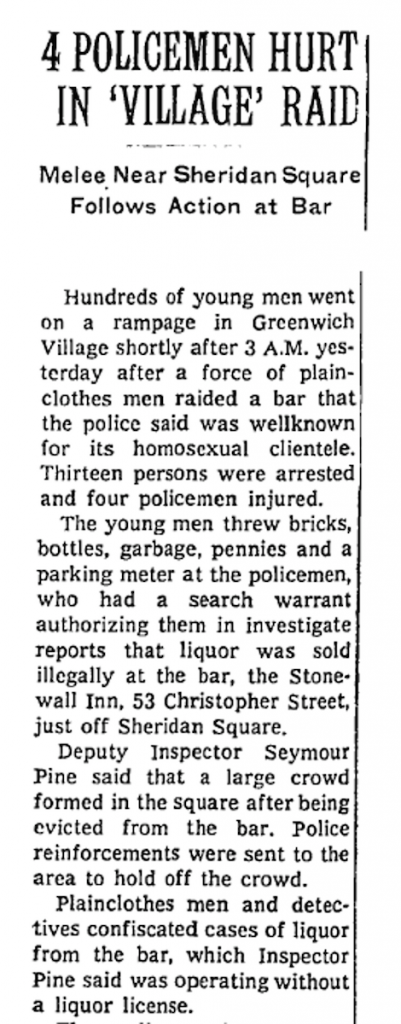
The first article on Stonewall to appear in The New York Times. Photo courtesy New York Times

A more political meaning after the 1969 Stonewall Rebellion, in which patrons of the Stonewall Inn in New York City fought back against a police raid. The rebellion included riots and a resistance that lasted for days. It was subsequently commemorated in an annual march known today as “gay pride.”

At the first Gay Liberation March in New York City in June 1970, one of the organizers stated that “we’ll never have the freedom and civil rights we deserve as human beings unless we stop hiding in closets and in the shelter of anonymity.”

By this time, coming out was juxtaposed with being in the closet, conveying the shame associated with hiding. By the end of the 1960s, queer people who pretended to be heterosexual were said to be “in the closet” or labeled a “closet case” or, in the case of gay men, “closet queens.”

By the 1970s, mainstream journalists were already using the term beyond sexual orientation—to speak of, for instance, “closet conservatives” and “closet gourmets.”

A Rite of Passage

By presenting coming out as a way to end internalized self-hatred and achieve a better life, the LGBTQ movement helped to encourage people to come out, despite associated risks. It also showed how coming out could be used to build solidarity and recruit other queer people.

For instance, in 1978, in his campaign to defeat a California initiative that would have banned gay teachers from working in state public schools, openly gay elected government official Harvey Milk urged people to “Come Out, Come Out, Wherever You Are.”

Milk gambled that if queer people told their friends they were gay, Californians would realize that they had friends, coworkers and family members who were gay and—out of solidarity—would oppose the proposition. The campaign helped defeat the initiative.

In the 1980s, the gay and lesbian rights movement radicalized in response to the Christian right and AIDS epidemic. Activists used the mantra “Come Out, Come Out, Wherever You Are” to demand that people declare their homosexuality. The coming out narrative became a rite of passage, something to be shared with others, and the centerpiece of gay liberation movements.

In Your Face

In the 1990s, the radical organization Queer Nation took coming out to a new level.

Its members wore T-shirts in Day-Glo colors with slogans such as “PROMOTE HOMOSEXUALITY. GENERIC QUEER. FAGGOT. MILITANT DYKE.” Wearing these T-shirts, they entered heterosexual bars in New York and San Francisco and staged “kiss-ins.” They visited suburban shopping malls outside these same cities and chanted, “We’re here, we’re queer, we’re fabulous—and we’re not going shopping!” Through these tactics, they not only came out, but forced heterosexuals to acknowledge their presence.

The politics of coming out has helped make LGBTQ people more visible and better protected by law. As testimony of this shift, today, marriage equality is the law of the land, the popular TV comedy “Modern Family” features a gay couple and one of the leading candidates for the Democratic presidential ticket, Pete Buttigieg, is a gay man.

To be sure, homophobia and transphobia are still alive and well. Still, LGBTQ people have made clear strides in the past half-century and coming out politics has been part of their success.

Going Bigger

The success of the LGBTQ movement has inspired other social movements—such as the fat acceptance movement and the undocumented youth movement, among others—to also “come out.”

As I show in my new book, coming out has become what sociologists call a “master frame,” a way of understanding the world that is elastic and inclusive enough for a wide range of social movements to use.

For example, just as Harvey Milk urged queer people to come out for “youngsters who are becoming scared,” so too the undocumented immigrant youth movement urged undocumented youth to “come out as undocumented and unafraid.”

As one of the immigrant youth movement leaders quoted in my new book explained, Milk’s speech had impressed upon her and her peers that, “If you don’t come out nobody’s gonna know that you’re there. … They’re gonna say or do whatever they want because nobody’s standing up, and you’re not standing up for yourself.”

This campaign has been effective at convincing undocumented youth to be visible, which has been crucial for political mobilization.

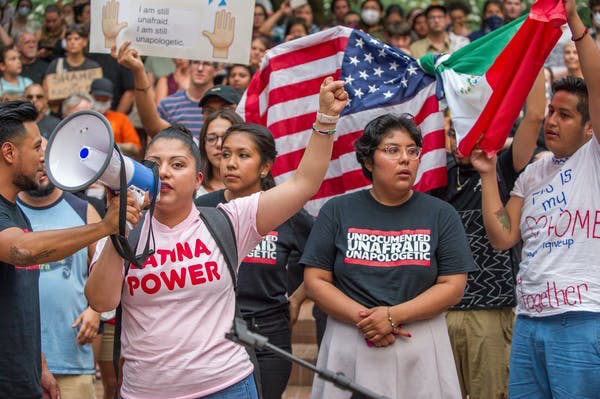
At a 2017 rally, one activist wears a T-shirt reading ‘Undocumented and Unafraid.’ Diego G Diaz/Shutterstock.com

The specific language of “coming out,”which is so closely associated with LGBTQ rights, allows other social movements to liken their experience to that of LGBTQ people.

For instance, when fat liberation activist Marilyn Wann speaks about how she “came out” as fat, she is not just speaking about a turning point in her personal biography. By using the term “coming out,” she implies that being fat is like being gay—and that, just as homophobia is morally wrong, so too is “fatphobia.” In this context, coming out as fat means owning one’s fatness and refusing to apologize for it.

As my book shows, the multiple meanings of coming out—including coming into community, cultivating self-love, and collectively organizing to promote equality and justice—offer a productive way for social movements to move forward.

This MFP Voices essay does not necessarily represent the views of the Mississippi Free Press, its staff or board members. To submit an essay for the MFP Voices section, send up to 1,200 words and factcheck information to azia@mississippifreepress.com. We welcome a wide variety of viewpoints.

Dolly Parton on the Rumor That She Had an Affair With Her Friend Judy Ogle – Showbiz Cheat Sheet

Though Dolly Parton is widely beloved, she’s not immune to rumors. Through the years, the public has suggested that her husband isn’t real, that she’s had multiple affairs, and that she’s in a romantic relationship with her friend Judy Ogle. Here’s what the “Jolene” singer has to say about that last rumor.

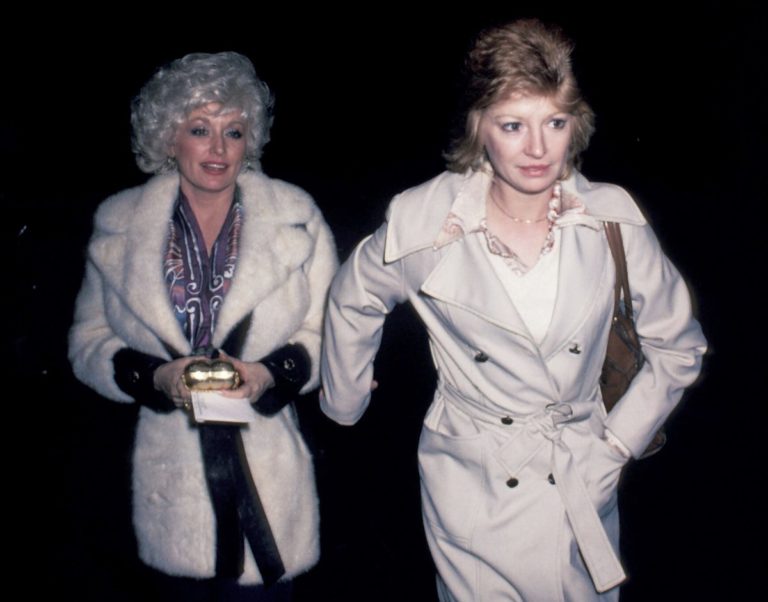
Dolly Parton and Judy Ogle arriving at Nirvana in New York City, NY.

Dolly Parton and Judy Ogle | Ron Galella/Ron Galella Collection via Getty Images

Who is Judy Ogle?

Parton and Ogle have known each other for most of their lives. They’re very close friends. But that’s it.

“Judy and I have been best friends for 64 years, since we were little kids,” said Parton, as reported by Your Tango. “Our ­parents knew each other, we grew up together, we were like ­sisters, became best friends. She was very quiet, I was very outgoing. So we made perfect friends.”

RELATED: Dolly Parton Hopes to ‘Fall Dead’ Doing This — ‘That’s the Way I Go’

The friends have been through a lot together — all of life’s ups and downs.

“We went all through school together,” said Parton. “She went to the army when we graduated because she needed the insurance and she needed to help her family and I was trying to make it. As soon as she got out, she came to Nashville and we’ve been together ever since.”

Dolly Parton on the rumor that she and Judy Ogle are romantically involved

“People say that because you can’t really have a great relationship with a woman. I’m not gay but I have so many gay friends and I accept everybody for who they are,” said Parton. “People love to talk. People love to gossip. They’ve said that about Oprah, but it’s not true.”

Parton added that she’s “never in my life had a relationship with a woman or had a desire to be with a woman.”

The “9 to 5” singer says the rumor doesn’t bother her, but it does embarrass Ogle and her family, which Parton doesn’t like.

“She dates and she has had several boyfriends,” said Parton of her friend. “The fact that they never see my husband, they make it out that we are in a relationship. It doesn’t upset me but it upsets and embarrasses Judy and her family. I say to her which would you prefer — being called an old maid or a lesbian? She says lesbian every time!” 

RELATED: Why Does Dolly Parton Always Wear Gloves?

In an interview Parton did with Pride Source in 2014 she, once again, was asked about the rumor.

“There was some story recently (in the National Enquirer) where I was supposedly marrying my longtime friend Judy (Ogle) and that my husband was OK with it!” said Parton. “I thought, ‘Where did they come up with all this?’ I am not gay, but if I were I would be the first one running out of the closet.”

“And right into Judy’s arms?” asked her interviewer.

“Yeah, who knows!” she said. “I might’ve said, ‘Judy, you wanna get something going with me?’ (Laughs) But our friendship is just a precious friendship.”

Dolly Parton has been a long-time supporter of gay rights

Parton has a large LGBTQ+ following. Here’s why, according to the “Jolene” singer.

“I do believe that I have a lot of gay fans because I think they do accept me as I am – the differences in me – and I think they know that I see that and love that in everybody else,” she said. “I am not a judgmental person. I’m a very loving and accepting person. I try to see the good in everybody and I don’t care who people are as long as they’re themselves, whatever that is. That old saying ‘to thine own self be true’ – no truer words were ever spoken, and I’m just honored and proud to be accepted.”

RELATED: Dolly Parton Reveals the Length and Color of Her Real Hair

When Parton’s interviewer asked her why she first decided to advocate for gay rights as a celebrity, the Queen of Country said:

“Why wouldn’t I stand up for everybody, for all people? In the country field, we’re brought up in spiritual homes, we’re taught to ‘judge not lest you be judged,’ and it’s always been a mystery to me how people jump all over things just to criticize, condemn and judge other people when that is so un-Christian – and they claim to be good Christians! We’re supposed to love one another. We’re supposed to accept and love one another. Whether we do or not, that’s a different story. But that’s what we’re supposed to do.”

Implementation of Public Safety Committee’s recommendations to begin shifting mental health crisis response away from WUPD – Student Life

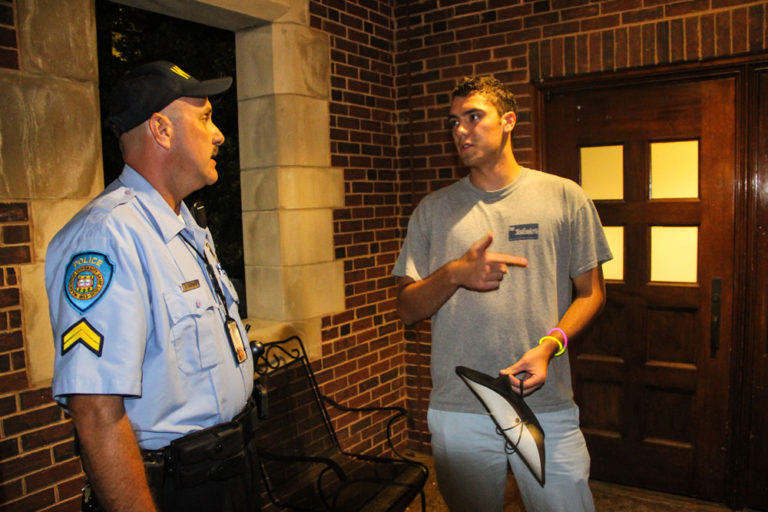
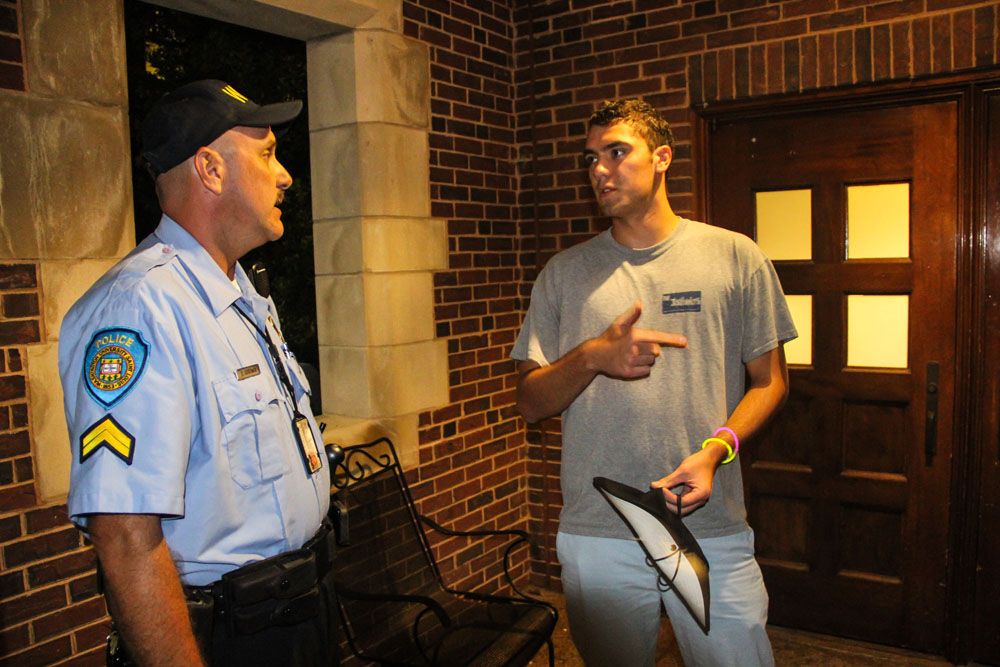
A police officer in a light blue shirt and black cap faces a student wearing a gray shirt. The two figures stand in front of a brick building.

In this 2014 file photo, WUPD officer Dave Goodwin speaks with a student. The University is reducing WUPD’s role in responding to mental health crises starting in the fall semester. (Photo by Stephen Huber | Student Life)

Washington University plans to adopt some of the recommendations the Public Safety Committee made in February, including training for mental health professionals to handle mental health crises instead of Washington University Police Department officers and the establishment of a 24-hour team of on-call mental health professionals.

The changes, which the University announced last month in The Source, will reduce the role WUPD plays in responding to mental health crises starting in the fall semester.

Except in the event of a “safety concern,” WUPD officers will not be dispatched to a call deemed a mental health emergency, Executive Vice Chancellor for Civic Affairs and Strategic Planning Hank Webber said, though it remains unclear what constitutes a “safety concern.”

“We are working to determine this,” Webber wrote in a follow-up email to Student Life. “It is an issue facing all police forces across the country that are moving toward having mental health professionals respond to calls.”

The mental health professionals will be housed in an independent, community mental health agency, Webber said, with most of the funding for the changes going to that entity.

This funding strategy is different from the Committee’s recommendation, which asked for funds to be earmarked for WUPD for specific mental health services, a recommendation that left some students unsatisfied. Webber noted that some of these changes are simple reallocations of funds while others will cause an increase in the overall University budget.

“Some of the recommendations are fairly inexpensive and will come from reallocations within the Police Department,” Webber said. “The increased mental health coverage will be an increase in the University budget. That is not something that can be covered by a reallocation.”

Though the University plans for these changes to reduce contact between WUPD and students during mental health emergencies, administrators are also working to bolster trust between community members and WUPD. Campus engagements during orientation for incoming students in the fall will allow for greater “informal contact” between students and WUPD officers, Webber said.

“Some of the crisis around the country in police community relations is about a lack of trust,” Webber said. “We believe that we have a very good police department. We also believe that there’s always work to be done in building trust, and we think trust comes out of interaction, and it often comes out of interaction that is not at a moment of crisis.”

In addition to the orientation engagements planned, Webber acknowledged that targeted trust building is needed for specific communities on campus. The survey indicated that of students identifying as African American, Latino/Hispanic, Asian and two or more races, 50%, 55%, 60% and 43%, respectively, said they were comfortable with their interactions with WUPD while 68% of white students said they were comfortable or very comfortable with their WUPD interactions.

“I think we need to recognize that confidence in police and police relations in America everywhere are influenced by race in a significant way,” Webber said.

Webber also called the LGBTQ community members’ trust in the police the “most distressing” part of the survey. Seventy-six percent of students identifying as heterosexual said they were comfortable in interactions with WUPD, while 21% and 44% of bisexual and gay/lesbian students, respectively, reported comfort with those interactions.

I think we have a lot of work to do,” Webber said. “I think we have some work to do in the police force to be more sensitive to this community… but I also think this is a broader issue that the University needs to work on.” 

To ensure that students that are most uncomfortable with police presence are involved in this process, Webber said the University will coordinate targeted outreach toward specific student groups and their leadership. Additionally, the University will form a standing committee to continue the work of the Public Safety Committee. While the standing committee will be representative of the University community, Webber said, there likely will be a “greater representation” of the groups where relations are more strained.

Junior Tennyson Holmes, a member of the Public Safety Committee, said he thinks the changes are a step in the right direction because WUPD should not be asked to handle mental health situations, given their training and expertise.

“I think if you talked to WUPD officers themselves, while they always want to be protectors of our community, they also didn’t sign up to be mental health professionals and counselors; like that’s not their job, the job is to investigate,” Holmes said.

Moreover, Holmes noted that narrowing the scope of WUPD’s role on campus will also encourage reluctant students to report crises. Together with the on-call mental health professionals, the community will greatly benefit, he said.

“It’s really difficult to want to report a mental health crisis… when your first responder might be an officer who you might not feel comfortable with and who might not be trained to handle whatever situation you’re in. So the community is getting a huge benefit; the fact that there’s going to be mental health professionals on call 24/7 for when crises do occur,” Holmes said.

Junior Emily Angstreich, incoming co-director of Uncle Joe’s Peer Counseling and Resource Center, echoed Holmes’ hope that more students will be inclined to call given the changes recommended by the Committee.

“I think students will be more willing to potentially respond to calls or make those calls if they’re feeling unsafe or a friend might be more comfortable calling for another person,” Angstreich said. “So that’s the more positive change that I am envisioning.”

Holmes noted that community awareness of these changes is important so all students feel comfortable asking for help when it is needed. It will increase the number of people using the service, thus more people will benefit from these changes, Holmes said.

As part of the implementation of these changes, the WUPD dispatch team will also receive additional training. Both Angstreich and Holmes said more training is not a permanent solution to address the problems in responding to mental health crises.

“It’s great that WUPD will have more training,” Angstreich said. “However, something that I’ve seen a lot in my research on this topic is that, while training is certainly not harmful—it’s definitely more helpful—it does not replace the abilities of someone who’s really been trained in this.”

Holmes agreed. “Mental health crises don’t fall under the scope of police work, no matter how much training they get,” he said. “That was a problem too… for so long we’ve always thought if we could just give them more training, more training then the problem would solve itself over time. But the issue is… it’s never going to substitute for a degree in social work or a degree in counseling.”


Other Student Life stories about mental health on campus:

‘During times of adversity we become like social magnets’: How the pandemic has affected WU extroverts and introverts differently

‘People are just being left in the cracks’: Activists organize mental health advocacy initiative to push for better resources

NYT panned for Mara Gay defense following her ‘disturbing’ American flags remark: ‘Every word here is a lie’ – Fox News

The New York Times issued a statement defending its editorial board member Mara Gay after she went on television and expressed the “disturbing” sight of American flags she witnessed during a visit to Long Island in New York. 

On Tuesday morning, the MSNBC analyst appeared on “Morning Joe” and spoke about how “Americanness” and “Whiteness” need to be separated. 

NYT, MSNBC’S MARA GAY: ‘DISTURBING’ TO SEE ‘DOZENS OF AMERICAN FLAGS’ ON LONG ISLAND 

“I was on Long Island this weekend visiting a really dear friend, and I was really disturbed,” Gay said. “I saw, you know, dozens and dozens of pickup trucks with explicatives [sic] against Joe Biden on the back of them, Trump flags, and in some cases just dozens of American flags, which is also just disturbing … Essentially the message was clear. ‘This is my country. This is not your country. I own this.’” 

Gay received swift backlash on social media for her condemnation of the all the American flags she saw, but according to a statement released by her employer, her critics are off-base. 

NEW YORK TIMES’ MARA GAY ROASTED FOR CLAIMING DAVE RUBIN’S SHOW ‘REGULARLY HOSTS WHITE SUPREMACISTS’

“New York Times editorial board member Mara Gay’s comments on MSNBC have been irresponsibly taken out of context,” NYTimes Communications tweeted Tuesday evening. “Her argument was that Trump and many of his supporters have politicized the American flag.”

The statement added, “The attacks on her today are ill-informed and grounded in bad-faith.”

The Times’ tweet was also panned by critics. 

“Lmao they’re just gonna pretend we didn’t all see the video where she said the American flags she saw were ‘disturbing,’” The Daily Caller’s Greg Price reacted. 

“I mean people just quoted her verbatim and also posted the entire video of her comments?” journalist Zaid Jilani similarly tweeted.

CLICK HERE TO GET THE FOX NEWS APP 

“Interesting, considering that’s not what she said,” Washington Examiner commentator Becket Adams shot back.

“Every word here is a lie,” The Federalist co-founder Sean Davis slammed the tweet.

“Dear God….the @nytimes justifies mocking the American flag because Donald Trump likes the American flag. It’s propaganda for the ruling party. We see it,” former DNI Ric Grenell wrote. 

The Times did not immediately respond to Fox News’ request for comment. 

This isn’t the first time Gay went viral for unflattering reasons. In March 2020, she and MSNBC anchor Brian Williams botched the math of the money Mike Bloomberg spent on his failed presidential campaign, suggesting that the $500 million he put towards political ads could have been given every person in the U.S. population $1 million.

It was actually $1.53 per person. 

Happy World Oceans Day, From San Franciso | The Bold Italic – thebolditalic

Like the temperatures on land, our tides are also rising

San Francisco’s a city defined by its proximity to the Pacific ocean, a massive expanse of saline water we continuously take for granted.

Humans are profoundly naive; we’ve become increasingly detached from the natural world. And away from the reality of what our ecosystems can carry — from the resources we use, the pollutants we release; the oceans we contaminate.

Like the climate, our oceans, too, are warming at an alarming rate.

Earth’s oceans are hotter than ever before, causing a loss of marine biodiversity we can’t truly comprehend. (The glossy PSAs about coral bleaching are striking and sobering, but how a warming planet is affecting the open and deep oceans is still only briefly understood.) What we do know for certain, however, is that life on the land is tied to whatever happens in the oceans.

Warming seas have threatened the very livelihoods of coastal communities that rely on fish supplies to feed themselves. With dystopian algae blooms becoming more common in our oceans, drinking water supplies are more at-risk of harboring deadly pathogens. Jellyfish are, quite literally, taking over the seas. Man-sized squids continue to expand their ranges. Islands of single-use plastics mound as sea levels rise.

The Bay Area, itself, could sit below sea level before even the turn of the half-century.

On World Oceans Day 2021, let’s both celebrate the coastal waters we so fondly cherish, while also expanding our practical consciousness on what it means to protect them.

(I.e. do your absolute best to thwart your water unnecessary consumption — so stop synonymizing cleaning yourself with a bubble bath. Take a three-, five-minute shower. Stop flushing urine every time your toilet water fills with a yellow murk; flush every other time or every third time. Better yet: pee in the sink. Or even go as far as to embrace composting toilets. Ditch plastic straws, entirely.)

Happy World Oceans Day, humans. Here’s to us trying to be less shitty to the bodies of water that make up 70% of the earth’s surface.

Manitoba gay couple lose fight to have 1974 marriage validated – CBC.ca

A gay Winnipeg couple have lost their fight to have their marriage of nearly five decades registered by the province of Manitoba.

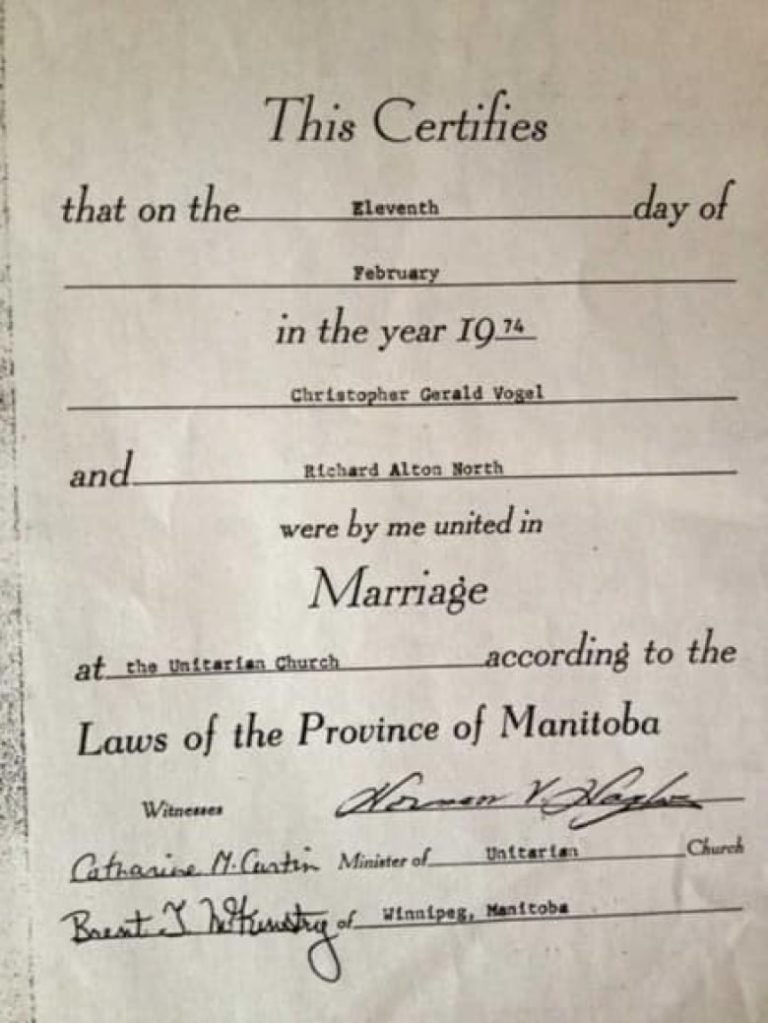
Chris Vogel and Richard North got married in 1974, becoming the first gay couple to get married in a Canadian church.

When they tried to register the marriage with what is now the Manitoba Vital Statistics Agency, they were denied based on the fact they were both men.

The pair fought the decision in court, but the judge at the time declared declared Vogel and North’s ceremony a “nullity.”

In 2018, a human rights adjudicator ruled he was bound by the 1974 ruling, which found there was nothing to be registered because there had been no marriage.

The Manitoba Human Rights Commission and North sought a judicial review of that decision in April, but their application was dismissed on June 1.

Manitoba Court of Queen’s Bench Justice ​Gerald Chartier wrote in his ruling that the previous decision, which stated that the province didn’t discriminate against North — who filed the application for review — was a reasonable decision.

The marriage certificate that was issued to Richard North and Chris Vogel in 1974. Their marriage is still not considered valid in the province. (Ryan Hicks/CBC)

“He was treated identically to all other persons whose ceremony of marriage was determined to be a nullity. He was treated identically to all other persons whose marriage had been the subject of a court decision specifically directing the province not to register,” Chartier wrote.

“Abiding by the rule of law does not amount to discrimination.” 

Same-sex marriage wasn’t legalized in Manitoba until 2004.

The latest decision doesn’t sit well with Karen Sharma, the executive director of the Manitoba Human Rights Commission, who calls the decision “a disappointing way to to start the month of Pride.”

She says the couple continues to fail to have their marriage validated.

“For us that feels like a clear issue of discrimination because that failure to recognize their marriage was on the basis of discriminatory laws from the 1970s,” Sharma said. 

“We feel like this this is an injustice and we’re disappointed that we weren’t successful at this stage in having it recognized.”

Justice Chartier took issue with North’s push to validate his marriage based on the fact that he and Vogel would be allowed to marry today, or to have the Charter of Rights and Freedoms applied retroactively.

“What Mr. North is seeking is to redress an old event which took place before the Charter created the right sought to be vindicated,” Chartier wrote.

CBC News has reached out to Vogel and North for comment but didn’t immediately receive a response.

Sharma says the human rights commission is mulling its options for further legal action.

Florida State softball alumni near and far showing their support – WTXL ABC 27

TALLAHASSEE, Fla. (WTXL) — Proud may not be the right word to fully describe the feelings Florida State softball alumni near and far feel about this team’s incredible run to the national championship series.

“As an alumni, a former player and current coach proud doesn’t even describe it. The amount of feelings we have for these girls is awesome,” says former FSU softball player and Lincoln High School head softball coach Terese Waltman.

The nostalgia of their time dawning the Garnet and Gold has begun to resurface as the memories they made on the softball field flood their minds ahead of Tuesday night’s big game.

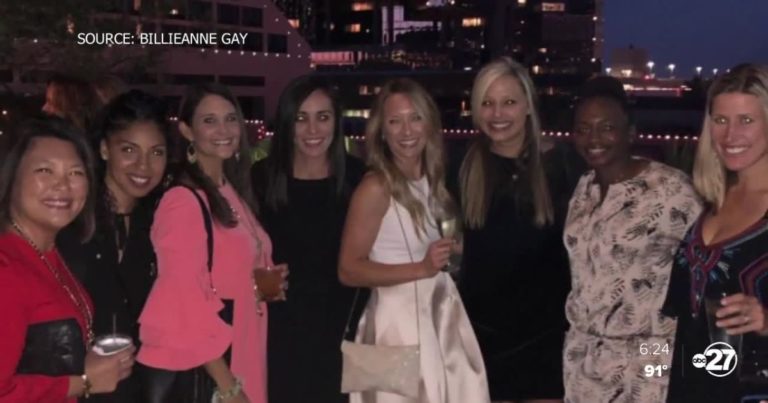
“Alumni like myself from a different era, we still feel like we’re apart of something big. It’s been a long while since 2004. But we’ve got a little text thread of that team and we’re all just so proud,” adds former FSU catcher BillieAnne Gay. “It feels like we’re there again.”

Five of the current Seminoles on this 2021 roster helped FSU take home the 2018 national title. But with so many newcomers to the national spotlight a few words of advice were shared on how to get the most out of this experience. And how to control the pregame jitters.

JESSICA GILMORE WELLS/FSU SOFTBALL PLAYER 2007-2009: “Get as much information from the girls living it now because they’re already in that situation and feeling the excitement and the atmosphere and everything,” said former player Jessica Gilmore and older sister of current they can use that next year.”

GAY: “They’ve got the whole country behind them and we’re excited for them. They just need to keep running after that win and not fear anything. And I think they’ll be just fine.

WALTMAN: “This is the time to trust in yourselves and your ability and don’t try to do too much. Focus on what you can control out there and do your best and give it 110%. Leave everything on the field and don’t leave with any regrets.”

TNT Health Club, a former gay bathhouse in Detroit, to go up for auction – Health Bollyinside – BollyInside

More: View Detroit properties at risk of tax foreclosure in this year’s Wayne County auction More: Here are 10 places to pick strawberries

TNT Health Club shut down in summer 2018 and was open longer than another gay bathhouse in the city. Some of the amenities offered at TNT while it was still in business were that of a heated swimming pool, a whirlpool, a steam room, Finnish sauna, weight room, and movie lounges.

Source Gay bathhouses were created out of a need for exclusively gay spaces, especially somewhere hidden from outside scrutiny and bigotry. After the AIDS crisis in the 80s, TNT was apparently the last one standing out of all the other establishments in the area. 

News Highlights Health

  • TNT Health Club, a former gay bathhouse in Detroit, to go up for auction
  • Check all news and articles from the Health news information updates.

Disclaimer: If you need to update/edit/remove this news or article then please contact our support team.

Let’s learn from COVID to prevent the next pandemic – GZERO Media

Days before G7 leaders meet in the UK to talk about how to “build back better” after the pandemic, experts are warning them that they should not lose sight of the opportunity to learn from the experience of COVID to be more prepared when the next public crisis hits. Below are a few insights from a livestream discussion between political leaders, policy makers, health experts and scientists, entitled Beyond the Pandemic: A Radical New Approach to Health Security, hosted by GZERO Media in partnership with Flagship Pioneering.


It’s time to not just move on, but rather think carefully about pre-empting future pandemics by bolstering health security, said Noubar Afeyan, co-founder of Modern and CEO of the Flagship Pioneering venture capital firm. That would be the best way, he explained, to do justice to the global calls for “never again.” For Ian Bremmer, president of Eurasia Group and GZERO Media, the window of opportunity to rally the global cooperation that was virtually absent during the worst of the pandemic is closing fast.

Science journalist Laurie Garrett blasted global leadership, especially in countries like Brazil and India, for making the pandemic worse with their politicized responses, and for underplaying the importance of preventive public health. Many governments, she pointed out, obliterated their own public health capacity by putting politics first, for instance in the US by demonizing experts such as Dr. Anthony Fauci and weaponizing the probe into the origins of COVID to blame China.

Prime Minister Kyriakos Mitsotakis offered the lessons Greece has learned from dealing with a massive public health crisis barely after recovering from an economic depression. Mitsotakis also came out in support of the EU’s decision to procure vaccines as a bloc over “solidarity,” and anticipated that very soon people who still don’t want to get vaccinated will realize their lives will become much easier when they agree to get the jab.

For his part, Pfizer CEO Albert Bourla defended his company’s opposition to waiving vaccine patents because the doses are for all — rich or poor, east or west — and that the only reason they can’t produce more is because not enough raw materials are now available. Pfizer, he added, is looking into expanding mRNA technology to develop better flu vaccines, those that can boost the immune system to fight non-communicable diseases like cancer, and illnesses that stem from genetic mutations.

Other key moments of the program:

  • Former US Homeland Security chief Jeh Johnson on a possible COVID commission in the US Congress
  • Partners in Health founder Paul Farmer on why only former colonial powers are against lifting vaccine patents,
  • Dame Sally Davies, England’s former chief medical officer, on why we need to think differently about pandemic data
  • Partnership for a Healthier America CEO Nancy Roman on the importance of nutrition in preventing unnecessary deaths in any public health crisis
  • Lord Ara Darzi (Flagship Pioneering) on why governments need to take public health threats as seriously as national security
  • Lovisa Afzelius (Flagship Pioneering) on why we should care about the Global Pathogen Shield.

The second part of the series, Stronger Partnerships for a Healthier World: Mutually Assured Protection, is scheduled for Wednesday, June 9 at 11 am EDT. Register to watch at www.gzeromedia.com/healthsecurity

This live event series is produced by GZERO Media in partnership with Flagship Pioneering. We thank our event partners, Partnership for a Healthier America and Medtronic.

Pastor Claims Hate Crime Laws Made to Reduce Retaliation Against Gays Trying to Seduce Straight People – Newsweek

Pastor and radio host E.W. Jackson says that hate crime laws are made to allow gay people to be able to seduce straight people without retaliation, according to a video shared by Right Wing Watch on Twitter Tuesday.

In the video shared Tuesday from his talk show The Awakening, the pastor said that he believes hate crimes were created so that homosexuals can be protected from straight peoples’ retaliation.

Right-wing radio host and pastor E.W. Jackson says that hates crimes laws are designed to allow gay people “to try to seduce people without [straight people] being able to retaliate.” pic.twitter.com/RCJDuCXiLC

— Right Wing Watch (@RightWingWatch) June 8, 2021

“Say, for example, some homosexual approaches a man who is heterosexual, touches him the wrong way, does something the wrong way, and the man pushes him or maybe punches him, or just responds in an angry way without thinking—that then becomes a hate crime, and I think that’s what a lot of this stuff is intended to protect against,” he said.

The conservative pastor said that hate crime laws allow homosexuals to have more “freedom and latitude” to approach people “and seduce people without them being able to retaliate.”

He clarified that he does not believe hate crime laws are intended solely for that purpose, but that hate crime laws are created based on prior incidents, such as the one he described.

The responses on Twitter were mostly filled with opposition. “Been my experience that gays do take ‘no’ for an answer,” replied one Twitter user.

Another comment mentioned the death of Matthew Shepard, a University of Wyoming student who was found dead after being beaten and left to die. The user said that Jackson’s claims were justifying “violent sociopaths who murdered Matthew Shepard,” whose death had sparked the creation of the Hate Crimes Prevention Act, signed into effect by former President Barack Obama in 2009.

This is not the first time Bishop Jackson has gathered attention for his beliefs. In 2019,he spoke outwardly against homosexuality, saying that the use of the rainbow symbol was blasphemy.

“The rainbow was given to us by God as a sign that he would not destroy the earth by water again, and you’re going to appropriate that as pride in homosexuality? Are you kidding me? Talk about blasphemy. Talk about arrogance. Talk about boldness. Talk about shaking your fist in God’s face.”

In April, he claimed that the Black Lives Matter movement was worse than COVID-19, saying that the long-term effects of the movement in the U.S. were going to be worse than the pandemic.

“COVID is a medical problem and a disease problem that is going to run its course,” Jackson said. “I think Black Lives Matter could so infect the culture of our country, so divide us racially that it could take a generation to undo the damage they are doing.”

Bishop Jackson is also the founder of S.T.A.N.D Foundation, a right-wing nonprofit organization intended to educate and unite under conservative beliefs.

Newsweek reached out to Bishop Jackson for additional comment.

New York City Celebrates Pride Month
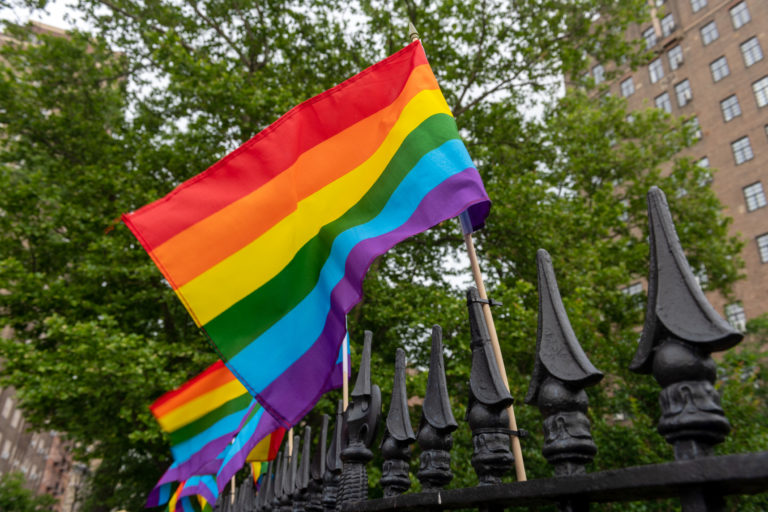
Pride flags are displayed at Christopher Park near the Stonewall Inn in the West Village on June 03, 2021 in New York City. Bishop and talk show host E.W. Jackson said recently that hate crime laws were intended to protect homosexuals so that they can try to seduce straight people without retaliation.